
About the Author
Image credit: Press in 2010
Works by Eyal Press
Beautiful Souls: Saying No, Breaking Ranks, and Heeding the Voice of Conscience in Dark Times (2012) 194 copies, 4 reviews
Dirty Work: Essential Jobs and the Hidden Toll of Inequality in America (2021) 188 copies, 6 reviews
Absolute Convictions: My Father, a City, and the Conflict That Divided America (2006) 71 copies, 4 reviews
Associated Works
Tagged
Common Knowledge
- Birthdate
- 1970-09-09
- Gender
- male
- Nationality
- Israel (birth)
- Birthplace
- Jerusalem, Israel
- Associated Place (for map)
- Jerusalem, Israel
Members
Reviews
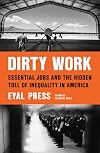
Really good, horrifying book about the way that we make low-paid workers responsible for doing the worst things in our society, then blame them for having done those things within structures that make their bad behavior almost inevitable. This “dirty work” requires the tacit consent of “good people,” maybe even more in a democracy than in an autocracy. After all, how are we going to deal with all the mentally ill people we have decided not to care for outside of prison, or fight the show more wars we’ve decided to fight without lots of troops on the ground? Covers prison health care, military drone operators, slaughterhouse workers, and other jobs that most people don’t aspire to or pretend are noble (not, for example, police officers and teachers, who are also given individualized blame for structural failings including the structural failings that socialize them into behaving badly, but are also lionized in the abstract). For example: “Nobody told Curtis and his fellow guards to get brutal. But no one really needed to tell them this. It was enough to pay them modest salaries to enforce order in overcrowded, understaffed prisons that were neither equipped nor expected to do much else.”
These jobs tend to evoke disgust and shame, affecting both how others see the workers and often how the workers see themselves—Press discusses the idea of “moral injury,” especially in the context of drone operators. Although you might think they’d treat death like a video game, many of them instead react negatively—and they end up seeing more death and destruction than most Special Forces on the ground. Moral injury is a useful concept, Press argues, because PTSD, while also descriptive, can depoliticize and individualize what is a problem of what the system asked the individual to do. Meanwhile, drone operators aren’t seen as “real” soldiers, a status deriving “from the very thing that made drone warfare appealing to politicians and the public”—it saved money and lives on our side.
Press emphasizes that many of the workers he talks to are not the primary victims of the systems they work in—prisoners, foreigners subject to drone strikes, and maybe animals are--but they are also suffering as they cause suffering, and we should not let individualized blame obscure that they are doing what we as a society want them to do. This is particularly true because these are jobs disproportionately filled by poor people without other opportunities and people of color, walled off from others by geography, fences, and other barriers so we don’t have to think about them. Hedge fund guys, disproportionately white, don’t face the same stigma even as they do lots of damage, and they are rewarded with money and prestige for doing so. So, when the BP oil rig exploded, even the workers’ families understood that images of oil-covered birds would generate more public outrage than pictures of the loved ones they’d lost. But when these workers try to challenge unsafe conditions, they find they’re easily replaced, unlike high-tech workers whose protests are often heeded. (Interesting contrast to Tyler Schultz’s narrative of whistleblowing about Theranos—he definitely suffered, but his suffering had a point, which most of these workers can’t say.) “What do we owe these workers? At a minimum, it seems to me, we owe them the willingness to see them as our agents, doing work that is not disconnected from our own daily lives, and to listen to their stories, however unsettling what they tell us may be.” (Of course, this framing accepts that they aren’t likely to be reading the same books as “we” are.)
You should read it; it’s mostly about the US though there are a few fascinating comparisons, such as to research on the prison system in France, which also found that guards were ashamed of what they did for a living. In Norway, where the prison system is much more rehabilitative, the staff seemed much prouder (though he doesn’t have the same depth of ethnographic data). show less
These jobs tend to evoke disgust and shame, affecting both how others see the workers and often how the workers see themselves—Press discusses the idea of “moral injury,” especially in the context of drone operators. Although you might think they’d treat death like a video game, many of them instead react negatively—and they end up seeing more death and destruction than most Special Forces on the ground. Moral injury is a useful concept, Press argues, because PTSD, while also descriptive, can depoliticize and individualize what is a problem of what the system asked the individual to do. Meanwhile, drone operators aren’t seen as “real” soldiers, a status deriving “from the very thing that made drone warfare appealing to politicians and the public”—it saved money and lives on our side.
Press emphasizes that many of the workers he talks to are not the primary victims of the systems they work in—prisoners, foreigners subject to drone strikes, and maybe animals are--but they are also suffering as they cause suffering, and we should not let individualized blame obscure that they are doing what we as a society want them to do. This is particularly true because these are jobs disproportionately filled by poor people without other opportunities and people of color, walled off from others by geography, fences, and other barriers so we don’t have to think about them. Hedge fund guys, disproportionately white, don’t face the same stigma even as they do lots of damage, and they are rewarded with money and prestige for doing so. So, when the BP oil rig exploded, even the workers’ families understood that images of oil-covered birds would generate more public outrage than pictures of the loved ones they’d lost. But when these workers try to challenge unsafe conditions, they find they’re easily replaced, unlike high-tech workers whose protests are often heeded. (Interesting contrast to Tyler Schultz’s narrative of whistleblowing about Theranos—he definitely suffered, but his suffering had a point, which most of these workers can’t say.) “What do we owe these workers? At a minimum, it seems to me, we owe them the willingness to see them as our agents, doing work that is not disconnected from our own daily lives, and to listen to their stories, however unsettling what they tell us may be.” (Of course, this framing accepts that they aren’t likely to be reading the same books as “we” are.)
You should read it; it’s mostly about the US though there are a few fascinating comparisons, such as to research on the prison system in France, which also found that guards were ashamed of what they did for a living. In Norway, where the prison system is much more rehabilitative, the staff seemed much prouder (though he doesn’t have the same depth of ethnographic data). show less
Beautiful Souls: Saying No, Breaking Ranks, and Heeding the Voice of Conscience in Dark Times by Eyal Press
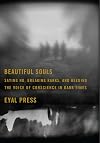
There are a fair number of books about bad people, numerous biographies about Hitler and their ilk and how it is they became the embodiment of evil. But Eyal Press was interested in a more overlooked subject, why some people resist the worst inclinations of their neighbors, sometimes their entire societies, and act on the side of goodness, even at extreme cost to themselves. His short book consists of a prologue, four chapters, and an epilogue. Each chapter is a unique case history focusing show more on a different person, context, and period. These are, respectively, Paul Gruninger, a commander of the State Police who allowed Jews to enter Switzerland as refugees at a time when his country's official policy was to turn them away, Aleksander Jevtic, a Serb who protected Croats during their bitter war and ethnic conflicts, Avner Wishnitzer, an Israeli soldier who comes to sympathize with Palestinians, and Leyla Wydler, the whistle-blower on Standford Securities. Eyal examines each case closely and sheds light on what forces, both internal and external, might have led each individual to act the way they did. In light of our partisan, hate-filled times, it is soothing and sobering to read about these beautiful souls. show less
Beautiful Souls: Saying No, Breaking Ranks, and Heeding the Voice of Conscience in Dark Times by Eyal Press
This is a wonderful book, a must read for anyone interested in how and why individuals in society decide to resist that which they believe to be wrong or evil. Philosophical but accessible, with examples from history as well as the present day, Press forces us to ask ourselves how "we avoid making uncomfortable choices in the course of our daily lives" by pinning responsibility for those choices to forces we decide we cannot fight.
I listened to the audio edition of this book, and I found the reader to be absolutely painful to listen to. His reading was slow, monotonous, and rife with baffling pronunciations (e.g., typically in English, the stress is on the first syllable in “slaughterhouses,” not the final syllable). I found it to be a bit more listenable at a speed of 1.2x.
However, this is not a complaint about the work as a whole, which was fascinating, engaging, and thoroughly researched. It was worth show more contending with the poor reading. show less
However, this is not a complaint about the work as a whole, which was fascinating, engaging, and thoroughly researched. It was worth show more contending with the poor reading. show less
Awards


You May Also Like


Associated Authors
Statistics
- Works
- 6
- Also by
- 1
- Members
- 468
- Popularity
- #52,558
- Rating
- 3.8
- Reviews
- 14
- ISBNs
- 27
- Languages
- 2