

Kamala Markandaya (1924–2004)
Author of Nectar in a Sieve
About the Author
Disambiguation Notice:
a.k.a. Kamala Purnaiya Taylor
Series
Works by Kamala Markandaya
Fortielsens spinn : roman 1 copy
Á ódáinsakri 1 copy
Kirjuri ja h©Þnen vaimonsa 1 copy
Writing in modern India — Author — 1 copy
Tagged
Common Knowledge
- Canonical name
- Markandaya, Kamala
- Legal name
- Taylor, Kamala (married)
Purnaiya, Kamala (born) - Birthdate
- 1924
- Date of death
- 2004-05-16
- Gender
- female
- Education
- University of Madras
- Occupations
- novelist
- Nationality
- India
- Birthplace
- Mysore, India
- Places of residence
- Mysore, India
London, England, UK - Disambiguation notice
- a.k.a. Kamala Purnaiya Taylor
- Associated Place (for map)
- India
Members
Reviews
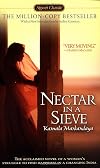
I am pretty sure that when Kamala Markandaya sat down to write this book, the tale of an Indian peasant woman right around the time of decolonization, that she wrote a list called Terrible Things That Can Happen to an Indian Peasant Woman. Then she turned that list into an outline. The first two-thirds of this novel are pretty unrelenting in terms of the bad things that happen: famine, accusations of infidelity, famine, workers being laid off, famine, infants dying, famine, sons being show more worthless, more famine. At times it became annoying, but the character of Rukmani holds the book together, as a simple, believable figure doing what needs to be done to get by and never complaining. The book really picked up, however, in Part II, when Rukmani and her husband have to travel into the city, and they end up completely out of their element. It's devastatingly sad, but it's also gripping, probably because I, too, fear the city. I think also this works because in Part I, a part of you thinks that they don't have to be doing what they're doing and if they go somewhere else things would be better... but Part II shows you that's untrue, as the only way things can go is to get worse. show less
Set in some village in India, Kamala Markandaya's Nectar in a Sieve is a gripping story of one indefatigable woman's survival of a checkered life, one that had no margin for misfortune. Neither does the book have surprises nor twist, but readers will find a determined, unrelinquished fighter in a woman who bears an unfailing faith and rams through impregnable clamor that invades her life.
Rukmani married Nathan, a tenant farmer whom she had never met, as a child bride. Even though Rukmani was show more ignorant of the simplest of tasks, Nathan never uttered a single cross word and gave an impatient look. He looked at her as if nobody had discovered her beauty. He never asserted his rights to forbid her reading and writing, a talent that placed Rukmani above her illiterate husband.
Misfortune seemed to have a tight foothold in Rukmani and Nathan. The monsoon inundated the rice paddies where Rukmani worked side by side with Nathan to wrest a living for a household of eight. No sooner had the monsoon tapered off than a drought ravaged the harvest. Hope and fear acted like twin forces that tugged at them in one direction and another.
Poverty-stricken Rukmani saw her daughter Ira become a prostitute, her 4-year-old son Kuti died from hunger, her teenage son Raja caught stealing and beaten to death, her oldest sons Thambi and Arjun set off to Ceylon to work in a tea plantation. The opening of a tannery, of which Rukmani was only skeptical, had spread like weeds and strangled whatever life grew in its way, changed the village beyond recognition.
And yet, Rukmani survived. The interminable poverty and impregnable fate of Rukmani and Nathan must evoke in readers' pity and sympathy. But at the same time, Rukmani, whom Nathan always appeased, might seem somewhat self-piteous, cynical, and complaisant (like Dr. Kennington said, she needed to cry out for help). Ira, who exchanged her body for Kuti's milk and food, had lost her reason and given up her sanity rather than faced the truth.
A recurring theme of the book is the significance of land that fostered life, spirits, happiness and family. Rukmani often found solace in the land on which her husband built a home for her with his own hands in the time he was waiting for her. She often reminisced the very home to which Nathan had brought her with pride. The land became her life:
"I looked about me at the land and it was life to my starving spirit. I felt the earth beneath my feet and wept for happiness." (188)
So much was the book about Rukmani. The one character that stood out to me was Selvam, one of her younger son who flinched and quailed at the firecracker and used the money intended for firecracker to buy a confection cane. As wealth lured all his elder brothers away, he stayed behind and took care of his family, shouldered the household responsibilities while assisting in the village hospital.
Nectar in a Sieve is a book that will make you lump in the throat. The writing is painfully eloquent, taut, and cut-to-the-root. The living conditions, life struggles, poverty, fragility and abasement of life depicted are beyond imaginations to those who live in the first world and have never stretch a single meal portion to three meals. Everyday was a life-and-death situation. show less
Rukmani married Nathan, a tenant farmer whom she had never met, as a child bride. Even though Rukmani was show more ignorant of the simplest of tasks, Nathan never uttered a single cross word and gave an impatient look. He looked at her as if nobody had discovered her beauty. He never asserted his rights to forbid her reading and writing, a talent that placed Rukmani above her illiterate husband.
Misfortune seemed to have a tight foothold in Rukmani and Nathan. The monsoon inundated the rice paddies where Rukmani worked side by side with Nathan to wrest a living for a household of eight. No sooner had the monsoon tapered off than a drought ravaged the harvest. Hope and fear acted like twin forces that tugged at them in one direction and another.
Poverty-stricken Rukmani saw her daughter Ira become a prostitute, her 4-year-old son Kuti died from hunger, her teenage son Raja caught stealing and beaten to death, her oldest sons Thambi and Arjun set off to Ceylon to work in a tea plantation. The opening of a tannery, of which Rukmani was only skeptical, had spread like weeds and strangled whatever life grew in its way, changed the village beyond recognition.
And yet, Rukmani survived. The interminable poverty and impregnable fate of Rukmani and Nathan must evoke in readers' pity and sympathy. But at the same time, Rukmani, whom Nathan always appeased, might seem somewhat self-piteous, cynical, and complaisant (like Dr. Kennington said, she needed to cry out for help). Ira, who exchanged her body for Kuti's milk and food, had lost her reason and given up her sanity rather than faced the truth.
A recurring theme of the book is the significance of land that fostered life, spirits, happiness and family. Rukmani often found solace in the land on which her husband built a home for her with his own hands in the time he was waiting for her. She often reminisced the very home to which Nathan had brought her with pride. The land became her life:
"I looked about me at the land and it was life to my starving spirit. I felt the earth beneath my feet and wept for happiness." (188)
So much was the book about Rukmani. The one character that stood out to me was Selvam, one of her younger son who flinched and quailed at the firecracker and used the money intended for firecracker to buy a confection cane. As wealth lured all his elder brothers away, he stayed behind and took care of his family, shouldered the household responsibilities while assisting in the village hospital.
Nectar in a Sieve is a book that will make you lump in the throat. The writing is painfully eloquent, taut, and cut-to-the-root. The living conditions, life struggles, poverty, fragility and abasement of life depicted are beyond imaginations to those who live in the first world and have never stretch a single meal portion to three meals. Everyday was a life-and-death situation. show less

I picked this book up on a whim off of the "staff favorites" display at the library. I've since discovered that this book is required reading for many high schoolers, but somehow I missed this 1954 classic story of tenant rice farmers in rural India until now. This story is narrated by Rukmani, married at age 12 to a gentle and loving husband. Together they raise a daughter and 6 sons, and work the land, facing starvation in years of heavy monsoon rains or drought. A central theme of this show more straightforward, simply written book is the love of the land, and its keenly felt loss when their land is sold to the tannery that has transformed their village to a squalid town. Rukmani, her husband, and their children face hunger, anger, tragedy, betrayal, and upheaval, yet as unrelenting as their struggle is, the book is also hopeful and compelling. show less
Nectar in a Sieve takes place during the period of English colonization of India and is about a woman, Rukmani, and her attempt to make a life on the land with her family while India changes around her. I really liked this book, and there is a lot going on such as the effects that colonization has on those being colonized, the role of women in this society, the role of family in helping us through tough times, and the fact that change can create winners out of some and great losers out of show more others. It leads to the question whether progress is worth the destruction. I found myself becoming more and more sympathetic to the narrator, who is Rukmani, as she is very likable and also poignantly insightful. It reminds me of Achebe and even Rushdie for some obvious reason, but it also reminded me of Steinbeck in that it was about downtrodden underdogs, who you really want to root for, but you know they are doomed for unhappiness in an unfair world. show less
Lists
Awards


You May Also Like


Associated Authors
Statistics
- Works
- 25
- Members
- 1,914
- Popularity
- #13,442
- Rating
- 3.7
- Reviews
- 30
- ISBNs
- 95
- Languages
- 9
- Favorited
- 2