
John A. T. Robinson (1919–1983)
Author of Honest to God
About the Author
John A. T. Robinson was a New Testament scholar who served as Bishop of Woolwich England was well as Dean of Trinity College, University of Cambridge. Among his many writings are Redating the New Testament, Honest to God, and Wrestling with Romans.
Works by John A. T. Robinson
Honest to God, and, The 'Honest to God' debate: Some reactions to the book 'Honest to God' (1963) 34 copies
Questo non posso crederlo 2 copies
Layman's Church 2 copies
A Face Humana de Deus 2 copies
Gott ist anders 2 copies
Sincer envers Déu: Honest to god. 2 copies
La Iglesia en el mundo 1 copy
Associated Works
Tagged
Common Knowledge
- Legal name
- Robinson, John Arthur Thomas
- Birthdate
- 1919-05-16
- Date of death
- 1983-12-05
- Gender
- male
- Education
- University of Cambridge (Jesus and Trinity College)
- Occupations
- New Testament scholar
Anglican priest
Anglican Bishop (of Woolwich) - Organizations
- Church of England (Bishop Suffragan of Woolwich)
Trinity College, Cambridge - Relationships
- Robinson, Edward (brother)
Robinson, Arthur W. (father) - Nationality
- UK
- Birthplace
- Canterbury, Kent, England, UK
- Places of residence
- Canterbury, Kent, England, UK (birth)
- Associated Place (for map)
- Canterbury, Kent, England, UK
Members
Reviews
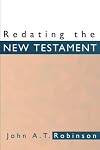
One of the oddest facts about the New Testament is that what on any showing would appear to be the single most datable and climactic event of the period -- the fall of Jerusalem in AD 70, and with it the collapse of institutional Judaism based on the temple -- is never once mentioned as a past fact. It is, of course, predicted; and these predictions are, in some cases at least, assumed to be written (or written up) after the event. But the silence is nevertheless as significant as theshow more
silence for Sherlock Holmes of the dog that did not bark. (13)Thus John A.T. Robinson begins chapter 2, "The Significance of 70", of his Redating the New Testament.
Robinson ends with several points in chapter 11, "Conclusions and Corollaries," of which I highlight just two here. First, "We may start with the fact, which I confess I did not appreciate before beginning the investigation, of how little evidence there is for the dating of any of the New Testament writings...It is surprising to be made to realize that there is only one reasonably secure absolute date (and that within a year or so either way) in the life of St Paul, which in turn can be used to fix the chronology of his writings. And this -- that of the proconsulship of Gallio in Achaia -- relates not to any statement of Paul himself but to a minor incident recorded of him in Acts" (336). Second is a quite long quote from a non-academic source (A.H.N. Green-Armytage, John Who Saw, 1952) that Robinson notes has been used by others before him, a portion of which i quote here:
There is a world -- I do not say a world in which all scholars live but one at any rate into which all of them sometimes stray, and which some of them seem permanently to inhabit -- which is not the world in which I live. In my world, if The Times and The Telegraph both tell one story in somewhat different terms, nobody concludes that one of them must have copied the other, nor that the variations in the story have some esoteric significance. But in that world of which I am speaking this would be taken for granted. There, no story is ever derived from facts but always from somebody else's version of the same story...(356)Robinson continues the long quote, but his point is already made. The story of the birth of the New Testament, which includes dates of composition, has often been conjecture posing as Neutestamentler dogma.
In between, Robinson addresses each book (or group of books) of the New Testament. His work is scholarly, heavily footnoted (major plus for the editors and publishers! See my footnote/endnote rant elsewhere), and draws upon a broad understanding not just of the exegetical tradition but also the historical context. Robinson has been criticized as heretical in some circles -- even as an "atheist" (Geisler and Turek, I Don't Have Enough Faith To Be An Atheist: "But it's not just conservative scholars who believe these early dates. Even some radical critics, such as atheist John A. T. Robinson, admit the New Testament documents were written early. Known for his role in launching the "Death of God" movement, Robinson wrote a revolutionary book titled Redating the New Testament, in which he posited that most New Testament books, including all four Gospels, were written sometime between A.D. 40 and 65" (243). But I digress) -- and despite this accusation, there is no denying his intimate familiarity not just with the New Testament writings themselves, but also the history of its criticism.
I give five stars to Redating; it is required reading for anyone interested in the historical development of the New Testament. show less

A thoughtful critique of the system of dating the New Testament used by the higher criticism school of Biblical studies. Basically higher criticism discounts the prophecy of the fall of Jerusalem and dates all books that reference it as later than 70 C.E. Robinson argues that there is no reason for this late dating, especially by people who accept that Jesus was divine. Even I, as a non-believer, don't think it's such a stretch to think that Jesus or the gospel writers might have predicted show more that the Roman-Jewish detente would fall apart in a generation and end in some kind of disaster.
The fact is that there simply isn't enough information to reliably date the books of the New Testament within the framework of early Christianity. I see no particular reason to accept the myth promulgated by higher criticism over Robinson's. show less
The fact is that there simply isn't enough information to reliably date the books of the New Testament within the framework of early Christianity. I see no particular reason to accept the myth promulgated by higher criticism over Robinson's. show less

Where I got the book: purchased used on Amazon. My copy is the 1963 American edition.
I have no clue whether this book is currently laughed at by theologians or accepted as an interesting step in the development of modern theology, so I'll just forge ahead and give you my impressions.
I spent much of this book thinking that Robinson was throwing the baby out with the bathwater. First, he wants us to consider a non-supernaturalist idea of God: let's stop thinking of God as a Being apart from show more ourselves, "a supreme Person, a self-existent subject of infinite goodness and power, who enters into a relationship with us comparable with that of one human personality with another." Instead, we are to view God as "in the depths" of our existence: "For the word 'God' denotes the ultimate depth of all our being, the creative ground and meaning of all our existence."
Robinson tries very hard to prove that this is not pantheism (i.e. God is in everything, everything is God) but I got the impression that he's walking a very fine tightrope here, theologically speaking. And he talks a lot about love in this chapter, giving me the impression that he was cutting two thousand years of Christian doctrine down to some nebulous form of New Age spirituality.
And then we get to the chapter about Jesus...blimey. Is Robinson actually saying that Jesus isn't God? It certainly looks like it. "Jesus never claims to be God, personally: yet he always claims to bring God, completely." Mmmmmmmmmmmkay but if you knock the claim that Jesus is God out of the Christian religion, there's not much left of it. The Incarnation is one of those litmus test thingies: if you don't believe in it, your claim to be a Christian is a bit empty.
And then JR attacks religion, the Church and prayer; you get the impression that he thinks Christianity would be so, so much better off without them and we wouldn't have to feel guilty about not going to church or not praying. At this point I'm yelling "Dude, you're a Church of England Bishop...if you find religion inconvenient you may be IN THE WRONG JOB." Look, I'm perfectly OK with people telling me they're "spiritual but not religious." But saying that and then saying you're a Christian in the same breath is like watching a giraffe give birth to something that's half antelope, half lizard. There's a point to the "rules," which is that we're really not very good at making any spiritual progress without a bit of structure and community, and Christianity, for all its faults, does supply the undergirding which allows us (ideally) to move in the right direction.
Having thus increasingly annoyed me in chapters 1-5, JR redeemed himself considerably in the last two chapters. He considers the various ethical/moralist/humanist systems that have arisen to replace the supernaturalist view and moral absolutes of traditional Christianity, and posits that "they have taken their stand, quite correctly, against any subordination of the concrete needs of the individual situation to an alien universal norm. But in the process any objective or unconditional standard has disappeared in a morass of relativism and subjectivism." He claims that there is a standard, but it is love as taught and shown by Jesus Christ, and that Christians are called to practice a "casuistry of love" in which we must judge (if judge we must) situations on the basis that "compassion for persons overrides all law." I believe that many Christians nowadays understand this form of casuistry in everyday life; accepting the Bible's teaching on moral absolutes for themselves, they nevertheless support their divorcing friends, love their gay neighbors and are tolerant, even friendly, toward other religions. They are not the ones shouting that God hates fags/Muslims/Harry Potter, and therefore go unnoticed.
And then Robinson wraps up by making some interesting observations about what the church IS and what it should be: For the last thing the Church exists to be is an organization for the religious. Its charter is to be the servant of the world." You'll get no argument from me there, JR. And I liked this: ". . .[for] authentic Christian worldliness. . .the things of this world are 'really interesting in themselves', . . .'their truth is not as it were swallowed up and destroyed by a higher reference'--for instance, by how far they can be turned to the service of the church or used as occasions for evangelism." That's thought-provoking while well within the bounds of orthodoxy, so I'll give it a think.
So, something of a parson's egg of a book--parts of it were quite good. Is it relevant? Is it necessary? Or is it just the ramblings of a disaffected clergyman looking for a feelgood religion more suited to the spirit of the 60s than the CofE in which he has climbed high? I'm rather hoping someone will come across this review and give me the low-down on how this book has survived (or not) in theological circles. show less
I have no clue whether this book is currently laughed at by theologians or accepted as an interesting step in the development of modern theology, so I'll just forge ahead and give you my impressions.
I spent much of this book thinking that Robinson was throwing the baby out with the bathwater. First, he wants us to consider a non-supernaturalist idea of God: let's stop thinking of God as a Being apart from show more ourselves, "a supreme Person, a self-existent subject of infinite goodness and power, who enters into a relationship with us comparable with that of one human personality with another." Instead, we are to view God as "in the depths" of our existence: "For the word 'God' denotes the ultimate depth of all our being, the creative ground and meaning of all our existence."
Robinson tries very hard to prove that this is not pantheism (i.e. God is in everything, everything is God) but I got the impression that he's walking a very fine tightrope here, theologically speaking. And he talks a lot about love in this chapter, giving me the impression that he was cutting two thousand years of Christian doctrine down to some nebulous form of New Age spirituality.
And then we get to the chapter about Jesus...blimey. Is Robinson actually saying that Jesus isn't God? It certainly looks like it. "Jesus never claims to be God, personally: yet he always claims to bring God, completely." Mmmmmmmmmmmkay but if you knock the claim that Jesus is God out of the Christian religion, there's not much left of it. The Incarnation is one of those litmus test thingies: if you don't believe in it, your claim to be a Christian is a bit empty.
And then JR attacks religion, the Church and prayer; you get the impression that he thinks Christianity would be so, so much better off without them and we wouldn't have to feel guilty about not going to church or not praying. At this point I'm yelling "Dude, you're a Church of England Bishop...if you find religion inconvenient you may be IN THE WRONG JOB." Look, I'm perfectly OK with people telling me they're "spiritual but not religious." But saying that and then saying you're a Christian in the same breath is like watching a giraffe give birth to something that's half antelope, half lizard. There's a point to the "rules," which is that we're really not very good at making any spiritual progress without a bit of structure and community, and Christianity, for all its faults, does supply the undergirding which allows us (ideally) to move in the right direction.
Having thus increasingly annoyed me in chapters 1-5, JR redeemed himself considerably in the last two chapters. He considers the various ethical/moralist/humanist systems that have arisen to replace the supernaturalist view and moral absolutes of traditional Christianity, and posits that "they have taken their stand, quite correctly, against any subordination of the concrete needs of the individual situation to an alien universal norm. But in the process any objective or unconditional standard has disappeared in a morass of relativism and subjectivism." He claims that there is a standard, but it is love as taught and shown by Jesus Christ, and that Christians are called to practice a "casuistry of love" in which we must judge (if judge we must) situations on the basis that "compassion for persons overrides all law." I believe that many Christians nowadays understand this form of casuistry in everyday life; accepting the Bible's teaching on moral absolutes for themselves, they nevertheless support their divorcing friends, love their gay neighbors and are tolerant, even friendly, toward other religions. They are not the ones shouting that God hates fags/Muslims/Harry Potter, and therefore go unnoticed.
And then Robinson wraps up by making some interesting observations about what the church IS and what it should be: For the last thing the Church exists to be is an organization for the religious. Its charter is to be the servant of the world." You'll get no argument from me there, JR. And I liked this: ". . .[for] authentic Christian worldliness. . .the things of this world are 'really interesting in themselves', . . .'their truth is not as it were swallowed up and destroyed by a higher reference'--for instance, by how far they can be turned to the service of the church or used as occasions for evangelism." That's thought-provoking while well within the bounds of orthodoxy, so I'll give it a think.
So, something of a parson's egg of a book--parts of it were quite good. Is it relevant? Is it necessary? Or is it just the ramblings of a disaffected clergyman looking for a feelgood religion more suited to the spirit of the 60s than the CofE in which he has climbed high? I'm rather hoping someone will come across this review and give me the low-down on how this book has survived (or not) in theological circles. show less
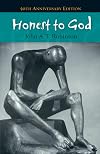
I found this book in a pile of give-away books, and I picked it up because the title looked familiar. Later, I realized that I knew the title because Shelby Spong, in his autobiography, Here I Stand, had raved about the impact of this book on his own faith. Since I like Spong's books so much, I decided to check this out.
I think it's an excellent book. Other reviewers have offered some good summary and depth to his arguments. Speaking much more pointedly to my own preferences, I like that show more Robinson takes seriously the implications of science and 20th century knowledge on our Christian faith. I love that he makes it clear that the focus of religion should be on how we live in relationship with "the least of these." As Robinson writes, "Whether one has 'known' God is tested by one question only, 'How deeply have you loved?'" And he goes on to list ways that the Bible (Matthew 25) defines that love in how we provide the material needs of others (61). So the whole point of deepening our faith becomes tied to deepening our concern for other people (87, 90).
The book leaves me with some good quotes that I can share with others. It is dated, of course, but I would definitely recommend it to people looking for a meaningful articulation of what it means to be Christian. show less
I think it's an excellent book. Other reviewers have offered some good summary and depth to his arguments. Speaking much more pointedly to my own preferences, I like that show more Robinson takes seriously the implications of science and 20th century knowledge on our Christian faith. I love that he makes it clear that the focus of religion should be on how we live in relationship with "the least of these." As Robinson writes, "Whether one has 'known' God is tested by one question only, 'How deeply have you loved?'" And he goes on to list ways that the Bible (Matthew 25) defines that love in how we provide the material needs of others (61). So the whole point of deepening our faith becomes tied to deepening our concern for other people (87, 90).
The book leaves me with some good quotes that I can share with others. It is dated, of course, but I would definitely recommend it to people looking for a meaningful articulation of what it means to be Christian. show less
Lists
You May Also Like


Associated Authors
Statistics
- Works
- 43
- Also by
- 2
- Members
- 2,828
- Popularity
- #9,070
- Rating
- 3.9
- Reviews
- 28
- ISBNs
- 78
- Languages
- 4
- Favorited
- 1