
Matthew Zapruder
Author of Why Poetry
About the Author
Matthew Zapruder is the author of four collections of poetry. His poetry, essays, and translations have appeared in publications including The New Yorker, The Paris Review, Tin House, and The Believer. An associate professor in the Saint Mary's College of California MFA program and English show more department, he is also editor at large at Wave Books and, from 2016 to 2017, was the editor of the poetry page of the New York Times Magazine. He lives in Oakland, California, with his wife and son. show less
Image credit: Author Matthew Zapruder at the 2017 Texas Book Festival. By Larry D. Moore, CC BY-SA 4.0, https://commons.wikimedia.org/w/index.php?curid=63995682
Works by Matthew Zapruder
Associated Works
The Wall in My Head: Words and Images from the Fall of the Iron Curtain (2009) — Contributor — 57 copies, 4 reviews
And We Came Outside and Saw the Stars Again: Writers from Around the World on the COVID-19 Pandemic (2020) — Contributor — 16 copies
Tagged
Common Knowledge
- Canonical name
- Zapruder, Matthew
- Birthdate
- 1967
- Gender
- male
- Education
- Amherst College, Amherst, Massachusetts, USA
University of California, Berkeley
University of Massachusetts, Amherst - Occupations
- poet
editor
translator
professor - Organizations
- Saint Mary’s College, Moraga
Wave Books - Awards and honors
- Guggenheim Fellowship (2011)
- Relationships
- Zapruder, Michael (brother)
- Short biography
- 05.2014:
Matthew Zapruder is the author of four collections of poetry, most recently Sun Bear (Copper Canyon Press, 2014). An assistant professor in the St. Mary’s College of California MFA program and English department, and an editor-at-large at Wave Books, he lives in Oakland, California. - Nationality
- USA
- Birthplace
- Washington, D.C., USA
- Places of residence
- Oakland, California, USA
- Associated Place (for map)
- California, USA
Members
Reviews
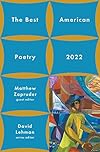
In the late 1960s I came across an anthology of new American poetry on the shelves of my high school library. I had been systemically reading all of the poetry books on the shelf, everything from Catullus to a book of poetry for young adults. I discovered many poets in that volume, so I was excited to get The Best American Poetry 2022, knowing I would discover poets new to me.
I did find some familiar poets, including Gerald Stern, who so recently passed, and who I heard read from Lucky Life show more when a student at Temple University, whose Lest I Forget Thee is included. And poets whose recent books I was lucky to have received from the publisher, including Sharon Olds whose Best Friend Ballad was a favorite in her collection Balladz, and Charles Simic’s In the Lockdown from No Land in Sight.
Many of the poems reflect contemporary life: Covid isolation and fears, racism, the failure of the American Dream, loss, the things which sustain us.
I will note some of my favorites in this volume upon first reading.
Goblin by Matthew Dickman tells of a grandfather playacting a goblin to scares his child. “Half the time I had no idea what I was doing,” he writes about child raising, before continuing, “but I think we do know.” I was transported to my mother’s game of holding me over the side of the bed, saying the mice would eat my toes, and pulling me back to her in a hug. I was an adult before I realized it was why I was afraid to cross a dark room at night, worried that something would eat my toes!
Lisa Muradyan reflects a mother’s concern during the pandemic in Quoting the Bible: “I place a green dinosaur/mask on his face,/don’t be afraid, I spray/ his hands with disinfectant/ don’t be afraid/I hold him close.”
“I would love to live/In a country that lets me grow old,” Jericho Brown writes in Inaugural.
Biographies of each poet includes a comment on the poem included, which I often found as moving as the poem. “I have been thinking more and more about what it means to reproduce ourselves–through art, through offspring–what it means to live, love, age, die, leave a legacy when our world is facing potential extinction,” Cathy Linh Che comments on Marriage. It is something I often think about, age 70 and without a grandchild, our son the last to carry on his family name, making my quilts and writing my reviews.
My Father’s Mustache arose when Ada Limon’s father sent her a photograph of himself from the 1970s when he was young and in his prime; it had been a year since they had seen each other. His portrait of him is so vivid, sporting the “lush mustache” she “adored.” “As a child I once cried when he shaved it. Even then/I was too attached to this life.” I recalled my husband from that time with his dark hair and thick mustache and tan designer suit.
Elegy on Fire by D. A. Powell grew out his frustration with Fourth of July fireworks that are potential fire threats, a fear I share as we live a block away from a a yearly big fireworks display; the poem morphed into something deeper. “I want to wake up the neighbors/the way they once woke me the/building’s on fire get out get out/I want to have already rebuilt after/patriotism had hurled its sparklers/in its trash and scorched us all”.
Erika A. Sanchez’s Departure is chilling, a poem that helped her work through trauma.
As things kept getting worse in 2020, William Waltz wrote In a dark time, the eye begins to see. “When we looked/past the flames/all was a curtain/of mystery and ignorance,/so we poked the pit/with pointed sticks.”
The seventy-five poems are chosen from online and print magazines. I loved the diversity and the timely subjects and themes.
I received an ARC from the publisher. My review is fair and unbiased. show less
I did find some familiar poets, including Gerald Stern, who so recently passed, and who I heard read from Lucky Life show more when a student at Temple University, whose Lest I Forget Thee is included. And poets whose recent books I was lucky to have received from the publisher, including Sharon Olds whose Best Friend Ballad was a favorite in her collection Balladz, and Charles Simic’s In the Lockdown from No Land in Sight.
Many of the poems reflect contemporary life: Covid isolation and fears, racism, the failure of the American Dream, loss, the things which sustain us.
I will note some of my favorites in this volume upon first reading.
Goblin by Matthew Dickman tells of a grandfather playacting a goblin to scares his child. “Half the time I had no idea what I was doing,” he writes about child raising, before continuing, “but I think we do know.” I was transported to my mother’s game of holding me over the side of the bed, saying the mice would eat my toes, and pulling me back to her in a hug. I was an adult before I realized it was why I was afraid to cross a dark room at night, worried that something would eat my toes!
Lisa Muradyan reflects a mother’s concern during the pandemic in Quoting the Bible: “I place a green dinosaur/mask on his face,/don’t be afraid, I spray/ his hands with disinfectant/ don’t be afraid/I hold him close.”
“I would love to live/In a country that lets me grow old,” Jericho Brown writes in Inaugural.
Biographies of each poet includes a comment on the poem included, which I often found as moving as the poem. “I have been thinking more and more about what it means to reproduce ourselves–through art, through offspring–what it means to live, love, age, die, leave a legacy when our world is facing potential extinction,” Cathy Linh Che comments on Marriage. It is something I often think about, age 70 and without a grandchild, our son the last to carry on his family name, making my quilts and writing my reviews.
My Father’s Mustache arose when Ada Limon’s father sent her a photograph of himself from the 1970s when he was young and in his prime; it had been a year since they had seen each other. His portrait of him is so vivid, sporting the “lush mustache” she “adored.” “As a child I once cried when he shaved it. Even then/I was too attached to this life.” I recalled my husband from that time with his dark hair and thick mustache and tan designer suit.
Elegy on Fire by D. A. Powell grew out his frustration with Fourth of July fireworks that are potential fire threats, a fear I share as we live a block away from a a yearly big fireworks display; the poem morphed into something deeper. “I want to wake up the neighbors/the way they once woke me the/building’s on fire get out get out/I want to have already rebuilt after/patriotism had hurled its sparklers/in its trash and scorched us all”.
Erika A. Sanchez’s Departure is chilling, a poem that helped her work through trauma.
As things kept getting worse in 2020, William Waltz wrote In a dark time, the eye begins to see. “When we looked/past the flames/all was a curtain/of mystery and ignorance,/so we poked the pit/with pointed sticks.”
The seventy-five poems are chosen from online and print magazines. I loved the diversity and the timely subjects and themes.
I received an ARC from the publisher. My review is fair and unbiased. show less
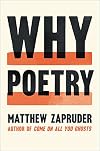
Zapruder aims to take poetry out of the stultified classrooms where most of us first learned formal poetry. He does an admirable job, arguing that anyone can really understand poetry, that all the academic mystery that surrounds it is mostly nonsense and ends up making people hate poetry. All we need to do is understand the words, look at how the poet has formed the space of those words, and think about it. It is comprehensible to most anyone who speaks the language. He writes, "Good poets show more do not deliberately complicate something just to make it harder for a reader to understand."
A poem is meant to bring you out of your regular day to day use of language, to slow you down, and connect you with words, ideas, images, and feelings in ways that most of us rarely do. But, I guess since the book he was writing was in prose, he couldn't resist returning to the mundane, and talking about current politics. show less
A poem is meant to bring you out of your regular day to day use of language, to slow you down, and connect you with words, ideas, images, and feelings in ways that most of us rarely do. But, I guess since the book he was writing was in prose, he couldn't resist returning to the mundane, and talking about current politics. show less
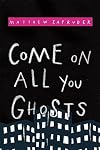
Invigorating, often funny, often melancholy. The most zingy -- can I say, zingiest? - of contemporary poetry. I think his work may be love-it-or-hate-it. Here, at random, are the opening three lines from the poem "The Prelude" to help you decide: "Oh this Diet Coke is really good, / though come to think of it it tastes / like nothing plus the idea of chocolate".
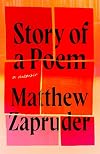
An ideal book for me, [a:Matthew Zapruder|422626|Matthew Zapruder|https://images.gr-assets.com/authors/1704914194p2/422626.jpg] writes lyrically and thoughtfully about how a poem unfolds for him through various drafts and picks up bits of his reading along the way to add to his ideas, changing his poem with each draft. Part memoir, he talks about his pitch-perfect son's diagnosis of autism, his sobriety, his father's death, his reading, his visits to poets ([a:W S Merwin|23523643|W S show more Merwin|https://s.gr-assets.com/assets/nophoto/user/u_50x66-632230dc9882b4352d753eedf9396530.png]), to the Isamu Noguchi Museum, about [a:Basho|19055160|Basho|https://s.gr-assets.com/assets/nophoto/user/u_50x66-632230dc9882b4352d753eedf9396530.png], [a:Li Bai|4058|Li Bai|https://images.gr-assets.com/authors/1260676684p2/4058.jpg][a:Li Bai|4058|Li Bai|https://images.gr-assets.com/authors/1260676684p2/4058.jpg], and even [a:Rupi Kaur|8075577|Rupi Kaur|https://images.gr-assets.com/authors/1612048194p2/8075577.jpg], [a:Paul Celan|86816|Paul Celan|https://images.gr-assets.com/authors/1651508206p2/86816.jpg], [a:Wallace Stevens|42920|Wallace Stevens|https://images.gr-assets.com/authors/1208891582p2/42920.jpg], [a:Federico García Lorca|44150|Federico García Lorca|https://images.gr-assets.com/authors/1651452804p2/44150.jpg], [a:Vicente Aleixandre|119735|Vicente Aleixandre|https://images.gr-assets.com/authors/1219466121p2/119735.jpg], [a:Mary Ruefle|282933|Mary Ruefle|https://images.gr-assets.com/authors/1250203628p2/282933.jpg], [a:Richard Hugo|38124|Richard Hugo|https://images.gr-assets.com/authors/1317685323p2/38124.jpg],and many more poets. Relatable and compelling, I read it late into the night and each morning I looked up poems.
"Dear Reader, I am trying to pry open your casket/ with this burning snowflake." James Tate show less
"Dear Reader, I am trying to pry open your casket/ with this burning snowflake." James Tate show less
Lists
Wishlist (1)
Awards


You May Also Like


Associated Authors
Statistics
- Works
- 10
- Also by
- 14
- Members
- 618
- Popularity
- #40,696
- Rating
- 3.8
- Reviews
- 8
- ISBNs
- 23
