
Jane Aiken Hodge (1917–2009)
Author of The Private World of Georgette Heyer
About the Author
Jane Aiken Hodge was born near Cambridge, Massachusetts, on Decmber 4, 1917. Her father was the Pulitzer prize-winning poet, Conrad Aiken. She attended Oxford University and Radcliff College. She wrote about 30 suspense novels and historical novels. She was a longtime believer in the right of show more people to end their own lives. In 2009 she chose to do this to the shock of her two grown daughters. (Bowker Author Biography) show less
Image credit: Carol Stephenson's Blog
Series
Works by Jane Aiken Hodge
Associated Works
Tagged
Common Knowledge
- Legal name
- Hodge, Jane Aiken
- Birthdate
- 1917-12-04
- Date of death
- 2009-06-17
- Gender
- female
- Education
- Somerville College, Oxford University (BA|1938)
Radcliffe College (BA|1938) - Occupations
- civil servant
journalist
historical novelist
detective novelist
book reviewer
biographer - Agent
- Georgia Glover (David Higham Associates)
- Relationships
- Aiken, Conrad (father)
Aiken, Joan (sister)
Aiken, John (brother)
Hodge, Joanna (daughter)
Hodge, Jessica (daughter) - Short biography
- Jane Aiken Hodge was the daughter of Pulitzer Prize-winning American writer Conrad Aiken and his first wife, Jessie McDonald. Jane was three years old when her family moved to Great Britain, settling in Rye, East Sussex where her younger sister, Joan, who would grow up to become a novelist and a children's writer, was born. Their parents divorced in 1929. Jane read English at Oxford University, and in 1938 earned a second degree in English at Radcliffe, her mother's alma mater. She worked a civil servant in the USA for a time, and also worked for Time Magazine, before returning to Great Britain in 1947. Her published works included historical novels, biographies, and contemporary detective novels. In 1972, Jane Hodge renounced her USA citizenship and became a British subject.
- Cause of death
- suicide
- Nationality
- USA (birth)
UK (naturalized 1972) - Birthplace
- Cambridge, Massachusetts, USA
- Places of residence
- Lewes, Sussex, England, UK
Rye, East Sussex, England, UK - Place of death
- Lewes, East Sussex, England, UK
- Burial location
- cremated
- Map Location
- UK
Members
Discussions
Another Governess Romance in Name that Book (February 2012)
Reviews
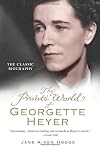
Jane Aiken Hodge’s 1984 biography of Georgette Heyer, reissued this month by Sourcebooks, was until very recently the only one available. Published ten years after Heyer’s death, it describes her life primarily from her letters to her publisher. An intensely private person, Heyer eschewed publicity, never giving an interview, and not keeping her papers. Thus a biographer has relatively little material available. Hodge interviewed Heyer’s editors, surviving family members, and a very show more few friends (all of whom loved or respected her), and then wove a narrative around the books themselves, using them to illustrate her life, and vice versa.
A lot of the criticism of this biography has focused on either errors Hodge made about the novels themselves, or some kind of personal disappointment the reader feels from finding Heyer “unlikeable.” I personally find whatever errors Hodge made to be minor and forgivable, and find Heyer herself to be witty, strong-willed, and very likeable. Her personality comes forth in her letters, and makes me want to read more of them. Coupled with her friends’ descriptions of her immense style and charm, they make me wish I could have known her.
Her private nature prevented her from discussing her books with her friends. She would talk about everything else in the world with them, but when the conversation came around to her work, she would remain silent on it, leaving any discussion to her husband, or changing the subject. It is hard to tell from this remove (of both time and culture), but it seems to me that this was, at its core, a very large dose of British reticence and self-deprecation. The idea of self-promotion was simply repugnant to her, and since her first novel, written as a serial to amuse a sick brother when she was 17 and published before she was twenty, had sold well, and a later novel had come out during a general strike with no publicity and yet sold 190,000 copies, she was convinced that she had no need to promote her work. She referred requesters of interviews back to her work. Hodge reports that she would say: You will find me in my work.
So this biography focuses on her work, and how it informs us about the author. And in that regard, it is particularly interesting to writers. There is advice to new authors (she sometimes read other people’s manuscripts for her publisher) and there is the long incubation and development and experimentation of her own style and settings before she settled into the Regency period. It took her twenty years, and twenty-four novels, before she did so. For many years she wrote a historical novel and a thriller every year. It was an intense pace. And her meticulous research is always highlighted.
I was surprised by the size of the Sourcebooks edition, which was smaller and thinner than I had expected. The comparative sizes of this trade-paperback-sized edition and the original hardcover edition is deceptive, however. The new edition runs to 242 pages while the original is only 216. The new edition has a new sentence at the end of the Acknowledgements stating that some new material has been incorporated into the text. While I did not make a word-for-word comparison of the two editions, I did not find any additions or corrections. The most significant difference between the editions appears to be the lack of color illustrations in the new one, and the omission of as many as half of the illustrations that were in the original. The hardcover edition is one of the best-illustrated books about the Regency anywhere, full of large color and black and white plates of photographs, portraits, caricatures, fashion plates, and paintings, something on nearly every page. Many, perhaps most, of these are missing in the new edition, and of course the smaller format and plain paper reduces the beauty, and even the utility, of many of those that remain. It is still well-illustrated, just no longer exceptionally so. This is the only thing that restrains what would otherwise be an enthusiastic recommendation of this book to all Heyer and Regency fans. Even so, it is still well worth reading for anyone who enjoys Heyer or who is interested in the development of a successful author’s career.
Note: I wrote this review for Austenprose, where it was published 14 August 2011. show less
A lot of the criticism of this biography has focused on either errors Hodge made about the novels themselves, or some kind of personal disappointment the reader feels from finding Heyer “unlikeable.” I personally find whatever errors Hodge made to be minor and forgivable, and find Heyer herself to be witty, strong-willed, and very likeable. Her personality comes forth in her letters, and makes me want to read more of them. Coupled with her friends’ descriptions of her immense style and charm, they make me wish I could have known her.
Her private nature prevented her from discussing her books with her friends. She would talk about everything else in the world with them, but when the conversation came around to her work, she would remain silent on it, leaving any discussion to her husband, or changing the subject. It is hard to tell from this remove (of both time and culture), but it seems to me that this was, at its core, a very large dose of British reticence and self-deprecation. The idea of self-promotion was simply repugnant to her, and since her first novel, written as a serial to amuse a sick brother when she was 17 and published before she was twenty, had sold well, and a later novel had come out during a general strike with no publicity and yet sold 190,000 copies, she was convinced that she had no need to promote her work. She referred requesters of interviews back to her work. Hodge reports that she would say: You will find me in my work.
So this biography focuses on her work, and how it informs us about the author. And in that regard, it is particularly interesting to writers. There is advice to new authors (she sometimes read other people’s manuscripts for her publisher) and there is the long incubation and development and experimentation of her own style and settings before she settled into the Regency period. It took her twenty years, and twenty-four novels, before she did so. For many years she wrote a historical novel and a thriller every year. It was an intense pace. And her meticulous research is always highlighted.
I was surprised by the size of the Sourcebooks edition, which was smaller and thinner than I had expected. The comparative sizes of this trade-paperback-sized edition and the original hardcover edition is deceptive, however. The new edition runs to 242 pages while the original is only 216. The new edition has a new sentence at the end of the Acknowledgements stating that some new material has been incorporated into the text. While I did not make a word-for-word comparison of the two editions, I did not find any additions or corrections. The most significant difference between the editions appears to be the lack of color illustrations in the new one, and the omission of as many as half of the illustrations that were in the original. The hardcover edition is one of the best-illustrated books about the Regency anywhere, full of large color and black and white plates of photographs, portraits, caricatures, fashion plates, and paintings, something on nearly every page. Many, perhaps most, of these are missing in the new edition, and of course the smaller format and plain paper reduces the beauty, and even the utility, of many of those that remain. It is still well-illustrated, just no longer exceptionally so. This is the only thing that restrains what would otherwise be an enthusiastic recommendation of this book to all Heyer and Regency fans. Even so, it is still well worth reading for anyone who enjoys Heyer or who is interested in the development of a successful author’s career.
Note: I wrote this review for Austenprose, where it was published 14 August 2011. show less
This readable biography was a pleasant surprise. Hodge created an accurate and sympathetic view of the historical fiction written over the decades by Georgette Heyer. The prose never descended into maudlin praise or esoteric speculation about the very private person that was ‘Miss Heyer’. Remarks and quotes throughout about the development of most of her novels added an excellent insight into Heyer’s way of writing. At one point, Hodge details very succinctly that people who sneer at show more Heyer's work clearly haven't read any. I loved her passages on this topic because it shows how thoroughly the inner workings of Heyer's writing was analyzed.
It was especially astonishing to read about her difficulties with the British income tax assessments. One now can understand why many citizens became British ex-pats in order to survive. It was also very refreshing to have Heyer’s work revealed as highly capable and well-researched narratives that men apparently read as well as women. It was increasingly evident as Heyer’s research came to light that she was a notable expert in military strategy of the Napoleanic and Peninsular war histories. Highly recommended biography. show less
It was especially astonishing to read about her difficulties with the British income tax assessments. One now can understand why many citizens became British ex-pats in order to survive. It was also very refreshing to have Heyer’s work revealed as highly capable and well-researched narratives that men apparently read as well as women. It was increasingly evident as Heyer’s research came to light that she was a notable expert in military strategy of the Napoleanic and Peninsular war histories. Highly recommended biography. show less
I'd heard that this book was disappointing for Heyer fans, because it depicted Heyer in an unsympathetic, cold, snobbish light. However, I really liked the book a lot. To me, Heyer's personality was not at all incompatible with the books she wrote - her letters are amusing (very Austen-esque) and she almost seems to have lived in the world she wrote about. I enjoyed the synopses of her novels and the descriptions of her struggles in writing them and getting them published. There were also show more (at least in the hardcover version I read) a lot of interesting paintings and photographs, mostly depicting the Regency world. I have so much more respect for Heyer now; I used to think of her novels as well-written fluff, but she actually did huge amounts of research on the Regency period, collecting notebooks full of costumes, carriages, slang, political events, and pretty much anything else you can think of. I was completely floored. In short, I highly recommend this bio to Heyer fans, and to anyone who likes to read (or write) Regency romance. show less

The Adventurers by Jane Aiken Hodge is an enjoyable historical novel set during near the end of the Napoleonic wars. Sonia von Hugel is a young noblewoman whose home in Germany is sacked by fleeing French soldiers. She and her governess Elizabeth Barrymore escape the carnage, but where can two women find refuge in such a dangerous time? Sonia pairs up with spy and adventurer Philip Vincent to escort them to safety as they play their way to fortune at the card table.
This story has definite show more Heyerian undertones with the young heroine successfully dressing up as a boy, the intelligent, sharp, and ambiguous hero, and even the setting of the Napoleonic wars. There are also some Austenian moments with Lady Elinor, who, like Lady Catherine de Bourgh, unwittingly brings together the two people whom she desires most to keep apart. Very clever.
It's been awhile since I have read a new author that I immediately wanted to continue reading. While a few things felt too neat to be fully believable, one does believe the characters themselves. And they're what makes it fun. show less
This story has definite show more Heyerian undertones with the young heroine successfully dressing up as a boy, the intelligent, sharp, and ambiguous hero, and even the setting of the Napoleonic wars. There are also some Austenian moments with Lady Elinor, who, like Lady Catherine de Bourgh, unwittingly brings together the two people whom she desires most to keep apart. Very clever.
It's been awhile since I have read a new author that I immediately wanted to continue reading. While a few things felt too neat to be fully believable, one does believe the characters themselves. And they're what makes it fun. show less
Lists
You May Also Like


Associated Authors
Statistics
- Works
- 37
- Also by
- 3
- Members
- 2,225
- Popularity
- #11,517
- Rating
- 3.6
- Reviews
- 63
- ISBNs
- 257
- Languages
- 3
- Favorited
- 5