
Sofia Samatar
Author of A Stranger in Olondria
About the Author
Image credit: Photo by Jim C. Hines
Series
Works by Sofia Samatar
Honey Bear {short story} 2 copies
Associated Works
Long Hidden: Speculative Fiction from the Margins of History (2014) — Contributor — 230 copies, 17 reviews
Kaleidoscope: Diverse YA Science Fiction and Fantasy Stories (2014) — Contributor — 123 copies, 6 reviews
The Best Science Fiction and Fantasy of the Year, Volume 8 (2014) — Contributor — 116 copies, 6 reviews
We See a Different Frontier: A Postcolonial Speculative Fiction Anthology (2013) — Contributor — 76 copies, 3 reviews
Fantasy Magazine, Issue 60 (December 2016) - People of Colo(u)r Destroy Fantasy! Special Issue (2016) — Contributor — 32 copies, 1 review
Philosophy through Science Fiction Stories: Exploring the Boundaries of the Possible (2021) — Contributor — 19 copies, 1 review
Inviting Interruptions: Wonder Tales in the Twenty-First Century (Fairy-Tale Studies) (2021) — Contributor — 8 copies
Weird Dream Society: An Anthology of the Possible & Unsubstantiated in Support of RAICES (2020) — Contributor — 8 copies
State and Culture in Postcolonial Africa: Enchantings (African Expressive Cultures) (2017) — Contributor — 6 copies
Spelling the Hours: Poetry Celebrating the Forgotten Others of Science and Technology (Stone Bird Poetry) (Volume 1) (2016) — Contributor — 4 copies, 1 review
Climbing Lightly Through Forests: A Poetry Anthology Honoring Ursula K. Le Guin (2021) — Contributor — 4 copies
Fantasy Fiction: A Writer's Guide and Anthology (Bloomsbury Writer's Guides and Anthologies) (2024) — Contributor — 2 copies
Bull Spec #7 — Contributor — 1 copy
Tagged
Common Knowledge
- Birthdate
- 1971-10-24
- Gender
- female
- Education
- University of Wisconsin-Madison (MA|1997|Ph.D|2013)
Goshen College, Indiana (BA ∙ English) - Occupations
- editor
novelist
short story writer
professor - Organizations
- James Madison University
- Awards and honors
- Bernard J. Brommel Award (2023)
Robert Holdstock Award (2014)
Astounding Award for Best New Writer (2014)
Crawford Award (2014) - Relationships
- Miller, Keith (spouse)
Samatar, Said S. (parent)
Samatar, Del (sibling) - Nationality
- USA
- Birthplace
- Indiana, USA
- Places of residence
- Madison, Wisconsin, USA
Yambio, South Sudan
Ventura, California, USA
Egypt - Associated Place (for map)
- USA
Members
Reviews

Once, he said, on ancient Earth, there was a Horizon, and to gaze on it was to look neither up nor down. Look out...This is an sf story about a generation ship and the people on it who have never known anything else. Those are a dime a dozen in science fiction, of course, but Samatar focuses on the class divide in the ship, and academia's role in both upending and upholding systems of oppression—it's a unique angle on an old sf staple, and of course totally played to my own interests. show more Great read. show less
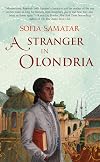
Beautifully written, exquisitely crafted, a tale of books and reading, and the wisdom that lies somewhere between the written word and lived experience. A callow young islander travels to a rich and distant empire, his head filled with vibrant visions thanks to the book of his exile tutor. Immersing himself in this new world, he becomes haunted by an angel, the ghost of a sick girl he met briefly on his voyage. Tormented by her visitations, he becomes part of a power struggle between show more religious factions that are slowly leading to civil war.
Vivid descriptions, a lush atmosphere and a rich and varied world brought to life in the same manner that so enchants our young protagonist - a brilliant and gorgeous and profound book. show less
Vivid descriptions, a lush atmosphere and a rich and varied world brought to life in the same manner that so enchants our young protagonist - a brilliant and gorgeous and profound book. show less
When I start reading a Samatar story I'm never quite sure where I am or why I'm there... And then something turns, or a heart opens, or a scar (more often something worse, like a cyborg implant or a synthetic sky) is revealed, and nothing matters more than being right there, right now, until I get to the last page.
Plus there are often moments like the one below, appealing especially to acolytes of the written word. I'm smitten, give me up for lost.
"This is not the first time I have written show more something I intend to submit for preservation. I have submitted a number of works, more than I care to remember. All have been rejected. I have submitted dreams, fantastical stories, novels of Old Earth, children's tales, even hymns. At this point, merely to pass by the archives gives me a queasy feeling. For this reason, I rarely go into town, and if I need something unavailable in Housing, I pick it up from Sister Bundle's little stand, rather than visiting the stores. It is a terrible feeling to have your work pulped. Brother Chalk at the archives--whom I call Ezera, since I knew him at school--tries to comfort me by telling me that pulped paper makes fresh paper possible, that destruction and renewal is the cycle of Life. His remaining hair clumped at the back of his head, his chubby jowls fringed with beard, he is a good man, a father, sympathetic, and one of my best friends. The last time I spoke with him, I thanked God that I had no pencil with me, for I might have succumbed to the temptation to drive it into his hand."
From "Fallow" show less
Plus there are often moments like the one below, appealing especially to acolytes of the written word. I'm smitten, give me up for lost.
"This is not the first time I have written show more something I intend to submit for preservation. I have submitted a number of works, more than I care to remember. All have been rejected. I have submitted dreams, fantastical stories, novels of Old Earth, children's tales, even hymns. At this point, merely to pass by the archives gives me a queasy feeling. For this reason, I rarely go into town, and if I need something unavailable in Housing, I pick it up from Sister Bundle's little stand, rather than visiting the stores. It is a terrible feeling to have your work pulped. Brother Chalk at the archives--whom I call Ezera, since I knew him at school--tries to comfort me by telling me that pulped paper makes fresh paper possible, that destruction and renewal is the cycle of Life. His remaining hair clumped at the back of his head, his chubby jowls fringed with beard, he is a good man, a father, sympathetic, and one of my best friends. The last time I spoke with him, I thanked God that I had no pencil with me, for I might have succumbed to the temptation to drive it into his hand."
From "Fallow" show less
The lush description builds up a setting that is rather hodgepodge--at first, given the opening, I thought Olondria would be an alternative India or other South Asian setting, but in the end there's bits of everywhere, people wear monocles and skullcaps, sit in parlors and cafes bearing swaths of silk in un-Victorian profusion, eat pears poached in wine and drink chocolate (which to my mind either implies a Columbian Exchange in this alternate universe or just proves there is no North show more American analogue). This is actually the kind of creatively anachronistic, stylishly rich worldbuilding I love, and it excuses the level of description--when nothing can be taken for granted, a writer should tell the readers enough details to get by. One particular set of details I loved: Jevick frequently quotes other writers from the world of Olondria, which reminded me of more classic writers and their tradition of allusions. It's a great way to immediately add depth to the text, and I should note that Samatar takes a gamble by using actual excerpts from the fictional books, and successfully pulls them off.
As a ghost story, its mood is more melancholy than horrific. I want to compare it to The Dream Quest of Unknown Kadath, for the rich tour of the world with a quest at the heart of it (a quest that starts off personal and turns out to have stakes on a much greater scale). However, there is not a hint of H.P. Lovecraft's virulent racism (hopefully this is clear from both the cover and the fact that the book was at WisCon; it lands on the opposite end of the racefail-o-meter). And books are the emotional touchstone instead of cats. You can quote me on that.
And ultimately, it is a story about reading. Not in a pat moral sense--it's not The Reading Rainbow for grownups (not that anything is wrong with Reading Rainbow!). But with that theme in mind...well, as I said, I'm sure this story benefits from rereading. To do that, you need to read it the first time around. And you should.
A longer version of this review appears at Story Addict . show less
As a ghost story, its mood is more melancholy than horrific. I want to compare it to The Dream Quest of Unknown Kadath, for the rich tour of the world with a quest at the heart of it (a quest that starts off personal and turns out to have stakes on a much greater scale). However, there is not a hint of H.P. Lovecraft's virulent racism (hopefully this is clear from both the cover and the fact that the book was at WisCon; it lands on the opposite end of the racefail-o-meter). And books are the emotional touchstone instead of cats. You can quote me on that.
And ultimately, it is a story about reading. Not in a pat moral sense--it's not The Reading Rainbow for grownups (not that anything is wrong with Reading Rainbow!). But with that theme in mind...well, as I said, I'm sure this story benefits from rereading. To do that, you need to read it the first time around. And you should.
A longer version of this review appears at Story Addict . show less
Lists
5 Stars in '18 (1)
Favourite Books (1)
Awards


You May Also Like


Associated Authors
Statistics
- Works
- 20
- Also by
- 67
- Members
- 1,987
- Popularity
- #12,940
- Rating
- 3.8
- Reviews
- 103
- ISBNs
- 35
- Languages
- 3
- Favorited
- 2
