
Richard Peter McKeon
Author of Selections from Medieval Philosophers, Volume I: Augustine to Albert the Great
About the Author
Works by Richard Peter McKeon
Selections from Medieval Philosophers, Volume II: Roger Bacon to William of Ockham (1972) 106 copies
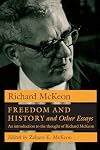
Freedom and History and Other Essays: An Introduction to the Thought of Richard McKeon (1989) 27 copies, 1 review
Selected Writings of Richard McKeon: Volume One: Philosophy, Science, and Culture (v. 1) (1998) 9 copies
Freedom and history; the semantics of philosophical controversies and ideological conflicts (1952) 4 copies
Associated Works
Tagged
Common Knowledge
- Gender
- male
Members
Reviews

A unique book in my experience as it explores myriad aspects of philosophical, historical, rhetorical, and poetic thought. Erudite in ways that are beyond my personal ability to understand, yet absolutely demanding further reading to discover the benefits of this great thinker and rhetorician.
Freedom and history and other essays : an introduction to the thought of Richard McKeon by Richard P. McKeon
“The direction of history is discovered neither a priori nor empirically. It is neither an abstract imposition nor an objective observation.”
“History is an account of facts and connections of facts….The data of history are selected existential simples, subject to enumeration, but the facts of history are interpreted complexes, stated in propositions. Data are given, but facts are made. There is always a connection in a fact, and there is always a direction in a series of statements show more of fact. In philosophy or science, inquiry or proof does not always follow the same consequences as the processes it treats. In history, interpretation or account seeks to trace the consequence of occurrences; but the facts depend on the choice among connections, and facts are joined to each other in historical consequences only by preserving connections of meaning which are philosophical consequences....[I]ndividual actions and social occurrences may evolve their meanings and connections against a transcendental background of intelligibility and reality which gives them an organic unity; or against the background of an underlying material structure—physical nature, human nature, ‘natural law’, relations of economic production—which provide them with ‘elements’ and ‘laws’; or in the context of conditioning circumstances—biological, political, social, cultural—which give them circumstantial particularity; or in an interaction of impulsions and repulsions which give them an operational schema. The report of facts in any of these senses connects data by processes and functions. The direction of history depends on what history is about and how processes are conceived.’ show less
“History is an account of facts and connections of facts….The data of history are selected existential simples, subject to enumeration, but the facts of history are interpreted complexes, stated in propositions. Data are given, but facts are made. There is always a connection in a fact, and there is always a direction in a series of statements show more of fact. In philosophy or science, inquiry or proof does not always follow the same consequences as the processes it treats. In history, interpretation or account seeks to trace the consequence of occurrences; but the facts depend on the choice among connections, and facts are joined to each other in historical consequences only by preserving connections of meaning which are philosophical consequences....[I]ndividual actions and social occurrences may evolve their meanings and connections against a transcendental background of intelligibility and reality which gives them an organic unity; or against the background of an underlying material structure—physical nature, human nature, ‘natural law’, relations of economic production—which provide them with ‘elements’ and ‘laws’; or in the context of conditioning circumstances—biological, political, social, cultural—which give them circumstantial particularity; or in an interaction of impulsions and repulsions which give them an operational schema. The report of facts in any of these senses connects data by processes and functions. The direction of history depends on what history is about and how processes are conceived.’ show less
You May Also Like


Associated Authors
Statistics
- Works
- 26
- Also by
- 3
- Members
- 464
- Popularity
- #53,000
- Rating
- 4.1
- Reviews
- 2
- ISBNs
- 23