
Wilhelm Roepke (1899–1966)
Author of A Humane Economy: The Social Framework of the Free Market
About the Author
Works by Wilhelm Roepke
Economics of the free society 4 copies
Mass und Mitte 2 copies
L' ordine internazionale 2 copies
Against the Tide 1 copy
Scritti liberali 1 copy
Die Krise des Kollektivismus 1 copy
Ekonomi för millioner 1 copy
Bortom utbud och efterfrågan 1 copy
Wort und Wirkung : [16 Reden aus den Jahren 1947 bis 1964, mit einem Lebensbild von Alfred Hunold] 1 copy
La crisi del collettivismo 1 copy
LA CRISIS DEL COLECTIVISMO 1 copy
Associated Works
Tagged
Common Knowledge
- Legal name
- Roepke, Wilhelm Theodor
- Birthdate
- 1899-10-10
- Date of death
- 1966-04-05
- Gender
- male
- Education
- University of Marburg (Dr.rer.pol|1921)
University of Marburg (Habilitation|1922) - Occupations
- soldier
professor
economist
government advisor
historian - Organizations
- German Army (World War I)
Mont Pelerin Society
American Economic Association
Swiss Economic Association
Royal Economic Society
Institut de France (show all 7)
Institute of International Studies, Geneva - Awards and honors
- Iron Cross (World War 1)
Grand Cross of Merit of Federal Republic of Germany
Columbia University (DLitt|1954)
University of Geneva (Dr. es Sciences Politiques|1959)
Willibald Pirckheimer Medal (1962) - Short biography
- Roepke was an economics professor fluent in German, French, English, Italian, and Latin, and had a reading knowledge of Spanish and Dutch. He traveled in the United States, South America, Far East, and Africa. A proponent of "third way" economics, Roepke advised the Chancellor of West Germany, Konrad Adenauer, and his Minister of Economics, Ludwig Erhard, and was influential in Germany's post-World War II economic recovery.
- Nationality
- Switzerland
Germany - Birthplace
- Schwarmstedt, Germany
- Places of residence
- Schwarmstadt, Germany (birth)
Istanbul, Turkey
Geneva, Switzerland - Place of death
- Geneva, Switzerland
- Burial location
- Geneva, Switzerland
Members
Reviews
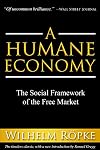
Much of this book is beautifully written --Ropke (even in translation) has a vivid and sympathetic style that reminds me of Chesterton. However, I bought the book because it was supposed to be a brilliant defense of the ethics of a free market economy -- that the free market not only works, but is ethically preferable to even fully democratic socialism. Frankly, I simply did not find that here. Ropke is credited with much of the West German economic recovery, but the first 150 pages (out of show more 261) are nostalgic praise of a pre-industrial economy. It reminds me more of Small Is Beautiful than, say, Milton Friedman. Ropke's ideal seems to be a simple agrarian society with a low technological level. He speaks of a painting of a farm with a horse and says it would not be so pretty with a tractor. No doubt that is true, but no-one is seriously suggesting that modern farms go back to horses. It may well be that much of German agriculture was still horse-powered up to World War II, and I suppose Ropke may have grown up with that life, but it does not fit the Germany of Volkswagens and BMWs when he was writing in the 1960s. He laments the "proletarianization" of the industrial workforce, but he has no serious suggestion for how to move industry back to small-scale independent factories. After page 150, he moves into a serious critique of the welfare state, arguing that it includes built-in inflation, which may well be true, though very few economists (even conservatives) are serious "hard money" theorists nowadays, and politically I suspect hard money is impossible even if it is desirable. He also criticizes the "monopoly" position of labor unions, but given the collapse of unions in the US and Britain since he wrote, that does not seem very relevant either He says he is writing to convince sincere Christian socialists that the free market is morally preferable to the welfare state, but he says almost nothing about the application of Christian ethics to business. Personally, I am not a socialist, but if I were, I do not think this book would convert me. show less

„Plädoyer für eine westdeutsche Bundesstaatsgründung, die den 1866 mit der ‚Verpreußung‘ eingeschlagenen Irrweg aufgibt und in die sich neu bildende ‚Atlantic Community‘ einfügt. ‚Es ist in der Tag zu hoffen, daß dieses föderative Westdeutschland, das nunmehr bis zur Klärung des russischen Problems völlig von Preußen getrennt wäre und den wichtigsten und größten Teil Deutschlands ausmacht, bald in die ‚Atlantische Gemeinschaft‘ aufgenommen würde, falls sich show more dieser auf der Gemeinsamkeit der Überlieferung, der geographischen Lage und der politisch-wirtschaftlichen Interessen beruhende Staatenverband trotz der starken kommunistischen Strömungen in Wessteuropa verwirklichen ließe.‘ (S.250)“
Quelle: Cobet, Christoph [Hrsg.]: Deutschlands Erneuerung : 1945 - 1950 ; [bio-bibliogr. Dokumentation mit 433 Texten] / [Christoph Cobet]. Frankfurt am Main : Antiquariat Cobet 1985 show less
Quelle: Cobet, Christoph [Hrsg.]: Deutschlands Erneuerung : 1945 - 1950 ; [bio-bibliogr. Dokumentation mit 433 Texten] / [Christoph Cobet]. Frankfurt am Main : Antiquariat Cobet 1985 show less
Apr 1, 2015German
You May Also Like


Associated Authors
Statistics
- Works
- 44
- Also by
- 2
- Members
- 394
- Popularity
- #61,533
- Rating
- 4.2
- Reviews
- 2
- ISBNs
- 33
- Languages
- 4
- Favorited
- 1