
Elizabeth von Arnim (1866–1941)
Author of The Enchanted April
About the Author
Disambiguation Notice:
Also wrote under the name of Alice Cholmondeley, and in first publications only under her pen-name "Elizabeth"
Series
Works by Elizabeth von Arnim
Elizabeth von Arnim's Collected Works: The Enchanted April, The Solitary Summer, The Benefactress, Vera, and More! ( 11 Works) (2023) 24 copies
Delphi Complete Works of Elizabeth von Arnim (Illustrated) (Delphi Series Eight Book 16) (2017) 11 copies
Elizabeth's children 1 copy
Prisoners 1 copy
»Mein himmlisches Königreich«: Gartenglück mit Elizabeth von Arnim (insel taschenbuch) (2015) 1 copy
The Danvers Jewels 1 copy
The Lowest Rung 1 copy
1993 1 copy
A Devotee 1 copy
Sigurd Eckdal’s Bride 1 copy
Associated Works
Gender in Modernism: New Geographies, Complex Intersections (2007) — Contributor — 12 copies, 1 review
Tagged
Common Knowledge
- Canonical name
- Arnim, Elizabeth von
- Legal name
- Beauchamp, Mary Annette (birth)
- Other names
- "Elizabeth" (pen name)
Cholmondeley, Alice (pseudonym)
Countess von Arnim-Schlagenthin
Elizabeth Russell, Countess Russell - Birthdate
- 1866-08-31
- Date of death
- 1941-02-09
- Gender
- female
- Education
- Royal College of Music
- Occupations
- novelist
- Relationships
- Mansfield, Katherine (cousin)
Russell, Bertrand (brother-in-law)
Wells, H. G. (lover)
de Charms, Leslie (daughter)
Walpole, Hugh (friend; tutor of her children)
Forster, E. M. (friend) (show all 8)
Earl Russell (2nd husband)
von Arnim-Schlagenthin, Henning August (1st husband) - Short biography
- Born Mary Annette Beauchamp in Sydney, Australia. Married first to Count Henning August von Arnim-Schlagenthin, then to Francis, 2nd Earl Russell. Australia was the setting of the family's vacation home, and when she was three years old, they returned to England. After her first husband's death in 1910, she lived in Switzerland, England, and the USA, and entertained a large circle of literary and society friends. She produced some 20 novels, semi-autobiographical works, and memoirs, beginning with Elizabeth and her German Garden (1898), and including The Enchanted April (1922), which was adapted as a Broadway play in 1925; a successful film in 1992; a Tony Award-nominated stage play in 2003; a musical play in 2010; and a serial on BBC Radio 4 in 2015.
- Cause of death
- influenza
- Nationality
- England
UK - Birthplace
- Kirribilli Point, New South Wales, Australia
- Places of residence
- Sydney, New South Wales, Australia
Valais, Switzerland
London, Middlesex, England, UK
Berlin, Germany
Nassenheide, Pomerania, Germany
Charleston, South Carolina, USA - Place of death
- Charleston, South Carolina, USA
- Burial location
- St Margaret's Church, Tylers Green, Penn, Buckinghamshire, England, UK
- Map Location
- England, UK
- Disambiguation notice
- Also wrote under the name of Alice Cholmondeley, and in first publications only under her pen-name "Elizabeth"
Members
Discussions
April Read: Elizabeth von Arnim in Virago Modern Classics (May 2017)
Elizabeth von Arnim in Tattered but still lovely (October 2014)
GROUP READ: The Enchanted April by Elizabeth von Arnim in 2013 Category Challenge (April 2013)
Reviews

This sequel to the semi-autobiographical Elizabeth and Her German Garden is just as delightful! (I would wonder why on earth I didn’t think to read it before now -- prompted by discovering the audiobook on Everand -- but I read Elizabeth and her German Garden March 2020, so understandably I was Very Distracted By Other Things at that time.)
Elizabeth has persuaded her husband (“The Man of Wrath”) that she wants to spend a summer uninterrupted by having to entertain guests. I show more particularly enjoyed her descriptions of her garden and of her approach to reading, and her anecdotes about her small daughters.
For a very short book (novella length), and for an audiobook (which meant I couldn’t easily bookmark quotes as I went), there were A LOT of memorable passages, which I made a point of looking up afterwards. For instance:
I remembered wondering about Elizabeth and Her German Garden why she wasn’t more involved in gardening in a hands-on way, so I was interested to get this explanation. It makes more sense to me, too, when I consider that Elizabeth was a countess (a “Gräfin”), too -- a fact that I don’t believe the books mention. Maybe one can infer, from the hints about her life, what her social class must have been? I am not sufficiently informed about German society in the late 19th century.
Elizabeth has persuaded her husband (“The Man of Wrath”) that she wants to spend a summer uninterrupted by having to entertain guests. I show more particularly enjoyed her descriptions of her garden and of her approach to reading, and her anecdotes about her small daughters.
For a very short book (novella length), and for an audiobook (which meant I couldn’t easily bookmark quotes as I went), there were A LOT of memorable passages, which I made a point of looking up afterwards. For instance:
[...] but of what use is it to buy good seeds and plants and bulbs if you are forced to hand them over to a gardener who listens with ill-concealed impatience to the careful directions you give him, says Jawohl a great many times, and then goes off and puts them in in the way he has always done, which is invariably the wrong way? My hands were tied because of the unfortunate circumstance of sex, or I would gladly have changed places with him and requested him to do the talking while I did the planting, and as he probably would not have talked much there would have been a distinct gain in the peace of the world, which would surely be very materially increased if women's tongues were tied instead of their hands, and those that want to could work with them without collecting a crowd. And is it not certain that the more one's body works the fainter grow the waggings of one's tongue? I sometimes literally ache with envy as I watch the men going about their pleasant work in the sunshine, turning up the luscious damp earth, raking, weeding, watering, planting, cutting the grass, pruning the trees — not a thing that they do from the first uncovering of the roses in the spring to the November bonfires but fills my soul with longing to be up and doing it too. A great many things will have to happen, however, before such a state of popular large-mindedness as will allow of my digging without creating a sensation is reached, so I have plenty of time for further grumblings [...] After having driven through vast tracts of forest and heath for hours, and never meeting a soul or seeing a house, it is surprising to be told that on such a day you took such a drive and were at such a spot; yet this has happened to me more than once. And if even this is watched and noted, with what lightning rapidity would the news spread that I had been seen stalking down the garden path with a hoe over my shoulder and a basket in my hand, and weeding written large on every feature! Yet I should love to weed.
I remembered wondering about Elizabeth and Her German Garden why she wasn’t more involved in gardening in a hands-on way, so I was interested to get this explanation. It makes more sense to me, too, when I consider that Elizabeth was a countess (a “Gräfin”), too -- a fact that I don’t believe the books mention. Maybe one can infer, from the hints about her life, what her social class must have been? I am not sufficiently informed about German society in the late 19th century.
What a blessing it is to love books. Everybody must love something, and I know of no objects of love that give such substantial and unfailing returns as books and a garden. And how easy it would have been to come into the world without this, and possessed instead of an all-consuming passion, say, for hats, perpetually raging round my empty soul! I feel I owe my forefathers a debt of gratitude, for I suppose the explanation is that they too did not care for hats.show less

I can see why this book sent many in 1922 rushing to vacation on the Italian coast. If I were a) richer, b) more inclined to travel, and c) not living in very uncertain travel times, I would be booking a trip myself. I am one of not many people who love winter as much as summer, and today have enjoyed looking out the windows at my snow-covered yard and neighborhood. But every night since starting this book I have gone to sleep dreaming of sunshine and sea air and an overabundance of show more flowers.
The four women who take this trip together - all initially unknown to one another - could really not be more different. As a person who would never vacation with strangers on purpose, I could not begin to imagine how this April would become the least bit enchanted. And yet it did, in very sweet ways though with plenty of bitterness to keep one's teeth from aching from the sugar. Oh, and humor, the kind of humor that is actually funny. Another author I have been shielded from all my life by all the pseudo-thrillers and cartoon-cover romances that fill up the bestseller lists in 2022. Loved it. show less
The four women who take this trip together - all initially unknown to one another - could really not be more different. As a person who would never vacation with strangers on purpose, I could not begin to imagine how this April would become the least bit enchanted. And yet it did, in very sweet ways though with plenty of bitterness to keep one's teeth from aching from the sugar. Oh, and humor, the kind of humor that is actually funny. Another author I have been shielded from all my life by all the pseudo-thrillers and cartoon-cover romances that fill up the bestseller lists in 2022. Loved it. show less

Ew! What a character that Wemyss is. Didn't take him long to wheedle himself into the life of a very recently bereaved and now unprotected Lucy. He's 45; she's early 20s and attractive and naive. Only a few months previous he lost his wife, Vera, under scandalous circumstances. But within days of meeting Lucy, he's calling her his "little love" and having her sit in his lap, plus has a thing for tousling her short, bobbed hair. Ew!
He grows steadily more obnoxious but by the time his bad show more behavior starts showing up, Lucy is too far "in love" and too naturally sweet to change her high opinion of him. There were moments where I audibly groaned at his audacity and my creep alarm was by then sounding non-stop. No wonder Lucy was tired all the time. Every time this guy opened his mouth, he was exhausting.
Now we would readily recognize him as a psychopath. Although high functioning, his relationship with the World is warped. He has that inner emptiness: where his soul should be is only gaping, insatiable need for power and flattery. And, oddly but characteristically, he poses himself as a victim with righteous indignation at the smallest slight or contrary opinion. (Sound like someone we all know here in September 2020?) Just to prevent him spinning off into overwrought drama at a misplaced word or sigh is the new Mrs. Wemyss' full time occupation.
But, man this was a good read! Von Arnim grows in my esteem. Nothing like The Enchanted April or Elizabeth and Her German Garden, she rocked this genre and even pre-dated du Maurier's Rebecca. Published in 1921, she adeptly presents this man as menacing and sexually revolting well within the constraints of her era. Nothing explicit but that doesn't mean she didn't describe some twisted stuff.
I read where Wemyss was based on the "Wicked Earl" Frank Russell, who von Arnim married but was separated from him after a very short time together. Having a personal relationship with a psychopath would explain her acuity, even if "psychopath" wasn't bantered around back then like it is now. Apparently it was common knowledge at the time that this novel was written that it was based on Russell, so that bit had to have been some sweet bonus revenge for her.
Lifted from the wisdom of this novel, here's some sound advice for a young person considering marriage:
I "read' this novel by listening to the free recording, well done by Greg W at Librivox.org . show less
He grows steadily more obnoxious but by the time his bad show more behavior starts showing up, Lucy is too far "in love" and too naturally sweet to change her high opinion of him. There were moments where I audibly groaned at his audacity and my creep alarm was by then sounding non-stop. No wonder Lucy was tired all the time. Every time this guy opened his mouth, he was exhausting.
Now we would readily recognize him as a psychopath. Although high functioning, his relationship with the World is warped. He has that inner emptiness: where his soul should be is only gaping, insatiable need for power and flattery. And, oddly but characteristically, he poses himself as a victim with righteous indignation at the smallest slight or contrary opinion. (Sound like someone we all know here in September 2020?) Just to prevent him spinning off into overwrought drama at a misplaced word or sigh is the new Mrs. Wemyss' full time occupation.
But, man this was a good read! Von Arnim grows in my esteem. Nothing like The Enchanted April or Elizabeth and Her German Garden, she rocked this genre and even pre-dated du Maurier's Rebecca. Published in 1921, she adeptly presents this man as menacing and sexually revolting well within the constraints of her era. Nothing explicit but that doesn't mean she didn't describe some twisted stuff.
I read where Wemyss was based on the "Wicked Earl" Frank Russell, who von Arnim married but was separated from him after a very short time together. Having a personal relationship with a psychopath would explain her acuity, even if "psychopath" wasn't bantered around back then like it is now. Apparently it was common knowledge at the time that this novel was written that it was based on Russell, so that bit had to have been some sweet bonus revenge for her.
Lifted from the wisdom of this novel, here's some sound advice for a young person considering marriage:
1. TAKE YOUR TIME. Get to know the person long enough for those hormones to settle down.
2. IF YOUR FAMILY AND FRIENDS DON'T LIKE HIM/HER then listen. They probably see something you don't see yet. But if you marry them, you surely will.
3. PAY ATTENTION TO YOUR OWN FEELINGS. Feeling smothered, having self-doubts, missing alone time, and feeling tired are not healthy signs. And if you find you are spending time trying to "figure them out" in order to explain their unpleasant behavior, that would be a big red flag against your chances of future happiness with this beloved.
4. AND DON'T MARRY A WRITER unless you are 100% sure you'll never get divorced or separated. Or only if you are 100% sure you are not a psychopath.
I "read' this novel by listening to the free recording, well done by Greg W at Librivox.org . show less
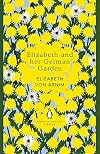
I loved this - I think I first heard about it from a mention by Themis-Athena, but had to await its publication here before reading it. It's a slim tome, but packed; at 104 pages, what I originally thought would be a fast read instead took me a couple of days, despite my being absorbed in it.
Mostly, it's a celebration of gardens, the outdoors, and nature, as written by one new to all of it. But buried in the narrative, structured loosely like a diary, are moments of scathing wit, social show more commentary, and on the part of her husband, not a little misogyny. Elizabeth and her German Garden was originally published in 1898 and though its language is of the time, Elizabeth is refreshingly modern. Her thoughts, attitude, and personality are in almost all ways indistinguishable from the average 21st century woman's voice. I loved her and her scathing, dry wit.
My only complaint about the book is it was slightly too short. After lamenting two years of summer droughts that kept her in suspense of her garden's potential, the book ends at the very start of April and spring; I desperately want to know if she finally got to see her garden in all its glory! Did the yellow border work out? Enquiring minds are left hanging! show less
Mostly, it's a celebration of gardens, the outdoors, and nature, as written by one new to all of it. But buried in the narrative, structured loosely like a diary, are moments of scathing wit, social show more commentary, and on the part of her husband, not a little misogyny. Elizabeth and her German Garden was originally published in 1898 and though its language is of the time, Elizabeth is refreshingly modern. Her thoughts, attitude, and personality are in almost all ways indistinguishable from the average 21st century woman's voice. I loved her and her scathing, dry wit.
My only complaint about the book is it was slightly too short. After lamenting two years of summer droughts that kept her in suspense of her garden's potential, the book ends at the very start of April and spring; I desperately want to know if she finally got to see her garden in all its glory! Did the yellow border work out? Enquiring minds are left hanging! show less
Lists
Five star books (1)
A Novel Cure (1)
Out of Copyright (1)
Folio Society (1)
discontinued (1)
MPLClassics (1)
1920s (1)
Female Author (1)
Persephone (1)
Garden-fiction (3)
Best Beach Reads (2)
Comfort Reads (2)
el (1)
Spring Books (1)
Reading LIst (1)
Schwob Nederland (1)
Awards


You May Also Like


Associated Authors
Statistics
- Works
- 47
- Also by
- 9
- Members
- 8,108
- Popularity
- #2,985
- Rating
- 3.9
- Reviews
- 303
- ISBNs
- 802
- Languages
- 14
- Favorited
- 52

