
Hugh Aldersey-Williams
Author of Periodic Tales: A Cultural History of the Elements, from Arsenic to Zinc
About the Author
Hugh Aldersey-Williams is an author and journalist from the United Kingdom. Aldersey-Williams was educated at Highgate School and studied the natural sciences at the University of Cambridge. he is known for his bestselling book, Periodic Tales: A Cultural History of the Elements, from Arsenic to show more Zinc, which explains all the elements found in the periodic table and their origins. He has also written The Most Beautiful Molecule and Anatomies: A Cultural History of the Human Body. (Bowker Author Biography) show less
Works by Hugh Aldersey-Williams
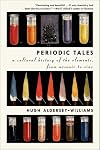
Periodic Tales: A Cultural History of the Elements, from Arsenic to Zinc (2011) 1,411 copies, 26 reviews
In Search of Sir Thomas Browne: The Life and Afterlife of the Seventeenth Century's Most Inquiring Mind (2015) 131 copies, 3 reviews
Panicology: Two Statisticians Explain What's Worth Worrying About (and What's Not) in the 21st Century (2009) 30 copies, 3 reviews
New American Design 1 copy
Associated Works
Tagged
Common Knowledge
- Birthdate
- 1959
- Gender
- male
- Education
- University of Cambridge
Highgate School, London, England, UK - Occupations
- journalist
author
curator - Organizations
- New Statesman
- Nationality
- UK
- Birthplace
- London, England, UK
- Places of residence
- London, England, UK
Norfolk, England, UK - Associated Place (for map)
- England, UK
Members
Reviews

This is a nice compact and very readable readable scientific biography of Christiaan Huygens (1629-1695), a man who didn't leave a hugely visible footprint on the history of science — unless you're particularly interested in optics or horology you probably won't even remember his name — but was in fact one of the most important European scientists in the interval between Galileo and Newton, and, as Aldersey-Williams argues here, also played a key role in the development of scientific show more institutions and the modern, collaborative, empirical way of doing science.
It's interesting to see how there was a kind of window of opportunity for science in Northern Europe in the middle of the seventeenth century: the English were setting up the Royal Society, Colbert was trying to harness the power of science to the advancement of his bureaucratic state in France, and there was a lot of openness to cross-border co-operation. There was money for big experiments, and a general relaxation of religious control of ideas. It didn't last long, of course; by the mid-1680s the French had shut the door to Protestants and the English (under Dutch rule) had reverted to their usual opposition to any ideas from the other side of the Channel. But it was long enough for the leading European scientists to consolidate their own private networks and adapt to the new ways of working with rapid publication of new discoveries, replication of results and constructive discussion. It's astonishing, with hindsight, how someone like Christiaan could move around so freely between three countries that were at war with each other — in one or other combination — for quite a big chunk of his life.
As well as talking abut the general situation of seventeenth century Holland, France and Britain, Aldersey-Williams also takes care to put Christiaan in the context of his over-achieving family, especially his father the courtier, diplomat, composer, architect and poet Constantijn (1596-1687) and his brother the lens-grinder, diplomat and secretary to William III, Constantijn (1628-1697).
(The Huygens family included at least four generations of notable Christiaans and Constantijns, all of whom seem to have had major achievements in more than one field, so it soon gets confusing.)
The book is said to be aimed at "general readers", but you would need to know a certain amount about physics (at least high-school level) to get anything much out of it. It's well backed up with references and a generous bibliography. show less
It's interesting to see how there was a kind of window of opportunity for science in Northern Europe in the middle of the seventeenth century: the English were setting up the Royal Society, Colbert was trying to harness the power of science to the advancement of his bureaucratic state in France, and there was a lot of openness to cross-border co-operation. There was money for big experiments, and a general relaxation of religious control of ideas. It didn't last long, of course; by the mid-1680s the French had shut the door to Protestants and the English (under Dutch rule) had reverted to their usual opposition to any ideas from the other side of the Channel. But it was long enough for the leading European scientists to consolidate their own private networks and adapt to the new ways of working with rapid publication of new discoveries, replication of results and constructive discussion. It's astonishing, with hindsight, how someone like Christiaan could move around so freely between three countries that were at war with each other — in one or other combination — for quite a big chunk of his life.
As well as talking abut the general situation of seventeenth century Holland, France and Britain, Aldersey-Williams also takes care to put Christiaan in the context of his over-achieving family, especially his father the courtier, diplomat, composer, architect and poet Constantijn (1596-1687) and his brother the lens-grinder, diplomat and secretary to William III, Constantijn (1628-1697).
(The Huygens family included at least four generations of notable Christiaans and Constantijns, all of whom seem to have had major achievements in more than one field, so it soon gets confusing.)
The book is said to be aimed at "general readers", but you would need to know a certain amount about physics (at least high-school level) to get anything much out of it. It's well backed up with references and a generous bibliography. show less
I know nothing about chemistry. I barely passed it in high school. I do not know the difference between organic and inorganic. I do not know much about the difference between a mineral (geology) vs an element (chemistry). I have a very difficult time grasping metals vs gases vs "nonmetals" vs "metalloids" Like...are metalloids just rocks? I don't know! I have very little understanding of the processes used to find these elements. BUT it was interesting to learn the history of so many show more elements that are simply part of our lives. Also interesting to read about rare-earth elements (the seeds of technology, apparently) when they were literally in the news a couple of weeks ago ("raw earth"). The fact that the periodic table is still legit today after 100+ years is pretty incredible, way to go Mendeleev!
The chapters are relatively short, but dense because many topics were covered for one metal in most chapters. It made for a great book to read while falling asleep. show less
The chapters are relatively short, but dense because many topics were covered for one metal in most chapters. It made for a great book to read while falling asleep. show less

Aldersey-Williams takes readers along on his quest to collect all of the elements in the periodic table. While a bit of a slog at times, this book is mostly entertaining as it highlights the humanity of scientific discovery---the ego and the ambition, the odd mix of hubris and humility that leads to the conviction that everything is ultimately knowable, and the sometimes shocking carelessness of chemists in pre-OSHA days---and makes me wonder what's tinting my sunglasses. Especially show more appealing to me are the dry wit and the urge for classification and the comfort that comes with the feeling that the world is a place of order, despite appearances to the contrary. show less

If you've lived with a favorite author for a while, read him or her until the writer's voice in your ear became almost an alter ego, you can imagine what prompted Hugh Aldersey-Williams to write this book. As he says himself, this may not be the most innovative study on Thomas Browne, it does not bring to light any new manuscripts, lost letters, or describe newly uncovered material objects that were in Browne's possession and that might give us new insight into his everyday life. What it show more does, however, is, I think, much better: it brings Thomas Browne to life -- not as a historical figure of academic interest, but as an erudite person possessed of infectious curiosity who might have something to say about our own everyday life. Thomas Browne emerges as both a familiar, a progressive thinker we might relate to, and as a foreign visitor to our timeline who allows us to see 21st-century problems with a fresh pair of eyes and also show us that, well, nihil novi sub sole, our 21st-century problems aren't all that new or unique.
Browne captures the reader's interest with his surprising (yet often invisible) innovations (such as a host of neologisms that have become part of common vocabulary, like the adjectives "medical" or "deductive") and as an unacknowledged (almost-)pioneer of numerous branches of science, such as archaeology or ... marine biology. The main lesson that Aldersey-Williams draws from this Norwich "Renaissance man" is his ability to remain critical of both science and religion, his methodical approach to empirically testing even the most unlikely popular belief and superstition without removing the mystery and wonder from the world around us. The sections in which Aldersey-Williams "channels" Browne's comments on 21st-century failure of science and religion to find some common ground and dialogue are perhaps a bit drawn out, but he raises important points: for example, he keeps returning to the question of the tone of scientific discourse - why is it so antagonistic, a-priori condescending towards religion or any other form of non-scientific thinking? Might this not contribute to some [fundamentalist] religious rejection of science? And is science really so antithetical to beliefs, don't scientists believe in science? At the least, doesn't proving a hypothesis require the belief that it holds true? Isn't it also possible that some of what science views today as axioms might be modified, or even overturned by science of the future? Examples often come from Browne's professional domain, medicine: modern medicine's belief in the power of antibiotics, for instance, is being undermined by studies showing that over-prescribing antibiotics does more harm than good, and that actually traditional (e.g. herbal) remedies might be more effective with fewer side effects.
This is the first piece by Aldersey-Williams I've read, and I look forward to reading more: in some sense, I feel I've found a "kin spirit" -- a non-militant atheist who desires dialogue & tolerance among cultures (be it different religions or science and religion) in a non-abstract sense, who cares about the fate of the world (environment, social welfare...) and is able to envision how different world views (religious / scientific) might find common ground in desiring the same good. In a world where many people feel that their only option is to stake out an inflexible position, it is refreshing to hear a reconciliatory tone without a note of condescension. And Thomas Browne is indeed a great model for such an approach: a non-partisan medical professional not confined to his own discipline, willing to admit that there might be a grain of truth even behind seemingly the most absurd belief -- and openminded enough to go and look for it. show less
Browne captures the reader's interest with his surprising (yet often invisible) innovations (such as a host of neologisms that have become part of common vocabulary, like the adjectives "medical" or "deductive") and as an unacknowledged (almost-)pioneer of numerous branches of science, such as archaeology or ... marine biology. The main lesson that Aldersey-Williams draws from this Norwich "Renaissance man" is his ability to remain critical of both science and religion, his methodical approach to empirically testing even the most unlikely popular belief and superstition without removing the mystery and wonder from the world around us. The sections in which Aldersey-Williams "channels" Browne's comments on 21st-century failure of science and religion to find some common ground and dialogue are perhaps a bit drawn out, but he raises important points: for example, he keeps returning to the question of the tone of scientific discourse - why is it so antagonistic, a-priori condescending towards religion or any other form of non-scientific thinking? Might this not contribute to some [fundamentalist] religious rejection of science? And is science really so antithetical to beliefs, don't scientists believe in science? At the least, doesn't proving a hypothesis require the belief that it holds true? Isn't it also possible that some of what science views today as axioms might be modified, or even overturned by science of the future? Examples often come from Browne's professional domain, medicine: modern medicine's belief in the power of antibiotics, for instance, is being undermined by studies showing that over-prescribing antibiotics does more harm than good, and that actually traditional (e.g. herbal) remedies might be more effective with fewer side effects.
This is the first piece by Aldersey-Williams I've read, and I look forward to reading more: in some sense, I feel I've found a "kin spirit" -- a non-militant atheist who desires dialogue & tolerance among cultures (be it different religions or science and religion) in a non-abstract sense, who cares about the fate of the world (environment, social welfare...) and is able to envision how different world views (religious / scientific) might find common ground in desiring the same good. In a world where many people feel that their only option is to stake out an inflexible position, it is refreshing to hear a reconciliatory tone without a note of condescension. And Thomas Browne is indeed a great model for such an approach: a non-partisan medical professional not confined to his own discipline, willing to admit that there might be a grain of truth even behind seemingly the most absurd belief -- and openminded enough to go and look for it. show less
Lists
Awards


You May Also Like


Associated Authors
Statistics
- Works
- 19
- Also by
- 2
- Members
- 2,307
- Popularity
- #11,126
- Rating
- 3.6
- Reviews
- 41
- ISBNs
- 85
- Languages
- 8