
Matthieu Ricard
Author of Happiness: A Guide to Developing Life's Most Important Skill
About the Author
Matthieu Ricard, a Buddhist monk residing in Katmandu, is a coauthor of "The Monk & the Philosopher" & is the official French translator of His Holiness the Dalai Lama. (Bowker Author Biography)
Works by Matthieu Ricard
The Monk and the Philosopher: A Father and Son Discuss the Meaning of Life (1998) — Author — 732 copies, 7 reviews
The Quantum and the Lotus: A Journey to the Frontiers Where Science and Buddhism Meet (2000) 554 copies, 10 reviews
On the Path to Enlightenment: Heart Advice from the Great Tibetan Masters (2001) — Author — 146 copies, 3 reviews
A Plea for the Animals: The Moral, Philosophical, and Evolutionary Imperative to Treat All Beings with Compassion (2014) 103 copies, 4 reviews
In Search of Wisdom: A Monk, a Philosopher, and a Psychiatrist on What Matters Most (2014) — Author — 96 copies, 2 reviews
Journey to Enlightenment: The Life and World of Khyentse Rinpoche, Spiritual Teacher From Tibet (1996) 49 copies
The Spirit of Tibet: The Life and World of Khyentse Rinpoche, Spiritual Teacher (1998) 48 copies, 1 review
Our Animal Neighbors: Compassion for Every Furry, Slimy, Prickly Creature on Earth (2020) 13 copies, 2 reviews
Freedom for All of Us: A Monk, a Philosopher, and a Psychiatrist on Finding Inner Peace (2020) 5 copies
Allumfassende Nächstenliebe: ALTRUISMUS - die Antwort auf die Herausforderungen unserer Zeit (2017) 3 copies
felicidade 1 copy
Journey to Enlightenment–The Life and World of Khyentse Rinpoche, Spiritual Teacher from Tibet 1 copy
The Life of Shabkar 1 copy
Associated Works
Emotional Awareness: Overcoming the Obstacles to Psychological Balance and Compassion (2008) — Foreword, some editions — 236 copies, 5 reviews
The Great Medicine That Conquers Clinging to the Notion of Reality: Steps in Meditation on the Enlightened Mind (2007) — Foreword, some editions — 40 copies
Buddha, the Brain and the Science of Happiness (2007) — Preface, some editions — 24 copies, 2 reviews
Tagged
Common Knowledge
- Birthdate
- 1946-02-15
- Gender
- male
- Education
- Pasteur Institute
- Relationships
- Revel, Jean-François (father)
- Nationality
- France
- Associated Place (for map)
- France
Members
Reviews
Our Animal Neighbors: Compassion for Every Furry, Slimy, Prickly Creature on Earth by Matthieu Ricard

Consider that this big, round earth is in fact one single neighborhood, and every living being is our neighbor. How might this affect the way we treat animals? Our Animal Neighbors celebrates the rich diversity of skills, habits, needs, and homes that creatures on this earth have, and yet reminds us that we all, from ant to octopus to human being, live as part of one global community.
The book was co-written by Matthieu Ricard, Buddhist monk, teacher, and author of A Plea for the Animals, and show more Jason Gruhl, a psychotherapist and founder of The Joshua School who recently wrote the lovely children’s book Everything Is Connected. Our Animal Neighbors brings together Ricard’s dedication to animal welfare and Gruhl’s talent for making interconnection and interdependence fun, personal and accessible for children. The result is an informative exploration of the world’s species and ecosystems, and the ways we humans affect other beings around us. It’s a warm and friendly book that invites us to think outside of the anthropocentric box and access our compassion for all living things.
Note: this book advocates for the reduction of meat consumption, and offers others resources for supporting animal welfare. show less
The book was co-written by Matthieu Ricard, Buddhist monk, teacher, and author of A Plea for the Animals, and show more Jason Gruhl, a psychotherapist and founder of The Joshua School who recently wrote the lovely children’s book Everything Is Connected. Our Animal Neighbors brings together Ricard’s dedication to animal welfare and Gruhl’s talent for making interconnection and interdependence fun, personal and accessible for children. The result is an informative exploration of the world’s species and ecosystems, and the ways we humans affect other beings around us. It’s a warm and friendly book that invites us to think outside of the anthropocentric box and access our compassion for all living things.
Note: this book advocates for the reduction of meat consumption, and offers others resources for supporting animal welfare. show less
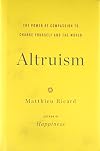
Excellently heartfelt and well-researched tome that arrives at a definition and tackles various subjects such as: Can animals act altruistically; the selfishness of corporations (Monsanto the perfect example), and many others, all with footnotes and a rather extensive bibliography. I particularly enjoyed the section on animals, which waded into the murky waters of stubborn scientists who refuse against all evidence to use language that admits that animals do indeed feel fear and loyalty and show more love; he asks "Can we call a spade a spade?" Ricard furnishes many examples of animals that rather do prove that animals can and do act altruistically (the chimp who dashes across electrical wires to rescue a drowning friend; such spontaneity precluded calculation, but had the other chimp drowned, there would be no point of expecting return kindness in future; and the elephant that lost part of its trunk to a snare, who was assisted and waited on by others until he'd regained some strength). Also really heartening was the Monsanto section in which "Vandana Shiva, recipient of the Right Livelihood Award (the 'alternative Nobel Prize') in 2003 and named by The Guardian one of the 100 most remarkable women in the world, fights against the practices that are at the root of so many acts of despair in India." It gives one hope to read about people fighting against such corporate greed in a country where 270,940 Indian farmer suicides have occurred since 1995. You give capitalism a bad name, Monsanto, procurer of DDT, Agent Orange, GMOs, Roundup, and Aroclor! All in all, a huge, easy-to-read effort from a onetime geneticist who turned his back on his trade. show less
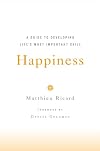
After receiving his doctorate in molecular biology, Frenchman Matthieu Ricard chose to leave his privileged life for the ascetic life of a Buddhist monk. Since then he has been called the happiest person in the world. In this book he describes paths toward happiness drawn from ancient traditions and modern science.
Happiness is a general term encompassing many different experiences. It is important to distinguish pleasure—a fleeting emotion often based on outer circumstances—from show more contentment—an optimal and long-lasting state of being with an enlightened state of mind—the enduring form of happiness discussed in this book.
Ignorance in the form of ego involvement—described here as attachment to the illusion of the self—is the primary obstacle to happiness. A calm mind, attained through mediation, is essential to lifting the veil, seeing past the illusion, and allowing compassion to flourish. Exercises throughout the book help the conscientious reader practice these mental disciplines and move toward optimal states of being.
I imagine detaching the self by visualizing it as a spoiled three year old child. Think of taking a bratty toddler shopping. He might nag you to buy every toy in sight, make cruel and nasty comments about the appearance or behavior of other shoppers, impatiently ask to go home right now, annoy you with constant whining and misbehavior, and start crying at the least inconvenience. But you are not that child; you can use good judgment, act responsibly, calm the child, and move away from those behaviors. Similarly, the self—that bratty ego—can also be displaced, ignored, and silenced, because it has no substance.
Rigorous scientific examination, using EEG, fMRI, and other techniques confirm that monks who have extensively practiced various meditation techniques have achieved remarkably high levels of positive emotional experiences, mental coherence, and peace of mind. Ricard integrates ancient traditions with modern scientific thought to provide a coherent and reliable message.
A variety of mental disciplines are described, including a general technique for dispelling destructive emotions, and specific remedies to extinguish desire, hatred, and envy. Environmental, biological, and sociological factors affecting well-being are described, and many of these are within our control. The role of humility, optimism, perspectives on time, flow, ethics, and death are all explored in their own chapters.
Although the techniques are derived from the Buddhist traditions, they are presented here as entirely secular skills. The book is exceptionally well written, deep, and entirely accessible to the Western reader. This is not a how-to book full of quick fixes and platitudes. The simple paths described here require commitment, discipline, and practice. They may well change your life. show less
Happiness is a general term encompassing many different experiences. It is important to distinguish pleasure—a fleeting emotion often based on outer circumstances—from show more contentment—an optimal and long-lasting state of being with an enlightened state of mind—the enduring form of happiness discussed in this book.
Ignorance in the form of ego involvement—described here as attachment to the illusion of the self—is the primary obstacle to happiness. A calm mind, attained through mediation, is essential to lifting the veil, seeing past the illusion, and allowing compassion to flourish. Exercises throughout the book help the conscientious reader practice these mental disciplines and move toward optimal states of being.
I imagine detaching the self by visualizing it as a spoiled three year old child. Think of taking a bratty toddler shopping. He might nag you to buy every toy in sight, make cruel and nasty comments about the appearance or behavior of other shoppers, impatiently ask to go home right now, annoy you with constant whining and misbehavior, and start crying at the least inconvenience. But you are not that child; you can use good judgment, act responsibly, calm the child, and move away from those behaviors. Similarly, the self—that bratty ego—can also be displaced, ignored, and silenced, because it has no substance.
Rigorous scientific examination, using EEG, fMRI, and other techniques confirm that monks who have extensively practiced various meditation techniques have achieved remarkably high levels of positive emotional experiences, mental coherence, and peace of mind. Ricard integrates ancient traditions with modern scientific thought to provide a coherent and reliable message.
A variety of mental disciplines are described, including a general technique for dispelling destructive emotions, and specific remedies to extinguish desire, hatred, and envy. Environmental, biological, and sociological factors affecting well-being are described, and many of these are within our control. The role of humility, optimism, perspectives on time, flow, ethics, and death are all explored in their own chapters.
Although the techniques are derived from the Buddhist traditions, they are presented here as entirely secular skills. The book is exceptionally well written, deep, and entirely accessible to the Western reader. This is not a how-to book full of quick fixes and platitudes. The simple paths described here require commitment, discipline, and practice. They may well change your life. show less
For me, the most interesting idea that this book had to offer was precisely what one reviewer found upsetting: "the way it treats emotions, by telling yourself to feel differently." The idea that Ricard advocates in this book is to not fall into the trap of feeling that pessimism and "gritty reality" make you perspicacious. This is exactly what keeps smart people from trying to change their situation when they're miserable. Pessimism, though, is a set of emotions just as empty as optimism. show more Optimism, even though it can be far from realistic too, makes the wiser choice, for your own peace of mind and for accomplishing whatever goals you might have in your life. show less
Lists
Awards


You May Also Like


Associated Authors
Statistics
- Works
- 80
- Also by
- 9
- Members
- 4,020
- Popularity
- #6,275
- Rating
- 3.9
- Reviews
- 76
- ISBNs
- 302
- Languages
- 21
- Favorited
- 3


