

James Wallman
Author of Stuffocation
Works by James Wallman
Tagged
Common Knowledge
- Gender
- male
- Education
- University of Oxford
University of the Arts - Occupations
- journalist
- Short biography
- James Wallman is a journalist, trend forecaster, speaker, and author. He has commented on trends happening now, and predicted what will happen next, for publications like GQ, the New York Times, and the Financial Times, and for clients such as Absolut, BMW, Burberry, and Nike. James wrote the futurology column in T3 magazine from 2008-2012, and was editor of a trend consultancy called The Future Laboratory's forecasting publication, LS:N Global, from 2009-2013. James has an MA in Classics from Oxford University and an MA in Journalism from the University of the Arts London. He has lived in France, Greece, and Palo Alto in California and currently lives in London, with his wife and daughter.
- Nationality
- UK
- Places of residence
- London, England, UK
Palo Alto, California, USA
France
Greece
Members
Reviews
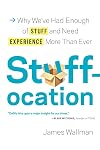
I was hoping for more from this book. Stuffocation - and I'll pause to note, what a great title! - by James Wallman attacks the growth of clutter and materialism in Western culture, and how best to move away from this cultural crisis. He expounds on the history of materialism and how we got here, how we know we are there, and where we can go, not necessarily in that order. He looks at options: minimalism, simple living, and medium chill, before settling on experientialism as the great show more answer.
I wanted to be more impressed, but this book was both annoyingly cynical and idealistic at the same time, which is a feat in and of itself.
The first problem came in the introduction, which is never good. He talks about how we know we are drowning in stuff and gives a very interesting case study about the CELF project, which aimed to see how people in the middle-class U.S. lived. One of the results showed that people frequently feel more trapped by their possessions than they feel happy with them. To find out if you feel this way, he presents a quiz. Now look, this isn't a scholarly, academic book, but its tone certainly tries to present itself as that way, so it's rather jarring to see the bias implicit in these questions. Qualitative studies are very careful to vet questions so they don't lead any way - for instance, like this one: "Are you (a) happy with our current materialistic culture, or (b) do you worry that it is, from an environmental point of view, like the proverbial frog in the saucepan as the water slowly comes to the boil?" (xvii). Oh, well, when you put it like that!
I'm not disagreeing with him, really, just his methods. Clearly the rise of decluttering books and shows and self-help blogs are pointing to a fairly serious problem we have in the United States - and elsewhere - that says we have too much stuff and don't know what to do with it. But his methodology is flawed.
For one thing, though he admits that there might be more of a correlation rather than a causation between stuff and unhappiness, he doesn't dwell on this - and that's a problem, because it's at the core of his argument. We could easily say that people are just disillusioned in general with the world, and swapping marketing from goods to experiences will not cure it, but instead just give us new reasons to be cynical. He answers this by saying that psychologists give the "rose-tinted glasses" effect (his words) to experiences more than goods - meaning that if you buy a bad dress, it's still a bad dress six months later. If you have a camping trip that's miserable, six months later, you may laugh about it. He even brings in the phenomenon of "FOMO", Fear Of Missing Out, that has popped up due to only seeing the best of people's lives posted on Facebook. This is a valid question - after all, FOMO makes people unhappy, right? But he argues that it's still better than materialism because experiences cannot be compared so easily.
Wallman is very keen on status markers. Everyone uses them. In previous years, they were the new Rolex or Porsche in the driveway. He argues that experiences can be the new status markers. However, there are some problems with this.
1. Perhaps people aren't happy with their stuff because they are comparing them to others. Maybe we would be happier if we didn't know that our brand new car isn't the newest model, like our neighbor's or friend's. So exchanging our status markers for experiences means that we will still be comparing ourselves to others, which may be why we're all really unhappy.
2. Okay, okay, but he says that experiences can't be compared as easily! You can go sledding and someone else can go to Tahiti, and how do they compare? Well. Um. Pretty unfavorably. Experiences like, "I went to Tahiti" and "I went to South Africa", sure, there's less of a comparison, because they're more or less equal in terms of money spent, exotic factor, etc. But his argument that they experiences in general cannot be compared, or that anyone can have experiences regardless of monetary status, is fundamentally flawed. They can, and will be - the person who stays home and reads for a vacation is having an experience, but it's not as an exciting one as the person who took a cruise to Alaska for theirs.
Finally, we're reaching the foundation of my problem with this book. I don't think he's wrong in that we need something new, but I don't think that his assertion that experiences are the way to go is right - because there's something deeper at work, and he's scratching the surface. As he would call it, substitution - wherein we exchange the harder question for the easier. He replaces, "Why are we unhappy?" with "What would make us happier than stuff?". Experiences may very well make you happier than your stuff, but not necessarily. There are still social and status markers that invite comparison, making us worry we're not favorably competing with the Jones's vacation to Europe while we went to visit our parents three hours away. There's a wonderful book called The Paradox of Choice that points out that our very abundance of choices causes us unhappiness - and that choice isn't taken away when we have to choose between whether to go to Oregon or Maine for vacation for our experience rather than the Ferrari or the Jaguar.
There are some valid critiques on his focus on the middle-class and what they've accomplished, but most of what I would say has been said, so I won't belabor the point except to say that his cultural forecasting is flawed, as well. For instance, he uses how many have adopted this new way already as a measure - which is great, but you also have to look into why it was adopted in the first place. He asserts that millennials are buying small apartments rather than houses, or not buying cars, or other things - and yet, how many aren't because they're bogged down in student loans and can't afford to? If the student loan problem is solved, will they go back to doing what their parents did, and buying the flashy car and big house in the suburb? Because if so, then we're not moving away from materialism because of a cultural shift of values, but an economic shift.
It's not a bad book. It has some interesting points, and I think it does add to the voices saying that we need to change something, otherwise we're all going to be unhappy - but I'm not sure the Grand Answer he supplies is the one really worth pursuing. show less
I wanted to be more impressed, but this book was both annoyingly cynical and idealistic at the same time, which is a feat in and of itself.
The first problem came in the introduction, which is never good. He talks about how we know we are drowning in stuff and gives a very interesting case study about the CELF project, which aimed to see how people in the middle-class U.S. lived. One of the results showed that people frequently feel more trapped by their possessions than they feel happy with them. To find out if you feel this way, he presents a quiz. Now look, this isn't a scholarly, academic book, but its tone certainly tries to present itself as that way, so it's rather jarring to see the bias implicit in these questions. Qualitative studies are very careful to vet questions so they don't lead any way - for instance, like this one: "Are you (a) happy with our current materialistic culture, or (b) do you worry that it is, from an environmental point of view, like the proverbial frog in the saucepan as the water slowly comes to the boil?" (xvii). Oh, well, when you put it like that!
I'm not disagreeing with him, really, just his methods. Clearly the rise of decluttering books and shows and self-help blogs are pointing to a fairly serious problem we have in the United States - and elsewhere - that says we have too much stuff and don't know what to do with it. But his methodology is flawed.
For one thing, though he admits that there might be more of a correlation rather than a causation between stuff and unhappiness, he doesn't dwell on this - and that's a problem, because it's at the core of his argument. We could easily say that people are just disillusioned in general with the world, and swapping marketing from goods to experiences will not cure it, but instead just give us new reasons to be cynical. He answers this by saying that psychologists give the "rose-tinted glasses" effect (his words) to experiences more than goods - meaning that if you buy a bad dress, it's still a bad dress six months later. If you have a camping trip that's miserable, six months later, you may laugh about it. He even brings in the phenomenon of "FOMO", Fear Of Missing Out, that has popped up due to only seeing the best of people's lives posted on Facebook. This is a valid question - after all, FOMO makes people unhappy, right? But he argues that it's still better than materialism because experiences cannot be compared so easily.
Wallman is very keen on status markers. Everyone uses them. In previous years, they were the new Rolex or Porsche in the driveway. He argues that experiences can be the new status markers. However, there are some problems with this.
1. Perhaps people aren't happy with their stuff because they are comparing them to others. Maybe we would be happier if we didn't know that our brand new car isn't the newest model, like our neighbor's or friend's. So exchanging our status markers for experiences means that we will still be comparing ourselves to others, which may be why we're all really unhappy.
2. Okay, okay, but he says that experiences can't be compared as easily! You can go sledding and someone else can go to Tahiti, and how do they compare? Well. Um. Pretty unfavorably. Experiences like, "I went to Tahiti" and "I went to South Africa", sure, there's less of a comparison, because they're more or less equal in terms of money spent, exotic factor, etc. But his argument that they experiences in general cannot be compared, or that anyone can have experiences regardless of monetary status, is fundamentally flawed. They can, and will be - the person who stays home and reads for a vacation is having an experience, but it's not as an exciting one as the person who took a cruise to Alaska for theirs.
Finally, we're reaching the foundation of my problem with this book. I don't think he's wrong in that we need something new, but I don't think that his assertion that experiences are the way to go is right - because there's something deeper at work, and he's scratching the surface. As he would call it, substitution - wherein we exchange the harder question for the easier. He replaces, "Why are we unhappy?" with "What would make us happier than stuff?". Experiences may very well make you happier than your stuff, but not necessarily. There are still social and status markers that invite comparison, making us worry we're not favorably competing with the Jones's vacation to Europe while we went to visit our parents three hours away. There's a wonderful book called The Paradox of Choice that points out that our very abundance of choices causes us unhappiness - and that choice isn't taken away when we have to choose between whether to go to Oregon or Maine for vacation for our experience rather than the Ferrari or the Jaguar.
There are some valid critiques on his focus on the middle-class and what they've accomplished, but most of what I would say has been said, so I won't belabor the point except to say that his cultural forecasting is flawed, as well. For instance, he uses how many have adopted this new way already as a measure - which is great, but you also have to look into why it was adopted in the first place. He asserts that millennials are buying small apartments rather than houses, or not buying cars, or other things - and yet, how many aren't because they're bogged down in student loans and can't afford to? If the student loan problem is solved, will they go back to doing what their parents did, and buying the flashy car and big house in the suburb? Because if so, then we're not moving away from materialism because of a cultural shift of values, but an economic shift.
It's not a bad book. It has some interesting points, and I think it does add to the voices saying that we need to change something, otherwise we're all going to be unhappy - but I'm not sure the Grand Answer he supplies is the one really worth pursuing. show less
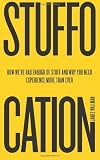
I just finished reading Stuffocation and thoroughly enjoyed it. In fact, I'll give it the highest compliment I can give a book: I want to reread it!
I do have to admit that I wasn't really looking forward to reading this book. I was expecting it to be more of a "how to" book that would (hopefully) help me deal with the massive amount of stuff that weighs me down. While I find those kind of self-help books to be useful, they are seldom fun to immerse myself in. But instead of a dull read, I show more found this to be a delightful book that on one level was very easy and entertaining reading and on another level was very thought provoking. I found myself examining my own thoughts and beliefs and wondering what would happen if I made this or that change or tried this or that idea. I love books that engage me as much as this one did.
In short, James Wallman explores why "stuffocation", his jargon for the effect of the acquisition, maintenance and valuing of objects in our collective and individual consciousness, is such a problem in our society. He explores the history that created our obsession with stuff, discusses some of the problems that our stuff creates, explores the pros and cons of possible solutions that some people have tried, and then moves on to his ideas on how we can change our relationship to stuff. I was fascinated by his description of experiences as the new "stuff" that we collect.
I will say that at times particular passages could have been a bit shorter. But all in all I have recommended this book to friends and family and suggest that you, too, read it. I give it a hearty five stars! show less
I do have to admit that I wasn't really looking forward to reading this book. I was expecting it to be more of a "how to" book that would (hopefully) help me deal with the massive amount of stuff that weighs me down. While I find those kind of self-help books to be useful, they are seldom fun to immerse myself in. But instead of a dull read, I show more found this to be a delightful book that on one level was very easy and entertaining reading and on another level was very thought provoking. I found myself examining my own thoughts and beliefs and wondering what would happen if I made this or that change or tried this or that idea. I love books that engage me as much as this one did.
In short, James Wallman explores why "stuffocation", his jargon for the effect of the acquisition, maintenance and valuing of objects in our collective and individual consciousness, is such a problem in our society. He explores the history that created our obsession with stuff, discusses some of the problems that our stuff creates, explores the pros and cons of possible solutions that some people have tried, and then moves on to his ideas on how we can change our relationship to stuff. I was fascinated by his description of experiences as the new "stuff" that we collect.
I will say that at times particular passages could have been a bit shorter. But all in all I have recommended this book to friends and family and suggest that you, too, read it. I give it a hearty five stars! show less
 This review was written for LibraryThing Early Reviewers.
Review for Librarything Early Reviewers:
"Stuffocation" has as its premise the idea that the 21st century developed world is tired of consumerism and is looking for another way of life. Wallman, a forecaster of future trends, attempts to predict which way of life currently being tried by the century’s trendsetters will become the standard approach in the next half century. To explain the various attempts, Wallman goes into the history of consumerism and then gives histories or case studies show more of his chosen trendsetters before drawing his conclusions and making his prediction. He does mention the growing consumer societies of China and other developing countries briefly but his focus is on the developed world with especial reference to the USA and the UK.
"Stuffocation" is a well written and an easy read without too much reliance on jargon or statistics. As well, it has extensive endnotes so if the reader is interested in one specific trend or topic it is possible to find Wallman’s references and investigate further if desired. The only quibble I had with the book is that the conspicuous consumers and trendsitters are all clearly in the very small percentage of the developed world with not just disposable income but with large amounts of disposable income. Wallman seems to make the assumption that all people following the trendsetters (he does make a few generalisations in his conclusions) are in the same situation but never addresses the possibility that the decrease in home ownership and various other forms of consumerism may be related to decreasing disposable income and increasing difficulty in affording necessities not just luxuries.
Apart from that caveat, I thoroughly enjoyed the book and not only would but have recommended it as a fascinating and thought provoking read. show less
"Stuffocation" has as its premise the idea that the 21st century developed world is tired of consumerism and is looking for another way of life. Wallman, a forecaster of future trends, attempts to predict which way of life currently being tried by the century’s trendsetters will become the standard approach in the next half century. To explain the various attempts, Wallman goes into the history of consumerism and then gives histories or case studies show more of his chosen trendsetters before drawing his conclusions and making his prediction. He does mention the growing consumer societies of China and other developing countries briefly but his focus is on the developed world with especial reference to the USA and the UK.
"Stuffocation" is a well written and an easy read without too much reliance on jargon or statistics. As well, it has extensive endnotes so if the reader is interested in one specific trend or topic it is possible to find Wallman’s references and investigate further if desired. The only quibble I had with the book is that the conspicuous consumers and trendsitters are all clearly in the very small percentage of the developed world with not just disposable income but with large amounts of disposable income. Wallman seems to make the assumption that all people following the trendsetters (he does make a few generalisations in his conclusions) are in the same situation but never addresses the possibility that the decrease in home ownership and various other forms of consumerism may be related to decreasing disposable income and increasing difficulty in affording necessities not just luxuries.
Apart from that caveat, I thoroughly enjoyed the book and not only would but have recommended it as a fascinating and thought provoking read. show less
This review was written for LibraryThing Early Reviewers.The author of Stuffocation shines a fresh light on the materialism that afflicts many Americans. The book is a blend of history, anthropology, ethnography and case studies showing the impact of too much stuff in our homes, garages and storage sheds. I expected a book about clutter-busting but James Wallman takes a different approach. It is not about organizing the stuff. Rather it is about minimizing the stuff and, instead, spending time and money on experiences. Most of the case studies are show more about people who have whittled their possessions down to a minimum, in some cases as few as 33 or 100 items. Some have quit jobs and sold homes in order to indulge in world travel or move to cabins in the woods. They walk away from rampant consumerism and pursue their dreams. While some readers may not have the freedom or resources to quit a job and totally revamp their lifestyle, this is a worthwhile read for one seeking inspiration to refocus on the things that matter. show less
This review was written for LibraryThing Early Reviewers.You May Also Like


Statistics
- Works
- 4
- Members
- 362
- Popularity
- #66,318
- Rating
- 3.6
- Reviews
- 44
- ISBNs
- 19
- Languages
- 3


