
Catherine Hanley (2) (1972–)
Author of Matilda: Empress, Queen, Warrior
For other authors named Catherine Hanley, see the disambiguation page.
Works by Catherine Hanley
Tagged
Common Knowledge
- Birthdate
- 1972
- Gender
- female
- Occupations
- medievalist
- Organizations
- Wisden Cricketers' Almanack
- Nationality
- Australia
- Birthplace
- Perth, Western Australia, Australia
- Associated Place (for map)
- Western Australia, Australia
Members
Reviews
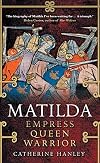
Generally speaking, when I pick up a book outside of my staple choices (science fiction & fantasy, military history, etc.), it's because, at some point, I had a question. In this case, the question was how do you go from the Norman rulers of England, to the Plantagenet monarchs, not that I expected this book to necessarily answer that question, but because Matilda seemed like an interesting personage. Well, by the time I was done, I now have the sense that the history I was exposed to back show more in the day (we're talking 1970s here), just glossed over this woman as being something of an embarrassment. And there was nothing to be embarrassed about; betrothed to the German Emperor at 8, regent of Imperial holdings in Italy at 16, polished diplomat and executive in her 20s, ruthless defender of her rights until she fought her opposition to a draw, the ancestor of every English/British monarch down to the current day, and arguably, the first exemplar of a national female executive in the Western world. Even if you want to accuse Hanley of putting the best spin possible on Matilda, one can't help but be impressed. If you want to argue that the best stories can't be made up, this book is your proof. The only reason I don't give Hanley five stars is because, for all I know, I'd be more impressed with some of the more canonical books on Matilda that she's glossing for a general audience. show less
In 1216 the nobility of England was frustrated with their King. John was vicious, a womaniser and a mean ruler and the barons had had enough of the hard fought Magna Carta being ignored. They asked the French Dauphin, Louis, to come to England and take over. Louis landed with a small force and was acknowledged by some parts of the country. The. John died and suddenly his heir was a nine-year old boy, Henry III. Over the next year England was at war and over the course of three major events show more the future was determined.
Hanley is a great writer about the High Middle Ages and this book manages to be both scholarly and eminently readable. This is a period of history that I was aware of but had read little about and so it was a joy to discover the danger that the country was in as it teetered on the precipice of becoming part of France. As Hanley points out, the sense of England as an independent territory began here as there was a shift from the rule of the 'Normans', when John lost control of Normandy then England was irretrievably separated. There are some wonderful characters introduced eg, Nichola de la Haye, and revisited - I galloped through, enjoying every page. show less
Hanley is a great writer about the High Middle Ages and this book manages to be both scholarly and eminently readable. This is a period of history that I was aware of but had read little about and so it was a joy to discover the danger that the country was in as it teetered on the precipice of becoming part of France. As Hanley points out, the sense of England as an independent territory began here as there was a shift from the rule of the 'Normans', when John lost control of Normandy then England was irretrievably separated. There are some wonderful characters introduced eg, Nichola de la Haye, and revisited - I galloped through, enjoying every page. show less
In their introduction, Hanley states that "this book is not a biography in the traditional sense." Indeed, it tells the life of Philip Augustus through his campaigns against the royal Plantagenet family of England. It began with Henry II, who was 47 when Philip - aged 16 - became King of France. Henry II controlled vast portions of France, largely thanks to his marriage to indomitable Eleanor of Aquitaine, but suffered from near constant familial turmoil. Of his sons, Richard the Lionheart, show more later Richard II, reveled in being the biggest thorn in Philip's side. Hanley explains that traditionally, Philip "has been portrayed as a schemer who avoided combat," but truthfully "his military prowess has been vastly underrated." Richard may have had the reputation of a foolishly brave yet cruel warrior, but Philip knew how to play the long game, facing his enemy in battle when the time was right. France remained Philip's top priority, for worse or better, and he outlived them all.
I enjoyed this one, especially when Hanley delivers a line of biting sarcasm to take these royal lads down a peg. However, I thought that Philip's exceptional anti-Semitism, his willful detachment from the persecution of the Cathars, and his cold treatment of his wife, were not explored nearly enough. Hanley brings up these points, offhandedly and at various times as personality flaws, but just as quickly moves on. I realize that Hanley has generations of "jolly King Richard" myth to overcome, but Philip's own cruel actions cannot be understated or ignored. That being said, Hanley's descriptions of the siege of Château Gaillard and the Battle of Bouvines were excellent and the action packed family drama never lets up. show less
I enjoyed this one, especially when Hanley delivers a line of biting sarcasm to take these royal lads down a peg. However, I thought that Philip's exceptional anti-Semitism, his willful detachment from the persecution of the Cathars, and his cold treatment of his wife, were not explored nearly enough. Hanley brings up these points, offhandedly and at various times as personality flaws, but just as quickly moves on. I realize that Hanley has generations of "jolly King Richard" myth to overcome, but Philip's own cruel actions cannot be understated or ignored. That being said, Hanley's descriptions of the siege of Château Gaillard and the Battle of Bouvines were excellent and the action packed family drama never lets up. show less
A very solid biography of Matilda, one-time German Empress and would-be Queen of the English in the twelfth century. Matilda has long been in that shadowy hinterland of a historical figure whose name is well-known but who has attracted comparatively little historiographical attention in her own right, dismissed as an arrogant woman doomed by her own folly. Historians in the 19th century would even go so far as to write not of "Matilda's party" but of "Robert's party" in the war, attributing show more the impetus for the struggle over the English crown not to a mere woman such as Matilda, but rather to her half-brother and loyal general, Robert of Gloucester.
Marjorie Chibnall's The Empress Matilda: Queen Consort, Queen Mother and Lady of the English was the first full-length study of Matilda, produced in the early 1990s, and it still has much to recommend it. However, Catherine Hanley's Matilda has the benefit of incorporating the insights of some 30 years of subsequent scholarship on women's history and queenship studies, and Hanley also writes clearly and accessibly for general audiences. I particularly liked her habit of pausing every so often to remind the reader of who was who among the plethora of Matildas and Williams.
Inasmuch as one can in a biography of a medieval figure, Hanley sketches a Matilda who is both more appealing and more convincing than the general stereotypes. I do have a number of question marks against some of Hanley's conclusions about medieval gender and power, and some things I would have liked to see more of. Matilda's patronage of the church, for instance, is only glanced on here but it was an important part of her exercise of authority—I know less sexy than battles and escapes, but still crucial to getting as rounded a picture of her as possible. But those are of course differences of interpretation and emphasis, and those and indeed the book as a whole would be excellent to use in an undergraduate classroom. show less
Marjorie Chibnall's The Empress Matilda: Queen Consort, Queen Mother and Lady of the English was the first full-length study of Matilda, produced in the early 1990s, and it still has much to recommend it. However, Catherine Hanley's Matilda has the benefit of incorporating the insights of some 30 years of subsequent scholarship on women's history and queenship studies, and Hanley also writes clearly and accessibly for general audiences. I particularly liked her habit of pausing every so often to remind the reader of who was who among the plethora of Matildas and Williams.
Inasmuch as one can in a biography of a medieval figure, Hanley sketches a Matilda who is both more appealing and more convincing than the general stereotypes. I do have a number of question marks against some of Hanley's conclusions about medieval gender and power, and some things I would have liked to see more of. Matilda's patronage of the church, for instance, is only glanced on here but it was an important part of her exercise of authority—I know less sexy than battles and escapes, but still crucial to getting as rounded a picture of her as possible. But those are of course differences of interpretation and emphasis, and those and indeed the book as a whole would be excellent to use in an undergraduate classroom. show less
Lists
You May Also Like


Statistics
- Works
- 7
- Members
- 346
- Popularity
- #69,042
- Rating
- 4.2
- Reviews
- 7
- ISBNs
- 26