
About the Author
Scientist Irene Maxine Pepperberg was born in Brooklyn, New York on April 1, 1949. She received her B.S. from the Massachusetts Institute of Technology and her M.A. and Ph.D. from Harvard University. Pepperberg is an adjunct psychology professor at Brandeis University and active in wildlife show more conservation. She is also the president and founder of The Alex Foundation, a non-profit organization. Pepperberg's studies focus on animal cognition, animal behavior, and comparative psychology, and she is well-known for her successful work in teaching Alex, an African Grey Parrot, a large vocabulary and the ability to identify objects by color, shape, number, and material. Pepperberg has published many scholarly books and articles, which appear in journals including Animal Cognition and the Journal of Comparative Psychology. She also wrote the New York Times-bestseller Alex and Me: How a Scientist and a Parrot Uncovered a Hidden World of Animal Intelligence--and Formed a Deep Bond in the Process. (Bowker Author Biography) show less
Image credit: Irene Pepperberg and Alex
Works by Irene M. Pepperberg
Alex and Me: How a Scientist and a Parrot Uncovered a Hidden World of Animal Intelligence and Formed a Deep Bond in the Process (2008) 1,135 copies, 81 reviews
The Alex Studies: Cognitive and Communicative Abilities of Grey Parrots (1999) 117 copies, 4 reviews
Associated Works
What Is Your Dangerous Idea? Today's Leading Thinkers on the Unthinkable (2007) — Contributor — 668 copies, 8 reviews
Tagged
Common Knowledge
- Canonical name
- Pepperberg, Irene M.
- Other names
- Pepperberg, Irene Maxine
- Birthdate
- 1949-04-01
- Gender
- female
- Education
- Harvard University (PhD|Chemistry|1976)
Harvard University (AM|Chemistry|1971)
Massachusetts Institute of Technology (SB|Chemistry|1969) - Occupations
- scholar of animal cognition
conservationist
university professor - Organizations
- Harvard University
Brandeis University - Nationality
- USA
- Birthplace
- Brooklyn, New York, USA
- Places of residence
- Brooklyn, New York, USA
Cambridge, Massachusetts, USA
Chicago, Illinois, USA
Tucson, Arizona, USA - Associated Place (for map)
- USA
Members
Reviews
Alex & Me: How a Scientist and a Parrot Discovered a Hidden World of Animal Intelligence--and Formed a Deep Bond in the Process by Irene M. Pepperberg
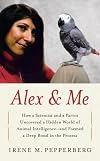
Irene grew up in a family with a deficit of love and companionship, except for a parakeet that her father bought her as a pet. She loved that parakeet and it was her constant companion. So it is not a total surprise, after obtaining degrees in chemistry and biochemistry, that she might turn to animal communication as her postgraduate field of study and that she would decide to use the African Gray Parrot, renowned for its ability to talk and mimic the sounds of other animals and people. show more Despite difficulties finding stable faculty positions, she managed to do groundbreaking work in animal communication and linguistics with her beloved parrot, Alex. Alex seemed to be an extremely intelligent parrot who, often as not, would purposely give the wrong answer unless she did something he wanted, or often interrupt training sessions with other parrots to give the right answer. He also used to ask questions and give answers he was never taught and seemed to understand principles such as quantity, the idea of zero and other ideas often thought to be too sophisticated for a "bird brain". A lifelong relationship, ended too soon by Alex's death at the age of 31, was a rewarding scientific journey and a wonderful story about how a person and a parrot can grow to value each other's company. I highly recommend reading this book for its novelty, its warmth, the science and the humor. show less
Alex & Me: How a Scientist and a Parrot Discovered a Hidden World of Animal Intelligence--and Formed a Deep Bond in the Process by Irene M. Pepperberg

Irene Pepperberg had a PhD in chemistry, but found that she was more intrigued by the questions of intelligence in birds, which had been her pets from childhood.
She managed to wrangle some space in a behavioral research lab and soon acquired a newly hatched gray parrot, which, she chose completely at random to bolster her scientific results. She named the little chick Alex (Avian Learning Experiment) and began nurturing him to adulthood.
It was the 1970’s and people had discovered that show more chimpanzees could acquire human knowledge. But those same researchers believed that no lower form of life such as a bird - especially with brains like Alex's the size of a walnut - would be able to do more than mimic sounds.
Irene and Alex proved them wrong as Alex learned colors, shapes, concepts such as fewer, more and even zero as well as being able to request food and put words together in new ways.
The bird also had a highly mischievous side as he would sometimes stubbornly give wrong answers when he was tired of the researchers repeating questions. When younger birds became part of learning experiments, Alex would sometimes help the beginner with the right answers – and sometimes on purpose give the poor learner the wrong answer.
Altogether, Alex proved that gray parrots can acquire language equal to or even beyond what chimpanzees are capable of doing. I’ll never look at birds in quite the same way after reading this book. show less
She managed to wrangle some space in a behavioral research lab and soon acquired a newly hatched gray parrot, which, she chose completely at random to bolster her scientific results. She named the little chick Alex (Avian Learning Experiment) and began nurturing him to adulthood.
It was the 1970’s and people had discovered that show more chimpanzees could acquire human knowledge. But those same researchers believed that no lower form of life such as a bird - especially with brains like Alex's the size of a walnut - would be able to do more than mimic sounds.
Irene and Alex proved them wrong as Alex learned colors, shapes, concepts such as fewer, more and even zero as well as being able to request food and put words together in new ways.
The bird also had a highly mischievous side as he would sometimes stubbornly give wrong answers when he was tired of the researchers repeating questions. When younger birds became part of learning experiments, Alex would sometimes help the beginner with the right answers – and sometimes on purpose give the poor learner the wrong answer.
Altogether, Alex proved that gray parrots can acquire language equal to or even beyond what chimpanzees are capable of doing. I’ll never look at birds in quite the same way after reading this book. show less
Alex & me : how a scientist and a parrot discovered a hidden world of animal intelligence--and formed a deep bond in the process by Irene M. Pepperberg

This was a book that I could not put down once I started it. Because I knew from the beginning that Alex, the African Grey parrot who helped Dr. Irene M. Pepperberg with her research, was no longer alive, I wanted to find out what happened to him.
Along the way, I was introduced to two separate worlds. One was world of the investigator and how Dr. Pepperberg had to cope with the difficulties of obtaining research funding to carry on what was deemed as "off-the-beaten-track" research. The show more other was the world of the intellectual capabilities the African Grey parrot. Dr. Pepperberg had several of these, but Alex was the one with which she began her research and who became best-known of all her birds.
Dr. Pepperberg describes the intertwining of these two worlds in a way that is captivating, humorous, and surprising. She ends her story with a beautiful note of how all nature is connected and Homo Sapiens are really not as supreme as we would like to think. show less
Along the way, I was introduced to two separate worlds. One was world of the investigator and how Dr. Pepperberg had to cope with the difficulties of obtaining research funding to carry on what was deemed as "off-the-beaten-track" research. The show more other was the world of the intellectual capabilities the African Grey parrot. Dr. Pepperberg had several of these, but Alex was the one with which she began her research and who became best-known of all her birds.
Dr. Pepperberg describes the intertwining of these two worlds in a way that is captivating, humorous, and surprising. She ends her story with a beautiful note of how all nature is connected and Homo Sapiens are really not as supreme as we would like to think. show less

Frankly, Irene by herself is not appealing. So her childhood and adolescence in the first third of the book; and her afterward mourning and preaching detract from the book. Alex is the star, and scenes without him are just irrelevant filler material.
Alex is quite a personality. And while Pepperberg is always careful to couch her results so as to not claim too much, Alex' intelligence and wit shine through.
Alex is quite a personality. And while Pepperberg is always careful to couch her results so as to not claim too much, Alex' intelligence and wit shine through.
Lists
You May Also Like


Associated Authors
Statistics
- Works
- 3
- Also by
- 2
- Members
- 1,253
- Popularity
- #20,469
- Rating
- 3.9
- Reviews
- 85
- ISBNs
- 19
- Languages
- 3
- Favorited
- 1