
Mario Levrero (1940–2004)
Author of The Luminous Novel
About the Author
Series
Works by Mario Levrero
מוזרים : אנתולוגיית סיפורי פנטזיה, אימה ומסתורין — Author — 2 copies
No vendo piso 1 copy
Burdeos 2003 1 copy
Diario de un canalla 1986-87 1 copy
El discurso vacio 1996 1 copy
El sótano 1 copy
Noveno piso 1 copy
La Cuidad 1 copy
La calle de los mendigos 1 copy
La novela luminosa 2005 1 copy
Associated Works
Cuentos fantásticos y de ciencia ficción en América Latina — Contributor — 1 copy
Tagged
Common Knowledge
- Legal name
- Varlotta Levrero, Jorge Mario
- Birthdate
- 1940-01-23
- Date of death
- 2004-08-30
- Gender
- male
- Occupations
- photographer
Librero
Guionista
Dibujante de Comics
Levantador de Quiniela
Secretario de Redacción de Revista de Crucigramas - Awards and honors
- Guggenheim Fellowship (2000)
- Nationality
- Uruguay
- Birthplace
- Montevideo, Uruguay
- Places of residence
- Montevideo, Uruguay
Rosario, Argentina
Piriápolis, Uruguay
Colonia, Uruguay
Burdeos, Francia
Buenos Aires, Argentina - Place of death
- Montevideo, Uruguay
- Map Location
- Uruguay
Members
Reviews
Incredible. I wish I could figure out how Levrero turns what in a lesser author's hands would just be a record of anxiety and navel-gazing into something entirely relevant, relatable, and funny to boot. In other words, something very human, and maybe because it's not at all insistent on drilling anything into the reader. Felt like Knausgaard, but in a much lighter mode. Loved every minute of this book.
This book takes a different direction into the realm of bedtime reads, steering toward the reality of tired parents and using easy, psychological tools like yawns to sink into the world of dreams. In other words, it's original and clever.
Nicol wants a reader identified only as 'me' to tell him a bedtime tale, but 'Me' is more than tired and can barely stay awake enough to fulfill the task. It's a scene parents will easily relate to. As 'Me' tries to appease Nicol, 'Me' steers into the show more wildest and oddest tales, but each time, Nicol wants to hear one more. 'Me' gives in until six stories are told.
The book is written as a back and forth between Nicol and a reader. The name of either 'Me' or Nicol introduce what each one says...a bit like a play. This offers all sorts of possibilities to the adult reading the book, when done as a read-aloud, but on the other hand, the style also requires more of the person reading it. For the right parents, it allows their talents to shine.
But then, this isn't a book for the youngest listeners, either. The text is more suited to ages 4/5 and up. The author has built in many 'yawns', which might seem redundant and weird, but actually, this is a clever way to use the 'yawns are contagious' phenomenon, which can help put listeners (and maybe readers) to sleep. Add the unique illustrations, which allow the quirkiness of 'Me's' tales to comes across with an original and strange flair, and it's not your usual bedtime read. It might not be everyone's thing, but it stands out and does the job in its own way. I received an ARC. show less
Nicol wants a reader identified only as 'me' to tell him a bedtime tale, but 'Me' is more than tired and can barely stay awake enough to fulfill the task. It's a scene parents will easily relate to. As 'Me' tries to appease Nicol, 'Me' steers into the show more wildest and oddest tales, but each time, Nicol wants to hear one more. 'Me' gives in until six stories are told.
The book is written as a back and forth between Nicol and a reader. The name of either 'Me' or Nicol introduce what each one says...a bit like a play. This offers all sorts of possibilities to the adult reading the book, when done as a read-aloud, but on the other hand, the style also requires more of the person reading it. For the right parents, it allows their talents to shine.
But then, this isn't a book for the youngest listeners, either. The text is more suited to ages 4/5 and up. The author has built in many 'yawns', which might seem redundant and weird, but actually, this is a clever way to use the 'yawns are contagious' phenomenon, which can help put listeners (and maybe readers) to sleep. Add the unique illustrations, which allow the quirkiness of 'Me's' tales to comes across with an original and strange flair, and it's not your usual bedtime read. It might not be everyone's thing, but it stands out and does the job in its own way. I received an ARC. show less
These are notes about a curious little book by Mario Levrero.
I wish I could add a couple of the images that accompany this work in my review. But the version I’m reading has one of those software thingies that stick the image to the page, protecting it from abuse by malevolent reviewers like myself. I love the drawings. They are beautiful and haunting. More so than the words on the page. They are often sparse, much white space, black and white with the right touch of vivid colour to play show more with your experience of the whole. Sometimes they are big and bold juxtaposing multitudes into one space. But they sometimes work too close to the text. Or the text works too close to them. Apart, they are excellent, together, less so. Or maybe, I want more somehow. I’m going to say, it’s not you, it’s me.
Levrero’s prose is sparse and concise too. Sentences generally short, descriptive of action. Cute and sinister at the same time. Nah, Levrero can’t do sinister. He’s like your funny looking uncle at Christmas gatherings. So this is play with words. And images that play too. I have an affection for image and text.
The hunter doesn’t see those red eyes, sharp and shining, alert to any movement. As the hunter closes in, the rabbit in heat leaps, releasing a terrifying roar that sends a shudder through the forest. The hunter, taken by surprise, stands paralyzed and makes no attempt at defense. The fight would not be fair, in any case: a few quick swipes, a well-placed bite, and then the rabbit takes off, dragging a loose and bloody cadaver that will amount to a feast for all the hungry bunnies.
They say they’re going to hunt rabbits but they picnic instead. They dance around an old Victrola, steal kisses among the trees, fish or pretend to fish while sleeping. They eat and drink, singing when they return to the castle in a rented omnibus always too small for everyone. The rabbits take advantage of the leftovers. These fake, drunk hunters often forget their Victrola. So the rabbits dance, under the moonlight, to the sound of wild old music until dawn. .
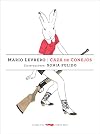
The accompanying drawing is of a rabbit and a hunter each wearing a mask. The illustrator is Sonia Pulido. Inversion of role is essential for the images to transform the weird into the known. Surreal works with a dead pan style, too. Dead pan prose drawing vivid images. It’s like Alice has wandered into a field and she’s learned from wonderland how to exist in the new paradigm.
Properly tanned rabbit skin makes silky gloves to caress our naked bodies in solitude. Our children play marbles with the eyes. Rabbit teeth are marvelous beads for the necklaces and bracelets our women wear. We eat the meat. With the tripe we make strings for our musical instruments. Our music is profound and sad.
This kind of sums up some of Levrero’s ways. The erotic and mundane mix with a bittersweet emotion. Despite the subject which can be brutal at times, he normalises oddness.
I’ve often worked with an artist who creates books. The first thing we did together years ago was a text-image story that the editor called photo-fiction. It remained the only category twenty-five years ago that we could slip into. And it had to be invented on the spot by the editor. The journal over its long history had never published photo fiction before, and so it was new. It also never did photo-text-montage fiction either. But that’s a mouthful. But less categorical. What did I learn from working with an artist in words and image that blurred between author and artist, so that neither was one nor the other? Images never illustrate, they tell their own story. And words don’t need to explain images when used together. And I never did. The other day, I caught myself doing just that and told myself off for it. Some of the images here tend towards the illustration of text. Sometimes they repeat the text with an image copy of it. They stand up on their own as images for their clarity. They are subtle, clear and vivid on their own, unlike the text which tends towards the absurd rather than the horrifying. By the second half of the 20thC was it even possible to experience horror in a book? It’s everywhere in life. But one thing I really liked was the idea that rabbits weren’t really rabbits. But the rabbit hunt was really some erotic journey of sadistic followed by masochistic fantasy. When one illustration turns rabbits into women with rabbit it ears, I realised I was lost in the woods and fields at times. The whole book may really just be a kind of sexual battle ground of frustrations and endless impossible to achieve desires.
The work I read is not the same as the one I’ve added my review to. I was sent a copy to read by the translator, some of you might know him as Lee Klein the author, but he’s also a translator, and he travels among us here regularly at GR. And I liked this translation. I never felt I was struggling to believe the text and wondering if I’m missing something from the original. Lee let me read it, because apparently the estate won’t accept it for publication. And he noticed a fellow traveller through the land of Levrero. It’s a shame it wasn’t accepted by the estate, because I enjoyed both elements, each in their own way. And I love Mario Levrero and can’t wait for more of his work to appear in English. He’s one of those authors who seem to cross the translation boundary and the feel of their prose is somehow universal (I know, no one uses that word anymore. Though we share more with each other than not, except consciousness. Which is why we have writers and artists.)
Classic Levrero
After an epoch of brilliant hullabaloo, the only sound that remains is the tick tock of an enormous, antique grandfather clock. The sound irritates me and causes insomnia. But I cannot stop winding it — yearning for the past, it helps me count every minute I survive in disgrace. It is, as well, a form of company.
And
In place of the rosebush they had erected a huge mud statue in the form of a rabbit that looked in my direction with one hand on its genitals making an obscene gesture and the other thumbing its snout at me. show less
I wish I could add a couple of the images that accompany this work in my review. But the version I’m reading has one of those software thingies that stick the image to the page, protecting it from abuse by malevolent reviewers like myself. I love the drawings. They are beautiful and haunting. More so than the words on the page. They are often sparse, much white space, black and white with the right touch of vivid colour to play show more with your experience of the whole. Sometimes they are big and bold juxtaposing multitudes into one space. But they sometimes work too close to the text. Or the text works too close to them. Apart, they are excellent, together, less so. Or maybe, I want more somehow. I’m going to say, it’s not you, it’s me.
Levrero’s prose is sparse and concise too. Sentences generally short, descriptive of action. Cute and sinister at the same time. Nah, Levrero can’t do sinister. He’s like your funny looking uncle at Christmas gatherings. So this is play with words. And images that play too. I have an affection for image and text.
The hunter doesn’t see those red eyes, sharp and shining, alert to any movement. As the hunter closes in, the rabbit in heat leaps, releasing a terrifying roar that sends a shudder through the forest. The hunter, taken by surprise, stands paralyzed and makes no attempt at defense. The fight would not be fair, in any case: a few quick swipes, a well-placed bite, and then the rabbit takes off, dragging a loose and bloody cadaver that will amount to a feast for all the hungry bunnies.
They say they’re going to hunt rabbits but they picnic instead. They dance around an old Victrola, steal kisses among the trees, fish or pretend to fish while sleeping. They eat and drink, singing when they return to the castle in a rented omnibus always too small for everyone. The rabbits take advantage of the leftovers. These fake, drunk hunters often forget their Victrola. So the rabbits dance, under the moonlight, to the sound of wild old music until dawn. .
The accompanying drawing is of a rabbit and a hunter each wearing a mask. The illustrator is Sonia Pulido. Inversion of role is essential for the images to transform the weird into the known. Surreal works with a dead pan style, too. Dead pan prose drawing vivid images. It’s like Alice has wandered into a field and she’s learned from wonderland how to exist in the new paradigm.
Properly tanned rabbit skin makes silky gloves to caress our naked bodies in solitude. Our children play marbles with the eyes. Rabbit teeth are marvelous beads for the necklaces and bracelets our women wear. We eat the meat. With the tripe we make strings for our musical instruments. Our music is profound and sad.
This kind of sums up some of Levrero’s ways. The erotic and mundane mix with a bittersweet emotion. Despite the subject which can be brutal at times, he normalises oddness.
I’ve often worked with an artist who creates books. The first thing we did together years ago was a text-image story that the editor called photo-fiction. It remained the only category twenty-five years ago that we could slip into. And it had to be invented on the spot by the editor. The journal over its long history had never published photo fiction before, and so it was new. It also never did photo-text-montage fiction either. But that’s a mouthful. But less categorical. What did I learn from working with an artist in words and image that blurred between author and artist, so that neither was one nor the other? Images never illustrate, they tell their own story. And words don’t need to explain images when used together. And I never did. The other day, I caught myself doing just that and told myself off for it. Some of the images here tend towards the illustration of text. Sometimes they repeat the text with an image copy of it. They stand up on their own as images for their clarity. They are subtle, clear and vivid on their own, unlike the text which tends towards the absurd rather than the horrifying. By the second half of the 20thC was it even possible to experience horror in a book? It’s everywhere in life. But one thing I really liked was the idea that rabbits weren’t really rabbits. But the rabbit hunt was really some erotic journey of sadistic followed by masochistic fantasy. When one illustration turns rabbits into women with rabbit it ears, I realised I was lost in the woods and fields at times. The whole book may really just be a kind of sexual battle ground of frustrations and endless impossible to achieve desires.
The work I read is not the same as the one I’ve added my review to. I was sent a copy to read by the translator, some of you might know him as Lee Klein the author, but he’s also a translator, and he travels among us here regularly at GR. And I liked this translation. I never felt I was struggling to believe the text and wondering if I’m missing something from the original. Lee let me read it, because apparently the estate won’t accept it for publication. And he noticed a fellow traveller through the land of Levrero. It’s a shame it wasn’t accepted by the estate, because I enjoyed both elements, each in their own way. And I love Mario Levrero and can’t wait for more of his work to appear in English. He’s one of those authors who seem to cross the translation boundary and the feel of their prose is somehow universal (I know, no one uses that word anymore. Though we share more with each other than not, except consciousness. Which is why we have writers and artists.)
Classic Levrero
After an epoch of brilliant hullabaloo, the only sound that remains is the tick tock of an enormous, antique grandfather clock. The sound irritates me and causes insomnia. But I cannot stop winding it — yearning for the past, it helps me count every minute I survive in disgrace. It is, as well, a form of company.
And
In place of the rosebush they had erected a huge mud statue in the form of a rabbit that looked in my direction with one hand on its genitals making an obscene gesture and the other thumbing its snout at me. show less
Sleepy Stories is a collection of bedtime stories quite unlike the typical style. You have this dad who pleads sleepiness but his son refuses to listen to him and wants one more story. All the stories that the father narrates are related to characters falling into a deep sleep. What makes the stories funnier are the yawns that are interspersed in the narrative. But I expected far more from the book. There are barely 6 stories in the book. In fact, there are more pages of illustrations than show more stories. (The illustrations are ok though; they reminded me of old Russian storybooks I read in my childhood.) The font size is extremely small (at least in the ARC copy I received). It didn’t make for a comfortable digital read.
The idea is definitely good and might work well as a read-aloud at bedtime. But this entirely depends on the narrative capabilities of the parent.
Thank you, NetGalley and Elsewhere Editions, for the Advanced Review Copy of the book in exchange for an honest review.
***********************
Join me on the Facebook group, Readers Forever!, for more reviews, book-related discussions and fun.
Follow me on Instagram: RoshReviews show less
The idea is definitely good and might work well as a read-aloud at bedtime. But this entirely depends on the narrative capabilities of the parent.
Thank you, NetGalley and Elsewhere Editions, for the Advanced Review Copy of the book in exchange for an honest review.
***********************
Join me on the Facebook group, Readers Forever!, for more reviews, book-related discussions and fun.
Follow me on Instagram: RoshReviews show less
Lists
Awards


You May Also Like


Associated Authors
Statistics
- Works
- 45
- Also by
- 2
- Members
- 695
- Popularity
- #36,411
- Rating
- 3.8
- Reviews
- 19
- ISBNs
- 107
- Languages
- 8
- Favorited
- 2
