
Volker Braun
Author of Unvollendete Geschichte
About the Author
Image credit: October 2006
Works by Volker Braun
Guevara oder Der Sonnenstaat. Mit 11 Holzschnitten u. 5 Malbriefen von HAP Grieshaber (1983) 2 copies
Stücke 1 copy
Stücke 1 copy
Proces Galilei 1 copy
What's really wanted : three stories ; and, Break down power relations : Georg Büchner prize 2000 acceptance speech (2009) 1 copy
Vorläufiges 1 copy
Wir Befinden Uns Soweit Wohl. Wir Sind Erst Einmal Am Ende. (Edition Suhrkamp) (German Edition) (1998) 1 copy
Vorläufiges 1 copy
Associated Works
Die Geschichtenerzähler: Neues und Unbekanntes von Allende bis Zafón (suhrkamp taschenbuch) (2008) — Contributor — 5 copies
Tagged
Common Knowledge
- Canonical name
- Braun, Volker
- Birthdate
- 1939-05-07
- Gender
- male
- Occupations
- Schriftsteller
- Organizations
- Berliner Akademie der Künste
Deutsche Akademie für Sprache und Dichtung - Awards and honors
- Georg Büchner Preis (2000)
- Nationality
- Germany
- Birthplace
- Dresden, Sachsen, Deutschland
- Places of residence
- Dresden, Germany (birth)
Berlin, Germany - Associated Place (for map)
- Germany
Members
Reviews
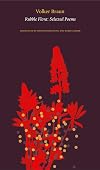
What struck me particularly about this volume is how academic it is. The translations, the introduction, the contextualization and the framework for the poems, are all so ... perhaps muted is the right word. Everything doused in the attempt at fidelity and objectivity. There is light in these poems, and lyric, and beauty, but for the most part they are a bit limp on the page. It's especially interesting when you get to one of the poems translated by David Constantine because they are so show more sharply contrasted to the ones translated by Karen Leeder. The ones translated by Leeder are fine, some are very good, and they have the form and craft of someone who's studied poetry. But the Constantine ones sing. It's that ineffable quality that shifts the poetry from meaning to art that is re-infused in the language of Constantine's translations.
Perhaps it has something to do with choice, too. Leeder's translations tend to be the more political, the more referential to context and other poets. Her interest in them is evidently first scholarly and then poetic. Compare these two poems, the first in Leeder's translation, the second in Constantine's, and appearing in that order in the book:
PROPERTY
That's me still here. My country's going west.
WAR ON THE POOR GOD BLESS THE PALACES.
I helped it out the door with all the rest.
What paltry charms it has it gives away.
After winter comes the summer of excess.
And I can go to hell is what they say.
I don't know the meaning of my text.
What I never owned, they've taken even this.
What I never lived, I know I'll always miss.
It was hope that came before this fall.
My property, you flog from stall to stall.
When will I say mine again and mean of all.
9 NOVEMBER
Lengths of wire, the brackish water has a barbed smile
Silently, like a dream, the mines drift
Like dinner plates back into the cupboard. Surreal moment:
On tiptoe where the world is sundering, and not a shot.
Reason, so long hounded, utterly fagged out, reaches
For some (any old) mistake . . . The filthy bandage bursts.
Neon signs invade to centre stage. REJOICE
BERLIN, too soon. Blow now, nor'easter, hard.
Leeder's is expressly political, a commentary on capitalism. Constantine's also comments on capitalism ("Neon signs invade to center stage.") but through allusion and image. And for me the second is more incisive, more powerful, and certainly more poetic. Leeder also gives in to the temptation to torture syntax to match the rhyme scheme of the sonnet, most evident in the last five lines, clearly in deference to the form in the original, but certainly to the detriment of the poetry in the translation where the rhyme becomes trite and weak. show less
Perhaps it has something to do with choice, too. Leeder's translations tend to be the more political, the more referential to context and other poets. Her interest in them is evidently first scholarly and then poetic. Compare these two poems, the first in Leeder's translation, the second in Constantine's, and appearing in that order in the book:
PROPERTY
That's me still here. My country's going west.
WAR ON THE POOR GOD BLESS THE PALACES.
I helped it out the door with all the rest.
What paltry charms it has it gives away.
After winter comes the summer of excess.
And I can go to hell is what they say.
I don't know the meaning of my text.
What I never owned, they've taken even this.
What I never lived, I know I'll always miss.
It was hope that came before this fall.
My property, you flog from stall to stall.
When will I say mine again and mean of all.
9 NOVEMBER
Lengths of wire, the brackish water has a barbed smile
Silently, like a dream, the mines drift
Like dinner plates back into the cupboard. Surreal moment:
On tiptoe where the world is sundering, and not a shot.
Reason, so long hounded, utterly fagged out, reaches
For some (any old) mistake . . . The filthy bandage bursts.
Neon signs invade to centre stage. REJOICE
BERLIN, too soon. Blow now, nor'easter, hard.
Leeder's is expressly political, a commentary on capitalism. Constantine's also comments on capitalism ("Neon signs invade to center stage.") but through allusion and image. And for me the second is more incisive, more powerful, and certainly more poetic. Leeder also gives in to the temptation to torture syntax to match the rhyme scheme of the sonnet, most evident in the last five lines, clearly in deference to the form in the original, but certainly to the detriment of the poetry in the translation where the rhyme becomes trite and weak. show less
The very last book we read in school. Very, very quickly in about 2 weeks. Nothing of its content stayed with me. I don't remember anything, just that it was boring. A friend of mine didn't even remember that we read a book with that title when I mentioned it. A total waste of time in my opinion.

Lists
Awards


You May Also Like


Associated Authors
Statistics
- Works
- 64
- Also by
- 6
- Members
- 305
- Popularity
- #77,180
- Rating
- 3.3
- Reviews
- 3
- ISBNs
- 90
- Languages
- 5
- Favorited
- 1