
Milton Crane (1917–1985)
Author of 50 Great Short Stories
About the Author
Works by Milton Crane
The Roosevelt Era 1 copy
Associated Works
Tagged
Common Knowledge
- Birthdate
- 1917
- Date of death
- 1985-08
- Gender
- male
- Education
- Columbia University
Harvard University - Occupations
- professor
literary critic - Organizations
- George Washington University
- Nationality
- USA
- Place of death
- Washington, D.C., USA
- Associated Place (for map)
- D.C., USA
Members
Reviews
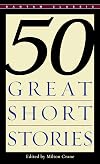
It is always a fascinating adventure to see what others think is “great” literature. It is even more interesting the further back in time you go; what did those of a few or many years ago think was good? And how much have tastes changed? That is why I have a particular fondness for picking up collections of short stories that purport to be great, the best, or some pinnacle of literature as perceived by that time frame. In some instances, I find nuggets I never knew. More often than not, show more it seems that tastes have changed to the extent that some do not come off as well as others.
This book, first collected in 1952, has all of the above. In particular, the older the story, the less well it stands up. You will know many of the names: e.g. H.G. Wells, Carson McCullers, Rudyard Kipling, Edgar Allan Poe, O. Henry (and that is just me randomly picking from the first list of names.) But having a good name does not necessarily result in having a good story (let alone a “great” one, as the title promises.) There is, to my taste, a lot of mediocrity within. And, as I read through the first stories I wondered if I would ever get away from the verbosity, entitlement, and stuck-in-its-time writing I encountered.
Some of the writings of famous authors creaked with age. H. G. Wells deserves all the acclaim in the world for what he started. But this story “The Man Who Could Work Miracles” provides a basic premise, the end of which can be seen miles away. Rudyard Kiplin’s “The Courting of Dinah Shadd” is almost unreadable in its attempt to duplicate dialect. (And, assuming I did work my way through it correctly, is a story not worth telling.) There are more, but let’s not dwell on the negative.
Because things got better. To start with, you can never go wrong by including “The Lottery.” (If I have to tell you who wrote this or provide a synopsis…well, I’ll leave it at that.) And I rediscovered one of my favorite stories – one I read a very long time ago – “The Law” by Robert M. Choates, about what happens when the law of averages no longer exists. And there were others I recognized; ones I had enjoyed in the past. But the good news is that I found new/old nuggets I didn’t know about before. Examples. Wilbur Daniel Steele’s “How Beautiful with Shoes”, a strange story of abduction. Nathaniel Hawthorne’s “The Minister’s Black Veil – a Parable” (a story of a minister who began wearing a black veil he never removed), while feeling its age, still stood up. And “A Girl from Red Lion, P.A.” by H. L. Mencken is a sweet story of a girl who comes to the big city, but that isn’t really the story.
Again, you never know what you’ll get by reading these older collections. I’ve stumbled over a lot of them which I wish I had not stumbled on. And, as I started this one, I thought stumbling was going to happen again. But there are some good stories here. And other people might think there are more than I thought warranted the time. Does that make it worth slogging through the muck? Probably not. But there are worse. (And, of course, there are better.) show less
This book, first collected in 1952, has all of the above. In particular, the older the story, the less well it stands up. You will know many of the names: e.g. H.G. Wells, Carson McCullers, Rudyard Kipling, Edgar Allan Poe, O. Henry (and that is just me randomly picking from the first list of names.) But having a good name does not necessarily result in having a good story (let alone a “great” one, as the title promises.) There is, to my taste, a lot of mediocrity within. And, as I read through the first stories I wondered if I would ever get away from the verbosity, entitlement, and stuck-in-its-time writing I encountered.
Some of the writings of famous authors creaked with age. H. G. Wells deserves all the acclaim in the world for what he started. But this story “The Man Who Could Work Miracles” provides a basic premise, the end of which can be seen miles away. Rudyard Kiplin’s “The Courting of Dinah Shadd” is almost unreadable in its attempt to duplicate dialect. (And, assuming I did work my way through it correctly, is a story not worth telling.) There are more, but let’s not dwell on the negative.
Because things got better. To start with, you can never go wrong by including “The Lottery.” (If I have to tell you who wrote this or provide a synopsis…well, I’ll leave it at that.) And I rediscovered one of my favorite stories – one I read a very long time ago – “The Law” by Robert M. Choates, about what happens when the law of averages no longer exists. And there were others I recognized; ones I had enjoyed in the past. But the good news is that I found new/old nuggets I didn’t know about before. Examples. Wilbur Daniel Steele’s “How Beautiful with Shoes”, a strange story of abduction. Nathaniel Hawthorne’s “The Minister’s Black Veil – a Parable” (a story of a minister who began wearing a black veil he never removed), while feeling its age, still stood up. And “A Girl from Red Lion, P.A.” by H. L. Mencken is a sweet story of a girl who comes to the big city, but that isn’t really the story.
Again, you never know what you’ll get by reading these older collections. I’ve stumbled over a lot of them which I wish I had not stumbled on. And, as I started this one, I thought stumbling was going to happen again. But there are some good stories here. And other people might think there are more than I thought warranted the time. Does that make it worth slogging through the muck? Probably not. But there are worse. (And, of course, there are better.) show less

These are in no way the 50 greatest short stories. Many of them aren't even the best story by that writer. The editor does say, however, that he passed over some more frequently anthologized stories. As a result, much of what is here is not so familiar to me. It is a curious mid-20th Century snapshot of the tastes of the editor and the 500 professors of English at American colleges and universities he asked to make nominations. Some of the choices are indeed classics, such as Shirley show more Jackson's The Lottery. Others are perfection, such as Salinger's For Esme--With Love and Squalor, Sylvia Townsend Warner's The Phoenix, or John Collier's The Chaser. There are lots of lesser known authors as well--at least from 21st Century perspective, although I had heard of most of them. Other pleasures include V.S. Pritchett's The Saint, Max Beerbohm's A.V. Laider (anything by Beerbohm seems to deliver pleasure), and Edith Wharton's The Other Two. And there are others. In addition, there are a few stories that don't seem to meet the definition of "Great" under any circumstance--but I'll leave those for you to discover. Chances are they won't be the same ones on my list. That's a great thing about a book like this; there is something for just about everyone. show less
What a slog. Took me, um, three months to get through. Dreary. Too much racism, sometimes addressed, sometimes accepted. Too much mysterious jewelry and women (both wives and governesses) as ornament. Too much alcohol. Very Western, usually bleak or at least bleary. A few gems, but I can't be bothered to go check which ones they were.
An eclectic collection of short stories. Some of them are great, others I didn't enjoy as much. Is that because they weren't great? Maybe, or maybe they were just from a different time. Some stories are timeless, others very much live in the moment they were written. In the unique idioms and idiosyncrasies of that time. Still, it's a great read and most of the stories hit their mark. I particularly liked:
The Garden Party
The Standard of Living
The Other Side of the Hedge
Brooksmith
The show more Shot
Putois (Truly fantastic)
The Lottery
The Apostate
A Girl From Red Lion, P.A. (Wow, this one really surprised me)
The Minister's Black Veil - A Parable (My favorite in the collection)
The Man Who Could Work Miracles show less
The Garden Party
The Standard of Living
The Other Side of the Hedge
Brooksmith
The show more Shot
Putois (Truly fantastic)
The Lottery
The Apostate
A Girl From Red Lion, P.A. (Wow, this one really surprised me)
The Minister's Black Veil - A Parable (My favorite in the collection)
The Man Who Could Work Miracles show less
You May Also Like


Associated Authors
Statistics
- Works
- 10
- Also by
- 1
- Members
- 2,033
- Popularity
- #12,643
- Rating
- 3.7
- Reviews
- 14
- ISBNs
- 24