

Joachim du Bellay (1522–1560)
Author of Les Regrets Les Antiquites De Rome (Pobesie) (French Edition)
About the Author
Image credit: Dessin/Aquarelle de Joachim du Bellay (XIXe siècle / Musée des Beaux-Arts d'Angers)
Works by Joachim du Bellay
Poesies 5 copies
L'Olive 2 copies
« Heureux qui, comme Ulysse... » et autres poèmes (Du Bellay): suivi d'un parcours sur le sonnet (Classiques & Cie Lycée, 116) (French Edition) (2020) 2 copies
Les regrets choix de poèmes 1 copy
Oeuvres Poetiques - Tome VIII: Autres Oeuvres Latines (Societe Des Textes Francais Modernes) (French Edition) (2012) 1 copy
The Olive Augmentit 1 copy
Du Bellay. Les Regrets : Choix de poèmes. Avec une notice biographique... des notes... par Yvonne Wendel-Bellenger (1969) 1 copy
Les Antiquitez de Rome 1 copy
Vijf sonnetten — Author — 1 copy
Œuvres poétiques IV 1 copy
Les Regrets Et Autres Oeuvres Poetiques suivis des Antiquitez de Rome, Plus un Songe ou Vision sur le mesme subject. (1966) 1 copy
Choix de poèmes 1 copy
Joachim du Bellay 1 copy
Poesies 1 copy
Oeuvres Poétiques 1 copy
Œuvres poétiques I 1 copy
Œuvres poétiques II 1 copy
Œuvres poétiques III 1 copy
Œuvres poétiques V 1 copy
Œuvres poétiques VI 1 copy
Œuvres poétiques VII 1 copy
Œuvres poétiques VIII 1 copy
Associated Works
World Poetry: An Anthology of Verse from Antiquity to Our Time (1998) — Contributor — 499 copies, 2 reviews
Tagged
Common Knowledge
- Canonical name
- Bellay, Joachim du
- Legal name
- Bellay, Joachim du
- Birthdate
- 1522
- Date of death
- 1560-01-01
- Gender
- male
- Education
- University of Poitiers
- Occupations
- poet
critic - Organizations
- La Pleiade
- Relationships
- Ronsard, Pierre de (Condisciple)
Macrin, Salmon (Condisciple)
Peletier du Mans, Jacques (Condisciple)
Dorat, Jean (Professeur)
François 1er, Roi de France (Protecteur) - Short biography
- Joachim du Bellay est un poète français de la Renaissance.
Il naît vers 1522 à Liré (Anjou), au château de la Turmelière, sur les bords de la Loire dans une famille noble et renommée. Il y passe son enfance mais devient orphelin de père et de mère à dix ans. Son frère aîné devient son tuteur sans y apporter grande attention. Toutefois, François 1er - alors roi de France - favorise les arts et la culture. C'est le temps de la Renaissance et Joachim du Bellay sera un représentant brillant de la période.
Vers l’âge de 20 ans, Joachim part pour l’université de Poitiers. Il suit les enseignements de latin et grec, et se lie d'amitié avec Pierre de Ronsard. Ensemble, ils rejoignent Paris et les enseignements du Collège Coqueret. Avec 5 autres "étudiants", du Bellay et Ronsard créent la Pléiade : un groupe de poètes défendant et s'exprimant en français alors que le latin domine en tant que langue des "Clercs".
De 1553 à 1557, il est secrétaire du cardinal Jean Du Bellay, cousin de son père et diplomate. Il l'accompagne à Rome mais la cité le déçoit. Pris de regret, du Bellay met en poésie ses sentiments dans plusieurs recueils de poésie en s'inspirant de Pétrarque. C'est ainsi que naît le fameux recueil "Les Regrets". Fortement attaché à son Anjou natal, il ne cesse d'en faire l'éloge dans ses poèmes, notamment avec son sonnet le plus renommé "Heureux qui comme Ulysse..."
En août 1557, du Bellay tombe malade et est de retour à Paris. Ses recueils de poésie sont appréciés et lui valent de participer à la vie intellectuelle parisienne avec ses condisciples de la Pléiade. Souffrant de plus en plus, il s'éteint le 1er janvier 1560.
Il est inhumé dans la chapelle de Saint-Crépin, une des anciennes chapelles de la cathédrale Notre-Dame de Paris. Sa sépulture disparaît ensuite au fil du temps. - Nationality
- France
- Birthplace
- Chateau de la Turmelière, Liré, Anjou, France
- Places of residence
- Château of La Turmelière, France
Poitiers, France
Paris, France - Place of death
- Paris, France
- Burial location
- Apoplexie
- Associated Place (for map)
- France
Members
Reviews

A collection of 32 sonnets published by Joachim du Bellay probably written in 1554. The poet had travelled to Rome as one of the secretaries of Cardinal Du Bellay and these verses were inspired by his thoughts on seeing the ruins of ancient Rome that were spread around the Renaissance city. He wrote in French having previously published Défense et Illustration de la langue française in which he admitted that the French language at the time was too poor to write higher forms of poetry but show more he envisaged an enrichment of the language and I presume he wrote in French rather than Latin to aid this process. I have to confess I read a modern English translation as well as a translation by Edmund Spenser published in 1591.
The sonnets are vivid and imaginative and in some respects look towards the Romantic poetry of the nineteenth century. The sequence opens with the poet standing on the ruins and imagining he is shouting down to the people that inhabited ancient Rome; he wants to tell them of the devotion he has for their civilisation, but is also wary of the fury he might evoke. This sets the tone for the sequence because the poet wishes to celebrate the greatness of Rome, but he also fully aware of how that civilisation tore itself to pieces. Themes of time passing, of a society that became addicted to leisure, one that even threatened the gods themselves are played out in some wonderful imagery. It is quite pagan in feel and devoid of any Christian censure and in one of the sonnets there is more than a hint that Peter’s successor (the pope) took away the power of the peoples consuls to the cities detriment.
An example from the modern translation:
If that blind fury that engenders wars,
Fails to rouse the creatures of a kind,
Whether swift bird aloft or fleeting hind,
Whether equipped with scales or sharpened claws,
What ardent Fury in her pincers’ jaws
Gripped your hearts, so poisoned the mind,
That intent on mutual cruelty, we find,
Into your own entrails your own blade bores?
Was this, Romans, your harsh destiny,
Or some old sin, with discordant mutiny,
Working on you its eternal vengeance?
The gods denying, in just indignation,
Your walls, bloodied by that ancient instance
Of fraternal strife, a sure foundation.
And here is The same verse as translated by Edmund Spenser
If the blinde Furie, which warres breedeth oft,
Wonts not t’ enrage the hearts of equall beasts,
Whether they fare on foote, or flie aloft,
325
Or armed be with clawes, or scalie creasts,
What fell Erynnis, with hot burning tongs,
Did grype your hearts, with noysome rage imbew’d,
That, each to other working cruell wrongs,
Your blades in your owne bowels you embrew’d?
330
Was this, ye Romanes, your hard destinie?
Or some old sinne, whose unappeased guilt
Powr’d vengeance forth on you eternallie?
Or brothers blood, the which at first was spilt
Upon your walls, that God might not endure
335
Upon the same to set foundation sure?
On a technical note it will be noticed that the rhyming scheme differs between the two translations. The Modern translation by A S Kline recreates the Petrachan scheme that was used by Du Bellay, Spenser however used his own scheme ending each sonnet with a rhyming couplet.
Du Bellay cannot help sounding his own trumpet in the final sonnet claiming he is the first to write in praise of Rome in the french language and Spenser tacks on an extra sonnet to his translation: titled L’Envoy, in which he adds his own admiration for the poems and Du Bellay. I think I would add my voice in favour of these splendid sonnets which I thoroughly enjoyed. A four star read. show less
The sonnets are vivid and imaginative and in some respects look towards the Romantic poetry of the nineteenth century. The sequence opens with the poet standing on the ruins and imagining he is shouting down to the people that inhabited ancient Rome; he wants to tell them of the devotion he has for their civilisation, but is also wary of the fury he might evoke. This sets the tone for the sequence because the poet wishes to celebrate the greatness of Rome, but he also fully aware of how that civilisation tore itself to pieces. Themes of time passing, of a society that became addicted to leisure, one that even threatened the gods themselves are played out in some wonderful imagery. It is quite pagan in feel and devoid of any Christian censure and in one of the sonnets there is more than a hint that Peter’s successor (the pope) took away the power of the peoples consuls to the cities detriment.
An example from the modern translation:
If that blind fury that engenders wars,
Fails to rouse the creatures of a kind,
Whether swift bird aloft or fleeting hind,
Whether equipped with scales or sharpened claws,
What ardent Fury in her pincers’ jaws
Gripped your hearts, so poisoned the mind,
That intent on mutual cruelty, we find,
Into your own entrails your own blade bores?
Was this, Romans, your harsh destiny,
Or some old sin, with discordant mutiny,
Working on you its eternal vengeance?
The gods denying, in just indignation,
Your walls, bloodied by that ancient instance
Of fraternal strife, a sure foundation.
And here is The same verse as translated by Edmund Spenser
If the blinde Furie, which warres breedeth oft,
Wonts not t’ enrage the hearts of equall beasts,
Whether they fare on foote, or flie aloft,
325
Or armed be with clawes, or scalie creasts,
What fell Erynnis, with hot burning tongs,
Did grype your hearts, with noysome rage imbew’d,
That, each to other working cruell wrongs,
Your blades in your owne bowels you embrew’d?
330
Was this, ye Romanes, your hard destinie?
Or some old sinne, whose unappeased guilt
Powr’d vengeance forth on you eternallie?
Or brothers blood, the which at first was spilt
Upon your walls, that God might not endure
335
Upon the same to set foundation sure?
On a technical note it will be noticed that the rhyming scheme differs between the two translations. The Modern translation by A S Kline recreates the Petrachan scheme that was used by Du Bellay, Spenser however used his own scheme ending each sonnet with a rhyming couplet.
Du Bellay cannot help sounding his own trumpet in the final sonnet claiming he is the first to write in praise of Rome in the french language and Spenser tacks on an extra sonnet to his translation: titled L’Envoy, in which he adds his own admiration for the poems and Du Bellay. I think I would add my voice in favour of these splendid sonnets which I thoroughly enjoyed. A four star read. show less
Les Regrets / La Défense et Illustration de la Langue française / Les Antiquités de Rome by Joachim du Bellay
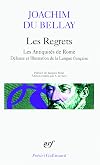
Here's a collection of work (3 in total) by one of the key poets of the French Renaissance. What about it?
Les Antiquités de Rome is just a series of poetical variations on the same idea; that of feeling dreamy and pensive at the sight of Rome, once a powerful city which was at the centre of a world but is now reduced to being mostly in ruins, with not much left of its past Glory. Its telling enough, but quite repetitive.
Les Regrets, considered by most as being his poetical masterpiece, is show more more diverse and so richer in its motifs. It too is about nostalgia, but, nostalgia about France this time; since it was written when the author was working in Italy. Besides feeling homesick, then, he addresses here some friends back home (including Ronsard) while expressing his boredom and disappointment (again!) at having travelled abroad looking for excitement only to find a dreary, boring job (he worked as the personal assistant to a Cardinal...) and in a country that had seemingly lost its Grandeur. Now, given that he was in Italy at the time of the Renaissance this personal impression struck me as being quite baffling! But then again, that's because he decided to deal here, not with the exciting new culture bubbling all around him but, the courtiers whom he had to interact with as part of his daily job and that he considered as being nothing but annoying sycophants and hypocrites. It's petty, but there goes.
The key text in this book, of course, remains his Défense et Illustrations de la Langue française; a major, key, central manifesto when it comes to French language, and arguing for French poets to stop looking up at Ancient Greek and Latin to, instead, accept French as being a language having the full potential to become as great when it comes to creativity and artistry, hence to be used and developed as such. This is (let's be honest!) why du Bellay is mostly remembered these days, for having been the French equivalent of a Chaucer of sort when it comes to defend his native language as opposed to dead ones. Now, obviously, reading this manifesto in the 21st century the arguments that he put forth will seem like barging with a ram and through an open door already! Nevertheless, it still is powerful and, bearing in mind the time when it was first published, quite a bombshell leaving admirative for its Grand Vision. At the very least, it's a very commanding view of the possibility offered by a language -be it French or any other.
In the end, what about it all? When it comes to French poets of the Renaissance, I prefer -and by far!- Ronsard to du Bellay. It's not that du Bellay was a bad poet (far, far from that!) but that the ideas that he chose to expand upon were either limited to say the least (e.g. the nostalgia about his modern-days Rome...) or quite petty and so not a topic of interest to me (e.g. the boredom and disappointment when it comes to his personal professional career). If you are into poetry and French poetry especially, then of course du Bellay still remains a must-read to be familiar with! Having said that, I (personally) read him for his historical value and importance more than for his artistry and creativity per se. As such, if I can recommend only one work of his which I consider to be invaluable, then it would be his Défense et Illustrations de la Langue française. This one at least should appeal to poetry and literature lovers as much as to those interested in language and linguistics. show less
Les Antiquités de Rome is just a series of poetical variations on the same idea; that of feeling dreamy and pensive at the sight of Rome, once a powerful city which was at the centre of a world but is now reduced to being mostly in ruins, with not much left of its past Glory. Its telling enough, but quite repetitive.
Les Regrets, considered by most as being his poetical masterpiece, is show more more diverse and so richer in its motifs. It too is about nostalgia, but, nostalgia about France this time; since it was written when the author was working in Italy. Besides feeling homesick, then, he addresses here some friends back home (including Ronsard) while expressing his boredom and disappointment (again!) at having travelled abroad looking for excitement only to find a dreary, boring job (he worked as the personal assistant to a Cardinal...) and in a country that had seemingly lost its Grandeur. Now, given that he was in Italy at the time of the Renaissance this personal impression struck me as being quite baffling! But then again, that's because he decided to deal here, not with the exciting new culture bubbling all around him but, the courtiers whom he had to interact with as part of his daily job and that he considered as being nothing but annoying sycophants and hypocrites. It's petty, but there goes.
The key text in this book, of course, remains his Défense et Illustrations de la Langue française; a major, key, central manifesto when it comes to French language, and arguing for French poets to stop looking up at Ancient Greek and Latin to, instead, accept French as being a language having the full potential to become as great when it comes to creativity and artistry, hence to be used and developed as such. This is (let's be honest!) why du Bellay is mostly remembered these days, for having been the French equivalent of a Chaucer of sort when it comes to defend his native language as opposed to dead ones. Now, obviously, reading this manifesto in the 21st century the arguments that he put forth will seem like barging with a ram and through an open door already! Nevertheless, it still is powerful and, bearing in mind the time when it was first published, quite a bombshell leaving admirative for its Grand Vision. At the very least, it's a very commanding view of the possibility offered by a language -be it French or any other.
In the end, what about it all? When it comes to French poets of the Renaissance, I prefer -and by far!- Ronsard to du Bellay. It's not that du Bellay was a bad poet (far, far from that!) but that the ideas that he chose to expand upon were either limited to say the least (e.g. the nostalgia about his modern-days Rome...) or quite petty and so not a topic of interest to me (e.g. the boredom and disappointment when it comes to his personal professional career). If you are into poetry and French poetry especially, then of course du Bellay still remains a must-read to be familiar with! Having said that, I (personally) read him for his historical value and importance more than for his artistry and creativity per se. As such, if I can recommend only one work of his which I consider to be invaluable, then it would be his Défense et Illustrations de la Langue française. This one at least should appeal to poetry and literature lovers as much as to those interested in language and linguistics. show less
'Les Regrets / Les Antiquites De Rome by Du Bellay ( Author ) ON Jan-01-1978, Paperback' by Joachim du Bellay
Read these in Oevres Francoises (LeMerre: Paris, 1866) 2 vols. In sonnet 76 he advises against desiring praise: Dispraise has more truth than praise, which makes you say what you don't believe. President Trump, four and a half centuries later, should listen to the great French poet; should ignore the flattery he requires, since no-one believes, not even the flatterer, the flattery they spout.
DuBellay's 67th sonnet is spoken by a Know-it-all. (Maybe the US prez is again addressed.) What he show more knows is stereotypes: vain Neapolitans, shifty Venenetians, usurer Florentines, lazy Romans, unruly Brits, brave Scots, traitor Burguignons, haughty Spaniards, drunken Thudes. [Think that's Westphalia, but...your guess?] He lists all the traits he despises, including his own imperfections, but most of all, he hates a Know-it-all.
Joachim writes a war of poetry and ignorance, "La Musagnocomachia" (I.139-43), but also an amusing old man courting a young woman, "L'anterotique de la vielle et de la juene amie,"
Vielle qui as, Ô vielle Beste!
Plus d'yeux, que de cheveaux au Teste. (lines 11-12)
Love this line: So old he has more eyes than hairs on his head.
DuBellay's "Defense et illustration de la langue Francoise" recommends following Greek and Latin examples--like the 19 different poetic forms that Horace uses, not forms like rondeau, ballad, virelais, rhyme royale which "corrupt the taste in our language." These very forms, thrown out of France by the Pleiade he represented, were welcomes into English. (I.p38) This "Defense" I quoted in my Ph.D. on poetic criticism in verse, for example, DuBellay's own "Contre Les Petraquistes" (see my This Critical Age, published U MI 1981). He says he's forgotten how the art of Petrarchising, of your beauties like pearls, crystal, marble and fine gold. He'd rather speak frankly of Love, without flattering her and without disguising himself. Disguising hellish passions in a Paradise of fictions--such empty paintings.
In contrast, "Of your beauty I'd say, if my eye does not judge foolishly, your beauty is equal to your goodness, your distinction."
His sonnet 85 begins, "Flatter un crediteur, pour son terme allonger," which I adapted to
my graduate school experience, in translation addressed to my fellow student, Ben.
To flatter the professor, quote his phrases,
Mimic him so he will think you're grand,
Discussing neither politics nor raises
Until you know just where he takes a stand;
Not to waste your health on too much laughing,
Nor to make unprofitable quips;
Not to tell anyone all you’re thinking,
While thinking least about the prof’s own field.
Know eccentricities, know the tester;
As much as you have clout to wield,,
Wield it. Challenge criticisms, make ‘em yield.
Take every course for grades, keep strict account:
Here it is, my friend Ben, I calculate
All I’ve learned five years post-graduate.
This exactly happened, with a different fellow grad student who actually memorized the Norton Anthology intro's by a professor on both our committees. The old prof was so impressed to hear his own words, he actually got that student a job at an Ivy institution. For my orals, the next day, I had neglected to memorize the old guy's intro's, so I did not get an Ivy job.
DuBellay lost both his parents early, but was raised well-connected, in a family that included Cardinal--for whom he eventually worked as a clerk and bookeeper for a couple years in Rome. Some of the sonnets he wrote there were translated into English by Edmund Spenser. DuBellay met Ronsard by chance, both around 25, in an inn nearing Poitiers. They would go on to Paris, where they lived for years and formed the Pleiade. show less
DuBellay's 67th sonnet is spoken by a Know-it-all. (Maybe the US prez is again addressed.) What he show more knows is stereotypes: vain Neapolitans, shifty Venenetians, usurer Florentines, lazy Romans, unruly Brits, brave Scots, traitor Burguignons, haughty Spaniards, drunken Thudes. [Think that's Westphalia, but...your guess?] He lists all the traits he despises, including his own imperfections, but most of all, he hates a Know-it-all.
Joachim writes a war of poetry and ignorance, "La Musagnocomachia" (I.139-43), but also an amusing old man courting a young woman, "L'anterotique de la vielle et de la juene amie,"
Vielle qui as, Ô vielle Beste!
Plus d'yeux, que de cheveaux au Teste. (lines 11-12)
Love this line: So old he has more eyes than hairs on his head.
DuBellay's "Defense et illustration de la langue Francoise" recommends following Greek and Latin examples--like the 19 different poetic forms that Horace uses, not forms like rondeau, ballad, virelais, rhyme royale which "corrupt the taste in our language." These very forms, thrown out of France by the Pleiade he represented, were welcomes into English. (I.p38) This "Defense" I quoted in my Ph.D. on poetic criticism in verse, for example, DuBellay's own "Contre Les Petraquistes" (see my This Critical Age, published U MI 1981). He says he's forgotten how the art of Petrarchising, of your beauties like pearls, crystal, marble and fine gold. He'd rather speak frankly of Love, without flattering her and without disguising himself. Disguising hellish passions in a Paradise of fictions--such empty paintings.
In contrast, "Of your beauty I'd say, if my eye does not judge foolishly, your beauty is equal to your goodness, your distinction."
His sonnet 85 begins, "Flatter un crediteur, pour son terme allonger," which I adapted to
my graduate school experience, in translation addressed to my fellow student, Ben.
To flatter the professor, quote his phrases,
Mimic him so he will think you're grand,
Discussing neither politics nor raises
Until you know just where he takes a stand;
Not to waste your health on too much laughing,
Nor to make unprofitable quips;
Not to tell anyone all you’re thinking,
While thinking least about the prof’s own field.
Know eccentricities, know the tester;
As much as you have clout to wield,,
Wield it. Challenge criticisms, make ‘em yield.
Take every course for grades, keep strict account:
Here it is, my friend Ben, I calculate
All I’ve learned five years post-graduate.
This exactly happened, with a different fellow grad student who actually memorized the Norton Anthology intro's by a professor on both our committees. The old prof was so impressed to hear his own words, he actually got that student a job at an Ivy institution. For my orals, the next day, I had neglected to memorize the old guy's intro's, so I did not get an Ivy job.
DuBellay lost both his parents early, but was raised well-connected, in a family that included Cardinal--for whom he eventually worked as a clerk and bookeeper for a couple years in Rome. Some of the sonnets he wrote there were translated into English by Edmund Spenser. DuBellay met Ronsard by chance, both around 25, in an inn nearing Poitiers. They would go on to Paris, where they lived for years and formed the Pleiade. show less

De 1553 à 1557, du Bellay vécut à Rome, pour y remplir la fonction de secrétaire auprès de son oncle le cardinal Jean du Bellay. Ce séjour au pays d'Horace et de Pétrarque le séduisit d'abord, puis le déprima profondément. D'une santé fragile, isolé par la surdité dont il était atteint, et surtout nostalgique de son Anjou natal, il ne put apprécier la beauté de Rome sans amertume : le spectacle des ruines le plongea dans une sombre méditation sur le déclin de toute chose, show more qui lui inspira le recueil les Antiquités de Rome, publié à son retour en France, en 1558, sous le titre complet de : le Premier Livre des Antiquités de Rome, contenant une description générale de sa grandeur et comme une déploration de sa ruine. show less
Lists
You May Also Like


Associated Authors
Statistics
- Works
- 61
- Also by
- 2
- Members
- 397
- Popularity
- #61,077
- Rating
- 3.9
- Reviews
- 8
- ISBNs
- 49
- Languages
- 5
- Favorited
- 5


