
Kaye Webb (1914–1996)
Author of I Like This Poem
About the Author
Series
Works by Kaye Webb
Family Tree: A Collection of Favourite Poems and Stories About All Kinds of Families (1994) 3 copies
Grimms' Fairy Tales 2 copies
Associated Works
Tagged
Common Knowledge
- Birthdate
- 1914-01-26
- Date of death
- 1996-01-16
- Gender
- female
- Occupations
- journalist
publisher - Organizations
- Puffin Books
- Relationships
- Searle, Ronald (spouse, 1946-1966)
- Nationality
- UK
- Associated Place (for map)
- UK
Members
Reviews
The St. Trinian's Story. The whole ghastly dossier compiled by Kaye Webb, with contributions by Siriol Hugh-Jones [and others], etc. [With cartoons by Ronald Searle.] by Kaye Webb

All-singing, all-dancing tribute to Ronald Searle's celebrated girls' school, one of the more surprising British cultural phenomena of the forties and fifties. Compiled by Kaye Webb, the first editor to publish Searle's cartoons and his wife at the time this book was published, it features contributions from a galaxy of fifties names: everyone from Robert Graves and C. Day Lewis to Johnny Dankworth and Flanders & Swann (not to mention the features editor of Vogue). And of course dozens of show more hilarious — and frequently macabre — drawings of misshapen girls in straw hats, gymslips and black stockings.
Some of the contributors ask themselves why the notion of savage middle-class schoolgirls wielding hockey sticks, whisky bottles and Bren guns had such an appeal. Probably a worthwhile question, as half a century on there's something that still makes otherwise respectable British people drag up in St Trinian's costumes for stag nights and hen parties. It's obviously got something to do with sex and innocence, but it's not very obvious what.
The girls in Searle's pictures are interested in every other vice, and in breaking every other taboo, but they are ostentatiously hors concours where sex is concerned. They are ridiculously short or tall, fat or skinny, their hair and clothes are outrageously dishevelled, and they just don't care. They are sturdy British antidotes to the Françoise Sagans and Brigitte Bardots that young women of the time aspired to be. I suppose the idea might be that a young girl with an offensive weapon is somehow less threatening to the average male than the same young girl presented as a potential mate. Where's Freud when you need him?
It's striking when you look at the actual cartoons how violent they are. Webb points out that Searle's view of the world was obviously influenced by the four years he spent as a prisoner of the Japanese in Singapore, and that certainly seems to make sense when you see the amount of death and destruction there is in his drawings. There's one where we see two teachers stepping out into a yard littered with the stabbed, mutilated and dismembered bodies of their pupils: one teacher observes breezily to the other "Looks as though the cleaners have been getting sloppy again." When the St Trinian's motif is picked up in other media, or when we see Searle's cartoons reproduced, it's never this aspect that comes to the fore. The stress quietly, but significantly, shifts from violence to sex. In the film versions, the violence is reduced to harmless slapstick, but when we see girls in ill-fitting school uniforms, it's because the girls are actually adults and the uniforms are tailored to maximise sexual provocation: closer to the ethos of "schoolgirl" porn than to Searle's grotesquery. show less
Some of the contributors ask themselves why the notion of savage middle-class schoolgirls wielding hockey sticks, whisky bottles and Bren guns had such an appeal. Probably a worthwhile question, as half a century on there's something that still makes otherwise respectable British people drag up in St Trinian's costumes for stag nights and hen parties. It's obviously got something to do with sex and innocence, but it's not very obvious what.
The girls in Searle's pictures are interested in every other vice, and in breaking every other taboo, but they are ostentatiously hors concours where sex is concerned. They are ridiculously short or tall, fat or skinny, their hair and clothes are outrageously dishevelled, and they just don't care. They are sturdy British antidotes to the Françoise Sagans and Brigitte Bardots that young women of the time aspired to be. I suppose the idea might be that a young girl with an offensive weapon is somehow less threatening to the average male than the same young girl presented as a potential mate. Where's Freud when you need him?
It's striking when you look at the actual cartoons how violent they are. Webb points out that Searle's view of the world was obviously influenced by the four years he spent as a prisoner of the Japanese in Singapore, and that certainly seems to make sense when you see the amount of death and destruction there is in his drawings. There's one where we see two teachers stepping out into a yard littered with the stabbed, mutilated and dismembered bodies of their pupils: one teacher observes breezily to the other "Looks as though the cleaners have been getting sloppy again." When the St Trinian's motif is picked up in other media, or when we see Searle's cartoons reproduced, it's never this aspect that comes to the fore. The stress quietly, but significantly, shifts from violence to sex. In the film versions, the violence is reduced to harmless slapstick, but when we see girls in ill-fitting school uniforms, it's because the girls are actually adults and the uniforms are tailored to maximise sexual provocation: closer to the ethos of "schoolgirl" porn than to Searle's grotesquery. show less
I like this poem a collection of best-loved poems chosen by children for other children by Kaye Webb

This probably isn't the collection of the best poetry in the world, but when I was a young girl in primary school it had a lot of poems that I loved. And I still enjoy leafing through it, which is probably why it's falling apart at the seams.
I Like This Poem: A Collection of Best-Loved Poems Chosen by Children for Other Children (Puffin Books) by Kaye Webb
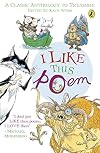
This book is a great selection of poems chosen by kids for other children. It is a collection of all different kinds of poems. The themes of the poems are themes that children would find exciting. This book is great in a preschool setting where poems can be read to the children all the way through 6th grade where the children would work more one on one with the book of poems. This book appeals to children because the poems selected are the ideas of other children. This book would be great in show more the classroom to:
-inspire children to start their own collection of poems
-begin an activity that guides children through a book publishing process
-look at the individual poems and ask why the other children chose them
-decide which poem they would choose if they were asked to be in the book
-illusrate the poems in their own unique way show less
-inspire children to start their own collection of poems
-begin an activity that guides children through a book publishing process
-look at the individual poems and ask why the other children chose them
-decide which poem they would choose if they were asked to be in the book
-illusrate the poems in their own unique way show less

Excellent book containing stories and sketches of people and places in 1950's London.
You May Also Like


Associated Authors
Statistics
- Works
- 19
- Also by
- 8
- Members
- 474
- Popularity
- #52,000
- Rating
- 4.2
- Reviews
- 9
- ISBNs
- 20