
Scott Bradfield
Author of The History of Luminous Motion
About the Author
Scott Bradfield is a professor of English at the University of Connecticut.
Image credit: Scott Bradfield, 2025-04
Works by Scott Bradfield
The Devil Disinvests 3 copies
Dazzle the Pundit 3 copies
The Darling [short fiction] 3 copies
Animals Behind Bars! [short fiction] 3 copies
Angry Duck 2 copies
Zombie-ish 1 copy
The Reflection Once Removed 1 copy
Penguins for Lunch 1 copy
Doggy Love 1 copy
Dazzle's Inferno 1 copy
Dazzle Redux 1 copy
The Queen of the Apocalypse 1 copy
Associated Works
The Vintage Book of Contemporary American Short Stories (1994) — Contributor — 546 copies, 2 reviews
The Year's Best Fantasy and Horror: Eighth Annual Collection (1995) — Contributor — 329 copies, 6 reviews
The New Gothic: A Collection of Contemporary Gothic Fiction (1991) — Contributor — 273 copies, 2 reviews
The Year's Best Fantasy and Horror: Ninth Annual Collection (1996) — Contributor — 258 copies, 3 reviews
The Year's Best Fantasy and Horror: Sixth Annual Collection (1993) — Contributor — 219 copies, 1 review
The Year's Best Fantasy and Horror: Second Annual Collection (1987) — Contributor — 207 copies, 1 review
The Mammoth Book of Halloween Stories: Terrifying Tales Set on the Scariest Night of the Year! (2018) — Contributor — 72 copies
To Sleep, Perchance to Dream...Nightmare: 30 Terrifying Tales (1993) — Contributor — 54 copies, 1 review
The Magazine of Fantasy and Science Fiction August 2003, Vol. 105, No. 2 (2003) — Author — 17 copies, 1 review
Tagged
Common Knowledge
- Legal name
- Bradfield, Scott Michael
- Birthdate
- 1955-04-27
- Gender
- male
- Education
- Ph. D., Lettres
- Occupations
- Professeur (Lettres)
Journaliste
Critique littéraire - Organizations
- Université Sainte-Marie, Twickenham (Professeur ∙ Lettres ∙ 20 20)
Université de Californie à Berkeley
Université du Connecticut
Université Kingston
Université d'Irvine, Californie (Professeur ∙ 5 ans)
Times Literary Supplement (Critique littéraire) (show all 10)
Elle (Critique littéraire)
The Observer (Critique littéraire)
Vice (Critique littéraire)
The Independent (Critique littéraire) - Nationality
- USA
- Birthplace
- San Francisco, Californie, Etats-Unis
- Places of residence
- Londres, Angleterre, Royaume-Uni
- Associated Place (for map)
- USA
Members
Reviews
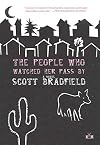
(Reprinted from the Chicago Center for Literature and Photography [cclapcenter.com]. I am the original author of this essay, as well as the owner of CCLaP; it is not being reprinted illegally.)
One of the obvious main benefits of small presses is that since both costs and expectations are lowered, it allows for much more passionate and idiosyncratic choices over what exactly gets published in the first place, titles which everyone involved knows beforehand will be intensely disliked by some show more readers, which is then made up for by the equal number of people who intensely love it; take for example the tiny Ohio press Two Dollar Radio, who I became a big fan of earlier this year because of the wondrous Some Things That Meant the World to Me by Joshua Mohr, and who was kind enough to send along a couple of their other new titles as well. I just finished one of them this week, Scott Bradfield's The People Who Watched Her Pass By, which like I said strikes me as the very reason small presses exist in the first place; because even though I ended up liking it quite a lot, it's patently obvious that many others will not do the same, the kind of book guaranteed to cause controversy the moment its subject matter is even brought up. And that's a testament to Two Dollar Radio, I think, for taking a chance on a deserving book like this, when most mainstream publishers wouldn't touch a hot potato like this with a ten-foot pole.
Because what this book is about, see, is a five-year-old girl who gets kidnapped one day by a creepy neighbor; but instead of being the usual Lifetime-movie cautionary tale, lit veteran Bradfield (this is his fifth book) uses the concept to turn in a lyrical, surreal, surprisingly poetic tale, a journey across the backwater parts of the US that by the end becomes an intriguing combination of Sam Shepard and David Lynch. And this takes some getting used to, to be frank, with even I not quite sure at first what to think of it all, which is quite obviously why this is the kind of book you'll only find on a small press; because either you'll eventually accept the idea of our spartan heroine Salome Jensen being merely a symbol, in service of a larger and grander point that Bradfield is trying to make, or you'll never accept the idea, and instead see this book as some sort of icky ode to the fun adventures that come with child kidnapping.
In fact, this story really comes off more like a fairytale than anything else, albeit the kind of challenging, grown-up fairytale that fuels such similar projects as, say, Gus Van Sant's equally audience-splitting movie My Own Private Idaho; because far from ever being in any kind of serious trouble, for example, our adolescent protagonist actually manages to thrive for months at a time as a survivalist camper, and also manages to stay for a time in the homes of dozens of random adults without a single one of them bothering to call Child Services. Add to this, then, that Salome often speaks with the complexity of an adult herself, plus the plenty of plot turns that sometimes border on the ludicrous (such as a religious cult whose members have infiltrated the various educated sectors of the child-welfare system, like a judge and a lawyer and a social worker, so that they can work in collusion to illegally "punish the wicked" and bring about a new golden age), and you suddenly start seeing more of what Bradfield is going for in this book -- that it's more a sly examination of the tics and quirks found in so-called "White Trash America" (my term, not his), a look at the crumbling backroads and small towns of this country that at some points turn almost post-apocalyptic in his characterizations. (In fact, there are big parts of this book that reminded me of a kiddie version of Cormac McCarthy's The Road.)
If you're able to get into the groove of such an unusual story, you're going to be immensely pleased by the end, a book that turns out to be as quietly disturbing as it is subtly funny; but there's also a good chance that you'll never get into this groove, in which case you will likely find The People Who Watched Her Pass By nothing more than a piece of glib, manipulative garbage, with neither of these opinions necessarily "wrong" or "right" from an objective standpoint. And like I said, this is what I find so great about small presses, is that they tend to be filled with visionaries who understand the artistic importance of titles like these; and since these presses aren't bogged down with dozens of mid-level executives all with Brooklyn condo payments to make, they can afford to take bigger chances with what exactly they put out, which is why such presses so imminently deserve our gratitude and support. Although it may very well not turn out to be your cup of tea, I highly encourage you to take a chance on this book anyway; and needless to say that I'm looking forward to the next Two Dollar Radio title in my reading queue, Xiaoda Xiao's The Cave Man, which I'll be tackling here at the website in just another couple of weeks.
Out of 10: 8.8 show less
One of the obvious main benefits of small presses is that since both costs and expectations are lowered, it allows for much more passionate and idiosyncratic choices over what exactly gets published in the first place, titles which everyone involved knows beforehand will be intensely disliked by some show more readers, which is then made up for by the equal number of people who intensely love it; take for example the tiny Ohio press Two Dollar Radio, who I became a big fan of earlier this year because of the wondrous Some Things That Meant the World to Me by Joshua Mohr, and who was kind enough to send along a couple of their other new titles as well. I just finished one of them this week, Scott Bradfield's The People Who Watched Her Pass By, which like I said strikes me as the very reason small presses exist in the first place; because even though I ended up liking it quite a lot, it's patently obvious that many others will not do the same, the kind of book guaranteed to cause controversy the moment its subject matter is even brought up. And that's a testament to Two Dollar Radio, I think, for taking a chance on a deserving book like this, when most mainstream publishers wouldn't touch a hot potato like this with a ten-foot pole.
Because what this book is about, see, is a five-year-old girl who gets kidnapped one day by a creepy neighbor; but instead of being the usual Lifetime-movie cautionary tale, lit veteran Bradfield (this is his fifth book) uses the concept to turn in a lyrical, surreal, surprisingly poetic tale, a journey across the backwater parts of the US that by the end becomes an intriguing combination of Sam Shepard and David Lynch. And this takes some getting used to, to be frank, with even I not quite sure at first what to think of it all, which is quite obviously why this is the kind of book you'll only find on a small press; because either you'll eventually accept the idea of our spartan heroine Salome Jensen being merely a symbol, in service of a larger and grander point that Bradfield is trying to make, or you'll never accept the idea, and instead see this book as some sort of icky ode to the fun adventures that come with child kidnapping.
In fact, this story really comes off more like a fairytale than anything else, albeit the kind of challenging, grown-up fairytale that fuels such similar projects as, say, Gus Van Sant's equally audience-splitting movie My Own Private Idaho; because far from ever being in any kind of serious trouble, for example, our adolescent protagonist actually manages to thrive for months at a time as a survivalist camper, and also manages to stay for a time in the homes of dozens of random adults without a single one of them bothering to call Child Services. Add to this, then, that Salome often speaks with the complexity of an adult herself, plus the plenty of plot turns that sometimes border on the ludicrous (such as a religious cult whose members have infiltrated the various educated sectors of the child-welfare system, like a judge and a lawyer and a social worker, so that they can work in collusion to illegally "punish the wicked" and bring about a new golden age), and you suddenly start seeing more of what Bradfield is going for in this book -- that it's more a sly examination of the tics and quirks found in so-called "White Trash America" (my term, not his), a look at the crumbling backroads and small towns of this country that at some points turn almost post-apocalyptic in his characterizations. (In fact, there are big parts of this book that reminded me of a kiddie version of Cormac McCarthy's The Road.)
If you're able to get into the groove of such an unusual story, you're going to be immensely pleased by the end, a book that turns out to be as quietly disturbing as it is subtly funny; but there's also a good chance that you'll never get into this groove, in which case you will likely find The People Who Watched Her Pass By nothing more than a piece of glib, manipulative garbage, with neither of these opinions necessarily "wrong" or "right" from an objective standpoint. And like I said, this is what I find so great about small presses, is that they tend to be filled with visionaries who understand the artistic importance of titles like these; and since these presses aren't bogged down with dozens of mid-level executives all with Brooklyn condo payments to make, they can afford to take bigger chances with what exactly they put out, which is why such presses so imminently deserve our gratitude and support. Although it may very well not turn out to be your cup of tea, I highly encourage you to take a chance on this book anyway; and needless to say that I'm looking forward to the next Two Dollar Radio title in my reading queue, Xiaoda Xiao's The Cave Man, which I'll be tackling here at the website in just another couple of weeks.
Out of 10: 8.8 show less
This was my first exposure to Scott Bradfield's writing, and I agree with another reviewer on here, that some passages are so beautiful that I wanted to clip them out and save them as keepsakes. The storyline itself is odd, and somewhat disturbing. Three-year-old Salome is abducted by the water heater repairman, and then shuffled from house to house, and at times even living in a laundromat. The story is told through her eyes, although not in her voice. In fact, the voice of the novel is show more quite poetic and philosophical.
By the end of the book Salome has walked through the desert, and emerged as an almost Christ-like figure. Visitors drive from afar in the hopes of seeing her emerge from her seclusion. Once "Sal" leaves the edge of the desert to return to civilization, she decides on her direction and destination. She has become wise beyond her years, and certainly wiser than the adults who watched her pass by. show less
By the end of the book Salome has walked through the desert, and emerged as an almost Christ-like figure. Visitors drive from afar in the hopes of seeing her emerge from her seclusion. Once "Sal" leaves the edge of the desert to return to civilization, she decides on her direction and destination. She has become wise beyond her years, and certainly wiser than the adults who watched her pass by. show less

Poetic and haunting, but ultimately not a book I'd recommend to anyone - I only give it three stars because it is well written. However, I could not imagine an eight year old kid who was as intelligent as our narrator actually acting out his Oedipal urges in this way and his 12 year old friend who is a Marxist is just a bit over the top for me. If the kid had anything else besides a good vocabulary going for him, perhaps I would have had more empathy for him, but as a narrator he was totally show more unlikable. show less

Sandra, a disturbed young woman who is deserted by her father and thrown out by her mother, signs up for a church which takes postal donations in return for the promise of luxury items in return. When she dreams she enters a mysterious room containing a wonderful product, and when she awakes that same product is in her flat. But what happiness does this bring her?
Lists
Awards


You May Also Like


Associated Authors
Statistics
- Works
- 36
- Also by
- 27
- Members
- 684
- Popularity
- #36,990
- Rating
- 3.7
- Reviews
- 12
- ISBNs
- 45
- Languages
- 4
- Favorited
- 5


