

Faith Ringgold (1930–2024)
Author of Tar Beach
About the Author
Series
Works by Faith Ringgold
Associated Works
Theories and Documents of Contemporary Art: A Sourcebook of Artists' Writings (1995) — Contributor — 417 copies, 1 review
Tagged
Common Knowledge
- Canonical name
- Ringgold, Faith
- Other names
- Jones, Faith Willi (birth)
- Birthdate
- 1930-10-08
- Date of death
- 2024-04-13
- Gender
- female
- Education
- City College of New York (BA|1955|Art Education)
City College of New York (MA|1959) - Occupations
- painter
artist
professor emeritus (Art) - Organizations
- University of California, San Diego
- Awards and honors
- American Academy of Arts and Letters Academy Award (Art, 2004)
- Relationships
- Ringgold, Burdette (spouse)
- Nationality
- USA
- Birthplace
- Harlem, New York, USA
- Places of residence
- Englewood, New Jersey, USA
- Place of death
- Englewood, New Jersey, USA
- Associated Place (for map)
- New Jersey, USA
Members
Reviews

Faith Ringgold was born in 1930 in Harlem, and has achieved international acclaim as a painter, mixed media sculptor, performance artist, writer, teacher, lecturer and author. While she is now predominantly known for her incredible story quilts, the fact is that her homey quilts showing slices of life - family and friendship and fun - are easier for white audiences to accept than her early edgy, accusatory political work.
This book, which begins in 1967 and proceeds chronologically through show more 1981, consists of quotes by Faith Ringgold and essays by Michele Wallace and Kirsten Weiss. It outlines the metamorphosis of Ringgold and her art in this seminal period as she became conscious of the importance of representation in the quest for Black power.
As bell hooks observed in her 1992 book, “Black Looks: Representation and Race,” white supremacy has affected the collective psyches of Blacks, including how Blacks look at one another. She noted:
“In the essay ‘Black Feminism: The Politics of Articulation,’ filmmaker Pratibha Parmar states, ‘Images play a crucial role in defining and controlling the political and social power to which both individuals and marginalized groups have access. The deeply ideological nature of imagery determines not only how other people think about us but how we think about ourselves.’”
Politics Power helps illuminate Ringgold’s early work in helping to change the aesthetic sensibility of American society. Ringgold was ahead of the curve in trying to counter the conventional ways of seeing Blackness, of transforming that image, of creating alternatives to white perceptions and representations.
In the tradition of Frederick Douglass, she understood the power of pictures to mesmerize, to capture truth, to counter caricatures, and to stir the emotions. During the time slavery still gripped the country, Douglass spoke often about the revolutionary potential of representation. He capitalized on his own dignified appearance in photos, which he distributed widely, to help spread the message that Blacks held as property were not in fact “things” but human beings. He averred:
"It is evident that the great cheapness and universality of pictures must exert a powerful, though silent, influence upon the ideas and sentiment of present and future generations.”
[For more on Douglass and his role in advocating the use of images to change perceptions, see Picturing Frederick Douglass: An Illustrated Biography of the Nineteenth Century's Most Photographed American by John Stauffer, Zoe Trodd, and Celeste-Marie Bernier, published by Liveright Publishing Corporation, a division of W.W. Norton & Company, 2015.]
Ringgold began her “Black Light” series in 1967. The authors write: “It is a foundational body of work initiating a powerful discourse on the formal and social associations of the color black.” In fact, for that series, Ringgold did not use any white paint in her palette.
In the early 1970s, Ringgold created a series of posters in support of the Black Panther Party, part of the Black Power movement, for a white group, the Committee to Defend the Panthers. The Panthers were reviled as militant (Blacks carrying guns in self-defense!) Their truly revolutionary community outreach programs, including voting registration drives, clothing distribution, free medical clinics, and free breakfasts for children in need, were ignored by the media. And because Ringgold’s initial efforts showed Blacks holding weapons, the Committee rejected her first two posters as “too aggressive.”
Ringgold also created a number of posters calling out racism and sexism and joined other artists protesting at museums over the low number of women represented in New York City art exhibitions. Ringgold anticipated postmodernists in the early 1990s who questioned whether museums were in fact mostly about serving the interests of the people who build and stock them. Sociologists proposed that objects were selected as “material codifications of continuing social orders” in such a way as “to sustain certain myths and ideologies, both about people as individuals and about particular cultures.” (Henry A. Giroux, Disturbing Pleasures, 1994.). Ringgold was fighting against this 30 years earlier.
In 1972, Ringgold began using textiles as part of her artistic expression. She asked: “Who said that art is oil paint stretched on canvas with art frames? I didn’t say that. . . . now I do sewing and all kinds of things.”
She created a mixed-media series in which landscapes were depicted as political and historical spaces. For example, the “Slave Rape Series” conveyed the trauma of forceful abduction, enslavement and sexual violence. Here again she demonstrated her radical vision with the recognition that landscapes have traditionally reflected asymmetrical power in the ability to impose a view on social spaces. [See, for example, an explanation of this phenomenon in Sharon Zukin, "Postmodern Urban Landscapes: Mapping Culture and Power," in Modernity & Identity 224, 1992.]
In 1975 Harlem took center stage in her art. She fashioned what she called “portrait masks” - multimedia sculptures representing influential figures from Harlem’s history.
In 1976 she organized the Sojourner Truth Festival of the Arts with a focus on black women - traditionally excluded (and thus devalued) from collections purporting to represent cultural heritage. In addition to exhibits, she asked prominent public figures to write letters to a theoretical young Black girl about what they thought it would be important for such a girl to know.
Between 1979 and 1981 Ringgold created soft sculptures of dolls. She thought dolls were unjustly considered unimportant artistically, a belief which she saw as rooted in sexism.
In 1981 she made a series of works representing murdered Black children in Atlanta. The last work covered by this book is “Screaming Woman,” a sculpture of a Black woman expressing fear, shock, horror and rage all at once, and holding a copy of the poster “Save Our Children in Atlanta.”
Now 91, Ringgold’s work currently is featured in a retrospective at the New Museum in Manhattan. The New York Times observed:
“Ringgold was already a committed painter when the Black Power movement erupted. And she had a personal investment in the questions it raised: not just how to survive as a Black person in a racist white world, but how, as a woman, to thrive in any world at all.”
If you are thinking how the Black Lives Matter Movement has made Ringgold’s earlier work relevant again, it is certainly the case. But it is important to acknowledge that Ringgold helped pave the way for the many expressions of empowerment employed today by Black activists. As an article in the New York Times once noted in 2020 after the movement galvanized by the murder of George Floyd:
“She is, after all, the visionary behind the painting of a race riot in the collection of the Museum of Modern Art that, in the last week, has been called a ‘gateway’ to challenging entrenched ways of thinking about social injustice. Her large-scale work “American People Series #20: Die,” from 1967, was inspired by ‘Guernica,’ and hangs now alongside several of Picasso’s iconic paintings.”
Sheena Wagstaff, the Metropolitan Museum of Art’s chairwoman of Modern and Contemporary Art also emphasized that Ringgold was a trailblazer: “. . . while Beyoncé may have invaded the Louvre in a recent music video, Ms. Ringgold had been there three decades ago.” Nevertheless, Wagstaff added, making an important point that is clearly elucidated in this book: “Faith Ringgold is always polemical but never one-sided.” Ringgold herself remarked: “I didn’t want to leave anybody off. Everybody gets to speak.”
Discussion: Black history studies tend to emphasize the civic arena, but as Ringgold herself would contend, art is political as well, and has historically been critical in informing people about important issues in a succinct way with high impact. One might, as Ringgold did, think of the effect of Picasso’s “Guernica.” And of course propaganda posters play a significant role in war. The persuasive power of images make such an emotional impression. How many were horrified and moved to action by the short video of George Floyd’s death? How many sought out information about the invasion of Ukraine after seeing photographs of buildings around the world lit up in blue and yellow in support of the valiant defenders of Ukraine? Imagery can be a powerful force for social justice, and Faith Ringgold has been pivotal not only in contributing to political images focusing attention on social justice, but in fighting for their inclusion in traditional establishment venues.
Evaluation: This is an excellent book for students of both art and history. They will learn more about the role of art in political movements, the various forms that protest art can take, and how the elements of art, such as color and composition, can enhance its message. A better knowledge of the entire ouevre of Ringgold’s visionary work can help teach and inspire today’s activists. show less
This book, which begins in 1967 and proceeds chronologically through show more 1981, consists of quotes by Faith Ringgold and essays by Michele Wallace and Kirsten Weiss. It outlines the metamorphosis of Ringgold and her art in this seminal period as she became conscious of the importance of representation in the quest for Black power.
As bell hooks observed in her 1992 book, “Black Looks: Representation and Race,” white supremacy has affected the collective psyches of Blacks, including how Blacks look at one another. She noted:
“In the essay ‘Black Feminism: The Politics of Articulation,’ filmmaker Pratibha Parmar states, ‘Images play a crucial role in defining and controlling the political and social power to which both individuals and marginalized groups have access. The deeply ideological nature of imagery determines not only how other people think about us but how we think about ourselves.’”
Politics Power helps illuminate Ringgold’s early work in helping to change the aesthetic sensibility of American society. Ringgold was ahead of the curve in trying to counter the conventional ways of seeing Blackness, of transforming that image, of creating alternatives to white perceptions and representations.
In the tradition of Frederick Douglass, she understood the power of pictures to mesmerize, to capture truth, to counter caricatures, and to stir the emotions. During the time slavery still gripped the country, Douglass spoke often about the revolutionary potential of representation. He capitalized on his own dignified appearance in photos, which he distributed widely, to help spread the message that Blacks held as property were not in fact “things” but human beings. He averred:
"It is evident that the great cheapness and universality of pictures must exert a powerful, though silent, influence upon the ideas and sentiment of present and future generations.”
[For more on Douglass and his role in advocating the use of images to change perceptions, see Picturing Frederick Douglass: An Illustrated Biography of the Nineteenth Century's Most Photographed American by John Stauffer, Zoe Trodd, and Celeste-Marie Bernier, published by Liveright Publishing Corporation, a division of W.W. Norton & Company, 2015.]
Ringgold began her “Black Light” series in 1967. The authors write: “It is a foundational body of work initiating a powerful discourse on the formal and social associations of the color black.” In fact, for that series, Ringgold did not use any white paint in her palette.
In the early 1970s, Ringgold created a series of posters in support of the Black Panther Party, part of the Black Power movement, for a white group, the Committee to Defend the Panthers. The Panthers were reviled as militant (Blacks carrying guns in self-defense!) Their truly revolutionary community outreach programs, including voting registration drives, clothing distribution, free medical clinics, and free breakfasts for children in need, were ignored by the media. And because Ringgold’s initial efforts showed Blacks holding weapons, the Committee rejected her first two posters as “too aggressive.”
Ringgold also created a number of posters calling out racism and sexism and joined other artists protesting at museums over the low number of women represented in New York City art exhibitions. Ringgold anticipated postmodernists in the early 1990s who questioned whether museums were in fact mostly about serving the interests of the people who build and stock them. Sociologists proposed that objects were selected as “material codifications of continuing social orders” in such a way as “to sustain certain myths and ideologies, both about people as individuals and about particular cultures.” (Henry A. Giroux, Disturbing Pleasures, 1994.). Ringgold was fighting against this 30 years earlier.
In 1972, Ringgold began using textiles as part of her artistic expression. She asked: “Who said that art is oil paint stretched on canvas with art frames? I didn’t say that. . . . now I do sewing and all kinds of things.”
She created a mixed-media series in which landscapes were depicted as political and historical spaces. For example, the “Slave Rape Series” conveyed the trauma of forceful abduction, enslavement and sexual violence. Here again she demonstrated her radical vision with the recognition that landscapes have traditionally reflected asymmetrical power in the ability to impose a view on social spaces. [See, for example, an explanation of this phenomenon in Sharon Zukin, "Postmodern Urban Landscapes: Mapping Culture and Power," in Modernity & Identity 224, 1992.]
In 1975 Harlem took center stage in her art. She fashioned what she called “portrait masks” - multimedia sculptures representing influential figures from Harlem’s history.
In 1976 she organized the Sojourner Truth Festival of the Arts with a focus on black women - traditionally excluded (and thus devalued) from collections purporting to represent cultural heritage. In addition to exhibits, she asked prominent public figures to write letters to a theoretical young Black girl about what they thought it would be important for such a girl to know.
Between 1979 and 1981 Ringgold created soft sculptures of dolls. She thought dolls were unjustly considered unimportant artistically, a belief which she saw as rooted in sexism.
In 1981 she made a series of works representing murdered Black children in Atlanta. The last work covered by this book is “Screaming Woman,” a sculpture of a Black woman expressing fear, shock, horror and rage all at once, and holding a copy of the poster “Save Our Children in Atlanta.”
Now 91, Ringgold’s work currently is featured in a retrospective at the New Museum in Manhattan. The New York Times observed:
“Ringgold was already a committed painter when the Black Power movement erupted. And she had a personal investment in the questions it raised: not just how to survive as a Black person in a racist white world, but how, as a woman, to thrive in any world at all.”
If you are thinking how the Black Lives Matter Movement has made Ringgold’s earlier work relevant again, it is certainly the case. But it is important to acknowledge that Ringgold helped pave the way for the many expressions of empowerment employed today by Black activists. As an article in the New York Times once noted in 2020 after the movement galvanized by the murder of George Floyd:
“She is, after all, the visionary behind the painting of a race riot in the collection of the Museum of Modern Art that, in the last week, has been called a ‘gateway’ to challenging entrenched ways of thinking about social injustice. Her large-scale work “American People Series #20: Die,” from 1967, was inspired by ‘Guernica,’ and hangs now alongside several of Picasso’s iconic paintings.”
Sheena Wagstaff, the Metropolitan Museum of Art’s chairwoman of Modern and Contemporary Art also emphasized that Ringgold was a trailblazer: “. . . while Beyoncé may have invaded the Louvre in a recent music video, Ms. Ringgold had been there three decades ago.” Nevertheless, Wagstaff added, making an important point that is clearly elucidated in this book: “Faith Ringgold is always polemical but never one-sided.” Ringgold herself remarked: “I didn’t want to leave anybody off. Everybody gets to speak.”
Discussion: Black history studies tend to emphasize the civic arena, but as Ringgold herself would contend, art is political as well, and has historically been critical in informing people about important issues in a succinct way with high impact. One might, as Ringgold did, think of the effect of Picasso’s “Guernica.” And of course propaganda posters play a significant role in war. The persuasive power of images make such an emotional impression. How many were horrified and moved to action by the short video of George Floyd’s death? How many sought out information about the invasion of Ukraine after seeing photographs of buildings around the world lit up in blue and yellow in support of the valiant defenders of Ukraine? Imagery can be a powerful force for social justice, and Faith Ringgold has been pivotal not only in contributing to political images focusing attention on social justice, but in fighting for their inclusion in traditional establishment venues.
Evaluation: This is an excellent book for students of both art and history. They will learn more about the role of art in political movements, the various forms that protest art can take, and how the elements of art, such as color and composition, can enhance its message. A better knowledge of the entire ouevre of Ringgold’s visionary work can help teach and inspire today’s activists. show less
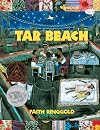
Cassie Louise Light-foot, eight years old in 1939, has a dream to be free and to go wherever she wants for the rest of her life. One night, up on "tar beach" the rooftop of her family's apartment building, her dream comes true. The stars lift her up into the sky, and she flies all over the city. This book gives a beautifully moving perspective on how simple a child's brain works in times of stress, they long for the simple things, like mother's sleeping at night and having ice cream for show more dinner. This magical story resonates with a universal wish. show less
I was really impressed with this Caldecott book for a couple reasons. I found the illustrations to be beautiful but I was overlooking something at the top and bottom as adults often do. I love children, in part, because they notice everything and help me to keep my awareness instead of tuning out the world. I got to the end of this good story and decided to read a bit about the author to realize the illustrations were pieces of art and her history was as rich as the theme of the story. This show more gave the book so much more dimension and cultural relevance not only for lost artforms such as quilting but sometimes the voices of our ancestors. Bravo, for bringing it all together in a way a child can celebrate! show less

Celebrated African-American artist Faith Ringgold, whose Tar Beach was awarded a Caldecott Honor in 1992, turns in this picture-book to the world of Christmas carols, offering her illustrative interpretations of five traditional songs, together with the performance of the Boys Choir of Harlem. After a brief quotation from the Holy Scripture, telling the Christmas story, the text of each carol - Silent Night; O Come, All Ye Faithful; O Holy Night; Hark! the Herald Angels Sing; and Joy to the show more World - is presented, together with Ringgold's artwork. A CD, included at the rear of the book, presents the performance of the songs by the choir...
As someone who loves Christmas carols, and has an annual project to track down new (or new to me) picture-books devoted to them, I picked up O Holy Night: Christmas With The Boys Choir of Harlem at my public library with great anticipation. I'm familiar with Ringgold, of course, and know that The Boys Choir of Harlem is considered a New York institution. I enjoyed perusing Ringgold's boldly colorful artwork, which features mostly African-Americans in the various roles of Holy Family, angels, shepherds and Wise Men. Listening to the CD was an added bonus, although not really necessary for my enjoyment of the book, as I usually sing the carols to myself, while reading such titles. Recommended to anyone who enjoys Christmas carol picture-books, to fans of Faith Ringgold, or to readers seeking children's Christmas books with an African-American setting. show less
As someone who loves Christmas carols, and has an annual project to track down new (or new to me) picture-books devoted to them, I picked up O Holy Night: Christmas With The Boys Choir of Harlem at my public library with great anticipation. I'm familiar with Ringgold, of course, and know that The Boys Choir of Harlem is considered a New York institution. I enjoyed perusing Ringgold's boldly colorful artwork, which features mostly African-Americans in the various roles of Holy Family, angels, shepherds and Wise Men. Listening to the CD was an added bonus, although not really necessary for my enjoyment of the book, as I usually sing the carols to myself, while reading such titles. Recommended to anyone who enjoys Christmas carol picture-books, to fans of Faith Ringgold, or to readers seeking children's Christmas books with an African-American setting. show less
Lists
Reading Rainbow (1)
Awards


You May Also Like


Associated Authors
Statistics
- Works
- 32
- Also by
- 10
- Members
- 7,700
- Popularity
- #3,162
- Rating
- 4.0
- Reviews
- 306
- ISBNs
- 105
- Languages
- 1
- Favorited
- 1