
Wayson Choy (1939–2019)
Author of The Jade Peony
About the Author
Wayson Choy was born in Vancouver, Canada on April 20, 1939. He graduated from the University of British Columbia in 1962. After working in advertising, he became a professor at Humber College. He taught there for more than 25 years. His first novel, The Jade Peony, was published in 1995 and show more received a Trillium Award and the City of Vancouver Book Award. His second novel, All That Matters, was published in 2004 and received the Trillium Prize. He also wrote two memoirs entitled Paper Shadows: A Chinatown Childhood, which received the Edna Staebler Prize for Creative Non-Fiction, and Not Yet: A Memoir of Living and Almost Dying. In 2005, he was named to the Order of Canada. In 2015, he received the George Woodcock Lifetime Achievement Award for an outstanding literary career in B.C. He died after suffering cardiac arrest on April 27, 2019 at the age of 80. (Bowker Author Biography) show less
Works by Wayson Choy
Associated Works
Tagged
Common Knowledge
- Canonical name
- Choy, Wayson
- Legal name
- 崔維新
Choy, Wayson - Birthdate
- 1939-04-20
- Date of death
- 2019-04-28
- Gender
- male
- Education
- University of British Columbia (Creative Writing)
- Occupations
- author
instructor (Humber College)
instructor (Humber School for Writers) - Organizations
- Cahoots Theatre Company of Toronto (President, 1999-2002)
- Awards and honors
- Trillium Book Award
Order of Canada (2005) - Nationality
- Canada
- Birthplace
- Vancouver, British Columbia, Canada
- Places of residence
- Vancover, British Columbia, Canada
Toronto, Ontario, Canada - Place of death
- Toronto, Ontario, Canada
- Associated Place (for map)
- Canada
Members
Reviews

Three children of immigrant Chinese parents each tell a story from their childhood in Vancouver's Chinatown between 1933 and 1941. We begin with Jook-Liang, the only daughter, as she meets for the first time the ancient Wong-Suk known by everyone as "The Monkey Man". Despite the fact that most people find him ugly and even frightening in appearance, Liang is immediately drawn to him, and he becomes, all too briefly, her best friend and companion. The second section is in the voice of Liang's show more older, adopted brother, Jung-Sum, who tells us how he came to be part of the family, and how he became the protege of an older youth with a tough reputation who eventually decided to go to Seattle to join the U. S. Marine Corps. Finally, we hear from the Little Brother, Sek-Lung, his Grandmother's special project, who has suffered from birth with lung ailments that require extraordinary attention and keep him from starting school at the normal time. Each of these children develops a unique personal relationship that supports them, but ultimately teaches them about loss and letting go. Over all the stories hangs the cloud of world events--the war between China and Japan, and the impending calamities of WWII; the ongoing conflict between Chinese and Japanese immigrant communities; and the eternal struggle of the immigrants and their children to find a balance between Old Ways and Canadian (American) ways. Although I found the ending a bit abrupt, and there isn't an over-arching story line connecting the three sections, I was very impressed with the novel, and would recommend it. Parts of this story are similar to the later novel, [Hotel on the Corner of Bitter and Sweet], set down the coast in the American Northwest--the Chinese/Japanese racial and cultural divide, the Romeo and Juliet motif, the assimilation vs. tradition themes. I'm rating [The Jade Peony] slightly higher than Ford's novel, however, as it avoided any glaring anachronisms and kept me more fully engaged with the characters.
The strength of Choy's work is excellently anticipated by the book's epigraph:
T'ong Yahn Gaai was what
we once called
where we lived: "China-People Street".
Later, we mimicked
Demon talk
and wrote down only
Wah Fauh--"China-Town."
The difference
is obvious: the people
disappeared.
---Wing Tek Lum, "Translations" show less
The strength of Choy's work is excellently anticipated by the book's epigraph:
T'ong Yahn Gaai was what
we once called
where we lived: "China-People Street".
Later, we mimicked
Demon talk
and wrote down only
Wah Fauh--"China-Town."
The difference
is obvious: the people
disappeared.
---Wing Tek Lum, "Translations" show less
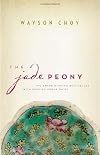
The Jade Peony, Choy’s debut novel set in Vancouver’s Chinatown during WWII, is a vibrant and moving story of one family’s immigrant experience. Grandmother Poh Poh, one of Chinatown’s few elder women, the keeper of the old ways, and the undisputed heart of the family, lives with her son and daughter-in-law and their four children. Three of the children narrate the story: Jook-Liang, Only Sister; Jung-Sum, Second Brother; and Sek-Lung (Sekky), Third Brother.
Through the voices of his show more characters, Choy writes poignantly of what it means to belong to a family living in two worlds, East and West, with loyalties to two countries. Forging new identities is complicated by the war: Canada is fighting Germany, and Japan is invading China. Poh Poh is adamant that the children are Chinese, that they must know of Old China. Father and Stepmother (so called by even her biological children, by Poh Poh’s declaration) worry that their children are “neither this nor that, neither Chinese nor Canadian.” (152) And the children, struggling to belong, find their loyalties torn between family and the desire to establish Canadian identities: “What would white people in Vancouver think of us? We were Canadians now, Chinese-Canadians, a hyphenated reality that our parents could never accept. So it seemed, for different reasons, we were all holding our breath, waiting for something." (162)
Choy strikes a perfect tone between poignant and comical. Wholly respectful of the painful challenges of an immigrant family, he realizes that the experience is not without its own particular humour. For Sekky, the youngest, who has the closest relationship with Poh Poh but is also the most “Western” member of the family, the confusion occasionally becomes all too much. I couldn’t help but delight when he came out with this:
“The Chinese rankings for acquaintances and relatives were overwhelming. There were different titles for those persons related to us according to the father’s age, the mother’s age, and even the ages of the four grandparents, and according to whether they were from the mother’s or father’s side – never mind if you threw in a stepmother and her best friend. And if those persons were also tied to us by false papers to obtain immigration visas, they became “paper sons” or “paper uncles,” heirs to a web of illegal subterfuge brought on by laws that stipulated only relatives of official “merchant-residents” or “scholars” could immigrate from China to Canada. Paper money could buy paper relatives. But whose papers were connected to whose relatives? My head pounded.” (148)
I was completed charmed by The Jade Peony and will look for more of Choy’s work. Highly recommended. show less
Through the voices of his show more characters, Choy writes poignantly of what it means to belong to a family living in two worlds, East and West, with loyalties to two countries. Forging new identities is complicated by the war: Canada is fighting Germany, and Japan is invading China. Poh Poh is adamant that the children are Chinese, that they must know of Old China. Father and Stepmother (so called by even her biological children, by Poh Poh’s declaration) worry that their children are “neither this nor that, neither Chinese nor Canadian.” (152) And the children, struggling to belong, find their loyalties torn between family and the desire to establish Canadian identities: “What would white people in Vancouver think of us? We were Canadians now, Chinese-Canadians, a hyphenated reality that our parents could never accept. So it seemed, for different reasons, we were all holding our breath, waiting for something." (162)
Choy strikes a perfect tone between poignant and comical. Wholly respectful of the painful challenges of an immigrant family, he realizes that the experience is not without its own particular humour. For Sekky, the youngest, who has the closest relationship with Poh Poh but is also the most “Western” member of the family, the confusion occasionally becomes all too much. I couldn’t help but delight when he came out with this:
“The Chinese rankings for acquaintances and relatives were overwhelming. There were different titles for those persons related to us according to the father’s age, the mother’s age, and even the ages of the four grandparents, and according to whether they were from the mother’s or father’s side – never mind if you threw in a stepmother and her best friend. And if those persons were also tied to us by false papers to obtain immigration visas, they became “paper sons” or “paper uncles,” heirs to a web of illegal subterfuge brought on by laws that stipulated only relatives of official “merchant-residents” or “scholars” could immigrate from China to Canada. Paper money could buy paper relatives. But whose papers were connected to whose relatives? My head pounded.” (148)
I was completed charmed by The Jade Peony and will look for more of Choy’s work. Highly recommended. show less
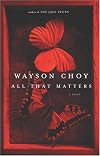
Set very specifically in Vancouver’s Chinatown in the interwar period, All That Matters is a fascinating and complex book about family, friendship and community in an immigrant community. It’s specific but the themes are universal.
The descriptive detail that Wayson Choy brings into his story make it easy to visualize the reality of the characters’ lives – especially for a Vancouver resident who can place each incident in a well-known setting. When Choy says that someone could hear show more the roaring trains passing through the neighbourhood, or could sit on their back porch and watch the sun shining on the mountains, I know exactly what he means. But even for a non-resident, I think the settings would be concrete and real.
Since the story deals with specific historical events and locations, this concreteness helps set the story as the lived experience of people in a real place and time, in spite of a mystical layer that Choy also weaves in. He places things so specifically that I kept thinking the story was autobiographical, although it is not.
Choy offers an insight into an immigrant experience that helps to understand the complexity of the city’s past. Although the Chinese and Irish kids are neighbours and play together, they rarely enter each other’s houses, and their parents barely acknowledge each other over the back fences. And the Chinese immigrants want Canada to enter the war against the Japanese because they know the brutality their families face in China, and hope to take over confiscated Japanese Canadian property. Even within the Chinese community, political and social factions compete, and often resent the benefits that luckier ones have won – such as the children that the single men are unable to father because they cannot bring a wife from China.
Choy also shows the complex relationships within the family. Third Uncle, who is a clan member but not a blood relative, sponsors Father, Grandmother and Kiam-Kim (the narrator as a child) after the death of his own wife. This creates feelings of gratitude, but also obligation, When Second Wife arrives to replace Father’s dead first wife and bring up the family, resentments also grow, although over time that develops into deeper, positive emotions. Kiam-Kim’s own relationships as Eldest Son make him responsible for the adopted Second Son, although he also resents him. When Father and Second Wife have their own children, the family seems to grow together more naturally into a loving unit. Later in the story, secret relationships are revealed that explain some of the underlying family tensions.
I’m not sure what to think of the mystical elements that Choy introduces to these very concrete scenes. Kiam-Kim’s dead mother seems to hover over his life and he sometimes feels her as a real presence. His grandmother communicates with her past lover, and makes artworks that seem to be inspired by unseen forces. These elements seem to be more than the traditional spiritual practices of the community, but represent a powerful force in the lives of the characters – perhaps the weight of their past and their community’s history.
By the end of the story, Choy seems to be saying that what matters is not nationality or community or even family, but supporting the people who are important to you. This will include family, but also others who are part of your life. This perspective is unexpected in a culture where family is central, but as a gay writer, Choy knows that “chosen family” is as important as legal family, even when traditional family ties are complex and deeply part of a character’s psyche. show less
The descriptive detail that Wayson Choy brings into his story make it easy to visualize the reality of the characters’ lives – especially for a Vancouver resident who can place each incident in a well-known setting. When Choy says that someone could hear show more the roaring trains passing through the neighbourhood, or could sit on their back porch and watch the sun shining on the mountains, I know exactly what he means. But even for a non-resident, I think the settings would be concrete and real.
Since the story deals with specific historical events and locations, this concreteness helps set the story as the lived experience of people in a real place and time, in spite of a mystical layer that Choy also weaves in. He places things so specifically that I kept thinking the story was autobiographical, although it is not.
Choy offers an insight into an immigrant experience that helps to understand the complexity of the city’s past. Although the Chinese and Irish kids are neighbours and play together, they rarely enter each other’s houses, and their parents barely acknowledge each other over the back fences. And the Chinese immigrants want Canada to enter the war against the Japanese because they know the brutality their families face in China, and hope to take over confiscated Japanese Canadian property. Even within the Chinese community, political and social factions compete, and often resent the benefits that luckier ones have won – such as the children that the single men are unable to father because they cannot bring a wife from China.
Choy also shows the complex relationships within the family. Third Uncle, who is a clan member but not a blood relative, sponsors Father, Grandmother and Kiam-Kim (the narrator as a child) after the death of his own wife. This creates feelings of gratitude, but also obligation, When Second Wife arrives to replace Father’s dead first wife and bring up the family, resentments also grow, although over time that develops into deeper, positive emotions. Kiam-Kim’s own relationships as Eldest Son make him responsible for the adopted Second Son, although he also resents him. When Father and Second Wife have their own children, the family seems to grow together more naturally into a loving unit. Later in the story, secret relationships are revealed that explain some of the underlying family tensions.
I’m not sure what to think of the mystical elements that Choy introduces to these very concrete scenes. Kiam-Kim’s dead mother seems to hover over his life and he sometimes feels her as a real presence. His grandmother communicates with her past lover, and makes artworks that seem to be inspired by unseen forces. These elements seem to be more than the traditional spiritual practices of the community, but represent a powerful force in the lives of the characters – perhaps the weight of their past and their community’s history.
By the end of the story, Choy seems to be saying that what matters is not nationality or community or even family, but supporting the people who are important to you. This will include family, but also others who are part of your life. This perspective is unexpected in a culture where family is central, but as a gay writer, Choy knows that “chosen family” is as important as legal family, even when traditional family ties are complex and deeply part of a character’s psyche. show less
The Jade Peony, Wayson Choy's first novel and a RUSA Notable Book, is a genre-bending, memoirlike collection of stories about a family in Vancouver's Chinatown before and during World War II. Three siblings tell the stories of their very different childhoods in a world defined by change, each in their own way wresting autonomy from the strictures of history, family, and poverty. Sister Jook-Liang aspires to be Shirley Temple; adopted Second Brother Jung-Sum, who struggles with his sexuality, show more finds his way through boxing. Third Brother Sekky, who never feels comfortable with the multitude of Chinese dialects swirling around him, becomes obsessed with war games, and learns a devastating lesson about what war really means when his 17-year-old babysitter dates a Japanese man, with terrible consequences.
One of Choy's most compelling subjects is the fluidity of the extended family. The shadowy woman everyone calls Stepmother is a house servant and concubine who moves into the role of mother, giving birth to two of the siblings but never quite achieving full status. Many chapters focus on the powerful effects friends and neighbors have on the family and the importance of their names and titles.
Choy's evocations of life in Depression-era and wartime Vancouver are especially memorable: the bewildered air of Little Tokyo during the first Christmas after Pearl Harbor, a burned-down church that Sekky and his grandmother pick through for bits of the stained-glass windows--a metaphor for the family's task of sorting out what to keep and what to abandon as it moves into the future. Like the jade peony of the title, Choy's storytelling is at once delicate, powerful, and lovely. show less
One of Choy's most compelling subjects is the fluidity of the extended family. The shadowy woman everyone calls Stepmother is a house servant and concubine who moves into the role of mother, giving birth to two of the siblings but never quite achieving full status. Many chapters focus on the powerful effects friends and neighbors have on the family and the importance of their names and titles.
Choy's evocations of life in Depression-era and wartime Vancouver are especially memorable: the bewildered air of Little Tokyo during the first Christmas after Pearl Harbor, a burned-down church that Sekky and his grandmother pick through for bits of the stained-glass windows--a metaphor for the family's task of sorting out what to keep and what to abandon as it moves into the future. Like the jade peony of the title, Choy's storytelling is at once delicate, powerful, and lovely. show less
Lists
Awards


You May Also Like


Associated Authors
Statistics
- Works
- 4
- Also by
- 1
- Members
- 1,184
- Popularity
- #21,706
- Rating
- 3.6
- Reviews
- 37
- ISBNs
- 31
- Languages
- 1
- Favorited
- 6