
Alan Hollinghurst
Author of The Line of Beauty
About the Author
Image credit: Alan Hollinghurst on May 8, 2014 in Saint Malo, France
Works by Alan Hollinghurst
Hollinghurst Alan 1 copy
Associated Works
The Pleasure of Reading: 43 Writers on the Discovery of Reading and the Books That Inspired Them (2015) — Contributor — 104 copies, 2 reviews
Queer: A Collection of LGBTQ Writing from Ancient Times to Yesterday (2021) — Contributor, some editions — 66 copies
Tagged
Common Knowledge
- Birthdate
- 1954-05-26
- Gender
- male
- Education
- University of Oxford ( [1975])
- Occupations
- lecturer
deputy editor (Times Literary Supplement ∙ 1981-1985)
novelist
poet
short story writer
translator - Organizations
- The Times Literary Supplement
- Awards and honors
- E. M. Forster Award (1991)
Newdigate Prize for poetry (1974)
Royal Society of Literature (Fellow)
Granta's Best Of Young British Novelists (1993) - Relationships
- Mendez, Paul (partner)
- Nationality
- England
UK - Birthplace
- Stroud, Gloucestershire, England, UK
- Places of residence
- London, England, UK
- Map Location
- England, UK
Members
Discussions
The Stranger's Child by Alan Hollinghurst in Booker Prize (November 2020)
Reviews
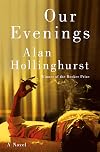
Great writers leave you with the sensation of having witnessed a magic trick. Just as the magician shows you the empty box, the lack of strings, and manages to conjure a dove or levitate an apple, you go into a novel believing that you know the author's toolset--the English language, the same language you grew up with and know intimately--and they conjure something seemingly impossible before your very eyes. You can string a sentence together, you're watching them do it, and yet there it show more somehow springs into being: The Great Novel.
Our Evenings is a great novel. It is, more than anything, absorbing. It is perhaps the most vivid book I've ever read, despite not being particularly flashy or bold. Every time I picked it up, I felt that I was dropping into the life of the narrator, David Win, who is so three-dimensional you can practically shake his hand. Hollinghurst is just so exceptionally skilled at capturing the texture of spaces and the way things and people stand out in memory because of the time we encountered them.
I am also very impressed by the way Hollinghurst deals with time. Ultimately this is a novel in vignettes, but it isn't at all choppy. Though we often start a new chapter of David's life in media res without immediate clarity on the setting or the major players, the author never keeps us in the dark for too long and smartly clues us in (via details that can seem minor at first) to the fates of other characters and arcs. Long periods of David's life are skipped over in the way we might skip over uneventful periods of our own lives when telling our life story to a stranger--and, keeping the thematic thread and the same protagonist, it works.
This sort of sweeping odyssey feels almost anachronistic in 2024. Unfortunately, its radiance is undercut by the final few pages. That is what ultimately prevented me from giving this five stars. The ending was bungled. By which I mean, there's a good, quiet ending, and then a loud, not-very-good ending right after it. No spoilers, and I understand why Hollinghurst made this decision, but if I were his editor I would have argued mightily against it. To me, it feels a bit shallow and brash and gets overly meta where the meta aspects had been managed quite beautifully and subtly up to that point. show less
Our Evenings is a great novel. It is, more than anything, absorbing. It is perhaps the most vivid book I've ever read, despite not being particularly flashy or bold. Every time I picked it up, I felt that I was dropping into the life of the narrator, David Win, who is so three-dimensional you can practically shake his hand. Hollinghurst is just so exceptionally skilled at capturing the texture of spaces and the way things and people stand out in memory because of the time we encountered them.
I am also very impressed by the way Hollinghurst deals with time. Ultimately this is a novel in vignettes, but it isn't at all choppy. Though we often start a new chapter of David's life in media res without immediate clarity on the setting or the major players, the author never keeps us in the dark for too long and smartly clues us in (via details that can seem minor at first) to the fates of other characters and arcs. Long periods of David's life are skipped over in the way we might skip over uneventful periods of our own lives when telling our life story to a stranger--and, keeping the thematic thread and the same protagonist, it works.
This sort of sweeping odyssey feels almost anachronistic in 2024. Unfortunately, its radiance is undercut by the final few pages. That is what ultimately prevented me from giving this five stars. The ending was bungled. By which I mean, there's a good, quiet ending, and then a loud, not-very-good ending right after it. No spoilers, and I understand why Hollinghurst made this decision, but if I were his editor I would have argued mightily against it. To me, it feels a bit shallow and brash and gets overly meta where the meta aspects had been managed quite beautifully and subtly up to that point. show less
OUR EVENINGS BY ALAN HOLLINGHURST.
It means a great deal to me, as I’m sure it does to others, to read a novel that tells the story of a queer life as ordinary. The world feels built to accommodate a certain perspective, a certain mode of life, despite the human experience being endlessly complex and vastly different between one person and the next. It feels like such a victory, then, to read about a life that doesn’t fit neatly into the limiting view that people are one of a few things. show more This is a celebration of queerness as being normal, which it of course it is.
This is the story of a life, just like any other, filled with beauty and sadness and change. There’s a sincerity in the writing here that makes David’s story as gripping as anything I’ve ever read. I crave connection - to people, to the world - and this book provides just as much insight into David’s life as it highlights how little I know about those around me. Reading this felt like a command, a challenge to make a concerted effort to imagine the world and the people in it from a different vantage point than my own.
I almost feel as though David is a real person, and as I approached the end of the novel, I felt like I was witnessing a life ending. My throat squeezed as I flipped through those final pages, as people important to him passed on, as he himself reached the final stage of life. I came to love him, in the end.
I think, ultimately, that’s the beauty of stories. To know someone, whether it’s a fictional character or the author who created them, is to love them. I’m happy I know David’s story, and I’m happy that, through David, I learned a bit more about Alan Hollinghurst. His writing is a gift I feel lucky to have received.
Go read this book. show less
It means a great deal to me, as I’m sure it does to others, to read a novel that tells the story of a queer life as ordinary. The world feels built to accommodate a certain perspective, a certain mode of life, despite the human experience being endlessly complex and vastly different between one person and the next. It feels like such a victory, then, to read about a life that doesn’t fit neatly into the limiting view that people are one of a few things. show more This is a celebration of queerness as being normal, which it of course it is.
This is the story of a life, just like any other, filled with beauty and sadness and change. There’s a sincerity in the writing here that makes David’s story as gripping as anything I’ve ever read. I crave connection - to people, to the world - and this book provides just as much insight into David’s life as it highlights how little I know about those around me. Reading this felt like a command, a challenge to make a concerted effort to imagine the world and the people in it from a different vantage point than my own.
I almost feel as though David is a real person, and as I approached the end of the novel, I felt like I was witnessing a life ending. My throat squeezed as I flipped through those final pages, as people important to him passed on, as he himself reached the final stage of life. I came to love him, in the end.
I think, ultimately, that’s the beauty of stories. To know someone, whether it’s a fictional character or the author who created them, is to love them. I’m happy I know David’s story, and I’m happy that, through David, I learned a bit more about Alan Hollinghurst. His writing is a gift I feel lucky to have received.
Go read this book. show less

This is in many ways quite a different book. Starting in the world of EM Forster, where the Edwardian bourgeoisie uncomfortably rubs shoulders with the nouveau very riche aristocracy, lubricated by poetry and sex; it changes setting, linking characters across a hundred years of profound social and economic change, united somehow by a piece of poetry, elusive, but somehow capturing some essence of the English character. Hollinghurst uses this device of the interlinked story to explore very show more many different themes - changing social attitudes to homosexuality (and women's relationships with gay men); literature and criticism; performance and silence; childhood and heredity; mental illness and charm; social status and economic cycles; education, architecture, discovery and, most importantly, mystery and secrecy. The book ends where it starts, with a breathless chase for revelation which is as tricky and elusive as the novel itself. For a writer often known for his openness and candour, this book celebrates the unspoken and confronts the question always there for fiction, and for us as humans living our own narratives - what can be said to be true? What survives of us, what stories, what fractional views - and this is as much true of those who are famous and have others paid to construct their narratives, as those who live undiscovered lives. Fascinating show less
There’s a closeness in watching a kid grow up over the course of a book, but I didn’t have to get far into it to start caring for this character. What struck me most wasn’t the plot or characters, but the way Hollinghurst draws out those thoughts between thoughts, those feelings you can’t name; a perspective hard to find outside of poetry or maybe Virginia Woolf. I felt I was in the midst of a classic but found few met-expectations or tropes along the way. This was my introduction to show more the wonderful Hollinghurst, and I can’t wait for more. show less
Lists
2000s decade (1)
Netgalley Reads (1)
Elegant Prose (1)
. (1)
Awards


You May Also Like


Associated Authors
Statistics
- Works
- 17
- Also by
- 16
- Members
- 12,330
- Popularity
- #1,900
- Rating
- 3.6
- Reviews
- 323
- ISBNs
- 252
- Languages
- 19
- Favorited
- 45
