
David Leavitt
Author of The Lost Language of Cranes
About the Author
David Leavitt's first collection of stories, "Family Dancing," was a finalist for both the National Book Critics Circle Award & the PEN/Faulkner Prize. "The Lost Language of Cranes" was made into a BBC film, & "While England Sleeps" was shortlisted for the Los Angeles Times Fiction Prize. Leavitt show more is also the author of "Equal Affections," "A Place I've Never Been," "Arkansas," & "The Page Turner." With Mark Mitchell, he coedited "The Penguin Book of Short Stories" & "The Pages Passed from Hand to Hand" & cowrote "Italian Pleasures." He is recipient of fellowships from the John Simon Guggenheim Foundation & the National Endowment for the Arts. He divides his time between Italy and Florida. (Bowker Author Biography) show less
Image credit: Devid Leavitt, Milano, Italy, 17th September 2017
Works by David Leavitt
The Man Who Knew Too Much: Alan Turing and the Invention of the Computer (2006) 729 copies, 20 reviews
Pages Passed from Hand to Hand: The Hidden Tradition of Homosexual Literature in English from 1748 to 1914 (1997) — Editor — 185 copies, 1 review
Devota (in Ballo di famiglia) 2 copies
Territory 2 copies
O Escriturário Indiano 2 copies
Sentimentos paralelos 1 copy
O Virador de Páginas 1 copy
Linguagem Perdida 1 copy
A Room With a View 1 copy
Subtropics (1) 1 copy
Associated Works
The Scribner Anthology of Contemporary Short Fiction: Fifty North American American Stories Since 1970 (1999) — Contributor — 587 copies, 4 reviews
Writers on Writing: Collected Essays from the New York Times (2001) — Contributor — 485 copies, 5 reviews
For the Love of Books: 115 Celebrated Writers on the Books They Love Most (1999) — Contributor — 479 copies, 4 reviews
You've Got to Read This: Contemporary American Writers Introduce Stories that Held Them in Awe (1994) — Introduction — 414 copies, 3 reviews
The Letter Q: Queer Writers' Notes to their Younger Selves (2012) — Contributor — 296 copies, 5 reviews
There's No Toilet Paper on the Road Less Traveled: The Best of Travel Humor and Misadventure (1998) — Contributor — 217 copies, 5 reviews
First Fiction: An Anthology of the First Published Stories by Famous Writers (1994) — Contributor — 196 copies, 1 review
The Literary Lover: Great Stories of Passion and Romance (1993) — Contributor — 55 copies, 2 reviews
Tagged
Common Knowledge
- Birthdate
- 1961-06-23
- Gender
- male
- Education
- Yale University
- Occupations
- novelist
short story writer
non-fiction writer
professor - Organizations
- University of Florida
- Nationality
- USA
- Birthplace
- Pittsburgh, Pennsylvania, USA
- Associated Place (for map)
- Pennsylvania, USA
Members
Reviews

I love those instances of synchronicity discovered through reading.
Until I read this book I had never heard of mathematician Ramanujan and certainly never heard of his contributions to mathematics.
This is despite studying mathematics for my Bachelor of Science major.
And then, within a week of finishing the book I ran across mention of him in this article from Nature: https://www.nature.com/articles/s41586-021-03229-4
I suppose the story of a mathematics genius from India who was brought to show more England by some of the greatest minds of the early 20th century would not appeal to everyone but I was quite fascinated by it. Not only do we learn about Ramanujan and his mentor, Hardy, but we get a glimpse of pre-war England especially as it was experienced in the halls of Cambridge. Names such as Rupert Brooke and Bertrand Russell and John Maynard Keynes pop up at parties and dinners. Many of them belong to the Apostles Club, a discussion group of current and former Cambridge students. It appears that many of the members were homosexual according to this book. Certainly G. H. Hardy is portrayed as one. Women play an important part in this story although their position in society at that time was certainly subservient to men. There is the married woman, Mrs. Chase, who is the mistress of one of Hardy's collaborator; there is Hardy's unmarried sister; and there is Mrs. Norton, wife of another mathematician. It is Mr. and Mrs. Norton who meet Ramanujan in India and persuade him to come to England where they host him at their house for some months. Ramanujan is a strict vegetarian and Mrs. Norton special meals for him, although they don't seem to be to Ramanujan's taste and certainly are not liked by Hardy and the other guests. In the process Mrs. Norton becomes infatuated with Ramanujan but he does not return her attention. When Ramanujan moves out into rooms at the college he cooks for himself possibly giving himself lead poisoning from the cookware he uses. Leavitt doesn't definitively say that lead poisoning was the cause of Ramanujan's early death but it seems as good a theory as any. While Ramanujan did not prove the Reimann Hypothesis that fascinated Hardy (in fact it still remains unproven) but he did contribute to the fields of number theory, infinite series and continued fractions. For someone who had no formal training in mathematics that was miraculous. It may have been that lack of formal training that allowed him to branch out into new approaches and achieve the breakthroughs that he did.
Truly a fascinating portrayal. show less
Until I read this book I had never heard of mathematician Ramanujan and certainly never heard of his contributions to mathematics.
This is despite studying mathematics for my Bachelor of Science major.
And then, within a week of finishing the book I ran across mention of him in this article from Nature: https://www.nature.com/articles/s41586-021-03229-4
I suppose the story of a mathematics genius from India who was brought to show more England by some of the greatest minds of the early 20th century would not appeal to everyone but I was quite fascinated by it. Not only do we learn about Ramanujan and his mentor, Hardy, but we get a glimpse of pre-war England especially as it was experienced in the halls of Cambridge. Names such as Rupert Brooke and Bertrand Russell and John Maynard Keynes pop up at parties and dinners. Many of them belong to the Apostles Club, a discussion group of current and former Cambridge students. It appears that many of the members were homosexual according to this book. Certainly G. H. Hardy is portrayed as one. Women play an important part in this story although their position in society at that time was certainly subservient to men. There is the married woman, Mrs. Chase, who is the mistress of one of Hardy's collaborator; there is Hardy's unmarried sister; and there is Mrs. Norton, wife of another mathematician. It is Mr. and Mrs. Norton who meet Ramanujan in India and persuade him to come to England where they host him at their house for some months. Ramanujan is a strict vegetarian and Mrs. Norton special meals for him, although they don't seem to be to Ramanujan's taste and certainly are not liked by Hardy and the other guests. In the process Mrs. Norton becomes infatuated with Ramanujan but he does not return her attention. When Ramanujan moves out into rooms at the college he cooks for himself possibly giving himself lead poisoning from the cookware he uses. Leavitt doesn't definitively say that lead poisoning was the cause of Ramanujan's early death but it seems as good a theory as any. While Ramanujan did not prove the Reimann Hypothesis that fascinated Hardy (in fact it still remains unproven) but he did contribute to the fields of number theory, infinite series and continued fractions. For someone who had no formal training in mathematics that was miraculous. It may have been that lack of formal training that allowed him to branch out into new approaches and achieve the breakthroughs that he did.
Truly a fascinating portrayal. show less

This has a very promising opening, with a bunch of New York middle-class liberals at a party in early November 2016 discussing whether emigration or political assassination would be the most appropriate response to America’s latest self-inflicted disaster. It looks as though we’re in for a bright, Firbankian political satire of Trump-era life, something that would take our minds off the current nervous speculation about whether anyone could be crazy enough to vote for him a second time show more (written late October 2024).
But unfortunately, the book doesn’t really deliver on this early promise. It turns into a rather rambling adultery comedy, rather like a less-funny version of Ab Fab, in which the only real joke is the way the overprivileged characters constantly fail to realise that their worthy political ideals are undermined by the financial security blanket that insulates their lives from the consequences of the actions of even the most incompetent and self-interested administration. The only real whiff of the old Leavitt is the gay interior designer (hold on a minute: a gay interior designer? What next, flight attendants…?) Jake, who turns out to have a much-trailed-but-only-revealed-in-the-last-chapter back-story that could well have been the main plot of a Leavitt novel in the 1980s. Good in parts, but it felt like a waste of a situation that he could have done so much more with. show less
But unfortunately, the book doesn’t really deliver on this early promise. It turns into a rather rambling adultery comedy, rather like a less-funny version of Ab Fab, in which the only real joke is the way the overprivileged characters constantly fail to realise that their worthy political ideals are undermined by the financial security blanket that insulates their lives from the consequences of the actions of even the most incompetent and self-interested administration. The only real whiff of the old Leavitt is the gay interior designer (hold on a minute: a gay interior designer? What next, flight attendants…?) Jake, who turns out to have a much-trailed-but-only-revealed-in-the-last-chapter back-story that could well have been the main plot of a Leavitt novel in the 1980s. Good in parts, but it felt like a waste of a situation that he could have done so much more with. show less
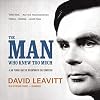
This is a game effort by a novelist to write a somewhat mathematical biography of a mathematician. The novelist is a gay novelist, and the subject was a gay mathematician; the biography argues for a strong connection between Turing's homosexuality and his mathematical research. I can't get behind this idea too strongly, but I couldn't claim that it was wrong, either.
There is an excellent quotation about Turing's attitude to a profound mathematical question: "Turing was probably in neither show more group. His isolation (not to mention his homosexuality) disinclined him to over identify with larger collectives." My stance is probably similar.
The initial discussion of set theory and the paradox of the set which can neither be a member of itself or a member of its complement is well-presented, but the discussion of Godel's work communicates very little. It is possible to blame Godel for this, though. His construction is a lot of work.
The first Turing machine, on page 68, doesn't work for any right-side operand other than 11 (2). That is, it gives the right answer only if the right operand is 2. It would have made more sense if it had just been a +2 machine. The machine on page 71 works as advertised. As the chapter, "The Universal Machine" winds on its way, the Turing machines become less clearly defined and the paradox is so rushed as to be incomprehensible. I longed to read a more technical discussion that would actually convince.
(Note I had fun entering the first Turing machine in https://turing9000.com, a really visually attractive Turing machine simulator. But for serious work, I would still have to go with JFLAP.)
The next chapter, "God is Slick", discusses Turing's hiatus at Princeton, where he had been sent by his advisor at Cambridge in order to pursue his work on computable numbers with Alonzo Church. At this time, Turing also dipped back into pure, rather than meta-mathematics, working on the Riemann hypothesis, but considering it in a mechanical way. This chapter is less technical, hence less frustrating.
The following chapter, "The Tender Peel", takes Turing to Bletchley Park. Again, it flounders in the technical detail, attempting some discussion but lacking the necessary precision. (The bit about Babbage's approach to the Vigeniere cipher is almost comprehensible.) But the chapter sets the stage effectively, and again leaves me wanting a more rigorous mathematical treatment. "the tender peel" is a quotation from the witch's song in the Disney film, "Sleeping Beauty". Turing takes a bite at the apple which will leave him a person of interest to the British government for the rest of his life.
In "The Electronic Athlete" Turing moves on from Bletchley Park and begins work on voice encryption and, at the National Physics Laboratory, the construction of the ACE computer. It is not really clear how much the ACE was real, and how Turing's ideas were really so different.
In "The Imitation Game" Turing moves to Manchester to work on a new machine with his former advisor, Newman. The chair of the department of neurosurgery at Manchester, Sir Geoffrey Jefferson, gives a lecture preemptively refuting machine intelligence. The talk was humorous in parts, but smug in a way that would have gone over poorly with Turing, who, like Darwin, felt that the constant, implicit assumption that humans were superior because the qualities humans ascribe to themselves are the ones that they insist are the superior qualities, was boring and ignorant. Turing publishes his eerie "Computing Machinery and Intelligence" paper in the journal "Mind". This paper takes a tender and very sympathetic attitude toward machines. He continues to try to solve a variety of problems on his new machine: calculations to disprove the Riemann hypothesis but also, by one of his colleagues, a clever hack to make it play "God Save the King".
"Price's Buoy" is the endgame. Turing is elected to the Royal Society, becomes interested in morphogenesis, is arrested and charged with "gross indecency", writes a short story about his unfortunate experience, and dies. The general consensus is suicide, although some of his friends prefer to believe that the death is accidental. The author gives one paragraph to the possibility that the government might have decided to kill him off as a security threat, or rather to the fact that this possibility didn't seem to occur to anyone who knew him at that time.
Although it does fall down on the mathematical side, not only w/ the bad Turing machine but also with a bunch of typos in the discussion of Mersenne primes, and wanders off into the weeds with some of its mathematical explanation, this book is worth the read. It presents a coherent, individual, and sympathetic view of Turing's life. show less
There is an excellent quotation about Turing's attitude to a profound mathematical question: "Turing was probably in neither show more group. His isolation (not to mention his homosexuality) disinclined him to over identify with larger collectives." My stance is probably similar.
The initial discussion of set theory and the paradox of the set which can neither be a member of itself or a member of its complement is well-presented, but the discussion of Godel's work communicates very little. It is possible to blame Godel for this, though. His construction is a lot of work.
The first Turing machine, on page 68, doesn't work for any right-side operand other than 11 (2). That is, it gives the right answer only if the right operand is 2. It would have made more sense if it had just been a +2 machine. The machine on page 71 works as advertised. As the chapter, "The Universal Machine" winds on its way, the Turing machines become less clearly defined and the paradox is so rushed as to be incomprehensible. I longed to read a more technical discussion that would actually convince.
(Note I had fun entering the first Turing machine in https://turing9000.com, a really visually attractive Turing machine simulator. But for serious work, I would still have to go with JFLAP.)
The next chapter, "God is Slick", discusses Turing's hiatus at Princeton, where he had been sent by his advisor at Cambridge in order to pursue his work on computable numbers with Alonzo Church. At this time, Turing also dipped back into pure, rather than meta-mathematics, working on the Riemann hypothesis, but considering it in a mechanical way. This chapter is less technical, hence less frustrating.
The following chapter, "The Tender Peel", takes Turing to Bletchley Park. Again, it flounders in the technical detail, attempting some discussion but lacking the necessary precision. (The bit about Babbage's approach to the Vigeniere cipher is almost comprehensible.) But the chapter sets the stage effectively, and again leaves me wanting a more rigorous mathematical treatment. "the tender peel" is a quotation from the witch's song in the Disney film, "Sleeping Beauty". Turing takes a bite at the apple which will leave him a person of interest to the British government for the rest of his life.
In "The Electronic Athlete" Turing moves on from Bletchley Park and begins work on voice encryption and, at the National Physics Laboratory, the construction of the ACE computer. It is not really clear how much the ACE was real, and how Turing's ideas were really so different.
In "The Imitation Game" Turing moves to Manchester to work on a new machine with his former advisor, Newman. The chair of the department of neurosurgery at Manchester, Sir Geoffrey Jefferson, gives a lecture preemptively refuting machine intelligence. The talk was humorous in parts, but smug in a way that would have gone over poorly with Turing, who, like Darwin, felt that the constant, implicit assumption that humans were superior because the qualities humans ascribe to themselves are the ones that they insist are the superior qualities, was boring and ignorant. Turing publishes his eerie "Computing Machinery and Intelligence" paper in the journal "Mind". This paper takes a tender and very sympathetic attitude toward machines. He continues to try to solve a variety of problems on his new machine: calculations to disprove the Riemann hypothesis but also, by one of his colleagues, a clever hack to make it play "God Save the King".
"Price's Buoy" is the endgame. Turing is elected to the Royal Society, becomes interested in morphogenesis, is arrested and charged with "gross indecency", writes a short story about his unfortunate experience, and dies. The general consensus is suicide, although some of his friends prefer to believe that the death is accidental. The author gives one paragraph to the possibility that the government might have decided to kill him off as a security threat, or rather to the fact that this possibility didn't seem to occur to anyone who knew him at that time.
Although it does fall down on the mathematical side, not only w/ the bad Turing machine but also with a bunch of typos in the discussion of Mersenne primes, and wanders off into the weeds with some of its mathematical explanation, this book is worth the read. It presents a coherent, individual, and sympathetic view of Turing's life. show less

I discovered this book in my last semester of college in 1988 after reading the author’s article “The New Lost Generation,” from Esquire magazine. Being the same age, the article was one of the best accounts of defining Gen X. The book caught me off guard because of some of the gay subject matter but I ended up liking several of the stories and could identify with the sexual introspection during this period in the 1980s. I loaned the book to someone I knew in Chicago and it never got show more back to me so it’s one of those books still “wandering.” show less
Lists
Awards


You May Also Like


Associated Authors
Statistics
- Works
- 59
- Also by
- 34
- Members
- 8,796
- Popularity
- #2,719
- Rating
- 3.7
- Reviews
- 143
- ISBNs
- 320
- Languages
- 19
- Favorited
- 17
