
A. R. Ammons (1926–2001)
Author of Garbage: A Poem
About the Author
Archie Randolph Ammons, 1926 - Poet and teacher A. R. Ammons was born in North Carolina in 1926. He served his country during World War II aboard a U.S. Navy destroyer escort in the South Pacific, which is where he began writing poetry. After he returned from duty, he attended Wake Forest College, show more North Carolina and the University of California, Berkley. He began teaching at Cornell University in 1964 and, in 1971, became a Goldwin Smith Professor of Poetry there. Ammons has authored nearly 30 books of poetry and some of those titles include "Garbage" (1993), which won the National Book Award and the Library of Congress's Rebekah Johnson Bobbitt National Prize for Poetry; "A Coast of Trees" (1981), which received the national Book Critics Circle Award for Poetry; "Sphere" (1974), which received the Bollingen Prize; and "Collected Poems 1951-1971" (1972), which won the National Book Award. Other honors include the Academy's Tanning Prize, the Poetry Society of America's Robert Frost Medal and the Ruth Lilly Prize. He has also received fellowships from the Guggenheim Foundation, the MacArthur Foundation, and the American Academy of Arts and Letters. Archie Randolph Ammons died on February 25, 2001. (Bowker Author Biography) show less
Image credit: Owen Barfield World Wide Website
Series
Works by A. R. Ammons
An Image for Longing: Selected Letters and Journals of A.R. Ammons, 1951-1974 (English Literary Monograph) (2013) 6 copies
Epoch: This is just a place. An issue devoted to the life and work of A. R. Ammons. Volume 52, Number 3. (2004) 4 copies
Mansion 1 copy
A. R. Ammons: Selected Poems 1 copy
Changing Things 1 copy
A.R. Ammons Collection 1 copy
TEK ERA E KAM SHPËTIMIN 1 copy
Associated Works
Literature: An Introduction to Fiction, Poetry, and Drama (1995) — Contributor, some editions — 1,017 copies, 7 reviews
The Norton Anthology of American Literature, Volume 2: 1865 to Present (1979) — Contributor, some editions — 137 copies
The Poem Is You: 60 Contemporary American Poems and How to Read Them (2016) — Contributor — 78 copies
Possibilities of Poetry: An Anthology of American Contemporaries (1970) — Contributor — 17 copies, 1 review
Epitaphs for Lorine — Contributor — 6 copies
Truck 21, A 50th Birthday Celebration For Jonathan Williams — Contributor — 1 copy
Tagged
Common Knowledge
- Legal name
- Ammons, Archie Randolph
- Other names
- AMMONS, Archie Randolph
AMMONS, A. R. - Birthdate
- 1926-02-18
- Date of death
- 2001-02-25
- Gender
- male
- Education
- Wake Forest University
University of California, Berkeley (M.A.|English) - Occupations
- elementary school principal
real estate salesman
editor
professor
biological glassware manufacturer - Organizations
- American Academy of Arts and Letters (Literature ∙ 1990)
Fellowship of Southern Writers (charter member) - Awards and honors
- Ruth Lilly Poetry Prize (1995)
Frost Medal (1993/1994)
Bollingen Prize (1975)
Wallace Stevens Award (1998)
Lannan Literary Award (Poetry, 1992)
American Academy of Arts and Letters Academy Award (Literature, 1977) (show all 7)
Rebekah Johnson Bobbitt National Prize for Poetry (1993) - Nationality
- USA
- Places of residence
- Whiteville, North Carolina, USA
Ithaca, New York, USA - Associated Place (for map)
- USA
Members
Reviews

The Material of Writing Before Materiality
Materiality, material culture, object-oriented ontology, thing studies, actor-network theory -- these are all kinds of theories that pay attention to the thingness of the thing: the physical book, the paper, pages, weight, and texture. My own project, Writing with Images, impinges on these topics whenever I find myself studying texts where the book itself is part of the work's expressive purpose. Anne Carson's "Nox" is an example. (I've written on show more that at some length in writingwithimages.com.)
Books like these are increasingly common, but they have earlier precedents. An interesting one is A.R. Ammons's "Tape for the Turn of the Year," which was typed on a single roll of adding-machine tape. As far as I can discover (I haven't called Cornell, which has the original reel), there is no scan of the tape, and no facsimile edition. The book transcribes the tape, so we don't see the original monospace typewriter font, and we can only imagine the edges of the reel on both sides of the irregularly formatted text. A typical passage:
1:26 pm:
I feel a little
shivery :
the cold's making--
forgive me--headway :
but I just had a baked ham
sandwich, glass of milk &
coffee,
that to be
transformed into
whatever ammunition
it can :
after this,
this long poem, I hope I
can do short rich hard
lyrics : lines
that can incubate
slowly
then fall into
symmetrical tangles :
lines that can be
gone over (and over)
till they sing with
pre-established rightness :
here, I plug on :
whatever the Muse
gives, I release [p. 143]
The wide margins conjure the invisible constraints Ammons gave himself, and he also writes intermittently about the roll itself, which is slowly unfurling, and how he re-rolls in an ashtray. Ammons may have known about Kerouac's "On the Road" scroll, done in the 1950s, and it is barely possible he knew about some of the early Fluxus experiments -- but my guess is he didn't know either. He was part-time at Cornell University at the time, and his points of reference are writers such as William Carlos Williams, Robert Lowell, Allen Ginsberg, Walt Whitman, and Robert Penn Warren.
All that is by way of explaining why it may never have occurred to Ammons to print a facsimile in monospace font with the tape made explicitly visible. He did have an interest in painting, and exhibited several times, but as I imagine it he wouldn't have thought that an image of the typewriter's embossed imprint, or even the red margins signalling the end of the tape is approaching (which he mentions several times; the red margins would have been visible at the center of the coiled tape roll as he worked) would have served any purpose except distracting readers from his voice. On the other hand, as the reader is reminded on every page, the project has a certain duration, requires specific arrangements (he unspools the tape at one point in order to take it with him on a trip out of town), and constrains every thought between its invisible margins. It is therefore a different kind of materiality, one that represents the physical stuff in words rather than images. It's an interesting kind of awareness of the material, unlike the literalism of today's theories, and immune from the preciousness that comes along with high-resolution color scans (as in Carson's book). When he asks himself
why do I need to throw
this structure
against the flow
which I cannot stop?
is there something
unyielding in me that
can't accept
the passing away of days [p. 87]
he doesn't mean the "structure" of the tape, its spools, his typewriter. He means the structure formed by their constraints, as they are represented in the book. That is a crucial, and I think moderate, ambitious, and sensible, alternative to today's insistence on the stuff itself, its mass, its weight, its look.
(As a poem, "Tape for the Turn of the Year" feels as though it is in the first wave of postmodernism. It is almost unedited; it contains all sorts of unpolished thoughts, including elephant jokes (haven't heard those since I was a child) and space- or time-filling observations, which he excuses by invoking the absence of the Muse. It also has flight of invention, and a wonderful, in the end entirely winning, mode of address to the reader ("reader, we've been thru / a lot together : / who are you?" p. 200). It's as memorable a high-wire act now as it was when I first read it, when Ammons was younger than I am now.) show less
Materiality, material culture, object-oriented ontology, thing studies, actor-network theory -- these are all kinds of theories that pay attention to the thingness of the thing: the physical book, the paper, pages, weight, and texture. My own project, Writing with Images, impinges on these topics whenever I find myself studying texts where the book itself is part of the work's expressive purpose. Anne Carson's "Nox" is an example. (I've written on show more that at some length in writingwithimages.com.)
Books like these are increasingly common, but they have earlier precedents. An interesting one is A.R. Ammons's "Tape for the Turn of the Year," which was typed on a single roll of adding-machine tape. As far as I can discover (I haven't called Cornell, which has the original reel), there is no scan of the tape, and no facsimile edition. The book transcribes the tape, so we don't see the original monospace typewriter font, and we can only imagine the edges of the reel on both sides of the irregularly formatted text. A typical passage:
1:26 pm:
I feel a little
shivery :
the cold's making--
forgive me--headway :
but I just had a baked ham
sandwich, glass of milk &
coffee,
that to be
transformed into
whatever ammunition
it can :
after this,
this long poem, I hope I
can do short rich hard
lyrics : lines
that can incubate
slowly
then fall into
symmetrical tangles :
lines that can be
gone over (and over)
till they sing with
pre-established rightness :
here, I plug on :
whatever the Muse
gives, I release [p. 143]
The wide margins conjure the invisible constraints Ammons gave himself, and he also writes intermittently about the roll itself, which is slowly unfurling, and how he re-rolls in an ashtray. Ammons may have known about Kerouac's "On the Road" scroll, done in the 1950s, and it is barely possible he knew about some of the early Fluxus experiments -- but my guess is he didn't know either. He was part-time at Cornell University at the time, and his points of reference are writers such as William Carlos Williams, Robert Lowell, Allen Ginsberg, Walt Whitman, and Robert Penn Warren.
All that is by way of explaining why it may never have occurred to Ammons to print a facsimile in monospace font with the tape made explicitly visible. He did have an interest in painting, and exhibited several times, but as I imagine it he wouldn't have thought that an image of the typewriter's embossed imprint, or even the red margins signalling the end of the tape is approaching (which he mentions several times; the red margins would have been visible at the center of the coiled tape roll as he worked) would have served any purpose except distracting readers from his voice. On the other hand, as the reader is reminded on every page, the project has a certain duration, requires specific arrangements (he unspools the tape at one point in order to take it with him on a trip out of town), and constrains every thought between its invisible margins. It is therefore a different kind of materiality, one that represents the physical stuff in words rather than images. It's an interesting kind of awareness of the material, unlike the literalism of today's theories, and immune from the preciousness that comes along with high-resolution color scans (as in Carson's book). When he asks himself
why do I need to throw
this structure
against the flow
which I cannot stop?
is there something
unyielding in me that
can't accept
the passing away of days [p. 87]
he doesn't mean the "structure" of the tape, its spools, his typewriter. He means the structure formed by their constraints, as they are represented in the book. That is a crucial, and I think moderate, ambitious, and sensible, alternative to today's insistence on the stuff itself, its mass, its weight, its look.
(As a poem, "Tape for the Turn of the Year" feels as though it is in the first wave of postmodernism. It is almost unedited; it contains all sorts of unpolished thoughts, including elephant jokes (haven't heard those since I was a child) and space- or time-filling observations, which he excuses by invoking the absence of the Muse. It also has flight of invention, and a wonderful, in the end entirely winning, mode of address to the reader ("reader, we've been thru / a lot together : / who are you?" p. 200). It's as memorable a high-wire act now as it was when I first read it, when Ammons was younger than I am now.) show less
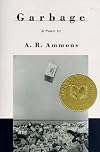
Reading the first poem in the book, one learns right away that A. R. Ammons’ Garbage (Norton, 1993) is not a book about garbage. It’s about poetry writing; it’s about ageing; it’s about values and survival (“simplicity and elegance, pitch in a / little courage and generosity, a touch of / commitment, enough asceticism to prevent / fattening: moderation: elegant and simple / moderation.”) Ultimately, and above all, it’s about anxiety: the anxiety we feel for those we love, whose show more errors and anguish we must live with, but in whose lives we must not intercede.
This long poem won the National Book Award for Poetry in 1994. Its eighteen separate sections (like separate poems, actually) are written in unrhymed, run-on couplets and (like its predecessor, Tape for the Turn of the Year) typed on adding machine tape. The blurb on the back jacket is a quotation from Harold Bloom’s review. I seldom trust blurbs and often disagree with Bloom’s judgments on contemporary poetry. But this time, he has it just right: “The outrageously titled Garbage is strong Ammons: wise, eloquent, exuberantly argumentative, imbued with the continued inventiveness of a maker who would have delighted Whitman and Emerson.”
At the beginning of section #2, the poet states his theme by exploring his dominant metaphor. You have to see the lines and hear the rush of language to get a sense of how eloquently Whitmanesque the poem is.
garbage has to be the poem of our time because
garbage is spiritual, believable enough
to get our attention, getting in the way, piling
up, stinking, turning brooks brownish and
creamy white: what else deflects us from the
errors of our illusionary ways, not a temptation
to trashlessness, that is not too far off, and,
anyway, unimaginable, unrealistic: . . .
At the age of 63, driving down I-95 in Florida, the speaker watches garbage trucks crawl “as up ziggurats” to deposit yet more garbage where gulls and earthworms and natural processes continue their ceaseless work. But quickly, even before he catalogs the refuse being deposited, even in the refuse itself, “the very asshole of comedown,” the poet finds “redemption.” Alluding early on, as he will recurrently throughout the poem, to modern physical sciences, he lifts us up to “the pole where matter’s forms diffuse and / energy loses all means to express itself except / as spirit.”
So, this long poem Garbage is not about garbage—the burgeoning material waste of our world. It’s really about the spiritual. Oh, yes, it’s about anxiety, not so much how to overcome anxiety, but how to harness it, use it to “behold the / wonder . . . of things.” To the philosophic mind (that is to say, the poetic and also the scientific mind), “the mystique of high places lingers / on, the altar-like flames residual in the high / levels of trash management.”
And the ageing poet’s poem is also about poetry. “The best kind of poetry,” he seems to conclude, may be that in which “understatement rides swells / of easing away.” The best metaphor, after all, may be the simplest, and the simplest, the most elegant:
and, often, truly, it can be so nice to watch
the classical moves through the complication, as
with Larry Bird en route for a lay-up, and
anxiety often itself has such heights of stalled
cumuli it can perform miracles . . . .
In such a poem of so many delightful catalogs of metaphors (and repulsive catalogs, too), the best metaphor for poetry itself may turn out to be a Larry Bird layup, so naturally skillful, so seemingly effortless, so swiftly exhilarating.
In these lines, Ammons glides in for many a layup.
--------------------
Appendix (7.18.2011)
[I'm sorrythe LibraryThing review format makes these lines run over; they shouldn't. Just pretend they don't, OK?]
Is a Poem about Garbage Garbage?
What Lyrical Ballads was to the 1790s
(though they didn’t know it) and In Memoriam
to the Victorians (they did), Wasteland to all of us,
Age of Anxiety in the Great Depression,
Howl to the Beats, Sylvia Plath in the Sixties,
Archie Ammons’ Garbage was to the 1990s,
its iambic pentameter the width of adding machine tape,
its author sixty-three and counting, its original stimulus
a mound (mountain) of trash off I-95 in south Florida,
its unrhymed, run-on couplets, fromless – well, mostly formless.
They weren’t Gay Nineties, you understand, but leftovers
from the American Century (its wasteland and age of anxiety),
so lets show the rest of the world, all those ages past
(and to come) that poetry can be made of anything, anything:
“Lines Written after Passing a Trash Heap in South Florida”
. . . . old deck chairs,
crippled aluminum lawn chairs, lemon crates
with busted slats or hinges, strollers with
whacking or spinningly idle wheels: stub ends
of hotdogs . . . (Never mind; never mind.)
NB: the liquidity of all those l's, assonance and
consonance, and all those internal, almost rhymes
(lemons, hinges, spnningly, ends) just right
for these times:: fin de siecle, Y2K, Armaggedon.
Garbage has to be the poem of our time because . . .
well, just because. Make a list of all those aches and pains:
count ‘em out, the signs of our times: medicare/Medicaid,
national osteoporosis week, gadabout tours,
hearing loss, homesharing programs, and choosing
good nutrition! (Been there, done that!)
Forget about sequence and consequence, suspense and
closure, about coherence and unity and parallelism and
proportion, “balance and reconciliation.” Juxtaposition
is the principle, recurrence and repetition, free association
(or the appearance of free association). Work in a little bit
of Confessional Poetry, of what Frank O’Hara would have sat
down and written at lunch time (at the Museum of Modern Art),
just jotting down whatever came to his attention, whatever
came to mind. Every once in a while, throw in an obscurity or
two in memory of T.S. Eliot (and all his Writers’ Worskhop
descendants); some ambiguity and ambivalence for those old
New Critics; with a bit of graffiti for Ginsberg and Kerouac and
the Merry Pranksters gallivanting in their school bus Further;
with enough accessibility to please Billy Collins, but not his brevity.
Poetry should be about poetry: self-consciousness is part of the
art of post-modern poetry. Notice all those lines ending in the;
and the time that rhyme dropped in – a coincidence? or the subtle
craft of a craftsman, aware of his work, letting you the reader in on
his search for words, his apprehension, misgiving, what transfigures this
into this, garbage into something golden? or maybe trash into cash?
And then, all of a sudden (you’ve been forewarned not to expect it),
profundity occurs: “life, too, if it is to have / meaning, must be made
meaningful: if it is to / have purpose, its purpose must be divined,
invented, / manifested, held to.” A wee insight emerges: “I who want-
ed the sky / fall to the glint in a passing eye . . . “; “the aperture so to /
say, poetically speaking, into faith is, of / course, as everyone knows,
the magical exception / to the naturalistic rule . . .” Oh yes, of course,
as everyone knows. Then, too, “we have replaced / the meadows with
oilslick.” Reading along, I trip over “a persiflageous empurpling.” Then,
suddenly . . . the spirea bush, the five
nearly round, slightly dented petals to each
blossom, snows the ground white during rains:
the norway maple I cut back in the hedge has
turned out leaves ten inches between the
points! the robin down by the fence just about
sings his head off now, close to dusk . . . “
There have been disasters, and there will be disasters yet
to come. Users of language will use language to use you.
C’est la vie. But among them are the whisperers,
whose language is gentle and whose faith is not fugitive.
We arise from some eternity, and to some eternity we will
return. In the meantime, the moments in which we live
live on in us, and live on, beyond us. And so, we live on
and on. In the meantime, among the profundities, a chuckle
or two to relieve our anxiety, quench the stench of our waste-
land—reaching higher, skyward just off I-95 in south Florida:
we’ll kick the l out of the world and cuddle
up with the avenues and byways of the word: show less
This long poem won the National Book Award for Poetry in 1994. Its eighteen separate sections (like separate poems, actually) are written in unrhymed, run-on couplets and (like its predecessor, Tape for the Turn of the Year) typed on adding machine tape. The blurb on the back jacket is a quotation from Harold Bloom’s review. I seldom trust blurbs and often disagree with Bloom’s judgments on contemporary poetry. But this time, he has it just right: “The outrageously titled Garbage is strong Ammons: wise, eloquent, exuberantly argumentative, imbued with the continued inventiveness of a maker who would have delighted Whitman and Emerson.”
At the beginning of section #2, the poet states his theme by exploring his dominant metaphor. You have to see the lines and hear the rush of language to get a sense of how eloquently Whitmanesque the poem is.
garbage has to be the poem of our time because
garbage is spiritual, believable enough
to get our attention, getting in the way, piling
up, stinking, turning brooks brownish and
creamy white: what else deflects us from the
errors of our illusionary ways, not a temptation
to trashlessness, that is not too far off, and,
anyway, unimaginable, unrealistic: . . .
At the age of 63, driving down I-95 in Florida, the speaker watches garbage trucks crawl “as up ziggurats” to deposit yet more garbage where gulls and earthworms and natural processes continue their ceaseless work. But quickly, even before he catalogs the refuse being deposited, even in the refuse itself, “the very asshole of comedown,” the poet finds “redemption.” Alluding early on, as he will recurrently throughout the poem, to modern physical sciences, he lifts us up to “the pole where matter’s forms diffuse and / energy loses all means to express itself except / as spirit.”
So, this long poem Garbage is not about garbage—the burgeoning material waste of our world. It’s really about the spiritual. Oh, yes, it’s about anxiety, not so much how to overcome anxiety, but how to harness it, use it to “behold the / wonder . . . of things.” To the philosophic mind (that is to say, the poetic and also the scientific mind), “the mystique of high places lingers / on, the altar-like flames residual in the high / levels of trash management.”
And the ageing poet’s poem is also about poetry. “The best kind of poetry,” he seems to conclude, may be that in which “understatement rides swells / of easing away.” The best metaphor, after all, may be the simplest, and the simplest, the most elegant:
and, often, truly, it can be so nice to watch
the classical moves through the complication, as
with Larry Bird en route for a lay-up, and
anxiety often itself has such heights of stalled
cumuli it can perform miracles . . . .
In such a poem of so many delightful catalogs of metaphors (and repulsive catalogs, too), the best metaphor for poetry itself may turn out to be a Larry Bird layup, so naturally skillful, so seemingly effortless, so swiftly exhilarating.
In these lines, Ammons glides in for many a layup.
--------------------
Appendix (7.18.2011)
[I'm sorrythe LibraryThing review format makes these lines run over; they shouldn't. Just pretend they don't, OK?]
Is a Poem about Garbage Garbage?
What Lyrical Ballads was to the 1790s
(though they didn’t know it) and In Memoriam
to the Victorians (they did), Wasteland to all of us,
Age of Anxiety in the Great Depression,
Howl to the Beats, Sylvia Plath in the Sixties,
Archie Ammons’ Garbage was to the 1990s,
its iambic pentameter the width of adding machine tape,
its author sixty-three and counting, its original stimulus
a mound (mountain) of trash off I-95 in south Florida,
its unrhymed, run-on couplets, fromless – well, mostly formless.
They weren’t Gay Nineties, you understand, but leftovers
from the American Century (its wasteland and age of anxiety),
so lets show the rest of the world, all those ages past
(and to come) that poetry can be made of anything, anything:
“Lines Written after Passing a Trash Heap in South Florida”
. . . . old deck chairs,
crippled aluminum lawn chairs, lemon crates
with busted slats or hinges, strollers with
whacking or spinningly idle wheels: stub ends
of hotdogs . . . (Never mind; never mind.)
NB: the liquidity of all those l's, assonance and
consonance, and all those internal, almost rhymes
(lemons, hinges, spnningly, ends) just right
for these times:: fin de siecle, Y2K, Armaggedon.
Garbage has to be the poem of our time because . . .
well, just because. Make a list of all those aches and pains:
count ‘em out, the signs of our times: medicare/Medicaid,
national osteoporosis week, gadabout tours,
hearing loss, homesharing programs, and choosing
good nutrition! (Been there, done that!)
Forget about sequence and consequence, suspense and
closure, about coherence and unity and parallelism and
proportion, “balance and reconciliation.” Juxtaposition
is the principle, recurrence and repetition, free association
(or the appearance of free association). Work in a little bit
of Confessional Poetry, of what Frank O’Hara would have sat
down and written at lunch time (at the Museum of Modern Art),
just jotting down whatever came to his attention, whatever
came to mind. Every once in a while, throw in an obscurity or
two in memory of T.S. Eliot (and all his Writers’ Worskhop
descendants); some ambiguity and ambivalence for those old
New Critics; with a bit of graffiti for Ginsberg and Kerouac and
the Merry Pranksters gallivanting in their school bus Further;
with enough accessibility to please Billy Collins, but not his brevity.
Poetry should be about poetry: self-consciousness is part of the
art of post-modern poetry. Notice all those lines ending in the;
and the time that rhyme dropped in – a coincidence? or the subtle
craft of a craftsman, aware of his work, letting you the reader in on
his search for words, his apprehension, misgiving, what transfigures this
into this, garbage into something golden? or maybe trash into cash?
And then, all of a sudden (you’ve been forewarned not to expect it),
profundity occurs: “life, too, if it is to have / meaning, must be made
meaningful: if it is to / have purpose, its purpose must be divined,
invented, / manifested, held to.” A wee insight emerges: “I who want-
ed the sky / fall to the glint in a passing eye . . . “; “the aperture so to /
say, poetically speaking, into faith is, of / course, as everyone knows,
the magical exception / to the naturalistic rule . . .” Oh yes, of course,
as everyone knows. Then, too, “we have replaced / the meadows with
oilslick.” Reading along, I trip over “a persiflageous empurpling.” Then,
suddenly . . . the spirea bush, the five
nearly round, slightly dented petals to each
blossom, snows the ground white during rains:
the norway maple I cut back in the hedge has
turned out leaves ten inches between the
points! the robin down by the fence just about
sings his head off now, close to dusk . . . “
There have been disasters, and there will be disasters yet
to come. Users of language will use language to use you.
C’est la vie. But among them are the whisperers,
whose language is gentle and whose faith is not fugitive.
We arise from some eternity, and to some eternity we will
return. In the meantime, the moments in which we live
live on in us, and live on, beyond us. And so, we live on
and on. In the meantime, among the profundities, a chuckle
or two to relieve our anxiety, quench the stench of our waste-
land—reaching higher, skyward just off I-95 in south Florida:
we’ll kick the l out of the world and cuddle
up with the avenues and byways of the word: show less
Too much. I need to get this copy back to the library. I want to either own this, or, preferably, start with a best-of.
I am enjoying what I'm reading. It's accessible (at least on a superficial level, to this reader who does have some experience w/poetry) and interesting. I did get to p. 6o, to 'Thaw.' I particularly liked 'A Sheaf of Light.'
I am enjoying what I'm reading. It's accessible (at least on a superficial level, to this reader who does have some experience w/poetry) and interesting. I did get to p. 6o, to 'Thaw.' I particularly liked 'A Sheaf of Light.'
Mixed feelings about this one, but overall, I'm glad I read it. I describe a sample encounter with one of the poems here: https://zwieblein.bearblog.dev/another-close-quotational-call/.
Lists
Awards


You May Also Like


Associated Authors
Statistics
- Works
- 37
- Also by
- 24
- Members
- 1,817
- Popularity
- #14,150
- Rating
- 3.9
- Reviews
- 15
- ISBNs
- 77
- Languages
- 2
- Favorited
- 12