
John de Graaf
Author of Affluenza: The All-Consuming Epidemic
About the Author
Image credit: University of Iowa
Works by John de Graaf
Take Back Your Time: Fighting Overwork and Time Poverty in America (2003) — Editor — 90 copies, 2 reviews
What's the Economy For, Anyway? Why It's Time to Stop Chasing Growth and Start Pursuing Happiness (2011) 61 copies, 1 review
Associated Works
Tagged
Common Knowledge
- Birthdate
- 1946-08-26
- Gender
- male
- Occupations
- writer
television producer - Organizations
- Take Back Your Time (national coordinator)
- Nationality
- USA
- Associated Place (for map)
- USA
Members
Reviews
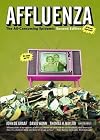
Given all the plaudits Affluenza has received, I found it to be a surprisingly bad book.
I suppose its authorial team is to be given credit for 'consciousness raising' -- but they're awful writers. We get plenty o' platitudes -- plus bromides! Shrill, hectoring denunciations of American lifestyles plus the biggest selection of 'noble savage' references you'll find outside Rousseau. Did you know that people in every country, in every time in history, except maybe for some dead white guy show more countries sometimes, have understood the secret to life and happiness -- except Americans?
Look, I'm all for confronting affluenza. I agree with the book's ultimate premise, i.e. that buying things doesn't lead to guaranteed happiness or give life ultimate meaning. But the treatment here is so stupifyingly shallow and inane reading it made we want to go out and burn down some redwoods. Tell me you can read passages like this one and not feel the same way:
"Simple things to save the Earth? Sure, let's do as many as we can, because they reduce impacts, stimulate better design, and save money . . . . But while we're at it, let's not forget a few other details that need to be taken care of by the week after next: redesigning the American economy and many of its products, and recycling the American mindset." (p. 202)
Have you ever read more inappropriately breezy, vapid prose? And don't think there's any depth behind these sweeping pronouncements: the best you'll get is lots of calls for government regulations and cheesy environmentalist claptrap. The authors suggest that we confront the anomie of postmodern consumerist culture by advocating, over and over and yet over again, that it's nice to 'get back in touch with nature'.
Affluenza is a serious topic, but this is not a serious book. show less
I suppose its authorial team is to be given credit for 'consciousness raising' -- but they're awful writers. We get plenty o' platitudes -- plus bromides! Shrill, hectoring denunciations of American lifestyles plus the biggest selection of 'noble savage' references you'll find outside Rousseau. Did you know that people in every country, in every time in history, except maybe for some dead white guy show more countries sometimes, have understood the secret to life and happiness -- except Americans?
Look, I'm all for confronting affluenza. I agree with the book's ultimate premise, i.e. that buying things doesn't lead to guaranteed happiness or give life ultimate meaning. But the treatment here is so stupifyingly shallow and inane reading it made we want to go out and burn down some redwoods. Tell me you can read passages like this one and not feel the same way:
"Simple things to save the Earth? Sure, let's do as many as we can, because they reduce impacts, stimulate better design, and save money . . . . But while we're at it, let's not forget a few other details that need to be taken care of by the week after next: redesigning the American economy and many of its products, and recycling the American mindset." (p. 202)
Have you ever read more inappropriately breezy, vapid prose? And don't think there's any depth behind these sweeping pronouncements: the best you'll get is lots of calls for government regulations and cheesy environmentalist claptrap. The authors suggest that we confront the anomie of postmodern consumerist culture by advocating, over and over and yet over again, that it's nice to 'get back in touch with nature'.
Affluenza is a serious topic, but this is not a serious book. show less
What's the Economy For, Anyway?: Why It's Time to Stop Chasing Growth and Start Pursuing Happiness by David K. Batker
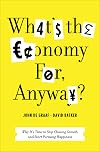
The first book on economics that I've encountered that starts with the premise that an economy's most important job is to provide food, shelter and clothing for the people participating in it! The authors clearly understand that an economy is a shared idea about how we can collectively get things done and that the idea we currently share in the United States isn't working very well.
Throughout the book the authors point to other high-functioning economies (mostly in Europe) that have made show more different collective decisions about what they want their economies to do. It is clear that:
- the economy will not collapse if we provide health insurance for everyone
- employment will go up if we all get more time off (because more people will be needed to get the same amount of work done)
- having less stuff and more time will not only be better for us as individuals (more time means more exercise for one thing). It's also better for the environment
My only complaint about the book is that it gets a tad redundant. I don't know how many times the point about time off is better for your health was repeated. I got it the first time.
However, I highly recommend this book to anyone who thinks we can't change things in the US because the economy will collapse. It's not the economy, stupid, it's what we want from the economy that's the problem. show less
Throughout the book the authors point to other high-functioning economies (mostly in Europe) that have made show more different collective decisions about what they want their economies to do. It is clear that:
- the economy will not collapse if we provide health insurance for everyone
- employment will go up if we all get more time off (because more people will be needed to get the same amount of work done)
- having less stuff and more time will not only be better for us as individuals (more time means more exercise for one thing). It's also better for the environment
My only complaint about the book is that it gets a tad redundant. I don't know how many times the point about time off is better for your health was repeated. I got it the first time.
However, I highly recommend this book to anyone who thinks we can't change things in the US because the economy will collapse. It's not the economy, stupid, it's what we want from the economy that's the problem. show less
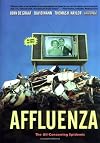
It's good to know that I'm doing at least some things right, though I know I could do more. Reading this book only reaffirmed my beliefs about the state of over-consumption in America and increasingly, in the world. Written tongue-in-cheek as an exposé of the disease of affluenza, the authors discuss the disorder's symptoms, causes, and treatments.
I always seem to read these types of books after the predictions have come true. For example, take the credit crash of fall 2008. For anyone in show more government or business who said the state of credit in America was fine and were surprised by the catastrophe, this book is but one exhibit in a litany of books, articles, and documentaries that surmised a crash would be the inevitable conclusion. It makes me wonder what the authors of Affluenza would have written had they had the chance to see what happened under the Bush administration. I imagine it would have gone from concerned and distressed to appalled and disgusted.
For me the highlight was part two: causes of affluenza. It was wonderful to hear Marx again and incongruous that as a society we still fail to heed his advice. Again and again throughout history we are shown the errors of our ways yet still make the same mistakes. And now with the rest of the world watching and imitating us, we're taking everyone down the primrose path. Hopefully this time, we will have learned some lessons. It's not just the economy that is at stake if we don't - it's our environment, our health, our families, and our self-worth. show less
I always seem to read these types of books after the predictions have come true. For example, take the credit crash of fall 2008. For anyone in show more government or business who said the state of credit in America was fine and were surprised by the catastrophe, this book is but one exhibit in a litany of books, articles, and documentaries that surmised a crash would be the inevitable conclusion. It makes me wonder what the authors of Affluenza would have written had they had the chance to see what happened under the Bush administration. I imagine it would have gone from concerned and distressed to appalled and disgusted.
For me the highlight was part two: causes of affluenza. It was wonderful to hear Marx again and incongruous that as a society we still fail to heed his advice. Again and again throughout history we are shown the errors of our ways yet still make the same mistakes. And now with the rest of the world watching and imitating us, we're taking everyone down the primrose path. Hopefully this time, we will have learned some lessons. It's not just the economy that is at stake if we don't - it's our environment, our health, our families, and our self-worth. show less
It’s more than a book … it’s a disease. Affluenza is a largely modern disease when people are consumed with the idea of consuming. Does this sound like anyone you know?
The book was written around November 2000 and is still very true today. Fun, witty, and filled with illustrations from Pulitzer Prize Winner, David Horsey, this book takes aim at our growing culture of consumerism. Nowadays, we just have so much stuff … or is it junk?
The book divides into three parts: symptoms, causes, show more and treatments. In short, the symptoms include things like emptiness, stress, and feeling like not having enough time. Feeling bloated and sluggish are also prevalent symptoms. There is little test in the book to take to see how much affluenza you have.
Jokingly, the authors blame Adam and Eve’s Original Sin as the root of affluenza. There are anecdotes of a company like Kellogg that at one point had a standard six hour workday (do any of you know anyone who works only six hours a day?) and the beginnings of the credit card industry. It’s strange in light of all the advances in technology that we were supposed to save us time; we collectively have even less time.
So is there a cure? Yes, one can choose to downshift to a smaller household or just have a smaller environmental footprint. The things most important to us can probably not be bought at your local mall. Goodness knows we have all tried. show less
The book was written around November 2000 and is still very true today. Fun, witty, and filled with illustrations from Pulitzer Prize Winner, David Horsey, this book takes aim at our growing culture of consumerism. Nowadays, we just have so much stuff … or is it junk?
The book divides into three parts: symptoms, causes, show more and treatments. In short, the symptoms include things like emptiness, stress, and feeling like not having enough time. Feeling bloated and sluggish are also prevalent symptoms. There is little test in the book to take to see how much affluenza you have.
Jokingly, the authors blame Adam and Eve’s Original Sin as the root of affluenza. There are anecdotes of a company like Kellogg that at one point had a standard six hour workday (do any of you know anyone who works only six hours a day?) and the beginnings of the credit card industry. It’s strange in light of all the advances in technology that we were supposed to save us time; we collectively have even less time.
So is there a cure? Yes, one can choose to downshift to a smaller household or just have a smaller environmental footprint. The things most important to us can probably not be bought at your local mall. Goodness knows we have all tried. show less
Lists
Awards

You May Also Like


Associated Authors
Statistics
- Works
- 12
- Also by
- 1
- Members
- 1,211
- Popularity
- #21,206
- Rating
- 3.8
- Reviews
- 26
- ISBNs
- 31
- Languages
- 2