
Brian M. Fagan (1936–2025)
Author of The Little Ice Age: How Climate Made History, 1300–1850
About the Author
Brian Fagan is emeritus professor of anthropology at the University of California, Santa Barbara. A former Guggenheim fellow, he has written many internationally acclaimed, popular books about archaeology, including The Little Ice Age, The Great Warming, and The Lang Summer. He lives in Santa show more Barbara, California. show less
Disambiguation Notice:
The anthropology books and the sailing books were written by the same Brian Fagan.
Series
Works by Brian M. Fagan
The Great Warming: Climate Change and the Rise and Fall of Civilizations (2008) 409 copies, 6 reviews
Time Detectives: How Archaeologists Use Technology to Recapture the Past (1995) 363 copies, 3 reviews
The Rape of the Nile: Tomb Robbers, Tourists, and Archaeologists in Egypt, Revised and Updated (1975) 287 copies, 7 reviews
Eyewitness to Discovery: First-Person Accounts of More Than Fifty of the World's Greatest Archaeological Discoveries (1996) 285 copies, 2 reviews
The Seventy Great Mysteries of the Ancient World: Unlocking the Secrets of Past Civilizations (2001) 251 copies, 4 reviews
Beyond the Blue Horizon: How the Earliest Mariners Unlocked the Secrets of the Oceans (2012) 184 copies, 8 reviews
From Stonehenge to Samarkand: An Anthology of Archaeological Travel Writing (2006) 89 copies, 1 review
The Complete Ice Age: How Climate Change Shaped the World (The Complete Series) (2009) 70 copies, 2 reviews
Return to Babylon: Travelers, Archaeologists, and Monuments in Mesopotamia (1979) 66 copies, 1 review
The First North Americans: An Archaeological Journey (Ancient Peoples and Places) (2011) 49 copies, 1 review
A Brief History of Archaeology: Classical Times to the Twenty-First Century (2004) 46 copies, 1 review
The Cruising Guide to Central and Southern California: Golden Gate to Ensenada, Mexico, Including the Offshore Islands (2001) 14 copies
Drinking at Disney: A Tipsy Travel Guide to Walt Disney World's Bars, Lounges & Glow Cubes (2016) 7 copies
One God, Two Goddesses, Three Studies of South Indian Cosmology (Jerusalem Studies in Religion and Culture) (2013) 5 copies
Chartering Fundamentals: The Official American Sailing Association Guide to Chartering and Cruising for Pleasure (1987) 3 copies
The Victoria Falls; a handbook to the Victoria Falls, the Batoka Gorge, and part of the Upper Zambesi River (1964) 3 copies
Cruising Guide to Southern California's Offshore Islands: With Sailing Directions for the Santa Barbara Channel's Mainland Coast (1992) 2 copies
África Austral 2 copies
Τα εβδομήντα μεγάλα μυστήρια του αρχαίου κόσμου: Η αποκάλυψη των μυστικών των πολιτισμών του… (2003) 2 copies
The First Human Diaspora 1 copy
Our Earliest Ancestors 1 copy
In the Beginning 1 copy
The First Europeans 1 copy
Introducing Human Prehistory 1 copy
Sedmdesát velkých záhad 1 copy
África Austral 1 copy
Krótka historia archeologii 1 copy
Associated Works
Tagged
Common Knowledge
- Canonical name
- Fagan, Brian M.
- Legal name
- Fagan, Brian Murray
- Birthdate
- 1936-08-01
- Date of death
- 2025-07-01
- Gender
- male
- Education
- Rugby School
Pembroke College, Cambridge University (archaeology | anthropology | BA | 1959 | MA | 1962 | PhD | 1965) - Occupations
- museum curator
archaeologist
university professor
sailor - Organizations
- Royal Navy [UK]
Livingstone Museum, Northern Rhodesia
British Institute of Nairobi, Bantu Studies Project
University of California, Santa Barbara - Awards and honors
- Society of Professional Archaeologists' Distinguished Service Award (1996)
Society for American Archaeology Presidential Recognition Award (1996)
Society for American Archaeology Public Education Award (1997) - Relationships
- Burkitt, Miles Crawford (university teacher)
Clark, Grahame (university teacher)
Clark, J Desmond (university teacher) - Cause of death
- complications from sepsis
- Nationality
- USA
UK (birth) - Birthplace
- Birmingham, England, UK
- Places of residence
- England, UK
Zambia, Central Africa
Santa Barbara, California, USA - Map Location
- USA
- Disambiguation notice
- The anthropology books and the sailing books were written by the same Brian Fagan.
Members
Reviews
Beyond the blue horizon : how the earliest mariners unlocked the secrets of the oceans by Brian Fagan

Brian Fagan put together his long professional experience as an archaeologist and anthropologist with his even longer private experience as a small-boat sailor to create this fascinating global overview of what we know about seafaring as it was practiced before the era of scientific navigation, at what motivated people to sail out of sight of land and at what tools and techniques they had available to them to be able to do it (reasonably) safely and repeatably.
He looks separately at the show more history of seafaring in Polynesia, in the Aegean, in the Indian Ocean, in Northern Europe, and on the West coast of North and Central America. What is immediately striking is how early in the development of human societies in all those regions there were communities that relied on trade with other communities, in some cases a very long way away, to supply themselves with certain essential commodities. Obsidian and, later, metals for making tools; important ritual objects like cowrie shells; even wood for building boats had to be imported in some parts of the world (notably the Arab peninsula). It's astonishing to realise that there was regular trade between Arabia, India and the East African coast long before the rise of Islam.
In the Pacific and the Indian Ocean predictable seasonal reversals in wind direction must have helped to make it possible to voyage into "the unknown" and know that you would be able to get home again, but in all parts of the world navigators seem to have relied on variations in the same basic techniques of ocean navigation — using stars to follow lines of latitude to known destinations; using wave patterns, clouds, and marine life as clues to the proximity of land.
Techniques of boat construction varied around the world, though: the invention of the outrigger meant that there was no urgent need for Polynesians to build anything more substantial than a canoe, whilst the Aleutian kayak was always the perfect hunting craft for northern waters, as long as there were sea-lion skins available to make it from. Elsewhere reeds, balsa wood, and eventually split planks were used, although planked construction on a large scale had to wait for the invention of the nail (there were limits to the size of hull that could be built with stitched planks).
A very interesting book, shaped by Fagan's ability to give us a clear digest of the mass of archaeological literature on the subject and season it with his own practical insights into what does and doesn't make sense from a seafarer's point of view. show less
He looks separately at the show more history of seafaring in Polynesia, in the Aegean, in the Indian Ocean, in Northern Europe, and on the West coast of North and Central America. What is immediately striking is how early in the development of human societies in all those regions there were communities that relied on trade with other communities, in some cases a very long way away, to supply themselves with certain essential commodities. Obsidian and, later, metals for making tools; important ritual objects like cowrie shells; even wood for building boats had to be imported in some parts of the world (notably the Arab peninsula). It's astonishing to realise that there was regular trade between Arabia, India and the East African coast long before the rise of Islam.
In the Pacific and the Indian Ocean predictable seasonal reversals in wind direction must have helped to make it possible to voyage into "the unknown" and know that you would be able to get home again, but in all parts of the world navigators seem to have relied on variations in the same basic techniques of ocean navigation — using stars to follow lines of latitude to known destinations; using wave patterns, clouds, and marine life as clues to the proximity of land.
Techniques of boat construction varied around the world, though: the invention of the outrigger meant that there was no urgent need for Polynesians to build anything more substantial than a canoe, whilst the Aleutian kayak was always the perfect hunting craft for northern waters, as long as there were sea-lion skins available to make it from. Elsewhere reeds, balsa wood, and eventually split planks were used, although planked construction on a large scale had to wait for the invention of the nail (there were limits to the size of hull that could be built with stitched planks).
A very interesting book, shaped by Fagan's ability to give us a clear digest of the mass of archaeological literature on the subject and season it with his own practical insights into what does and doesn't make sense from a seafarer's point of view. show less
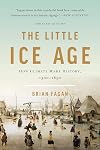
After the amazing warm period of the 13th century, climate change had a profound effect on human behavior and well-being. Brian Fagan takes us step by step through the cold, unsettled, rainy, dry, hot and otherwise completely unpredictable years of the Little Ice Age, when the subsistence farmers of Europe and elsewhere suffered repeated bad harvests and terrible privations. He is blunt, and after the description of life in the 1300s and 1400s, I was consumed with empathy for these people show more who had to live through such uncertain times.
Starting in the early 1300s, weather became increasingly destructive to farming, with repeated cold spells, drenching rains and unexpected droughts. Fagan takes us all the way through to the 1800s and the blistering Irish famine that pushed so many to emigrate or die. In between, he notes the persistent rain in the 14th and 15th centuries that turned farmlands and pasturelands to seas of mud and certainly contributed to the outcomes of battles (for instance, Agincourt) as well as privation. He notes calamity in the New World as well, as early settlers in North America fought to live through one of the coldest winters of the age, the Incan Empire and other indigenous societies were ruined by drought, volcanic eruptions blocked the sun, and the Thames froze solid.
And of course, he ends the age with our own interference in climate. This book, published in 2000, is cautious about laying all the global warming at our feet, citing other contributing possibilities. But his description of one possible outcome is literally chilling, as fresh water melt covers the north end of the Gulf Stream and shuts off the downwelling of that great warm river in the sea. Once we scorch the Earth, another Ice Age may come again. show less
Starting in the early 1300s, weather became increasingly destructive to farming, with repeated cold spells, drenching rains and unexpected droughts. Fagan takes us all the way through to the 1800s and the blistering Irish famine that pushed so many to emigrate or die. In between, he notes the persistent rain in the 14th and 15th centuries that turned farmlands and pasturelands to seas of mud and certainly contributed to the outcomes of battles (for instance, Agincourt) as well as privation. He notes calamity in the New World as well, as early settlers in North America fought to live through one of the coldest winters of the age, the Incan Empire and other indigenous societies were ruined by drought, volcanic eruptions blocked the sun, and the Thames froze solid.
And of course, he ends the age with our own interference in climate. This book, published in 2000, is cautious about laying all the global warming at our feet, citing other contributing possibilities. But his description of one possible outcome is literally chilling, as fresh water melt covers the north end of the Gulf Stream and shuts off the downwelling of that great warm river in the sea. Once we scorch the Earth, another Ice Age may come again. show less
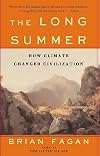
Mark Twain supposedly once said "Everybody talks about the weather but nobody does anything about it", I guess as a commentary on how helpless human beings are over the vast power of nature. Well, these days humanity is certainly doing something about the weather in the form of dumping tons of greenhouse gases into the atmosphere each year, but it's under-appreciated how vulnerable we still are to unusual weather events, how dependent on complex climate patterns modern civilization is, and show more also how fortunate we are to have come of age as a species in an unusually long spell of (relatively) moderate climate across the whole planet. Indeed, without particular confluences of abrupt climate disequilibria, we'd probably still be hanging around Olduvai Gorge.
According to Fagan, primitive peoples were doing just fine in their native ecosystems for tens of millennia, wandering around their veldts and steppes, chasing the seasons and the prey animals, until a series of climate shifts allowed them to expand beyond their traditional homelands and colonize the whole planet. He documents a whole series of climate "pumps" - in the first stage a group of humans has settled a particular area and is hemmed in by resources or inhospitable conditions. Then a shift allows that group to expand a little bit farther, either to take advantage of new opportunities or under pressure from another group trying to compete for its homeland. Then the climate shifts again, and since the group can't stay where it is and it can't go back to where it was, it's forced out into new lands. After a few cycles of expand, explore, consolidate, and expand again, groups of hunter-gatherers had been pushed to every corner of the globe, sometimes carrying old technology with them but often being forced to innovate and adapt to new environments and food sources along the way. At some point in recent history an unusually long period of relative calm began - and I say "relative" only because Fagan recounts numerous examples of the often catastrophic effects that even single-year events like late rains or exceptionally cold winters had on medieval and classical civilization - and humanity was able to build the foundations of intensive agriculture and far-flung trade networks that all modern societies have inherited. There's a consistent theme of the fragility of civilization, as groups coalesce into tribes, then into states, then into empires, only to disintegrate after rainfall patterns shifted.
It concurs with a good deal of Jared Diamond's Collapse, albeit from strictly climate-based perspective rather than resource-based. I always enjoy these broad high-level popular science history books because they give you new ways to look at the world. For example, in not too long the American Southwest, which for many many years was a nearly waterless desert, will have to make tough choices about what kind of lifestyle they can afford in the face of what is guaranteed to be an astronomical increase in the price of water. Up until now, the US has been rich enough (and wet enough) to have all the golf courses and hilariously non-native crops that it wanted, wherever it wanted, but very slight shifts in climate could render the lifestyles of tens of millions of people not just unsustainable, but unsupportable period. The abandoned dwellings in Chaco Canyon make for excellent tourist attractions, but it doesn't take a huge stretch of the imagination to wonder if Phoenix could end up the same way, and what the implications would be for the rest of the country. Closer to home, the landscape of my own native Texas Hill Country has changed greatly from its settlement by cotton farmers to its current infestation by cedar trees, the only thing hardy enough to grow on the edge of the great western desert (for more on the heartbreak this caused would-be farmers, see the beginning of Robert Caro's superb Path to Power). If rain fell consistently just a few meridians to the west, then the economy of all of North America would be very different, and it's cool to speculate on that sort of thing.
Fagan doesn't really go into much of the what-ifs, but I was a little mystified by his tendency to end every chapter in the same way - after pages and pages of sober, well-sourced historical discussion, he would launch into a few closing paragraphs of fervid speculation about the spiritual beliefs of the Clovis people or Siberian nomads or whoever. It's not a huge deal, but the contrast between the detached and scientific sections talking about the contents of paleolithic waste dumps and the feverishly prolix sections about the meanings of cave paintings was very noticeable. However, his overall metaphor of civilization as a huge ship blundering in treacherous seas was well-chosen, and ably conveys the risk and uncertainty involved in building our cities and our lives in places so easily affected by changes in climate. show less
According to Fagan, primitive peoples were doing just fine in their native ecosystems for tens of millennia, wandering around their veldts and steppes, chasing the seasons and the prey animals, until a series of climate shifts allowed them to expand beyond their traditional homelands and colonize the whole planet. He documents a whole series of climate "pumps" - in the first stage a group of humans has settled a particular area and is hemmed in by resources or inhospitable conditions. Then a shift allows that group to expand a little bit farther, either to take advantage of new opportunities or under pressure from another group trying to compete for its homeland. Then the climate shifts again, and since the group can't stay where it is and it can't go back to where it was, it's forced out into new lands. After a few cycles of expand, explore, consolidate, and expand again, groups of hunter-gatherers had been pushed to every corner of the globe, sometimes carrying old technology with them but often being forced to innovate and adapt to new environments and food sources along the way. At some point in recent history an unusually long period of relative calm began - and I say "relative" only because Fagan recounts numerous examples of the often catastrophic effects that even single-year events like late rains or exceptionally cold winters had on medieval and classical civilization - and humanity was able to build the foundations of intensive agriculture and far-flung trade networks that all modern societies have inherited. There's a consistent theme of the fragility of civilization, as groups coalesce into tribes, then into states, then into empires, only to disintegrate after rainfall patterns shifted.
It concurs with a good deal of Jared Diamond's Collapse, albeit from strictly climate-based perspective rather than resource-based. I always enjoy these broad high-level popular science history books because they give you new ways to look at the world. For example, in not too long the American Southwest, which for many many years was a nearly waterless desert, will have to make tough choices about what kind of lifestyle they can afford in the face of what is guaranteed to be an astronomical increase in the price of water. Up until now, the US has been rich enough (and wet enough) to have all the golf courses and hilariously non-native crops that it wanted, wherever it wanted, but very slight shifts in climate could render the lifestyles of tens of millions of people not just unsustainable, but unsupportable period. The abandoned dwellings in Chaco Canyon make for excellent tourist attractions, but it doesn't take a huge stretch of the imagination to wonder if Phoenix could end up the same way, and what the implications would be for the rest of the country. Closer to home, the landscape of my own native Texas Hill Country has changed greatly from its settlement by cotton farmers to its current infestation by cedar trees, the only thing hardy enough to grow on the edge of the great western desert (for more on the heartbreak this caused would-be farmers, see the beginning of Robert Caro's superb Path to Power). If rain fell consistently just a few meridians to the west, then the economy of all of North America would be very different, and it's cool to speculate on that sort of thing.
Fagan doesn't really go into much of the what-ifs, but I was a little mystified by his tendency to end every chapter in the same way - after pages and pages of sober, well-sourced historical discussion, he would launch into a few closing paragraphs of fervid speculation about the spiritual beliefs of the Clovis people or Siberian nomads or whoever. It's not a huge deal, but the contrast between the detached and scientific sections talking about the contents of paleolithic waste dumps and the feverishly prolix sections about the meanings of cave paintings was very noticeable. However, his overall metaphor of civilization as a huge ship blundering in treacherous seas was well-chosen, and ably conveys the risk and uncertainty involved in building our cities and our lives in places so easily affected by changes in climate. show less
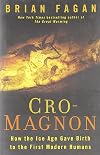
Cro-Magnon tells the story of the first anatomically modern humans in Europe and (to a lesser extent) that of the Neanderthals they replaced. Fagan aims to give a layman's overview of the subject, without too much technical detail. I'd say his success at this is variable. Many passages were dry, with perhaps a bit more specific information than I really wanted. And these are interspersed with speculative imagined scenes of Cro-Magnon life, which I often found somewhat unsatisfying, in that show more it wasn't always clear how much was based on actual archeological knowledge and how much was sheer assumption. Fagan's writing also tends to be a bit rambly and repetitive; he likes to make the same basic points over and over, often in exactly the same words.
However, although I would have preferred it if the writing were a bit livelier and more concise, I did find this worth reading. The subject is interesting, and Fagan does offer interesting information about it. If nothing else, he successfully dispels some popular misconceptions, such as the stereotype of Neanderthals as ugly, clumsily brutish cavemen, and the notion of the Ice Age as one long, unbroken, icy winter. He also repeatedly invites the reader to imagine what it might have been like to live in those distant times and to walk among these vanished people. I found that mental exercise both exciting and rewarding, and it's Fagan's ability to evoke that response that is the book's real strength. show less
However, although I would have preferred it if the writing were a bit livelier and more concise, I did find this worth reading. The subject is interesting, and Fagan does offer interesting information about it. If nothing else, he successfully dispels some popular misconceptions, such as the stereotype of Neanderthals as ugly, clumsily brutish cavemen, and the notion of the Ice Age as one long, unbroken, icy winter. He also repeatedly invites the reader to imagine what it might have been like to live in those distant times and to walk among these vanished people. I found that mental exercise both exciting and rewarding, and it's Fagan's ability to evoke that response that is the book's real strength. show less
 This review was written for LibraryThing Early Reviewers.
Lists
Awards


You May Also Like


Associated Authors
Statistics
- Works
- 118
- Also by
- 6
- Members
- 9,572
- Popularity
- #2,513
- Rating
- 3.7
- Reviews
- 145
- ISBNs
- 499
- Languages
- 18
- Favorited
- 16


