
William MacAskill
Author of Doing Good Better: Effective Altruism and a Radical New Way to Make a Difference
About the Author
Image credit: From English Wikipedia
Works by William MacAskill
Doing Good Better: Effective Altruism and a Radical New Way to Make a Difference (2015) 483 copies, 26 reviews
Associated Works
Tagged
Common Knowledge
- Other names
- MacAskill, Will
- Birthdate
- 1987-03-24
- Gender
- male
- Education
- University of Oxford (BPhil, DPhil)
University of Cambridge (BA Hons) - Occupations
- philosopher
associate professor (Philosophy) - Organizations
- University of Cambridge (Emmanuel College)
University of Oxford (Lincoln College) - Nationality
- UK
- Birthplace
- Glasgow, Scotland, UK
- Map Location
- Scotland, UK
Members
Reviews
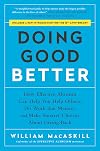
Doing Good Better: How Effective Altruism Can Help You Help Others, Do Work that Matters, and Make Smarter Choices about Giving Back by William MacAskill
If you are a tycoon who has amassed billions through rapacious capitalist practices and are looking for an equally effective means of maximizing your philanthropic endeavours, then the advice and guidance in this book may be just the ticket. If you think the difference been one good action and another good action is that one of them must be “gooder”, then this book will affirm your intuition. And if your primary goal is the gooderest actions you can accomplish either individually or by show more subcontracting, ideally in a cash poor but resource rich needful environment, then applying the “scientifically-based” methods of charitable action evaluation espoused in this volume will definitely meet your needs.
The standard criticism of crude utilitarianism was that we, poor mortals, are insufficiently well-informed to determine the action that will lead to maximization of the good (or happiness, or utility, or pleasure) in all but the most trivial of cases. William MacAskill appears to believe that his application of the “scientific” techniques of economics, statistical analysis, and the information gathering readily available via the Internet somehow overcomes this constraint. Well meaning nonsense, of course. This, despite the obvious truth that if you are disbursing substantial wealth gleaned either through personal greed or taxation, it makes sense to do your research first. But don’t confuse the practicalities of policy with the aspects of an action that make it “good” in the first place. Go ahead and help that blind man cross the street. Don’t let anyone tell you that you “ought” to have rather donated the cash that you could have earned in the time you took to perform that act to a charity providing mosquito nets in Africa.
I know my head shaking and ridicule will have very little impact on those who are already convinced that calculations are likely to lead to wise choices and good actions. Just be aware that moral philosophers consider this to be an essentially contested field, with a fair number of them arguing that actions are incommensurable. It’s not just a case of apples and oranges, sometimes it’s apples and bananas.
Better to donate the money you would have spent on this book to a charity providing mosquito nets in Africa. show less
The standard criticism of crude utilitarianism was that we, poor mortals, are insufficiently well-informed to determine the action that will lead to maximization of the good (or happiness, or utility, or pleasure) in all but the most trivial of cases. William MacAskill appears to believe that his application of the “scientific” techniques of economics, statistical analysis, and the information gathering readily available via the Internet somehow overcomes this constraint. Well meaning nonsense, of course. This, despite the obvious truth that if you are disbursing substantial wealth gleaned either through personal greed or taxation, it makes sense to do your research first. But don’t confuse the practicalities of policy with the aspects of an action that make it “good” in the first place. Go ahead and help that blind man cross the street. Don’t let anyone tell you that you “ought” to have rather donated the cash that you could have earned in the time you took to perform that act to a charity providing mosquito nets in Africa.
I know my head shaking and ridicule will have very little impact on those who are already convinced that calculations are likely to lead to wise choices and good actions. Just be aware that moral philosophers consider this to be an essentially contested field, with a fair number of them arguing that actions are incommensurable. It’s not just a case of apples and oranges, sometimes it’s apples and bananas.
Better to donate the money you would have spent on this book to a charity providing mosquito nets in Africa. show less
I find it hard to rate this book. It has a lot of good points, but I also find myself disagreeing with a few of their recommendations, or at least thinking that they are overlooking specific aspects.
The general idea of "donate your money to the most effective charity in the area you are interested in" obviously has merit, and the book disabused me of some of my preconceived notions about charitable organizations. There are some truly surprising stories and anecdotes about which interventions show more are positive, neutral and even negative, and the differences in effectiveness of some interventions (appearantly, some actions can get you a factor of 10 to 100 more effect for the same money than other, still good, interventions in the same area).
MacAskill also discusses if you should work in an area with high direct positive impact (like working in an effective nonprofit), or if you should get a "normal" job that pays much better and donate heavily. The idea of "earning to give" (get a job that pays twice as much as NGO work, then donate 10 % of your earnings) is interesting, but this is where my main gripe lies: It does not factor in externalities of the job you are doing. If I, hypothetically, work as a lobbyist for an arms manufacturer and try to convince governments to buy nuclear weapons from my company, then the net effect I am having on the world may be negative, even if I donate 20% of my earnings to an NGO that works in nuclear disarmament. This may be an extreme example, but there are many jobs that have hidden externalities that may lead to you having a bad impact on the world through your actions (building applications that assist judges in finding a sentence for a perpetrator may inadvertently reinforce racial biases in the criminal justice system. Working at Facebook may have you assisting in creating more effective filter bubbles. etc.)
The second point I found hard to stomach was the argument for buying products produced in sweat shops. Appearantly, sweatshops are considered a good intermediate step for a country on the way to becoming an industrialized nation. In fact, factories in europe had sweatshop-like conditions for many decades. So, economists argue that sweatshops are actually good for the countries they are situated in. Additionally, sweatshop jobs are actually considered the *good jobs* in many of these countries, as the alternatives are even worse. So, (or so the authors argue), stopping to buy sweatshop-produced items and buying products that are produced in the US, Germany, France etc. will actually harm the people you try to help.
The argument the authors gives against buying from producers that have their factories in sweatshop countries but pay better wages is that only a small percentage of the price hike this means for you will end up actually reaching the people that are producing them. The same is appearantly true for fair trade products (I did not fact check this, but the book does give sources for all of these claims), where fair trade producers are sometimes even paid less than the people producing non-fair products. The author argues that this means you are better off buying the cheaper products from non-fair production, and then (crucially) donating the difference to an effective NGO, where the same amount of money will do more good.
Again, I am not sure what I think about this approach. I have a few problems with these 100% statistics-based approaches: First off, they make it easy to rationalize objectionable behaviour on the grounds that "the money will do more good somewhere else." Second, they seem to imply a centralization of funding - if everyone started working on the basis of this book, we would have very few, very effective, very well funded NGOs. But we would also lose other NGOs that do different interventions that may not be as effective directly, but provide other benefits. It may even be that combining the two interventions would have an effect larger than the sum of its parts, but the second intervention will never be funded, as it is not as effective on its own as the first. It also serves as a "barrier to entry" for new ideas that may be even more effective.
Third and lastly, the book focuses on areas and interventions where the effects are reasonably easy to measure. I am donating to political NGOs, whose effect is hard to quantify, and I am not sure where they would fall in the system. How do you evaluate teaching children about data protection? Is teaching 1000 children about IT Security more or less important than invalidating an unconstitutional surveillance law before the surpreme court? It kind of falls through the cracks, which makes it hard to justify donating to these organizations under the rules of effective altruism. However, I believe that these kinds of NGOs are critical to maintaining a society that is actually worth living in - or, to overstate it: Is it worth saving thousands of africans from malaria if that only means they are around to be subjugated by a newly fascist state, which could have been prevented if political NGOs had been funded properly?
I will say this: The book made me think, and I will reevaluate my donations. However, I do not think I will massively change the current donations I have set up (although I may end up adding a few new organizations that will also receive money from me). If you are altruistically minded, I would recommend reading this book, but reading it with a critical eye, and making up your own mind what you want to incorporate into your own strategies (like donating to the best-in-class charities), and what you may want to leave on the table (like working at am arms manufacturer to be able to fund a peace-loving NGO). Four stars for starting the debate in my head. show less
The general idea of "donate your money to the most effective charity in the area you are interested in" obviously has merit, and the book disabused me of some of my preconceived notions about charitable organizations. There are some truly surprising stories and anecdotes about which interventions show more are positive, neutral and even negative, and the differences in effectiveness of some interventions (appearantly, some actions can get you a factor of 10 to 100 more effect for the same money than other, still good, interventions in the same area).
MacAskill also discusses if you should work in an area with high direct positive impact (like working in an effective nonprofit), or if you should get a "normal" job that pays much better and donate heavily. The idea of "earning to give" (get a job that pays twice as much as NGO work, then donate 10 % of your earnings) is interesting, but this is where my main gripe lies: It does not factor in externalities of the job you are doing. If I, hypothetically, work as a lobbyist for an arms manufacturer and try to convince governments to buy nuclear weapons from my company, then the net effect I am having on the world may be negative, even if I donate 20% of my earnings to an NGO that works in nuclear disarmament. This may be an extreme example, but there are many jobs that have hidden externalities that may lead to you having a bad impact on the world through your actions (building applications that assist judges in finding a sentence for a perpetrator may inadvertently reinforce racial biases in the criminal justice system. Working at Facebook may have you assisting in creating more effective filter bubbles. etc.)
The second point I found hard to stomach was the argument for buying products produced in sweat shops. Appearantly, sweatshops are considered a good intermediate step for a country on the way to becoming an industrialized nation. In fact, factories in europe had sweatshop-like conditions for many decades. So, economists argue that sweatshops are actually good for the countries they are situated in. Additionally, sweatshop jobs are actually considered the *good jobs* in many of these countries, as the alternatives are even worse. So, (or so the authors argue), stopping to buy sweatshop-produced items and buying products that are produced in the US, Germany, France etc. will actually harm the people you try to help.
The argument the authors gives against buying from producers that have their factories in sweatshop countries but pay better wages is that only a small percentage of the price hike this means for you will end up actually reaching the people that are producing them. The same is appearantly true for fair trade products (I did not fact check this, but the book does give sources for all of these claims), where fair trade producers are sometimes even paid less than the people producing non-fair products. The author argues that this means you are better off buying the cheaper products from non-fair production, and then (crucially) donating the difference to an effective NGO, where the same amount of money will do more good.
Again, I am not sure what I think about this approach. I have a few problems with these 100% statistics-based approaches: First off, they make it easy to rationalize objectionable behaviour on the grounds that "the money will do more good somewhere else." Second, they seem to imply a centralization of funding - if everyone started working on the basis of this book, we would have very few, very effective, very well funded NGOs. But we would also lose other NGOs that do different interventions that may not be as effective directly, but provide other benefits. It may even be that combining the two interventions would have an effect larger than the sum of its parts, but the second intervention will never be funded, as it is not as effective on its own as the first. It also serves as a "barrier to entry" for new ideas that may be even more effective.
Third and lastly, the book focuses on areas and interventions where the effects are reasonably easy to measure. I am donating to political NGOs, whose effect is hard to quantify, and I am not sure where they would fall in the system. How do you evaluate teaching children about data protection? Is teaching 1000 children about IT Security more or less important than invalidating an unconstitutional surveillance law before the surpreme court? It kind of falls through the cracks, which makes it hard to justify donating to these organizations under the rules of effective altruism. However, I believe that these kinds of NGOs are critical to maintaining a society that is actually worth living in - or, to overstate it: Is it worth saving thousands of africans from malaria if that only means they are around to be subjugated by a newly fascist state, which could have been prevented if political NGOs had been funded properly?
I will say this: The book made me think, and I will reevaluate my donations. However, I do not think I will massively change the current donations I have set up (although I may end up adding a few new organizations that will also receive money from me). If you are altruistically minded, I would recommend reading this book, but reading it with a critical eye, and making up your own mind what you want to incorporate into your own strategies (like donating to the best-in-class charities), and what you may want to leave on the table (like working at am arms manufacturer to be able to fund a peace-loving NGO). Four stars for starting the debate in my head. show less

I really wanted and expected to like this book, but ultimately I really didn't.
The basic premise seems solid enough: when trying to make a difference in the world, we should take a rational, evidence-based approach to determine what will have the biggest impact. This is something that I can get behind pretty fully when it comes to choosing a charity. For the most part, it turns out that our money goes farther when it's donated to health-related causes in very poor countries; even if we show more personally care a lot about, say, education, donating to a charity like Deworm the World Initiative can make more of a difference by making children healthy and therefore more able to attend school than donating textbooks directly.
But what happens if you take this coldly rational approach to extremes, and start applying it to every aspect of your life? It turns out that, instead of choosing a career where you can make a difference directly, you might well have more of an impact by choosing the highest-paying career possible, and then donating that money to effective charities. Instead of doing volunteer work in your community, you might well have more of an impact by working overtime to earn still more money that you can donate to charities helping the most impoverished people in Africa.
This seems perfectly reasonable in one way, but perfectly horrible in another way. Is the ideal world really one in which all the best and brightest work 80-hour weeks in hedge fund companies, doing work they don't even believe in, just so they can have the greatest possible impact by giving away money indirectly to people across the world whom they'll never meet? That sounds like a pretty awful existence to me. It wasn't immediately obvious what the problem was, but reading a review on GoodReads led me to an idea of what was missing here: any sense of community. I think there's ultimately more to life than making the largest quantitative difference, and it involves some sense of investment in the people around you.
The author acknowledges all this to some extent, discussing the risk of losing your own values and becoming disillusioned if you spend all your time surrounded by colleagues who prioritize earning money above all else. But he blithely dismisses the concern by citing the examples of a few people like Bill Gates who have become very wealthy while still being devoted to philanthropy. It may be telling that the author himself doesn't practice what he preaches: he himself is a professor at Oxford, not an investment banker.
Again, I think he makes a lot of valuable points, especially when focusing on the early-career stage. He emphasizes the value of developing skills and career capital at the start, rather than going directly out of college to do low-skilled admin work at a non-profit. And I think that's valuable advice; investing some time in yourself can allow you to make more of a difference later on. But there's a difference between that and focusing exclusively on making the most money possible.
One of my favourite sections of the book was actually the one where he talked about the research on job satisfaction; it's not actually following your passion that leads to the most happiness, but instead whether the job has five other factors: independence, sense of completion, variety, feedback, and contribution. (As a side note, looking at these factors made it clear why I'm so much happier teaching than working exclusively on my dissertation.) Pursuing a career solely for the salary would fail on the "contribution" metric, and I'm not convinced that you could compensate for that with the knowledge that your money was making more of a difference indirectly.
One of my least-favourite sections of the book, and the one that caused me to put it down for six months in the middle, came when he abandoned his evidence-based framework and started making the case for his personal pet cause. He had spent the first half of the book telling us that we shouldn't try to help people in North America because our money can go farther helping people in Africa, that we shouldn't focus on education because we can have more of an impact by focusing on health (with the impact measured in QALYs, or quality-adjusted life years), and so on. And then suddenly he was talking about animal rights, and how we could have more of an impact with our $100 by donating to an organization that would convince someone else to become a vegetarian than we would by becoming vegetarians ourselves (the author is a vegetarian). The hypocrisy was pretty unbearable: there was no mention of how we could justify donating $100 to convince someone to become a vegetarian, when that money could instead be going to the Deworm the World Initiative or one of the other highly-recommended organizations focused on human health in the developing world.
And that brings me to the final problem with the book: for all its evidence-based veneer, the major decisions ultimately come down to subjective value judgements. The final section talks about how to choose a cause, and the author rates the magnitude of various issues on a scale from 1-4. Extreme poverty is a 3; US criminal justice reform is a 1; catastrophic global climate change is a 2-4, "depending on value judgements" (i.e., whether you think there's any value in continuing the existence of human civilization far into the future). Factory farming is "up to 3, depending on value judgements". In other words, the reader is ultimately invited to dismiss all data and decide for themselves what issues are most important. And that sort of defeats the whole purpose of the book.
This book still has a lot going for it. It's certainly thought-provoking, and the author makes a lot of interesting points. I finished it a couple of days ago and am nowhere near done engaging with the ideas that it raises. But it's also a fairly dry read, and one that ultimately doesn't reflect a vision of the world that I can support. I want to do more in life than earn a lot of money to help people I'll never meet, and I hope the people around me will choose to be more active agents of change as well. show less
The basic premise seems solid enough: when trying to make a difference in the world, we should take a rational, evidence-based approach to determine what will have the biggest impact. This is something that I can get behind pretty fully when it comes to choosing a charity. For the most part, it turns out that our money goes farther when it's donated to health-related causes in very poor countries; even if we show more personally care a lot about, say, education, donating to a charity like Deworm the World Initiative can make more of a difference by making children healthy and therefore more able to attend school than donating textbooks directly.
But what happens if you take this coldly rational approach to extremes, and start applying it to every aspect of your life? It turns out that, instead of choosing a career where you can make a difference directly, you might well have more of an impact by choosing the highest-paying career possible, and then donating that money to effective charities. Instead of doing volunteer work in your community, you might well have more of an impact by working overtime to earn still more money that you can donate to charities helping the most impoverished people in Africa.
This seems perfectly reasonable in one way, but perfectly horrible in another way. Is the ideal world really one in which all the best and brightest work 80-hour weeks in hedge fund companies, doing work they don't even believe in, just so they can have the greatest possible impact by giving away money indirectly to people across the world whom they'll never meet? That sounds like a pretty awful existence to me. It wasn't immediately obvious what the problem was, but reading a review on GoodReads led me to an idea of what was missing here: any sense of community. I think there's ultimately more to life than making the largest quantitative difference, and it involves some sense of investment in the people around you.
The author acknowledges all this to some extent, discussing the risk of losing your own values and becoming disillusioned if you spend all your time surrounded by colleagues who prioritize earning money above all else. But he blithely dismisses the concern by citing the examples of a few people like Bill Gates who have become very wealthy while still being devoted to philanthropy. It may be telling that the author himself doesn't practice what he preaches: he himself is a professor at Oxford, not an investment banker.
Again, I think he makes a lot of valuable points, especially when focusing on the early-career stage. He emphasizes the value of developing skills and career capital at the start, rather than going directly out of college to do low-skilled admin work at a non-profit. And I think that's valuable advice; investing some time in yourself can allow you to make more of a difference later on. But there's a difference between that and focusing exclusively on making the most money possible.
One of my favourite sections of the book was actually the one where he talked about the research on job satisfaction; it's not actually following your passion that leads to the most happiness, but instead whether the job has five other factors: independence, sense of completion, variety, feedback, and contribution. (As a side note, looking at these factors made it clear why I'm so much happier teaching than working exclusively on my dissertation.) Pursuing a career solely for the salary would fail on the "contribution" metric, and I'm not convinced that you could compensate for that with the knowledge that your money was making more of a difference indirectly.
One of my least-favourite sections of the book, and the one that caused me to put it down for six months in the middle, came when he abandoned his evidence-based framework and started making the case for his personal pet cause. He had spent the first half of the book telling us that we shouldn't try to help people in North America because our money can go farther helping people in Africa, that we shouldn't focus on education because we can have more of an impact by focusing on health (with the impact measured in QALYs, or quality-adjusted life years), and so on. And then suddenly he was talking about animal rights, and how we could have more of an impact with our $100 by donating to an organization that would convince someone else to become a vegetarian than we would by becoming vegetarians ourselves (the author is a vegetarian). The hypocrisy was pretty unbearable: there was no mention of how we could justify donating $100 to convince someone to become a vegetarian, when that money could instead be going to the Deworm the World Initiative or one of the other highly-recommended organizations focused on human health in the developing world.
And that brings me to the final problem with the book: for all its evidence-based veneer, the major decisions ultimately come down to subjective value judgements. The final section talks about how to choose a cause, and the author rates the magnitude of various issues on a scale from 1-4. Extreme poverty is a 3; US criminal justice reform is a 1; catastrophic global climate change is a 2-4, "depending on value judgements" (i.e., whether you think there's any value in continuing the existence of human civilization far into the future). Factory farming is "up to 3, depending on value judgements". In other words, the reader is ultimately invited to dismiss all data and decide for themselves what issues are most important. And that sort of defeats the whole purpose of the book.
This book still has a lot going for it. It's certainly thought-provoking, and the author makes a lot of interesting points. I finished it a couple of days ago and am nowhere near done engaging with the ideas that it raises. But it's also a fairly dry read, and one that ultimately doesn't reflect a vision of the world that I can support. I want to do more in life than earn a lot of money to help people I'll never meet, and I hope the people around me will choose to be more active agents of change as well. show less
 This review was written for LibraryThing Early Reviewers.
Most readers will likely find fault with some aspect of the argument put forth by William MacAskill in his book "Doing Good Better." And that is the prime value of the book. MacAskill, cofounder of the effective altruism movement, challenges the accepted wisdom about how to make a difference through one’s career, volunteering, and giving. He advocates taking a scientific approach to determining the effectiveness of efforts aimed at alleviating social ills. By applying precise measurements, show more MacAskill questions the efficacy of donating to disaster relief, buying fair-trade products, or boycotting clothing made in sweatshops. He provides a process based on answering five questions to use whenever considering how to allocate one’s time and treasure to addressing societal problems. "Doing Good Better" is sure to get readers thinking more deeply about their altruistic endeavors, and that is the value of the book, whether or not you agree with the author’s specific conclusions. show less
This review was written for LibraryThing Early Reviewers.Awards


You May Also Like


Associated Authors
Statistics
- Works
- 6
- Also by
- 4
- Members
- 933
- Popularity
- #27,526
- Rating
- 3.9
- Reviews
- 33
- ISBNs
- 33
- Languages
- 5
- Favorited
- 1
