
Jerry Sohl (1913–2002)
Author of Costigan's Needle
About the Author
Series
Works by Jerry Sohl
Secret of the Lost Race / One Against Herculum (Vintage Ace Double D-381) (1959) — Author — 44 copies
Underhanded Chess: A Hilarious Handbook of Devious Diversions and Stratagems for Winning at Chess (1973) 39 copies, 4 reviews
Galaxy 12 ; Eine Auswahl der besten Stories aus dem amerikanischen Science Fiction Magazin Galaxy / [Herausgegeben und übersetzt von Walter Ernsting und Thomas Schlück] (1969) — Contributor — 4 copies
The 7th Order 3 copies
Death in Transit 3 copies
L'uomo nelle rovine 3 copies
La aguja del Dr. Costigan 2 copies
Short Science Fiction Collection 067 2 copies
℗L'℗uomo nelle rovine 1 copy
Urania 0074 - RESURREZIONE 1 copy
The Little Red Bag 1 copy
The Invisible Enemy 1 copy
The Service 1 copy
Il pianeta dell'esilio 1 copy
Urania 0050 - MORBO ORRENDO 1 copy
The Elroom 1 copy
El hombre trascendente 1 copy
Vampiri della morte 1 copy
L'uomo nelle rovine 1 copy
Jerry Sohl. The Greatest Science Fiction Stories: The Elroom. Brknk's Bounty. The Ultroom Error 1 copy
Counterweight 1 copy
Associated Works
Tagged
Common Knowledge
- Legal name
- Sohl, Gerald Allan, Sr.
- Other names
- Butler, Nathan
Sullivan, Sean Mei
Mountjoy, Roberta Jean - Birthdate
- 1913-12-02
- Date of death
- 2002-11-04
- Gender
- male
- Occupations
- writer
photographer
police reporter
critic and reviewer for several Midwest papers - Nationality
- USA
- Birthplace
- Los Angeles, California, USA
- Places of residence
- Chicago, Illinois, USA
Los Angeles, California, USA - Place of death
- Thousand Oaks, California, USA
- Associated Place (for map)
- California, USA
Members
Discussions
At this rate: Probably! in Good Show Sir! — bad science fiction and fantasy covers (March 2025)
Reviews

Sohl's Underhanded Chess is a quick read, and entertaining enough for anyone fond of chess who has a little sociopathic streak. No, honestly, it is pretty funny throughout, whether analyzing Bobby Fischer's methods of psyching out Boris Spassky, recounting anecdotes from Sohl's own games, or offering hypothetical tactics to disorient and demoralize chess opponents.
All of this is for entertainment purposes only, of course. You wouldn't really (often) want to win a chess game so badly that you show more would arrange for duplicitous confederates, work up conversational routines for the sole purpose of distracting your opponent, or specially engineer the furniture to discomfit him. But if winning really is the chief priority, Sohl suggests quite a few devastating rudenesses, and sagely notes, "Then you say you're sorry. You can always be sorry." (40)
The high point for me was chapter six, "How to Play against Weirdos," full of funniness about players who see fairies and perform divinations. Yet here the author also observes, "Just the same, it really does come down to a hard embrace of this question: Whose magic is more powerful, yours or his?" (65) (On a related note, occultists who read this book will have an opportunity to recognize the chess aptitude of Aufnahmevermoegen as a crucial faculty in the development and deployment of the subtle body.)
There is an appendix on "Useful Trivia," but a second promised appendix, to inventory names of various obscure openings, variations, and stratagems, is absent. show less
All of this is for entertainment purposes only, of course. You wouldn't really (often) want to win a chess game so badly that you show more would arrange for duplicitous confederates, work up conversational routines for the sole purpose of distracting your opponent, or specially engineer the furniture to discomfit him. But if winning really is the chief priority, Sohl suggests quite a few devastating rudenesses, and sagely notes, "Then you say you're sorry. You can always be sorry." (40)
The high point for me was chapter six, "How to Play against Weirdos," full of funniness about players who see fairies and perform divinations. Yet here the author also observes, "Just the same, it really does come down to a hard embrace of this question: Whose magic is more powerful, yours or his?" (65) (On a related note, occultists who read this book will have an opportunity to recognize the chess aptitude of Aufnahmevermoegen as a crucial faculty in the development and deployment of the subtle body.)
There is an appendix on "Useful Trivia," but a second promised appendix, to inventory names of various obscure openings, variations, and stratagems, is absent. show less

This is an excellent story from one of the master storytellers of the Twilight Zone, the Outer Limits and Star Trek. Curtis Sheridan was a surgeon on the rise before a motor accident that left him in a coma. The doctors pronounced him brain dead, but he is kept alive in intensive care. Everybody was waiting for him to die, especially his wife who spent most days at his bedside. However, Curtis discovered that he could invade the dreams of others. What ensued was a series of attacks on people show more known to him in what he viewed as revenge. The end was in one sense predictable, but the way it occurred was very different. show less
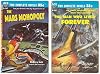
The Mars Monopoly (1956): In the 1960s, I recall reading complaints by early reviewers of SF about stories that were just westerns with spaceships. They didn't name names and I never saw it in the SF I read (Heinlein, Bradbury, Sturgeon, Asimov, ...). Perhaps this was the novel they meant. The Mars Monopoly mashes together several genres. It starts with a boys' adventure rocket race at the start. Then settles in for a western gold mining story on Mars, with uranium for gold. There's a touch show more of noir in the relationship between the two-fisted hero and the widow who runs the only bar in town. Mars is the Old West, with thinner air. Spaceships mechanically are no more complicated than 1950s cars. Martians are the mistreated Indians. Though written for adults, it's really a young adult book at best.
The Man Who Lived Forever is copyrighted 1956, but reads more like 1930s. According to the Internet SF Database, it was originally published in 1938 with just R. De Witt Miller as author. My guess is that Anna Hunger updated it with some skeevy sex. Nothing is explicit just people coming together and dropping their robes, but cringe-inducing because of the ambiguously described youth of the primary female involved. The premise is silly. It was realized that the science was the only hope for civilization but it had become too complicated to learn everything in one lifetime. Therefore, one person was chosen to be the Master, rejuvenated every thirty years with the life energy of a randomly selected member of the World Scientists.
Not recommended, except for SF historians show less
The Man Who Lived Forever is copyrighted 1956, but reads more like 1930s. According to the Internet SF Database, it was originally published in 1938 with just R. De Witt Miller as author. My guess is that Anna Hunger updated it with some skeevy sex. Nothing is explicit just people coming together and dropping their robes, but cringe-inducing because of the ambiguously described youth of the primary female involved. The premise is silly. It was realized that the science was the only hope for civilization but it had become too complicated to learn everything in one lifetime. Therefore, one person was chosen to be the Master, rejuvenated every thirty years with the life energy of a randomly selected member of the World Scientists.
Not recommended, except for SF historians show less

http://nwhyte.livejournal.com/1715010.html
It's a low-key, subtle, short novel about a man and woman who wake up in a motel together one day in 1957 with no memory of each other, or of anything that has happened since 1946; and they have to explain 1950s America to themselves, and themselves to each other, before discovering what has actually happened to them. The alert reader will work out what the answer probably is by about halfway through the book, but the atmospherics are fantastic. I show more see that Sohl was more successful as a TV scriptwriter for Alfred Hitchcock Presents, The Twilight Zone and even Star Trek, so will look out for his stuff in future. show less
It's a low-key, subtle, short novel about a man and woman who wake up in a motel together one day in 1957 with no memory of each other, or of anything that has happened since 1946; and they have to explain 1950s America to themselves, and themselves to each other, before discovering what has actually happened to them. The alert reader will work out what the answer probably is by about halfway through the book, but the atmospherics are fantastic. I show more see that Sohl was more successful as a TV scriptwriter for Alfred Hitchcock Presents, The Twilight Zone and even Star Trek, so will look out for his stuff in future. show less
Lists
Guilty Pleasures (1)
You May Also Like


Associated Authors
Statistics
- Works
- 63
- Also by
- 8
- Members
- 757
- Popularity
- #33,605
- Rating
- 3.5
- Reviews
- 16
- ISBNs
- 60
- Languages
- 4