
John Zerzan
Author of Anarhoprimitivizam protiv civilizacije [Anarchoprimitivism Against Civilization]
About the Author
Image credit: John Zerzan discusses The Coming Insurrection during a lecture at the 2010 San Francisco Anarchist Bookfair
Works by John Zerzan
Anarhoprimitivizam protiv civilizacije [Anarchoprimitivism Against Civilization] (2004) 272 copies, 3 reviews
Ammazzare il tempo 1 copy
Origins: Number - Language – Agriculture: Three Essays from John Zerzan's 'Elements Of Refusal' 1 copy
Nihilist's Dictionary 1 copy
On the Origins of War 1 copy
Technology 1 copy
Origins and Meaning of WWI 1 copy
The Dark Before the Dawn 1 copy
Associated Works
Take My Advice: Letters to the Next Generation from People Who Know a Thing or Two (2002) — Contributor — 50 copies
Tagged
Common Knowledge
- Birthdate
- 1943
- Gender
- male
- Education
- San Francisco State University
Stanford University
University of Southern California - Occupations
- author
writer - Nationality
- USA
- Places of residence
- Salem, Oregon, USA
Eugene, Oregon, USA - Associated Place (for map)
- Oregon, USA
Members
Discussions
John zerzan? in Other People's Libraries (July 2022)
Reviews
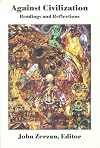
A collection of excerpted writings, critiques of civilization by the eminently civilized. Therefore a sadness pervades - the alternative they seek is only a dream or a concept, or an anthropological hypothesis. None of these writers knows what it is like to live in a time or social group that is outside of civilization. So overall, I was reminded of that TS Eliot line (paraphrasing): "each in his cell thinking of the key/ thinking of the key, each confirms the lock."
Here's a particularly sad show more thought from Richard Heinberg - we have domesticated ourselves - "We are to primitive [sic] peoples as cows and sheep are to bears and eagles."
So those who dream of a human life without civilization are like sheep or cows who dream of being bears and eagles. show less
Here's a particularly sad show more thought from Richard Heinberg - we have domesticated ourselves - "We are to primitive [sic] peoples as cows and sheep are to bears and eagles."
So those who dream of a human life without civilization are like sheep or cows who dream of being bears and eagles. show less
It's a bit ironic to use a computer to blog about this Luddite tome, but John Zerzan's 'future primitive' take on philosophical anarchism is enchanting; I like particularly his little essay on the banal evil of timekeeping, and his suggestion based on recent archeology that everything went wrong with humanity only after we started cultivating food I find most agreeable. Most of his essays are interesting, funny, challenging, and display a breadth of research and interest unparalleled in the show more Tom Friedman world in which we live.
I disagreed of course with Zerzan's ad hominem attack on Chomsky; it's fine to take issue with his linguistic theories--I do as well, and for reasons not dissimilar to Zerzan's. It's also okay to disagree on fundamentals about Chomsky's degree of commitment to anarchism and its ideals, although I'd point out that Noam has written and spoken about his anarchism as an ideal achievable only after a profound spiritual transformation of humanity--which is what Zerzan himself suggests is necessary. Criticizing Chomsky as a phony anarchist because he's currently for strengthening the federal government makes sense--there is a ring of 'dictatorship of the proletariat' about the idea--but in the face of an unprecedented assault on human rights by corporate power, it's not completely wrong-headed to suggest a strengthening of the one institution that can protect us from pillage.
Zerzan says Chomsky doesn't give a shit about women's rights or minority rights or the environment because he focuses on foreign policy; this displays complete ignorance of Chomsky's writings and speeches. Chomsky focuses on foreign policy because it's the area where most Americans are most deluded about our true role in the world, but civil and human rights and women's rights are always primary in his books, as is environmental degradation. I'm sure there are many anarchists who regard Zerzan as a poseur because he doesn't loft bombs at Bill Gates. show less
I disagreed of course with Zerzan's ad hominem attack on Chomsky; it's fine to take issue with his linguistic theories--I do as well, and for reasons not dissimilar to Zerzan's. It's also okay to disagree on fundamentals about Chomsky's degree of commitment to anarchism and its ideals, although I'd point out that Noam has written and spoken about his anarchism as an ideal achievable only after a profound spiritual transformation of humanity--which is what Zerzan himself suggests is necessary. Criticizing Chomsky as a phony anarchist because he's currently for strengthening the federal government makes sense--there is a ring of 'dictatorship of the proletariat' about the idea--but in the face of an unprecedented assault on human rights by corporate power, it's not completely wrong-headed to suggest a strengthening of the one institution that can protect us from pillage.
Zerzan says Chomsky doesn't give a shit about women's rights or minority rights or the environment because he focuses on foreign policy; this displays complete ignorance of Chomsky's writings and speeches. Chomsky focuses on foreign policy because it's the area where most Americans are most deluded about our true role in the world, but civil and human rights and women's rights are always primary in his books, as is environmental degradation. I'm sure there are many anarchists who regard Zerzan as a poseur because he doesn't loft bombs at Bill Gates. show less

Sono rimasto piuttosto deluso, per quanto trovi interessante il punto di vista di molti anprim e per quanto provo altrettanto interesse per argomentazioni critiche sociologico/antropologiche, dalla pesantezza della scrittura di Zerzan. Il linguaggio tecnico non è neanche il problema principale, anche se non favorisce la scorrevolezza, quanto invece lo è la assoluta indisponibilità di approfondire le citazioni filosofiche buttate qui e là. Le tesi le ho apprezzate per la maggior parte, a show more tratti l'autore prende posizioni un po' campate in aria, ma in tutta sincerità questo non accade abbastanza spesso da diventare un problema: il lavoro di ricerca è solido.
Nel complesso è stata una lettura difficoltosa da digerire che credo non ripeterò però che mi ha lasciato qualcosa soprattutto nel capitolo che parla del tempo che a mio parere è il più interessante.
3 stelle appena appena. show less
Nel complesso è stata una lettura difficoltosa da digerire che credo non ripeterò però che mi ha lasciato qualcosa soprattutto nel capitolo che parla del tempo che a mio parere è il più interessante.
3 stelle appena appena. show less

Zerzan has got good ideas, but not a very captivating manner of presenting them. Most of the stuff he says here was said more elegantly or with better supporting data by Derrick Jensen, Pierre Clastres, Marshal Sahlins, and even guys like Edward Abbey and Aldo Leopold.
Either way, we are treated to the now-predictable argument that progress and civilization are corrupting our human spirit (actually, a short essay on "Technology" at the end of the book is one of the highlights as he briefly show more discusses the insidious harm that the inevitable march of computers and robotics perpetrates). What is unfortunately missing is any sort of solution.
Perhaps the most interesting essay, "Tonality and Totality" is little more than an indulgent aside, where Zerzan discusses the subtle control that all Western music exerts over us. According to him, the major/minor key dichotomy with its eight notes actually conditions our brains to accept our culture's paradigm of domination and subjugation. Just as minor or atonal notes must be subjugated to the majors for the sake of the melody, just as every "off-note" must resolve itself toward the harmony or key, we must sacrifice our individual autonomy for the sake of society. Whether or not you agree, this is by far the most provocative position Zerzan endorses in the entire book. show less
Either way, we are treated to the now-predictable argument that progress and civilization are corrupting our human spirit (actually, a short essay on "Technology" at the end of the book is one of the highlights as he briefly show more discusses the insidious harm that the inevitable march of computers and robotics perpetrates). What is unfortunately missing is any sort of solution.
Perhaps the most interesting essay, "Tonality and Totality" is little more than an indulgent aside, where Zerzan discusses the subtle control that all Western music exerts over us. According to him, the major/minor key dichotomy with its eight notes actually conditions our brains to accept our culture's paradigm of domination and subjugation. Just as minor or atonal notes must be subjugated to the majors for the sake of the melody, just as every "off-note" must resolve itself toward the harmony or key, we must sacrifice our individual autonomy for the sake of society. Whether or not you agree, this is by far the most provocative position Zerzan endorses in the entire book. show less
You May Also Like


Associated Authors
Statistics
- Works
- 43
- Also by
- 1
- Members
- 1,075
- Popularity
- #23,918
- Rating
- 3.6
- Reviews
- 8
- ISBNs
- 44
- Languages
- 7
- Favorited
- 4