Poquette's Bibliomonde II
This is a continuation of the topic Poquette's Bibliomonde.
Talk Club Read 2012
Join LibraryThing to post.
This topic is currently marked as "dormant"—the last message is more than 90 days old. You can revive it by posting a reply.
1Poquette

Looking up . . . Abbey Library, St. Gall
Welcome everybody! Continuing here from Poquette's Bibliomonde.
I have carried forward just below my 2012 reading list and Hope To Read lists for my own convenience mostly.
A review of Jim Crace's Continent will be forthcoming soon.
2Poquette
Books read in 2012:
Fiction
Flaubert's Parrot by Julian Barnes (1984) finished reading 1/7/2012 ****½
Moby-Dick, or the Whale by Herman Melville (1851) Kindle Edition 1/27 *****
A Mapmaker's Dream: A Novel by James Cowan (1996) Warner Books 1/31 ****
A Troubadour's Testament: A Novel by James Cowan (1998) Shambhala 2/1 ****½
Einstein's Dreams by Alan Lightman (1993) 2/2 ****
Morality Play by Barry Unsworth (1995) 2/20 ****½
The House of Doctor Dee by Peter Ackroyd (1993) 2/26 ***½
Child 44 by Tom Rob Smith (2008) 3/3 ***½
Invisible Cities by Italo Calvino (1972) 3/5 *****½
Arthurian Romances by Chrétien de Troyes (1170) 3/29 ****½
Continent by Jim Crace (1986) 3/30 ***½
Crystal Vision: A Novel by Gilbert Sorrentino (1981) 4/13 ***
Burning Your Boats by Angela Carter (1995) 4/15 ***
Maigret and the Fortuneteller by Georges Simenon (1944) 4/25 ***½
The Night Circus by Erin Morgenstern (2011) 5/4 ****½
The Prague Cemetery by Umberto Eco (2010) 6/13 ****
The Jewels of Paradise by Donna Leon (2012) 10/14 **½
And Only to Deceive by Tasha Alexander (2006) 10/21 ***½
A Poisoned Season by Tasha Alexander (2008) 10/24 ***½
A Fatal Waltz by Tasha Alexander (2009 11/2 ***½
Tears of Pearl by Tasha Alexander (2009) 11/3 ***
Dangerous to Know by Tasha Alexander (2010) 11/7 ***
A Crimson Warning by Tasha Alexander (2011) 11/9 ***
Death in the Floating City by Tasha Alexander (2012) 11/12 ***½
The Time Machine by H.G. Wells (1895) 12/3 ***½
Nonfiction
99 Novels: The Best in English Since 1939 by Anthony Burgess (1984) 1/4 ****
The Philosophers' Secret Fire: A History of the Imagination by Patrick Harpur (2003) 2/15 ***
How I Sold 1 Million eBooks in 5 Months by John Locke (2011) 3/13 *½
Pen of Iron: American Prose and the King James Bible by Robert Alter (2010) 3/29 *****
The Planets Within: The Astrological Psychology of Marsilio Ficino by Thomas Moore (1982) 4/4 ****½
Meditations on the Soul: Selected Letters of Marsilio Ficino (1495) 5/6 ****½
Tarot Symbolism by Robert V. O'Neill (1986) 5/18 ****½
The Survival of the Pagan Gods by Jean Seznec (1940) 6/4 ****
Imagined Cities by Robert Alter (2005) 6/7 *****
Naming the World and Other Exercises for the Creative Writer by Bret Anthony Johnston (2007) 10/15 ****
Fiction
Flaubert's Parrot by Julian Barnes (1984) finished reading 1/7/2012 ****½
Moby-Dick, or the Whale by Herman Melville (1851) Kindle Edition 1/27 *****
A Mapmaker's Dream: A Novel by James Cowan (1996) Warner Books 1/31 ****
A Troubadour's Testament: A Novel by James Cowan (1998) Shambhala 2/1 ****½
Einstein's Dreams by Alan Lightman (1993) 2/2 ****
Morality Play by Barry Unsworth (1995) 2/20 ****½
The House of Doctor Dee by Peter Ackroyd (1993) 2/26 ***½
Child 44 by Tom Rob Smith (2008) 3/3 ***½
Invisible Cities by Italo Calvino (1972) 3/5 *****½
Arthurian Romances by Chrétien de Troyes (1170) 3/29 ****½
Continent by Jim Crace (1986) 3/30 ***½
Crystal Vision: A Novel by Gilbert Sorrentino (1981) 4/13 ***
Burning Your Boats by Angela Carter (1995) 4/15 ***
Maigret and the Fortuneteller by Georges Simenon (1944) 4/25 ***½
The Night Circus by Erin Morgenstern (2011) 5/4 ****½
The Prague Cemetery by Umberto Eco (2010) 6/13 ****
The Jewels of Paradise by Donna Leon (2012) 10/14 **½
And Only to Deceive by Tasha Alexander (2006) 10/21 ***½
A Poisoned Season by Tasha Alexander (2008) 10/24 ***½
A Fatal Waltz by Tasha Alexander (2009 11/2 ***½
Tears of Pearl by Tasha Alexander (2009) 11/3 ***
Dangerous to Know by Tasha Alexander (2010) 11/7 ***
A Crimson Warning by Tasha Alexander (2011) 11/9 ***
Death in the Floating City by Tasha Alexander (2012) 11/12 ***½
The Time Machine by H.G. Wells (1895) 12/3 ***½
Nonfiction
99 Novels: The Best in English Since 1939 by Anthony Burgess (1984) 1/4 ****
The Philosophers' Secret Fire: A History of the Imagination by Patrick Harpur (2003) 2/15 ***
How I Sold 1 Million eBooks in 5 Months by John Locke (2011) 3/13 *½
Pen of Iron: American Prose and the King James Bible by Robert Alter (2010) 3/29 *****
The Planets Within: The Astrological Psychology of Marsilio Ficino by Thomas Moore (1982) 4/4 ****½
Meditations on the Soul: Selected Letters of Marsilio Ficino (1495) 5/6 ****½
Tarot Symbolism by Robert V. O'Neill (1986) 5/18 ****½
The Survival of the Pagan Gods by Jean Seznec (1940) 6/4 ****
Imagined Cities by Robert Alter (2005) 6/7 *****
Naming the World and Other Exercises for the Creative Writer by Bret Anthony Johnston (2007) 10/15 ****
3Poquette
Hope To Read in 2012
Fiction
The Prague Cemetery by Umberto Eco
The Unconsoled by Kazuo Ishiguro
The City & The City by China Mieville
The Way We Live Now by Anthony Trollope
Moby Dick by Herman Melville (reread)
Omoo by Herman Melville
Typee by Herman Melville
Piazza Tales by Herman Melville
Flaubert's Parrot by Julian Barnes
Night Train to Lisbon by Pascal Mercier
Middlemarch by George Eliot
The Mill on the Floss by George Eliot
The Thousand Autumns of Jacob de Zoet by David Mitchell
A House for Mr. Biswas by V.S. Naipaul
Burning Your Boats: The Collected Short Stories by Angela Carter
The Moon in Its Flight by Gilbert Sorrentino
Crystal Vision by Gilbert Sorrentino
Against Nature by Joris-Karl Huysmans
The Flanders Road by Claude Simon
Morality Play by Barry Unsworth
Lord Byron's Novel by John Crowley
Love & Sleep by John Crowley (v 2 Aegypt Cycle)
Daemonomania by John Crowley (v 3 Aegypt Cycle)
Endless Things by John Crowley (v 4 Aegypt Cycle)
The House of Doctor Dee by Peter Ackroyd
The Ambassadors by Henry James
The Master and Margarita by Michail Bulgakow
Literature
On The Nature of Things by Lucretius
Metamorphoses by Ovid
Arthurian Romances by Chretien de Troyes
Parzival by Wolfram von Eschenbach
Symposium and Timaeus by Plato
The Iliad by Homer
Fiction
The Unconsoled by Kazuo Ishiguro
The City & The City by China Mieville
The Way We Live Now by Anthony Trollope
Omoo by Herman Melville
Typee by Herman Melville
Piazza Tales by Herman Melville
Night Train to Lisbon by Pascal Mercier
Middlemarch by George Eliot
The Mill on the Floss by George Eliot
The Thousand Autumns of Jacob de Zoet by David Mitchell
A House for Mr. Biswas by V.S. Naipaul
The Moon in Its Flight by Gilbert Sorrentino
Against Nature by Joris-Karl Huysmans
The Flanders Road by Claude Simon
Lord Byron's Novel by John Crowley
Love & Sleep by John Crowley (v 2 Aegypt Cycle)
Daemonomania by John Crowley (v 3 Aegypt Cycle)
Endless Things by John Crowley (v 4 Aegypt Cycle)
The Ambassadors by Henry James
The Master and Margarita by Michail Bulgakow
Literature
On The Nature of Things by Lucretius
Metamorphoses by Ovid
Parzival by Wolfram von Eschenbach
Symposium and Timaeus by Plato
The Iliad by Homer
4Poquette
Hope To Read in 2012 (Continued)
Nonfiction
Pagan Influences
The Mirror of the Gods: How the Renaissance Artists Rediscovered the Pagan Gods by Malcolm Bull
The Survival of the Pagan Gods by Jean Seznec
Commentary on the Dream of Scipio by Macrobius
Giordano Bruno and the Hermetic Tradition by Frances Yates
The Rosicrucian Enlightenment by Frances Yates
The Philosophers' Secret Fire: A History of the Imagination by Patrick Harpur
The Planets Within: The Astrological Psychology of Marsilio Ficino by Thomas Moore
Archetypal Imagination: Glimpses of the Gods in Life and Art by Noel Cobb
The Dream of Poliphilo: The Soul in Love by Linda Fierz-David
Criticism
The Classical Tradition: Greek and Roman Influences on Western Literature by Gilbert Highet
The Renaissance: Studies in Art and Poetry by Walter Pater
Literary Theory and Criticism: An Oxford Guide by Patricia Waugh
99 Novels: The Best in English Since 1939 by Anthony Burgess
A Voice From the Attic by Robertson Davies
History and Geography
Plutarch and the Historical Tradition by Philip A. Stadter
A History of Histories by John Burrow
Blue Latitudes: Boldly Going Where Captain Cook has Gone Before by Tony Horwitz
The Greater Journey by David McCullough
Empires of the Indus: The Story of a River by Alice Albinia
The Passion of the Western Mind: Understanding the Ideas that Have Shaped Our World View by Richard Tarnas
Nonfiction
Pagan Influences
The Mirror of the Gods: How the Renaissance Artists Rediscovered the Pagan Gods by Malcolm Bull
Commentary on the Dream of Scipio by Macrobius
Giordano Bruno and the Hermetic Tradition by Frances Yates
The Rosicrucian Enlightenment by Frances Yates
Archetypal Imagination: Glimpses of the Gods in Life and Art by Noel Cobb
The Dream of Poliphilo: The Soul in Love by Linda Fierz-David
Criticism
The Classical Tradition: Greek and Roman Influences on Western Literature by Gilbert Highet
The Renaissance: Studies in Art and Poetry by Walter Pater
Literary Theory and Criticism: An Oxford Guide by Patricia Waugh
A Voice From the Attic by Robertson Davies
History and Geography
Plutarch and the Historical Tradition by Philip A. Stadter
A History of Histories by John Burrow
Blue Latitudes: Boldly Going Where Captain Cook has Gone Before by Tony Horwitz
The Greater Journey by David McCullough
Empires of the Indus: The Story of a River by Alice Albinia
The Passion of the Western Mind: Understanding the Ideas that Have Shaped Our World View by Richard Tarnas
5Poquette
Having just finished Arthurian Romances, Pen of Iron and Jim Crace's Continent, I am now trying to finish up Burning your Boats by Angela Carter. I have The Uses of Literature by Italo Calvino at hand which I am dipping into as time permits. It is a collection of essays, so it lends itself to sporadic reading.
At Barry and Zeno's request, I am also reading The Planets Within: The Astrological Psychology of Marsilio Ficino by Thomas Moore, which is incredibly fascinating. This is part of my ongoing "pagan influences" interest, and while it is on the "Hope To Read" list above, I was planning to squeeze a couple of others in before this. But as it turns out, this is the perfect book to be reading next on this subject. It is written by a former priest and current psychotherapist who is in the school of "archetypal psychology," a designation I had never heard of, but a current proponent is James Hillman, who I actually heard speak back in the seventies, and this school of psychology is in the tradition of Jung. But what is new to me is that this was fleshed out and promoted by Marcilio Ficino in the midst of the Italian Renaissance. Not being a psychologist, I will be skating on thin ice to review this book, but it contains many salient insights in terms of understanding exactly what went on intellectually during the Renaissance.
Finally, I am participating in the 30 Days of April short story challenge, so in addition to having limited reading time, I have a lot on my plate. But it is all so stimulating . . .
At Barry and Zeno's request, I am also reading The Planets Within: The Astrological Psychology of Marsilio Ficino by Thomas Moore, which is incredibly fascinating. This is part of my ongoing "pagan influences" interest, and while it is on the "Hope To Read" list above, I was planning to squeeze a couple of others in before this. But as it turns out, this is the perfect book to be reading next on this subject. It is written by a former priest and current psychotherapist who is in the school of "archetypal psychology," a designation I had never heard of, but a current proponent is James Hillman, who I actually heard speak back in the seventies, and this school of psychology is in the tradition of Jung. But what is new to me is that this was fleshed out and promoted by Marcilio Ficino in the midst of the Italian Renaissance. Not being a psychologist, I will be skating on thin ice to review this book, but it contains many salient insights in terms of understanding exactly what went on intellectually during the Renaissance.
Finally, I am participating in the 30 Days of April short story challenge, so in addition to having limited reading time, I have a lot on my plate. But it is all so stimulating . . .
7dchaikin
Stepping into the hallowed library of Bibliomonde II...I love your 1st post picture, again. Intrigued to see where The Planets Within take you.
9Poquette
Thanks, Barry!
Dan and avaland, that is my favorite library in all the world—of the ones I have visited, that is.
Dan and avaland, that is my favorite library in all the world—of the ones I have visited, that is.
10Poquette

Continent by Jim Crace (1986) Penguin
—From one generation to the next a farm with a strange herd thrives.
—The plight of the disappeared is seen from the inside.
—A young teacher from Canada who likes to run is challenged to a race—but the opponent will be on horseback.
—A naturalist's interests take an odd turn toward the conjugal cycle of an isolated forest tribe.
—An elderly calligrapher creates lists on funerary scrolls of the sins and virtues of his customers but he becomes famous for the artistry of his work.
—Electricity comes to a village that was not prepared for it.
—A mining agent loses his grip on reality.
What do these scenarios have in common? The only clue between the covers of Jim Crace's book that it is about an imaginary continent is the epigraph:
There and beyond is a seventh continent—seven peoples, seven masters, seven seas. And its business is trade and superstition.The seven scenarios are fleshed out in seven otherwise unconnected chapters that comprise Continent. Crace, who clearly understands a great deal about human nature, also seems to delight in ambiguities. All of these stories could indeed be set on a seventh continent, but they also describe people and places that seem vaguely familiar.
The reader is kept guessing from page one to the very end. What do these tales have in common? It was only at the end, upon rereading the epigraph that it began to sink in that each was about one of the seven peoples harbored there. But of course, this rather open secret is spelled out on the back cover of the book if one isn't aware of it already.
Imagination, a high level of ambiguity, humor and even a certain degree of creepiness are the watchwords of this very clever novella—or is it a collection of short stories connected only by the somewhat tenuous thread that they all relate to the fancied seventh continent?
This book is one of those "quirky dreamy novellas" that I keep going on about. I especially enjoyed the chapter about the calligrapher which is called "Sins and Virtues."

11rebeccanyc
Sounds intriguing.
12dmsteyn
Nice review. I'm sorry you didn't enjoy Continent more, Suzanne, but I'm glad that it wasn't a complete waste of time.
13Linda92007
Great review of Continent, Suzanne. I have enjoyed everything that I have read by Jim Crace and may give this a try, even though you seem to have found it only so-so. Do you know what it was that didn't quite connect for you?
14Poquette
It was not a complete waste of time, Dewald. I very much appreciated the inventiveness of the whole thing.
As to why it did not connect, Linda, I've been puzzling over that. It must be the creepiness factor which pervades a couple of the stories that left me feeling less than satisfied. I'm not even sure that's it. Whatever it is must be a matter of taste because when I look at the stories individually they are very well done. The whole concept of the book appeals to me. But when I compare it to the other novellas that I have read recently — and you know what they are — I simply enjoyed the others more. If anything, Continent suffers by comparison more than anything else, because I cannot really fault it.
As to why it did not connect, Linda, I've been puzzling over that. It must be the creepiness factor which pervades a couple of the stories that left me feeling less than satisfied. I'm not even sure that's it. Whatever it is must be a matter of taste because when I look at the stories individually they are very well done. The whole concept of the book appeals to me. But when I compare it to the other novellas that I have read recently — and you know what they are — I simply enjoyed the others more. If anything, Continent suffers by comparison more than anything else, because I cannot really fault it.
15baswood
Suzanne, I have enjoyed a couple of Jim Crace's novels they have been imaginative and well written. I note that Continent was his first published book and so he has probably developed somewhat as a writer since then.
16Poquette
Don't get me wrong, Barry. His writing is first rate. It is one thing to criticize a book for its defects, which I am not doing here. It is quite another to not just love it. I liked it, as I said. But just not as much as some other books I have read recently in a similar vein.
17Poquette
Last evening I finished reading The Planets Within and will have more to say about it soon.
In the meantime, as mentioned above, I am participating in the April short story challenge — 30 stories, 30 days, 30 authors. So I have been purposely looking for the shortest stories so that I will be able to follow through on the commitment. The interesting thing about these very short masterpieces is that in many cases they carry a sharp bite or some element that causes one to stop and think.
Here are some thumbnails about my first five stories:
1. "The Lone Ranger and Tonto Fist Fight in Heaven," title story in a collection by Sherman Alexie — This story evokes the sense of "other" that the narrator feels trying to thrive in a white society.
2. "The Drop of Water" by Hans Christian Andersen, from Hans Andersen's Fairy Tales, Second Series — An old man looks with his magician friend at a drop of ditch water through his microscope and sees a village full of people squabbling. He feels helpless in being unable to intervene.
3. "The Phantom of the Opera's Friend" by Donald Barthelme, from Sixty Stories — The phantom's friend finally persuades him to give up his place in the bowels of the opera. But does he follow through?
4. "Ragnarök" by Jorge Luis Borges, from Labyrinths — in this fable the Gods return after many centuries in exile to be greeted with suspicion by the people and to find they could not communicate amongst themselves. Overcome by fear and suspicion the people take out their guns and joyfully — oops! Don't want to spoil it!
5. "The Enchanted Garden" by Italo Calvino, from Difficult Loves — Two children unwittingly step into the garden of an old villa where temptations abound in which they indulge themselves, always expecting to be driven out. Instead, they experience an epiphany.
In the meantime, as mentioned above, I am participating in the April short story challenge — 30 stories, 30 days, 30 authors. So I have been purposely looking for the shortest stories so that I will be able to follow through on the commitment. The interesting thing about these very short masterpieces is that in many cases they carry a sharp bite or some element that causes one to stop and think.
Here are some thumbnails about my first five stories:
1. "The Lone Ranger and Tonto Fist Fight in Heaven," title story in a collection by Sherman Alexie — This story evokes the sense of "other" that the narrator feels trying to thrive in a white society.
2. "The Drop of Water" by Hans Christian Andersen, from Hans Andersen's Fairy Tales, Second Series — An old man looks with his magician friend at a drop of ditch water through his microscope and sees a village full of people squabbling. He feels helpless in being unable to intervene.
3. "The Phantom of the Opera's Friend" by Donald Barthelme, from Sixty Stories — The phantom's friend finally persuades him to give up his place in the bowels of the opera. But does he follow through?
4. "Ragnarök" by Jorge Luis Borges, from Labyrinths — in this fable the Gods return after many centuries in exile to be greeted with suspicion by the people and to find they could not communicate amongst themselves. Overcome by fear and suspicion the people take out their guns and joyfully — oops! Don't want to spoil it!
5. "The Enchanted Garden" by Italo Calvino, from Difficult Loves — Two children unwittingly step into the garden of an old villa where temptations abound in which they indulge themselves, always expecting to be driven out. Instead, they experience an epiphany.
18zenomax
Excellent story summaries. You make the stories sound very appealing (although I would not be surprised if your synopses were better than the stories themselves - they allow us to add in our own shadow stories rather than read the real ones and perhaps be disappointed...)
I am on the cusp of purchasing one or two books of my amazon wishlist, so your upcoming comments on The Planets Within could make all the difference.
I am on the cusp of purchasing one or two books of my amazon wishlist, so your upcoming comments on The Planets Within could make all the difference.
19detailmuse
After the comments on Crace here, his name jumped from the Table of Contents of Granta 109: Work, so I read his short story. A well-written fragment apparently pulled from his novel All That Follows, which I'm tempted to read except I see LTERers rated it poorly, I don't think the main character held up.
>17 Poquette: the shortest stories {...} carry a sharp bite
If you're still slotting stories and per chance you've not read Kate Chopin's 1000-word The Story of An Hour, take a look.
>17 Poquette: the shortest stories {...} carry a sharp bite
If you're still slotting stories and per chance you've not read Kate Chopin's 1000-word The Story of An Hour, take a look.
20Poquette
>18 zenomax: – Thanks, Zeno. Trust me, the stories are better than my dry little synopses.
Still mulling over how to limit my remarks about The Planets Within and still capture the author's intent. But I'm sure going to try. This is an amazing book for those of us who have an interest in archetypal psychology.
>19 detailmuse: – Crace strikes me as a very good writer. I should have given the book 4 stars and avoided all this controversy. I was thinking about ice cream and how I love both vanilla and chocolate in all their infinite varieties. But I love vanilla just a little bit more. That's how it is with Continent.
I'll take a look at Kate Chopin's story. Thanks for the suggestion. Believe it or not, I have all 30 stories tentatively picked out for this challenge! But maybe I could slip this one in.
ETA — what I am trying to say is that Continent is chocolate.
Still mulling over how to limit my remarks about The Planets Within and still capture the author's intent. But I'm sure going to try. This is an amazing book for those of us who have an interest in archetypal psychology.
>19 detailmuse: – Crace strikes me as a very good writer. I should have given the book 4 stars and avoided all this controversy. I was thinking about ice cream and how I love both vanilla and chocolate in all their infinite varieties. But I love vanilla just a little bit more. That's how it is with Continent.
I'll take a look at Kate Chopin's story. Thanks for the suggestion. Believe it or not, I have all 30 stories tentatively picked out for this challenge! But maybe I could slip this one in.
ETA — what I am trying to say is that Continent is chocolate.
22Poquette
Let me see: ice cream (vanilla versus chocolate), cheese, the moon . . .
Did I miss something?
Cheese ice cream, a continent on the moon . . . made of cheese?
I have it! Chocolate cheese, anyone? ;-)
Did I miss something?
Cheese ice cream, a continent on the moon . . . made of cheese?
I have it! Chocolate cheese, anyone? ;-)
23Mr.Durick
A long, long time ago there was a club like the Book of the Month Club that did cheese. They sold a whipped-with-chocolate cheese that was suave and tasty. Apparently they did not make enough money legitimately, and they turned into a hard core mailing list development outfit that failed to deliver.
Robert
Robert
25DieFledermaus
>17 Poquette: - I agree with zenomax - great story summaries.
I would not be surprised if your synopses were better than the stories themselves - they allow us to add in our own shadow stories rather than read the real ones and perhaps be disappointed...
This sounds like it could be a Borges story - shadow stories vs. real ones.
>22 Poquette: - Is there such a thing as cheese ice cream?
I would not be surprised if your synopses were better than the stories themselves - they allow us to add in our own shadow stories rather than read the real ones and perhaps be disappointed...
This sounds like it could be a Borges story - shadow stories vs. real ones.
>22 Poquette: - Is there such a thing as cheese ice cream?
26Poquette

Engraving from Renaissance Italy showing Apollo,
the Muses, the planetary spheres and musical ratios

The Planets Within: The Astrological Psychology of Marsilio Ficino by Thomas Moore (1982) Lindisfarne Books
In many ways I am distinctly unqualified to review this book, which is by a psychiatrist and presumably is written with other psychiatrists and psychologists in mind. However, it is written in such a way as to appeal to anyone interested in psychology in general, archetypal psychology in particular, or even to those interested in Renaissance intellectual and art history, and beyond that, to aficionados of astrology, tarot cards and the like.
Thomas Moore's book does two things: It analyzes Marsilio Ficino's De vita coelitus comparanda, or "How Life Should Be Arranged According to the Heavens," which Moore refers to simply as The Planets. And it brings Ficino's book into some kind of relationship with the practice of psychology today. Moore has focused on the school of archetypal psychology of which Jung is the most important modern representative and James Hillman is perhaps the most prominent contemporary proponent.
My interest does not arise primarily from a psychological perspective, but rather because of the information presented about the prominence of the pagan gods in Renaissance art, literature and philosophy. For a number of reasons I am fascinated with this subject, and The Planets Within indirectly answers the underlying question: Why and how did pagan influences reach such a peak of importance in Renaissance Italy?
The answer is that the collective frame of mind of Renaissance artists, writers and philosophers fell under the spell of newly reintroduced writings from Ancient Greece, much of which reflected Platonic, Neoplatonic and Hermetic ideas.
Marsilio Ficino, who is almost unknown today, was perhaps the most influential philosopher of his age. It was Ficino who translated from Greek into Latin those first texts that arrived in Florence from Constantinople around 1438-39. It was Ficino who established a new academy in Florence modeled on Plato's academy. Ficino flourished under the sponsorship of the Medici family, and because of his relationship with them and their generosity in support of his academy, he effectively became tutor and intellectual mentor to the Florentine intelligentsia. Looking back with the 20/20 hindsight of the 21st century, it is apparent from what Thomas Moore tells us that Ficino functioned in some ways as a psychotherapist to his friends and students. His letters are full of helpful advice about right living and striving to make of one's life a work of art. The Planets is Ficino's treatise on using one's imagination to apply astrology to that end.
Moore's book is divided in three parts. In the first part he defines the basic elements of Ficino's brand of psychology and attempts to draw comparisons and distinctions with the modern practice of psychology. He discusses how soul has been neglected since the Age of Enlightenment. He defines "soul" as "precisely that which makes us human." He equates it to some extent with the psyche. His main argument with post-Enlightenment attitudes is their insistence upon literalism at the expense of imagination. This is the same notion Patrick Harpur emphasized in The Philosopher's Secret Fire: A History of the Imagination. At the very foundation of Ficino's psychology is an emphasis on stimulating the imagination. He promotes the use of astrological influences to stimulate the imagination in warding off melancholy, anger and other unhelpful states of mind. Moore also agrees with Harpur that monotheism has caused many psychological problems for Western civilization.
Moore is well aware that criticism of monotheism is a hard sell. He hastens to explain that neither he nor Ficino were actually promoting the worship of multiple gods. Not at all. What they are suggesting is that rather than worship or adoration of Venus and Luna and Mercury, that students learn enough about their attributes in order to see them as models to emulate. Of course, the behaviors of the Greek and Roman gods as reported in their collective myths are in many ways less than admirable. But these are not the manifestations that Ficino was promoting; rather, he was speaking in terms of the celestial attributes and influences of the planetary spheres. This is the subject of the second part of The Planets Within. Chapters on Sol, Venus, Mercury, Luna, Saturn, Jupiter and Mars describe the psychologically pertinent aspects of these "planets."
Part III consists of one chapter entitled "The Well-Tempered Life" which attempts to sum all this up in the context of the medieval notions of music. This is too complicated to try to summarize here, but it may be enough to say that "the music of the spheres" takes on new meaning in the context of this book.
What I got out of The Planets Within is an encouragement to cultivate the imagination by use of archetypal images of many sorts to stimulate ones state of mind and to encourage people to aspire to living as well and fully as possible. All in all, there is much that is interesting between the covers of this very readable and positive book. It provides deeper insights into not only the value of Jungian archetypes but also a new perspective on exactly what the Renaissance mentality was all about.

27baswood
Thank you, thank you Suzanne, for that wonderful review. It all sounds so interesting that I have added it to this months to buy list. Anything that purports to throw light on Renaissance mentality and thoughts is worth reading. No doubt I will chat to you further when I have read it.
28dmsteyn
Very good review, Suzanne! Coincidentally, I have Moore's Dark Nights of the Soul, which a doctor gave to me when I was going through a very rough time as an undergraduate. For a 'self-help' book, it is surprisingly well-written and informative; it even has references to literature, etc. Now I understand from where those aspects of his work come.
29Poquette
>25 DieFledermaus: Thanks DF!
I actually believe zenomax could write a very good Borgean story.
As for cheese ice cream, that was pure brainstorming.
>27 baswood: I'm so pleased you liked my review, Barry. I was writing with you and zeno in mind.
>28 dmsteyn: Dewald, Moore impressed me very much. His and Ficino's approach to psychology has a strong appeal. Rather than focusing on one's own problems per se, they advocate populating the imagination with stimulating archetypes, fantasies, etc., to pull oneself out of the doldrums, or wherever one happens to be stuck. My own experience with conquering depression many decades ago actually validates this approach.
I actually believe zenomax could write a very good Borgean story.
As for cheese ice cream, that was pure brainstorming.
>27 baswood: I'm so pleased you liked my review, Barry. I was writing with you and zeno in mind.
>28 dmsteyn: Dewald, Moore impressed me very much. His and Ficino's approach to psychology has a strong appeal. Rather than focusing on one's own problems per se, they advocate populating the imagination with stimulating archetypes, fantasies, etc., to pull oneself out of the doldrums, or wherever one happens to be stuck. My own experience with conquering depression many decades ago actually validates this approach.
30Poquette
In the spirit of a commonplace book, here are a few quotes from The Planets Within:
"Marsilio Ficino was the admiring inheritor of both streams of knowledge — the humanistic and the occult. Today, on those rare occasions when his name does appear in books and essays, Ficino is recognized chiefly for his translations of Plato and the Neoplatonic philosophers and for the influence of his Platonic thought in art and literature. " (Chapter 1, p. 30)
"Under Cosimo's enlightened patronage, unfailing intuitive judgment, and clever political moves the Florentine intellectual community thrived. In this atmosphere the followers of Plato could pursue their cultivation of 'virtù,' the individual's total development of himself beyond all limits and the shaping of his life into a work of art." (p. 32)
"Ficino's work is sometimes called 'poetic theology,' a phrase offered by his star pupil, Pico della Mirandola. But his writing is also a poetic psychology, a psychopoetics. His insights are expressed imagistically rather than discursively. His psychology is also poetic in that its purpose is to nourish and educate imagination, the vital instrument by which the natural is rendered psychological and the soul is allowed a place in life. Why wear an amulet signifying the speed of Mercury except to keep that quality of the soul in mind? For Ficino the gods themselves are facets of the soul requiring attention." (p. 39)
"We arrive here at the crux of Ficinian astrological psychology. This is no superstitious playing with birth charts and sun signs, though even these have a place in Ficino's practice. More importantly, through an astrological consciousness we may recognize the polycentric nature of the psyche and become aware of the impact of even minor objects and events on the spiritual life of the soul. The planets, signs, houses, and aspects of technical astrology are only a means for imagining the multiple facets of the psyche." (p. 50)
"Basically, what Ficino proposes as a technique of psychotherapy is an astrological art of memory." (p. 53)
"Our Western historical era of Enlightenment made, perhaps, some important advances in humanism, but it also gave us an image of man as clockwork, an image that still remains among enlightened technologists. Mystery and depth in human experience are expunged by that light that hangs above us like a glaring lamp used to intimidate criminals and extract confessions, or so the movies say." (Ch. 4, p. 91)
"I am suggesting that we read all of this astrology in terms of a sky within. The planets correspond, then, to deeply felt movements of the soul . . . Mars is not simply a surface tendency toward anger, nor is Venus the trappings of body awareness. These planetary centers are deep in the psyche, generating many complexes, fantasies, and behaviors. The sky within truly seems as vast as the sky without, and the planets are just as massive, mysterious and unearthly." (Ch. 6, p. 126)
"The close connection between [the metaphorical value of music] and the structural forms of music was once widely acknowledged, but that connection was lost in the turn in Western history from a mythological to a scientific view of the world. It is apparent to many people interested in mythology, art, and religious systems that in two fields we have studied, astronomy and chemistry, a rationalistic, scientific reduction began to take place toward the end of the medieval era. Astronomy was drawn pure and clear from the murky myths of astrology, and chemistry developed in precision and mathematical rigor, leaving behind the occult hallucinations of the alchemists. It is less recognized that music suffered a similar purification, losing its religious and mythological foundations to become a refined art. From the point of view of a psychologist who values imagery, of course, these developments were hardly evolutionary in any positive progressive sense. What was lost is at least equal in importance to what was gained." (Ch 14, p. 193)
"Marsilio Ficino was the admiring inheritor of both streams of knowledge — the humanistic and the occult. Today, on those rare occasions when his name does appear in books and essays, Ficino is recognized chiefly for his translations of Plato and the Neoplatonic philosophers and for the influence of his Platonic thought in art and literature. " (Chapter 1, p. 30)
"Under Cosimo's enlightened patronage, unfailing intuitive judgment, and clever political moves the Florentine intellectual community thrived. In this atmosphere the followers of Plato could pursue their cultivation of 'virtù,' the individual's total development of himself beyond all limits and the shaping of his life into a work of art." (p. 32)
"Ficino's work is sometimes called 'poetic theology,' a phrase offered by his star pupil, Pico della Mirandola. But his writing is also a poetic psychology, a psychopoetics. His insights are expressed imagistically rather than discursively. His psychology is also poetic in that its purpose is to nourish and educate imagination, the vital instrument by which the natural is rendered psychological and the soul is allowed a place in life. Why wear an amulet signifying the speed of Mercury except to keep that quality of the soul in mind? For Ficino the gods themselves are facets of the soul requiring attention." (p. 39)
"We arrive here at the crux of Ficinian astrological psychology. This is no superstitious playing with birth charts and sun signs, though even these have a place in Ficino's practice. More importantly, through an astrological consciousness we may recognize the polycentric nature of the psyche and become aware of the impact of even minor objects and events on the spiritual life of the soul. The planets, signs, houses, and aspects of technical astrology are only a means for imagining the multiple facets of the psyche." (p. 50)
"Basically, what Ficino proposes as a technique of psychotherapy is an astrological art of memory." (p. 53)
"Our Western historical era of Enlightenment made, perhaps, some important advances in humanism, but it also gave us an image of man as clockwork, an image that still remains among enlightened technologists. Mystery and depth in human experience are expunged by that light that hangs above us like a glaring lamp used to intimidate criminals and extract confessions, or so the movies say." (Ch. 4, p. 91)
"I am suggesting that we read all of this astrology in terms of a sky within. The planets correspond, then, to deeply felt movements of the soul . . . Mars is not simply a surface tendency toward anger, nor is Venus the trappings of body awareness. These planetary centers are deep in the psyche, generating many complexes, fantasies, and behaviors. The sky within truly seems as vast as the sky without, and the planets are just as massive, mysterious and unearthly." (Ch. 6, p. 126)
"The close connection between [the metaphorical value of music] and the structural forms of music was once widely acknowledged, but that connection was lost in the turn in Western history from a mythological to a scientific view of the world. It is apparent to many people interested in mythology, art, and religious systems that in two fields we have studied, astronomy and chemistry, a rationalistic, scientific reduction began to take place toward the end of the medieval era. Astronomy was drawn pure and clear from the murky myths of astrology, and chemistry developed in precision and mathematical rigor, leaving behind the occult hallucinations of the alchemists. It is less recognized that music suffered a similar purification, losing its religious and mythological foundations to become a refined art. From the point of view of a psychologist who values imagery, of course, these developments were hardly evolutionary in any positive progressive sense. What was lost is at least equal in importance to what was gained." (Ch 14, p. 193)
31PeterKein
great list.. somehow we come upon similar books in different ways.. which always interests me. A project I am working on involves a number of your 2012 books A Mapmaker's Dream, Invisible Cities, Einstein's Dreams, The Uses of Literature, (Moby-Dick as well but for other reasons). Besides Imagined Cities perhaps you might enjoy Maps of the Imagination.
Re: Life: A User's Manual - http://www.librarything.com/topic/132721#3237340
I would read a bunch about Perec and OULIPO in general first. Can you read french? If so, read it alongside his notebooks.. Cahier des charges de la vie mode d'emploi
I must confess your bibliomonde to be the most interesting to me.
Re: Life: A User's Manual - http://www.librarything.com/topic/132721#3237340
I would read a bunch about Perec and OULIPO in general first. Can you read french? If so, read it alongside his notebooks.. Cahier des charges de la vie mode d'emploi
I must confess your bibliomonde to be the most interesting to me.
32Linda92007
A very interesting review, Suzanne. I began my undergraduate studies as a psychology major and I can assure you, there were no courses available in astrological psychology! I always learn a great deal from your reviews, although they also point out to me what are cavernous gaps in my knowledge from these earlier periods.
33Poquette
Peter – Thank you for your recommendation of Maps of the Imagination. I would be very interested in that book.
Also thanks for the links. I have bookmarked the one from your thread. Regarding Life a User's Manual, my French is very weak at this point. However, I have found a number of resources in English which may be helpful in lieu of French sources. You may actually already have read this article with an impossibly long subtitle in Mosaic 37:1, 2004, "Constructing the Architext: Georges Perec's Life a User's Manual; This essay argues that Georges Perec's Life a User's Manual – at once a novel, an apartment building, and a game of chess – articulates compellingly the confluence of literature and architecture that took place in the late twentieth century."
Also I found very interesting "Italo Calvino and Georges Perec: The Multiple and Contrasting Emotions of Cities and Puzzles," The Romantic Review 97, 2006.
Hopefully your research library has access to these if you are interested. Unfortunately the text is not freely available on line, but it is accessible at questia.com. This is not a free site but these links may work for you on a one-time basis:
http://www.questia.com/PM.qst?a=o&d=5002649567
http://www.questia.com/PM.qst?a=o&d=5019433502
Also thanks for the links. I have bookmarked the one from your thread. Regarding Life a User's Manual, my French is very weak at this point. However, I have found a number of resources in English which may be helpful in lieu of French sources. You may actually already have read this article with an impossibly long subtitle in Mosaic 37:1, 2004, "Constructing the Architext: Georges Perec's Life a User's Manual; This essay argues that Georges Perec's Life a User's Manual – at once a novel, an apartment building, and a game of chess – articulates compellingly the confluence of literature and architecture that took place in the late twentieth century."
Also I found very interesting "Italo Calvino and Georges Perec: The Multiple and Contrasting Emotions of Cities and Puzzles," The Romantic Review 97, 2006.
Hopefully your research library has access to these if you are interested. Unfortunately the text is not freely available on line, but it is accessible at questia.com. This is not a free site but these links may work for you on a one-time basis:
http://www.questia.com/PM.qst?a=o&d=5002649567
http://www.questia.com/PM.qst?a=o&d=5019433502
34Poquette
Linda, you are not alone in the "cavernous gaps" category. I too had a brief flirtation with psychology in my undergrad days, but the emphasis in the psych department at that time was on experimental psychology and behavioral psychology. Jungian psychology was dealt with at the higher levels that I never reached. I only learned through reading The Planets Within that "archetypal psychology" is what they are calling at least a branch of Jungian psychology these days. Thus my disclaimer at the beginning of the review. What do I know? ;-)
35PeterKein
"Italo Calvino and Georges Perec: The Multiple and Contrasting Emotions of Cities and Puzzles," The Romantic Review 97, 2006.
Very interesting. I will pick it up tomorrow. thanks.
Re: Ficino, probably one of the least well known wonders of intelligence which I venture is due to his neo-platonic rather aristotilean outlook. You may want to look into Vico and Plotinus as well if you are interested in archetypal 'psychology'.
Very interesting. I will pick it up tomorrow. thanks.
Re: Ficino, probably one of the least well known wonders of intelligence which I venture is due to his neo-platonic rather aristotilean outlook. You may want to look into Vico and Plotinus as well if you are interested in archetypal 'psychology'.
36Poquette
Ah yes, there are many depths to plumb. But my interest is not so much in archetypal psychology as archetypes in general. One of my current manias is exploring what I call "pagan influences," and I find that Ficino is an important key to understanding the Renaissance preoccupation with gods and goddesses in painting and sculpture and literature. The Planets Within which I just read has turned my thinking around on this. Before I was thinking of the raw mythical content of Renaissance painting. But I'm realizing that all those images of Apollo and Venus and Mercury, etc. (see Boticelli's Primavera for a prime example) have more to do with their "celestial" or planetary influences, and the images in art and the literary references are more symbolically related to astrology. The myths were merely vehicles for the astrological cum psychological ideas. What a revelation!
37Poquette
Just to update what I am currently reading, I am still working on Angela Carter's Burning Your Boats, and I have Italo Calvino's The Uses of Literature at hand and am slowly working my way through the essays therein. Last evening I began Crystal Vision by Gilbert Sorrentino, which is the first book I've read in years that made me laugh out loud. This makes quite a change from recent reading.
Continuing with the 30 short stories by 30 authors in 30 days, here is another group of stories that I have read. My brief summaries unfortunately leave out the genius of the stories themselves.
6. "A Very, Very Great Lady and Her Son at Home" by Angela Carter, from Burning Your Boats — The story begins: When I was adolescent, my mother taught me a charm, gave me a talisan, handed me the key of the world. Said talisman serves the protagonist well until she reveals it to her son. At the same time lyrical and scatalogical, this is a masterpiece in miniature.
7. "The Story of an Hour" by Kate Chopin, from Kate Chopin: Complete Novels and Stories; also available on line at http://www.vcu.edu/engweb/webtexts/hour; thanks to detailmuse for suggesting this story — A woman learns that her husband has been killed in a train wreck. Her emotions run the gamut from grief to a strange sense of liberation. And then . . .
8. "Mirror Games" by Colette, from The Collected Stories of Colette — Two women, one more beautiful than the other, vie for the attentions of a man who seems to favor one over the other, but does he? The women mirror each other's mannerisms in the belief that copying the other will make her more attractive.
9. "The Blank Page" by Isak Dinesen, from Last Tales — A story set in Old Portugal which illustrates how a blank page may be more eloquent than "the most perfectly printed page of the most precious books."
10. "The Adventure of the Blue Carbuncle" by Sir Arthur Conan Doyle, in The Complete Sherlock Holmes — An exceedingly large blue gemstone is recovered from the crop of a Christmas goose; and how it got there and who found it are the questions raised and answered by the great Sherlock Holmes.
Continuing with the 30 short stories by 30 authors in 30 days, here is another group of stories that I have read. My brief summaries unfortunately leave out the genius of the stories themselves.
6. "A Very, Very Great Lady and Her Son at Home" by Angela Carter, from Burning Your Boats — The story begins: When I was adolescent, my mother taught me a charm, gave me a talisan, handed me the key of the world. Said talisman serves the protagonist well until she reveals it to her son. At the same time lyrical and scatalogical, this is a masterpiece in miniature.
7. "The Story of an Hour" by Kate Chopin, from Kate Chopin: Complete Novels and Stories; also available on line at http://www.vcu.edu/engweb/webtexts/hour; thanks to detailmuse for suggesting this story — A woman learns that her husband has been killed in a train wreck. Her emotions run the gamut from grief to a strange sense of liberation. And then . . .
8. "Mirror Games" by Colette, from The Collected Stories of Colette — Two women, one more beautiful than the other, vie for the attentions of a man who seems to favor one over the other, but does he? The women mirror each other's mannerisms in the belief that copying the other will make her more attractive.
9. "The Blank Page" by Isak Dinesen, from Last Tales — A story set in Old Portugal which illustrates how a blank page may be more eloquent than "the most perfectly printed page of the most precious books."
10. "The Adventure of the Blue Carbuncle" by Sir Arthur Conan Doyle, in The Complete Sherlock Holmes — An exceedingly large blue gemstone is recovered from the crop of a Christmas goose; and how it got there and who found it are the questions raised and answered by the great Sherlock Holmes.
38zenomax
Thank you for the fine review of The Planets Within.
These books bring with them all sorts of mini revelations I find. You suddenly switch onto a different track and see things in a different light.
The imagination is seemingly the key here.
My current reading of Jung brings me to a view that, whether shaman or scientist, it matters not. He produced a view of the world which increases the possibilities of what might be.
It is insight such as his, prompting our imagination to flow into and through its open door, that pushes our view of the world, the universe, and the multiple beyonds one step further.
It would seem (from what little I know) that Ficino was to 15th century europe what Jung was to the 20th century counterpart.
But does this mean Jung may be lost for 500 years.
These books bring with them all sorts of mini revelations I find. You suddenly switch onto a different track and see things in a different light.
The imagination is seemingly the key here.
My current reading of Jung brings me to a view that, whether shaman or scientist, it matters not. He produced a view of the world which increases the possibilities of what might be.
It is insight such as his, prompting our imagination to flow into and through its open door, that pushes our view of the world, the universe, and the multiple beyonds one step further.
It would seem (from what little I know) that Ficino was to 15th century europe what Jung was to the 20th century counterpart.
But does this mean Jung may be lost for 500 years.
39Poquette
Thanks, Zeno!
That's an interesting thought: that Ficino was the 15th century Jung. I would pretty much agree with that. Let us hope that Jung is never lost.
That's an interesting thought: that Ficino was the 15th century Jung. I would pretty much agree with that. Let us hope that Jung is never lost.
40Poquette
I have now almost completed the fourth collection of stories in Burning Your Boats by Angela Carter — this group previously published in 1993 as American Ghosts and Old World Wonders. I have to confess at this point that as much as I admire Carter's stories, it is probably best not to try to read them all at once. Not that I've exactly flown through these. After all, I began reading Burning Your Boats in the middle of February and I have six stories to go. But I was sitting here reading "In Pantoland" (see below) and wondering why am I reading this stuff?
I have to confess that I am not one who reads for the sake of reading. I am never happier than when I have a purpose lurking behind or within the book in hand. Some of my purposes are obscure, others pretty straightforward. And perhaps I fit into a category that Anthony Burgess was gently lampooning in his review of Foucault's Pendulum when he said it would "appeal to readers who have a puritanical tinge — those who think they are vaguely sinning if they are having a good time with a book. To be informed, however, is holy." Hardly anyone who actually knows me would confuse me with the puritanical. And maybe I do feel a grand frisson when I have settled down with a good book, particularly when it means I am putting off doing something else. The one statement in that quote that I unequivocally subscribe to, though, is "To be informed, however, is holy." And this would explain my unmistakable leaning toward nonfiction.
This year, uncharacteristically, I have read or am reading 13 fictional works, and it is still only April! I am way ahead of last year and am indeed fulfilling my New Year's Resolution No. 3. At any rate, I do look forward to getting back to more purposeful reading.
Meanwhile, back to Angela Carter:
"Lizzie's Tiger" — Four-year-old Lizzie runs away to see the circus, and by dumb luck winds up in front of the very tiger she was seeking. But wait till you find out who Lizzie really is!
"John Ford's 'Tis Pity She's a Whore" — Two John Fords – one a Jacobean dramatist, the other an American filmmaker, and how the same plot – forbidden love – might be scripted by each.
"Gun for the Devil" — Karma arrives at a town controlled by vicious bandits on the Mexican border in the form of a brothel piano player.
"The Merchant of Shadows" — A legendary Hollywood director's aged widow, who was a great star in her own right, grants an interview . . . sort of.
"The Ghost Ships: A Christmas Story" — How the Massachusetts Colony Puritans prevented wassailing, Christmas pudding and mumming plays featuring St. George and the Turkish Knight from reaching the shores of Boston Bay and forbade the people from celebrating Christmas.
"In Pantoland" — Take one part Disneyland, one part fairyland, one part Finocchio's and mix them with a raunchy carnival atmosphere and – voila! – you have Pantoland, "which is the carnival of the unacknowledged and the fiesta of the repressed, everything is excessive and gender is variable."
I have to confess that I am not one who reads for the sake of reading. I am never happier than when I have a purpose lurking behind or within the book in hand. Some of my purposes are obscure, others pretty straightforward. And perhaps I fit into a category that Anthony Burgess was gently lampooning in his review of Foucault's Pendulum when he said it would "appeal to readers who have a puritanical tinge — those who think they are vaguely sinning if they are having a good time with a book. To be informed, however, is holy." Hardly anyone who actually knows me would confuse me with the puritanical. And maybe I do feel a grand frisson when I have settled down with a good book, particularly when it means I am putting off doing something else. The one statement in that quote that I unequivocally subscribe to, though, is "To be informed, however, is holy." And this would explain my unmistakable leaning toward nonfiction.
This year, uncharacteristically, I have read or am reading 13 fictional works, and it is still only April! I am way ahead of last year and am indeed fulfilling my New Year's Resolution No. 3. At any rate, I do look forward to getting back to more purposeful reading.
Meanwhile, back to Angela Carter:
"Lizzie's Tiger" — Four-year-old Lizzie runs away to see the circus, and by dumb luck winds up in front of the very tiger she was seeking. But wait till you find out who Lizzie really is!
"John Ford's 'Tis Pity She's a Whore" — Two John Fords – one a Jacobean dramatist, the other an American filmmaker, and how the same plot – forbidden love – might be scripted by each.
"Gun for the Devil" — Karma arrives at a town controlled by vicious bandits on the Mexican border in the form of a brothel piano player.
"The Merchant of Shadows" — A legendary Hollywood director's aged widow, who was a great star in her own right, grants an interview . . . sort of.
"The Ghost Ships: A Christmas Story" — How the Massachusetts Colony Puritans prevented wassailing, Christmas pudding and mumming plays featuring St. George and the Turkish Knight from reaching the shores of Boston Bay and forbade the people from celebrating Christmas.
"In Pantoland" — Take one part Disneyland, one part fairyland, one part Finocchio's and mix them with a raunchy carnival atmosphere and – voila! – you have Pantoland, "which is the carnival of the unacknowledged and the fiesta of the repressed, everything is excessive and gender is variable."
41Poquette

Crystal Vision: A Novel by Gilbert Sorrentino (1981, 1999) Dalkey Archive
In the past year or so I have become interested in post-modern literature. I am particularly intrigued by the playfulness of some practitioners of this genre. But gameplayer that I am, even I have limitations to my tolerance for literary gamesmanship if it is not accompanied by some other qualities. For example, I love Calvino's If on a winter's night a traveler. The playfulness begins on page one and continues apace, but there is something wonderful about the way Calvino engages with the reader that goes beyond mere entertainment. The same is true of his Invisible Cities and of Eco's Foucault's Pendulum and of Lightman's Einstein's Dreams, to name a few examples.
To quite a large extent Angela Carter also engages in a sophisticated level of literary playfulness. Some of her stories even verge on near luminosity, but others sink to the level of mere shaggy dog stories. In reading her collected short stories, I have found myself running the gamut from being in awe of her many skills to wishing I had skipped some particular story.
So it is with mixed emotions that I attempt to report on my reading of yet another postmodern work, Crystal Vision by Gilbert Sorrentino of whom I had never heard until last year. I am guessing, although I don't know for sure, that he would be considered as a second or third-tier postmodern writer since hardly anybody reads him these days. However, I approached Crystal Vision with some enthusiasm because I thought I was going to get a two-fer out of it — that is, it is postmodern, and it has at least a tangential connection with my interest in archetypal images. The connection there is that it consists of 78 chapters which are evocations of the 78 images in a deck of tarot cards. And from my point of view, Tarot cards are nothing if not archetypal.
The first twenty or so chapters of Crystal Vision are pretty entertaining. Sorrentino gets full marks for inventiveness. He is another writer who enjoys playing with the language. His characters are a collection of blue collar types who are prone to misuse words, and there is one character known as "the Arab" who is a veritable reincarnation of Mrs. Malaprop. Here is a typical sample of the Arab's loquacious outpouring (carefully proofread to preserve all misspellings and the lack of punctuation):
While it is not my wont to discuss my philosophy of life willy-nilly and in whatever environings at all—particularly on this offensive and odiously cockaroachish street corner, the Arab says, you tempt me sorely to present a briefly compendous sketch of my basic creedo because of your remarks anent the vague nature of good and evil and their effect upon the homo known as sapiens, in short, us.
Go ahead, Fat Frankie says. Me and Big Duck are all ears. Right, Duck?
Big Duck grunts into a glassful of vanilla malted.
Allow and permit me then to present my ideas in simple wise, and the Arab takes up a position midway between the candy counter and the soda cooler. Psychologocal behaviorism suggests with stern puissance that people who tread paths of evil, however disguised, tend to fall, or get pushed, a posteriori, into disrepute. Holistically, and tautologically, this is sometimes given the terminology of "falling on evil days"—odd contradition! Allow me then, for a brief sec, to give you a rather puerilitous phenomological example, invented out of wholesome cloth, yet still basically a mere outline. Still and yet, it obtains a certain odd logic that draws me. May I go on?
Onward! Fat Frankie says, keeping his place in Sexology with an index finger.
It all makes for a barrel of laughs. And I confess to laughing out loud at first.
But . . . after a while, it begins to wear thin. It turns out — and I did not know this at the outset — that the characters who populate Crystal Vision first appeared in an earlier Sorrentino novel called Steelwork published in 1970. So Crystal Vision is in some ways a sequel or at least a companion piece. But the problem is that this so-called sequel really amounts to a collection of 78 encounters among various characters in which dreams, gossip, letters, jokes and earlier conversations are reported. Someone described all this as vaudevillian, and I cannot disagree with that. Each chapter is contrived to reflect the elements of a particular tarot card. And Sorrentino deserves a gold star for his fanciful attempts to turn the symbols in the tarot cards into something that a collection of bawdy-minded lumpens could relate to. However, the emphasis on form over substance in this instance falls flat after a while. There are no luminous insights, no special effects that raise the novel above the pedestrian. The hilarity at the beginning becomes, to this reader anyway, rather boring and repetitious in the end. Even the rather tenuous connection to the tarot card images was not enough to hold my interest.
So the bottom line is that I pronounce this novel a disappointment, on balance. It is very clever in concept, but 78 fairly mindless conversations, dreams and bits of gossip end up being about sixty too many.

42Linda92007
A very well done review of Crystal Vision, Suzanne, although fortunately not a book I would ever be tempted to read.
>40 Poquette: Your comments on purposeful reading were thought-provoking for me, as I find different readers' perspectives on the nature and roles of literature to be fascinating. I have always tended more towards reading fiction, which I think can in its own way be as informative as nonfiction. In the hands of a skilled writer, both are certainly vehicles for showing us something of the human condition.
>40 Poquette: Your comments on purposeful reading were thought-provoking for me, as I find different readers' perspectives on the nature and roles of literature to be fascinating. I have always tended more towards reading fiction, which I think can in its own way be as informative as nonfiction. In the hands of a skilled writer, both are certainly vehicles for showing us something of the human condition.
43baswood
I had not heard of Crystal Vision or Gilbert Sorrentino and would never have come across them if I had not read your excellent review. Not a book for me though.
44Poquette
Linda and Barry, I hate it when a book doesn't come together. It's even worse to have to bash it!
Linda, that little outpouring in #40 above is what happens when my reading time is impinged upon by a mountain of things I don't want to do and it puts me in a very bad humor. And that's when I start committing triage upon my stack of Hope To Reads, asking futile questions like: Why do I want to read this?
Linda, that little outpouring in #40 above is what happens when my reading time is impinged upon by a mountain of things I don't want to do and it puts me in a very bad humor. And that's when I start committing triage upon my stack of Hope To Reads, asking futile questions like: Why do I want to read this?
45DieFledermaus
I was vaguely familiar with Sorrentino because his books are published by Dalkey Archive but I'll avoid this one. Good review.
46Poquette
Five more stories from the 30 stories in 30 days challenge. I am double-posting here and on the challenge thread because I want to make a record here:
11. "Along the Scenic Route" by Harlan Ellison, from The Essential Ellison — George has a hissy fit when some other driver cuts him off on the freeway. A car chase from hell ensues and everything runs amok.
12. "The Bridal Party" by F. Scott Fitzgerald, from The Stories of F. Scott Fitzgerald — Americans in Paris at the time before the ravages of the Great Crash had had a chance to set in. But a fancy wedding takes place even though the groom receives a telegram during the bachelor party announcing that he has lost everything.
13. "Privilege" by Frederick Forsyth, from No Comebacks — In England a reporter falsely libels a small businessman who could sue but the costs would most likely outweigh the damages. But there is more than one way to restore one's honor, retaliate and come out smelling like a rose at practically no cost.
14. "The Great Carbuncle" by Nathaniel Hawthorne, from Twice-Told Tales and Other Short Stories — In the time of Capt. John Smith, a Seeker, an alchemist, a merchant, a Cynic, a poet, a dandy and a pair of newlyweds – each with his own selfish purpose – embark on a quest in the Crystal Hills for the Great Carbuncle. Perhaps "quest" is the wrong word.
15. "Cat in the Rain" by Ernest Hemingway, from The First Forty-Nine Stories — A vain American wife on holiday with her husband at a deserted seaside hotel spies a cat huddling under a table out of the rain and decides on impulse she must possess it.
Today marks the halfway point in our challenge. All the stories I have read so far are good, each in its own way, but there are two real standouts for me. One is the Angela Carter story "A Very, Very Great Lady and Her Son at Home." It is very short, only a couple of pages, but stylistically it is a small masterpiece. The tone Carter uses immediately captures the atmosphere and this is carried through almost to the ending where she shifts her voice in such a way as to snap you to attention. I was very taken with the way this story was told – the vocabulary, the tone, the diction. The same goes for "Mirror Games" by Colette. Sometimes Colette's stories sound like they were written by a teenage girl. But other of her stories seem almost to have been written by a totally different person, and "Mirror Games" is one of those. The word "mirror" is a metaphor of what takes place in the story, but Colette conveys this also in the way the story unfolds. Again, this is a relatively short story, but it is a model of what can be accomplished by a skilled writer in very few words.
11. "Along the Scenic Route" by Harlan Ellison, from The Essential Ellison — George has a hissy fit when some other driver cuts him off on the freeway. A car chase from hell ensues and everything runs amok.
12. "The Bridal Party" by F. Scott Fitzgerald, from The Stories of F. Scott Fitzgerald — Americans in Paris at the time before the ravages of the Great Crash had had a chance to set in. But a fancy wedding takes place even though the groom receives a telegram during the bachelor party announcing that he has lost everything.
13. "Privilege" by Frederick Forsyth, from No Comebacks — In England a reporter falsely libels a small businessman who could sue but the costs would most likely outweigh the damages. But there is more than one way to restore one's honor, retaliate and come out smelling like a rose at practically no cost.
14. "The Great Carbuncle" by Nathaniel Hawthorne, from Twice-Told Tales and Other Short Stories — In the time of Capt. John Smith, a Seeker, an alchemist, a merchant, a Cynic, a poet, a dandy and a pair of newlyweds – each with his own selfish purpose – embark on a quest in the Crystal Hills for the Great Carbuncle. Perhaps "quest" is the wrong word.
15. "Cat in the Rain" by Ernest Hemingway, from The First Forty-Nine Stories — A vain American wife on holiday with her husband at a deserted seaside hotel spies a cat huddling under a table out of the rain and decides on impulse she must possess it.
Today marks the halfway point in our challenge. All the stories I have read so far are good, each in its own way, but there are two real standouts for me. One is the Angela Carter story "A Very, Very Great Lady and Her Son at Home." It is very short, only a couple of pages, but stylistically it is a small masterpiece. The tone Carter uses immediately captures the atmosphere and this is carried through almost to the ending where she shifts her voice in such a way as to snap you to attention. I was very taken with the way this story was told – the vocabulary, the tone, the diction. The same goes for "Mirror Games" by Colette. Sometimes Colette's stories sound like they were written by a teenage girl. But other of her stories seem almost to have been written by a totally different person, and "Mirror Games" is one of those. The word "mirror" is a metaphor of what takes place in the story, but Colette conveys this also in the way the story unfolds. Again, this is a relatively short story, but it is a model of what can be accomplished by a skilled writer in very few words.
47janeajones
I'm thoroughly enjoying your short story reviews, Suzanne. I rarely sit down to read stories -- probably because I associate them with teaching intro. to lit. classes -- but I may have to pick up a collection or two. I have read many of Carter's stories.
48Poquette
Jane, I think I can relate to what you are saying about short stories. I didn't like them much when I was in high school and had to read them. I rarely was able to relate to the stories that were in the textbook anthologies. One stand-out example is a Faulkner story called "The Bear" which I could hardly get through I thought it was so boring. Actually, I think it was an abridged version or an excerpt. Too long ago to be sure. But that unfortunate experience led to a lifelong avoidance of Faulkner. I have yet to read one of his books!
But after I "grew up," whenever that was, I started to really enjoy short stories both for their literary qualities and what they have to say about life in a very few words.
But after I "grew up," whenever that was, I started to really enjoy short stories both for their literary qualities and what they have to say about life in a very few words.
49Poquette
I ran across this video serendipitously. It lasts about five minutes.
La Mer de Pianos . . .
http://player.vimeo.com/video/33517151
La Mer de Pianos . . .
http://player.vimeo.com/video/33517151
50Poquette
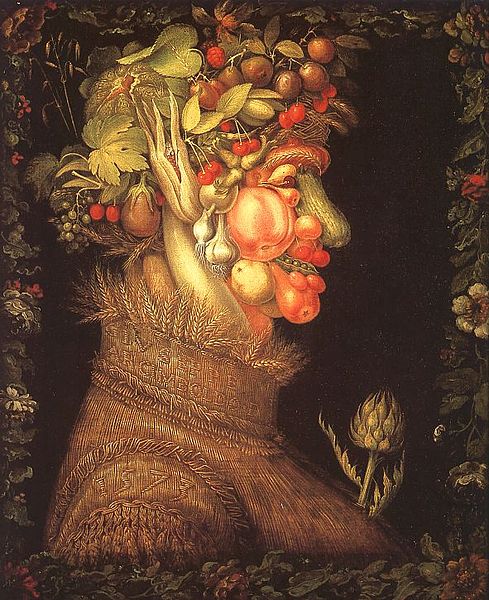
Summer by Giuseppe Arcimboldo
Here are the final three stories that make up the last published collection called American Ghosts and Old World Wonders:
"Ashputtle or The Mother's Ghost: Three Versions of One Story" — The name Ashputtle is probably unfamiliar to most Americans but this is the old German name of Cinderella. Carter riffs on three old versions of the fairy tale.
"Alice in Prague, or The Curious Room" — Archduke Rudolph plays host to Dr. Dee, Alice of Wonderland fame, and Archimboldo, who creates "Summer" in the dead of a very cold Prague winter.
"Impressions: The Wrightsman Magdalene" — A meditation upon the three Marys, particularly the Magdalene, after they have landed in the South of France.
The final three stories in Burning Your Boats were previously uncollected although all but one had appeared elsewhere.
"The Scarlet House" — This story is so sick and pointless, if I weren't such a compulsive completist, I would have not finished it. What possesses someone to write such crap? And what possesses someone else to publish it?
"The Snow Pavilion" — A car breaks down, a blizzard ensues, the driver goes for help at an enchanted mansion and hallucinates.
"The Quiltmaker" — A patchwork quilt is a metaphor for a meditation about the infinite and unexpected variety of life experiences.
Okay, folks, that concludes my reading of all the stories in Burning Your Boats. You all have witnessed the wild swings in my reactions to Carter's stories, ranging from supreme admiration to absolute disgust. I fear I may have embarrassed myself by appearing to suffer from some kind of a manic-depressive psychosis. Rest assured, I am not even close to depression, but I am feeling rather manic that I have finally come to the end of this. On balance, and with few exceptions, it would have been better if I had stopped with Saints and Strangers, although one of my favorite Carter stories was the second one in this collection, namely, "A Very, Very Great Lady and Her Son at Home," which I have already mentioned.
So . . . there will be no formal review forthcoming. I am finished with this book in more ways than one. Recognizing that Carter has great talents, she is probably not everyone's cup of tea, and this collection of short stories certainly has not been my cup of tea all the time. I'm going to have to give it 3 stars because it is no worse than Crystal Vision. I toyed with giving that one 2.5 stars, but finally decided that it deserved 3 for cleverness alone. So 3 it is.
51baswood
Excellent little video. It reminded me of The Piano Shop on the left Bank which I read last year.
I am planning a visit to Paris next month and so if I am near the 13th arrondisment I will look for the shop.
I am planning a visit to Paris next month and so if I am near the 13th arrondisment I will look for the shop.
52Linda92007
Thanks for sharing that wonderful video, Suzanne, although I must admit to cringing a bit when I saw him using that rather large sledge hammer. My piano is my most prized possession, but my playing does not live up to the instrument's full potential.
53Poquette
Barry, that was exactly what I thought. I wish I had seen the video before I read the book!
Linda, that sledge hammer was a bit daunting. I too was picturing my piano undergoing such operations and it made my fingernails curl. Well, not really, but you know . . .
Linda, that sledge hammer was a bit daunting. I too was picturing my piano undergoing such operations and it made my fingernails curl. Well, not really, but you know . . .
54PeterKein
Perhaps another text of interest - Franco Moretti's Atlas of the European Novel 1800-1900
55avaland
>41 Poquette: I just came across a forthcoming book of essays by various authors about Sorrentino's Mulligan Stew, a novel that has been on my shelf for about a decade now since it was first recommended to me by an author (it's a story populated with characters from other books). Just in case you are looking for more Sorrentino (other than that book, I think I have a book of lit crit by him...)
56baswood
Suzanne, an interest in Venice I see, I love the Donna Leon detective novels, which do have an atmosphere of the city about them. However she is wrong about the food as she goes into some detail about the cooking and the eating in Venice. The only time I had a decent meal in the city was when I cooked it myself. Perhaps the restaurants don't serve decent food to tourists.
Venice one of the most beautiful cities I have ever been to, but one of the worst to eat in.
Venice one of the most beautiful cities I have ever been to, but one of the worst to eat in.
57detailmuse
>41 Poquette: I have become interested in post-modern literature. I am particularly intrigued by the playfulness of some practitioners of this genre. But gameplayer that I am, even I have limitations to my tolerance for literary gamesmanship if it is not accompanied by some other qualities.
I wanted to write a screed in agreement, with examples, but time passes and I have to leave it at “Me too.” I love it, but as seasoning not a main ingredient.
Also, after your comments I googled “A Very, Very Great Lady and Her Son at Home” to see if there is public availability and fyi your thread here (for post #37) is on the first page of my results :)
I wanted to write a screed in agreement, with examples, but time passes and I have to leave it at “Me too.” I love it, but as seasoning not a main ingredient.
Also, after your comments I googled “A Very, Very Great Lady and Her Son at Home” to see if there is public availability and fyi your thread here (for post #37) is on the first page of my results :)
58Poquette
>54 PeterKein: – Thanks for that reference, Peter. I'm adding it to my wishlist.
>55 avaland: – I actually have a collection of Sorrentino's short stories which I am sampling. He is not really a writer I am connecting with, as it turns out.
>56 baswood: – Ah, Venice, yes, Barry. I was there once in the dim dark past and quite loved it, as who would not. The recent flurry of interest was sparked by seeing an old Commissario Brunetti made-for-TV movie last week — a German production with English subtitles. This was followed by a documentary about the filming of the Brunetti series. Who knew? I was swept over with waves of nostalgia by the gorgeous cinematography. Honest to God, it was almost like being there. I fear my traveling days are over, but my armchair traveling days most assuredly are not. Since I had not heard of Donna Leon before, I thought I would try one of her books. And FYI, the Brunetti films are available on DVD or for streaming at Amazon and maybe elsewhere. I have since watched a couple more.
Do tell more about cooking in Venice. You have got my attention! As I recall, eating there was as wonderful as everything else, and I was a mere tourist, but luckily I was steered in the right directions.
>57 detailmuse: – I guess "Poquette" can now enjoy her fifteen minutes of fame! Tragically, no one knows exactly who Poquette is!
Just for fun I "Binged" it and it was not on the first page, so I Googled it and it has now moved to the second page. But I stand all amazed . . .
>55 avaland: – I actually have a collection of Sorrentino's short stories which I am sampling. He is not really a writer I am connecting with, as it turns out.
>56 baswood: – Ah, Venice, yes, Barry. I was there once in the dim dark past and quite loved it, as who would not. The recent flurry of interest was sparked by seeing an old Commissario Brunetti made-for-TV movie last week — a German production with English subtitles. This was followed by a documentary about the filming of the Brunetti series. Who knew? I was swept over with waves of nostalgia by the gorgeous cinematography. Honest to God, it was almost like being there. I fear my traveling days are over, but my armchair traveling days most assuredly are not. Since I had not heard of Donna Leon before, I thought I would try one of her books. And FYI, the Brunetti films are available on DVD or for streaming at Amazon and maybe elsewhere. I have since watched a couple more.
Do tell more about cooking in Venice. You have got my attention! As I recall, eating there was as wonderful as everything else, and I was a mere tourist, but luckily I was steered in the right directions.
>57 detailmuse: – I guess "Poquette" can now enjoy her fifteen minutes of fame! Tragically, no one knows exactly who Poquette is!
Just for fun I "Binged" it and it was not on the first page, so I Googled it and it has now moved to the second page. But I stand all amazed . . .
60June
> 58
Poquette
I would like to see the Commissario Brunetti movie you refer to on Netflix. However, when I search by 'Donna Leon" and "Brunetti" I do not get a hit. Suggestion?
Poquette
I would like to see the Commissario Brunetti movie you refer to on Netflix. However, when I search by 'Donna Leon" and "Brunetti" I do not get a hit. Suggestion?
61Poquette
>59 zenomax: – Zeno, thank you, and I would agree that Google is better.
>60 June: – June, I'm sorry to say I have never used Netflix so I cannot help you there.
>60 June: – June, I'm sorry to say I have never used Netflix so I cannot help you there.
62rebeccanyc
I checked Netflix, and as far as I can tell Netflix neither has them nor even knows about them. There seems to have been a series on German TV, and Amazon has them for sale.
63Poquette
In addition to movies, Amazon is a pretty good source for international made-for-TV videos and they are usually available both as DVDs and for streaming or downloading. I really like the streaming feature. I guess it must be similar to Netflix, but maybe Amazon has more stuff available. I don't know for sure. But they almost always have the obscure items that I want to see.
64Poquette
Every culture, our culture, indefinitely makes maps of the space of knowledge and of the imaginary available everywhere, maps available and ruled by cycles of cycles. To inhabit a space, to inhabit concrete space, either the space of knowledge or the space of culture, means having a place: a personal or colletive place, defined by these multiple circles.
—Michel Serres, Jouvences sur Jules Verne (1974), 149, quoted in Christian Jacob, The Sovereign Map (2006)
66rachbxl
Just catching up. Am intrigued by Continent, which I shall look out for. And Angela Carter, vaguely on my 'must get round to that someday' radar for quite some time now, is shooting up my mental wishlist.
67Poquette
>66 rachbxl: rachbxl - as you probably gathered from my roller-coaster comments about Angela Carter, she is a mixed bag, so beware . . .
68Poquette
I just realized I forgot to post here the next installment of my short story challenge. I am double-posting just so I have a record in this thread (part I posted in the challenge thread 4/16).
Part I. Almost all of the stories I have read come from collections that are sitting on my shelves and they are mostly by very well-known writers. Two were from the Internet. But of the stories from my own books, I have in some cases actually read two or three in order to find one that I wanted to comment on. So while this is a challenge to read 30 stories, I will have probably read 50 or more by the time we are finished.
Here are five more:
16. "Araby" by James Joyce, from Dubliners — Boy loves girl next door and makes himself almost ill with anticipation of the Araby bazaar where he plans to buy her something. By the time he arrives, the lights go out.
17. "Unmasking a Confidence Trickster" by Franz Kafka, from Metamorphosis and Other Stories — "At last I arrived, about ten in the evening, outside the grand house where I was invited to a party." It suddenly dawns upon the narrator that the man who had been following him around for the previous two hours was nothing but a con man.
18. "The Gate of a Hundred Sorrows" by Rudyard Kipling, in Rudyard Kipling: Selected Stories — An old man talks of how he gradually became enslaved by "The Black Smoke" in an opium den owned by an old Chinese man from Calcutta.
19. "The Lotus Eater" by W. Somerset Maugham, in 65 Short Stories — A young man falls in love with the Isle of Capri and decides not to return home from vacation. However, there is an ultimate time limit on his early retirement — self-inflicted.
20. "The Conservatory" by Guy de Maupassant in Guy de Maupassant: Stories — A married couple, having tired of each other, bickered constantly until one night when they thought they heard an intruder.
Here is today's post:
Part II. When I began this project I decided to select stories in alphabetical order by name of author so I wouldn't waste a lot of time shilly-shallying around trying to figure out what to read next. If you knew me you would understand what a good idea this was! But I ran across this charming story on line by O. Henry a few days ago, and I'm going to throw it into the mix just for fun even though it is out of order. No point in being compulsive about it. This puts me a bit ahead of schedule.
21. "Transients in Arcadia" by O. Henry, from The Voice of the City; also available on line at Project Gutenberg — Two people meet in a stylish Manhattan hotel, but each has a vital secret which is revealed in typical O. Henry fashion at the end of the story.
22. "The Green Fly" by Kalman Mikszath, from A World of Great Stories — An old peasant with a young wife is bitten by a fly. Infection sets in. A doctor says amputate or die. What does he do?
23. "The Aurelian" by Vladimir Nabokov, from Nabokov's Dozen — "Aurelian" is an old-fashioned designation for lepidopterist. The Aurelian in question is a seller of mounted butterflies who daydreams constantly of traveling to collect butterflies in storied places. At last he manages to save enough money and the day arrives.
24. "The Purloined Letter" by Edgar Allan Poe, in Great Tales of Edgar Allan Poe — I chose this story because I had not read it before. It concerns the solution by Poe's Sherlockian detective M. Dupin to a perplexing case of the theft from a very important personage of a letter. The feeling of the story is very reminiscent of Sir Arthur Conan Doyle.
25. "Day Million" by Frederick Pohl, in The Norton Book of Science Fiction — The human life form undergoes dramatic changes between now and then, a thousand years hence, but people will still be people.
26. "Facts and Their Manifestations" by Gilbert Sorrentino, from The Moon in Its Flight — A man has formed a certain mental image of his mother who dies when he was four years old in front of the Plaza Hotel, and he is repeatedly attracted to women who remind him in some enigmatic way of this image.
Part I. Almost all of the stories I have read come from collections that are sitting on my shelves and they are mostly by very well-known writers. Two were from the Internet. But of the stories from my own books, I have in some cases actually read two or three in order to find one that I wanted to comment on. So while this is a challenge to read 30 stories, I will have probably read 50 or more by the time we are finished.
Here are five more:
16. "Araby" by James Joyce, from Dubliners — Boy loves girl next door and makes himself almost ill with anticipation of the Araby bazaar where he plans to buy her something. By the time he arrives, the lights go out.
17. "Unmasking a Confidence Trickster" by Franz Kafka, from Metamorphosis and Other Stories — "At last I arrived, about ten in the evening, outside the grand house where I was invited to a party." It suddenly dawns upon the narrator that the man who had been following him around for the previous two hours was nothing but a con man.
18. "The Gate of a Hundred Sorrows" by Rudyard Kipling, in Rudyard Kipling: Selected Stories — An old man talks of how he gradually became enslaved by "The Black Smoke" in an opium den owned by an old Chinese man from Calcutta.
19. "The Lotus Eater" by W. Somerset Maugham, in 65 Short Stories — A young man falls in love with the Isle of Capri and decides not to return home from vacation. However, there is an ultimate time limit on his early retirement — self-inflicted.
20. "The Conservatory" by Guy de Maupassant in Guy de Maupassant: Stories — A married couple, having tired of each other, bickered constantly until one night when they thought they heard an intruder.
Here is today's post:
Part II. When I began this project I decided to select stories in alphabetical order by name of author so I wouldn't waste a lot of time shilly-shallying around trying to figure out what to read next. If you knew me you would understand what a good idea this was! But I ran across this charming story on line by O. Henry a few days ago, and I'm going to throw it into the mix just for fun even though it is out of order. No point in being compulsive about it. This puts me a bit ahead of schedule.
21. "Transients in Arcadia" by O. Henry, from The Voice of the City; also available on line at Project Gutenberg — Two people meet in a stylish Manhattan hotel, but each has a vital secret which is revealed in typical O. Henry fashion at the end of the story.
22. "The Green Fly" by Kalman Mikszath, from A World of Great Stories — An old peasant with a young wife is bitten by a fly. Infection sets in. A doctor says amputate or die. What does he do?
23. "The Aurelian" by Vladimir Nabokov, from Nabokov's Dozen — "Aurelian" is an old-fashioned designation for lepidopterist. The Aurelian in question is a seller of mounted butterflies who daydreams constantly of traveling to collect butterflies in storied places. At last he manages to save enough money and the day arrives.
24. "The Purloined Letter" by Edgar Allan Poe, in Great Tales of Edgar Allan Poe — I chose this story because I had not read it before. It concerns the solution by Poe's Sherlockian detective M. Dupin to a perplexing case of the theft from a very important personage of a letter. The feeling of the story is very reminiscent of Sir Arthur Conan Doyle.
25. "Day Million" by Frederick Pohl, in The Norton Book of Science Fiction — The human life form undergoes dramatic changes between now and then, a thousand years hence, but people will still be people.
26. "Facts and Their Manifestations" by Gilbert Sorrentino, from The Moon in Its Flight — A man has formed a certain mental image of his mother who dies when he was four years old in front of the Plaza Hotel, and he is repeatedly attracted to women who remind him in some enigmatic way of this image.
69Poquette
After all the high-minded blather above about reading with a purpose and getting back to it, I'm still finding bits of fiction here and there that insist upon interposing themselves. I recently stumbled on a couple of old Maigret paperbacks that had seen better days and were available for a song. Haven't read any Georges Simenon for absolute decades, but coincidentally, the same cable channel where I saw the Commissario Brunetti video features other international "mystery" productions as well, including Irene Huss, whom I had never heard of, and once a week we are being treated to a Maigret featuring the great French actor Bruno Cremer. These are all in the original language with English subtitles. Anyway, that's probably what caused the Maigret novels to catch my eye. One was Maigret and the Fortuneteller (also known as To any Lengths, or Signé Picpus in French) which I quickly read. Typical Simenon whodunit. In this case, the novel opens with the discovery that a certain fortune teller will be murdered at five o'clock. A murder does indeed occur and there are plenty of red herrings before we find out what actually happens. So this was a fun diversion.
The other book was what I consider a serendipitous find. I have been lamenting how I am losing my French and trying to think how I can recapture it without making a job of work out of it. Maigret et le fantôme appears to be a graded reader, based on a limited vocabulary of 1500 words and undoubtedly abridged somewhat. That's probably a bigger vocabulary than I ever had, but what fun to refresh my French and perhaps expand it at the same time with this little whodunit.
This reminds me that I got involved in a conversation somewhere about the pros and cons of abridgment, and I honestly at the time could think of no justification whatsoever. But I am now thinking that perhaps in the aid of learning or refreshing a foreign language, perhaps an abridgment — in this case a simplification — is not an altogether bad thing.
The other book was what I consider a serendipitous find. I have been lamenting how I am losing my French and trying to think how I can recapture it without making a job of work out of it. Maigret et le fantôme appears to be a graded reader, based on a limited vocabulary of 1500 words and undoubtedly abridged somewhat. That's probably a bigger vocabulary than I ever had, but what fun to refresh my French and perhaps expand it at the same time with this little whodunit.
This reminds me that I got involved in a conversation somewhere about the pros and cons of abridgment, and I honestly at the time could think of no justification whatsoever. But I am now thinking that perhaps in the aid of learning or refreshing a foreign language, perhaps an abridgment — in this case a simplification — is not an altogether bad thing.
70Nickelini
"The Lotus Eater" by W. Somerset Maugham, in 65 Short Stories — A young man falls in love with the Isle of Capri and decides not to return home from vacation.
Oh, I have to track down this story! I spent a day on Capri back in 1992 and I still dream of escaping back there forever. It's the place I go to when people say "go to your happy place."
Oh, I have to track down this story! I spent a day on Capri back in 1992 and I still dream of escaping back there forever. It's the place I go to when people say "go to your happy place."
71Poquette
Joyce, please be forewarned — I hate to give out spoilers — but "The Lotus Eater" does not end well for said young man. Being a lotus eater works for a period of time, but not forever in this case.
72Nickelini
Ah, yes, you hinted at that in your first mention of the story. I live in Vancouver, which has the nickname "Lotusland," so I've heard the warning before! Still, after a week of spring rain, I think I'd trade this Lotusland for a sunny, Mediterranean version ;-)
73baswood
The Maigret books are great ones for brushing up on your French. I read them for the same reason and find myself enjoying the stories.

75Poquette
>74 detailmuse: - What a hoot!
76baswood
Belgium - perhaps the only country where a pot of tea is served with whipped cream and chocolate - they also dip their chips/fries in mayonnaise.
77zenomax
We spent the easter weekend in Bruges and I can testify to the splendour of the fries and mayonnaise - easy to overdose on them. They do a lovely garlic mayonnaise too....
And as it was Easter there were multitudes of belgian chocolate easter eggs.
And as it was Easter there were multitudes of belgian chocolate easter eggs.
78Poquette
Barry and Zeno, didn't realize the Belgians were responsible for fries and mayonnaise. And the idea of garlic mayonnaise is making me salivate. As for tea with whipped cream and chocolate, somehow I cannot wrap my mind around that.
79Poquette
The wish list this month is dramatically shorter than usual. I wonder what that means! If anything.
April Wish List
My Life in Pieces by Simon Callow (***Cariola — entertaining autobio in the form of a collection of his writings, essays from here and there)
The Avian Gospels by Adam Novy (***Yolana — this may be one of those quirky dreamy novellas)
Lord of the Flies by William Golding (***bragan, whose review and subsequent thread discussion throw several new lights)
Maps of the Imagination by Peter Turchi (***PeterKein — in connection with Alter's Imagined Cities)
Two Renaissance Book Hunters: The Letters of Poggius Bracciolini to Nicolaus De Niccolis by Phillis Walter Goodhart Gordan (***PimPhilipse — obvious follow-on to The Swerve)
Another Sort of Learning by James V. Schall (***stephenjchow — collection of essays about education, learning, books, history, philosophy, lots of good stuff)
Ragnarok: The End of the Gods by A.S. Byatt (***janeajones — "the myth to end all myths")
The Barbarian Conversion: From Paganism to Christianity by Richard Fletcher (***dchaiken)
Venus and Adonis and The Rape of Lucrece by Shakespeare (***janeajones — been meaning to read the second one in particular)
The Paston Letters: A Selection in Modern Spelling (Oxford World's Classics) ed. by Norman Davis (***baswood — correspondence of a 15th century English family)
Atlas of the European Novel 1800-1900 by Franco Moretti (***PeterKein)
Carl Sagan: A Life in the Cosmos by William Poundstone (***bragan)
April Wish List
My Life in Pieces by Simon Callow (***Cariola — entertaining autobio in the form of a collection of his writings, essays from here and there)
The Avian Gospels by Adam Novy (***Yolana — this may be one of those quirky dreamy novellas)
Lord of the Flies by William Golding (***bragan, whose review and subsequent thread discussion throw several new lights)
Maps of the Imagination by Peter Turchi (***PeterKein — in connection with Alter's Imagined Cities)
Two Renaissance Book Hunters: The Letters of Poggius Bracciolini to Nicolaus De Niccolis by Phillis Walter Goodhart Gordan (***PimPhilipse — obvious follow-on to The Swerve)
Another Sort of Learning by James V. Schall (***stephenjchow — collection of essays about education, learning, books, history, philosophy, lots of good stuff)
Ragnarok: The End of the Gods by A.S. Byatt (***janeajones — "the myth to end all myths")
The Barbarian Conversion: From Paganism to Christianity by Richard Fletcher (***dchaiken)
Venus and Adonis and The Rape of Lucrece by Shakespeare (***janeajones — been meaning to read the second one in particular)
The Paston Letters: A Selection in Modern Spelling (Oxford World's Classics) ed. by Norman Davis (***baswood — correspondence of a 15th century English family)
Atlas of the European Novel 1800-1900 by Franco Moretti (***PeterKein)
Carl Sagan: A Life in the Cosmos by William Poundstone (***bragan)
80PeterKein
I have to confess that I find Moretti's Atlas of the European Novel a bit hard to get through - the idea behind it is interesting, but I just don't feel as though the pay-off lives up to the promise.
I enjoyed Maps of the Imagination- for the first half at least but then it seems like it went on a bit longer than necessary.
Another book I am perusing, not quite as centrally related to mapping as to questions of style and problems of translation, is Adan Thirlwell's The Delighted States but the texts it references have been formidable ones for me. The benefit of the text is the way you can peruse its 'chapters' which are often rather self-contained.
I enjoyed Maps of the Imagination- for the first half at least but then it seems like it went on a bit longer than necessary.
Another book I am perusing, not quite as centrally related to mapping as to questions of style and problems of translation, is Adan Thirlwell's The Delighted States but the texts it references have been formidable ones for me. The benefit of the text is the way you can peruse its 'chapters' which are often rather self-contained.
81bragan
>79 Poquette:: It means we need to recommend more books for you, clearly. :)
82Poquette
>80 PeterKein: Thanks for that clarification, Peter. And I, too have The Delighted States sitting right here. It, too, is not quite what I was aiming for, but it will be interesting nonetheless.
>81 bragan: It looks like you were doing your part, Bragan. 2 out of 12 is pretty good!
>81 bragan: It looks like you were doing your part, Bragan. 2 out of 12 is pretty good!
83Poquette

Fresco, Santa Maria Novella, Cappella Tornabuoni, Florence. 1486-1490 (detail)
Marsilio Ficino depicted on the left
Meditations on the Soul: Selected Letters of Marsilio Ficino (1495), 1997
It was Barry (baswood) who first alerted me to the availability of these letters by Ficino in English. I have learned since that there are eight or nine volumes of his letters from which these were taken and are but a sampling.
As we read in the introduction:
There are few who would pick up a book of fifteenth-century philosophy from anything other than a sense of duty. But the letters of Marsilio Ficino of Florence are an exception. They are philosophical, inspired by Plato, but they also have an instant appeal because they connect with what we all know, but mostly ignore: the knowledge of our own soul. In so many of these letters Ficino urges us either directly or indirectly to cultivate our soul, a message that in our own times has been taken up with great eloquence and power by Thomas Moore (Care of the Soul).This reference to Thomas Moore brings me full circle. Some of you may recall my recent review of The Planets Within: The Astrological Psychology of Marsilio Ficino by Thomas Moore.
Immediately I was struck by the lofty tone that prevails throughout, and it occurs to me that no one writes or talks like this today. Ficino was a great teacher and these letters reflect that. Here he is attempting to instill high standards of morality and behavior among the young men he corresponded with who were destined for high places in scholarship, in diplomacy, in politics and in the Church.
It has been about forty years since I was inside a church to attend services and listen to a sermon. But these letters of Ficino put me in mind of the kind of thing one might hear in that setting without all the fire and brimstone.
The letters in this book are not presented in chronological order, but are grouped around broad subjects such as "Truth and Virtue," "Human Nature," "The Soul," "Knowledge and Philosophy," "Fortune, Fate, and Happiness," "Love, Friendship, and Marriage" and "Worldly Things and Civic Duty." Neither do they include both sides of Ficino's correspondence. Thus, at first I was disappointed because there is much to learn about people through the letters they exchange. Despite this one-sidedness, there is still much to learn here because these letters are steeped in philosophical, literary, political, historical and religious allusions that give us a glimpse into the mind and the world view of a great Renaissance humanist philosopher.
In reading these letters it has been helpful to me to try to transport myself back almost six hundred years and adjust my own world view to try to grasp how all these references to virtues and planetary spheres were uppermost in the consciousness of a spiritually and intellectually generous man like Ficino. It helps to recall that many of the ancient writings by Plato and Cicero and many others were just becoming available again for the first time in a thousand years. Great efforts were being made by thinkers like Ficino and his protégés including Pico della Mirandola to reconcile the then-surprisingly high-minded pagan philosophers with Christianity.
But at the same time, as Joscelyn Godwin pointed out in The Pagan Dream of the Renaissance, "The irruption of the pagan pantheon caused a bifurcation in the European psyche." Godwin's book is about
. . . a state of mind and soul that arose in fifteenth-century Italy, spread through Europe along certain clearly defined fault lines, and persisted for about two hundred years, during which, although no one believed in the gods, many people acted as though they existed. Those privileged to create their own surroundings chose to have the gods painted on their furniture and walls, made statues of them, read and declaimed about them, and impersonated them in pageants and plays. A naive visitor to a Renaissance palace or villa might well conclude that its owners were votaries of Apollo, Venus, Hercules, and a host of attendants in human and semihuman forms. Yet if he stepped into the chapel, a very different set of images would meet his eye, and he might wonder what exactly was going on.Godwin goes on to say: "I do not suppose that anyone in the fifteenth or sixteenth centuries was a pagan in the sense of rejecting Christianity and adopting a pre-Christian religion." Then he quotes Lucien Febvre: "It is absurd and puerile, therefore, to think that the unbelief of men in the sixteenth century, insofar as it was a reality, was in any way comparable to our own. It is absurd, and it is anachronistic." Then this from Godwin:
What I do suggest is that some people during this period "dreamed" of being pagans. In their waking life they accepted the absurdities acknowledged as the essence and credenda of Christianity, all the while nurturing a longing for the world of antiquity and a secret affinity for the divinities of that world. No one confessed, no one described this urge, for it was never dragged beneath the searchlight of consciousness or the scrutiny of the Inquisition. It would have been suicidal, were it even possible, for anyone in Christian Europe to articulate it. But that was all the more reason for it to manifest in the favorite language of the unconscious, and of dreams: that of images.I quote all of this at length to try to shed some light on what it might have been like in Quattrocento Florence in particular and Italy in general to have all this swirling around in one's consciousness.
These are some of the thoughts that have been swirling around in my head as well as I have been reading. So it is with a similar frame of mind and reference that one may appreciate the depth and sincerity and beauty of Ficino's letters. I have not yet finished reading his "meditations of the soul" and am in no particular hurry to do so, but I wanted to set these thoughts down while fresh and try to convey what makes this whole area of "pagan influences" so interesting to me.
While this is not a review per se, I should mention several features of the book that are really useful. In addition to an introduction there is a biographical section at the end which identifies and places Ficino's correspondents in their historical context. The end notes interestingly identify the sources of certain ideas from ancient writers such as Plato, Aristotle, Cicero, Virgil and many more. One begins to see how Ficino and probably others were trying to assimilate those ancient ideas into their own thought processes.
For those of you who are interested at all in the Renaissance, this collection of letters is quite delightful and revealing in wholly unexpected ways.
84Mr.Durick
Okay, Ficino is on my wishlist, not for my interest in the Renaissance but for my interest in my soul.
Thanks,
Robert
Thanks,
Robert
86Poquette
Robert, you are brave in view of my rather checkered track record in recommending books to you. It is with some trepidation that I hope you will enjoy Ficino. And of course, who could disagree with Peter's sentiment? ;-)
87baswood
Enjoyed your thoughts on Meditations on the Soul I hope to get to it next month. Your thoughts on the pagan aspects are interesting, because from a 21st century perspective a typical Renaissance man seems to have led at least a triple life. It is so difficult for us to accept the mindset of someone who was a devout Christian although knew and accepted paganism as part of his life. Who also wrote about morality and yet functioned within one of the most corrupt societies that we know of.
Great post of that fresco
Great post of that fresco
88Poquette
I forgot to post the last of my April challenge stories. April was a slow reading month for me, relatively speaking, and I for one have appreciated having this short story challenge to encourage stolen moments away from work. Here are my final stories:
27. "The World Well Lost" by Theodore Sturgeon, from E Pluribus Unicorn — The planet Dirbanu has force-field technology that prevents landing by ships from Earth. Their first and only ambassador to Earth leaves in disgust after a brief visit. This disdain is only explained when two fugitives from Dirbanu must be returned and a shocking misunderstanding about Earthlings is revealed.
28. "The Piano Tuner's Wives" by William Trevor, from After Rain — Two women wanted to marry the piano tuner when he was a young man even though he was blind. He married Violet who was dumpy and drab but had a gift for feeding his imagination with her descriptions of the world around him. After forty years, Violet died and he married the beautiful Belle who, after so many years, cannot shake her disappointment over being second choice, and this manifests itself in unexpected ways.
29. "The Triumphs of a Taxidermist" by H.G. Wells, in Thirty Strange Stories — In his cups one evening a taxidermist reveals his penchant for "forging" convincing specimens of extinct or even nonexistent birds.
30. "Circus at Dawn" by Thomas Wolfe, in A World of Great Stories — As recently as the 1930s when a circus came to town they pitched their tents in an open space where curious children could go and see the elephants raise the tent poles and watch the magic unfold. This evocative story captures the sights and smells of that lost era.
27. "The World Well Lost" by Theodore Sturgeon, from E Pluribus Unicorn — The planet Dirbanu has force-field technology that prevents landing by ships from Earth. Their first and only ambassador to Earth leaves in disgust after a brief visit. This disdain is only explained when two fugitives from Dirbanu must be returned and a shocking misunderstanding about Earthlings is revealed.
28. "The Piano Tuner's Wives" by William Trevor, from After Rain — Two women wanted to marry the piano tuner when he was a young man even though he was blind. He married Violet who was dumpy and drab but had a gift for feeding his imagination with her descriptions of the world around him. After forty years, Violet died and he married the beautiful Belle who, after so many years, cannot shake her disappointment over being second choice, and this manifests itself in unexpected ways.
29. "The Triumphs of a Taxidermist" by H.G. Wells, in Thirty Strange Stories — In his cups one evening a taxidermist reveals his penchant for "forging" convincing specimens of extinct or even nonexistent birds.
30. "Circus at Dawn" by Thomas Wolfe, in A World of Great Stories — As recently as the 1930s when a circus came to town they pitched their tents in an open space where curious children could go and see the elephants raise the tent poles and watch the magic unfold. This evocative story captures the sights and smells of that lost era.
89Poquette

The Night Circus by Erin Morgenstern (2011) Kindle Edition
Our revels now are ended. These our actors,This passage from The Tempest forms an epigraph at the beginning of the fifth and final part of The Night Circus, and while I have not seen everything Erin Morgenstern has said about the literary antecedents to her novel, I have to say that it embodies the very essence of Prospero's speech.
As I fortold you, were all spirits, and
Are melted into air, into thin air:
And, like the baseless fabric of this vision,
The cloud-capp'd tow'rs, the gorgeous palaces,
The solemn temples, the great globe itself,
Yea, all which it inherit, shall dissolve,
And, like this insubstantial pageant faded,
Leave not a rack behind. We are such stuff
As dreams are made on; and our little life
Is rounded with a sleep.
—Prospero, The Tempest, Act IV, Scene 1
The Night Circus first crossed my radar screen when I saw rave comments about it in the "Hot Reviews" by a man I perceive to be of a certain age, who has read a book or two, and who proclaimed this to be one of the top five favorite reads of his lifetime! Now, that is saying something, and it got my attention, and after looking into it a bit more, I decided this book might be worth reading even though I do not usually go in for fantasy, as such. While the book is a definite page-turner and I have to admit to having gotten caught up in the enchantment of it, at this point I could not declare it to be among the top five all-time favorites, but it was very, very good. Not just very, very good, it was downright delightful. The characters are quite captivating as well.
There are at this point 279 reviews of this book on LT, so there is not much I can add to what has already been said, except to say that this is a 4½ star read. And with the passage of time, I may eventually decide I should have given it more.
90janeajones
Suzanne -- I'm so glad you enjoyed The Night Circus -- it's not in my top 5 all-time favorites either, but it's certainly in the top favorites of this year's reads.
91edwinbcn
It sounds as if The Night Circus might be a bit like Jonathan Strange and Mr Norrell, would you agree?
92Poquette
Jane, I thoroughly enjoyed it.
Edwin, I have not yet read Jonathan Strange so I don't know, but I believe I heard somewhere that Erin Morgenstern was inspired by it.
Edwin, I have not yet read Jonathan Strange so I don't know, but I believe I heard somewhere that Erin Morgenstern was inspired by it.
93Cait86
I just finished The Night Circus this morning, and I agree with you, Suzanne, that while it isn't one of my favourite books ever, it was a very good novel, and a lot of fun to read. My favourite character was the circus itself, which I found far more captivating that any of the actual people in the book.
94Linda92007
I enjoyed your review of The Night Circus, Suzanne, and especially the quote from The Tempest. But I am still undecided about the book. I tried once to read Jonathan Strange and Mr. Norrell and never even got through the first chapter. Maybe just not my type of book.
95janemarieprice
Hmm. Think I'll have to add The Night Circus to the wishlist. Seen several good reviews now.
96Poquette
>93 Cait86: - Hi Cait, you are so right about the circus being absolutely captivating. I liked most of the characters as well but thought they could have been more fleshed out. But the overall impression was very satisfying.
>94 Linda92007: - Linda, I'm going to have to read Jonathan Strange and Mr. Norrell before I will be able to say anything intelligent about it. I suspect they are very different books, however. I have it sitting here on my Kindle and will try to get to it soon.
>95 janemarieprice: - Hi Jane, the reviews are mostly positive it would seem, and I think for good reason. It is pure fantasy, so a heavy suspension of disbelief is required. Very well done, on the whole.
>94 Linda92007: - Linda, I'm going to have to read Jonathan Strange and Mr. Norrell before I will be able to say anything intelligent about it. I suspect they are very different books, however. I have it sitting here on my Kindle and will try to get to it soon.
>95 janemarieprice: - Hi Jane, the reviews are mostly positive it would seem, and I think for good reason. It is pure fantasy, so a heavy suspension of disbelief is required. Very well done, on the whole.
97Poquette

Meditations on the Soul: Selected Letters of Marsilio Ficino (1495), 1997
If we transport ourselves back about six hundred years and try to grasp the world view that prevailed in those times, when there were seven heavens governed by the planetary spheres and the New World was about to be discovered, we step into a world that was filled with the intrigues of the Medicis, the artistry of Botticelli and Michaelangelo, the literary output of Chaucer and the philosophy of Marsilio Ficino.
Ficino was at the same time avuncular and didactic: He reminds one of a favorite uncle who delights in writing long letters filled with advice regarding good behavior and virtuous living. His main message is that by forming good habits of thought and action while young, it will be easier to direct one's life along the right path.
Marsilio Ficino was apparently an ordained priest although he was not attached to any congregation. Instead, he devoted his life to learning and teaching and translating the "new" Greek texts that were coming into Italy from the crumbling Byzantine Empire. Constantinople had been conquered by the Turks in 1453 when Ficino was twenty years old. He mastered Greek during his twenties and embarked on the project of translating the works of Plato from Greek to Latin. It was in the midst of this effort that Cosimo de Medici, his sponsor, asked him to drop everything and translate the Corpus Hermeticum attributed to Hermes Trismegistus (titled Poimander by Ficino), and these documents influenced Renaissance religious philosophy for the next two hundred years although they have been languishing in the dustbin of history ever since. His establishment of a new Platonic Academy outside of Florence allowed him to gather about him many like-minded men who shared his desire to reconcile Plato with Christianity.
Ficino was an exceptionally warm-hearted and emotionally generous friend, if his letters are any indication. His language seems flowery and somewhat over the top when compared with social exchanges today, but they seem heartfelt. Here is a typical salutation:
Good health to you always, heavenly and divine friend. Of my other friends, some were presented by chance and the rest were of my own choosing; but the heavens joined Bernardo Bembo to me from the beginning, and then divine providence confirmed this in a wonderful way. I say "heavens" because we were born in the same year, on the same day, under the same star.A number of Ficino's letters are worth mentioning here briefly. One of his most remarkable letters (no. 5 in this collection) is addressed to a very young Cardinal Riario who had just received his elevation at the tender age of sixteen! Ficino does not mince words in advising him while adopting the persona of "Truth":
To Cardinal Riario, her most beloved, son, Truth gives many greetings and promises true salvation. . . . Most people think that I [Truth] abide in the high palaces of princes. On the contrary, I am more often compelled to seek out cottages and to dwell in humble homes. . . . I am driven back from the thick roofs and walls of rich houses; and if these doors are ever opened, a tumult of countless falsehoods immediately streams out to meet me. Not thinking to stay among enemies, I instantly take flight. I leave that house that is full of gold and lies but impoverished and empty of truth. Today, however, I come to you willingly, fortunate cardinal, to dwell with you always, if you but wish it. I have come in haste at the very outset of your appointment before your hearth is beset by my enemies, the pernicious lies of flatterers and slanderers. . . .Letter 29 is a dialogue between The Soul and God and amounts to a religious ecstasy put to paper. I kept thinking of Michaelangelo's St. Theresa. Letter 69 contains an example of a prayer that Ficino claims to say every day. Letter 38 describes the distinction between the celestial Venus and the common Venus. This underscores the insights found in Thomas Moore's The Planets Within which distinguishes between the planetary influences and the common Greek and Roman myths. Letter 84 is about true friendship. Letter 47 is the longest letter in this collection and is a life of Plato. Letter 95 is addressed to Pope Sixtus IV, dripping with irony and castigating him for making war on part of his flock, namely Florence:
You should attribute your high rank of office to your ancestry and not to your own merits which, to speak truly, could not have achieved so much in your few tender years. You should not attribute it to fate and fortune either, for sacred mysteries and holy orders do not arise from the caprice of fortune but from the eternal wisdom of God.
Whoever uses arms against your sheep undoubtedly harms you before anyone else. For there is no shepherd without a flock, and he who disowns or loses any part of the flock at once ceases to be shepherd of the whole.Ficino speaks always in favor of virtue and he equates the good with God, or vice-versa. For those readers with a religious aversion, if they think "good" whenever he says "God," the message is striking and worth thinking about.
Several features of the book are really quite useful. In addition to an introduction there is a biographical section at the end which identifies and places Ficino's correspondents in their historical context. The end notes interestingly identify the sources of certain ideas from ancient writers such as Plato, Aristotle, Cicero, Virgil and many more. One begins to see how Ficino and probably others were trying to assimilate those ancient ideas into their own thought processes.
I dare say this book will not appeal to many readers because it is heavily steeped in a religious world view that seems to be quite out of fashion today. But for those readers who are interested at all in the Renaissance, this collection of letters is quite delightful and revealing in wholly unexpected ways.
These letters are always philosophical, frequently informative, and sometimes amusing in terms of the quaint Renaissance view of scientific and technical matters. Except when they become lost in an excess of logic and syllogism, they are always charming and full of good will.
This review is also posted on the book page.
98baswood
Fabulous review of Meditations on the Soul Suzanne. You have done a great job of putting the letters into some sort of context, so that readers who might be interested, will have a good idea of what is in the book.
I am looking forward to reading it next month.
I am looking forward to reading it next month.
99Linda92007
I agree with Barry, Suzanne. Although it is unlikely that I will ever read this book, I greatly enjoyed your excellent review.
101janeajones
Fascinating review, Suzanne -- I too will probably never get to this book, but I'm absorbing the details of your review.
102Poquette
Thank you one and all — Barry, Linda, Dewald and Jane — for your kind words. Realizing that Renaissance intellectual history is pretty esoteric and that I run the risk here of driving people away rolling their eyes, believe it or not I am sticking with this for a bit longer.
Just wait until you hear about the book I am reading now — actually there are several, but one is relevant here. That book is Survival of the Pagan Gods by Jean Seznec. This is a holdover from early last year. I had intended to read it after finishing Jocelyn Godwin's seminal book — for me anyway — The Pagan Dream of the Renaissance. And speaking of seminal, Seznec's book, translated from the French, is listed in almost every bibliography I have encountered since I got on this "pagan influences" kick. I have only read the first couple of chapters, but I am seeing that it would have been helpful to have read this book long before now. Seznec, just for instance, right off the bat enlarges upon this notion that I keep mentioning about the differences between the ancient Greek and Roman myths and the transformation of the gods as planetary powers and how it happened and how this is a key to how the pagan gods survived the middle ages. It is an amazing book. More on this later.
The other books in progress currently are Imagined Cities by Robert Alter, The Uses of Literature by Italo Calvino, and The Prague Cemetery by Umberto Eco. All of these are absorbing and I look forward to exchanging comments on them as I finish them.
Just wait until you hear about the book I am reading now — actually there are several, but one is relevant here. That book is Survival of the Pagan Gods by Jean Seznec. This is a holdover from early last year. I had intended to read it after finishing Jocelyn Godwin's seminal book — for me anyway — The Pagan Dream of the Renaissance. And speaking of seminal, Seznec's book, translated from the French, is listed in almost every bibliography I have encountered since I got on this "pagan influences" kick. I have only read the first couple of chapters, but I am seeing that it would have been helpful to have read this book long before now. Seznec, just for instance, right off the bat enlarges upon this notion that I keep mentioning about the differences between the ancient Greek and Roman myths and the transformation of the gods as planetary powers and how it happened and how this is a key to how the pagan gods survived the middle ages. It is an amazing book. More on this later.
The other books in progress currently are Imagined Cities by Robert Alter, The Uses of Literature by Italo Calvino, and The Prague Cemetery by Umberto Eco. All of these are absorbing and I look forward to exchanging comments on them as I finish them.
104Poquette
Presumably you are making a little joke which is sailing right over my head. However, just perusing the scant LT info re American Gods and since it is fiction, I suspect there is no connection. Sorry, I am unfamiliar with the book. Please do enlighten me. Is it something I need to read?
105Mr.Durick
American Gods is a beloved not very good novel by Neil Gaiman about the gods that American immigrants brought with them and how those gods fare in contemporary America. That is to say it is about the survival of pagan gods. It is not something that you need to read. Sorry about the little joke's going over your head, but you are right; that is what it is.
Robert
Robert
107ncgraham
91, 92 > I love Jonathan Strange & Mr. Norrell! And I'm not at all surprised that Morgenstern said she was inspired it; after all, its success was what really inspired the current vogue for historical fantasy.
I got the audiobook of The Night Circus from the library recently, but unfortunately it didn't play well. I think they've resurfaced it so I'll have to try checking it out again.
I got the audiobook of The Night Circus from the library recently, but unfortunately it didn't play well. I think they've resurfaced it so I'll have to try checking it out again.
108edwinbcn
>107 ncgraham:
its success was what really inspired the current vogue for historical fantasy
I am sure it was the success of the Harry Potter books which inspired Suzanna Clarke.
its success was what really inspired the current vogue for historical fantasy
I am sure it was the success of the Harry Potter books which inspired Suzanna Clarke.
109Poquette
Nathan, good to "see" you!
One of the knocks I have against The Night Circus is that there are two time lines, two story lines that are moving forward and eventually converge. One is running several years behind the other. The chapter titles include dates. Because the novel jumps back and forth between the two time lines, I think it could be very confusing to listen to. But I may be wrong. I read the book on Kindle, which does not lend itself well to jumping back and forth to check dates, and whatnot. I ended up copying out the table of contents so I could have it visually available as I read. But maybe that's just me. Other than that, it is a totally delightful book.
One of the knocks I have against The Night Circus is that there are two time lines, two story lines that are moving forward and eventually converge. One is running several years behind the other. The chapter titles include dates. Because the novel jumps back and forth between the two time lines, I think it could be very confusing to listen to. But I may be wrong. I read the book on Kindle, which does not lend itself well to jumping back and forth to check dates, and whatnot. I ended up copying out the table of contents so I could have it visually available as I read. But maybe that's just me. Other than that, it is a totally delightful book.
110ncgraham
108 > Yes, but Harry Potter is hardly historical fantasy. Most authors are inspired by someone else. I was speaking just in terms of a specific sub-genre. Of course, the sub-genre itself existed well before Clarke, but there's been quite a spate of books involving magic in 18th or 19th century Europe since the publication of Strange & Norrell, and I don't think it's coincidental.
Thanks for the heads-up, Suzanne. Roni 'n' cats also told me that she'd recommend reading the physical book just for the sheer beauty of the design, so maybe I'll reconsider. Otherwise I may have to find a volume in the library or bookstore and copy out the table of contents myself. That would work just as well for an audiobook, I think.
Thanks for the heads-up, Suzanne. Roni 'n' cats also told me that she'd recommend reading the physical book just for the sheer beauty of the design, so maybe I'll reconsider. Otherwise I may have to find a volume in the library or bookstore and copy out the table of contents myself. That would work just as well for an audiobook, I think.
111Poquette
>110 ncgraham: – Nathan, even the Amazon preview does not include the table of contents so you can't crib from that and type it yourself. Bummer.
By the way, I also seem to remember that Morgenstern mentioned The Prestige by Christopher Priest as an influence for The Night Circus. In reading about it, it sounds a lot like a film from a few years back called The Illusionist starring Edward Norton and Jessica Biel which I loved. Do you happen to know — or does anyone reading this know — whether The Illusionist is based on The Prestige? Just curious.
By the way, I also seem to remember that Morgenstern mentioned The Prestige by Christopher Priest as an influence for The Night Circus. In reading about it, it sounds a lot like a film from a few years back called The Illusionist starring Edward Norton and Jessica Biel which I loved. Do you happen to know — or does anyone reading this know — whether The Illusionist is based on The Prestige? Just curious.
112edwinbcn
》110
I meant to say that the interest in writing about magicians probably stems from the Harry Potter rage.
I meant to say that the interest in writing about magicians probably stems from the Harry Potter rage.
113ncgraham
True, Edwin.
Yes, Suzanne—I tried going that route and it failed. I'm a couple CDs into the audiobook right now and not having too much trouble keeping track of the time period so far. Maybe your warning has made me extra cautious. It's really lovely, and Jim Dale's reading is excellent.
No, The Illusionist is not based on The Prestige. However, there was a film version of The Prestige that was released the same year as The Illusionist. Confusing, no? They're supposed to be somewhat similar in subject matter and style, although The Prestige is much darker. I haven't read Christopher Priest's book or seen The Illusionist, although I have seen the movie version of The Prestige. It's pretty good, but not as great as everyone was making it out to be, in my opinion. I really must watch The Illusionist some time; wisewoman is a great fan of it as well.
Yes, Suzanne—I tried going that route and it failed. I'm a couple CDs into the audiobook right now and not having too much trouble keeping track of the time period so far. Maybe your warning has made me extra cautious. It's really lovely, and Jim Dale's reading is excellent.
No, The Illusionist is not based on The Prestige. However, there was a film version of The Prestige that was released the same year as The Illusionist. Confusing, no? They're supposed to be somewhat similar in subject matter and style, although The Prestige is much darker. I haven't read Christopher Priest's book or seen The Illusionist, although I have seen the movie version of The Prestige. It's pretty good, but not as great as everyone was making it out to be, in my opinion. I really must watch The Illusionist some time; wisewoman is a great fan of it as well.
114Poquette
Thanks, Nathan. Yes, you must watch The Illusionist.
115Poquette





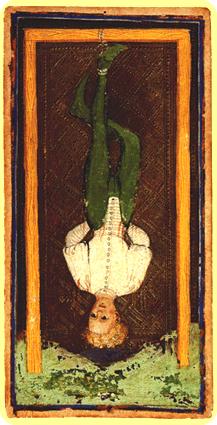


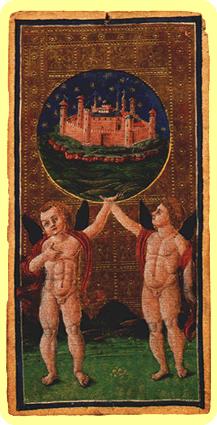
From the Visconti-Sforza Tarot Deck (c. 1451): The Fool, The Magician, The High Priestess, The Chariot, The Hermit, The Hanged Man, Death, The Tower, The World

Tarot Symbolism by Robert V. O'Neill (1986) Fairway Press
It is one thing to think of tarot cards as a vehicle for fortune telling, but it is quite another to envision them as a map for a mystical journey. And many people will dismiss them out of hand on either account. However, Robert V. O'Neill has shown in this book how the tarot cards, which first appeared in Italy in the early 1400s, are a unique and colorful mirror of the philosophical, religious and aesthetic preoccupations of that brief moment in the history of the West.
During the 18th century several French occultists began circulating a mass of misinformation about the origins and history of tarot cards, and this is where their use as tools of fortune telling arose. This was followed by a "flowering" in England in the 19th and early 20th centuries of similar occultist preoccupations led by, among others, the Brotherhood of the Golden Dawn and its offshoots including the ever popular Arthur E. Waite and his ubiquitous Rider-Waite deck. I have found that most of what is available today about tarot cards and their interpretation bears little if any resemblance to what the original Renaissance designers seem to have had in mind. There is no evidence of such use during the period in which they originated.
Indeed, O'Neill argues that key elements of Renaissance trionfi (triumphal processions), humanism, Neoplatonism, gnosticism, mystery religions, hermeticism, Christian mysticism, kabbalah, alchemy, numerology, the art of memory, astrology, the planetary spheres and the Great Chain of Being are all amalgamated into the 22 cards that make up the so-called Major Arcana or Trumps. The cumulative effect of all of this is astonishing and would overwhelm the reader if it did not make such perfect sense in view of the historical milieu in which it all arose.
My own interest in tarot was piqued because of the strong archetypal elements in the cards. And come to find out, Robert O'Neill must have been thinking along the same lines, for he has written a book that summarizes and articulates many things that have occurred to me over the years but I lacked knowledge of Renaissance intellectual history to formulate any kind of a coherent theory of the cards. But O'Neill has done it for us in his well researched and comprehensive study of the various historical influences that culminated in production of the tarot cards.
O'Neill, who has a doctorate in biological science, has approached his task as a scientist would by devoting a chapter to each of the main historical threads listed above, explaining the background of each and how it relates to some or all of the 22 archetypal images. According to the back cover of the book, his "interest in the mystical stems from early training for the Catholic priesthood."
Over and over again, Dr. O'Neill argues that because of the Renaissance preoccupation with mysticism, "we are able to argue that the Tarot is not only a Neoplatonic system of philosophy but a mystical system as well." In fact, while Joseph Campbell had identified the same 22 archetypal cards as a reflection of the Hero's Journey, Dr. O'Neill has demonstrated how it is a mystical journey showing a pathway to realizing one's ultimate desires — in Neoplatonic terms, a union with God. This is all admittedly very strange to the typical 21st century reader, but in the Renaissance context, it was not strange at all.
There is no lack of information on the topics listed above together with copious notes; however, there is no comprehensive bibliography and the book suffers from lack of illustrations and an index. Despite these frustrations, this is an excellent book for what it is. Incidentally, Tarot Symbolism is a difficult book to find and if you do find a copy, it will be expensive. But readers who are interested in this subject will find it well worth reading as much for what it says about Renaissance preoccupations as about the history of tarot cards.
This review also appears on the book page
116Poquette
Interestingly, quite a number of books I have read, am currently reading or am about to read are included among the vast resources O'Neill used in his research. Among them are:
Burckhardt, The Civilization of the Renaissance in Italy
Corpus Hermeticum
Dante, The Divine Comedy
Jung, Psychology and Alchemy
Jung, Psychology and Religion
Jung, Symbols of Transformation
Letters of Marsilio Ficino
Malory, Le Morte d'Arthur
Plato, Timaeus
Seznec, The Survival of the Pagan Gods
Yates, Frances, The Art of Memory
Yates, Giordano Bruno and the Hermetic Tradition
This is a drop in the bucket, but these books and a few others, most of which I read in 2010-11, have been leading me in this direction:
The Rise of Christianity by W.H.C. Frend
The High Medieval Dream Vision by Kathryn Lynch
The Religious Quests of the Graeco-Roman World by Samuel Angus (O'Neill cites another book by Angus)
The Friar and the Cipher: Roger Bacon and the Unsolved Mystery of the Most Unusual Manuscript in the World
Hypnerotomachia Poliphili
The Occult Philosophy in the Elizabethan Age by Francis Yates
The Pagan Dream of the Renaissance by Joscelyn Godwin
The Golden Thread: The Ageless Wisdom of the Western Mystery Traditions by Joscelyn Godwin
The Secret Language of the Renaissance: Decoding the Hidden Symbolism of Italian Art by Richard Stemp
Anyway, you get the idea . . .
Burckhardt, The Civilization of the Renaissance in Italy
Corpus Hermeticum
Dante, The Divine Comedy
Jung, Psychology and Alchemy
Jung, Psychology and Religion
Jung, Symbols of Transformation
Letters of Marsilio Ficino
Malory, Le Morte d'Arthur
Plato, Timaeus
Seznec, The Survival of the Pagan Gods
Yates, Frances, The Art of Memory
Yates, Giordano Bruno and the Hermetic Tradition
This is a drop in the bucket, but these books and a few others, most of which I read in 2010-11, have been leading me in this direction:
The Rise of Christianity by W.H.C. Frend
The High Medieval Dream Vision by Kathryn Lynch
The Religious Quests of the Graeco-Roman World by Samuel Angus (O'Neill cites another book by Angus)
The Friar and the Cipher: Roger Bacon and the Unsolved Mystery of the Most Unusual Manuscript in the World
Hypnerotomachia Poliphili
The Occult Philosophy in the Elizabethan Age by Francis Yates
The Pagan Dream of the Renaissance by Joscelyn Godwin
The Golden Thread: The Ageless Wisdom of the Western Mystery Traditions by Joscelyn Godwin
The Secret Language of the Renaissance: Decoding the Hidden Symbolism of Italian Art by Richard Stemp
Anyway, you get the idea . . .
117Linda92007
Very interesting review, Suzanne, although I'm not sure I really grasp the concept of a mystical journey. Loved the cards you selected.
118Poquette
Linda, as a nonreligious person myself, I probably have no business trying to define "mystical." But as I understand it, there are two forces at work in the religious realm, and one operates from top-down and the other, bottom-up. For example, Christianity has became bogged down in doctrine and rules of thought and behavior that are administered from the top tiers of authority down to ordinary people, members, participants. But in the early days it was very much a mystical sect in that its adherents were seeking a direct experience of God. This was also true of the ascetics who retired to the desert to commune with God, and also of the highly secretive pagan mystery religions of ancient times. And it was certainly true of the Renaissance philosophers who were attracted to the mysticism inherent in Hermetic teachings and neoplatonic philosophy.
So by "mystical," O'Neill and others are speaking of methods or means such as meditation or intensive prayer that individual worshipers utilized in attempting to achieve a direct connection with God, which cut out the middle man, so to speak, namely, the Church. There was a parallel festering movement toward anticlericalism at the time of the Renaissance because of the corruption that reigned among church authorities from monks and priests all the way up to the Pope. It should come as no surprise that sincerely religious people were looking for ways to avoid the corrosive practices that were all around them. It was the mystical tendencies of the Renaissance philosophers that caused them to run afoul of the Church because if people are "communing" directly with God without aid of priests and church authorities, they must be doing something heretical. Confusingly, the cult of Mary is a mystical phenomenon, but it is tolerated.
To achieve enlightenment or oneness with God is not easy and requires intensive concentration, a journey if you will, sometimes through despair before attaining the ultimate goal. To summarize it here is impossible, but "mystical journey" is really shorthand for attempting to achieve a meaningful religious ecstacy, if you will. Many paths to this have been written about for thousands of years. The tarot apparently was merely a visual means to inspire such a mystical journey.
I hope this helps.
So by "mystical," O'Neill and others are speaking of methods or means such as meditation or intensive prayer that individual worshipers utilized in attempting to achieve a direct connection with God, which cut out the middle man, so to speak, namely, the Church. There was a parallel festering movement toward anticlericalism at the time of the Renaissance because of the corruption that reigned among church authorities from monks and priests all the way up to the Pope. It should come as no surprise that sincerely religious people were looking for ways to avoid the corrosive practices that were all around them. It was the mystical tendencies of the Renaissance philosophers that caused them to run afoul of the Church because if people are "communing" directly with God without aid of priests and church authorities, they must be doing something heretical. Confusingly, the cult of Mary is a mystical phenomenon, but it is tolerated.
To achieve enlightenment or oneness with God is not easy and requires intensive concentration, a journey if you will, sometimes through despair before attaining the ultimate goal. To summarize it here is impossible, but "mystical journey" is really shorthand for attempting to achieve a meaningful religious ecstacy, if you will. Many paths to this have been written about for thousands of years. The tarot apparently was merely a visual means to inspire such a mystical journey.
I hope this helps.
119Linda92007
Well, of course. It is not dissimilar to the Buddhist traditions. I don't know where my thoughts were that I didn't make that connection. But your eloquent explanation added considerably to my understanding of this as it manifests in Christianity. Thanks Suzanne!
120janeajones
Interesting and detailed review, Suzanne, thanks.
121Poquette
Indeed, one does think of Sidhartha in this context. I should have mentioned Eastern religions and I could have shortened my explanation! Duh!
Thanks, Jane! I realize this is a strange topic even for me, but the book is so full of elements of Renaissance thinking that I have been reading about in other contexts and has the added bonus of showing how they relate with each other, it was almost irresistible to comment about.
Thanks, Jane! I realize this is a strange topic even for me, but the book is so full of elements of Renaissance thinking that I have been reading about in other contexts and has the added bonus of showing how they relate with each other, it was almost irresistible to comment about.
122baswood
Excellent review of Tarot symbolism and an eloquent explanation of mysticism at # 118.
As you say the O'Neil book is difficult to find. I have not yet come across any references to the use of the tarot in my readings on the renaissance, but I probably will in the future.
As you say the O'Neil book is difficult to find. I have not yet come across any references to the use of the tarot in my readings on the renaissance, but I probably will in the future.
123zenomax
Thank you for bringing to light O'Neill's book, and for your summary of thoughts around this.
It provides another piece of the jigsaw, doesn't it?
The problem is the jigsaw is infinite, and it takes a lifetime to realise this, let alone comprehend what the implications are.
It provides another piece of the jigsaw, doesn't it?
The problem is the jigsaw is infinite, and it takes a lifetime to realise this, let alone comprehend what the implications are.
125avaland
It mind-boggling how far behind on a thread I can get...
>69 Poquette: ha! I'm reading The Use and Abuse of Literature alongside other books currently. It's dense and I think it's going the way of 'high minded talk..." I've made it through half of the introduction and we have spent quite a few words on the evolution of the word 'literature'...
>76 baswood: Belgium: where they make the lightest, crispiest waffles and then serve them with vanilla ice cream and a dark chocolate syrup...
I very much enjoyed your comments on The Night Circus and the subsequent conversation. I've not been terribly attracted to the book (might have been the hype that preceded it) despite my ongoing affair with fantasy of varying kinds. However, the conversations around it are interesting:-)
>69 Poquette: ha! I'm reading The Use and Abuse of Literature alongside other books currently. It's dense and I think it's going the way of 'high minded talk..." I've made it through half of the introduction and we have spent quite a few words on the evolution of the word 'literature'...
>76 baswood: Belgium: where they make the lightest, crispiest waffles and then serve them with vanilla ice cream and a dark chocolate syrup...
I very much enjoyed your comments on The Night Circus and the subsequent conversation. I've not been terribly attracted to the book (might have been the hype that preceded it) despite my ongoing affair with fantasy of varying kinds. However, the conversations around it are interesting:-)
126DieFledermaus
Very interesting review of Tarot Symbolism. Did I see somewhere on another thread that you hadn't read Calvino's Castle of Crossed Destinies or was that someone else? Your review had me wondering how faithful Calvino was to the original Renaissance conception of the cards.
127detailmuse
>118 Poquette: so interesting and helpful! The mystical journey aspect pulls me toward learning a bit about tarot.
128Poquette
>122 baswood: – Barry, probably the closest thing you will encounter is the Tarocchi of Mantegna, which are neither tarot cards nor by Mantegna! But they represent the Great Chain of Being in 50 cards and were thought to be used as a basis for memory. As you will have discovered by now, the Renaissance scholars were quite taken with the idea of creating encyclopedias in various forms, and the Tarocchi were a sort of visual encyclopedia. The tarot, on the other hand, seem to have been used in games that were related to learning and memory and other things as well. I cannot help thinking of Trivial Pursuit in that context.
>123 zenomax:, 124 – Thank you, Zeno. Indeed, the book seems to attempt to put the puzzle together by tracing the many threads of philosophy and psychology that weave together and overlap each other. Having read O'Neill, I can begin to see the different layers of meaning that may be attributable to many familiar symbols and archetypes.
>125 avaland: – Apparently The Use and Abuse of Literature has created a variety of reactions itself. My curiosity is piqued and I'm adding it to the wishlist. Thanks!
Regarding The Night Circus, fortunately I missed all the initial hype and was lured to it by a review I read here on LT. It is a thoroughly delightful book. Forget the hype. In this case, I don't think it was overdone.
>126 DieFledermaus: – It was The Baron in the Trees that I have not read. I actually own — and have read — two different editions of The Castle of Crossed Destinies. And as for historical authenticity, forget that! Calvino was having his own brand of fun. But don't let that deter you. It certainly did not deter me.
127 – MJ, there are a gazillion books out there on the subject of tarot, some better than others. But regardless, they are fascinating in all their ambiguity.
>123 zenomax:, 124 – Thank you, Zeno. Indeed, the book seems to attempt to put the puzzle together by tracing the many threads of philosophy and psychology that weave together and overlap each other. Having read O'Neill, I can begin to see the different layers of meaning that may be attributable to many familiar symbols and archetypes.
>125 avaland: – Apparently The Use and Abuse of Literature has created a variety of reactions itself. My curiosity is piqued and I'm adding it to the wishlist. Thanks!
Regarding The Night Circus, fortunately I missed all the initial hype and was lured to it by a review I read here on LT. It is a thoroughly delightful book. Forget the hype. In this case, I don't think it was overdone.
>126 DieFledermaus: – It was The Baron in the Trees that I have not read. I actually own — and have read — two different editions of The Castle of Crossed Destinies. And as for historical authenticity, forget that! Calvino was having his own brand of fun. But don't let that deter you. It certainly did not deter me.
127 – MJ, there are a gazillion books out there on the subject of tarot, some better than others. But regardless, they are fascinating in all their ambiguity.
129Poquette
Been away visiting my 91-year-old mom over an extended Memorial Day weekend. Here follow my gleanings from the threads here on Club Read:
May Wish List
Song of Achilles by Madeline Miller (***japaul — the Iliad from Patroclus' pov; to read after reading the Iliad — somehow I forgot to add this to the April list)
Renaissance in Italy by John Addington Symonds (***baswood — available at Project Gutenberg; have already dipped into one volume but am posting this reminder)
On Painting (Penguin Classics) by Leon Battista Alberti (***baswood — this would seem to be required reading for Renaissance afficionados)
The Baron in the Trees by Italo Calvino (***pamelad — why haven't I read this???)
The Sense of Paper by Taylor Holden (***janeajones — despite Jane's lukewarm review, the subject matter intrigues me)
The Civilisation of the Renaissance in Italy by Jacob Burkhardt (***baswood — I could probably benefit from a reread of this now that I am firmly ensconced in a plethora of books about the Renaissance)
Gulag: A History by Anne Applebaum (***Arubawoman — this intrigues me since reading Child 44)
Cousin Bette by Honore Balzac (***Arubawoman — I feel Balzac calling)
The Origins of Satan by Elaine Pagels (***DieFledermaus — concept of Satan began with Christianity; who knew?)
Mrs. Dalloway by Virginia Woolf (***japaul — reminding me that this ought to be on my TBR)
The Adventures of Sindbad by by Gyula Krudy (***SassyLassy — see review; also ***rebeccanyc recommends)
Mumbai Noir ed. by Altaf Tyrewala (***Ridgeway Girl — collection of genre short stories set in . . . Bombay)
As You Like It by William Shakespeare (***ncgraham — I read this in college but Nathan's comments make me think I would enjoy rereading)
La grammaire est une chanson douce by Erik Orsenna (***Robert Durick — "this tiny book, in French, could help me with my French reading")
Why Mahler? How one man and ten symphonies changed the world by Norman Lebrecht (***DieFledermaus — fascinating subject but DF recommends looking for another bio instead; this is a reminder)
The Rembrandt Affair by Daniel Silva (***torontoc — this is one of a "series featuring spy and art restorer Gabriel Allon"; NB: read in order)
May Wish List
Song of Achilles by Madeline Miller (***japaul — the Iliad from Patroclus' pov; to read after reading the Iliad — somehow I forgot to add this to the April list)
Renaissance in Italy by John Addington Symonds (***baswood — available at Project Gutenberg; have already dipped into one volume but am posting this reminder)
On Painting (Penguin Classics) by Leon Battista Alberti (***baswood — this would seem to be required reading for Renaissance afficionados)
The Baron in the Trees by Italo Calvino (***pamelad — why haven't I read this???)
The Sense of Paper by Taylor Holden (***janeajones — despite Jane's lukewarm review, the subject matter intrigues me)
The Civilisation of the Renaissance in Italy by Jacob Burkhardt (***baswood — I could probably benefit from a reread of this now that I am firmly ensconced in a plethora of books about the Renaissance)
Gulag: A History by Anne Applebaum (***Arubawoman — this intrigues me since reading Child 44)
Cousin Bette by Honore Balzac (***Arubawoman — I feel Balzac calling)
The Origins of Satan by Elaine Pagels (***DieFledermaus — concept of Satan began with Christianity; who knew?)
Mrs. Dalloway by Virginia Woolf (***japaul — reminding me that this ought to be on my TBR)
The Adventures of Sindbad by by Gyula Krudy (***SassyLassy — see review; also ***rebeccanyc recommends)
Mumbai Noir ed. by Altaf Tyrewala (***Ridgeway Girl — collection of genre short stories set in . . . Bombay)
As You Like It by William Shakespeare (***ncgraham — I read this in college but Nathan's comments make me think I would enjoy rereading)
La grammaire est une chanson douce by Erik Orsenna (***Robert Durick — "this tiny book, in French, could help me with my French reading")
Why Mahler? How one man and ten symphonies changed the world by Norman Lebrecht (***DieFledermaus — fascinating subject but DF recommends looking for another bio instead; this is a reminder)
The Rembrandt Affair by Daniel Silva (***torontoc — this is one of a "series featuring spy and art restorer Gabriel Allon"; NB: read in order)
130DieFledermaus
Another ambitious list! I definitely need to read The Song of Achilles now - I noticed that there were available copies at the library when good reviews first started popping up here but now there's a line.
131Poquette
Beginning with The Mapmaker's Dream and with subsequent thanks to PeterKein, RidgewayGirl and some others, I have been seduced into wishlisting or outright buying a bunch of books related to atlases of both real and imaginary dimensions. And now RidgewayGirl has piqued my interest with her comments about an Atlas of Remote Islands by Judith Schalansky ("for mapheads . . . a series of two-page spreads with a map on the right hand page and a story about the island on the other side, along with the distances to the nearest landmasses and a timeline of the island's history.") This inevitably led me to Amazon where a whole slew of interesting books are listed as being of related interest. Here are a few that caught my eye:
Infinite City: A San Francisco Atlas by Rebecca Solnit
You Are Here: Personal Geographies and Other Maps of the Imagination by Katharine Harmon
Strange Maps by Frank Jacobs — according to Amazon, "Spanning many centuries, all continents, and the realms of outer space and the imagination, this collection of 138 unique graphics combines beautiful full-color illustrations with quirky statistics and smart social commentary."
Maphead: Charting the Wide, Weird World of Geography Wonks by Ken Jennings of Jeopardy fame
Infinite City: A San Francisco Atlas by Rebecca Solnit
You Are Here: Personal Geographies and Other Maps of the Imagination by Katharine Harmon
Strange Maps by Frank Jacobs — according to Amazon, "Spanning many centuries, all continents, and the realms of outer space and the imagination, this collection of 138 unique graphics combines beautiful full-color illustrations with quirky statistics and smart social commentary."
Maphead: Charting the Wide, Weird World of Geography Wonks by Ken Jennings of Jeopardy fame
132Nickelini
Suzanne - I didn't know the term "maphead" but I've always been one. I'm pretty sure my grandfather was one too, so perhaps it's genetic. Thanks for the research! You are Here has been on my wishlist since it was published, but the others are hitherto unknown to me. Good job.
133Mr.Durick
LibraryThing recommends You Are Here: Personal Geographies and Other Maps of the Imagination to me based on my ownership of In Me Own Words: The Autobiography of Bigfoot. I've put it on my wishlist anyway.
I had to go to the Will-you-like-it for a recommendation about Strange Maps. It says with medium certainty that I 'probably will like' the book. Onto the wishlist for it too.
I would think that in a discussion like this The Dictionary of Imaginary Places would come up.
I already have Maphead.
If you get to any of these before I do I'll be interested in your reaction.
Robert
I had to go to the Will-you-like-it for a recommendation about Strange Maps. It says with medium certainty that I 'probably will like' the book. Onto the wishlist for it too.
I would think that in a discussion like this The Dictionary of Imaginary Places would come up.
I already have Maphead.
If you get to any of these before I do I'll be interested in your reaction.
Robert
134bragan
While I am not to be listed among the ranks of the mapheads, Strange Maps sounds fascinating to me, anyway. Another one for the wishlist there, I think.
135baswood
Oh I love maps, whenever I go somewhere new I need to get a map. This is not necessarily to enable me to get from one place to another, but more so that I can study it at my leisure and imagine the places depicted on the map.
I probably buy as many maps as I do books.
I am currently engrossed in a series of maps of the Parc National Des Pyrenees, which I use when I organise hiking trips. Unfortunately these days some of the routes I make up I am no longer sure I can physically do them.
I probably buy as many maps as I do books.
I am currently engrossed in a series of maps of the Parc National Des Pyrenees, which I use when I organise hiking trips. Unfortunately these days some of the routes I make up I am no longer sure I can physically do them.
136Poquette
Aha! Mapheads unite! I'm thrilled to see you all are tripping away with me in this little geographic — and quasi geographic — diversion!
Robert — The Dictionary of Imaginary Places sounds vaguely familiar! Off to investigate . . .
Barry — I'm having the same problem regarding walking and hiking. I'm now firmly in the ranks of armchair travelers.
Robert — The Dictionary of Imaginary Places sounds vaguely familiar! Off to investigate . . .
Barry — I'm having the same problem regarding walking and hiking. I'm now firmly in the ranks of armchair travelers.
137Poquette

Pluto and Proserpina by Bernini
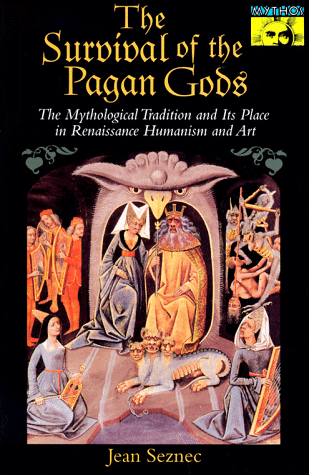
The Survival of the Pagan Gods: The Mythological Tradition and Its Place in Renaissance Humanism and Art by Jean Seznec (1940) Princeton
I am so sorry I did not read this book last year right after The Pagan Dream of the Renaissance, which was my initial intent.
While The Survival of the Pagan Gods is not a book for everyone, it is perhaps the most scholarly attempt we have available in English to explain the time line or progression of the role played by the ancient mythologies in the literature, art, philosophy and theology of the West from Plato up to the sixteenth century.
Originally written in French as La Survivance des Dieux Antiques in 1940, it was translated into English and published by the Bollingen Foundation in 1953. Author Jean Seznec was a world-renowned scholar who taught for many years at Harvard and later at Oxford.
The main point of the book is to say that while it is a commonplace that the Olympian gods died with the rise of Christianity, to be resurrected during the Renaissance, the fact is that they did not completely disappear but merely assumed different forms and identities, and that medieval writers used them allegorically to further their own theological positions. Then during the Renaissance, with the fresh availability of ancient sources, few writers and artists actually relied on primary sources but instead turned to reference manuals compiled largely from medieval sources to describe and list the attributes of the ancient deities. This in large part accounts for the sometimes bizarre inconsistencies that are found in descriptions and depictions of these gods. (See above, Bernini vis-à-vis the book cover illustration from a medieval manuscript.)
This is all a very specialized subject, and as an American whose familiarity with Latin and the living European languages is limited to vague recollections of high school exposure and also as someone who has no pretenses to scholarly erudition, I found this book to be somewhat annoying to read. And that annoyance, let me hasten to say, is a function of my own lack of fluency in languages other than English. The author Seznec has cited countless ancient medieval and Renaissance sources and quoted liberally from them. The quotations that were in Latin are thankfully translated in footnotes, but modern language quotations are not given the same treatment. The net effect is that the book, while otherwise fairly easy to follow, is a source of some frustration when one would like to know what the passages in French and Italian actually said.
Aside from this, I found the book to be quite elucidating in explaining the many anomalies we moderns face when trying to understand the symbolism in paintings and poetic references particularly. The book is liberally strewn with black and white illustrations from manuscripts, incunabula and later printed editions, and also of painting and sculpture. So throughout we have visual representations of what Seznec is discussing.
Despite the frustrations of a scholarly work for the nonscholarly reader, I do believe The Survival of the Pagan Gods is a foundational work which in the end will serve as a useful reference to come back to again and again.

* * * * *
As a postscript, I have come to realize that there is so much more information available in especially Italian but also French and German about the Renaissance that I really do believe those of us who have not taken the trouble to become fluent in one or more European language really are at a disadvantage. I marvel at the fact that most Europeans learn at least one secondary language from an early age just as a matter of course. There are probably significant economic advantages to this, which are not fully appreciated here in America. Hats off to all of you bi- or multi-lingual readers out there! You have my admiration — and envy!
138baswood
Excellent review of The survival of the pagan gods suzanne. This immediately had me checking out abe books to see if it was available and I am pleased to say there are a number of inexpensive books on offer and so I shall soon be following you in reading this book.
I like the front cover too.
I like the front cover too.
139detailmuse
My parents kept a road atlas in the car and when they stopped driving, my mom kept it near her main chair in the living room and referred to it often. It was tattered so I bought a replacement, which pleased her and prompted one of my brothers to ask, a little mockingly, where she thought she was going. She and I exchanged a look: with a map and an imagination -- anywhere!
Re: the map books above, I gave Strange Maps to another of my brothers a couple Christmases ago and have meant to get my own copy; thoughtful, clever, sometimes silly -- it’s compiled from a blog.
I enjoyed skimming two by Katharine Harmon -- You Are Here and The Map As Art (map-inspired art) -- but remember thinking her text confounded me; I should probably take another look.
I too have Maphead in my TBRs.
A few more: I enjoyed the detail and nostalgia of TV Sets by Mark Bennett -- blueprints of the film sets of classic TV series. And the time maps in Cartographies of Time: A History of the Timeline. And working its way up my wishlist after your post: Peter Turchi’s Maps of the Imagination.
Re: the map books above, I gave Strange Maps to another of my brothers a couple Christmases ago and have meant to get my own copy; thoughtful, clever, sometimes silly -- it’s compiled from a blog.
I enjoyed skimming two by Katharine Harmon -- You Are Here and The Map As Art (map-inspired art) -- but remember thinking her text confounded me; I should probably take another look.
I too have Maphead in my TBRs.
A few more: I enjoyed the detail and nostalgia of TV Sets by Mark Bennett -- blueprints of the film sets of classic TV series. And the time maps in Cartographies of Time: A History of the Timeline. And working its way up my wishlist after your post: Peter Turchi’s Maps of the Imagination.
140Poquette
>138 baswood: – Barry, you'll be amazed at all the stuff I left out of the review at the risk of making people's eyes glaze over. Glad you will be reading it and look forward to what you have to say.
>139 detailmuse: – MJ, TV Sets sounds kind of quirky and fun. And I will also check out Cartographies of Time. I have Maps of the Imagination which PeterKein suggested sometime back, but I have not read it yet.
Another somewhat related one to add to the list is Atlas of the European Novel 1800-1900 by Franco Moretti. I am curious to get into this one as well.
>139 detailmuse: – MJ, TV Sets sounds kind of quirky and fun. And I will also check out Cartographies of Time. I have Maps of the Imagination which PeterKein suggested sometime back, but I have not read it yet.
Another somewhat related one to add to the list is Atlas of the European Novel 1800-1900 by Franco Moretti. I am curious to get into this one as well.
141Poquette
Imagined Cities: Urban Experience and the Language of the Novel by Robert Alter (2005) Yale University Press
From the demise of the flaneur to the "savagery of isolation in the urban crowd," Robert Alter explains how urbanization during the 19th century affected certain modernist writers and in turn was interpreted by those writers in their novels. He points out that "Traditional narrative—epic, biblical narrative, romance and the earlier phases of the novel—works on an organizing premise of purposeful continuity." But writers like Balzac, Flaubert and Dickens began to describe how the mass movement into large cities like Paris and London was in itself creating conditions that would ultimately interfere with this "purposeful continuity" for ordinary people, and it began to influence the way novels were written in order to convey the disjuncture that was characteristic of urban life. In short, the modernist tendency to eschew traditional narrative techniques, which reached the outer limits in writers like James Joyce, were at least in part a function of the changes in daily urban life that were being described by these early modernist writers.
Imagined Cities is a thin volume containing only eight chapters, but it is packed with interesting insights about selected writings of six major modernist writers — two chapters each on Gustave Flaubert and Charles Dickens, one chapter each on Andrei Bely, Virginia Woolf, James Joyce and Franz Kafka. The focus, of course, is upon the way these particular writers convey the details of urban life.
In talking about Flaubert's novel The Sentimental Education, Alter begins with the flaneur, who he described variously as an "idling pedestrian, curious, perhaps disinterested, the purposeless observer of teeming urban variety, the spectator connoisseur," who in the late 19th century is becoming "no longer a vehicle of observation but an object of satiric attention." Through the eyes of the flaneur, the city experience devolves into "confusion, fantasy and fragmentation." This is a metaphor of Flaubert's observations of the transformation of city life, how "the urban world is never represented in and of itself but always through the sensibility, the preoccupations and the limited visual or auditory vantage point of the protagonist." In this novel, Flaubert develops an innovative diction that reveals the disturbing nature of the new urban reality. Alter's discussion is so compelling that one is driven to immediately go out and acquire The Sentimental Education!
Dickens' sometimes extravagant descriptions of the underbelly of 19th century London are legendary, and Alter compares and contrasts Dickens and Flaubert and their very different approaches to writing about the city milieu.
Less well known is the work of Andrei Bely, a Russian novelist who wrote Petersburg, the focus of Alter's discussion. St. Petersburg was perhaps the first planned city — and possibly the only one — in Europe. Yet for all the foresight that went into it, urban crowding and the accretion of slums on the outskirts could not be avoided: "the swarm" — a key word in this novel — "threatens the planned city as an embodiment of the actual, uncontainable nature of the urban world." Bely contrasts the mathematical precision of the city's grid with the "antigeometric figure of the swarm" to highlight the contradictions between urban fantasy and reality.
Alter tells us that "Bely's St. Petersburg, like Flaubert's Paris, is represented as a place more of streets than of houses, and, even more notably, of opening and shutting doors." Here is an entrancing passage from Petersburg:
From time to time, while passing from the outer door to the inner door of the entryway, a certain strange, very strange state came over him, as if everything that was beyond the door was not what it was, but something else. Beyond the door there was nothing. If the door were to be flung open it would be flung open onto the measureless immensity of the cosmos, and the only thing left was to . . . plunge into it headfirst and fly past stars and planetary spheres, in an atmosphere of two hundred and seventy-three degrees below zero.Bely represents the dark side of modernism in his view that "the overweening urban project cannot hold together." And as Alter points out, there seems to be a correspondence between "the modern city as a construct of human design . . . and the modern novel as an inventive assemblage of self-conscious, sometimes iconoclastic artifices."
Virginia Woolf's Mrs. Dalloway — by contrast almost an urban pastoral — presents a pleasant change from all this "angst, alienation and anomie." Here we see that cities are also places of excitement and beauty. This idea and others are developed more fully in the book.
Joyce and Kafka present still different pictures of urban life. Joyce's Dublin is a small town compared to Paris or London, yet in Ulysses Joyce puts us right there on the tram in front of Nelson's Pillar. Kafka, on the other hand, in The Trial sees the city as a place of instability pervaded by a climate of suspicion.
Robert Alter has a wonderful ability to focus on an idea — in this case the fictional presentation of urban life — and cause one to look at writing not merely as storytelling but as a multilayered communication. He brings one into the mind of the author to show how a particular passage is not merely a brilliant piece of descriptive writing, but it may demonstrate the very essence of the milieu in which characters operate without devolving into symbolism. His discussion of novelistic technique brings the reader right to the writer's desk and you can really see how the writing is done. In this context, the book is similar to Pen of Iron, which also looks in detail at writing style in the context of conveying and presenting more than the bare bones of a story. And like Pen of Iron, this is another five-star read.

142baswood
My goodness, how prolific is Robert Alter. Excellent review suzanne
143zenomax
Alter is everywhere it seems.
I was convinced I had Bely in my library but seemingly not. I must have thought of him quite intensely at some stage to the degree that I almost materialised one of his books.
Anyway Petersburg & Silver Dove are both circulating...
I was convinced I had Bely in my library but seemingly not. I must have thought of him quite intensely at some stage to the degree that I almost materialised one of his books.
Anyway Petersburg & Silver Dove are both circulating...
144Linda92007
Fabulous review of Imagined Cities, Suzanne, and definitely one for the wishlist. I enjoy books that discuss novelistic technique and influences and this one sounds like it would also motivate reading the works that he discusses.
145SassyLassy
This is a book I have seen around and often wondered about and your review has convinced me that it should go on the wish list.
Petersburg is on my current reading list, so I was pleased to see that I can now find out more about this little known author in the English speaking world.
Zeno, I must have thought of him quite intensely at some stage to the degee that I almost materialised one of his books sounds like something right out of Bely.
Did Alter mention any other authors whom he might have included? Zola comes to mind.
Petersburg is on my current reading list, so I was pleased to see that I can now find out more about this little known author in the English speaking world.
Zeno, I must have thought of him quite intensely at some stage to the degee that I almost materialised one of his books sounds like something right out of Bely.
Did Alter mention any other authors whom he might have included? Zola comes to mind.
146Poquette
Thanks Barry!
Zeno, if one looks at the list of books Alter has written one begins to see why he seems to be everywhere. He is indeed prolific. Bely's Petersburg was one of the books Alter discusses that I thought I would like to read.
Linda, I am sure you would find Alter's book rewarding. I cannot think of another writer of criticism who discusses technique as clearly, and the net effect indeed is that you want to run right out and get the books.
Sassy, Alter did talk about other authors in passing. Balzac and Zola are central to the discussion of Flaubert and to some extent Dickens. Dostoevsky comes up in the context of Dickens and Bely. Others are mentioned here and there in passing. And many of these featured authors are mentioned in the context of each other, as many of them had read each other's books and may or may not have been influenced. I especially enjoyed the discussion of Flaubert's Sentimental Education – enough so that I have already downloaded the book!
Zeno, if one looks at the list of books Alter has written one begins to see why he seems to be everywhere. He is indeed prolific. Bely's Petersburg was one of the books Alter discusses that I thought I would like to read.
Linda, I am sure you would find Alter's book rewarding. I cannot think of another writer of criticism who discusses technique as clearly, and the net effect indeed is that you want to run right out and get the books.
Sassy, Alter did talk about other authors in passing. Balzac and Zola are central to the discussion of Flaubert and to some extent Dickens. Dostoevsky comes up in the context of Dickens and Bely. Others are mentioned here and there in passing. And many of these featured authors are mentioned in the context of each other, as many of them had read each other's books and may or may not have been influenced. I especially enjoyed the discussion of Flaubert's Sentimental Education – enough so that I have already downloaded the book!
147janeajones
Catching up and enjoying your reviews, Suzanne -- particularly intrigued by The Survival of the Pagan Gods.
149Poquette

The Prague Cemetery by Umberto Eco (2010) Houghton Mifflin Harcourt
Umberto Eco has finally written a book that made me squirm. Not that it is badly written, not that it imparts anything but important truths, but the subject matter is not conducive to elevating one's faith in humanity. It presents a snapshot of a brief period in European history when the confluence of events created conditions that were ripe for every imaginable conspiracy theory to be taken seriously and many seriously flawed intellectual and emotional responses to religious and political institutions took hold.
The protagonist was a person who made room only for hatred in his heart for everyone, but especially for Jews, Jesuits, Masons and women. His only positive enthusiasm was for food, and one of the signs that we know Eco is having fun while delivering an important lesson is that every opportunity is taken to embellish the narrative with recipes of whatever the protagonist happens to be dining on at the moment.
Eco has provided a case study of how conspiracies fed by bigotry, ignorance and fuzzy thinking can run amok when no one of importance values the truth. In his collection of essays entitled Serendipities, one of the essays, "The Force of Falsity," demonstrates how easy it is for little lies to become big lies that actually affect the lives of real people. Readers of The Prague Cemetery will find that essay to be instructive. One of Eco's messages is that "the wisdom of the community is based on constant awareness of the fallibility of our learning." In our current democratic society, we also carry the burden of being constantly aware of the fallibility of learning of our leaders. The level of petty and everyday corruption exposed in the pages of The Prague Cemetery really gives one pause. We could think of it as a canary in the coal mine.
150Linda92007
Excellent review of The Prague Cemetery, Suzanne. I definitely plan to read this one.
151SassyLassy
You have changed my mind. I was a fan, but I had sort of given up on Eco after multiple instances of picking up and putting down and finally giving up on The Island of the Day Before. Your review makes me think this recent book would put me back on track with him. Onto my wish list.
152rebeccanyc
Great review, and it encourages me to move The Prague Cemetery higher up on the TBR.
153dmsteyn
Enjoyed your review of Eco, Suzanne. I have his On Literature, but I have yet to read any of his fiction. Maybe this isn't the place to start - I'll try The Name of the Rose first. Thanks for enticing me.
154Poquette
Linda, Sassy, Rebecca and Dewald —
Thank you so much for your positive response to my review, but quite honestly that was not the reaction I expected. The Prague Cemetery is definitely NOT the place to begin with Umberto Eco. The Name of the Rose is good, but my favorite is Foucault's Pendulum which is dripping with black humor, also panning conspiracy theories.
The Prague Cemetery is a very painful novel to read. It is filled with hatred. The protagonist, who Eco purposely made as odious as he could, is a mindless and irretrevably lost anti-Semite. The pages are filled with anti-Jewish venom. There is a point to all this to be sure, but it was not easy to stomach. As one reviewer — LolaWalser, I believe — said, it is a necessary book. Necessary to show how invidious hatred can be. The efforts of this one dreadful man resulted in the infamous "Protocols of the Elders of Zion," which have long been discredited as a total fiction, but which left so much damage and so many bodies in its wake that it is sick-making. This novel demonstrates how lies can take on a life of their own despite evidence to the contrary, and if governments and institutions are corrupt enough, people in high places will look away and let terrible things happen.
So . . . I just say: approach The Prague Cemetery with your eyes wide open. If you feel you cannot stomach it, you are forgiven for not wanting to finish it. I confess to being made extremely uncomfortable by it, and perhaps Eco is preaching to the choir in my case, but hopefully others will read it and see some kind of epiphany and it will have been worth it.
Thank you so much for your positive response to my review, but quite honestly that was not the reaction I expected. The Prague Cemetery is definitely NOT the place to begin with Umberto Eco. The Name of the Rose is good, but my favorite is Foucault's Pendulum which is dripping with black humor, also panning conspiracy theories.
The Prague Cemetery is a very painful novel to read. It is filled with hatred. The protagonist, who Eco purposely made as odious as he could, is a mindless and irretrevably lost anti-Semite. The pages are filled with anti-Jewish venom. There is a point to all this to be sure, but it was not easy to stomach. As one reviewer — LolaWalser, I believe — said, it is a necessary book. Necessary to show how invidious hatred can be. The efforts of this one dreadful man resulted in the infamous "Protocols of the Elders of Zion," which have long been discredited as a total fiction, but which left so much damage and so many bodies in its wake that it is sick-making. This novel demonstrates how lies can take on a life of their own despite evidence to the contrary, and if governments and institutions are corrupt enough, people in high places will look away and let terrible things happen.
So . . . I just say: approach The Prague Cemetery with your eyes wide open. If you feel you cannot stomach it, you are forgiven for not wanting to finish it. I confess to being made extremely uncomfortable by it, and perhaps Eco is preaching to the choir in my case, but hopefully others will read it and see some kind of epiphany and it will have been worth it.
155rebeccanyc
I read both The Name of the Rose and Foucault's Pendulum back in the 80s or early 90s and enjoyed them, but haven't read any other Eco since. I admit I was intrigued by the title, since I've been to the Jewish cemetery in Prague, but I realize it could be, as you put it, an "extremely uncomfortable" read -- although I've certainly read plenty of other uncomfortable reads.
156Poquette
Hi Rebecca, I guess I'm being overly careful. The book is a very clever approach to making a case against bigotry. Typically I don't enjoy such books anymore, although I too have read my share of uncomfortable books. But now that I'm getting older my preference is to avoid them. Because I am such a fan of Eco and I've read almost everything of his that has been published in English, it seemed important to read this latest book. I'm not sorry, I just don't want anyone to hate me for leading them into something they might not be expecting.
I've probably beaten this dead horse enough, eh? ;-)
I've probably beaten this dead horse enough, eh? ;-)
159Poquette
Sorry for the late response, Dan. Am currently moving and only have phone internet access. Difficult to navigate, etc. Will be inactive for a while, but all is well. Thanks for your concern. ;-)

