
Spoiler alert - I want a flag
This topic was continued by Spoiler alert - I want a flag #2.
Talk Recommend Site Improvements
Join LibraryThing to post.
This topic is currently marked as "dormant"—the last message is more than 90 days old. You can revive it by posting a reply.
1SqueakyChu
I always avoid reading book reviews until I finish a book because I detest the spoilers in some of them. When I do finish a book and read the reviews, I'm often very distressed by OVERT spoilers that are given at times simply because a reader dislikes what happens in a particular book.
I wish I would have the ability to flag such reviews with SPOILER ALERT flag.
I wish I would have the ability to flag such reviews with SPOILER ALERT flag.
2lilithcat
Problem is, people can't always agree on what constitutes a spoiler. Giving away the murderer might be an obvious one, but others less so. I've seen people seriously claim that it's a spoiler to say that Romeo and Juliet die, when Shakespeare says so at the very beginning of the play.
3AnnaClaire
>2 lilithcat:
This.
This.
4brightcopy
And this is why I almost never read reviews for fiction before I've read it. Nor do I expect to be able to. It is what it is.
(In related news, I'm a fan of star ratings...)
(In related news, I'm a fan of star ratings...)
5geitebukkeskjegg
>1 SqueakyChu: Yes. I've often had the same thought. There's members who habitually name the murderer in every cirme novel they review.
Don't need to be a flag, just a one-click to stamp the top of a review with the text "SPOILER ALERT" in bold. If available, reviewers would be reminded and some should get a clue.
Don't need to be a flag, just a one-click to stamp the top of a review with the text "SPOILER ALERT" in bold. If available, reviewers would be reminded and some should get a clue.
6SqueakyChu
> 2
Problem is, people can't always agree on what constitutes a spoiler.
Does it really matter what people think is a spoiler? A spoiler alert just cautions readers to what might be a spoiler. Marking a review with a spoiler alert is just like a flashing yellow light. It advises that readers might want to be a little more cautious in reading what follows (which may or may not be a spoiler).
I know that I appreciate when reviewers post their own spoiler alerts. Even if they are wrong by not really being spoilers (such as in the example you gave), a spoiler alert does no harm. It does not prevent anyone from reading a review in its entirety. It just give a heads up to those who care about such things and allows them to move ahead to a different review.
> 4
And this is why I almost never read reviews for fiction before I've read it.
I also frequently find spoilers in tags (e.g. suicide, incest, etc.).
Problem is, people can't always agree on what constitutes a spoiler.
Does it really matter what people think is a spoiler? A spoiler alert just cautions readers to what might be a spoiler. Marking a review with a spoiler alert is just like a flashing yellow light. It advises that readers might want to be a little more cautious in reading what follows (which may or may not be a spoiler).
I know that I appreciate when reviewers post their own spoiler alerts. Even if they are wrong by not really being spoilers (such as in the example you gave), a spoiler alert does no harm. It does not prevent anyone from reading a review in its entirety. It just give a heads up to those who care about such things and allows them to move ahead to a different review.
> 4
And this is why I almost never read reviews for fiction before I've read it.
I also frequently find spoilers in tags (e.g. suicide, incest, etc.).
7SqueakyChu
Today I read a *one-sentence review* (thankfully, I had already finished the book) that gave away the most upsetting finish of the book. I would have been quite distressed to have read merely that one sentence at any time during the weeks I took to finish the book.
I get my maximum enjoyment from reading by having a story reveal itself to me through the writing (not by being told what will happen by others). I finally got my husband to stop telling me the plots of books that I hope to read on my own at a later date. I don't want others doing this to me as well.
In looking at book reviews before or during reading a book, I usually only look at the star rating and the first and last line of the review. I read reviews in their entirety only after finishing a book.
I get my maximum enjoyment from reading by having a story reveal itself to me through the writing (not by being told what will happen by others). I finally got my husband to stop telling me the plots of books that I hope to read on my own at a later date. I don't want others doing this to me as well.
In looking at book reviews before or during reading a book, I usually only look at the star rating and the first and last line of the review. I read reviews in their entirety only after finishing a book.
8lilithcat
> 6
Does it really matter what people think is a spoiler? A spoiler alert just cautions readers to what might be a spoiler.
Yes, it does matter.
I'm rather tired of catering to the lowest common denominator. I'd hate to see reviews that didn't have spoilers cluttered with flags just because some people are ignorant.
Does it really matter what people think is a spoiler? A spoiler alert just cautions readers to what might be a spoiler.
Yes, it does matter.
I'm rather tired of catering to the lowest common denominator. I'd hate to see reviews that didn't have spoilers cluttered with flags just because some people are ignorant.
9lorax
6>
Does it really matter what people think is a spoiler? A spoiler alert just cautions readers to what might be a spoiler. Marking a review with a spoiler alert is just like a flashing yellow light.
That's an excellent metaphor, but not in the way I think you intend it; it's not a safety issue, after all. Flashing yellow lights are intended to be unignorable and to draw attention. A large boldface "SPOILER WARNING!!!!" at the top of reviews would be extremely distracting and intrusive. And a large boldface "SPOILER WARNING!!!!" at the top of my reviews, that I didn't put there, would deter me from wanting to review fiction. I don't do so very often, and I don't give away endings, but when people think basic thematic details are spoilers I suspect nearly all fiction reviews will draw these warnings (thus rendering them all-but-useless for their intended purpose).
Does it really matter what people think is a spoiler? A spoiler alert just cautions readers to what might be a spoiler. Marking a review with a spoiler alert is just like a flashing yellow light.
That's an excellent metaphor, but not in the way I think you intend it; it's not a safety issue, after all. Flashing yellow lights are intended to be unignorable and to draw attention. A large boldface "SPOILER WARNING!!!!" at the top of reviews would be extremely distracting and intrusive. And a large boldface "SPOILER WARNING!!!!" at the top of my reviews, that I didn't put there, would deter me from wanting to review fiction. I don't do so very often, and I don't give away endings, but when people think basic thematic details are spoilers I suspect nearly all fiction reviews will draw these warnings (thus rendering them all-but-useless for their intended purpose).
10brightcopy
#8 by @lilithcat> I'd hate to see reviews that didn't have spoilers cluttered with flags just because some people are ignorant.
Playing devil's advocate:
If Tim made it an account-level setting "show/hide spoilers in reviews" and made it where you both can't see the spoilers flags and can't flag things as spoilers if you have spoilers set to shown, then you would never see any spoiler clutter.
Playing devil's advocate:
If Tim made it an account-level setting "show/hide spoilers in reviews" and made it where you both can't see the spoilers flags and can't flag things as spoilers if you have spoilers set to shown, then you would never see any spoiler clutter.
11SqueakyChu
> 8
I'd hate to see reviews that didn't have spoilers cluttered with flags just because some people are ignorant.
Truthfully, is one *small* yellow flag truly what could be considered "clutter" if it has a specific function and can be ignored?
I'd hate to see reviews that didn't have spoilers cluttered with flags just because some people are ignorant.
Truthfully, is one *small* yellow flag truly what could be considered "clutter" if it has a specific function and can be ignored?
12SqueakyChu
> 9
A large boldface "SPOILER WARNING!!!!" at the top of reviews would be extremely distracting and intrusive.
I never made such a suggestion. I would like a little yellow flag to go along with the blue and red flags. People could also unflag it as they do with the other two flags.
Seriously, with yellow flags, I think people would still read reviews the same way. Okay make them colorless flags (less intrusive).
When I find what I consider to be a serious spoiler in a review, I always have the desire to alert others.
In addition, if someone wants to write a review that includes a spoiler (and many people like to do that to make their reviews complete), they can proactively post the (now transparent and colorless) spoiler flag to alert others who dislike reading this sort of review.
> 10
Brightcopy, that's brilliant! Let's do it!! Oh, I guess Tim has to do it.
A large boldface "SPOILER WARNING!!!!" at the top of reviews would be extremely distracting and intrusive.
I never made such a suggestion. I would like a little yellow flag to go along with the blue and red flags. People could also unflag it as they do with the other two flags.
Seriously, with yellow flags, I think people would still read reviews the same way. Okay make them colorless flags (less intrusive).
When I find what I consider to be a serious spoiler in a review, I always have the desire to alert others.
In addition, if someone wants to write a review that includes a spoiler (and many people like to do that to make their reviews complete), they can proactively post the (now transparent and colorless) spoiler flag to alert others who dislike reading this sort of review.
> 10
Brightcopy, that's brilliant! Let's do it!! Oh, I guess Tim has to do it.
13brightcopy
Unfortunately, getting Tim to add an "account-level setting" is about as likely as him changing the color scheme away from salmon.
;)
;)
14lorax
12>
So how is this yellow flag (after someone has flagged a review with it) going to be both inconspicuous enough not to annoy those of us who don't want to see it and conspicuous enough to be instantaneously visible at a glance to those who do such that they can see it without seeing any text? I was basing the "large boldface" comment on geitebukkeskjegg's description in #5; apologies for attributing it to you as well.
So how is this yellow flag (after someone has flagged a review with it) going to be both inconspicuous enough not to annoy those of us who don't want to see it and conspicuous enough to be instantaneously visible at a glance to those who do such that they can see it without seeing any text? I was basing the "large boldface" comment on geitebukkeskjegg's description in #5; apologies for attributing it to you as well.

16brightcopy
#14 by @lorax> I don't think what SC has proposed is a "will stop me from reading a review when I've forgotten some reviews might contain spoilers" type of notice. I think she's proposing something that allows her to mindfully look for yellow flags before reading review. Kind of like how many product have a normal size printed notice "contains nuts" on the back of the package under the ingredients.
17jjwilson61
Doesn't anyone ever want to find out what others thought about a book *after* they've read it? Why does a review have to imply that it's for people who haven't read the book yet? If I'm reading something that someone has written to avoid revealing major plot points them I'm not getting that reviewers full opinion of the work.
18lilithcat
> 17
Doesn't anyone ever want to find out what others thought about a book *after* they've read it?
All the time. If I have a strong opinion about a book I've read, I'm always curious about what other people thought of it.
Doesn't anyone ever want to find out what others thought about a book *after* they've read it?
All the time. If I have a strong opinion about a book I've read, I'm always curious about what other people thought of it.
19SqueakyChu
> 13
getting Tim to add an "account-level setting" is about as likely as him changing the color scheme away from salmon.
Hey. It never hurts to ask. At least what is mentioned will forever remain in his mind even if he never gets it done.
getting Tim to add an "account-level setting" is about as likely as him changing the color scheme away from salmon.
Hey. It never hurts to ask. At least what is mentioned will forever remain in his mind even if he never gets it done.
20SqueakyChu
> 14
If you have the yellow flag *option* turned off, you'll never see it. If you have it turned on, you'll see it.
If you have the yellow flag *option* turned off, you'll never see it. If you have it turned on, you'll see it.
21SqueakyChu
> 16
I think she's proposing something that allows her to mindfully look for yellow flags before reading review. Kind of like how many product have a normal size printed notice "contains nuts" on the back of the package under the ingredients.
Exactly!! Thank you, BC.
I think she's proposing something that allows her to mindfully look for yellow flags before reading review. Kind of like how many product have a normal size printed notice "contains nuts" on the back of the package under the ingredients.
Exactly!! Thank you, BC.
22brightcopy
#17 by @jjwilson61> Doesn't anyone ever want to find out what others thought about a book *after* they've read it?
Yes. But isn't this a non sequitur to the discussion at hand?
Yes. But isn't this a non sequitur to the discussion at hand?
23SqueakyChu
> 17
Doesn't anyone ever want to find out what others thought about a book *after* they've read it?
Absolutely, yes!! I always read book reviews after I finish reading a book, especially those books I love (or hate) the most!
Doesn't anyone ever want to find out what others thought about a book *after* they've read it?
Absolutely, yes!! I always read book reviews after I finish reading a book, especially those books I love (or hate) the most!
24AnnaClaire
I've seen people seriously claim that it's a spoiler to say that Romeo and Juliet die, when Shakespeare says so at the very beginning of the play. (#2)
I propose a thought experiment: Can things that are common knowledge really be spoilers? For example, if you're watching Titanic, would saying that the ship sinks be a spoiler?
25SqueakyChu
I don't think that anything that is known (or should be known, as in "common knowledge") at the beginning of a book is a spoiler. Sometimes a murder is revealed within the first few pages of a mystery. That, to me, does not constitute a spoiler.
What makes a spoiler for me is the revelation of a significant plot twist (e.g. an untimely death of an important character, the identity of who committed a murder, a particular character committing suicide) that occurs far into the story - after I've dedicated a significant amount of my time into reading a work.
What is sad about the early revelation of spoilers is that it takes so much of my fun out of reading a work. I like to be surprised by every new page of what I read. I truly savor the discovery of what will happen next.
What makes a spoiler for me is the revelation of a significant plot twist (e.g. an untimely death of an important character, the identity of who committed a murder, a particular character committing suicide) that occurs far into the story - after I've dedicated a significant amount of my time into reading a work.
What is sad about the early revelation of spoilers is that it takes so much of my fun out of reading a work. I like to be surprised by every new page of what I read. I truly savor the discovery of what will happen next.
26SqueakyChu
As a courtesy to those who read my reviews, I never add any spoilers without an alert. Most often, I simply try to shy away from any spoilers. Maybe that makes my reviews less thorough or less interesting reading. Anyway, that works for me.
27Bookmarque
while the thought behind flags etc, is mostly good, I don't see this issue as being solved by anything but self-policing. On the part of the reader, if sensitive, to avoid reviews prior to reading. On the part of the reviewer, if sensitive, to put a warning into the review text. Flagging or text-covering methods seem to be too fraught with problems and conflict to be workable.
28brightcopy
Why don't we talk about flagging for spam and flagging for not a review, if we're going to go down this alley? Both of those are vaguely designed and open to interpretation and often debated. Yet somehow the system manages to get along and the consensus is good enough. I would think the same would be the case here. You defined a "spoiler" by saying "flag this if you believe it's a spoiler" and have at it.
What's the fear here, that someone might skip your review because someone else marked it as a spoiler? That's already happening for those people who care about spoilers. We just don't read reviews at all until after we've read the book that we're worried about spoilers on.
Or are you honestly just so sensitive that someone saying something in your review is a spoiler actually offends you in some way? I'm not just asking this as a jab, I really want to know if someone says something is a spoiler (even something so silly as the Titanic sinking or Romeo and Juliet dying) that it actually affects you negatively? Is it just that you get irritable because it makes you aware of people you consider stupid or ignorant?
If so, what I proposed earlier where you'd never even see the spoiler flags if you don't use the feature should address this. Or would it still get under your skin that somewhere out there someone could be acting stupid and you know it's happening even if you're not seeing it? If that's the case, best not to lie awake at night thinking about the world. :D
What's the fear here, that someone might skip your review because someone else marked it as a spoiler? That's already happening for those people who care about spoilers. We just don't read reviews at all until after we've read the book that we're worried about spoilers on.
Or are you honestly just so sensitive that someone saying something in your review is a spoiler actually offends you in some way? I'm not just asking this as a jab, I really want to know if someone says something is a spoiler (even something so silly as the Titanic sinking or Romeo and Juliet dying) that it actually affects you negatively? Is it just that you get irritable because it makes you aware of people you consider stupid or ignorant?
If so, what I proposed earlier where you'd never even see the spoiler flags if you don't use the feature should address this. Or would it still get under your skin that somewhere out there someone could be acting stupid and you know it's happening even if you're not seeing it? If that's the case, best not to lie awake at night thinking about the world. :D
29Bookmarque
I'm somewhat sensitive to plot-related spoilers. If I want to get an overall impression of a book before reading, I'll usually skim reviews that are a paragraph or two long. Those are usually safe, but give enough info for me to make a decision to buy or skip.
30MarthaJeanne
How about all the 'reviews' that are just a run through of the plot, even if they stop short of saying who the murderer was?
31brightcopy
#30 by @MarthaJeanne> Again, in my opinion it would be a waste of time for this handful of posters to try to determine what's "right" for that situation and instead let the what is commonly flagged as a spoiler determine what should be commonly defined as a spoiler.
32Bookmarque
I don't flag reviews often. Just for grievous uselessness in terms of content. The regurgitation of plots I leave alone for the most part. Eh, I probably wouldn't use a spoiler flag much either since what is a spoiler for me is probably different for someone else. The inherent flaw in a flag so subjective as this one would be. The not a review flag is bad enough.
33ABVR
>28 brightcopy: Why don't we talk about flagging for spam and flagging for not a review, if we're going to go down this alley?
Actually, putting it that way crystallizes something for me: Flags, as such, currently amount to a statement that "you did something wrong here" . . . a warning aimed at the person who posted the thing being flagged. A yellow flag for spoilers, though not intended as judgmental, would read that way . . . and (not without reason) get many reviewers' backs up.
If the "Spoilers" mark is going to be visible (and, per #10, I'd rather it wasn't), it needs to take some form other than a flag.
edited to fix runaway italics
Actually, putting it that way crystallizes something for me: Flags, as such, currently amount to a statement that "you did something wrong here" . . . a warning aimed at the person who posted the thing being flagged. A yellow flag for spoilers, though not intended as judgmental, would read that way . . . and (not without reason) get many reviewers' backs up.
If the "Spoilers" mark is going to be visible (and, per #10, I'd rather it wasn't), it needs to take some form other than a flag.
edited to fix runaway italics
34SqueakyChu
> 27
Flagging or text-covering methods seem to be too fraught with problems and conflict to be workable.
I just don't see how one innocuous flag would do this. Is it because person #1 (who would choose to see the flag) would then be annoyed if person #2 puts on spoiler alert on person #1's review? Person #1 then would need to turn this option OFF!
Flagging or text-covering methods seem to be too fraught with problems and conflict to be workable.
I just don't see how one innocuous flag would do this. Is it because person #1 (who would choose to see the flag) would then be annoyed if person #2 puts on spoiler alert on person #1's review? Person #1 then would need to turn this option OFF!
35SqueakyChu
> 28
If so, what I proposed earlier where you'd never even see the spoiler flags if you don't use the feature should address this. Or would it still get under your skin that somewhere out there someone could be acting stupid and you know it's happening even if you're not seeing it? If that's the case, best not to lie awake at night thinking about the world. :D
Very well put. Agreed.
If so, what I proposed earlier where you'd never even see the spoiler flags if you don't use the feature should address this. Or would it still get under your skin that somewhere out there someone could be acting stupid and you know it's happening even if you're not seeing it? If that's the case, best not to lie awake at night thinking about the world. :D
Very well put. Agreed.
36SqueakyChu
> 30
How about all the 'reviews' that are just a run through of the plot, even if they stop short of saying who the murderer was?
Those are not a problem. After reading just a sentence or two, it's quite obvious what they are. At least, it's obvious enough for me to move along to the next review.
If we did have spoiler alerts, perhaps we'd make more and better use of reviews (i.e. be able to calmly and thoroughly read them both before *and* after reading a work).
How about all the 'reviews' that are just a run through of the plot, even if they stop short of saying who the murderer was?
Those are not a problem. After reading just a sentence or two, it's quite obvious what they are. At least, it's obvious enough for me to move along to the next review.
If we did have spoiler alerts, perhaps we'd make more and better use of reviews (i.e. be able to calmly and thoroughly read them both before *and* after reading a work).
37jjwilson61
22> Yes. But isn't this a non sequitur to the discussion at hand?
Is it? If there were a separate field to put post-read reviews then those who don't consider their audience as consisting of people who haven't yet read the book have a place for their spoilery reviews where they won't bother anyone.
Is it? If there were a separate field to put post-read reviews then those who don't consider their audience as consisting of people who haven't yet read the book have a place for their spoilery reviews where they won't bother anyone.
38ABVR
> 31 let what is commonly flagged as a spoiler determine what should be commonly defined as a spoiler
Fair point . . . but one of the things that keeps the "Not A Review" flag from being more contentious than it is, is the existence of a guideline that resolves, up front, a lot of would-be edge cases (short reviews, vague reviews, poorly written reviews) by excluding them from flagging.
The thought of writing a guideline like that for spoilers -- and the ensuing discussion -- makes my head hurt.
Fair point . . . but one of the things that keeps the "Not A Review" flag from being more contentious than it is, is the existence of a guideline that resolves, up front, a lot of would-be edge cases (short reviews, vague reviews, poorly written reviews) by excluding them from flagging.
The thought of writing a guideline like that for spoilers -- and the ensuing discussion -- makes my head hurt.
39SqueakyChu
> 33
Actually, putting it that way crystallizes something for me: Flags, as such, currently amount to a statement that "you did something wrong here"
Actually, I think what you said makes the most sense of all the replies I've gotten to my request. We don't want to discourage people from posting reviews so my suggestion might just make people either stop posting reviews or only posting them privately.
Still...I wish I could have spoiler alerts as a feature...although I think I cannot.
*sigh*
Actually, putting it that way crystallizes something for me: Flags, as such, currently amount to a statement that "you did something wrong here"
Actually, I think what you said makes the most sense of all the replies I've gotten to my request. We don't want to discourage people from posting reviews so my suggestion might just make people either stop posting reviews or only posting them privately.
Still...I wish I could have spoiler alerts as a feature...although I think I cannot.
*sigh*
40SqueakyChu
> 37
If there were a separate field to put post-read reviews..."
Gah! We don't want reviews posted in two separate places!!
If there were a separate field to put post-read reviews..."
Gah! We don't want reviews posted in two separate places!!
41SqueakyChu
> 38
The thought of writing a guideline like that for spoilers -- and the ensuing discussion -- makes my head hurt.
Heh!
The thought of writing a guideline like that for spoilers -- and the ensuing discussion -- makes my head hurt.
Heh!
42jjwilson61
40> Gah! We don't want reviews posted in two separate places!!
But they're actually two different things. One's an advertisement, why you should read or not read this book, and the other is more of an analysis of what you thought about the book.
But they're actually two different things. One's an advertisement, why you should read or not read this book, and the other is more of an analysis of what you thought about the book.
43AnnieMod
>37 jjwilson61:
But that's the problem... by definition any review is a post-read one - you cannot review if you had not read the book. And then the thing that you believe is not a spoiler (the first murder on page 10 for example) may be a spoiler for someone else. So how do you propose to separate the reviews? Based on the reviewer opinion? - we are back to square 1.
But that's the problem... by definition any review is a post-read one - you cannot review if you had not read the book. And then the thing that you believe is not a spoiler (the first murder on page 10 for example) may be a spoiler for someone else. So how do you propose to separate the reviews? Based on the reviewer opinion? - we are back to square 1.
44jjwilson61
I meant post-read to refer to the audience of the review, not the writer of the review. So the reviews that are written for an audience that has already read the book (or for himself for that matter) would probably contain spoilers that a person who has read the book may want to avoid. But a person writing reviews written for an audience that are interested in reading the book is going to want to avoid spoilers, so separating the two kinds of reviews would at least lessen the number of spoilers contained in the latter category.
46brightcopy
The whole "but flags are bad!" point of view - even if not using the word "flag" - comes up in a lot of discussions. The "ratty data marker" is forefront in my mind. I could never understand how people could get so caught up in terminology and rule out an idea based on what the "working term" was, rather than simply say "I don't object to the idea, but I object to what it's called". It always seemed to me like the weakest argument against something, because words are some of the easiest things to change on the website.
So if you're objecting to the word "spoiler flag", how about "spoiler alert", "potential spoiler notice" or any other number of innocuous terms? And if you still don't like the idea apart from the terminology, can we just argue about that instead of how you feel the connotations of a particular changeable word make you feel?
jjwilson: The reason I think the question of whether people ALSO read reviews after they've read the review is a non sequitur to this discussion is that (insert term for this feature here) would in no way hinder (or promote) that use of reviews. I believe this feature suggested is neutral to that and hence that's why it struck me as puzzling to go into a tangent on it. Of course, if people get in a huff because (even if they can't see it) someone, somewhere might possibly mark their review as a spoiler - well geez I don't even want to finish typing all that. People will always get outraged about something and stomp their feet and shake their fists. I can't live my life on my tiptoes trying to please them.
So if you're objecting to the word "spoiler flag", how about "spoiler alert", "potential spoiler notice" or any other number of innocuous terms? And if you still don't like the idea apart from the terminology, can we just argue about that instead of how you feel the connotations of a particular changeable word make you feel?
jjwilson: The reason I think the question of whether people ALSO read reviews after they've read the review is a non sequitur to this discussion is that (insert term for this feature here) would in no way hinder (or promote) that use of reviews. I believe this feature suggested is neutral to that and hence that's why it struck me as puzzling to go into a tangent on it. Of course, if people get in a huff because (even if they can't see it) someone, somewhere might possibly mark their review as a spoiler - well geez I don't even want to finish typing all that. People will always get outraged about something and stomp their feet and shake their fists. I can't live my life on my tiptoes trying to please them.
47TimSharrock
46> the negative feel is, I believe, a significant point for many.
One previous time this came up I suggested a positive variant "suitable for the spoiler-sensitive" ( http://www.librarything.com/topic/36892#605922 ), which some people liked.
One previous time this came up I suggested a positive variant "suitable for the spoiler-sensitive" ( http://www.librarything.com/topic/36892#605922 ), which some people liked.
48lorax
20, 21>
Let's not assume there's going to be an option; we all know what Tim thinks of options.
So if I get this straight, all that you want (we've seen in this thread that some advocates of spoiler markings want boldface text placed above a review) is a yellow flag, that would appear with the red and blue flags, that would similarly be green-flaggable (no this isn't a spoiler), and that did not affect sorting in any way (so if I wanted to downweight red-flagged reviews, I wouldn't be missing things that someone somewhere thought would be a spoiler)?
That would be fine with me.
Let's not assume there's going to be an option; we all know what Tim thinks of options.
So if I get this straight, all that you want (we've seen in this thread that some advocates of spoiler markings want boldface text placed above a review) is a yellow flag, that would appear with the red and blue flags, that would similarly be green-flaggable (no this isn't a spoiler), and that did not affect sorting in any way (so if I wanted to downweight red-flagged reviews, I wouldn't be missing things that someone somewhere thought would be a spoiler)?
That would be fine with me.
49SqueakyChu
> 48
That's exactly what I want.
That's exactly what I want.
50brightcopy
#48 by @lorax> Let's not assume there's going to be an option; we all know what Tim thinks of options.
While I generally agree (hence my joke earlier in the thread), I think there's actually a backdoor that Tim has a cognitive dissonance on. He does seem to sometimes be okay with a COOKIE level setting. An example of this is the "title|shelf|covers" selector on the tags page. I swear I've seen this type of option in some other places but just can't recall where right now.
While I generally agree (hence my joke earlier in the thread), I think there's actually a backdoor that Tim has a cognitive dissonance on. He does seem to sometimes be okay with a COOKIE level setting. An example of this is the "title|shelf|covers" selector on the tags page. I swear I've seen this type of option in some other places but just can't recall where right now.
51ScarletBea
*quietly pops in*
Why do people want to read reviews before they read a book? Either you find the book interesting (by author, title, cover, etc) and want to read it, or you don't, you shouldn't be influenced by what random others (that you have no idea if they have the same tastes as you) like or not...
(that's also why I have a problem with book charts, book clubs, reading groups, and the like...)
Why do people want to read reviews before they read a book? Either you find the book interesting (by author, title, cover, etc) and want to read it, or you don't, you shouldn't be influenced by what random others (that you have no idea if they have the same tastes as you) like or not...
(that's also why I have a problem with book charts, book clubs, reading groups, and the like...)
52SqueakyChu
> 51
Why do people want to read reviews before they read a book?
I like to scan reviews to see if a book is worthwhile reading. If a book has tons of negative reviews, I might choose another book with better reviews. Why waste my time?
Why do people want to read reviews before they read a book?
I like to scan reviews to see if a book is worthwhile reading. If a book has tons of negative reviews, I might choose another book with better reviews. Why waste my time?
53Bookmarque
Because with time being a finite and diminishing resource, I like to be a bit more sure I'm not wasting it. I find the opinions of other folks useful in this task. Granted, it's not perfect and I've been burned, but I like to think I avoid a lot of crap, too. Forewarned at least.
54abbottthomas
Looking at enough reviews, I, for one, start to recognise reviewers whose minds and tastes work along the same lines as mine. That I do find influential when deciding whether or not to read something. If they aren't there I feel much the same as ScarletBea (#51)
55macsbrains
>51 ScarletBea: For me, the main reason for reading reviews before deciding to purchase a book that has come to my attention is to try to get a sense of what is actually inside the book as opposed to what is advertised on the book. This is not the same as being spoiled on the plot. I find jacket copy to be very misleading and I want to know if that fantasy book I pick up is actually a fantasy novel which I will enjoy, or a romance novel masquerading as one which I will probably not. The only way to get that information is through reviews.
I would love a way for people to be able to mark a review for spoilers, either as a whole or in part so they can comment, but it just doesn't feel very LT-ish to me.
I would love a way for people to be able to mark a review for spoilers, either as a whole or in part so they can comment, but it just doesn't feel very LT-ish to me.
56Diane-bpcb
>10 brightcopy:
I agree that that is brilliant, and vote for it!!! I think it solves a lot of issues raised here.
I agree that that is brilliant, and vote for it!!! I think it solves a lot of issues raised here.
57geitebukkeskjegg
>51 ScarletBea: Why do people want to read reviews before they read a book?
Most people probably don't look on reviews before reading, but many of us read reviews before acquiring a book. Many LT reviewers hold a very high standard, and LT reviews is a great source for locating interesting books you'd never find otherwise.
(This, of course, in addition to the books we buy just because we like the cover/smell/typeface/blurb/paper/author/first paragraph on page 47/the shelf it's standing on/the bookseller's daughter/etc. Oh, and those we buy because they were beaten to pulp by a reviewer we hate.)
But really, naming the murderer deserves a flag. Or worse.
Most people probably don't look on reviews before reading, but many of us read reviews before acquiring a book. Many LT reviewers hold a very high standard, and LT reviews is a great source for locating interesting books you'd never find otherwise.
(This, of course, in addition to the books we buy just because we like the cover/smell/typeface/blurb/paper/author/first paragraph on page 47/the shelf it's standing on/the bookseller's daughter/etc. Oh, and those we buy because they were beaten to pulp by a reviewer we hate.)
But really, naming the murderer deserves a flag. Or worse.
58reading_fox
#48, #49 - deserves more attention. Lorax and SqueakyChu agree!
Although I too initally shared Lorax's concerns - I don't want someone casting negative asperations on my reviews! - I find #48 to be a reasonable comprimise, especially if the community can 'greenflag' the non-appropriately applied warnings away.
I know I sometimes stray close to the spoiler line as it isn't somethign that I find problematic, but I do try not to reveal crucial details. I may say that a key character dies, if I feel it's important in how the issue is handled, but I generally won't say which one.
Although I too initally shared Lorax's concerns - I don't want someone casting negative asperations on my reviews! - I find #48 to be a reasonable comprimise, especially if the community can 'greenflag' the non-appropriately applied warnings away.
I know I sometimes stray close to the spoiler line as it isn't somethign that I find problematic, but I do try not to reveal crucial details. I may say that a key character dies, if I feel it's important in how the issue is handled, but I generally won't say which one.
59geitebukkeskjegg
>58 reading_fox: I find #48 to be a reasonable comprimise, especially if the community can 'greenflag' the non-appropriately applied warnings away.
Ditto.
Provided the reviewer can also flag their own reviews. As a public service. If they absolutely must name the murderer.
Ditto.
Provided the reviewer can also flag their own reviews. As a public service. If they absolutely must name the murderer.
61lorax
59>
That would be a lot of added code complexity, since people can't (and rightly so) currently flag their own reviews. If someone wants to add spoiler warnings to their own reviews they can presumably do so the old-fashioned way by actually saying so in words.
That would be a lot of added code complexity, since people can't (and rightly so) currently flag their own reviews. If someone wants to add spoiler warnings to their own reviews they can presumably do so the old-fashioned way by actually saying so in words.
62krazy4katz
I am going to ramble here:
Having read through the entire thread also, I think the problem is a flag, or whatever symbol you choose, is an absolute. Some spoilers are severe, some are not so bad and everyone has a different opinion about what constitutes a spoiler.
I think having a flag is equivalent to trying to control society or control your day. Imagine walking down the street in a big city and being able to control your environment so that you don't see anything unpleasant. Nice, but unrealistic. In my mind, this is a similar situation. We have a diverse group of users at LT who may see a review differently and LT is a place where all viewpoints are welcome (more or less). Tim has provided some rational ground rules for writing one (i.e. it has to have an opinion). I don't think we can do much more without restricting the diversity of thought or the enjoyment some readers have when they read reviews AFTER they have read the book.
Perhaps Tim could add a warning stating "if you plan to reveal details of the plot in your review, please state, in capital letters 'SPOILER ALERT' so that readers will be warned." That way, readers will know whether they should read the review before or after they have read the book. This would not solve the problem, but perhaps it would reduce it.
k4k
Having read through the entire thread also, I think the problem is a flag, or whatever symbol you choose, is an absolute. Some spoilers are severe, some are not so bad and everyone has a different opinion about what constitutes a spoiler.
I think having a flag is equivalent to trying to control society or control your day. Imagine walking down the street in a big city and being able to control your environment so that you don't see anything unpleasant. Nice, but unrealistic. In my mind, this is a similar situation. We have a diverse group of users at LT who may see a review differently and LT is a place where all viewpoints are welcome (more or less). Tim has provided some rational ground rules for writing one (i.e. it has to have an opinion). I don't think we can do much more without restricting the diversity of thought or the enjoyment some readers have when they read reviews AFTER they have read the book.
Perhaps Tim could add a warning stating "if you plan to reveal details of the plot in your review, please state, in capital letters 'SPOILER ALERT' so that readers will be warned." That way, readers will know whether they should read the review before or after they have read the book. This would not solve the problem, but perhaps it would reduce it.
k4k
63brightcopy
#61 by @lorax> It would be more complex if it were a MASTER spoiler switch that overrides anyone else tagging it as "not a spoiler". But if you just let anyone tag their own reviews as spoilers in the normal way, I think it'd be okay. Likewise, they should be able to tag their own review as NOT being a spoiler just like anyone else would.
A question would be how many users tagging does it take to show the indicator. Should it be like some other places where it takes multiple people or should one single person tagging it as a spoiler make it show the indicator? And do spoiler/not-a-spoiler count as the same weight?
For discussion purposes, I'll throw out tagging something as a spoiler counts as one vote and tagging it as not-a-spoiler counts as 1.1 vote. That would protect people from feeling like one rogue user could wrongly tag their reviews as spoilers because they always have the power to override it as long as someone else doesn't also agree that it's a spoiler and tag it a second time.
A question would be how many users tagging does it take to show the indicator. Should it be like some other places where it takes multiple people or should one single person tagging it as a spoiler make it show the indicator? And do spoiler/not-a-spoiler count as the same weight?
For discussion purposes, I'll throw out tagging something as a spoiler counts as one vote and tagging it as not-a-spoiler counts as 1.1 vote. That would protect people from feeling like one rogue user could wrongly tag their reviews as spoilers because they always have the power to override it as long as someone else doesn't also agree that it's a spoiler and tag it a second time.
64jjwilson61
61> That would be a lot of added code complexity, since people can't (and rightly so) currently flag their own reviews.
I don't know whether it's rightly so, but I just looked at my reviews and I do have the option of flagging them. I was afraid to go through with it so I didn't actually test to see whether it would let me actually do it.
I don't know whether it's rightly so, but I just looked at my reviews and I do have the option of flagging them. I was afraid to go through with it so I didn't actually test to see whether it would let me actually do it.
65lorax
64>
If you want to try it, I'll counterflag. It may just be that people can't green-flag their own reviews.
If you want to try it, I'll counterflag. It may just be that people can't green-flag their own reviews.
66AndreasJ
ScarletPea:
Why do people want to read reviews before they read a book? Either you find the book interesting (by author, title, cover, etc) and want to read it, or you don't, you shouldn't be influenced by what random others (that you have no idea if they have the same tastes as you) like or not...
I don't know why I shouldn't be influenced random others, but, that aside, reviews, or at least the sort of reviews I want to read, tell you things beyond whether the reviewer liked it or not - they tell you what sort of book it is, and they tell you something about the reviewer's tastes, allowing me to judge whether they seem similar to mine.
(Also, of course, not all LT reviews are written by "random others" - many are written by individuals of whom I know something of their tastes and personality. And if I don't, LT is a pretty good tool for estimating their tastes as far as reading matter is concerned - if someone's collection consists primarily of lit fic or harlequins it's a reasonable assumption their tastes don't align very well with mine, frex.)
ObOnTopic: I wouldn't mind a spoiler marker for reviews, but using a spoiler flag particularly would very much send the message that spoilers are an offense comparable to spamming. I don't think we want to imply that.
Why do people want to read reviews before they read a book? Either you find the book interesting (by author, title, cover, etc) and want to read it, or you don't, you shouldn't be influenced by what random others (that you have no idea if they have the same tastes as you) like or not...
I don't know why I shouldn't be influenced random others, but, that aside, reviews, or at least the sort of reviews I want to read, tell you things beyond whether the reviewer liked it or not - they tell you what sort of book it is, and they tell you something about the reviewer's tastes, allowing me to judge whether they seem similar to mine.
(Also, of course, not all LT reviews are written by "random others" - many are written by individuals of whom I know something of their tastes and personality. And if I don't, LT is a pretty good tool for estimating their tastes as far as reading matter is concerned - if someone's collection consists primarily of lit fic or harlequins it's a reasonable assumption their tastes don't align very well with mine, frex.)
ObOnTopic: I wouldn't mind a spoiler marker for reviews, but using a spoiler flag particularly would very much send the message that spoilers are an offense comparable to spamming. I don't think we want to imply that.
67lilithcat
> 51
Why do people want to read reviews before they read a book? Either you find the book interesting (by author, title, cover, etc)
Because "author, title, cover" (with the exception of a few authors whose books I will always try) isn't sufficient to tell me whether or not I'll find the book interesting. Good (and by that I mean "well-written", "thoughtful", "analytical") will.
you shouldn't be influenced by what random others . . .like
I'm not. I'm influenced by the content of their reviews. Of course, those "others" are generally not so "random". Book review publications such as the New York Times book review, the New York Review of Books, the London Review of Books, tend to have reviewers who a) know what they are talking about, and b) write good, in-depth reviews that are actually helpful.
Why do people want to read reviews before they read a book? Either you find the book interesting (by author, title, cover, etc)
Because "author, title, cover" (with the exception of a few authors whose books I will always try) isn't sufficient to tell me whether or not I'll find the book interesting. Good (and by that I mean "well-written", "thoughtful", "analytical") will.
you shouldn't be influenced by what random others . . .like
I'm not. I'm influenced by the content of their reviews. Of course, those "others" are generally not so "random". Book review publications such as the New York Times book review, the New York Review of Books, the London Review of Books, tend to have reviewers who a) know what they are talking about, and b) write good, in-depth reviews that are actually helpful.
68brightcopy
Also, many times I'll look at a review for a book I've heard about to get a gist of what it's about. It's like looking at the bookflap. I most often use the Amazon description or member description fields for this, but they're not always there. But it might be the case that once I read what the book is about, I might think "hmm, that's a book that sounds interesting enough to check out." So it's kind of a bummer if a review starts off with "I would have liked the book more had Sir Reginold had a more established reason for murdering Lord Featherbottom".
70AndreasJ
Vote: I want a yellow flag, that would appear with the red and blue flags, that would similarly be green-flaggable (no this isn't a spoiler), and that did not affect sorting in any way (so if I wanted to downweight red-flagged reviews, I wouldn't be missing things that someone somewhere thought would be a spoiler)?
Current tally: Yes 16, No 28, Undecided 2
71brightcopy
I think the people who get hung up on the word "flag" aren't going to like that very much.
73krazy4katz
A flag by any other name is still a flag...
75brightcopy
By not being used?
"Plot details"
But really, connotations are often what you make of them. Why would people put "Caution: SPOILERS" at the top of their reviews if they thought it was saying something "bad" about their review?
But if you've somehow developed a negative connotation with it, there's not much that can be done but try to dance around it and hope not to trip into someone else's connotations.
A friend of mine hates the smell of lilies because they always make her think of funerals. Whaddyagonnado?
"Plot details"
But really, connotations are often what you make of them. Why would people put "Caution: SPOILERS" at the top of their reviews if they thought it was saying something "bad" about their review?
But if you've somehow developed a negative connotation with it, there's not much that can be done but try to dance around it and hope not to trip into someone else's connotations.
A friend of mine hates the smell of lilies because they always make her think of funerals. Whaddyagonnado?
77jjwilson61
76> "People should not be so rude as to give the plot away when all they're supposed to be doing is giving their opinion on the work."
But I want to hear your opinion about those plot points. I mean if you're withholding information about major plot points then your not really giving a full review of the work, are you?
But I want to hear your opinion about those plot points. I mean if you're withholding information about major plot points then your not really giving a full review of the work, are you?
79brightcopy
Personally, I don't feel it's "rude" in any way to discuss spoilers. But I warn people if there's a potential that someone who has not read it will be reading it. It's just like real life. How many times have you said "Have you read/seen _______?" before discussing how it ended or who did what? So to me, there's no value judgment to "spoilers", just an informational classification.
80krazy4katz
I still think the simplest thing to do is have a note beside the review box that says: Please warn people with a Spoiler Alert if you are going to discuss a significant plot point.
I looked back at my reviews to see if I had given away plot points. I don't intend to do that, but in some of the longer reviews there are some plot details, although not ones that I consider real spoilers. I am curious/but not curious about what other people think.
I looked back at my reviews to see if I had given away plot points. I don't intend to do that, but in some of the longer reviews there are some plot details, although not ones that I consider real spoilers. I am curious/but not curious about what other people think.
81BTRIPP
As some of you know, I read almost no fiction, so this "spoiler" thing is somewhat alien to me. However, I recently read/reviewed a book which was nominally a novel, and (having read assorted spoiler discussions on LT) I was a bit gun-shy about how to go about reviewing the book without "giving away" too many details. Care to take a look at it and tell me how I did? http://btripp-books.livejournal.com/144832.html
82brightcopy
#80 by @krazy4katz> I wouldn't mind doing that first, but in my opinion the reality will be that much stuff will slip through. And the only person who will be able to tag it as giving away plot details will be the original reviewer, who might not even use LT anymore. I think the ability of users to tag reviews as giving away plot details would be a lot more effective.
But going back to my first post, I'm not going to hold my breath. I'll probably just keep doing what I already do - avoid reading any reviews of books I intend to read and maybe coming back and reading them afterwards. There's just to much vocal opposition, no matter if it's the majority or minority (no idea which it truly is).
But going back to my first post, I'm not going to hold my breath. I'll probably just keep doing what I already do - avoid reading any reviews of books I intend to read and maybe coming back and reading them afterwards. There's just to much vocal opposition, no matter if it's the majority or minority (no idea which it truly is).
83lilithcat
> 81
As some of you know, I read almost no fiction, so this "spoiler" thing is somewhat alien to me.
Crazy as it sounds, I've seen people complain about spoilers in non-fiction, too.
As some of you know, I read almost no fiction, so this "spoiler" thing is somewhat alien to me.
Crazy as it sounds, I've seen people complain about spoilers in non-fiction, too.
84AnnaClaire
Crazy as it sounds, I've seen people complain about spoilers in non-fiction, too. (#83)
<sarcasm>
SPOILER ALERT!! The Spanish Armada failed!
</sarcasm>
85SqueakyChu
> 82
I'll probably just keep doing what I already do - avoid reading any reviews of books I intend to read and maybe coming back and reading them afterwards.
Yeah, brightcopy. I feel beaten down. I'm going to do what you do (and what I've been doing all along). That is, I'll read reviews only after I read my books.
> 73
A flag by any other name is still a flag...
How about a very tiny "s" instead of a yellow FLAG? :)
I'll probably just keep doing what I already do - avoid reading any reviews of books I intend to read and maybe coming back and reading them afterwards.
Yeah, brightcopy. I feel beaten down. I'm going to do what you do (and what I've been doing all along). That is, I'll read reviews only after I read my books.
> 73
A flag by any other name is still a flag...
How about a very tiny "s" instead of a yellow FLAG? :)
86krazy4katz
a very, very tiny "s" - like a whisper...might work. :-)
87AnnaClaire
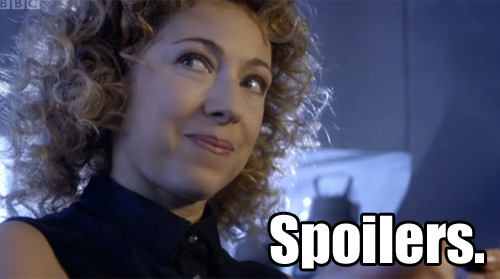
How about River Song? Will she do?
89AnnaClaire
Let's see if it catches on! :)
91SimonW11
Ok I admit it I try and control my day. Today for instance I choose what I had for breakfast instead of letting the girl behind the counter do it. I dont think it makes me a bad person. and I don't think being able to make an informed choice about which reviews to read will make me a bad person either.
92aulsmith
Based on this discussion, I spent about 20 minutes trying to label all my reviews that might "spoil" a book book for someone else. I found it incredibly difficult.
SqueakyChu said: I get my maximum enjoyment from reading by having a story reveal itself to me through the writing
So does that mean that if I say the story is too dark for me or too post-modern that it will be spoiled because you now know it ends badly or confusingly?
What if, in a non-fiction book I mention that the guru was caught having inappropriate relations? It's common knowledge if you know anything about the religious group the book is about, but if this is the first time you've encountered it, this would be new information.
After 20 minutes I found that I was pretty much labeling every review except for my craft books. Is the same thing going to happen with flags/messages/alerts? Will every book, except the most dry and factual non-fiction, end up with a spoiler alert?
I urge everyone who wants a flag to go back through their own reviews, read them critically, and see how many might reveal too much to get in the way of SqueakyChu's maximum enjoyment. If your results vary from mine, then maybe we need an alert and all my reviews need them. But otherwise, I think those of us who are sensitive to certain kinds of spoilers need to not read reviews for that type of book. All a spoiler alert is going to tell us is that all reviews might have spoilers.
SqueakyChu said: I get my maximum enjoyment from reading by having a story reveal itself to me through the writing
So does that mean that if I say the story is too dark for me or too post-modern that it will be spoiled because you now know it ends badly or confusingly?
What if, in a non-fiction book I mention that the guru was caught having inappropriate relations? It's common knowledge if you know anything about the religious group the book is about, but if this is the first time you've encountered it, this would be new information.
After 20 minutes I found that I was pretty much labeling every review except for my craft books. Is the same thing going to happen with flags/messages/alerts? Will every book, except the most dry and factual non-fiction, end up with a spoiler alert?
I urge everyone who wants a flag to go back through their own reviews, read them critically, and see how many might reveal too much to get in the way of SqueakyChu's maximum enjoyment. If your results vary from mine, then maybe we need an alert and all my reviews need them. But otherwise, I think those of us who are sensitive to certain kinds of spoilers need to not read reviews for that type of book. All a spoiler alert is going to tell us is that all reviews might have spoilers.
93royalhistorian
Can't it be more simply solved by providing a h2-heading or something above the reviews that says: possible plot details discussed? No need to alter individual reviews, no flagging, just a text warning above the listing of all the reviews.
94JerryMmm
I just don't read reviews. I hate spoilers, I do my best to avoid them, that just means not reading reviews. The chances are just too high for me.
95SqueakyChu
> 93
just a text warning above the listing of all the reviews.
If you put a header above all the reviews, there is no purpose to it.
just a text warning above the listing of all the reviews.
If you put a header above all the reviews, there is no purpose to it.
96AnnaClaire
>95 SqueakyChu:
What, you want to be warned for the spoiler bits, but leave the rest of the review unmarked? I don't think there would ever be enough consensus on what makes a spoiler for that to happen. At least having a warning about the possibility means that, well, we've been warned.
What, you want to be warned for the spoiler bits, but leave the rest of the review unmarked? I don't think there would ever be enough consensus on what makes a spoiler for that to happen. At least having a warning about the possibility means that, well, we've been warned.
97bestem
>96 AnnaClaire:
No, Squeaky wants just the reviews that have spoilers marked, so they can be ignored until after the book is read. The person who wrote message 93 is suggesting that there be a warning over all the reviews, not just the ones that have spoilers.
We already know that reviews may potentially contain spoilers, and doesn't help someone avoid just the reviews that have spoilers. Or help someone who's looking for a review that discusses plot points to focus on the reviews that have spoilers.
No, Squeaky wants just the reviews that have spoilers marked, so they can be ignored until after the book is read. The person who wrote message 93 is suggesting that there be a warning over all the reviews, not just the ones that have spoilers.
We already know that reviews may potentially contain spoilers, and doesn't help someone avoid just the reviews that have spoilers. Or help someone who's looking for a review that discusses plot points to focus on the reviews that have spoilers.
98AnnaClaire
>97 bestem:
But until there's a consensus on what a spoiler even is, spoiler marking is. Simply. Not. Feasible.
There will always be some dolt complaining that the spoiler marking is way too underused, even well past what most people think is common knowledge*. Likewise, there will always be some know-it-all who insists that it's being used far too much.
This isn't like punctuation and word choice, where everyone tends to do things a little bit differently but there are definitely rules that most people agree on, even if they many people couldn't list the rules but know "wrong" when they read it. Everyone has their own notion of what a spoiler is but the definition is as wide open as, say, dress sense: what you think is an appropriate outfit may well strike someone else as hopelessly stuffy and a third person as incredibly wild. However many people agree with you, there will always be enough outliers to make it not really worth the bother.
-----------
* It would not surprise me in the least if someone going to see Titanic were to think "you know the ship sinks at the end, right?" is the biggest spoiler ever. To each their own stupidity.
But until there's a consensus on what a spoiler even is, spoiler marking is. Simply. Not. Feasible.
There will always be some dolt complaining that the spoiler marking is way too underused, even well past what most people think is common knowledge*. Likewise, there will always be some know-it-all who insists that it's being used far too much.
This isn't like punctuation and word choice, where everyone tends to do things a little bit differently but there are definitely rules that most people agree on, even if they many people couldn't list the rules but know "wrong" when they read it. Everyone has their own notion of what a spoiler is but the definition is as wide open as, say, dress sense: what you think is an appropriate outfit may well strike someone else as hopelessly stuffy and a third person as incredibly wild. However many people agree with you, there will always be enough outliers to make it not really worth the bother.
-----------
* It would not surprise me in the least if someone going to see Titanic were to think "you know the ship sinks at the end, right?" is the biggest spoiler ever. To each their own stupidity.
99bestem
>98 AnnaClaire:
I'm not going to argue about if a consensus can be reached, or if it's needed.
I was just saying how the idea that Squeaky proposed and is arguing for was different than what was said in messages 93 and 96.
I'm not going to argue about if a consensus can be reached, or if it's needed.
I was just saying how the idea that Squeaky proposed and is arguing for was different than what was said in messages 93 and 96.
100Vvolodymyr
There are flags for "not a review" and other stuff - a flag for spoiler is perfectly feasible.
Exactly same as others with same functionality and counterflag options etc. etc.
those that don't understand why do people read reviews before buying a book ... (R U Sirius?) or those that have philosophical issues about the nature of spoilers and whether they truly exist can just ignore all that.
The people who do need such feature will appreciate it greatly.
Exactly same as others with same functionality and counterflag options etc. etc.
those that don't understand why do people read reviews before buying a book ... (R U Sirius?) or those that have philosophical issues about the nature of spoilers and whether they truly exist can just ignore all that.
The people who do need such feature will appreciate it greatly.
101aulsmith
100: The people who do need such feature will appreciate it greatly
What some of us are saying is the virtually every review for every fiction book and many non-fiction books with surprising historical facts are going to have spoiler flags because some people are so sensitive to spoilers that any mention of plot points will cause them to flag a review. Is that really going to help you?
What some of us are saying is the virtually every review for every fiction book and many non-fiction books with surprising historical facts are going to have spoiler flags because some people are so sensitive to spoilers that any mention of plot points will cause them to flag a review. Is that really going to help you?
102SqueakyChu
> 98
Everyone has their own notion of what a spoiler is
...which was why I suggested a flag (which could be unflagged) in the first place.
*sigh*
I have more faith in people. I think LT-ers would use a spoiler flag judiciously. I see how the red and blue flags are used now and find them pretty much used appropriately.
I wish we could run a beta with a yellow flag opt-in.
Everyone has their own notion of what a spoiler is
...which was why I suggested a flag (which could be unflagged) in the first place.
*sigh*
I have more faith in people. I think LT-ers would use a spoiler flag judiciously. I see how the red and blue flags are used now and find them pretty much used appropriately.
I wish we could run a beta with a yellow flag opt-in.
103aulsmith
102: We can run a beta. A bunch of us could volunteer to put alerts on our own reviews based on your notion that the story should reveal itself. Others could give feedback on whether they thought the review was a spoiler or not -- they'd have volunteer to potentially have a bunch of stuff spoiled, but they'd have to do that to use the flags too.
I've already started. As I said, I ended up flagging nearly all the fiction reviews, which seems like a waste of time to me.
I've already started. As I said, I ended up flagging nearly all the fiction reviews, which seems like a waste of time to me.
104lilithcat
> 103
I just looked at the first few pages of your reviews, sorted by date. In my view, none of those to which you added an alert contained spoilers.
I just looked at the first few pages of your reviews, sorted by date. In my view, none of those to which you added an alert contained spoilers.
105lilithcat
> 102
I see how the red and blue flags are used now and find them pretty much used appropriately.
Then why am I so often having to counter-flag? Particularly the blue flags. I find that these are frequently used on reviews that are simply short ("I loved this book!" is a review), or that are reviews but are also TOS violations and should therefore have only red flags.
And some blue flags just boggle the mind. How is this, for example, not a review under any definition? Or this?
I just sorted "In lilithcat's library and reviewed by others" by votes and had to unflag about a dozen just in the first couple of pages.
So I'm afraid I can't agree with "pretty much used appropriately".
I see how the red and blue flags are used now and find them pretty much used appropriately.
Then why am I so often having to counter-flag? Particularly the blue flags. I find that these are frequently used on reviews that are simply short ("I loved this book!" is a review), or that are reviews but are also TOS violations and should therefore have only red flags.
And some blue flags just boggle the mind. How is this, for example, not a review under any definition? Or this?
I just sorted "In lilithcat's library and reviewed by others" by votes and had to unflag about a dozen just in the first couple of pages.
So I'm afraid I can't agree with "pretty much used appropriately".
106aulsmith
104: Thanks.
I stopped at about page 4 sorted by date, if anyone else wants to see them. A lot of them are reviews of poems, a rather quixotic hobby of mine.
I stopped at about page 4 sorted by date, if anyone else wants to see them. A lot of them are reviews of poems, a rather quixotic hobby of mine.
108lorax
SqueakyChu, have you considered the issue of uptake? That is, most reviews especially at first aren't going to have been looked at by someone with "spoiler flagging" in mind; there will be a very good chance that you'll still be spoiled by an unflagged review. And there will always be the issue of newly-added reviews; I wonder whether that wouldn't almost be worse, since people might have a false sense of security that an unflagged review was "safe", rather than just "indeterminate".
109SqueakyChu
> 105
So I'm afraid I can't agree with "pretty much used appropriately".
...the point being that the counter-flags are doing their job to make the results more accuate!
So I'm afraid I can't agree with "pretty much used appropriately".
...the point being that the counter-flags are doing their job to make the results more accuate!
110SqueakyChu
> 108
there will be a very good chance that you'll still be spoiled by an unflagged review.
That's true, but I could always add a flag to help someone else.
I guess the truth is that I mostly read newly added reviews (i.e. those that are posted on my reviews page), so I'm probably still only going to skim those.
STILL...I've always appreciated spoiler alerts by authors of reviews. In addition, a spoiler alert does not hinder anyone from reading a review.
In fact, I know of at least one person who prefers to know in detail what a book is about (including spoilers) before reading it.
I just saw on Goodreads (and, no, I don't want us to become another GR...) that book reviews can be hidden entirely by their author if they think that spoilers will affect other readers adversely. I guess we can do that as well. Sometimes I put reviews I don't want seen in my "private notes" column here on LT.
It always surprises me (not negatively, though, so don't take this in the wrong way) how contentious people are here on LibraryThing. I guess that can be attributed to how deeply we think about issues from all points of view in order to keep LT the best book site on the web.
Thanks, all, for your thoughts.
there will be a very good chance that you'll still be spoiled by an unflagged review.
That's true, but I could always add a flag to help someone else.
I guess the truth is that I mostly read newly added reviews (i.e. those that are posted on my reviews page), so I'm probably still only going to skim those.
STILL...I've always appreciated spoiler alerts by authors of reviews. In addition, a spoiler alert does not hinder anyone from reading a review.
In fact, I know of at least one person who prefers to know in detail what a book is about (including spoilers) before reading it.
I just saw on Goodreads (and, no, I don't want us to become another GR...) that book reviews can be hidden entirely by their author if they think that spoilers will affect other readers adversely. I guess we can do that as well. Sometimes I put reviews I don't want seen in my "private notes" column here on LT.
It always surprises me (not negatively, though, so don't take this in the wrong way) how contentious people are here on LibraryThing. I guess that can be attributed to how deeply we think about issues from all points of view in order to keep LT the best book site on the web.
Thanks, all, for your thoughts.
111norabelle414
>110 SqueakyChu: In my experience LT is way less contentious than GR. I've seen huge arguments on GR over what constitutes a spoiler and what does not. I think it's fine to let reviewers mark their own reviews as spoilers, but when you allow people to mark others' reviews as spoilers, things can get messy. And if reviewers are going to mark their own reviews as spoilers, they can do that just as easily within the text of the review.
112brightcopy
#108 by @lorax> I think this is mitigated by me being much more likely to want to avoid spoilers on newer books. As has been said before, everyone already knows the Titanic sank.
(Though yes, I do read plenty of older stuff. But the thing is that I'm not expecting perfection. So arguments about how a proposed solution isn't perfect don't really bother me.)
(Though yes, I do read plenty of older stuff. But the thing is that I'm not expecting perfection. So arguments about how a proposed solution isn't perfect don't really bother me.)
113lorax
112>
Thanks for the input; not really caring about the issue much one way or the other I wasn't sure how spoiler-averse people were and whether they'd have their day ruined by seeing one on a review they thought was "safe" because it was unflagged.
Thanks for the input; not really caring about the issue much one way or the other I wasn't sure how spoiler-averse people were and whether they'd have their day ruined by seeing one on a review they thought was "safe" because it was unflagged.
114brightcopy
#113 by @lorax> a review they thought was "safe" because it was unflagged
The thing is, I'd just never made that assumption. Even with newer books. Someone has to be the first person to see the "gives away plot details" and to tag it as such (I'm trying to use the "positive" language as much as possible.)
The marker would just help me, not make all the decisions for me. It would help to increase the percentage of non-plot-details-giving-away reviews in the pool, making it less likely I'll run into a plot-details-given-away.
The thing is, I'd just never made that assumption. Even with newer books. Someone has to be the first person to see the "gives away plot details" and to tag it as such (I'm trying to use the "positive" language as much as possible.)
The marker would just help me, not make all the decisions for me. It would help to increase the percentage of non-plot-details-giving-away reviews in the pool, making it less likely I'll run into a plot-details-given-away.
115aulsmith
Does Goodreads have spoiler alerts that can be set by review readers? Have any of the people who want an alert here used them on Goodreads and found them helpful? Are there actually reviews left to read after the alerts have been added. If so, I would consider that a sufficient beta test.
My only objection has been that it seems like alerts would be counter-productive -- so many reviews with alerts there are none left to read and the ones without alerts might be new ones that do have spoilers. But if alerts have been successfully used elsewhere, I'm fine with them. They won't affect me in any way.
My only objection has been that it seems like alerts would be counter-productive -- so many reviews with alerts there are none left to read and the ones without alerts might be new ones that do have spoilers. But if alerts have been successfully used elsewhere, I'm fine with them. They won't affect me in any way.
116brightcopy
#115 by @aulsmith> From my googling, it appears GR has <spoiler><spoiler> tags you can put in reviews and in their Talk equivalent that are "click-to-show".
And from that same google search, what I found was threads saying lots of people don't use them and people reading reviews wind up tripping onto plot-details-given-away.
And from that same google search, what I found was threads saying lots of people don't use them and people reading reviews wind up tripping onto plot-details-given-away.
117reading_fox
#100 "those that don't understand why do people read reviews before buying a book ... (R U Sirius?) or those that have philosophical issues about the nature of spoilers and whether they truly exist can just ignore all that.
"
Not really. Innapropriate flags (in their view) have been placed on their review. They will take umbridge at that. People write reviews for their own reasons, that they may help some unknown other person is a fringe benefit. - if that person then goes aorund complaining about their review, then they will be unhappy. To what degree (and how large a proportion of LT users that is) remains to be seen.
"
Not really. Innapropriate flags (in their view) have been placed on their review. They will take umbridge at that. People write reviews for their own reasons, that they may help some unknown other person is a fringe benefit. - if that person then goes aorund complaining about their review, then they will be unhappy. To what degree (and how large a proportion of LT users that is) remains to be seen.
118Vvolodymyr
It seriously pisses me off how some ppl who don't want a yellow flaggie, think that LT is swarming with a bunch of morons and panicky half-wits.
As if the moment the thing is implemented, suddenly the whole thing will be shining with yellow flags.
Relax - The yellow flaggie can be ignored - easily - and only serve as a warning to normal people who don't want to be told the solution to mystery BEFORE reading the book which is designed to revel the mystery ...
I looked up a bunch of books where a revelation of a major mystery would have seriously pissed me off - and for the most part - people who really had to discuss stuff relating to mystery did put a warning themselves, but not all - solution flag it.
For the most part the system of flags is working, people are mostly reasonable. Whatever someone here pointed out with blue flags - is BS - 99.99% of the time I see the blue flag exactly where it should be.
The same will be with spoilers.
Geez
P.S. >117 reading_fox: - counterflag - try it - it works :)
As if the moment the thing is implemented, suddenly the whole thing will be shining with yellow flags.
Relax - The yellow flaggie can be ignored - easily - and only serve as a warning to normal people who don't want to be told the solution to mystery BEFORE reading the book which is designed to revel the mystery ...
I looked up a bunch of books where a revelation of a major mystery would have seriously pissed me off - and for the most part - people who really had to discuss stuff relating to mystery did put a warning themselves, but not all - solution flag it.
For the most part the system of flags is working, people are mostly reasonable. Whatever someone here pointed out with blue flags - is BS - 99.99% of the time I see the blue flag exactly where it should be.
The same will be with spoilers.
Geez
P.S. >117 reading_fox: - counterflag - try it - it works :)
119geitebukkeskjegg
#116 From my googling, it appears GR has tags you can put in reviews and in their Talk equivalent that are "click-to-show"
Well, that's a more elegant version of what I suggested back in #5. Provide a means for the reviewer to flag/hide spoliers, and most will understand why and use it where appropriate. Like #118 I don't believe other users are either morons or evil. Some reviewers sometimes think spoilers need to be included in their reviews. That does not bother me. But it does when they fail to include a warning.
#117 People write reviews for their own reasons, that they may help some unknown other person is a fringe benefit
Now THAT is really hard to understand. Why publish a review (world wide, in LT's case) if it's not meant for "some unknown other persons"?
Well, that's a more elegant version of what I suggested back in #5. Provide a means for the reviewer to flag/hide spoliers, and most will understand why and use it where appropriate. Like #118 I don't believe other users are either morons or evil. Some reviewers sometimes think spoilers need to be included in their reviews. That does not bother me. But it does when they fail to include a warning.
#117 People write reviews for their own reasons, that they may help some unknown other person is a fringe benefit
Now THAT is really hard to understand. Why publish a review (world wide, in LT's case) if it's not meant for "some unknown other persons"?
120Vvolodymyr
>119 geitebukkeskjegg: - agree completely, Thank You.
ex:
Hey Bob - is the book good?
Nah Joe - the characters are flat, the writing is difficult, and then the plot doesn't jell.
That right there is the most basic review. Stemming from a purpose - an answer to a question.
It grows into something bigger - many reviews for one book - better picture, better idea, help in decision to read or not to read (to buy or not to buy).
Also grew into a literary thing, where ppl try to writer better reviews - look at each-other's reviews - rate their quality. Totally cool - but still with same purpose at the core of it.
If anyone had question about why people read reviews before reading/buying a book (I am shocked!) - that this thread could serve as a source of enlightenment.
Here's an example of ... :
Anyone read "Angels and Demons" by Dan Brown (or watched a movie yet) ? - No? - Oh ok - let me tell you what happens then :) - The chamberlain (Pope's helper) - poisoned the pope, stole antimatter from CERN, made it look like science terrorists are out to get the church (all in secret and without suspicion on him), kidnapped a few cardinals (most likely to be elected the next pope), and ... anyways in the end took the canister with antimatter which was about to blow onto helicopter then jumped out with parachute - saving the day - all the cardinals were watching this and called out his name as he did his act - which is some obscure way of electing a pope - which was his agenda all along.
Tadaa! - Except he was found out and all was well.
Oh - that was a example of spoiler.
:D
ex:
Hey Bob - is the book good?
Nah Joe - the characters are flat, the writing is difficult, and then the plot doesn't jell.
That right there is the most basic review. Stemming from a purpose - an answer to a question.
It grows into something bigger - many reviews for one book - better picture, better idea, help in decision to read or not to read (to buy or not to buy).
Also grew into a literary thing, where ppl try to writer better reviews - look at each-other's reviews - rate their quality. Totally cool - but still with same purpose at the core of it.
If anyone had question about why people read reviews before reading/buying a book (I am shocked!) - that this thread could serve as a source of enlightenment.
Here's an example of ... :
Anyone read "Angels and Demons" by Dan Brown (or watched a movie yet) ? - No? - Oh ok - let me tell you what happens then :) - The chamberlain (Pope's helper) - poisoned the pope, stole antimatter from CERN, made it look like science terrorists are out to get the church (all in secret and without suspicion on him), kidnapped a few cardinals (most likely to be elected the next pope), and ... anyways in the end took the canister with antimatter which was about to blow onto helicopter then jumped out with parachute - saving the day - all the cardinals were watching this and called out his name as he did his act - which is some obscure way of electing a pope - which was his agenda all along.
Tadaa! - Except he was found out and all was well.
Oh - that was a example of spoiler.
:D
121reading_fox
#119 "Why publish a review (world wide, in LT's case) if it's not meant for "some unknown other persons"?"
I write my reviews to remind myself what I thought of a book, and partly maybe to let specific friends (who generally have already read them) know what I've thought of a book. They are worldwide available only because LT happens to include a social aspect in its otherwise personal cataloguing system.
#118 - generally you can't counterflag your own works - it would need a code re-write to allow it I think. ALos they are normally weighted against you, so you need more counterflags than original flags to 'clear' your review.
Besides why should anyone have to keep checking and fiddling with their review because other people don't like what's been written?
I do basically support the idea if there is a need for it, (and don't really care whether strangers like my review or not) but I fully understand many reasons for many people not supporting it.
I write my reviews to remind myself what I thought of a book, and partly maybe to let specific friends (who generally have already read them) know what I've thought of a book. They are worldwide available only because LT happens to include a social aspect in its otherwise personal cataloguing system.
#118 - generally you can't counterflag your own works - it would need a code re-write to allow it I think. ALos they are normally weighted against you, so you need more counterflags than original flags to 'clear' your review.
Besides why should anyone have to keep checking and fiddling with their review because other people don't like what's been written?
I do basically support the idea if there is a need for it, (and don't really care whether strangers like my review or not) but I fully understand many reasons for many people not supporting it.
122Vvolodymyr
so ok - it's some people with hurt feelings (i.e. What the? they marked my review as containing spam? but.. but.. I was just writing it for myself, why would anyone read it ) vs. some sort of warning of spoilers.
overall LT members can be trusted with flagging system as it is. That's an answer to anyone saying that you can't counterflag you own reviews, you need more counter flags etc. etc. and other excuses - as is - it's functioning is reasonable.
No reason not implement it for spoilers. And that's that.
Let's have them :)
overall LT members can be trusted with flagging system as it is. That's an answer to anyone saying that you can't counterflag you own reviews, you need more counter flags etc. etc. and other excuses - as is - it's functioning is reasonable.
No reason not implement it for spoilers. And that's that.
Let's have them :)
123Bookmarque
oh and this will certainly help Vv "It seriously pisses me off how some ppl who don't want a yellow flaggie, think that LT is swarming with a bunch of morons and panicky half-wits.
As if the moment the thing is implemented, suddenly the whole thing will be shining with yellow flags."
maybe keep your judgmental attitude to yourself and learn to manage your emotions better. As you say, it's not a big thing and other people should get over it. Take some of your own medicine why don't you?
As if the moment the thing is implemented, suddenly the whole thing will be shining with yellow flags."
maybe keep your judgmental attitude to yourself and learn to manage your emotions better. As you say, it's not a big thing and other people should get over it. Take some of your own medicine why don't you?
124Vvolodymyr
>123 Bookmarque: - Actually that's the attitude here - I just call it what it is :)
Read the posts about how this will cause every review to be flagged - hence "think that LT is swarming with a bunch of morons and panicky half-wits". I don't think that - but others evidently do.
and all because of a yellow flaggie :)
Read the posts about how this will cause every review to be flagged - hence "think that LT is swarming with a bunch of morons and panicky half-wits". I don't think that - but others evidently do.
and all because of a yellow flaggie :)
125lilithcat
> 119
Why publish a review (world wide, in LT's case) if it's not meant for "some unknown other persons"?
Because there is no option on LT to keep a review private.
Why publish a review (world wide, in LT's case) if it's not meant for "some unknown other persons"?
Because there is no option on LT to keep a review private.
126lilithcat
> 120
ex:
Hey Bob - is the book good?
Nah Joe - the characters are flat, the writing is difficult, and then the plot doesn't jell.
Lousy review. What's the book about?
ex:
Hey Bob - is the book good?
Nah Joe - the characters are flat, the writing is difficult, and then the plot doesn't jell.
Lousy review. What's the book about?
127Vvolodymyr
>125 lilithcat: - that would be a different feature request then, lol
>126 lilithcat: - read what I wrote after that. Oh - a description or plot retelling is not a review - but any of this is immaterial to the original request by SqueakyChu for a very useful feature.
>126 lilithcat: - read what I wrote after that. Oh - a description or plot retelling is not a review - but any of this is immaterial to the original request by SqueakyChu for a very useful feature.
128lilithcat
> 127
Oh - a description or plot retelling is not a review
For LT's purposes, yes, it is.
Oh - a description or plot retelling is not a review
For LT's purposes, yes, it is.
129Bookmarque
well it's a ridiculous position to take Vv no matter which "side" you're on. It did not add anything positive or constructive. Way to go.
130SqueakyChu
> 122
Let's have them
I'm ready. All we have to do is convince Tim! ;)
Let's have them
I'm ready. All we have to do is convince Tim! ;)
131SqueakyChu
> 125
Because there is no option on LT to keep a review private.
Not really true. I post reviews I don't want read by others on my private comments section.
Because there is no option on LT to keep a review private.
Not really true. I post reviews I don't want read by others on my private comments section.
132lilithcat
> 131
That's fine if you don't use the private comments field for actual private comments, don't mind using the same field for different purposes, or don't care if your reviews are mislabeled as something they are not.
That's fine if you don't use the private comments field for actual private comments, don't mind using the same field for different purposes, or don't care if your reviews are mislabeled as something they are not.
133SqueakyChu
> 128
I don't think the plot of a book is a review. I think part of the plot should be revealed (without spoilers, of course), along with your opinions of the book, in order to make a more complete review.
Now this is funny. Way before LT even existed, I used to keep a journal of book reviews on my pc. Each consisted two parts. The first was a bare bones plot summary (so I'd remember what each book was about) and the second part was my critique of the book.
With LT, I was happy to learn that the plot summary had its own spot and, going forward, I could use the "review" section mostly for my own thoughts about the book.
I guess this whole thread discussion points to the many ways in which each of us uses LT differently (and we each like our own way the best!). :)
I don't think the plot of a book is a review. I think part of the plot should be revealed (without spoilers, of course), along with your opinions of the book, in order to make a more complete review.
Now this is funny. Way before LT even existed, I used to keep a journal of book reviews on my pc. Each consisted two parts. The first was a bare bones plot summary (so I'd remember what each book was about) and the second part was my critique of the book.
With LT, I was happy to learn that the plot summary had its own spot and, going forward, I could use the "review" section mostly for my own thoughts about the book.
I guess this whole thread discussion points to the many ways in which each of us uses LT differently (and we each like our own way the best!). :)
134brightcopy
#121 by @reading_fox> it would need a code re-write to allow it I think
I think you overstate a bit. I suspect it'd take about 5 minutes. These kinds of things are just a matter of tweaking a conditional.
#132 by @lilithcat> don't care if your reviews are mislabeled as something they are not
Comments about a book that you want to keep private aren't "private comments"? X)
I think you overstate a bit. I suspect it'd take about 5 minutes. These kinds of things are just a matter of tweaking a conditional.
#132 by @lilithcat> don't care if your reviews are mislabeled as something they are not
Comments about a book that you want to keep private aren't "private comments"? X)
135SqueakyChu
> 132
I do use my private comments for actual comments. I also use it for private reviews. Since I don't have the option of using two spaces, I make spaces with a row of asterisks.
I don't mind using the private comments section for anything at all that I want private, including reviews.
I don't consider the "private comments" section as a "labeled section". I consider it a place where I can post anything at all that will be unread (except for PRISM, of course!). :D
Confession: I usually post reviews that I don't think are good enough for public viewing in my "private comments" section.
I do use my private comments for actual comments. I also use it for private reviews. Since I don't have the option of using two spaces, I make spaces with a row of asterisks.
I don't mind using the private comments section for anything at all that I want private, including reviews.
I don't consider the "private comments" section as a "labeled section". I consider it a place where I can post anything at all that will be unread (except for PRISM, of course!). :D
Confession: I usually post reviews that I don't think are good enough for public viewing in my "private comments" section.
136lilithcat
> 134
You can't keep a book private. (Yes, I know there's a beta thing, but I don't think it's working.)
And a review isn't a "comment".
You can't keep a book private. (Yes, I know there's a beta thing, but I don't think it's working.)
And a review isn't a "comment".
137brightcopy
#136 by @lilithcat> And a review isn't a "comment".
That's where we'll have to differ, I suppose. (Though I would phrase it as "comments".)
That's where we'll have to differ, I suppose. (Though I would phrase it as "comments".)
138Bookmarque
so if it was labeled 'private field' it would be ok?
139jjwilson61
If I wanted to share my opinion of a book for those who have already read the book, why isn't that a review? And why would I want to make it private?
140aulsmith
133: I think part of the plot should be revealed (without spoilers, of course), along with your opinions of the book, in order to make a more complete review.
Okay, now I'm confused. Earlier you said you wanted a book to reveal itself and for the review not to get in the way of that. Now you want part of the plot but not "spoilers". So how much of the plot can be revealed without it getting in the way of the book revealing itself to you? Because when I did my test, I assumed it would be almost anything -- which it pretty much is for me (therefore I don't read fiction reviews).
I'm certainly willing to see if there is some kind of happy medium where most people agree how much plot can be revealed without spoiling the read, but I think the feature is going to be a hard sell to Tim because of the potential for flag wars and a lot of whining (either from people who trusted that no flag meant the review was okay and had their read spoiled or from people who thought they did a good job of stopping their plot description short of an actual spoiler, only to have their review flagged.)
If we could demonstrate that there was a consensus of where plot points end and spoilers begin, we'd have a better chance.
What about taking some reviews from a book, some of which you think are fine and some you think go too far and letting people vote on whether they think each review contains a spoiler or not?
Okay, now I'm confused. Earlier you said you wanted a book to reveal itself and for the review not to get in the way of that. Now you want part of the plot but not "spoilers". So how much of the plot can be revealed without it getting in the way of the book revealing itself to you? Because when I did my test, I assumed it would be almost anything -- which it pretty much is for me (therefore I don't read fiction reviews).
I'm certainly willing to see if there is some kind of happy medium where most people agree how much plot can be revealed without spoiling the read, but I think the feature is going to be a hard sell to Tim because of the potential for flag wars and a lot of whining (either from people who trusted that no flag meant the review was okay and had their read spoiled or from people who thought they did a good job of stopping their plot description short of an actual spoiler, only to have their review flagged.)
If we could demonstrate that there was a consensus of where plot points end and spoilers begin, we'd have a better chance.
What about taking some reviews from a book, some of which you think are fine and some you think go too far and letting people vote on whether they think each review contains a spoiler or not?
141brightcopy
To me, the test is simple: Would any of this be out of place on the bookflap/back cover?
(And yes, before someone points this out, people have put some incredibly stupid things in both of those places. But I submit that THEY failed the test, not that the rule is wrong.)
(And yes, before someone points this out, people have put some incredibly stupid things in both of those places. But I submit that THEY failed the test, not that the rule is wrong.)
142SqueakyChu
> 139
If I wanted to share my opinion of a book for those who have already read the book, why isn't that a review? And why would I want to make it private?
I often use the "private field" to compose my review as I read a book. Sometimes, I know how I feel about a book, but can't really put it into good enough words to want to say it in public. I then still have my thoughts about that book recorded, but I have no obligation to make them public. For me, it's still a "review", whether it is public or private.
I don't only use that "private field" for "comments" alone. Anything that I put into that field can be construed as "comments" - even if it is a book review!
If I wanted to share my opinion of a book for those who have already read the book, why isn't that a review? And why would I want to make it private?
I often use the "private field" to compose my review as I read a book. Sometimes, I know how I feel about a book, but can't really put it into good enough words to want to say it in public. I then still have my thoughts about that book recorded, but I have no obligation to make them public. For me, it's still a "review", whether it is public or private.
I don't only use that "private field" for "comments" alone. Anything that I put into that field can be construed as "comments" - even if it is a book review!
143SqueakyChu
> 140
So how much of the plot can be revealed without it getting in the way of the book revealing itself to you?
This will vary with every individual! However, with me, tell me what happens as the book opens. I will have an idea of the plot but not where it's headed. If what you're looking for is a definition, then "what happens in the first chapter" is not a spoiler. It suggests what might happen next.
I know Tim hates whining and features that elicit contentiousness from LT members.
What about taking some reviews from a book, some of which you think are fine and some you think go too far and letting people vote on whether they think each review contains a spoiler or not?
I don't want to do this but invite others to do this if they wish.
So how much of the plot can be revealed without it getting in the way of the book revealing itself to you?
This will vary with every individual! However, with me, tell me what happens as the book opens. I will have an idea of the plot but not where it's headed. If what you're looking for is a definition, then "what happens in the first chapter" is not a spoiler. It suggests what might happen next.
I know Tim hates whining and features that elicit contentiousness from LT members.
What about taking some reviews from a book, some of which you think are fine and some you think go too far and letting people vote on whether they think each review contains a spoiler or not?
I don't want to do this but invite others to do this if they wish.
144brightcopy
I know Tim hates whining and features that elicit contentiousness from LT members.
Well, there goes the "Talk" feature. :D
Well, there goes the "Talk" feature. :D
145SqueakyChu
LOL!
146SqueakyChu
> 143
I don't want to do this
I take what I said back. Here's a review that upset me greatly this past week...
This is the entire review:
"Would have been four stars. Great light read, but she KILLED (XXXXX)."
The character that was killed was right at the end of the book. The XXXXX I placed in lieu of the name of the character above. It was a character I loved all along.ETA: If I could have deleted that entire review, I would have. That made me so angry!!! Fortunately, I'd already read the book and was just looking to see what others thought of it.
When looking through reviews, it's kind of hard not to see spoilers that are in one or two sentences that comprise the entire review.
ETA2: In fact, it was this "review" which led me to open this discussion in RSI.
I don't want to do this
I take what I said back. Here's a review that upset me greatly this past week...
This is the entire review:
"Would have been four stars. Great light read, but she KILLED (XXXXX)."
The character that was killed was right at the end of the book. The XXXXX I placed in lieu of the name of the character above. It was a character I loved all along.
Vote: Is this a spoiler?
Current tally: Yes 33, No 0, Undecided 1
When looking through reviews, it's kind of hard not to see spoilers that are in one or two sentences that comprise the entire review.
ETA2: In fact, it was this "review" which led me to open this discussion in RSI.
147jjwilson61
147> That's an obvious spoiler, like revealing the whodoneit in a whodoneit. I think aulsmith wished to explore the edge cases.
148SqueakyChu
> 147
Seriously, I don't care about the "edge cases". It's the blatant spoilers such as the one I described above that take away any joy I might find in reading reviews before I read a book.
The "edge cases" are really one person's opinion against another. Those are the ones that will be flagged and unflagged over and over again. The majority will eventually rule, depending how the flagging is set up.
Anyway, a yellow flag simply means caution. That should not scare anyone.
Seriously, I don't care about the "edge cases". It's the blatant spoilers such as the one I described above that take away any joy I might find in reading reviews before I read a book.
The "edge cases" are really one person's opinion against another. Those are the ones that will be flagged and unflagged over and over again. The majority will eventually rule, depending how the flagging is set up.
Anyway, a yellow flag simply means caution. That should not scare anyone.
149brightcopy
#147 by @jjwilson61> But while at least talking through them is good, the edge cases are usually dismissed by Tim et al. when trying to formulate the overall intention/usability/design of a feature.
And honestly, I think further discussion of any of the cases is a bit useless at this point. People on both sides have their opinions and they've been aired incredibly thoroughly. And I think once you've dug in enough, your opinion informs your logic rather than the other way around.
As it stands, I think enough people have raised a ruckus that this feature is never going to happen, so it seems pointless to keep going back and forth about it. Of course, that's just, like, my opinion, man.
And honestly, I think further discussion of any of the cases is a bit useless at this point. People on both sides have their opinions and they've been aired incredibly thoroughly. And I think once you've dug in enough, your opinion informs your logic rather than the other way around.
As it stands, I think enough people have raised a ruckus that this feature is never going to happen, so it seems pointless to keep going back and forth about it. Of course, that's just, like, my opinion, man.
150SqueakyChu
> 148
As it stands, I think enough people have raised a ruckus that this feature is never going to happen, so it seems pointless to keep going back and forth about it.
That's not necessarily true. Sometimes such features need to evolve over time or be tweaked in a way that they will be more acceptable to the majority.
I think Tim does need to know what things about LT makes us upset. Especially if our upset continues over a long period of time.
True, I'll be careful in the future. However, I know that another case, such as the one I described above, will rear its ugly head. Then, I'll be even less willing to glance at book reviews prior to reading a book.
It's like monitoring a person's blood pressure. It's good to know the trends.
As it stands, I think enough people have raised a ruckus that this feature is never going to happen, so it seems pointless to keep going back and forth about it.
That's not necessarily true. Sometimes such features need to evolve over time or be tweaked in a way that they will be more acceptable to the majority.
I think Tim does need to know what things about LT makes us upset. Especially if our upset continues over a long period of time.
True, I'll be careful in the future. However, I know that another case, such as the one I described above, will rear its ugly head. Then, I'll be even less willing to glance at book reviews prior to reading a book.
It's like monitoring a person's blood pressure. It's good to know the trends.
151norabelle414
>146 SqueakyChu: I think a spoiler that blatant would catch my eye before I was even able to check the bottom to see if there was a tiny yellow flag.
152SqueakyChu
The flag would have caught my eye first. It was the second review.
153aulsmith
Edge cases:
I was more interested in middle cases. I'm sure the majority of us would agree that a surprise ending shouldn't be revealed to someone who hasn't read the book. And I also suspect the majority are okay with SqueakyChu's first chapter rule (or what I would call the set up). However, jacket copy often goes as far as a third of the way through the book. I'm not sure how far the average LT fiction review goes, since I don't read them, but based on length, I suspect they get fairly deep in. I was interested in whether there was a kind of clear cut off where most people bulked or not. But it was kind of idle speculation. I don't think Tim will do it -- certainly not any time soon.
Just out of curiosity: SqueakyChu: if the reviewer hadn't named the character but had said they didn't like the book because a favorite character died and they don't like books that do that, would that have struck you the same way? I often react badly to depressing endings which is why many of my reviews talk about the stories being dark, but that does tend to signal the end.
I was more interested in middle cases. I'm sure the majority of us would agree that a surprise ending shouldn't be revealed to someone who hasn't read the book. And I also suspect the majority are okay with SqueakyChu's first chapter rule (or what I would call the set up). However, jacket copy often goes as far as a third of the way through the book. I'm not sure how far the average LT fiction review goes, since I don't read them, but based on length, I suspect they get fairly deep in. I was interested in whether there was a kind of clear cut off where most people bulked or not. But it was kind of idle speculation. I don't think Tim will do it -- certainly not any time soon.
Just out of curiosity: SqueakyChu: if the reviewer hadn't named the character but had said they didn't like the book because a favorite character died and they don't like books that do that, would that have struck you the same way? I often react badly to depressing endings which is why many of my reviews talk about the stories being dark, but that does tend to signal the end.
154brightcopy
The reason I say to use the bookflap as a guideline is because - as has already been exhaustively covered - everyone might approach them a bit differently. But in general, all readers are aware of bookflaps and are familiar with the kinds of things that go on them. It's exceptional when a bookflap gives away anything of significance of the plot. And by "significance" to the plot I have to, as always, refer to what a consensus would find significant and not try to pick it apart and find outliers. Does it happen? Sure! But I still stand by it being exceptional and I stand by the reader of said bookflap being likely to say "well that was just too much information!" Likewise, I think one should approach the "plot details revealed" review "tag" on LT the same way.
155lorax
Should these hypothetical flags fade with time? Several people have mentioned, and it makes sense, that they're primarily concerned with spoilers for new books, and I don't think anyone really expects to be protected from spoilers for decades-old works. But there are some reviews, like this one (for Harry Potter and the Half-Blood Prince, so don't click if you want to read it and don't know the plot) that would have been very much spoilers the day after the book was released, but that now aren't really giving anything away that hasn't been given away a thousand times in a thousand places. Or would that naturally be self-policing?
156ABVR
>154 brightcopy: {The book-flap test}
Wow . . . I hereby withdraw my objection, expressed 120-odd posts back, that it'd be impossible to write a clear, usable consensus guideline for use of the "spoiler" flag. "Would it appear on the book flap?" is -- elegantly -- just that.
So -- I withdraw my skepticism about the feature. Bring it on!
Wow . . . I hereby withdraw my objection, expressed 120-odd posts back, that it'd be impossible to write a clear, usable consensus guideline for use of the "spoiler" flag. "Would it appear on the book flap?" is -- elegantly -- just that.
So -- I withdraw my skepticism about the feature. Bring it on!
157bestem
155>
I wouldn't want them to go away over time. There are a wealth of books out there older than I am that I haven't read yet but would be interested in reading. Not everything is as popular as Harry Potter and very few books have plot details that become something akin to common knowledge as time goes on. Some do, but not many compared to the sheer quantity of books that exists.
I wouldn't want them to go away over time. There are a wealth of books out there older than I am that I haven't read yet but would be interested in reading. Not everything is as popular as Harry Potter and very few books have plot details that become something akin to common knowledge as time goes on. Some do, but not many compared to the sheer quantity of books that exists.
158aulsmith
Just for statistical purposes:
Vote: The book flap copy is usually too much for me and I avoid reading them.
Current tally: Yes 3, No 34, Undecided 5
159brightcopy
#155 by @lorax> No. My point (when I mentioned this) was that the inescapable fact that they'd be applied to NEW reviews more than OLD ones was at least somewhat alleviated by being more likely to read new fiction than old ones. Though I still read plenty of old fiction, and the definition of "new" can sometimes be a few years old...
#156 by @ABVR> Wow . . . I hereby withdraw my objection, expressed 120-odd posts back, that it'd be impossible to write a clear, usable consensus guideline for use of the "spoiler" flag. "Would it appear on the book flap?" is -- elegantly -- just that.
So -- I withdraw my skepticism about the feature. Bring it on!
Well, one down. :D In all seriousness, thanks for keeping an open mind.
#156 by @ABVR> Wow . . . I hereby withdraw my objection, expressed 120-odd posts back, that it'd be impossible to write a clear, usable consensus guideline for use of the "spoiler" flag. "Would it appear on the book flap?" is -- elegantly -- just that.
So -- I withdraw my skepticism about the feature. Bring it on!
Well, one down. :D In all seriousness, thanks for keeping an open mind.
160SqueakyChu
> 153
if the reviewer hadn't named the character but had said they didn't like the book because a favorite character died and they don't like books that do that, would that have struck you the same way?
Not at all. Often characters die in books. Often they die unexpectedly. However to know exactly who dies in the end would make me want to avoid reading this particular book in favor of another one.
if the reviewer hadn't named the character but had said they didn't like the book because a favorite character died and they don't like books that do that, would that have struck you the same way?
Not at all. Often characters die in books. Often they die unexpectedly. However to know exactly who dies in the end would make me want to avoid reading this particular book in favor of another one.
161MarthaJeanne
I remember that for one of the Harry Potter books they announced in advance that one of the characters dies in the book (but not which) and it just raised the number of people who wanted to read it.
162lilithcat
> 158
Frankly, my experience is that, with fiction, book flaps don't tell me enough about the book. They're all sort of vague stuff about how "heart-warming" the book is, how it's all about the "resilience of the human spirit", and that sort of crap, and never say anything about the plot.
Frankly, my experience is that, with fiction, book flaps don't tell me enough about the book. They're all sort of vague stuff about how "heart-warming" the book is, how it's all about the "resilience of the human spirit", and that sort of crap, and never say anything about the plot.
163brightcopy
Anyone in the "yes" camp in #158 care to raise their hand?
164SqueakyChu
I don't read the book flaps at all, but simply to avoid spoilers. I usually don't read them after I read a book either.
Book jackets do a lot of that "heart-warming" and oozing praise stuff. That doesn't add anything to my reads. What I do like to read, however, often before I read a book, is its short author biography contained somewhere in the book.
I don't usually read "Introductions" first either unless it is part of the story or preceding a nonfiction book since they neither have plot points (well, some do!) nor spoilers.
Book jackets do a lot of that "heart-warming" and oozing praise stuff. That doesn't add anything to my reads. What I do like to read, however, often before I read a book, is its short author biography contained somewhere in the book.
I don't usually read "Introductions" first either unless it is part of the story or preceding a nonfiction book since they neither have plot points (well, some do!) nor spoilers.
165brightcopy
#164 by @SqueakyChu> You're probably missing a "not" before "simply". :D
I was just curious how many were voting because of feeling the bookflaps were giving things away and how many just found bookflaps useless. I often don't read them, but that's for various non-giveaway reasons. Many times it's because I really love author X and I want to read everything by them. Or I've already read the first book in the series and I'm going to read this one no matter what. Or this book was highly recommended to me already, so no reason to read the bookflap.
I was just curious how many were voting because of feeling the bookflaps were giving things away and how many just found bookflaps useless. I often don't read them, but that's for various non-giveaway reasons. Many times it's because I really love author X and I want to read everything by them. Or I've already read the first book in the series and I'm going to read this one no matter what. Or this book was highly recommended to me already, so no reason to read the bookflap.
166aulsmith
163: Book flaps often give away too much for me, especially sf and mystery ones. I sometimes read the first sentence to see if they explain the set-up, but then I leave them alone. If I'm thinking of bailing because I'm bored (a common occurrence), I'll sometimes read the rest flap to see if it looks like it'll get better (which is why I know they sometimes go as far as 1/3 of the way into the book).
Sorry I worded the question ambiguously. It's really meant to see if a review written with the book flap rule would generally be immune to spoiler alerts. Looks good so far.
Sorry I worded the question ambiguously. It's really meant to see if a review written with the book flap rule would generally be immune to spoiler alerts. Looks good so far.
167brightcopy
Just for the record, I didn't vote "yes". Good to hear from 2 out of the 3.
ETA: And maybe I should rephrase the Book Flap Rule as: "Would you expect to see it on a book flap?" That would cover the "I've seen them stupidly reveal _____" ones! I don't think people generally go in expecting to read revealing stuff on the book flap, even if they're not surprised by the occasional boneheaded one.
ETA: And maybe I should rephrase the Book Flap Rule as: "Would you expect to see it on a book flap?" That would cover the "I've seen them stupidly reveal _____" ones! I don't think people generally go in expecting to read revealing stuff on the book flap, even if they're not surprised by the occasional boneheaded one.
168Bookmarque
OK.
I'm gonna admit it.
Not reading book jacket copy is a mystery to me.
How else do you decide to read the book? Are we back to judging a book by its cover?
{confused}
I'm gonna admit it.
Not reading book jacket copy is a mystery to me.
How else do you decide to read the book? Are we back to judging a book by its cover?
{confused}
169brightcopy
#168 by @Bookmarque> Well, I gave several reasons in #165. I'm sure there's more.
170Bookmarque
But how do you come to a NEW author? A new concept? One sentence made up by some marketing flack is enough? {boggles}
171brightcopy
#170 by @Bookmarque> Recommendations by friends/algortithms?
(Some of my best friends are algorithms.)
(And I come by some of my new music through the excellent music podcast started by the former vice president: Al Gore's Rhythms.)
(Some of my best friends are algorithms.)
(And I come by some of my new music through the excellent music podcast started by the former vice president: Al Gore's Rhythms.)
172Bookmarque
Ok. whatever you say if it works for you. I still don't get it though. I guess I'm not a trusting type to go in blind.
173SqueakyChu
> 170
I have way too many ways to get interested in books. I get recommendations from others, LT recommendations, books from BookCrossing, books from Little Free Library, books from The Book Thing of Baltimore.
Why I get interested...
I might like the book cover.
I might like the topic.
I read one book and was told to read a similar book.
I was told by a friend that I'd love a certain book.
I like an author and want to read more of his books (that happens a lot).
I know nothing about an author and want to be surprised. I can do this by avoiding genres I dislike and following the "Pearl Rule".
I read the first and last sentence of LT book reviews and notice the number of the star ratings. Really! I do this a lot!!
Want to hear even more?
Finding books I want to read is really not a problem. I find too many of those.
Of the ones I'm reading now...
1. One was an LT ER book. I saw its blurb (which had no spoilers).
2. One was a new library CD. I didn't know the book or the author. That was random. So far, I really like listening to that book.
3. One was from a fellow BookCrosser. It had a picture of an owl on its cover, and I knew it was non fiction. I love animals. That was a no-brainer.
4. One is going to be a group read for July. I like the creepy picture on the front of the book and know that it's supposed to be a "weird" book (love those!)
5. One is a book of short stories. I got that book from The Book Thing. It had a strange cover. I liked that.
To see if I'll like a book, I'll read a few paragraphs. A book will will either grab me right away or not. If it doesn't, it's history.
What I don't want...are spoilers. :(
I have way too many ways to get interested in books. I get recommendations from others, LT recommendations, books from BookCrossing, books from Little Free Library, books from The Book Thing of Baltimore.
Why I get interested...
I might like the book cover.
I might like the topic.
I read one book and was told to read a similar book.
I was told by a friend that I'd love a certain book.
I like an author and want to read more of his books (that happens a lot).
I know nothing about an author and want to be surprised. I can do this by avoiding genres I dislike and following the "Pearl Rule".
I read the first and last sentence of LT book reviews and notice the number of the star ratings. Really! I do this a lot!!
Want to hear even more?
Finding books I want to read is really not a problem. I find too many of those.
Of the ones I'm reading now...
1. One was an LT ER book. I saw its blurb (which had no spoilers).
2. One was a new library CD. I didn't know the book or the author. That was random. So far, I really like listening to that book.
3. One was from a fellow BookCrosser. It had a picture of an owl on its cover, and I knew it was non fiction. I love animals. That was a no-brainer.
4. One is going to be a group read for July. I like the creepy picture on the front of the book and know that it's supposed to be a "weird" book (love those!)
5. One is a book of short stories. I got that book from The Book Thing. It had a strange cover. I liked that.
To see if I'll like a book, I'll read a few paragraphs. A book will will either grab me right away or not. If it doesn't, it's history.
What I don't want...are spoilers. :(
174aulsmith
170: For sf I read the short stories in magazines and then read books for the writers I like. For mysteries the set-up is enough. For the rest of my fiction reading (of which there isn't much) I generally go by friend's recommendations.
175JGKC
Count me in the camp that is totally against this idea. Spoilers are not against any rules therefore they should not be flagged. I'm also not comfortable with the idea of allowing others to place any kind of label onto reviews that are not theirs and I'd even go as far as saying that the very idea is highly offensive.
Having said that, I would be fine with the idea of having two separate review types (I think jjwilson suggested this). Keep the regular review field as is and create a second field for spoiler free reviews that would be subject to whatever spoiler flagging system is put into place
Having said that, I would be fine with the idea of having two separate review types (I think jjwilson suggested this). Keep the regular review field as is and create a second field for spoiler free reviews that would be subject to whatever spoiler flagging system is put into place
176Vvolodymyr
>175 JGKC: - you've missed the point entirely. Nobody says spoilers are "against the rules" nor are they ment to be flagged as something bad. They are only proposed to be marked as a warning - the yellow flag was proposed as it looked less "threatening" - any other obvious yet not too obnoxious marker would be fine as well - as long as there's some kind of warning.
177geitebukkeskjegg
What is a spoiler?
Putting myself in a reviewers place, it would be a spoiler if it's -
Yes, I know writing reviews is not easy. Personally I'm not very comfortable with it, so usually I just keep separate notes. (A few exceptions). But that's exactly why a tool that could help the reviewer hide spoilers would be welcome.
Spoilers are not against any rules
Of course not. There are hundreds of good reasons why plot details may have to be revealed in discussion of a book. Spoliers are not evil. Just don't shove them in somebody's face without warning.
(Edit: Added stuff in (()) for #178)
Putting myself in a reviewers place, it would be a spoiler if it's -
- something the author on purpose tried to hide from the reader untill a certain point in the text. (Ie. the solution of a mystery, a surprise ending , plot twist)
- anything that would have detracted from my enjoyment if I knew it beforehand when _I_ ((the reviewer)) read the book.
Yes, I know writing reviews is not easy. Personally I'm not very comfortable with it, so usually I just keep separate notes. (A few exceptions). But that's exactly why a tool that could help the reviewer hide spoilers would be welcome.
Spoilers are not against any rules
Of course not. There are hundreds of good reasons why plot details may have to be revealed in discussion of a book. Spoliers are not evil. Just don't shove them in somebody's face without warning.
(Edit: Added stuff in (()) for #178)
178lilithcat
> 177
anything that would have detracted from my enjoyment if I knew it beforehand when _I_ read the book.
And how is anyone else supposed to know what that is?
anything that would have detracted from my enjoyment if I knew it beforehand when _I_ read the book.
And how is anyone else supposed to know what that is?
179paradoxosalpha
> 62 could add a warning stating "if you plan to reveal details of the plot in your review, please state, in capital letters 'SPOILER ALERT' so that readers will be warned."
I have actually done that in one or two out of 500+ reviews I've posted. I also did it three-quarters of the way into the review so I could segregate the possible spoilers from the remainder of the review. I wouldn't be happy with any "solution" to the spoiler "problem" that uniformly condemned entire reviews as spoilers.
> 116, 119
In another site I frequent, there is a "spoiler-text" script that allows users to post text in a spoiler box that stays invisible until clicked. I think giving reviewers that further ability would be wonderful.
I have actually done that in one or two out of 500+ reviews I've posted. I also did it three-quarters of the way into the review so I could segregate the possible spoilers from the remainder of the review. I wouldn't be happy with any "solution" to the spoiler "problem" that uniformly condemned entire reviews as spoilers.
> 116, 119
In another site I frequent, there is a "spoiler-text" script that allows users to post text in a spoiler box that stays invisible until clicked. I think giving reviewers that further ability would be wonderful.
180aulsmith
So far there is about a 70% approval rating for the "book flap rule of thumb". I'm modifying the alerts on my reviews to conform with that notion of spoiler. I think it's very helpful that we were able to articulate a definition of spoiler that would be helpful to so many of us.
181paradoxosalpha
The "book flap rule of thumb" is preposterous. Practically nothing I write in a review would ever appear on a book flap, not because of plot disclosure, but because book flaps are just advertising, and they include no critical consideration of the work other than occasional laudatory excerpts from actual reviews.
Also, in my experience, book flaps are often inaccurate in the plot and character elements they reveal. So using them as any kind of standard, positive or negative, seems pointless.
ETA: And I voted "no" to #158, simply answering the question asked.
Also, in my experience, book flaps are often inaccurate in the plot and character elements they reveal. So using them as any kind of standard, positive or negative, seems pointless.
ETA: And I voted "no" to #158, simply answering the question asked.
182brightcopy
Well, that's certainly an... opinion.
183aulsmith
181: As I understand the "book flap rule of thumb" it does not mean that the review reads like a book flab blurb. It means that the plot points revealed in the review do not exceed the plot points generally revealed in a book flap.
I know from talking to book flap writers that they are often writing the copy from the book outline, not the actual book, so the plot points sometimes don't match the finished book. In addition they are often told to disguise facts about controversial characters (usually gay) so as not to put off potential readers. I would say that neither of these book flap conventions would be observed in LT review writing.
I know from talking to book flap writers that they are often writing the copy from the book outline, not the actual book, so the plot points sometimes don't match the finished book. In addition they are often told to disguise facts about controversial characters (usually gay) so as not to put off potential readers. I would say that neither of these book flap conventions would be observed in LT review writing.
184paradoxosalpha
Well, I'm much more of a book reader than a book-flap reader. I usually don't get around to reading book flaps until after I've read much if not most of the book--not because of any worries about "spoilers," but because by the time the book is in my hands, I've already decided to read it. Hell, I've read an entire book before reading some of the jacket copy on the outside cover. My discovery process is mostly by means of intertextual reference from other books, published reviews, and friends' recommendations. (I realize that market research makes me an outlier in this regard, and it's probably related to my age and crustiness. When I was younger, I too depended a lot on chancing into books as unanticipated objects on bookstore and library shelves.)
Jacket copy and reviews are very different things, and I still think asking reviewers to make inferential judgments based on the universe of jacket copy is off-base.
Jacket copy and reviews are very different things, and I still think asking reviewers to make inferential judgments based on the universe of jacket copy is off-base.
185aulsmith
184: You can write a review any way you want to.
In terms of the "book flap rule of thumb," we're discussing two points:
a: if LT were to implement a spoiler alert, is there enough consensus as to how to identify a spoiler that the alert would have some meaning and not lead to an endless round of flagging wars
and
b: if an individual reviewer wishes to help people who read reviews before reading the book by warning them about possible spoilers, is the "book flap rule of thumb" a reasonable place for the reviewer to draw the line in terms of defining what a spoiler is?
I seem to be the only person actually testing the various ideas about spoilers discussed in this thread. So far the book flap rule of thumb has been easy to implement and led to much more rational results than my first try of honoring SqueakyChu's "let the book reveal itself".
In terms of the "book flap rule of thumb," we're discussing two points:
a: if LT were to implement a spoiler alert, is there enough consensus as to how to identify a spoiler that the alert would have some meaning and not lead to an endless round of flagging wars
and
b: if an individual reviewer wishes to help people who read reviews before reading the book by warning them about possible spoilers, is the "book flap rule of thumb" a reasonable place for the reviewer to draw the line in terms of defining what a spoiler is?
I seem to be the only person actually testing the various ideas about spoilers discussed in this thread. So far the book flap rule of thumb has been easy to implement and led to much more rational results than my first try of honoring SqueakyChu's "let the book reveal itself".
186aulsmith
New poll:
Imagine yourself in any of the following situations:
1. There is an LT spoiler alert function and you are considering whether a given review should have an alert
2. You are writing a review and wonder if it should have a spoiler alert
3. You are reading reviews and looking at a spoiler alert
Imagine yourself in any of the following situations:
1. There is an LT spoiler alert function and you are considering whether a given review should have an alert
2. You are writing a review and wonder if it should have a spoiler alert
3. You are reading reviews and looking at a spoiler alert
Vote: The "book flap rule of thumb" as articulated in post 183 would provide adequate guidance for me to have a general idea of how to proceed
Current tally: Yes 17, No 14, Undecided 7
187SqueakyChu
I voted no because some book flaps reveal too much. In addition, I don't think that reviewers would really understand the "book flap rule of thumb" because of what I just said.
I have another idea related to msg #179...
In another site I frequent, there is a "spoiler-text" script that allows users to post text in a spoiler box that stays invisible until clicked. I think giving reviewers that further ability would be wonderful.
If we could allow reviewers to make optional "invisible spoilers" as part of their reviews, that would take care of some* spoilers. No one would upset them by "yellow flagging" their review. It's their choice. True, not everyone would use this option, but IMHO at least it would be a step in the right direction.
*There are people who truly like to expose spoilers quite blatantly for whatever reason. :(
I have another idea related to msg #179...
In another site I frequent, there is a "spoiler-text" script that allows users to post text in a spoiler box that stays invisible until clicked. I think giving reviewers that further ability would be wonderful.
If we could allow reviewers to make optional "invisible spoilers" as part of their reviews, that would take care of some* spoilers. No one would upset them by "yellow flagging" their review. It's their choice. True, not everyone would use this option, but IMHO at least it would be a step in the right direction.
*There are people who truly like to expose spoilers quite blatantly for whatever reason. :(
188SqueakyChu
> 186
Do we really need a definition of a spoiler? To different people, it is different things, yet we all have a pretty good concept of what how a "spoiler" affects the readers of our reviews. That's why I prosed a yellow flag/unflag option. It's specifically to deal with a difference of opinion.
Who would follow that definition anyway? People would call a spoiler what they themselves think it is (as seen from what's been written here in this thread).
Perhaps we should start with an "invisible spoiler" as a test. If that goes okay, perhaps later we can try the yellow flag/unflag option.
Do we really need a definition of a spoiler? To different people, it is different things, yet we all have a pretty good concept of what how a "spoiler" affects the readers of our reviews. That's why I prosed a yellow flag/unflag option. It's specifically to deal with a difference of opinion.
Who would follow that definition anyway? People would call a spoiler what they themselves think it is (as seen from what's been written here in this thread).
Perhaps we should start with an "invisible spoiler" as a test. If that goes okay, perhaps later we can try the yellow flag/unflag option.
189krazy4katz
I think this thread solidifies my view that allowing other people to flag/mark one's review as containing spoilers is just too difficult to be effective given the diversity of opinions here. And this thread is only a very small sample of LT users. I still think the best we can do is add a request to the review box to please warn people if your review contains spoilers. The request should contain a very specific definition of a spoiler.
Since I am one of the people who is uncomfortable with others tagging/flagging/marking my reviews, I confess to being biased. I get enough criticism in my real life. I KNOW it is not meant as criticism but it feels like it.
ETA: I do try not to reveal major plot points in my reviews. How well I succeed is up to others to judge, I guess.
Since I am one of the people who is uncomfortable with others tagging/flagging/marking my reviews, I confess to being biased. I get enough criticism in my real life. I KNOW it is not meant as criticism but it feels like it.
ETA: I do try not to reveal major plot points in my reviews. How well I succeed is up to others to judge, I guess.
190SqueakyChu
> 189
I KNOW it is not meant as criticism but it feels like it.
I can understand that.
I KNOW it is not meant as criticism but it feels like it.
I can understand that.
191aulsmith
188: The major objection to your proposal is that there is no consensus on what a spoiler is, so we tried to come up with some consensus that we could mostly agree with. If you want to go back to there is no consensus than those of us who have been convinced that this might work okay will go back to opposing it.
The second major objection is from reviewers who don't want flags/alerts/markers on their reviews. This is probably the item that makes this proposal DOA.
I'm willing to put spoiler alerts on my reviews, regardless of a new feature, IF there is some reasonable consensus view of what a spoiler is. Otherwise, I'm just going back to letting the reader beware at all times without an assist.
The second major objection is from reviewers who don't want flags/alerts/markers on their reviews. This is probably the item that makes this proposal DOA.
I'm willing to put spoiler alerts on my reviews, regardless of a new feature, IF there is some reasonable consensus view of what a spoiler is. Otherwise, I'm just going back to letting the reader beware at all times without an assist.
192SqueakyChu
> 188
The major objection to your proposal is that there is no consensus on what a spoiler is, so we tried to come up with some consensus that we could mostly agree with. If you want to go back to there is no consensus than those of us who have been convinced that this might work okay will go back to opposing it.
*sigh*
I'm willing to put spoiler alerts on my reviews, regardless of a new feature, IF there is some reasonable consensus view of what a spoiler is. Otherwise, I'm just going back to letting the reader beware at all times without an assist.
So we're back to square one. I'll avoid reading reviews thoroughly. I'll avoid putting spoilers in mine. Others will continue to put reviews with spoilers, and so forth.
*defeated*
:(
The major objection to your proposal is that there is no consensus on what a spoiler is, so we tried to come up with some consensus that we could mostly agree with. If you want to go back to there is no consensus than those of us who have been convinced that this might work okay will go back to opposing it.
*sigh*
I'm willing to put spoiler alerts on my reviews, regardless of a new feature, IF there is some reasonable consensus view of what a spoiler is. Otherwise, I'm just going back to letting the reader beware at all times without an assist.
So we're back to square one. I'll avoid reading reviews thoroughly. I'll avoid putting spoilers in mine. Others will continue to put reviews with spoilers, and so forth.
*defeated*
:(
193krazy4katz
Sorry! Please don't be sad. :-(
194AnnaClaire
I think this thread solidifies my view that allowing other people to flag/mark one's review as containing spoilers is just too difficult to be effective given the diversity of opinions here. (#189)
I agree: there just isn't the consensus required to make it work properly. This thread, if nothing else, proves that. I'd rather have the Staff be doing useful stuff than extinguishing flag wars, and flag wars are likely to increase ginormously if a spoiler flag were introduced.
195SqueakyChu
I'm not really sad. I've gotten used to not getting everything I want here. It's Tim's website after all. :)
196Vvolodymyr
Just hold on a minute.
All the people afraid of spoiler alert function keep pointing that some other people will "be confused" or "not know what a spoiler is" - and thus marking too many reviews as a spoiler -
and YET -
all the people who do want the spoiler alert do not express such outrageously ridiculous views.
the whole "bookflap" idead - was just an idea - but ultimately a detraction.
Everyone is able to figure out what a major plot spoiler is.
Not just "containing plot elements" but a major spoiler. For those who like to debate and philosophize it was proven in a few posts (and votes) - where everyone correctly identified a spoiler as a spoiler.
Put that as a rule - "Only mark reviews as containing a spoiler, if and only if it contains Major Spoiler (eg. major plot twist revelation, mystery solution etc.)"
some may argue what it is or whatever - but let's be real - it's pretty damn obvious - gaming walkthrough sites have spoiler alerts, movie sites have them, it's a common universal concept.
So put that as a strong rule - sure there will be cases straying into less major cases - but still grouping around a core of "reasobleness".
The blue and red flags are used very reasonably as of now - and so will the spoiler warning feature.
All the, well frankly, fear-mongering about alleged potential "flag wars" is out of place and somewhat manipulative.
I'm sure many would really appreciate Tim's or other site administrators' view/input on this.
Thank You
All the people afraid of spoiler alert function keep pointing that some other people will "be confused" or "not know what a spoiler is" - and thus marking too many reviews as a spoiler -
and YET -
all the people who do want the spoiler alert do not express such outrageously ridiculous views.
the whole "bookflap" idead - was just an idea - but ultimately a detraction.
Everyone is able to figure out what a major plot spoiler is.
Not just "containing plot elements" but a major spoiler. For those who like to debate and philosophize it was proven in a few posts (and votes) - where everyone correctly identified a spoiler as a spoiler.
Put that as a rule - "Only mark reviews as containing a spoiler, if and only if it contains Major Spoiler (eg. major plot twist revelation, mystery solution etc.)"
some may argue what it is or whatever - but let's be real - it's pretty damn obvious - gaming walkthrough sites have spoiler alerts, movie sites have them, it's a common universal concept.
So put that as a strong rule - sure there will be cases straying into less major cases - but still grouping around a core of "reasobleness".
The blue and red flags are used very reasonably as of now - and so will the spoiler warning feature.
All the, well frankly, fear-mongering about alleged potential "flag wars" is out of place and somewhat manipulative.
I'm sure many would really appreciate Tim's or other site administrators' view/input on this.
Thank You
198andyl
#196
Why are you using such emotive language?
people afraid of spoiler alert function
outrageously ridiculous views
fear-mongering
somewhat manipulative.
Such language IS manipulative IMHO and I don't particularly welcome it.
Just because people do not have the same ideas of what is desirable does not make them afraid of something, or that their views are ridiculous.
Why are you using such emotive language?
people afraid of spoiler alert function
outrageously ridiculous views
fear-mongering
somewhat manipulative.
Such language IS manipulative IMHO and I don't particularly welcome it.
Just because people do not have the same ideas of what is desirable does not make them afraid of something, or that their views are ridiculous.
199lilithcat
The blue and red flags are used very reasonably as of now
In fact, they are too often misused, particularly the blue flags.
In fact, they are too often misused, particularly the blue flags.
200Vvolodymyr
I think the emotion is being attributed to written words here.
it's not about what is viewed to be desirable,
it's the seemingly prevalent view of those afraid of flags/warnings and ability of users to mark other users' material,
that other people on LT would be confused, will panic and overwhelm the system with inappropriate markings.
That is the crux here. Which I don't particularly welcome.
Actually, such attitude - although covered up by civility - could be viewed as insulting, even if not deliberate.
But the experience shows that people will not overwhelm the reviews with inappropriate markings - the blue and red flag/counterflag feature, or cover flag feature.
But - I keep reading throughout this thread where the main argument are these hypothetical examples of others' ignorance (starting with post 8) - with Titanic, Romeo and Juliet and so on.
All these are nothing but a fruit of a heavily negative and, frankly, demeaning view of others.
That's just wrong.
it's not about what is viewed to be desirable,
it's the seemingly prevalent view of those afraid of flags/warnings and ability of users to mark other users' material,
that other people on LT would be confused, will panic and overwhelm the system with inappropriate markings.
That is the crux here. Which I don't particularly welcome.
Actually, such attitude - although covered up by civility - could be viewed as insulting, even if not deliberate.
But the experience shows that people will not overwhelm the reviews with inappropriate markings - the blue and red flag/counterflag feature, or cover flag feature.
But - I keep reading throughout this thread where the main argument are these hypothetical examples of others' ignorance (starting with post 8) - with Titanic, Romeo and Juliet and so on.
All these are nothing but a fruit of a heavily negative and, frankly, demeaning view of others.
That's just wrong.
201paradoxosalpha
Look, here's a perfectly non-hyperbolic and actual scenario. In my most recently written and posted review, somewhere past the middle of it, I wrote:
Much of the novel is told (in the third person) from the perspective of {the titular hero} or his fellow psychics, which creates some rather incoherently impressionistic passages, to the point where I wondered once if there had been editing errors disrupting the continuity. But this technique works pretty well in the book's climax, with a hallucinatory confrontation between {the hero} and {the villain}.I'm actually fairly confident, given the professed spoiler sensitivity of some posters in this very thread, that if there were a tool (and thus an implicit encouragement) to stigmatize some reviews as "spoilers," this one would get the flag for my exposure of the existence of an event in the last 20 pages of a novel. But I didn't give any spoiler warning myself, and I think it would be petty and condescending to do so, since the climactic confrontation is a straightforward plotting outcome that any reasonable reader would be anticipating from early in the story.
202brightcopy
stigmatize some reviews as "spoilers,"
And thus, the chasm between views. I don't view it as a stigma. I'd be fine with my reviews being marked as such. To me, it's simply information about what's in the review. I'm sure it's that way with the people who regularly put spoiler warnings on their own reviews without anyone asking them to. To think they were self-stigmatizing is kind of unbelievable.
But clearly, some people will never see it any other way so it is what it is.
And thus, the chasm between views. I don't view it as a stigma. I'd be fine with my reviews being marked as such. To me, it's simply information about what's in the review. I'm sure it's that way with the people who regularly put spoiler warnings on their own reviews without anyone asking them to. To think they were self-stigmatizing is kind of unbelievable.
But clearly, some people will never see it any other way so it is what it is.
203paradoxosalpha
> 202 the people who regularly put spoiler warnings on their own reviews without anyone asking them to
See, and I am one of those people. Well, maybe not "regularly," because my reviews tend not to be so plot-oriented in the first place, and I think my idea of what warrants a "warning" is rather narrower than many others here.
If you don't think warnings are stigmatizing, you seem to have a narrower idea of "stigma."
Warning: "This is a perfectly fine review that you probably shouldn't read if you care about having major plot tensions or surprises defused in advance."
See, and I am one of those people. Well, maybe not "regularly," because my reviews tend not to be so plot-oriented in the first place, and I think my idea of what warrants a "warning" is rather narrower than many others here.
If you don't think warnings are stigmatizing, you seem to have a narrower idea of "stigma."
Warning: "This is a perfectly fine review that you probably shouldn't read if you care about having major plot tensions or surprises defused in advance."
204Vvolodymyr
> paradoxosalpha - well - you're a cool reviewer then. Yeah I can see how someone would mark it as a spoiler - but someone else (like me - I did counterflag some things here and there out of a feeling of fairness) would counterflag it. If it's a definite spoiler the flaggings would outweigh the counterflaggings, and vice-versa - if it's really something minor/obvious and such the counterflaggings would outweigh the flaggings - or not be flagged at all. The truly edge cases - I guess those would be a bit in a bummer - that's assuming there would be a bunch of ppl going about and zealously flagging stuff left, right and center.
Like When I just got here I started seeing in reviews a lot of links to blogs (those just with a link and nothing else) - and I thought "that ain't right. I'm not going to your blog, just post it here, otherwise it looks like self promotion which kinda seems a no-no here on LT" - so I click on the "flag it" option and there's a message saying that the links are ok - and I though "that's weird but ok" - and that was that.
Let's say I ignored/didn't notice, and I did flag a bunch of those - sure as rain I'd get messages (possibly with emotive language :) ) to back da heck off and to read the rules.
This is internet democracy in action :)
Like When I just got here I started seeing in reviews a lot of links to blogs (those just with a link and nothing else) - and I thought "that ain't right. I'm not going to your blog, just post it here, otherwise it looks like self promotion which kinda seems a no-no here on LT" - so I click on the "flag it" option and there's a message saying that the links are ok - and I though "that's weird but ok" - and that was that.
Let's say I ignored/didn't notice, and I did flag a bunch of those - sure as rain I'd get messages (possibly with emotive language :) ) to back da heck off and to read the rules.
This is internet democracy in action :)
205brightcopy
#203 by @paradoxosalpha> If you don't think warnings are stigmatizing, you seem to have a narrower idea of "stigma."
I find this even more baffling than feeling like spoiler warnings on reviews are stigmatizing.
Don't you ever talk to a person and stop yourself, asking them "Wait, have you read/seen ________ yet?" before launching into the details? A spoiler warning is just that, but modified because you aren't having a face-to-face conversation where you can pause and wait for an answer.
I find this even more baffling than feeling like spoiler warnings on reviews are stigmatizing.
Don't you ever talk to a person and stop yourself, asking them "Wait, have you read/seen ________ yet?" before launching into the details? A spoiler warning is just that, but modified because you aren't having a face-to-face conversation where you can pause and wait for an answer.
206Vvolodymyr
we could use a smiley instead of a yellow flag. both are yellow :)
207mckait
I was once accused of posting a spoiler in my thread because I mentioned the name of a recurring character in a series. This revealed to someone who rarely posted there that he had not been the one murdered in that particular book. There are many recurring characters in this particular series, so I assume that any comment should not mention anyone or anything at all?
I have to assume that for some people almost anything can be a spoiler. I think that if you are so sensitive to spoilers, you should consider not reading the reviews, but only the book descriptions on an online book site, although that might spoil it as well.
I am not super sensitive to spoilers, so perhaps it is easy for me to say? I agree with whoever it was that said that such flags or smilies or what have you might cause some folks to not post reviews. Someone I know here nearly left the site because a review that they posted was flagged not a review. It was such a lovely review, I believe it was just a mistake, and that it was meant to be a thumb, but still.
I have to assume that for some people almost anything can be a spoiler. I think that if you are so sensitive to spoilers, you should consider not reading the reviews, but only the book descriptions on an online book site, although that might spoil it as well.
I am not super sensitive to spoilers, so perhaps it is easy for me to say? I agree with whoever it was that said that such flags or smilies or what have you might cause some folks to not post reviews. Someone I know here nearly left the site because a review that they posted was flagged not a review. It was such a lovely review, I believe it was just a mistake, and that it was meant to be a thumb, but still.
208brightcopy
#207 by @mckait> But don't you think that's an example of "you have to design a feature regardless of the people who will easily storm off in a huff"? Couldn't the same thing be said about spam flags? People have accidentally gotten flagged that way. And often people who do drive-by author spams are flagged that way, even though Tim encourages us to not do it because he wants to keep the authors here. But I think those arguments just don't bear on whether there should be spam flagging.
209mckait
Frankly, I don't care much for flagging. I rarely do it, unless what I find is ( imo) a clear misuse, like copying a description from Amazon etc.
To be honest, I don't care if such a feature is implemented or not. Once I post a review, I rarely go back to look at it. It wouldn't keep me from reading a review or cause me to read one. I agree.. I think that there have been mistakes in flagging, it would be a miracle if that never happened. I just think that I could easily live without any flags. I can also live quite happily were Tim to implement the spoiler alert. Judging the reviews or posts of others isn't something that interests me much.
I like to read reviews. I read them for books, vacuum cleaners, pet food and etc. So it won't affect me either way. I don't understand why some want to go charging around being in charge of reviews, posts, or additions, collections or whatever. I can barely find enough time in my life to take care of my own business, and I don't even want to think about making time to judge the thoughts of others.
Spammers are usually pretty easy to spot, I think. They post in a dozen threads in five minutes and have no books. That annoys me, I admit it. I have flagged them.
To be honest, I don't care if such a feature is implemented or not. Once I post a review, I rarely go back to look at it. It wouldn't keep me from reading a review or cause me to read one. I agree.. I think that there have been mistakes in flagging, it would be a miracle if that never happened. I just think that I could easily live without any flags. I can also live quite happily were Tim to implement the spoiler alert. Judging the reviews or posts of others isn't something that interests me much.
I like to read reviews. I read them for books, vacuum cleaners, pet food and etc. So it won't affect me either way. I don't understand why some want to go charging around being in charge of reviews, posts, or additions, collections or whatever. I can barely find enough time in my life to take care of my own business, and I don't even want to think about making time to judge the thoughts of others.
Spammers are usually pretty easy to spot, I think. They post in a dozen threads in five minutes and have no books. That annoys me, I admit it. I have flagged them.
210overlycriticalme
This message has been deleted by its author.
211brightcopy
#209 by @mckait> I don't understand why some want to go charging around being in charge of reviews, posts, or additions, collections or whatever. I can barely find enough time in my life to take care of my own business, and I don't even want to think about making time to judge the thoughts of others.
Was this really necessary?
Was this really necessary?
212overlycriticalme
i'm sorry, i didn't read the entire thread, got about 1/3 through so sorry if this is a repeat. one of the only things that i think goodreads does better than lt is the spoiler thing, but of course only if the reviewer uses it. same as bolding, underlining, italicizing texts. instead of b for bold, you type spoiler. and the review has only the word spoiler in it, which the reader can click on to make what's in between the brackets pop up. so the reader chooses to view it or not. obviously this doesn't let a reader flag someone for not labeling a spoiler when they could have...
213mckait
No specific members named, and it is something I come across every tme I venture into this group so, as a comment and question.. yes. IMO of course.
215mckait
I was NOT referring to Brightcopy . I think she is always working at being fair to everyone.
I simply believe that if reading reviews spoils books for someone, they should not read reviews.
It seems so simple. But there is always someone who wants to change things to suit them or force others to fit into some box of their construction. I find it interesting.
I simply believe that if reading reviews spoils books for someone, they should not read reviews.
It seems so simple. But there is always someone who wants to change things to suit them or force others to fit into some box of their construction. I find it interesting.
216HolmesGirl221b
I thought the whole idea of writing a review, was to give description and analysis on it's content and merit. I don't see how you can do this without bringing spoilers into it, especially if the writer wants to mention how well the book achieved it's goal.
217krazy4katz
208> Brightcopy
Right, but you can't compare spam flagging to spoiler flagging, can you? I am just fine with the spammers leaving LT in a huff. I feel differently about people who put spoilers in their reviews. I may be annoyed (not sure, quite frankly), but I don't want them to leave. So yes, I would hesitate to design a feature that would make people leave in a huff if it were the spoiler alert feature. I guess I just don't think we need to control too much. That is one of the reasons LT doesn't have monitors for Talk, isn't it? So we can live with the diverse and imperfect world that is the internet? Except for spam of course. ;-)
212>elisa
That is actually an interesting idea. Again, I think something that people who write reviews could do to warn "the public" would be a very good idea.
k4k
Right, but you can't compare spam flagging to spoiler flagging, can you? I am just fine with the spammers leaving LT in a huff. I feel differently about people who put spoilers in their reviews. I may be annoyed (not sure, quite frankly), but I don't want them to leave. So yes, I would hesitate to design a feature that would make people leave in a huff if it were the spoiler alert feature. I guess I just don't think we need to control too much. That is one of the reasons LT doesn't have monitors for Talk, isn't it? So we can live with the diverse and imperfect world that is the internet? Except for spam of course. ;-)
212>elisa
That is actually an interesting idea. Again, I think something that people who write reviews could do to warn "the public" would be a very good idea.
k4k
218brightcopy
#217 by @krazy4katz> FYI, I wasn't referring to "spammers" leaving in a huff. I specifically pointed out two examples: 1) an author doesn't realize the policy and posts to some place like Sci Fi fans that he is giving away copy on his blog (happens quite regularly) and 2) someone is accidentally flagged as spam (happens from time to time).
#215 by @mckait> Though I take no offense and no apology is necessary, I'd just like that I am a Mr. Brightcopy and not a Ms. Brightcopy. :)
And yes, as I said in post #4, I didn't really expect to ever get to be able to use reviews on books I'm interested in reading but haven't yet read. It was a good try, but I'll just go back to ignoring reviews. I think it's a bit of shame, though, but it is what it is.
#215 by @mckait> Though I take no offense and no apology is necessary, I'd just like that I am a Mr. Brightcopy and not a Ms. Brightcopy. :)
And yes, as I said in post #4, I didn't really expect to ever get to be able to use reviews on books I'm interested in reading but haven't yet read. It was a good try, but I'll just go back to ignoring reviews. I think it's a bit of shame, though, but it is what it is.
219krazy4katz
218: sorry about that! I was reading too quickly. k4k
220bestem
I would rarely, if ever, use a spoiler tag like Elisa mentions in message 212. Mostly because I don't believe I give away too much detail in the majority of my reviews. But for some people, maybe I am giving away too much, and I wouldn't mind if my own reviews were marked as being slightly spoilery. If I saw a blatant spoiler by another reviewer when glancing at reviews, and I had the ability to mark it as such, I'd have no problem doing so, either.
I don't think self-policing would be the way to go, personally. People who are going to police themselves, by using a spoiler tag, I would assume are already doing so by stating that the review contains spoilers. If they're not doing that to begin with, why would they start when there's all of a sudden a tag that they can use on their own reviews, but no one else can?
I don't think self-policing would be the way to go, personally. People who are going to police themselves, by using a spoiler tag, I would assume are already doing so by stating that the review contains spoilers. If they're not doing that to begin with, why would they start when there's all of a sudden a tag that they can use on their own reviews, but no one else can?
221bestem
>215 mckait: I simply believe that if reading reviews spoils books for someone, they should not read reviews.
It seems so simple. But there is always someone who wants to change things to suit them or force others to fit into some box of their construction. I find it interesting.
But aren't you trying to fit Squeakychu, and those that feel as Squeaky does, into a box? Sure, it's a box of the way the site is currently designed, but that doesn't make it any less of one.
Some people enjoy reading reviews that have only minor, if any, plot details contained within. Some enjoy reading reviews that mention major plot details or discuss plot details at length (I simply adore the rereads on Tor's website for my favorite books, but I don't go anywhere near them until I've read the book at least 3 times myself). Why is one way more right than the other? Currently both types of reviews are mixed together with no easy way to differentiate between them. Would being able to do so really make people have to fit into a brand new box, or is it just making the current box bigger?
It seems so simple. But there is always someone who wants to change things to suit them or force others to fit into some box of their construction. I find it interesting.
But aren't you trying to fit Squeakychu, and those that feel as Squeaky does, into a box? Sure, it's a box of the way the site is currently designed, but that doesn't make it any less of one.
Some people enjoy reading reviews that have only minor, if any, plot details contained within. Some enjoy reading reviews that mention major plot details or discuss plot details at length (I simply adore the rereads on Tor's website for my favorite books, but I don't go anywhere near them until I've read the book at least 3 times myself). Why is one way more right than the other? Currently both types of reviews are mixed together with no easy way to differentiate between them. Would being able to do so really make people have to fit into a brand new box, or is it just making the current box bigger?
222Vvolodymyr
>221 bestem: It sounds awesome to discuss stuff in detail after reading a book with others.
But even someone like mckait would be forced to agree, that having someone tell you before you saw/read that Decaprio dies at the end of Titanic, name of the murderer in a murder mystery, or the matrix is a virtual world where humans are enslaved by AI - would be a bad spoiler.
As I've said - put a strong rule - only major spoilers.
Again - spoilers are not judging anyone ... it's a warning to a reader.
But even someone like mckait would be forced to agree, that having someone tell you before you saw/read that Decaprio dies at the end of Titanic, name of the murderer in a murder mystery, or the matrix is a virtual world where humans are enslaved by AI - would be a bad spoiler.
As I've said - put a strong rule - only major spoilers.
Again - spoilers are not judging anyone ... it's a warning to a reader.
223geitebukkeskjegg
>215 mckait: I simply believe that if reading reviews spoils books for someone, they should not read reviews.
Nobody think "reading reviews spoils books". Some think reading reviews containing spoilers before reading a book detracts from the pleasure. If we see a spoiler warning, most of us will anyways return to read the review after the book. Especially on LT where there's a large percent of truly excellent reviews. Including those with spoilers.
Reviews are used in different ways. For analysis and discussion after reading, sure. But also for finding new books to read. Most users probably associate a "review" with the recommendations/warnings of the press. Where spoilers are considered bad taste, even if not always avoided.
there is always someone who wants to change things to suit them or force others to fit into some box of their construction. I find it interesting.
What I find interesting is that people who I've never seen include a spoiler in any review are so set against the idea of including a simple warning IF they sometime should feel inclined to.
Here's an actual spoiler that made me NOT read a book. (translated from another language and all names changed, so it should not be recognizable).
At the end of an otherwise splendid review, I read: "The murderer is Jane, who has long harboured an intense secret hatred for Sarah. An excellent crime novel."
It won't stop me from reading other of this person's reviews, which are often very useful. I won't even complain to him, he's done nothing wrong. But it may have ruined an excellent crime novel for me and others. So why should placing a simple spoiler warning next those last words be such a terrible thing?
Nobody think "reading reviews spoils books". Some think reading reviews containing spoilers before reading a book detracts from the pleasure. If we see a spoiler warning, most of us will anyways return to read the review after the book. Especially on LT where there's a large percent of truly excellent reviews. Including those with spoilers.
Reviews are used in different ways. For analysis and discussion after reading, sure. But also for finding new books to read. Most users probably associate a "review" with the recommendations/warnings of the press. Where spoilers are considered bad taste, even if not always avoided.
there is always someone who wants to change things to suit them or force others to fit into some box of their construction. I find it interesting.
What I find interesting is that people who I've never seen include a spoiler in any review are so set against the idea of including a simple warning IF they sometime should feel inclined to.
Here's an actual spoiler that made me NOT read a book. (translated from another language and all names changed, so it should not be recognizable).
At the end of an otherwise splendid review, I read: "The murderer is Jane, who has long harboured an intense secret hatred for Sarah. An excellent crime novel."
It won't stop me from reading other of this person's reviews, which are often very useful. I won't even complain to him, he's done nothing wrong. But it may have ruined an excellent crime novel for me and others. So why should placing a simple spoiler warning next those last words be such a terrible thing?
224Vvolodymyr
>223 geitebukkeskjegg: - Right on the dot with each point, geitebukkeskjegg - Thank You
225andyl
#222
The only one I wouldn't want to come across is the murderer in a murder mystery, or at least a traditional whodunnit.
Decaprio dying in Titanic is hardly much of a spoiler - what people expected everyone to live happily ever after? Nor is The Matrix - at least for me.
spoilers are not judging anyone ... it's a warning to a reader.
That may be so - however people will extend them beyond the obvious level of revealing whodunnits and the details of twist endings. Some people may even flag a review which reveals there is a twist ending (but does not say what that ending is).
In the end, it may result in some (not many) people hosting their reviews on their own site (blog), and some stopping reviewing altogether.
The only one I wouldn't want to come across is the murderer in a murder mystery, or at least a traditional whodunnit.
Decaprio dying in Titanic is hardly much of a spoiler - what people expected everyone to live happily ever after? Nor is The Matrix - at least for me.
spoilers are not judging anyone ... it's a warning to a reader.
That may be so - however people will extend them beyond the obvious level of revealing whodunnits and the details of twist endings. Some people may even flag a review which reveals there is a twist ending (but does not say what that ending is).
In the end, it may result in some (not many) people hosting their reviews on their own site (blog), and some stopping reviewing altogether.
226mckait
218> I think you may have told me that before, and I forgot and apologize. Why do I always picture you as cute, red haired and freckled? Sort of like a cute and wise young girl? I think its the name and the positive sort of perky responses.. :P
So, um... sorry Mr Brightcopy!
At least I know I am not guilty of spoiler tags. I am a terrible tagger. Rarely bother. I do understand the valu of them for myself as well as others, but there you go. Laziness in logging ... oops!
So, um... sorry Mr Brightcopy!
At least I know I am not guilty of spoiler tags. I am a terrible tagger. Rarely bother. I do understand the valu of them for myself as well as others, but there you go. Laziness in logging ... oops!
227southernbooklady
As a reviewer, I hate the idea of being constrained from giving a full and honest opinion of a book because I'm not supposed to have "spoilers." But it is a somewhat hypocritical stance since I tend not to include them anyway--conditioned, perhaps, by a twenty year career as a bookseller, where my primary goal was to entice and intrigue people into buying the book. It's a habit of self-censorship I wish I could more easily break.
I think we should label spoiler reviews with those red "EXPLICIT" labels Wal-Mart puts on CDs with bad words in the lyrics!
I think we should label spoiler reviews with those red "EXPLICIT" labels Wal-Mart puts on CDs with bad words in the lyrics!
228aulsmith
222: Okay, let's test it.
New poll
Imagine yourself in any of the following situations:
1. There is an LT spoiler alert function and you are considering whether a given review should have an alert
2. You are writing a review and wonder if it should have a spoiler alert
3. You are reading reviews and looking at a spoiler alert
New poll
Imagine yourself in any of the following situations:
1. There is an LT spoiler alert function and you are considering whether a given review should have an alert
2. You are writing a review and wonder if it should have a spoiler alert
3. You are reading reviews and looking at a spoiler alert
Vote: The "strong rule" as articulated in post 222 would provide adequate guidance for me to have a general idea of how to proceed
Current tally: Yes 3, No 17, Undecided 2
229SqueakyChu
> 221
Currently both types of reviews are mixed together with no easy way to differentiate between them. Would being able to do so really make people have to fit into a brand new box, or is it just making the current box bigger?
...which gives me an idea!
What if there were a way for the author of a review to optionally mark his or her own review either "spoilerish" or "spoiler-free". I'd gladly read spoiler-free reviews prior to reading a book.
Since reviews are such a large part of LT, I see no reason why things that are off-putting to some readers (such as spoilers in reviews) are not tweaked in some way to improve how others view them simply in an effort to have them used more. That seems reasonable.
Of course, in my example, reviews could also be left unmarked (which means, then, that I'd not read them prior to reading my book because, well..., I'd be afraid to! :)
How this might be different from what was mentioned higher up in this thread is that the reviews would all remain exactly in one place (where they are now).
Currently both types of reviews are mixed together with no easy way to differentiate between them. Would being able to do so really make people have to fit into a brand new box, or is it just making the current box bigger?
...which gives me an idea!
What if there were a way for the author of a review to optionally mark his or her own review either "spoilerish" or "spoiler-free". I'd gladly read spoiler-free reviews prior to reading a book.
Since reviews are such a large part of LT, I see no reason why things that are off-putting to some readers (such as spoilers in reviews) are not tweaked in some way to improve how others view them simply in an effort to have them used more. That seems reasonable.
Of course, in my example, reviews could also be left unmarked (which means, then, that I'd not read them prior to reading my book because, well..., I'd be afraid to! :)
How this might be different from what was mentioned higher up in this thread is that the reviews would all remain exactly in one place (where they are now).
230SqueakyChu
> 223
Reviews are used in different ways.
I often look at reviews even mid-book. If I'm in the midst of reading a book that is either really horrible or really great, I want to see what others are saying about it. I do not. however, want the end of the book revealed to me via spoiler when I'm only 50% of the way through the story.
So, again, I usually read only the first and last sentence of a review at that time. That's sad, as noted above, because LT does contain some thoughtful, well-written reviews.
Reviews are used in different ways.
I often look at reviews even mid-book. If I'm in the midst of reading a book that is either really horrible or really great, I want to see what others are saying about it. I do not. however, want the end of the book revealed to me via spoiler when I'm only 50% of the way through the story.
So, again, I usually read only the first and last sentence of a review at that time. That's sad, as noted above, because LT does contain some thoughtful, well-written reviews.
231aulsmith
229: I have offered to do that, IF there is some common notion of spoiler. (I am fine with brightcopy's idea of a spoiler alert being information -- but information that isn't meaningful to the recipient is just noise).
So far I have run two tests of different definitions of spoiler:
Test 1: Any information that would prevent the story from revealing itself
This test resulted in my flagging virtually all my fiction reviews, which is clearly useless noise. If that's your criteria, you should not be reading fiction reviews before reading the book.
Test 2: Any plot points not commonly found on a book flap
This test resulted in a mix of marked and unmarked reviews and looked a lot more useful. However the poll in post 186 shows that over 1/2 of the readers of this thread either didn't find this definition useful or don't know if they would or not. Not to mention that YOU YOURSELF rejected the idea in post 187.
We're currently looking at
Test 3: Any major spoilers
This test would result in none of my reviews being marked. We'll have to see what the poll (message 228) says. So far it's not looking good.
So far I have run two tests of different definitions of spoiler:
Test 1: Any information that would prevent the story from revealing itself
This test resulted in my flagging virtually all my fiction reviews, which is clearly useless noise. If that's your criteria, you should not be reading fiction reviews before reading the book.
Test 2: Any plot points not commonly found on a book flap
This test resulted in a mix of marked and unmarked reviews and looked a lot more useful. However the poll in post 186 shows that over 1/2 of the readers of this thread either didn't find this definition useful or don't know if they would or not. Not to mention that YOU YOURSELF rejected the idea in post 187.
We're currently looking at
Test 3: Any major spoilers
This test would result in none of my reviews being marked. We'll have to see what the poll (message 228) says. So far it's not looking good.
233lorax
@226
{referring to brightcopy}
Why do I always picture you as cute, red haired and freckled?
Well, cute and red haired may be because of
http://www.librarything.com/pic/113169
but as for freckled I've got nothing.
{referring to brightcopy}
Why do I always picture you as cute, red haired and freckled?
Well, cute and red haired may be because of
http://www.librarything.com/pic/113169
but as for freckled I've got nothing.
234Bookmarque
When I discuss plot elements in my reviews and feel that I'd have been bummed to have known about them before starting the story, I do warn for spoilers. I also try to get in a bit of review before that so a potential reader can have an idea if it's worth reading or not before the give-away bits. However, it's purely subjective. I hope I'm playing fair, but since everyone's sensitivity is different I have no idea. Since I do try to write stuff for new readers apart from the spoilers, I'd be a bit bummed if my review was flagged, buried and unread since it still has value for the sensitive-ly wired.
235brightcopy
Oh, and something further on the "stigma" of spoilers in reviews. Often when I finish a book, I go to the reviews and specifically look for reviews in which plot details and "spoilers" are discussed. I actually want to read what the reviewer thought about (to make a generic example) the murderer having been Mr. Smith all along, because I didn't think it made sense with that one scene.
It's like when you read a book/see a movie, you go back to that friend that earlier stopped and said, "Wait, have you read/seen ______ yet?" You want to go back and talk about it now that you can talk unfettered.
So in reality, a spoiler flag would actually make it MORE likely for me to read your review, just after I read the book.
I think it's a lot more complicated than some people's gut reaction.
It's like when you read a book/see a movie, you go back to that friend that earlier stopped and said, "Wait, have you read/seen ______ yet?" You want to go back and talk about it now that you can talk unfettered.
So in reality, a spoiler flag would actually make it MORE likely for me to read your review, just after I read the book.
I think it's a lot more complicated than some people's gut reaction.
236lorax
234>
flagged, buried, and unread
I think the proposal on the table was for spoiler markers to be purely decorative, and not downweight or hide the review in any way.
flagged, buried, and unread
I think the proposal on the table was for spoiler markers to be purely decorative, and not downweight or hide the review in any way.
237ScarletBea
235> Exactly!
I'm in the camp of "never reading reviews before the book" anyway, but afterwards, I do exactly like you described, hehe
I'm in the camp of "never reading reviews before the book" anyway, but afterwards, I do exactly like you described, hehe
238JerryMmm
@southernbooklady what gives you the idea you wouldn't be able to discuss plot points in your review under any of the schemes being discussed here?
239southernbooklady
>238 JerryMmm:
Nothing. It was more of an observation about how my own philosophical position is not always consistent my actual writing. That I'm conscious of potential spoilers even if I'm ostensibly not writing to avoid them.
But I would be very unlikely to pay attention to any schemes for marking spoiler warnings in my own reviews, so if they are implemented I would just have to resign myself to the occasional flag or whatever.
Nothing. It was more of an observation about how my own philosophical position is not always consistent my actual writing. That I'm conscious of potential spoilers even if I'm ostensibly not writing to avoid them.
But I would be very unlikely to pay attention to any schemes for marking spoiler warnings in my own reviews, so if they are implemented I would just have to resign myself to the occasional flag or whatever.
240_Zoe_
>229 SqueakyChu: I think a "spoiler-free" marker would be much better than a "spoiler" marker. People could mark other people's reviews as not-a-spoiler. It doesn't have the stigma of any negative implication, and it would make more sense in the case of new reviews, because unmarked would imply potential spoiler.
241mckait
232> Hah! at least I got something right :D freckles! lol
I wish I had a cave....
I think you and Tim would get along famously running this show. And I think it would be fun to watch.
I wish I had a cave....
I think you and Tim would get along famously running this show. And I think it would be fun to watch.
242mckait
Zoe, just because you seem a review spoiler free, doesn't mean I would. Or vice versa. It's all a matter of opinion. imo.

244SqueakyChu
> 240
I think a "spoiler-free" marker would be much better than a "spoiler" marker.
Here you're going to get the argument I faced above: Who decides what a "spoiler" is?
I think a "spoiler-free" marker would be much better than a "spoiler" marker.
Here you're going to get the argument I faced above: Who decides what a "spoiler" is?
245southernbooklady
>243 brightcopy:
I think the link to that review is broken because the original site went down--I've been fixing them bit by bit. but if you read the whole review you'd realize that isn't a spoiler (there is no butler)
I think the link to that review is broken because the original site went down--I've been fixing them bit by bit. but if you read the whole review you'd realize that isn't a spoiler (there is no butler)
246brightcopy
#245 by @southernbooklady> Sorry, I thought it was obvious that I "tweaked" your review for the purposes of an example to show my proposed interface. :)
248southernbooklady
>246 brightcopy:
No, I got that. But it sort of illustrates my point. It's entirely the kind of thing I would write....only to turn the tables on the review reader -- because actually that "review" was more a discussion of how John Banville/Benjamin Black plays with the conventions of the mystery genre (as set out by Van Dine) in his Quirk book(s). In the process I allude to quite a few things in the book that could be considered spoilers, even though I remain coy enough about the context not to ruin the suspense...I hope.
And now I'm going to fix that link.
No, I got that. But it sort of illustrates my point. It's entirely the kind of thing I would write....only to turn the tables on the review reader -- because actually that "review" was more a discussion of how John Banville/Benjamin Black plays with the conventions of the mystery genre (as set out by Van Dine) in his Quirk book(s). In the process I allude to quite a few things in the book that could be considered spoilers, even though I remain coy enough about the context not to ruin the suspense...I hope.
And now I'm going to fix that link.
249_Zoe_
There are multiple issues that would have to be resolved for this (the general thread concept) to work.
Marking non-spoilers rather than spoilers would address some of those issues.
I'm not saying that the discussion would be done and no problems would remain, but partial solutions are still steps forward.
Marking non-spoilers rather than spoilers would address some of those issues.
I'm not saying that the discussion would be done and no problems would remain, but partial solutions are still steps forward.
250aulsmith
So, what do other people think of brightcopy's mock up in 243?
Here the positives I see:
- I understand how I could mark my own reviews and actually be providing useful information
- It isn't negative
- It allows for cumulative opinions which several people have thought important
Here the positives I see:
- I understand how I could mark my own reviews and actually be providing useful information
- It isn't negative
- It allows for cumulative opinions which several people have thought important
252_Zoe_
>250 aulsmith: I like it. Showing numbers for both means that we can get a sense of the continuum, rather than trying to represent a consensus opinion about something where there's not necessarily a consensus.
254SimonW11
216>"I thought the whole idea of writing a review, was to give description and analysis on it's content and merit. I don't see how you can do this without bringing spoilers into it, especially if the writer wants to mention how well the book achieved it's goal."
I see that as criticism the role of the critic The role if a reviewer is to my, mind different.
I see that as criticism the role of the critic The role if a reviewer is to my, mind different.
255ABVR
> 243, 250
I think it's brilliant -- I like the potential for capturing both strong consensus (where it exists) and weak (or nonexistent) consensus in one simple system.
I think it's brilliant -- I like the potential for capturing both strong consensus (where it exists) and weak (or nonexistent) consensus in one simple system.
256geitebukkeskjegg
>243 brightcopy: Yes, that could work!
257reading_fox
I would have no objections to #243 - although it would need an explanation somewhere.
258MarthaJeanne
243> That is just brilliant.
259lilithcat
I don't understand #243.
Oh, and we're way over 200 posts, so I'm continuing this in a new topic.
Oh, and we're way over 200 posts, so I'm continuing this in a new topic.
260fuzzi
(26) @SqueakyChu wrote As a courtesy to those who read my reviews, I never add any spoilers without an alert. Most often, I simply try to shy away from any spoilers. Maybe that makes my reviews less thorough or less interesting reading. Anyway, that works for me.
Works for me too. It sometimes is a challenge, but I always try to not divulge "spoilers" in my reviews.
Works for me too. It sometimes is a challenge, but I always try to not divulge "spoilers" in my reviews.
This topic was continued by Spoiler alert - I want a flag #2.

