Swynn reads and runs in 2014
This is a continuation of the topic Swynn reads and runs in 2014.
Talk 75 Books Challenge for 2014
This group has been archived. Find out more.
Join LibraryThing to post.
1swynn
Still no resolutions for 2014, though I'm keeping track of states and making pretty good progress, so I'll probably decide to do the 50 state challenge again. Mostly, though, expect more mysteries and thrillers, science fiction, history, popular science and mathematics, and library science. Other than reading, my hobbies include running stupid distances and I ramble about that from time to time.
My 2014 reads are:
1) When the green star calls / Lin Carter
2) Big data / Viktor Mayer-Schönberger and Kenneth Cukier
3) Technomancer / B.V. Larson
4) Flesh and bone / Jefferson Bass
5) Mud season / Ellen Stimson
6) Cadillac desert / Marc Reisner
7) A storm too soon / Michael J. Tougias
8) Timebound / Rysa Walker
9) Echo X / Ben Barzman
10) The knife of never letting go / Patrick Ness
11) The four just men / Edgar Wallace
12) The book of Philip Jose Farmer / Philip Jose Farmer
13) Wild ones / Jon Mooallem
14) Descending son / Scott Shepherd
15) Fiend / Peter Stenson
16) Blackbirds / Chuck Wendig
19) Cold wind / C.J. Box
20) Testament XXI / Guy Snyder
21) The ask and the answer / Patrick Ness
22) Desolate angel / Chaz McGee
23) The thing around your neck / Chimamanda Ngozi Adichie
24) The blonde / Duane Swierczynski
25) Hyperbole and a half / Allie Brosh
26) Cold fear / Rick Mofina
27) Following Atticus / Tom Ryan
28) The secret lives of Baba Segi's wives / Lola Shoneyin
29) The man who bought London / Edgar Wallace
30) Beyond the hundredth meridian /Wallace Stegner
31) Skinner / Charlie Huston
32) Falling upward / Richard Holmes
33) The resurrectionist / Matthew Guinn
34) The solace of open spaces / Gretel Ehrlich
35) How to read novels like a professor / Thomas C. Foster
36) Man in the blue moon / Michael Morris
37) Whose body? / Dorothy Sayers
38) The end of Alice / A.M. Homes
39) A semantic web primer / Grigoris Antoniou, et al.
40) The madness season / C.S. Friedman
41) Ghostman / Roger Hobbs
42) Hitchers / Will McIntosh
43) Bad behavior / Mary Gaitskill
44) Tornado hunter / Stefan Bechtel and Tim Samaras
45) The lives of Tao / Wesley Chu
46) Monsters of men / Patrick Ness
47) Beyond religion / Dalai Lama
48) Toms River / Dan Fagin
49) Abandon / Blake Crouch
50) Books can be deceiving / Jenn McKinlay
51) Reservation blues / Sherman Alexie
52) Mockingbird / Chuck Wendig
53) Force of nature / C.J. Box
54) False memory / Dan Krokos
55) Alone on the ice / David Roberts
56) Pandora's planet / Christopher Anvil
57) The whole lie / Steve Ulfelder
58) Moon of three rings / Andre Norton
59) Encounters with the archdruid / John McPhee
60) Partials / Dan Wells
61) Bookmarked for death / Lorna Barrett
62) Red rising / Pierce Brown
63) Endal / Allen Parton
64) Across time / David Grinnell (i.e., Donald Wollheim)
65) False sight / Dan Krokos
66) The Martian / Andy Weir
67) The troupe / Robert Jackson Bennett
68) Creatures of appetite / Todd Travis
69) Tornado valley / Shelley Miller
70) Five billion years of solitude / Lee Billings
71) Montana / Gwen Florio
72) On looking / Alexandra Horowitz
73) Unwind / Neal Shusterman
74) Top brain, bottom brain / Stephen Kosslyn and D. Wayne Miller
75) The reservoir / John Milliken Thompson
76) Influx / Daniel Suarez
77) The collaboration / Ben Urwand
78) A land more kind than home / Wiley Cash
79) Atlas / Dung Kai-cheung
80) The last town / Blake Crouch
81) Shella / Andrew Vachss
82) The cancer chronicles / George Johnson
83) Fragments / Dan Wells
84) Kentucky Straight / Chris Offuit
85) Homicide / David Simon
86) My life as a white trash zombie / Diana Rowland
87) California bones / Greg van Eekhout
88) The rented mule / Bobby cole
89) Ancillary justice / Ann Leckie
90) Persuasive games / Ian Bogost
91) Warrior of Scorpio / Alan Burt Akers
92) Breaking point / C.J. Box
93) Dust / Joan Frances Turner
94) Exiles of the stars / Andre Norton
95) Ghost stories of an antiquary / M.R. James
96) The lord's pink ocean / David Walker
97) Neutrino hutners / Ray Jayawardhana
98) Supercell / H, W. "Buzz" Bernard
99) Starmasters' Gambit / Gerard Klein
100) The Simpsons and their Mathematical Secrets / Simon Singh
My 2014 reads are:
1) When the green star calls / Lin Carter
2) Big data / Viktor Mayer-Schönberger and Kenneth Cukier
3) Technomancer / B.V. Larson
4) Flesh and bone / Jefferson Bass
5) Mud season / Ellen Stimson
6) Cadillac desert / Marc Reisner
7) A storm too soon / Michael J. Tougias
8) Timebound / Rysa Walker
9) Echo X / Ben Barzman
10) The knife of never letting go / Patrick Ness
11) The four just men / Edgar Wallace
12) The book of Philip Jose Farmer / Philip Jose Farmer
13) Wild ones / Jon Mooallem
14) Descending son / Scott Shepherd
15) Fiend / Peter Stenson
16) Blackbirds / Chuck Wendig
19) Cold wind / C.J. Box
20) Testament XXI / Guy Snyder
21) The ask and the answer / Patrick Ness
22) Desolate angel / Chaz McGee
23) The thing around your neck / Chimamanda Ngozi Adichie
24) The blonde / Duane Swierczynski
25) Hyperbole and a half / Allie Brosh
26) Cold fear / Rick Mofina
27) Following Atticus / Tom Ryan
28) The secret lives of Baba Segi's wives / Lola Shoneyin
29) The man who bought London / Edgar Wallace
30) Beyond the hundredth meridian /Wallace Stegner
31) Skinner / Charlie Huston
32) Falling upward / Richard Holmes
33) The resurrectionist / Matthew Guinn
34) The solace of open spaces / Gretel Ehrlich
35) How to read novels like a professor / Thomas C. Foster
36) Man in the blue moon / Michael Morris
37) Whose body? / Dorothy Sayers
38) The end of Alice / A.M. Homes
39) A semantic web primer / Grigoris Antoniou, et al.
40) The madness season / C.S. Friedman
41) Ghostman / Roger Hobbs
42) Hitchers / Will McIntosh
43) Bad behavior / Mary Gaitskill
44) Tornado hunter / Stefan Bechtel and Tim Samaras
45) The lives of Tao / Wesley Chu
46) Monsters of men / Patrick Ness
47) Beyond religion / Dalai Lama
48) Toms River / Dan Fagin
49) Abandon / Blake Crouch
50) Books can be deceiving / Jenn McKinlay
51) Reservation blues / Sherman Alexie
52) Mockingbird / Chuck Wendig
53) Force of nature / C.J. Box
54) False memory / Dan Krokos
55) Alone on the ice / David Roberts
56) Pandora's planet / Christopher Anvil
57) The whole lie / Steve Ulfelder
58) Moon of three rings / Andre Norton
59) Encounters with the archdruid / John McPhee
60) Partials / Dan Wells
61) Bookmarked for death / Lorna Barrett
62) Red rising / Pierce Brown
63) Endal / Allen Parton
64) Across time / David Grinnell (i.e., Donald Wollheim)
65) False sight / Dan Krokos
66) The Martian / Andy Weir
67) The troupe / Robert Jackson Bennett
68) Creatures of appetite / Todd Travis
69) Tornado valley / Shelley Miller
70) Five billion years of solitude / Lee Billings
71) Montana / Gwen Florio
72) On looking / Alexandra Horowitz
73) Unwind / Neal Shusterman
74) Top brain, bottom brain / Stephen Kosslyn and D. Wayne Miller
75) The reservoir / John Milliken Thompson
76) Influx / Daniel Suarez
77) The collaboration / Ben Urwand
78) A land more kind than home / Wiley Cash
79) Atlas / Dung Kai-cheung
80) The last town / Blake Crouch
81) Shella / Andrew Vachss
82) The cancer chronicles / George Johnson
83) Fragments / Dan Wells
84) Kentucky Straight / Chris Offuit
85) Homicide / David Simon
86) My life as a white trash zombie / Diana Rowland
87) California bones / Greg van Eekhout
88) The rented mule / Bobby cole
89) Ancillary justice / Ann Leckie
90) Persuasive games / Ian Bogost
91) Warrior of Scorpio / Alan Burt Akers
92) Breaking point / C.J. Box
93) Dust / Joan Frances Turner
94) Exiles of the stars / Andre Norton
95) Ghost stories of an antiquary / M.R. James
96) The lord's pink ocean / David Walker
97) Neutrino hutners / Ray Jayawardhana
98) Supercell / H, W. "Buzz" Bernard
99) Starmasters' Gambit / Gerard Klein
100) The Simpsons and their Mathematical Secrets / Simon Singh
2swynn

46) Monsters of Men / Patrick Ness
Third in the Chaos Walking series, a YA science fiction trilogy about a couple of teenagers dealing with tyranny, war, and personal identity on a planet where men have turned telepathic.
This brings the series to a mostly satisfying end. I say "mostly" because (mild spoiler)
What disappointment I have is mild, though, and I still recommend the series enthusiastically.
3swynn
I seem to have successfully continued the last thread, but missed the step where I can edit the title on the new one. Is there a way to rename the thread so I can indicate this is the second?
4SweetbriarPoet
Wow you are doing amazingly! How do you read so much?!
5swynn
>4 SweetbriarPoet:: Welcome, Taryn! Actually in this group I'm a middle-of-the-packer. You should go check out Suzanne's (Chatterbox's) thread.
My hobbies are reading and running, and that's about it. Not watching television creates a remarkable amount of time for both. Lacking a social life helps too...
My hobbies are reading and running, and that's about it. Not watching television creates a remarkable amount of time for both. Lacking a social life helps too...
6drneutron
>3 swynn: Unfortunately, no. For the first ten minutes after a thread is created you can just by hitting edit on the first message. After that, it's not editable. On the other hand, it's ok, I have it in the Threadbook so folks can find it!
7swynn
>6 drneutron: Well, rats. I'll know for next time. Thanks for keeping the Threadbook straight, Jim!
9swynn
Well, this is interesting: the book I'm currently reading just won the Pulitzer in General Nonfiction:
http://www.pulitzer.org/citation/2014-General-Nonfiction
What excellent taste I have!
And in case the Pulitzer isn't enough for you: I'm likely to call it highly recommended.
http://www.pulitzer.org/citation/2014-General-Nonfiction
What excellent taste I have!
And in case the Pulitzer isn't enough for you: I'm likely to call it highly recommended.
10qebo
>9 swynn: Well I got it as an ER last year, so taste points for me too! And yes, highly recommended.
12swynn
>10 qebo:: You do indeed have excellent taste, Katherine! And the book deserves the recognition.
>11 scaifea:: Thanks, Amber!
>11 scaifea:: Thanks, Amber!

14swynn
Thanks, Diana! I had an excellent Easter weekend with in-laws in Oklahoma-- with a surprise race, since my sister-in-law was registered for a "bunny-hop" 5K, and invited me along. I did not need to be asked twice.
I hope everyone else's Easter/Resurrection Sunday/Spring Vacation was just as fun.
I hope everyone else's Easter/Resurrection Sunday/Spring Vacation was just as fun.
15swynn
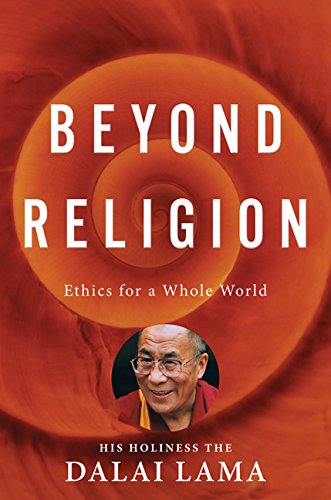
47) Beyond Religion / Dalai Lama
In a secular society -- that is, a society in which all faiths are equally respected -- it is important to develop an ethical perspective independent of any specific religion. The Dalai Lama believes this can be done by grounding ethics in compassion. This book contains his argument for such an ethic, along with recommendations for developing states of mind conducive to compassion.
I sympathize with the message that we ought to be kinder to each other and to the planet. I also sympathize with his desire to develop ethics from a secular perspective -- I identify more or less as an atheist, and it's nice to be included. But I found the argument tedious. It's full of poorly-defined abstractions, some with shades of meaning that were lost on me: despite the Lama's classification I still think that "attentiveness," "heedfulness," and "mindfulness," are basically synonyms.
I won't go on, because I think it's probably at least as good as average for a spiritual self-help book; it's a genre that just doesn't appeal to me. So ... why this book now? It's because my RL book club meets on Tuesday and I've got myself into a position where I just can't skip. You might say that the Dalai Lama's most valuable lesson for me is this: when asked to lead a book discussion, the wise man always asks the title before saying "Yes."
16swynn

48) Toms River / Dan Fagin
In 1949, chemical manufacturer Ciba bought two square miles of undeveloped land near Dover Township, New Jersey, more popularly called Toms River. Like many other chemical companies, Ciba had faced harsh criticism for the way its wastes had contaminated air and water. In the backwoods pinelands of New Jersey, Ciba hoped to find lower levels of scrutiny and regulation. For a long time, Ciba found just what it was looking for.
Ciba specialized in vat dyes derived from coal tar, which is nasty stuff even at the beginning. To extract the dyes, coal tar was mixed with various industrial solvents and other toxins, most of which ended up as waste -- and discarded untreated in unlined basins on the Ciba property. (Later, when Ciba started using lined basins in response to public pressure, the waste promptly ate right through the protective liners.)
It is flabbergasting in 2014 to read about how casually these lethal byproducts were handled. Arguably, we just didn't know back in the 1950s how easily toxins would leach into the groundwater and by the time we did know it was already too late. But there was no shortage of warnings -- the plant's own water was undrinkable within two years -- or of opportunities to change waste protocols. Instead Ciba continued its practices, making only minimal adjustments as required by slowly-evolving state and federal laws. In hindsight, the results were inevitable: high cancer rates among Ciba's employees and among customers of the water company downstream of the plant.
The story is complex, with a large cast and multiple perspectives: chemistry, business, public policy, statistics, law. Fagin brings all the personalities and perspectives together into a coherent and fascinating narrative.
Most impressive is his coverage of statistics. Numerous studies were performed on the Toms River population, but for various reasons -- notably, small sample sizes -- results were inconclusive. Fagin's explanations of the statistical challenges, the studies, and their differences in approach is admirably clear and compelling.
I picked this up because Scientific American chose it as a Best Book of 2013. Recently it won the Pulitzer Prize for general nonfiction. The honors are well deserved. Highly recommended.
17qebo
>16 swynn: I thought it lagged toward the end with the lawsuit, but then that's not the aspect of interest to me. I agree, the explanation of the difficulty of determining statistical significance was enlightening. I was struck by the problem of industrial waste, less modern than I'd supposed.
>15 swynn: "attentiveness," "heedfulness," and "mindfulness," are basically synonyms
Well maybe if you're the Dalai Lama the distinctions are more obvious; to most of us, they're at a rather fuzzy distance.
>15 swynn: "attentiveness," "heedfulness," and "mindfulness," are basically synonyms
Well maybe if you're the Dalai Lama the distinctions are more obvious; to most of us, they're at a rather fuzzy distance.
18qebo
BTW, watching the live feed of the Boston Marathon (http://watchlive.baa.org/) while I'm "working".
19swynn
>18 qebo:: Me too! Actually, I have the day off for "Spring Vacation," but came in anyway to tidy up some loose ends ... and since some folks are running in Boston, well, why not? I have a few friends running this year, but for some reason the camera isn't following them.
Except of course for my brand-new BFF Shalane Flanagan.
Except of course for my brand-new BFF Shalane Flanagan.
20swynn
Well, anyone else who was watching knows that Flanagan fell off her pace -- but since she set the pace for the first twenty miles or so she certainly contributed to a very exciting finish, in which the four leading women broke the previous course record. Flanagan finally came in sixth, setting an American course record.
As for the men: the last time an American won I was in Junior High. Meb Keflezighi rocks.
As for the men: the last time an American won I was in Junior High. Meb Keflezighi rocks.
21qebo
>20 swynn: Yeah, it was sounding from the commentary like she'd faded way out, but sheesh, she was fine. Fortunately my conference call was short this morning so I got to see both women's and men's finish.
22swynn
Same here. I wondered whether she had injured herself, but apparently she dropped from 5-and-a-quarter-minute miles to 5-and-a-half-minute miles. That's still what I call flying.
23swynn

49) Abandon / Blake Crouch
Pretty good thriller set in an abandoned mining town near Silverton, Colorado. The narrative alternates between the 19th-century events that caused the town's demise, and a group of modern-day adventurers exploring the town.
24scaifea
>17 qebo: re: The Dalai Lama's 'synonyms' - I suspect that something may also be lost in the translation of those terms.
25swynn
>24 scaifea:: I do think there is a translation barrier. He frequently notes that he's using a term in the sense of a Tibetan term X, where X means such-and-such:
[H]eedfulness refers to adopting an overall sense of caution. The Tibetan term bhakyö, often translated as "heedfulness" or "conscientiousness," carries the sense of being careful and attentive.
But wait ... if "heedfulness" means a state of "being careful and attentive," then what does "attentiveness" mean? To be fair, in this context he is distinguishing "heedfulness" from "mindfulness" ( drenpa, recollection of one's core values and motivation) and "awareness" ( sheshin, attentiveness to one's own behavior). I think all of these terms are shades of "attentiveness."
For a person with the Dalai Lama's experience in contemplation, the distinctions may be clearer. For myself they are distinctions with very little difference, and I find the going even rougher when he seems to use one of his specially-defined abstract terms in another sense. For example, after he defines "awareness" as "paying attention to our own behavior" he writes in the very next paragraph about "awareness of our own behavior." (Wait: "Paying attention to our own behavior of our own behavior"? What?) Other times he combines fuzzy abstractions into suspect pronouncements like "Understanding leads to spiritual awareness." I think that means something but I don't know what.
The discussion is tonight. Others in the group have found the book enlightening -- with any luck, that will make my job easier.
[H]eedfulness refers to adopting an overall sense of caution. The Tibetan term bhakyö, often translated as "heedfulness" or "conscientiousness," carries the sense of being careful and attentive.
But wait ... if "heedfulness" means a state of "being careful and attentive," then what does "attentiveness" mean? To be fair, in this context he is distinguishing "heedfulness" from "mindfulness" ( drenpa, recollection of one's core values and motivation) and "awareness" ( sheshin, attentiveness to one's own behavior). I think all of these terms are shades of "attentiveness."
For a person with the Dalai Lama's experience in contemplation, the distinctions may be clearer. For myself they are distinctions with very little difference, and I find the going even rougher when he seems to use one of his specially-defined abstract terms in another sense. For example, after he defines "awareness" as "paying attention to our own behavior" he writes in the very next paragraph about "awareness of our own behavior." (Wait: "Paying attention to our own behavior of our own behavior"? What?) Other times he combines fuzzy abstractions into suspect pronouncements like "Understanding leads to spiritual awareness." I think that means something but I don't know what.
The discussion is tonight. Others in the group have found the book enlightening -- with any luck, that will make my job easier.
26swynn
The discussion last night was interesting as always, though -- also as always -- we strayed a bit from the book under discussion. Opinions of the book were generally positive and generally approving of the idea of secular ethics. Some of the details were open for discussion -- Is compassion a product of nature or nurture? To what extent is it possible to separate actor from actions? Can meditation become harmful? Discussion was interesting enough that several of us stayed past the meeting, almost until the library's closing time.
27swynn

50) Books Can Be Deceiving / Jenn McKinlay
Okay cozy featuring a librarian detective, set in a Connecticut coastal community. The director of the Briar Creek Public Library must investigate when the children's librarian is suspected of murdering her boyfriend.
The writing is just okay, the characters a bit thin, the plot creaks at the hinges, and the mystery isn't much. The heroine seems to run her library like a city-wide book club, and doesn't show much talent for research-- she spends several chapters pursuing a question that could be answered with one visit to the county courthouse. But it moves along well and the two librarians make a cute duo. This series would make good treadmill fare.
28swynn
Libraries make you happy.
This should come as a shock to approximately nobody.
Well, technically, the study shows correlation not causation: maybe libraries make you happy; maybe happy people use libraries; maybe happiness and libraries are both related to some third factor like community engagement.
But we know how it works, don't we? It's the books.
This should come as a shock to approximately nobody.
Well, technically, the study shows correlation not causation: maybe libraries make you happy; maybe happy people use libraries; maybe happiness and libraries are both related to some third factor like community engagement.
But we know how it works, don't we? It's the books.
29swynn

51) Reservation Blues / Sherman Alexie
Robert Johnson, the blues guitarist who sold his soul to the devil for talent, wanders onto the Spokane Indian reservation. Thomas Builds-the-Fire, a Spokane storyteller and sort of village fool, picks up Johnson's guitar. He puts together a band, which takes a shot at rock and roll stardom.
This one grew on me: the first few chapters felt a bit rambling and aimless, but the story builds into something surprisingly affecting. There's much magic realism, with multiple dreams and pervasive dream-logic, with ghosts and demons both real and metaphorical. By the end it's a blues opera of frustrated dreams and bad choices. Along the way, Alexie explores themes of self-loathing and resentment, performance, sacrifice, and compromise.
Recommended.
30swynn
52) Mockingbird / Chuck Wendig
Whenever Miriam Black touches a stranger, she sees how they die. After the events of Blackbirds, Black tries to establish a more normal life with a nine-to-five and a steady relationship with Lou, the truck driver she rescued-- and who rescued her. But normal is difficult, and when Lou offers her a chance to use her talent on commission she jumps at the opportunity. "Jumps," that is, as if out of the proverbial frying pan. Soon she is on the trail of a serial killer who preys on "bad girls."
I had mixed feelings about the first in this series, but knew what to expect going into this one: gratuitous locker-room humor driving a paranormal thriller with an interesting heroine. A cover blurb calls it "splendidly profane." I wouldn't call it splendid, but it's certainly, exuberantly profane. For my taste, the splendid profanity missed as often as it hit the mark, but if you know what you're in for then it's a fun ride.
The villain is even better this time around, with motives an interesting contrast to Black's own. Unfortunately, we don't learn those motives until late in the book, which limits the amount of ethical reflection. Of course, thoughtfulness isn't really the point: Wendig aims for a compelling action thriller with an in-your-face aesthetic. He succeeds.
Recommended with a warning about frequent f-bombs, scatological humor, and graphic violence.
31lyzard
>29 swynn: I have that somewhere. And I do mean SOMEWHERE...!?
32swynn
>31 lyzard:: Hope you like it when you get around to it, Liz!
33lyzard
I hope so too! I bought it ages ago and then never got around to reading it. (I know: how unprecendented for an LTer!)
34swynn
"Bought it ages ago and then never got around to reading it" describes 60% of my collection. There's an extra 30% of "Bought it a few years ago and haven't gotten around to reading it."
I really should do something about that and hey look at that new book!
I really should do something about that and hey look at that new book!
37swynn
Well, this one isn't new, exactly, but it is the next in a series and...oh, you understand:

53) Force of Nature / C.J. Box
12th in Box's series about Wyoming game warden Joe Pickett. In this one, Joe's friend Nate has bad people from his past come to town to rub him out. Joe has to balance his need to protect his family with his duty to enforce the law and his loyalty to his friend.
It's more paranoid and testosteroney than usual -- more Rambo than High Noon this time around. I enjoyed it mostly, but could have done without tired cliches likethe female enemy agent converted to good through the power of righteousness and lust.

53) Force of Nature / C.J. Box
12th in Box's series about Wyoming game warden Joe Pickett. In this one, Joe's friend Nate has bad people from his past come to town to rub him out. Joe has to balance his need to protect his family with his duty to enforce the law and his loyalty to his friend.
It's more paranoid and testosteroney than usual -- more Rambo than High Noon this time around. I enjoyed it mostly, but could have done without tired cliches like
38lyzard
...oh, you understand
Only too well, my friend. :)
{sarcasm alert} Oh, that cliche! - that's one of my favourites!! {/sarcasm alert}
Only too well, my friend. :)
{sarcasm alert} Oh, that cliche! - that's one of my favourites!! {/sarcasm alert}
39swynn
Yes, but this time she is cruelly gunned down by her former allies as she bravely defends the man she once hated. Betcha didn't see that coming.
42swynn

54) False Memory / Dan Krokos
Miranda wakes up on a park bench in Cleveland with no memory of who she is, how she got on the park bench, or why she's in Cleveland. (Actually, she has a pretty good guess for the last question: she must live there, since there is no other logical reason to be in Cleveland.)
After a brief misadventure in a nearby mall and a rescue by a friend she doesn't recognize, she finds out who she is: a psychic warrior able to project waves of fear with the power of her mind. Together with a team of three other psychic warriors, she has been trained to control her power for... Well, for reasons that nobody on the team understands exactly.
The more Miranda learns, the more questions she has: who funded their training? Why? Why did her boyfriend have her memory wiped? And does she still love him?
This won the 2013 Thriller Award in the YA category, and for plot-heavy fun it's a solid choice. I read part of it on the treadmill, for which it's ideally suited.
43swynn

55) Alone on the Ice / David Roberts
In 1911 thirty men, mostly Australians and New Zealanders, set out on the Australasian Antarctic Expedition, an ambitious attempt to gather data and samples on an unexplored region of Antarctica south of Australia. The plan was to camp through the winter of 1912, then set out the following spring in small teams on a variety of geographical projects. All the teams faced unique hardships, but none harder than the Far East Party, under the leadership of the Expedition's commander Douglas Mawson.
Besides Mawson, the Far Eastern Party included the young soldier Belgrave Ninnis and the expert skiier and outdoorsman Xavier Mertz. The Party's goal was to push 350 miles south and east into polar terra incognita. Three weeks out and 300 miles from base camp, Ninnis fell through a crevasse to his death, along with most of the party's supplies including their tent and all but a week and a half's worth of rations.
Mawson and Mertz did the only thing they could do. They promptly turned back to camp, planning to survive on half-rations, including meat from the few remaining sled dogs. Both men became predictably and increasingly weak and ill. Before reaching camp Mertz succombed to exposure and starvation -- or very possibly malnutrition -- leaving Mawson to complete a final slog of 100 miles alone, starving, and half-frozen.
He made it.
It's a thrilling story, and Roberts relates it well. He does make some odd narrative choices: for example, he begins by telling the outward journey of the Far East Party up to Ninnis's death. Then he leaves Mawson and Martz stranded in the middle of nowhere to fill in backstory and tel selected anecdotes from the history of Antarctic exploration. He doesn't return to Mawson and Mertz for nearly 200 pages. During the backstory Roberts devotes considerable space to one of Mawson's earlier expeditions -- but when it comes to relating the experiences of some AAE parties he apologizes for having to summarize. So what is the book? it's too broad in scope to be a biography of Mawson or a narrative of the Far East Party, but too narrow to be an account of the AAE.
But the lack of focus and a certain oddness in pacing is the worst I can say about it. Roberts has terrific material and I found even the narrative detours enthralling. Amazon.com picked it as one of their favorite science books of last year, and I will recommend it too.
44rosalita
Steve, you've been doing some fabulous reading. Visiting your thread is dangerous to my wishlist! In particular, the Toms River, the Alexie, and the South Pole books all look really good. And you read the second book in the Blackbirds series, which only serves to remind me that I still have the first waiting for me ...somewhere digital. Sigh.
45swynn
Hi, Julia! I do hope you get to the Fagin and the Roberts books especially and enjoy them as much as I did. I see there's already another Blackbirds book to be had, so I will probably be reading that soon.
46ursula
>43 swynn: I just read (well, listened to) that one recently as well. I agree that the focus was sort of scattershot, but maybe he just wanted to save room for the insanity of Jeffryes in the last year.
47swynn
>46 ursula:: Wasn't that wild? I think a big problem with selecting a focus for this material is that everywhere you look there's a great story that can't *not* be told.
48swynn
For anyone interested: volumes 2 and 3 of Chuck Wendig's Blackbords series are Kindle daily deals today.
49rosalita
Ha! I just noticed that on Amazon and was coming here to mention it. Now I wish I had gone ahead and read the first one already so I'd know whether I liked it enough to pick up 2 and 3. Sigh.
50swynn

56) DAW #66: Pandora's Planet / Christopher Anvil
The Centrans have conquered planet Earth, but the scrappy Earthmen (yeah, "...men": more on that below) don't seem to realize it. Fact is, they are smarter than the Centrans; they were just never able to get their act together long enough to make it into space.
But now that the Centrans have arrived..., well, it's hard enough dealing with sabotage and guerilla warfare, but now the Terrans are introducing the Centran forces to notions like installment plans, communism, pornography, and revolution. Some of the Earthmen don't even seem to realize the Centrans are in charge. What, exactly, will remain of the Centran empire?
I first read this in high schol and loved it, but revisited it with mixed reactions. The writing has held up well, and much of the satire still makes me laugh. Both the Centrans and the humans come under fire: the former as military bureaucrats unable to cope with ingenuity, and the latter as liable to take naive philosophies to silly extremes.
But some naive philosophies are exempt from Anvil's scrutiny. He has a sweet confidence in the incorruptibility of "original American principles" and, bizarrely, of the church: crypto-Catholic libertarianism? I don't know.
The story also shows its age in an almost complete absence of women and people of color: the latter show up occasionally for comic effect, and the former are mentioned early in the text as distractions. But that's no reason not to paint one cheesily on the cover -- um, thanks, Kelly Freas. You've made me appreciate the German cover just a smidgeon:

...by which of course I mean, WTF?
All in all, a pretty good story that would have benefitted from a broader perspective.
51swynn
>49 rosalita:: Thanks for thinking of me, Julia! I did download #3, so I'll be reading that, well, soonish.
52swynn
57) The Whole Lie / Steve Ulfelder
Second in Ulfelder's noir mystery series featuring ex-drunk ex-addict ex-race car driver Conway Sax. In this one, Sax gets tangled up in an ex-girlfriend's problems which involve blackmail and the race for lieutenant governor of Massachusetts. Sax is ambivalent about politics, especially the race for Bay State Number Two, but when his old flame turns up dead he's very interested in justice.
53swynn

58) Moon of Three Rings / Andre Norton
While visiting the backwater world of Yiktor, the young free trader Krip is kidnapped by revolutionary forces. Krip finds an unlikely ally in Maelen, a member of an old and powerful culture and no friend of the insurgents. Maelen's only option for saving Krip's life and hiding him from the badguys is to transfer his mind into the body of a wild animal.
This is a standard plot-heavy Norton adventure but does take some time to ponder puzzles of identity and multiculturalism. It's pretty good for those who enjoy the Norton style. I never could get into her books when I was younger because I could never get past her stilted diction. I'm glad I've given her works a second chance, because they're quite fun and have aged better than most books of her contemporaries.
The odd jumping-jacks cover is from a 1980 reprint and is by Walter Velez.
55swynn
Hi, Roni! I'm glad I picked this one up too. I've also enjoyed the Zero Stone series and of course some of the Witch World books ... once I grew old enough to appreciate them, anyway.
Moon of Three Rings wasn't a planned read, so it was a nice surprise. Last week an out-of-town appointment ran longer than expected and I finished The Whole Lie with (gasp) nothing else worth reading in reach.
Fortunately, I always keep a "like to get around to it but probably never will" paperback in the glove compartment in case of just such a reading emergency. That backup book was Moon of Three Rings, and by the time I got home I was more interested in Krip and Maelen's situation than in the next book on the stack.
Now I want to read Exiles of the Stars.
Moon of Three Rings wasn't a planned read, so it was a nice surprise. Last week an out-of-town appointment ran longer than expected and I finished The Whole Lie with (gasp) nothing else worth reading in reach.
Fortunately, I always keep a "like to get around to it but probably never will" paperback in the glove compartment in case of just such a reading emergency. That backup book was Moon of Three Rings, and by the time I got home I was more interested in Krip and Maelen's situation than in the next book on the stack.
Now I want to read Exiles of the Stars.
56swynn

59) Encounters with the Archdruid / John McPhee
Here's a different kind of mashup: a collection of pieces originally written for the New Yorker, collectively profiling David Brower, former CEO of the Sierra Club.
In each of three pieces, McPhee records conversations between Brower and a political opponent: Charles Park, a geologist for the mining industry; Charles Fraser, a developer who at the time was planning a resort on Cumberland Island; and Floyd Dominy, head of the Bureau of Reclamation, who wants to build a dam in the Grand Canyon. It's entertaining and thought-provoking, pitting Brower's passion for wilderness against arguments for quality of life.
Brower is an complex character. Tireless as he is in advocating for wilderness preservation, he is occasionally unwilling to live up to his stated ideals -- for instance he's the father of four children when he says the limit should be two, and his own home is more swank than he thinks proper. He is also willing to invent facts to bolster his arguments: pressed for sources to some of his statistics, he'll sometimes hint that they're made up on the spot based on feeling. His sparring partners are interesting in their own right, passionate in their own domains, and McPhee gives them a fair platform for nuanced arguments. It's difficult to dislike any of these guys. In particular, Dominy seems like a decent fellow to have a beer with, and I wonder how much McPhee influenced Marc Reisner, who portrayed Dominy as domineering and reckless, but also charismatic.
It's a bit dated -- from 1971 -- especially with respect to specific locations and the white male perspective, but since the conversations deal with principled views of our relationship to nature, they feel remarkably contemporary. Recommended.
57qebo
>56 swynn: Do I have this book? Yes I do. It is on an amazingly organized shelf next to The Pine Barrens, which I have actually read. Someday...
58rosalita
It is so comforting to be among a group of people who totally understand the concept of keeping a book stashed in the car for a reading emergency! I'm glad that one ended up working out so well for you, Steve. Now, which book are you putting in the glovebox to take its place as the "just in case" book?
59swynn
>57 qebo:: Ah, the someday shelf. I have more than a few of those myself. Also a glove compartment. Hope you like it if you get around to it, Katherine!
>58 rosalita:: Next in the glove compartment is Eric Flint's 1632, with Gary Braunbeck's Keepers as a mood contingency.
>58 rosalita:: Next in the glove compartment is Eric Flint's 1632, with Gary Braunbeck's Keepers as a mood contingency.
60swynn

60) Partials / Dan Wells
Postapocalyptic YA book in which a biologically-engineered virus wiped out all of humanity except for a few tens of thousands living on Long Island. Survivors are huddled there because the mainland is occupied by the biologically-engineered supersoldiers called "Partials."
Worst of the virus's effects is that it has halted population growth: all newborns die within a few days of birth, and despite government efforts to maximize childbirth -- essentially, requiring every woman over 18 to give birth every 10-12 months -- no babies have survived for 11 years.
Since this is a YA book all these problems can be solved by the right teenager. In this case our magic teenager is 16 year-old medic Kira Walker who has a bold idea for finding a cure: get samples from the Partials, who seem to be immune to the disease.
There secrets to uncover and peril to risk, and it all moves along at a pretty good pace. I had a few problems, though: some early conversations are heavy-handed infodumps; and there are a number of things that don't quite make sense. For example: requiring women to give birth every 10-12 months? That seems like a plan for creating a population of sick women than for getting healthy babies. But okay, men have done dumber things. But then if you've decided that the women are basically breeding stock, do you also go to the trouble of training teenage girls in microbiology and virology and the operation of an electron microscope? And about that medical equipment: you don't have enough power to run elevators in the hospital, but you let the 16-year old girl play on the electron microscope? And order herself an MRI? I don't know much about those machines, but I bet those puppies draw some juice.
Despite some iffy worldbuilding, the story did draw me in well enough that I'll probably continue the series.
61swynn

61) Bookmarked for Death / Lorna Barrett
Second in the Booktown mystery series featuring bookstore owner Tricia Miles. In this one a bestselling author of historical mysteries is found dead in Tricia's shop after a book signing. This was fun for a cozy, and I'll continue the series.
62swynn

62) Red Rising / Pierce Brown
First volume in a series about a revolutionary on a terraformed Mars. Plot and action are excellent, and I look forward to the next volume.
63lyzard
he's the father of four children when he says the limit should be two
To be fair, he may have acquired his belief about a limit of two after having four. :)
To be fair, he may have acquired his belief about a limit of two after having four. :)
64swynn
>63 lyzard:: That's a valid point, and applies to the house as well. There's one bit where Brower basically says, "If I'd known then what I know now I'd have done things differently." Now that he has the large family and the environmentally-unfriendly dwelling, the damage is done. Whatchagonnado? (One assumes it would be easier to downsize the home than the family. But his front porch apparently has a really nice view.)
Still, the mismatches between his ideals and his behavior -- pre-enlightenment or not -- contribute to McPhee's portrait of Brower as a man of contradictions.
Still, the mismatches between his ideals and his behavior -- pre-enlightenment or not -- contribute to McPhee's portrait of Brower as a man of contradictions.
65swynn

63) Endal / Allen Parton
Allen Parton designed weapons systems for the British Navy until an automobile accident damaged his memory, his mobility, and his ability to socialize. Parton could not remember marrying his wife Sandra, nor did he remember his children, which put a tremendous strain on their family as Sandra became his personal nurse. Into that scenario comes Endal, a yellow lab assistance dog of remarkable intelligence who teaches Parton how to love again.
I read this with my son. We both thought it was okay, but not among our favorites. It's very Lifetime-movie-y but with references to British pop culture, which were largely lost on us. On the positive side, Endal is a genuinely talented and charismatic dog and (Spoiler!) the story follows him through retirement but no further: there's no cheap tearyanking denouement. So maybe not so Lifetimey after all.
66swynn

Abandoned:
The Erdős Distance Problem / Julia Garibaldi, Alex Iosevich, Steven Senger
The Erdős distance problem is one of those intriguing puzzles that can be explained to the average high school student but resists solution by the brightest mathematicians. (According to Wikipedia, a solution exists in preprint; that solution is not covered in this text.)
Essentially it is a problem in geometry having to do with distances between points. consider three points in the plane. You can arrange the three points, as at the vertices of an equilateral triangle, so that the distance between any two of them is the same -- say, d. But you can't add a fourth point that is d distant from all three other points. If the new point is d distant from two of the other points it must be some other distance from the third. So adding another point means adding at least one more distance. But do you have to add more distances for a fifth point? A sixth? A six millionth? On the other hand, in three-dimensional space you *can* arrange four points, as at the vertices of a tetrahedron, so that the distance between any two points is the same.
The problem goes back to a 1946 paper in American Mathematical Monthly, in which the Hungarian mathematician Paul Erdős (pronounced "erdish") asked for a formula describing the minimum number of distinct distances determined by n points in the plane. If you have access to JSTOR, the paper is here. The problem has been expanded to arbitrarily many dimensions ("What is the minimum number of distances determined by n points in k-dimensional space?") and has changed from asking for an explicit formula to asking about its asymptotic behavior ("How quickly does the minimum number of distances grow with n?").
This book outlines the history of the problem by proving various and increasingly accurate results related to the problem. To do this, the authors draw on many mathematical fields, including graph theory, probability, topology, abstract algebra, and Fourier transforms. The bibliography is excellent.
This book has been praised by reviewers who know much more mathematics than I so I hesitate to criticize it, but I'm afraid I found it frustrating. The variety of approaches really is fun, but many details are omitted and I found it time consuming to work out intermediate steps. Working out details became especially important to me after the authors made a freshman error in logic.
One theorem's proof (Theorem 4.4) is based on the incorrect assumption that a conditional statement implies its inverse: if A implies B, then not A implies not B. That is, if we have proven that all apples are fruit then according to the authors' logic anything not an apple is therefore not fruit. This assumption is false in general -- non-apple fruit like peaches do exist -- and is false in this case specifically. In this case the authors prove (correctly) that all planar graphs have a certain property. From this they infer that all non-planar graphs lack the property. But they are wrong: some non-planar graphs *do* have the property and examples are easily constructed.
After that, every omitted step looked suspiciously like another error. I did not find any more logical errors -- suspected ones were really just gaps in my understanding, which are embarrassingly many-- but as the material became less familiar I also became less confident of my ability to judge.
Sweating out the details can be as fun as it is time-consuming, but when a recreational project becomes more time-consuming than fun it's time to look for another project. I'm starting a Coursera course next week which I hope will restore the balance to the "fun" side.
Also, the editor, is, excessively, fond, of commas,.
Despite my frustrations, I'll recommend the book to a narrow audience: readers with a mathematical background who are interested in the problem and are willing to spend some time with it. The material is aimed at upper-division undergraduates, which is about my level of knowledge and I'd say it mostly hits that target. The authors claim it is accessible to "motivated high school students" but I'd guess a high school student would have to be extremely motivated to get very far. Casual readers should wait for a more popular treatment.
67swynn

64) Across Time / David Grinnell
Date: 1957
Zack Halleck is a test pilot for the USAF until a near encounter with a UFO. Zack is grounded and reassigned to work with a couple of civilian scientists who hav devised a way to track UFOs with a giant radar array. Military brass think they're doing Zack a favor: the scientists are Zack's brother Carl and sister-in-law Sylvia.
Zack does not refuse orders, but he's not thrilled about the assignment either. Zack and Carl have a strained relationship, with a history of competition where Carl always comes out ahead. Worse, that competition extends to Sylvia, who was once Zack's fiance but married Carl instead when Zack went missing and presumed dead in Korea.
Shortly after Zack's arrival at the research station, a swarm of UFOs attack the radar array. Carl and Sylvia vanish without a trace. Zack blames himself for their loss, but before he can brood long he is approached by an emissary from one million years in the future, who takes Zack on an excursion into the far future.
It turns out the drivers of the UFOs are human beings who have evolved into globes of living energy. Some of these future humans are peace-and-kindness types, but others are a meddlesome type who have taken to monkeying with history. Zack's contact is the good sort, but Carl and Sylvia have been kidnapped by the bad. After an education and training in the ways of the future, Zack wil be sent to rescue his brother, his sister-in-law, and all of human history.
There are good things here. Most appealing is the future history, which is impressive for its scope and for confidrnce in its dubious assumptions. Also space battles occur, and they are pretty cool.
Less impressive are the very-1950s attitudes toward women and race, with a few painfully awkward passages. The sexual politics of the love triangle becomes downright creepy near the end.
The cover is by the fantastic Jeff Jones. It doesn't have much to do with the story, but captures well its gee-whiz spirit.
"David Grinnell" was a pen name of Donald A Wollheim, who was an editor at Ace when this was published.
68swynn

65) False Sight / Dan Krokos
Follow-up to False Memory, in which the super-soldier teenagers run around other dimensions as they learn about their origin and purpose.
The first was okay, this one less appealing. The action is so frenetic I had the feeling that Krokos was making it up as he went. It probably would have worked better on a treadmill.
69swynn

66) The Martian / Andy Weir
Me too. This reminded me of those old Poul Anderson stories in which he'd drop a group of engineers into an unsurvivable situation, then watch them survive. God, I loved those stories. God, I loved this one.
71swynn
>70 drneutron:: Hi, Jim! I did have a question about the plot that you'd probably be able to answer if you're willing.
(SPOILERS follow)
Near the end, the Hermes crew make various adjustments to their speed and position in order to snag Watney, whose trajectory is far less than optimal. They don't seem to worry about how those changes will affect their own return voyage even though the rescue involves burning all but a minimum amount of fuel.
Why is that? Do the changes have a negligible effect on the Hermes' course? Or is the fuel needed to correct their position included in the 20% they reserve for their voyage home? If the later, how can they spend 80% of their fuel changing course -- not to mention the additional energy expended through the airlock -- but recover with something less than 20%? (And was this all explained and I just missed it?)
(SPOILERS follow)
Near the end, the Hermes crew make various adjustments to their speed and position in order to snag Watney, whose trajectory is far less than optimal. They don't seem to worry about how those changes will affect their own return voyage even though the rescue involves burning all but a minimum amount of fuel.
Why is that? Do the changes have a negligible effect on the Hermes' course? Or is the fuel needed to correct their position included in the 20% they reserve for their voyage home? If the later, how can they spend 80% of their fuel changing course -- not to mention the additional energy expended through the airlock -- but recover with something less than 20%? (And was this all explained and I just missed it?)
72swynn

67) The Troupe / Robert Jackson Bennett
George Carole is a young pianist and a good one, much better than the vaudeville theaters he's paid to play. George does have loftier professional goals but first he must resolve a personal one: he's looking for a particular touring company led by a mysterious figure named Silenus.
Silenus's show is an odd one: ask someone who's seen the show and they'll remember the first few acts: a puppeteer whose puppets weren't very funny; a Persian princess with a charming voice; a strong woman, then ... they can't quite remember the last act ... come to think of it, they're not sure they actually saw the show at all. Of course George wants to see the show, but he has an even more pressing motive for finding Silenus. George is convinced Silenus is his father.
When George finds the show, Silenus acknowledges him and welcomes him into the troupe. But George soon learns that by satisfying his personal goal he has compromised his professional ambitions. Silenus's show will never offer him fame and fortune because the show has its own agenda. More than mere entertainment, the show mends the fabric of the universe and keeps the wolves at bay, less metaphorically than you might expect.
This is a dark fantasy in an American landscape, like American Gods or The Great and Secret Show. I have some complaints about convenient coincidences driving the plot, but since they led to some amazing places I won't complain too much. My main complaint has to do with the end where I thought one character changed too much, too quickly and too conveniently.
Despite the complaints I liked it a lot, and recommend it.
73drneutron
>71 swynn: Hmmm, I don't have the book anymore (back to the library), so I can't read what he wrote. I'm remembering that they had to do a burn/gravity assist that put them back on course to Mars. This would have been an orbit that would allow for a trip back to Earth with little or no adjustment other than the usual small trajectory correction maneuvers. Then at Mars they fired attitude thrusters which are not the same as the main engines for the previous burn to adjust for the MAV failing to make altitude, plus use the depressurization to slow them down. That wouldn't have much effect on the overall orbit - the change to pick him up is pretty small in the trajectory scheme of things. So they should have continued on a course back to Earth, but may not have arrived when and where they originally intended. Of course, this is from memory, so I may have forgotten an important detail or two... :)
74swynn
You've got the pertinent details, at least as I read the text. Checking the yext again, I see that they used the attitude thrusters to "deflect" 72 kilometers -- which obviously wouldn't be a big deal as long as it stayed a difference of 72 kilometers, which I wasn't sure it would -- especially throwing in changes in velocity.
I'm obviously waving my ignorance flag: everything seemed to have been worked out meticulously, and the fact that nobody seemed worried about getting back on course made me suspect that it wasn't an issue. Thanks for the confirmation!
I'm obviously waving my ignorance flag: everything seemed to have been worked out meticulously, and the fact that nobody seemed worried about getting back on course made me suspect that it wasn't an issue. Thanks for the confirmation!
75swynn
RUNNING UPDATE:
I haven't posted much since the Knoxville race. I have been running less than I'd like, but am building mileage again to a comfortable level.
On the way home from Knoxville my left foot began swelling, with a strange and painful bruise at the base of my big toe. Within a couple of days I could barely walk. This was a new injury to me, but I've broken a toe before and that was roughly the level of pain.
My doctor took one look and asked if my family had a history of gout. The answer, alas, is yes.
Having seen Richard's posts about what a bastard *that* disease can be, I really really want to postpone the next attack as long as possible. So I've forsworn alcohol, gravy, and mushrooms and cut way back on meat, especially the red sorts. But ice cream and pasta are still okay, and with my decreased mileage... well, I've put on a pound or two.
Last month I ran the "Bridge the Gap" half-marathon in Quincy, Illinois. I finished under two hours, with an average pace just under nine minutes, which was about what I figured I had in me. Pictures here, look for bib 2211:
http://www.thomasphotographic.com/Event.asp?EventIndex=147
This summer I'm focusing on speedwork and dropping weight, hoping to get back in condition for a fall marathon. I'm down a few pounds from the half, and hope to go for about 20 more by November. My fall marathon will be the Tulsa "Route 66" marathon, which features a detour to the Center of the Universe (No, really.)
I haven't posted much since the Knoxville race. I have been running less than I'd like, but am building mileage again to a comfortable level.
On the way home from Knoxville my left foot began swelling, with a strange and painful bruise at the base of my big toe. Within a couple of days I could barely walk. This was a new injury to me, but I've broken a toe before and that was roughly the level of pain.
My doctor took one look and asked if my family had a history of gout. The answer, alas, is yes.
Having seen Richard's posts about what a bastard *that* disease can be, I really really want to postpone the next attack as long as possible. So I've forsworn alcohol, gravy, and mushrooms and cut way back on meat, especially the red sorts. But ice cream and pasta are still okay, and with my decreased mileage... well, I've put on a pound or two.
Last month I ran the "Bridge the Gap" half-marathon in Quincy, Illinois. I finished under two hours, with an average pace just under nine minutes, which was about what I figured I had in me. Pictures here, look for bib 2211:
http://www.thomasphotographic.com/Event.asp?EventIndex=147
This summer I'm focusing on speedwork and dropping weight, hoping to get back in condition for a fall marathon. I'm down a few pounds from the half, and hope to go for about 20 more by November. My fall marathon will be the Tulsa "Route 66" marathon, which features a detour to the Center of the Universe (No, really.)
76qebo
>75 swynn: Mushrooms?
78rosalita
Mushrooms I could give up without a qualm. Have given up, in fact, since I hate them. But not my asparagus!
79ronincats
Just finished The Martian yesterday and really enjoyed it as well.
Thinking about adding the The Troupe to my wish list, but concerned about all the "horror" tags.
Congrats on the running, sorry about the gout diagnosis.
Thinking about adding the The Troupe to my wish list, but concerned about all the "horror" tags.
Congrats on the running, sorry about the gout diagnosis.
80swynn
>78 rosalita:: Mushrooms are more difficult for me, since I use them for flavor in many dishes all year round. I also like asparagus, but only fresh (Canned asparagus? Ick. Frozen? Maybe I just haven't figured out how to do it right. Restaurant-prepared? Mostly worse than canned, since that's probably how it starts.) so for me it's a seasonal thing and I'll just skip it.
>79 ronincats:: I'd love to share the fun that is The Troupe, but fair warning: the horror tags are earned. There are monsters, they are creepy, and there are passages whose only purpose is to evoke their creepiness. There are a few gruesome scenes where characters meet Very Bad Ends.
On the other hand, there's none of the gratuitous splatter that comes with a lot of horror fiction. I can't think of any characters who are introduced and killed in the same scene -- a horror-fiction trope that drives me batty. The horror elements serve the story rather than the other way round.
>79 ronincats:: I'd love to share the fun that is The Troupe, but fair warning: the horror tags are earned. There are monsters, they are creepy, and there are passages whose only purpose is to evoke their creepiness. There are a few gruesome scenes where characters meet Very Bad Ends.
On the other hand, there's none of the gratuitous splatter that comes with a lot of horror fiction. I can't think of any characters who are introduced and killed in the same scene -- a horror-fiction trope that drives me batty. The horror elements serve the story rather than the other way round.
81porch_reader
Steve - Nice race pics from Quincy, IL. I lived there after undergraduate for a year. Was the race route very hilly? I know that there are some hills around there. I hope that you're able to prevent any more gout attacks and that your training goes well. I started running again at the first of June. I was almost ready for a 5K, but then I fell and then I had sinus surgery. But I'm out of excuses, so I'm hoping to get back to it!
82swynn
Hi, Amy! There were a couple of hills: one right at the beginning, since the start was down by the river. Crossing the starting line we immediately turned left and climbed up to the Bayview Bridge. After that it was pretty flat for six or seven miles, until the course went through Riverview Park, up the bluff where the George Rodgers Clark memorial stands. That hill is pretty steep and I confess I walked a bit of it.
Sorry to hear about your injuries. May your next injury be many moons away!
Sorry to hear about your injuries. May your next injury be many moons away!
83swynn

68) Creatures of Appetite / Todd Travis
Okay thriller about two two FBI agents chasing a child killer in rural Nebraska. Nothing new here.
84swynn

69) Tornado Valley / Shelley Miller
Personal memoir of encounters with tornadoes, mostly in the Huntsville, Alabama area. I read this one with my son. He liked it pretty well when the author kept her focus on tornadoes, less when she went off on a tangent, which she did too frequently.
86swynn
>86 swynn: They were indeed less than stellar, but they were both Kindle deals, so at least I got what I paid for. But yes, I do have a couple of much better reads coming right up!
87swynn
Why I love working in a library: Argument 3,629.
About a month ago the library was given an interesting item:

This is a Braille Bible that originally belonged to a blind preacher who lived in northeast Missouri 1862-1911. It's an excellent piece of local history, and from its condition it is clear that the Bible was well used. Our special collections librarian, who has interests in both local history and in the history of the book, was happy to add it to the collection.
To get a better idea of just what we had, we gave it to a faculty member who has a lot of experience with Braille. He puzzled over it for awhile, and announced that it wasn't in any language he recognized, which included English and most Romance languages. He did give us an important hint, though: based on counting the number of chapters and verses he was pretty sure the volume contained the gospels of Luke and John.
We were not suprised to hear that the Bible was non-English. The donor had told us the original owner was "Dutch," which might mean Dutch but more likely means German, especially in Missouri. Germans settled heavily in Missouri, enough to support German-speaking congregations. I read German pretty well, and Dutch with difficulty, and have a smattering of Greek and Latin. I figured that should cover the likely languages, and volunteered to take a look. My Braille is mostly Grade 1 and even that is rusty, but I offered to give it a shot.
Perhaps it doesn't work this way in all libraries, but in mine if a problem sounds interesting and you say so, you're usually invited to try solving it.
I was quickly put in my place. Here's how the text reads:
-vel- -ii-
-ajjeddx -bb -lur,
-s -lur, -zashbch 1
That doesn't look very German, but it uses some grade 2 transcription, which means that in some cases a single character represents multiple letters or even an entire word. Of course, if the language is non-English then we can't expect the grade 2 chart to represent the same abbreviations and contractions. So let's replace the grade 2 characters with question marks:
?vel? ?ii?
?ajj?dx ?? ?lur?
?s ?lur? ?za?b? 1
Hm. Even with all those gaps, it's still not remotely German. Or anything else recognizable.
At this point, you couldn't pull me off this puzzle if you tried. So the last few days I've spent a good chunk of my free time getting up to speed on Braille, investigating German, Dutch, and Greek encodings for Braille -- for the record, it doesn't make any more sense in Greek than it does in German -- and trying to find information about early Braille standards. Strangely, the more dead ends I hit, the more it all looked tantalizingly familiar.
Turns out it's English after all. So I hit on the solution this morning, and worked it out over lunch and the waiting room of an auto shop this afternoon. (Cryptic Braille I can tackle. Automotive grinding noises are best referred to professionals). The kicker is that it uses a nonstandard Braille encoding. The character that usually represents 'e' instead represents 'o'; 'j' actually represents 'c'; 'x' represents 'ing'. After you've made a few changes to the standard Braille encoding you get this:
VOL II
According To Luke
St Luke Chapter 1
A couple dozen changes more, and the rest of the text resolves into the 1881 English Revised Version.
Where but a library do you get handed puzzles like this?
About a month ago the library was given an interesting item:
This is a Braille Bible that originally belonged to a blind preacher who lived in northeast Missouri 1862-1911. It's an excellent piece of local history, and from its condition it is clear that the Bible was well used. Our special collections librarian, who has interests in both local history and in the history of the book, was happy to add it to the collection.
To get a better idea of just what we had, we gave it to a faculty member who has a lot of experience with Braille. He puzzled over it for awhile, and announced that it wasn't in any language he recognized, which included English and most Romance languages. He did give us an important hint, though: based on counting the number of chapters and verses he was pretty sure the volume contained the gospels of Luke and John.
We were not suprised to hear that the Bible was non-English. The donor had told us the original owner was "Dutch," which might mean Dutch but more likely means German, especially in Missouri. Germans settled heavily in Missouri, enough to support German-speaking congregations. I read German pretty well, and Dutch with difficulty, and have a smattering of Greek and Latin. I figured that should cover the likely languages, and volunteered to take a look. My Braille is mostly Grade 1 and even that is rusty, but I offered to give it a shot.
Perhaps it doesn't work this way in all libraries, but in mine if a problem sounds interesting and you say so, you're usually invited to try solving it.
I was quickly put in my place. Here's how the text reads:
-vel- -ii-
-ajjeddx -bb -lur,
-s -lur, -zashbch 1
That doesn't look very German, but it uses some grade 2 transcription, which means that in some cases a single character represents multiple letters or even an entire word. Of course, if the language is non-English then we can't expect the grade 2 chart to represent the same abbreviations and contractions. So let's replace the grade 2 characters with question marks:
?vel? ?ii?
?ajj?dx ?? ?lur?
?s ?lur? ?za?b? 1
Hm. Even with all those gaps, it's still not remotely German. Or anything else recognizable.
At this point, you couldn't pull me off this puzzle if you tried. So the last few days I've spent a good chunk of my free time getting up to speed on Braille, investigating German, Dutch, and Greek encodings for Braille -- for the record, it doesn't make any more sense in Greek than it does in German -- and trying to find information about early Braille standards. Strangely, the more dead ends I hit, the more it all looked tantalizingly familiar.
Turns out it's English after all. So I hit on the solution this morning, and worked it out over lunch and the waiting room of an auto shop this afternoon. (Cryptic Braille I can tackle. Automotive grinding noises are best referred to professionals). The kicker is that it uses a nonstandard Braille encoding. The character that usually represents 'e' instead represents 'o'; 'j' actually represents 'c'; 'x' represents 'ing'. After you've made a few changes to the standard Braille encoding you get this:
VOL II
According To Luke
St Luke Chapter 1
A couple dozen changes more, and the rest of the text resolves into the 1881 English Revised Version.
Where but a library do you get handed puzzles like this?
88qebo
>87 swynn: At this point, you couldn't pull me off this puzzle if you tried.
Heh. And you get paid for this?! What fun!
Heh. And you get paid for this?! What fun!
89rosalita
What a great puzzle, and what a fine library detective you are, Steve! That is a very cool story.
92swynn
Follow-up to the braille Bible story: it turns out the mystery code isn't such a mystery after all to those who know more than, say, me, about the history of braille.
Having concluded that the volume was in English, I went looking for possible publishers of English-language braille Bibles in late 19th-early twentieth century America. Soon I stumbled across references to "modified American braille." It turns out that when braille was adopted in the United States, some of the codes were rearranged based on letter freqency. I tracked down charts for American braille, and sure enough: they match what I'd worked out.
So the code isn't nonstandard, exactly, just deprecated. It had a relatively short life, being developed in the early 1890's then jettisoned for the current standard in 1919 during an international standardization movement.
So the book is less exotic than it originally seemed; on the other hand, our Special Collections librarian is just as pleased as ever. Now it is not just an interesting piece of local history; it's an artifact illustrating an interesting story in the history of American printing. I suspect she's concocting a display even now ...
Having concluded that the volume was in English, I went looking for possible publishers of English-language braille Bibles in late 19th-early twentieth century America. Soon I stumbled across references to "modified American braille." It turns out that when braille was adopted in the United States, some of the codes were rearranged based on letter freqency. I tracked down charts for American braille, and sure enough: they match what I'd worked out.
So the code isn't nonstandard, exactly, just deprecated. It had a relatively short life, being developed in the early 1890's then jettisoned for the current standard in 1919 during an international standardization movement.
So the book is less exotic than it originally seemed; on the other hand, our Special Collections librarian is just as pleased as ever. Now it is not just an interesting piece of local history; it's an artifact illustrating an interesting story in the history of American printing. I suspect she's concocting a display even now ...
93swynn
One more step on the road to senescence: I have ordered my first pair of bifocals. Well, "progressive lenses," but still.
Dr. Optometrist was trying to help me decide whether they were absolutely necessary just yet. "Do you spend more time reading? Or on the computer?"
"I'm not sure," I said. "How do I count the time I spend reading on the computer?"
"I think you may be ready for bifocals," he said, and I guessed so too.
Dr. Optometrist was trying to help me decide whether they were absolutely necessary just yet. "Do you spend more time reading? Or on the computer?"
"I'm not sure," I said. "How do I count the time I spend reading on the computer?"
"I think you may be ready for bifocals," he said, and I guessed so too.
94swynn
70) Five Billion Years of Solitude / Lee Billings
Status report on the search for extraterrestrial life, for a popular audience.
Billings starts with a couple of chapters on SETI, which looks to be on its very last leg barring some unexpected infusion of cash. Despite SETI's misfortune our search for extraterrestrial life continues, down an avenue barely imagined in SETI's heyday: exoplanetology.
Billings gives an overview of and status report on the search for planets orbiting other suns. Not that long ago, it was all but unimaginable that we could even detect such bodies. The people looking for exoplanets were mavericks working at astronomy's fringes, gambling their careers on a project others considered futile. Now that the pioneers have schooled us the bandwagon is filling fast. Techniques are constantly being refined as one group of researchers try to distinguish themselves from all the others.
New planets are announced every few days, so that now we know about hundreds of nonsolar worlds. The early ones were Jupiter-sized bodies in orbits with crazy small radius but now smaller and smaller bodies are being found farther and farther away from their stars, some now about the size of Earth, some maybe -- just maybe -- habitable if only we can figure out how to get there.
But how do we know from our vantage point light years away whether a planet is capable of supporting life? Especially when any light from the candidate planet is washed out by light from its star, a billion times more intense? It's not easy. But it is not wise to say "impossible" where smart and passionate people are concerned.
Billings gives an overview of our own 4.6-billion-year history to explore what markers we might look for in other planets, and just how we might find them. He also introduces us to some of the people who are looking, their methods, and the challenges they face. You can't help but come away with the impression that we are close to very exciting discoveries.
The treatment is popular, with accessible explanations and a focus on personalities in the field. I expect those familiar with exoplanetology might find it a bit fluffy, but I found it fascinating. Recommended.
95swynn

71) Montana / Gwen Florio
Pretty good mystery about a foreign correspondent pulled back home when her paper faces budget cuts. She decides to take a brief vacation to visit a friend in Montana before flying back to an Afghan war zone on her own dime. But when she gets to Montana, her friend is dead.
The mystery isn't much of a mystery but the character is appealing and the writing is above average. I'll probably read the next eventually.
96swynn
I'm on the bandwagon: I just got the notification that I've won an ER book, Mastering Running. Now to see whether I'll follow through...
97swynn

72) On Looking / Alexandra Horowitz
The book's subtitle is "eleven walks with expert eyes," and that's the conceit: Horowitz takes a walk around her New York City block, trying to notice as much detail as possible. She then takes walks-around-the-block with eleven "experts," each of whom she asks to describe what they see.
"Expert" sometimes means an expert in the conventional sense: she accompanies a geologist, a typographer, and an entomologist for example. Others are experts not in an academic field but rather in a particular way of experiencing the world: the toddler, the blind world traveler, or the dog for instance.
As you might expect some walks are more interesting than others, and some will leave you wanting more. The latter problem is compounded by the fact that Horowitz constantly interjects her own expert perspective as a psychologist. Several reviewers have complained about this, and it bothered me too at first: I wished she'd turn off her analysis and just let the geologist speak.
But I think that complaint is missing the point. The book is not so much a collection of eleven different perspectives as it is a single perspective on multiple perspectives. The various views are illustrations and object lessons in a series of essays on attention, perception, and specialization. As such it's pretty good. Some details are off, such as when she passes a Bingo house and hears the caller announcing numbers that do not exist (O47 and N4), but allowing a little narrative license it's quite readable too.
Scientific American chose this as one of their best books of 2013. I think it's not the strongest in that list, but not the weakest either and I'll recommend it for readers interested in popular works on cognitive science.
98qebo
>97 swynn: I just got this one; was an LT recommendation awhile back and a few weeks ago it showed up on Andrew Sullivan's blog as a book club selection. Of course "just got it" is not the same thing as "will read it soon"...
100swynn

73) Unwind / Neal Shusterman
YA book about a future where unwanted teenagers are harvested for body parts. Plenty of others have read this; I fall into the "pretty good story with some significant gaps in plausibility" camp.
I did like how Shusterman sets his future up as a hell devised not by one runaway ideology or another, but as the consequence of a polarized society, both of whom would prefer a hellish compromise to giving the other side an inch.
Pretty good for what it is, and I will probably continue the series.
101swynn

74) Top Brain, Bottom Brain / Stephen Kosslyn and D. Wayne Miller
This is another of Scientific American's favorites of 2013 and definitely one of their weaker choices. Kosslyn and Miller borrow from recent brain research to tell a story about how our behavior is divided into top-brain functions -- which include spatial perception and planning -- and bottom-brain functions -- which include shape recognition and rumination. They then describe four "modes" defined by how much a person relies on top-brain or bottom brain functions.
Those who rely on top-brain functions are Stimulators, great at making plans but not so much on follow-through; those who rely on bottom-brain functions are Perceivers, wise but passive; those who rely on both are Movers, good managers who can both plan and adjust the plan to changing conditions; and those who don't rely on either are Adapters, who can be good team players. In case you think this sounds like one of those annoying Internet quizzes ala WHICH MODE ARE YOU?!?!? you're absolutely right and if you're curious you can take the annoying Internet quiz here:
http://www.gwaynemiller.com/test.html
Curiously, they spend some time ridiculing the left brain/right brain fad. Unlike the left/right brain nonsense, they say, their approach is based on Science. Theirs is not a false dichotomy, you see, because their theory offers four choices not just two. And they're carefully squishy about what it all really means. It's not so much a dichotomy as a system, and if your results don't match your experience it's probably because you operate in different modes in different contexts. But still, you have a Dominant Mode because ... well if you didn't how could they make an Internet Quiz about it? Maybe it's just me but the more they protest the more they sound like Melville's Lightning-Rod Man.
I'm probably being unfairly flippant. The authors do include some considerations on the test's accuracy and reliability so they do address some of the criticism. For context: I'm deeply suspicious of personality research in general, and this stuff doesn't seem to me to rise above the rest. There are some good bits early in the book showcasing interesting results from recent brain research, but it's all down the self-help hill for me when they launch into the personality typing and armchair analysis of tabloid stars and politicians.
Not recommended.
More to the point: come on, Scientific American. What were you thinking?
102swynn

75) The Reservoir / John Milliken Thompson
Historical crime drama set in1885 Richmond, Virginia.
A pregnant young woman is found drowned in a reservoir. Suspicion soon settles on a cousin, Tommie Cuverius. Tommie is a bright young lawyer with great expectations. He is also, it seems, the father of the victim's unborn child.
Parallels to Dreiser's An American Tragedy are strong: Cuverius has another girlfriend and occasional fiancee who is heiress to a fortune. Cuverius juggles both love interests as he tries to choose between passion and financial advancement. As a circumstantial case builds against him, Cuverius does himself no favors by spinning conflicting stories.
Cuverius is not an appealing character, even in a lovable-rogue kind of way, but his transformation from favorite son to trapped rat is captivating. Thompson's attention to local color and period detail create an effective setting for it. Recommended.
103qebo
>101 swynn: annoying Internet quizzes
Yes it is. Weird. Can I automatically identify dog breeds?
Yes it is. Weird. Can I automatically identify dog breeds?
104swynn
>103 qebo: Exactly. What does "automatically" even mean in that context? The authors say that the quiz questions were winnowed out of a much larger set after preliminary tests indicated that those twenty had the highest reliability and validity. Which is curious considering some of their content.
105swynn

76) Influx / Daniel Suarez
Jon Grady is a physicist working out of the mainstream on a project that everyone knows is impossible: a device to reflect gravity. When Grady and his team actually invent the thing, they know that they are on the verge of fame and wealth, a Nobel Prize and a brand-new-era. So it's disappointing when Luddite terrorists swoop in and blow up Grady's research lab with Grady and his team inside.
Except the terrorists aren't terrorists and Grady doesn't die. The attack is actually cover for an intervention by the Bureau of Technology Control. The BTC is a secretive government organization tasked with monitoring and suppressing discoveries and inventions that could be socially disruptive -- like Grady's gravity mirror. The BTC takes Grady into custody and makes him an offer: join us or spend the rest of your days in a top secret supermax prison.
Grady isn't much of a joiner. But what's he going to do? The BTC has been collecting geniuses and their revolutionary inventions for years. It's not like he can break out of prison, then hide from their ubiquitous surveillance long enough to plan and mount an attack on an agency whose funding and power are practically unlimited and whose technology is generations ahead of any other army's or intelligence agency's on earth.
On the other hand, he can't help but try.
It's exactly as silly as it sounds -- like a James Bond film with Q as the hero -- and almost as fun as you don't dare hope it might be. Yes, it's popcorn fiction but it's salted and buttered just right. Recommended.
106swynn
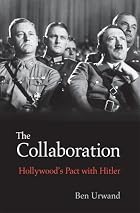
77) The Collaboration / Ben Urwand
Through the 1930's major Hollywood studios worked with the German government to produce films that would meet increasingly nationalistic and antisemitic demands.
Surprisingly, the German demands did not just affect the kind and content of films distributed in Germany. By threatening to block the distribution of any film from an offending studio, German officials could demand changes to films distributed anywhere in the world. By working closely with the Hays Office, the Germans even schooled the American film industry to censor itself.
Urwand documents substantial cuts made to major releases like All Quiet on the Western Front and its sequels. After a few encounters with German representatives the studios learned what subjects and scenes to avoid, and even produced fascist-friendly films like Gabriel Over the White House. Antifascist projects -- such as an adaptation of Sinclair Lewis's It Can't Happen Here -- were simply killed in production rather than risk the lucrative German market. Most interesting is the almost complete disappearance of Jewish characters and themes from Hollywood films, despite the public awareness of persecution and despite the fact that most of the major studios had Jewish owners.
This is a piece of Hollywood history I knew nothing about: I'm more familiar with the patriotic anti-Nazi productions of the 1940's and after, so Urwand's story comes as an enlightening surprise. I think he's prone to overstate his case on occasion (he suggests that Mr. Deeds Goes to Town is a profascist film) and I'd like to read another take on the subject for balance. But it's difficult to argue against Urwand's documentation, and his treatment is readable and recommended.
107swynn
Dear Weird Al,
I love you.
http://www.dailymotion.com/video/x21fc1k_weird-al-yankovic-word-crimes_music
Say you have an I-T followed by apostrophe S.
Now what does that mean?
You would not use this in this case as a possessive.
It's a contraction. What's a contraction?
Well, it's the shortening of a word, or a group of words by the omission of a sound or letter.
You rock both literally and figuratively.
I love you.
http://www.dailymotion.com/video/x21fc1k_weird-al-yankovic-word-crimes_music
Say you have an I-T followed by apostrophe S.
Now what does that mean?
You would not use this in this case as a possessive.
It's a contraction. What's a contraction?
Well, it's the shortening of a word, or a group of words by the omission of a sound or letter.
You rock both literally and figuratively.
108qebo
>107 swynn: Well that improved my morning. Thanks.
110swynn
>108 qebo: You're welcome! It brightened mine, so I'm happy to share.
>109 ronincats: He has fallen off my radar for the last few years, probably because I have lost touch with the pop music he spoofs. Then I heard him on NPR this weekend plugging his new album. They played a teaser for this, and I had to get it. The rest of the album is pretty much what you expect: silly parodies, pop hits ala polka band, and a handful of original tunes. But "Word Crimes" made me love him all over again.
>109 ronincats: He has fallen off my radar for the last few years, probably because I have lost touch with the pop music he spoofs. Then I heard him on NPR this weekend plugging his new album. They played a teaser for this, and I had to get it. The rest of the album is pretty much what you expect: silly parodies, pop hits ala polka band, and a handful of original tunes. But "Word Crimes" made me love him all over again.
111swynn

78) A Land More Kind Than Home / Wiley Cash
I picked this up last month for the "sense of place" TIOLI challenge. I didn't get to it last month, but I'm glad I didn't just send it back to the library: this is my best fiction read of the year so far.
In a rural Appalachian community, an autistic boy is killed during a healing at a secretive "With Signs Following" church. Cash tells the story from multiple perspectives. There's the victim's nine-year-old brother, who witnessed an earlier attempt at healing and feels indirectly responsible for the second, fatal, attempt. There's the elderly Sunday School teacher who witnessed an accidental death during a service years ago and has since made it her mission to protect the congregation's children. And there's the sheriff who is still an outsider after an entire career in the community. Each voice rings true, and Cash manages to convey regional dialect without misspellings and apostrophes.
Surrounding the boy's death is a deep history of betrayal and hubris and venality and the whole thing builds to a climax fit for Greek tragedy. Along the way we're treated to thoughts on power, religion, and transformation and, yes, it has a marvelous sense of place.
Enthusiastically recommended.
112swynn
The training plan is working slowly, but definitely working. I ran a 5K last night in 23:09, my best time of the year so far and fast enough to take third in my age group. Next planned race is another 5K at the end of August.
Meanwhile:
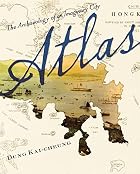
79) Atlas : The Archaeology of an Imaginary City / Dung Kai-cheung
Following on the heels of my favorite novel of the year so far is this, the most perplexing.
This is a collection of critical essays, purportedly written in the mid-21st century, interpreting maps of Hong Kong. Collectively, they offer a future view of Hong Kong's history within the context of an imaginary scholarly discourse.
It's extremely clever. Most (maybe all) of the maps actually exist, many can be found online, and the text is largely plausible as critical interpretation. But the text also includes stories about Hong Kong's history, many of them clearly fanciful: is Dung mining folktales? Is he presenting his own inventions as folktales? Probably both, but which is which? Most essays make a point, subtly or otherwise, about colonialism: power and its effect on both the colonized and the colonizer. It's also awfully postmodern: it references Barthes; in fact, it references itself.
All of which makes it sound stuffy, which it is in a sense: its style is certainly mock-stuffy academic writing though not nearly as opaque as the real thing. But that makes the gems sparkle even more: the story about historians who interview a flock of parrots believing that the birds may have passed down the speech patterns of a lost community; or about the street that has one name in winter and another in summer so that letters sometimes arrive six months late.
So what is it? Arguably science fiction: it won the 2013 Science Fiction and Fantasy Translation Award, so I guess you could make that argument. But if it's a novel it's one without plot or characters. Fanciful future history? Whatever, it is interesting.
Not recommended for treadmill reading, because every sentence counts and is usually doing half a dozen things. Term papers and dissertations will be written on this, but even for us non-scholars it's Definitely worth a look for its thoughtful and playful take on Hong Kong's history.
Meanwhile:
79) Atlas : The Archaeology of an Imaginary City / Dung Kai-cheung
Following on the heels of my favorite novel of the year so far is this, the most perplexing.
This is a collection of critical essays, purportedly written in the mid-21st century, interpreting maps of Hong Kong. Collectively, they offer a future view of Hong Kong's history within the context of an imaginary scholarly discourse.
It's extremely clever. Most (maybe all) of the maps actually exist, many can be found online, and the text is largely plausible as critical interpretation. But the text also includes stories about Hong Kong's history, many of them clearly fanciful: is Dung mining folktales? Is he presenting his own inventions as folktales? Probably both, but which is which? Most essays make a point, subtly or otherwise, about colonialism: power and its effect on both the colonized and the colonizer. It's also awfully postmodern: it references Barthes; in fact, it references itself.
All of which makes it sound stuffy, which it is in a sense: its style is certainly mock-stuffy academic writing though not nearly as opaque as the real thing. But that makes the gems sparkle even more: the story about historians who interview a flock of parrots believing that the birds may have passed down the speech patterns of a lost community; or about the street that has one name in winter and another in summer so that letters sometimes arrive six months late.
So what is it? Arguably science fiction: it won the 2013 Science Fiction and Fantasy Translation Award, so I guess you could make that argument. But if it's a novel it's one without plot or characters. Fanciful future history? Whatever, it is interesting.
Not recommended for treadmill reading, because every sentence counts and is usually doing half a dozen things. Term papers and dissertations will be written on this, but even for us non-scholars it's Definitely worth a look for its thoughtful and playful take on Hong Kong's history.
113swynn

80) The Last Town / Blake Crouch
Okay third entry in the Wayward Pines series. It's fast and violent and delivers on its promises.
114swynn

81) Shella / Andrew Vachss
A hit man on parole goes looking for the stripper he fell in love with before he got locked up. To get information he takes a job targeting the leader of a white-supremacist community. It's unpleasant and violent and very Vachss. I liked it.
116swynn
Thanks, Roni!
I confess to a weakness for fictional violence, especially the apocalyptic mayhem of zombie novels (or Wayward Pines) and the disillusioned testosteroney scrappiness of noir fiction. I have no stomach for the real thing.
I confess to a weakness for fictional violence, especially the apocalyptic mayhem of zombie novels (or Wayward Pines) and the disillusioned testosteroney scrappiness of noir fiction. I have no stomach for the real thing.
117swynn

82) The Cancer Chronicles / George Johnson
A science writer looks at cancer from the context of his own experience as his wife undergoes treatment.
This is another of Scientific American's favorite books of last year, and has been longlisted for the Royal Society Winton Prize. It is pretty good, and probably would have felt even better if I hadn't already read Siddharta Mukherjee's The Emperor of All Maladies first. When Johnson enters territory already covered by Mukherjee, Mukherjee's explanations are superior -- which is saying something because Johnson's are mostly clear and not at all bad.
So what does Johnson offer that Mukherjee doesn't? He does offer a personal perspective: there are anecdotes from his wife's battle with cancer, and anecdotes from his journalistic investigations. Where Mukherjee is an expert Johnson is a student, so where Mukherjee offers insight and direction Johnson communicates the overwhelming multidirectional bewilderment of cancer research.
Most interesting to me were the first couple of chapters in which Johnson discusses cancer in prehistory (including dinosaur cancer). A surprising number of cancers have been preserved in prehuman and early human remains -- around 200 cases, enough to make it statistically difficult to claim that cancer rates have increased in modern times.
There is a certain fatalism in Johnson's tone. He emphasizes that there's really very little you can do to keep cancer away other than not smoking, controlling body weight, and exercising. For almost everything else -- five-a-day fruits and vegetables, avoiding red meats, reducing cell phone usage -- the evidence is ambiguous. And forget about shark cartilage: contrary to con artists' claims sharks do get cancer.
But there is some hope: Johnson attends cancer conventions to learn about emerging treatments. His impression is that cancer treatment will depend on a deeper understanding of human cell biology; the problem is that the intricacies of human cell biology are constantly deeper than anyone expects. Mukherjee made this point too, but Johnson has a layman's astonishment upon glimpsing just how complex the field is. So do I.
Johnson is a career science writer and a good one, so his book is engaging and enlightening. But if you're only going to read one book on cancer make it Mukherjee's.
119swynn
>118 rosalita:: Thanks, Julia! No, Shella is not one of the Burke books which is probably why I hadn't read it before. It does have similar themes and characters: broken adults with abusive childhoods.
120rosalita
Thanks, I'll have to check it out. The subject matter of Vachss' books can be disturbing but it's so much more grim knowing that he's seen similar cases and worse in his work as a legal advocate for abused children.
122scaifea
<117 Oh, that one sounds interesting, but I also haven't read the Mukherjee book, so I guess they both go on the wishlist...
123swynn
Hi Amber!
Well, I made it clear which I think is better, but Mukherjee's is also a bigger commitment at (if memory serves) five hundredish fascinating pages. Either is good, and I hope you enjoy whichever you get to.
Well, I made it clear which I think is better, but Mukherjee's is also a bigger commitment at (if memory serves) five hundredish fascinating pages. Either is good, and I hope you enjoy whichever you get to.
124swynn

83) Fragments / Dan Wells
Disappointing follow-up to the flawed but promising Partials, which I mentioned a couple of months ago. The setting is a postapocalyptic world in which most of humanity has been wiped out by a one-two punch: humans vs. supersoldiers war followed by a bioengineered plague that killed 99% of the human population (but not the supersoldiers) and left the survivors infertile.
Humanity is reduced to a remnant of some 35,000 souls living on Long Island in fear of the supersoldier "Partials" who swarm the mainland. In book one we learned that the Partials carry the cure to the plague but that they too are doomed: the Partials were manufactured with an "expiration date," limiting their lives to 20 years. The oldest Partials have already died and the others have only a couple years left at most. You'd think the mutual doom would be an opportunity to declare truce, sing a verse of Kum Ba Yah, and work together for mutual survival. But this is YA fiction so that solution occurs only to a sixteen-year old girl.
In this installment hostilities intensify between humans and Partials while Kira sets out on an information-seeking mission with her new Partial friends across the former United States. They know it will be dangerous so they pack plenty of food, weapons, ammunition ... and quarters, just in case the abandoned wasteland has toll roads. Really.
Unfortunately, the inconsistent world-building continues. Our heroine was only five years old when civilization collapsed but she has no trouble reading pre-collapse financial documents and contemplates how stairclimbing might improve her "glutes." Despite the post-apocalyptic setting there is rarely a sense of deprivation or even of disconnection from consumer culture.
Besides the anachronisms there are also continuity problems. In one scene of her trek across North America, Kira reads a thriller "by the light of the moon" while rain pounds "furiously" on the roof of her shelter. (I showed this scene to Mrs. Ninja, who suggested that perhaps meteorological civilization had also collapsed.) The anachronisms and inconsistencies continue for nearly six hundred pages, padded out by frequent interruptions for tedious moralizing and navel-gazing.
Tangled up in all of these frustrating bits is a pretty good story, which is almost too bad: if it too had been rubbish I could have just returned the book unfinished and forgotten about it. Instead, God help me, I'll have to read the third book to see how it all turns out.
I have no recommendation on this one. I'm inclined to say "Don't even start," but others have raved about the series in general and this book in particular. My mostly-negative reaction falls into a narrow minority. When this happens I assume that there is a flaw in my own taste rather than everyone else's. YM, as they say, MV.
127swynn

84) Kentucky Straight / Chris Offut
Collection of stories about a mountain community in backwoods Kentucky. I picked this up after seeing Chris Offut described as the "reigning master" of "redneck noir." i can imagine that's true, but these stories don't feel like examples of the genre: too little crime, too much affirmation of life, even if the life affirmed is sordid and short. A couple of stories also have a folklorish supernatural element that doesn't fit my naturalistic notion of noir.
But what the hell-- whatever the genre these stories pack a punch, largely about people stuck in lives that do not satisfy but are the only lives that suit them. Recommended.
128swynn
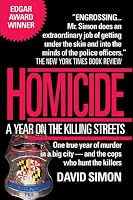
85) Homicide / David Simon
In 1988, Baltimore Sun reporter David Simon took a leave of absence to follow a team of homicide detectives. This is his report, a chronological account of the city's murders, some explored in chilling detail, others rattled off in a word or two per life. Featured cases include the still-unsolved murder of an eleven-year old girl; the attempted murder of a police officer; the death of a suspect fleeing police; and a kindly old scripture-loving lady who had a knack for predicting which friends and relatives were about to die and backing her hunches with life insurance policies.
One reviewer in The Guardian commented that the book has "the size, heft and moral weight of a 19th-century novel." That's an apt description. It runs to 600 pages, has a huge cast, is prone to elaborate descriptions, and despite a pervasive jaded tone is not above moralizing. Some of the writing is painfully purple: at its worst it doesn't know whether it wants to be noir reportage or tabloid journalism. At its best though it provides a compelling portrait of Baltimore and the detectives who clean up its messes. Recommended.
This book was the basis for the NBC series, "Homicide : Life on the Street" and its author went on to more television work, developing and producing the HBO series "The Wire" and "Treme."
129swynn

86) My Life as a White Trash Zombie / Diana Rowland (DAW #1554)
Date: 2011
Before she woke up in the emergency room Angel Crawford had problems enough: drug abuse, an abusive father, a loser boyfriend, that whole misunderstanding about a stolen car ... but post-ER she has a brand new set of problems that put the old ones in perspective. She's a zombie. She wants brains and she'll have to do what it takes to get them, even if "what it takes" involves keeping a job, dropping the drugs and resolving her father issues.
I picked this up this spring at a 2-for-1 sale at my local bookstore, but it was Dejah's enthusiastic endorsement that prompted me to kick it to the top of the pile. It is fun as promised, with a snarky and endearing heroine, an intriguing setting, and serviceable prose. The pacing is leisurely but never too slow; the conflict is light but that's because because of time spent establishing the world and Angel's place in it. There's flirtation but no smarmy romance. (And my threshold for smarmy is guyishly low.) It's a good start to a series and I'll read more.
The rocking pink cover is by Daniel Dos Santos.
130swynn
Grrrr. False advertising.
Really Big Numbers / Richard Evan Schwartz
This was the blurb that got me:
In the American Mathematical Society's first-ever book for kids (and kids at heart), mathematician and author Richard Evan Schwartz leads math lovers of all ages on an innovative and strikingly illustrated journey through the infinite number system.
How exciting! Inifinite numbers are fascinating things, but students don't typically encounter them until undergraduate set theory. Somebody has written a picture book to introduce infinite numbers to children? I must see it! I must!
I'm sorry to report that there are no infinite numbers inside. (Well, arguably one on the very last page.) By "numbers" Schwartz means "integers." He does in fact talk about unimaginably large "really big" integers but they are all (sigh) finite. The book is about an infinitely large system of numbers, not about a system of infinitely large numbers.
So it's not the book I thought was advertised. How is it for what it is? Not bad, I guess: it starts with 1, 2, 3 then proceeds through counting by tens and hundreds, introduces exponential notation, and finally Steinhaus-Mauer notation to get really big numbers.
Along the way, Schwartz offers ways to visualize ever larger numbers, either objects (100,00 hairs on a monkeys head; 10^61 ways to tour capitals of the lower 48 states). The images become increasingly fanciful and breathtaking as the numbers grow. As we reach a googol the numbers grow too large to imagine ("A googol atoms would fill the universe about 100 quadrillion times over.") and by the time we reach a googol-plex we just give up on trying to imagine them and just marvel that there are so many numbers even larger.
I'm not crazy about the Inkscape-primitive illustrations but that's a matter of taste.
Despite my disappointment, the book has its charms. Big integers are after all pretty cool, and this could be an interesting catalyst for thinking about them, for kids and for older readers too.
Really Big Numbers / Richard Evan Schwartz
This was the blurb that got me:
In the American Mathematical Society's first-ever book for kids (and kids at heart), mathematician and author Richard Evan Schwartz leads math lovers of all ages on an innovative and strikingly illustrated journey through the infinite number system.
How exciting! Inifinite numbers are fascinating things, but students don't typically encounter them until undergraduate set theory. Somebody has written a picture book to introduce infinite numbers to children? I must see it! I must!
I'm sorry to report that there are no infinite numbers inside. (Well, arguably one on the very last page.) By "numbers" Schwartz means "integers." He does in fact talk about unimaginably large "really big" integers but they are all (sigh) finite. The book is about an infinitely large system of numbers, not about a system of infinitely large numbers.
So it's not the book I thought was advertised. How is it for what it is? Not bad, I guess: it starts with 1, 2, 3 then proceeds through counting by tens and hundreds, introduces exponential notation, and finally Steinhaus-Mauer notation to get really big numbers.
Along the way, Schwartz offers ways to visualize ever larger numbers, either objects (100,00 hairs on a monkeys head; 10^61 ways to tour capitals of the lower 48 states). The images become increasingly fanciful and breathtaking as the numbers grow. As we reach a googol the numbers grow too large to imagine ("A googol atoms would fill the universe about 100 quadrillion times over.") and by the time we reach a googol-plex we just give up on trying to imagine them and just marvel that there are so many numbers even larger.
I'm not crazy about the Inkscape-primitive illustrations but that's a matter of taste.
Despite my disappointment, the book has its charms. Big integers are after all pretty cool, and this could be an interesting catalyst for thinking about them, for kids and for older readers too.
131swynn

87) California Bones / Greg Van Eekhout
This is an urban fantasy caper story, set in a California ruled by osteomancers: sorcerors who gather power by consuming the flesh and bones of magical beasts (including other osteomancers). Daniel Blackland is the orphaned son of a powerful osteomancer who ran afoul of the ruling powers, but not before passing some of his knowledge and protection on to Daniel. He also forged a sword for (and partially from) Daniel, but that was lost when the Hierarch of Southern California murdered him.
Now Daniel is a teenager surviving on the streets through theft and magic, when he is given a unique opportunity for justice: rob the Hierarch's ossuary, a tremendous storehouse of magical relics. The score would be historic but Daniel also has a personal stake: reliable information says the sword is in the ossuary.
This has everything you want in a heist story: high stakes, an impossible mission, an appealing ensemble cast, peril, and treachery. As an urban fantasy it has an intriguing magic system and a well-developed world with just the right mix of familiarity and weirdness. It's quite fun and very recommended.
132ronincats
You got me with a Book Bullet for that last book, Steve. And the library has it, so I've just requested it.
134swynn

88) The Rented Mule / Bobby Cole
Thriller about an Alabama ad executive framed for his wife's kidnapping. It's not bad for treadmill reading, but it has little other merit: the characters are caricatures, the pacing is uneven, and dialog is written in painfully awkward and inconsistent dialects. Not recommended.
135rosalita
the characters are caricatures, the pacing is uneven, and dialog is written in painfully awkward and inconsistent dialects.
Other than that, Mr. Swynn, how was the play?
:-) Thanks for the heads-up on that one.
Other than that, Mr. Swynn, how was the play?
:-) Thanks for the heads-up on that one.
136swynn
>135 rosalita: Well, the good news is that I got it through some sort of Kindle deal so I got my money's worth ...
137swynn

89) Ancillary Justice / Ann Leckie
Breq doesn't remember where or when or who she was born: somewhere, somebody on a planet colonized by the rapidly-expanding Radch empire. For whatever reason the new Radch overlords wiped her original identity and made her an ancillary or "corpse soldier," a tool under the control of a Radch warship, one of hundreds of bodies sharing their experience and actions communally.
But she does remember when she became Breq. When her ship was destroyed by an act of treachery Breq alone escaped. She turned her thoughts and considerable talents to revenge. Along the way she picked up a partner, a former Radch officer whom Breq has never liked and who brings her own issues to the table.
Unequal parts revenge yarn, buddy movie, and space opera, this sounds like my kind of stuff. Plenty of others have certainly found it appealing, and it won the Nebula last May. I think I understand its appeal: Leckie has created a diverse and complex universe and incorporates themes of gender, colonialism, identity, and agency. I can imagine a reader getting absorbed in its detail or its launchpoints for reflection.
Not this reader, alas. According to the cover blurb, NPR Books called it "assured, gripping and stylish." I can agree with "assured" and "stylish" but "gripping" I found it not. There were flaws -- a pivotal scene that felt forced, a character's unconvincing conversion -- and why does a language that lacks gender designation contain a gendered pronoun? But these would have been forgivable if I had only found the book more engaging. For me the problem was coyness: Leckie dribbles out bits of of backstory, motivation, and setting in miserly bits. I didn't feel I understood the main character's motivation until near the end, despite the fact that she is the first-person narrator. Sometimes that kind of misdirection works for an unreliable narrator, but in this case we seem to have a reliable narrator who just plays coy. It took about 100 pages for me to feel involved in the story and even then I found it quite putdownable, though it did draw me in slowly and finished strong.
No recommendation pro or con from me on this one: others have loved it and I think with good reason. It didn't click for me, but the world was interesting enough that I'll probably pick up the next book.
I acquired this as part of the big Hachette giveaway last month, for which I promised to supply a review. So the "assigned reading" effect may also be part of my problem.
138swynn
Favorite typo of the year, from Ian Bogost's Persuasive Games:
Advertisers have enjoyed enormous success adapting new surfaces for advertising. ... BBDO New York created a blue t-shit for FedEx with an image of the familiar FedEx envelope screen printed on the lower right side ... "
Man, those guys really will advertise on anything.
My inner twelve-year-old can't stop giggling.
Advertisers have enjoyed enormous success adapting new surfaces for advertising. ... BBDO New York created a blue t-shit for FedEx with an image of the familiar FedEx envelope screen printed on the lower right side ... "
Man, those guys really will advertise on anything.
My inner twelve-year-old can't stop giggling.
140swynn
The Triple D Winter Race has been scheduled for January 18, 2015. I'm tentatively planning to run this race again, so ... meet-up in Iowa City again? Or Dubuque?
141rosalita
Steve, that looks like it's again the day before MLK Day, so either the Saturday before or the Monday after would work for me. I am fine with either Iowa City or Dubuque, weather permitting as we must always qualify Midwestern winter plans.
142swynn
Let's say Iowa City, MLK weekend, and work out details in December. Something to look forward to!
143rosalita
Most excellent! And I definitely need happy things to look forward to in January!
I will drop a bee in the bonnets of Amy, Amber and Terri as well.
I will drop a bee in the bonnets of Amy, Amber and Terri as well.
145swynn
Oh, squee! The Simpsons and their Mathematical Secrets has been on my mental "get around to it soon" list since it was published last year ... and it's a Kindle Daily Deal today for a coupla measly bucks. Eeeeeeexcellent.
146scaifea
>145 swynn: *snork!* For one glorious second there I thought you were over-the-moon happy that I was coming to the meet-up...
147swynn
Amber,
For clarity: I *am* squee-ish over a 2d annual meet-up and am delighted you plan to come!
For clarity: I *am* squee-ish over a 2d annual meet-up and am delighted you plan to come!
149swynn
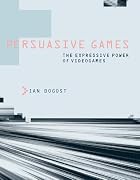
90) Persuasive Games / Ian Bogost
Bogost discusses videogames as an expressive medium in terms of "procedural rhetoric": the ways a game expresses arguments by means of procedures, abstract rules and their representation. After introducing his terms and their context, he examines videogames in three domains where videogames are often designed for rhetorical purposes: politics, advertising, and education.
The content is mostly good. Bogost's experience with videogames is both broad and deep, having studied them as a gamer, as an academic, and as a designer. Several examples are Bogost's own games designed for political campaigns and for corporate training.
Highlights for me included an analysis of Tax Invaders, a cheap Space Invaders imitator with a George Bush theme. Bogost argues that it is more sophisticated than it appears; an analysis of the Harry Potter game Quidditch World Cup, which Bogost claims illuminates themes in the book; and an analysis of his own The Howard Dean for Iowa Game, which he claims succeeded in the intended ways but failed in a broader unexpected sense. I think he's wrong about Tax Invaders, and overreaching about Quidditch, but right or wrong his arguments are carefully considered and interesting.
Unfortunately there's a good bit of sloppiness too, too much to be enthusiastic about the book. I mentioned an amusing typo above, but there are plenty of less-amusing others. Misspelled, elided, inserted, and substituted words -- he consistently uses "populous" when he means "populace' -- abound.
It's intended for an academic audience but is pretty accessible anyway, especially when Bogost talks about the games. I don't pretend to grasp most of the technical material: I'm not familiar with some of the rhetorical vocabulary, and not at all with most of the philosophical preliminaries. Worse, some of the technical parts that I *am* familiar with, Bogost gets wrong.
For example, Bogost seems to be confused about the meaning of "negative reinforcement" in behavioral theory, as in observations like this:
If videogames teach their content, and if that content ought to be negatively reinforced, then exposure to such games positively reinforces negative content.
This does not match my understanding of negative reinforcement. First, from a behavioral perspective, it is behavior not content that is reinforced. I don't even know what it might mean to reinforce content. More importantly, Bogost seems to think that "negative reinforcement" means "rewarding the avoidance of behavior," which is simply wrong. In behavioral theory, "negative reinforcement" means rewarding behavior by *removing* an undesired effect. Suppose I am trying to reinforce a desired behavior such as ... oh, stretching after a run. I can reinforce this behavior with "positive reinforcement" such as rewarding myself with a cookie after a proper stretch; or I can notice an absence of muscle cramps the following day: negative reinforcement. "Negative" and "positive" refer to the nature of the reinforcement, not to the nature of the behavior.
There's little math in the book, but what is there is wrong. Late in the book Bogost references the"set-theoretical ontology" of Alain Badiou, a French philosopher whom I know only by his (poor) reputation among mathematicians. Discussing Badiou's philosophy, Bogost makes a single set-theoretical claim:
A new situation is constructed out of the void (the empty set, Ø), which is always a member of every set.
This claim is false. Bogost has confused "member" for "subset." To be fair, for all I know Badiou may make the same error.
So it's a mixed bag: there's a lot of material here to ponder and I think he's hit on something important about how videogames work. It has problems, but I found it as fascinating as it was frustrating, and I plan to read more of Bogost's work. Recommended for readers interested in a critical look at videogames.
150swynn
Today I picked up the set of books my RL reading group will tackle this year:
A Road Trip Into America's Hidden Heart / John Drake Robinson
English Assassin / Daniel Silva
Outliers / Malcolm Gladwell
Age of Edison / Ernest Freeberg
Hotel on the Corner of Bitter and Sweet / Jamie Ford
Unbroken / Jessie Haas
The Fault in Our Stars / John Green
From this list, only The Fault in our Stars is in the swamp, so it's a collection of titles I wouldn't have read otherwise. I am looking forward to the Gladwell, whose books I haven't read but whom I've seen in interviews and presentations where I've found him both provocative and irritating. Also looking forward to the Freeberg because history and technology.
The others ... well, we'll see. Even with bad books the group discussions are always interesting.
A Road Trip Into America's Hidden Heart / John Drake Robinson
English Assassin / Daniel Silva
Outliers / Malcolm Gladwell
Age of Edison / Ernest Freeberg
Hotel on the Corner of Bitter and Sweet / Jamie Ford
Unbroken / Jessie Haas
The Fault in Our Stars / John Green
From this list, only The Fault in our Stars is in the swamp, so it's a collection of titles I wouldn't have read otherwise. I am looking forward to the Gladwell, whose books I haven't read but whom I've seen in interviews and presentations where I've found him both provocative and irritating. Also looking forward to the Freeberg because history and technology.
The others ... well, we'll see. Even with bad books the group discussions are always interesting.
151swynn

91) DAW #65: Warrior of Scorpio / Alan Burt Akers
Third in the "Dray Prescott" series of swords & planets adventures, following Suns of Scorpio, which I summarized here. This is more of the same, which you'll like if you like this sort of thing, and not a bit if you don't. I do like this sort of thing warts and all so ...
In this one Prescott is reunited with his great love Delia of Delphond. Then he loses her again. Twice. This seems to be a pattern.
He also meets the archer Seg Segutorio who becomes a series regular.
The cover is by Tim Kirk. Kirk also provides several interior illustrations; his style is a good fit for the series.
As with the first two, I'm summarizing the story for my own future reference.
SPOILERS FOLLOW:
In the last book, Dray organized and led a rebellion among galley slaves on the inland sea called The Eye of the World. On the verge of triumph in battle, Dray was pulled away from the scene by the Star Lords.
By force of will, Dray remains on Kregen, though he cannot keep the Star Lords from removing him from battle. Instead of sending him back to Earth, they deposit him at a nearby farm. There he meets Seg Segutorio, former bowman of Loh, captured and sold into slavery and currently serving as foreman on the farm.
Soon after Prescott's arrival the farm is attacked by sorzats, lizard-men raiding for slaves. Dray and Seg escape together with the farm's mistress and her infant child. They make for Happapat, a port town on The Eye of the World and the launch point for the sorzats' raiding expedition.
In Happapat Dray and Seg raise a rebellion among the sorzats' galley slaves, and torch all but one of the ships. In the remaining ship they set across the Eye of the World to rejoin Dray's slave rebellion. But storms prevent them from journeying far, which Dray interprets as intervention by the Star Lords.
Sighting a merchant ship beset by magdag slavers, Dray and Seg decide to intervene. They fight of the magdags and learn that the merchant ship has passengers: Delia of Delphond and her handmaiden Thelda. Apparently, Delia had heard rumors that Dray Prescott was running around the Eye of the World and came running to be at his side.
Seg insists on accompanying Dray, Delia, and Thelda back to Delphond. He seems to be motivated partly by loyalty to Prescott, but also by an infatuation for Thelda. Thelda, unfortunately for all, has eyes only for Dray. The journey to Delphond is a dangerous journey over the Stratemsk mountain range and the politically unstable Hostile Territories. The airboat carries them through the mountains well enough, but dies just as they enter the Hostile Territories.
They set out on foot toward Delphond, occasionally fighting off strange tentacled beasts, until they come across an army being attacked in a field by ullars, purple-haired warriors mounted on giant birds. Dray and Seg jump into the fray on the side of the underdog, and battle off the ullars. But as the ullars flee they take Delia with them.
Dray, Seg, and Thelda travel with the army to Hiclantung, where they are treated as guests of honor because Dray rescued the Queen's nephew during the battle. Queen Lilah of course falls in love with Dray (this seems to be a universal affliction among Kregen's women) and tries to get him to forget Delia. But when Dray hears that Delia may be alive and held captive in a tower in the ullars' capital Plicla.
Seg and Dray plan to sneak into Plicla by air, dropping Dray onto the tower's roof. The infiltration goes as planned, and there is indeed a captive in the tower. But the captive is not Delia; it is an old wizard Lu-si-Yuong. When Dray is certain his Delia is nowhere to be found he reluctantly escapes with the wizard.
Back in Hiclantung they hear new intelligence: a female captive is being held in the ullar city of Chersonang. Queen Lilah plans an attack on Chersonang anyway, and asks Dray to lead the army. Dray agrees. On the eve of battle Thelda tells him that she really did love him, but her advances were largely a ruse. Powerful groups in Delphond do not want Delia married to Dray and had hired her to interfere in their romance. She sees now that Dray truly loves Delia and to tell the truth she thinks Seg is kind of hot. She accompanies the army in its attack on Chersonang.
The attack does not go well. The army of Hiclantung is overwhelmed by air and ground forces. Seg and Thelda are unaccounted for and Dray believes them dead. He himself is taken prisoner to die in the arena of Chersonang. But when Dray arrives in the arena, naked and unarmed, he sees Delia there as well (also naked and unarmed). They fight off an Ullgishoa -- a slithery, slimy, squamous tentacled thing, then fight their way out of the arena. (If you think being naked and unarmed would prevent Prescott from defeating a horde armed to the teeth you haven't been paying attention.)
Escaping from Chersonang they meet a group of Vallians in an airboat: apparently the King of Delphond has sent out search parties to find Delia. They head back toward Delphond, but after camping the first night Dray awakes to find himself abandoned. Apparently Delia's enemies have conspired to keep them apart once again.
152swynn
Ancillary Justice wins the Hugo -- and though the book didn't thrill me I think it's a respectable choice. I haven't read the others, though I did once start the Robert Jordan thing. I bailed before it turned ponderous.
Sofia Samatar won the Campbell Award for best new writer, and her debut A Stranger in Olondria looks intriguing. Down for soonish, I think.
Sofia Samatar won the Campbell Award for best new writer, and her debut A Stranger in Olondria looks intriguing. Down for soonish, I think.
153swynn
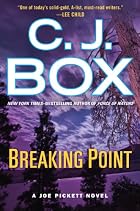
92) Breaking Point / C.J. Box
Thirteenth in Box's series featuring Wyoming game warden Joe Pickett. In this one, Joe's friend Butch Robertson falls under suspicion for murder when two EPA agents turn up dead and Butch flees into the wilderness.
As a thriller it's quite good; as social commentary it's heavy handed. Box explicitly parallels the Robertsons' situation to the Sackett case but for dramatic purposes he bleaches all nuance from the case, leaving a black-and-white tale of heroic citizens v. jackbooted thugs. In this installment all federal employees are either (1) jaded opportunists chasing a paycheck or (2) petty dictators manipulating regulations for personal gain.
In the past Box has dramatized questions of land use with shades of gray. Not so here. He even closes with a coda recommending donations to the Pacific Legal Foundation, an anticonservationist legal aid group and innovator in strategic lawsuits against public participation. I actually sympathize with the Sacketts mostly, but will keep my pennies.
Still, recommended for the thrills.
154swynn
I spent the weekend at my parents' in northeast Iowa, and took the opportunity to run a half-marathon near Hampton. The finish line and festivities were at Beed's Lake State Park.
RACE REPORT:

That's the scene at the starting line (taken with my crappy Tracfone camera, but you get the idea). Just a few minutes before, we'd been sitting in the shuttle bus waiting for lightning and downpour to pass.
The heavy rain had cleared off by the 8:00 start, but light rain continued for the next couple of hours. The rain was surprisingly pleasant: I had worried about forecasts of heat and humidity but the cloud cover kept the sun off and the rain helped moderate the temperature. It was humid obviously, but a pleasure for running.
It's the sort of rain that Mrs. Ninja scolds me for running in ("You'll catch your death of cold!") To which I respond: "'Twasn't a rain. 'Twas but a heavy mist."
The course starts with six miles of crushed gravel on converted railbed, then about six miles of blacktop road, and finishes with about a mile of single-track dirt trail leading to a causeway across the lake. The course was among the flattest I've ever run-- we'd been warned about a hill at mile 10, but it was little more than a speed bump. Other than that there was a slight positive grade leading up to an overpass around mile 9 but otherwise it was pancake-flat. (It would be great for a PR, if you're looking for that.)
I'm in a training cycle for a November marathon so I wasn't going for a PR. My plan was to treat this as a training run, take an easy pace, hopefully around nine minutes per mile, and finish just under two hours. So I was very pleased to run at a pace that felt good and still finish in 1:50. Thanks to the small field, that placed me third in my age group.
This was a lot of fun, well organized, and even the volunteers seemed to be having a great time standing in the rain handing out PowerAde. I'd run this one again.
Overheard on the shuttle bus:
A: Pardon me, may I sit here? I promise I don't bite.
B: (Laughs politely.) Sure.
A: (sits.) (waits a beat.) Of course, my water bottle leaks. But I don't bite.
RACE REPORT:

That's the scene at the starting line (taken with my crappy Tracfone camera, but you get the idea). Just a few minutes before, we'd been sitting in the shuttle bus waiting for lightning and downpour to pass.
The heavy rain had cleared off by the 8:00 start, but light rain continued for the next couple of hours. The rain was surprisingly pleasant: I had worried about forecasts of heat and humidity but the cloud cover kept the sun off and the rain helped moderate the temperature. It was humid obviously, but a pleasure for running.
It's the sort of rain that Mrs. Ninja scolds me for running in ("You'll catch your death of cold!") To which I respond: "'Twasn't a rain. 'Twas but a heavy mist."
The course starts with six miles of crushed gravel on converted railbed, then about six miles of blacktop road, and finishes with about a mile of single-track dirt trail leading to a causeway across the lake. The course was among the flattest I've ever run-- we'd been warned about a hill at mile 10, but it was little more than a speed bump. Other than that there was a slight positive grade leading up to an overpass around mile 9 but otherwise it was pancake-flat. (It would be great for a PR, if you're looking for that.)
I'm in a training cycle for a November marathon so I wasn't going for a PR. My plan was to treat this as a training run, take an easy pace, hopefully around nine minutes per mile, and finish just under two hours. So I was very pleased to run at a pace that felt good and still finish in 1:50. Thanks to the small field, that placed me third in my age group.
This was a lot of fun, well organized, and even the volunteers seemed to be having a great time standing in the rain handing out PowerAde. I'd run this one again.
Overheard on the shuttle bus:
A: Pardon me, may I sit here? I promise I don't bite.
B: (Laughs politely.) Sure.
A: (sits.) (waits a beat.) Of course, my water bottle leaks. But I don't bite.
155qebo
That's a good time for a casual effort. Running in the rain is fun if you can dry off immediately. Hanging around afterward in the rain is less fun.
I'm sitting here watching a live feed of the IronMan Louisville; a former running buddy finished little while ago. Former because I got slower and I am significantly less ambitious.
I'm sitting here watching a live feed of the IronMan Louisville; a former running buddy finished little while ago. Former because I got slower and I am significantly less ambitious.
157swynn
>155 qebo: Thanks, Katherine! I did have dry things to change into shortly after finishing and so did not have to stand around wet. Excellent weather, perfect timing.
Congratulations to your friend! I keep thinking triathlons would be fun, and keep saying "next year" ...
>156 ronincats:: Thanks, Roni!
Congratulations to your friend! I keep thinking triathlons would be fun, and keep saying "next year" ...
>156 ronincats:: Thanks, Roni!
158swynn
I also read some things on vacation ...
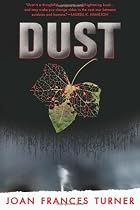
93) Dust / Joan Frances Turner
Like My Life as a White Trash Zombie, this is a zombie novel from the zombie's point of view. Unlike MLAAWTZ, these zombies are the traditional moaning shambling entrails-craving George Romero/Walking Dead sort and will never pass for human on a good day. Here's the opener:
My right arm fell off today. Lucky for me, I'm left-handed.
Zombies do not lack wit, nor social life, though the humans who bother to think about them generally lack the imagination to realize it. Jessie is actually quite happy with her undead life. She enjoys hunting and dancing and rotting with her gang in the wilderness south of the Indiana Dunes National Lakeshore. Humans generally leave them alone and they generally return the favor.
But a new disease is spreading, infecting humans and zombies alike. It makes zombies more alive, and humans more dead. Worse, Jessie's human brother has shown up in the woods, babbling about his work on a cure. From the sickness or the cure, Jessie's friends are either dying or changing into something not-human and not-undead. It shakes her zombie paradise and makes her ponder her loyalties to the person she is, to the human she used to be, and to both her families dead and undead.
Turner has imagined the life of her zombies in absorbing detail. It's not for the squeamish: the undead are preoccupied with rot, decay, and viscera. Given those basics, it's surprising how she has made their social life so appealing. Better, she turns a premise that sounds like an artfully unappealing one-joke book into a sustained meditation on loss, hunger, and friendship.
Enthusiastically recommended to those with the stomach for it.
93) Dust / Joan Frances Turner
Like My Life as a White Trash Zombie, this is a zombie novel from the zombie's point of view. Unlike MLAAWTZ, these zombies are the traditional moaning shambling entrails-craving George Romero/Walking Dead sort and will never pass for human on a good day. Here's the opener:
My right arm fell off today. Lucky for me, I'm left-handed.
Zombies do not lack wit, nor social life, though the humans who bother to think about them generally lack the imagination to realize it. Jessie is actually quite happy with her undead life. She enjoys hunting and dancing and rotting with her gang in the wilderness south of the Indiana Dunes National Lakeshore. Humans generally leave them alone and they generally return the favor.
But a new disease is spreading, infecting humans and zombies alike. It makes zombies more alive, and humans more dead. Worse, Jessie's human brother has shown up in the woods, babbling about his work on a cure. From the sickness or the cure, Jessie's friends are either dying or changing into something not-human and not-undead. It shakes her zombie paradise and makes her ponder her loyalties to the person she is, to the human she used to be, and to both her families dead and undead.
Turner has imagined the life of her zombies in absorbing detail. It's not for the squeamish: the undead are preoccupied with rot, decay, and viscera. Given those basics, it's surprising how she has made their social life so appealing. Better, she turns a premise that sounds like an artfully unappealing one-joke book into a sustained meditation on loss, hunger, and friendship.
Enthusiastically recommended to those with the stomach for it.
159swynn

94) Exiles of the Stars / Andre Norton
Follow-up to Moon of Three Rings. In this one Maelen has joined the crew of Krip's trading ship. Carrying a cargo of cultural treasures from a planet on the verge of revolution, their ship is sabotaged and lands on the inhospitable planet Sekhmet. What first appears to be a need for rescue becomes a fight for survival when telepathic aliens attack.
This was fun enough, but lacked anything like the first book's reflections on identity. The closest thing is Krip's divided loyalties to his crew on the one hand and his growing bond with Maelen on the other. Still a pretty good story, and I will read the next.
160swynn
95) Ghost Stories of an Antiquary / M.R. James
Eight stories, mostly about historians, collectors, and gentlemen with antiquarian interests stumbling onto and accidentally disturbing ancient mysteries inn exotic locales. They are simple and funny and effectively creepy and I want more.
Eight stories, mostly about historians, collectors, and gentlemen with antiquarian interests stumbling onto and accidentally disturbing ancient mysteries inn exotic locales. They are simple and funny and effectively creepy and I want more.
161swynn

96) Daw #67: The Lord's Pink Ocean / David Walker
Date: 1972
A mysterious global algal bloom has turned the oceans pink and the land gray. The only habitable land left on the planet is in arctic regions and around isolated lakes.
The Parkers and the Smiths are survivors living on the banks of a spring-fed lake. James Parker is hard-working and conscientious; Robert Smith takes a day at a time. Parker is black and Smith is Scottish. They're united by mutual dependence but also divided by personal and racial animosity, so their shared existence depends on belief in tolerance and good fences. Parker has a daughter; Smith has a son; the rest is inevitable. Further complications ensue when missionaries from the arctic disturb their uneasy equilibrium.
It's a parable about racism and environmentalism and its heart is in the right place but it's awfully obvious and heavy-handed with painfully stiff dialogue. Skippable.
162swynn

97) Neutrino Hunters / Ray Jayawardhana
Neutrinos are mysterious things: their existence was conjectured back in the early twentieth century in order to solve a puzzling problem in particle physics, but the physicist who authored the conjecture doubted they would ever be found even if they turned out to exist. Turns out they do, and they're hugely abundant but awfully elusive: maybe massless maybe as heavy as a millionth the mass of an electron, and though the sun produces them by the billions almost all of the neutrinos that arrive at earth pass right through without ever hitting anything.
Elusive though neutrinos are, scientists are finding ever-cleverer ways to detect them. With detectors buried deep underground in abandoned mines or under antarctic ice, they are developing new understandings of the particles' place in the universe. Observations from experiments currently underway may have far-ranging effects, from forcing us to revise the standard model of particle physics to sharpening our understanding of the early universe.
Jayawardhana's account of the history, personalities, experiments, and prospects in neutrino research is another of Scientific American's favorite books of 2013. It's a good choice: it's engaging and surprisingly brief at just 192 generously-illustrated pages. The length means that there's little opportunity for attention to wander but that theory mostly gets a back-of-the-envelope treatment. I occasionally wished for more detail but was never bored.
With popular treatments of quantum physics, I'm always suspicious of explanations that seem to make sense (How messed up is that?), so I can't help feeling a bit suspicious of Jayawardhana's clear and coherent exposition. But I'll recommended it anyway because it was just so interesting and fun.
164swynn
Hope you like it if you can find it, Jim! I'd certainly be interested in your take on it. FYI, I've made a few edits to the comments above, mostly typos but one substantive change:
"a millionth the mass of an atom"
should be:
"a millionth the mass of an electron"
Early morning typing, sheesh.
"a millionth the mass of an atom"
should be:
"a millionth the mass of an electron"
Early morning typing, sheesh.
165swynn
Treadmill reading:
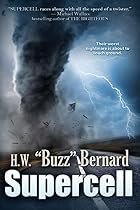
98) Supercell / H, W. "Buzz" Bernard
Chuck Rittenberg is a washed-up tornado chaser. Years ago, a passenge was killed on one of his chases and in the aftermath Chuck lost his career, his family, and most of his will for life.
But the opportunity to get it all back comes knocking when a Hollywood producer shows up with a million-dollar contract, payable only if Chuck can place a film crew in position to capture an EF-5 tornado. Seeing an opportunity to resurrect his family relationships as well as his career, Chuck contacts his estranged son and asks him to join the team. Almost simultaneously, Chuck is approached by an attractive FBI agent on the trail of storm-chasing criminals.
It's okay for treadmill reading. Relationships are a little iffy: Chuck and the FBI agent have a romance of course, which lacks all chemistry; and Chuck's difficulty with his son hinge on his religious hangups with his son's sexual orientation, which lead to heavy-handed pontificating. (As in life, I'm puzzled by Christian characters who think God is cool with alcoholism and sleeping around but throws a hissy over guys hooking up.) It all works out, I guess, since Chuck decides to accept his son, but I can't help thinking he's a jerk for not coming to that conclusion before extending the invitation.
98) Supercell / H, W. "Buzz" Bernard
Chuck Rittenberg is a washed-up tornado chaser. Years ago, a passenge was killed on one of his chases and in the aftermath Chuck lost his career, his family, and most of his will for life.
But the opportunity to get it all back comes knocking when a Hollywood producer shows up with a million-dollar contract, payable only if Chuck can place a film crew in position to capture an EF-5 tornado. Seeing an opportunity to resurrect his family relationships as well as his career, Chuck contacts his estranged son and asks him to join the team. Almost simultaneously, Chuck is approached by an attractive FBI agent on the trail of storm-chasing criminals.
It's okay for treadmill reading. Relationships are a little iffy: Chuck and the FBI agent have a romance of course, which lacks all chemistry; and Chuck's difficulty with his son hinge on his religious hangups with his son's sexual orientation, which lead to heavy-handed pontificating. (As in life, I'm puzzled by Christian characters who think God is cool with alcoholism and sleeping around but throws a hissy over guys hooking up.) It all works out, I guess, since Chuck decides to accept his son, but I can't help thinking he's a jerk for not coming to that conclusion before extending the invitation.
166swynn
RACE REPORT
My first triathlon, sort of: this Sunday I did the Nemo Triathlon on a 3-man team. I did the running leg. The day was terrific for running (and for biking and for swimming too, I assume: the water was a balmy 74 degrees at the start despite an air temperature in the low 50's.
The starting line is at a beach about a mile from the transition area, and I went to watch the start, figuring I'd start to warm up on the way back. I watched the swimmers proceed as I jogged back to the transition area. Unfortunately, running and spectating was one task too many for my limited coordination: I stepped off the road and rolled my ankle. Badly. Also scraped my shin pretty well on the blacktop. Also sliced my thumb open.
I was the First Aid station's first customer (there are no medals for this). I think I caught them off-guard: when I asked if they had any bandages they said they weren't sure. (Really.) They did get me bandaged up and let me go about the time my biker teammate took off, telling me to come back after the race. I spent the next hour working my ankle to keep it from stiffening up, but was a little concerned that the exercise didn't seem to be improving things much.
The run went pretty well, considering. It's a five-mile leg and I'd hoped to break forty minutes, which was probably optimistic since the course is hilly. I thought the ankle would trash my time completely but I still finished in just over forty-one. Our team took second place out of four male teams -- twenty minutes behind the crazy fast lead team, so my bum ankle hurt our placement not at all.
I did return as instructed to the first aid station, which was staffed by students and staff from the local osteopathic school. My ankle was diagnosed as a bad sprain and I was instructed to stay off it for the next two weeks. At least. Here's a confession: I did not intend to follow this directive. Then Sunday night my ankle swelled to softball size, then Monday morning it was marbled purple and I could barely stand on it.
No running for two weeks.
And no books finished over the weekend: I've been sulking and binge-watching Dexter on Netflix.
My first triathlon, sort of: this Sunday I did the Nemo Triathlon on a 3-man team. I did the running leg. The day was terrific for running (and for biking and for swimming too, I assume: the water was a balmy 74 degrees at the start despite an air temperature in the low 50's.
The starting line is at a beach about a mile from the transition area, and I went to watch the start, figuring I'd start to warm up on the way back. I watched the swimmers proceed as I jogged back to the transition area. Unfortunately, running and spectating was one task too many for my limited coordination: I stepped off the road and rolled my ankle. Badly. Also scraped my shin pretty well on the blacktop. Also sliced my thumb open.
I was the First Aid station's first customer (there are no medals for this). I think I caught them off-guard: when I asked if they had any bandages they said they weren't sure. (Really.) They did get me bandaged up and let me go about the time my biker teammate took off, telling me to come back after the race. I spent the next hour working my ankle to keep it from stiffening up, but was a little concerned that the exercise didn't seem to be improving things much.
The run went pretty well, considering. It's a five-mile leg and I'd hoped to break forty minutes, which was probably optimistic since the course is hilly. I thought the ankle would trash my time completely but I still finished in just over forty-one. Our team took second place out of four male teams -- twenty minutes behind the crazy fast lead team, so my bum ankle hurt our placement not at all.
I did return as instructed to the first aid station, which was staffed by students and staff from the local osteopathic school. My ankle was diagnosed as a bad sprain and I was instructed to stay off it for the next two weeks. At least. Here's a confession: I did not intend to follow this directive. Then Sunday night my ankle swelled to softball size, then Monday morning it was marbled purple and I could barely stand on it.
No running for two weeks.
And no books finished over the weekend: I've been sulking and binge-watching Dexter on Netflix.
167scaifea
Oh, no! I'm sorry to hear about your tumble and the resulting marbled ankle! Here's hoping it heals quickly!
168qebo
>166 swynn: Oh no! What a nuisance. Though it does make for a more exciting race report.
169swynn
Thanks for the commisseration!
At Mrs. Ninja's insistence I saw the doctor today. He was a little more hopeful: unless it's fractured (he ordered x-rays), he told me to back off everything for a week, except for some exercises he gave me. After that he said I could "work it to comfort."
He did warn me to reduce my expectations for long runs and consequently for Tulsa also. He doubts I'll be ready to run all 26 miles by the end of November, but a judicious run-walk strategy isn't out of the question. He tells me to let comfort and good sense be my guides. (I'll have to rely heavily on the former because I seem to have a deficit of the latter.)
On the other hand if the ankle is fractured we'll have to "treat it more aggressively."
At Mrs. Ninja's insistence I saw the doctor today. He was a little more hopeful: unless it's fractured (he ordered x-rays), he told me to back off everything for a week, except for some exercises he gave me. After that he said I could "work it to comfort."
He did warn me to reduce my expectations for long runs and consequently for Tulsa also. He doubts I'll be ready to run all 26 miles by the end of November, but a judicious run-walk strategy isn't out of the question. He tells me to let comfort and good sense be my guides. (I'll have to rely heavily on the former because I seem to have a deficit of the latter.)
On the other hand if the ankle is fractured we'll have to "treat it more aggressively."
172swynn
170, 171: Thanks for the hopes & finger-crossings. There is indeed a fracture, but it's an "avulsion fracture," which the Dr. says means that I broke a chip off the end of the tibia. Looking at a skeletal diagram I have a hard time imagining this, and wonder if he meant the fibula (I could also have misheard).
This is good and bad news: this is a less severe fracture than he'd feared, so there is no change in treatment. Bad news is that he's very skeptical about my chances for a November marathon. See how it goes but don't push it too hard, he says.
This is good and bad news: this is a less severe fracture than he'd feared, so there is no change in treatment. Bad news is that he's very skeptical about my chances for a November marathon. See how it goes but don't push it too hard, he says.
173qebo
>172 swynn: Thanks to kidzdoc and his injured finger, I have already looked up "avulsion". :-)
174scaifea
>172 swynn: Well, dang. Here's hoping the recovery goes even faster than expected for you, Steve.
175swynn
>173 qebo: That's it! I knew I had seen the term recently.
>174 scaifea: Thanks, Amber!
My plan is to shift workouts to the spinning cycle or swimming pool to continue building cardio conditioning while minimizing stress on the ankle. We'll see how that works.
Oh and ... I read a book!

99) DAW #68: Starmasters' Gambit / Gerard Klein
Date: 1973
This is an English translation of Klein's 1958 novel Gambit des Étoiles.
Jerg Algan is Earth-born and Earth-bound and likes it that way. But a recruiter for the space colonies plies him with drugs and cons him into enlisting. Algan is now destined for some distant backwater planet. Thanks to relativity when he returns to Earth -- if he ever returns to Earth -- it won't be the Earth he left.
In his first port of call, in a market on one of the Puritan worlds, Algan discovers a mysteriously appealing object: an ancient chessboard inscribed with intricate and unfamiliar characters. The merchant spins him a story about how the board was recovered from a frontier world from the remains of a civilization that predates human exploration. The merchant gifts the board to Algan and urges him to seek out its mystery. This he does.
It's awfully talky, with long interludes musing about fate and purpose. There are two major powers in the universe, distinguished largely by their strategies to control human destiny. The master planners of Betelgeuse have a more ambitious plan for fate, and employ a broad-scope strategy of colonization and gathering knowledge hoping to establish human networks among the stars.
In competition to the Betelgeusians, the Puritan worlds plan to manipulate human destiny by exploiting the time distortions of space travel: send one astronaut out for twenty years, another for forty, and as the travelers return they can establish cultural continuity across centuries or longer.
Algan is caught between the Betelgeusians and the Puritan worlds. The Betelegeusians Shanghaied him for the colony worlds but also give tacit support to his mission to find chessboard's creators. On the other hand, the Puritans supplied him with the board and hope that Algan's success might undermine Betelgeuse's power. Algan himself feels robbed of his fate and bears neither Betelgeuse nor the Puritan worlds any loyalty. It is clear pretty early on that the answer to the mystery will be an even greater power manipulating both the planners' and the Puritans' fate just as they attempt to control Algan's.
The creators of the chessboard are the stars themselves, or possibly sentient beings who live on stars, who lead incredibly lonely lives. These beings are also responsibile for the seeding and evolution of human beings, whose purpose is to play chess. It turns out that solutions to chess problems are also solutions to problems in interstellar navigation: to the stars, humans are chess-playing robots whose purpose is to help the stars establish communication networks.
For me Klein's philosophical preoccupations blocked any decent character development or narrative rhythm so I won't recommend it generally. If you like the pensive sort of science fiction that uses plot as a platform for Big Ideas you might find it interesting.
The cover is by Kelly Freas.
>174 scaifea: Thanks, Amber!
My plan is to shift workouts to the spinning cycle or swimming pool to continue building cardio conditioning while minimizing stress on the ankle. We'll see how that works.
Oh and ... I read a book!

99) DAW #68: Starmasters' Gambit / Gerard Klein
Date: 1973
This is an English translation of Klein's 1958 novel Gambit des Étoiles.
Jerg Algan is Earth-born and Earth-bound and likes it that way. But a recruiter for the space colonies plies him with drugs and cons him into enlisting. Algan is now destined for some distant backwater planet. Thanks to relativity when he returns to Earth -- if he ever returns to Earth -- it won't be the Earth he left.
In his first port of call, in a market on one of the Puritan worlds, Algan discovers a mysteriously appealing object: an ancient chessboard inscribed with intricate and unfamiliar characters. The merchant spins him a story about how the board was recovered from a frontier world from the remains of a civilization that predates human exploration. The merchant gifts the board to Algan and urges him to seek out its mystery. This he does.
It's awfully talky, with long interludes musing about fate and purpose. There are two major powers in the universe, distinguished largely by their strategies to control human destiny. The master planners of Betelgeuse have a more ambitious plan for fate, and employ a broad-scope strategy of colonization and gathering knowledge hoping to establish human networks among the stars.
In competition to the Betelgeusians, the Puritan worlds plan to manipulate human destiny by exploiting the time distortions of space travel: send one astronaut out for twenty years, another for forty, and as the travelers return they can establish cultural continuity across centuries or longer.
Algan is caught between the Betelgeusians and the Puritan worlds. The Betelegeusians Shanghaied him for the colony worlds but also give tacit support to his mission to find chessboard's creators. On the other hand, the Puritans supplied him with the board and hope that Algan's success might undermine Betelgeuse's power. Algan himself feels robbed of his fate and bears neither Betelgeuse nor the Puritan worlds any loyalty. It is clear pretty early on that the answer to the mystery will be an even greater power manipulating both the planners' and the Puritans' fate just as they attempt to control Algan's.
For me Klein's philosophical preoccupations blocked any decent character development or narrative rhythm so I won't recommend it generally. If you like the pensive sort of science fiction that uses plot as a platform for Big Ideas you might find it interesting.
The cover is by Kelly Freas.
176swynn

100) The Simpsons and their Mathematical Secrets / Simon Singh
Simon Singh explains mathematical jokes and freeze-frame gags from The Simpsons and Futurama. There are more than you might think: the production staff on both shows include writers with advanced degrees in mathematics who enjoy inserting nerdy jokes into the scripts and scenery.
It's fun, though I expect it will appeal mostly to fans of the shows.
177swynn

101) The Burn Palace / Stephen Dobyns
Morgan Memorial Hospital, small-town Brewster, Rhode Island. A newborn baby disappears from the neonatal wing, replaced in its bassinet by a corn snake.
It may be the weirdest thing to happen this week, but not for lack of competition. An insurance investigator turns up deceased and scalped; a janitor at the local crematorium goes violently mad; a pack of unusually large and bold coyotes prowl the town at night; and in a nearby swamp are found the remains of a bonfire and signs of a secretive ritual that .... well, ain't exactly Methodist. As Halloween draws closer things promise only to turn weirder.
There's a lot to like here, chiefly the large and convincing cast of characters. They cover the spectrum from appealing to appalling and from admirable to pathetic and frequently mixtures of all. The prose is simple and direct, more suited to wry humor than to small-town weirdness -- which occasionally makes creepy scenes all the more effectively creepy. It's been widely praised, so the recipe seems to have worked for quite a few.
It mostly works for me too, though the pacing felt off. At about the two-thirds point, though I started to wonder whether things were ever going to come together. It was beginning to feel like a meal of too much herring and not enough beef. The various threads do in fact converge late in the book but they do so too quickly, requiring an epilogue to connect the dots. And for me some dots remain unconnected.
No strong recommendation from me on this one: it's better than many small-town gothic stories, but its pacing problems negatively affected the suspense and resolution for me.
178swynn

102) Just One Damned Thing After Another / Jodi Taylor
I think I'll hang around on this bandwagon, it's a fun ride.
179swynn
103) Ruins / Dan Wells
Third and last in Wells's Partials series. I thought the first was flawed but intriguing, the second bloated and rambling, and this third is ... okay. It has flaws of its own that keep it from making up for volume 2, but it does what it needs to do, wrapping up loose ends and closing -- rather suddenly, considering the pace of everything that went before -- on a satisfactory hopeful note.
180swynn
104) A Road Trip Into America's Hidden Heart / John Drake Robinson
This was the first of this season's books in my RL reading group, chosen because the author will be visiting town next month. It's a report from the author's project of driving every mile of state-maintained road in the state of Missouri. He and his car were close friends.
It's a good-humored book and a treasure chest of historical and culinary trivia about Missouri's smaller towns. I found myself making notes about obscure sights to check out. That was probably the author's intent, so mission accomplished.
On the downside, despite its premise it feels very little like a personal odyssey and much more like a chatty travel guide. The text is heavy on historical anecdotes and restaurant recommendations, to the extent that eighty percent of the book could have been cribbed from a Missouri tourist manual. Ten percent of the rest consists of wordplay based on small-town names. It's amusing, but appreciated best in small doses.
Probably most appealing to Missouri residents, to whom it's recommended.
181swynn

105) Even White Trash Zombies Get the Blues / Diana Rowland
Satisfying follow-up to My Life as a White Trash Zombie. In this one Angel unravels a conspiracy involving re-resurrected zombies, synthetic brains, and the zombie mafia. It's quite fun, and recommended.
182rosalita
And another one succumbs to the St. Mary's virus! They are cracking good fun, aren't they?
184swynn
106) Dark Invasion / Howard Blum
I don't remember where I first saw this mentioned; it may have been Suzanne, who read and raved about it earlier this year. Whoever, wherever, I'm glad I picked it up. It's a suspenseful narrative about Germany's network of spies and saboteurs in America during the early years of WWI, and the efforts of law enforcement -- led by the head of the New York City bomb squad -- to ferret them out.
The cover is dull as dirt, so don't let that put you off. It's a terrific story well told. Recommended.
185swynn

107) The Good Nurse / Charles Graeber
Over sixteen years in nine hospitals, nurse Charles Cullen killed at least forty and as many as four hundred patients by administering high doses of unprescribed meications. His motives are puzzling: he killed patients with terminal conditions as well as others who were recovering and about to be discharged. In some cases, he killed randomly, spiking IV bags that hadn't yet been distributed and leaving his victims to the luck of the draw.
But Cullen isn't the only villain here. This isn't one of the stories where the killer had everyone fooled. In fact, he was clearly a piece of work almost from the beginning. He was repeatedly terminated for dosing irregularities, but always found it easy to join the staff of another hospital, even receiving positive references from former supervisors who suspected him of murder. Even after a police investigation was opened, hospital administration stonewalled, cooperating only to the minimum amount required by law, maybe less. By the end the mystery is not how Cullen got away with it for sixteen years but the fact that he was ever caught at all.
The style is a thriller's and the pace is fast. Occasionally there's an odd rhetorical flourish or an irrelevant mid-sentence footnote but for the most part it works and is recommended.
186qebo
>185 swynn: I remember when this was in the news. An entire book may be too creepy for my taste.
187rosalita
>185 swynn: Whoa! I remember that case, too, and the book sounds fascinating. Onto the list!
188swynn
>186 qebo:: It is pretty relentless. It never really feels exploitative, though: he doesn't dwell on victims' suffering, it's more a chronicle of what's known about Cullen's methods, and the responses from hospital administration and finally law enforcement.
>187 rosalita:: If you get to it, Julia, I hope you find it as compelling as I did!
>187 rosalita:: If you get to it, Julia, I hope you find it as compelling as I did!
189swynn
Treadmill reading:
108) Whirlwind / Rick Mofina
Another Rick Mofina novel, another missing-child plot. This time a baby boy is kidnapped during a tornado emergency in the Dallas-Fort Worth area. At first everyone suspects the child was blown away by the storm, but when no body is found, a persistent reporter finds clues that he is still alive. The plot involves black-market babies, the Russian mob, and newsroom politics. The style is simple and direct, perfect for a workout entertainment.
108) Whirlwind / Rick Mofina
Another Rick Mofina novel, another missing-child plot. This time a baby boy is kidnapped during a tornado emergency in the Dallas-Fort Worth area. At first everyone suspects the child was blown away by the storm, but when no body is found, a persistent reporter finds clues that he is still alive. The plot involves black-market babies, the Russian mob, and newsroom politics. The style is simple and direct, perfect for a workout entertainment.
190swynn
More treadmill reading:
109) Eveline Mandeville / Alvin Addison
Date: 1837
I picked this up from Indiana University's Wright American Fiction online collection of 19th-century American novels. It's an entertaining but very dated melodrama about the perils of Eveline Mandeville, a marriageable young woman who unwittingly catches the amorous attention of man-about-town Willard Duffel.
Eveline's father is impressed by Duffel's apparent wealth and charm and urges Eveline to accept his proposal. But there is something about him Eveline dislikes: in fact, she suspects that Duffel is a horse thief. Besides, her heart belongs to the virtuous (but impecunious) Charles Hadley. Duffel *is* in fact a horse thief. But when he learns that Hadley is a rival for Eveline's affection, Duffel persuades Eveline's father that the criminal is Hadley, not he. Complications ensue, including attempted murder, kidnapping, horse thievery, and nearly-compromised virtue.
The entertainment is heightened by its period flourishes, which tend to have effects opposite their intended ones, as when Père Mandeville forbids Eveline to marry Hadley, causing her to fall ill with a broken heart that keeps her bedridden and near death for weeks; or as when the dastardly Duffel meets his well-deserved end repenting earnestly of his wickedness and crying for his sainted mother who, in a vision, forgives him. And just in case the reader is unsure how to react to some turn of events, the author occasionally addresses his readers or his characters directly and hysterically:
Exulting wretch! Would to heaven the vengeance of an angry God could overtake you, ere your schemes of fiendish crimes and dark murders are completed. But, alas for the innocent, crime is yet in the ascendant!
Of course in the end evil is thwarted and the lovers reunited through a thrilling -- and by "thrilling" I mean "unintentionally funny" -- series of unlikely coincidences. Recommended for the curious.
109) Eveline Mandeville / Alvin Addison
Date: 1837
I picked this up from Indiana University's Wright American Fiction online collection of 19th-century American novels. It's an entertaining but very dated melodrama about the perils of Eveline Mandeville, a marriageable young woman who unwittingly catches the amorous attention of man-about-town Willard Duffel.
Eveline's father is impressed by Duffel's apparent wealth and charm and urges Eveline to accept his proposal. But there is something about him Eveline dislikes: in fact, she suspects that Duffel is a horse thief. Besides, her heart belongs to the virtuous (but impecunious) Charles Hadley. Duffel *is* in fact a horse thief. But when he learns that Hadley is a rival for Eveline's affection, Duffel persuades Eveline's father that the criminal is Hadley, not he. Complications ensue, including attempted murder, kidnapping, horse thievery, and nearly-compromised virtue.
The entertainment is heightened by its period flourishes, which tend to have effects opposite their intended ones, as when Père Mandeville forbids Eveline to marry Hadley, causing her to fall ill with a broken heart that keeps her bedridden and near death for weeks; or as when the dastardly Duffel meets his well-deserved end repenting earnestly of his wickedness and crying for his sainted mother who, in a vision, forgives him. And just in case the reader is unsure how to react to some turn of events, the author occasionally addresses his readers or his characters directly and hysterically:
Exulting wretch! Would to heaven the vengeance of an angry God could overtake you, ere your schemes of fiendish crimes and dark murders are completed. But, alas for the innocent, crime is yet in the ascendant!
Of course in the end evil is thwarted and the lovers reunited through a thrilling -- and by "thrilling" I mean "unintentionally funny" -- series of unlikely coincidences. Recommended for the curious.
191swynn

110) DAW #69: The Pritcher Mass / Gordon R. Dickson
Date: 1972
Sometime in the early 21st century, pollution and the worldwide dispersal of a deadly fungus have forced humans into domed, sealed cities. This retreat is only a stopgap measure, since the spores are so small and ubiquitous that it is only a matter of time before any sterile environment is compromised. Humanity's only hope is to find another habitable planet. It turns out that our best chance of doing that is psychics.
The "Pritcher Mass" is a nonmaterial construct located somewhere out beyond the orbit of Pluto. Just how a nonmaterial construct can be located anywhere is never explained, but somehow it's necessary to have the people working on the mass located beyond the psychic influences of earth. Or something. The people working on the mass are powerful psychics who build the mass according to no particular plan: each individual adds to it according to his or her intuition about how it might be best developed.
Crazy as it sounds, humans have gambled everything on the Mass. Workers live in enviable comfort and ease out beyond Pluto, but the tests for eligibility are hard. Enter Charles "Chaz" Sant, who is convinced that he has Pritcher Mass talent but has always tested just under the threshold for eligibility. Chaz has heard that a catalyst might help him focus his psychic ability, bumping him just enough to pass the test. Unfortunately, the best catalyst is a stone gathered from outside the sealed domes: acquiring one is impossible, and possessing one is illegal.
Then a fortuitous train wreck lets Chaz slip outside, grab a stone, then sneak back inside unobserved ... or so he thinks. His action launches a chain of events that has him dodging authorities and organized crime, aided by a witch who was sent to stop him but fell in love with him instead when he turned out to be a fun drunk. Really.
With the witch's help Chaz gets sent out to Pluto where he learns that the Mass is really on earth after all (again: how?) so he comes back, organizes a terrorist cell, and starts a revolution.
Dickson's books are mostly hit and miss with me, and this one's a miss. Yes, the premise is ridiculous, but I was willing to go with it. But the hero is an arrogant prick and the female characters are misogynistic stereotypes. The denouement, in which the end justifies the means, is just plain disturbing. The witch's familiar, a telepathic wolverine, was the single interesting character and there just wasn't enough of him.
Not recommended.
The colorful and very busy cover is by DAW favorite Kelly Freas. The next DAW is The Hero of Downways, by Michael G. Coney who is consistently interesting. I'm looking forward to it.
192swynn

111) A Madness of Angels / Kate Griffin
Roni is doing a great job spreading the word about this terrific series, and I don't have much to add except that it's every bit as good as she claims: I spent most of last week wandering a hyperreal supernatural London with a dangerous and powerful guide. The tour is oh my yes.
I picked it up because Roni had compared it favorably to the Sandman Slim series and okay, Roni you win: this is a better book. It's a richer world, a more interesting character, and a scarier more marvelous trip. That said, I've lost no love for Sandman Slim, which still seems to me a smart and snarky middle finger to convention.
But if you're only going to read one of the series, make it Matthew Swift.
193ronincats
See there, people!! Vindication in spades! Thank you, Steve.
I think the Sandman Slim series would appeal more to males than females, because of, well, all the testosterone being sprayed around there. But for character and world depth, follow Steve's advice! And Steve...The Midnight Mayor shows none of the usual flaws of a sophomore book, but is just as marvelous, imho. I have to get up to Mysterious Galaxy this week--my copy of book 3 is awaiting me.
I have a lot of Dickson, but what I kept was mostly his Dorsai series and Masters of Everon. Didn't hold onto The Pritcher Mass and don't really remember it although I'm sure I read it...40 years ago.
I think the Sandman Slim series would appeal more to males than females, because of, well, all the testosterone being sprayed around there. But for character and world depth, follow Steve's advice! And Steve...The Midnight Mayor shows none of the usual flaws of a sophomore book, but is just as marvelous, imho. I have to get up to Mysterious Galaxy this week--my copy of book 3 is awaiting me.
I have a lot of Dickson, but what I kept was mostly his Dorsai series and Masters of Everon. Didn't hold onto The Pritcher Mass and don't really remember it although I'm sure I read it...40 years ago.
194swynn
>193 ronincats:: Hi Roni and thanks for the recommendation! I confess to a weakness for testosteroney narrative so that may explain everything. The Midnight Mayor is on the way, but it may be a month or two before I get to it.
Although I read science fiction voraciously as a kid I remember very little Dickson, probably because he wasn't well represented in my local public library. I remember reading The Dragon and the George and loving it, but trying Necromancer and not getting it. So I don't have a strong attachment to his work, and feel no guilt saying "meh."
Although I read science fiction voraciously as a kid I remember very little Dickson, probably because he wasn't well represented in my local public library. I remember reading The Dragon and the George and loving it, but trying Necromancer and not getting it. So I don't have a strong attachment to his work, and feel no guilt saying "meh."
195swynn

112) A Killing in the Hills / Julia Keller
An unidentified gunman walks into a cafe in backwoods Acker's Gap, West Virginia, and guns down three senior citizens over their ritual coffee. Witness to the murders is Carla Elkins, daughter of county prosecutor Bell Elkins. Bell already has her hands full with battling the burgeoning black market in prescription painkillers and with an ethically complex case involving a mentally disabled man and a dead child; add to that the triple homicide and a traumatized teenager, and her life becomes difficult.
Pluses here are a good sense of place and a solid cast of characters. Minuses are a plot that feels like a cut-and-paste job on two different books, and the tone-- it feels like Keller's trying to reinvent redneck noir from a middle-class D.A.'s perspective, and it doesn't quite work for me.
Still, the setting and characters are interesting enough that I'd pick up the second just to see where it goes. Probably not soon, though.
196swynn
RUNNING POST
This weekend I spent in northeast Oklahoma visiting in-laws and celebrating Mrs. Ninja's 50th birthday (I'm quite sure she doesn't mind me mentioning the exact number, since she was announcing it to perfect strangers all weekend.)
There's a terrific program in Mrs. Ninja's hometown called "Run the Streets," which pairs at-risk teenagers with community volunteer runners in a twelve-week program to train for a half-marathon. The program seems to be a great success both for the youth and for the volunteers -- and at every race I've been in the area I've seen that kids wearing "Run the Streets" shirts get a lot of love from spectators as well.
So this weekend was a major fundraiser for the program: an 8K over the roads of Woolaroc, a lovely patch of green in northeast Oklahoma. Woolaroc used to be the private ranch of Frank Phillips, founder of Phillips Petroleum and today is home to a wildlife preserve and historical museum. The course is hillier than you might expect for Oklahoma, but not painfully so, and you get to run with buffalo which is a rare opportunity.
The race was well-attended, with about 400 runners despite a cool and rainy morning. The rain stopped just in time for the race, and the mid-50's temperature was perfect. I finished in about 41 and half minutes, so still a little slow but pain-free through the run. My bad ankle held up well: in fact it was my other foot that hurt the next day, with what seemed to be a touch of my old frenemy plantar fasciitis. I know how to deal with that.
Looking forward to another 5K this weekend, this one partly on trail.
This weekend I spent in northeast Oklahoma visiting in-laws and celebrating Mrs. Ninja's 50th birthday (I'm quite sure she doesn't mind me mentioning the exact number, since she was announcing it to perfect strangers all weekend.)
There's a terrific program in Mrs. Ninja's hometown called "Run the Streets," which pairs at-risk teenagers with community volunteer runners in a twelve-week program to train for a half-marathon. The program seems to be a great success both for the youth and for the volunteers -- and at every race I've been in the area I've seen that kids wearing "Run the Streets" shirts get a lot of love from spectators as well.
So this weekend was a major fundraiser for the program: an 8K over the roads of Woolaroc, a lovely patch of green in northeast Oklahoma. Woolaroc used to be the private ranch of Frank Phillips, founder of Phillips Petroleum and today is home to a wildlife preserve and historical museum. The course is hillier than you might expect for Oklahoma, but not painfully so, and you get to run with buffalo which is a rare opportunity.
The race was well-attended, with about 400 runners despite a cool and rainy morning. The rain stopped just in time for the race, and the mid-50's temperature was perfect. I finished in about 41 and half minutes, so still a little slow but pain-free through the run. My bad ankle held up well: in fact it was my other foot that hurt the next day, with what seemed to be a touch of my old frenemy plantar fasciitis. I know how to deal with that.
Looking forward to another 5K this weekend, this one partly on trail.
197qebo
>196 swynn: you get to run with buffalo which is a rare opportunity
Oh, cool; I checked the web site. Also a map. Zero to a half marathon seems rather a lot for twelve weeks, which perhaps is the point. Happy 50th to Mrs. Ninja!
Oh, cool; I checked the web site. Also a map. Zero to a half marathon seems rather a lot for twelve weeks, which perhaps is the point. Happy 50th to Mrs. Ninja!
198swynn
It is a challenging task; I'd been running for about a year and a half before my first half-- most couch-to-5Ks come in 12- to 16-week schedules. As you'd expect, the kids who participate finish the target race with a wide variety of strategies.
But running, walking, or by some mixture they finish. And quite a few come back for the next season determined to do even better.
But running, walking, or by some mixture they finish. And quite a few come back for the next season determined to do even better.
199swynn

113) Big City, Bad Blood / Sean Chercover
When Hollywood locations manager Bob Loniski is threatened by a low-level Chicago gangster he comes to P.I. Ray Dudgeon for bodyguard services. Dudgeon is a native Chicagoan with a healthy respect for the "Outfit," so before he takes the job he checks with his underworld contacts: is there a sanctioned hit out on Loniski? Told there isn't one, Dudgeon takes the job.
It isn't long before Dudgeon wishes he'd turned it down anyway: a couple of goons rough him up, and other enemies of the low-level gangster start turning up dead. Dudgeon slowly realizes that by protecting Loniski he has stumbled onto a pending shakeup in the Chicago mob and the body he's guarding will be his own.
This is an old-fashioned noir story with fisticuffs, shootouts, oodles of testosterone, and good and bad just shades of gray. Recommended for those who like that sort of thing.
200swynn

114) The Kill Artist / Daniel Silva
Ex-Mossad agent Gabriel Allon is called out of retirement to hunt down the Palestinian terrorist who killed his wife and child. It's okay, and goes to some effort to acknowledge that the relationship between Israel and Palestine is anything but goodguys vs. badguys so the politics are more nuanced you might expect in a thriller aimed at the bestseller list, but the characters are one-dimensionally super-- superspy, supermodel girlfriend, supervillain -- so the net effect is more James Bond than George Smiley. Not bad, but not essential either. Oh, and there's a complicating twist in the denouement that I didn't buy.
This is the first in a series, and I picked it up because the second book is the October read for my RL reading group.
201swynn
I've been absent for a little while as RL has gotten a bit hectic. Most of it isn't sharable, but I will share the passing of my uncle. I did not know him well. I understand he was a sort of treasure among craft brewers around the country, especially in the Knoxville TN area where he could always be found in his shop, most reliably on Sundays and holidays when business was light and the only people who dropped in were people whose company he enjoyed.
Making beer and working on Sundays weren't exactly admirable activities in my immediate (and religious) family, where my uncle was viewed with distant disapproval. This alone was enough to incline me to like the guy, but also enough to limit any opportunity to know him well. The marriage too was unofficially disapproved, mostly for their tardiness in seeking benefit of clergy. Also I understand there was alcohol at the wedding, which wasn't even in a church. Horrors.
From the same perspective, my aunt was a sort of black sheep, which of course only made her a sort of hero to me. (I find confusing the distinction between "black sheep" and "international woman of mystery.") She has not lost her touch: she did not have a funeral for her husband but instead organized a couple of outdoor public events to celebrate his life. Her argument: my uncle didn't care to step inside a church while he was alive, why should she drag him into one now that he was gone?
So I spent last weekend in Knoxville with my aunt, honored my uncle's passing, attended one of the events -- a promotion for pet rescue, dogs invited -- looked at wedding pictures, and learned a little of the family's secret history. The trip pushed some other priorities to the side, but was rewarding in ways that few other things have been recently.
Making beer and working on Sundays weren't exactly admirable activities in my immediate (and religious) family, where my uncle was viewed with distant disapproval. This alone was enough to incline me to like the guy, but also enough to limit any opportunity to know him well. The marriage too was unofficially disapproved, mostly for their tardiness in seeking benefit of clergy. Also I understand there was alcohol at the wedding, which wasn't even in a church. Horrors.
From the same perspective, my aunt was a sort of black sheep, which of course only made her a sort of hero to me. (I find confusing the distinction between "black sheep" and "international woman of mystery.") She has not lost her touch: she did not have a funeral for her husband but instead organized a couple of outdoor public events to celebrate his life. Her argument: my uncle didn't care to step inside a church while he was alive, why should she drag him into one now that he was gone?
So I spent last weekend in Knoxville with my aunt, honored my uncle's passing, attended one of the events -- a promotion for pet rescue, dogs invited -- looked at wedding pictures, and learned a little of the family's secret history. The trip pushed some other priorities to the side, but was rewarding in ways that few other things have been recently.
202swynn
Due to stuff -- the Knoxville trip among other things -- I've fallen off my reading, and have recently abandoned more books than I've completed. What I have completed has been lighter:
115) Afraid / Jack Kilborn
A rural community in Wisconsin is invaded by special-ops soldiers trained in terrorist tactics. Worse, the soldiers turn out to be wetware-enhanced serial killers chosen for their enjoyment of mayhem and torture. Short on character development and realism, it's strong on rapid-fire plot and viscera. God help me, I liked it.
I also picked up the sort-of sequel but abandoned it after about thirty pages. A little of this goes a long way, apparently.
115) Afraid / Jack Kilborn
A rural community in Wisconsin is invaded by special-ops soldiers trained in terrorist tactics. Worse, the soldiers turn out to be wetware-enhanced serial killers chosen for their enjoyment of mayhem and torture. Short on character development and realism, it's strong on rapid-fire plot and viscera. God help me, I liked it.
I also picked up the sort-of sequel but abandoned it after about thirty pages. A little of this goes a long way, apparently.
203swynn

116) On Basilisk Station / David Weber
I picked this up months ago as a Kindle freebie and am kicking myself that I didn't read it long before I had ever heard of the Kindle thingy. It started out as a treadmill read, but the politics and the worldbuilding demanded too much attention so I finished it on the couch. Like like like.
204ronincats
Sorry to hear about your uncle, but it sounds like your aunt gave him a great send-off.
The first 6 or 7 Honor Harringtons are great fun, before he gets bogged down int he politics of it all.
The first 6 or 7 Honor Harringtons are great fun, before he gets bogged down int he politics of it all.
205swynn
>204 ronincats: Thanks, Roni, she did indeed.
Six or seven good entries is not too shabby for a series so I'll enjoy it while it lasts. I've already downloaded the next, but no bets on when I'll start it.
Six or seven good entries is not too shabby for a series so I'll enjoy it while it lasts. I've already downloaded the next, but no bets on when I'll start it.
206qebo
>201 swynn: honored my uncle's passing, attended one of the events -- a promotion for pet rescue, dogs invited
Sure beats a funeral for value to the world.
Sure beats a funeral for value to the world.
207swynn
>206 qebo: Sure beats a funeral for value to the world.
Exactly. Also for representing my uncle's contribution to it. It was brilliant.
Exactly. Also for representing my uncle's contribution to it. It was brilliant.
208swynn
More light reading.
117) The Boy at the End of the World / Greg Van Eekhout
Sometime in the near future, earth's environment degrades so badly that humanity's only hope for survival is suspended animation until the worst passes. Fisher is prematurely awakened when his Ark comes under attack. All of the Ark's other sleeping humans are killed. Fisher spends the rest of the book roaming the country looking for other Arks in the company of a robot, a dwarf mammoth, and a genetically engineered prairie dog. It sounds more fun than it is. I have enjoyed both of Van Eekhout's novels for adults so was very disappointed to find this one cynical, condescending, and preachy. Others liked it a lot, so maybe I just have a tin ear for Middle-grade lit.
118) The Wowzer / Frank Wheeler, Jr.
Jerry is a sheriff's deputy for a rural community in the Arkansas Ozarks. He's also an enforcer for the local drug supplier, but that creates no conflict of interest, since he reports to the same boss for both positions. Trouble arises when a small-time dealer decides to go independent. Jerry takes care of the situation only to find out that the upstart had powerful backers. Things turn western just as Jerry is trying to develop his relationship with an emergency room physician -- a woman for whom it just might be worth turning legitimate. This is an excellent country noir story. Unfortunately it's narrated in dialect. Unless your name is Mark Twain you shouldn't write dialect.

119) No Human Involved / Barbara Seranella
Treadmill/stationary cycle reading. When a local pimp/drug dealer turns up dead with bullet perforations, police declare the homicide "AOA, NHI": asshole on asshole, no human involved. But Munch Mancini, who made those bullet holes, is not your average asshole. Tired of her heroin addiction, tired of prostitution, finally rid of her foster father pimp, Munch decides to go straight. She changes her name, gets a grease monkey gig, and hooks up with Narcotics Anonymous. Unfortunately, the police eventually connect the pimp's death to a higher-profile series of killings, complicating Munch's efforts to lie low and find redemption. I liked this one.
120) Hounded / Kevin Hearne
A snarky urban fantasy High Noon based on Celtic mythology. All the cool kids are reading this series and they're right: it's fun.
117) The Boy at the End of the World / Greg Van Eekhout
Sometime in the near future, earth's environment degrades so badly that humanity's only hope for survival is suspended animation until the worst passes. Fisher is prematurely awakened when his Ark comes under attack. All of the Ark's other sleeping humans are killed. Fisher spends the rest of the book roaming the country looking for other Arks in the company of a robot, a dwarf mammoth, and a genetically engineered prairie dog. It sounds more fun than it is. I have enjoyed both of Van Eekhout's novels for adults so was very disappointed to find this one cynical, condescending, and preachy. Others liked it a lot, so maybe I just have a tin ear for Middle-grade lit.
118) The Wowzer / Frank Wheeler, Jr.
Jerry is a sheriff's deputy for a rural community in the Arkansas Ozarks. He's also an enforcer for the local drug supplier, but that creates no conflict of interest, since he reports to the same boss for both positions. Trouble arises when a small-time dealer decides to go independent. Jerry takes care of the situation only to find out that the upstart had powerful backers. Things turn western just as Jerry is trying to develop his relationship with an emergency room physician -- a woman for whom it just might be worth turning legitimate. This is an excellent country noir story. Unfortunately it's narrated in dialect. Unless your name is Mark Twain you shouldn't write dialect.

119) No Human Involved / Barbara Seranella
Treadmill/stationary cycle reading. When a local pimp/drug dealer turns up dead with bullet perforations, police declare the homicide "AOA, NHI": asshole on asshole, no human involved. But Munch Mancini, who made those bullet holes, is not your average asshole. Tired of her heroin addiction, tired of prostitution, finally rid of her foster father pimp, Munch decides to go straight. She changes her name, gets a grease monkey gig, and hooks up with Narcotics Anonymous. Unfortunately, the police eventually connect the pimp's death to a higher-profile series of killings, complicating Munch's efforts to lie low and find redemption. I liked this one.
120) Hounded / Kevin Hearne
A snarky urban fantasy High Noon based on Celtic mythology. All the cool kids are reading this series and they're right: it's fun.
209ronincats
Too bad about the Van Eekhout, since we both enjoyed California Bones.
Welcome to the Oberon fan club!
Welcome to the Oberon fan club!
210swynn
>209 ronincats:: Agreed: too bad. Still looking forward to Pacific Fire (California Bones #2).
And thanks for the welcome! First St Mary's and now Oberon. You kids are such a bad influence, bless you.
And thanks for the welcome! First St Mary's and now Oberon. You kids are such a bad influence, bless you.
211swynn
RUNNING UPDATE
Alas, things have not been going well with training. I have done a couple of 5Ks since my last post, and even took first in my age division in one thanks to a small field. But my times have been slow, and I've been hurting.
The plantar fasciitis in my right foot did not respond to the usual treatment -- ice, massage, stretching, NSAIDs -- in fact it seemed to be getting worse. About a week ago I decided to move most workouts back to the stationary cycle and the swimming pool in order to add rest to the mix. Things are slowly improving.
Tulsa is looming, and I'm clearly not ready. Right now I should be tapering off from twenty-mile runs, but the longest training run I've done so far is just sixteen. Choices at this point are to forego the race, or to go ahead and participate just for the joy of the event with no expectations for performance. I'm evenly torn between the two choices, and will probably choose based on how my foot feels in the next couple of weeks.
Alas, things have not been going well with training. I have done a couple of 5Ks since my last post, and even took first in my age division in one thanks to a small field. But my times have been slow, and I've been hurting.
The plantar fasciitis in my right foot did not respond to the usual treatment -- ice, massage, stretching, NSAIDs -- in fact it seemed to be getting worse. About a week ago I decided to move most workouts back to the stationary cycle and the swimming pool in order to add rest to the mix. Things are slowly improving.
Tulsa is looming, and I'm clearly not ready. Right now I should be tapering off from twenty-mile runs, but the longest training run I've done so far is just sixteen. Choices at this point are to forego the race, or to go ahead and participate just for the joy of the event with no expectations for performance. I'm evenly torn between the two choices, and will probably choose based on how my foot feels in the next couple of weeks.
213scaifea
Oh, dang. I'm sorry that your foot issues aren't clearing up as quickly as you'd like. But congrats on coming in first on the one race!
214qebo
>211 swynn: Choices at this point
Well, just don't make your foot worse.
Well, just don't make your foot worse.
215swynn
212: I haven't tried inserts, but will. Thanks for the suggestion!
213: Thanks for the congrats and for the commisseration.
214: That is goal number one.
213: Thanks for the congrats and for the commisseration.
214: That is goal number one.
216swynn
RUNNING POST
I woke up Sunday feeling good, with very little foot pain. (Roni, I did get inserts for my work shoes, and they make a HUGE difference in comfort. Thanks!) So I ran.
Results were probably predictable: I stopped running at 18 miles and dropped out at 20. By most indicators I was good to go: I had plenty of breath, still had fuel in the tank, legs were tired but far from trashed. Easily, I had 8 more miles in me. Except for those feet. Shortly before passing the 18-mile marker I started feeling sharp pains every few steps in my right heel. I pushed through the marker and a couple more minutes beyond, but things clearly weren't getting better; nor did they improve after an extended walking break.
There's a lesson there about how much training can be shifted to low-impact cardio; conditioning also has to involve a steady regimen of pounding feet on pavement or else they just won't be ready. That regimen just wasn't practical this training cycle, and its absence kept me from finishing.
I probably shouldn't have run at all, but the event was fun and I seem to have timed my decision well, quitting before any lasting damage was done. I could barely stand the rest of Sunday but Monday I woke with little foot pain and even went for a nice slow walk.
I woke up Sunday feeling good, with very little foot pain. (Roni, I did get inserts for my work shoes, and they make a HUGE difference in comfort. Thanks!) So I ran.
Results were probably predictable: I stopped running at 18 miles and dropped out at 20. By most indicators I was good to go: I had plenty of breath, still had fuel in the tank, legs were tired but far from trashed. Easily, I had 8 more miles in me. Except for those feet. Shortly before passing the 18-mile marker I started feeling sharp pains every few steps in my right heel. I pushed through the marker and a couple more minutes beyond, but things clearly weren't getting better; nor did they improve after an extended walking break.
There's a lesson there about how much training can be shifted to low-impact cardio; conditioning also has to involve a steady regimen of pounding feet on pavement or else they just won't be ready. That regimen just wasn't practical this training cycle, and its absence kept me from finishing.
I probably shouldn't have run at all, but the event was fun and I seem to have timed my decision well, quitting before any lasting damage was done. I could barely stand the rest of Sunday but Monday I woke with little foot pain and even went for a nice slow walk.
217swynn
Also, books:
121) Final Price / J. Gregory Smith
Chinese-American detective Paul Chang investigates a series of killings in Wilmington, Delaware. In more-or-less alternating chapters we also follow the criminal, a car salesman who kills customers who decide not to buy. Meh.
122) No Mercy / Lori Armstrong
Army sniper Mercy Gunderson returns to her South Dakota home after her father's death. Besides the responsibility of settling her father's large estate, Mercy's personal life is in crisis as a medical condition spells the end of her career as a sniper. She doesn't have much love for the old homestead, but she has even less love for the smarmy real estate developers who suddenly have her on speed dial. When a missing young man turns up dead in a remote area of the Gunderson ranch and police seem reluctant to investigate, Mercy finds herself reestablishing ties she thought she'd left far behind. This one I found appealing, with its strong local color and characters. The resolution was a bit involved and not altogether convincing, but I'd visit Mercy again.
123) The Stolen Dog
Tricia O'Malley's Boston terrier Briggs is stolen in broad daylight from off her back porch. Tricia, her husband, and a band of volunteers organize a search and publicity campaign to bring him back. I read this with my son; he liked it better than I did. He liked the author's determination and her willingness to face dangerous situations to rescue her pet. I found her obsession a bit off-putting, especially her scolding remarks about anybody whose life didn't come to a screeching halt over her personal loss, her disdain for any rules or ordinances that got in her way, and her credulous fondness for psychic advice. Good news, though: no dogs die.
124) 3 Futures / Peter T. McQueeny
Collection of three short stories recommended by scifi365.net. It's not bad for self-published science fiction.
121) Final Price / J. Gregory Smith
Chinese-American detective Paul Chang investigates a series of killings in Wilmington, Delaware. In more-or-less alternating chapters we also follow the criminal, a car salesman who kills customers who decide not to buy. Meh.
122) No Mercy / Lori Armstrong
Army sniper Mercy Gunderson returns to her South Dakota home after her father's death. Besides the responsibility of settling her father's large estate, Mercy's personal life is in crisis as a medical condition spells the end of her career as a sniper. She doesn't have much love for the old homestead, but she has even less love for the smarmy real estate developers who suddenly have her on speed dial. When a missing young man turns up dead in a remote area of the Gunderson ranch and police seem reluctant to investigate, Mercy finds herself reestablishing ties she thought she'd left far behind. This one I found appealing, with its strong local color and characters. The resolution was a bit involved and not altogether convincing, but I'd visit Mercy again.
123) The Stolen Dog
Tricia O'Malley's Boston terrier Briggs is stolen in broad daylight from off her back porch. Tricia, her husband, and a band of volunteers organize a search and publicity campaign to bring him back. I read this with my son; he liked it better than I did. He liked the author's determination and her willingness to face dangerous situations to rescue her pet. I found her obsession a bit off-putting, especially her scolding remarks about anybody whose life didn't come to a screeching halt over her personal loss, her disdain for any rules or ordinances that got in her way, and her credulous fondness for psychic advice. Good news, though: no dogs die.
124) 3 Futures / Peter T. McQueeny
Collection of three short stories recommended by scifi365.net. It's not bad for self-published science fiction.
218ronincats
Glad the inserts helped, but obviously they are the end-all or be-all when you put your feet under that type of stress.
219swynn
The inserts may not be a magic bullet, Roni, but they are helping, and things continue to improve slowly.
I wasn't able to finish a marathon over Thanksgiving break, but I did finish several books, knocking several stories off the Tower of Due.
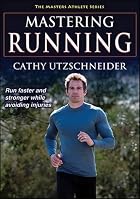
125) Mastering Running / Cathy Utzschneider
I got this as an Early Reviewers copy, and it's way overdue for a review.
This is intended to be a manual for runners over 40, and as such its coverage is pretty broad: notes on the challenges posed by aging, form drills, flexibility exercises, injury prevention (and dealing with the injuries that happen anyway), training strategies, and a wide variety of training schedules for races from the mile to the marathon.
The schedules recommend more frequent workouts than others I've followed, frequently prescribing six runs a week rather than four or five. Personally I find that at least two days per week of rest -- or at most cross-training -- are pretty important.
As a survey, it's not bad. The only comparable book I'm aware of is Hal Higdon's Masters Running, compared to which Utzschneider's book is less entertaining but more useful, better organized, and less cluttered with personal promotion. The main flaw is that Utzschneider necessarily sacrifices depth for breadth, and readers interested in a fuller discussion of, say, form or flexibility will have to consult other resources.
I wasn't able to finish a marathon over Thanksgiving break, but I did finish several books, knocking several stories off the Tower of Due.
125) Mastering Running / Cathy Utzschneider
I got this as an Early Reviewers copy, and it's way overdue for a review.
This is intended to be a manual for runners over 40, and as such its coverage is pretty broad: notes on the challenges posed by aging, form drills, flexibility exercises, injury prevention (and dealing with the injuries that happen anyway), training strategies, and a wide variety of training schedules for races from the mile to the marathon.
The schedules recommend more frequent workouts than others I've followed, frequently prescribing six runs a week rather than four or five. Personally I find that at least two days per week of rest -- or at most cross-training -- are pretty important.
As a survey, it's not bad. The only comparable book I'm aware of is Hal Higdon's Masters Running, compared to which Utzschneider's book is less entertaining but more useful, better organized, and less cluttered with personal promotion. The main flaw is that Utzschneider necessarily sacrifices depth for breadth, and readers interested in a fuller discussion of, say, form or flexibility will have to consult other resources.
220swynn

126) Countdown to Zero Day / Kim Zetter
This is another Early Reviewers book, though this review is not quite so late.
Zetter tells the story of Stuxnet, a remarkable piece of malware intended to disrupt Iran's nuclear program. The narrative is both technical and political, and Zetter fuses both stories into a compelling whole.
The technical bits read like a hacker's detective story, as computer security professionals piece together clues about what the virus does and why. I found Zetter's discussion quite easy to follow, despite Stuxnet's Byzantine structure and objectives.
The political reporting is also thorough and enlightening. I remember watching and reading news reports drawing contradictory conclusions about Iran's nuclear capabilities. Zetter's details provide a context for all of those mixed signals.
Altogether, it's an accessible account of a complicated subject in a complicated context. Recommended.
221swynn
Not Early Reviewer books:

127) Alaska Traveler / Dana Stabenow
For five years, Alaskan mystery writer Dana Stabenow contributed a travel column to Alaska Magazine, describing events and excursions around the state. This collects her columns.
128) Night on Fire / Douglas Corleone
Second in Corleone's Kevin Corvelli series, about a criminal defense lawyer who moves from a high-profile New York practice to a low-stress office in Hawaii. In this one, Corvelli defends a woman who probably killed her husband on her honeymoon by torching their hotel. I like this series.
129) No Cure For Death / Max Allan Collins
First or second in Collins's Mallory series, depending on which list you consult. In a preface to this edition Collins explains that No Cure for Death was written first but published second (after The Baby Blue Rip-Off). In this one Mallory comes to the rescue of a pretty blonde menaced by an ugly thug. Later the girl turns up dead in a car crash. Only Mallory suspects foul play, and his investigation leads to an aging snake oil salesman and Iowa politics. Testosteroney noir fun.
130) The Unlikely Disciple / Kevin Roose
Account of the author's "semester abroad" spent at Liberty University. I can't say this was very enlightening, but it was funny and uncomfortably familiar, recalling my own undergraduate career attending a religious liberal arts college while my faith slowly unraveled.
131) Salt Sugar Fat / Michael Moss
Account of the food industry's deep dependence on things that are killing us. I expected a jeremiad, but it's not that at all. Instead it's an explanation of why processed foods are so loaded with sugar, fat, and salt and why it's so hard to change that. Recommended.
132) What If? / Randall Munroe
What would happen if the earth suddenly stopped spinning but everything else retained its velocity? What if all the DNA in your body just vanished? What if a glass suddenly became literally "half empty"?
Randall Munroe, genius artist of the webcomic xkcd, offers scientifically defensible answers to absurd hypothetical questions. If this sounds like a cool idea, you're right: it is cool, it is enlightening and funny, it has clever illustrations, and you want to read it. If this sounds like a stupid idea, you're also probably right but it wasn't written for you anyway.
The only disappointment: in spite of the cover illustration, Munroe does not answer whether a sarlacc can digest a T. Rex (Maybe because ... why wouldn't it? The only thing a sarlacc can't digest is, I think, Boba Fett.) He does however estimate Yoda's force power in megawatts so for Star Wars nerds there is at least that.

127) Alaska Traveler / Dana Stabenow
For five years, Alaskan mystery writer Dana Stabenow contributed a travel column to Alaska Magazine, describing events and excursions around the state. This collects her columns.
128) Night on Fire / Douglas Corleone
Second in Corleone's Kevin Corvelli series, about a criminal defense lawyer who moves from a high-profile New York practice to a low-stress office in Hawaii. In this one, Corvelli defends a woman who probably killed her husband on her honeymoon by torching their hotel. I like this series.
129) No Cure For Death / Max Allan Collins
First or second in Collins's Mallory series, depending on which list you consult. In a preface to this edition Collins explains that No Cure for Death was written first but published second (after The Baby Blue Rip-Off). In this one Mallory comes to the rescue of a pretty blonde menaced by an ugly thug. Later the girl turns up dead in a car crash. Only Mallory suspects foul play, and his investigation leads to an aging snake oil salesman and Iowa politics. Testosteroney noir fun.
130) The Unlikely Disciple / Kevin Roose
Account of the author's "semester abroad" spent at Liberty University. I can't say this was very enlightening, but it was funny and uncomfortably familiar, recalling my own undergraduate career attending a religious liberal arts college while my faith slowly unraveled.
131) Salt Sugar Fat / Michael Moss
Account of the food industry's deep dependence on things that are killing us. I expected a jeremiad, but it's not that at all. Instead it's an explanation of why processed foods are so loaded with sugar, fat, and salt and why it's so hard to change that. Recommended.
132) What If? / Randall Munroe
What would happen if the earth suddenly stopped spinning but everything else retained its velocity? What if all the DNA in your body just vanished? What if a glass suddenly became literally "half empty"?
Randall Munroe, genius artist of the webcomic xkcd, offers scientifically defensible answers to absurd hypothetical questions. If this sounds like a cool idea, you're right: it is cool, it is enlightening and funny, it has clever illustrations, and you want to read it. If this sounds like a stupid idea, you're also probably right but it wasn't written for you anyway.
The only disappointment: in spite of the cover illustration, Munroe does not answer whether a sarlacc can digest a T. Rex (Maybe because ... why wouldn't it? The only thing a sarlacc can't digest is, I think, Boba Fett.) He does however estimate Yoda's force power in megawatts so for Star Wars nerds there is at least that.
222qebo
>216 swynn: Well I'm glad you had the sense to stop. There are other races.
>219 swynn: I should probably pick this up... motivation for running has dwindled and it'll just more and more difficult to get back to it.
>220 swynn: DrN reviewed this one too. It's on my wishlist.
>221 swynn: The Unlikely Disciple More enlightening for some of us. Glad you didn't hate it.
>219 swynn: I should probably pick this up... motivation for running has dwindled and it'll just more and more difficult to get back to it.
>220 swynn: DrN reviewed this one too. It's on my wishlist.
>221 swynn: The Unlikely Disciple More enlightening for some of us. Glad you didn't hate it.
223swynn
>222 qebo: I hope you find Mastering Running useful and Countdown to Zero Day intriguing when & if you get to them.
I didn't hate The Unlikely Disciple at all; Roose's effort to attempt an understanding was much appreciated and largely successful for me. It's just that I spent four years at a college with objectives very similar to Liberty's, so Roose's cultural discoveries were uncomfortably old-hat for me.
I didn't hate The Unlikely Disciple at all; Roose's effort to attempt an understanding was much appreciated and largely successful for me. It's just that I spent four years at a college with objectives very similar to Liberty's, so Roose's cultural discoveries were uncomfortably old-hat for me.
224swynn

133) Honor of the Queen / David Weber
Second in Weber's Honor Harrington space opera series. In this one Honor travels to a star system colonized by a religious sect of patriarchal polygamists. The system has two inhabited planets: Honor's Manticoran government is courting the planet occupied by the sect's more moderate wing, while the enemy Havenites are secretly assisting the planet of radical fundamentalists.
Weber makes an effort to draw deeper characters here, and we learn that Honor is capable of making mistakes. But there were a number of things that just didn't sit right with me. Chief among them is a plot development in which the fundamentalists gang-rape captured Manticoran women soldiers. It's not that the plot point is unrealistic, but the victims are passive objects of pity hurried off the stage as soon as possible. It all feels exploitative and smarmy.
Other points did seem unrealistic, such as
Despite the false notes it's still fun, though I'm less taken with the series than I was after the first.
225swynn
Treadmill reading:

134) Dead Wood / Dani Amore
John Rockne is a PI in Grosse Pointe, Michigan, with a very brief career in law enforcement. Rockne investigates the death of a high-end guitar maker at the behest of the victim's father, a fading country music star who is certain he knows the murderer and only needs Rockne to prove it. I liked the tone, which is light and snarky, rather like Fletch or The Glades.

134) Dead Wood / Dani Amore
John Rockne is a PI in Grosse Pointe, Michigan, with a very brief career in law enforcement. Rockne investigates the death of a high-end guitar maker at the behest of the victim's father, a fading country music star who is certain he knows the murderer and only needs Rockne to prove it. I liked the tone, which is light and snarky, rather like Fletch or The Glades.
226swynn
135) A Country Doctor, and Selected Stories and Sketches / Sarah Orne Jewett
This is ashort novelbundled with half a dozen shorter pieces exploring small towns and characters of coastal New England -- southern Maine, say the critics, though the stories rarely mention a state and most of the towns are imaginary -- or don't appear on Google maps, which I acknowledge is not the same thing.
The novel deals with an orphan girl, raised under the care of a country doctor and who decides to become a doctor herself. Despite the skepticism of the townspeople the girl has the doctor's support and works toward her dream. Only briefly does she falter, when she falls in with her birth father's urban family and she briefly considers marriage -- within the historical context, marriage and medicine are mutually exclusive paths. Her dreams win out.
For me the novel was too leisurely and episodic. It was also a bit didactic, though Jewett manages to slip most of her messages into dialogues and she has an undeniable talent for natural dialogue. Still I preferred the shorter ieces, which carried neither a burden of plot development. nor of a sustained theme. The stories address class, social change, environment, and labor with a strong regional flavor.
This is ashort novelbundled with half a dozen shorter pieces exploring small towns and characters of coastal New England -- southern Maine, say the critics, though the stories rarely mention a state and most of the towns are imaginary -- or don't appear on Google maps, which I acknowledge is not the same thing.
The novel deals with an orphan girl, raised under the care of a country doctor and who decides to become a doctor herself. Despite the skepticism of the townspeople the girl has the doctor's support and works toward her dream. Only briefly does she falter, when she falls in with her birth father's urban family and she briefly considers marriage -- within the historical context, marriage and medicine are mutually exclusive paths. Her dreams win out.
For me the novel was too leisurely and episodic. It was also a bit didactic, though Jewett manages to slip most of her messages into dialogues and she has an undeniable talent for natural dialogue. Still I preferred the shorter ieces, which carried neither a burden of plot development. nor of a sustained theme. The stories address class, social change, environment, and labor with a strong regional flavor.
227rosalita
>225 swynn: That sounds good; maybe a bit like Lawrence Block's "Burglar" series in the light/snarky vein. I suppose it's part of a series, doggone it all?
228swynn
Julia! So excellent to see you again!
Yes, it's part of a series and even worse: the end of #1 is a setup for #2. So far, those two are the only books in the series.
Yes, it's part of a series and even worse: the end of #1 is a setup for #2. So far, those two are the only books in the series.
229rosalita
>228 swynn: That's what I was afraid of. Sigh. Someday someone will write a mystery standalone book again, and I will be the happiest reader in North America.
230swynn
>229 rosalita: I know what you mean: it's nice now and then to read a mystery without feeling like you're making a commitment.
231lyzard
I don't think publishers allow it, do they? Everything has to have an open ending, just in case...
Oddly enough, right now I have the opposite problem: I bought what I thought was the first in a series, but it seems to be a standalone.
Oddly enough, right now I have the opposite problem: I bought what I thought was the first in a series, but it seems to be a standalone.
232swynn
>231 lyzard: You're using "problem" in a sense with which I'm unfamiliar, Liz. Or are you worried you may never get over the shock?
This one is definitely a standalone, but the plot ain't for much:
136) Ethnomathematics / Marcia Ascher
Ascher argues for the study mathematical ideas drawn from other cultures. By "mathematical ideas" she means ideas about number, logic, and spatial organization; the category of "mathematics" is largely a Western invention.
Her book reads like a volume of popular mathematics, with topics and illustrations taken from anthropology.
Ascher talks about the number system of the Incas, as embedded in objects of knot-tying art called quipu. (The really remarkable thing here is that the Inca seem to have developed a positional base-10 notation, including zero, without ever developing written language.) Other topics include traditional designs of the Bushoong people of Africa and the Malekula of Vanuatu, which Ascher discusses in terms of graph theory; kinship relations of Australian aborigines, in terms of group theory; and games of Native Americans and Maori, in terms of combinatorics.
Largely, the mathematics offers perspective on the cultural objects, but not so much the other way round. A notable exception is a chapter on the organization of space. Ascher argues that Western notions of space and time are at least somewhat culturally determined, and not in an absolute sense "correct." By way of contrast, she describes alternative perspectives on space and time from Navajo, Inuit, and Micronesian cultures. She draws a parallel to geometry: for most Westerners, Euclid's geometry seems the most natural and "correct", though we know that Riemann's and Lobachevsky's are just as consistent and in some contexts more natural.
Mathematical content is fairly light and quite accessible -- there are no explicit exercises nor any reason for them, but you'll probably reach for pen and paper anyway during discussions of graphs and games just to work some things out for yourself. Recommended if it sounds interesting.
This one is definitely a standalone, but the plot ain't for much:
136) Ethnomathematics / Marcia Ascher
Ascher argues for the study mathematical ideas drawn from other cultures. By "mathematical ideas" she means ideas about number, logic, and spatial organization; the category of "mathematics" is largely a Western invention.
Her book reads like a volume of popular mathematics, with topics and illustrations taken from anthropology.
Ascher talks about the number system of the Incas, as embedded in objects of knot-tying art called quipu. (The really remarkable thing here is that the Inca seem to have developed a positional base-10 notation, including zero, without ever developing written language.) Other topics include traditional designs of the Bushoong people of Africa and the Malekula of Vanuatu, which Ascher discusses in terms of graph theory; kinship relations of Australian aborigines, in terms of group theory; and games of Native Americans and Maori, in terms of combinatorics.
Largely, the mathematics offers perspective on the cultural objects, but not so much the other way round. A notable exception is a chapter on the organization of space. Ascher argues that Western notions of space and time are at least somewhat culturally determined, and not in an absolute sense "correct." By way of contrast, she describes alternative perspectives on space and time from Navajo, Inuit, and Micronesian cultures. She draws a parallel to geometry: for most Westerners, Euclid's geometry seems the most natural and "correct", though we know that Riemann's and Lobachevsky's are just as consistent and in some contexts more natural.
Mathematical content is fairly light and quite accessible -- there are no explicit exercises nor any reason for them, but you'll probably reach for pen and paper anyway during discussions of graphs and games just to work some things out for yourself. Recommended if it sounds interesting.
233scaifea
>232 swynn: Oooh, that one does sound interesting - thanks for the review!
234qebo
>232 swynn: Thought I already had this one, but turns out that I have another with the same title, and recognize the author from books/articles of the same ilk.
235swynn
>233 scaifea: Hope you like it if you get around to it, Amber!
>234 qebo: Is yours Arthur Powell's book? That one also looks interesting.
>234 qebo: Is yours Arthur Powell's book? That one also looks interesting.
236qebo
>235 swynn: Yeah. Can't tell you much about it though. It's journal articles, so I doubt that I read it straight through, and in any case it's been awhile, 10-15 years.
237swynn
>236 qebo: There's a copy of that one in the library, and I see it includes a chapter by Ascher. I'll have to check it out sometime.
137) Tracks / Louise Erdrich
Every time I read a Louise Erdrich book I wonder why I don't read more.
We started dying before the snow, and like the snow, we continued to fall.
That's the best first line I've read all year. Not that the competition was fierce, but still.
Set on the same Anishinabe reservation as Love Medicine and The Beet Queen, this one steps back a generation to tell the story of how Eli Kashpaw and Fleur Pillager came together to make Lulu Nanapush; how Lulu came to regard Nanapush as her father; and how Pauline Puyat (Love Medicine's Sister Leopolda) complicated everything she touched.
It's about love and loss and jealousy and loss and betrayal and loss and survival, and it has bits you'll want to stop and reread, aloud. Recommended.
137) Tracks / Louise Erdrich
Every time I read a Louise Erdrich book I wonder why I don't read more.
We started dying before the snow, and like the snow, we continued to fall.
That's the best first line I've read all year. Not that the competition was fierce, but still.
Set on the same Anishinabe reservation as Love Medicine and The Beet Queen, this one steps back a generation to tell the story of how Eli Kashpaw and Fleur Pillager came together to make Lulu Nanapush; how Lulu came to regard Nanapush as her father; and how Pauline Puyat (Love Medicine's Sister Leopolda) complicated everything she touched.
It's about love and loss and jealousy and loss and betrayal and loss and survival, and it has bits you'll want to stop and reread, aloud. Recommended.
238qebo
>237 swynn: I read a bunch of books by Michael Dorris some 20-25 years ago, never anything by Louise Erdrich, not sure why, but the real life version is so horribly hideously sad that I can't quite see picking up fiction "about love and loss and jealousy and loss and betrayal and loss and survival" even if it is exceptionally well written.
239lyzard
>232 swynn: Well, it was a problem inasmuch as I bought the wrong book. :)
240swynn
>238 qebo: Well, that can't be unread. What an ugly mess, and awful for the breathing, feeling humans involved.
I've been pondering how (and whether) to compartmentalize enjoyment of an author's work from sordid details of his/her life. I've been thinking about it in reference to Marion Zimmer Bradley, whose complicity in awful crimes is clear and certain. I'm still sorting my thoughts out, and may be doing so for a while. This news gives me more to chew on.
>239 lyzard: Now *that* is a problem. But sometimes a pleasant surprise.
I've been pondering how (and whether) to compartmentalize enjoyment of an author's work from sordid details of his/her life. I've been thinking about it in reference to Marion Zimmer Bradley, whose complicity in awful crimes is clear and certain. I'm still sorting my thoughts out, and may be doing so for a while. This news gives me more to chew on.
>239 lyzard: Now *that* is a problem. But sometimes a pleasant surprise.
241swynn
Treadmill reading:
138) Bypass Gemini / Joseph Lallo
First in a science fiction series about Lex, an interstellar courier. In this one Lex stumbles into a plot involving the galaxy's largest communication and transport company and the mob; all Lex has on his side are his piloting skills and a reclusive weapons developer hiding out on a trash heap planet. Fun enough to pass the time, not enough to seek out the next.
138) Bypass Gemini / Joseph Lallo
First in a science fiction series about Lex, an interstellar courier. In this one Lex stumbles into a plot involving the galaxy's largest communication and transport company and the mob; all Lex has on his side are his piloting skills and a reclusive weapons developer hiding out on a trash heap planet. Fun enough to pass the time, not enough to seek out the next.
242swynn
139) Low Down Death Right Easy / Jay David Osborne
Here's a terse and punchy country noir, set somewhere in Oklahoma. Danny Ames is an enforcer for the local drug supplier. Danny's brother Thomas -- the golden son, the one studying to be a teacher -- has disapeared. Rumors are, Thomas has started dealing. The obvious conclusion is that he may have crossed the wrong people.
Meanwhile, another pair of brothers make a gruesome find while noodling: instead of snagging a catfish, they retrieve a bloated and decaying human head.
Chapters and sentences are very short; the reader is expected to read between the lines, and there's more "between" than line. But the book has everything you expect from the genre: drugs and violence and desparate characters. There's little to complain about and I'll recommend it readers who like this sort if thing. (Okay, one complaint: late in the book a couple of the characters make a day trip to Tulsa and follow I-35 from Oklahoma City to get there. This is an interesting strategy, but it may help to be high while executing it.)
Personally, though, I think I may be reaching a saturation point. I think next year's reading list will be heavier with science fiction and fantasy, and lighter on lurid thrillers.
Here's a terse and punchy country noir, set somewhere in Oklahoma. Danny Ames is an enforcer for the local drug supplier. Danny's brother Thomas -- the golden son, the one studying to be a teacher -- has disapeared. Rumors are, Thomas has started dealing. The obvious conclusion is that he may have crossed the wrong people.
Meanwhile, another pair of brothers make a gruesome find while noodling: instead of snagging a catfish, they retrieve a bloated and decaying human head.
Chapters and sentences are very short; the reader is expected to read between the lines, and there's more "between" than line. But the book has everything you expect from the genre: drugs and violence and desparate characters. There's little to complain about and I'll recommend it readers who like this sort if thing. (Okay, one complaint: late in the book a couple of the characters make a day trip to Tulsa and follow I-35 from Oklahoma City to get there. This is an interesting strategy, but it may help to be high while executing it.)
Personally, though, I think I may be reaching a saturation point. I think next year's reading list will be heavier with science fiction and fantasy, and lighter on lurid thrillers.
243qebo
>242 swynn: Tulsa and follow I-35 from Oklahoma City
Oh why do you make me look at maps?
lighter on lurid thrillers
It is good to have goals.
Oh why do you make me look at maps?
lighter on lurid thrillers
It is good to have goals.
244swynn
>243 qebo: Oh why do you make me look at maps?
Sorry, Katherine. To save others the pain: that road don't go there. Interstate 35 heads almost due north out of Oklahoma City toward Wichita, KS and right to the state line. Tulsa lies north but also considerably east of Oklahoma City; the most direct route is via I-44. The author seems to have confused the two interstates.
It is good to have goals.
Baby steps. :)
Sorry, Katherine. To save others the pain: that road don't go there. Interstate 35 heads almost due north out of Oklahoma City toward Wichita, KS and right to the state line. Tulsa lies north but also considerably east of Oklahoma City; the most direct route is via I-44. The author seems to have confused the two interstates.
It is good to have goals.
Baby steps. :)
245qebo
>240 swynn: I've been pondering how (and whether) to compartmentalize enjoyment of an author's work from sordid details of his/her life.
For me, it boils down to how much the personal intrudes and contradicts. I’ve never ready anything by MZB because I first heard of her, in the mid 1980s, from a male friend who mentioned (I forget the context of the conversation) that he had gone to scifi conventions some years before and her husband had a creepy thing for teenage boys. So the ick factor was too high for me to read her books out of mere curiosity. I’d already read and enjoyed several books by Anne Perry when I saw Heavenly Creatures, and I haven’t read any since. I read mysteries for escape, and there’s no escape from the imagery of that movie. With Dorris & Erdrich, it’s different; the reality adds a deeper layer to the fiction, and it’s more a matter of how much pain do I want to take on.
For me, it boils down to how much the personal intrudes and contradicts. I’ve never ready anything by MZB because I first heard of her, in the mid 1980s, from a male friend who mentioned (I forget the context of the conversation) that he had gone to scifi conventions some years before and her husband had a creepy thing for teenage boys. So the ick factor was too high for me to read her books out of mere curiosity. I’d already read and enjoyed several books by Anne Perry when I saw Heavenly Creatures, and I haven’t read any since. I read mysteries for escape, and there’s no escape from the imagery of that movie. With Dorris & Erdrich, it’s different; the reality adds a deeper layer to the fiction, and it’s more a matter of how much pain do I want to take on.
246swynn
>245 qebo: For me, it boils down to how much the personal intrudes and contradicts.
I think this is how it is for me too: does knowing x about author y affect my enjoyment of y's work?
It bothers me that the criterion is so subjective. I've not read any Anne Perry, but Heavenly Creatures story hasn't been a deterrent; I just haven't gotten around to her. I love Woody Allen movies (Manhattan was a kind of revelation to me back in high school), and re-watch many of them frequently. His private life seems creepy but it doesn't intrude.
Of course the news about Erdrich hasn't had time to settle, but I don't find that my impression of her work has been negatively affected. I'd still like to read the next.
On the other hand I now find it difficult to read Orson Scott Card, whom I used to admire -- not because of things he's done but because of things he's said. This bothers me: Enable your husband in the abuse of your children? Fine. Disagree with me? Fie upon you. What's wrong with me?
MZB is an odd case for me. The few books I've read haven't impressed me, but I have friends who are (or used to be) big fans. I've always felt that that I just hadn't read the right book yet. The new(er) reports from her daughter give me reason to just give up; on the other hand, there are a whole lot of MZBs to be read in my DAW project, and ... completeness. Hunters of the Red Moon is coming up pretty soon, and I'm feeling both "Maybe this is the one" and "ick." I've all but decided to go ahead and read it, but also make a donation to RAINN to balance out the latter feeling.
I think this is how it is for me too: does knowing x about author y affect my enjoyment of y's work?
It bothers me that the criterion is so subjective. I've not read any Anne Perry, but Heavenly Creatures story hasn't been a deterrent; I just haven't gotten around to her. I love Woody Allen movies (Manhattan was a kind of revelation to me back in high school), and re-watch many of them frequently. His private life seems creepy but it doesn't intrude.
Of course the news about Erdrich hasn't had time to settle, but I don't find that my impression of her work has been negatively affected. I'd still like to read the next.
On the other hand I now find it difficult to read Orson Scott Card, whom I used to admire -- not because of things he's done but because of things he's said. This bothers me: Enable your husband in the abuse of your children? Fine. Disagree with me? Fie upon you. What's wrong with me?
MZB is an odd case for me. The few books I've read haven't impressed me, but I have friends who are (or used to be) big fans. I've always felt that that I just hadn't read the right book yet. The new(er) reports from her daughter give me reason to just give up; on the other hand, there are a whole lot of MZBs to be read in my DAW project, and ... completeness. Hunters of the Red Moon is coming up pretty soon, and I'm feeling both "Maybe this is the one" and "ick." I've all but decided to go ahead and read it, but also make a donation to RAINN to balance out the latter feeling.
247swynn

140) Beyond Cold Blood / Larry Welch
This is a history of the Kansas Bureau of Investigation, written by a former director of the Bureau. The KBI was founded in 1939 at the sustained urging of Kansas bankers and cattlemen. The state was experiencing an epidemic of bank robberies and cattle rustling that Kansas's tiny rural police departments were ill-equipped to handle. The Bureau was a success from its inception as Welch describes it, opening with a thrilling shootout that thwarted a bank robbery in Macksville bringing great credit to all agents involved. Welch's story stretches from those early days, when the bureau consisted of four agents and the most frequent cases involved cattle rustling or "marihuana weed," to today, with a staff over 200 and investigations into meth manufacture and homeland security.
It's a mixed bag. There are really two books here: first is a history of the bureau, narrating changes in the criminal landscape and developments in law enforcement; second is a popular true-crime anthology of KBI's greatest hits. The former is more interesting, but its coverage is uneven. Welch provides a lot of material on the KBI's early days, and a lot more on conditions in his administration from the mid-nineties to 2007. But for the half-century in between, discussion of demographic trends, investigative techniques, and administrative strategy is sparse. Worse, when he comes to discussing conditions under his own tenure, Welch is prone to list long litanies of names involved in this project or that with no information other than what a swell bunch of professionals they all were. It occasionally reads like an extended Acknowledgments page for his administration.
But the latter is what will sell the book with its melodrama gruesome details of crime scenes. Cases summarized include the 1959 Clutter murders (subject of Truman Capote's In Cold Blood), the BTK murders, and a handful of other cases with interesting features: building a case for the 1971 murder of Goldie Millar in absence of a body; investigating the death of a Kansan undergraduate killed while studying in Costa Rica; building a case to prosecute the murder of a county sheriff killed when he stumbled into an active meth lab.
They're certainly interesting cases,and Welch tries to whip up drama and suspense, but he's just not all that great a storyteller. He is prone to redundancy (in one sentence he refers to the "forty-member" Kansas senate and in the next he tells us the Kansas senate has forty members), inept phrasing (he tells us that one criminal "gave new meaning to the word fugitive" -- by which he means that the criminal was at large and sought by law enforcement, the plain old meaning), and dramatic cliches.
There's also an odd obsession with the physical attractiveness of females -- especially victims -- in Welch's stories. One victim is "beautiful" on the witness stand though most victims are "pretty." Even an 11-year-old victim is "pretty." A 13-year-old victim was "still a little girl, with no obvious feminine charms" but Welch assures us she was "cute." Perhaps predictably, not a single male is "handsome," "rugged," or "buff," or even plain "good-looking." It didn't exactly strike me as creepy so much as just awkward, the casual sexism of a couple of generations ago. I get the generation gap, but an editor should have helped clean that up. Also: is "coed" even still a word?
In sum: there's a huge amount of insight and detail on the history of regional and even national law enforcement, and interested readers will find it rewarding. But it lacks the polish of more commercial works and casual readers will probably be turned off.
248swynn

141) American Elsewhere / Robert Jackson Bennett
Oh my yes this was fun.
Mona Bright arrives in tiny Wink, New Mexico to claim a house her mother left to her thirty years before. Wink's residents seem unenthusiastic about Mona's arrival, but still there's something about the New Mexico landscape and even about the town itself that make Mona think she could finally be happy here.
As perfect as Wink seems, though, all is not right: Mona is warned not to wander the town after dark; residents at Wink's fringes survive by arrangements with powers beyond its borders; and worst, on Mona's arrival people start dying: not just people who shouldn't be dying but people who shouldn't be able to die at all.
The tropes are familiar: the uncanny village, other dimensions, things we were not meant to know, unbeholdable horrors and old powerful things trying to wake up. Although the elements are familiar the story is fresh and the writing is vivid. It's 650 pages that speed by like 400.
Highly recommended for fans of dark fantasy.
249ronincats
If you like that, Steve, have you ever read Jane Lindskold's Child of a Rainless Year?
From Amazon:
Middle-aged Mira Fenn knows she has an uncomfortably exotic past. As a small girl, she lived in a ornate old house in tiny Las Vegas, New Mexico, tended by oddly silent servant women and ruled by her coldly flamboyant mother Colette. When Mira was nine, Colette went on one of her unexplained trips, only this time she never returned.
Placed with foster parents, Mira was raised in Ohio, normal save for her passion for color. On gaining adulthood, she learned that she still owned the New Mexico house. She also learned that, as a condition of being allowed to adopt her, Mira's foster parents had agreed to change their name, move to another state, and never ask why.
Years later, going through family papers after the deaths of her elderly foster parents, Mira finds documents that pique her curiosity about her vanished mother and the reasons behind her strange childhood and adoption.
Travelling back to New Mexico, she finds the house is and isn't as she remembers it. Inside, it's much the same. Outside, it's been painted in innumerable colors. As Mira continues to investigate her mother's life, events take stranger and stranger turns. The silent women reappear. Even as Mira begins to suspect the power to which she may be heir, the house itself appears to be waking up...
Shot through with magic and the atmosphere of the Southwest, this singular fantasy novel has all the storytelling vigor of Jane Lindskold's very popular Firekeeper series.
Changer, my favorite of hers, is also set in the Southwest.
I have Bennett's City of Stairs high up in my tbr pile.
From Amazon:
Middle-aged Mira Fenn knows she has an uncomfortably exotic past. As a small girl, she lived in a ornate old house in tiny Las Vegas, New Mexico, tended by oddly silent servant women and ruled by her coldly flamboyant mother Colette. When Mira was nine, Colette went on one of her unexplained trips, only this time she never returned.
Placed with foster parents, Mira was raised in Ohio, normal save for her passion for color. On gaining adulthood, she learned that she still owned the New Mexico house. She also learned that, as a condition of being allowed to adopt her, Mira's foster parents had agreed to change their name, move to another state, and never ask why.
Years later, going through family papers after the deaths of her elderly foster parents, Mira finds documents that pique her curiosity about her vanished mother and the reasons behind her strange childhood and adoption.
Travelling back to New Mexico, she finds the house is and isn't as she remembers it. Inside, it's much the same. Outside, it's been painted in innumerable colors. As Mira continues to investigate her mother's life, events take stranger and stranger turns. The silent women reappear. Even as Mira begins to suspect the power to which she may be heir, the house itself appears to be waking up...
Shot through with magic and the atmosphere of the Southwest, this singular fantasy novel has all the storytelling vigor of Jane Lindskold's very popular Firekeeper series.
Changer, my favorite of hers, is also set in the Southwest.
I have Bennett's City of Stairs high up in my tbr pile.
250swynn
>249 ronincats: No, I've not read any of Jane Lindskold's works, but I'll put Child of a Rainless Year high on my list for next year.
And I'll definitely hit City of Stairs early next year. I understand Bennett is working on a sequel to that one ...
And I'll definitely hit City of Stairs early next year. I understand Bennett is working on a sequel to that one ...
251swynn

142) The White Cascade / Gary Krist
Late February 1910. A series of winter storms dump an unprecedented mass of snow and rain in Washington's Cascade Mountains. This is especially bad news for the Great Northern Railroad, which has a passenger and a mail train stranded at a remote station high in the cascades at Wellington. The rail company works rotary blowers and snow-shoveling teams around the clock in an effort to clear the tracks and move the trains through, but as fast as they can be cleared the tracks are covered again with fresh snow, blown snow, and snow slides.
The station at Wellington is running low on coal and water when on March 1, the worst happens: an avalanche descends onto the waiting trains, knocking the cars off the tracks and down a steep slope below. Ninety-six passengers and railroad crew are killed, making the Wellington disaster the deadliest avalanche in U.S. history.
Gary Krist mines surviving letters, diaries, papers and company documents to tell the story. He weaves in historical context of late nineteenth-century railroading, labor disputes, and the shifting public sentiment against rail barons. It's quite good, and recommended.
252swynn

143) Fear and Loathing in Las Vegas and Other American Stories / Hunter S. Thompson
Almost everyone knows about this, so I'll skip the summary and chatter about my own reactions.
Here is a revelation to shock approximately nobody: I am a square.
I first picked up Fear and Loathing about twenty-five years ago when I'd read something about it being a a seminal work in a kind of counterestablishment journalism. But I am a square. I got about three chapters in, realized that it was a litany of drug abuse and bad behavior, found nothing to recommend continuing, and gave up. When Terry Gilliam offered a film adaptation in 1998 I wondered whether the dramatisation might be enlightening, so when the film was released on video I tried again. My reaction was similar: I pressed Stop 15 minutes in and returned the tape to the library.
Twenty-five years older and -- well, probably not a wiser but certainly a different person -- I've finally finished it. My reactions are:
(1) As a litany of drug abuse and bad behavior, it's not half bad. I laughed. Frequently.
(2) Thanks to engaging prose it has probably aged better than most other drug literature of the seventies (I expect; I'm the opposite of a connoisseur). But it *has* aged, and I missed its historical moment. I feel no sense of loss about this, as in its historical moment I was not yet able to read. Even if I had been, I do not think I would have been among its intended audience. That is because ...
(3) I am a square.
With respect to (2), many of Thompson's points are still relevant -- about the fucked-uppedness of real life compared to psychotropics, about law enforcement soaking public funds while lagging about a decade behind the problems they claim to address -- arguable, but relevant. Others are hard to fathom, such as his thesis that stimulants are associated with freedom and depressants with political repression:
Uppers are no longer stylish. Methedrine is almost as rare, on the 1971 market, as pure acid or DMT. "Consciousness Expansion" went out with LBJ ... and it is worth noting, historically, that downers came in with Nixon.
Noted. But now that we have meth out the wazoo but nothing like a sixties' epidemic of peace and love I suspect that was just coincidence.
I picked this up because it's been nagging at me that I should give it another try. And I needed a quick read set in Nevada (three more states to go for another annual tour!) I think I enjoyed it as much as I'm likely ever to do, but it's not the classic for me that it has been for others.
The Modern Library edition I read also contains "Strange rumblings in Aztlan," Thompson's Rolling Stone article about the death of Ruben Salazar; and "The Kentucky Derby is Decadent and Depraved," about the Kentucky Derby. I found both more accessible than Fear and Loathing in Las Vegas. In fact the former story, covering the killing by police of an unarmed man of color, seems eerily timely.
253lyzard
>247 swynn: I'm interested that you bring up "coed", Steve, because as an outsider I've always found that expression puzzling. I don't understand why people still use it or how it can still have meaning, but it is certainly still in use. (Disclosure: I encounter it chiefly in context of female victims in true-crime shows.)
254swynn
>253 lyzard:
It has always seemed strange to me, but I figured it was because I'm too young to remember single-sex higher education; surely it was a holdover from the 1950s or earlier. Seems to me we're approaching a time when nobody remembers single-sex higher ed and the term should just die quietly. So it was a bit jarring to see it used repeatedly in a book published (and presumably edited) by a university press.
A search of the Oxford English Dictionary retrieves some gems: the earliest reference in the OED is from Louisa May Alcott's Jo's Boys:
Girls..ought not to study so much. Never liked co-ed.
Not knowing the context of that quote I won't draw any conclusions about Louisa May.
The earliest reference to "co-ed" as referring to a female student is the 1897 Funk's Standard Dictionary of the English Language, but just a few years later we get this observation from a 1903 number of The Independent:
Any college where the girls are commonly called ‘co-eds’ is not a truly co-educational institution.
Indeed.
Also interesting that the term may show its greatest longevity in the true crime genre. My guess is that it evokes vulnerability so it's useful for the victim/menace rhetoric, but there may be other things going on too.
It has always seemed strange to me, but I figured it was because I'm too young to remember single-sex higher education; surely it was a holdover from the 1950s or earlier. Seems to me we're approaching a time when nobody remembers single-sex higher ed and the term should just die quietly. So it was a bit jarring to see it used repeatedly in a book published (and presumably edited) by a university press.
A search of the Oxford English Dictionary retrieves some gems: the earliest reference in the OED is from Louisa May Alcott's Jo's Boys:
Girls..ought not to study so much. Never liked co-ed.
Not knowing the context of that quote I won't draw any conclusions about Louisa May.
The earliest reference to "co-ed" as referring to a female student is the 1897 Funk's Standard Dictionary of the English Language, but just a few years later we get this observation from a 1903 number of The Independent:
Any college where the girls are commonly called ‘co-eds’ is not a truly co-educational institution.
Indeed.
Also interesting that the term may show its greatest longevity in the true crime genre. My guess is that it evokes vulnerability so it's useful for the victim/menace rhetoric, but there may be other things going on too.
255qebo
>253 lyzard:, >254 swynn: coed
Common in reference to situations, e.g. coed college, coed dorm, coed sports, but not to people. The local college "went coed" in the early 1970s, well within my memory, but I haven't heard female students referred to as "coeds" in decades.
Common in reference to situations, e.g. coed college, coed dorm, coed sports, but not to people. The local college "went coed" in the early 1970s, well within my memory, but I haven't heard female students referred to as "coeds" in decades.
256swynn
>255 qebo: Agreed. Talk about "coed dorms" and "coed sports" are certainly familiar: my undergraduate institution still has only single-sex dorms, and the question of a "coed dorm" was discussed with some interest by students -- and pointedly undiscussed by administration -- back in the mid-1980's. I'd be surprised if that has changed.
"Coed\ucational\" in the sense of "mixed sex" is probably still useful in some contexts, though I expect even in those contexts it's being displaced by broader, more contemporary terms like "gender inclusive."
It's "coed" in the sense of "female student" that feels obsolete but was used frequently in Beyond Cold Blood.
"Coed\ucational\" in the sense of "mixed sex" is probably still useful in some contexts, though I expect even in those contexts it's being displaced by broader, more contemporary terms like "gender inclusive."
It's "coed" in the sense of "female student" that feels obsolete but was used frequently in Beyond Cold Blood.
257rosalita
>248 swynn: OK, Steve. You got me with American Elsewhere, AND the library has it so I might even get it squeezed into 2014's reading list. Your description made me think of Those Across the River, which I read last year and was delightfully scary.
258lyzard
Yes, "coed" to refer to a female college student specifically was what was puzzling me. I understand the origin of the term but not its persistence.
You needn't have doubts about Louisa May herself - that quote certainly isn't her speaking - but she was writing at a time when there was a lot of debate about female education and what was needed and proper. (Jo's Boys is a follow-up to Little Men, which is about a school predominantly for boys, but also houses a girl who grows up to reject the female "norms" and become a doctor.)
You needn't have doubts about Louisa May herself - that quote certainly isn't her speaking - but she was writing at a time when there was a lot of debate about female education and what was needed and proper. (Jo's Boys is a follow-up to Little Men, which is about a school predominantly for boys, but also houses a girl who grows up to reject the female "norms" and become a doctor.)
259swynn
>257 rosalita: Hope you like it, Julia! And Those Across the River goes into the swamp.
>258 lyzard: My knowledge of Louisa May Alcott is limited to the 1933 film adaptation of Little Women, but even that small taste didn't seem to match the sentiment quoted in the OED. So I was ready to give her the benefit of the doubt. Someday I should read one of Alcott's books to fill a gap in my education.
>258 lyzard: My knowledge of Louisa May Alcott is limited to the 1933 film adaptation of Little Women, but even that small taste didn't seem to match the sentiment quoted in the OED. So I was ready to give her the benefit of the doubt. Someday I should read one of Alcott's books to fill a gap in my education.
260ronincats
Steve, it's Chrismas Eve's eve, and so I am starting the rounds of wishing my 75er friends the merriest of Christmases or whatever the solstice celebration of their choice is.


261swynn
>260 ronincats: Christmas it is at the swynn home. We are celebrating a bit early since son & I are heading north to visit my parents while Mrs. Swynn stays home for manfree relaxation.
For Christmas she gave me bookshelves. As if I needed to be reminded why I married her.
May your winter holiday be just as merry, Roni!
For Christmas she gave me bookshelves. As if I needed to be reminded why I married her.
May your winter holiday be just as merry, Roni!

265swynn
Still in Iowa, exploiting free Internet access @ The Library ...
>262 scaifea: Bookshelves indeed. And yes I am. Somehow, they're almost full already. Don't know how *that* happened. :)
>263 qebo: And a happy new year, Katherine!
>264 rosalita: Same to you, Julia! I'm still up for a January meetup. I am definitely *not* running Triple D next year due to ongoing foot problems -- I will do a shorter, more local run in January -- but the Iowa City meetup is still on as far as I am concerned.
>262 scaifea: Bookshelves indeed. And yes I am. Somehow, they're almost full already. Don't know how *that* happened. :)
>263 qebo: And a happy new year, Katherine!
>264 rosalita: Same to you, Julia! I'm still up for a January meetup. I am definitely *not* running Triple D next year due to ongoing foot problems -- I will do a shorter, more local run in January -- but the Iowa City meetup is still on as far as I am concerned.
266swynn

144) Refuge / Terry Tempest Williams
During the mid-1980s, the Great Salt Lake rose to historic levels, endangering Salt Lake City with extended flooding.
Terry Tempest Williams was a conservationist, an educator at the Utah Museum of Natural History, and a passionate observer of birds at the Bear River Migratory Bird Refuge on the Great Salt Lake's eastern shore. The Great Salt Lake flooded the refuge as it rose, endangering some bird populations while providing a boon to others. At the same time, Williams' mother was diagnosed with and eventually succumbed to cancer.
Refuge is Williams's experience of the flood and the illness. She wrestles with big questions about meaning, faith, solace, and humans' proper relationship to the planet. She finds clues and occasional answers in her relationships with family and her sojourns in wilderness. There's a lot to ponder here. For my taste it occasionally got a bit too mystical. But Williams's eye for natural detail is keen, her sources are interesting, and she writes memorably well. This is one I expect to return to, and highly recommend it.
267qebo
>266 swynn: Oh damn you, BB!
268swynn
>267 qebo: Hope you like it, Katherine! The next one is easy to dodge:
145) Gone But Not Forgotten / Phillip Margolin
Routine thriller with a colorful psychopath villain, set mostly in Portland, Oregon. It does what it needs to do and little else. Okay for treadmill reading.
145) Gone But Not Forgotten / Phillip Margolin
Routine thriller with a colorful psychopath villain, set mostly in Portland, Oregon. It does what it needs to do and little else. Okay for treadmill reading.
269swynn

146) Flags in the Dust / William Faulkner
A couple of years ago I decided to read through the works of Faulkner. But after the uneven Soldiers' Pay and the boring Mosquitoes I lost what little momentum I had. It's only with this third novel, his first set in Mississippi, that Faulkner becomes Faulkner.
In retrospect it's hard to believe that Faulkner had trouble publishing Flags in the Dust. It's a better novel than his first two in every way: the characters are solid, the setting is textured and the prose is entrancing. But in retrospect we have the advantage of knowing who Faulkner would become; at the time, publishers felt that the narrative was unfocused and desperate for trimming and tightening.
The publisher's weren't wrong: there are jarring shifts in narrative viewpoint, a clamor of subplots some of which just peter out, and new characters continue to be introduced even very late in the book. Anyone writing this thing now would be encouraged to give up on a novel and rewrite it as a collection of linked short stories. But Faulkner's is the name we remember so maybe he knew better than the publishers.
Worse from a 21st century point of view is Faulkner's treatment of black characters, whom he uniformly portrays as lazy and deceitful comic relief. You can argue that the white characters aren't much better, but they just aren't as wincingly stereotypical.
But how can you fault writing like this?
Up the last hill the tireless pony bore him, and in the low December sun their shadow fell longly across the hardwood ridge and into the valley, from which the high, shrill yapping of the dogs came again upon the frosty windless air. Young dogs, Bayard told himself, and he sat his horse in the faint scar of the road, listening as the high breathless hysteria of them swept echoing across his aural field though the race itself was hidden beyond the trees. Motionless, he could feel frost in the air. Above him the pines, though there was no wind in them, made a continuous dry, wild sound; above them against the evening blue, a shallow V of geese slid.
You can't; you can only hope things get even better. Since novel number four is called The Sound and the Fury, there's an excellent chance they will.

