weird_O…starts…LATE!
This topic was continued by weird_O…starts…LATE! ...and is STILL late!.
Talk 75 Books Challenge for 2015
Join LibraryThing to post.
This topic is currently marked as "dormant"—the last message is more than 90 days old. You can revive it by posting a reply.
1weird_O
As the first quarter heads to its close, I'm joining up. I've been keeping a record of books read (with finish dates) since 2010. Last year, I completed 80 books. I've read 20 so far this year, so I think I'm on track.
There's no particular theme to my reading, no particular program to it. But the core of this year's reading roundup will be shaped by a used-book buy I made a month ago. More about that later.
Here's what I've read so far in 2015:
January
1. I Know Why the Caged Bird Sings by Maya Angelou
2. I Married a Communist by Philip Roth
3. Just Mercy by Bryan Stevenson
4. Tom Jones by Henry Fielding
5. Fathers and Sons by Ivan Turgenev
February
6. The Cycle of American Literature by Robert Spiller
7. Main Street by Sinclair Lewis
8. Native Son by Richard Wright
9. The Jungle Books by Rudyard Kipling
10. Henry and June by Anais Nin
11. Cotton Tenants by James Agee
12. The Wonderful Adventures of Paul Bunyan by Louis Untermeyer
March
13. Zuleika Dobson by Max Beerbohn
14. Penguin Island by Anatole France
15. The Innocent Voyage (b.k.a. A High Wind in Jamaica) by Richard Hughes
16. Travels with a Donkey by Robert Louis Stevenson
17. Confessions of an English Opium-Eater by Thomas DeQuincey
18. The Way of All Flesh by Samuel Butler
19. Peter Ibbetson by George du Maurier
20. The Seven Voyages of Sindbad the Sailor by Anonymous
All but one of these books are from the family library. Just Mercy I borrowed from my sister in law. All but I Married a Communist and The Cycle of American Literature are hardcovers (do not know what difference THAT makes). I guess I should comment on each book, something I've not done before, but will probably try to do.
So.... More later.
There's no particular theme to my reading, no particular program to it. But the core of this year's reading roundup will be shaped by a used-book buy I made a month ago. More about that later.
Here's what I've read so far in 2015:
January
1. I Know Why the Caged Bird Sings by Maya Angelou
2. I Married a Communist by Philip Roth
3. Just Mercy by Bryan Stevenson
4. Tom Jones by Henry Fielding
5. Fathers and Sons by Ivan Turgenev
February
6. The Cycle of American Literature by Robert Spiller
7. Main Street by Sinclair Lewis
8. Native Son by Richard Wright
9. The Jungle Books by Rudyard Kipling
10. Henry and June by Anais Nin
11. Cotton Tenants by James Agee
12. The Wonderful Adventures of Paul Bunyan by Louis Untermeyer
March
13. Zuleika Dobson by Max Beerbohn
14. Penguin Island by Anatole France
15. The Innocent Voyage (b.k.a. A High Wind in Jamaica) by Richard Hughes
16. Travels with a Donkey by Robert Louis Stevenson
17. Confessions of an English Opium-Eater by Thomas DeQuincey
18. The Way of All Flesh by Samuel Butler
19. Peter Ibbetson by George du Maurier
20. The Seven Voyages of Sindbad the Sailor by Anonymous
All but one of these books are from the family library. Just Mercy I borrowed from my sister in law. All but I Married a Communist and The Cycle of American Literature are hardcovers (do not know what difference THAT makes). I guess I should comment on each book, something I've not done before, but will probably try to do.
So.... More later.
3weird_O
I spied this 50-item challenge and it struck my fancy.
1. A book with more than 500 pages
2. A classic romance
3. A book that became a movie
4. A book published this year
5. A book with a number in the title
6. A book written by someone under 30
7. A book with non-human characters
8. A funny book
9. A book by a female author
10. A mystery or thriller
11. A book with a one-word title
12. A book of short stories
13. A book set in a different country
14. A non-fiction book
15. A popular author’s first book
16. A book from an author you love that you haven’t read yet
17. A book a friend recommended
18. A Pulitzer Prize-winning book
19. A book based on a true story
20. A book at the bottom of your to-read list
21. A book your mom loves
22. A book that scares you
23. A book more than 100 years old
24. A book based entirely on its cover
25. A book you were supposed to read in school but didn’t
26. A memoir
27. A book you can finish in a day
28. A book with antonyms in the title
29. A book set somewhere you’ve always wanted to visit
30. A book that came out the year you were born
31. A book with bad reviews
32. A trilogy
33. A book from your childhood
34. A book with a love triangle
35. A book set in the future
36. A book set in high school
37. A book with a colour in the title
38. A book that made you cry
39. A book with magic
40. A graphic novel
41. A book by an author you’ve never read before
42. A book you own but have never read
43. A book that takes place in your hometown
44. A book that was originally written in a different language
45. A book set during Christmas
46. A book written by an author with your same initials
47. A play
48. A banned book
49. A book based on or turned into a TV show
50. A book you started but never finished
If I am to fulfill the 75-book overall challenge AND nail the 50 individual challenges as well, I'm going to have to do more advance planning than I'm inclined to do. As it works out, I've already read a few books this year that respond to particular challenges. I'm pulling some additional books now. Fun!
1. A book with more than 500 pages
2. A classic romance
3. A book that became a movie
4. A book published this year
5. A book with a number in the title
6. A book written by someone under 30
7. A book with non-human characters
8. A funny book
9. A book by a female author
10. A mystery or thriller
11. A book with a one-word title
12. A book of short stories
13. A book set in a different country
14. A non-fiction book
15. A popular author’s first book
16. A book from an author you love that you haven’t read yet
17. A book a friend recommended
18. A Pulitzer Prize-winning book
19. A book based on a true story
20. A book at the bottom of your to-read list
21. A book your mom loves
22. A book that scares you
23. A book more than 100 years old
24. A book based entirely on its cover
25. A book you were supposed to read in school but didn’t
26. A memoir
27. A book you can finish in a day
28. A book with antonyms in the title
29. A book set somewhere you’ve always wanted to visit
30. A book that came out the year you were born
31. A book with bad reviews
32. A trilogy
33. A book from your childhood
34. A book with a love triangle
35. A book set in the future
36. A book set in high school
37. A book with a colour in the title
38. A book that made you cry
39. A book with magic
40. A graphic novel
41. A book by an author you’ve never read before
42. A book you own but have never read
43. A book that takes place in your hometown
44. A book that was originally written in a different language
45. A book set during Christmas
46. A book written by an author with your same initials
47. A play
48. A banned book
49. A book based on or turned into a TV show
50. A book you started but never finished
If I am to fulfill the 75-book overall challenge AND nail the 50 individual challenges as well, I'm going to have to do more advance planning than I'm inclined to do. As it works out, I've already read a few books this year that respond to particular challenges. I'm pulling some additional books now. Fun!
4weird_O
Individual challenges met in the First quarter.
7. A book with non-human characters -- The Jungle Books
9. A book by a female author -- I Know Why the Caged Bird Sings Maya Angelou
13. A book set in a different country -- Fathers and Sons
14. A non-fiction book -- Just Mercy
27. A book you can finish in a day -- The Seven Voyages of Sindbad the Sailor
7. A book with non-human characters -- The Jungle Books
9. A book by a female author -- I Know Why the Caged Bird Sings Maya Angelou
13. A book set in a different country -- Fathers and Sons
14. A non-fiction book -- Just Mercy
27. A book you can finish in a day -- The Seven Voyages of Sindbad the Sailor
5qebo
Returning your visit to my thread... If I've read any of the books in your list, it was decades ago, so alas I have no comment.
Your profile sez you're new to LibraryThing. Do you know about touchstones?
Your profile sez you're new to LibraryThing. Do you know about touchstones?
6weird_O
>5 qebo: I am new here, so I know very little. I see Touchstones off to the right as I type this. Do tell me more. What should I be doing?
7weird_O
Finished Two Years Before the Mast by Richard Henry Dana Jr. on 3/27/2015.
8qebo
>6 weird_O: Exactly what you did in >7 weird_O:. :-)
And you can touchstone the author too with double brackets. Gives your audience the ability to click for more information.
And you can touchstone the author too with double brackets. Gives your audience the ability to click for more information.
10qebo
>9 weird_O: Also, if you click the book touchstone to get to the "work" page, the left column has a link to Conversations; this lists all the threads where the touchstone appears. Sometimes the thread doesn't say anything further about the book, but sometimes it does, and it's helpful for finding other people with similar interests, or when you remember someone was talking about this book awhile back but aren't quite sure who or when.
11scaifea
>7 weird_O: Oh, what did you think of Two Years before the Mast? I read it a few years ago and loved it.
12weird_O
>11 scaifea: I did enjoy the book. Too bad Dana didn't write another.
13weird_O
Last night I finished reading Treasure Island. Really swell; I'd recommend it (though I may be the last person left who hadn't read it before). I picked it to check off challenge #33: A book from your childhood. The book really was from my childhood; I've had it as long as I can remember, though I don't remember how I came by it. The edition apparently was produced in 1955, in which year I would've turned 11.
I don't remember ever reading it, though we rented and watched the Disney movie with Robert Newton not all that many years ago. The character names--Pew, Billy Bones, Ben Gunn--were familiar. But the storyline, the plot twists, were all new to me. Good fun, fun for all ages.
I don't remember ever reading it, though we rented and watched the Disney movie with Robert Newton not all that many years ago. The character names--Pew, Billy Bones, Ben Gunn--were familiar. But the storyline, the plot twists, were all new to me. Good fun, fun for all ages.
14scaifea
I just read Treasure Island for the first time a couple of years ago and was really surprised at how much I enjoyed it.
15weird_O
Before I get to my reading challenges, I want to explain the Heritage Press oriented focus of my reading in March (all but one of my March reads was a Heritage Press edition). It started in January. I was just trying to get some readable editions of books on my (mental) reading list.
In January, having finished Just Mercy, and having rejected a score of next-read possibilities, I settled on Tom Jones. Book's been on the shelf for a while. Good story. How could I forget the movie? Young Albert Finney, right there on the book's cover, with a flock of 1960s babes cuddled around him. Yeah, the book was a mass market paperback, all of 75¢, packaged to promote the new movie. Bought new, …ah…50 years ago.
Hadn't gotten too far before I felt justified in reinforcing the spine and cover with packing tape. Even so, I didn't want to flex the binding too vigorously for fear of breaking it, loosing all 432 leaves composing the book. But I did want to flex it to spread the narrow gutter that was swallowing the beginnings and ends of lines. A PIA to read, though the story was great fun. I just wanted a better package.
Thus my introduction to Heritage Press books.
On the main street of a nearby town is a tiny tiny building, housing an antiquarian and used book store, open only five afternoons a week. I've long hankered to check it out. The store has a website with a searchable inventory listing, and I found some books I wanted, including Tom Jones. One snowy afternoon, running errands in the town, I stopped in and came out with a swell copy of Tom Jones in a slipcase. Yes, 'twas a Heritage Press edition. Cost me 12 bucks.
Yah, yah. A new paperback could have been gotten for less money (though some cost more, even through amazon). But finding the book was a bit of an adventure. I saw other books I want, put a little money in the local economy, and got a line on another used bookstore a couple of blocks away. What could be better?
Once home, I dove right into the adventures of young Mr. Jones. It's now a book I'm pleased to have read, and certainly a book I'm proud to shelve in a prime bookcase.
Compare the two:


In January, having finished Just Mercy, and having rejected a score of next-read possibilities, I settled on Tom Jones. Book's been on the shelf for a while. Good story. How could I forget the movie? Young Albert Finney, right there on the book's cover, with a flock of 1960s babes cuddled around him. Yeah, the book was a mass market paperback, all of 75¢, packaged to promote the new movie. Bought new, …ah…50 years ago.
Hadn't gotten too far before I felt justified in reinforcing the spine and cover with packing tape. Even so, I didn't want to flex the binding too vigorously for fear of breaking it, loosing all 432 leaves composing the book. But I did want to flex it to spread the narrow gutter that was swallowing the beginnings and ends of lines. A PIA to read, though the story was great fun. I just wanted a better package.
Thus my introduction to Heritage Press books.
On the main street of a nearby town is a tiny tiny building, housing an antiquarian and used book store, open only five afternoons a week. I've long hankered to check it out. The store has a website with a searchable inventory listing, and I found some books I wanted, including Tom Jones. One snowy afternoon, running errands in the town, I stopped in and came out with a swell copy of Tom Jones in a slipcase. Yes, 'twas a Heritage Press edition. Cost me 12 bucks.
Yah, yah. A new paperback could have been gotten for less money (though some cost more, even through amazon). But finding the book was a bit of an adventure. I saw other books I want, put a little money in the local economy, and got a line on another used bookstore a couple of blocks away. What could be better?
Once home, I dove right into the adventures of young Mr. Jones. It's now a book I'm pleased to have read, and certainly a book I'm proud to shelve in a prime bookcase.
Compare the two:


16scaifea
Lovely story about the new-to-you bookshop and the Heritage Press book - thanks for sharing!
17weird_O
>16 scaifea: It gets better.
19weird_O
A few days after buying the HP edition of Tom Jones, I visited that other used book shop. A neat and tidy establishment with a lot of books, all well organized, shelved in very tall bookcases, each bearing a sticker with price and bar code. There I found an HP edition of Fathers and Sons by Ivan Turgenev, another "must-read" from my youth. Yes, I have a never-read mass market paperback copy, bought new for less than a dollar.
A few days after that, I located another well-run, properly organized, used bookstore purporting to have a good copy of The Way of All Flesh by Samuel Butler, a book I wanted to own and read. I found an excuse to sneak off to check out this third reasonably nearby used book shop. Another score! The place had two different versions of my quarry, one of which was, natch, an HP edition. Also on the shelves were near fine HP editions of Robinson Crusoe and of Gulliver's Travels. I'm holding off on the latter two books, hoping they'll be there still when I get some book money.
Now I had three HP books.

I began looking online to see what it would cost to increase my holdings. On eBay was a package of 135 Heritage Press books for $120. Here's the lede photo:

The pitch was that the seller had acquired the lot some months before, with the intent of selling them individually. Conditions varied from book to book; some were downright shabby, others were in fine condition. Most of the slipcases had damage, and many were absent. The seller realized that selling 135 (actually, more than 135) individual books, at maybe $5 or $10 apiece, requiring an eBay listing for each, plus packaging each and shipping, paying out a fee to eBay on each sale. Lot of work, little profit. Or as Chuck Berry once sang, "Bahhhhh! Too much monkey business." So…
Fire Sale! Less than a buck a book. But, oh yeah; no shipping. You do have to get to the Oyster Bay area of Long Island to pick them up. For me, that drive was do-able. Not my favorite drive, but still, I have driven around Manhattan and onto LI. While hemming and hawing, the sale ended. But the seller relisted the package for $10 less. So I did make the buy, and I did make the trip—150 or so miles each way. Across NJ, over the GW Bridge into Manhattan and within a couple of blinks into the Bronx, on to the Throggs Neck Bridge into Queens, thence into Nassau County and on to Oyster Bay. The seller tossed another dozen books into the basket, and offered several more (the best of what he bought) at $2 a pop. I came away with 161 books. Even with the extra payment for extra books, the cost of a tank of gas, and $30 in bridge tolls, I got the lot for about a buck apiece.
The highlight for me was the seller saying that he told his wife: "I think this guy wants to read 'em!"
A few days after that, I located another well-run, properly organized, used bookstore purporting to have a good copy of The Way of All Flesh by Samuel Butler, a book I wanted to own and read. I found an excuse to sneak off to check out this third reasonably nearby used book shop. Another score! The place had two different versions of my quarry, one of which was, natch, an HP edition. Also on the shelves were near fine HP editions of Robinson Crusoe and of Gulliver's Travels. I'm holding off on the latter two books, hoping they'll be there still when I get some book money.
Now I had three HP books.

I began looking online to see what it would cost to increase my holdings. On eBay was a package of 135 Heritage Press books for $120. Here's the lede photo:

The pitch was that the seller had acquired the lot some months before, with the intent of selling them individually. Conditions varied from book to book; some were downright shabby, others were in fine condition. Most of the slipcases had damage, and many were absent. The seller realized that selling 135 (actually, more than 135) individual books, at maybe $5 or $10 apiece, requiring an eBay listing for each, plus packaging each and shipping, paying out a fee to eBay on each sale. Lot of work, little profit. Or as Chuck Berry once sang, "Bahhhhh! Too much monkey business." So…
Fire Sale! Less than a buck a book. But, oh yeah; no shipping. You do have to get to the Oyster Bay area of Long Island to pick them up. For me, that drive was do-able. Not my favorite drive, but still, I have driven around Manhattan and onto LI. While hemming and hawing, the sale ended. But the seller relisted the package for $10 less. So I did make the buy, and I did make the trip—150 or so miles each way. Across NJ, over the GW Bridge into Manhattan and within a couple of blinks into the Bronx, on to the Throggs Neck Bridge into Queens, thence into Nassau County and on to Oyster Bay. The seller tossed another dozen books into the basket, and offered several more (the best of what he bought) at $2 a pop. I came away with 161 books. Even with the extra payment for extra books, the cost of a tank of gas, and $30 in bridge tolls, I got the lot for about a buck apiece.
The highlight for me was the seller saying that he told his wife: "I think this guy wants to read 'em!"
20scaifea
*Sits at her computer with mouth hanging open*
Wow. Just look at all of those lovely books! And I love that you made that drive to get them! Excellent story - and what an amazing deal!
Wow. Just look at all of those lovely books! And I love that you made that drive to get them! Excellent story - and what an amazing deal!
21weird_O
>20 scaifea: Thanks. It's been great fun. And I have been reading them. Nine so far.
22weird_O
It's Good Friday. For Anthony Ray Hinton of Alabama it is the best Friday in more than 30 years, for that's how long he has languished on death row. Thirty years.
Hinton's situation is briefly mentioned in the closing pages of Bryan Stevenson's book Just Mercy, a report on Stevenson's work as head of the Equal Justice Initiative. The EJI, which he founded, is a legal practice dedicated to poor, often black, men, women, and children who've been wrongly convicted and condemned to death or to interminable prison sentences. Whatever the crime, whatever the circumstances of the investigation, trial and conviction, whatever the new evidence, district attorneys and attorneys general are loath to reopen a case. Judges are loath to force them to. In the closing pages of his account, Stevenson writes:
Just yesterday—Maundy Thursday—I read that a motion by the state to dismiss the charges had been granted, and that Hinton was ordered to be released today. Hinton's trial was in 1985. The review by the defense lawyers' forensics experts was in 2002. Only after 12 years and countless appeals was a new trial ordered. The State finally conceded it had no case.
Just Mercy is not simply a good read, it is an important read.


Hinton's situation is briefly mentioned in the closing pages of Bryan Stevenson's book Just Mercy, a report on Stevenson's work as head of the Equal Justice Initiative. The EJI, which he founded, is a legal practice dedicated to poor, often black, men, women, and children who've been wrongly convicted and condemned to death or to interminable prison sentences. Whatever the crime, whatever the circumstances of the investigation, trial and conviction, whatever the new evidence, district attorneys and attorneys general are loath to reopen a case. Judges are loath to force them to. In the closing pages of his account, Stevenson writes:
I was losing sleep over another man on Alabama's death row, a man who was clearly innocent. Anthony Ray Hinton was…wrongly convicted of two robbery-murders outside Birmingham after state forensic employees mistakenly concluded that a gun recovered from his mother's home had been used in the crimes. Mr. Hinton's appointed defense attorney got only $500 from the court to retain a gun expert to confront the state's case, so he ended up with a mechanical engineer who was blind in one eye and who had almost no experience testifying as a gun expert.
The State's primary evidence against Mr. Hinton involved a third crime where a witness identified him as the assailant. But we found a half-dozen people and security records that proved that Mr. Hinton was locked inside a secure supermarket warehouse working as a night laborer fifteen miles away at the time of the crime. We got some of the nation's best experts to review the gun evidence, and they concluded the Hinton weapon could not be matched to the murders. I had hopes that the state might reopen the case. Instead they persisted in moving toward execution. The media was not interested in the story, citing "innocence fatigue." "We've done that story before," we heard again and again. We kept getting very close decisions from appellate courts denying relief, and Mr. Hinton remained on death row…
Just yesterday—Maundy Thursday—I read that a motion by the state to dismiss the charges had been granted, and that Hinton was ordered to be released today. Hinton's trial was in 1985. The review by the defense lawyers' forensics experts was in 2002. Only after 12 years and countless appeals was a new trial ordered. The State finally conceded it had no case.
Just Mercy is not simply a good read, it is an important read.


23weird_O
Finished Spartacus by Howard Fast.
24weird_O
As of today, I've read 9 books in the 50 Book Challenge:
3. A book that became a movie Spartacus
6. A book written by someone under 30 Two Years Before the Mast published when Dana was 25.
7. A book with non-human characters The Jungle Book
9. A book by a female author I Know Why the Caged Bird Sings by Maya Angelou
13. A book set in a different country Fathers and Sons
14. A non-fiction book Just Mercy
23. A book more than 100 years old Tom Jones
27. A book you can finish in a day The Seven Voyages of Sindbad the Sailor
33. A book from your childhood Treasure Island
I've got books in mind for 14 more of the challenges. The others I'll come up with in the next 9 months.
I'm having a good time. How about you?
3. A book that became a movie Spartacus
6. A book written by someone under 30 Two Years Before the Mast published when Dana was 25.
7. A book with non-human characters The Jungle Book
9. A book by a female author I Know Why the Caged Bird Sings by Maya Angelou
13. A book set in a different country Fathers and Sons
14. A non-fiction book Just Mercy
23. A book more than 100 years old Tom Jones
27. A book you can finish in a day The Seven Voyages of Sindbad the Sailor
33. A book from your childhood Treasure Island
I've got books in mind for 14 more of the challenges. The others I'll come up with in the next 9 months.
I'm having a good time. How about you?
25scaifea
Good job so far on the 50 Book Challenge! I enjoy trying to fill out those challenges, too, and usually do a Bingo one in the summer, which my local library hosts. That, and my reading is almost completely governed by book lists. *grins*
26weird_O
Finished William Tell by Friedrich Schiller, a play. Fulfilling challenge #47. I like Rossini's music much better.
27weird_O
Last week I visited the library of my childhood. For nine years (my first nine years), I lived just three blocks away. Now I'm about 40 miles away, but any PA resident can get a card, so what the heck...
What I wanted was a audiobook. I've never listened to one, thought it was about time. Found something I've never read, though I'd like to. Then I noticed there was a book sale on-going. Buy a plastic grocery bag full of books for $5. After selecting about a half-bag o' books, it dawned on me that I hadn't a dime in my pocket.
Yesterday I went back with cash in my pocket and came away with 19 books in two bags. Three trade paperbacks, 16 hardcovers.
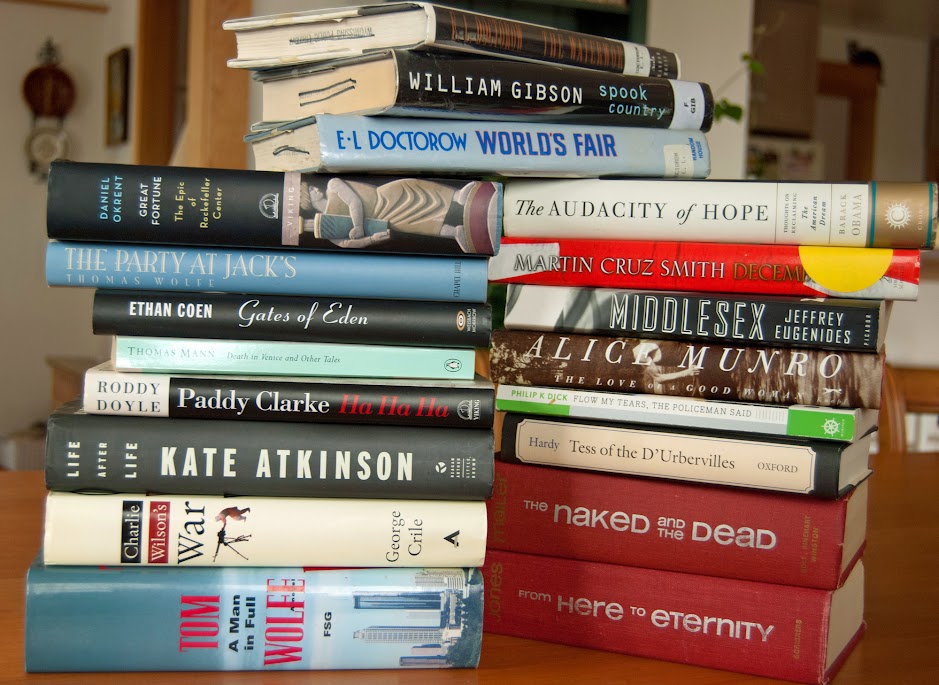
Several of these I've read, but I either wanted my own copy (Paddy Clarke Ha Ha Ha) or a copy that wasn't falling apart. I had to read Tess in high school and loathed. We'll see if I've overcome...
'Twas a great day, including the miles driven with windows open!
What I wanted was a audiobook. I've never listened to one, thought it was about time. Found something I've never read, though I'd like to. Then I noticed there was a book sale on-going. Buy a plastic grocery bag full of books for $5. After selecting about a half-bag o' books, it dawned on me that I hadn't a dime in my pocket.
Yesterday I went back with cash in my pocket and came away with 19 books in two bags. Three trade paperbacks, 16 hardcovers.
Several of these I've read, but I either wanted my own copy (Paddy Clarke Ha Ha Ha) or a copy that wasn't falling apart. I had to read Tess in high school and loathed. We'll see if I've overcome...
'Twas a great day, including the miles driven with windows open!
29weird_O
Finished reading Dangling Man, Saul Bellow's first novel, published in 1944, the year of my birth.
30weird_O
Running late, as usual. Here's a roundup of my First Quarter reading.
January
1. I Know Why the Caged Bird Sings by Maya Angelou
2. I Married a Communist by Philip Roth
3. Just Mercy by Bryan Stevenson
4. Tom Jones by Henry Fielding
5. Fathers and Sons by Ivan Turgenev
February
6. The Cycle of American Literature by Robert Spiller
7. Main Street by Sinclair Lewis
8. Native Son by Richard Wright
9. The Jungle Books by Rudyard Kipling
10. Henry and June by Anais Nin
11. Cotton Tenants by James Agee
12. The Wonderful Adventures of Paul Bunyan by Louis Untermeyer
March
13. Zuleika Dobson by Max Beerbohn
14. Penguin Island by Anatole France
15. The Innocent Voyage (b.k.a. A High Wind in Jamaica) by Richard Hughes
16. Travels with a Donkey by Robert Louis Stevenson
17. Confessions of an English Opium-Eater by Thomas DeQuincey
18. The Way of All Flesh by Samuel Butler
19. Peter Ibbetson by George du Maurier
20. The Moon and Sixpence by W. Somerset Maugham
21. The Seven Voyages of Sindbad the Sailor by Anonymous
22. Two Years Before the Mast by Richard Henry Dana Jr.
23. Treasure Island by Robert Louis Stevenson
Borrowing drneutron's statistical form:
Total Read
23
Author Gender
Male: 21 (91%)
Female: 2 (9%)
Living/Dead
Living: 2 (9%)
Dead: 21 (91%)
Medium
Hardback: 21 (91%)
Trade: 1 (4.5%)
Mass Market: 1 (4.5%)
Category
Fiction: 15 (65%)
Nonfiction: 8 (35%)
Source
Borrowed: 1 (4%)
Mine: 22 (96%)
...I find I am reading books by dead white guys. Uh ohhhhh...
January
1. I Know Why the Caged Bird Sings by Maya Angelou
2. I Married a Communist by Philip Roth
3. Just Mercy by Bryan Stevenson
4. Tom Jones by Henry Fielding
5. Fathers and Sons by Ivan Turgenev
February
6. The Cycle of American Literature by Robert Spiller
7. Main Street by Sinclair Lewis
8. Native Son by Richard Wright
9. The Jungle Books by Rudyard Kipling
10. Henry and June by Anais Nin
11. Cotton Tenants by James Agee
12. The Wonderful Adventures of Paul Bunyan by Louis Untermeyer
March
13. Zuleika Dobson by Max Beerbohn
14. Penguin Island by Anatole France
15. The Innocent Voyage (b.k.a. A High Wind in Jamaica) by Richard Hughes
16. Travels with a Donkey by Robert Louis Stevenson
17. Confessions of an English Opium-Eater by Thomas DeQuincey
18. The Way of All Flesh by Samuel Butler
19. Peter Ibbetson by George du Maurier
20. The Moon and Sixpence by W. Somerset Maugham
21. The Seven Voyages of Sindbad the Sailor by Anonymous
22. Two Years Before the Mast by Richard Henry Dana Jr.
23. Treasure Island by Robert Louis Stevenson
Borrowing drneutron's statistical form:
Total Read
23
Author Gender
Male: 21 (91%)
Female: 2 (9%)
Living/Dead
Living: 2 (9%)
Dead: 21 (91%)
Medium
Hardback: 21 (91%)
Trade: 1 (4.5%)
Mass Market: 1 (4.5%)
Category
Fiction: 15 (65%)
Nonfiction: 8 (35%)
Source
Borrowed: 1 (4%)
Mine: 22 (96%)
...I find I am reading books by dead white guys. Uh ohhhhh...
32scaifea
How did you like the Saul Bellow? I've read a couple of his (not that one, though) and appreciated the writing if not the story so much.
33Storeetllr
Hi! Just stopped by to mark a place at your reading table and was gobsmacked by your book buying and reading adventures, especially >19 weird_O:. Also drooling over all those beautiful books!
34weird_O
>31 drneutron: Glad you like 'em.
>32 scaifea: Yes, the writing is good. Yes, the story kinda sucks.
The narrator, Joseph, is a Canadian, married to an American citizen, and living in Chicago. Because of his citizenship, his effort to join the U.S. Army is stalled. He'll be accepted, he's told, but but there'll be a delay. They'll contact him soon. In anticipation, he quits his job. He and his wife economize to live on her earnings, give up their flat and move into a rooming house. He sits at home. Waits. Gets into squabbles with his wife, his parents and brother, his in-laws, with longtime friends, with neighbors. He rejects every effort people make to ease him through this limbo. Fists fly. He's asked to leave the rooming house, his wife is ready to separate. What's to like about the guy?
At first, it seemed to be about alienation. He's an alien, and that status initially prompts rejection by the army. People endeavor to commiserate, and they offer suggestions and even financial assistance, which he chooses to view as insults. His reactions to people mystifies then and, pushed a little more, angers them. More alienation. But it's really about his indecision, his reluctance to commit himself one way or another. Contrarian.
But it's a short book.
>33 Storeetllr: Hi to you. The buying is fun, but the backlog is, well, kind of frustrating. I gotta turn away from all the great recommendations I'm getting here and focus on the reading.
>32 scaifea: Yes, the writing is good. Yes, the story kinda sucks.
The narrator, Joseph, is a Canadian, married to an American citizen, and living in Chicago. Because of his citizenship, his effort to join the U.S. Army is stalled. He'll be accepted, he's told, but but there'll be a delay. They'll contact him soon. In anticipation, he quits his job. He and his wife economize to live on her earnings, give up their flat and move into a rooming house. He sits at home. Waits. Gets into squabbles with his wife, his parents and brother, his in-laws, with longtime friends, with neighbors. He rejects every effort people make to ease him through this limbo. Fists fly. He's asked to leave the rooming house, his wife is ready to separate. What's to like about the guy?
At first, it seemed to be about alienation. He's an alien, and that status initially prompts rejection by the army. People endeavor to commiserate, and they offer suggestions and even financial assistance, which he chooses to view as insults. His reactions to people mystifies then and, pushed a little more, angers them. More alienation. But it's really about his indecision, his reluctance to commit himself one way or another. Contrarian.
But it's a short book.
>33 Storeetllr: Hi to you. The buying is fun, but the backlog is, well, kind of frustrating. I gotta turn away from all the great recommendations I'm getting here and focus on the reading.
35weird_O
>32 scaifea: "How did you like the Saul Bellow?" brings to mind a piece of family lore.
Back in the 1970's, my sister-in-law and her then-husband were invited by a friends (at least one of whom was teaching at UNH) to spend a weekend with them at a New Hampshire lakeside cottage. These friends were getting a visit from former colleagues who lived in Chicago. The wife was, I think, a math prof at Northwestern, and they were told the prof's husband was some kind of writer or something. "Come on. Three couples. My friends from Chicago are older, but it'll be fun."
So they go, and they have a swell time. And back at work on Monday, my sister-in-law tells a coworker about the weekend, and says this guy from Chicago was named Bellow.
"Saul Bellow?"
"Yeah, that's it. Saul. Saul Bellow. He's a writer or something."
"Saul Bellow?!! You spent the weekend with Saul Bellow?!!
"Yeah. Should I know who that is?"
The fact that neither she nor her husband knew who Saul Bellow was surely made the weekend a whole lot more relaxing for Bellow and for everyone else. It was just after Humbolt's Gift was published, but before it was selected for the Pulitzer and before Bellow got the Nobel.
Back in the 1970's, my sister-in-law and her then-husband were invited by a friends (at least one of whom was teaching at UNH) to spend a weekend with them at a New Hampshire lakeside cottage. These friends were getting a visit from former colleagues who lived in Chicago. The wife was, I think, a math prof at Northwestern, and they were told the prof's husband was some kind of writer or something. "Come on. Three couples. My friends from Chicago are older, but it'll be fun."
So they go, and they have a swell time. And back at work on Monday, my sister-in-law tells a coworker about the weekend, and says this guy from Chicago was named Bellow.
"Saul Bellow?"
"Yeah, that's it. Saul. Saul Bellow. He's a writer or something."
"Saul Bellow?!! You spent the weekend with Saul Bellow?!!
"Yeah. Should I know who that is?"
The fact that neither she nor her husband knew who Saul Bellow was surely made the weekend a whole lot more relaxing for Bellow and for everyone else. It was just after Humbolt's Gift was published, but before it was selected for the Pulitzer and before Bellow got the Nobel.
36Storeetllr
I know what you mean. I don't usually buy books ~ rather, I read library books mostly ~ but I have been a bit profligate in that area lately. (Nothing like you've been lately, of course.) My To-Be-Read pile is now a Teetering TBR, so now I'm adding books to the Wish List instead. Once I get the TTBR pile under a smidge of control, I'll go back to borrowing/buying books.
ETA >35 weird_O: GREAT story!
ETA >35 weird_O: GREAT story!
37mstrust
Wow, you've been getting some amazing book deals! I should follow you around.
>19 weird_O: I have Tristram Shandy in the same binding as your Tom Jones, but mine is way more faded.
>35 weird_O: I agree that that's a great story!
>19 weird_O: I have Tristram Shandy in the same binding as your Tom Jones, but mine is way more faded.
>35 weird_O: I agree that that's a great story!
38scaifea
>35 weird_O: Ha! Love it. I've read Humbolt's Gift and Augie March and felt the same way about both of them: I recognized that the writing was excellent, but the characters weren't at all likeable and the story was frustrating and depressing. So it sounds like I should likely stay away from the on you just read...
39ffortsa
Hi, weird_o! Welcome to our mad world. I envy you your book buying. One of the problems of living in a NY apartment is the question of where to put all the books. So I am not buying much in the way of physical books these days. But your haul looks great.
Years ago, with more money than sense, I joined the Limited Editions Club, which published the up market editions of many of the Heritage titles, which were then made available with the design and illustrations to Heritage. Isn't it nice to read a beautifully designed book?
Years ago, with more money than sense, I joined the Limited Editions Club, which published the up market editions of many of the Heritage titles, which were then made available with the design and illustrations to Heritage. Isn't it nice to read a beautifully designed book?
40weird_O
>36 Storeetllr: I'm not too much of a library guy. There's nothing conveniently close. I do borrow, but mostly from my kids (all of 'em grownup). Unlike >39 ffortsa:, we've got the room for books.
>37 mstrust: >39 ffortsa: Good to hear from other HP fans. I just finished Around the World in Eighty Days, and it was a pleasure to read it in a well-designed format. Decent margins, readable typeface, yahda yahda.
>37 mstrust: >39 ffortsa: Good to hear from other HP fans. I just finished Around the World in Eighty Days, and it was a pleasure to read it in a well-designed format. Decent margins, readable typeface, yahda yahda.
41weird_O
Got into a reading mode; wanted a munchie or two instead of a heavy meal.
First up was E. L. Doctorow's The Waterworks, which I finished 4/9/15. OK, a page-turner for sure, but not great.
Then P. K. D.'s Flow My Tears Said the Policeman. Finished 4/10/15. A decent page-turner, but not completely satisfying. The book was written in the mid-70's, but set in 1988, so it's "in the future." The central figure is a celeb who wakes up in a flea-bag hotel, a big wad of cash in his pocket, but no ID. And he quickly discovers that NO ONE KNOWS WHO HE IS. And of course, he's living in a police-state kind of society where ID of multiple types is essential. But there are NO files on him anywhere in the whole world, not even in the colonies on the Moon. That of course makes him a subject of interest to the authorities, who want to know how he expunged the international data banks of his personal data. It's not spoiling anything to say that it all works out in the end. Pretty much.
I get a kick out of the mix of technological forecasting that's stirred into such stories. In this depiction of 1988, people travel around in vehicles called "quibbles" that fly, taking off and landing vertically. There seem to be traffic lanes in the sky, but no traffic controllers. There seem to be streets, and people park their quibbles at the curb. Taxis are robotic quibbles, and once at your destination, you can't exit ('cause the door won't open) until you pay up.
The authorities have endless data bases, digital dossiers on ev...er...y...body, that can be accessed quicktime. The phones have video-screens so you can see who you are talking to. They've got microdot tracking devices that can be hidden in a person's clothing, and even supremely miniaturized nuclear bombs (called "seeds") that can be implanted under your skin and triggered remotely if you...uh...you know...drift out of line.
All this BUT, vinyl discs are state-of-the-art for recorded music. All the phones are linked by wires. Wanna call your buddy? Get out some coin and find a pay phone. The computer mavens still depend on punch cards.
Finally, this afternoon (4/11/15), I finished Around the World in Eighty Days. First Jules Verne I've ever read. Honest. Without reservation, this was the best of my three-day, three-book spree. Loved it. I don't need to summarize it, for I knew the premise and plot framework before I started, and you do too. Highly recommended.
I'm plunging now into Dietrich Knickerbocker's History of New York by Washington Irving.
Hope all are having a great weekend. Up here on Schochary Ridge, the sky was blue with just a few scattered clouds, the air was breezy, the temp near 60. I had a window open all afternoon!
First up was E. L. Doctorow's The Waterworks, which I finished 4/9/15. OK, a page-turner for sure, but not great.
Then P. K. D.'s Flow My Tears Said the Policeman. Finished 4/10/15. A decent page-turner, but not completely satisfying. The book was written in the mid-70's, but set in 1988, so it's "in the future." The central figure is a celeb who wakes up in a flea-bag hotel, a big wad of cash in his pocket, but no ID. And he quickly discovers that NO ONE KNOWS WHO HE IS. And of course, he's living in a police-state kind of society where ID of multiple types is essential. But there are NO files on him anywhere in the whole world, not even in the colonies on the Moon. That of course makes him a subject of interest to the authorities, who want to know how he expunged the international data banks of his personal data. It's not spoiling anything to say that it all works out in the end. Pretty much.
I get a kick out of the mix of technological forecasting that's stirred into such stories. In this depiction of 1988, people travel around in vehicles called "quibbles" that fly, taking off and landing vertically. There seem to be traffic lanes in the sky, but no traffic controllers. There seem to be streets, and people park their quibbles at the curb. Taxis are robotic quibbles, and once at your destination, you can't exit ('cause the door won't open) until you pay up.
The authorities have endless data bases, digital dossiers on ev...er...y...body, that can be accessed quicktime. The phones have video-screens so you can see who you are talking to. They've got microdot tracking devices that can be hidden in a person's clothing, and even supremely miniaturized nuclear bombs (called "seeds") that can be implanted under your skin and triggered remotely if you...uh...you know...drift out of line.
All this BUT, vinyl discs are state-of-the-art for recorded music. All the phones are linked by wires. Wanna call your buddy? Get out some coin and find a pay phone. The computer mavens still depend on punch cards.
Finally, this afternoon (4/11/15), I finished Around the World in Eighty Days. First Jules Verne I've ever read. Honest. Without reservation, this was the best of my three-day, three-book spree. Loved it. I don't need to summarize it, for I knew the premise and plot framework before I started, and you do too. Highly recommended.
I'm plunging now into Dietrich Knickerbocker's History of New York by Washington Irving.
Hope all are having a great weekend. Up here on Schochary Ridge, the sky was blue with just a few scattered clouds, the air was breezy, the temp near 60. I had a window open all afternoon!
42jnwelch
Finally catching up with you, weird_O! I'm a Philip K. Dick and Jules Verne fan, so it's good to see you liked a couple of their books. What a book haul up above! Good for you for making the extra effort; it looks like it really paid off.
43weird_O
For the last few days, I've been occupied with adding more of my books to my online "library". As I entered the info on a pile of Steinbeck paperbacks, I began to think that some of them I'd never really read. So I put Washington Irving aside to read Cup of Gold, Steinbeck's first published book and only piece of historical fiction. That done, I'm back to W.I.
44weird_O
Been a while. I'm still reading Washington Irving (slowly), still reading one or two O. Henry stories every day. I'm still cataloging books. Since finishing Cup of Gold, I've read four other books, and I'm actively reading The City of Falling Angels by John Berendt.
45weird_O
Cup of Gold by John Steinbeck (4/15/15)


Cup of Gold is John Steinbeck's retelling of the life of notorious 17th century British pirate Henry Morgan, taking us from his farmboy beginnings to his triumphant plunderings of the Spanish main and his docile end back in England. Steinbeck's premise is that Morgan prevailed because he studied his targets, developed a plan of attack for each raid, and established and maintained strict discipline over his crews. His seizure of Panama—the Cup of Gold—was no naval operation, rather a land war. He pursues the fabled La Santa Roja—is she the woman of his dreams?—driving his men across the isthmus. Yes, he captures her, and, yeah, you won't believe what happens next.
Cup of Gold is a decent, easy read, at just under 200 pages. The most notable features: it's Steinbeck's first novel, published in 1928, and his only historical novel. I enjoyed it, had no trouble sticking with it, but there's many another seafaring novel I'd recommend before this one.
Why did I read it? I was sorting and cataloging the books on my shelves, consolidating my Steinbacks from various locations. Cup of Gold was in my hands, didn't seem at all familiar, didn't seem a task to read, so I read. No regrets.


Cup of Gold is John Steinbeck's retelling of the life of notorious 17th century British pirate Henry Morgan, taking us from his farmboy beginnings to his triumphant plunderings of the Spanish main and his docile end back in England. Steinbeck's premise is that Morgan prevailed because he studied his targets, developed a plan of attack for each raid, and established and maintained strict discipline over his crews. His seizure of Panama—the Cup of Gold—was no naval operation, rather a land war. He pursues the fabled La Santa Roja—is she the woman of his dreams?—driving his men across the isthmus. Yes, he captures her, and, yeah, you won't believe what happens next.
Cup of Gold is a decent, easy read, at just under 200 pages. The most notable features: it's Steinbeck's first novel, published in 1928, and his only historical novel. I enjoyed it, had no trouble sticking with it, but there's many another seafaring novel I'd recommend before this one.
Why did I read it? I was sorting and cataloging the books on my shelves, consolidating my Steinbacks from various locations. Cup of Gold was in my hands, didn't seem at all familiar, didn't seem a task to read, so I read. No regrets.
46weird_O
Cyrano de Bergerac by Edmund Rostand (4/16/15)


Another book—actually, the script of a play—that presented itself through cataloging is Cyrano de Bergerac. I believe I read it in prep school, and the particular book shown above, is the copy I read. Still have it (obviously), 50 some years later (I've always been loath to dispose of books). But those years have erased much of it from my memory. As I read, I pictured Steve Martin with a prosthetic nose and Jose Ferrier with his prosthetic nose. And I couldn't remember how either movie ended.
This is a great play, with action and comedy and romance. And I was surprised how moving the conclusion of the play is. Read it and see for yourself.


Another book—actually, the script of a play—that presented itself through cataloging is Cyrano de Bergerac. I believe I read it in prep school, and the particular book shown above, is the copy I read. Still have it (obviously), 50 some years later (I've always been loath to dispose of books). But those years have erased much of it from my memory. As I read, I pictured Steve Martin with a prosthetic nose and Jose Ferrier with his prosthetic nose. And I couldn't remember how either movie ended.
This is a great play, with action and comedy and romance. And I was surprised how moving the conclusion of the play is. Read it and see for yourself.
47weird_O
Pride and Prejudice by Jane Austen (4/24/15)

My first ever Jane Austen read. My wife is a dedicated Austen fan, having read every one of her novels, the best of them four or twelve times since she was introduced to them in high school. She's got several screen versions of Pride and Prejudice and it is one of her favorite comfort movies. So Pride and Prejudice wasn't unknown to me; I just never read it. Wasn't going to either. But I need to get through a "classic romance." Cornered.
Alright. I admit it. Pride and Prejudice is excellent. I will certainly read more Jane Austen, and before the year is out.

My first ever Jane Austen read. My wife is a dedicated Austen fan, having read every one of her novels, the best of them four or twelve times since she was introduced to them in high school. She's got several screen versions of Pride and Prejudice and it is one of her favorite comfort movies. So Pride and Prejudice wasn't unknown to me; I just never read it. Wasn't going to either. But I need to get through a "classic romance." Cornered.
Alright. I admit it. Pride and Prejudice is excellent. I will certainly read more Jane Austen, and before the year is out.
48jnwelch
>47 weird_O: Glad to hear it, w_O. I was just talking to a co-worker; we'd put P &P up there with the best novels ever. My second favorite is Persuasion, but after P & P you'll find a lot of variety in how Austen readers rank her books.
P & P has romance, but I think its, and her, enduring popularity stem from a different source. She's a biting social satirist of the first order. If you want to get a fun perspective on her writings, try reading Bitch in a Bonnet, by Richard Rodi. The title gives you a good idea of his perspective.
P & P has romance, but I think its, and her, enduring popularity stem from a different source. She's a biting social satirist of the first order. If you want to get a fun perspective on her writings, try reading Bitch in a Bonnet, by Richard Rodi. The title gives you a good idea of his perspective.
49mstrust
>47 weird_O: Isn't it nice when something turns out to be less painful than expected? Austen's charm is hard to resist.
50scaifea
You know, I've only ever read Persuasion. I *really* need to get back to Jane...
51msf59
Happy Thursday, Bill! I've been seeing you around the threads, so I thought I would stop by and say: Welcome to the Mighty 75!! You picked the best place on LT, to call home.
With all your "classic" reading, the AAC, should be a perfect fit for you. And we will always take suggestions.
With all your "classic" reading, the AAC, should be a perfect fit for you. And we will always take suggestions.
52Whisper1
>10 qebo: What an incredible book haul, and wonderful story! All those books, and so little money for them.
You may find a common thread running through our threads and that is we simply cannot help pass up a book sale, nor can some of us refuse to stop purchasing books, long after all space is filled.
There is something about collecting books that makes the soul sing!
Welcome to the 75 challenge group. I hope you like it here. We began in 2008. Since then many members have joined.
You may find a common thread running through our threads and that is we simply cannot help pass up a book sale, nor can some of us refuse to stop purchasing books, long after all space is filled.
There is something about collecting books that makes the soul sing!
Welcome to the 75 challenge group. I hope you like it here. We began in 2008. Since then many members have joined.
53weird_O
April 2015 Reading Roundup
24. Spartacus by Howard Fast (4/3/15)
25. William Tell by Friedrich Schiller (4/5/15)
26. Dangling Man by Saul Bellow (4/8/15)
27. The Waterworks by E. L. Doctorow (4/9/15)
28. Flow My Tears Said the Policeman by Philip K. Dick (4/10/15)
29. Around the World in Eighty Days by Jules Verne (4/11/15)
30. Cup of Gold by John Steinbeck (4/15/15)
31. Cyrano de Bergerac by Edmund Rostand (4/16/15)
32. Dameon by Hermann Hesse (4/18/15)
33. Breakfast with Buddha by Roland Murello (4/21/15)
34. Pride and Prejudice by Jane Austen (4/24/15)
35. The City of Falling Angels by John Berendt (4/27/15)
36. Life After Life by Kate Atkinson (4/30/15)
Stats
Total Read
13
Author Gender
Male: 11 (85%)
Female: 2 (15%)
Living/Dead
Living: 4 (31%)
Dead: 9 (69%)
Medium
Hardback: 6 (46%)
Trade: 3 (23%)
Mass Market: 4 (31%)
Category
Fiction: 12 (92%)
Nonfiction: 1 (8%)
Source
Borrowed: 0 (0%)
Mine: 13 (100%)
50 Book Challenge: Jan. 1 through April 30
2. A classic romance Pride and Prejudice
3. A book that became a movie Spartacus
5. A book with a number in the title Around the World in Eighty Days
6. A book written by someone under 30 Two Years Before the Mast Published when Richard Henry Dana Jr. was 25.
7. A book with non-human characters The Jungle Book
9. A book by a female author I Know Why the Caged Bird Sings by Maya Angelou
13. A book set in a different country Fathers and Sons
14. A non-fiction book Just Mercy
15. A popular author’s first book Cup of Gold by John Steinbeck
23. A book more than 100 years old Tom Jones
27. A book you can finish in a day The Seven Voyages of Sindbad the Sailor
30. A book that came out the year you were born Dangling Man (1944)
33. A book from your childhood Treasure Island
47. A play William Tell
24. Spartacus by Howard Fast (4/3/15)
25. William Tell by Friedrich Schiller (4/5/15)
26. Dangling Man by Saul Bellow (4/8/15)
27. The Waterworks by E. L. Doctorow (4/9/15)
28. Flow My Tears Said the Policeman by Philip K. Dick (4/10/15)
29. Around the World in Eighty Days by Jules Verne (4/11/15)
30. Cup of Gold by John Steinbeck (4/15/15)
31. Cyrano de Bergerac by Edmund Rostand (4/16/15)
32. Dameon by Hermann Hesse (4/18/15)
33. Breakfast with Buddha by Roland Murello (4/21/15)
34. Pride and Prejudice by Jane Austen (4/24/15)
35. The City of Falling Angels by John Berendt (4/27/15)
36. Life After Life by Kate Atkinson (4/30/15)
Stats
Total Read
13
Author Gender
Male: 11 (85%)
Female: 2 (15%)
Living/Dead
Living: 4 (31%)
Dead: 9 (69%)
Medium
Hardback: 6 (46%)
Trade: 3 (23%)
Mass Market: 4 (31%)
Category
Fiction: 12 (92%)
Nonfiction: 1 (8%)
Source
Borrowed: 0 (0%)
Mine: 13 (100%)
50 Book Challenge: Jan. 1 through April 30
2. A classic romance Pride and Prejudice
3. A book that became a movie Spartacus
5. A book with a number in the title Around the World in Eighty Days
6. A book written by someone under 30 Two Years Before the Mast Published when Richard Henry Dana Jr. was 25.
7. A book with non-human characters The Jungle Book
9. A book by a female author I Know Why the Caged Bird Sings by Maya Angelou
13. A book set in a different country Fathers and Sons
14. A non-fiction book Just Mercy
15. A popular author’s first book Cup of Gold by John Steinbeck
23. A book more than 100 years old Tom Jones
27. A book you can finish in a day The Seven Voyages of Sindbad the Sailor
30. A book that came out the year you were born Dangling Man (1944)
33. A book from your childhood Treasure Island
47. A play William Tell
54SandDune
Hi, I've seen you round the threads recently so I thought I'd just drop by to say hello. You've been doing some great reading.
55weird_O
>54 SandDune: Hi back. It's been fun.
56weird_O
It's only been five days since adding to my thread. But I've a lot to report.
First, I've avoided reporting on four of the last six books I've read, primarily because I just haven't taken the time to jot down a coherent paragraph or two about each. I'm going to do it. Really. The titles are:
Dameon by Hermann Hesse
Breakfast with Buddha by Roland Murello
The City of Falling Angels by John Berendt
Life After Life by Kate Atkinson
I did very briefly report on Pride and Prejudice, and bits of feedback prompted me to search out a tutored read, and I'm working my way through it. It formed a 131 page pdf.
My first read of May was Bad Boy Brawly Brown by Walter Mosley, and my report on it is in the thread on murder and mayhem, here: https://www.librarything.com/topic/190483#5149459
I also bought a couple of bags of books at a nearby library sale, and found, as well, three good books in the "Freebies" bin just outside the library entrance.
Finally, I've been putting in some hours cataloging books. Don't have too many more to do.
So what are YOU up to?
First, I've avoided reporting on four of the last six books I've read, primarily because I just haven't taken the time to jot down a coherent paragraph or two about each. I'm going to do it. Really. The titles are:
Dameon by Hermann Hesse
Breakfast with Buddha by Roland Murello
The City of Falling Angels by John Berendt
Life After Life by Kate Atkinson
I did very briefly report on Pride and Prejudice, and bits of feedback prompted me to search out a tutored read, and I'm working my way through it. It formed a 131 page pdf.
My first read of May was Bad Boy Brawly Brown by Walter Mosley, and my report on it is in the thread on murder and mayhem, here: https://www.librarything.com/topic/190483#5149459
I also bought a couple of bags of books at a nearby library sale, and found, as well, three good books in the "Freebies" bin just outside the library entrance.
Finally, I've been putting in some hours cataloging books. Don't have too many more to do.
So what are YOU up to?
57weird_O
The library sale was a little over a week ago, and featured two rooms with tables and shelves filled with books. You'd buy a paper grocery bag for $5. Fill it with as many books as you could. All of them for $5. I did fill two bags.

Several of these books I have read, having borrow them, but I wanted to have them to reread sometime. A couple others will replace tattered paperbacks. I even got a couple of duplicates because it was too lazy to check to see if I had already bagged copies. When all was tallied, I spend about 35 cents per book, so I felt empowered to give away any extras.
I've already read The City of Falling Angels and Bad Boy Brawly Brown.

Several of these books I have read, having borrow them, but I wanted to have them to reread sometime. A couple others will replace tattered paperbacks. I even got a couple of duplicates because it was too lazy to check to see if I had already bagged copies. When all was tallied, I spend about 35 cents per book, so I felt empowered to give away any extras.
I've already read The City of Falling Angels and Bad Boy Brawly Brown.
58weird_O
Struggling out of the library, a full grocery bag in each arm, I spied old boxes with a jumble of books in them. A paper sign on the wall above them said "Free". Well, how can you resist? Even if you are holding a bag of books in each arm. Set the bags down very carefully and methodically sorted through the give-aways. Found paperback copies of Sick Puppy by Carl Hiaasen and Gulag Archipelago by Solzhenitsyn, a theater book, and a hardcover book inserted spine first in a slipcase.

Shaking the book out of the slipcase, revealed a pristine copy of Henry James's The Ambassadors. Free!


Shaking the book out of the slipcase, revealed a pristine copy of Henry James's The Ambassadors. Free!


59mstrust
Great haul and how lucky to get that Henry James. Now why doesn't my library do $5 a bag sales? Jealous.
60charl08
>57 weird_O: Love the idea of a fill a bag book sale. Great haul.
62msf59
Wow! That is a great book haul. Many fine titles.
Look forward to your thoughts on Breakfast with Buddha. I recently enjoyed that one myself. I am also a big fan of The City of Falling Angels & Life After Life. You are reading some terrific books.
Look forward to your thoughts on Breakfast with Buddha. I recently enjoyed that one myself. I am also a big fan of The City of Falling Angels & Life After Life. You are reading some terrific books.
63jnwelch
What Mark said, w_O! Great load of books you have there. Are you a Walter Mosley fan? I run into fewer of them on Librarything than I would've guessed. I'm glad he's resuming the Easy Rawlins series - I enjoyed Rose Gold.
64weird_O
>59 mstrust: >60 charl08: You are just going to have to suggest it. Both libraries I hit take in book donations during the year and stockpile them. I only got three to five books with library markings. And, absolutely, I do love these bonanzas.
>61 scaifea: Amber, I'm vera vera happy about the James book myself. The Ambassadors is about the only James novel I've wanted to read. That ship has now docked! Hah! After driving to Oyster Bay and back for 160 books, I find a prime novel at the local library. Free!
>62 msf59: Mark, check back for Bill's weird book reports. Berendt was good, Atkinson puzzling, Merullo...well...meh.
>61 scaifea: Amber, I'm vera vera happy about the James book myself. The Ambassadors is about the only James novel I've wanted to read. That ship has now docked! Hah! After driving to Oyster Bay and back for 160 books, I find a prime novel at the local library. Free!
>62 msf59: Mark, check back for Bill's weird book reports. Berendt was good, Atkinson puzzling, Merullo...well...meh.
65weird_O
Breakfast with Buddha by Roland Merullo (4/21/15)


Sorry. I just can't be enthusiastic about this book. Oh, it's easy-reading, the author is a good writer, the trip is well-structured with clever twists and surprises. But you can see where the story is headed pretty early on.
The premise is that Otto, the narrator, is driving from a northern suburb of NYC to pick up his flakey sister Cecelia in Patterson, NJ. She's going to ride with him to the North Dakota farm they've inherited following the deaths of their parents. Ahhh. But she pulls a devious trick, and isn't going. In her place, Otto's passenger will be an outlandish, buddha-like guru to whom the sister wants to give her share of the farm, so he can develop a retreat center there. After arguing back and forth, the silent figure settles into the front passenger seat, and off they go. Do I have to tell you were this is going? I mean, beside North Dakota.
Otto wants to stop at a few off-the-Interstate places, swell small restaurants where he, a professional foodie, wants to dine. Rinpoche, for that's the buddha-like passenger's name, for his part, must stop at several places to give talks. As the trip unravels, Otto's going to be disputatious, Rinpoche a paragon of calm. And in the end, well you take it from here.
I just want to say I thought the final paragraphs were sappy, sappy, sappy. I hear the buddha's hosting—down that winding road—lunch, tea, supper, and maybe a late-night snack.
66jnwelch
>65 weird_O: Sorry BWB didn't work better for you, w_O (I liked it and its successors a lot), but that's a good, frank review. I don't remember the final paragraphs as sappy x 3, but then again, maybe sappy x 3 would be a valid description of me.
68weird_O
>67 Whisper1: I just heard this evening that the Bethlehem library is holding its annual sale next Wednesday, and my informants assured me that this sale is top-flight. Hardcovers one dollar, paperbacks fifty cents. Do you know anything about this? Ever been to one?
69thornton37814
>57 weird_O: Nice book haul.
70weird_O
The City of Falling Angels by John Berendt
Venice is the city. In this book, published in 2005, John Berendt gives Venice the same basic treatment he gave Savannah in a previous book, Midnight in the Garden of Good and Evil. He has a framework and a construction formula. Select a very interesting city, focus on a calamity there that engages all the wits and gossips, draws all the sidewalk (in this case, canal) superintendents. As the details of the calamity and its aftermath trickle out, Berendt fleshes out his tale with what amount to sidebars on ancillary characters and conflicts and entertainments.
Here his main event is a disastrous fire than destroys the Fenice Opera House in January 1996. The Fenice is hundreds of years old. Because the canal adjacent to the structure has been drained for needed repairs and renovation, firefighters can't quickly deluge the blaze. They have to jerry-rig hose-lines through walkways and even through some buildings. In the aftermath, new threads develop, following investigations into the cause, following various plans for reconstruction, following competition for the reconstruction contract. The ornate structure's been expanded, renovated and its interior altered over the years, of course, but the archive of architectural plans, of construction plans, is spotty. Recent photos of the interior spaces are nonexistent.
As this tale unfolds, Berendt intersperses it with sidebars.
• Archimede Seguso, whose apartment is across the canal from the theater is stupified by the inferno, sitting in a chair by a window, watching the fire all night, ignoring pleas from fire officials, his wife, his son to vacate to safety. He is, we learn, a master glassblower, active for 75 years, and now in his late 80s is the patriarch of one of Venice's most significant firms. Berendt recounts the story of glass making in Venice, of family feuds that threaten the creative and business integrity of the firms, and how Signor Seguso energized by the fire.
• A group of wealthy Americans are gathering in Venice, when the fire explodes. These men and women are the leaders of Save Venice, a New York-based charity that funds repairs and restorations. Several own palatial residences bordering the Grand Canal and other waterways. Some represent inherited wealth, while others built their own fortunes. As time passes, these powerful folks get to squabbling amongst themselves. Berendt tells pretty much of it.
• Ezra Pound was long a resident of Venice, where he lived with his mistress of 50 years, Olga Rudge. When Pound, then his widow, died in the early 1970s, Olga was left in possession of their house and several large chests with the poet and editor's papers. Berendt is drawn to the end-of-life machinations to gain control of those papers and the house. (Now I have to read Pound and about Pound!)
Oh, there's a lot more. Anecdotes about daily life in a city without cars. Profiles on the rich, the aristocratic, the political, even ordinary mortals. Can you tell that I really enjoyed this book?
What's missing? Photos and drawings. How can you tell about this unique city and its artistic and architectural wonders, about a devastating fire and an enormously complicated construction without SHOWING at least a handful of pictures. The endpapers are printed with a marvellous bird-eye view of the city with many buildings highlighted. But it isn't enough. Check Google Maps as you read.
Finally, here are a few photos plucked from the internets.

The Morning After

Interior of the Fenice Theater
 The Grand Canal
 space
space

71charl08
Sounds like a great book - and thanks for the images. Those murals in particular caught my eye - beautiful.
72weird_O
Last night I finished book #38 for the year, Dodsworth by Sinclair Lewis. Today I've taken up Sick Puppy by Carl Hiaasen, and I expect to read a few more O.Henry stories, just to keep that going. Since I jumped into both the TBR Challenge and the American Author Challenge, to augment the Category Challenge and the basic 75er, I felt compelled to list the specific titles I'm committed to, and further, to map the categories into which they fit. Wow!
73weird_O
My reading has gotten ahead of my reporting. So far in May, I've completed:
Big Bad Brawly Brown by Walter Mosley
Dodsworth by Sinclair Lewis
Sick Puppy by Carl Hiaasen
Famous People I Have Known by Ed McClanahan
But I still haven't reported on Life After Life by Kate Atkinson, which I finished the last day of April. That's coming. But first...
Famous People I Have Known by Ed McClanahan
 …
… ...Ed McClanahan
In the opening chapter of this little book, the author meets a singer named Jimmy Sacca. It happens in the parking lot outside a rural Kentucky roadhouse. McClanahan, a college student, has just puked on the fender of Sacca's car. He can't find his own car or the friends he came with. The tale progresses. Sacca is angry, but nevertheless is pursuaded to drive this, this drunk back to town, and on to the girl's dorm at the college—McClanahan's looking for his car, don't you see, and thinks one of the girls will know where it is. But it's in the wee morning hours, and how does one awaken a particular co-ed and not everyone in the neighborhood? It involves a serenade.
And I'm wondering who this Jimmy Sacca is. Is this a real person? And who is Ed McClanahan again?
I picked up this book years ago, primarily because I liked the R. Crumb drawing on the cover. The author was unknown to me, and remained so even after I'd read that first chapter. Although not billed as such, the book seems to be a collection of articles, and indeed, the copyright page extension (in the very back) notes that portions have appeared in Esquire, Playboy and other periodicals. With some help from my good friend Google, I've learned that Ed McClanahan published 7 or 8 books, most notably The Natural Man. He's a native Kentuckian, sometimes known as Captain Kentucky. (Jimmy Sacca, by the way, was the leader singer in the Hilltoppers, an early 1950s group formed by him and two classmates at Western Kentucky State College. Wikipedia has more.)
A later chapter in this memoir recounts McClanahan's associations with hippies in early 1960s San Francisco, his friendship with Ken Kesey, his involvement as a Merry Prankster. Another chapter is devoted to Carlos Toadvine, better known as Little Enis, the All-American, Left-handed, Upside-Down Guitar Player. In a closing chapter, he again meets Jimmy Sacca, now operating a "medium-sized, medium-nice Southern café" in Jackson, Mississippi. The jukebox has a whole selection of Hilltoppers records. Sacca, of course, doesn't know him.
Big Bad Brawly Brown by Walter Mosley
Dodsworth by Sinclair Lewis
Sick Puppy by Carl Hiaasen
Famous People I Have Known by Ed McClanahan
But I still haven't reported on Life After Life by Kate Atkinson, which I finished the last day of April. That's coming. But first...
Famous People I Have Known by Ed McClanahan
 …
… ...Ed McClanahan
 In the opening chapter of this little book, the author meets a singer named Jimmy Sacca. It happens in the parking lot outside a rural Kentucky roadhouse. McClanahan, a college student, has just puked on the fender of Sacca's car. He can't find his own car or the friends he came with. The tale progresses. Sacca is angry, but nevertheless is pursuaded to drive this, this drunk back to town, and on to the girl's dorm at the college—McClanahan's looking for his car, don't you see, and thinks one of the girls will know where it is. But it's in the wee morning hours, and how does one awaken a particular co-ed and not everyone in the neighborhood? It involves a serenade.
And I'm wondering who this Jimmy Sacca is. Is this a real person? And who is Ed McClanahan again?
I picked up this book years ago, primarily because I liked the R. Crumb drawing on the cover. The author was unknown to me, and remained so even after I'd read that first chapter. Although not billed as such, the book seems to be a collection of articles, and indeed, the copyright page extension (in the very back) notes that portions have appeared in Esquire, Playboy and other periodicals. With some help from my good friend Google, I've learned that Ed McClanahan published 7 or 8 books, most notably The Natural Man. He's a native Kentuckian, sometimes known as Captain Kentucky. (Jimmy Sacca, by the way, was the leader singer in the Hilltoppers, an early 1950s group formed by him and two classmates at Western Kentucky State College. Wikipedia has more.)
A later chapter in this memoir recounts McClanahan's associations with hippies in early 1960s San Francisco, his friendship with Ken Kesey, his involvement as a Merry Prankster. Another chapter is devoted to Carlos Toadvine, better known as Little Enis, the All-American, Left-handed, Upside-Down Guitar Player. In a closing chapter, he again meets Jimmy Sacca, now operating a "medium-sized, medium-nice Southern café" in Jackson, Mississippi. The jukebox has a whole selection of Hilltoppers records. Sacca, of course, doesn't know him.
74weird_O
Finished my 42nd book this year last night, shortly before midnight. It's a good one.
The Killer Angels by Michael Shaara
 ..
.. Michael Shaara
The Killer Angels is a novel about the Battle of Gettysburg, focusing on the thoughts and actions of but a few of the hundreds of thousands of combatants on those fateful three days in July 1863. It was awarded the Pulitzer for fiction in 1975, and served as the basis for the epic movie Gettysburg. I've seen the movie, visited the battlefield, read quite a few Civil War histories. I loved this book and recommend it.
In a prefatory note, Shaara asserts he relied primarily on the words, letters, and documents of the participants, rather than historical opinion, that he hasn't altered facts (though he admits to some condensation for the sake of brevity), and that interpretation of character is his own. Maps—they are a great feature—show the alignment of confederate and union forces at critical times.
The novel touches on every aspect of the war, from the mindsets and morale of individual footsoldiers, the epic casts, the logistical challenges, the impact of personalities. Rather than lay out information in PowerPoint, Shaara conveys it in man-to-man confrontations, in vignettes. The dominant viewpoint is southern, the core tension that between Lee, who is determined to fight at this place, and Longstreet, his most trusted general, who wants to withdraw and fight another day in more terrain and circumstances more auspicious to them.
The key figures in Shaara's telling:
 General James Longstreet, who sees a fight his Confederates can't win.
General Robert E. Lee, revered commander of all Confederate forces, who sees a fight that must be won.
 General John Buford, first Union officer in Gettyburg, who recognizes the high ground and determines to hold it against advancing Rebs, hold it until the main Union force arrives.
Colonel Joshua Lawrence Chamberlain, college rhetorics professor, charged with holding the very end of the Union line—with an undermanned unit.
 Confederate General Lewis Armistead, who longs for one last visit with General Winfield Scott Hancock, a lifelong friend who is fighting for the Union.
General George Pickett, champing to get into the fight, on the three and final day.
 Englishman Arthur Fremantle, a journalist following the Southern forces, cheering them on to what he confidently believes will be a glorious victory.
For what it's worth, my wife picked up the book the day after I put it down, read a half-dozen pages, and was hooked.
The Killer Angels by Michael Shaara
 ..
.. Michael Shaara
The Killer Angels is a novel about the Battle of Gettysburg, focusing on the thoughts and actions of but a few of the hundreds of thousands of combatants on those fateful three days in July 1863. It was awarded the Pulitzer for fiction in 1975, and served as the basis for the epic movie Gettysburg. I've seen the movie, visited the battlefield, read quite a few Civil War histories. I loved this book and recommend it.
In a prefatory note, Shaara asserts he relied primarily on the words, letters, and documents of the participants, rather than historical opinion, that he hasn't altered facts (though he admits to some condensation for the sake of brevity), and that interpretation of character is his own. Maps—they are a great feature—show the alignment of confederate and union forces at critical times.
The novel touches on every aspect of the war, from the mindsets and morale of individual footsoldiers, the epic casts, the logistical challenges, the impact of personalities. Rather than lay out information in PowerPoint, Shaara conveys it in man-to-man confrontations, in vignettes. The dominant viewpoint is southern, the core tension that between Lee, who is determined to fight at this place, and Longstreet, his most trusted general, who wants to withdraw and fight another day in more terrain and circumstances more auspicious to them.
The key figures in Shaara's telling:
 General James Longstreet, who sees a fight his Confederates can't win.
General Robert E. Lee, revered commander of all Confederate forces, who sees a fight that must be won.

 General John Buford, first Union officer in Gettyburg, who recognizes the high ground and determines to hold it against advancing Rebs, hold it until the main Union force arrives.
Colonel Joshua Lawrence Chamberlain, college rhetorics professor, charged with holding the very end of the Union line—with an undermanned unit.

 Confederate General Lewis Armistead, who longs for one last visit with General Winfield Scott Hancock, a lifelong friend who is fighting for the Union.
General George Pickett, champing to get into the fight, on the three and final day.

 Englishman Arthur Fremantle, a journalist following the Southern forces, cheering them on to what he confidently believes will be a glorious victory.
For what it's worth, my wife picked up the book the day after I put it down, read a half-dozen pages, and was hooked.
75Whisper1
You are zipping along with your reading, and you are reading some very good books!
Happy Day To You!
Happy Day To You!
76weird_O
>75 Whisper1: Why thanks to you. It has been a good day. And thanks for posting the photos of Linderman Library. I always did love that multilevel semi-circular space, and I am so glad they essentially restored it, rather that "re-imagining" it (or some other euphemism for screwing it up).
77weird_O
The Stories of O. Henry by William Sidney Porter
 ...
...
To fulfill my Category Challenge # 12. A book of short stories (see 3 at the top of the thread), I picked The Stories of O. Henry from the collection of Heritage Press titles I bought (cheap) in February. The book is handsome, the text is comfortably readable, and it is embellished with pen-and-ink sketches, some in color, by John Groth. Forty stories are reproduced.
O. Henry is a name familiar to most readers. He's a short-story author, famous for his most anthologized stories, "The Gift of the Magi" and "The Ransom of Red Chief." We read them in school, maybe middle school. Beyond that, what do we know of this gifted story-teller? According to the introduction, the first story by "O. Henry" was published in 1898. William Sidney Porter, the real writer behind the false one, picked his pen name on a whim from a phone directory. When really pressed by an insistent editor, Porter came up with Oliver as the name "O" abbreviated.
Porter's most productive period began in 1902. By 1910, he was dead.
The stories in this collection are generally good. Many have the surprise endings for which O. Henry was known. They tell about ordinary folks, working low-wage jobs, seeking love, seeking their fortunes, seeking fulfillment, the ideal scam, escape. The stories often are conveyed in the vernacular of the setting and characters, a slang and a cadence Porter worked hard to reproduce accurately. He reviled "the eastern story-paper kind" of slang. What was important was character. As Bob Tidball tells his cohort Shark Dodson in "The Roads We Take," "It ain't the roads we take; it's what's inside us that makes us turn out the way we do."
 The Roads We Take
 The Trimmed Lamp
 The Man Higher Up
 The Caballero's Way
 ...
...
To fulfill my Category Challenge # 12. A book of short stories (see 3 at the top of the thread), I picked The Stories of O. Henry from the collection of Heritage Press titles I bought (cheap) in February. The book is handsome, the text is comfortably readable, and it is embellished with pen-and-ink sketches, some in color, by John Groth. Forty stories are reproduced.
O. Henry is a name familiar to most readers. He's a short-story author, famous for his most anthologized stories, "The Gift of the Magi" and "The Ransom of Red Chief." We read them in school, maybe middle school. Beyond that, what do we know of this gifted story-teller? According to the introduction, the first story by "O. Henry" was published in 1898. William Sidney Porter, the real writer behind the false one, picked his pen name on a whim from a phone directory. When really pressed by an insistent editor, Porter came up with Oliver as the name "O" abbreviated.
Porter's most productive period began in 1902. By 1910, he was dead.
The stories in this collection are generally good. Many have the surprise endings for which O. Henry was known. They tell about ordinary folks, working low-wage jobs, seeking love, seeking their fortunes, seeking fulfillment, the ideal scam, escape. The stories often are conveyed in the vernacular of the setting and characters, a slang and a cadence Porter worked hard to reproduce accurately. He reviled "the eastern story-paper kind" of slang. What was important was character. As Bob Tidball tells his cohort Shark Dodson in "The Roads We Take," "It ain't the roads we take; it's what's inside us that makes us turn out the way we do."
 The Roads We Take
 The Trimmed Lamp
 The Man Higher Up
 The Caballero's Way
78msf59
I love the reviews, Bill! I am also a big fan of The Killer Angels. I also read the next 2 books, in this Civil War Trilogy. These were written by his son Jeff.
I have never read O. Henry. Someday?
I have never read O. Henry. Someday?
79jnwelch
Ditto re The Killer Angels, Bill, and the ones after. KA is terrific. Fun to see those photos. I'm an O'Henry fan, too.
80weird_O
>78 msf59: >79 jnwelch: I have a Jeff Shaara guide to Civil War battlefields, and I know of Gods and Generals. What's the third book of this trilogy?
My wife, Judi, is just now finishing KA; clearly she's liking it.
As for O. Henry, Mark, you've got two thumbs up now. Give 'im a try.
My wife, Judi, is just now finishing KA; clearly she's liking it.
As for O. Henry, Mark, you've got two thumbs up now. Give 'im a try.
81msf59
The final book in the trilogy is The Last Full Measure and it is another good one.
I will have to read some O. Henry, my friend.
I will have to read some O. Henry, my friend.
82weird_O
 .
.
Completed The Light of Day by Eric Ambler last night. Don't know where I got it; a nice little hardcover. I guess I was drawn to the author's name, as a writer of international thrillers;, never read anything he'd written until yesterday. The jacket photo shows him looking all urbane.
The main character, Arthur Simpson, is a product of the British empire's melting pot--father in British military, mother an Egyptian. He's a low-life preying on tourists in Greece and Turkey in the late 1950s/early 1960s. When he's caught in the act of stealing traveler's checks from "client," said client blackmails him into driving a Lincoln from Athens to Istanbul. He's detained at the Turkish border because his Egyptian passport has expired, and the Turks discover the Lincoln's doors are loaded with guns and grenades. He's blackmailed by Turkish authorities to continue on to Istanbul, acting as their spy. It's all twisty-turny. It was just what I was looking for--respite.
83mstrust
That does sound action-packed, so you got me with a BB. I have a couple from Ambler on the shelf, but I don't believe this is one of them. Glad you liked it!
84weird_O
I've been plugging away at a couple of big books. One is an 800+ page bio of Sinclair Lewis, which is a bit more than I want to know about Red. (I could do with fewer dinners and cocktail parties.) But I'm halfway through it, and feel that I've earned a break. Ordinarily, I'd switch to the other Big Book (Under the Volcano), but that's been a slog. I call it a Big Book because it's been dogging me since college--allegedly one of the most important novels in English in the 20th century. But it is bloody murky. I couldn't get through the thing in college, nor in several attempts since then. I am determined, damn it!
So you see, I need a little something light. The Light of Day, see #82, was a good diversion. Today I started The Commitments by Roddy Doyle. I intend to read Doyle's Barrytown trilogy this year, so this is the first. Have to buy or borrow the other two books.
We're taking a road trip to New Hampshire, leaving in the morning. I expect to wrap up The Commitments and read more of Under the Volcano whilst we're away. I'd like to review Life after Life too, which I finished a month ago but still haven't let go of. Backup materials for the trip include The Unsettling of America and Green Mansions.
Have a great weekend, folks.
So you see, I need a little something light. The Light of Day, see #82, was a good diversion. Today I started The Commitments by Roddy Doyle. I intend to read Doyle's Barrytown trilogy this year, so this is the first. Have to buy or borrow the other two books.
We're taking a road trip to New Hampshire, leaving in the morning. I expect to wrap up The Commitments and read more of Under the Volcano whilst we're away. I'd like to review Life after Life too, which I finished a month ago but still haven't let go of. Backup materials for the trip include The Unsettling of America and Green Mansions.
Have a great weekend, folks.
87weird_O
May 2015 Reading Roundup
37. Bad Boy Brawly Brown by Walter Mosley (5/4/15)
38. Dodsworth by Sinclair Lewis (5/9/15)
39. Sick Puppy by Carl Hiaasen (5/12/15)
40. Famous People I Have Known by Ed McClanahan (5/13/15)
41. The Stories of O. Henry by O. Henry (William Sidney Porter) (5/16/15)
42. The Killer Angels by Michael Shaara (5/18/15)
43. The Light of Day by Eric Ambler (5/26/15)
44. The Commitments by Roddy Doyle (5/27/15)
Total Read
8
Author Gender
Male: 8 (100%)
Female: 0 (00%)
Living/Dead
Living: 4 (50%)
Dead: 4 (50%)
Format
Hardback: 3 (37.5%)
Trade: 2 (25%)
Mass Market: 3 (37.5%)
Category
Fiction: 7 (87%)
Nonfiction: 1 (13%)
Source
Borrowed: 0 (0%)
Mine: 8 (100%)
50 Book Category Challenge
(15) 8. A funny book Sick Puppy
(16) 10. A mystery or thriller Bad Boy Brawly Brown
(17) 11. A book with a one-word title Dodsworth
(18) 12. A book of short stories The Stories of O. Henry
(19) 19. A book based on a true story The Killer Angels
(20) 24. A book based entirely on its cover Famous People I Have Known with cover by R. Crumb
TBR Challenge
PRIMARY
The Commitments by Roddy Doyle
ALTERNATE
The Light of Day by Eric Ambler
Famous People I Have Known by Ed McClanahan
Standoff by Sandra Brown DNF
AAC May: Sinclair Lewis
Main Street (2/9/15)
Dodsworth (5/9/15)
37. Bad Boy Brawly Brown by Walter Mosley (5/4/15)
38. Dodsworth by Sinclair Lewis (5/9/15)
39. Sick Puppy by Carl Hiaasen (5/12/15)
40. Famous People I Have Known by Ed McClanahan (5/13/15)
41. The Stories of O. Henry by O. Henry (William Sidney Porter) (5/16/15)
42. The Killer Angels by Michael Shaara (5/18/15)
43. The Light of Day by Eric Ambler (5/26/15)
44. The Commitments by Roddy Doyle (5/27/15)
Total Read
8
Author Gender
Male: 8 (100%)
Female: 0 (00%)
Living/Dead
Living: 4 (50%)
Dead: 4 (50%)
Format
Hardback: 3 (37.5%)
Trade: 2 (25%)
Mass Market: 3 (37.5%)
Category
Fiction: 7 (87%)
Nonfiction: 1 (13%)
Source
Borrowed: 0 (0%)
Mine: 8 (100%)
50 Book Category Challenge
(15) 8. A funny book Sick Puppy
(16) 10. A mystery or thriller Bad Boy Brawly Brown
(17) 11. A book with a one-word title Dodsworth
(18) 12. A book of short stories The Stories of O. Henry
(19) 19. A book based on a true story The Killer Angels
(20) 24. A book based entirely on its cover Famous People I Have Known with cover by R. Crumb
TBR Challenge
PRIMARY
The Commitments by Roddy Doyle
ALTERNATE
The Light of Day by Eric Ambler
Famous People I Have Known by Ed McClanahan
Standoff by Sandra Brown DNF
AAC May: Sinclair Lewis
Main Street (2/9/15)
Dodsworth (5/9/15)
88weird_O
Finally finished Sinclair Lewis. Hooray! 814 pages, many of them exhausting.
Immediately read a chapter of Wendell Berry, then plunged into The Spectator Bird by Wallace Stegner.
"It is hard to be relaxed around a man who at any moment might examine your prostate."
Immediately read a chapter of Wendell Berry, then plunged into The Spectator Bird by Wallace Stegner.
"It is hard to be relaxed around a man who at any moment might examine your prostate."
89kidzdoc
"It is hard to be relaxed around a man who at any moment might examine your prostate."
Heh. Truer words have never been spoken.
Heh. Truer words have never been spoken.
90streamsong
Hi and even though you've been here several months, welcome! from an avid lurker on threads.
I saw your question on Mark's thread about additional group reads. If you click on '75 Books Challenge' at the top of each thread, you'll get to the group's home page. From there, click on the 75'ers wiki. That's the fantastic list that Jim/Dr Neutron keeps of ongoing reads. The most recent, and current, are on the bottom of each list. Paul C hosts a monthly British author challenge with two authors each month. There's also an Australian/New Zealand author challenge with monthly reads. Then there are the stand alone group reads. Uh oh - beware!, while checking the wiki I was attacked by the Lovecraft read just starting). You might also enjoy the Take It or Leave It Challenges (TIOLI)
And there are the other groups here on LT ....
I saw your question on Mark's thread about additional group reads. If you click on '75 Books Challenge' at the top of each thread, you'll get to the group's home page. From there, click on the 75'ers wiki. That's the fantastic list that Jim/Dr Neutron keeps of ongoing reads. The most recent, and current, are on the bottom of each list. Paul C hosts a monthly British author challenge with two authors each month. There's also an Australian/New Zealand author challenge with monthly reads. Then there are the stand alone group reads. Uh oh - beware!, while checking the wiki I was attacked by the Lovecraft read just starting). You might also enjoy the Take It or Leave It Challenges (TIOLI)
And there are the other groups here on LT ....
91billiejean
Thanks for the link to your thread. I loved the review of the Eric Ambler book. Now I will have to buy some. Rats! That book is right up my alley.
92weird_O
I've been putzing around with an assessment of Life after Life for more than a month. I let it compost, because I wasn't comfortable with my own understanding of the book. A couple of weeks ago, I started skimming through it and picked up insights I missed. So here's my book report.
Life After Life by Kate Atkinson (4/30/15)
Here's the puzzle: If you die, then are reborn on exactly the same date, of the same parents, in the same place and the same circumstances as your "original" birth, will your new life be different? And if so, how? And why? What mission would be sufficient to warrant rebirth after rebirth?
In her 2013 novel Life after Life, Kate Atkinson toys with this puzzle, setting the mission on the first page.
The date is November 1930. An English woman joins a group of Germans enjoying pastries. One man in particular draws her to a seat next to him. She reaches into her purse, stowed beneath the table, for a handkerchief—it's embroidered with the initials UBT. Returning it to the purse, she draws a revolver and levels it at the man beside her. Everything stops.
On the next page, the lives begin. The date is 11 February 1910. It's a blizzard. Sylvie Todd is in labor. The midwife is marooned in a distant tavern, the doctor mired in a snow drift. The baby emerges, the umbilical cord tight around its neck. Darkness falls.
Third page: Same as the second. But this time, the doctor escapes the drift, arriving in time to snip the cord and save the baby. The Todds name her Ursula. She has a brother Maurice and a sister Pamela. In May 1914, during a family outing at the beach, Pamela leads Ursula a little bit too far out into the surf. They are rolled by a wave. Darkness falls.
Back to 11 February 1910. Ursula is born. In 1914, an artist painting a seascape pulls Pamela and Ursula from the surf. But the following year, midwinter, Ursula ventures out her bedroom window in pursuit of a doll tossed onto the roof by Maurice. Darkness falls.
In the next rendition, Ursula retrieves her doll from the roof with a makeshift net. But she and her younger brother Teddy succumb to the influenza, unwittingly brought into the house by a family servant just back from an overnight celebration of the Armistice. Next time, Ursula is wary:
But little Teddy manages to sneak into Bridget's room to embrace her, becoming infected himself and in turn infecting Ursula. Again darkness falls.
Next life. Ursula pushes Bridget as she leaves the house on Armistice Day; her ankle is twisted, but Bridget won't be deterred from going to the celebration that evening. And returning with the flu. And infecting others. So next time around, Ursula pushes Bridget from the top of the stairs; the tumble breaks her arm. No celebration. No deaths in the family. "All she knew was that she had to do it. The great sense of dread had come over her and she had to do it."
How could this be happening? Atkinson toys with possibilities.
Ursula's mother sets up sessions with the psychiatrist after Bridget's arm is broken. Dr. Kellet has speculations, but no hard explanation. Ursula tells him of her "obscure memories of elation, of falling into darkness" but says they seem to belong to a "world of shadows and dreams that was ever present and yet impossible to pin down."
And…
Just where is this headed? As the pages flip by, the author experiments with Ursula's sexual awakening—a rude one; with her relations with an aunt, her father's younger sister Izzie; with her education; with her career choices; with marriage. Presumably, Atkinson is in control and is building to some life payoff. Ursula's mission is to knock off Hitler, right? Can there be more, an even greater goal?
Life After Life by Kate Atkinson (4/30/15)
Here's the puzzle: If you die, then are reborn on exactly the same date, of the same parents, in the same place and the same circumstances as your "original" birth, will your new life be different? And if so, how? And why? What mission would be sufficient to warrant rebirth after rebirth?
In her 2013 novel Life after Life, Kate Atkinson toys with this puzzle, setting the mission on the first page.
The date is November 1930. An English woman joins a group of Germans enjoying pastries. One man in particular draws her to a seat next to him. She reaches into her purse, stowed beneath the table, for a handkerchief—it's embroidered with the initials UBT. Returning it to the purse, she draws a revolver and levels it at the man beside her. Everything stops.
"Führer," she said, breaking the spell. "Für Sie."
Around the table guns were jerked from holsters and pointed at her. One breath. One shot.
Ursula pulled the trigger.
Darkness fell.
On the next page, the lives begin. The date is 11 February 1910. It's a blizzard. Sylvie Todd is in labor. The midwife is marooned in a distant tavern, the doctor mired in a snow drift. The baby emerges, the umbilical cord tight around its neck. Darkness falls.
Third page: Same as the second. But this time, the doctor escapes the drift, arriving in time to snip the cord and save the baby. The Todds name her Ursula. She has a brother Maurice and a sister Pamela. In May 1914, during a family outing at the beach, Pamela leads Ursula a little bit too far out into the surf. They are rolled by a wave. Darkness falls.
Back to 11 February 1910. Ursula is born. In 1914, an artist painting a seascape pulls Pamela and Ursula from the surf. But the following year, midwinter, Ursula ventures out her bedroom window in pursuit of a doll tossed onto the roof by Maurice. Darkness falls.
In the next rendition, Ursula retrieves her doll from the roof with a makeshift net. But she and her younger brother Teddy succumb to the influenza, unwittingly brought into the house by a family servant just back from an overnight celebration of the Armistice. Next time, Ursula is wary:
Ursula's first instinct was to clamber out of bed and shake Pamela awake so they could go downstairs and interrogate Bridget about the high jinks, but something stopped her. As she lay listening to the dark, a wave of something horrible washed over her, a great dread, as if something truly treacherous were about the happen. The same feeling she had had when she'd followed Pamela into the sea…They mustn't go downstairs. They mustn't see Bridget. Ursula didn't know why this was so…
But little Teddy manages to sneak into Bridget's room to embrace her, becoming infected himself and in turn infecting Ursula. Again darkness falls.
Next life. Ursula pushes Bridget as she leaves the house on Armistice Day; her ankle is twisted, but Bridget won't be deterred from going to the celebration that evening. And returning with the flu. And infecting others. So next time around, Ursula pushes Bridget from the top of the stairs; the tumble breaks her arm. No celebration. No deaths in the family. "All she knew was that she had to do it. The great sense of dread had come over her and she had to do it."
How could this be happening? Atkinson toys with possibilities.
"It's called déjà vu," Sylvie said. "It's a trick of the mind. The mind is a fathomless mystery." Ursula was sure she could recall lying in the baby carriage beneath the tree. "No," Sylvie said, "no one came remember being so small," yet Ursula remembered the leaves, like great green hands, waving in the breeze and the silver hare that hung from the carriage hood, turning and twisting in front of her face.
Ursula's mother sets up sessions with the psychiatrist after Bridget's arm is broken. Dr. Kellet has speculations, but no hard explanation. Ursula tells him of her "obscure memories of elation, of falling into darkness" but says they seem to belong to a "world of shadows and dreams that was ever present and yet impossible to pin down."
"Perhaps you're remembering another life. Of course, the disciples of the Buddha don't believe that you keep coming back as the same person in the same circumstances, as you feel you do…Most ancient religions," he continued, "adhered to an idea of circularity—the snake with its tail in its mouth, and so on…"
And…
"From a more scientific point of view," he said, "perhaps the part of your brain responsible for memory has a little flaw, a neurological problem that leads you to think that you are repeating experiences. As if something had got stuck." She wasn't really dying and being reborn, he said, she just thought she was.
Just where is this headed? As the pages flip by, the author experiments with Ursula's sexual awakening—a rude one; with her relations with an aunt, her father's younger sister Izzie; with her education; with her career choices; with marriage. Presumably, Atkinson is in control and is building to some life payoff. Ursula's mission is to knock off Hitler, right? Can there be more, an even greater goal?
93weird_O
>90 streamsong: Thanks for the tips. I think for this year, I'm pretty well booked (ha ha ha). This afternoon, I gathered almost all the books in my possession that I'm committed to read by the end of 2015. Lined them up on a sideboard. Then I made of list of books I going to have to buy or borrow. I believe I'll be doing great if I get them all read.
>91 billiejean: Go get you some Ambler, BillieJean. After I posted my book report, I discovered that the book (The Light of Day) was the basis for the movie Topkapi.
>91 billiejean: Go get you some Ambler, BillieJean. After I posted my book report, I discovered that the book (The Light of Day) was the basis for the movie Topkapi.
94mahsdad
I saw your comment about posting weird book reports on Mark's thread so I had to come over and drop a star. I like weird book reports.
95msf59
Great review of Life After Life, Bill. You will probably like the follow-up better, since it is a bit more "grounded".
I also like "weird book reports."
I also like "weird book reports."
97jnwelch
I enjoyed Life After Life, too, Bill. Now I want to try God in Ruins.
98weird_O
The Commitments by Roddy Doyle is the 44th book I've read since January 1, 2015. I liked it, yes I did. My wife thinks the movie made from the book in 1991 was better (she just finished reading the book). To me, it's a tossup. But here my report:
The Commitments by Roddy Doyle
 …
…
Roddy Doyle's first book tells of the inception, rise and fall of an Irish band called The Commitments. The book is the anchor of Doyle's Barrytown Trilogy, together with his next two novels—The Snapper and The Van.
The story is fast-paced, told primarily through dialogue, set off with dashes rather than traditional quotation marks. That quirk and the working-class Irish slang present minor challenges to understanding, but you catch on quickly. Be aware that f-bombs are tossed freely from line to line.
As the tale begins, three lads from the working class Barrytown section of Dublin, Ireland, are forming a band.
Disharmony already infects the group. Outspan and Derek are skeptical about the band's name, among other issues. Without Ray's knowledge, the two appeal to Jimmy Rabbitte for ideas and advice.
So Jimmy meets with Derek and Outspan, and he questions them about their band and its purpose, their intentions and aspirations, personnel, musical styles, and, of course, the name. Derek and Outspan are fairly short of ideas, but not Jimmy.
Jimmy quickly takes charge by proposing a musical genre—soul—and a name—The Commitments. He recruits a singer named Declan Cuffe who works in the shop he does; he'd heard him sing at a Christmas party, his voice "a real deep growl that scraped on the throat and tongue on its way out." He'll be Deco from now on, Jimmy tells him.
An ad placed in the Hot Press classifieds brings a stream of aspirants to the Rabbitte home, including one Joey The Lips Fagan, a trumpet player who is, as Jimmy exclaims, "the same age as me f**kin' da!"
Replies Joey, "---You may speak the truth, Brother Rabbitte, but I'm sixteen years younger than B. B. King. And six years younger than James Brown." Astonished that Joey even knows who James Brown is, Jimmy is more astonished that he claims to have "jammed with the man." Yes, James Brown and about two dozen other famous rockers. Joey's in, of course, and Jimmy is delighted. "He knew now that everything was going to be alright."
The book surges on. Jimmy lines up additional band members including three girl backup singers. All gather in a garage behind Joey The Lips's mother's house. They talk and talk, about individual nicknames, about performance models, about musical styles. In twos and threes, they bicker and complain about bandmates. Of course, they practice individually and collectively, first mastering their instruments, then playing together, then all playing a single song, beginning to end, then another, and another.
Jimmy gets the band venues in which to perform. At first, they're entertaining neighborhood kids in the church hall, but they move up to a squalid pub, followed by a better pub. With increasing success, internal rivalries and frictions grow. Eventually, the whole falls to pieces.
Read the whole book—takes only a day or two. You'll like it.
The Commitments by Roddy Doyle
 …
…
Roddy Doyle's first book tells of the inception, rise and fall of an Irish band called The Commitments. The book is the anchor of Doyle's Barrytown Trilogy, together with his next two novels—The Snapper and The Van.
The story is fast-paced, told primarily through dialogue, set off with dashes rather than traditional quotation marks. That quirk and the working-class Irish slang present minor challenges to understanding, but you catch on quickly. Be aware that f-bombs are tossed freely from line to line.
As the tale begins, three lads from the working class Barrytown section of Dublin, Ireland, are forming a band.
Outspan, Derek and Ray's group…was three days old; Ray on the Casio and his little sister's glockenspiel, Outspan on his brother's acoustic guitar, Derek on nothing yet but the bass guitar as soon as he'd the money saved.
Disharmony already infects the group. Outspan and Derek are skeptical about the band's name, among other issues. Without Ray's knowledge, the two appeal to Jimmy Rabbitte for ideas and advice.
Jimmy Rabbitte knew his music. He knew his stuff alright…The last time Outspan had flicked through Jimmy's records he'd seen names like Microdisney, Eddie and the Hot Rods, Otis Redding, The Screaming Blue Messiahs…groups that Outspan had never heard of, never mind heard. Jimmy even had albums by Frank Sinatra and The Monkees…Jimmy knew what was what.
So Jimmy meets with Derek and Outspan, and he questions them about their band and its purpose, their intentions and aspirations, personnel, musical styles, and, of course, the name. Derek and Outspan are fairly short of ideas, but not Jimmy.
---Where are yis from? (He answered the question himself.) ---Dublin. (He asked another one.) ---Wha' part o' Dublin? Barrytown. Wha' class are yis? Workin' class. Are yis proud of it? Yeah, yis are. (Then a practical question.) ---Who buys the most records? The workin' class. Are yis with me? (Not really.) ---Your music should be abou' where you're from an' the sort o' people yeh come from. -----Say it once, say it loud, I'm black an' I'm proud.
They looked at him…
They were stunned by what came next.
---The Irish are the niggers of Europe, lads.
They nearly gasped: it was so true.
Jimmy quickly takes charge by proposing a musical genre—soul—and a name—The Commitments. He recruits a singer named Declan Cuffe who works in the shop he does; he'd heard him sing at a Christmas party, his voice "a real deep growl that scraped on the throat and tongue on its way out." He'll be Deco from now on, Jimmy tells him.
An ad placed in the Hot Press classifieds brings a stream of aspirants to the Rabbitte home, including one Joey The Lips Fagan, a trumpet player who is, as Jimmy exclaims, "the same age as me f**kin' da!"
Replies Joey, "---You may speak the truth, Brother Rabbitte, but I'm sixteen years younger than B. B. King. And six years younger than James Brown." Astonished that Joey even knows who James Brown is, Jimmy is more astonished that he claims to have "jammed with the man." Yes, James Brown and about two dozen other famous rockers. Joey's in, of course, and Jimmy is delighted. "He knew now that everything was going to be alright."
The book surges on. Jimmy lines up additional band members including three girl backup singers. All gather in a garage behind Joey The Lips's mother's house. They talk and talk, about individual nicknames, about performance models, about musical styles. In twos and threes, they bicker and complain about bandmates. Of course, they practice individually and collectively, first mastering their instruments, then playing together, then all playing a single song, beginning to end, then another, and another.
Jimmy gets the band venues in which to perform. At first, they're entertaining neighborhood kids in the church hall, but they move up to a squalid pub, followed by a better pub. With increasing success, internal rivalries and frictions grow. Eventually, the whole falls to pieces.
Read the whole book—takes only a day or two. You'll like it.
100mahsdad
98> I never knew that Commitments was a Doyle book. Only ever knew the movie (which I loved). Going to have to add the book to the WL, and watch the movie again.
101weird_O
Discombobulated is what I am this month. Started well enough, finishing Schorer's Sinclair Lewis from my primary TBR Challenge list. But I agonized over several book reports, eventually completing two-- >92 weird_O: >98 weird_O:.
I over-smarted myself on the Lewis bio by clicking on that wormy can labeled "reviews." The most recent review, posted several years ago, blasted the author's motive in writing the thing. So I got out a old paperback of Dorothy and Red by Vincent Sheean and just finished it this evening. I think I'll do a mashup of them. And there's a more recent bio of Lewis by James Lundquist that I may check into.
I did manage to whiz through A Spectator Bird, report coming...just any day now...annnyy day.
The topper to this confusion and delay is my having started about a half-dozen books, all of which I benched. I's gonna get at least one of them back into the reading lineup in an hour or so.
In no particular order:
I over-smarted myself on the Lewis bio by clicking on that wormy can labeled "reviews." The most recent review, posted several years ago, blasted the author's motive in writing the thing. So I got out a old paperback of Dorothy and Red by Vincent Sheean and just finished it this evening. I think I'll do a mashup of them. And there's a more recent bio of Lewis by James Lundquist that I may check into.
I did manage to whiz through A Spectator Bird, report coming...just any day now...annnyy day.
The topper to this confusion and delay is my having started about a half-dozen books, all of which I benched. I's gonna get at least one of them back into the reading lineup in an hour or so.
In no particular order:
Under the Volcano
The Unsettling of America
Wallace Stegner (a bio by Jackson J. Benson)
Green Mansions
Hawk Mountain: A Conservation Success Story
Joe Hill
102weird_O
I finished The Spectator Bird by Wallace Stegner last week. Loved it. I paged back through it since then, relishing all the detail Stegner weaves into the novel. It's so low key, yet so rich. I posted my Weird Book Report on the Stegner thread, and if you've a mind to, go there to read it.
https://www.librarything.com/topic/189318#5187912
Meanwhile, I'm working on a mashup report on two Sinclair Lewis bios I read. And I am multi-reading at least five books.
https://www.librarything.com/topic/189318#5187912
Meanwhile, I'm working on a mashup report on two Sinclair Lewis bios I read. And I am multi-reading at least five books.
103scaifea
>102 weird_O: Yay for multi-reading! I wouldn't have mine any other way.
104weird_O
>103 scaifea: I tend to view multi-reading as an indication that none of the books involved are really engaging. I finished one yesterday and made decent progress in two others. Today is gloomy, and tomorrow, the weatherpersons promise us, will feature the remnants of tropical storm me (Bill). I do believe I'll be doing some reading; expect I'll finish a couple of those multis.
105scaifea
>104 weird_O: Oh, well then, I take back that yay. Ha! For me, reading multiple books at a time is just a way of life. I started the habit in grad school, when there was no other option, and just never got out of the practice. I know it's not really accurate, but it makes me feel like I'm accomplishing more. *grins*
It's pretty gloomy here this morning, too, although no rain yet.
It's pretty gloomy here this morning, too, although no rain yet.
106mstrust
I'm usually reading two or three books at once. I have a heavier book downstairs to have on a table, then a very light one to read in bed. And sometimes I have one on my Kindle, which I use only to read things I haven't been able to find in print form. But with that amount of choice, there is usually one story that grabs me more than the others.
107Tess_W
I have to read 2-4 books at a time...one is a big fatty...a chunkster (like War and Peace or an anthology) that I can work on over the course of months, then I have a Kindle-read, a real book read, and probably something else! Like a previous poster said, I started this in college and just continued it. It feels like I read "more", although I'm fully aware I don't! But for me it feels good to finish 2-3 books all within the same week.
108weird_O
>105 scaifea: >106 mstrust: >107 Tess_W: Whatevah works for you ladies. I was never more than a mediocre student, Amber, in part because keeping up with multiple subjects was not a forte of mine. I'm not into multiple platforms, either. I like books as objects. I like underlining phrases and sentences. Can't read a long piece on a computer; I typically print it out. I salute those who can cope, but I'm not one of them.
109weird_O
 …
…
I read Of Mice and Men by John Steinbeck to fulfill the Category Challenge #31: "A book with bad reviews." I'm no masochist, so picking a recent book that got bad reviews was out of the question; it surely would be bad, a sour read. I googled the challenge and got a list of articles, many citing well-respected books that initially got a bad review or two. Of Mice and Men met the challenge (thanks to Time magazine). Whoever wrote its review in 1937, offer the following glib dispatch:
An oxymoronic combination of the tough and tender, Of Mice and Men will appeal to sentimental cynics, cynical sentimentalists…Readers less easily thrown off their trolley will still prefer Hans Andersen.
Blessed with this (cherry-picked) bad review, Of Mice and Men met some other criteria I had. It is a book I own (in a Heritage Press edition), and it is short. Yes, like just everyone else in America, I did read it in high school. I'm aware of it as a popular play, and it's been filmed at least twice. In fact, Steinbeck conceived it as a novel and play.
I see no point in offering a review, since there are already 428 on LT. But here are three illustrations by Fletcher Martin from the HP edition.
Lennie loves "the dream"

Curley's wife with Lennie and George

The end

111weird_O
>110 Tess_W: Oh, of course.
112weird_O
Happy Father's Day to all. I'm a dad, and proud of it. But all of us dads owe that status to others. For me, thanks go to...
 ...
...
Judi, here holding our first child, Jeremy, way back in 1972. Twelve years later, we had three: Jeremy, Ned, and Becky. Now the boys are fathers, and I'm a grandfather. Holy moley!
 ...
...
Judi, here holding our first child, Jeremy, way back in 1972. Twelve years later, we had three: Jeremy, Ned, and Becky. Now the boys are fathers, and I'm a grandfather. Holy moley!
113kidzdoc
>112 weird_O: Fabulous photos, Bill. Happy Father's Day to you!
114msf59
Happy Father's Day, Bill! Hooray for being a Granddad too! I have not had that honor yet. Are your are children located near you?
^Love the family photos!
I am really enjoying your reviews! Steinbeck is my favorite author. He will finally be honored next year, in the AAC.
^Love the family photos!
I am really enjoying your reviews! Steinbeck is my favorite author. He will finally be honored next year, in the AAC.
115Tess_W
>111 weird_O: Sadly, I've read The Grapes of Wrath and Of Mice and Men and thought, could this be more boring? However, for me RL bookclub this month we read East of Eden and that seemed to be a whole other ballgame. My friend told me that his Cannery Row was her favorite and had her laughing out loud. I may try it......someday.....
116weird_O
>115 Tess_W: I read a lot of Steinbeck in my youth. It's interesting to go back and reread and assess what you think now of books you loved or loathed 50 or so years ago.
117jnwelch
Hope you had an enjoyable Father's Day, Bill. Great photos.
Of Mice and Men is a good 'un. The LT 75ers had a "Steinbeckathon" a couple of years ago, headed up by Ellen and Ilana, if I remember correctly, and it got me into more entertaining Steinbeck books than I ever expected. Cannery Row and its follow-up Sweet Thursday were my favorites. Unlike Tess, I did enjoy Grapes of Wrath. One of my favorites of his that isn't well-known is Log from the Sea of Cortez, which is a nonfiction account of a marine specimen-collecting expedition in the Gulf of California with his friend Ed Ricketts, the inspiration for Doc in Cannery Row.
Of Mice and Men is a good 'un. The LT 75ers had a "Steinbeckathon" a couple of years ago, headed up by Ellen and Ilana, if I remember correctly, and it got me into more entertaining Steinbeck books than I ever expected. Cannery Row and its follow-up Sweet Thursday were my favorites. Unlike Tess, I did enjoy Grapes of Wrath. One of my favorites of his that isn't well-known is Log from the Sea of Cortez, which is a nonfiction account of a marine specimen-collecting expedition in the Gulf of California with his friend Ed Ricketts, the inspiration for Doc in Cannery Row.
118weird_O
>117 jnwelch: Father's Day was great, Joe. Glad you liked the photos. I'll revisit Steinbeck, but probably not this year. Too many other commitments; don't think I'll do a category challenge next year.
I completed The Unsettling of America last night. I'm about a third of the way through Green Mansions, which I read in my youth. Mr. Hudson and I share the same initials--that category challenge thing. Can't say I find the book compelling.
I completed The Unsettling of America last night. I'm about a third of the way through Green Mansions, which I read in my youth. Mr. Hudson and I share the same initials--that category challenge thing. Can't say I find the book compelling.
119Donna828
The Spectator Bird is on my wishlist after your fine review, Bill. I am loving my reread of Angle of Repose.
What a lovely family you have. It's great being a grandparent, isn't it? How many grands do you have? My six in three different states are my greatest joy!
What a great idea to post illustrations from a book with many reviews. I always learn good stuff from the new kids on the block! I am totally borrowing the idea next time it fits. I too love the old Heritage Press books, although I have very few compared to your windfall collection.
What a lovely family you have. It's great being a grandparent, isn't it? How many grands do you have? My six in three different states are my greatest joy!
What a great idea to post illustrations from a book with many reviews. I always learn good stuff from the new kids on the block! I am totally borrowing the idea next time it fits. I too love the old Heritage Press books, although I have very few compared to your windfall collection.
120weird_O
>119 Donna828: I read Angle of Repose last summer and enjoyed it immensely. Having just now finished a book, I'm pondering whether to rip into Joe Hill or a Jackson J. Benson bio of Stegner. One or the other.
>119 Donna828: >114 msf59: Our kids and grandkids, since you both inquired. Our oldest son married his high school sweetheart and they have three daughters--14-year-old twins Helen and Claire, and 9-year-old Gracie. They live about 45 minutes away, so we see them fairly often. Daughter Becky is unmarried. She went to college in Boston and just stayed there. She's on summer hiatus right now, so I expect Judi and I will drive up to visit in July. Our younger son married his college sweetie. They live in south Jersey. They fostered and then adopted 5-year-old Gus and are fostering a toddling girl, intending to adopt her.
>119 Donna828: >114 msf59: Our kids and grandkids, since you both inquired. Our oldest son married his high school sweetheart and they have three daughters--14-year-old twins Helen and Claire, and 9-year-old Gracie. They live about 45 minutes away, so we see them fairly often. Daughter Becky is unmarried. She went to college in Boston and just stayed there. She's on summer hiatus right now, so I expect Judi and I will drive up to visit in July. Our younger son married his college sweetie. They live in south Jersey. They fostered and then adopted 5-year-old Gus and are fostering a toddling girl, intending to adopt her.
121bell7
Just catching up on your thread after your visit to mine - looks like you've been reading some great books so far this year! Pride and Prejudice is one of my all-time favorite classics. I may have to add The Spectator Bird to my ever-growing to be read list. My book group really enjoyed reading Crossing to Safety last year, and I've been meaning to read more by Stegner.
122weird_O
 …
… …
…
Green Mansions is a sort of fantasy romance set in the jungles of South America. The author, W. H. Hudson, was a naturalist early in his life, doing research in the flora and fauna of the frontier near his birthplace in Argentina. His parents were British and Irish. After he settled in England in 1874, he began organizing and reporting on his research findings. He also wrote a number of books reporting on and extolling the English countryside.
His background as a naturalist is evident throughout Green Mansions, as he describes the terrain and flora of his jungle setting, as well as its birds and wildlife.
The story revolves around the wanderings of Abel de Argensola, a Venezuelan. When a plot against the government, of which he is a part, is thwarted, he slips into the jungle, ostensibly to document the flora and fauna, as well as the culture of the Indians, but really to avoid retribution. Travelling alone, Abel meets Indians, wins their trust, and is soon sharing life with them. He learns that a particular area of the jungle is strictly avoided by the Indians because it home to and guarded by "the daughter of Didi," a mystical girl who speaks to the birds and animals in a lilting, musical voice. Two Indians, hunting together in that jungle, saw this creature, and one shot a poison dart at her. It hit his companion, killing him. The shooter swore the creature caught the dart and threw it back at the hunters. Hence, the Indians fear her powers and stay clear of "her turf."
Abel, of course, ventures boldly into that jungle, hears and sees the creature and is enchanted. Before too long, he actually meets her, learns her name—Rima—and meets her "grandfather," an elderly, white-bearded Venezuelan named Nuflo. The time Abel spends in Rima's forest riles the Indians, who now distrust him.
Rima speaks repeatedly of her mother and the region where she died. To win her favor, Abel persuades Nuflo to lead him and Rima back to the mountain where he rescued the pregnant mother. After the rescue, Nuflo had carried her to a village with a priest, where Rima was born. The mother, who is never named, cares for her daughter and teaches her to communicate with the birds and beasts. Ultimately, she fades and dies. Nuflo and Rima travel to the area in which Abel has found them. With Nuflo persuaded, the arduous trek is made. In their absence, the Indians discover they can hunt with impunity in the forbidden forest.
And it's downhill from there.
Green Mansions is very much a book of its time—1904. The patient pace, the flowery descriptions, the slow, drawn out dialogue. To me, it started slowly, built up some momentum, than tailed deliberately to a conclusion. I read it a long time ago (like 50 years) and got caught up in the mystical Rima. To an old coot, Rima doesn't have the same appeal. I still liked it, but… Give it three.
123weird_O
 Red-tailed hawk; illustration ©Julie Zickefoose
Hawk Mountain is about a pioneering "bird sanctuary" in eastern Pennsylvania and how it has evolved into a raptor research center with world-wide reach. I snagged this from my son's book self and read it almost immediately. Local pride is involved; I live about 15 miles from Hawk Mountain.
For viewing hawks and other raptors in flight, Hawk Mountain is felicitously positioned. Migrating hawks and other raptors follow the Kittatinny Ridge through eastern Pennsylvania on their journey south from eastern Canada, New England, and New York. As the hawks sail along the ridge, they're actually below watchers at a rocky outcropping known as the North Lookout. They zoom up at you and pass directly overhead. Marvelous!
A hundred years and more ago, Hawk Mountain's lookouts were favorite spots for gun-crazies, who slaughtered thousands of raptors each year. In mid-1930, a conservationist acquired all but 1400 acres of mountain land and established the Hawk Mountain Sanctuary Association. The first caretaker, in addition to posting the sanctuary and trying to dissuade shooters, organized educational programs. Legistation was proposed to protect raptors. Annual migratory bird counts were inaugurated.
Today, the sanctuary encompasses about 2500 acres. A succession of field researchers keep developing new ways of counting and tracking the travels of raptors. Fellowships bring dozens of graduate students and experienced scientists together to exchange knowledge and ideas.
In words, photos, and drawings, this book lays out the history, accomplishments and continuing mission of the sanctuary association.It is not a long book, but it is inspiring. Obviously, it isn't for every reader, but it is for conservationists and all those others who care about the earth.
Juvenile red-tailed hawk; photo ©Bill Moses

North Lookout; photo ©Lyn Knepper Chesna

Sharp-shinned hawk; illustration ©Julie Zickefoose

Osprey with redhorse sucker; illustration ©Julie Zickefoose

124weird_O
June was a so-so month for my reading program. Made progress toward my goals, but not as much as I'd have liked.
June 2015 Reading Roundup
45. Sinclair Lewis by Mark Schorer (6/5/15) (cc1. book 500+ pages) (TBR-A) (ROOT)
46. The Spectator Bird by Wallace Stegner (6/8/15) (AAC—June) ®
47. Dorothy and Red by Vincent Sheean (6/16/15) (ROOT)
48. Of Mice and Men by John Steinbeck (6/19/15) (cc31. bad reviews) ®
49. Hawk Mountain: A Conservation Success Story by James Brett and Keith Bildstein (6/20/15) ®
50. The Unsettling of America by Wendell Berry (6/22/15) (TBR-A) (ROOT)
51. Green Mansions by W. H. Hudson (6/24/15) (cc46. author with my initials) (ROOT) ®
52. Wallace Stegner: His Life and Work by Jackson J. Benson (6/30/15) (AAC—June)
Total Read
8
Author Gender
Male: 9 (100%)
Female: 0 (00%)
Living/Dead
Living: 4 (44%)
Dead: 5 (56%)
Format
Hardback: 5 (62.5%)
Trade: 1 (12.5%)
Mass Market: 2 (25%)
Category
Fiction: 3 (37.5%)
Nonfiction: 5 (62.5%)
Source
Borrowed: 3 (37.5%)
Mine: 5 (62.5%)
50 Book Category Challenge
(21) 1. A book with more than 500 pages Sinclair Lewis
(22) 31. A book with bad reviews Of Mice and Men
(23) 46. A book written by an author with your same initials Green Mansions by W. H. Hudson
TBR Challenge
PRIMARY
Sinclair Lewis by Mark Schorer (6/5/15)
The Unsettling of America by Wendell Berry (6/22/15)
ALTERNATE
NONE
AAC June—Wallace Stegner
The Spectator Bird (6/8/15)
Wallace Stegner: His Life and Work (6/30/15)
June 2015 Reading Roundup
45. Sinclair Lewis by Mark Schorer (6/5/15) (cc1. book 500+ pages) (TBR-A) (ROOT)
46. The Spectator Bird by Wallace Stegner (6/8/15) (AAC—June) ®
47. Dorothy and Red by Vincent Sheean (6/16/15) (ROOT)
48. Of Mice and Men by John Steinbeck (6/19/15) (cc31. bad reviews) ®
49. Hawk Mountain: A Conservation Success Story by James Brett and Keith Bildstein (6/20/15) ®
50. The Unsettling of America by Wendell Berry (6/22/15) (TBR-A) (ROOT)
51. Green Mansions by W. H. Hudson (6/24/15) (cc46. author with my initials) (ROOT) ®
52. Wallace Stegner: His Life and Work by Jackson J. Benson (6/30/15) (AAC—June)
Total Read
8
Author Gender
Male: 9 (100%)
Female: 0 (00%)
Living/Dead
Living: 4 (44%)
Dead: 5 (56%)
Format
Hardback: 5 (62.5%)
Trade: 1 (12.5%)
Mass Market: 2 (25%)
Category
Fiction: 3 (37.5%)
Nonfiction: 5 (62.5%)
Source
Borrowed: 3 (37.5%)
Mine: 5 (62.5%)
50 Book Category Challenge
(21) 1. A book with more than 500 pages Sinclair Lewis
(22) 31. A book with bad reviews Of Mice and Men
(23) 46. A book written by an author with your same initials Green Mansions by W. H. Hudson
TBR Challenge
PRIMARY
Sinclair Lewis by Mark Schorer (6/5/15)
The Unsettling of America by Wendell Berry (6/22/15)
ALTERNATE
NONE
AAC June—Wallace Stegner
The Spectator Bird (6/8/15)
Wallace Stegner: His Life and Work (6/30/15)
125weird_O
Finished the first book of July this afternoon. Bridget Jones: The Edge of Reason by Helen Fielding. Number fifty-three for the year.
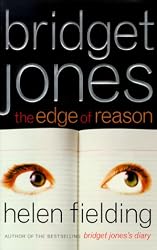 ...
...
When I say it wasn't what I thought it was, I mean that a couple of ways. I put it on my primary TBR list for the year thinking, even with it in my hand, that it was titled "Bridget Jones's Diary." Hmmm. That was the previous book, now wasn't it. Right. So this is official notice; this is the book I intended all along to read and did, in fact, read, and I am scoring out as completed the one Helen Fielding book on my TBR list, regardless or irregardless of the book title on the list. Got that? Good.
So I read it, and somehow, I wasn't quite prepared for chick-lit. Immediately, I was embarrassed for NOT being prepared. My daughter, who I spoke with on the phone, snickered at me. But, what the hell, it was a pretty good read. Tore right through it. I did think the Thailand event was pretty grim for a comedy. That whole meme of characters not explaining themselves fully, thus triggering unhappiness, is familiar but annoying. That's as much as I'll admit to.
 ...
...
When I say it wasn't what I thought it was, I mean that a couple of ways. I put it on my primary TBR list for the year thinking, even with it in my hand, that it was titled "Bridget Jones's Diary." Hmmm. That was the previous book, now wasn't it. Right. So this is official notice; this is the book I intended all along to read and did, in fact, read, and I am scoring out as completed the one Helen Fielding book on my TBR list, regardless or irregardless of the book title on the list. Got that? Good.
So I read it, and somehow, I wasn't quite prepared for chick-lit. Immediately, I was embarrassed for NOT being prepared. My daughter, who I spoke with on the phone, snickered at me. But, what the hell, it was a pretty good read. Tore right through it. I did think the Thailand event was pretty grim for a comedy. That whole meme of characters not explaining themselves fully, thus triggering unhappiness, is familiar but annoying. That's as much as I'll admit to.
126weird_O
Second book for July. Having read it, I can put a check beside category challenge #18: a Pulitzer Prize winner. It's also a ROOTs read.
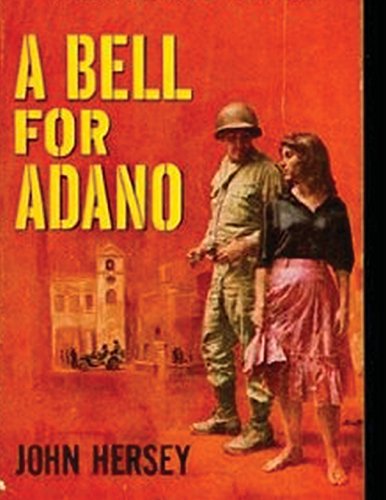 …
…
Within days of the Allied invasion of Italy in 1943, U. S. Army Major Victor Joppolo is assigned to duty as the civil affairs officer in Adano, a coastal town. Most of the community's Facist leaders and administrators have escaped to the hills, and Joppolo's job is to get the town back on its feet, ensuring that order is restored, that residents have food, jobs, security.
No sooner is he settled into the Mayor's office than he's approached by two elderly men offering advice. "Tell me," asks Joppolo, what does this town need the most right now?" One tells him food is the biggest need; the other says, "It needs a bell more than anything." The backstory is quickly revealed. Days before the invasion, the Fascists lowered a historic bell from the town clock tower and shipped it off to be melted for arms. Further interviews show the townspeople are united in a desire for a bell. Cockamamie though it seems, Joppolo initiates a search for the relic.
Along about this time, General Marvin, commander of the fighting troops, tries to blow through town, but is stymied by a mule cart weaving along the narrow roadway. Enraged, the general orders his aides to dump the cart off the road and to shoot the mule. He bans the carts from the road, which means the carts can't get to Adano and that Adano can't get food or even water.
In just the next few days, Joppolo countermands the general's ban, learns the bell's been melted down and launches a search for a suitable substitute, cajoles a Navy officer into raising an Axis ship that sank in the harbor so its cargo can be sold to benefit the town, persuades the local fishermen to go back to work so fresh fish are available in the town, quells fears of a bogus gas attack, sends the Facist—and still troublesome—former mayor to prison camp, deals with the death of a child scrambling for candy tossed from military trucks, struggles with afflection for a local woman.
And all the while, a report of Joppolo's countermand of General Marvin's ban wends its way to the general's desk, despite the efforts of junior officers and clerks to misdirect it, lose it, misfile it.
A Bell for Adano was John Hersey's first novel. Published in 1944, it won the fiction Pulitzer in 1945.
 …
…
Within days of the Allied invasion of Italy in 1943, U. S. Army Major Victor Joppolo is assigned to duty as the civil affairs officer in Adano, a coastal town. Most of the community's Facist leaders and administrators have escaped to the hills, and Joppolo's job is to get the town back on its feet, ensuring that order is restored, that residents have food, jobs, security.
No sooner is he settled into the Mayor's office than he's approached by two elderly men offering advice. "Tell me," asks Joppolo, what does this town need the most right now?" One tells him food is the biggest need; the other says, "It needs a bell more than anything." The backstory is quickly revealed. Days before the invasion, the Fascists lowered a historic bell from the town clock tower and shipped it off to be melted for arms. Further interviews show the townspeople are united in a desire for a bell. Cockamamie though it seems, Joppolo initiates a search for the relic.
Along about this time, General Marvin, commander of the fighting troops, tries to blow through town, but is stymied by a mule cart weaving along the narrow roadway. Enraged, the general orders his aides to dump the cart off the road and to shoot the mule. He bans the carts from the road, which means the carts can't get to Adano and that Adano can't get food or even water.
In just the next few days, Joppolo countermands the general's ban, learns the bell's been melted down and launches a search for a suitable substitute, cajoles a Navy officer into raising an Axis ship that sank in the harbor so its cargo can be sold to benefit the town, persuades the local fishermen to go back to work so fresh fish are available in the town, quells fears of a bogus gas attack, sends the Facist—and still troublesome—former mayor to prison camp, deals with the death of a child scrambling for candy tossed from military trucks, struggles with afflection for a local woman.
And all the while, a report of Joppolo's countermand of General Marvin's ban wends its way to the general's desk, despite the efforts of junior officers and clerks to misdirect it, lose it, misfile it.
A Bell for Adano was John Hersey's first novel. Published in 1944, it won the fiction Pulitzer in 1945.
127Donna828
>123 weird_O:: I wish I were in that picture on North Lookout. How lucky you are to have such a wonderful nature preserve so close to you. Thanks for sharing, Bill.
128msf59
Happy Monday, Bill! You are retired, right? I can say that then. Grins.
The package is in the mail and hopefully you'll receive it in a couple of days. I am hoping for Thursday. Grins again...
The package is in the mail and hopefully you'll receive it in a couple of days. I am hoping for Thursday. Grins again...
129weird_O
>127 Donna828: Sharing? Maybe more like gloating. We love living right here.
>128 msf59: Yeah, I'm retired. Thursday would be a great deal to get a present; it's me birthday. Good timing. I'm going for one (probably way more than one, really) present Wednesday: book sale at the Bethlehem Public Library. Hoping to snag selected books for the vacancies in my reading list.
>128 msf59: Yeah, I'm retired. Thursday would be a great deal to get a present; it's me birthday. Good timing. I'm going for one (probably way more than one, really) present Wednesday: book sale at the Bethlehem Public Library. Hoping to snag selected books for the vacancies in my reading list.
132scaifea
Our public library tends to have their annual book sale the week of my birthday, and it's a lovely present. Here's hoping you find tons of good deals! And Happy Birthday, a bit early!
133jnwelch
Good review of A Bell for Adano, Bill. Did you end up enjoying the read?
Happy Birthday in advance (we'll be away from home on the big day). 45 years of marriage! I thought we were doing well with our 32d coming up. 45 is impressive.
Happy Birthday in advance (we'll be away from home on the big day). 45 years of marriage! I thought we were doing well with our 32d coming up. 45 is impressive.
134charl08
>126 weird_O: Read this - sounds an interesting book -thought the setting sounded familiar, and realized I'd read a book that is (partly) set in similar context of Allied occupation - Adam Foulds' book In the Wolf's Mouth, which I enjoyed. Was Hersey drawing on personal experience though?
135weird_O
My older son and his family are returning home from Dublin, Ireland. As I write, they're in the air. Landing in Newark in time for the evening rush, but never mind that.
He posted this photo of The Long Room Library, Trinity College. Wanted to share. I don't have room for something like this. Don't have the books for it, either.

He posted this photo of The Long Room Library, Trinity College. Wanted to share. I don't have room for something like this. Don't have the books for it, either.

136weird_O
>133 jnwelch: Yes, I enjoyed Bell. Curiously, I had the sense that it was a slick and professional construction, presenting an assortment of personality types and situations, all while keeping that report moving up the chain of command, getting diverted to North Africa, almost getting deep sixed, with Joppolo none the wiser. And everything being sorted out "for the best" by the final page. I'd give it one thumb up, but not both.
>134 charl08: Wikipedia sez:
During World War II, newsweekly correspondent Hersey covered fighting in Europe as well as Asia, writing articles for Time as well as Life magazine. He accompanied Allied troops on their invasion of Sicily, survived four airplane crashes, and was commended by the Secretary of the Navy for his role in helping evacuate wounded soldiers from Guadalcanal.
So I'd guess he was drawing on some personal experience. The Wiki also says Adano was in Sicily, not Italy; I missed that in the book.
>134 charl08: Wikipedia sez:
During World War II, newsweekly correspondent Hersey covered fighting in Europe as well as Asia, writing articles for Time as well as Life magazine. He accompanied Allied troops on their invasion of Sicily, survived four airplane crashes, and was commended by the Secretary of the Navy for his role in helping evacuate wounded soldiers from Guadalcanal.
So I'd guess he was drawing on some personal experience. The Wiki also says Adano was in Sicily, not Italy; I missed that in the book.
137Oberon
>135 weird_O: Fantastic photo. Thanks for sharing.
138jnwelch
>136 weird_O: Intriguing, thanks. It's one of those often-mentioned ones I've never read.
139charl08
>136 weird_O: Interesting stuff. I don't think I would have got on another plane after crash number one, never mind after the third...
Foulds has this image of a guy who escaped a mafia feud in a coffin, shipped to the US, coming back into town with the full might of the US forces behind him: his wife's horror at his resurrection. Makes me think the history must also make for compelling reading.
Foulds has this image of a guy who escaped a mafia feud in a coffin, shipped to the US, coming back into town with the full might of the US forces behind him: his wife's horror at his resurrection. Makes me think the history must also make for compelling reading.
140msf59
Happy Birthday, Bill! It's been nice having you in the 75 Club! You are a fine addition. Enjoy your day!
141weird_O
I did have a good birthday! Heard from family and friends, and roughly scheduled road trips to Boston to see my daughter and up the Shenandoah Valley to see my sister. Had a quiet dinner at a place run by a former neighbor, whose mother and two sisters were my co-workers (back in the day).
For the second consecutive year, my present was a used-book shopping spree. Last year, we were in Maine, so I hit a couple of shops in Freeport. This year, the Bethlehem Public Library was thoughtful enough to schedule a book sale--one of six they have each year--for the day before my birthday. Got 24 books (11 hc, 13 trade pbk) for $28.09. Boy, I love these sales!
2 Hiassens, 4 Mosleys, Satanic Verses in hc, the Shaara family's Civil War trilogy, a Le Guin and 2 Bradburys for AAC. Other stuff, too, of course.
On the downside, a tornado demolished an elementary school about 20 miles west of us. Damn thing left the nearby Cabela's, Walmart, Lowe's untouched, but busted up the school.
For the second consecutive year, my present was a used-book shopping spree. Last year, we were in Maine, so I hit a couple of shops in Freeport. This year, the Bethlehem Public Library was thoughtful enough to schedule a book sale--one of six they have each year--for the day before my birthday. Got 24 books (11 hc, 13 trade pbk) for $28.09. Boy, I love these sales!
2 Hiassens, 4 Mosleys, Satanic Verses in hc, the Shaara family's Civil War trilogy, a Le Guin and 2 Bradburys for AAC. Other stuff, too, of course.
On the downside, a tornado demolished an elementary school about 20 miles west of us. Damn thing left the nearby Cabela's, Walmart, Lowe's untouched, but busted up the school.
142msf59
Glad you had a nice birthday, Bill. And nice job at the book sale. Boo, to the tornado, though. Never a nice thing.
Did you get the package?
Did you get the package?
144weird_O
55. Joe Hill by Wallace Stegner
 …
…
Originally published in 1950 under the title The Preacher and the Slave, Joe Hill is a biographical novel based on the short life of an early 20th century labor organizer and agitator named Joe Hillstrom, better known simply as Joe Hill.
Hill's lasting fame stems in part from his catchy pro-labor songs, but more from his trial and execution for two murders—his martyrdom many called it, claiming he was framed because of his pro-union activities. He was an active member of the Industrial Workers of the World or IWW, known as the Wobblies. And the Wobblies were the most radical, intransigent, and violent union. Hill traveled the west, from one labor hot spot to another. He was taciturn but self-centered, moody, hot-tempered, very much the loner.
According to Stegner biographer Jackson J. Benson, Wallace first got interested in Joe Hill during the late 1930s, when teaching at Harvard. At a party, he for the first time heard people sing "The Ballad of Joe Hill." ("I dreamed I saw Joe Hill last night…") The song stuck in his mind. In 1946, Stegner, then at Stanford, started reseaching Hill. Wrote Benson:
The novel traces Hill's union activities from the docks in Washington State to those in San Pedro (a main port for Los Angeles), from farm fields in the Sacramento Valley to minefields in Utah. The living and working conditions are laid out in excruciating detail, alongside the atrocities of owners and managers and their thugs (including police and other government agents).
Hill's singular talent was writing song lyrics and poetry. Among his memorable songs are "The Tramp", "There is Power in a Union", "The Rebel Girl", and "Casey Jones—the Union Scab". Typically, he'd write new lyrics to a familiar tune, so everyone at a meeting could sing along. Using the tune from "In the Sweet By-and-Bye," he produced a song called "The Preacher and the Slave":
In the end, Hill was arrested and charged in a double homicide in Salt Lake City. The killer was known to have been shot, and Hill was treated for a gunshot wound the same night as the murders. At trial, he refused to take the stand in his own defense, insisting that he didn't have to prove himself innocent and that the state hadn't proven him guilty. Stegner puts it all in his novel.
I didn't dislike this novel, though clearly it is not among Stegner's best. I'd give it one thumb up, but not both.
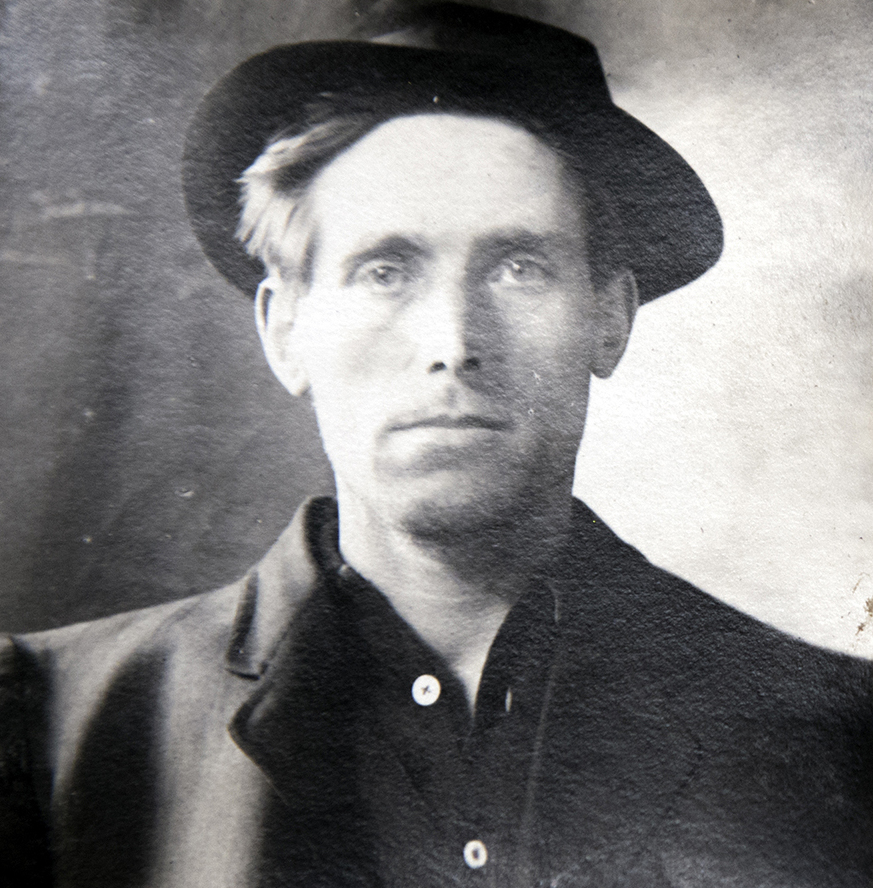 …
…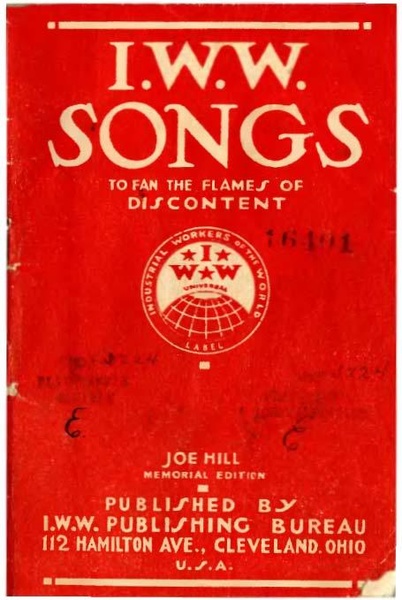
 …
…
Originally published in 1950 under the title The Preacher and the Slave, Joe Hill is a biographical novel based on the short life of an early 20th century labor organizer and agitator named Joe Hillstrom, better known simply as Joe Hill.
Hill's lasting fame stems in part from his catchy pro-labor songs, but more from his trial and execution for two murders—his martyrdom many called it, claiming he was framed because of his pro-union activities. He was an active member of the Industrial Workers of the World or IWW, known as the Wobblies. And the Wobblies were the most radical, intransigent, and violent union. Hill traveled the west, from one labor hot spot to another. He was taciturn but self-centered, moody, hot-tempered, very much the loner.
According to Stegner biographer Jackson J. Benson, Wallace first got interested in Joe Hill during the late 1930s, when teaching at Harvard. At a party, he for the first time heard people sing "The Ballad of Joe Hill." ("I dreamed I saw Joe Hill last night…") The song stuck in his mind. In 1946, Stegner, then at Stanford, started reseaching Hill. Wrote Benson:
Since Stegner had great sympathy for the union movement and detested the red-baiting that had already started…in the late 1940s, he began his project with great sympathy for Hill, trying to prove that he was indeed a martyr and, in the spirit of the song that Wallace was so fond of, that his message lives on for all of us. But the further Wallace went with his research, "the less I thought of him as a legitimate martyr, you know?...I thought at least that he was probably guilty of the crime he was executed for."
The novel traces Hill's union activities from the docks in Washington State to those in San Pedro (a main port for Los Angeles), from farm fields in the Sacramento Valley to minefields in Utah. The living and working conditions are laid out in excruciating detail, alongside the atrocities of owners and managers and their thugs (including police and other government agents).
Hill's singular talent was writing song lyrics and poetry. Among his memorable songs are "The Tramp", "There is Power in a Union", "The Rebel Girl", and "Casey Jones—the Union Scab". Typically, he'd write new lyrics to a familiar tune, so everyone at a meeting could sing along. Using the tune from "In the Sweet By-and-Bye," he produced a song called "The Preacher and the Slave":
Long-haired preachers come out every night
Try to tell you what's wrong and what's right
But when asked how 'bout something to eat
They will answer in voices so sweet
chorus
You will eat, bye and bye
In that glorious land above the sky
Work and pray, live on hay
You'll get pie in the sky when you die
In the end, Hill was arrested and charged in a double homicide in Salt Lake City. The killer was known to have been shot, and Hill was treated for a gunshot wound the same night as the murders. At trial, he refused to take the stand in his own defense, insisting that he didn't have to prove himself innocent and that the state hadn't proven him guilty. Stegner puts it all in his novel.
I didn't dislike this novel, though clearly it is not among Stegner's best. I'd give it one thumb up, but not both.
 …
…
145weird_O
Finished a couple of books over the weekend: The Lathe of Heaven by Ursula Le Guin (for July's AAC) and The Thrilling Adventures of Lacelace and Babbage by Sydney Padua (for my category challenge to read a graphic novel).
I posted my take on the Le Guin book on the Le Guin thread. It is here: https://www.librarything.com/topic/192700#5213220
My brain is still processing Mr. Babbage's Analytical Engine.
Slowly and carefully (?) reading Mr. Faulkner's The Unvanquished. It's a re-read.
Chow!
I posted my take on the Le Guin book on the Le Guin thread. It is here: https://www.librarything.com/topic/192700#5213220
My brain is still processing Mr. Babbage's Analytical Engine.
Slowly and carefully (?) reading Mr. Faulkner's The Unvanquished. It's a re-read.
Chow!
146weird_O
I finished reading this book at the beginning of June and have been alternately drafting a report on it and thinking about all sorts of other things. Important things...like, "Hey! What's that in my navel?" But my drafting is final. I give you...Red Lewis!
46. Sinclair Lewis: An American Life by Mark Schorer
 …
…
At one time, Sinclair Lewis was the toast of the literary world. In the span of a single decade, he wrote five first-rate novels (as well as a couple of so-so novels). In the same decade (1920-1929), he wrote 60 short stories, articles, reviews, essays, and other published writings. He was passed over for one Pulitzer, later awarded the prize for a different book (which prize he rejected), and finally, became the first American author to win the Nobel Prize for Literature (which prize he accepted). It was pretty much downhill from there. He died alone in an obscure hospital outside Rome in 1951.
A writer as significant as Lewis deserves an in-depth biography, but I don't think Sinclair Lewis: An American Life by Mark Schorer is the one Lewis deserves. It is exhaustive, with 800+ pages devoted to his birth, childhood, education, and literary career. It examines the subjects and the author's intentions; how he researched and outlined them, pouring out an extensive character study of each person in the book, writing, then rewriting, invariably pruning and condensing. The biography enumerates endless dinners, soirees, trips, visits, binges, friendships and fights. It details his two marriages (both ending in divorce) and his almost non-existent relationships with his two sons. It describes Lewis' ceaseless movement—from room to room, house to house to house, country to country.
Harry Sinclair Lewis was born in 1885 in Sauk Centre, Minnesota. His father was a physician. He had two older brothers, Claude, who became a surgeon, and Fred, an auto mechanic. Their mother died when the boys were young, and Dr. Lewis remarried. The doctor was reserved and conservative, favoring Claude and withholding from Harry, as the father always called his son, the love and approval and praise that he craved.
Growing up, Lewis was a tall, gawky, redhead with dreadful acne and a brilliant mind. Naturally, he was known as Red. He was self-centered, egotistical, articulate, creative...and maddening. The butt of pranks and bullying, he had very few friends. In high school, he was writing poetry and short pieces, and he was first published in the local newspaper in 1902. His father was a pinch-penny and bickered over college costs, but Harry went to Yale and did graduate, though not with his class.
Hike and the Aeroplane, a young reader's book, was published in 1912 under the pen name Tom Graham. Two years later, he published Our Mr. Wrenn: The Romantic Adventures of a Gentle Man under his own name, followed by four more books in six years. And then it was 1920, the year Main Street was introduced to America, making Sinclair Lewis a famous writer and a wealthy man. In the decade that followed, Lewis published Babbitt in 1922, Arrowsmith in 1925, Elmer Gantry in 1927, and finally, in 1929, Dodsworth.


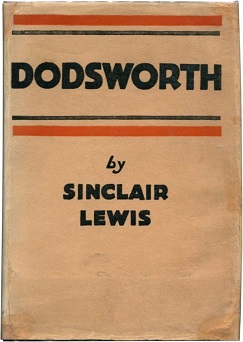
Each of these five books was controversial, generating offense, consternation, anger, disapproval, and—on the other hand—praise and approval. Oh, and sales. Lots and lots of book sales. Yes, Lewis was rich. He was a big shot and expected everyone to know it and to show him the proper respect. He had always been thin-skinned, looking for slights and insults, and volcanic of temper. His alcoholism, a major contributor to his decline and death, amped up his every disagreeable trait.
Having won and accepted the Nobel, Lewis' career was pretty much over. Only the noise, bluster, and tempest carried on. He became stage struck, channeling energy, effort, and money into staging and directing plays, even acting in them. He wrote play after play, relatively few produced, none particularly successful.
It's all here in the biography Schorer spent ten years researching and writing. Somehow, he makes it boring. I'm in the market for a good Red Lewis bio. I give this one the razzburries.
46. Sinclair Lewis: An American Life by Mark Schorer
 …
…
At one time, Sinclair Lewis was the toast of the literary world. In the span of a single decade, he wrote five first-rate novels (as well as a couple of so-so novels). In the same decade (1920-1929), he wrote 60 short stories, articles, reviews, essays, and other published writings. He was passed over for one Pulitzer, later awarded the prize for a different book (which prize he rejected), and finally, became the first American author to win the Nobel Prize for Literature (which prize he accepted). It was pretty much downhill from there. He died alone in an obscure hospital outside Rome in 1951.
A writer as significant as Lewis deserves an in-depth biography, but I don't think Sinclair Lewis: An American Life by Mark Schorer is the one Lewis deserves. It is exhaustive, with 800+ pages devoted to his birth, childhood, education, and literary career. It examines the subjects and the author's intentions; how he researched and outlined them, pouring out an extensive character study of each person in the book, writing, then rewriting, invariably pruning and condensing. The biography enumerates endless dinners, soirees, trips, visits, binges, friendships and fights. It details his two marriages (both ending in divorce) and his almost non-existent relationships with his two sons. It describes Lewis' ceaseless movement—from room to room, house to house to house, country to country.
Harry Sinclair Lewis was born in 1885 in Sauk Centre, Minnesota. His father was a physician. He had two older brothers, Claude, who became a surgeon, and Fred, an auto mechanic. Their mother died when the boys were young, and Dr. Lewis remarried. The doctor was reserved and conservative, favoring Claude and withholding from Harry, as the father always called his son, the love and approval and praise that he craved.
Growing up, Lewis was a tall, gawky, redhead with dreadful acne and a brilliant mind. Naturally, he was known as Red. He was self-centered, egotistical, articulate, creative...and maddening. The butt of pranks and bullying, he had very few friends. In high school, he was writing poetry and short pieces, and he was first published in the local newspaper in 1902. His father was a pinch-penny and bickered over college costs, but Harry went to Yale and did graduate, though not with his class.
Hike and the Aeroplane, a young reader's book, was published in 1912 under the pen name Tom Graham. Two years later, he published Our Mr. Wrenn: The Romantic Adventures of a Gentle Man under his own name, followed by four more books in six years. And then it was 1920, the year Main Street was introduced to America, making Sinclair Lewis a famous writer and a wealthy man. In the decade that followed, Lewis published Babbitt in 1922, Arrowsmith in 1925, Elmer Gantry in 1927, and finally, in 1929, Dodsworth.


Each of these five books was controversial, generating offense, consternation, anger, disapproval, and—on the other hand—praise and approval. Oh, and sales. Lots and lots of book sales. Yes, Lewis was rich. He was a big shot and expected everyone to know it and to show him the proper respect. He had always been thin-skinned, looking for slights and insults, and volcanic of temper. His alcoholism, a major contributor to his decline and death, amped up his every disagreeable trait.
Having won and accepted the Nobel, Lewis' career was pretty much over. Only the noise, bluster, and tempest carried on. He became stage struck, channeling energy, effort, and money into staging and directing plays, even acting in them. He wrote play after play, relatively few produced, none particularly successful.
It's all here in the biography Schorer spent ten years researching and writing. Somehow, he makes it boring. I'm in the market for a good Red Lewis bio. I give this one the razzburries.
147drneutron
Nice review. I don't know much about Lewis' life - a shame this one's not such a good bio.
148msf59
Hi Bill! I enjoy following your reading life. Good review of Joe Hill. I am waiting for a modern narrative nonfiction account of labor unions. Hear that, Ken Burns?
I think reading bios on AAC authors is such a fantastic idea. I will have to consider, following your lead, in the future. Sorry, the Lewis bio didn't cut it.
I think reading bios on AAC authors is such a fantastic idea. I will have to consider, following your lead, in the future. Sorry, the Lewis bio didn't cut it.
149weird_O
>147 drneutron: >148 msf59: I've read but not reported (yet) on Dorothy and Red, the story of Lewis' marriage to Dorothy Thompson. The author, Vincent Sheean, was a friend to both before and during their marriage. While it covers only a period of Lewis' life, it's far more readable than Schorer's doorstop. Best of all, it has as an appendix, a biographical essay about Lewis written by Thompson and published in the Atlantic Monthly after his death. Who knew him better than a smart and articulate woman who loved him, was married to him, but--really--couldn't live with him?
A more recent bio of Lewis (2005) is Sinclair Lewis: Rebel from Main Street by Richard Lingeman. I haven't read it, but it got at least one appreciative review here on LT.
I'm glad you like the bios-reading idea, Mark. I still have to report on a bio of Wallace Stegner. Haven't looked for anything on Ursula Le Guin, so I don't know what, if anything, is out there.
A more recent bio of Lewis (2005) is Sinclair Lewis: Rebel from Main Street by Richard Lingeman. I haven't read it, but it got at least one appreciative review here on LT.
I'm glad you like the bios-reading idea, Mark. I still have to report on a bio of Wallace Stegner. Haven't looked for anything on Ursula Le Guin, so I don't know what, if anything, is out there.
150weird_O
Finished The Unvanquished by William Faulkner. Book #58 for the year. ROOTs #25 against a goal of 44.
For me, this was a re-read, as I read it five years ago. I may have read it first in school or college; my copy is of that vintage. Anyway, I took the time to savor Faulkner's language and pacing. I picked up on things I know I missed last time through. Violence begets violence.
For me, this was a re-read, as I read it five years ago. I may have read it first in school or college; my copy is of that vintage. Anyway, I took the time to savor Faulkner's language and pacing. I picked up on things I know I missed last time through. Violence begets violence.
151weird_O
47. Dorothy and Red by Vincent Sheean
 ...
...
On July 9, 1927, a young newspaper correspondent in Berlin, newly divorced, was introduced to famed novelist Sinclair Lewis, himself recently divorced. She invited him to the birthday party she was giving herself that evening. He came, and before the evening was out, he had asked her to marry him.
At the time, Lewis was 42, author of four celebrated novels, a restless and provocative man. To friends and acquaintances, he was known as Red, thanks to the color of his hair, and perhaps also to his fiery complexion, which developed from youthful acne that "had grown steadily more acute and eventually marked his face like a battlefield." He was ugly, just physically unattractive; tall with long legs, a hatchet face, bad teeth, and, of course, that complexion. Nevertheless, he was, says the author, "wondrous good company, the most inventive and salacious of wits, a true refreshment in his irreverance for the accepted persons and ideas…"
Dorothy Thompson, turning 33 on that day, represented the Philadelphia Public Ledger and the New York Evening Post in Berlin. She was a highly regarded journalist, and would shortly gain notice for an interview with Adolf Hitler. Not long after it was published, the German government tossed her out; the interview story had not been well received.
Red courted Dorothy relentlessly. She succumbed; they married. They made a honeymoon tour of the English countryside by caravan—a kind of gypsy wagon towed (very slowly) by Red's open touring car. Then they went their separate ways. Dorothy pursued her journalistic career and soon was an advisor to diplomats and government leaders. She was in Europe, she was in Washington, but seldom was she with her husband. Red, for his part, couldn't ever settle anywhere. He didn't like sharing the limelight, even with his wife.
The author, Vincent Sheean, was a friend of both Dorothy and of Red, knowing them individually and as a couple. He lived with them from time to time, at the farm they owned in Vermont, a house they owned in New York. He connected with them in Europe from time to time. So this isn't simply a research project, though Sheean did a lot of that. He scoured the Thompson archive at Syracuse Univerity and the Lewis papers at Yale. The book includes extensive exerpts from the letters they exchanged, and a highlight, to me, was an article about Lewis that Thompson had published in the Atlantic Monthly after his death, included as an appendix.
Despite the friendship, Dorothy and Red is not hagiography. It is not a full biography of either Thompson or Lewis, but a memoir of their life together. An enjoyable and worthwhile read.
 ...
...
 ...
...
On July 9, 1927, a young newspaper correspondent in Berlin, newly divorced, was introduced to famed novelist Sinclair Lewis, himself recently divorced. She invited him to the birthday party she was giving herself that evening. He came, and before the evening was out, he had asked her to marry him.
At the time, Lewis was 42, author of four celebrated novels, a restless and provocative man. To friends and acquaintances, he was known as Red, thanks to the color of his hair, and perhaps also to his fiery complexion, which developed from youthful acne that "had grown steadily more acute and eventually marked his face like a battlefield." He was ugly, just physically unattractive; tall with long legs, a hatchet face, bad teeth, and, of course, that complexion. Nevertheless, he was, says the author, "wondrous good company, the most inventive and salacious of wits, a true refreshment in his irreverance for the accepted persons and ideas…"
Dorothy Thompson, turning 33 on that day, represented the Philadelphia Public Ledger and the New York Evening Post in Berlin. She was a highly regarded journalist, and would shortly gain notice for an interview with Adolf Hitler. Not long after it was published, the German government tossed her out; the interview story had not been well received.
Red courted Dorothy relentlessly. She succumbed; they married. They made a honeymoon tour of the English countryside by caravan—a kind of gypsy wagon towed (very slowly) by Red's open touring car. Then they went their separate ways. Dorothy pursued her journalistic career and soon was an advisor to diplomats and government leaders. She was in Europe, she was in Washington, but seldom was she with her husband. Red, for his part, couldn't ever settle anywhere. He didn't like sharing the limelight, even with his wife.
The author, Vincent Sheean, was a friend of both Dorothy and of Red, knowing them individually and as a couple. He lived with them from time to time, at the farm they owned in Vermont, a house they owned in New York. He connected with them in Europe from time to time. So this isn't simply a research project, though Sheean did a lot of that. He scoured the Thompson archive at Syracuse Univerity and the Lewis papers at Yale. The book includes extensive exerpts from the letters they exchanged, and a highlight, to me, was an article about Lewis that Thompson had published in the Atlantic Monthly after his death, included as an appendix.
Despite the friendship, Dorothy and Red is not hagiography. It is not a full biography of either Thompson or Lewis, but a memoir of their life together. An enjoyable and worthwhile read.
 ...
...
153kidzdoc
Great summary of the life of Sinclair Lewis, Bill! I'm sorry that the biography was a disappointment, though. I also enjoyed your review of Dorothy and Red. I had meant to read Arrowsmith this spring, so I'll try to get to it this summer.
154streamsong
I really liked your thoughtful in-depth reviews of the Sinclair Lewis bios. Thumbs up for both.
I loved the two Stegners I've read. Must. Read. More.
I loved the two Stegners I've read. Must. Read. More.
155charl08
Ready interesting comparison of those two bios. Dorothy and Red sounds like something I'd enjoy, I'll have a look for it.
156weird_O
The Bounty by Caroline Alexander is book #59 for the year. It was on my TBR "A" list, and it is a ROOTs read.
59. The Bounty: The True Story of the Mutiny on the Bounty by Caroline Alexander
 …
…
I do believe the basic story of "The Mutiny on the Bounty" is widely known: A British ship named Bounty, commanded by Lt. William Bligh, was seized by mutineers led by Fletcher Christian. Bligh and a group of loyalists journeyed thousands of miles in an overloaded open boat and eventually returned to England. Several of the mutineers were captured on Tahiti, returned to England, and tried, with all being convicted. Three were pardoned by King George III, three others were hanged. Years later, one surviving mutineer was discovered living on Pitcairn Island with a few Tahitian natives and some children fathered by mutineers. But by that time, relatively few cared. The End.
Thanks to high-level family connections, shrewd counsel, bogus investigations, and trash journalism, the tale, even before it had played out, was manipulated and twisted. In the popular mind, Bligh was a despicable villain with Christian becoming a folk hero. Novels and films have been spawned by the tale, and most of them have simply entrenched that idea: Bligh was a villain, Christian a misunderstood, introverted loner-hero.
Caroline Alexander may not be the first historian to research the records for the truth, but her book is the only one on the topic that I've read. She's done a thorough and commendable job. I think she does a good job of marshaling and dispensing the facts to maintain the mystery and our interest. What dialogue there is is taken from letters, trial testimony, written reports, and the like; no fictionalizing. I wouldn't call it a page-turner, and some readers will judge it plodding. I think it's interesting, methodical, thorough. Alexander presents facts, then asks questions and roots for more information and answers.
Having reached the end, I am satisfied. The feats of navigation and seafaring are simply incredible, the mutiny itself not really surprising, the intrigue and shenanigans before, during, and after the court-martial worthy of Trollope or Dickens
59. The Bounty: The True Story of the Mutiny on the Bounty by Caroline Alexander
 …
…
I do believe the basic story of "The Mutiny on the Bounty" is widely known: A British ship named Bounty, commanded by Lt. William Bligh, was seized by mutineers led by Fletcher Christian. Bligh and a group of loyalists journeyed thousands of miles in an overloaded open boat and eventually returned to England. Several of the mutineers were captured on Tahiti, returned to England, and tried, with all being convicted. Three were pardoned by King George III, three others were hanged. Years later, one surviving mutineer was discovered living on Pitcairn Island with a few Tahitian natives and some children fathered by mutineers. But by that time, relatively few cared. The End.
Thanks to high-level family connections, shrewd counsel, bogus investigations, and trash journalism, the tale, even before it had played out, was manipulated and twisted. In the popular mind, Bligh was a despicable villain with Christian becoming a folk hero. Novels and films have been spawned by the tale, and most of them have simply entrenched that idea: Bligh was a villain, Christian a misunderstood, introverted loner-hero.
Caroline Alexander may not be the first historian to research the records for the truth, but her book is the only one on the topic that I've read. She's done a thorough and commendable job. I think she does a good job of marshaling and dispensing the facts to maintain the mystery and our interest. What dialogue there is is taken from letters, trial testimony, written reports, and the like; no fictionalizing. I wouldn't call it a page-turner, and some readers will judge it plodding. I think it's interesting, methodical, thorough. Alexander presents facts, then asks questions and roots for more information and answers.
Having reached the end, I am satisfied. The feats of navigation and seafaring are simply incredible, the mutiny itself not really surprising, the intrigue and shenanigans before, during, and after the court-martial worthy of Trollope or Dickens
157msf59
Hi Bill! "the Bounty" sounds good. I am definitely interested in that subject matter. Did you ever read any of the Master and Commander books?
158weird_O
I have not, Mark. But I did buy what I think is the first in the series at the library book sale a couple of weeks ago. Maybe next year I'll get to it. :-)
159jnwelch
Nice review of The Bounty, Bill. I really enjoyed her book on the Shackelton voyage, The Endurance.
My dad loves that Patrick O'Brian series. For some reason, I liked the Horatio Hornblower books better.
My dad loves that Patrick O'Brian series. For some reason, I liked the Horatio Hornblower books better.
160msf59
I think I have read the first 5 or 6' Master & Commander books. They are quite addictive. I NEED to return to the series. It has been awhile.
I am sure you will love them.
I am sure you will love them.
161lyzard
Hi, Bill! Interesting comments on The Bounty. Are you aware of Captain Bligh's Other Mutiny by Stephen Dando-Collins? It traces Bligh's later career, including the revolt against him when he was Governor of New South Wales. The man had a talent for attracting trouble! :)
162weird_O
>161 lyzard: I have not heard of the Dando-Collins book. In The Bounty, Alexander does describe Bligh's entire career, including the "other mutiny." The Fatal Shore by Robert Hughes also speaks of that episode.
>160 msf59: The book I bought is titled Master and Commander and it lists, opposite the title page, 18 books as "the Aubrey-Maturin Novels." Reading all 18 will keep you out of trouble at least a month.
>160 msf59: The book I bought is titled Master and Commander and it lists, opposite the title page, 18 books as "the Aubrey-Maturin Novels." Reading all 18 will keep you out of trouble at least a month.
163Oberon
Thought I would chime in as obsessive Aubrey/Maturin lover. There are 20 books in the series with the first being Master and Commander and the last being Blue at the Mizzen. There is an unfinished 21st book which has also been published. It is the only one of the series I have not read (I am not a big fan of publishing uncompleted works).
There is a bit of confusion that stems from the movie (an excellent film with Russell Crowe playing Aubrey). The movie is called Master and Commander: The Far Side of the World. The movie is primarily based on Book 10 of the series The Far Side of the World. Most of the movie tie-in books that I have seen that use the "Master and Commander: The Far Side of the World" title are actually copies of Master and Commander, the true first book in the series. It can be confusing at times.
There is a bit of confusion that stems from the movie (an excellent film with Russell Crowe playing Aubrey). The movie is called Master and Commander: The Far Side of the World. The movie is primarily based on Book 10 of the series The Far Side of the World. Most of the movie tie-in books that I have seen that use the "Master and Commander: The Far Side of the World" title are actually copies of Master and Commander, the true first book in the series. It can be confusing at times.
164weird_O
>163 Oberon: Ah, thanks for the info. If I like the book I bought, clearly I've got a lot of reading to do. Makes me sort of regret not swooping up all the Aubrey/Maturin novels that were on the shelf (and it was a lot). 'Twas a library sale, with paperbacks going to 50 cents. Less than 10 bucks for the lot. So it goes...
You reading this, Mark?
>161 lyzard: I wanted to mention, Liz, that years and years ago I bought a copy of Bligh's narrative of the mutiny in an edition printed at Franklin Court in Philadelphia. We were touristing at the time, taking our kids through Independence Hall and all that. At Franklin Court, we watched the...what do you call them...the re-enactors inking the type on the press bed, laying a sheet in place, setting the platen and applying pressure, and finally, pulling the sheet and draping it over a line to dry. Told what was being printed, we signed up for a copy, which was mailed to use months later. The colophon says:
The Franklin Court Printshop and Bindery was established to promote and preserve printing and bookbinding techniques of the late eighteen century. This edition represents the most ambitious undertaking to date.
William Spotswoood's 1790 Philadelphia edition was used for the text, while the wood engravings were designed and cut expressly for this edition.
This edition was printed and bound conforming as closely as possible to the eighteenth century methods, using reproduction equipment. The type used was ATF twelve point Caslon Oldstyle, the paper Spring Grove Ivory Laid Text.
Our book is number 57 of 350 copies.
Have I read it? Uh, yeah, well...almost. Yeah, almost.
You reading this, Mark?
>161 lyzard: I wanted to mention, Liz, that years and years ago I bought a copy of Bligh's narrative of the mutiny in an edition printed at Franklin Court in Philadelphia. We were touristing at the time, taking our kids through Independence Hall and all that. At Franklin Court, we watched the...what do you call them...the re-enactors inking the type on the press bed, laying a sheet in place, setting the platen and applying pressure, and finally, pulling the sheet and draping it over a line to dry. Told what was being printed, we signed up for a copy, which was mailed to use months later. The colophon says:
The Franklin Court Printshop and Bindery was established to promote and preserve printing and bookbinding techniques of the late eighteen century. This edition represents the most ambitious undertaking to date.
William Spotswoood's 1790 Philadelphia edition was used for the text, while the wood engravings were designed and cut expressly for this edition.
This edition was printed and bound conforming as closely as possible to the eighteenth century methods, using reproduction equipment. The type used was ATF twelve point Caslon Oldstyle, the paper Spring Grove Ivory Laid Text.
Our book is number 57 of 350 copies.
Have I read it? Uh, yeah, well...almost. Yeah, almost.
165weird_O
57. The Thrilling Adventures of Lovelace and Babbage by Sydney Padua
 …
…
The subtitle of this graphic novel is "The (Mostly) True Story of the First Computer." The novel's creator, Sydney Padua, manipulates the actual interactions of 19th century math prodigy Ada, Countess of Lovelace and eccentric genius Charles Babbage, so she can present and explain the workings of Babbage's Analytical Engine. She presents most of the story in comic strip format, taking liberties throughout to make an abstract (even abstruse) subject entertaining and, mostly, understandable. Notables of the Victorian Age—Queen Victoria herself, the Duke of Wellington, Marian Evans (bka George Eliot), Charles Dickens and Wilkie Collins, Thomas Carlyle, Charles Dodgson (bka Lewis Carroll)—pass in and out of the narrative. Witty footnotes document the factual bases of situations, individuals, meetings, assertions, so the book isn't all comic strip. Yes, there actually are pages of text to read.
Babbage's Analytical Engine is central. Babbage designed a mechanical device, powered by a hand crank, with gears and shafts to calculate and print logorithmic tables. This he called the Difference Engine. A kind of test module was all that Babbage ever built, in part because he got a better idea: a much much larger and more complex machine with greater capabilities. He called that the Analytical Engine, and he didn't get that built either. He was fine-tuning his plans for it up until he died in 1871.

Ada, the Countess of Lovelace, you'll learn on the first page or two, was the daughter of poet Lord Byron. She was a math wiz, but also, as befits the spawn of Byron, a bit of a nutcase. She was 18 when she met the 42-year-old Babbage. Although a few experts dispute the claim, Lovelace is often cited as the person who wrote the first computer program. Padua, needless to say, makes a great deal of their association.

At a social gathering, Babbage explains the workings of his Difference Engine test module to Lovelace, who he has just met.
Padua conjures an alternative universe—Is this de rigueur in this type of publication?—so she can imagine that the Analytical Engine actually is built. She portrays it as a mammoth and deafening conglomeration of cogwheels, towering stacks of gears, shafts, levers, toggles, gauges, pipes, valves, pumps, tubes, switches, and endless belts of punched cards, housed in a Victorian warehouse of parallel corridors overhung by a web of catwalks suspended from skyhooks, linked by spiralling and Escherian stairways, all converging to a vanishing point shrouded in shadow and steam clouds. Superintending this mysterious, clicking, clanking, hissing, yes, even frightening, industrial-seeming behemoth—always just on the thin edge of control—is Ada Lovelace. Oh, not the frail Victorian Countess of Lovelace, but steely-eyed Ada, standing tall, clay pipe clamped in her teeth, garbed in Jodphurs, riding boots, and close-fitting tunic.

What. A. Gal!
In an appendix, Padua does a remarkable job of transferring Babbage's 2-D engineering drawings of his machine into perspective views, to elucidate its operation. I can't say I grasp it entirely, but her presentation is fascinating.
In the short term, it all came to naught. Lovelace descended into periods of madness and died at 36 in 1852. Babbage rumbled on until his death in 1871, his Engines never built. But in the long term, Babbage is popularly recognized as the first computer designer, Lovelace as the first programmer. The book is novel, entertaining, and pretty informative.
 …
…
Two pages from Appendix II

Sydney Padua draws on her computer.
 …
…
The subtitle of this graphic novel is "The (Mostly) True Story of the First Computer." The novel's creator, Sydney Padua, manipulates the actual interactions of 19th century math prodigy Ada, Countess of Lovelace and eccentric genius Charles Babbage, so she can present and explain the workings of Babbage's Analytical Engine. She presents most of the story in comic strip format, taking liberties throughout to make an abstract (even abstruse) subject entertaining and, mostly, understandable. Notables of the Victorian Age—Queen Victoria herself, the Duke of Wellington, Marian Evans (bka George Eliot), Charles Dickens and Wilkie Collins, Thomas Carlyle, Charles Dodgson (bka Lewis Carroll)—pass in and out of the narrative. Witty footnotes document the factual bases of situations, individuals, meetings, assertions, so the book isn't all comic strip. Yes, there actually are pages of text to read.
Babbage's Analytical Engine is central. Babbage designed a mechanical device, powered by a hand crank, with gears and shafts to calculate and print logorithmic tables. This he called the Difference Engine. A kind of test module was all that Babbage ever built, in part because he got a better idea: a much much larger and more complex machine with greater capabilities. He called that the Analytical Engine, and he didn't get that built either. He was fine-tuning his plans for it up until he died in 1871.

Ada, the Countess of Lovelace, you'll learn on the first page or two, was the daughter of poet Lord Byron. She was a math wiz, but also, as befits the spawn of Byron, a bit of a nutcase. She was 18 when she met the 42-year-old Babbage. Although a few experts dispute the claim, Lovelace is often cited as the person who wrote the first computer program. Padua, needless to say, makes a great deal of their association.

At a social gathering, Babbage explains the workings of his Difference Engine test module to Lovelace, who he has just met.
Padua conjures an alternative universe—Is this de rigueur in this type of publication?—so she can imagine that the Analytical Engine actually is built. She portrays it as a mammoth and deafening conglomeration of cogwheels, towering stacks of gears, shafts, levers, toggles, gauges, pipes, valves, pumps, tubes, switches, and endless belts of punched cards, housed in a Victorian warehouse of parallel corridors overhung by a web of catwalks suspended from skyhooks, linked by spiralling and Escherian stairways, all converging to a vanishing point shrouded in shadow and steam clouds. Superintending this mysterious, clicking, clanking, hissing, yes, even frightening, industrial-seeming behemoth—always just on the thin edge of control—is Ada Lovelace. Oh, not the frail Victorian Countess of Lovelace, but steely-eyed Ada, standing tall, clay pipe clamped in her teeth, garbed in Jodphurs, riding boots, and close-fitting tunic.

What. A. Gal!
In an appendix, Padua does a remarkable job of transferring Babbage's 2-D engineering drawings of his machine into perspective views, to elucidate its operation. I can't say I grasp it entirely, but her presentation is fascinating.
In the short term, it all came to naught. Lovelace descended into periods of madness and died at 36 in 1852. Babbage rumbled on until his death in 1871, his Engines never built. But in the long term, Babbage is popularly recognized as the first computer designer, Lovelace as the first programmer. The book is novel, entertaining, and pretty informative.
 …
…
Two pages from Appendix II

Sydney Padua draws on her computer.
166Whisper1
I'm stopping by to say hello. I've been away from LT for awhile and I miss it.
Here is a recent photo of Lehigh during summertime.

Here is a recent photo of Lehigh during summertime.

167jnwelch
>165 weird_O: Nice review, thanks! My wife has hinted I'm getting this one for my birthday. I'm looking forward to it.
170qebo
>165 weird_O: The Thrilling Adventures of Lovelace and Babbage by Sydney Padua
Adding the touchstone...
OMG I must get this book!
Adding the touchstone...
OMG I must get this book!
171msf59
>163 Oberon: Thanks for supplying the useful info on the Master and Commander series. I will have to get back to it, at some point. I also loved the film version. I wish they could have done more.
>165 weird_O: Great review of The Thrilling Adventures of Lovelace and Babbage, Bill! I really liked the book too, even though sections of it, went sailing over my head. I am so glad you are able to enjoy a GN. Big Smile!
>165 weird_O: Great review of The Thrilling Adventures of Lovelace and Babbage, Bill! I really liked the book too, even though sections of it, went sailing over my head. I am so glad you are able to enjoy a GN. Big Smile!
172weird_O
Thank you all for dropping by.
>166 Whisper1: You've got me with that photo, Linda. It is classic Lehigh, but I'm darned if I can figure out the view point. That is the UC tower, correct? What's the building on the left?
To all of you who liked the report on L&B, that's...well, ahh...thrilling! I admit I checked with Wikipedia on both the main characters, just to keep things straight.
On the new reading scene, I've completed The Two Mrs. Grenvilles by Dominick Dunne. Number 60 for the year; a ROOTs book, as well as a category challenge book. I'm several chapters into To Engineer Is Human by Henry Petroski, a TBR "A" lister. And I've selected Edith Wharton's The House of Mirth; see if I can get through it in what remains of July.
>166 Whisper1: You've got me with that photo, Linda. It is classic Lehigh, but I'm darned if I can figure out the view point. That is the UC tower, correct? What's the building on the left?
To all of you who liked the report on L&B, that's...well, ahh...thrilling! I admit I checked with Wikipedia on both the main characters, just to keep things straight.
On the new reading scene, I've completed The Two Mrs. Grenvilles by Dominick Dunne. Number 60 for the year; a ROOTs book, as well as a category challenge book. I'm several chapters into To Engineer Is Human by Henry Petroski, a TBR "A" lister. And I've selected Edith Wharton's The House of Mirth; see if I can get through it in what remains of July.
173Whisper1
That is a part of the University Center. I will be returning back to Lehigh in a few weeks after a six month recovery period from major surgery. Because the pace of work will have to be slower for me now, I will actually take time to walk around campus and enjoy the buildings during lunch time.
174weird_O
60. The Two Mrs. Grenvilles by Dominick Dunne
 …
…
A trashy roman è clef is what this is. Here's the story. William Grenville Jr. is the most eligible young bachelor in New York's high society. Fabulously wealthy, handsome, somewhat shy and introverted. He meets and is bedded by a showgirl, Ann Arden. He is, as they used to say, reamed, steamed, and dry cleaned. Against the wishes of his imperious mother (the first Mrs. Grenville), he marries Ann in Tacoma hours before shipping off to the Pacific battles of WWII. He returns from the war to resume his life in New York, Oyster Bay, Newport, and at his Kentucky thoroughbred farm. Ann (the second Mrs. Grenville) works very diligently to fit into his society but isn't really accepted. Too many gaffes. She is, it turns out, a Bitch (yes, with that capital B), especially when schnockered, which is often. She's a loose lady, too, but insanely jealous of her husband. After attending—and making a loud, destructive scene—at a party for the Duchess of Wales, she and her husband return to their estate and she shoots him with a shotgun. Shoots him dead!
All this and, of course, more, much much more, is conveyed to us by a writer named Basil Plante, who drifts in and out of these society doings, trying, in the end, to coax the truth out of Ann.
As I said, this is a roman è clef. It really happened. Only all the names have been changed. The real names were Billy Woodward Jr. and his wife Ann. Ann shot Billy, but Billy's mother organized a high society stonewall in which no one at the party had a hard word for Ann. Yahda yahda. A grand jury didn't indict her. She got away with murder! Ann's MIL (very reluctantly) stood by her and directed Billy's four sisters to stand by her also. "We can't have this splashed in the newspapers." But Ann really was closed out. In this (true) story, Basil is Truman Capote, who exposed Ann Woodward in a chapter of his unfinished book Answered Prayers. When that chapter was published by Esquire, Ann Woodward took cyanide. Blluttt! End of story.
Except that Dunne's version enjoyed best-sellerdom, and it was made into a TV movie starring Ann-Margaret as Ann and Steven Collins as Billy. In her final role, Claudette Colbert played the first Mrs. Grenville, Billy's mother. (This is why I put it on my reading schedule; category challenge #49: A book based on or turned into a TV show. Too, it was on the shelf, so it's a ROOTs book.)
As I said, it's trashy, but it is a page-turner. Quick read, pretty entertaining, of no particular lasting value.

Dominick Dunne between the "two Mrs. Grenvilles," Ann-Margaret and Claudette Colbert.
Ann and Billy Woodward Jr.
 …
…
A trashy roman è clef is what this is. Here's the story. William Grenville Jr. is the most eligible young bachelor in New York's high society. Fabulously wealthy, handsome, somewhat shy and introverted. He meets and is bedded by a showgirl, Ann Arden. He is, as they used to say, reamed, steamed, and dry cleaned. Against the wishes of his imperious mother (the first Mrs. Grenville), he marries Ann in Tacoma hours before shipping off to the Pacific battles of WWII. He returns from the war to resume his life in New York, Oyster Bay, Newport, and at his Kentucky thoroughbred farm. Ann (the second Mrs. Grenville) works very diligently to fit into his society but isn't really accepted. Too many gaffes. She is, it turns out, a Bitch (yes, with that capital B), especially when schnockered, which is often. She's a loose lady, too, but insanely jealous of her husband. After attending—and making a loud, destructive scene—at a party for the Duchess of Wales, she and her husband return to their estate and she shoots him with a shotgun. Shoots him dead!
All this and, of course, more, much much more, is conveyed to us by a writer named Basil Plante, who drifts in and out of these society doings, trying, in the end, to coax the truth out of Ann.
As I said, this is a roman è clef. It really happened. Only all the names have been changed. The real names were Billy Woodward Jr. and his wife Ann. Ann shot Billy, but Billy's mother organized a high society stonewall in which no one at the party had a hard word for Ann. Yahda yahda. A grand jury didn't indict her. She got away with murder! Ann's MIL (very reluctantly) stood by her and directed Billy's four sisters to stand by her also. "We can't have this splashed in the newspapers." But Ann really was closed out. In this (true) story, Basil is Truman Capote, who exposed Ann Woodward in a chapter of his unfinished book Answered Prayers. When that chapter was published by Esquire, Ann Woodward took cyanide. Blluttt! End of story.
Except that Dunne's version enjoyed best-sellerdom, and it was made into a TV movie starring Ann-Margaret as Ann and Steven Collins as Billy. In her final role, Claudette Colbert played the first Mrs. Grenville, Billy's mother. (This is why I put it on my reading schedule; category challenge #49: A book based on or turned into a TV show. Too, it was on the shelf, so it's a ROOTs book.)
As I said, it's trashy, but it is a page-turner. Quick read, pretty entertaining, of no particular lasting value.

Dominick Dunne between the "two Mrs. Grenvilles," Ann-Margaret and Claudette Colbert.
Ann and Billy Woodward Jr.
175lyzard
>174 weird_O:
That's interesting to me because of how many American mysteries of the 20s and 30s end with a cover-up and the murderer being allowed to quietly commit suicide, so that the "nice" people aren't tainted by being publicly involved in murder---it makes a bit of a difference to your perspective when you realise that kind of thing was going on in reality.
That's interesting to me because of how many American mysteries of the 20s and 30s end with a cover-up and the murderer being allowed to quietly commit suicide, so that the "nice" people aren't tainted by being publicly involved in murder---it makes a bit of a difference to your perspective when you realise that kind of thing was going on in reality.
176mstrust
Great review for a book I know I'll never read! And the pic of the real couple is wonderful.


185msf59
Happy Saturday, Bill! Hooray for Blue Moon love, (not the beer, of course. LOL!)
Glad you are enjoying Jonathan Strange. I should be starting the 2nd half today.
Are you joining us for the McMurtry AAC?
Glad you are enjoying Jonathan Strange. I should be starting the 2nd half today.
Are you joining us for the McMurtry AAC?
186weird_O
>183 mstrust: Why not? I'm not as judgmental about beer as Mark. Ha.
>184 scaifea: Well sure, Amber. I have that effect on people. Minds go blank...
>185 msf59: I am enjoying Jonathan Strange. I'm into Part III, and I feel the pace accelerating. And of course I'm doing the McMurtry AAC. I've staked by reads on the August AAC thread. Damn! It IS August now.
>184 scaifea: Well sure, Amber. I have that effect on people. Minds go blank...
>185 msf59: I am enjoying Jonathan Strange. I'm into Part III, and I feel the pace accelerating. And of course I'm doing the McMurtry AAC. I've staked by reads on the August AAC thread. Damn! It IS August now.
187weird_O
July 2015 Reading Roundup
53. Bridget Jones: The Edge of Reason by Helen Fielding (7/2/15) (TBR-A) (ROOT) ®
54. A Bell for Adano by John Hersey (7/3/15) (cc18. Pulitzer Prize winner) (ROOT) ®
55. Joe Hill by Wallace Stegner (7/10/15) (AAC—June) ®
56. The Lathe of Heaven by Ursula Le Guin (7/11/15) (AAC—July) ®
57. The Thrilling Adventures of Lovelace and Babbage by Sydney Padua (7/12/15) (cc40. graphic novel) ®
58. The Unvanquished by William Faulkner (7/15/15) (ROOT)
59. The Bounty by Caroline Alexander (7/19/15) (TBR-A) (ROOT) ®
60. The Two Mrs. Grenvilles by Dominic Dunn (7/24/15) (cc49. based on or turned into TV show) (ROOT) ®
61. To Engineer Is Human by Henry Petroski (7/31/15) (TBR-A)
Total Read
9
Author Gender
Male: 5 (55.6%)
Female: 4 (44.4%)
Living/Dead
Living: 5 (55.6%)
Dead: 4 (44.4%)
Format
Hardcover: 3 (33.3%)
Trade: 3 (33.3%)
Mass Market: 3 (33.3%)
Category
Fiction: 7 (77.8%)
Nonfiction: 2 (22.2%)
Source
Borrowed: 1 (88.9%)
Mine: 8 (62.5%)
50 Book Category Challenge
(24) 18. A Pulitzer Prize-winning book A Bell for Adano by John Hersey (1945)
(25) 40. A graphic novel The Thrilling Adventures of Lovelace and Babbage
(26) 49. A book based on or turned into a TV show The Two Mrs. Grenvilles
TBR Challenge
PRIMARY
Bridget Jones: The Edge of Reason by Helen Fielding (7/2/15)
The Bounty by Caroline Alexander (7/19/15)
To Engineer Is Human by Henry Petroski (7/31/15)
ALTERNATE
NONE
AAC June—Wallace Stegner
Joe Hill originally published as The Preacher and the Slave (7/10/15)
AAC July—Ursula Le Guin
The Lathe of Heaven (7/11/15)
53. Bridget Jones: The Edge of Reason by Helen Fielding (7/2/15) (TBR-A) (ROOT) ®
54. A Bell for Adano by John Hersey (7/3/15) (cc18. Pulitzer Prize winner) (ROOT) ®
55. Joe Hill by Wallace Stegner (7/10/15) (AAC—June) ®
56. The Lathe of Heaven by Ursula Le Guin (7/11/15) (AAC—July) ®
57. The Thrilling Adventures of Lovelace and Babbage by Sydney Padua (7/12/15) (cc40. graphic novel) ®
58. The Unvanquished by William Faulkner (7/15/15) (ROOT)
59. The Bounty by Caroline Alexander (7/19/15) (TBR-A) (ROOT) ®
60. The Two Mrs. Grenvilles by Dominic Dunn (7/24/15) (cc49. based on or turned into TV show) (ROOT) ®
61. To Engineer Is Human by Henry Petroski (7/31/15) (TBR-A)
Total Read
9
Author Gender
Male: 5 (55.6%)
Female: 4 (44.4%)
Living/Dead
Living: 5 (55.6%)
Dead: 4 (44.4%)
Format
Hardcover: 3 (33.3%)
Trade: 3 (33.3%)
Mass Market: 3 (33.3%)
Category
Fiction: 7 (77.8%)
Nonfiction: 2 (22.2%)
Source
Borrowed: 1 (88.9%)
Mine: 8 (62.5%)
50 Book Category Challenge
(24) 18. A Pulitzer Prize-winning book A Bell for Adano by John Hersey (1945)
(25) 40. A graphic novel The Thrilling Adventures of Lovelace and Babbage
(26) 49. A book based on or turned into a TV show The Two Mrs. Grenvilles
TBR Challenge
PRIMARY
Bridget Jones: The Edge of Reason by Helen Fielding (7/2/15)
The Bounty by Caroline Alexander (7/19/15)
To Engineer Is Human by Henry Petroski (7/31/15)
ALTERNATE
NONE
AAC June—Wallace Stegner
Joe Hill originally published as The Preacher and the Slave (7/10/15)
AAC July—Ursula Le Guin
The Lathe of Heaven (7/11/15)
188Whisper1
>174 weird_O: What a great review! I'll look for this one.
Thanks for letting us know about the Blue Moon! It was incredibly beautiful.
Thanks for letting us know about the Blue Moon! It was incredibly beautiful.
189weird_O
Prospective August Reading
I'm all but finished with Jonathan Strange & Mr Norrell. Just 10 or 12 pages to go. Got some chores to finish before darktime, but then I can wrap up the first book for August. I've got two McMurtrys to read for the August AAC, and an Erdrich for April AAC makeup. Also my three-in-one literary cement overshoes, albatross, and millstone: Under the Volcano.

I'm all but finished with Jonathan Strange & Mr Norrell. Just 10 or 12 pages to go. Got some chores to finish before darktime, but then I can wrap up the first book for August. I've got two McMurtrys to read for the August AAC, and an Erdrich for April AAC makeup. Also my three-in-one literary cement overshoes, albatross, and millstone: Under the Volcano.

190Whisper1
I'm interested in what you think about The Wright Brothers by David McCullough. He is a great author.
191weird_O
Ding ding ding ding...
Completed first book of August, #62 for the year: Jonathan Strange & Mr Norrell. I give it a couple of thumbs up. .
.
I'll explain, but not tonight. Leaving for BeanTown in the morning; Bridie the Wheaten likes the ocean, Bill and Judi like the Belle Isle lobster rolls and Spinelli's lobster tails, and all three of us like Becky, the number one daughter (of one). I get to pick through her books (as if I really need something to read).
Completed first book of August, #62 for the year: Jonathan Strange & Mr Norrell. I give it a couple of thumbs up.
 .
. I'll explain, but not tonight. Leaving for BeanTown in the morning; Bridie the Wheaten likes the ocean, Bill and Judi like the Belle Isle lobster rolls and Spinelli's lobster tails, and all three of us like Becky, the number one daughter (of one). I get to pick through her books (as if I really need something to read).
192weird_O
>190 Whisper1: I will do that, Linda. I too like McCullough, and the Wrights are pretty amazing. The book isn't nearly the doorstop that some other McCullough books are (I'm thinking Truman).
193scaifea
I'm excited to get to the newest McCullough eventually, too. Love his stuff.
Safe travels!
Safe travels!
194msf59
Hi, Bill! Glad you enjoyed Jonathan Strange. I should follow you in a couple of days.
LOVE the stack of August reads! Some wonderful titles. I really enjoyed The Plague of Doves. I have the Wright Brothers saved on audio too.
Enjoy your time in Beantown!
LOVE the stack of August reads! Some wonderful titles. I really enjoyed The Plague of Doves. I have the Wright Brothers saved on audio too.
Enjoy your time in Beantown!
195weird_O
Great time in Boston. We are creatures of habit. Ate seafood at Bob's Clam Shack in Kittery, ME, a cone at Nubble Lighthouse in York, ME, lobster rolls from Belle Isle Seafood, Italian in the North End, lobster tails from Bova's, ricotta pie from Spinelli's. Sat on a park bench on Deer Island, watching the sun set and the jets landing at Logan. Sat at Piers Park in East Boston, watching kids learn to row and sail. Walked through Quincy Market, and strolled through Boston's new fresh foods market (very reminiscent of Philly's Reading Terminal Market, just in a new facility).

View of Boston Harbor and the cityscape from East Boston's Piers Park. The small craft in the foreground are from the park's Sailing School.

Looking east (toward France) from Deer Island at sunset.
And. And. I regained possession of a pile of books that my daughter "borrowed." :-) Principal among them, from the standpoint of my reading list, was my first edition, first printing mass market paperback of Stephen King's Carrie, which I got (free) at the 1974 ABA Convention, held I-don't-remember-where. I put Carrie on my Category Challenge list as "a book set in high school." I remembered having it, but I couldn't find it. When I asked my daughter if she had a copy, she told me she had mine. Whaaa?! Anyway, got it back and got it read (#63 for the year).

The drive home was really tiring. Clots of traffic moving from 0 mph up to about 35 mph and back down, then suddenly sprinting off at 75. Crawling across NY State. Aiyiyi! The damn people just wouldn't get Out of My Way! I was sooo vexed. Only consolation was that the traffic headed the other direction seemed worse; just miles and miles of stopped cars, trucks, and buses.
Next trip will be a red-eye venture--10 p.m. to 4 a.m.

View of Boston Harbor and the cityscape from East Boston's Piers Park. The small craft in the foreground are from the park's Sailing School.

Looking east (toward France) from Deer Island at sunset.
And. And. I regained possession of a pile of books that my daughter "borrowed." :-) Principal among them, from the standpoint of my reading list, was my first edition, first printing mass market paperback of Stephen King's Carrie, which I got (free) at the 1974 ABA Convention, held I-don't-remember-where. I put Carrie on my Category Challenge list as "a book set in high school." I remembered having it, but I couldn't find it. When I asked my daughter if she had a copy, she told me she had mine. Whaaa?! Anyway, got it back and got it read (#63 for the year).

The drive home was really tiring. Clots of traffic moving from 0 mph up to about 35 mph and back down, then suddenly sprinting off at 75. Crawling across NY State. Aiyiyi! The damn people just wouldn't get Out of My Way! I was sooo vexed. Only consolation was that the traffic headed the other direction seemed worse; just miles and miles of stopped cars, trucks, and buses.
Next trip will be a red-eye venture--10 p.m. to 4 a.m.
196weird_O
61. To Engineer Is Human by Henry Petroski
 …
…
The subtitle of this 1985 book--The Role of Failure in Successful Design--establishes the theme of the book.
In his introduction, Petroski, a professor of civil engineering at Duke, writes:
I believe that the concept of failure…is central to understanding engineering, for engineering design has as its first and foremost objective the obviation of failure. Thus, colossal disasters that do occur are ultimately failures of design, but the lessons learned from those disasters can do more to advance engineering knowledge than all the successful machines and structures in the world…To understand what engineering is and what engineers do is to understand how failures can happen and how they can contribute more than successes to advance technology.
To elaborate on this statement, the author cites several famous engineering failures as case studies. What happened? What was learned? How is that new knowledge applied by engineers?
One example is the collapse of the Tacoma Narrows Bridge.
This suspension bridge linked the mainland of Washington State to its Olympic Peninsula and was built in 1940, a year after a bridge of similar design, the Bronx-Whitestone, was completed and opened to traffic. Both bridges used an unconventional stiffened-girder design that reduced the thickness of the roadway structure, giving it a slender silhouette. But even during construction, the Narrows bridge displayed frightening instability in crosswinds, even relatively mild ones. Its two-lane, half-mile-long deck would undulate and twist, quickly earning the bridge the sobriquet "Galloping Gerty." After only a few months of use, its imminent failure being obvious, it was closed and soon thereafter the deck tore completely apart. The only casualty was the bridge itself.

Petroski points out that the Bronx-Whitestone Bridge has a wider, six-lane roadway, but that it too displayed unsettling flexibility. Even as the Narrows bridge was going up, the Bronx-Whitestone was being altered with extra cables and stiffening devices. Alterations to the bridge continued into the 1980s.
The fault in the design of these bridges, writes Petroski, was that "the bridge span acted much like an airplane wing subjected to uncontrolled turbulence." At the time, the aerodynamic aspect of bridge design was not considered. It is now, of course, with designs being "tested in wind tunnels much the way new airplace designs are."
Other examples cited include the mid-flight explosions in the early 1950s that destroyed several DeHavilland Comets, the world's first commercial jet passenger aircraft (killing all on board each time); the collapse of pedestrian bridges spanning the vast lobby of the Kansas City Hyatt Regency Hotel at second, third, and fourth floor levels (killing and injuring hundreds).
The shortcoming of the book is its age. "From Slide Rule to Computer: Forgetting How It Used to Be Done" is a chapter near the book's end in which Petroski frets about problems that may stem from the computers supplanting manual computations, and in the process, lulling engineers into complacency. "{T}he engineer who employs the computer in design must still ask the crucial questions…" The lessons the book teaches are timeless, but a host of new case studies have presented themselves in the last twenty+ years.
 …
…
The subtitle of this 1985 book--The Role of Failure in Successful Design--establishes the theme of the book.
In his introduction, Petroski, a professor of civil engineering at Duke, writes:
I believe that the concept of failure…is central to understanding engineering, for engineering design has as its first and foremost objective the obviation of failure. Thus, colossal disasters that do occur are ultimately failures of design, but the lessons learned from those disasters can do more to advance engineering knowledge than all the successful machines and structures in the world…To understand what engineering is and what engineers do is to understand how failures can happen and how they can contribute more than successes to advance technology.
To elaborate on this statement, the author cites several famous engineering failures as case studies. What happened? What was learned? How is that new knowledge applied by engineers?
One example is the collapse of the Tacoma Narrows Bridge.
This suspension bridge linked the mainland of Washington State to its Olympic Peninsula and was built in 1940, a year after a bridge of similar design, the Bronx-Whitestone, was completed and opened to traffic. Both bridges used an unconventional stiffened-girder design that reduced the thickness of the roadway structure, giving it a slender silhouette. But even during construction, the Narrows bridge displayed frightening instability in crosswinds, even relatively mild ones. Its two-lane, half-mile-long deck would undulate and twist, quickly earning the bridge the sobriquet "Galloping Gerty." After only a few months of use, its imminent failure being obvious, it was closed and soon thereafter the deck tore completely apart. The only casualty was the bridge itself.
Petroski points out that the Bronx-Whitestone Bridge has a wider, six-lane roadway, but that it too displayed unsettling flexibility. Even as the Narrows bridge was going up, the Bronx-Whitestone was being altered with extra cables and stiffening devices. Alterations to the bridge continued into the 1980s.
The fault in the design of these bridges, writes Petroski, was that "the bridge span acted much like an airplane wing subjected to uncontrolled turbulence." At the time, the aerodynamic aspect of bridge design was not considered. It is now, of course, with designs being "tested in wind tunnels much the way new airplace designs are."
Other examples cited include the mid-flight explosions in the early 1950s that destroyed several DeHavilland Comets, the world's first commercial jet passenger aircraft (killing all on board each time); the collapse of pedestrian bridges spanning the vast lobby of the Kansas City Hyatt Regency Hotel at second, third, and fourth floor levels (killing and injuring hundreds).
The shortcoming of the book is its age. "From Slide Rule to Computer: Forgetting How It Used to Be Done" is a chapter near the book's end in which Petroski frets about problems that may stem from the computers supplanting manual computations, and in the process, lulling engineers into complacency. "{T}he engineer who employs the computer in design must still ask the crucial questions…" The lessons the book teaches are timeless, but a host of new case studies have presented themselves in the last twenty+ years.
197kidzdoc
Nice description and photos of your trip to Boston, Bill. I'll visit Caroline there in two weeks, but I'm taking Amtrak instead of driving, since my parents live close to the Trenton train station.
Nice review of To Engineer Is Human, which sounds very interesting.
Nice review of To Engineer Is Human, which sounds very interesting.
198weird_O
Finished The Last Picture Show this afternoon. Number 64 for the year.
199drneutron
I'm going to have to find that Petroski book. We deal with failure in the space biz - and it sounds like his viewpoint would be useful.
200weird_O
I've been reading but not reporting. Got to catch up. Here's my report on a book I finished in mid-July.
58. The Unvanquished by William Faulkner


This is the story of the Sartoris family, during and shortly after the Civil War, as told by Bayard Sartoris. As the story begins, Bayard's father John is off leading Confederate troops in battle. John's mother-in-law, known to all as Granny, is managing the homeplace. Vicksburg has fallen to Grant's beseiging army, and at least one of the family's slaves is envisioning the fall of the entire Confederacy.
While Col. John is resisting the Union with fire and sword, Granny, Bayard, and his black friend Ringo resist with a nifty grift. Who would believe this whisp of a woman could harbor such gile? But Granny attempts to do business with a small band of rebel deserters who are pilaging and terrorising the region, and she's murdered. Bayard and Ringo relentlessly track the gang until the murderer is released to them. They have their revenge.
When the war ends, the colonel returns home to rebuild. He thwarts northern schemers who endeavor to install former slaves in the local government. With a business partner, he develops a railroad. The partnership sours, and Bayard leaves college to avenge his father.
The theme, to my mind, is resistence to suppression. These southerners refuse to be vanquished, by the Union army, by thieves and marauders, by corrupt politicans, by death, even by tradition and convention. Being unvanquished isn't necessarily being triumphant, or even surviving. It is being resolute, strong, clever, persistent, courageous, proud, often perverse.
Faulkner is a challenging writer. Sure he tells the story in those endless sentences, the ones so low-key that you misjudge their power. The narrative is a torrent, an unstoppable rush. I luv it.
58. The Unvanquished by William Faulkner


This is the story of the Sartoris family, during and shortly after the Civil War, as told by Bayard Sartoris. As the story begins, Bayard's father John is off leading Confederate troops in battle. John's mother-in-law, known to all as Granny, is managing the homeplace. Vicksburg has fallen to Grant's beseiging army, and at least one of the family's slaves is envisioning the fall of the entire Confederacy.
While Col. John is resisting the Union with fire and sword, Granny, Bayard, and his black friend Ringo resist with a nifty grift. Who would believe this whisp of a woman could harbor such gile? But Granny attempts to do business with a small band of rebel deserters who are pilaging and terrorising the region, and she's murdered. Bayard and Ringo relentlessly track the gang until the murderer is released to them. They have their revenge.
When the war ends, the colonel returns home to rebuild. He thwarts northern schemers who endeavor to install former slaves in the local government. With a business partner, he develops a railroad. The partnership sours, and Bayard leaves college to avenge his father.
The theme, to my mind, is resistence to suppression. These southerners refuse to be vanquished, by the Union army, by thieves and marauders, by corrupt politicans, by death, even by tradition and convention. Being unvanquished isn't necessarily being triumphant, or even surviving. It is being resolute, strong, clever, persistent, courageous, proud, often perverse.
Faulkner is a challenging writer. Sure he tells the story in those endless sentences, the ones so low-key that you misjudge their power. The narrative is a torrent, an unstoppable rush. I luv it.
201weird_O
63. Carrie by Stephen King (8/9/15)
 ..
..
I may be the very last reader in America, in the world even, to read Stephen King's first novel, Carrie, this despite being one of the first few thousand to possess the book.
The plot is surely known to all; it was to me though I hadn't read the book (nor seen either of the film versions). Carrie White, 16, is the daughter of a widow obsessed with her wretched, extreme, pathological concept of sin and its consequences. Carrie is a virtual recluse, an outsider excluded from the social life at the high school she attends. She's the butt of every prank, joke, and jibe. Naturally, she's ignorant of sex and reproduction, and it's this ignorance that upends everything. Despite her privations, she's gifted with telekinetic powers, meaning she can move objects by thinking about moving the objects.
King frames the tale as a scientific report, with genetic mumbo-jumbo, citations from research papers, and testimony given before a government committee investigating the catastrophe triggered by high school social politics. He keeps the action moving; you know the denouement is going to be spectacular and bloody, with a high body count. And of course it is.
As you may know, King was teaching at a high school in Maine when Carrie was written. Frustrated by what he saw as his manuscript's shortcomings, he tossed it. His wife retrieved it and coaxed him to complete it. Doubleday accepted the book, paying King a $2,500 advance for the hardcover edition it published in 1974.
In April 1975, Signet published Carrie in mass-market paperback, releasing it with great hoopla during the American Bookseller's Convention in NYC. That's where I picked up my free copy; it is the copy I just read.

Can't end my Carrie report without showing the iconic image from the original film, can I?
 ..
..
I may be the very last reader in America, in the world even, to read Stephen King's first novel, Carrie, this despite being one of the first few thousand to possess the book.
The plot is surely known to all; it was to me though I hadn't read the book (nor seen either of the film versions). Carrie White, 16, is the daughter of a widow obsessed with her wretched, extreme, pathological concept of sin and its consequences. Carrie is a virtual recluse, an outsider excluded from the social life at the high school she attends. She's the butt of every prank, joke, and jibe. Naturally, she's ignorant of sex and reproduction, and it's this ignorance that upends everything. Despite her privations, she's gifted with telekinetic powers, meaning she can move objects by thinking about moving the objects.
King frames the tale as a scientific report, with genetic mumbo-jumbo, citations from research papers, and testimony given before a government committee investigating the catastrophe triggered by high school social politics. He keeps the action moving; you know the denouement is going to be spectacular and bloody, with a high body count. And of course it is.
As you may know, King was teaching at a high school in Maine when Carrie was written. Frustrated by what he saw as his manuscript's shortcomings, he tossed it. His wife retrieved it and coaxed him to complete it. Doubleday accepted the book, paying King a $2,500 advance for the hardcover edition it published in 1974.
In April 1975, Signet published Carrie in mass-market paperback, releasing it with great hoopla during the American Bookseller's Convention in NYC. That's where I picked up my free copy; it is the copy I just read.

Can't end my Carrie report without showing the iconic image from the original film, can I?
202kidzdoc
Great review of The Unvanquished, Bill. I shall have to start reading Faulkner in earnest starting next year, as I own the complete Library of America collection of his novels.
Umm...there is at least one person (who prefers to remain nameless) who has never read a Stephen King book. He did see the movie, though.
Umm...there is at least one person (who prefers to remain nameless) who has never read a Stephen King book. He did see the movie, though.
203msf59
Hi, Bill! Sounds like you had a good time in Beantown. Nice photos. I remember reading Carrie back in the mid-70s. I would like to revisit it, along with many other of his early works.
Good review of The Unvanquished. Faulkner was featured on the AAC, last year.
Good review of The Unvanquished. Faulkner was featured on the AAC, last year.
204Whisper1
>195 weird_O: What incredible photos! Thanks for sharing these.
205mahsdad
That's so cool to still have a "pristine" copy of any book from the 70's. Hope it was worth the wait. ;)
206qebo
Hmm, you were last seen at The Book Trader in Philadelphia, still searching for books when the rest of us departed. I hope you got out and home...
207Whisper1
Thanks for posting the photos Catherine! How wonderful to see so many faces I recognize from the last Philadelphia meet up.
208weird_O
>204 Whisper1: They are great, aren't they. Cell phone shots by my son (top) and daughter (bottom); Dad just pirates them.
>205 mahsdad: I don't know about pristine. Having a first edition of an enormously popular book like Carrie--even if it IS only a cheap paperback--is dopey fun.
>205 mahsdad: I don't know about pristine. Having a first edition of an enormously popular book like Carrie--even if it IS only a cheap paperback--is dopey fun.

213jnwelch
Way to go at The Book Trader, Bill. I thought Housekeeping was excellent.
214kidzdoc
We have a winner! I only bought two books at The Book Trader, and I'm sure that neither Katherine nor Monica bought as many as you did. Well done, indeed.
215weird_O
Thanks for the compliments on my Philly book haul, everybody. (My wife's reaction was less enthusiastic; anyone ever hear this: "You've GOT to stop buying books!!!" Yeah, I didn't think so...)
I've been reading right along, but I've fallen behind in reporting on my reads (two books from June, four of the five I've read so far this month). I liked many of the books I've read, so I want to hand out some gold stars, I'm just indolent, torpid, lethargic, or maybe...LAZY!
I've been reading right along, but I've fallen behind in reporting on my reads (two books from June, four of the five I've read so far this month). I liked many of the books I've read, so I want to hand out some gold stars, I'm just indolent, torpid, lethargic, or maybe...LAZY!
216weird_O

The Wright Brothers by David McCullough is just another entertaining and informative book from this wonderful historian. He presents the chronology, the background, the facts with all the essential details and nuances. He animates the personalities. I didn't need an audio version; as I read, I could hear McCulluogh's distinctive voice and cadence. It is all good.
The story is familiar to most of us. At the beginning of the twentieth century, brothers Wilbur and Orville Wright from Dayton, Ohio, take on the challenge of manned flight. With insight and focus and method that turns out to be typical of them, they first design and build a glider. The intention is to create a controllable craft that will carry a man. They test it on the wind-swept sand dunes of North Carolina's then-remote Outer Banks. Returning with it to Dayton, they revise their design, rebuild the glider, and again test it in North Carolina. Adding power is the next phase. When they can't buy an engine that meets their criteria, they build their own. They discover that were is no data to guide propellor design, so they develop their own. Testing the "Flyer" back in North Carolina on December 17, 1903, Orville pilots it on an historic 12-second flight that covers all of 120 feet. Not far, not long duration, but it's the very first flight of a piloted, powered, heavier-than-air craft. Later that morning, Wilbur takes the controls for a 175-foot flight, then Orville flies 200 feet. Finally, Wilbur takes another turn and flies 852 feet in 59 seconds. While the brothers discuss additional flights, a gust of wind tumbles the Flyer across the sand. The craft badly damaged, the tests in North Carolina abruptly conclude, never to be resumed.
But the Wrights now are satisfied they can repeat their initial flights and know just how much work still is needed. They return to Dayton and in 1904 resume their tests in a pasture outside of town. Each brother masters turning, and soon they are flying laps, extending the duration of flights, increasing the altitude they can achieve. They file a patent application (that takes three years to be granted).
Their real triumph doesn't come until 1908, when public trials are conducted in France and the United States. Thousands witness Wilbur's countless demonstration flights in France. Government and military officials from throughout Europe come to observe and to clamor for rides. Orville demonstrates the craft for American officials and the public at Ft. Myers, Virginia. The response is overwhelmingly positive.
This is a David McCullough book, so of course we get more than a bland, chronological recitation. We find out just how unique, how remarkable Wilbur and Orville were. They were not "tinkerers" who got lucky. Despite a lack of formal education beyond high school, the brothers were thoughtful and analytic, methodical and focused. A problem that resisted solution tended to make them obsessive. Propeller design is a good example. McCullough writes:
Much to their surprise, they could find no existing data on air propellers. They had assumed they could go by whatever rule-of-thumb marine engineers used for propellers on boats, and accordingly drew on the resources of the Dayton library only to find that after a hundred years in use the exact action of a screw propeller was still obscure. Once more they were left no choice but to solve the problem themselves…They began to see the propeller as an airplane wing traveling in a spiral course and that if they could calculate the effect of a wing traveling a straight course, why could they not calculate the effect of one traveling in a spiral course?
As it turned out, it was more complicated than that, as Orville explained in an article published in Flying in 1913:
But on further consideration, it is hard to find even a point from which to make a start; for nothing about a propeller, or the medium in which it acts, stands still for a moment. The thrust depends upon the speed and the angle at which the blade strikes the air; the angle at which the blade strikes the air depends on the speed at which the propeller is turning, the speed the machine is traveling forward, and the speed at which the air is slipping backward; the slip of the air backward depends on the thrust exerted by the propeller, and the amount of air acted upon. When any one of these change, it changes all the rest, as they are all interdependent on one another.
The Wright Brothers is a slight book for McCullough—262 pages of text. But he packs a lot into those pages. Highly recommended.
 ..
..
217weird_O
>210 msf59: Ellroy. I read the first two titles in the LA Quartet, and now I have the last. I just have to get hands on LA Confidential and read it, then I can read White Jazz. My daughter, who's read LA Confidential thinks Ellroy is twisted. Maybe. His mother was murdered when he was an adolescent, and the crime was never solved. He invested a lot of money for private investigators in trying to find the killer, but never could.
218weird_O
>213 jnwelch: When I got serious about reading ALL the books I missed over the years of RL, I compiled a kind of TRB from various other published lists--Time's best 100 novels, Modern Library's best 100, lists from the Observer, from Wiki, etc. Housekeeping was the first Robinson novel I put on my own list; just didn't get around to buying a copy. I've read Gilead and acquired Home earlier this year. Now with Housekeeping in hand, all I have to do is make time for reading it (and Home).
219msf59
Good review of The Wright Brothers. Big Thumb! I have this on audio, so I need to stick it in the rotation. Sounds like a winner.
You have some fine Robinson reading ahead of you.
LA Confidential is one of the best crime novels I have read and the movie is excellent too.
The Flannery O' Connor AAC thread is up. Drop by.
You have some fine Robinson reading ahead of you.
LA Confidential is one of the best crime novels I have read and the movie is excellent too.
The Flannery O' Connor AAC thread is up. Drop by.
220weird_O
>219 msf59: Hey, Mark. Nice of you to stop by. We've got the movie LA Confidential, which draws on all the novels in the quartet. Just gotta get the book. :-)
Maybe you--or whoever decides such stuff--should put Mrs. Robinson on the AAC for 2016. Or was she on it in 2014? (Before my time...) I've got some other names to suggest for AAC 2016.
I will drop by Ms. O'Connor's AAC thread, though I'm not sure what I can find of hers to read. Had her name in mind since April or May, whenever I've been book shopping, but no luck. (Another library book-sale coming up in about three weeks. Yeeha!)
Maybe you--or whoever decides such stuff--should put Mrs. Robinson on the AAC for 2016. Or was she on it in 2014? (Before my time...) I've got some other names to suggest for AAC 2016.
I will drop by Ms. O'Connor's AAC thread, though I'm not sure what I can find of hers to read. Had her name in mind since April or May, whenever I've been book shopping, but no luck. (Another library book-sale coming up in about three weeks. Yeeha!)
221msf59
I meant to start a rough AAC list for 2016, but never got to it. There are several authors, I plan on including. Robinson would make a good choice, but I try to include an author with a wider book list, to give folks a bigger palette to choose from. We will see.
223weird_O
Finished Anne Frank: Diary of a Young Girl and Roddy Doyle's The Snapper. Books numbers 67 and 68 for the year.
224weird_O
 ..
.. ..
..
Anne Frank: Diary of a Young Girl by Anne Frank
What can one say after reading this utterly remarkable book (other than I sure wish these families hadn't been ratted out)? There are so many thought arcs—the physical and psychological maturing of a teen (in her own words); the development of a skilled diarist; the developmental dynamic of a family; love and hate; the issues and tensions and mentalities of disparate people living in extremely close quarters—no, running away is not a viable option; the inhumanity of humans to each other; the great humanity of people in distress.
This work deserves an annotated edition. It may be out there; I didn't really look. I did some surfing primarily for photos to embellish this report, and considerable information regarding the individuals actually involved is easily found. Anne wrote two versions: her original day-by-day diary, and a recast version she worked on in response to a call for letters, stories, report, diaries of conditions in occupied Holland from a Dutch official living in exile in England. In the latter version, she changed the names of all the participants but her family.
I did find some photos of diary pages, which show that she pasted photos into the diary as she wrote. An adaptation of her layout to a book would be cool, I think.
At least two editions of the book exist, and to be honest, I don't know which one I have. Anne's father Otto, the only survivor, edited a version for publication, excising some passages in which Anne wrote of her physical and sexual maturing, as well as some musings on her feelings about her mother. Anne felt unloved by her, and in return, didn't love her mother. I understand that these passages were restored in a revised edition. There were such passages in what I read, though my copy seems to antedate the revised edition. Hmmm.
Well worth reading.



225weird_O
During the Philly Meetup, I finally found a copy of The Snapper at the used book store (Book Trader). It is the second book in Roddy Doyle's Barrytown trilogy. I pledged to read the trilogy to meet task #32 (read a trilogy) of my category challenge. I've already ready The Commitments, the first book. I have a copy of The Van, the third book, but I didn't want to read it out of sequence. So I got the book and now I've read it. Haha!
 ..
..
The Snapper by Roddy Doyle
This slim tome is the second novel in Roddy Doyle's Barrytown trilogy. It was preceded by The Commitments and followed by The Van. All three books focus on life in the working class section of Dublin known as Barrytown. Members of the Rabbitte family are principal characters in all three books.
The Snapper tells the tale of Sharon Rabbitte, a single 20-year-old living with her parents and five siblings. Even more, it tells how Sharon's "situation" upends her father's life. The book opens:
--You're wha'? said Jimmy Rabbitte Sr.
He said it loudly.
--You heard me, said Sharon.
Jimmy Jr was upstairs in the boys' room doing his D.J. practice. Darren was in the front room watching Police Acadeny II on the video. Les was out. Tracy and Linda, the twins, were in the front room annoying Darren. Veronica, Mrs Rabbitte, was sitting opposite Jimmy Sr at the kitchen table.
Sharon was pregnant and she'd just told her father that she thought she was. She'd told her mother earlier, before dinner.
--Oh –my Jaysis, said Jimmy Sr.
He looked at Veronica. She looked tired. He looked at Sharon again.
--That's shockin', he said.
More shocking is Sharon's refusal to divulge the identity of the father. She does want to stay at home, she does want to have and keep the baby, but she won't won't WON'T say who father is. Life proceeds. The siblings want to know. Sharon's girl friends want to know. Jimmy Sr's pals want to know. Everybody is v-e-r-y curious. And Sharon is mum.
Doyle's stories usually play out in conversations. Jimmy Sr retires after dinner each day to a nearby pub to share a pint wi' th' lads and verbally spar with them. He spars verbally with his children, with his wife, with neighbors. At first, he asserts that if Sharon doesn't care who the father is, why should he? But he can't hold that stance, which infuriates the young mother-to-be. When the father's identity comes out, Sharon denies he's the one, demanding that the family accept her assertion that the father is an unknown Spanish sailor. Jimmy Sr wrangles with Sharon almost to the moment of delivery.
And in the meantime, he dices with Jimmy Jr who is loudly practicing to be a DJ, Darren who wants a new bicycle, Les who is looking for a job, with Veronica who is being driven to distraction trying to costume the twins for their shifting desires to be cheerleaders, then ballroom dancers, then…
It's all good. An easy read (but for some Irish slang that's obscure), and to me a lot of laughs.
 ..
..The Snapper by Roddy Doyle
This slim tome is the second novel in Roddy Doyle's Barrytown trilogy. It was preceded by The Commitments and followed by The Van. All three books focus on life in the working class section of Dublin known as Barrytown. Members of the Rabbitte family are principal characters in all three books.
The Snapper tells the tale of Sharon Rabbitte, a single 20-year-old living with her parents and five siblings. Even more, it tells how Sharon's "situation" upends her father's life. The book opens:
--You're wha'? said Jimmy Rabbitte Sr.
He said it loudly.
--You heard me, said Sharon.
Jimmy Jr was upstairs in the boys' room doing his D.J. practice. Darren was in the front room watching Police Acadeny II on the video. Les was out. Tracy and Linda, the twins, were in the front room annoying Darren. Veronica, Mrs Rabbitte, was sitting opposite Jimmy Sr at the kitchen table.
Sharon was pregnant and she'd just told her father that she thought she was. She'd told her mother earlier, before dinner.
--Oh –my Jaysis, said Jimmy Sr.
He looked at Veronica. She looked tired. He looked at Sharon again.
--That's shockin', he said.
More shocking is Sharon's refusal to divulge the identity of the father. She does want to stay at home, she does want to have and keep the baby, but she won't won't WON'T say who father is. Life proceeds. The siblings want to know. Sharon's girl friends want to know. Jimmy Sr's pals want to know. Everybody is v-e-r-y curious. And Sharon is mum.
Doyle's stories usually play out in conversations. Jimmy Sr retires after dinner each day to a nearby pub to share a pint wi' th' lads and verbally spar with them. He spars verbally with his children, with his wife, with neighbors. At first, he asserts that if Sharon doesn't care who the father is, why should he? But he can't hold that stance, which infuriates the young mother-to-be. When the father's identity comes out, Sharon denies he's the one, demanding that the family accept her assertion that the father is an unknown Spanish sailor. Jimmy Sr wrangles with Sharon almost to the moment of delivery.
And in the meantime, he dices with Jimmy Jr who is loudly practicing to be a DJ, Darren who wants a new bicycle, Les who is looking for a job, with Veronica who is being driven to distraction trying to costume the twins for their shifting desires to be cheerleaders, then ballroom dancers, then…
It's all good. An easy read (but for some Irish slang that's obscure), and to me a lot of laughs.
226Whisper1
>216 weird_O: I must read this book. I hope one of the three libraries I frequent has a copy. Tomorrow I head to the Allentown library. Of the Palmer library and the Easton downtown library, Allentown seems to hold many more gems. And, they have a room to the left of the entrance wherein they sell books for .50 or a dollar. I never come home empty handed.
227weird_O
>226 Whisper1: Its a new book, published a few months ago. That and the fact that it's a McCullough suggests that every self-respecting library should have it. May have to get in line though.
228kidzdoc
Nice reviews of The Diary of Anne Frank and The Snapper, Bill. I read her diary years ago, probably as a high school student, and I'll likely read it again soon. The Barrytown Trilogy is one that I'd also like to get to someday.
229weird_O

OMG!! I did it! I DID it!
Last night, I finished reading Under the Volcano by Malcolm Lowry. It only took 50 years.

I was supposed to read it for a lit course called something like "Twentieth Century European Lit." I took and loved the companion course, "Twentieth Century American Lit." But, you know how it is, different reading material, different perfessor. This perfessor would sit at a desk confronting us students, open his loose-leaf notebook and read—for three hours—his erudite exegesis on the week's book.
(To this day, I ask myself, "Why didn't you just drop the bloomin' course? It was clear from class one we were wretchedly, even fatally mismatched." But. I was young and never sought advice and never took it if it was offered. Yes, yes, I brought it on myself.)
Anyway, this particular damned novel.
 ..
..
The year is 1938. Europe is in turmoil over the Spanish Civil War and the increasing belligerence of the Nazis in Germany and the Fascists in Italy. In Mexico, the presence of clashing fascistic and Bolshiveky influences are destabilizing life. Set in a Mexican town at the bases of the volcanos Popocatepetl and Ixtaccihuatl, the novel focuses on the final day in the life of British Consul Geoffrey Firmin, an alcoholic. (There's no explanation I remember of what a Consul does. Firmin has no office, no staff, no duties, no responsibilities, no authority, no respect.) Firmin's wife Yvonne had left him exactly one year before, driven away by his endless drinking and his increasing remoteness. She has just returned to try to get him back. Also appearing in town this day is Firmin's half-brother Hugh, who once had an affair with Yvonne. A film director who was a childhood friend of Firmin's (and another of Yvonne's clandestine lovers) lives in the town.
The characters wander aimlessly, talking and especially drinking. Lots of tequila and mescal. Geoffrey experiences hallucinations, blackouts, hangovers, brief periods of seeming sobriety. There's a ride on a rickety rattly bus, an apparent murder, a particular horse branded with the number 7 that appears and disappears and reappears, passing thunderstorms, a bull-riding event. Then, as I've said, Firmin is dead. End of novel.
According to supplemental reading I did—Wikipedia has a long entry on the book, and the Signet paperbacks (trade and mass-market) have an erudite introduction by Stephen Spender—the book is jam-packed with symbolism. I guess I knew that, intuitively maybe? But all that slides past me as a murky fog. What action there is is so low-key that you don't immediately grasp that it's action.
And having now typed this summation, it sounds like I'm being unfair, that I'm conflating my own early-twenties judgments and misjudgments and the actual quality of this novel. Hey, so read it yourself (and don't take 50 years to do it) and draw your own conclusions. I'll be over here watching the fireworks.

231msf59
Wow! What a fireworks show, Weirdo!
Congrats on finishing Under the Volcano. I have never read it but did see the film.
I remember being absolutely captivated with Diary of a Young Girl. It is a beautiful classic.
Congrats on finishing Under the Volcano. I have never read it but did see the film.
I remember being absolutely captivated with Diary of a Young Girl. It is a beautiful classic.
232jnwelch
>229 weird_O: Way to go, Bill! Your persistence paid off.
I don't think it will end up being 50 years, but I got halfway through War and Peace many years ago, and I'm determined to finish it some day. If I made it through Moby Dick, with more whale lore than I ever wanted to read, surely I can get through W & P. You've re-inspired me.
I don't think it will end up being 50 years, but I got halfway through War and Peace many years ago, and I'm determined to finish it some day. If I made it through Moby Dick, with more whale lore than I ever wanted to read, surely I can get through W & P. You've re-inspired me.
233weird_O
August 2015 Reading Roundup
August (8 read)
62. Jonathan Strange and Mr. Norrell by Susanna Clarke (8/3/15) (cc39. with magic) (ROOT)
63. Carrie by Stephen King (8/7/15) (cc36. set in high school) (ROOT) ®
64. The Last Picture Show by Larry McMurtry (8/9/15) (AAC—August)
65. Winter's Tale by Mark Helprin (8/18/15) (TBR-A) (cc42. book owned but unread) (ROOT)
66. The Wright Brothers by David McCullough (8/20/15) (cc4. published this year) ®
67. Anne Frank: The Diary of a Young Girl by Anne Frank (8/24/15) (cc44. Translated from another language) (TBR-B) (ROOT) ®
68. The Snapper by Roddy Doyle (8/27/15) (cc32. trilogy—2st book) ®
69. Under the Volcano by Malcolm Lowry (8/30/15) (TBR-A) (cc25. supposed to have read in school…but didn't) (ROOT) ®
Total Read
8
Author Gender
Male: 6 (75%)
Female: 2 (25%)
Living/Dead
Living: 6 (75%)
Dead: 2 (25%)
Format
Hardcover: 3 (37.5%)
Trade: 3 (37.5%)
Mass Market: 2 (25%)
Category
Fiction: 6 (75%)
Nonfiction: 2 (25%)
Source
Borrowed: 0 (0.0%)
Mine: 8 (100%)
50 Book Category Challenge
(28) 39. A book with magic Jonathan Strange and Mr. Norrell (8/3/15)
(29) 36. A book set in high school Carrie (8/7/15)
(30) 42. A book you own but have never read Winter's Tale (8/18/15)
(31) 4. A book published this year The Wright Brothers (8/20/15)
(32) 44. Originally written in a different language Anne Frank: The Diary of a Young Girl (8/24/15)
(33.33) 32. A trilogy Barrytown Trilogy #2 The Snapper (8/27/15)
(34) 25. A book you were supposed to read in school but didn’t Under the Volcano (8/30/15)
TBR Challenge {Goal for the year: 23}
PRIMARY
(8) Winter's Tale by Mark Helprin (8/18/15)
(9) Under the Volcano by Malcolm Lowry (8/30/15)
ALTERNATE
(10) Anne Frank: The Diary of a Young Girl by Anne Frank (8/24/15)
AAC August—Larry McMurtry
The Last Picture Show (8/9/15)
ROOTs {Goal for the year: 44}
(28) Jonathan Strange and Mr. Norrell by Susanna Clarke (8/3/15)
(29) Carrie by Stephen King (8/7/15)
(30) Winter's Tale by Mark Helprin (8/18/15)
(31) Anne Frank: The Diary of a Young Girl by Anne Frank (8/24/15)
(32) Under the Volcano by Malcolm Lowry (8/30/15)
August (8 read)
62. Jonathan Strange and Mr. Norrell by Susanna Clarke (8/3/15) (cc39. with magic) (ROOT)
63. Carrie by Stephen King (8/7/15) (cc36. set in high school) (ROOT) ®
64. The Last Picture Show by Larry McMurtry (8/9/15) (AAC—August)
65. Winter's Tale by Mark Helprin (8/18/15) (TBR-A) (cc42. book owned but unread) (ROOT)
66. The Wright Brothers by David McCullough (8/20/15) (cc4. published this year) ®
67. Anne Frank: The Diary of a Young Girl by Anne Frank (8/24/15) (cc44. Translated from another language) (TBR-B) (ROOT) ®
68. The Snapper by Roddy Doyle (8/27/15) (cc32. trilogy—2st book) ®
69. Under the Volcano by Malcolm Lowry (8/30/15) (TBR-A) (cc25. supposed to have read in school…but didn't) (ROOT) ®
Total Read
8
Author Gender
Male: 6 (75%)
Female: 2 (25%)
Living/Dead
Living: 6 (75%)
Dead: 2 (25%)
Format
Hardcover: 3 (37.5%)
Trade: 3 (37.5%)
Mass Market: 2 (25%)
Category
Fiction: 6 (75%)
Nonfiction: 2 (25%)
Source
Borrowed: 0 (0.0%)
Mine: 8 (100%)
50 Book Category Challenge
(28) 39. A book with magic Jonathan Strange and Mr. Norrell (8/3/15)
(29) 36. A book set in high school Carrie (8/7/15)
(30) 42. A book you own but have never read Winter's Tale (8/18/15)
(31) 4. A book published this year The Wright Brothers (8/20/15)
(32) 44. Originally written in a different language Anne Frank: The Diary of a Young Girl (8/24/15)
(33.33) 32. A trilogy Barrytown Trilogy #2 The Snapper (8/27/15)
(34) 25. A book you were supposed to read in school but didn’t Under the Volcano (8/30/15)
TBR Challenge {Goal for the year: 23}
PRIMARY
(8) Winter's Tale by Mark Helprin (8/18/15)
(9) Under the Volcano by Malcolm Lowry (8/30/15)
ALTERNATE
(10) Anne Frank: The Diary of a Young Girl by Anne Frank (8/24/15)
AAC August—Larry McMurtry
The Last Picture Show (8/9/15)
ROOTs {Goal for the year: 44}
(28) Jonathan Strange and Mr. Norrell by Susanna Clarke (8/3/15)
(29) Carrie by Stephen King (8/7/15)
(30) Winter's Tale by Mark Helprin (8/18/15)
(31) Anne Frank: The Diary of a Young Girl by Anne Frank (8/24/15)
(32) Under the Volcano by Malcolm Lowry (8/30/15)
234Donna828
Bill, you have my congratulations for finishing Under the Volcano. I don't give up on many books but dropped that one like a hot potato! I sure like your book reports with all the little extras. Those Anne Frank diary pages look amazing. Happy September reading to you!
235Storeetllr
Thank you for reading Under the Volcano (and reviewing it) so I don't have to! At my age, life's just too darn short.
Actually, your review made it sound sort of Hemingway-ish, except, you know, longer.
Actually, your review made it sound sort of Hemingway-ish, except, you know, longer.
236kidzdoc
Congratulations on finishing Under the Volcano, Bill! I wonder how many of us can claim to finish a book in a different century than the one we started it in. I own a copy of it, but I'm in no rush to read it.
At the risk of dating myself (again), the animated images in >229 weird_O: make me think of the opening credits of The Honeymooners.
http://youtu.be/VDmqguLeMMc
At the risk of dating myself (again), the animated images in >229 weird_O: make me think of the opening credits of The Honeymooners.
http://youtu.be/VDmqguLeMMc
237weird_O
Thank you all. It's stupid, but I do feel good about having stuck it out. Maybe I should reread it to suck all the juice out of it and really saavourrr the flavor.
Or not. Too many TBRs.
By the way, Darryl, I didn't remember the fireworks images bookending the moon credits for the Honeymooners. Certainly appropriate, considering the story arcs.
Or not. Too many TBRs.
By the way, Darryl, I didn't remember the fireworks images bookending the moon credits for the Honeymooners. Certainly appropriate, considering the story arcs.
238Limelite
>229 weird_O: Not sure if your fireworks make me excited to tackle my copy of "Volcano," or if your review and 50 year struggle freeze the cockles of my heart.
"Strange and Norrell" is one I picked up then put back down again. Thank goodness I won't be here in 50 years time to try again.
>232 jnwelch: Surely, this year's long Chicago winter is your perfect opportunity to read "W & P"? When a high schooler, I promised myself I'd read it when I turned 80. Then I got scared, "What if I don't live that long?" Almost immediately the thought left my head, I checked it out of the library and fell in love with that great Russian saga. My love raneth over and I read Anna Karenina in my very early 20s.
Once you finish those two novels, you're left with the feeling that you don't have to read anything else for the rest of your life. But the feeling passes.
Moby Dick really interested me when I read it in my youth. But I've never felt the need to test that interest in my dotage, in spite of it being an uncontested masterpiece of fiction.
"Strange and Norrell" is one I picked up then put back down again. Thank goodness I won't be here in 50 years time to try again.
>232 jnwelch: Surely, this year's long Chicago winter is your perfect opportunity to read "W & P"? When a high schooler, I promised myself I'd read it when I turned 80. Then I got scared, "What if I don't live that long?" Almost immediately the thought left my head, I checked it out of the library and fell in love with that great Russian saga. My love raneth over and I read Anna Karenina in my very early 20s.
Once you finish those two novels, you're left with the feeling that you don't have to read anything else for the rest of your life. But the feeling passes.
Moby Dick really interested me when I read it in my youth. But I've never felt the need to test that interest in my dotage, in spite of it being an uncontested masterpiece of fiction.
239jnwelch
>238 Limelite: Maybe this upcoming winter will give me a chance to finish W & P, Lime. I got the Annotated Persuasion as a present, so that's one I already plan to use to while away the snowy days.
I was not a fan of Anna Karenina. Modern medication would have made her character less grating - I know, sacrilege. I would've preferred a "Kitty and Levin" book.
I don't think I'll be left with the feeling I don't have to read anything else, like you did, when I finish W & P. When I finished AK, I couldn't wait to read something I'd enjoy. What a grump, huh?
You saw my review of Moby Dick; I'm glad I read it, but it wasn't a fountain of reading joy for me either. Stretches of it were terrific, I will say that.
Oops, I got carried away. Hi, Bill!
I was not a fan of Anna Karenina. Modern medication would have made her character less grating - I know, sacrilege. I would've preferred a "Kitty and Levin" book.
I don't think I'll be left with the feeling I don't have to read anything else, like you did, when I finish W & P. When I finished AK, I couldn't wait to read something I'd enjoy. What a grump, huh?
You saw my review of Moby Dick; I'm glad I read it, but it wasn't a fountain of reading joy for me either. Stretches of it were terrific, I will say that.
Oops, I got carried away. Hi, Bill!
240Whisper1
I haven't had coffee yet today. Now, your fireworks woke me from near slumber. Thanks for posting those.
Are you aware that the Bethlehem Library has a huge sale mid September? The selection is always over whelming, with good prices as well.
Are you aware that the Bethlehem Library has a huge sale mid September? The selection is always over whelming, with good prices as well.
241Limelite
:239 Ha! You've got me thinking. . .
. . .A new topic for this or your thread. What would your favorite literary hero/ines be like if they had access to modern pharmaceuticals? Heh heh.
. . .A new topic for this or your thread. What would your favorite literary hero/ines be like if they had access to modern pharmaceuticals? Heh heh.
242weird_O
>240 Whisper1: Didn't mean them to be so loud, but I AM celebrating. Sadly, we haven't actually seen any fireworks this year, though we've heard them in several occasions. Too many hills in the way...
I do know about the sale, and I have the 16th circled on my mental calendar. I mentioned it to my wife the other day, and she gave me the stink eye.
But tomorrow is her birthday (she'll be *passes hand over lips whilst mumbling* years old). Just acquired tix for a cinema matinee, to be preceded or followed by a nosh. Film of Bill Bryson's A Walk in the Woods; I liked the book. And if things go right, we'll have a Sunday parrr-tay with kids and grandkids. And things'll mellow.
And Dad'll get to the book sale... He hopes. Ha.
I do know about the sale, and I have the 16th circled on my mental calendar. I mentioned it to my wife the other day, and she gave me the stink eye.
But tomorrow is her birthday (she'll be *passes hand over lips whilst mumbling* years old). Just acquired tix for a cinema matinee, to be preceded or followed by a nosh. Film of Bill Bryson's A Walk in the Woods; I liked the book. And if things go right, we'll have a Sunday parrr-tay with kids and grandkids. And things'll mellow.
And Dad'll get to the book sale... He hopes. Ha.
243weird_O
>241 Limelite: Well, having just finished Winter's Tale a couple of weeks ago, I'd opine that with modern pharma, that book would evaporate. A leading lady of the novel is dying of consumption when she meets and marries the hero. She then dies, while the story charges on. So much in the story clings to her memory and enduring spiritual powers. If she lives...ummm...no story. It would shorten the book a LOT.
244qebo
>242 weird_O: Film of Bill Bryson's A Walk in the Woods
Ah, that's why the book has resurfaced. I got it as an ER a couple months ago, and I saw it at the grocery store recently.
Ah, that's why the book has resurfaced. I got it as an ER a couple months ago, and I saw it at the grocery store recently.
245weird_O
Redford, Nick Nolte, Emma Thompson, Mary Steenbergen...
I can see Nolte as Stephen Katz :-)
I can see Nolte as Stephen Katz :-)
246weird_O
I just wanted to mess with book covers… Heh heh heh… Juussstt wastin' some time. Uhuh uhuh.
Books I Gotta Write Up
 .
. .
.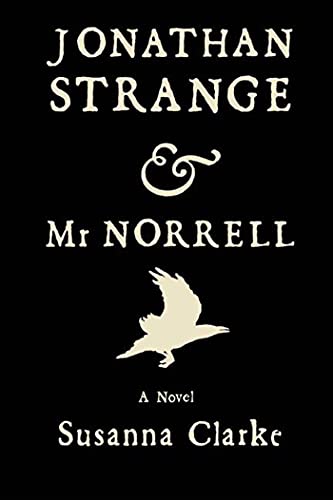 .
.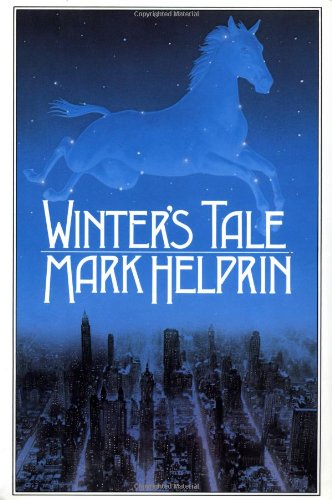 .
.
Currently Reading
 …
…
Other September Reading Candidates
 .
. .
. .
. .
. .
.
Books I Gotta Write Up
 .
. .
. .
. .
.
Currently Reading
 …
…
Other September Reading Candidates
 .
. .
. .
. .
. .
.
247charl08
>242 weird_O: Hope the film is good. I did enjoy that book! I like the way Bryson is willing to make himself out as a grumpy idiot.b
248msf59
LOVE all the great book covers, Bill. Glad you picked The Plague of Doves. That might be my favorite Erdrich. I see other part AAC authors on there too: Wharton, Updike and Roth, all made the cut last year.
I have read quite a few Atwoods but The Handmaid's Tale remains my favorite.
As far as O' Connor goes, can you find her 2nd collection Everything That Rises Must Converge? That is the one I'll be reading. I have a copy from the library. Lots of folks are going with her novel, Wiseblood too, which I have not read.
I have read quite a few Atwoods but The Handmaid's Tale remains my favorite.
As far as O' Connor goes, can you find her 2nd collection Everything That Rises Must Converge? That is the one I'll be reading. I have a copy from the library. Lots of folks are going with her novel, Wiseblood too, which I have not read.
249Oberon
The Unsettling of American Culture and Agriculture looks interesting. I will look for the review.
250weird_O
Finished book #70 for the year, The Plague of Doves by Louise Erdrich. The first of her books that I've read. This fulfills the April American Author Challenge, which challenge I engaged after April had passed. Catching up.
Kids and grandkids due soon for Gram's birthday do, which also will mark grandson Gus's already past birthday and son Ned's forthcoming birthday (Ned is Gus's dad). I don't know if books will change hands or not. Gram got a copy of Alice Hoffman's The River King from daughter Becky yesterday. Good timing, since Gram just finished Bill Bryson's A Walk in the Woods, which filmic version she and I saw Thursday (the actual birthday). Son Jeremy is coming too, with his wife and three daughters.
Party responsibly, of course. But joyfully.
The girls started school last week. Gus starts kindergarten on Tuesday.
Yee haw!!
Kids and grandkids due soon for Gram's birthday do, which also will mark grandson Gus's already past birthday and son Ned's forthcoming birthday (Ned is Gus's dad). I don't know if books will change hands or not. Gram got a copy of Alice Hoffman's The River King from daughter Becky yesterday. Good timing, since Gram just finished Bill Bryson's A Walk in the Woods, which filmic version she and I saw Thursday (the actual birthday). Son Jeremy is coming too, with his wife and three daughters.
Party responsibly, of course. But joyfully.
The girls started school last week. Gus starts kindergarten on Tuesday.
Yee haw!!
251qebo
>250 weird_O: I saw the filmic version yesterday and was underwhelmed.
252Whisper1
>250 weird_O: What a lovely picture you paint. I hope you have a wonderful time with your family. Alice Hoffman is one of my favorite authors. I've read most of her books. I finished The Museum of Extraordinary Things last month. It was one of her better ones.
253weird_O
More catching up to do. (Started late, haven't really caught up.)
>251 qebo: Ehhh. It wasn't great, but I wasn't expecting it to be. Sixteen screens, 16 films, and only this one had any appeal.
>252 Whisper1: Thanks. Judi did read The River King; she had read Practical Magic several years ago, but that book seems to have disappeared. (Was magic involved? More likely a borrower read it and passed it along.)
We did have a great time. As I suspected, books were involved. Gram got a clutch of new reads:

>251 qebo: Ehhh. It wasn't great, but I wasn't expecting it to be. Sixteen screens, 16 films, and only this one had any appeal.
>252 Whisper1: Thanks. Judi did read The River King; she had read Practical Magic several years ago, but that book seems to have disappeared. (Was magic involved? More likely a borrower read it and passed it along.)
We did have a great time. As I suspected, books were involved. Gram got a clutch of new reads:

254weird_O
Ten-year-old Gracie is a reader. Last weekend, she brought along her current read.

When I commented that she didn't have a bookmark in it, I got, well, a look. "I know what page I'm on." It isn't a short book.


When I commented that she didn't have a bookmark in it, I got, well, a look. "I know what page I'm on." It isn't a short book.

255weird_O
I mentioned that I had finished reading The Plague of Doves by Louise Erdrich (9/6/15). Number 70 for the year. Since then, I've finished The Handmaid's Tale by Margaret Atwood (# 71) on 9/10/15 and The Time Machine by H.G. Wells (# 72) today, 9/13/15. I'm also reading Stendahl's The Red and the Black and Updike's Rabbit, Run. The Updike I'm reading was printed and sold in the U.K. and the text has been modestly Anglicized: kerb for curb, colour for color, aluminium for aluminum. Weird.
256weird_O
..
70. The Plague of Doves by Louise Erdrich
"Nothing that happens, nothing, is not connected here by blood." So says Judge Antone Bazil Coutts, one of four narrators of Louise Erdrich's The Plague of Doves, which is set in and around Pluto, North Dakota, an all-white town on the edge of an Indian reservation,
At the center of this tale, is an episode of "rough justice" following the brutal murders of almost an entire farm family. It happened in the early years of the twentieth century. The only survivor was an infant; her parents, sister, and two brothers were shot-gunned.
The murders were discovered by four Ojibwe Indians, drawn to the bawling of the family's cows, which hadn't been milked for several days and thus were suffering. They milked the cows, feeding the infant in the process. Knowing they would be accused of the crime, they left the baby in her crib and vanished, but one did, in the dead of night, leave a note in the sheriff's mailbox. In short order, the crime was discovered by the whites, and somehow the Indians quickly were rounded up. Seized from the sheriff's custody by the white community's bully-boys, they were lynched.
The story is told decades after the fact to Evelina Harp, another of the narrators, by Mooshum Milk, her grandfather. Mooshum is a full-blooded Ojibwa. As it happens, he was one of the four Indians hanged. The men who lynched them, however, didn't allow him to die.
Evelina is gobsmacked. Her mother, Moosum's daughter, and her father, the son of a local (failed) banker, have heard the story before, indeed they tried to dissuade its recital on this occasion. Evelina explains:
The story Mooshum told us had its repercussions—the first being that I could not look at anyone in quite the same way anymore. I became obsessed with lineage. As I came to the end of my small leopard-print diary…I wrote down as much of Mooshum's story as I could remember, and then the relatives of everyone I knew—parents, grandparents, way on back in time. I traced the blood history of the murders through my classmates and friends until I could draw out elaborate spider webs of lines and intersecting circles. I drew in pencil. There were a few people, one of them being Corwin Peace, whose chart was so complicated that I erased parts of it until I wore right through the paper. Still, I could not erase the questions underneath, and Mooshum was no help. He bore interrogation with a vexed wince and silence. I persisted, kept on asking for details, but answered in evasions, to get rid of me. He never spoke with the direct fluidity of that first telling. His medicine bottle, confiscated by our mother, had held whisky. No one knew from what source. She'd never get him to stop. I still loved Mooshum, of course, but with this tale something in my regard of him was disturbed, as if I'd stepped into a clear stream and silt had billowed up around my feet.
As the book progresses, Judge Coutts recounts the mid-winter expedition that sited Pluto, a brutal trek made by his grandfather and four local brothers, the Buckendorfs, led by two Ojibwas, Henri and Lafayette Peace. In time, the younger brother of Henri and Lafayette, Cuthbert Peace would be lynched by Emil Buckendorf (and others). And Sister Mary Anita Buckendorf, Evelina's elementary school teacher and grandaughter of Emil, will acknowledge that Mooshum was hanged, but not to kill him. "Yes, my dear," Mary Anita says. "Wildstrand cut him down at the last moment, yes…{T}hey never meant to hang him all the way. They wanted to terrify him, to intimidate him. A false hanging will do that."
Ultimately, the mystery is solved. It's an elaborate, multigenerational spider web. As the Judge pointed out: "Nothing that happens, nothing, is not connected here by blood."
Did I like it? Of course. Both thumbs up.
257Oberon
>254 weird_O: My kids are big fans of the Riordan books. Has she tried the Kane Chronicles - Riordan's Egyptian themed series?
259msf59
Excellent review of The Plague of Doves, Bill. (You should post your review, so I can Thumb IT!) I hope this is just the beginning for you and Ms. Erdrich.
It looks like you have been doing some mighty fine reading. Looking forward to your thoughts on The Handmaid's Tale and the Updike.
BTW: I LOVED Beautiful Ruins. Nice catch!
It looks like you have been doing some mighty fine reading. Looking forward to your thoughts on The Handmaid's Tale and the Updike.
BTW: I LOVED Beautiful Ruins. Nice catch!
260Tara1Reads
I love your thread! I am also doing the same 50 Book Challenge. I am a little over halfway I think. I am not sure I will finish it in 2015 though as I still have a few daunting things ahead such as 'a trilogy' and a 'book more than 500 pages.'
John Steinbeck is one of my favorites. I am dying to try Roddy Doyle.
John Steinbeck is one of my favorites. I am dying to try Roddy Doyle.
261bell7
>256 weird_O: I've only read The Round House (loved it) and Shadow Tag (not so much), but A Plague of Doves is high on my list of potential book by Erdrich to try next. Glad to know it's a good one!
I was terrible about using bookmarks as a kid and was more likely to remember the page number too. I'm not great about remembering now, though, probably a mix of age and having to put down the book more frequently.
I was terrible about using bookmarks as a kid and was more likely to remember the page number too. I'm not great about remembering now, though, probably a mix of age and having to put down the book more frequently.
This topic was continued by weird_O…starts…LATE! ...and is STILL late!.

