lyzard's list: going forward to the past - Part 4
This topic was continued by lyzard's list: going forward to the past - Part 5.
Talk 75 Books Challenge for 2015
Join LibraryThing to post.
This topic is currently marked as "dormant"—the last message is more than 90 days old. You can revive it by posting a reply.
1lyzard
Little big cats
After our detour into the world of white lions, this thread topper features their more familiar but no less adorable cousins!


After our detour into the world of white lions, this thread topper features their more familiar but no less adorable cousins!


2lyzard

********************************************************
Currently reading:

The Magic Casket by R. Austin Freeman (1927)
3lyzard
January:
1. Raspberry Jam by Carolyn Wells (1920)
2. Legion by William Peter Blatty (1983)
3. Quintus Servinton: A Tale Founded Upon Incidents Of Real Occurrence by Henry Savery (1831)
4. The Victorian House: Domestic Life From Childbirth To Deathbed by Judith Flanders (2003)
5. The Mystery Of The Evil Eye by Anthony Wynne (Robert McNair Wilson) (1925)
6. The Social Gangster by Arthur B. Reeve (1916)
7. The Perfect Murder Case by Christopher Bush (1929)
8. Stupid Texas: Idiots In The Lone Star State by Leland Gregory (2010)
9. A Forger's Tale: The Extraordinary Story Of Henry Savery, Australia's First Novelist by Rod Howard (2011)
10. A Duchess And Her Daughter by Alfred Bishop Mason (1929)
11. The Hound Of Death And Other Stories by Agatha Christie (1933)
12. Beside The Bonnie Brier Bush by Ian Maclaren (John Watson) (1895)
13. Arabella by Georgette Heyer (1949)
February:
14. The Eustace Diamonds by Anthony Trollope (1873)
15. Death At Breakfast by John Rhode (Cecil J. Street) (1936)
16. La Tête d'un Homme by George Simenon (1931)
17. The Motor Rally Mystery by John Rhode (Cecil J. Street) (1933)
18. Diary Of A Provincial Lady by E. M. Delafield (1930)
19. Tom Grogan by Francis Hopkinson Smith (1895)
20. The Silver Wedding by Ethel M Dell (1931)
21. An Introduction To The Australian Novel, 1830-1930 by Barry Argyle (1972)
22. The Ice House by Minette Walters (1992)
23. The Fiend In You by Charles Beaumont (ed.) (1962)
24. Faulkner's Folly by Carolyn Wells (1917)
25. Darkness At Pemberley by T. H. White (1932)
26. Self-Made Woman by Faith Baldwin (1932)
March:
27. Mansfield Park by Jane Austen (1814)
28. The Saltmarsh Murders by Gladys Mitchell (1932)
29. The Language Of Meditation: Four Studies In Nineteenth-Century Fiction by John Halperin (1973)
30. Elsie's Girlhood by Martha Finley (1872)
31. Sydney St. Aubyn. In A Series Of Letters by John Robinson (1794)
32. Quo Vadis: A Narrative Of The Time Of Nero by Henryk Sienkiewicz (1896)
33. At The Blue Gates by Richard Keverne (Clifford Hosken) (1932)
34. That Was Yesterday by Storm Jameson (1932)
35. Murder On The Orient Express by Agatha Christie (1934)
36. The Grand Sophy by Georgette Heyer (1950)
1. Raspberry Jam by Carolyn Wells (1920)
2. Legion by William Peter Blatty (1983)
3. Quintus Servinton: A Tale Founded Upon Incidents Of Real Occurrence by Henry Savery (1831)
4. The Victorian House: Domestic Life From Childbirth To Deathbed by Judith Flanders (2003)
5. The Mystery Of The Evil Eye by Anthony Wynne (Robert McNair Wilson) (1925)
6. The Social Gangster by Arthur B. Reeve (1916)
7. The Perfect Murder Case by Christopher Bush (1929)
8. Stupid Texas: Idiots In The Lone Star State by Leland Gregory (2010)
9. A Forger's Tale: The Extraordinary Story Of Henry Savery, Australia's First Novelist by Rod Howard (2011)
10. A Duchess And Her Daughter by Alfred Bishop Mason (1929)
11. The Hound Of Death And Other Stories by Agatha Christie (1933)
12. Beside The Bonnie Brier Bush by Ian Maclaren (John Watson) (1895)
13. Arabella by Georgette Heyer (1949)
February:
14. The Eustace Diamonds by Anthony Trollope (1873)
15. Death At Breakfast by John Rhode (Cecil J. Street) (1936)
16. La Tête d'un Homme by George Simenon (1931)
17. The Motor Rally Mystery by John Rhode (Cecil J. Street) (1933)
18. Diary Of A Provincial Lady by E. M. Delafield (1930)
19. Tom Grogan by Francis Hopkinson Smith (1895)
20. The Silver Wedding by Ethel M Dell (1931)
21. An Introduction To The Australian Novel, 1830-1930 by Barry Argyle (1972)
22. The Ice House by Minette Walters (1992)
23. The Fiend In You by Charles Beaumont (ed.) (1962)
24. Faulkner's Folly by Carolyn Wells (1917)
25. Darkness At Pemberley by T. H. White (1932)
26. Self-Made Woman by Faith Baldwin (1932)
March:
27. Mansfield Park by Jane Austen (1814)
28. The Saltmarsh Murders by Gladys Mitchell (1932)
29. The Language Of Meditation: Four Studies In Nineteenth-Century Fiction by John Halperin (1973)
30. Elsie's Girlhood by Martha Finley (1872)
31. Sydney St. Aubyn. In A Series Of Letters by John Robinson (1794)
32. Quo Vadis: A Narrative Of The Time Of Nero by Henryk Sienkiewicz (1896)
33. At The Blue Gates by Richard Keverne (Clifford Hosken) (1932)
34. That Was Yesterday by Storm Jameson (1932)
35. Murder On The Orient Express by Agatha Christie (1934)
36. The Grand Sophy by Georgette Heyer (1950)
4lyzard
April:
37. A Description Of Millenium Hall And The Country Adjacent by Sarah Scott (1762)
38. Ruth Fielding At Sunrise Farm; or, What Became Of The Raby Orphans by "Alice B. Emerson" (1915)
39. The Benson Murder Case by S. S. Van Dine (Willard Huntington Wright) (1926)
40. The Treasure Train: Adventures Of Craig Kennedy, Scientific Detective, Which Ultimately Take Him Abroad by Arthur B. Reeve (1917)
41. The History of Lady Barton, A Novel, In Letters by Elizabeth Griffith (1771)
42. Caleb West, Master Diver by Francis Hopkinson Smith (1898)
43. Dreadful Deeds And Awful Murders: Scotland Yard's First Detectives 1829-1878 by Joan Lock (1990)
44. Virtue In Distress: Studies In The Novel Of Sentiment From Richardson To Sade by R. F. Brissenden (1974)
45. The Provincial Lady Goes Further by E. M. Delafield (1932)
46. Week-End Marriage by Faith Baldwin (1932)
47. The Quiet Gentleman by Georgette Heyer (1951)
48. The Listerdale Mystery by Agatha Christie (1934)
49. Kate, Plus 10 by Edgar Wallace (1917)
May:
50. Death Lights A Candle by Phoebe Atwood Taylor (1932)
51. Castle Rackrent by Maria Edgeworth (1800)
52. The Age Of Agony: The Art Of Healing c. 1700-1800 by Guy R. Williams (1975)
53. They Wouldn't Be Chessmen by A. E. W. Mason (1935)
54. Boomerang by Helen Simpson (1932)
55. Greenbanks by Dorothy Whipple (1932)
56. David Harum: A Story Of American Life by Edward Noyes Westcott (1898)
57. Dusky Night by Victor Bridges (1940)
58. The Cipher by Kathe Koja (1991)
59. The Provincial Lady In America by E. M. Delafield (1934)
60. The Australian Novel, 1830-1980: A Thematic Introduction by John Scheckter (1998)
June:
61. Ashton-Kirk, Investigator by John T. McIntyre (1910)
62. Cleek's Greatest Riddles by Thomas W. Hanshew (1916)
63. The Fellowship Of The Frog by Edgar Wallace (1925)
64. The Maestro Murders by Frances Shelley Wees (1931)
65. Something Wrong At Chillery by R. Francis Foster (1931)
66. The Prison Wall by Ethel M. Dell (1932)
67. Missing From His Home by Clifford Hosken (1932)
68. The Man With The Clubfoot by Valentine Williams (1918)
69. The Beauty Of The British Alps by Mary Leman Grimstone (1825)
70. To Have And To Hold by Mary Johnston (1899)
71. Cotillion by Georgette Heyer (1953)
72. Why Didn't They Ask Evans? by Agatha Christie (1934)
73. The Fatal 5 Minutes by R. A. J. Walling (1932)
July:
74. Evelina; or, The History Of A Young Lady's Entrance Into The World by Fanny Burney (1778)
75. Grasp Your Nettle by Eliza Lynn Linton (1865)
76. The Provincial Lady In Wartime by E. M. Delafield (1940)
77. Roger Sheringham And The Vane Mystery by Anthony Berkeley (1927)
78. The Six Proud Walkers by Francis Beeding (Hilary Saint George Saunders and John Palmer) (1928)
79. The Island Forbidden To Man by Muriel Hine (1946)
80. The Hunger And Other Stories: A Collection Of Violent Entertainments by Charles Beaumont (1958)
81. The Crisis by Winston Churchill (1901)
82. Nothing Venture by Patricia Wentworth (1932)
83. Parker Pyne Investigates by Agatha Christie (1934)
84. The Toll-Gate by Georgette Heyer (1954)
85. Red Pepper Burns by Grace S. Richmond (1910)
86. Bellamy by Elinor Mordaunt (1914)
37. A Description Of Millenium Hall And The Country Adjacent by Sarah Scott (1762)
38. Ruth Fielding At Sunrise Farm; or, What Became Of The Raby Orphans by "Alice B. Emerson" (1915)
39. The Benson Murder Case by S. S. Van Dine (Willard Huntington Wright) (1926)
40. The Treasure Train: Adventures Of Craig Kennedy, Scientific Detective, Which Ultimately Take Him Abroad by Arthur B. Reeve (1917)
41. The History of Lady Barton, A Novel, In Letters by Elizabeth Griffith (1771)
42. Caleb West, Master Diver by Francis Hopkinson Smith (1898)
43. Dreadful Deeds And Awful Murders: Scotland Yard's First Detectives 1829-1878 by Joan Lock (1990)
44. Virtue In Distress: Studies In The Novel Of Sentiment From Richardson To Sade by R. F. Brissenden (1974)
45. The Provincial Lady Goes Further by E. M. Delafield (1932)
46. Week-End Marriage by Faith Baldwin (1932)
47. The Quiet Gentleman by Georgette Heyer (1951)
48. The Listerdale Mystery by Agatha Christie (1934)
49. Kate, Plus 10 by Edgar Wallace (1917)
May:
50. Death Lights A Candle by Phoebe Atwood Taylor (1932)
51. Castle Rackrent by Maria Edgeworth (1800)
52. The Age Of Agony: The Art Of Healing c. 1700-1800 by Guy R. Williams (1975)
53. They Wouldn't Be Chessmen by A. E. W. Mason (1935)
54. Boomerang by Helen Simpson (1932)
55. Greenbanks by Dorothy Whipple (1932)
56. David Harum: A Story Of American Life by Edward Noyes Westcott (1898)
57. Dusky Night by Victor Bridges (1940)
58. The Cipher by Kathe Koja (1991)
59. The Provincial Lady In America by E. M. Delafield (1934)
60. The Australian Novel, 1830-1980: A Thematic Introduction by John Scheckter (1998)
June:
61. Ashton-Kirk, Investigator by John T. McIntyre (1910)
62. Cleek's Greatest Riddles by Thomas W. Hanshew (1916)
63. The Fellowship Of The Frog by Edgar Wallace (1925)
64. The Maestro Murders by Frances Shelley Wees (1931)
65. Something Wrong At Chillery by R. Francis Foster (1931)
66. The Prison Wall by Ethel M. Dell (1932)
67. Missing From His Home by Clifford Hosken (1932)
68. The Man With The Clubfoot by Valentine Williams (1918)
69. The Beauty Of The British Alps by Mary Leman Grimstone (1825)
70. To Have And To Hold by Mary Johnston (1899)
71. Cotillion by Georgette Heyer (1953)
72. Why Didn't They Ask Evans? by Agatha Christie (1934)
73. The Fatal 5 Minutes by R. A. J. Walling (1932)
July:
74. Evelina; or, The History Of A Young Lady's Entrance Into The World by Fanny Burney (1778)
75. Grasp Your Nettle by Eliza Lynn Linton (1865)
76. The Provincial Lady In Wartime by E. M. Delafield (1940)
77. Roger Sheringham And The Vane Mystery by Anthony Berkeley (1927)
78. The Six Proud Walkers by Francis Beeding (Hilary Saint George Saunders and John Palmer) (1928)
79. The Island Forbidden To Man by Muriel Hine (1946)
80. The Hunger And Other Stories: A Collection Of Violent Entertainments by Charles Beaumont (1958)
81. The Crisis by Winston Churchill (1901)
82. Nothing Venture by Patricia Wentworth (1932)
83. Parker Pyne Investigates by Agatha Christie (1934)
84. The Toll-Gate by Georgette Heyer (1954)
85. Red Pepper Burns by Grace S. Richmond (1910)
86. Bellamy by Elinor Mordaunt (1914)
5lyzard
Books in transit:
On interlibrary loan / storage request:
Intimate relationships: Marriage, Family, And Lifestyles Through Literature by Rose M. Somerville (ed.)
The Mask Of Fu-Manchu by Sax Rohmer
Tragedy At Freyne by Anthony Gilbert
Purchased and shipped:
The Blatchington Tangle by G. D. H. and M. Cole
Young Barbara by May Edginton
The Merrivale Mystery by James Corbett
Strange Murders At Greystones by Elsie Wright
On loan:
*Bellamy by Elinor Mordaunt (10/08/2015)
**Diary Of A Provincial Lady by E. M. Delafield (28/09/2015)
The Fortnight In September by R. C. Sherriff (28/09/2015)
Printer's Devil by Clemence Dane and Helen Simpson (30/09/2015)
The Amateur Gentleman by Jeffery Farnol (30/09/2015)
Amazing Grace by E. S. Turner (09/10/2015
Women And Marriage In Victorian Fiction by Jenni Calder (09/10/2015)
Love, Mystery And Misery by Coral Ann Howells (09/10/2015)
Track down:
Handfasted by Catherine Helen Spence {interlibrary loan}
The Final War by Louis Tracy {Internet Archive}
Guilty Bonds by William Le Queux {Project Gutenberg}
An Australian Heroine by Rosa Praed {Internet Archive}
The Last Lemurian by G. Firth Scott {Project Gutenberg Australia}
An Australian Girl by Catherine Martin {interlibrary loan}
The Medicine Lady by L. T. Meade {Book Depository}
Follow up:
Hatter's Castle by A. J. Cronin (interlibrary loan}
The Colonel's Daughter by Richard Aldington {Fisher Library storage}
Hunting Shirt by Mary Johnston {online}
One-Man Girl by Maysie Greig {interlibrary loan}
Simpson by Edward Sackville-West {Fisher Library}
The Silver Star by Jackson Gregory {interlibrary loan}
Murder In The House Of Commons by Mary Hamilton {Amazon domestic}
Murder In A Haystack by Dorothy Aldis {Amazon domestic}
The Avenging Parrot by Anne Austin {rare, expensive}
Amos The Wanderer by W. B. Maxwell {Archive Hobart?}
On interlibrary loan / storage request:
Intimate relationships: Marriage, Family, And Lifestyles Through Literature by Rose M. Somerville (ed.)
The Mask Of Fu-Manchu by Sax Rohmer
Tragedy At Freyne by Anthony Gilbert
Purchased and shipped:
The Blatchington Tangle by G. D. H. and M. Cole
Young Barbara by May Edginton
The Merrivale Mystery by James Corbett
Strange Murders At Greystones by Elsie Wright
On loan:
*Bellamy by Elinor Mordaunt (10/08/2015)
**Diary Of A Provincial Lady by E. M. Delafield (28/09/2015)
The Fortnight In September by R. C. Sherriff (28/09/2015)
Printer's Devil by Clemence Dane and Helen Simpson (30/09/2015)
The Amateur Gentleman by Jeffery Farnol (30/09/2015)
Amazing Grace by E. S. Turner (09/10/2015
Women And Marriage In Victorian Fiction by Jenni Calder (09/10/2015)
Love, Mystery And Misery by Coral Ann Howells (09/10/2015)
Track down:
Handfasted by Catherine Helen Spence {interlibrary loan}
The Final War by Louis Tracy {Internet Archive}
Guilty Bonds by William Le Queux {Project Gutenberg}
An Australian Heroine by Rosa Praed {Internet Archive}
The Last Lemurian by G. Firth Scott {Project Gutenberg Australia}
An Australian Girl by Catherine Martin {interlibrary loan}
The Medicine Lady by L. T. Meade {Book Depository}
Follow up:
Hatter's Castle by A. J. Cronin (interlibrary loan}
The Colonel's Daughter by Richard Aldington {Fisher Library storage}
Hunting Shirt by Mary Johnston {online}
One-Man Girl by Maysie Greig {interlibrary loan}
Simpson by Edward Sackville-West {Fisher Library}
The Silver Star by Jackson Gregory {interlibrary loan}
Murder In The House Of Commons by Mary Hamilton {Amazon domestic}
Murder In A Haystack by Dorothy Aldis {Amazon domestic}
The Avenging Parrot by Anne Austin {rare, expensive}
Amos The Wanderer by W. B. Maxwell {Archive Hobart?}
6lyzard
Ongoing series and sequels:
(1866 - 1876) **Emile Gaboriau - Monsieur Lecoq - The Widow Lerouge (1/6) {ManyBooks}
(1867 - 1905) **Martha Finley - Elsie Dinsmore - Elsie's Womanhood (4/28) {ManyBooks}
(1867 - 1872) **George MacDonald - The Seaboard Parish - Annals Of A Quiet Neighbourhood (1/3) {ManyBooks}
(1878 - 1917) **Anna Katharine Green - Ebenezer Gryce - A Matter Of Millions (6/12) {owned}
(1896 - 1909) **Melville Davisson Post - Randolph Mason - The Corrector Of Destinies (3/3) {Internet Archive}
(1894 - 1898) **Anthony Hope - Ruritania - Rupert Of Hentzau (3/3) {Project Gutenberg}
(1895 - 1901) **Guy Newell Boothby - Dr Nikola - Dr Nikola (2/5) {ManyBooks}
(1897 - 1900) **Anna Katharine Green - Amelia Butterworth - That Affair Next Door (1/3) {Fisher Library}
(1898 - 1915) **Kate Douglas Wiggins - Penelope - Penelope's Progress (1/4) {Project Gutenberg}
(1899 - 1909) **E. W. Hornung - Raffles - Raffles: The Amateur Cracksman (1/4) {ManyBooks}
(1899 - 1919) **Finley Peter Dunne - Mr Dooley - Mr Dooley In Peace And In War (1/8) {Internet Archive}
(1900 - 1974) *Ernest Bramah - Kai Lung - Kai Lung's Golden Hours (2/6) {ManyBooks}
(1901 - 1919) **Carolyn Wells - Patty Fairfield - Patty In Paris (5/17) {ManyBooks}
(1901 - 1927) George Barr McCutcheon - Graustark - Graustark (1/6) {Project Gutenberg}
(1903 - 1904) **Louis Tracy - Reginald Brett - A Fatal Legacy (aka The Stowmarket Mystery) (1/2) {ManyBooks}
(1904 - ????) *Louis Tracy - Winter and Furneaux - A Mysterious Disappearance (1/?) {ManyBooks}
(1905 - 1925) **Baroness Orczy - The Old Man In The Corner - Unravelled Knots (3/3) {Project Gutenberg Australia}}
(1905 - 1928) **Edgar Wallace - The Just Men - The Law Of The Four Just Men (4/6) {Project Gutenberg Australia}
(1906 - 1930) **John Galsworthy - The Forsyte Saga - Indian Summer Of A Forsyte (short story) (2/11) {Project Gutenberg}
(1907 - 1912) **Carolyn Wells - Marjorie - Marjorie's Vacation (1/6) {ManyBooks}
(1907 - 1942) *R. Austin Freeman - Dr John Thorndyke - The Magic Casket (14/26) {Roy Glashan's Library}
(1907 - 1941) *Maurice Leblanc - Arsene Lupin - Arsène Lupin contre Herlock Sholmès (2/21) {ManyBooks}
(1908 - 1924) **Margaret Penrose - Dorothy Dale - Dorothy Dale: A Girl Of Today (1/13) {ManyBooks}
(1909 - 1942) *Carolyn Wells - Fleming Stone - The Mystery Of The Sycamore (12/49) {ManyBooks}
(1910 - 1936) *Arthur B. Reeve - Craig Kennedy - The Treasure-Train (6/11) {ManyBooks}
(1910 - 1946) A. E. W. Mason - Inspector Hanaud - The Ginger King (short story) (5/6) {Roy Glashan's Library}
(1910 - ????) *Edgar Wallace - Inspector Smith - Kate Plus Ten (3/?) {Project Gutenberg Australia}
(1910 - 1930) **Edgar Wallace - Inspector Elk - The Joker (3/6?) {ManyBooks}
(1910 - ????) *Thomas Hanshew - Cleek - The Riddle Of The Night (3/?) {Internet Archive}
(1910 - 1918) *John McIntyre - Ashton-Kirk - Ashton-Kirk, Secret Agent (2/4) {Project Gutenberg}
(1910 - 1931) *Grace S. Richmond - Red Pepper Burns - Mrs Red Pepper (2/6) {Project Gutenberg}
(1910 - ????) *Jeffery Farnol - The Vibarts - The Way Beyond (3/?) {Project Gutenberg Canada}
(1911 - 1935) *G. K. Chesterton - Father Brown - The Scandal Of Father Brown (5/5) {branch transfer}
(1911 - 1937) *Mary Roberts Rinehart - Letitia Carberry - Tish Plays The Game (4/5) {GooglePlay}
(1911 - 1919) **Alfred Bishop Mason - Tom Strong - Tom Strong, Washington's Scout (1/5) {Internet Archive}
(1913 - 1934) *Alice B. Emerson - Ruth Fielding - Ruth Fielding And The Gypsies (8/30) {Project Gutenberg}
(1913 - 1973) Sax Rohmer - Fu-Manchu - The Mask Of Fu-Manchu (5/14) {interlibrary loan}
(1913 - 1952) *Jeffery Farnol - Jasper Shrig - The Amateur Gentleman (1/9) {Fisher Library storage}
(1914 - 1950) Mary Roberts Rinehart - Hilda Adams - Episode Of The Wandering Knife (5/5) Better World Books}
(1914 - 1934) *Ernest Bramah - Max Carrados - The Eyes Of Max Carrados (2/4) {Roy Glashan's Library}
(1916 - 1941) John Buchan - Edward Leithen - Sick Heart River (5/5) {Fisher Library}
(1915 - 1936) *John Buchan - Richard Hannay - The Thirty-Nine Steps (1/5) {Fisher Library / Project Gutenberg}
(1916 - 1917) **Carolyn Wells - Alan Ford - Faulkner's Folly (2/2) {owned}
(1916 - 1927) **Natalie Sumner Lincoln - Inspector Mitchell - I Spy (1/10) {Project Gutenberg}
(1917 - 1929) **Henry Handel Richardson - Dr Richard Mahony - Australia Felix (1/3) {interlibrary loan}
(1918 - 1923) **Carolyn Wells - Pennington Wise - The Room With The Tassels (1/8) {Project Gutenberg}
(1918 - ????) *Valentine Williams - Okewood / Clubfoot - The Man With The Clubfoot (1/?) {ManyBooks}
(1919 - 1966) *Lee Thayer - Peter Clancy - The Sinister Mark (5/60) {owned}
(1920 - 1939) E. F. Benson - Mapp And Lucia - Lucia's Progress (5/6) {Fisher Library}
(1920 - 1948) *H. C. Bailey - Reggie Fortune - Mr Fortune, Please (4/23) {academic loan}
(1920 - 1949) William McFee - Spenlove - The Beachcomber - (3/6) {AbeBooks / Better World Books}
(1920 - 1932) *Alice B. Emerson - Betty Gordon - Betty Gordon At Bramble Farm (1/15) {ManyBooks}
(1920 - 1975) Agatha Christie - Hercule Poirot - Three Act Tragedy (10/39) {owned}
(1920 - 1921) **Natalie Sumner Lincoln - Ferguson - The Red Seal (1/2) {Project Gutenberg}
(1921 - 1929) **Charles J. Dutton - John Bartley - The Second Bullet (5/9) {expensive}
(1921 - 1925) **Herman Landon - The Gray Phantom - The Gray Phantom's Return (aka "The Gray Phantom's Defense") (2/5) {Project Gutenberg}
(1922 - 1973) *Agatha Christie - Tommy and Tuppence - N. Or M.? (3/5) {owned}
(1922 - 1927) *Alice MacGowan and Perry Newberry - Jerry Boyne - The Mystery Woman (2/5) {Amazon, eBay?}
(1923 - 1937) Dorothy L. Sayers - Lord Peter Wimsey - Hangman's Holiday (9/15) {Fisher Library}
(1923 - 1924) **Carolyn Wells - Lorimer Lane - The Fourteenth Key (2/2) {eBay}
(1923 - 1931) *Agnes Miller - The Linger-Nots - The Linger-Nots And The Mystery House (1/5) {AbeBooks / Amazon}
(1923 - 1927) **Annie Haynes - Inspector Furnival - The Abbey Court Murder (1/3) {expensive}
(1924 - 1959) * / ***Philip MacDonald - Colonel Anthony Gethryn - Persons Unknown (aka "The Maze") (5/24) {academic loan}
(1924 - 1957) *Freeman Wills Crofts - Inspector French - The Cheyne Mystery (2/30) {Fisher Library}
(1924 - 1935) *Francis D. Grierson - Inspector Sims and Professor Wells - The Double Thumb (2/13) {rare, expensive}
(1924 - 1940) *Lynn Brock - Colonel Gore - Colonel Gore's Second Case (2/12) {AbeBooks}
(1924 - 1933) *Herbert Adams - Jimmie Haswell - The Crooked Lip (2/9) {rare, expensive}
(1924 - 1944) *A. Fielding - Inspector Pointer - The Charteris Mystery (2/23) {AbeBooks}
(1925 - 1961) ***John Rhode - Dr Priestley - Death In The Hopfields (25/72) {HathiTrust}
(1925 - 1953) *G. D. H. Cole / M. Cole - Superintendent Wilson - The Blatchington Tangle (3/?) {AbeBooks, expensive}
(1925 - 1937) *Hulbert Footner - Madame Storey - Madame Storey (2/10) {mobilereads / Project Gutenberg Canada}
(1925 - 1932) *Earl Derr Biggers - Charlie Chan - The Chinese Parrot (2/6) {feedbooks}
(1925 - 1944) *Agatha Christie - Superintendent Battle - Cards On The Table (3/5) {owned}
(1925 - 1934) *Anthony Berkeley - Roger Sheringham - The Silk Stocking Murders (4/10) {ordered}
(1925 - 1950) *Anthony Wynne (Robert McNair Wilson) - Dr Eustace Hailey - The Double-Thirteen Mystery (2/27) {AbeBooks}
(1925 - 1939) *Charles Barry (Charles Bryson) - Inspector Lawrence Gilmartin - The Smaller Penny (1/15) {AbeBooks}
(1926 - 1968) * / ***Christopher Bush - Ludovic Travers - Dead Man Twice (3/63) {AbeBooks}
(1926 - 1939) *S. S. Van Dine - Philo Vance - The Canary Murder Case (2/12) {owned}
(1926 - 1952) *J. Jefferson Farjeon - Ben the Tramp - No. 17 (1/8) {owned}
(1926 - ????) *G. D. H. Cole / M. Cole - Everard Blatchington - The Blatchington Tangle (1/?) {AbeBooks, expensive}
(1927 - 1933) *Herman Landon - The Picaroon - The Green Shadow (1/7) {AbeBooks / eBay}
(1927 - 1932) *Anthony Armstrong - Jimmie Rezaire - Jimmie Rezaire aka The Trail Of Fear (1/5) {AbeBooks}
(1927 - 1937) *Ronald Knox - Miles Bredon - The Three Taps (1/5) {AbeBooks / academic loan}
(1927 - 1958) *Brian Flynn - Anthony Bathurst - The Billiard-Room Mystery (1/54) {AbeBooks}
(1927 - 1947) *J. J. Connington - Sir Clinton Driffield - Murder In The Maze (1/17) {academic loan / ebook}
(1927 - 1935) *Anthony Gilbert (Lucy Malleson) - Scott Egerton - Tragedy At Freyne (1/10) {expensive}
(1928 - 1961) Patricia Wentworth - Miss Silver - The Case Is Closed (2/33) {branch transfer}
(1928 - 1936) ***Gavin Holt - Luther Bastion - The Garden Of Silent Beasts (5/17) {academic loan}
(1928 - ????) Trygve Lund - Weston of the Royal North-West Mounted Police - In The Snow: A Romance Of The Canadian Backwoods (4/?) {AbeBooks}
(1928 - 1936) *Kay Cleaver Strahan - Lynn MacDonald - Death Traps (3/7) {AbeBooks}
(1928 - 1937) *John Alexander Ferguson - Francis McNab - Murder On The Marsh (2/5) {Internet Archive}
(1928 - 1960) *Cecil Freeman Gregg - Inspector Higgins - The Murdered Manservant (1/35) {unavailable}
(1928 - 1959) *John Gordon Brandon - Inspector Patrick Aloysius McCarthy - Red Altars (1/?) {AbeBooks}
(1928 - 1935) *Roland Daniel - Inspector Saville - The Society Of The Spiders (1/?) {Unavailable}
(1928 - 1946) *Francis Beeding - Alistair Granby - The Five Flamboys (2/18) {academic loan}
(1928 - 1930) **Annie Haynes - Inspector Stoddart - The Man With The Dark Beard (1/4) {expensive}
(1928 - 1932) *William Blair Morton Ferguson - Daniel "Biff" Corrigan - Masquerade (1/4) {rare}
(1929 - 1947) Margery Allingham - Albert Campion - Sweet Danger (5/35) {Fisher Library}
(1929 - 1984) Gladys Mitchell - Mrs Bradley - Death At The Opera (5/67) {interlibrary loan}
(1929 - 1937) ***Patricia Wentworth - Benbow Smith - Walk With Care (3/4) {expensive}
(1929 - ????) Mignon Eberhart - Nurse Sarah Keate - Murder By An Aristocrat (5/8) {Better World Books}
(1929 - ????) Moray Dalton - Inspector Collier - ???? (3/?) - Death In The Cup {AbeBooks}, The Wife Of Baal {unavailable}
(1929 - ????) * / ***Charles Reed Jones - Leighton Swift - The King Murder (1/?) {Unavailable}
(1929 - 1931) Carolyn Wells - Kenneth Carlisle - Sleeping Dogs (1/3) {Amazon / eBay}
(1929 - 1967) *George Goodchild - Inspector McLean - McLean Of Scotland Yard (1/65) {AbeBooks}
(1929 - 1979) *Leonard Gribble - Anthony Slade - The Case Of The Marsden Rubies (1/33) {AbeBooks}
(1929 - 1932) *E. R. Punshon - Carter and Bell - The Unexpected Legacy (1/5) {expensive}
(1929 - 1971) *Ellery Queen - Ellery Queen - The Roman Hat Mystery (1/40) {interlibrary loan}
(1929 - 1966) *Arthur Upfield - Bony - The Barrakee Mystery (1/29) {Fisher Library}
(1929 - 1931) *Ernest Raymond - Once In England - A Family That Was (1/3) {AbeBooks}
(1929 - 1937) *Anthony Berkeley - Ambrose Chitterwick - The Poisoned Chocolates Case (1/3) {City of Sydney / Fisher Library}
(1929 - 1940) *Jean Lilly - DA Bruce Perkins - The Seven Sisters (1/3) {AbeBooks / expensive shipping}
(1929 - 1935) *N. A. Temple-Ellis (Nevile Holdaway) - Montrose Arbuthnot - The Inconsistent Villains (1/4) {AbeBooks / expensive shipping}
(1929 - 1943) *Gret Lane - Kate Clare Marsh and Inspector Barrin - The Cancelled Score Mystery (1/9) {unavailable?}
(1929 - 1961) *Henry Holt - Inspector Silver - The Mayfair Mystery (aka "The Mayfair Murder") (1/16) {AbeBooks}
(1929 - 1930) *J. J. Connington - Superintendent Ross - The Eye In The Museum (1/2) {AbeBooks}
(1929 - 1941) *H. Maynard Smith - Inspector Frost - Inspector Frost's Jigsaw (1/7) {AbeBooks}
(1929 - ????) *Armstrong Livingston - Jimmy Traynor - The Doublecross (1/?) {AbeBooks}
(1929 - 1932) *Clemence Dane and Helen Simpson - Sir John Saumarez - Printer's Devil (aka "Author Unknown") (2/3) {Fisher Library storage}
(1929 - 1940) *Rufus King - Lieutenant Valcour - Murder By The Clock (1/11) {AbeBooks / omnibus}
(1929 - 1933) *Will Levinrew (Will Levine) - Professor Brierly - The Poison Plague (1/5) {rare, expensive}
(1930 - ????) Moray Dalton - Hermann Glide - ???? (3/?) {see above}
(1930 - 1932) Hugh Walpole - The Herries Chronicles - The Fortress (3/4) {Fisher Library}
(1930 - 1932) Faith Baldwin - The Girls Of Divine Corners - Myra: A Story Of Divine Corners (4/4) {owned}
(1930 - 1960) ***Miles Burton - Desmond Merrion - The Milk-Churn Murder (10/61) {Munsey's}
(1930 - 1933) Roger Scarlett - Inspector Kane - Murder Among The Angells (4/5) {online shopping}
(1930 - 1941) *Harriette Ashbrook - Philip "Spike" Tracy - The Murder Of Sigurd Sharon (3/7) {AbeBooks}
(1930 - 1943) Anthony Abbot - Thatcher Colt - About The Murder Of The Night Club Lady (3/8) {AbeBooks}
(1930 - ????) * / ***David Sharp - Professor Henry Arthur Fielding - My Particular Murder (2/?) {AbeBooks}
(1930 - 1950) *H. C. Bailey - Josiah Clunk - Garstons aka The Garston Murder Case (1/11) {AbeBooks}
(1930 - 1968) *Francis Van Wyck Mason - Captain North - Seeds Of Murder (1/41) {rare, expensive}
(1930 - 1976) *Agatha Christie - Miss Jane Marple - The Body In The Library (3/12) {owned}
(1930 - ????) *Anne Austin - James "Bonnie" Dundee - The Avenging Parrot (1/?) - {AbeBooks, expensive shipping}
(1930 - 1950) *Leslie Ford (as David Frome) - Mr Pinkerton and Inspector Bull - The Hammersmith Murders (1/11) {AbeBooks}
(1930 - 1935) *"Diplomat" (John Franklin Carter) - Dennis Tyler - Murder In The State Department (1/7) {expensive}
(1930 - 1962) *Helen Reilly - Inspector Christopher McKee - The Diamond Feather (1/31) {AbeBooks / expensive shipping}
(1930 - 1933) *Mary Plum - John Smith - The Killing Of Judge MacFarlane (1/4) {AbeBooks}
(1930 - 1945) *Hulbert Footner - Amos Lee Mappin - The Mystery Of The Folded Paper (aka The Folded Paper Mystery (1/10) {mobilereads / omnibus}
(1930 - 1940) *E. M. Delafield - The Provincial Lady - The Provincial Lady In Wartime (4/4) {Fisher Library}
(1930 - 1933) *Monte Barrett - Peter Cardigan - The Pelham Murder Case (1/3) {Amazon}
(1931 - 1940) Bruce Graeme - Superintendent Stevens and Pierre Allain - The Imperfect Crime (2/8) {owned}
(1931 - 1951) Phoebe Atwood Taylor - Asey Mayo - The Mystery Of The Cape Cod Players (3/24) {AbeBooks}
(1931 - 1933) Philip MacDonald (as Martin Porlock) - Charles Fox-Browne - Mystery In Kensington Gore (aka Escape) (2/3) {owned}
(1931 - 1955) Stuart Palmer - Hildegarde Withers - Murder On Wheels (2/18) {AbeBooks}
(1931 - 1951) Olive Higgins Prouty - The Vale Novels - Lisa Vale (2/5) {academic loan}
(1931 - 1933) Sydney Fowler - Inspector Cleveland - Crime &. Co. (2/4) {owned}
(1931 - 1934) J. H. Wallis - Inspector Wilton Jacks - Murder By Formula (1/6) {Amazon}
(1931 - ????) Paul McGuire - Inspector Cummings - Daylight Murder (3/5) {academic loan}
(1931 - 1937) Carlton Dawe - Leathermouth - The Sign Of The Glove (2/13) {academic loan}
(1931 - 1947) R. L. Goldman - Asaph Clume and Rufus Reed - The Murder Of Harvey Blake (1/6) {AbeBooks}
(1931 - 1959) E. C. R. Lorac (Edith Caroline Rivett) - Inspector Robert Macdonald - The Murder On The Burrows (1/46) {rare, expensive}
(1931 - ????) Clifton Robbins - Clay Harrison - Dusty Death (1/?) {AbeBooks}
(1931 - 1972) Georges Simenon - Inspector Maigret - Le Chien Jaune (6/75) {branch transfer}
(1931 - 1934) T. S. Stribling - The Vaiden Trilogy - The Store (2/3) {academic loan}
(1931 - 1935) Pearl S. Buck - The House Of Earth - Sons (2/3) {Fisher Library}
(1931 - 1942) R. A. J. Walling - Garstang - The Stroke Of One (1/3) {Amazon}
(1931 - ????) Francis Bonnamy (Audrey Boyers Walz) - Peter Utley Shane - Death By Appointment (1/8){AbeBooks}
(1932 - 1954) Sydney Fowler - Inspector Cambridge and Mr Jellipot - The Bell Street Murders (1/11) {AbeBooks}
(1932 - 1935) Murray Thomas - Inspector Wilkins - Buzzards Pick The Bones (1/3) {AbeBooks / expensive}
(1932 - ????) R. A. J. Walling - Philip Tolefree - Follow The Blue Car (2/?) {expensive}
(1932 - 1962) T. Arthur Plummer - Detective-Inspector Andrew Frampton - Shadowed By The C. I. D. (1/50) {unavailable?}
(1932 - 1936) John Victor Turner - Amos Petrie - Death Must Have Laughed (1/7) {unavailable?}
(1932 - 1944) Nicholas Brady (John Victor Turner) - Ebenezer Buckle - The House Of Strange Guests (1/4) {unavailable?}
(1932 - 1932) Lizette M. Edholm - The Merriweather Girls - The Merriweather Girls On Campers' Trail (2/4) {AbeBooks}
(1932 - 1933) Barnaby Ross (aka Ellery Queen) - Drury Lane - The Tragedy Of Y (2/4) {Internet Archive}
(1932 - 1952) D. E. Stevenson - Mrs Tim - Mrs Tim Of The Regiment (1/5) {interlibrary loan}
(1933 - 1959) John Gordon Brandon - Arthur Stukeley Pennington - West End! (1/?) {AbeBooks}
(1933 - 1940) Lilian Garis - Carol Duncan - The Ghost Of Melody Lane (1/9) {AbeBooks}
(1933 - 1934) Peter Hunt (George Worthing Yates and Charles Hunt Marshall) - Allan Miller - Murders At Scandal House (1/3) {AbeBooks / Amazon}
(1933 - 1968) John Dickson Carr - Gideon Fell - Hag's Nook (1/23) {Better World Books}
(1933 - 1939) Gregory Dean - Deputy Commissioner Benjamin Simon - The Case Of Marie Corwin (1/3) {AbeBooks / Amazon}
(1933 - 1956) E. R. Punshon - Detective-Sergeant Bobby Owen - Information Received (1/35) {academic loan}
(1933 - 1970) Dennis Wheatley - Duke de Richlieu - The Forbidden Territory (1/11) {Fisher Library}
(1933 - 1934) Jackson Gregory - Paul Savoy - A Case For Mr Paul Savoy (1/3) {AbeBooks}
(1934 - 1936) Storm Jameson - The Mirror In Darkness - Company Parade (1/3) {Fisher Library}
(1934 - 1953) Leslie Ford (Zenith Jones Brown) - Colonel John Primrose and Grace Latham - The Clock Strikes Twelve (aka "The Supreme Court Murder") (NB: novella) {owned}
(1934 - 1949) Richard Goyne - Paul Templeton - Strange Motives (1/13) {unavailable?}
(1934 - 1941) N. A. Temple-Ellis (Nevile Holdaway) - Inspector Wren - Three Went In (1/3)
(1934 - 1953) Carter Dickson (John Dickson Carr) - Sir Henry Merivale - The Plague Court Murders (1/22) {Fisher Library}
(1934 - 1968) Dennis Wheatley - Gregory Sallust - Black August (1/11)
(1935 - 1939) Francis Beeding - Inspector George Martin - The Norwich Victims (1/3) {AbeBooks / Book Depository}
(1935 - 1976) Nigel Morland - Palmyra Pym - The Moon Murders (1/28) {unavailable?}
(1935 - 1941) Clyde Clason - Professor Theocritus Lucius Westborough - The Fifth Tumbler (1/10) {unavailable?}
(1935 - ????) G. D. H. Cole / M. Cole - Dr Tancred - Dr Tancred Begins (1/?) (AbeBooks, expensive}
(1935 - ????) George Harmon Coxe - Kent Murdock - Murder With Pictures (1/22) {AbeBooks}
(1936 - 1974) Anthony Gilbert (Lucy Malleson) - Arthur Crook - Murder By Experts (1/51) {interlibrary loan}
(1947 - 1974) Dennis Wheatley - Roger Brook - The Launching Of Roger Brook (1/12) {Fisher Library storage}
(1953 - 1960) Dennis Wheatley - Molly Fountain and Colonel Verney - To The Devil A Daughter (1/2) {Fisher Library storage}
*** Incompletely available series
** Series complete pre-1931
* Present status pre-1931
(1866 - 1876) **Emile Gaboriau - Monsieur Lecoq - The Widow Lerouge (1/6) {ManyBooks}
(1867 - 1905) **Martha Finley - Elsie Dinsmore - Elsie's Womanhood (4/28) {ManyBooks}
(1867 - 1872) **George MacDonald - The Seaboard Parish - Annals Of A Quiet Neighbourhood (1/3) {ManyBooks}
(1878 - 1917) **Anna Katharine Green - Ebenezer Gryce - A Matter Of Millions (6/12) {owned}
(1894 - 1898) **Anthony Hope - Ruritania - Rupert Of Hentzau (3/3) {Project Gutenberg}
(1895 - 1901) **Guy Newell Boothby - Dr Nikola - Dr Nikola (2/5) {ManyBooks}
(1897 - 1900) **Anna Katharine Green - Amelia Butterworth - That Affair Next Door (1/3) {Fisher Library}
(1898 - 1915) **Kate Douglas Wiggins - Penelope - Penelope's Progress (1/4) {Project Gutenberg}
(1899 - 1909) **E. W. Hornung - Raffles - Raffles: The Amateur Cracksman (1/4) {ManyBooks}
(1899 - 1919) **Finley Peter Dunne - Mr Dooley - Mr Dooley In Peace And In War (1/8) {Internet Archive}
(1900 - 1974) *Ernest Bramah - Kai Lung - Kai Lung's Golden Hours (2/6) {ManyBooks}
(1901 - 1919) **Carolyn Wells - Patty Fairfield - Patty In Paris (5/17) {ManyBooks}
(1901 - 1927) George Barr McCutcheon - Graustark - Graustark (1/6) {Project Gutenberg}
(1903 - 1904) **Louis Tracy - Reginald Brett - A Fatal Legacy (aka The Stowmarket Mystery) (1/2) {ManyBooks}
(1904 - ????) *Louis Tracy - Winter and Furneaux - A Mysterious Disappearance (1/?) {ManyBooks}
(1905 - 1928) **Edgar Wallace - The Just Men - The Law Of The Four Just Men (4/6) {Project Gutenberg Australia}
(1906 - 1930) **John Galsworthy - The Forsyte Saga - Indian Summer Of A Forsyte (short story) (2/11) {Project Gutenberg}
(1907 - 1912) **Carolyn Wells - Marjorie - Marjorie's Vacation (1/6) {ManyBooks}
(1907 - 1942) *R. Austin Freeman - Dr John Thorndyke - The Magic Casket (14/26) {Roy Glashan's Library}
(1907 - 1941) *Maurice Leblanc - Arsene Lupin - Arsène Lupin contre Herlock Sholmès (2/21) {ManyBooks}
(1908 - 1924) **Margaret Penrose - Dorothy Dale - Dorothy Dale: A Girl Of Today (1/13) {ManyBooks}
(1909 - 1942) *Carolyn Wells - Fleming Stone - The Mystery Of The Sycamore (12/49) {ManyBooks}
(1910 - 1936) *Arthur B. Reeve - Craig Kennedy - The Treasure-Train (6/11) {ManyBooks}
(1910 - 1946) A. E. W. Mason - Inspector Hanaud - The Ginger King (short story) (5/6) {Roy Glashan's Library}
(1910 - ????) *Edgar Wallace - Inspector Smith - Kate Plus Ten (3/?) {Project Gutenberg Australia}
(1910 - 1930) **Edgar Wallace - Inspector Elk - The Joker (3/6?) {ManyBooks}
(1910 - ????) *Thomas Hanshew - Cleek - The Riddle Of The Night (3/?) {Internet Archive}
(1910 - 1918) *John McIntyre - Ashton-Kirk - Ashton-Kirk, Secret Agent (2/4) {Project Gutenberg}
(1910 - 1931) *Grace S. Richmond - Red Pepper Burns - Mrs Red Pepper (2/6) {Project Gutenberg}
(1910 - ????) *Jeffery Farnol - The Vibarts - The Way Beyond (3/?) {Project Gutenberg Canada}
(1911 - 1937) *Mary Roberts Rinehart - Letitia Carberry - Tish Plays The Game (4/5) {GooglePlay}
(1911 - 1919) **Alfred Bishop Mason - Tom Strong - Tom Strong, Washington's Scout (1/5) {Internet Archive}
(1913 - 1934) *Alice B. Emerson - Ruth Fielding - Ruth Fielding And The Gypsies (8/30) {Project Gutenberg}
(1913 - 1973) Sax Rohmer - Fu-Manchu - The Mask Of Fu-Manchu (5/14) {interlibrary loan}
(1913 - 1952) *Jeffery Farnol - Jasper Shrig - The Amateur Gentleman (1/9) {Fisher Library storage}
(1914 - 1934) *Ernest Bramah - Max Carrados - The Eyes Of Max Carrados (2/4) {Roy Glashan's Library}
(1915 - 1936) *John Buchan - Richard Hannay - The Thirty-Nine Steps (1/5) {Fisher Library / Project Gutenberg}
(1916 - 1927) **Natalie Sumner Lincoln - Inspector Mitchell - I Spy (1/10) {Project Gutenberg}
(1917 - 1929) **Henry Handel Richardson - Dr Richard Mahony - Australia Felix (1/3) {interlibrary loan}
(1918 - 1923) **Carolyn Wells - Pennington Wise - The Room With The Tassels (1/8) {Project Gutenberg}
(1918 - ????) *Valentine Williams - Okewood / Clubfoot - The Man With The Clubfoot (1/?) {ManyBooks}
(1919 - 1966) *Lee Thayer - Peter Clancy - The Sinister Mark (5/60) {owned}
(1920 - 1939) E. F. Benson - Mapp And Lucia - Lucia's Progress (5/6) {Fisher Library}
(1920 - 1948) *H. C. Bailey - Reggie Fortune - Mr Fortune, Please (4/23) {academic loan}
(1920 - 1949) William McFee - Spenlove - The Beachcomber - (3/6) {AbeBooks / Better World Books}
(1920 - 1932) *Alice B. Emerson - Betty Gordon - Betty Gordon At Bramble Farm (1/15) {ManyBooks}
(1920 - 1975) Agatha Christie - Hercule Poirot - Three Act Tragedy (10/39) {owned}
(1920 - 1921) **Natalie Sumner Lincoln - Ferguson - The Red Seal (1/2) {Project Gutenberg}
(1921 - 1929) **Charles J. Dutton - John Bartley - The Second Bullet (5/9) {expensive}
(1921 - 1925) **Herman Landon - The Gray Phantom - The Gray Phantom's Return (aka "The Gray Phantom's Defense") (2/5) {Project Gutenberg}
(1922 - 1973) *Agatha Christie - Tommy and Tuppence - N. Or M.? (3/5) {owned}
(1922 - 1927) *Alice MacGowan and Perry Newberry - Jerry Boyne - The Mystery Woman (2/5) {Amazon, eBay?}
(1923 - 1937) Dorothy L. Sayers - Lord Peter Wimsey - Hangman's Holiday (9/15) {Fisher Library}
(1923 - 1931) *Agnes Miller - The Linger-Nots - The Linger-Nots And The Mystery House (1/5) {AbeBooks / Amazon}
(1923 - 1927) **Annie Haynes - Inspector Furnival - The Abbey Court Murder (1/3) {expensive}
(1924 - 1959) * / ***Philip MacDonald - Colonel Anthony Gethryn - Persons Unknown (aka "The Maze") (5/24) {academic loan}
(1924 - 1957) *Freeman Wills Crofts - Inspector French - The Cheyne Mystery (2/30) {Fisher Library}
(1924 - 1935) *Francis D. Grierson - Inspector Sims and Professor Wells - The Double Thumb (2/13) {rare, expensive}
(1924 - 1940) *Lynn Brock - Colonel Gore - Colonel Gore's Second Case (2/12) {AbeBooks}
(1924 - 1933) *Herbert Adams - Jimmie Haswell - The Crooked Lip (2/9) {rare, expensive}
(1924 - 1944) *A. Fielding - Inspector Pointer - The Charteris Mystery (2/23) {AbeBooks}
(1925 - 1961) ***John Rhode - Dr Priestley - Death In The Hopfields (25/72) {HathiTrust}
(1925 - 1953) *G. D. H. Cole / M. Cole - Superintendent Wilson - The Blatchington Tangle (3/?) {AbeBooks, expensive}
(1925 - 1937) *Hulbert Footner - Madame Storey - Madame Storey (2/10) {mobilereads / Project Gutenberg Canada}
(1925 - 1932) *Earl Derr Biggers - Charlie Chan - The Chinese Parrot (2/6) {feedbooks}
(1925 - 1944) *Agatha Christie - Superintendent Battle - Cards On The Table (3/5) {owned}
(1925 - 1934) *Anthony Berkeley - Roger Sheringham - The Silk Stocking Murders (4/10) {ordered}
(1925 - 1950) *Anthony Wynne (Robert McNair Wilson) - Dr Eustace Hailey - The Double-Thirteen Mystery (2/27) {AbeBooks}
(1925 - 1939) *Charles Barry (Charles Bryson) - Inspector Lawrence Gilmartin - The Smaller Penny (1/15) {AbeBooks}
(1926 - 1968) * / ***Christopher Bush - Ludovic Travers - Dead Man Twice (3/63) {AbeBooks}
(1926 - 1939) *S. S. Van Dine - Philo Vance - The Canary Murder Case (2/12) {owned}
(1926 - 1952) *J. Jefferson Farjeon - Ben the Tramp - No. 17 (1/8) {owned}
(1926 - ????) *G. D. H. Cole / M. Cole - Everard Blatchington - The Blatchington Tangle (1/?) {AbeBooks, expensive}
(1927 - 1933) *Herman Landon - The Picaroon - The Green Shadow (1/7) {AbeBooks / eBay}
(1927 - 1932) *Anthony Armstrong - Jimmie Rezaire - Jimmie Rezaire aka The Trail Of Fear (1/5) {AbeBooks}
(1927 - 1937) *Ronald Knox - Miles Bredon - The Three Taps (1/5) {AbeBooks / academic loan}
(1927 - 1958) *Brian Flynn - Anthony Bathurst - The Billiard-Room Mystery (1/54) {AbeBooks}
(1927 - 1947) *J. J. Connington - Sir Clinton Driffield - Murder In The Maze (1/17) {academic loan / ebook}
(1927 - 1935) *Anthony Gilbert (Lucy Malleson) - Scott Egerton - Tragedy At Freyne (1/10) {expensive}
(1928 - 1961) Patricia Wentworth - Miss Silver - The Case Is Closed (2/33) {branch transfer}
(1928 - 1936) ***Gavin Holt - Luther Bastion - The Garden Of Silent Beasts (5/17) {academic loan}
(1928 - ????) Trygve Lund - Weston of the Royal North-West Mounted Police - In The Snow: A Romance Of The Canadian Backwoods (4/?) {AbeBooks}
(1928 - 1936) *Kay Cleaver Strahan - Lynn MacDonald - Death Traps (3/7) {AbeBooks}
(1928 - 1937) *John Alexander Ferguson - Francis McNab - Murder On The Marsh (2/5) {Internet Archive}
(1928 - 1960) *Cecil Freeman Gregg - Inspector Higgins - The Murdered Manservant (1/35) {unavailable}
(1928 - 1959) *John Gordon Brandon - Inspector Patrick Aloysius McCarthy - Red Altars (1/?) {AbeBooks}
(1928 - 1935) *Roland Daniel - Inspector Saville - The Society Of The Spiders (1/?) {Unavailable}
(1928 - 1946) *Francis Beeding - Alistair Granby - The Five Flamboys (2/18) {academic loan}
(1928 - 1930) **Annie Haynes - Inspector Stoddart - The Man With The Dark Beard (1/4) {expensive}
(1928 - 1932) *William Blair Morton Ferguson - Daniel "Biff" Corrigan - Masquerade (1/4) {rare}
(1929 - 1947) Margery Allingham - Albert Campion - Sweet Danger (5/35) {Fisher Library}
(1929 - 1984) Gladys Mitchell - Mrs Bradley - Death At The Opera (5/67) {interlibrary loan}
(1929 - 1937) ***Patricia Wentworth - Benbow Smith - Walk With Care (3/4) {expensive}
(1929 - ????) Mignon Eberhart - Nurse Sarah Keate - Murder By An Aristocrat (5/8) {Better World Books}
(1929 - ????) Moray Dalton - Inspector Collier - ???? (3/?) - Death In The Cup {AbeBooks}, The Wife Of Baal {unavailable}
(1929 - ????) * / ***Charles Reed Jones - Leighton Swift - The King Murder (1/?) {Unavailable}
(1929 - 1931) Carolyn Wells - Kenneth Carlisle - Sleeping Dogs (1/3) {Amazon / eBay}
(1929 - 1967) *George Goodchild - Inspector McLean - McLean Of Scotland Yard (1/65) {AbeBooks}
(1929 - 1979) *Leonard Gribble - Anthony Slade - The Case Of The Marsden Rubies (1/33) {AbeBooks}
(1929 - 1932) *E. R. Punshon - Carter and Bell - The Unexpected Legacy (1/5) {expensive}
(1929 - 1971) *Ellery Queen - Ellery Queen - The Roman Hat Mystery (1/40) {interlibrary loan}
(1929 - 1966) *Arthur Upfield - Bony - The Barrakee Mystery (1/29) {Fisher Library}
(1929 - 1931) *Ernest Raymond - Once In England - A Family That Was (1/3) {AbeBooks}
(1929 - 1937) *Anthony Berkeley - Ambrose Chitterwick - The Poisoned Chocolates Case (1/3) {City of Sydney / Fisher Library}
(1929 - 1940) *Jean Lilly - DA Bruce Perkins - The Seven Sisters (1/3) {AbeBooks / expensive shipping}
(1929 - 1935) *N. A. Temple-Ellis (Nevile Holdaway) - Montrose Arbuthnot - The Inconsistent Villains (1/4) {AbeBooks / expensive shipping}
(1929 - 1943) *Gret Lane - Kate Clare Marsh and Inspector Barrin - The Cancelled Score Mystery (1/9) {unavailable?}
(1929 - 1961) *Henry Holt - Inspector Silver - The Mayfair Mystery (aka "The Mayfair Murder") (1/16) {AbeBooks}
(1929 - 1930) *J. J. Connington - Superintendent Ross - The Eye In The Museum (1/2) {AbeBooks}
(1929 - 1941) *H. Maynard Smith - Inspector Frost - Inspector Frost's Jigsaw (1/7) {AbeBooks}
(1929 - ????) *Armstrong Livingston - Jimmy Traynor - The Doublecross (1/?) {AbeBooks}
(1929 - 1932) *Clemence Dane and Helen Simpson - Sir John Saumarez - Printer's Devil (aka "Author Unknown") (2/3) {Fisher Library storage}
(1929 - 1940) *Rufus King - Lieutenant Valcour - Murder By The Clock (1/11) {AbeBooks / omnibus}
(1929 - 1933) *Will Levinrew (Will Levine) - Professor Brierly - The Poison Plague (1/5) {rare, expensive}
(1930 - ????) Moray Dalton - Hermann Glide - ???? (3/?) {see above}
(1930 - 1932) Hugh Walpole - The Herries Chronicles - The Fortress (3/4) {Fisher Library}
(1930 - 1960) ***Miles Burton - Desmond Merrion - The Milk-Churn Murder (10/61) {Munsey's}
(1930 - 1933) Roger Scarlett - Inspector Kane - Murder Among The Angells (4/5) {online shopping}
(1930 - 1941) *Harriette Ashbrook - Philip "Spike" Tracy - The Murder Of Sigurd Sharon (3/7) {AbeBooks}
(1930 - 1943) Anthony Abbot - Thatcher Colt - About The Murder Of The Night Club Lady (3/8) {AbeBooks}
(1930 - ????) * / ***David Sharp - Professor Henry Arthur Fielding - My Particular Murder (2/?) {AbeBooks}
(1930 - 1950) *H. C. Bailey - Josiah Clunk - Garstons aka The Garston Murder Case (1/11) {AbeBooks}
(1930 - 1968) *Francis Van Wyck Mason - Captain North - Seeds Of Murder (1/41) {rare, expensive}
(1930 - 1976) *Agatha Christie - Miss Jane Marple - The Body In The Library (3/12) {owned}
(1930 - ????) *Anne Austin - James "Bonnie" Dundee - The Avenging Parrot (1/?) - {AbeBooks, expensive shipping}
(1930 - 1950) *Leslie Ford (as David Frome) - Mr Pinkerton and Inspector Bull - The Hammersmith Murders (1/11) {AbeBooks}
(1930 - 1935) *"Diplomat" (John Franklin Carter) - Dennis Tyler - Murder In The State Department (1/7) {expensive}
(1930 - 1962) *Helen Reilly - Inspector Christopher McKee - The Diamond Feather (1/31) {AbeBooks / expensive shipping}
(1930 - 1933) *Mary Plum - John Smith - The Killing Of Judge MacFarlane (1/4) {AbeBooks}
(1930 - 1945) *Hulbert Footner - Amos Lee Mappin - The Mystery Of The Folded Paper (aka The Folded Paper Mystery (1/10) {mobilereads / omnibus}
(1930 - 1933) *Monte Barrett - Peter Cardigan - The Pelham Murder Case (1/3) {Amazon}
(1931 - 1940) Bruce Graeme - Superintendent Stevens and Pierre Allain - The Imperfect Crime (2/8) {owned}
(1931 - 1951) Phoebe Atwood Taylor - Asey Mayo - The Mystery Of The Cape Cod Players (3/24) {AbeBooks}
(1931 - 1933) Philip MacDonald (as Martin Porlock) - Charles Fox-Browne - Mystery In Kensington Gore (aka Escape) (2/3) {owned}
(1931 - 1955) Stuart Palmer - Hildegarde Withers - Murder On Wheels (2/18) {AbeBooks}
(1931 - 1951) Olive Higgins Prouty - The Vale Novels - Lisa Vale (2/5) {academic loan}
(1931 - 1933) Sydney Fowler - Inspector Cleveland - Crime &. Co. (2/4) {owned}
(1931 - 1934) J. H. Wallis - Inspector Wilton Jacks - Murder By Formula (1/6) {Amazon}
(1931 - ????) Paul McGuire - Inspector Cummings - Daylight Murder (3/5) {academic loan}
(1931 - 1937) Carlton Dawe - Leathermouth - The Sign Of The Glove (2/13) {academic loan}
(1931 - 1947) R. L. Goldman - Asaph Clume and Rufus Reed - The Murder Of Harvey Blake (1/6) {AbeBooks}
(1931 - 1959) E. C. R. Lorac (Edith Caroline Rivett) - Inspector Robert Macdonald - The Murder On The Burrows (1/46) {rare, expensive}
(1931 - ????) Clifton Robbins - Clay Harrison - Dusty Death (1/?) {AbeBooks}
(1931 - 1972) Georges Simenon - Inspector Maigret - Le Chien Jaune (6/75) {branch transfer}
(1931 - 1934) T. S. Stribling - The Vaiden Trilogy - The Store (2/3) {academic loan}
(1931 - 1935) Pearl S. Buck - The House Of Earth - Sons (2/3) {Fisher Library}
(1931 - 1942) R. A. J. Walling - Garstang - The Stroke Of One (1/3) {Amazon}
(1931 - ????) Francis Bonnamy (Audrey Boyers Walz) - Peter Utley Shane - Death By Appointment (1/8){AbeBooks}
(1932 - 1954) Sydney Fowler - Inspector Cambridge and Mr Jellipot - The Bell Street Murders (1/11) {AbeBooks}
(1932 - 1935) Murray Thomas - Inspector Wilkins - Buzzards Pick The Bones (1/3) {AbeBooks / expensive}
(1932 - ????) R. A. J. Walling - Philip Tolefree - Follow The Blue Car (2/?) {expensive}
(1932 - 1962) T. Arthur Plummer - Detective-Inspector Andrew Frampton - Shadowed By The C. I. D. (1/50) {unavailable?}
(1932 - 1936) John Victor Turner - Amos Petrie - Death Must Have Laughed (1/7) {unavailable?}
(1932 - 1944) Nicholas Brady (John Victor Turner) - Ebenezer Buckle - The House Of Strange Guests (1/4) {unavailable?}
(1932 - 1932) Lizette M. Edholm - The Merriweather Girls - The Merriweather Girls On Campers' Trail (2/4) {AbeBooks}
(1932 - 1933) Barnaby Ross (aka Ellery Queen) - Drury Lane - The Tragedy Of Y (2/4) {Internet Archive}
(1932 - 1952) D. E. Stevenson - Mrs Tim - Mrs Tim Of The Regiment (1/5) {interlibrary loan}
(1933 - 1959) John Gordon Brandon - Arthur Stukeley Pennington - West End! (1/?) {AbeBooks}
(1933 - 1940) Lilian Garis - Carol Duncan - The Ghost Of Melody Lane (1/9) {AbeBooks}
(1933 - 1934) Peter Hunt (George Worthing Yates and Charles Hunt Marshall) - Allan Miller - Murders At Scandal House (1/3) {AbeBooks / Amazon}
(1933 - 1968) John Dickson Carr - Gideon Fell - Hag's Nook (1/23) {Better World Books}
(1933 - 1939) Gregory Dean - Deputy Commissioner Benjamin Simon - The Case Of Marie Corwin (1/3) {AbeBooks / Amazon}
(1933 - 1956) E. R. Punshon - Detective-Sergeant Bobby Owen - Information Received (1/35) {academic loan}
(1933 - 1970) Dennis Wheatley - Duke de Richlieu - The Forbidden Territory (1/11) {Fisher Library}
(1933 - 1934) Jackson Gregory - Paul Savoy - A Case For Mr Paul Savoy (1/3) {AbeBooks}
(1934 - 1936) Storm Jameson - The Mirror In Darkness - Company Parade (1/3) {Fisher Library}
(1934 - 1953) Leslie Ford (Zenith Jones Brown) - Colonel John Primrose and Grace Latham - The Clock Strikes Twelve (aka "The Supreme Court Murder") (NB: novella) {owned}
(1934 - 1949) Richard Goyne - Paul Templeton - Strange Motives (1/13) {unavailable?}
(1934 - 1941) N. A. Temple-Ellis (Nevile Holdaway) - Inspector Wren - Three Went In (1/3)
(1934 - 1953) Carter Dickson (John Dickson Carr) - Sir Henry Merivale - The Plague Court Murders (1/22) {Fisher Library}
(1934 - 1968) Dennis Wheatley - Gregory Sallust - Black August (1/11)
(1935 - 1939) Francis Beeding - Inspector George Martin - The Norwich Victims (1/3) {AbeBooks / Book Depository}
(1935 - 1976) Nigel Morland - Palmyra Pym - The Moon Murders (1/28) {unavailable?}
(1935 - 1941) Clyde Clason - Professor Theocritus Lucius Westborough - The Fifth Tumbler (1/10) {unavailable?}
(1935 - ????) G. D. H. Cole / M. Cole - Dr Tancred - Dr Tancred Begins (1/?) (AbeBooks, expensive}
(1935 - ????) George Harmon Coxe - Kent Murdock - Murder With Pictures (1/22) {AbeBooks}
(1936 - 1974) Anthony Gilbert (Lucy Malleson) - Arthur Crook - Murder By Experts (1/51) {interlibrary loan}
(1947 - 1974) Dennis Wheatley - Roger Brook - The Launching Of Roger Brook (1/12) {Fisher Library storage}
(1953 - 1960) Dennis Wheatley - Molly Fountain and Colonel Verney - To The Devil A Daughter (1/2) {Fisher Library storage}
*** Incompletely available series
** Series complete pre-1931
* Present status pre-1931
7lyzard
Timeline of detective fiction:
Pre-history:
Things As They Are; or, The Adventures Of Caleb Williams by William Godwin (1794)
Mademoiselle de Scudéri by E.T.A. Hoffmann (1819)
Richmond: Scenes In The Life Of A Bow Street Officer by Anonymous (1827)
Memoirs Of Vidocq by Eugene Francois Vidocq (1828)
Le Pere Goriot by Honore de Balzac (1835)
Passages In The Secret History Of An Irish Countess by J. Sheridan Le Fanu (1838); The Purcell Papers (1880)
The Murders In The Rue Morgue: The Dupin Tales by Edgar Allan Poe (1841, 1842, 1845)
Serials:
The Mysteries Of Paris by Eugene Sue (1842 - 1843)
The Mysteries Of London - Paul Feval (1844) (Internet Archive, R. Stephenson)
The Mysteries Of London - George Reynolds (1844 - 1848)
The Mysteries Of The Court Of London - George Reynolds (1848 - 1856)
John Devil by Paul Feval (1861)
Early detective novels:
Recollections Of A Detective Police-Officer by "Waters" (William Russell) (1856)
The Widow Lerouge by Emile Gaboriau (1866)
Under Lock And Key by T. W. Speight (1869)
Checkmate by J. Sheridan LeFanu (1871)
Is He The Man? by William Clark Russell (1876)
Devlin The Barber by B. J. Farjeon (1888)
Mr Meeson's Will by H. Rider Haggard (1888)
The Mystery Of A Hansom Cab by Fergus Hume (1889)
The Queen Anne's Gate Mystery by Richard Arkwright (1889)
The Ivory Queen by Norman Hurst (1889) (Check Julius H. Hurst 1899)
The Big Bow Mystery by Israel Zangwill (1892)
Female detectives:
The Diary Of Anne Rodway by Wilkie Collins (1856)
The Female Detective by Andrew Forrester (1864)
Revelations Of A Lady Detective by William Stephens Hayward (1864)
The Law And The Lady by Wilkie Collins (1875)
Madeline Payne; or, The Detective's Daughter by Lawrence L. Lynch (Emma Murdoch Van Deventer) (1884)
Mr Bazalgette's Agent by Leonard Merrick (1888)
Moina; or, Against The Mighty by Lawrence L. Lynch (Emma Murdoch Van Deventer) (sequel to Madeline Payne?) (1891)
The Experiences Of Loveday Brooke, Lady Detective by Catherine Louisa Pirkis (1893)
Dorcas Dene, Detective by George Sims (1897)
- Amelia Butterworth series by Anna Katharine Grant (1897 - 1900)
Miss Cayley's Adventures by Grant Allan (1899)
Hilda Wade by Grant Allan (1900)
Dora Myrl, The Lady Detective by M. McDonnel Bodkin (1900)
The Investigators by J. S. Fletcher (1902)
Lady Molly Of Scotland Yard by Baroness Orczy (1910)
Constance Dunlap, Woman Detective by Arthur B. Reeve (1913)
Related mainstream works:
Adventures Of Susan Hopley by Catherine Crowe (1841)
Men And Women; or, Manorial Rights by Catherine Crowe (1843)
Hargrave by Frances Trollope (1843)
Clement Lorimer by Angus Reach (1849)
True crime:
Clues: or, Leaves from a Chief Constable's Note Book by Sir William Henderson (1889)
Dreadful Deeds And Awful Murders by Joan Lock
Pre-history:
Serials:
The Mysteries Of London - Paul Feval (1844) (Internet Archive, R. Stephenson)
The Mysteries Of London - George Reynolds (1844 - 1848)
The Mysteries Of The Court Of London - George Reynolds (1848 - 1856)
John Devil by Paul Feval (1861)
Early detective novels:
Recollections Of A Detective Police-Officer by "Waters" (William Russell) (1856)
The Widow Lerouge by Emile Gaboriau (1866)
Under Lock And Key by T. W. Speight (1869)
Checkmate by J. Sheridan LeFanu (1871)
Is He The Man? by William Clark Russell (1876)
Devlin The Barber by B. J. Farjeon (1888)
Mr Meeson's Will by H. Rider Haggard (1888)
The Mystery Of A Hansom Cab by Fergus Hume (1889)
The Queen Anne's Gate Mystery by Richard Arkwright (1889)
The Ivory Queen by Norman Hurst (1889) (Check Julius H. Hurst 1899)
The Big Bow Mystery by Israel Zangwill (1892)
Female detectives:
The Diary Of Anne Rodway by Wilkie Collins (1856)
The Female Detective by Andrew Forrester (1864)
Revelations Of A Lady Detective by William Stephens Hayward (1864)
Madeline Payne; or, The Detective's Daughter by Lawrence L. Lynch (Emma Murdoch Van Deventer) (1884)
Mr Bazalgette's Agent by Leonard Merrick (1888)
Moina; or, Against The Mighty by Lawrence L. Lynch (Emma Murdoch Van Deventer) (sequel to Madeline Payne?) (1891)
The Experiences Of Loveday Brooke, Lady Detective by Catherine Louisa Pirkis (1893)
Dorcas Dene, Detective by George Sims (1897)
- Amelia Butterworth series by Anna Katharine Grant (1897 - 1900)
Miss Cayley's Adventures by Grant Allan (1899)
Hilda Wade by Grant Allan (1900)
Dora Myrl, The Lady Detective by M. McDonnel Bodkin (1900)
The Investigators by J. S. Fletcher (1902)
Lady Molly Of Scotland Yard by Baroness Orczy (1910)
Constance Dunlap, Woman Detective by Arthur B. Reeve (1913)
Related mainstream works:
Men And Women; or, Manorial Rights by Catherine Crowe (1843)
Hargrave by Frances Trollope (1843)
Clement Lorimer by Angus Reach (1849)
True crime:
Clues: or, Leaves from a Chief Constable's Note Book by Sir William Henderson (1889)
8lyzard
Reading projects 2015:
Blog reads:
Chronobibliography: The Famous And Renowned History Of Sir Bevis Of Southampton
Authors In Depth: The Mother-In-Law by E.D.E.N. Southworth
Reading Roulette: Grasp Your Nettle by Eliza Lynn Linton / Bellamy by Elinor Mordaunt
Australian fiction: The Hermit In Van Diemen's Land by Henry Savery
Gothic novel timeline: Miscellaneous Pieces, In Prose by John and Anna Laetitia Aikin
Group / tutored reads:
Completed: Italian Mysteries by Francis Lathom - thread here
Completed: The Eustace Diamonds by Anthony Trollope - thread here
Completed: Mansfield Park by Jane Austen - thread here
Completed: Millenium Hall by Sarah Scott - thread here
Completed: Castle Rackrent by Maria Edgeworth - thread here
July: Evelina by Fanny Burney
September: Phineas Redux by Anthony Trollope
October??: The Midnight Bell by Francis Lathom
November / December: Cecilia by Fanny Burney
The evolution of detective fiction:
Next up: Men And Women; or, Manorial Rights by Catherine Crowe
Virago chronological reading project:
Next up: Evelina / Cecilia by Frances Burney
America's best-selling novels (1895 - ????):
Next up: The Virginian by Owen Wister
Agatha Christie mysteries in chronological order:
Next up: Three Act Tragedy
Georgette Heyer historical romances in chronological order:
Next up: Bath Tangle
Random reading 1940 - 1969:
Next up: Young Barbara by May Edginton
Potential decommission:
Next up: The Howling Man by Charles Beaumont
Possible future reading projects:
- Nobel Prize winners who won for fiction
- Daily Telegraph's 100 Best Novels, 1899
- 1898 C.K. Shorter List of Best 100 Novels
- James Tait Black Memorial Prize
- Berkeley "Books Of The Century"
- Mystery League books (and their covers)
Blog reads:
Chronobibliography: The Famous And Renowned History Of Sir Bevis Of Southampton
Authors In Depth: The Mother-In-Law by E.D.E.N. Southworth
Reading Roulette: Grasp Your Nettle by Eliza Lynn Linton / Bellamy by Elinor Mordaunt
Australian fiction: The Hermit In Van Diemen's Land by Henry Savery
Gothic novel timeline: Miscellaneous Pieces, In Prose by John and Anna Laetitia Aikin
Group / tutored reads:
Completed: Italian Mysteries by Francis Lathom - thread here
Completed: The Eustace Diamonds by Anthony Trollope - thread here
Completed: Mansfield Park by Jane Austen - thread here
Completed: Millenium Hall by Sarah Scott - thread here
Completed: Castle Rackrent by Maria Edgeworth - thread here
July: Evelina by Fanny Burney
September: Phineas Redux by Anthony Trollope
October??: The Midnight Bell by Francis Lathom
November / December: Cecilia by Fanny Burney
The evolution of detective fiction:
Next up: Men And Women; or, Manorial Rights by Catherine Crowe
Virago chronological reading project:
Next up: Evelina / Cecilia by Frances Burney
America's best-selling novels (1895 - ????):
Next up: The Virginian by Owen Wister
Agatha Christie mysteries in chronological order:
Next up: Three Act Tragedy
Georgette Heyer historical romances in chronological order:
Next up: Bath Tangle
Random reading 1940 - 1969:
Next up: Young Barbara by May Edginton
Potential decommission:
Next up: The Howling Man by Charles Beaumont
Possible future reading projects:
- Nobel Prize winners who won for fiction
- Daily Telegraph's 100 Best Novels, 1899
- 1898 C.K. Shorter List of Best 100 Novels
- James Tait Black Memorial Prize
- Berkeley "Books Of The Century"
- Mystery League books (and their covers)
9lyzard
April reading stats:
Works read: 13
TIOLI: 13, in 13 different challenges (equalling my record!!), and 4 shared reads
Mystery / thriller: 3
Classic: 3
Non-fiction: 2
Historical romance: 1
Romance: 1
Young adult: 1
Humour: 1
Short stories: 1
Series works: 5
Blog reads: 1
1932: 2
Virago: 2
Potential decommission: 0
Owned: 4
Library: 4
Ebook: 5
Male : female authors: 6 (including 1 female pseudonym) : 7
Oldest work: A Description Of Millenium Hall And The Country Adjacent by Sarah Scott (1762)
Newest work: Dreadful Deeds And Awful Murders: Scotland Yard's First Detectives 1829-1878 by Joan Lock (1990)
Works read: 13
TIOLI: 13, in 13 different challenges (equalling my record!!), and 4 shared reads
Mystery / thriller: 3
Classic: 3
Non-fiction: 2
Historical romance: 1
Romance: 1
Young adult: 1
Humour: 1
Short stories: 1
Series works: 5
Blog reads: 1
1932: 2
Virago: 2
Potential decommission: 0
Owned: 4
Library: 4
Ebook: 5
Male : female authors: 6 (including 1 female pseudonym) : 7
Oldest work: A Description Of Millenium Hall And The Country Adjacent by Sarah Scott (1762)
Newest work: Dreadful Deeds And Awful Murders: Scotland Yard's First Detectives 1829-1878 by Joan Lock (1990)


12lyzard
Unwritten reviews (aka The Shame File):
Unwritten blog posts:
The History of Lady Barton, A Novel, In Letters by Elizabeth Griffith
The Beauty Of The British Alps by Mary Leman Grimstone
Grasp Your Nettle by Eliza Lynn Linton
Unwritten book reviews:
Death Lights A Candle by Phoebe Atwood Taylor
Castle Rackrent by Maria Edgeworth
The Age Of Agony: The Art Of Healing c. 1700-1800 by Guy Williams
They Wouldn't Be Chessmen by A. E. W. Mason
Boomerang by Helen Simpson
Greenbanks by Dorothy Whipple
David Harum: A Story Of American Life by Edward Noyes Westcott
Dusky Night by Victor Bridges
The Cipher by Kathe Koja
The Provincial Lady In America by E. M. Delafield
The Australian Novel, 1830-1980 by John Scheckter
Ashton-Kirk, Investigator by John T. McIntyre
Cleek's Greatest Riddles by Thomas W. Hanshew
The Fellowship Of The Frog by Edgar Wallace
The Maestro Murders by Frances Shelley Wees
Something Wrong At Chillery by R. Francis Foster
The Prison Wall by Ethel M. Dell
Missing From His Home by Clifford Hosken
The Man With The Clubfoot by Valentine Williams
To Have And To Hold by Mary Johnston
Cotillion by Georgette Heyer
Why Didn't They Ask Evans? by Agatha Christie
The Fatal 5 Minutes by R. A. J. Walling
Evelina by Fanny Burney
The Provincial Lady In Wartime by E. M. Delafield
Roger Sheringham And The Vane Mystery by Anthony Berkeley
The Six Proud Walkers by Francis Beeding
The Island Forbidden To Man by Muriel Hine
The Hunger And Other Stories by Charles Beaumont
The Crisis by Winston Churchill
Nothing Venture by Patricia Wentworth
Parker Pyne Investigates by Agatha Christie
The Toll-Gate by Georgette Heyer
Red Pepper Burns by Grace S. Richmond
Bellamy by Elinor Mordaunt
Unwritten blog posts:
Grasp Your Nettle by Eliza Lynn Linton
Unwritten book reviews:
Evelina by Fanny Burney
Parker Pyne Investigates by Agatha Christie
The Toll-Gate by Georgette Heyer
Red Pepper Burns by Grace S. Richmond
Bellamy by Elinor Mordaunt
13lyzard
Best-selling books in the United States for 1899:
1. David Harum by Edward Noyes Westcott
2. When Knighthood Was in Flower by Edwin Caskoden (Charles Major)
3. Richard Carvel by Winston Churchill
4. The Day's Work by Rudyard Kipling
5. Red Rock by Thomas Nelson Page
6. Aylwin by Theodore Watts-Dunton
7. Janice Meredith by Paul Leicester Ford
8. Mr. Dooley in Peace and War by Finley Peter Dunne
9. No. 5 John Street by Richard Whiteing
10. The Market-Place by Harold Frederic
Wow! - 1899 gives us the most obscure collection of best-selling books and authors yet. The one exception is Rudyard Kipling, hanging in there with The Day's Work. Otherwise, while we all know the phrase "When Knighthood Was In Flower", how many of us have read Charles Major's novel?
I am more or less contractually obliged to add, "No, not that Winston Churchill." This Winston Churchill, one of America's most popular writers at this time, was not related to the British politician. Richard Carvel is one of several historical novels on the list--- When Knighthood Was in Flower began a trend for historical romances set in the distant past, while Red Rock is one of an increasing number of American novels from this time dealing with the Civil War and Reconstruction, and Janice Meredith is set during the War of Independence.
Mr Dooley In Peace And In War seems to have been the first book in a series...sigh.
Our best-selling novel of the year, David Harum: A Story Of American Life, was a story of a self-made man that was rejected by six different companies before being published late in 1898. Curiously, it is one of two posthumous novels on the list: #10, The Market-Place, found itself at the centre of a scandal when Harold Frederic's mistress was tried for manslaughter over his death.
1. David Harum by Edward Noyes Westcott
2. When Knighthood Was in Flower by Edwin Caskoden (Charles Major)
3. Richard Carvel by Winston Churchill
4. The Day's Work by Rudyard Kipling
5. Red Rock by Thomas Nelson Page
6. Aylwin by Theodore Watts-Dunton
7. Janice Meredith by Paul Leicester Ford
8. Mr. Dooley in Peace and War by Finley Peter Dunne
9. No. 5 John Street by Richard Whiteing
10. The Market-Place by Harold Frederic
Wow! - 1899 gives us the most obscure collection of best-selling books and authors yet. The one exception is Rudyard Kipling, hanging in there with The Day's Work. Otherwise, while we all know the phrase "When Knighthood Was In Flower", how many of us have read Charles Major's novel?
I am more or less contractually obliged to add, "No, not that Winston Churchill." This Winston Churchill, one of America's most popular writers at this time, was not related to the British politician. Richard Carvel is one of several historical novels on the list--- When Knighthood Was in Flower began a trend for historical romances set in the distant past, while Red Rock is one of an increasing number of American novels from this time dealing with the Civil War and Reconstruction, and Janice Meredith is set during the War of Independence.
Mr Dooley In Peace And In War seems to have been the first book in a series...sigh.
Our best-selling novel of the year, David Harum: A Story Of American Life, was a story of a self-made man that was rejected by six different companies before being published late in 1898. Curiously, it is one of two posthumous novels on the list: #10, The Market-Place, found itself at the centre of a scandal when Harold Frederic's mistress was tried for manslaughter over his death.
14lyzard
Coming soon! - the thread for the group read of Maria Edgeworth's Castle Rackrent. (I need to go and do some cooking just now...)
ETA: The thread is now up - here.
For those not familiar with it, this is a short, rather blackly humorous piece of Anglo-Irish fiction tracing several generations of a disreputable landowning family. Please join us if you can!
ETA: The thread is now up - here.
For those not familiar with it, this is a short, rather blackly humorous piece of Anglo-Irish fiction tracing several generations of a disreputable landowning family. Please join us if you can!
16lyzard

Death Lights A Candle - And after a ridiculous amount of time, I return to the Asey Mayo series by Phoebe Atwood Taylor. This time, Asey - aka "the Codfish Sherlock" - is at a loose end while his employer, Bill Porter, is on his honeymoon (as per the events of the first book in the series, The Cape Cod Mystery), and accepts a temporary post as sheriff of his small community in an isolated part of Cape Cod. He is reunited with his old collaborator, Miss Prudence Whitsby, when she travels to the area at the invitation of her friend, the artist Rowena Fible. Already a reluctant traveller, Prue is exasperated when she and Rowena get roped into joining another house-party, that hosted by businessmen Adelbert Stires, as chaperons for his ward, Desire Allerton, who has arrived unexpectedly from Europe. Prue's exasperation becomes even greater when a storm threatens to confine the party for several days, and when Bert Stires doesn't show up. On the other hand, the party is increased by the arrival of Asey, who drops in to see Prue, and Dr Walker, called in when the cook suffers burns while trying to light an oil-stove. These two uninvited guests are present when Bert Stires finally shows up out of the snow-storm, twenty-four hours late and offering no explanation for the delay---and when Stires is found dead on the floor of his room the following morning... Although it is initially assumed that Stires died from exhaustion or cold, Dr Walker determines that he was poisoned with arsenic. With the party snowed in, Asey begins an investigation; to his surprise and reluctant admiration, he finds that the killer has managed to plant arsenic on almost everyone. But, as it turns out, Stires did not ingest the poison. The murder weapon is a candle with its wick infused with arsenic---and making that discovery almost costs Asey and Prue their lives...
"What are you babbling about?"
"Lissen. Some one left the key hopin' I'd come in here. We did. Some one waited till we got in, an' then slammed the door on us. They'd been in here before an' fixed it so's the light wouldn't work, an' left this candle. 'Twas a long shot we wouldn't have a light of our own, but we didn't. We found the candle an' lit it. N'en we begun to feel sick---hey, what you doin'?"
"I think," I said drowsily, "I'll join you on the floor." And I slid off the shelf and landed with a thud on the cement...
17Helenliz
Happy new thread! Love the ickle lions at the top, but what have you been doing to the sloth? he looks like he needs blowdrying.
18souloftherose
Happy new thread Liz!
>11 lyzard: I misread the title of The Six Proud Walkers and had a moment of 'WHAT?' before I realised.....
>13 lyzard: I'm fascinated by the fact that David Harum has a prominent 'horse and buggy' tag on the work page and is one of only four novels to have that tag. Surely there have been more than four books containing a horse and buggy?
From your last thread, adding my 'ew' to Virtue In Distress: Studies In The Novel Of Sentiment From Richardson To Sade and Kate, Plus Ten sounds fun and reminds me I still haven't read anything by Edgar Wallace.
>11 lyzard: I misread the title of The Six Proud Walkers and had a moment of 'WHAT?' before I realised.....
>13 lyzard: I'm fascinated by the fact that David Harum has a prominent 'horse and buggy' tag on the work page and is one of only four novels to have that tag. Surely there have been more than four books containing a horse and buggy?
From your last thread, adding my 'ew' to Virtue In Distress: Studies In The Novel Of Sentiment From Richardson To Sade and Kate, Plus Ten sounds fun and reminds me I still haven't read anything by Edgar Wallace.
20ronincats
Happy new thread, Liz, from me too!
This would probably be a good time and place to announce that I have a reading copy, rather worn but the pages are tight, of Cotillion for any of your US readers to claim.
This would probably be a good time and place to announce that I have a reading copy, rather worn but the pages are tight, of Cotillion for any of your US readers to claim.
21lyzard
>17 Helenliz:
Hi, Helen! *I* haven't done anything to that sloth - I wish! - but I suspect he has just had a bath and a towel-down, yes. :)
>18 souloftherose:
Hi, Heather - :D !
I suspect that David Harum deals with the shift from literal to figurative horse-trading---Wikipedia is surprisingly helpful on that subject:
As standards for ethical business declined in the United States in the Gilded Age, the activities of horse traders came increasingly to be seen as the natural and, in part, desirable product of a competitive market rather than as symptoms of moral depravity... Reflecting this attitude, the term horse trading was widely adopted as a way to describe what might be seen as unethical business practices in a more positive light. It is likely the 1898 publication of Edward Noyes Westcott's David Harum – whose title character saw all business through the lens of horse trading – played a key role in this. In a further development of meaning, horse trading has come to refer specifically to political vote trading. This is now the most common sense of the term, largely displacing the older term, logrolling...
Can't comment on the "horse and buggy" content just yet, but I will report back and relieve your mind when I get it read! :)
adding my 'ew' to Virtue In Distress
I was sure I could count on you for that. :(
Most of Edgar Wallace's stories are fun, as long as you're not expecting credible plots! (Though I'll say this---he had a remarkable talent for getting his characters out of impossible situations.)
>19 scaifea:
Thanks, Amber!
>20 ronincats:
Hi, Roni - thank you! I hope Cotillion finds a good home. :)
Hi, Helen! *I* haven't done anything to that sloth - I wish! - but I suspect he has just had a bath and a towel-down, yes. :)
>18 souloftherose:
Hi, Heather - :D !
I suspect that David Harum deals with the shift from literal to figurative horse-trading---Wikipedia is surprisingly helpful on that subject:
As standards for ethical business declined in the United States in the Gilded Age, the activities of horse traders came increasingly to be seen as the natural and, in part, desirable product of a competitive market rather than as symptoms of moral depravity... Reflecting this attitude, the term horse trading was widely adopted as a way to describe what might be seen as unethical business practices in a more positive light. It is likely the 1898 publication of Edward Noyes Westcott's David Harum – whose title character saw all business through the lens of horse trading – played a key role in this. In a further development of meaning, horse trading has come to refer specifically to political vote trading. This is now the most common sense of the term, largely displacing the older term, logrolling...
Can't comment on the "horse and buggy" content just yet, but I will report back and relieve your mind when I get it read! :)
adding my 'ew' to Virtue In Distress
I was sure I could count on you for that. :(
Most of Edgar Wallace's stories are fun, as long as you're not expecting credible plots! (Though I'll say this---he had a remarkable talent for getting his characters out of impossible situations.)
>19 scaifea:
Thanks, Amber!
>20 ronincats:
Hi, Roni - thank you! I hope Cotillion finds a good home. :)
22lyzard
Finished Castle Rackrent for TIOLI #7.
Now reading The Age Of Agony: The Art Of Healing c. 1700-1800 by Guy Williams.
Now reading The Age Of Agony: The Art Of Healing c. 1700-1800 by Guy Williams.
23rosalita
>10 lyzard: I don't know; he looks guilty to me, like he got caught in the act doing something he wasn't supposed to be doing. Kind of a guilty/sheepish look. Of course, that could easily describe a sloth's default expression, now that I think about it.
25Matke
Marking my spot and remembering the Asey Mayo mysteries with fondness. Their ancient ambiance held a lot of charm for me when I read them in my early teens.
Seriously, Virtue in Distress seems quite disgusting. Ew is right.
Seriously, Virtue in Distress seems quite disgusting. Ew is right.
26lyzard
Hi, Gail! Yes, the Asey Mayo books are a lot of fun. They were among the first real "regional" mysteries with their Cape Cod setting; Kay Cleaver Strahan's Lynn MacDonald mysteries did that earlier, but tended to shift from place to place rather than describing one area.
The sad thing is, the analysis of the other works in Virtue In Distress is interesting and well-argued; but by then you've read the Clarissa analysis and put up your fences---ew.
The sad thing is, the analysis of the other works in Virtue In Distress is interesting and well-argued; but by then you've read the Clarissa analysis and put up your fences---ew.
27cbl_tn
Today I read the first few pages in Main Street during a break in a meeting (since I had an ebook copy) and came to this sentence: Nobody has done anything with the ugly towns here in the Northwest except hold revivals and build libraries to contain the Elsie books. Being a regular lurker on this thread, I of course recognized immediately that the "Elsie books" are the Elsie Dinsmore books, several of which have been reviewed here. So, once again, thanks for taking the hit for all of us with that series!
28lyzard
Ha! I've read Main Street but too long ago for that remark to have had any significance at the time. The Wikipedia entry on the Elsie books has an interesting section on how Elsie became a bit of a pop cultural punching-bag in the early 20th century, and that remark of Lewis's fits right in.
On the other hand you have put me in mind of the fact that I have another 24 of the Elsies to go... {*whimper*}
On the other hand you have put me in mind of the fact that I have another 24 of the Elsies to go... {*whimper*}
29CDVicarage
I first heard of the Elsie books in the Chalet School series. The heroine, Jo Bettany, is a bookworm and is supplied with several Elsie books to read while she is convalescing. She is also a would-be author and writes her own sequel. Although at one stage I intended to read every book that was ever mentioned in the CS series I never, somehow, made a start on the Elsie books...
30lyzard
Coward!! :D
I'd be inclined to recommend you to read one of the Elsie books, just for the experience*. They're...quite something. And they give you an increased appreciation of books that are not Elsie books!
(*In their original, uncensored, slave-owning form, of course.)
I'd be inclined to recommend you to read one of the Elsie books, just for the experience*. They're...quite something. And they give you an increased appreciation of books that are not Elsie books!
(*In their original, uncensored, slave-owning form, of course.)
31souloftherose
>30 lyzard: 'I'd be inclined to recommend you to read one of the Elsie books, just for the experience*. They're...quite something. And they give you an increased appreciation of books that are not Elsie books!
(*In their original, uncensored, slave-owning form, of course.)'
Now that's just mean :-P
(*In their original, uncensored, slave-owning form, of course.)'
Now that's just mean :-P
32lyzard
This from the woman who encouraged me to go on with the Elsie series because "your reviews are so entertaining to read"?? :-P
33lyzard
Finished The Age Of Agony: The Art Of Healing c. 1700-1800 for TIOLI #1.
Now reading They Wouldn't Be Chessmen by A. E. W. Mason.
Now reading They Wouldn't Be Chessmen by A. E. W. Mason.
37souloftherose
>35 lyzard: You can't just leave us hanging like that - we need details!
>36 lyzard: It arrived! Hope you enjoy Greenbanks.
>36 lyzard: It arrived! Hope you enjoy Greenbanks.
38ronincats
So, browsing around tor.com yesterday, I found out that one of their bloggers, Mari Ness, did a full reread of Heyer in 2013 and blogged about it. So I spent all last night reading her blogs from here:
http://www.tor.com/tags/georgette-heyer/
It was fun. So, in case you haven't heard of this, I'm sharing. Because, really, who can ever get enough of reading what people have to say about Heyer books?
http://www.tor.com/tags/georgette-heyer/
It was fun. So, in case you haven't heard of this, I'm sharing. Because, really, who can ever get enough of reading what people have to say about Heyer books?
39Smiler69
Hi Liz, I've been meaning to ask you: I have an audio version of Frances Burney's Evelina, but was wondering whether you'd recommend supplementing it with the OED edition for explanatory notes... I have a big book order to put through to take advantage of a 20% sale at one of our major bookstores, and throught I'd throw that one in, but wondering whether it's a 'necessary' expense or not...
Looking forward to your comments on Greenbanks. I've yet to read anything by Dorothy Whipple, but am highly intrigued about her work since the folks at Persephone seem so very excited about her skills as a storyteller.
Looking forward to your comments on Greenbanks. I've yet to read anything by Dorothy Whipple, but am highly intrigued about her work since the folks at Persephone seem so very excited about her skills as a storyteller.
41souloftherose
>40 ronincats: What Roni said.
43lyzard
Ugh.
Thanks for checking in, people. Nothing seriously wrong, just crap piled upon crap piled upon crap...
>37 souloftherose:
Heh! I belatedly became properly aware of the James Tait Black Memorial Prize, which seemed like the kind of thing I should be pursuing if only to balance out the Pulitzers which I am already vaguely pursuing. (Albeit not as a formal "challenge"...or not yet...)
Loved Greenbanks! Ordinarily I'd say "Review to come", but the way things have been going I figure I'd better not make any promises. :)
>38 ronincats:
Hi, Roni! I hadn't come across that, thanks very much!
>39 Smiler69:
Hi, Ilana - oops, sorry, I guess your sale order is placed by now! I don't think Evelina is a particularly difficult book, aside from the usual "getting your head around 18th century society" stuff, so I wouldn't say that an annotated version was necessary, no. Besides, *I'm* here! :D
Very glad that you'll be joining us, BTW!
Thanks for checking in, people. Nothing seriously wrong, just crap piled upon crap piled upon crap...
>37 souloftherose:
Heh! I belatedly became properly aware of the James Tait Black Memorial Prize, which seemed like the kind of thing I should be pursuing if only to balance out the Pulitzers which I am already vaguely pursuing. (Albeit not as a formal "challenge"...or not yet...)
Loved Greenbanks! Ordinarily I'd say "Review to come", but the way things have been going I figure I'd better not make any promises. :)
>38 ronincats:
Hi, Roni! I hadn't come across that, thanks very much!
>39 Smiler69:
Hi, Ilana - oops, sorry, I guess your sale order is placed by now! I don't think Evelina is a particularly difficult book, aside from the usual "getting your head around 18th century society" stuff, so I wouldn't say that an annotated version was necessary, no. Besides, *I'm* here! :D
Very glad that you'll be joining us, BTW!
44souloftherose
>43 lyzard: Sorry to hear about the all the crap Liz but glad to hear you're otherwise ok.
46lyzard
So where was I?? Hmm...
Oh, yeah - finished Greenbanks by Dorothy Whipple for TIOLI#4, and then moved onto America's best-selling novel of 1899...
Oh, yeah - finished Greenbanks by Dorothy Whipple for TIOLI#4, and then moved onto America's best-selling novel of 1899...
47lyzard

Edward Noyes Westcott was born in Syracuse in 1846, and spent most of his life as a banker. In 1895, Westcott was diagnosed with tuberculosis and forced to retire from work. He began writing a novel in 1895 while undergoing a rest cures in the Adirondacks and in Italy, and finished it late in 1896 after returning to the US.
Westcott's manuscript was rejected by half-a-dozen publishers before being picked up by D. Appleton & Company late in 1897. Sadly, Westcott did not live to see his lone novel's success, but died six months before its release. Published in September 1898, David Harum: A Story Of American Life became America's best-selling novel of 1899, and would go on to sell more than one million copies over the following forty years.
48lyzard
So - finished David Harum: A Story Of American Life for TIOLI #7 (and a shared read with Steve, yay!).
49lyzard
My next read didn't exactly play the role it was intended to. Some time ago I added yet another challenge to the list up above. Having been mired so long in the 1930s (and seeing no realistic prospect of ever getting unmired), I thought I would try to shake my reading up a bit by using a random number generator to pick books off my wishlist published between 1940 and 1969.
The first book selected this way was Dusky Night by Victor Bridges...a mystery / thriller featuring amateur detectives published in 1940...
So much for shaking things up.
The first book selected this way was Dusky Night by Victor Bridges...a mystery / thriller featuring amateur detectives published in 1940...
So much for shaking things up.
50lyzard
Finished Dusky Night for TIOLI #16...
...then moved onto The Cipher by Kathe Koja, for TIOLI #22...
...and then (in the spirit of going from one extreme to another!) to The Provincial Lady In America by E. M. Delafield, for TIOLI #8.
Now reading The Australian Novel 1830-1980: A Thematic Introduction by John Scheckter.
...then moved onto The Cipher by Kathe Koja, for TIOLI #22...
...and then (in the spirit of going from one extreme to another!) to The Provincial Lady In America by E. M. Delafield, for TIOLI #8.
Now reading The Australian Novel 1830-1980: A Thematic Introduction by John Scheckter.
52lyzard
Having read Dusky Night (and since this reading challenge is not so far meeting its secondary purpose of selecting books available from local libraries, and so shipping time needs to be factored in), I threw the dice again for my "1940-1969" personal challenge, and - after managing to hit something I'd already read the first time; what are the odds? - landed upon:
The Island Forbidden To Man by Muriel Hine, from 1946. I can't find out much about this one, although it does pop up on a list of feminist SF (so when she says "man", she means man?). We'll see.
The Island Forbidden To Man by Muriel Hine, from 1946. I can't find out much about this one, although it does pop up on a list of feminist SF (so when she says "man", she means man?). We'll see.
53lyzard
And in fact had a little buying spree, finding each of the following available fairly inexpensively (won't stop to contemplate the total)---Nothing Venture by Patricia Wentworth and Bricks And Mortar by Helen Ashton (the latter a Persephone), as well as The Island Forbidden To Man.
Baulking so far at the rather more expensive Belinda Grove, also by Helen Ashton (copies of which run up to $1500!!), and Amos The Wanderer by W. B. Maxwell. I guess we'll see there, too.
Baulking so far at the rather more expensive Belinda Grove, also by Helen Ashton (copies of which run up to $1500!!), and Amos The Wanderer by W. B. Maxwell. I guess we'll see there, too.
54lyzard
Finished The Australian Novel, 1830-1980: A Thematic Introduction for TIOLI #18.
Now reading Ashton-Kirk, Investigator by John T. McIntyre.
Now reading Ashton-Kirk, Investigator by John T. McIntyre.
55lyzard
Well, I had hoped Ashton-Kirk, Investigator would be my last for May, but it ended up slipping over into June, for TIOLI #12.
Now reading Cleek's Greatest Riddles by Thomas W. Hanshew.
Now reading Cleek's Greatest Riddles by Thomas W. Hanshew.
56lyzard
Finished Cleek's Greatest Riddles for TIOLI #23...and discovered that it isn't the third book in the series after all, The Riddle Of The Night is; I hate it when that happens, stoopid misleading interwebz!
(Hmm...The Riddle Of The Night seems to have been written third, but is set between Books 1 and 2; I hate that, too...)
Anyhoo, now reading The Fellowship Of The Frog by Edgar Wallace.
(Hmm...The Riddle Of The Night seems to have been written third, but is set between Books 1 and 2; I hate that, too...)
Anyhoo, now reading The Fellowship Of The Frog by Edgar Wallace.
57souloftherose
And she's back!
>56 lyzard: The Fellowship of the Frog is an interesting title.... Of course, it keeps making me think of Tolkien.
And on your reading projects I may be tempted to join you with To Have and To Hold based on the tags on the work page (pirates, romance, adventure - what more could a girl want?)
>56 lyzard: The Fellowship of the Frog is an interesting title.... Of course, it keeps making me think of Tolkien.
And on your reading projects I may be tempted to join you with To Have and To Hold based on the tags on the work page (pirates, romance, adventure - what more could a girl want?)
58lyzard
Well...I'm back, inasmuch as I'm here having a whinge about something; but I'm not back back, given that I haven't managed to catch up any reviews yet, yike!
The Fellowship Of the Frog is one of Wallace's thrillers about a master-criminal with a secret identity and a double life - not at all Tolkein's kind of fellowship!
I would love to have you join in for To Have And To Hold---I will probably be listing it for TIOLI #4, since it's technically a 19th century publication ("19th century" = my 15th ranked tag).
The Fellowship Of the Frog is one of Wallace's thrillers about a master-criminal with a secret identity and a double life - not at all Tolkein's kind of fellowship!
I would love to have you join in for To Have And To Hold---I will probably be listing it for TIOLI #4, since it's technically a 19th century publication ("19th century" = my 15th ranked tag).
59lyzard
Finished The Fellowship Of The Frog for TIOLI #1.
Now reading The Maestro Murders by Frances Shelley Wees, which I think is the first in a series, sigh...
Now reading The Maestro Murders by Frances Shelley Wees, which I think is the first in a series, sigh...
60harrygbutler
>59 lyzard: I'm looking forward to your review of The Maestro Murders. I've fished my copy out, and I'm about a third of the way through it now. I didn't know it kicked off a series.
61lyzard
Hi, Harry! I'm fairly sure that this was Michael Forrester's first appearance and that he appears in at least one more book by Wees, though the obscurity of most of her other novels makes it hard to be too certain about anything. I believe she also had a second series featuring a doctor and his sister as her amateur detectives. She may have found that easier to handle than the young lovers of The Maestro Murders (where do you go when you've married off your detectives?). The Maestro Murders is a bit too "over-emotional young people" for my taste, though that was common at the time, but I'm interested in the implication that Wees really wanted a female detective but didn't quite dare.
62lyzard
Finished The Maestro Murders for TIOLI #5.
Now reading Something Wrong At Chillery by R. Francis Foster.
Now reading Something Wrong At Chillery by R. Francis Foster.
63lyzard

Castle Rackrent - First published in 1800, Maria Edgeworth's novella may be the earliest example of British regional writing. Set in 18th century Ireland and told in the first person by devoted retainer Thady Quirk, Castle Rackrent traces the decline and fall of an Anglo-Irish landowning family over four generations. This short work is rich in wry humour, with the oblivious Thady lauding the Rackrents even as the family is torn apart by its own greed, stupidity and cruelty---although that said, since the time of Castle Rackrent's first publication there has been debate over the reliability of Thady as a narrator: whether he could, in fact, be quite so blind as he appears both to the myriad shortcomings of the Rackrents and to the manoeuvrings of his own son, Jason, a lawyer, who exploits the family's endless financial crises and finally acquires their property for himself. While most of her writings were "edited" by her domineering father, Richard, Edgeworth managed to publish Castle Rackrent without interference---and the novella shows signs of cold feet, with some editions carrying extensive footnotes and a glossary to "explain" its Irish characters and their language. Whether these additions were necessary is debatable - the novella certainly has a greater impact when it allowed to unfold in its own uninterrupted way - but they offer an intriguing glimpse into the mindset of the Anglo-Irish on the eve of the Act of Union.
The country, to be sure, talked and wondered at my lady's being shut up, but nobody chose to interfere or ask any impertinent questions, for they knew my master was a man very apt to give a short answer himself, and likely to call a man out for it afterwards: he was a famous shot, had killed his man before he came of age, and nobody scarce dared look at him whilst at Bath. Sir Kit's character was so well known in the country that he lived in peace and quietness ever after, and was a great favourite with the ladies, especially when in process of time, in the fifth year of her confinement, my Lady Rackrent fell ill and took entirely to her bed, and he gave out that she was now skin and bone, and could not last through the winter... It was not known how my lady's fortune was settled in her will, nor how the Castle Rackrent estate was all mortgaged, and bonds out against him, for he was never cured of his gaming tricks; but that was the only fault he had, God bless him!
64harrygbutler
>61 lyzard: Thanks for the extra info, Liz! Although I doubt I'll go out of my way to read further adventures of Michael (and Tuck?), as I wasn't too impressed. I didn't mind the romantic subplot, but the foolhardiness of some of their actions really grated. I thought the plotting and action rather choppy, too, and the main villain obvious pretty much from that party's introduction. Overall, it struck me as a second-rate Wallace imitation (and those sure seem to abound), and something that would have made a better programmer mystery movie (which I love, and toward whose failings I'm much more lenient than I am toward novels), wrapped up in a sprightly 65 minutes, than it did as a written work.
Where do you go after you've married off your detectives? I think you can just keep going; there are Christie's Tommy and Tuppence, Pat and Jean Abbott, Henry and Emily Bryce, and Pam and Jerry North (though they start out married), for example.
Where do you go after you've married off your detectives? I think you can just keep going; there are Christie's Tommy and Tuppence, Pat and Jean Abbott, Henry and Emily Bryce, and Pam and Jerry North (though they start out married), for example.
65lyzard
I agree with your criticisms, although I was somewhat won over by the fact that they were equally given to putting themselves stupidly in danger, and that there was never any "Oh, Michael, you were right" back down on Tuck's part. :)
I think you're spot on about the Wallace influence.
And while you can have married detectives, what I see a lot in this period is authors adding a romantic subplot to their detective novels, finishing off with happy-ever-after...and then realising they want to write a sequel / series and that they'll have to change the dynamic. Occasionally, where the romance is left hanging more than this one, Book #2 behaves as if it never happened...
I think you're spot on about the Wallace influence.
And while you can have married detectives, what I see a lot in this period is authors adding a romantic subplot to their detective novels, finishing off with happy-ever-after...and then realising they want to write a sequel / series and that they'll have to change the dynamic. Occasionally, where the romance is left hanging more than this one, Book #2 behaves as if it never happened...
67rosalita
Hi, Liz! Sorry to hear you were surfing some rough seas; I hope the weather has cleared or at least there's a rainbow somewhere on the horizon!
I have been reading, nothing that would interest you except that I did finally go back to and finish The Masqueraders, and found it quite enjoyable once I figured out who was who and what was what. I think that's the last unread romance for me from Ms. Heyer. I'm not sure if I'm up to tackling the detective novels but I suppose I will at some point just from sheer withdrawal pains.
I have been reading, nothing that would interest you except that I did finally go back to and finish The Masqueraders, and found it quite enjoyable once I figured out who was who and what was what. I think that's the last unread romance for me from Ms. Heyer. I'm not sure if I'm up to tackling the detective novels but I suppose I will at some point just from sheer withdrawal pains.
68lyzard
Hi, Julia! Thanks - things are a bit better but the list of necessary catch-ups never seems to get any shorter.
Heh! Yes, the opening section of The Masqueraders can be a bit of a mind-bender! The rest of us still have a way to go with the Heyers (though they are all re-reads for me), and then we were talking about trying her less-successful straight historical fiction. As for the detective fiction, I'm just taking that as it comes up on The Wishlist.
Heh! Yes, the opening section of The Masqueraders can be a bit of a mind-bender! The rest of us still have a way to go with the Heyers (though they are all re-reads for me), and then we were talking about trying her less-successful straight historical fiction. As for the detective fiction, I'm just taking that as it comes up on The Wishlist.
69rosalita
I'll have to keep an eye out on how your group reads progress. My hesitation with the straight historical fiction is based on my reaction to An Infamous Army, in which I pretty much skipped over all the battle strategy and fighting in favor of the actual interesting bits. :-)
70lyzard
I'm afraid I'm much behind with my own group reads! :)
Yes, the historical fiction has always been considered problematic - Heyer herself withdrew some of it from circulation out of dissatisfaction - but we'll probably give it a go anyway...eventually...
Still, as far as An Infamous Army goes, it is actually about Waterloo, after all! :D
Yes, the historical fiction has always been considered problematic - Heyer herself withdrew some of it from circulation out of dissatisfaction - but we'll probably give it a go anyway...eventually...
Still, as far as An Infamous Army goes, it is actually about Waterloo, after all! :D
72souloftherose
Hey Liz. Just to say that I have almost finished To Have and to Hold and have been enjoying it. Hope everything's ok with you.
73lyzard
Hi, Heather. Yeah, I'm okay - just more stupid reality. :(
Good to hear about To Have And To Hold - I'm just about to start it. I have added it to TIOLI #4, by the way, on the basis of it being technically a 19th century work, so it can be a matched read for you and Steve.
Good to hear about To Have And To Hold - I'm just about to start it. I have added it to TIOLI #4, by the way, on the basis of it being technically a 19th century work, so it can be a matched read for you and Steve.
74lyzard

The Age Of Agony: The Art Of Healing, c. 1700-1800 - As Guy Williams observes more than once in the course of his 1975 study of 18th century medicine - or "medicine" - it's a wonder that anyone survived to the 19th century: his overview of the early medical profession reveals a degree of ignorance not merely profound, but homicidally dangerous. Making extensive use of contemporary documents, Williams outlines the prevailing beliefs and practices with respect to blood and the circulation; pregnancy, childbirth and the care of babies; the transmission of disease; surgery; sexually transmitted diseases; and insanity. He also describes 18th century hospitals - the state of things best illustrated by the fact that at this time a hospital could be designed and built without a single thought being given to sanitation - the conduct of "watering places", and medicine in the armed forces. His chapter on "quackery", and those persecuted for practising it, only serves to highlight the fact that the difference between a doctor and a quack was one of attitude, not skill. The Age Of Agony is a slow-motion car crash of a book, horrifying and hypnotic---and not, repeat not, to be read at mealtimes, with its graphic descriptions of pre-anaesthetic surgery, the era's obsession with bleeding, purging and enemas, and the tortures that passed for "treatment" of the mentally ill. Equally disturbing, but more problematic, is that despite spending chapters on the dangerous proceedings of doctors, the text applauds the control of childbirth being wrested away from midwives by the medical profession. Likewise, dangerous treatments given by women ignorant through poverty and illiteracy are viewed with more scorn than, to take just one example, doctors who treated venereal disease by dosing patients with mercury until their teeth fell out. However, these attitudinal annoyances aside, The Age Of Agony is a fascinating account of what passed for medicine in the 18th century---albeit one not for the squeamish.
A little more difficult to administer than a worming laxative was a 'clyster' or enema... Among the clysters recommended by von Rosenstein for the eradication of worms was a solution of salt in tepid milk. Another...was one made by adding to tepid milk equal quantities of fine sugar and rats' dung, the two solids having previously been rubbed well together... A sporting element was introduced into child-worming by yet another technique recommended by the great Swedish pioneer. In this, a string was tied to a piece of fresh pork, and the bait was then introduced into the intestinum rectum of the small sufferer. After a short time, the meat would be pulled out again and (hopefully) a number of the ever-hungry worms would follow...
75lyzard

They Wouldn't Be Chessmen - The one fixed point in A. E. W. Mason's Inspector Hanaud series is Hanaud himself, who is never more dangerous than when mangling English idioms and acting like a buffoon---much to the mortification of his fastidious, self-satisfied friend, Mr Julius Ricardo. Otherwise, the series is notable for Mason's experimentation with plots and styles, with each book quite distinct from the others. They Wouldn't Be Chessmen is no exception, unexpectedly functioning, for perhaps half its length, as an "inverted mystery", with the reader following an evolving plot to steal a unique pearl necklace. The plot is the brainchild of Major Harvey Scott Carruthers, who is attached to the royal Indian family that owns the pearls, and it is a masterpiece of planning---at least in theory: the Major fails to take into account the impossibility of moving human beings around like chess pieces... Lydia Flight, a young opera singer taking a year off because of a damaged throat, is hired to "heal" a discoloured pearl necklace by wearing it constantly next to her skin; during the three months of the process, she has for a bodyguard Oliver Ransom, recently invalided home from the Anglo-Indian army. Busy falling in love with one another, and enjoying the holiday in the south of France that is offered as a incentive for their mutual hiring, Lydia and Oliver do not immediately notice that a net is closing about them... On the night of a masquerade ball at the palatial villa occupied by American millionaire, Guy Stallard, a dishevelled Lydia Flight staggers downstairs with a wild story about being attacked and chloroformed. It is soon discovered that the pearls have disappeared---and so has Oliver Ransom. The guilt of the young pair seems self-evident, but fortunately for them, they have recently made the acquaintance of a certain Julius Ricardo---and even more fortunately, Mr Ricardo is aware that his good friend, Inspector Hanaud, is on assignment nearby...
It had been a good scheme, he insisted sullenly... All the way from Bombay across the Indian Ocean, through the Suez Canal and the Mediterranean, he had polished and dovetailed and snipped off rough edges... A copy of the Chitipur rope to be made secretly, as indistinguishable from the original as fraud and art could make it. Then the theft---a mere matter of burglary as planned---then the boy Nahendra Nao persuaded to pass off the copy as the original on his return to Chitipur. And after that, blackmail and blackmail and blackmail, plus the rope itself. Well, when you found a pigeon you plucked him, didn't you? That is, if you loathed the sight of Chitipur and wanted to live happily ever afterwards, in Paris, with Lucrece Bouchette.
It was a fine scheme, well constructed, ingenious, flawless. It ought to have succeeded. It would have succeeded---if only he could have worked it with chessmen. But he couldn't. He had to use men and women, and because they had passions and would sacrifice the finest scheme to gratify them, he had run full tilt onto the rocks...
76lyzard

Boomerang - Winner of the James Tait Black Memorial Prize for 1932, Helen's Simpson's novel is a very strange book indeed, although never less than interesting. Its protagonist is Clothilde Boissy, who does not show up until fully halfway through this lengthy novel, the other half of which is devoted to tracing the improbable series of events that ultimately led to Clothilde's birth in rural New South Wales during the late 19th century. The improbability of the narrative is offset by the fact that to an extent this novel is, clearly, autobiographical: Simpson had French nobility in her heritage, and spent much of her childhood in a convent-school in Sydney, as does Clothilde. Furthermore, Simpson takes the bull by the horns in her preface, insisting that several of the novel's more incredible passages are based on real events. The great-granddaughter of an exiled nobleman given the thankless task of governing a French island-colony, and the granddaughter of a man who never ceased to be a Frenchman and an aristocrat despite spending the majority of his life as sheep-farmer in Australia, Clothilde herself lives a life no less contradictory and bizarre. A tomboyish childhood on her family's property near Bathurst gives way to the restrictions and rituals of Catholic school, and then to the agonies and embarrassments of debutante life in Sydney, before a scandal sees Clothilde banished to England. Far from being the punishment that her outraged relatives hope and expect, her journey sets in motion a series of events that sees Clothilde marrying into the British aristocracy and spending time back in Australia as the wife of the Governor-General, before being carried literally into the trenches of WWI...
There was none of this in the colonies of the last century, which was, for the tyrants, the very grandest imaginable time. There were doctors, true, and lawyers, but they were kept in their place and the tyrants used them. Land was for the asking. Convicts were done with, to everybody's relief---the last batch reached Sydney in 1840; but there was labour to be had, labour which, like the doctors and lawyers, knew its place, and took its wage with a finger to the forelock... To deal with the land and the labour, a great many laws were made, and printed, and forgotten on shelves; while on the land existed superbly a number of men and women who were laws to themselves; characters, obeyed as such, loved, feared, and occasionally murdered as such. And here we come upon those prime old personages, ripe and shocking and satisfying as good Stilton cheese, the despair of their families and neighbours, and worth the lot put together; Great-grandfather Boissy, and his son, Gustave-Félicité...
77lyzard

Greenbanks – Dorothy Whipple’s third novel, first published in 1932, is a multigenerational story about a middle-class English family, set in the early decades of the 20th century. “Greenbanks” is the house owned by the Ashtons, a warm, inviting residence that reflects the gentle and unselfish personality of its mistress, Louisa Ashton. The novel opens on a traditional Christmas gathering with the entire family present – parents, children, husbands, wives, grandchildren – but change is in the air: change for the Ashtons, with the family struck by various upheavals; change for England, with war on the horizon... A superficial glance at the plot of Greenbanks might suggest that “nothing happens” in this novel, but there is drama aplenty here, albeit that most of it is domestic in nature and presented in a quietly humorous manner that offsets but by no means disguises much genuine pain and sadness. Overall, the power of Greenbanks lies in Dorothy Whipple’s characterisations, which are achingly realistic and reflect an extraordinary depth of understanding. The novel unfolds across a period of shifting social mores and altered expectations, particularly for women and with respect to their gradual gaining of autonomy; but while Whipple’s sympathies are, clearly, predominantly with her female characters, particularly the put-upon wives, she is no less insightful about her men. One of the highlights of this book is the devastating portrait of Louisa’s son-in-law, Ambrose Harding: a man so self-satisfied as to border on the delusional, who progressively suffers the shattering of almost all of his illusions – particularly those he holds about the female sex, not least his own wife and daughter. However, Greenbanks in its entirety is woven around the central narrative of Rachel Harding, who over its course grows from an utterly delightful child into an intelligent, generous, emotionally naïve, occasionally over-impulsive young woman, one impatient of convention and reaching out eagerly for the new opportunities offered to her generation. The relationship between Rachel and her grandmother forms the emotional heart of the novel.
Louisa returned sadly to Greenbanks. Charles was gone, Laura unhappy; Letty was ‘getting through’ matrimony, she wasn’t enjoying it; Kate Barlow would never, Louisa felt, be happy at Greenbanks or anywhere else. She was as quiet, as steadily hopeless as ever. The only thing she allowed herself to hope for was next year’s garden; she did look forward to and plan for that; but no more.
“Eh, dear,” sighed Louisa to herself in the drawing-room. So much unhappiness.
And then Rachel came in, and an invisible breeze blew Louisa’s cloudy troubles away...
78lyzard

David Harum: A Story Of American Life - America's best-selling novel of 1899 is told chiefly from the perspective of John Knox Lenox, a young man raised to wealth and privilege who finds himself, upon the death of his father, severed from the life he has known and forced to earn his living. After some false starts, John ends up in the employment of David Harum, the owner of a bank serving a farming community in upstate New York. Before he has been many days in town, John hears disturbing things about his new employer's business practices, as well as witnessing for himself what he interprets as dishonesty; but time and observation bring a better understanding, and John learns that behind David Harum's uncompromising attitude to business is a wealth of generosity, wisdom and humour... While the financial and romantic travails of John Lenox, which act as bookends to the central narrative, are given unnecessary prominence (particularly the latter, although this may have been a concession to the marketplace), the character study which comprises the heart of David Harum make this novel worthwhile. The shades of David Harum's personality are progressively revealed to John Lenox and the reader alike, with David's sense of humour and up-country folksiness obscuring but not concealing a ruthless streak that never misses an opportunity, or forgets a bad turn---though to his credit, he never forgets a good one, either. It is rather dismaying to realise that much of the contemporary popularity of Edward Noyes Westcott's only novel can be traced to its suggestion that "ethics" and "business ethics" are not the same thing---as graphically illustrated by David Harum's passion for horse-trading. While in the running of his bank David sails close to the wind without crossing the line of honesty, when it comes to the buying and selling of horses his expressed belief is that whatever a man can get away with is allowable, and that anyone taken in over a horse gets what he deserves. So much did the public of the time embrace David's philosophy of, "Do unto the other feller the way he'd like to do unto you, an' do it fust", that the expression "horse-trading" became a way of describing any hardball and/or morally dubious business practice, before being adopted as political slang for vote-trading.
David stood with his feet aggressively wide apart, one hand in his trousers pocket, and holding in the other the "morgidge," which he waved from time to time in emphasis. "You c'n estimate, I reckon," he began, "what kind of a bringin'-up I had, an' what a poor, mis'able, God-fersaken, scairt-to-death little forlorn critter I was; put upon, an' snubbed, an' jawed at till I'd come to believe myself---what was rubbed into me the hull time---that I was the most all-'round no-account animul that was ever made out o' dust, an' wa'n't ever likely to be no diff'rent. Lookin' back, it seems to me that---exceptin' of Polly---I never had a kind word said to me, nor a day's fun. Your husband, Billy P. Cullom, was the fust man that ever treated me human up to that time... Mis' Cullom, he took me by the hand, an' he talked to me, an' he gin me the fust notion 't I'd ever had that mebbe I wa'n't only the scum o' the earth, as I'd ben teached to believe. I told ye that that day was the turnin' point of my life. Wa'al, it wa'n't the lickin' I got, though that had somethin' to do with it, but I'd never have had the spunk to run away's I did if it hadn't ben for the heartenin' Billy P. gin me, an' never knowed it, an' never knowed it," he repeated mournfully. "I alwus allowed to pay some o' that debt back to him, but seein' 's I can't do that, Mis' Cullom, I'm glad an' thankful to pay it to his widdo'."
79lyzard

Dusky Night - Peter Richmond has no sooner expressed a desire for adventure, specifically the chance to play amateur detective, than an escaped convict collapses on the doorstep of the cottage in which Peter and his friend, Dr James Dale, are holidaying, uttering before he dies the cryptic words, "Dusky night." The convict is a man jailed for burglary after some important papers were stolen from a scientist, who was later found murdered; although the timing of the crimes made it clear that the thief was not also the killer. An attempt by an individual posing as a journalist to discover if the convict said anything before he died puts Peter and Jimmy on the trail of the missing papers and introduces them to Maren O'Neill, the murdered scientist's beautiful niece, who is likewise determined that her uncle's killer will be brought to justice... Victor Bridges' 1940 thriller is a fairly entertaining work, but ultimately suffers from far too much plot contrivance, as well as repeated intrusions of some of its era's less savoury attitudes. The dying convict's last words, though seemingly a reference to an old hunting song, turn out to be the nickname of a former prize-fighter and now carnival showman named Knight, who was "almost as dark as a nigger". Meanwhile, the bad guy's henchmen are gypsies (and therefore automatically dishonest, cruel and violent), while the bad guy himself turns out to be not just - gasp! - a Jew, but an American Jew---which is apparently much worse. Bridges generates reasonable suspense during the hunt for the missing papers, as well as offering an interesting sketch of life among carnival folk in the 1940s, but the narrative has a distasteful tendency to treat as disposable anyone who didn't go to the right sort of school, while the central trio are such a bunch of snobs that it's hard to have much sympathy with their quest.
There was a slight movement and, with a low shuddering groan, the injured man opened his eyes. A spasm of pain flickered across his face and his lips parted. "Two 'undred," he muttered thickly. "Two 'undred quid. No dam' fear."
Jimmy bent down over him, wiping away the blood with a handkerchief. "It's all right, old man," he said gently. "Lie still and don't worry yourself."
The convict made a feeble gesture. It seemed as though he was trying to thrust away some invisible menace.
"Night," he whispered. "Dusky night..."
80cbl_tn
Reviews are flying here! Can sloths be far behind?!
>75 lyzard: I've only read the first Inspector Hanaud novel, At the Villa Rose. This one sounds like it's almost the same book - south of France, missing jewels, etc.
>75 lyzard: I've only read the first Inspector Hanaud novel, At the Villa Rose. This one sounds like it's almost the same book - south of France, missing jewels, etc.
81lyzard

The Cipher - Failed poet, dead-end-job holder, borderline alcoholic and all-around loser Nicholas has only one thing going for him - "going for him" in the sense that it keeps his sometime-girlfriend, the selfish and manipulative Nakota, hanging around - the fact that in a disused service room of his dilapidated apartment building is an inexplicable phenomenon, a hole containing a blackness that somehow seems alive... Nakota's growing obsession with the entity - which, in an effort to diffuse the nightmare, they dub "the Funhole" - leads her experiment by lowering objects into it, first living creatures which return horribly mutated, and then a camcorder which captures horrifying images that play differently to each person who sees the recording. Nicholas himself is terrified of the thing, not least because of Nakota's furious insistence that it - whatever "it" is - doesn't work without him. When Nakota tries to make contact with the living blackness, Nicholas must violently restrain her, and in the struggle puts his arm into the hole---leaving him with a lesion in the palm of his hand that manifests as a miniature version of the hole...and then begins to grow... Kathe Koja's 1991 debut novel is a disturbing yet gripping mixture of sex, violence and graphic body horror; although - as contradictory as this may seem - it is a story not without a mordant sense of humour, particularly with respect to Nicholas's growing band of wannabe-artist "disciples". However, for all of its in-your-face qualities, The Cipher is ultimately about what his experiences reveal about Nicholas, apparently one of life's eternal victims, but in whose very weakness of character lies the capacity for cruelty, even for evil. The story's true horror lies in Nicholas's growing realisation that it is what he lacks as a human being that makes him vulnerable to the entity, which is not so much possessing him as simply occupying unused space...
I pulled my own hands back through the seamless door. To stare at them, rocked back on heel and haunches, gaping like a monkey with a nuclear device. To stare particularly at the hole of my right hand and note, with a kind of dreamy detached nausea, the living leakage crawling up my fingers, painlessly chewing the flesh as it went. Eating me alive.
And the more I watched, the less I feared. Because it really couldn't get any weirder, now could it? Weirder or any worse, no. Just more of the same, world without end, Funhole forever. Skin and bone dissolving. Matter over mind...
I sat watching the relentless creep of the fluid on my body, as if given free run it was going for broke: up, now, past the mountains of my knuckles, leaving a transparent reddish coating that was somehow not strictly devouring but dissolving the flesh beneath to form something---new.
82lyzard
>80 cbl_tn:
Hi, Carrie! Getting some reviewing done, thankfully, but I've got a way to go yet before we can have sloths. :)
All of the Hanaud books are set in France, and they do like the contrast of wealth / luxury and crime that comes with the south of France, but plot-wise they are quite distinct.
Hi, Carrie! Getting some reviewing done, thankfully, but I've got a way to go yet before we can have sloths. :)
All of the Hanaud books are set in France, and they do like the contrast of wealth / luxury and crime that comes with the south of France, but plot-wise they are quite distinct.
83swynn
>78 lyzard:: Agreed: as a fictional character, David Harum is appealing. As a role model somewhat less so.
>81 lyzard:: I have that one on my unread shelves. May have to bump it up.
>81 lyzard:: I have that one on my unread shelves. May have to bump it up.
84souloftherose
Reviews!
>77 lyzard: I really liked Greenbanks and agree 'the power of Greenbanks lies in Dorothy Whipple’s characterisations, which are achingly realistic and reflect an extraordinary depth of understanding.'
>77 lyzard: I really liked Greenbanks and agree 'the power of Greenbanks lies in Dorothy Whipple’s characterisations, which are achingly realistic and reflect an extraordinary depth of understanding.'
85lyzard
>83 swynn:
Hi, Steve! Yes, the implications of that book are a bit worrying.
I'll be interested to hear what you make of The Cipher.
>84 souloftherose:
Struggling up that hill, yes. :)
Hi, Steve! Yes, the implications of that book are a bit worrying.
I'll be interested to hear what you make of The Cipher.
>84 souloftherose:
Struggling up that hill, yes. :)
86lyzard

The Provincial Lady In America - The third volume in the series finds the Lady unexpectedly invited to do a short speaking / book-signing tour of the north-eastern United States. Accepting the invitation after an agony of indecisiveness last-minute panic, the Lady finds herself welcomed into the bewildering hurry of American life. Despite her many qualms, on the whole her tour is a success---although, as her publisher's agent observes when seeing her off on the journey home, perhaps it would have been a good idea to prepare more than two speeches... The strength of The Provincial Lady In America is that, while it maintains the self-deprecating humour that is the hallmark of the series, it avoids most of the obvious and stereotypical jokes that we might expect from its setting. On the contrary, the Lady makes a point of highlighting the generosity and hospitality of her hosts, and admitting the superior comforts of American homes; and while she is a little dismayed by the determination of everyone to serve her tea, she is comforted by the discovery that American "tea" is just as likely to consist of cocktails. We do encounter a running joke about the fixation of Southerners on their own "Southernness", but the real joke here is that certain "types" are found the world over... This volume of the Provincial Lady series feels more immediately autobiographical than the earlier ones, as if E. M. Delafield is placing less distance between herself and her fictional counterpart, and writing more directly from life. This is particularly so with respect to this work's central set-piece, the Lady's quest to visit the home of Louisa May Alcott: an enterprise that finally requires the intervention of a powerful ally...
Luncheon-party---about thirty-five people---assembles by degrees on porch, and drinks cocktails, and nobody sits down to lunch until three o'clock. Have pleasant neighbours on either side, and slightly tiresome one opposite, who insists on talking across the table and telling me that I must go to the South, whatever else I do. She herself comes of a Southern family, and has never lost her Southern accent, as I have no doubt noticed. Am aware that she intends me to assent to this, but do not do so, and conversation turns to Anthony Adverse as usual---and the popularity of ice-cream in America. Lunch over at about four o'clock---can understand why tea, as a meal, does not exist in the USA...
Find myself sitting with elderly man, who civilly remarks that he wants to hear about the book I have written. Am aware that this cannot possibly be true, but take it in the spirit in which it is meant...
87lyzard

The Australian Novel, 1830-1980: A Thematic Introduction - I suppose it's not really fair to compare books published a generation apart, and in completely different academic milieux, but the difference in attitude expressed by John Scheckter's 1998 study of Australian literature and the previous such work that I read, An Introduction To The Australian Novel, 1830-1930 by Barry Argyle, is astonishing. While the earlier work is a grim slog through works which it treats as of little literary value, John Scheckter embraces all aspects of Australian literature with enthusiasm, finding historical and sociological value even in those works which he must admit are lacking as literature. Furthermore, Scheckter is an American, and his study therefore possesses the perspective of the "outsider eye" with respect to Australia's history and the fiction it produced; even the fact that this volume has a presumed American readership adds an interesting slant, as Scheckter stops to clarify points that an Australian academic might take for granted, and in doing so reveals how Australia is seen from a distance. As the subtitle of this study indicates, it is broken into chapters that examine particular themes in Australian literature which occur and recur over the 150 years of its remit---covering both the initial appearances of certain subjects, and the lingering echoes of those topics a century or more later: the convict system and the founding of the country; the outback, the vastness of Australia and the terror of isolation, and the image of the lost child; bushrangers and other criminals, and attitudes towards authority; representations of the Aboriginal population, and the reactions of the white settlers; the immigrant as outcast, and the struggle to call Australia "home"; tensions between the city and the bush - and, in the most recent works examined, the rise of suburbia. The overriding tendency that Scheckter identifies in Australian literature is that of brutally honest self-examination which, he argues, even if what it reveals is not always flattering, is the legacy of the many contradictions upon which the country was founded, and the tooth-and-nail struggle for survival that followed.
The extended inquiry of the novel form, above other kinds of self-revealing work in Australia, reflects the process of tying together personal and national definitions, and explores the methods of probing deeply into the individual feelings and motivations which form the nation's aggregate sense of itself... Perhaps what impresses readers new to Australian literature is that it bears such a keen edge of newness: because each act of definition comes from a personal exploration, the novel retains a sense of excitement that confrontation can be survived and communicated. There is a great dignity, then, in an author's self-examination, no matter how it results in complaint or how much pain it reveals, for the task of personal exploration is precisely the task of group definition as well...
88lyzard
May reading stats:
Works read: 11
TIOLI: 11, in 10 different challenges, with 2 shared reads
Mystery / thriller: 3
Contemporary drama: 3
Non-fiction: 2
Classic: 1
Horror: 1
Humour: 1
Series works: 3
Blog reads: 0
1932: 3
Virago: 1
Persephone: 1
Potential decommission: 1
Owned: 4
Library: 6
Ebook: 1
Male : female authors: 5 : 6
Oldest work: Castle Rackrent by Maria Edgeworth (1800)
Newest work: The Australian Novel, 1830-1980: A Thematic Introduction by John Scheckter (1998)
Works read: 11
TIOLI: 11, in 10 different challenges, with 2 shared reads
Mystery / thriller: 3
Contemporary drama: 3
Non-fiction: 2
Classic: 1
Horror: 1
Humour: 1
Series works: 3
Blog reads: 0
1932: 3
Virago: 1
Persephone: 1
Potential decommission: 1
Owned: 4
Library: 6
Ebook: 1
Male : female authors: 5 : 6
Oldest work: Castle Rackrent by Maria Edgeworth (1800)
Newest work: The Australian Novel, 1830-1980: A Thematic Introduction by John Scheckter (1998)

90cbl_tn
>89 lyzard: I knew there'd be sloths! What a sweet face!
92lyzard

Ashton-Kirk, Investigator - Making his first appearance as early as 1910, John T. McIntyre's Ashton-Kirk forms a bridge of sorts between Sherlock Holmes himself, whose intuitive approach, wide-ranging and often arcane knowledge, and largely cooperative relationship with the police the later creation also exhibits, and the upper-class gentleman-detective exemplified by Lord Peter Wimsey---although since Ashton-Kirk is American, Philo Vance might be a better point of comparison: not least because both men tend to the insufferable. Young, rich, socially connected, it is the whim of Ashton-Kirk (no first name) to dabble in mysteries; his successes have won him both a general reputation and the admiration of the police. A new case comes to Ashton-Kirk via his friend, James Pendleton (who assumes the role of sidekick, and who spends most of the narrative being bewildered and/or telling Ashton-Kirk how brilliant he is): Pendleton's relative, Miss Edyth Vale, a beautiful young heiress, confides to the detective that that she is very worried about her fiancée, Allan Morris, whose altered behaviour suggests a terrible secret preying on his mind. Miss Vale is able to learn nothing more than that the secret involves a man called Hume who, through determined effort, she identifies as an antique and curiosity dealer and numismatist. Ashton-Kirk promises to investigate Hume, and if possible to discover the connection between him and Morris. He learns quickly enough that Hume has been suspected in several high-profile art robberies, though nothing was ever proved against him; and also that he is widely disliked for his drinking, his temper, and his vindictive and mocking nature. Before the investigation can proceed much further, however, Hume is murdered; stabbed with a bayonet. In the aftermath, not only does Allan Morris disappear, but Ashton-Kirk finds a witness who saw Edyth Vale hurrying away from Hume's house on the night of the crime...
"I'm watching and listening," spoke Pendleton. "I'm also agitating my small portion of grey matter. But inspiration, it seems, is not for me. So I'll have to ask you what these things tell you?"
"Well, they give me a fairly good view of the man who, while he may not actually have murdered Hume, had much to do with his taking off." Ashton-Kirk bent over the lower step once more, then looked up with a smile upon his face. "What would you say," asked he, "if I told you that I draw from these things that the gentleman was short, well-dressed, near-sighted, and knew something of the German dramatists?"
93lyzard

Cleek's Greatest Riddles (US title: Cleek's Government Cases) - This third book in the series (fourth, chronologically) featuring The Man Who Calls Himself Hamilton Cleek marks the point where Mary and Hazel Hanshew took over the series following the death of, respectively, their husband and father. Although this novel was published in 1916, two years after Thomas Hanshew's death, it is likely he was nevertheless its main author: all of the Cleek "novels" originally appeared as short stories, which were then re-worked into a unified (albeit episodic) narrative; in this case it seems that Thomas wrote the short stories, while Mary and Hazel did the re-working - though the final product carries only Thomas' name. Cleek's Greatest Riddles picks up in the immediate aftermath of Cleek Of Scotland Yard, wherein Cleek was revealed as
A key grated in the rusty lock of the doorway: there came the sound of the door crashing back against the woodwork, a scream of triumph, the harsh sound of many voices, and Margot, followed by a string of chattering, gesticulating Apaches, plunged into the room. She faced Cleek with flashing eyes and upthrown head, all the hatred of a thousand years crammed into her insolent face.
"So, M'sieur Cleek," said she, sweeping him a deep courtesy, "so, m'sieur, we come face to face at last! My revenge, eh? Not yours, but mine, mine! Nom de Dieu! but I shall enjoy it. If I could kill you but fifty times instead of a paltry once, for every insult, every sneer! So many times have you escaped us, but now---now!"
She lifted her hand and struck him across the face, fairly screaming in her triumph...
94lyzard
Hmm...the matter of the authorship of the later Cleek stories is getting more and more confusing: the first ones written after the death of Thomas Hanshew seem to have been co-authored by Mary and Hazel from notes left by Thomas, but published as by Thomas and Mary. (In fact, he was still "co-authoring" books more than ten years after his death.)
Some others seem to have been written by Hazel alone, but published as by Mary (!?).
And the last few are by Hazel, as Hazel.
I'm thinking that between this and the Craig Kennedy stories by Arthur B. Reeve - which suddenly develop a "side-series" to the main series, via Reeve turning original screenplays into novels - I need to just set aside some time and get through both, and make of their chronology what I can.
("Set aside some time"...what a joker!)
Some others seem to have been written by Hazel alone, but published as by Mary (!?).
And the last few are by Hazel, as Hazel.
I'm thinking that between this and the Craig Kennedy stories by Arthur B. Reeve - which suddenly develop a "side-series" to the main series, via Reeve turning original screenplays into novels - I need to just set aside some time and get through both, and make of their chronology what I can.
("Set aside some time"...what a joker!)
95lyzard
A heads-up for the next group read...
As part of my Virago Chronological Read Project, the next work to be tackled is Fanny Burney's Cecilia; however, Heather and I have decided to read her first novel, Evelina, beforehand.
We will therefore be doing Evelina next month, and Cecilia across November / December.
As always, everyone is welcome!
As part of my Virago Chronological Read Project, the next work to be tackled is Fanny Burney's Cecilia; however, Heather and I have decided to read her first novel, Evelina, beforehand.
We will therefore be doing Evelina next month, and Cecilia across November / December.
As always, everyone is welcome!
96lyzard

The Fellowship Of The Frog - Serialised in 1923 before being published in book form in 1925, this thriller about a master-criminal with a secret identity and a double life is one of Edgar Wallace's most enduringly popular works---one which highlights his marvellous ability to turn something absurdly improbable into a grippingly suspenseful work. It also brings to prominence Elk of Scotland Yard, formally a minor player in 1910's The Nine Bears, but from this point one of the author's recurrent series characters. This time around, Wallace's super-crook is a man known only as "The Frog", who has created a vast criminal network by recruiting ex-convicts, tramps and other disaffected individuals. Although many crimes are committed by the gang, most of their activities, as the police are aware, are merely a smokescreen intended to obscure the true aims of The Frog and his lieutenants: brilliant and dangerous men, who will stop at nothing... When an undercover police detective is exposed and murdered by the gang, a special task-force is created to catch The Frog: its head, the ambitious young Richard Gordon, immediately recruits as his main investigator the lugubrious Sergeant Elk---thus bringing about the promotion to inspector that Elk has long been denied due to his lack of formal education. Elk is, however, as Gordon well knows, a highly intelligent man and a dogged detective---and he will need every bit of his professional ability if The Frog is to be stopped. Gordon and Elk begin to break up The Frog's organisation, and to identify a number of potential suspects including an irascible millionaire who chooses to live in squalor, a failed businessmen with no identifiable source of income, whose strange coming and goings tend to coincide with the occurrence of jewel robberies, and a footloose American who may be a detective---or something entirely different. As the investigators draw closer to their target their lives are in mortal danger more than once; while for Gordon, the case takes on a new personal urgency when he finds himself falling in love with the daughter of one of his suspects...
For three weeks this unfortunate man hovered between life and death, unconscious except at intervals, and unable during his lucid moments to throw any light on, or make any coherent statement concerning the assault, except to murmur, "Frog...frog...left arm...frog."
It was the first of many similar outrages, seemingly purposeless and wanton, in no case to be connected with robbery, and invariably (except once) committed upon people who occupied fairly unimportant positions in the social hierarchy. The Frogs advanced instantly to a first-class-topic. The disease was found to be widespread, and men who had read, light-heartedly, of minor victimisations, began to bolt their own doors and carry lethal weapons when they went abroad at night...
In the centre of many ramifications sat the Frog, drunk with authority, merciless, terrible. One who lived two lives and took full pleasure from both...
97lyzard
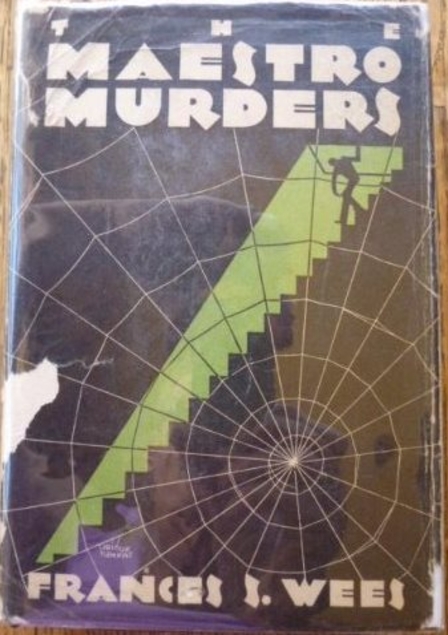
The Maestro Murders - The first novel of Canadian mystery writer, Frances Shelley Wees, is a thriller rather than a straight whodunit. Its plot concerns the machinations of a criminal mastermind nicknamed the Maestro who, after a series of daring jewel robberies committed in England some years back, seems to have transferred his activities to the US. The utter lack of success of the police in solving the thefts and identifying the Maestro causes District Attorney John Forrester to think the unthinkable: that either Police Commissioner Davies or Inspector Grey, both of whom were in England at the time of the Maestro's first appearance, are in with his gang---if indeed one of them is not actually the Maestro. Forrester contemplates bringing in his son, Michael, a lawyer, as an unofficial and independent investigator, but as it happens Michael manages to involve himself in the case without being asked when Theresa "Tuck" Torrie, a public stenographer with an office in the same building as himself, is burgled twice - once at work, once at home - and her papers completely ransacked, though nothing is taken. The key document turns out to be one Tuck is still carrying with her, whose author - oblivious to the implications - mentions seeing in an antique shop one of the items taken in a recent Maestro robbery. When the author is murdered, Michael realises that the shop must somehow be linked to the Maestro, and determines to begin his own investigation---one that will be conducted with the assistance of Miss Tuck Torrie, whether Michael likes it or not... Ultimately The Maestro Murders is both engaging and exasperating, with both its young investigators repeatedly putting themselves stupidly in danger---but with each of them contributing equally to the solving of the case, too, despite the ongoing attempts of Michael and his father to convince Tuck that unmasking the Maestro isn't "women's business", an assertion she treats with the contempt it deserves. With her criminal mastermind and his high-society gang, Wees seems to have been influenced by Edgar Wallace (just compare the plot of The Maestro Murders to that of The Fellowship Of The Frog!), but she lacks Wallace's masterful way with an improbable storyline. As well, the developing relationship between Michael and Tuck intrudes a bit too much on the main plot; while the reader will almost certainly be well ahead of the characters as far as the identity of the Maestro is concerned. However, despite its faults this remains an entertaining read.
Michael came around and stood beside her. "Tuck," he asked, "you did follow me tonight? Let's get this straight."
"Well, what if I did?"
He looked across at his father. "What can you do with a woman like that? he demanded. "Even when you tell them expressly to stay home and knit, they up and trail you."
"You might be a little grateful for her solicitude," his father suggested, "particularly as it nearly cost her her life."
Michael did not answer for a long minute; then he looked down at her searchingly. "I guess I'd better hear about it," he said, his flippancy gone.
98lyzard

Something Wrong At Chillery (US title: The Mystery At Chillery, reissue title: The Chillery Court Mystery) - "Something wrong", indeed: this 1931 mystery by R. Francis Foster is a contrived and frequently irritating work, with an intolerably stuffy central character, a heroine given to crying and fainting, and a plot that turns on a case of amnesia---and trust me, Foster is nowhere near a good enough writer to make that credible. Furthermore, this is one of those frustrating "mystery" books that serves up only one reasonable suspect, then wants you to be surprised when it turns out he dunnit. (I did come up with an alternative reading of the plot that made its "hero" the guilty party, but alas, this novel is nowhere near that imaginative.) The one bright spot of Something Wrong At Chillery is its amateur detective, the reporter, "Ravenhill of The Planet", a young man making quite a name for himself as a crime-writer. This is an unusual characterisation to find in an English novel of this time (far more so than in American novels), unusual too that the class-conscious central characters learn to like and trust Ravenhill, even though he's "just a reporter" (by which of course they mean, he's not a gentleman). Ravenhill teams up with Major Trevor Hawksbridge, who is staying with his former commanding officer, Colonel Merrow, at Chillery Court when a woman's body is found on a train. She is identified as Myrtle Ferribee, an acquaintance of Osyth Merrow, the Colonel's daughter---who Hawksbridge knows was surreptitiously out of the house on the night of the crime and, what's more, that someone else was following her... The first murder is quickly followed by a second, that of a local poacher; both were strangled in the Thuggee style notorious in India. The second death is followed by the disappearance of the Merrows' butler, who thus makes himself a suspect---until he, too, turns up dead. Woven around these crimes is a web of unravelling secrets involving Mrs Merrow's forgotten past and a blackmailer intent more upon tormenting his victims than taking their money---with a dismayed Hawksbridge realising that his first impression of "something wrong at Chillery" was a vast underestimation...
He looked towards the house, trying to make up his mind what he should do. He realised that he was in a difficult predicament, for he knew nothing and dared not presume. But the Colonel was his friend. That made a difference. And Osyth? Poor Osyth! She had looked like a terror-stricken child when her scream had awakened him. She needed help, and perhaps it was help that her father could not supply; or did he and his wife know all about it? There was that brief conversation that he had overheard last night. Mrs Merrow had obviously been urging her husband to confide in someone---probably himself.
There was something wrong at Chillery which the Colonel and his wife and Osyth all knew of; and that something was connected with the reported death in the night train. Convention be hanged! He musn't let ridiculous scruples and good form prevent him from lending a hand where it was needed...
99lyzard
...so no, the butler didn't do it. That he is the prime suspect for a good chunk of the story is amusing, but I doubt it was meant to be. This book, like its leading man, has no sense of humour...
100lyzard
Well! We haven't had any terrible covers for a while, but my recent reading has led where experience suggests they're unavoidable.
First up, Cotillion by Georgette Heyer; and while, this time around, this particular series refrains from the usual monochromic eyeball-bleeder, it's still...off.
Is it just me, or is this woman a bit, well, Picasso-esque? Or perhaps an early attempt at photoshopping?

Technically correct, but nevertheless awful (the devil is in the details, hence the upsizing; it's the fixed grins that kill me):

As for these three, I just want to slap them (and not just for their irrelevance to the novel they're fronting):

First up, Cotillion by Georgette Heyer; and while, this time around, this particular series refrains from the usual monochromic eyeball-bleeder, it's still...off.
Is it just me, or is this woman a bit, well, Picasso-esque? Or perhaps an early attempt at photoshopping?

Technically correct, but nevertheless awful (the devil is in the details, hence the upsizing; it's the fixed grins that kill me):

As for these three, I just want to slap them (and not just for their irrelevance to the novel they're fronting):

101lyzard
...meanwhile, Agatha Christie's 1934 standalone, Why Didn't They Ask Evans?, seems to have been bringing out the worst in cover artists for decades.
Ordinarily, as you know, I'd try to find the first edition; but not this time:

C'mon, people, you can surely do better than this!


(Why, yes, the story does open on a golf course; how did you guess? Though I don't know why you'd suggest that none of these artists read past the first three pages...)
Well, maybe they did better in America?
Or not.

As for these, well, they just gave up altogether, didn't they?
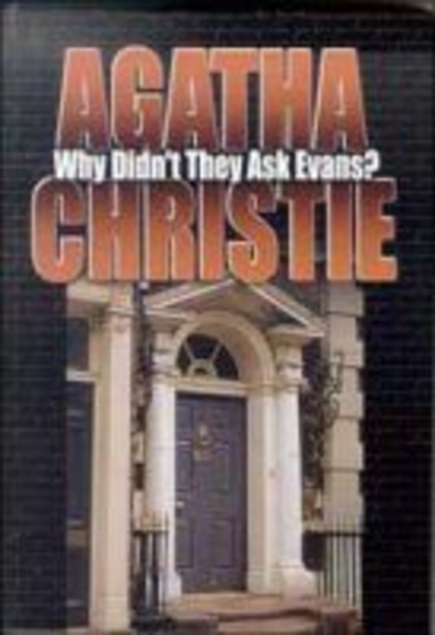
Ordinarily, as you know, I'd try to find the first edition; but not this time:

C'mon, people, you can surely do better than this!


(Why, yes, the story does open on a golf course; how did you guess? Though I don't know why you'd suggest that none of these artists read past the first three pages...)
Well, maybe they did better in America?
Or not.

As for these, well, they just gave up altogether, didn't they?
102lyzard

The Prison Wall - On the night of his twenty-first birthday, Beresford Vane's privileged world comes crashing down when his mother succumbs to heart disease. Knowing that she is dying, she reveals that the war hero whom Berry has always been taught to revere and emulate was not his father at all; that his father was actually Rupert Cheverell, who served fifteen years in prison for fraud and forgery, and was only recently released. At the last, his mother begs Berry to find his father and help him... Although his great-uncle, Admiral Vane-Trafford, furiously threatens to disinherit him if he seeks his father out, Berry is supported by his close friends, Joan and Sally Harbridge. He learns to his astonishment that Joan, having once encountered Cheverell, is still in occasional contact with him. She reveals that Cheverell is in Australia, and gives Berry the address of someone called Newman, who might know where his father is to be found. Almost overwhelmed by his circumstances, but determined to fulfil his mother's last wish, Berry sets out on his quest... This 1932 novel by Ethel M. Dell is, though melodramatic, consistently engaging and pleasingly unpredictable---and of course, the fact that, midway through, the narrative unexpectedly packs up and moves to Australia did it no harm in my eyes. Even the awful snobbery displayed by the central characters in the early chapters pays off, with Berry first having to come to grips with the knowledge of his true family background, then being forced to make a partner of sorts out of the disreputable and possibly untrustworthy Newman, before being defrauded by con-men who play to his class prejudices. There is an interesting air of detachment about this novel's Australian scenes, no overt suggestion that we are to offer blanket sympathy to Berry with respect to his reactions upon finding himself in a hostile, unforgiving land, where his Saville Row suit and public-school accent are a liability instead of an asset, and where - as he is finally forced to admit to himself - he would have been eaten alive if not for the wily Newman, who he starts out despising and distrusting, and ends up entirely dependent upon. I was overall sufficiently impressed by The Prison Wall to be disappointed in its ending, where Dell takes what I can only call a soft option; although that said, she did not take the softest option of all, making it clear that Rupert Cheverell was guilty of the crime of which he was convicted, and giving Berry no easy "out" in his struggle to rebuild his life.
Newman uttered an emphatic grunt of disapproval. "And a blasted mess you'll make of it," was his deliberate verdict. "Looks like being two dead Cheverells instead of one at your rate of going. And who's that going to help? Tell me that!"
"Heaven knows!" Beresford said. Tragic as the whole thing was, there yet was undeniably a redeeming element in the situation. Somehow this seedy individual appealed to him, and not only to his sense of humour. There was a certain veiled friendliness about him, to which, in that land of strangers, he could not help responding. There was something of comradeship, something of sympathy in their intercourse which could not be ignored. Whatever the loafer might be---and doubtless he was a rogue of some description---he possessed the rudimentary attraction of being at the least non-hostile in a country which so far had offered scant encouragement to a new-comer. Looking at him, Beresford realised that some sort of scheme was gradually hatching out somewhere behind that rugged and expressionless visage...
103tymfos
Greetings! I love your thread topper -- and the sloth @ >89 lyzard:. You've done some very interesting reading. I need to look more closely at some of those vintage mysteries -- I may add to my TBR list!
104rosalita
>100 lyzard: That last Cotillion cover is the one that's on my ebook. I love the typography on these e-editions but the photos seldom seem to bear much relevance to the stories, sadly.
105lyzard
>103 tymfos:
Hi, Terri - how lovely to have you drop in! My book bullets don't often hit, alas, so I would be thrilled if you joined me in a few old mysteries. :)
>104 rosalita:
Hi, Julia! Ah, it's the ebook cover, that wasn't apparent. "They're wearing the right sort of clothes, so that'll do"---grrr!!
Hi, Terri - how lovely to have you drop in! My book bullets don't often hit, alas, so I would be thrilled if you joined me in a few old mysteries. :)
>104 rosalita:
Hi, Julia! Ah, it's the ebook cover, that wasn't apparent. "They're wearing the right sort of clothes, so that'll do"---grrr!!
106lyzard

Missing From His Home - Though he was better known by his pseudonym, "Richard Keverne", Clifford Hosken did publish a few books under his own name. Why he used two identities is not immediately apparent from this 1932 work by Hosken, an effective and twisty thriller which has a very Keverne-like plot of ordinary people getting mixed up in serious crime. Stephen Penrose is startled when he hears a "missing from his home" radio broadcast about his cousin, Captain George Bayne. Though he hardly knows Bayne, Stephen feels that he must look into the situation, and discovers that this is not the first time that Bayne, who is still afflicted by war-trauma, has disappeared. Stephen is riled by the attitude of Humphrey Deacon, another cousin, with whom Bayne was living, and also Bayne's solicitor; Deacon implies that Stephen is only interested because he happens to be Bayne's heir. Rather than withdrawing and leaving it to the police, as Deacon suggests he should, Stephen makes a point of speaking to Pamela Warden, a young woman living in the same district who was the last to see Bayne before his disappearance. Far from allaying Stephen's fears, Pamela hints that Deacon knows more than he is telling, and may be involved in the disappearance. His curiosity thoroughly aroused, Stephen decides to instigate his own search for his cousin, and finds himself caught up the ramifications of an act of war-time treason and espionage, in danger of his life, and perilously uncertain of who he can trust...particularly when Pamela, who has encouraged Stephen's investigation and offered her assistance, is spotted in the company of a man who matches the description of the missing Captain Bayne...
Pamela spoke first. Her voice was steel-hard in its bitterness. "He followed me here---for some reason best known to himself," she said.
West forced a cold smile. "Ah! Mr Penrose, I see," he said in a level tone. "An unexpected meeting."
"Very," answered Stephen.
"Do you want to see me?" West asked with perfect courtesy.
"I didn't. I wanted to see Miss Warden. I had come here with a warning for her: but I think that will be unnecessary---now that I realise the role she has been playing..."
107lyzard
A certain amount of confusion surrounds Missing From His Home. In the first place, when Penguin reissued the book in 1939, they chose to publish it as by Richard Keverne, not Clifford Hosken. In the second place, the novel seems to have acquired the variant title of "Missing From Home"---and is listed as that in a number of sources. However, I have not been able to discover that it was ever published under that title. But what's really setting off my OCD alarms is that "Missing From Home" is what comes up here as the book's touchstone...even though no such book exists. Anyone have any idea how I might go about getting that fixed?---'cause it's driving me nuts...
108lyzard
When I reviewed Helen Simpson's Boomerang, I meant to mention this, but forgot---
There are two fascinating Trollope references in the novel. Returning to England upon the outbreak of WWI, Clothilde and her husband open up their country estate to servicemen on leave and/or in need of a place to recuperate. One of their visitors, Hugh Mitchell, an Australian medical officer, later has this to say:
"Barchester Towers. Know it? I used to think it was rubbish when I first read it in Australia. Since I've been to England I know it's all dead true: a storm in a Crown Derby tea-cup..."
Later, when Clothilde (through complicated circumstances) finds herself in a bunker on the front lines in France, she turns to Trollope as a defence against her immediate circumstances---as many English servicemen evidently did; there are countless stories of soldiers carrying Trollope's novels with them through both World Wars:
I lay on the bunk with The Last Chronicle Of Barset... In ten minutes I was in the thick of poor Mr Crawley's troubles, which seemed so much more real than those stiff figures I had seen, or that stain on the snow...
There are two fascinating Trollope references in the novel. Returning to England upon the outbreak of WWI, Clothilde and her husband open up their country estate to servicemen on leave and/or in need of a place to recuperate. One of their visitors, Hugh Mitchell, an Australian medical officer, later has this to say:
"Barchester Towers. Know it? I used to think it was rubbish when I first read it in Australia. Since I've been to England I know it's all dead true: a storm in a Crown Derby tea-cup..."
Later, when Clothilde (through complicated circumstances) finds herself in a bunker on the front lines in France, she turns to Trollope as a defence against her immediate circumstances---as many English servicemen evidently did; there are countless stories of soldiers carrying Trollope's novels with them through both World Wars:
I lay on the bunk with The Last Chronicle Of Barset... In ten minutes I was in the thick of poor Mr Crawley's troubles, which seemed so much more real than those stiff figures I had seen, or that stain on the snow...
109lyzard
Anyway!---this is about the point I was up to when I went off the grid for a bit. Since then have read:
- The Man With The Clubfoot by Valentine Williams, for TIOLI #2
- The Beauty Of The British Alps by Mary Leman Grimstone, for TIOLI #9
- To Have And To Hold by Mary Johnston, for TIOLI #4
- Cotillion by Georgette Heyer, for TIOLI #24
...and now reading Why Didn't They Ask Evans? by Agatha Christie.
- The Man With The Clubfoot by Valentine Williams, for TIOLI #2
- The Beauty Of The British Alps by Mary Leman Grimstone, for TIOLI #9
- To Have And To Hold by Mary Johnston, for TIOLI #4
- Cotillion by Georgette Heyer, for TIOLI #24
...and now reading Why Didn't They Ask Evans? by Agatha Christie.
110harrygbutler
109> I'll look forward to hearing your opinion of The Man with the Clubfoot. I just read it last month. Have you had any luck figuring out the series and its order after this one? I haven't really tried to sort it out yet, but I know that I need to do so if I am going to continue with Williams' books.
111lyzard
Hi, Harry - no, I do know that the Okewoods and Clubfoot each took on a life of their own after The Man With The Clubfoot but I haven't sat down to figure it all out yet. At the moment I'm rather bemused by the fact that there are more Clubfoot novels! Do you know, are they prequels, or were the rumours of his death exaggerated??
112harrygbutler
111> Hi, Liz, I was surprised by the (apparent) resolution, because I had already seen a couple other Clubfoot titles before I got around to reading the first. I assume they are not prequels, because the title of one is The Return of Clubfoot.
113lyzard
Likewise! I'm guessing that he faked his own death in order to pursue his vengeance against the Okewoods. :)
I think that The Secret Hand is the second of the Okewood books and that The Return Of Clubfoot is the second of the Clubfoot books.There's a four-year gap between them, 1918 and 1922, which suggests it didn't immediately occur to Williams to resurrect Dr Grundt.
I think that The Secret Hand is the second of the Okewood books and that The Return Of Clubfoot is the second of the Clubfoot books.
114souloftherose
>100 lyzard: Wow, those first two covers are awful. I have the third cover but reversed for some reason.
>101 lyzard: And those aren't much better....
>101 lyzard: And those aren't much better....
115lyzard
Hi, Heather! Yes, I saw the images both ways but that reproduction seemed the clearest image and therefore the most annoying. :)
Pretty uninspiring bunch, aren't they??
Pretty uninspiring bunch, aren't they??
116ronincats
When Sourcebooks was coming out with new editions of the Heyers during the prior decade, I bought a number of them, including Cotillion as my original copy (your first above) was becoming slightly worn, perhaps because this is my favorite Heyer of all. Unfortunately, they moved from trade paper size to mass market size in the middle...
Anyway, this is my cover.
Anyway, this is my cover.
117lyzard
Hi, Roni! Well, that one's not too bad, though a bit generic.
Yes, Cotillion is one of my favourites, too. :)
Yes, Cotillion is one of my favourites, too. :)
118lyzard
I have (finally) finished a blog post on The History Of Lady Barton, by Elizabeth Griffith, a sentimental epistolary novel from 1771, full of unhappy people at romantic cross-purposes.
The post is here.
The post is here.
119lyzard
Finished Why Didn't They ask Evans? for TIOLI #19.
Now reading The Fatal 5 Minutes by R. A. J. Walling.
Now reading The Fatal 5 Minutes by R. A. J. Walling.
120lyzard

The Man With The Clubfoot - In 1916, while employed as a war correspondent, Valentine Williams had a hair's-breadth escape from death when a shell exploded nearby. While recovering, he took the advice once given to him by John Buchan and tried writing a thriller, finally drawing upon his own recurrent nightmare of being pursued by German agents. The resulting novel - his "shell-shocker", as Williams called it with grim humour - was enormously successful, but not quite in the way its author hoped or expected: this is an early example of a novel's villain (and I mean villain, not "anti-hero" or "gentleman-crook" or something similar) becoming its breakout character. Williams' intended heroes were the Okewood brothers, Desmond and Francis, soldier and secret service agent, who did go on to appear in a handful of other novels (and were well-known enough for Agatha Christie to spoof them in Partners In Crime). However, it was the brothers' antagonist, Dr Adolph Grundt, aka "Clubfoot", who fascinated and horrified Williams' readership in equal measure, and who would reappear in a series that stretched right into WWII. Dr Grundt, head of what we might call the secret secret service in Germany, is a compendium of every one of the era's stereotypes about "the Hun"; Williams' description of his villain goes out of its way to emphasise his bestial nature:
He was a vast man, not so much by reason of his height, which was below the medium, but his bulk, which was enormous. The span of his shoulders was immense, and, though a heavy paunch and a white flabbiness of face spoke of a gross, sedentary life, he was obviously a man of quite unusual strength. His arms particularly were out of all proportion to his stature, being so long that his hands hung down on either side of him when he stood erect, like the paws of some giant ape. Altogether, there was something decidedly simian about his appearance his squat nose with hairy, open nostrils, and the general hirsuteness of the man, his bushy eyebrows, the tufts of black hair on his cheekbones and on the backs of his big, spade like hands. And there was that in his eyes, dark and courageous beneath the shaggy brows, that hinted at accesses of ape-like fury, uncontrollable and ferocious...
Nevertheless, Grundt remains a compelling presence; we certainly never doubt the extent of the danger that he represents. The Man With The Clubfoot is totally absurd by any objective standard, but the novel is one of those breathless thrillers that rarely give the reader time to think about such details. On the other hand, the jingoistic tone and its accompanying slurs require a bit of swallowing, although it's nothing unusual for a work of this type and time. The plot of The Man With The Clubfoot involves the battle between English and German spies for possession of a compromising letter written by the Kaiser just prior to the outbreak of war---though at first Desmond Okewood's only motivation for venturing into war-time Germany is to search for his brother, Francis, who has vanished while on a dangerous mission but managed to send out an ambiguous message that Desmond hopes is a clue to his hiding place. Though inexperienced at espionage, Desmond is courageous, determined and capable of thinking on his feet. However, his impulsive decision to impersonate an American German sympathiser finds him carried deep into the heart not just of Germany, but the German government: into the presence of the Kaiser himself, and that of the ruthless and sinister Clubfoot... Escaping by the skin of his teeth, Desmond succeeds in locating Francis, and the two manage to secure the vital letter; but now they must find a way back to England while being hunted by the most dangerous man in Germany...
Clubfoot lighted a cigar. He smoked in silence for a few minutes. I said nothing, for really there was nothing for me to say. They hadn't got their precious document, and it was not likely they would ever recover it now. I feared greatly that Francis in his loyalty might make an attempt to rescue me, but I hoped, whatever he did, he would think first of putting the document in a place of safety. I was more or less resigned to my fate. I was in their hands properly now, and whether they got the document or not, my doom was sealed.
"I will pay you the compliment of saying, my dear Captain Okewood," Clubfoot remarked in that urbane voice of his which always made my blood run cold, "that never before in my career have I devoted so much thought to any single individual, in the different cases I have handled, as I have to you. As an individual, you are a paltry thing: it is rather your remarkable good fortune that interests me as a philosopher of sorts... I assure you it will cause me serious concern to be the instrument of severing your really extraordinary strain of good luck."
121lyzard
Best-selling books in the United States for 1900:
1. To Have and to Hold by Mary Johnston
2. Red Pottage by Mary Cholmondeley
3. Unleavened Bread by Robert Grant
4. The Reign of Law by James Lane Allen
5. Eben Holden by Irving Bacheller
6. Janice Meredith by Paul Leicester Ford
7. The Redemption of David Corson by Charles Frederic Goss
8. Richard Carvel by Winston Churchill
9. When Knighthood Was in Flower by Charles Major
10. Alice of Old Vincennes by Maurice Thompson
We have seen the historical novel become increasingly important on the American best-seller lists over the preceding few years, and by the turn of the century the genre is dominant, with five out of ten top-selling books of 1900 falling into this category.
1900 is notable for having our first female chart-topper: Mary Johnston's To Have and to Hold is an historical romance set in the early days of the Virginia colony; it was a runaway best-seller and was filmed twice in the days of silent movies. (A third production is in the works now, though evidently with some significant changes.) We also find a woman in the #2 position: Mary Cholmondeley's Red Pottage was a bit of a succès de scandale, which may have helped to push it up the charts; it is now a Virago Modern Classic.
Janice Meredith, Richard Carvel and When Knighthood Was in Flower, all historical novels, are also all holdovers from the 1899 best-seller list; while the newcomer Alice of Old Vincennes is set against the Revolutionary War.
The Reign of Law and Eben Holden appear to be regional novels (upstate New York and Kentucky, respectively); Unleavened Bread is about new money and social-climbing; while The Redemption of David Corson is a religiously-themed drama (another popular genre at the time).
1. To Have and to Hold by Mary Johnston
2. Red Pottage by Mary Cholmondeley
3. Unleavened Bread by Robert Grant
4. The Reign of Law by James Lane Allen
5. Eben Holden by Irving Bacheller
6. Janice Meredith by Paul Leicester Ford
7. The Redemption of David Corson by Charles Frederic Goss
8. Richard Carvel by Winston Churchill
9. When Knighthood Was in Flower by Charles Major
10. Alice of Old Vincennes by Maurice Thompson
We have seen the historical novel become increasingly important on the American best-seller lists over the preceding few years, and by the turn of the century the genre is dominant, with five out of ten top-selling books of 1900 falling into this category.
1900 is notable for having our first female chart-topper: Mary Johnston's To Have and to Hold is an historical romance set in the early days of the Virginia colony; it was a runaway best-seller and was filmed twice in the days of silent movies. (A third production is in the works now, though evidently with some significant changes.) We also find a woman in the #2 position: Mary Cholmondeley's Red Pottage was a bit of a succès de scandale, which may have helped to push it up the charts; it is now a Virago Modern Classic.
Janice Meredith, Richard Carvel and When Knighthood Was in Flower, all historical novels, are also all holdovers from the 1899 best-seller list; while the newcomer Alice of Old Vincennes is set against the Revolutionary War.
The Reign of Law and Eben Holden appear to be regional novels (upstate New York and Kentucky, respectively); Unleavened Bread is about new money and social-climbing; while The Redemption of David Corson is a religiously-themed drama (another popular genre at the time).
122lyzard

Mary Johnston was born in Virginia in 1870, growing up in the post-Civil War South. As a girl she was both intensely shy and frequently ill, and spent much time alone reading. However, following the death of her mother when Mary was nineteen, she took over the running of her father's household and the care of her younger siblings---and eventually became a significant financial support as well, through her writing. She began with short stories, and published her first novel, Prisoners Of Hope, in 1898. The following year she published a second novel, To Have And To Hold, which became America's best-selling novel of 1900, and eventually one of the best-selling novels of its era.
All of Johnston's early novels are historical romances, dealing most frequently with the history of Virginia and the Civil War. Her later works, however, reflect her growing interest in politics and, in time, in civil rights. She became an active figure in the women's movement, while her works began to reflect a growing concern with the position of non-white Americans. While Johnston's earlier works generally treat non-whites as "the other" (an attitude accurate to their settings, of course), her later novels take a much broader and more sympathetic view; her 1923 short story, Nemesis, a lynching drama, is considered a keystone work in the civil rights movement.
The mixture of politics and mysticism in Johnston's later novels saw her popularity and critical success decline, and towards the end of her career she returned to the historical fiction on which she initially built her reputation.
123lyzard

To Have And To Hold - Captain Ralph Percy, a former soldier and now tobacco planter, secures a wife from amongst the shipload of women sent out to the new Virginia colony from England, and soon realises that she is not what she pretends to be. Back at Weyanoke, his planation, Percy's bride confesses that she has been driven from England and taken refuge in marriage, and throws herself upon his generosity. The appeal to Percy's chivalry is not in vain: he quietly accepts a marriage in name only... Percy learns his wife's secret when a ship arrives from England bearing Lord Carnal, the latest "favourite" of King James I. The nobleman has come in search of the Lady Jocelyn Leigh, the king's ward, who vanished after being commanded to marry Lord Carnal; he carries royal orders that Lady Jocelyn is to be brought back to England, as is her husband - in chains - so that their marriage can be formally dissolved. The Governor of Virginia, sympathetic to Percy but wary of angering the king, does what he can to delay proceedings. It is only buying time, however; time during which a deadly enmity grows between Percy and the arrogant and dangerous Carnal. When the original orders are upheld, Percy offers Jocelyn the choice to go or stay; to return to England and be married to Carnal in all honour, or to flee with him and become an outcast and a fugitive. She chooses the latter... Mary Johnston's 1899 novel is a gripping mixture of history and adventure, with the emphasis upon the latter; and while To Have And To Hold must inevitably be described as "an historical romance", the romantic subplot, though it acts as the catalyst for everything that happens, rarely intrudes upon the action, which is almost non-stop. It is pleasingly obvious that Johnston had a detailed knowledge of the period she was describing; and although the historical detail is accurate (up to and including an appearance by John Rolfe, the real husband of Pocahontas, despite what Hollywood tries to tell us), it is used only as a framework for the main plot. At the same time, Johnston's accuracy includes the attitudes displayed by the colonists, not least Ralph Percy himself, towards the colony's slaves and the local native tribes which are distasteful by today's standards, particularly the insistence upon the innate "treachery" of the latter. However, this is only one aspect of what is otherwise a full-blooded adventure story, with a narrative that moves at breakneck speed and encompasses duelling, attempted murder, shipwreck, piracy, capture and imprisonment, the threat of torture and execution, and a desperate race against time to prevent a massacre...
As I spoke the minister sprang upon the helmsman, and, striking him to the deck with one blow of his huge fist, himself seized the wheel. Before the pirates could draw breath he had jammed the helm to starboard, and the reef lay right across our bows.
A dreadful cry went up from that black ship to a deaf Heaven---a cry that was echoed by a wild shout of triumph from the merchantman. The mass fronting us broke in terror and rage and confusion. Some ran frantically up and down with shrieks and curses; others sprang overboard. A few made a dash for the poop and for us who stood to meet them. They were led by the Spaniard and the gravedigger. The former I met and sent tumbling back into the waist; the latter whirled past me, and rushing upon Paradise thrust him through with a pike, then dashed on to the wheel, to be met and hewn down by Diccon.
The ship struck. I put my arm around my wife, and my hand before her eyes; and while I looked only at her, in that storm of terrible cries, of flapping canvas, rushing water, and crashing timbers, the Spaniard clambered like a catamount upon the poop, that was now high above the broken forepart of the ship, and fired his pistol at me point-blank...
124lyzard
Finished The Fatal 5 Minutes for TIOLI #5, and that is me done for June.
Now reading Evelina by Fanny Burney, in preparation for next month's group read.
Now reading Evelina by Fanny Burney, in preparation for next month's group read.
125swynn
>122 lyzard: Thanks for the extra background on Mary Johnston; her entire career looks interesting, and I may have to check out some of her other work.
126lyzard
I didn't know most of that until I really went looking - most accounts of her career only address the historical novels, and I found the later direction taken by her life and work very interesting - I suspect I may enjoy some of her "failed" novels.
127lyzard

Cotillion - The eccentric and irascible Matthew Penicuik announces his intention of bequeathing his fortune to his young ward, Kitty Charing, on condition that she marry one of his great-nephews. Although Mr Penicuik insists publicly that each of the potential suitors is equally welcome, privately he is furious that his favourite, Jack Westruther, has ignored his summons. And Mr Penicuik is not the only one: after receiving the proposals of the rather "simple" Lord Dolphinton, goaded on by his domineering mother, and of the Reverend Hugh Rattray, who sees the girl as a charity case - so he says - Kitty's humiliation is complete. On impulse she runs away but gets no further than the local inn, where she encounters another great-nephew, the Honourable Frederick Standen. Realising that Freddy has no idea why he was summoned, Kitty pours out her troubles to him---and then conceives a plan... Although more remarkable for the excellence of his tailoring than for his mental abilities, Freddy is a young man of almost boundless good-nature; and at length he allows himself to be half-cajoled, half-bullied, into a fake engagement and into taking Kitty to London for a month, ostensibly to be presented to his parents. Having been kept in country isolation and in straitened circumstances all of her short life, the prospect of a month in London seems to Kitty like a dream come true; and besides, she argues to herself, in that time anything might happen. For example---Jack Westruther might realise what he has lost... This 1953 work is one of Georgette Heyer's most cleverly plotted and subtly funny novels, though it is also one that perhaps requires re-reading to be thoroughly appreciated. This is particularly true with respect to the progressive shift of Cotillion's narrative focus from Kitty Charing and her Cinderella plot to what we might call the awakening of Freddy Standen as, to his infinite dismay, he finds himself responsible for a girl as naïve as she is generous and impulsive. However unknowingly, Kitty has chosen for herself the best possible guide as she ventures into the pits and shoals of London society: whatever his intellectual shortcomings, no-one knows this world and how to navigate it better than Freddy Standen. Forced to exert himself for the first time in his privileged and undemanding existence, Freddy begins to display some unexpected depths---much to the astonishment of his family and friends. As for Kitty, as she pursues her own secret agenda, and embroils herself in the romantic misadventures of her relatives, she finds her feelings of affectionate contempt towards Freddy turning into genuine appreciation... No less than four subplots resolve themselves in marriage over the last few chapters of Cotillion, as the narrative builds to one of the most satisfying of all Heyer's climactic resolutions; satisfying in more ways than one. (I'm not usually a proponent of violence; but---) My only regret is that the reader is not privileged to witness the looming encounter between Hannah Plymstock and the Countess of Dolphinton.
"Was he very much vexed?" asked Meg. "He has such stuffy notions!"
"No, no, he was so kind that I almost burst into tears! And he might have reproached me! I do think," said Kitty fervently, "that Freddy is the most truly chivalrous person imaginable!"
Freddy's sister, regarding her with awe, opened her mouth, shut it again, swallowed, and managed to say, though in a faint voice: "Do you, indeed?"
"Yes, and a great deal more to the purpose than all the people one was taught to revere, like Sir Lancelot, and Sir Galahad, and Young Lochinvar, and - and that kind of man! I daresay Freddy might not be a great hand at slaying dragons, but you may depend upon it that none of those knight-errants would be able to rescue one from a social fix."
128lyzard
I have picked up a couple of library discard freebies recently: The Stars Look Down by A. J. Cronin, which was on The Wishlist, and The Only Victor by Alexander Kent aka Douglas Reeman, just because it looked interesting.
Although...walking back from the library and glancing at the blurb for The Only Victor, it struck me that this historical novel looked like it might be part of a series, which I now know is the case---a 30-book series, of which The Only Victor is #17.
WHAT HAVE I DONE!!!???
Although...walking back from the library and glancing at the blurb for The Only Victor, it struck me that this historical novel looked like it might be part of a series, which I now know is the case---a 30-book series, of which The Only Victor is #17.
WHAT HAVE I DONE!!!???
129Helenliz
>128 lyzard: put it down and walk away now...
I hate the sense of obligation that a long series of books causes me to feel. Yes, I liked that one, but why do I feel obliged to read the rest?
I hate the sense of obligation that a long series of books causes me to feel. Yes, I liked that one, but why do I feel obliged to read the rest?
130lyzard
:D
I think you're right, Helen! It actually looks like the kind of thing I'd be interested in, but the thought of yet another commitment of that magnitude is making me quake and quiver!
I think you're right, Helen! It actually looks like the kind of thing I'd be interested in, but the thought of yet another commitment of that magnitude is making me quake and quiver!
133cbl_tn
>127 lyzard: Cotillion was my first Heyer romance so it will always have a special place in my estimation!
134rosalita
I absolutely loved Cotillion. I found Freddy's character development to be delightful, and Kitty among the more appealing of Heyer's young ingénue heroines.
135lyzard
Hi, Carrie! Hi, Julia! I'm always amazed on re-reading how far Heyer went in playing with the conventions in this one.
A detail I love about Cotillion which I didn't specifically mention is the reaction of Lord Legerwood (one of my favourites among Heyer's minor characters) to the situation---I nearly quoted his kerbside conversation with Kitty, which always cracks me up ("Don't run away, will you?").
A detail I love about Cotillion which I didn't specifically mention is the reaction of Lord Legerwood (one of my favourites among Heyer's minor characters) to the situation---I nearly quoted his kerbside conversation with Kitty, which always cracks me up ("Don't run away, will you?").
136lyzard
I've been thinking about my reading patterns lately---not what I read, but when I read, and how much. I tend to get much more reading done on weekdays than on weekends, not least because I catch public transport: generally I read ~30min on the train in the morning, ~30 min at lunchtime, ~ 30 min on the train going home, and ~30 at bedtime---so around two hours a days. This drops off quite sharply on weekends due to Other Stuff Intruding - some weekends I get no reading done, quelle horreur! - though sometimes I have a lazy time on the bed or the couch with cat and book, and sometimes I have a long hot reading bubble bath.
I don't like to give star ratings for books because of the difficulty of comparing apples with oranges (and a suspicion I would waste way too much time fretting over it), but I tend to assign a baseline mental rating of 3½ at starting to anything I read: if a book keeps me engaged and basically does what it seems to promise, it's a 3½-star read. I would stick to my ~2 hours a day schedule for such a book, but probably not push to finish it over a weekend.
Meanwhile, a book that might be put aside at lunchtime for something else (like getting a review written!), or which didn't compel me to read a bedtime would be a 3-star read or even less; while conversely, a book for which I find myself sneaking extra reading periods on a weekday, or scheduling lots of cat time (or bath time) on weekends is 4 stars and up.
What do others tend to do?---stick to a schedule, read whenever possible, or have habits dictated by the quality of the book?
I don't like to give star ratings for books because of the difficulty of comparing apples with oranges (and a suspicion I would waste way too much time fretting over it), but I tend to assign a baseline mental rating of 3½ at starting to anything I read: if a book keeps me engaged and basically does what it seems to promise, it's a 3½-star read. I would stick to my ~2 hours a day schedule for such a book, but probably not push to finish it over a weekend.
Meanwhile, a book that might be put aside at lunchtime for something else (like getting a review written!), or which didn't compel me to read a bedtime would be a 3-star read or even less; while conversely, a book for which I find myself sneaking extra reading periods on a weekday, or scheduling lots of cat time (or bath time) on weekends is 4 stars and up.
What do others tend to do?---stick to a schedule, read whenever possible, or have habits dictated by the quality of the book?
137lkernagh
Interesting question. I don't follow a reading schedule, I more or less read when I have the time. Audio books are my salvation as, like you, I have a 30 minute commute to and from work (which is a walking commute for me) and I enjoy using that time to 'read'. I also like to get out during my lunch break for a walk if the weather is nice, so more audio reading time. I also read while in bed. If the book is one that has caught my attention, I tend to set aside my evening for reading. I never stay up all night reading, no matter how good a book is.... I need my sleep! When I am at home I read physical books - saving my audio reads for when I am 'out and about' - so I always have two or more books on the go at any given time. Weekends tend to be busy times but I usually manage to grab a good chunk of reading time on one of those days.
138harrygbutler
>136 lyzard: I'm very haphazard in terms of scheduling reading, but I do devote time to it pretty much every evening, and at whatever other odd times present themselves -- over breakfast or lunch, while waiting for an appointment, etc. I usually have several books going at once, because some are too large to really be portable (e.g., Lancelot-Grail: The Old French Arthurian Vulgate and Post-Vulgate in Translation, which I'm making my way through now) or not congenial to dipping in with limited time. If it's a thriller, mystery, or adventure I generally aim for a few dedicated chunks of time, but if there are others competing, or the book isn't particularly gripping, I may draw out the reading of, say, the first couple hundred pages, but then I generally move pretty rapidly through the last third of the book. Rarely do I set one aside unfinished, but it does happen. And there are authors, such as Edgar Wallace or Phoebe Atwood Taylor or the Littles, whose books may indeed tempt me to late-night, or even all-night, reading.
139lyzard
>137 lkernagh:
Hi, Lori! That's interesting, it sounds like you and I react in similar ways to certain books - you have a greater flexibility with your adoption of audiobooks, though, which I struggle with.
BTW, while I remember to say this, thank you for the veg recipes on your thread---I have fruit allergies, and am always looking for ways to increase my vegetable intake as compensation; your thread has been very helpful.
>138 harrygbutler:
A bit more opportunistic, then? I also find non-fiction harder to absorb without time to really focus; even so, I rarely have more than one book going - my brain just doesn't work that way. (An exception being when I'm forced to read something online, and have a hard-copy back-up book for travelling times.)
You make a good point about what authors might draw us into lengthened or even all-night sessions!---not always the ones you might suspect... :)
Hi, Lori! That's interesting, it sounds like you and I react in similar ways to certain books - you have a greater flexibility with your adoption of audiobooks, though, which I struggle with.
BTW, while I remember to say this, thank you for the veg recipes on your thread---I have fruit allergies, and am always looking for ways to increase my vegetable intake as compensation; your thread has been very helpful.
>138 harrygbutler:
A bit more opportunistic, then? I also find non-fiction harder to absorb without time to really focus; even so, I rarely have more than one book going - my brain just doesn't work that way. (An exception being when I'm forced to read something online, and have a hard-copy back-up book for travelling times.)
You make a good point about what authors might draw us into lengthened or even all-night sessions!---not always the ones you might suspect... :)
140lyzard
Finished Evelina; or, The History Of A Young Lady's Entrance Into The World for TIOLI #3.
Which brings me to #75 for the year---a landmark for which, as some of you would know, I always like to tackle a blog-read. I am therefore jumping about 100 years forward in the literary timeline for a random selection from The Wishlist:
Grasp Your Nettle by Eliza Lynn Linton, from 1865; Linton is an important Victorian novelist, but one I haven't previously managed to get to, so I'm pleased to have this opportunity.
Which brings me to #75 for the year---a landmark for which, as some of you would know, I always like to tackle a blog-read. I am therefore jumping about 100 years forward in the literary timeline for a random selection from The Wishlist:
Grasp Your Nettle by Eliza Lynn Linton, from 1865; Linton is an important Victorian novelist, but one I haven't previously managed to get to, so I'm pleased to have this opportunity.
141lkernagh
Awe, shucks! Glad to learn my adventures in vegetarian cooking have been helpful. I have been rather lax of late with posting veg recipes on my thread. I will try to post more as my 'experimentation' continues. Tonight's 'experiment' proved post-worthy and may interest you if you like the idea of cooked zucchini mushroom tomato and kale served over a bed of cooked farro. ;-)
142lyzard
That sounds like exactly the kind of thing I'm looking for, thanks! I have not tried farro yet, though I have done some trials with other grains, but this seems like a good place to start.
143ronincats
Have you set up a thread for Evelina yet? I've downloaded the free Kindle edition and plan to join in the read.
144lyzard
Whoo! Thrilled to have you along, Roni! :)
No, not yet - I will be setting it up shortly (as in either this afternoon or tonight), and will post some heads-ups around when it's done.
No, not yet - I will be setting it up shortly (as in either this afternoon or tonight), and will post some heads-ups around when it's done.
146lyzard
Fricking-fracking GoogleBooks!!
I really have to wonder why they bother, since each of their books available for download seems worse than the last...whether it's smeared pages or chunks of a page missing or, in the case of Grasp Your Nettle, about every 7th page completely blank. Not to mention that this is a three-volume novel and they've only scanned the first two volumes.
Why do they do it? Why waste their time and ours?
I can at least read Grasp Your Nettle online, either through the Internet Archive or the HaithiTrust, so I've been lucky this time. Nothing makes my heart sink like discovering GoogleBooks as a novel's only online source...
I really have to wonder why they bother, since each of their books available for download seems worse than the last...whether it's smeared pages or chunks of a page missing or, in the case of Grasp Your Nettle, about every 7th page completely blank. Not to mention that this is a three-volume novel and they've only scanned the first two volumes.
Why do they do it? Why waste their time and ours?
I can at least read Grasp Your Nettle online, either through the Internet Archive or the HaithiTrust, so I've been lucky this time. Nothing makes my heart sink like discovering GoogleBooks as a novel's only online source...
147countrylife
lyzard - I'm enjoying your Heyer book cover discussions and your olden-book readings!
149rosalita
>136 lyzard: After finishing this post, I realized I had written a ridiculously long answer to your question, so please don't feel you have to read the whole thing. But just in case you're a glutton for punishment, here goes:
My reading habits are in a state of flux at the moment. I used to read during my morning and evening commute (~20 minutes each way; I ride in a carpool) and also during my 1-hour lunch break. Then I would also read during the evening, as I don't have a television and generally chose reading over watching movie or whatever. I also usually get several hours of reading in on the weekends (thanks, nonexistent social life!).
Lately, I have been reading at breakfast and at dinner, and some days that's about it. I no longer read on my commute because I am trying to catch up on the many podcasts I subscribe to but never listen to, and lunchtime is now my knitting time (and since I started doing that I have finished a pair of fingerless mitts and a hat, so it is helping me be more productive). My evenings have been divided between letter writing (I'm trying to do a better job of keeping in touch with friends who live far away) and wasting time in the black hole that is YouTube, usually while listening to a baseball game on the radio.
I know I will end up reading fewer books this year than I have in recent years, and I'm OK with that. At the risk of being excommunicated from the 75er Challenge (oh, wait! I don't have a thread anymore so I'm already excommunicated) I was starting to feel that while I was reading a lot I wasn't necessarily getting maximum enjoyment from my reading. So this year I have strictly limited my re-reads and made an effort to read more nonfiction and fewer "easy" books. My success has been mixed, but I persevere anyway.
There have certainly been books I have read this year that I did not want to put down and ended up reading beyond my normal "set aside" times. I like your notion of starting every book with a baseline of 3½ stars, and reading outside my normal times is a definite sign that the rating should be bumped up.
My reading habits are in a state of flux at the moment. I used to read during my morning and evening commute (~20 minutes each way; I ride in a carpool) and also during my 1-hour lunch break. Then I would also read during the evening, as I don't have a television and generally chose reading over watching movie or whatever. I also usually get several hours of reading in on the weekends (thanks, nonexistent social life!).
Lately, I have been reading at breakfast and at dinner, and some days that's about it. I no longer read on my commute because I am trying to catch up on the many podcasts I subscribe to but never listen to, and lunchtime is now my knitting time (and since I started doing that I have finished a pair of fingerless mitts and a hat, so it is helping me be more productive). My evenings have been divided between letter writing (I'm trying to do a better job of keeping in touch with friends who live far away) and wasting time in the black hole that is YouTube, usually while listening to a baseball game on the radio.
I know I will end up reading fewer books this year than I have in recent years, and I'm OK with that. At the risk of being excommunicated from the 75er Challenge (oh, wait! I don't have a thread anymore so I'm already excommunicated) I was starting to feel that while I was reading a lot I wasn't necessarily getting maximum enjoyment from my reading. So this year I have strictly limited my re-reads and made an effort to read more nonfiction and fewer "easy" books. My success has been mixed, but I persevere anyway.
There have certainly been books I have read this year that I did not want to put down and ended up reading beyond my normal "set aside" times. I like your notion of starting every book with a baseline of 3½ stars, and reading outside my normal times is a definite sign that the rating should be bumped up.
150lyzard
Hey, there's no such thing as "too much information" when it comes to a topic like reading habits!
How people react to their changing circumstances is always interesting, too - whether you read more or less in stressful times, for instance, and what you read. (For instance, you note that you're doing less "easy" reads in pursuit of greater enjoyment; my difficult times have led my non-fiction reading to drop right off, while I retreat into even more obscure 30s mysteries.)
And please, my dear, you excommunicated yourself! - we would dream of doing such a thing! I'm glad that you're still popping in out of exile every now and then. :)
How people react to their changing circumstances is always interesting, too - whether you read more or less in stressful times, for instance, and what you read. (For instance, you note that you're doing less "easy" reads in pursuit of greater enjoyment; my difficult times have led my non-fiction reading to drop right off, while I retreat into even more obscure 30s mysteries.)
And please, my dear, you excommunicated yourself! - we would dream of doing such a thing! I'm glad that you're still popping in out of exile every now and then. :)
151lyzard

Why Didn't They Ask Evans? (US title: The Boomerang Clue) - When a man falls to his death from a cliff edge by the local golf course, Bobby Jones is a reluctant witness to his last moments, and the recipient of his last words: "Why didn't they ask Evans?" Reporting this to the sister and brother-in-law called in to identify the dead man, Bobby thinks no more of it; but the incident is followed first by a job offer which requires him to leave the country immediately, and then by an attempt upon his life... The latter brings back into Bobby's life the Lady Frances Derwent: friends and neighbours as children, the two have since drifted apart due to their disparate social standing. Thrilled to be mixed up in murder, the impulsive Frankie drags the more cautious Bobby into a private investigation. Their suspicions alight upon Roger Bassington-ffrench, who relieved Bobby from watching over the dead man and who, it appears, tampered with the contents of his pockets. Staging an accident, Frankie infiltrates the country house occupied by Bassington-ffrench, his brother and his sister-in-law. Though convinced that she is on the right track, her suspicions divide between the household itself, where something is obviously wrong, and the private sanatorium for drug addicts and the mentally ill nearby---where Bobby encounters the woman whose photograph he glimpsed in the dead man's pocket. Meanwhile, sure that it will somehow provide them with the key to the mystery, he and Frankie maintain their search for Evans... This 1934 standalone mystery by Agatha Christie is something of a throwback to her earlier, more light-hearted works - albeit one with fairly grim underpinnings - with an unlikely pair of amateur detectives looking into the circumstances of a suspicious death and finding themselves getting ever deeper into a criminal quagmire involving drug abuse, fraud, forgery and murder. This "split-vision" approach works well on the whole, with the lighter tone of the narrative helping to carry the reader over the more improbable plot moments. And while most of the banter between Frankie and Bobby is actually funny, with respect to the true identity of the mysterious Evans, the joke is very definitely on them...
Bobby continued to talk. Any signs of the inferiority complex that he had displayed at his last meeting with Frankie had now quite disappeared. He took a firm and egotistical pleasure in recounting every detail of his case.
"That's enough," said Frankie, quelling him. "I don't really care terribly for stomach pumps. To listen to you one would think no-one had ever been poisoned before."
"Jolly few have been poisoned with eight grains of morphia and got over it," Bobby pointed out. "Dash it all, you're not sufficiently impressed."
"Pretty sickening for the people who poisoned you," said Frankie.
"I know. Waste of perfectly good morphia..."
152lyzard
This bit in Why Didn't They Ask Evans? always makes me giggle: despite my love for the classics and my respect for Dinah Mulock Craik, my sympathies are with Bobby:
He cast his eyes over the table beside him. There was a novel of Ouida's and a copy of John Halifax, Gentleman and last week's Marchbolt Weekly Times. He picked up John Halifax, Gentleman.
After five minutes he put it down. To a mind nourished on The Third Bloodstain, The Case Of The Murdered Archduke and The Strange Adventure Of The Florentine Dagger, John Halifax, Gentleman lacked pep.
(Though I probably would have gone with Ouida.)
The other thing that always catches my eye in this novel is a throwaway remark when Bobby is trying to work out why anyone would want to kill him, which suggests that as early as 1934, Dame Agatha was figuring out plot details for a mystery not published until 1940...or did she accidentally give herself an idea?
He cast his eyes over the table beside him. There was a novel of Ouida's and a copy of John Halifax, Gentleman and last week's Marchbolt Weekly Times. He picked up John Halifax, Gentleman.
After five minutes he put it down. To a mind nourished on The Third Bloodstain, The Case Of The Murdered Archduke and The Strange Adventure Of The Florentine Dagger, John Halifax, Gentleman lacked pep.
(Though I probably would have gone with Ouida.)
The other thing that always catches my eye in this novel is a throwaway remark when Bobby is trying to work out why anyone would want to kill him, which suggests that as early as 1934, Dame Agatha was figuring out plot details for a mystery not published until 1940...or did she accidentally give herself an idea?
153rosalita
>150 lyzard: my difficult times have led my non-fiction reading to drop right off
Well, I DID say I was having mixed success. :-) But yes, whenever my real-life stress hits peak levels I cozy up with Nero Wolfe and Dick Francis mysteries, all of which I've read roughly a bajillion times each. And lately, thanks to you, re-reading my favorite Heyers has much the same effect.
Well, I DID say I was having mixed success. :-) But yes, whenever my real-life stress hits peak levels I cozy up with Nero Wolfe and Dick Francis mysteries, all of which I've read roughly a bajillion times each. And lately, thanks to you, re-reading my favorite Heyers has much the same effect.
154swynn
"Bobby Jones" is an interesting name for the protagonist of a golf mystery. Is the character supposed to be the man himself? He was certainly a prominent name in the industry when the book was published.
155lyzard
>153 rosalita:
Aw, thank you, but I think all the credit should go to Georgette. :)
>154 swynn:
I think Agatha may have been having a bit of fun at the expense of the golfing-mystery subgenre popularised by Herbert Adams and others---it is stated explicitly that this is not THAT Bobby Jones, even before a description of his golf game makes that obvious. (Our Bobby gets involved in the mystery by hitting a shot so misdirected, it almost defies the laws of physics.)
Aw, thank you, but I think all the credit should go to Georgette. :)
>154 swynn:
I think Agatha may have been having a bit of fun at the expense of the golfing-mystery subgenre popularised by Herbert Adams and others---it is stated explicitly that this is not THAT Bobby Jones, even before a description of his golf game makes that obvious. (Our Bobby gets involved in the mystery by hitting a shot so misdirected, it almost defies the laws of physics.)
156lyzard

The Fatal 5 Minutes - Private investigator Philip Tolefree is a specialist in matters affecting the world of business and finance; but when Wellington Burnet is murdered at his own country house even as his guests are gathering for a weekend house-party, Tolefree can hardly avoid getting involved---not least because of his conviction that the reason Burnet called him in was also the motive for his murder. The suspicions of Inspector Catterick immediately fasten upon the butler, Elford, who is revealed to have a criminal past; but Tolefree cannot see how it was possible for Elford to be the murderer. In fact, it is difficult to see how anyone had the chance to kill Burnet: investigations determine that there was no more than a five-minute window between Burnet delivering a telephone message, and the discovery of the body by his wife; yet in that brief time someone entered his study, struck him down, and escaped without being seen or heard... R. A. J. Walling's 1932 novel was the first in a lengthy series featuring Philip Tolefree, who spends most of it "protesting too much" about his unfamiliarity with violent crime, even as he sets about catching Wellington Burnet's killer. It is also the novel in which Tolefree acquires his "Watson", James Farrar, who narrates, and whose main job (as so often) is to be completely at sea throughout the entire business. In structure The Fatal 5 Minutes is almost a cliché, with murder at a country house and the roster of suspects consisting of "nice" people with nasty secrets; though the circumstances of the case add a welcome touch of the impossible crime. While a better work overall, as a mystery The Fatal 5 Minutes suffers from the same sorts of flaws as Something Wrong At Chillery: being likewise teddibly teddibly English, with the supporting characters forever wailing about the "beastliness" of being involved in a murder investigation (as opposed to the murder itself), responding to being questioned by going into fits of righteous indignation, and obstructing the investigation at all turns because "some things just aren't done"; while fuddy-duddy Farrar (his own term, and an accurate one) is more upset by the apparent infidelity of the victim's wife than by the murder itself, though the dead man was a close friend. Given this attitude to the murder - and more to the point, the narrative's tacit sympathy with it - it is a little too obvious who the killer must be, once you stop and think about it. However, the investigation itself holds the interest - even given the astonishing amount of (literal) running around in the dark which it entails.
"In that case," Tolefree said, "we had better go on to another element in the story. Take the facts of the murder itself. There has been a great lack of candour about what happened that Saturday evening. All the emphasis falls, or is forced, upon Elford. We are left to suppose the impossible. To believe that this frightful violence could be done in a room in the middle of a houseful of people, and that no-one could hear it. That the corridors and staircases of Midwood were empty and silent during exactly the time it took to murder Burnet, and that no-one saw and no-one knows anything. It is untrue. It is preposterous. I don't believe it. I have never believed it. Now, does any body want to volunteer information?"
Tolefree paused again. The circle remained silent...
157lyzard
June reading stats:
Works read: 13
TIOLI: 13, in 10 different challenges, with 3 shared reads
Mystery / thriller: 9
Historical romance: 2
Contemporary drama: 1
Classic: 1
Series works: 6
Blog reads: 1
1932: 3
Potential decommission: 0
Virago: 0
Persephone: 0
Owned: 6
Library: 1
Ebook: 6
Male : female authors: 7 : 6
Oldest work: The Beauty Of The British Alps by Mary Leman Grimstone (1825)
Newest work: Cotillion by Georgette Heyer (1953)
Works read: 13
TIOLI: 13, in 10 different challenges, with 3 shared reads
Mystery / thriller: 9
Historical romance: 2
Contemporary drama: 1
Classic: 1
Series works: 6
Blog reads: 1
1932: 3
Potential decommission: 0
Virago: 0
Persephone: 0
Owned: 6
Library: 1
Ebook: 6
Male : female authors: 7 : 6
Oldest work: The Beauty Of The British Alps by Mary Leman Grimstone (1825)
Newest work: Cotillion by Georgette Heyer (1953)
158lyzard
Half-yearly reading stats:
So far this year has been very much like the last---plenty of enjoyable reads, but very few standouts or stinkers.
I'm more or less on track for 150 for the year which would be nice, but I'm not going to stress it. I haven't given nearly as much time to my blog as I planned, and will try to focus more on that during the second half. My detective story history has also slipped off the radar a bit---although conversely I'm very much enjoying our countdown of America's best-selling novels; I'm glad to have started on that journey.
***************************
Works read: 73
TIOLI: 73
Mystery / thriller: 28
Classics: 11
Non-fiction: 9
Historical romance: 6
Contemporary drama: 6
Contemporary romance: 3
Horror: 3
Humour: 3
Young adult: 2
Short stories: 2
Series works: 26
Blog reads: 5
1932: 13
Virago: 4
Persephone: 1
Potential decommission: 3
Owned: 30
Library: 26
Ebook: 17
Male : female authors: 39 : 34
Oldest work: A Description Of Millenium Hall And The Country Adjacent by Sarah Scott (1762)
Newest work: A Forger's Tale: The Extraordinary Story Of Henry Savery, Australia's First Novelist by Rod Howard (2011)
So far this year has been very much like the last---plenty of enjoyable reads, but very few standouts or stinkers.
I'm more or less on track for 150 for the year which would be nice, but I'm not going to stress it. I haven't given nearly as much time to my blog as I planned, and will try to focus more on that during the second half. My detective story history has also slipped off the radar a bit---although conversely I'm very much enjoying our countdown of America's best-selling novels; I'm glad to have started on that journey.
***************************
Works read: 73
TIOLI: 73
Mystery / thriller: 28
Classics: 11
Non-fiction: 9
Historical romance: 6
Contemporary drama: 6
Contemporary romance: 3
Horror: 3
Humour: 3
Young adult: 2
Short stories: 2
Series works: 26
Blog reads: 5
1932: 13
Virago: 4
Persephone: 1
Potential decommission: 3
Owned: 30
Library: 26
Ebook: 17
Male : female authors: 39 : 34
Oldest work: A Description Of Millenium Hall And The Country Adjacent by Sarah Scott (1762)
Newest work: A Forger's Tale: The Extraordinary Story Of Henry Savery, Australia's First Novelist by Rod Howard (2011)
159lyzard
WHOO!!
Reviews caught up to the end of June, and only one blog post outstanding!
If that doesn't call for sloths, well, I don't know what does!

Reviews caught up to the end of June, and only one blog post outstanding!
If that doesn't call for sloths, well, I don't know what does!


161lyzard
...so where was I?
Oh, yeah. I'm still reading Grasp Your Nettle, but in fits and starts due to having to read it online; all the more frustrating because it's a book I'd otherwise be sneaking extra reading time for (as per my definition above of a 4+ star read). It's much closer to a sensation novel than I was expecting and in some ways quite racy (at least for 1865).
And because of the online reading, I'm doing what I hardly ever do and keeping a second book going, for my commute-times---The Provincial Lady In Wartime by E. M. Delafield.
(And if I'm not careful, I'm going to muck up my #75...)
Oh, yeah. I'm still reading Grasp Your Nettle, but in fits and starts due to having to read it online; all the more frustrating because it's a book I'd otherwise be sneaking extra reading time for (as per my definition above of a 4+ star read). It's much closer to a sensation novel than I was expecting and in some ways quite racy (at least for 1865).
And because of the online reading, I'm doing what I hardly ever do and keeping a second book going, for my commute-times---The Provincial Lady In Wartime by E. M. Delafield.
(And if I'm not careful, I'm going to muck up my #75...)
164lyzard
...{*drumroll*}...
Finished Grasp Your Nettle for TIOLI #19, which is #75 for the year!
Still reading The Provincial Lady In Wartime.
Finished Grasp Your Nettle for TIOLI #19, which is #75 for the year!
Still reading The Provincial Lady In Wartime.
167swynn
Congratulations on 75, Liz!
>160 lyzard: The Beaumont and the Hine look enticing. The Richmond cover is just ... well, no wonder his red pepper burns. Of course, it's the Churchill I'll be reading this month.
>160 lyzard: The Beaumont and the Hine look enticing. The Richmond cover is just ... well, no wonder his red pepper burns. Of course, it's the Churchill I'll be reading this month.
169souloftherose
>122 lyzard: Thanks for the background on Mary Johnston, particularly interesting to read that her novels became more sympathetic to non-whites.
>123 lyzard: 'the latest "favourite" of King James I'
I think I saw a discussion of this on @swynn's thread - was there something to read into this? I think it went completely over my head but that period of history is not exactly one I know a lot about (I wasn't even sure that it would have been King James rather than King Charles I).
>127 lyzard: 'it is also one that perhaps requires re-reading to be thoroughly appreciated'
Well, as I liked it when I read it for the first time last month I look forward to rereading Cotillion then :-)
>159 lyzard: Woo hoo!
And congrats on 75 books!
>123 lyzard: 'the latest "favourite" of King James I'
I think I saw a discussion of this on @swynn's thread - was there something to read into this? I think it went completely over my head but that period of history is not exactly one I know a lot about (I wasn't even sure that it would have been King James rather than King Charles I).
>127 lyzard: 'it is also one that perhaps requires re-reading to be thoroughly appreciated'
Well, as I liked it when I read it for the first time last month I look forward to rereading Cotillion then :-)
>159 lyzard: Woo hoo!
And congrats on 75 books!
171lyzard
Hi, Amber, Julia, Steve, Lori, Heather and Roni - thank you very much! :)
>167 swynn:
Yeah, I'm not thrilled about the cover either but it is by far the most readily available one. Some hunting around might be in order...
Glad to have you along for The Crisis - yet more historical fiction, I gather? (Get the feeling me might be dealing with quite a bit of that, going forward.)
>168 lkernagh:
Please continue to drop by for all your sloth needs, Lori!
>169 souloftherose:
Yes, as I said to Steve, I think it's important to record that because it doesn't seem widely known.
It is pretty well accepted that James I was gay, although there are still some people who insist that we are just misreading bromances through modern eyes*. His relationship with the Duke of Buckingham, which Mary Johnston works into her text, was all but open and is frequently referred to in court correspondence of the time. Some of James' own letters to Buckingham have survived and don't seem to leave much doubt about it.
(*Mostly those made uncomfortable by reconciling this with the King James Bible.)
A popular epigram at this time was Rex fuit Elizabeth: nunc est regina Jacobus---Elizabeth was king, now James is queen.
I liked it when I read it for the first time last month
Whoo! :)
Although I find that Cotillion plays with the conventions so much that people can be slow grasping what's actually going on, and need a second read to pick up the details.
>167 swynn:
Yeah, I'm not thrilled about the cover either but it is by far the most readily available one. Some hunting around might be in order...
Glad to have you along for The Crisis - yet more historical fiction, I gather? (Get the feeling me might be dealing with quite a bit of that, going forward.)
>168 lkernagh:
Please continue to drop by for all your sloth needs, Lori!
>169 souloftherose:
Yes, as I said to Steve, I think it's important to record that because it doesn't seem widely known.
It is pretty well accepted that James I was gay, although there are still some people who insist that we are just misreading bromances through modern eyes*. His relationship with the Duke of Buckingham, which Mary Johnston works into her text, was all but open and is frequently referred to in court correspondence of the time. Some of James' own letters to Buckingham have survived and don't seem to leave much doubt about it.
(*Mostly those made uncomfortable by reconciling this with the King James Bible.)
A popular epigram at this time was Rex fuit Elizabeth: nunc est regina Jacobus---Elizabeth was king, now James is queen.
I liked it when I read it for the first time last month
Whoo! :)
Although I find that Cotillion plays with the conventions so much that people can be slow grasping what's actually going on, and need a second read to pick up the details.
172lyzard
Finished The Provincial Lady In Wartime for TIOLI #15, which means that I have FINISHED A SERIES---whoo!!
173lyzard
Some of you may recall that when I read The Layton Court Mystery by Anthony Berkeley, the first in his series featuring Roger Sheringham, I mentioned that all the books in the series had been reissued except the second, The Wychford Poisoning Case---presumably because of its misogynistic ranting (and spanking scenes). The consequent rarity of the original editions have sent their price skyrocketing; and so, much as I hate skipping series works, I have decided to move on to the third of the Sheringham novels:
Now reading Roger Sheringham And The Vane Mystery by Anthony Berkeley.
Now reading Roger Sheringham And The Vane Mystery by Anthony Berkeley.
178lyzard
Stolen from Charlotte, who got it from the Guardian---
Are you listening, R. Francis Foster and R. A. J. Walling!?

Are you listening, R. Francis Foster and R. A. J. Walling!?

179charl08
>178 lyzard: "borrowed" :-)
181lyzard

The Provincial Lady In Wartime - It is slightly difficult to know how to react to the fourth and final volume in E. M. Delafield's semi-autobiographical series, which covers the months of September - November 1939: the reader's knowledge of what is to follow provokes wincing quite as much as laughter through the Provincial Lady's descriptions of the home front and life in London, as people begin to adjust to rationing, blackouts, gas-masks, the arrival of refugees and evacuees, and the simultaneous departure of servants, and prepare themselves for the inevitable air-raids. Moreover, behind everything the Lady says and does lies the knowledge that her son, Robin, is only months away from recruitment age. But although the humour in this entry is understandably muted, it is certainly there---people are people, after all, imminent war or not. Thus we find the Lady indulging her usual grandiose fantasies, this time about her indispensable contribution to the war effort, even as she troops from rejection to rejection and ends up in the graveyard-shift at a volunteer canteen; although even the indignity of this pales beside being repeatedly told that she must keep writing because, with all other options cut off, people will have nothing else to do and so be forced to read books. (This dispiriting attitude is offset by a plethora of literary references in the text: most notably, the Lady herself is reading Charlotte Yonge and, when appealed to, warmly recommends Dorothy Whipple.) However, people simply being themselves despite the circumstances is tacitly presented as a form of "keep calm and carry on"; while the narrative ends on a note both chilling and defiant, when the long-expected air-raids begin...
Ask myself whether war, as the term has hitherto been understood, can be going to begin at last. Reply, of sorts, supplied by Sir Auckland Geddes over the wireless.
Sir A. G. finds himself obliged to condemn the now general practice of running out into the street in order to view aircraft activities when engaged with the enemy overhead.
Can only hope that Hitler may come to hear of this remarkable reaction to his efforts, on the part of the British...
182lyzard
The Lady, as mentioned, is reading The Daisy Chain (also "a long novel about Victorian England", unnamed because the author Did Not Do The Research, apparently), but when asked for a recommendation she offers something more contemporary:
What, I enquire in order to gain time, does Mrs Peacock like in the way of books?
In times such as these, she replies very apologetically indeed, she thinks a novel is practically the only thing. Not a detective novel, not a novel about politics, nor about the unemployed, nothing to do with sex, and above all not a novel about life under Nazi regime in Germany.
Inspiration immediately descends upon me and I tell her without hesitation to read a delightful novel called The Priory by Dorothy Whipple, which answers all requirements, and has a happy ending into the bargain.
Mrs Peacock says it seems too good to be true, and she can hardly believe that any modern novel is as nice as all that, but I assure her that it is and that it is many years since I have enjoyed anything so much...
What, I enquire in order to gain time, does Mrs Peacock like in the way of books?
In times such as these, she replies very apologetically indeed, she thinks a novel is practically the only thing. Not a detective novel, not a novel about politics, nor about the unemployed, nothing to do with sex, and above all not a novel about life under Nazi regime in Germany.
Inspiration immediately descends upon me and I tell her without hesitation to read a delightful novel called The Priory by Dorothy Whipple, which answers all requirements, and has a happy ending into the bargain.
Mrs Peacock says it seems too good to be true, and she can hardly believe that any modern novel is as nice as all that, but I assure her that it is and that it is many years since I have enjoyed anything so much...
183lyzard
Finished Roger Sheringham And The Vane Mystery for TIOLI #22.
Now reading The Six Proud Walkers by Francis Beeding, the first in the series featuring Colonel Alastair Granby.
Now reading The Six Proud Walkers by Francis Beeding, the first in the series featuring Colonel Alastair Granby.
184lyzard
Finished The Six Proud Walkers for TIOLI #20.
Now reading The Island Forbidden To Man by Muriel Hine.
Now reading The Island Forbidden To Man by Muriel Hine.
185lyzard

Roger Sheringham And The Vane Mystery (US title: The Mystery Of Lovers' Cave) - In addition to his novel-writing, Roger Sheringham has acquired a sideline as a commentator on crime for a daily newspaper; and in this capacity he is sent to Hampshire to look into a seemingly accidental death---but one which seems to have attracted the attention of Scotland Yard. Roger travels to the small coastal village of Ludmouth, taking with him his good-natured but rather dim young cousin, Anthony Walton---who promptly falls for the prime suspect in what was definitely not an accidental death. The victim is Elsie Vane, whose body was found on the rocks below a cliff-edge path; Mrs Vane was last seen in the company of her pretty young cousin, Margaret Cross, who was employed as her companion, and is the main beneficiary of her will. Already on the scene is Inspector Moresby, with whom Roger is acquainted, and who takes the arrival of his amateur rival in good part; though in his opinion, the case is as good as solved. Roger, however, has other ideas... Ahhh, now--- I have spoken before about what Anthony Berkeley was trying to achieve with his Roger Sheringham series---that he intended Roger as a riposte to the British preference for the amateur-dilettante detective over the professional police officer (a phenomenon not nearly so widespread as often assumed, actually). Consequently, Roger is a smug, self-satisfied, know-it-all dabbler in crime...who turns out to be wrong in his deductions as often as not. Unfortunately, Berkeley's intentions quite often fell flat, through his own inability to tell where to draw the line: Roger is too often not funny-obnoxious, but simply obnoxious-obnoxious; not to mention imbued with his creator's own dubious psychological theories (particularly with respect to women). However, in Roger Sheringham And The Vane Mystery, the third book in the series, Berkeley succeeds in hitting the mark, offering a narrative that is both a satisfying mystery and a commentary on the mystery genre itself. In particular, the genial rivalry between Roger and Inspector Moresby progressively takes on an amusing "meta" quality, with Roger growing increasingly exasperated with Moresby's stubborn refusal to behave like a policeman in a book---that is, he's quite often right. It is discovered that Mrs Vane was not who she appeared to be: coming from a criminal background, and with a possibly bigamous marriage in her past, the dead woman had also been having an affair with a young man in the neighbourhood, meeting him secretly in a cave near the site of her murder; while Mrs Vane's doctor-scientist husband and his assistant, Miss Williamson, who is in love with him, are naturally also under suspicion. Delighted to be confronted by such a tangle, and with the love-struck Anthony in tow - every great detective needs a Watson, after all - Roger throws himself with enthusiasm into an investigation of Elsie Vane's murder, perfectly confident of his ability to solve it; while the opportunity to show up Scotland Yard in the process is just so much manna from heaven...
Woodthorpe jumped to his feet immediately the door opened. "Inspector," he said, with a return to his abrupt manner, "I've been waiting to see you. I want to give myself up for the murders of Mrs Vane and Meadows."
The inspector gazed at him coolly for a moment. Then he closed the door behind him. "Oh, you do, do you?" he inquired without emotion. "So it was you who did it after all, was it, Mr Woodthorpe?"
"Yes."
"Well, well," said the inspector tolerantly, "boys will be boys, I suppose. What's for supper, eh, Mr Sheringham?"
"C-cold veal and salad," stammered Roger, somewhat taken aback. He had never seen an experienced policeman arresting a murderer before, but this certainly did not coincide with his ideas of how it should be done.
186lyzard
I have posted a blog-piece on The Beauty Of The British Alps by Mary Leman Grimstone---this is an odd mixture of the domestic drama and the sensation novel that starts very badly, but builds some interesting characterisations as it goes along.
The post is here.
The post is here.
187lyzard
Ah, bad covers! - how I love you...
I've posted in the past some hilarious examples of 40s and 50s paperback reissues of early mystery novels, where they insist on sexing everything up no matter how inappropriate to the subject matter---but I'm not sure there's ever been one more inappropriate than this:

I've posted in the past some hilarious examples of 40s and 50s paperback reissues of early mystery novels, where they insist on sexing everything up no matter how inappropriate to the subject matter---but I'm not sure there's ever been one more inappropriate than this:

188lyzard
Finished The Island Forbidden To Man for TIOLI #2.
Now reading The Hunger And Other Stories by Charles Beaumont.
Now reading The Hunger And Other Stories by Charles Beaumont.
189swynn
>187 lyzard:: That cover is not so much bad as just before its time. The scene will be included in Guy Ritchie's film adaptation.
190rosalita
>187 lyzard: Oh. My Gosh. I have never seen that one before. It looks like a parody
191lyzard
There is a scene in that novel where a woman gets tied up, granted, but I'm reasonably sure that's not what she was wearing...
193lyzard
I found this interesting webpage on Mary Johnston, the author of To Have And To Hold, America's best-selling novel of 1900, which a few of us have read recently.
I definitely want to read some of her "less successful" novels:
Mary Johnston, Ahead Of Her Time
I definitely want to read some of her "less successful" novels:
Mary Johnston, Ahead Of Her Time
194countrylife
That reminds me that I never added my John Halifax, Gentleman to my catalog. Remedied with a guess as to reading date. Your thread is good for all kinds of things, lyzard!
195lyzard
Always glad to be of help, Cindy! Nice to meet someone else who's read John Halifax, Gentleman, too. :)
196Matke
>181 lyzard: Thank you for pointing me to E.M. Delafield. I read the first in the Provinial Lady series and was much amused. A delightful character.
>187 lyzard: Good grief. The mind boggles.
Looking up some other references you've made...
>187 lyzard: Good grief. The mind boggles.
Looking up some other references you've made...
197lyzard

The Six Proud Walkers - While visiting Rome, Geoffrey Carroll stumbles into a series of terrifying misadventures---first witnessing a murder, then being taken captive and made the unwilling subject of an experiment with drugs... Making a desperate escape, Geoffrey falls into the hands of Colonel Alastair Granby, who not only believes his bizarre story but realises that Geoffrey has inadvertently gained knowledge of a plot to provoke war and destabilise Europe. By carrying their story to the Italian Prime Minister, Granby and Geoffrey prevent immediate retaliation when Italian workers in Albania are massacred; but the men behind the plot will not easily be thwarted, and set in motion a plan of assassination... This espionage thriller by "Francis Beeding" (Hilary Saint George Saunders and John Palmer) is a bit of a mixed bag. Colonel Granby, formerly with British Intelligence, is one of those miraculous fictional creations who always manages to be in just the right place at just the right moment, and spends whole his life moving from one hair's-breadth escape to another. (His catch-cry, "Pretty sinister", is annoying even at this early stage, though I gather it doesn't later go away---"Pretty Sinister" is the title of one of his books!) On the other hand, Geoffrey Carroll makes for a refreshingly imperfect sidekick, not really cut out for the role of action hero, and suffering a number of physical and emotional breakdowns in the course of his harrowing adventures. The Six Proud Walkers does offer an interesting overview of between-wars Europe, with much emphasis placed upon the work of financial reconstruction carried out by the League of Nations. At the same time, however, the Italian Fascists are tacitly presented as the good guys in this story, while those objecting to their methods are weak and/or wrongheaded. In particular, the (fictional) Italian Prime Minister is depicted as a dedicated, courageous, clear-sighted individual, the type needed to hold Europe together in a time of crisis---which makes his removal necessary, if the plans of the secret cabal known as "The Six Proud Walkers" are to come to fruition. These are men who prey upon war, economic collapse, racial tensions and other national vulnerabilities...and who do not wait for them to occur naturally. Granby and Carroll manage to prevent the first attack upon the Prime Minister, but their further efforts to capture the gang place them in mortal peril. By a miracle the two men survive a bomb blast and the collapse of an underground passageway, only to find themselves trapped in the dark in the catacombs beneath Rome, with an incomplete map and a small supply of matches all that stands between them and oblivion...
I settled down in the shadow of the wall and looked steadily along the fence in the direction of the gate. I do not know how long I waited. Funnily enough, I did not feel sleepy, only excessively bored. And yet, I reflected, less than two days previously I had been cursing my luck that nothing exciting ever happened to me, that I was one of those fellows who stand by and look on at life instead of taking a part in it. By all the rules I should have been wildly excited at being in the thick of a dangerous intrigue, the ally, it seemed, of a famous ex-member of the British Intelligence Service, instead of which I began rapidly to forget all about the Six Proud Walkers and Doctor Palumbini and Doctor Vanni and the great figure of Caffarelli and the new road in Albania littered with Italian corpses and the mob in the Corso and all the rest of it, and thought entirely of Diana, as she had looked that evening, only a few months ago, with the white fur round her shoulders, on the terrace of her father's garden, when I first realised that I loved her...
198swynn
>193 lyzard: Me too.
The claim, though, that Johnston was " the first woman novelist to hit the New York Times bestseller list " sounded suspicious to me, and in fact it's false. The New York Times bestseller list debuted in October 1931 with woman novelists Pearl S. Buck and Willa Cather appearing.
Johnston was the first woman novelist to top the Bookman's annual bestseller list, but was not the first to "hit" that one either, as Frances Hodgson Burnett and Elzabeth Stuart Phelps Ward beat her to it in 1896. As I guess you probably recall.
Which doesn't change the fact that her most interesting novels may not have been bestsellers at all.
The claim, though, that Johnston was " the first woman novelist to hit the New York Times bestseller list " sounded suspicious to me, and in fact it's false. The New York Times bestseller list debuted in October 1931 with woman novelists Pearl S. Buck and Willa Cather appearing.
Johnston was the first woman novelist to top the Bookman's annual bestseller list, but was not the first to "hit" that one either, as Frances Hodgson Burnett and Elzabeth Stuart Phelps Ward beat her to it in 1896. As I guess you probably recall.
Which doesn't change the fact that her most interesting novels may not have been bestsellers at all.
199lyzard
>196 Matke:
Hi, Gail - how nice to have you drop in! Was it really me who pointed you to the Provincial Lady? How lovely, I hardly ever get to dispense Book Bullets! I hope you enjoy the rest of the series - I liked the third one, set in America, the best; I'll be interested to hear your opinion.
That's a great cover, isn't it?? :)
>197 lyzard:
People are very careless about their language around these things, I find - "hitting" the charts is different from "topping" the charts...and it's hard to do either when a list doesn't exist for most of your career!
And of course, a writer's best and/or most interesting works may do none of those things, which sounds like it might have been the case for Mary Johnston. (I'm eyeing her novel Hunting Shirt at the moment, which I gather has a Native American protagonist, as part of yet another effort to get quit of 1931...)
ETA: Interesting to note that Richard Carvel was apparently Winston Churchill's best-selling novel overall, though it never {*cough*} "topped the charts"...
ETA2: ...and now I gather that The Crisis is a sequel of sorts to Richard Carvel. Reading out of order!?---NOOO!!!!!!
Hi, Gail - how nice to have you drop in! Was it really me who pointed you to the Provincial Lady? How lovely, I hardly ever get to dispense Book Bullets! I hope you enjoy the rest of the series - I liked the third one, set in America, the best; I'll be interested to hear your opinion.
That's a great cover, isn't it?? :)
>197 lyzard:
People are very careless about their language around these things, I find - "hitting" the charts is different from "topping" the charts...and it's hard to do either when a list doesn't exist for most of your career!
And of course, a writer's best and/or most interesting works may do none of those things, which sounds like it might have been the case for Mary Johnston. (I'm eyeing her novel Hunting Shirt at the moment, which I gather has a Native American protagonist, as part of yet another effort to get quit of 1931...)
ETA: Interesting to note that Richard Carvel was apparently Winston Churchill's best-selling novel overall, though it never {*cough*} "topped the charts"...
ETA2: ...and now I gather that The Crisis is a sequel of sorts to Richard Carvel. Reading out of order!?---NOOO!!!!!!
200lyzard

The Island Forbidden To Man - Sybil Mappin, widowed after a miserable marriage, and Janet Vickers, struck off the Medical Register after being falsely accused in a patient's divorce, holiday together as they try to put their lives back together. Their interest is caught by a small island off the coast of Scotland, the isolated property bought and renovated by a wealthy American couple after the husband was severely disfigured during WWI, but vacated since his death. On impulse Sybil buys the property, envisaging a refuge for women like herself and Janet, who have been cruelly hurt by the world. While doubtful, Janet throws in her lot with Sybil and the two build a self-sustained community for women only; men are forbidden on the island, and the only access to the mainland is by means of a small launch. As the years pass, the island does provide a safe haven for women in need; but Sybil's increasingly obsessive rejection of the world outside begins to cause significant difficulties for her companions, some of whom feel themselves trapped. Janet's main concern, however, is for the future of Sybil's daughter, Marigold, who is growing into young womanhood under restrictions that Janet fears will lead to disaster... This 1946 novel by Muriel Hine is a peculiar book indeed; though the main issue with it is that it never seems quite certain of what it is trying to say. It tries to be even-handed in its presentation of its central conflict - making it clear that its female characters have genuine and serious grievances (which include rape, domestic violence, and legal, social and workplace discrimination), while insisting that their retreat is no real solution - but the tone vacillates wildly between feminist and anti-feminist, as if Hine were more concerned with not offending anyone than with taking a stand. Not surprisingly, the end result falls between two stools.
(Note that I use the terms "feminist" and "anti-feminist" in their modern sense: the novel itself, along with embracing out-dated theories of "sex repression" and "hysteria", equates feminism with man-hating. In this respect, and given the novel's premise, it is odd to report that there is not a hint of homosexuality in this book; which again points to Hine's fear of offending.)
However, Hine manages some successful characterisations, particularly those of Janet Vickers, torn between her loyalty to Sybil and her increasing fears for her friend's mental state; "Charlie" the electrician, who has only too many reasons to support Sybil in her anti-man policy; Madame Ducroy, a sophisticated Frenchwoman on the island under false pretences, but who proves herself shrewd, kind-hearted and generous; and young Marigold, whose strange upbringing leaves her guileless and trusting, yet straightforward and courageous. Dramatically, too, the novel is engaging: it is set during the early days of WWII, which begins gradually making its presence felt even in this isolated region, with the mandatory inspections of the women's farm-crops and livestock (some of which they hide without qualms), the likelihood of some of the group being called away for war-work - or going voluntarily - and the establishment of an airforce base on the mainland nearby and the influx of young servicemen: an event which drives Sybil to new levels of stifling authoritarianism, particularly with respect to Marigold's movements. But when one of the young airmen, flying low, spots the "Golden Girl" of this much gossiped about community, it triggers a series of events that will ultimately bring both tragedy and release to the women of the island...
A silver speck, growing larger. Excited, Marigold watched it, as the noise increased. It seemed to be coming straight for the island, flying low, but it swerved aside and passed. How splendid it must be up there, master of the air, in a freedom she had never known. She gazed after it with a feeling of loss. It was circling round, caught by the sun---coming back! She did not guess what a mark she made on the open cliff, the wind moulding her dress to her youthful body, like the figurehead of a ship. But the pilot had seen her. He came down in a dive, so low that she could see his face, his laughing eyes and the flash of white teeth, then a wave of a hand. In that thrilling moment she could no more have helped waving back than avoid the shadow of the great wings that raced across the turf...
Guiltily, she looked around her. There was no-one in sight. Waving to a man?
"I don't care," she said, half-aloud. "He looked nice. They can't all be bad..."
201swynn
>199 lyzard: Re: ETA2. Oh crap. At this point I'm going to just push on.
>200 lyzard: Flaws and all, that sounds interesting.
>200 lyzard: Flaws and all, that sounds interesting.
202lyzard
I don't think it's absolutely necessary to read them in order (thankfully!). As you'll find out yourself sooner or later, Richard Carvel is the ancestor of some of the characters in The Crisis, and fought in the War of Independence (which I gather his novel is about).
Flaws and all, that sounds interesting.
It is interesting, and odd enough to be compelling, but undermined by its own uncertainty.
Flaws and all, that sounds interesting.
It is interesting, and odd enough to be compelling, but undermined by its own uncertainty.
203CDVicarage
>187 lyzard: We have new internet filtering software at workand occasionally threads are caught in it. This one gets the big red cross and I can only conclude that it's because of this book!
204lyzard
In that case, I'm glad I didn't post the sexed-up cover of The Mysterious Affair At Styles! (I think the artist misinterpreted "affair".)
It is one of the few positives with my job at the moment that our filtering system doesn't read any further than "library". :)
It is one of the few positives with my job at the moment that our filtering system doesn't read any further than "library". :)
205tymfos
>187 lyzard: Good grief! Not what I'd expect for The Hound of the Baskervilles . . .
206lyzard
Hi, Terri! I bet there were a lot of very disappointed readers suckered in by that series of covers... :)
209rosalita
>204 lyzard: OK, having just re-read The Mysterious Affair at Styles I must ask you (politely!) to point me toward that cover!
210lyzard
Hi, Julia - it's this one I had in mind. I also like the "complete and unabridged" addendum, as if to reassure people that they haven't removed any of the graphic sex scenes:


211rosalita
Oh, my. That scene is ... not in the book I read. Maybe my copy was NOT complete and unabridged.
I love how the covers tell you more about the era they were created in than the books themselves.
I love how the covers tell you more about the era they were created in than the books themselves.
212lyzard
Welllll...yes, they do all run into Mrs Inglethorpe's room when she starts crying out; but--- :D
I wonder if that's supposed to be Mary or Cynthia? Mrs Inglethorpe doesn't strike me as the scarlet nail-polish type, either.
I love how the covers tell you more about the era they were created in than the books themselves.
Oh, hell, yes!
I wonder if that's supposed to be Mary or Cynthia? Mrs Inglethorpe doesn't strike me as the scarlet nail-polish type, either.
I love how the covers tell you more about the era they were created in than the books themselves.
Oh, hell, yes!
213rosalita
Cynthia was doped to the eyeballs, right? So she wouldn't have run into Mrs. Inglethorpe's room. So it must be Mary, and all I'll say is that Hastings' narrative did not give me that mental picture of her.
216lyzard
So, having finished Parker Pine Investigates, I looked into which was the next chronological Christie, and found that it was Three Act Tragedy. I also discovered that this novel was published in the US first, at the end of 1934, before the UK edition appeared in January 1935. (Which means that technically, Agatha published five books during 1934 - good grief, woman!?)
The other thing that came to light is that Three Act Tragedy is one of two novels by Agatha in which the plot was altered in the American edition, specifically the motive behind a murder. This interested me particularly because Three Act Tragedy is one of those rare mysteries where I did better working out the motive than the identity of the murderer. Most of the time - not always - I can work out who the killer is, but I rarely figure out all the details of the motive. (Well---that, or come up with a motive that fits the facts but bears no resemblance to what the author intended!)
But thinking about it, I found the reason for making changes to the plot of Three Act Tragedy a bit worrying:
(Briefly, for those who don't want to risk the spoilers, there is a plot-point in Three Act Tragedy that turns on a British law which did not operate in the US at the same time.)
MAJOR SPOILERS (ETA: Also spoilers in >219 casvelyn: below)
In the UK edition, Charles Cartwright murders Bartholomew Strange to pave the way for his bigamous marriage to Egg Lytton Gore. His first wife is alive but institutionalised, so that under the laws of the time he cannot get a divorce. Strange is the only person who knows about the marriage.
In the US edition, Strange is a "nerve specialist" (psychiatrist) who diagnoses developing insanity in Cartwright, and is murdered to prevent him taking any action.
In my opinion, the UK plot / motive make for a much stronger novel, as the changes undermine the importance of Egg's subplot---as well as removing the terrible irony surrounding Lady Mary's remark about older men being beyond the follies of youth.
Obviously the change was made because the divorce laws were different in the US---and this is what worries me:
We're left to wonder whether American people are *really* as incapable of understanding things outside their own experience as decisions like this seem to imply? After all, it's a British story in a British novel: why should everything be identical to how it is in America? In the context of a mystery, was the original plot considered "cheating" because American readers might not be able to work it out?
While the change made is not all that important in itself - comparable to spelling being changed in the US editions of British books, I guess - the idea of things having to be "Americanised" for American readers is one that seems to me to defeat one of the purposes of reading---which is surely to expose people to situations and experiences different from their own.
(Not to mention the further implication that if there's a difference between America and the rest of the world, it's the rest of the world that has to change!)
The other thing that came to light is that Three Act Tragedy is one of two novels by Agatha in which the plot was altered in the American edition, specifically the motive behind a murder. This interested me particularly because Three Act Tragedy is one of those rare mysteries where I did better working out the motive than the identity of the murderer. Most of the time - not always - I can work out who the killer is, but I rarely figure out all the details of the motive. (Well---that, or come up with a motive that fits the facts but bears no resemblance to what the author intended!)
But thinking about it, I found the reason for making changes to the plot of Three Act Tragedy a bit worrying:
(Briefly, for those who don't want to risk the spoilers, there is a plot-point in Three Act Tragedy that turns on a British law which did not operate in the US at the same time.)
MAJOR SPOILERS (ETA: Also spoilers in >219 casvelyn: below)
In the US edition, Strange is a "nerve specialist" (psychiatrist) who diagnoses developing insanity in Cartwright, and is murdered to prevent him taking any action.
In my opinion, the UK plot / motive make for a much stronger novel, as the changes undermine the importance of Egg's subplot---as well as removing the terrible irony surrounding Lady Mary's remark about older men being beyond the follies of youth.
Obviously the change was made because the divorce laws were different in the US---and this is what worries me:
We're left to wonder whether American people are *really* as incapable of understanding things outside their own experience as decisions like this seem to imply? After all, it's a British story in a British novel: why should everything be identical to how it is in America? In the context of a mystery, was the original plot considered "cheating" because American readers might not be able to work it out?
While the change made is not all that important in itself - comparable to spelling being changed in the US editions of British books, I guess - the idea of things having to be "Americanised" for American readers is one that seems to me to defeat one of the purposes of reading---which is surely to expose people to situations and experiences different from their own.
(Not to mention the further implication that if there's a difference between America and the rest of the world, it's the rest of the world that has to change!)
217lyzard
Picked up another library freebie today - Blaze by Richard Bachman (Stephen King), an almost immaculate hardback edition. Can't imagine why it was in the discard box, but there you go...
218lyzard
At some point last year I worked out the publication order of Philip MacDonald's Anthony Gethryn series from the early 30s---I figured I'd better copy the list over here, since I'll be dabbling again shortly:
Persons Unknown - aka The Maze - first published in the US late in 1930, republished early in 1931, published in the UK in 1932, which is usually, incorrectly, listed as its publication date (Book #5)
The Choice aka The Polferry Mystery aka The Polferry Riddle, 1931 (Book #6)
The Wraith, 1931 (Book#7)
The Crime Conductor - published late 1931 in the US, early 1932 in the UK (Book #8)
Rope To Spare, 1932 (Book #9)
Though of course, this does not address MacDonald's other early 30s works, written as "Martin Porlock", sigh...
Persons Unknown - aka The Maze - first published in the US late in 1930, republished early in 1931, published in the UK in 1932, which is usually, incorrectly, listed as its publication date (Book #5)
The Choice aka The Polferry Mystery aka The Polferry Riddle, 1931 (Book #6)
The Wraith, 1931 (Book#7)
The Crime Conductor - published late 1931 in the US, early 1932 in the UK (Book #8)
Rope To Spare, 1932 (Book #9)
Though of course, this does not address MacDonald's other early 30s works, written as "Martin Porlock", sigh...
219casvelyn
>216 lyzard: Just to preface, I'm American; I read lots of British books from all eras and I watch a lot of BBC stuff on Public Television. So I'm fairly familiar with British-ness in literature and storytelling.
I don't know what they were thinking back in 1934, but I suspect that with books today, they assume (probably with good reason) that while the American public is capable of understanding British slang and colloquialisms and laws and culture and such, that most of us don't want to have to put forth the extra effort to think about it or to look up anything we don't understand. This is silly, because with the internet and smart phones, accessing information is so much easier than it has ever been at any point in history. Plus, the reading public and the general public, at least in my experience, is two very different groups of people, with the reading public being more likely to actually look up things they don't understand.
I am a bit more understanding of children's books changing spelling and localisms, simply because children who are just learning to read or who have recently become "fluent" in independent reading don't necessarily need to be distracted or confused by words that are "misspelled." But in adult books, there's no good reason to change anything. If you're (the publishers) are really concerned that people will miss out on a crucial point, write a brief footnote explaining the situation. But really, we don't need to be trained as a solicitor with a background in legal history to understand that divorce laws at the time mean that he could not divorce his wife because she was in an institution, or that inheritance laws meant that Mr. Bennet couldn't leave his property to his daughters and thus they had to marry well or else. The details help with a better understanding, but they don't prevent comprehension of the basic plot.
I don't know what they were thinking back in 1934, but I suspect that with books today, they assume (probably with good reason) that while the American public is capable of understanding British slang and colloquialisms and laws and culture and such, that most of us don't want to have to put forth the extra effort to think about it or to look up anything we don't understand. This is silly, because with the internet and smart phones, accessing information is so much easier than it has ever been at any point in history. Plus, the reading public and the general public, at least in my experience, is two very different groups of people, with the reading public being more likely to actually look up things they don't understand.
I am a bit more understanding of children's books changing spelling and localisms, simply because children who are just learning to read or who have recently become "fluent" in independent reading don't necessarily need to be distracted or confused by words that are "misspelled." But in adult books, there's no good reason to change anything. If you're (the publishers) are really concerned that people will miss out on a crucial point, write a brief footnote explaining the situation. But really, we don't need to be trained as a solicitor with a background in legal history to understand that divorce laws at the time mean that he could not divorce his wife because she was in an institution, or that inheritance laws meant that Mr. Bennet couldn't leave his property to his daughters and thus they had to marry well or else. The details help with a better understanding, but they don't prevent comprehension of the basic plot.
220lyzard
>219 casvelyn:
Thanks for that perspective. It seems to me a fairly insulting process whatever the reasoning behind it - Americans shouldn't have to / can't be bothered / just don't care about / can't understand...whatever. I suppose I notice particularly because we get such a mix of influences here, and conversely are so used to not having our own arrangements understood, that we just wouldn't expect that kind of "catering".
Thanks for that perspective. It seems to me a fairly insulting process whatever the reasoning behind it - Americans shouldn't have to / can't be bothered / just don't care about / can't understand...whatever. I suppose I notice particularly because we get such a mix of influences here, and conversely are so used to not having our own arrangements understood, that we just wouldn't expect that kind of "catering".
221lyzard
So...another Georgette Heyer, another batch of awful covers...
There's a singularly unimaginative crop of covers for The Toll-Gate, on the whole, most of them a variant on one of the novel's (few) romantic moments.
Our retina-burning friends are back; at least they've stopped colour-coordinating the heroine and the wallpaper:

...while these ones just come under the heading of "Huh!?"


There's a singularly unimaginative crop of covers for The Toll-Gate, on the whole, most of them a variant on one of the novel's (few) romantic moments.
Our retina-burning friends are back; at least they've stopped colour-coordinating the heroine and the wallpaper:

...while these ones just come under the heading of "Huh!?"


223EBT1002
Hey there, Liz. I'm glad to see that there are still some very active TIOLI readers. I bailed a year or so ago and sometimes I miss the fun.
I'm thinking I would like Patricia Wentworth's work. Would you recommend a good starting place?
I'm thinking I would like Patricia Wentworth's work. Would you recommend a good starting place?
224casvelyn
>220 lyzard: I wish they'd leave the books well enough alone. Then again, I don't mind having to look stuff up while I'm reading and I appreciate a challenge with some of the more obscure references from cultures not my own. (Seriously, though, from this particular American's perspective, British books are some of the easiest to understand. At least they were in English to begin with--I don't mean that in an English-centric way, just that translation brings a whole new dynamic because in a translated work, *none* of the words are what the author *actually* said.)
This is one of the reasons I believe in reading from a wide variety of perspectives and genres, actually. You get to see things from another perspective. Whether it stems from condescension ("our readers won't understand") or arrogance ("everyone should change for us") or something else entirely, publishers do their readers a gross disservice by not even allowing them to encounter a book in it's original state.
This is one of the reasons I believe in reading from a wide variety of perspectives and genres, actually. You get to see things from another perspective. Whether it stems from condescension ("our readers won't understand") or arrogance ("everyone should change for us") or something else entirely, publishers do their readers a gross disservice by not even allowing them to encounter a book in it's original state.
225lyzard
>223 EBT1002:
Hi, Ellen - thank you for visiting! Yes, TIOLI is still going strong. Lots of our participants are only "part-time" these days, though, so maybe you could just dabble?? :)
Ooh, I'm not sure I've read enough of Patricia Wentworth's books to be able to advise you. She is certainly best known for her Miss Silver series (sort of the natural successor to Miss Marple, a former governess / teacher turned detective), but she wrote a lot of other crime and mystery fiction, and got her start writing historical novels. Anyway, she wrote about 50 books in all so there's plenty to choose from!
Hi, Ellen - thank you for visiting! Yes, TIOLI is still going strong. Lots of our participants are only "part-time" these days, though, so maybe you could just dabble?? :)
Ooh, I'm not sure I've read enough of Patricia Wentworth's books to be able to advise you. She is certainly best known for her Miss Silver series (sort of the natural successor to Miss Marple, a former governess / teacher turned detective), but she wrote a lot of other crime and mystery fiction, and got her start writing historical novels. Anyway, she wrote about 50 books in all so there's plenty to choose from!
226lyzard
>224 casvelyn:
I agree with you completely. I would find it totally exasperating if that was done for my alleged benefit, whatever the reasoning behind it.
Then again I wonder if American readers realise that such things are done? If that approach has been in place for so many years, why would they? We know at LT because our discussions bring them to light, but if you simply pick up the local edition of a book, what is there to tell you you're not reading what the author intended you to read?
I agree with you completely. I would find it totally exasperating if that was done for my alleged benefit, whatever the reasoning behind it.
Then again I wonder if American readers realise that such things are done? If that approach has been in place for so many years, why would they? We know at LT because our discussions bring them to light, but if you simply pick up the local edition of a book, what is there to tell you you're not reading what the author intended you to read?
227rosalita
>221 lyzard: Those are just awful covers, awful. The Toll-Gate was one of the last Heyers I read. I liked the beginning and middle a lot more than the boys-own-adventure type ending, I must say. But the bit when the main fella (WHY can I never remember their names?!) was manning the toll gate was very entertaining.
>226 lyzard: I agree with casvelyn's take in that the assumption seems to be that Americans are too dumb to handle other cultural references, and that the assumption is largely wrong. I don't think the vast majority of American readers have any idea that they are reading altered texts, though, because as you say how would you ever know unless you happened to read a review that mentioned it.
I would much rather that publishers kept the original language and added a brief glossary of the terms that they think their readers are too stupid to figure out. That way, people who are struggling could get help and the rest of us could cheerfully ignore it and enjoy the unaltered text. I've seen a handful of books do this, and wish more would take that route.
>226 lyzard: I agree with casvelyn's take in that the assumption seems to be that Americans are too dumb to handle other cultural references, and that the assumption is largely wrong. I don't think the vast majority of American readers have any idea that they are reading altered texts, though, because as you say how would you ever know unless you happened to read a review that mentioned it.
I would much rather that publishers kept the original language and added a brief glossary of the terms that they think their readers are too stupid to figure out. That way, people who are struggling could get help and the rest of us could cheerfully ignore it and enjoy the unaltered text. I've seen a handful of books do this, and wish more would take that route.
228lyzard
If you're going to forget a name, it might as well be "John". :)
(Apologies to all the Johns out there and the people who love them!)
The Toll-Gate is one of a handful where the romance plot is secondary to the crime / adventure plot, and I guess YMMV.
The unanswered question about altered books is, who makes that decision? Who decides what Americans can't or won't come to grips with? I really don't think this happens in other countries (at least, it doesn't happen here), and I would very much like to understand how this approach to publishing began.
(Apologies to all the Johns out there and the people who love them!)
The Toll-Gate is one of a handful where the romance plot is secondary to the crime / adventure plot, and I guess YMMV.
The unanswered question about altered books is, who makes that decision? Who decides what Americans can't or won't come to grips with? I really don't think this happens in other countries (at least, it doesn't happen here), and I would very much like to understand how this approach to publishing began.
229Helenliz
I really enjoyed The Toll-gate. Just for being more than a romance. The slang was a bit distracting and I'm not sure I really understood all of it.
230rosalita
Who decides what Americans can't or won't come to grips with?
I don't know, but I would assume it's the American publishing house that makes the decision. Like you, I'd love to know more about when this happened for the first time, what the reasoning was, and why the original publisher/author allowed it. I suppose the answer to that last one (as well as to why it doesn't happen in other countries) is that the American market is so much larger that it has a certain amount of clout to demand changes. None of which explains why the first person to do this ever thought it was a good idea, or how it came to be standard practice.
I tried to exercise my google-fu on this question and had a really hard time finding anything comprehensive. However, you might be interested in this report on the differences between the U.S. and British editions of The Great Gatsby, which if nothing else shows that it's not always the ugly Americans dumbing things down for their audience. :-)
I don't know, but I would assume it's the American publishing house that makes the decision. Like you, I'd love to know more about when this happened for the first time, what the reasoning was, and why the original publisher/author allowed it. I suppose the answer to that last one (as well as to why it doesn't happen in other countries) is that the American market is so much larger that it has a certain amount of clout to demand changes. None of which explains why the first person to do this ever thought it was a good idea, or how it came to be standard practice.
I tried to exercise my google-fu on this question and had a really hard time finding anything comprehensive. However, you might be interested in this report on the differences between the U.S. and British editions of The Great Gatsby, which if nothing else shows that it's not always the ugly Americans dumbing things down for their audience. :-)
231casvelyn
American editions of books also tend to have uglier covers. Not really related, but just another thing that annoys me. :)
I prefaced my original comment with my British entertainment habits just to point out that the first book you read from a culture not your own can be hard... well, harder, anyway. But if you keep reading books from that culture, eventually it's not hard anymore. And what you read in one book informs what you read in another book. When one of the British edition Harry Potter books mentioned "jacket potatoes" I knew what they were from either a Nigella Lawson or Jamie Oliver book that I'd read in the British edition. Who'd ever think that a cookbook would help explain a reference in a children's fantasy novel?
Then there are awesome people on the web, like Liz with the tutored reads or this guy: http://planetpeschel.com/the-wimsey-annotations/ who write lovely pieces that we can use to help us understand "foreign" books even better--whether they are foreign because they are from the past or another country or whatever.
I prefaced my original comment with my British entertainment habits just to point out that the first book you read from a culture not your own can be hard... well, harder, anyway. But if you keep reading books from that culture, eventually it's not hard anymore. And what you read in one book informs what you read in another book. When one of the British edition Harry Potter books mentioned "jacket potatoes" I knew what they were from either a Nigella Lawson or Jamie Oliver book that I'd read in the British edition. Who'd ever think that a cookbook would help explain a reference in a children's fantasy novel?
Then there are awesome people on the web, like Liz with the tutored reads or this guy: http://planetpeschel.com/the-wimsey-annotations/ who write lovely pieces that we can use to help us understand "foreign" books even better--whether they are foreign because they are from the past or another country or whatever.
232souloftherose
>215 lyzard: & >216 lyzard: I need to get started on my Parker Pyne reading!
'Which means that technically, Agatha published five books during 1934 - good grief, woman!?' Yeah...
I'm going to try and remember to come back and read your spoiler post after I've reread Three Act Tragedy because at the moment I can't remember much about it (apart from the fact that there's some kind of play in the novel?)
>221 lyzard: Ha! I think the Liebe unverzolt cover is my favourite there!
>230 rosalita: Thank you for the article on The Great Gatsby Julia, that's fascinating as I was wondering whether changes were ever made for American books published in the UK. Looking through the changes I feel like I could have coped perfectly well with the original American edition although maybe that would have been a lot more difficult in 1925. Of course, I never liked The Great Gatsby and maybe it was all those small changes getting to me!
>231 casvelyn: I've bookmarked the Wimsey annotations for future rereads - thanks! And yes, hoorah for Liz!
'Which means that technically, Agatha published five books during 1934 - good grief, woman!?' Yeah...
I'm going to try and remember to come back and read your spoiler post after I've reread Three Act Tragedy because at the moment I can't remember much about it (apart from the fact that there's some kind of play in the novel?)
>221 lyzard: Ha! I think the Liebe unverzolt cover is my favourite there!
>230 rosalita: Thank you for the article on The Great Gatsby Julia, that's fascinating as I was wondering whether changes were ever made for American books published in the UK. Looking through the changes I feel like I could have coped perfectly well with the original American edition although maybe that would have been a lot more difficult in 1925. Of course, I never liked The Great Gatsby and maybe it was all those small changes getting to me!
>231 casvelyn: I've bookmarked the Wimsey annotations for future rereads - thanks! And yes, hoorah for Liz!
233lyzard
>229 Helenliz:
Hi, Helen! There were actually glossaries of thieves' cant published in England from the 17th century onwards, and quite a number of authors made use of them in novels---probably the most famous example was William Harrison Ainsworth's Rookwood, which was a huge best-seller in the 19th century, and has a large chunk of its plot set amongst highwaymen who talk for chapters just like that. I've read enough of those books to understand most of what's said, but it certainly can be daunting.
>230 rosalita:
That's really interesting, Julia. As with most of what we're discussing here, the changes seem bizarrely unnecessary.
I should say that historically, we've nearly always had the British edition of everything here, so that's what seems "right" to me; though I guess that's in the eye of the beholder. :)
>231 casvelyn:
Ah, Harry Potter---Philosopher's Stone / Sorcerer's Stone still makes me grit my teeth...!
Aw, thank you - I'm glad the tutored reads are useful! Yes, "the past" is my particular foreign country. :)
>232 souloftherose:
I need to get started on my Parker Pyne reading!
Yes, you do! Love those shared reads...
there's some kind of play in the novel?
Yes, two of the characters are an actor and a playwright, and there's a play in rehearsal. Of course the novel is structured in three acts to mimic this, so there's a bunch of "meta" stuff going on.
Ha! I think the Liebe unverzolt cover is my favourite there!
Every time I scroll past it my first reaction is, "He's copping a feel!" :D
Hi, Helen! There were actually glossaries of thieves' cant published in England from the 17th century onwards, and quite a number of authors made use of them in novels---probably the most famous example was William Harrison Ainsworth's Rookwood, which was a huge best-seller in the 19th century, and has a large chunk of its plot set amongst highwaymen who talk for chapters just like that. I've read enough of those books to understand most of what's said, but it certainly can be daunting.
>230 rosalita:
That's really interesting, Julia. As with most of what we're discussing here, the changes seem bizarrely unnecessary.
I should say that historically, we've nearly always had the British edition of everything here, so that's what seems "right" to me; though I guess that's in the eye of the beholder. :)
>231 casvelyn:
Ah, Harry Potter---Philosopher's Stone / Sorcerer's Stone still makes me grit my teeth...!
Aw, thank you - I'm glad the tutored reads are useful! Yes, "the past" is my particular foreign country. :)
>232 souloftherose:
I need to get started on my Parker Pyne reading!
Yes, you do! Love those shared reads...
there's some kind of play in the novel?
Yes, two of the characters are an actor and a playwright, and there's a play in rehearsal. Of course the novel is structured in three acts to mimic this, so there's a bunch of "meta" stuff going on.
Ha! I think the Liebe unverzolt cover is my favourite there!
Every time I scroll past it my first reaction is, "He's copping a feel!" :D
235rosalita
>233 lyzard: I just want the book that the author wrote, no matter what nationality! Whenever I see the lists of what was changed I always think "Well, what was the point of changing that?" Even if someone didn't know exactly what it meant, you can usually tease out the general idea from the context. And of course, nowadays the answer is only a web search away.
I vividly remember reading Visitors From London because it was discarded from my elementary school library and I got to take it home for free (I would have been somewhere between 8 and 11 years old). I had no idea what the Blitz was, or why children were sent away from their parents in London to go live in the English countryside, or why they showed up carrying gas masks in a box on a string around their necks. I had no idea what the bath chair was that the kids appropriated for their games. And when they went to the seashore I had no idea what they were trying to catch, between the prawns and the winkles and what-not. But I loved loved loved that book and read it over and over again. Every year I understood a little more, and that was at least half the fun.
So I hate the idea that with, for example, the Harry Potter books, contemporary American kids didn't get the chance to experience that sort of delighted befuddlement for themselves.
I vividly remember reading Visitors From London because it was discarded from my elementary school library and I got to take it home for free (I would have been somewhere between 8 and 11 years old). I had no idea what the Blitz was, or why children were sent away from their parents in London to go live in the English countryside, or why they showed up carrying gas masks in a box on a string around their necks. I had no idea what the bath chair was that the kids appropriated for their games. And when they went to the seashore I had no idea what they were trying to catch, between the prawns and the winkles and what-not. But I loved loved loved that book and read it over and over again. Every year I understood a little more, and that was at least half the fun.
So I hate the idea that with, for example, the Harry Potter books, contemporary American kids didn't get the chance to experience that sort of delighted befuddlement for themselves.
236lyzard
Agreed, and agreed! I went through that sort of experience too, many times, and even more so because I habitually read above my age. Lots of books only made partial sense to me the first time, but that never put me off---I can remember almost as a physical sensation the moment during a re-read when I suddenly got something that had previously been a mystery to me. It's called LEARNING, people!! :D
237rosalita
Yes! And it doesn't even have to be cross-cultural. I sneaked my mom's copy of Rally Round the Flag, Boys out of her bedside table and devoured it when I was around 10 years old, with lots of gasps and giggles. This was pre-Happy Days TV show, so my grasp of 1950s teenage argot and dress was sorely lacking. Between the boys combing their hair into ducktails (what??) and rolling their cigarette packs up in their T-shirt sleeves, I was completely confused and entranced. And I think it was years afterward that I suddenly had an epiphany that when one of those juvenile delinquents exclaimed "Kee-rist" that he was blaspheming the Christian Son of God and not just making up a new slang word that in my head rhymed with "key wrist". :-D
Now that I think about it, I think I learned most of what I know about the world from books that I wasn't supposed to read yet. I didn't suss out where Mr. March had disappeared to (and which war) until long after I read Little Women in third grade, but it certainly made an impression.
Now that I think about it, I think I learned most of what I know about the world from books that I wasn't supposed to read yet. I didn't suss out where Mr. March had disappeared to (and which war) until long after I read Little Women in third grade, but it certainly made an impression.
239lyzard
I didn't suss out where Mr. March had disappeared to (and which war) until long after I read Little Women in third grade
Yes, me too!! (Complicated here by the fact that there is no cultural consciousness of the Civil War.)
A weird consequence of my early reading is that I sort of understood the meaning of a lot of words, and didn't quite know how to pronounce them---which didn't stop me freaking my English teachers out by using them. :)
Thank you for participating---this stuff is fascinating!
Yes, me too!! (Complicated here by the fact that there is no cultural consciousness of the Civil War.)
A weird consequence of my early reading is that I sort of understood the meaning of a lot of words, and didn't quite know how to pronounce them---which didn't stop me freaking my English teachers out by using them. :)
Thank you for participating---this stuff is fascinating!
240casvelyn
>233 lyzard: "the past" is my particular foreign country. :)
I'm a historian by training, so we can be expats together! :)
I'm a historian by training, so we can be expats together! :)
241rosalita
>239 lyzard: I sort of understood the meaning of a lot of words, and didn't quite know how to pronounce them
Oh, yeah. I still have that problem!
Oh, yeah. I still have that problem!
242Matke
All remarks here readily agreed with. I was not happy with the Harry Potter title. Really? You expect that kids will read this enormous book but are too dumb/lazy/essentially American to find out what a Philosopher's Stone is/was?
And I hated it when the Nancy Drew books my daughter read had been "updated" so that things like roadsters, rumble seats, and raccoon coats had been eliminated. Why? Don't people want kids to learn or to be curious enough to ask around or (now) use Google? Things like that can be good conversation starters between parents and children. I feel very strongly about this, in case it isn't obvious!
On a happier note, I often mispronounce words and names...I well remember calling a book "Anna KaraNEEna" to be gently helped by a friend to say it correctly. "Contemplative" is one I just learned a couple of days ago.
And yes, "The past is another country. They do things differently there."
Which is why it's so fascinating.
And I hated it when the Nancy Drew books my daughter read had been "updated" so that things like roadsters, rumble seats, and raccoon coats had been eliminated. Why? Don't people want kids to learn or to be curious enough to ask around or (now) use Google? Things like that can be good conversation starters between parents and children. I feel very strongly about this, in case it isn't obvious!
On a happier note, I often mispronounce words and names...I well remember calling a book "Anna KaraNEEna" to be gently helped by a friend to say it correctly. "Contemplative" is one I just learned a couple of days ago.
And yes, "The past is another country. They do things differently there."
Which is why it's so fascinating.
243lyzard
>240 casvelyn:
Fabulous! :)
>241 rosalita:
So do I - mostly around which syllable to put the emphasis on, since that shifts so much from accent to accent. Those online pronunciation recordings are often quite useful for that. I also find place names tricky for that, since there's less guidance out there.
Speaking of which---here's a test for all you non-Australians out there: how do you pronounce "Goonoogoonoo"? :D
>242 Matke:
I didn't know they changed those details in the Nancy Drew books as well as some of the "social attitude" stuff - what a shame! Can you still get the original texts? I've never read them and while I'd like to, I'd only be interested in the original versions.
Fabulous! :)
>241 rosalita:
So do I - mostly around which syllable to put the emphasis on, since that shifts so much from accent to accent. Those online pronunciation recordings are often quite useful for that. I also find place names tricky for that, since there's less guidance out there.
Speaking of which---here's a test for all you non-Australians out there: how do you pronounce "Goonoogoonoo"? :D
>242 Matke:
I didn't know they changed those details in the Nancy Drew books as well as some of the "social attitude" stuff - what a shame! Can you still get the original texts? I've never read them and while I'd like to, I'd only be interested in the original versions.
244casvelyn
>243 lyzard: How do you pronounce "Goonoogoonoo"?
Not the way it looks? :)
Anyway, Google tells me it's a place, so I'll see your "Goonoogoonoo" and raise you a "Loogootee."
Not the way it looks? :)
Anyway, Google tells me it's a place, so I'll see your "Goonoogoonoo" and raise you a "Loogootee."
245lyzard
NOT the way it looks, no! :D
I've encountered Loogootee before---it's a corruption of a French term, isn't it? La-Go-Tee?
I've encountered Loogootee before---it's a corruption of a French term, isn't it? La-Go-Tee?
246casvelyn
No one's really sure of the origin, but your pronunciation is close. The first syllable is pronounced "luh." Emphasis is on the middle syllable. Not very French, but this is Indiana, where the town of Versailles is pronounced "ver-sails."
As a native Hoosier, maybe I come by my inability to pronounce things naturally...
As a native Hoosier, maybe I come by my inability to pronounce things naturally...
247lyzard
Luh-GO-tee, then?
Heh! Come to think of it, I'm pretty sure the conversation that introduced me to Loogootee started with Ver-Sails. :)
Heh! Come to think of it, I'm pretty sure the conversation that introduced me to Loogootee started with Ver-Sails. :)
248lyzard

The Hunger And Other Stories: A Collection Of Violent Entertainments - Charles Beaumont's choice of subtitle for this collection of short stories from 1958 highlights the fact that though this slender volume might broadly be categorised as "horror", the tales within vary from the bluntly realistic to the outright supernatural; with much aberrant human behaviour in between. That said, the term "aberrant" needs to be carefully applied: these days the most disquieting stories in this collection tend to be so as much because of the way they reflect the sexual attitudes of their time, as because of their subject matter: this category includes The Dark Music, in which a repressed teacher starts a passionate affair with...something...in the woods; The Crooked Man, a futuristic story in which people are persecuted for the crime of heterosexuality; The Hunger, in which a serial killer and rapist invades a small town; and Miss Gentilbelle, in which a woman uses any means necessary to raise her only child to be a lady...whether he likes it or not... A number of the stories here, such as Fair Lady, The Train, and Nursery Rhyme deal with loneliness, or people trapped within their own obsessions; while others are infused with a macabre sense of humour: in particular, The Customers, in which an elderly couple receive a sinister visitor, Open House, in which a man chooses the worst possible moment to murder his wife, and Free Dirt, in which a miserly man's obsession with anything free reaches new heights, or depths. However, the strongest story in the collection is the one that closes it, Black Country, about a brilliant jazz trumpeter and his determined protégé, which fuses together a number of Beaumont's themes.
You remember. Spider-slow chords crawling down, soft, easy, and then bottom and silence and, suddenly, the cry of the horn, screaming in one note all the hate and sadness and loneliness, all the want and got-to-have; and then the note dying, quick, and Rose-Ann's voice, a whisper, a groan, a sigh...
"Black country is somewhere, Lord,
That I don't want to go..."
249lyzard
So I'm chasing up an obscure romance by Vida Hurst* called One Man Woman, and what do the touchstones give me? The Complete Works Of Oscar Wilde
That's just wrong however you look at it...
(*Upon reflection, "an obscure romance by Vida Hurst" may be a tautology.)
That's just wrong however you look at it...
(*Upon reflection, "an obscure romance by Vida Hurst" may be a tautology.)
250casvelyn
>247 lyzard: Yup!
252lyzard
Hmm...
It's a bit pricey, but I think I'll have to pick up a copy of this, based upon the combination of the book's blurb and the book-seller's blurb:
The Hawkmoor Mystery:
A curious, dastardly tale, summarised in the publisher's blurb as follows: "A diamond of incalculable value is stolen from an Indian Temple by Captain Berrington. Then, some twenty years afterwards, in an English country house, there are strange and bewildering happenings" (possibly the sound of Mr Wilkie Collins instructing his copyright lawyers from beyond the grave).
Also, it has a fabulous cover! (Hey, I do so many bad covers here, I figure I should even it up a bit with the occasional good one!)

It's a bit pricey, but I think I'll have to pick up a copy of this, based upon the combination of the book's blurb and the book-seller's blurb:
The Hawkmoor Mystery:
A curious, dastardly tale, summarised in the publisher's blurb as follows: "A diamond of incalculable value is stolen from an Indian Temple by Captain Berrington. Then, some twenty years afterwards, in an English country house, there are strange and bewildering happenings" (possibly the sound of Mr Wilkie Collins instructing his copyright lawyers from beyond the grave).
Also, it has a fabulous cover! (Hey, I do so many bad covers here, I figure I should even it up a bit with the occasional good one!)

253casvelyn
>251 lyzard: Throw in Russiaville, La Fontaine, Milan, and Peru, and you'll be speaking like the locals!
(For those NOT from Indiana, that's: roosha-vill, luh fountain, my-lun, and pay-rue.)
We talk good here. :)
(For those NOT from Indiana, that's: roosha-vill, luh fountain, my-lun, and pay-rue.)
We talk good here. :)
254Helenliz
>253 casvelyn: ouch!
Mind you, we're not exempt. Try Bosham and Cosham (they're not the same) and Croxton Kerrial.
Mind you, we're not exempt. Try Bosham and Cosham (they're not the same) and Croxton Kerrial.
255swynn
>252 lyzard: That is a good cover. I like the Beaumont cover too.
256lyzard
>253 casvelyn:
"Luh Fountain"?? That I did not know! :D
>254 Helenliz:
Boz-am and Cosh-am? Not sure about Croxton Kerrial.
Do have any Cockburn-s? Ours in WA always comes up in these conversations.
>255 swynn:
There was some wonderful cover art produced in the 20s and 30s---I know it's not what we're "supposed" to do but I always try to find those first edition cover images if I can for my books.
I've read an article somewhere online about The Mystery League, which published from 1930 - 1933, and which had a tendency to produce terrible books with stunning covers. It's been suggested that The Mystery League was where authors ended up when their manuscripts got rejected by everybody else. Be that as it may, they were smart enough to hire a cover artist called Eugene Thurston who was just getting started, and who did extraordinary work; they later hired a second talented artist called Arthur Hawkins, who had a long career and became quite famous for his cover art. As a result, most of these books are worthless as books, but collector's items for their dust jackets; good copies sell for hundreds, even thousands of dollars.
I've been thinking that I should post some of those Mystery League covers here, as compensation for the sexed-up paperbacks and the inexplicably terrible Heyers.
"Luh Fountain"?? That I did not know! :D
>254 Helenliz:
Boz-am and Cosh-am? Not sure about Croxton Kerrial.
Do have any Cockburn-s? Ours in WA always comes up in these conversations.
>255 swynn:
There was some wonderful cover art produced in the 20s and 30s---I know it's not what we're "supposed" to do but I always try to find those first edition cover images if I can for my books.
I've read an article somewhere online about The Mystery League, which published from 1930 - 1933, and which had a tendency to produce terrible books with stunning covers. It's been suggested that The Mystery League was where authors ended up when their manuscripts got rejected by everybody else. Be that as it may, they were smart enough to hire a cover artist called Eugene Thurston who was just getting started, and who did extraordinary work; they later hired a second talented artist called Arthur Hawkins, who had a long career and became quite famous for his cover art. As a result, most of these books are worthless as books, but collector's items for their dust jackets; good copies sell for hundreds, even thousands of dollars.
I've been thinking that I should post some of those Mystery League covers here, as compensation for the sexed-up paperbacks and the inexplicably terrible Heyers.
257swynn
>256 lyzard: I had never heard of The Mystery League, but I love the symmetry of the notion that one shouldn't judge a cover by its book. I'd certainly be interested posts of ML covers & your comments.
258lyzard
From what I can gather, these books were produced as part of an exclusive deal with a chain of drug stores; they were never sold in bookstores. There is a definite sense that they were pitched at what was perceived as a "non-literary" consumer base, and that the quality of the book was therefore much less important than an eye-catching cover.
The Mystery League did score a few high-quality releases along the way - chiefly as the American publishers of British authors - but for the most part they dealt with writers who are now justly forgotten.
However, they did launch with a "name" author: their first release was Edgar Wallace's The Hand Of Power...which was then three years old and not one of his more successful efforts...but hey! - Edgar Wallace!! :D

The Mystery League did score a few high-quality releases along the way - chiefly as the American publishers of British authors - but for the most part they dealt with writers who are now justly forgotten.
However, they did launch with a "name" author: their first release was Edgar Wallace's The Hand Of Power...which was then three years old and not one of his more successful efforts...but hey! - Edgar Wallace!! :D

259lyzard
Best-selling books in the United States for 1901:
1. The Crisis by Winston Churchill
2. Alice of Old Vincennes by Maurice Thompson
3. The Helmet of Navarre by Bertha Runkle
4. The Right of Way by Gilbert Parker
5. Eben Holden by Irving Bacheller
6. The Visits of Elizabeth by Elinor Glyn
7. The Puppet Crown by Harold MacGrath
8. The Life and Death of Richard Yea-and-Nay by Maurice Hewlett
9. Graustark by George Barr McCutcheon
10. D'ri and I by Irving Bacheller
...and in 1901 the historical novel continues to dominate the best-sellers list, holding five of the top ten spots including the top three. The subject matter of the four does vary significantly, however, suggesting that the genre rather than the topic was the key point: The Crisis is a Civil War novel; Alice of Old Vincennes is set against the Revolutionary War; The Helmet of Navarre deals with 16th century France; The Life and Death of Richard Yea-and-Nay is about Richard the Lionheart; while D'ri and I is set during the War of 1812. Meanwhile, both The Puppet Crown and Graustark are works of pseudo-historical Ruritanian fiction; George Barr McCutcheon would go on to set several more novels in his fictional country of Graustock. (Yes, that's right: a series, sigh.)
The newcomers to the list for 1901 are Bertha Runkle - The Helmet of Navarre was the first novel in a career cut short by marriage and travel; Harold MacGrath, who was a prolific author of historical romances who adapted many of his own novels for the screen; Maurice Hewlett, who found success as a novelist, a writer of short stories, and a playwright; and Elinor Glyn, who like so many women started writing to support herself after her marriage failed. (Amusingly, considering the reputation Glyn would later earn as a "scandalous" writer, The Visits of Elizabeth and its sequel, Elizabeth Visits America, focus on a naïve debutante.)
1. The Crisis by Winston Churchill
2. Alice of Old Vincennes by Maurice Thompson
3. The Helmet of Navarre by Bertha Runkle
4. The Right of Way by Gilbert Parker
5. Eben Holden by Irving Bacheller
6. The Visits of Elizabeth by Elinor Glyn
7. The Puppet Crown by Harold MacGrath
8. The Life and Death of Richard Yea-and-Nay by Maurice Hewlett
9. Graustark by George Barr McCutcheon
10. D'ri and I by Irving Bacheller
...and in 1901 the historical novel continues to dominate the best-sellers list, holding five of the top ten spots including the top three. The subject matter of the four does vary significantly, however, suggesting that the genre rather than the topic was the key point: The Crisis is a Civil War novel; Alice of Old Vincennes is set against the Revolutionary War; The Helmet of Navarre deals with 16th century France; The Life and Death of Richard Yea-and-Nay is about Richard the Lionheart; while D'ri and I is set during the War of 1812. Meanwhile, both The Puppet Crown and Graustark are works of pseudo-historical Ruritanian fiction; George Barr McCutcheon would go on to set several more novels in his fictional country of Graustock. (Yes, that's right: a series, sigh.)
The newcomers to the list for 1901 are Bertha Runkle - The Helmet of Navarre was the first novel in a career cut short by marriage and travel; Harold MacGrath, who was a prolific author of historical romances who adapted many of his own novels for the screen; Maurice Hewlett, who found success as a novelist, a writer of short stories, and a playwright; and Elinor Glyn, who like so many women started writing to support herself after her marriage failed. (Amusingly, considering the reputation Glyn would later earn as a "scandalous" writer, The Visits of Elizabeth and its sequel, Elizabeth Visits America, focus on a naïve debutante.)
260lyzard

"The American Winston Churchill" as he was frequently called these days, was one of the most successful novelists of the early 20th century; so much so that his British namesake began using his middle initial in order to distinguish himself from the man who was, at the time, far more famous. A native of Missouri, Churchill was a graduate of the United States Naval Academy and for a time juggled his duties with journalism; but eventually he resigned from the navy to concentrate on his writing.
Churchill was also a poet and an essayist, but his greatest success was as a novelist. His breakthrough work was Richard Carvel, an historical romance set against the Revolutionary War, which became a massive best-seller; but it was that novel's semi-sequel, The Crisis, a Civil War novel, which lifted Churchill to the top of the US best-seller lists in 1901.
While most of Churchill's early novels were historical fiction, in time he began to write contemporary fiction that dealt with social and political issues. His writing career began to take a backseat when he entered politics, and at length he gave up fiction altogether, his few later publications being works of non-fiction dealing with politics and religion. Simultaneously (and interestingly enough, like his fellow best-selling novelist, Francis Hopkinson Smith), Churchill developed an interest in art and gained a reputation as a landscape painter. (And so caused even more confusion between "the American Winston Churchill" and "the British Winston Churchill", who also took up painting as a hobby. It also makes it impossible to find an example of the American Churchill's art.)
261lyzard

The Crisis - It is a curious thing that although I have read only a very few novels about the American Civil War, two of the last three have been set in Missouri (the other being The Rebel's Daughter by John Gabriel Woerner). From a novelist's point of view this choice is perfectly understandable: Missouri was the conflict in miniature, a state divided against itself, split between settlers loyal to the North and to the South. For Winston Churchill, however, the choice was even easier: he was a native of St Louis, which forms the main setting of his 1901 best-seller, The Crisis. The focus of his novel is Stephen Brice, a young transplanted Bostonian, who is taken into the law office of the irascible but warm-hearted Judge Silas Whipple, a passionate adherent of the Union. Stephen's similar beliefs form what he regretfully accepts is an insuperable barrier between himself and Virginia Carvel, the daughter of Judge Whipple's closest friend, Colonel Carvel, and like her father a fervent believer in the Southern cause. Furthermore, without Stephen being aware of it, Judge Whipple begins subtly grooming him for a political future: a plan that involves introducing him to an Illinois rail-splitter named Abraham Lincoln. Tensions between North and South continue to escalate, dividing families and destroying friendships, until the flashpoint of the firing of Fort Sumter in April, 1861---when Missouri, like the nation itself, is violently torn in two... The Crisis is an effective mixture of history and fictional drama, though stronger on the former. It does sometimes assume a bit more knowledge on the part of the reader than was helpful for this Civil War novice; though this is balanced by some passages of closer historical analysis---for example, making clear the strategy behind the Lincoln-Douglas debates, which was designed to back the latter into a political corner and so keep him out of the White House. Various passages of the war are also vividly described---albeit with an unapologetic Northern slant, particularly Sherman's March to the Sea. The novel's greatest dramatic weakness is probably the over-obviousness of its central romance, a situation used in too many Civil War novels (even I know that!), with a Southern woman and a Northern man coming together in an allegorical - and perhaps overly optimistic - representation of the South learning the error of its ways. That said, Winston Churchill is more respectful of his heroine than many authors: there is no sense of Schadenfreude about Virginia's painful journey. Overall, perhaps the greatest stumbling-block for the modern reader of The Crisis is its highly emotive language---a common feature of fiction of this period, but still rather disconcerting. This is particularly so with respect to this novel's handling of Abraham Lincoln, who is presented in the narrative as a literal Christ-figure, dying for his nation's sins. However, in spite of these potential obstacles this remains a gripping work of historical fiction.
At the foot of Breed's Hill in Charlestown an American had been born into the world, by the might of whose genius that fateful name was sped to the uttermost parts of the nation. Abraham Lincoln was elected President of the United States. And the moan of the storm gathering in the South grew suddenly loud and louder.
Stephen Brice read the news in the black headlines and laid down the newspaper, a sense of the miraculous upon him. There again was the angled, low-celled room of the country tavern, reeking with food and lamps and perspiration; for a central figure a man of surpassing homeliness---coatless, tieless, and vestless---telling a story in the vernacular. He reflected that it might well seem strange---yea, and intolerable---to many that this comedian of the country store, this crude lawyer and politician, should inherit the seat dignified by Washington and the Adamses.
And yet Stephen believed. For to him had been vouchsafed the glimpse beyond...
262harrygbutler
>259 lyzard: I've been reading Graustark and have found it entertaining so far. My interest was sparked by often seeing later books in the series, and it took some time before I managed to obtain a copy of the first.
263lyzard
Hi, Harry! That's good to know - I wasn't previously aware of these books, but they're on The List now and I'll probably give them a try.
264lyzard
Not ANOTHER potential reading challenge!? No---no---NOOO!!!!
Teach me to do research. This time I stumbled across a "Books Of The Century" list put together at the University of California, Berkeley, which supplements the Bookman / Publishers Weekly best-seller lists which I'm already working from with further lists of "critically acclaimed and historically significant" books, put together by drawing on various sources (most notably Michael Korda's Making the List: A Cultural History of the American Bestseller, 1900-1999)---making the point that the books that sell are not necessarily the books that last.
Oh, well. One more to add to the growing list of "possible future reading projects", up above...
Teach me to do research. This time I stumbled across a "Books Of The Century" list put together at the University of California, Berkeley, which supplements the Bookman / Publishers Weekly best-seller lists which I'm already working from with further lists of "critically acclaimed and historically significant" books, put together by drawing on various sources (most notably Michael Korda's Making the List: A Cultural History of the American Bestseller, 1900-1999)---making the point that the books that sell are not necessarily the books that last.
Oh, well. One more to add to the growing list of "possible future reading projects", up above...
265souloftherose
>259 lyzard: '(Amusingly, considering the reputation Glyn would later earn as a "scandalous" writer, The Visits of Elizabeth and its sequel, Elizabeth Visits America, focus on a naïve debutante.)'
So, are the Elizabeth books the early 20th century equivalent of Evelina?
>264 lyzard: Oh dear....
So, are the Elizabeth books the early 20th century equivalent of Evelina?
>264 lyzard: Oh dear....
266harrygbutler
>263 lyzard: I had known of the Graustark series for a long time (as a big fan of The Prisoner of Zenda, I frequently encountered references to Graustarkian romance in mentions of Ruritanian romance), but I had never really tried to track it down until after I first got to know McCutcheon's humor and writing in Anderson Crow, Detective. That collection of short stories, drawn from magazines, followed the adventures of the eponymous protagonist, who had made his first appearance (I think) in the novel The Daughter of Anderson Crow, a romance with mystery elements that reached the bestseller list in 1907. (By the way, the series order in LibraryThing for those two books isn't really accurate, as I think most, if not all, of the stories in Anderson Crow, Detective, are set later than the events of the novel.)
267ronincats
Ah, Graustark! The Prisoner of Zenda is still my favorite, but I ran across Graustark in my teens. The summer I worked in the Eisenhower home, Ike's mom had it in the family bookcase at the time of her death. I read it and several of the sequels.
I've always liked The Toll-Gate despite having your first cover up there. I think I just like the hero, another of Heyer's laconic big men that you can depend on (Hi, Hugo and Anthony!).
I've always liked The Toll-Gate despite having your first cover up there. I think I just like the hero, another of Heyer's laconic big men that you can depend on (Hi, Hugo and Anthony!).
268lyzard
>265 souloftherose:
From what I can gather that's not so wide of the mark! The Visits Of Elizabeth *is* epistolary, and consists of a girl sending her observations on the society she's just entered in letters to her mother. I think there's more overt satirical intent than in Evelina, though, with Elizabeth "innocently" skewering her society and the people in it.
Hey, what's one more list of books among so many, am I right?? :)
>266 harrygbutler:
Series order can be a very tricky thing, particularly when it comes to short stories---for instance, Baroness Orczy's "Old Man In The Corner" series, where the first batch of published short stories weren't collected in book form until after the publication of The Case Of Miss Elliott, which consisted of the second batch of short stories. So the first book in the series was published in 1908, and the second book in 1905.
Do I thank you or not for bringing Anderson Crow to my attention??
>267 ronincats:
I read it and several of the sequels.
I give in, another one onto the list... {*whimper*}
So Roni, you agree with Rose Durward, then?
She gave a final sniff, and restored the handkerchief to her pocket. "I'm sure I don't know what possessed me, except for you being so big, sir!"
He could not help laughing. "Good God, what has that to say to anything?"
"You wouldn't understand, sir - not being a female," she replied, sighing.
From what I can gather that's not so wide of the mark! The Visits Of Elizabeth *is* epistolary, and consists of a girl sending her observations on the society she's just entered in letters to her mother. I think there's more overt satirical intent than in Evelina, though, with Elizabeth "innocently" skewering her society and the people in it.
Hey, what's one more list of books among so many, am I right?? :)
>266 harrygbutler:
Series order can be a very tricky thing, particularly when it comes to short stories---for instance, Baroness Orczy's "Old Man In The Corner" series, where the first batch of published short stories weren't collected in book form until after the publication of The Case Of Miss Elliott, which consisted of the second batch of short stories. So the first book in the series was published in 1908, and the second book in 1905.
Do I thank you or not for bringing Anderson Crow to my attention??
>267 ronincats:
I read it and several of the sequels.
I give in, another one onto the list... {*whimper*}
So Roni, you agree with Rose Durward, then?
She gave a final sniff, and restored the handkerchief to her pocket. "I'm sure I don't know what possessed me, except for you being so big, sir!"
He could not help laughing. "Good God, what has that to say to anything?"
"You wouldn't understand, sir - not being a female," she replied, sighing.
269lyzard

Nothing Venture - When Rosamund Carew jilts Jervis Weare only days before their wedding, the wording of their great-uncle's will means that Rosamund will inherit everything---unless Jervis immediately marries someone else. Certain that Rosamund has used him to this end, Jervis swears wildly that he will marry another woman, any woman. However, he hardly expects the proposition that he receives from Nan Forsyth, his lawyer's secretary, who offers to marry him in exchange for two thousand pounds flat. Revolted by Nan's cold-bloodedness, but still furious enough to proceed with his reckless plan, Jervis agrees. Unbeknownst to Jervis, Nan is the girl who, when only a child, saved his life after he suffered an accident---but was it an accident? Nan has never thought so; and when two more "accidents" follow hard on the announcement of their marriage, she is certain that the danger which once threatened Jervis not only still exists, but is closing in on him. In spite of the promptings of her jealousy, it is not Rosamund herself upon whom Nan's suspicions fasten, but Robert Leonard, a relative of Rosamund's recently settled in the neighbourhood. Various circumstantial evidence strengthens her belief in his guilt, but this is hardly needed---for Nan is certain Leonard is the man she glimpsed leaving the scene of Jervis's first brush with death, all those years ago... Patricia Wentworth's 1932 novel is a work of romantic suspense, with all the virtues and flaws of that genre. Nothing Venture is certainly an entertaining page-turner, with the plot against Jervis escalating rapidly, and Nan fighting back desperately against his unseen enemy - or enemies - in the teeth of her husband's scornful disbelief. The allies she gains during her quest are two more of the novel's bright spots: one is Jervis's rackety journalist friend, Ferdinand Fazackerley, whose circumstantial knowledge of Jervis's accident years earlier puts him in Nan's camp; and the other is Bran, an enormous yet gentle and intelligent dog. The main problem with Nothing Venture is that Jervis is such a jerkass, so wilfully, obstinately blind to the danger that threatens him, that it becomes harder and harder for the reader to fear for him, or to sympathise with Nan's fight to protect him---which begins to feel like so much wasted effort on her part. Not that I'm really surprised: even based upon my limited experience, jerkass men and the women who love them regardless seem to be a recurrent feature of Wentworth's thrillers.
"Oh, if you've been talking to Nan!" said Jervis with harsh contempt.
"Why shouldn't he talk to me?" said Nan quite gravely.
Jervis laughed. "You've got an idée fixe about Leonard; but I thought F.F. had more sense. All this bores me rather, you know."
"I'm coming right down to present day," said Ferdinand, "and you'll just have to put up with being bored. How many accidents have you had this last week or so?"
"One," said Jervis.
Ferdinand shook his head mournfully. "I'm a bit of a liar myself! You can't get away with it---not in front of me and Mrs Jervis. You've had three accidents this week, and you're darned lucky to be alive..."
270swynn
>261 lyzard:: Once again we're largely in agreement about a vintage bestseller. I also found the historical narrative to be the novel's strength. The personal drama, not so much.
271lyzard
I feel a bit more tolerant towards the romantic subplot than you---possibly because I've read a bunch of novels with that situation, and most of them handled it much worse than this one. Believe me, as Southern belles go, we got off light with Jinny. :)
But yeah, certainly the history is its strength---though really, the fascinating thing for me was not the history per se, but the way in which this novel chose to present that history compared to other novels, or non-fiction works. Some passages in this one made me raise my eyebrows, I can tell you!
So...The Virginian, hey?? I actually own a copy of that! (I'm not sure whether to be glad or sorry that we just missed Mrs. Wiggs of the Cabbage Patch...)
But yeah, certainly the history is its strength---though really, the fascinating thing for me was not the history per se, but the way in which this novel chose to present that history compared to other novels, or non-fiction works. Some passages in this one made me raise my eyebrows, I can tell you!
So...The Virginian, hey?? I actually own a copy of that! (I'm not sure whether to be glad or sorry that we just missed Mrs. Wiggs of the Cabbage Patch...)
273swynn
>271 lyzard: I listened The Virginian on audiobook a couple of ago and wasn't thrilled. I'm curious to see how it strikes me this time. Mrs. Wiggs of the Cabbage Patch would certainly have been ... well, different.
274ronincats
>269 lyzard: Oh, indeed I'll agree with Rose on that, at least for a certain type of big man. Big alone isn't enough, for there are a fair proportion who use their size to bully and bluster, but a calm, patient, thoughtful big man? Oh, yes!
Btw, I always think Rose's romance with her highwayman is one of the highlights of the story.
Btw, I always think Rose's romance with her highwayman is one of the highlights of the story.
275lyzard
>273 swynn:
I bought a copy of The Virginian for my father many years ago - it's one of those books I think I know, despite not having read it. We'll see.
Mrs Wiggs seems to be another "slice of working-class life" novel; interesting how popular those were at the time.
>274 ronincats:
Agreed, and agreed! :)
I bought a copy of The Virginian for my father many years ago - it's one of those books I think I know, despite not having read it. We'll see.
Mrs Wiggs seems to be another "slice of working-class life" novel; interesting how popular those were at the time.
>274 ronincats:
Agreed, and agreed! :)
This topic was continued by lyzard's list: going forward to the past - Part 5.

