Sakerfalcon consumes more books in 2016
This topic was continued by Sakerfalcon is still trying to reduce Mount Tbr in 2017.
Talk The Green Dragon
Join LibraryThing to post.
This topic is currently marked as "dormant"—the last message is more than 90 days old. You can revive it by posting a reply.
1Sakerfalcon
Well, it's time to start a new thread again and attempt to keep track of another year's reading. Thank you to everyone who lurked or commented on last year's thread; I very much enjoy your thoughts, responses and recommendations.
As usual I will try to read more books than I buy (not sure if I have ever yet managed to do this as I'm too afraid to calculate the number of new acquisitions!) and to do a better job at weeding out those I don't think I'll read again. I expect that as usual I'll read mostly fantasy and SF, and fail to increase the amount of non-fiction consumed.
So, welcome everyone; I hope that 2016 is a year of good reading for us all!
As usual I will try to read more books than I buy (not sure if I have ever yet managed to do this as I'm too afraid to calculate the number of new acquisitions!) and to do a better job at weeding out those I don't think I'll read again. I expect that as usual I'll read mostly fantasy and SF, and fail to increase the amount of non-fiction consumed.
So, welcome everyone; I hope that 2016 is a year of good reading for us all!
2Sakerfalcon
Technically these first two books belong on last year's thread, but I figure people won't be checking that one any more so I'll log them here.
As I expected, a couple of the books I received for Christmas threw themselves at me and demanded to be read ahead of those on the tbr pile. Raina Telgemeier's delightful graphic novel Drama was one and, as I often find with this medium, once started it was impossible to put down. It's aimed at early and mid teen readers I'd say, and is focused around a middle-school play with the associated crises both on and off stage. The characters are endearing and believable and the pressure of getting the play ready to open smoothly is conveyed effectively. My only complaint would be that because the story moves very fast the conflicts raised are resolved quickly, making the treatment of some interesting themes feel a bit shallow. But the illustration style is attractive and the story engaging and I look forward to whatever Telgemeier produces next. I still think Smile is her best work so far.
The other book which I had to read straight away was Manners and mutiny, the final book in Gail Carriger's Finishing School series which I have loved right from the start. This last book follows Sophronia's final months at the school during which she uncovers dastardly political and criminal plots which threaten the whole of society. She must use all of the skills she's learned at school in order to defeat the enemies - and of course, she can't succeed without the help of her loyal friends, who themselves have some surprises to reveal. This was a great resolution to the series and I am afraid that I'm going to have to seek out Carriger's other books, having tried to resist for the sake of my towering tbr piles.
I'm currently reading Illuminae, a YA novel that is told via emails, transcripts, interviews, technical logs and the like. It follows the refugees from a small planet that was attacked by a powerful interstellar corporation who wanted the resources that are located beneath the planet's surface. The ships that manage to flee are a long way from help and have suffered damage that hinders their escape. Most of the story is seen from the point of view of Kady and Ezra, who were swept up and taken onto different ships, and who realise that the refugees may not be being told the whole truth by those in authority. There is a bit of relationship angst as Kady and Ezra had just split up on the morning of the attack, but fortunately it is not protracted and they soon start communicating and working out ways to find out what is really going on, using their various skills and abilities. This is an enjoyable and intriguing read and I'm looking forward to finding out what happens next, as things ae turning decidedly pear-shaped ...
I've also started reading City on fire, which @catzteach managed to convince me to try with her comments upon finishing the book. Most of the reviews I've seen have been fairly negative but I'm going in with an open mind and looking forward to exploring this behemoth of a book. It's set in NYC in the 1970s and follows an interlinked set of characters as their lives are disrupted. It's very good so far, but then I'm less than 100 pages in and there are a lot more to go!
As I expected, a couple of the books I received for Christmas threw themselves at me and demanded to be read ahead of those on the tbr pile. Raina Telgemeier's delightful graphic novel Drama was one and, as I often find with this medium, once started it was impossible to put down. It's aimed at early and mid teen readers I'd say, and is focused around a middle-school play with the associated crises both on and off stage. The characters are endearing and believable and the pressure of getting the play ready to open smoothly is conveyed effectively. My only complaint would be that because the story moves very fast the conflicts raised are resolved quickly, making the treatment of some interesting themes feel a bit shallow. But the illustration style is attractive and the story engaging and I look forward to whatever Telgemeier produces next. I still think Smile is her best work so far.
The other book which I had to read straight away was Manners and mutiny, the final book in Gail Carriger's Finishing School series which I have loved right from the start. This last book follows Sophronia's final months at the school during which she uncovers dastardly political and criminal plots which threaten the whole of society. She must use all of the skills she's learned at school in order to defeat the enemies - and of course, she can't succeed without the help of her loyal friends, who themselves have some surprises to reveal. This was a great resolution to the series and I am afraid that I'm going to have to seek out Carriger's other books, having tried to resist for the sake of my towering tbr piles.
I'm currently reading Illuminae, a YA novel that is told via emails, transcripts, interviews, technical logs and the like. It follows the refugees from a small planet that was attacked by a powerful interstellar corporation who wanted the resources that are located beneath the planet's surface. The ships that manage to flee are a long way from help and have suffered damage that hinders their escape. Most of the story is seen from the point of view of Kady and Ezra, who were swept up and taken onto different ships, and who realise that the refugees may not be being told the whole truth by those in authority. There is a bit of relationship angst as Kady and Ezra had just split up on the morning of the attack, but fortunately it is not protracted and they soon start communicating and working out ways to find out what is really going on, using their various skills and abilities. This is an enjoyable and intriguing read and I'm looking forward to finding out what happens next, as things ae turning decidedly pear-shaped ...
I've also started reading City on fire, which @catzteach managed to convince me to try with her comments upon finishing the book. Most of the reviews I've seen have been fairly negative but I'm going in with an open mind and looking forward to exploring this behemoth of a book. It's set in NYC in the 1970s and follows an interlinked set of characters as their lives are disrupted. It's very good so far, but then I'm less than 100 pages in and there are a lot more to go!
5catzteach
I have Illuminae on my pile. I picked it up at the Librarian conference. It's a beast so I've been putting it off. You have explained it a bit more than the covers of the book do and now I'm intrigued even more. I'll have to move it up on the pile.
I didn't know there was another Finishing School book out! I'll have to check it out from the library. I so enjoy Carriger's books!
I hope you like City on Fire.
I didn't know there was another Finishing School book out! I'll have to check it out from the library. I so enjoy Carriger's books!
I hope you like City on Fire.
7kceccato
2:
Does Carriger's Finishing School series have better interactions between women than her Parasol Protectorate series? The thing that bothered me most about Soulless, even though I enjoyed the book overall, was Alexia's peculiar position as the only woman in the story with both a working brain and a working moral compass, and her "friendship" with a drooling dimwit with whom she had not a single thing in common and for whom she had no respect whatsoever (not that the dimwit deserved it). I've been hesitant to pick up the sequels, though I eventually will, simply because I'm not sure I could stomach more of Ivy Hisselpenny and Alexia's "friendship" with her. I strongly dislike depictions of insincere friendships between female characters.
So, is the other series a little less Smurfette Principle-y?
Does Carriger's Finishing School series have better interactions between women than her Parasol Protectorate series? The thing that bothered me most about Soulless, even though I enjoyed the book overall, was Alexia's peculiar position as the only woman in the story with both a working brain and a working moral compass, and her "friendship" with a drooling dimwit with whom she had not a single thing in common and for whom she had no respect whatsoever (not that the dimwit deserved it). I've been hesitant to pick up the sequels, though I eventually will, simply because I'm not sure I could stomach more of Ivy Hisselpenny and Alexia's "friendship" with her. I strongly dislike depictions of insincere friendships between female characters.
So, is the other series a little less Smurfette Principle-y?
9pwaites
2> What do you think about the format of Illuminae? Does the use of emails and such work well for it? It sounds interesting, but I tend not to be a fan of the epistolary formats for books.
10Peace2
Firstly, happy New Year and I wish you a plentiful supply of great books to tantalise the reading taste buds.
I'm going to curiously follow to see how you get along with Illuminae,as I have it in my sights. I recently finished The Lotus War Trilogy by Jay Kristoff and saw this recc'd as his next offering (although it seems to be coming up with a different author - is it a co-write? I'm also curious as to whether it is also going to be a series, in which case I might wait a while until more of the series is out.
I'm going to curiously follow to see how you get along with Illuminae,as I have it in my sights. I recently finished The Lotus War Trilogy by Jay Kristoff and saw this recc'd as his next offering (although it seems to be coming up with a different author - is it a co-write? I'm also curious as to whether it is also going to be a series, in which case I might wait a while until more of the series is out.
12zjakkelien
>2 Sakerfalcon: I recently re-read the entire Finishing school series (except for the last one, because that was a new read) and also enjoyed the fourth book very much. I love that series! I also liked the Alexia Tarabotti books, but I have to say that to me, the Finishing school stuff was better. The girls have a lot more autonomy right from the start. Alexia feels a bit limited to me in the beginning, but she does get better within 1 or 2 books.
>7 kceccato: In short, the answer is yes. Sophronia is in a school for girls, so you have all sorts there. She is pretty much the best of the group, but the others all have their strengths, and the further along you get in the series, the more it shows. Her best friend is a bit frivolous, though, just to warn you. Also, I see your point about Ivy in the first book, but she gets better later on. As far as I am concerned, that goes for a lot of the issues I had with the first book. Soulless was my first Carriger, and I had not planned on reading anything else by her based on that. Then I got seduced by Etiquette & espionage and totally fell for that series. Calculus lessons that involve poisonings! Lessons in eye-lash fluttering and fainting! I found it hilarious, so I went back to the Alexia books to see if I had missed something there. I enjoyed them it bit more on the second round, and I have now read most of them, but I still think the first one is the weakest in the bunch.
One of the things I really liked by the way (spoiler for book 4) is thatSophronia ultimately starts working with Monique, the girl she originally has an enmity for. She still doesn't like her, but it turns out her motives were never as bad as they seemed, and although she was unlikable, she was not evil.
>7 kceccato: In short, the answer is yes. Sophronia is in a school for girls, so you have all sorts there. She is pretty much the best of the group, but the others all have their strengths, and the further along you get in the series, the more it shows. Her best friend is a bit frivolous, though, just to warn you. Also, I see your point about Ivy in the first book, but she gets better later on. As far as I am concerned, that goes for a lot of the issues I had with the first book. Soulless was my first Carriger, and I had not planned on reading anything else by her based on that. Then I got seduced by Etiquette & espionage and totally fell for that series. Calculus lessons that involve poisonings! Lessons in eye-lash fluttering and fainting! I found it hilarious, so I went back to the Alexia books to see if I had missed something there. I enjoyed them it bit more on the second round, and I have now read most of them, but I still think the first one is the weakest in the bunch.
One of the things I really liked by the way (spoiler for book 4) is that
13Sakerfalcon
>3 majkia:, >6 Narilka:, >8 Meredy:, >11 SylviaC: Welcome everyone! Thank you for stopping by.
>4 jillmwo:, >5 catzteach:, >9 pwaites:, >10 Peace2: I'll try and write a full response to Illuminae when I finish it. I really enjoy epistolary novels and those that use ephemera to tell the story, and in fact it was a bookriot post about some new books of that type which drew it to my attention. It is co-authored, but I don't know how they collaborated - perhaps one of them wrote all the bits from the Hypatia and the other wrote the stuff from the other ship. So far it's fast moving and fun to read, though I think it's about to get more tense as one of the biggest dirty secrets has just been uncovered by our heroes. If you prefer the story to be told in a conventional narrative style this probably isn't for you, although so far I'm not finding it difficult to put the different bits and pieces together.
>7 kceccato: As @zjakkelien has said so well in post 12, the Finishing School books are excellent at representing female friendship. Sophronia and her three best friends are all very different in personality but each has her own strengths and weaknesses and the girls are always ready to work together to solve problems and defeat villainy. There are some love interests but I can't think of an occasion where friendship wasn't more important. The School's ethos is to teach girls to be competent, able to gather and interpret information and apply it; while they may sometimes be encouraged to act weak and fragile if it is necessary, underneath they will be alert and observant. Oh yes, the spoiler above for book 4 made me very happy!
>4 jillmwo:, >5 catzteach:, >9 pwaites:, >10 Peace2: I'll try and write a full response to Illuminae when I finish it. I really enjoy epistolary novels and those that use ephemera to tell the story, and in fact it was a bookriot post about some new books of that type which drew it to my attention. It is co-authored, but I don't know how they collaborated - perhaps one of them wrote all the bits from the Hypatia and the other wrote the stuff from the other ship. So far it's fast moving and fun to read, though I think it's about to get more tense as one of the biggest dirty secrets has just been uncovered by our heroes. If you prefer the story to be told in a conventional narrative style this probably isn't for you, although so far I'm not finding it difficult to put the different bits and pieces together.
>7 kceccato: As @zjakkelien has said so well in post 12, the Finishing School books are excellent at representing female friendship. Sophronia and her three best friends are all very different in personality but each has her own strengths and weaknesses and the girls are always ready to work together to solve problems and defeat villainy. There are some love interests but I can't think of an occasion where friendship wasn't more important. The School's ethos is to teach girls to be competent, able to gather and interpret information and apply it; while they may sometimes be encouraged to act weak and fragile if it is necessary, underneath they will be alert and observant. Oh yes, the spoiler above for book 4 made me very happy!
14Marissa_Doyle
Reporting for bullet-catching duty, ma'am. ;)
Happy New Year!
Happy New Year!
16dovelynnwriter
#13 I'll be looking forward to your thoughts on Illuminae too. I've been hearing a lot about it and I'm getting curious. ^_^ It sounds really intriguing.
Happy New Year!
Happy New Year!
17aviddiva
I'd given up on Gail Carriger based on Soulless, which I though was OK, but not appealing enough to buy more of. Sounds like the Finishing School series might be more my cup of tea. I did go to an all-girls school, and I like that sort of setting.
19zjakkelien
>17 aviddiva: Definitely give it a try, the setting is really brilliant, and the characters are also much nicer (IMO) than the ones in Soulless.
20sandstone78
Happy new year! ^^ I've been hearing quite a bit about Illuminae, but I've been afraid it's the type of book that ends with quite a cliffhanger. Wishing you many good reads this year!
21Sakerfalcon
>14 Marissa_Doyle:, >15 pgmcc:, >16 dovelynnwriter:, 18, >20 sandstone78: Welcome all, and Happy new year to you too!
>17 aviddiva: I have to admit, the real reason I'm tempted to try Soulless is to see how Sophronia and her friends fit into the series; I want to know what they do next. I get the impression that they have very minor roles though. I think you'd enjoy the Finishing School books if you like boarding school settings; I'm a fan of them myself, both traditional ones like the Chalet School and Malory Towers, and ones with a twist like Drearcliff Grange.
>20 sandstone78: I'm not at the end yet, but I suspect you are right about the cliffhanger. It's definitely one of those books that you just keep reading because each section is so short you think "just one more and then I'll turn out the light" and an hour later you're still going.
My first completed read of 2016 is the Lightspeed special issue Women destroy science fiction. This was an excellent collection of SF short stories and non-fiction writing by women, featuring established writers and those new to the field, of all ages, nationalities and backgrounds. From military mermaids to sentient diamonds, cloned children to human-plant hybrids, the content of the stories is diverse and creative, showing how broad the genre can be. Some of them make me hope for a novel set in the same world, while others are perfect as they are. As in any anthology, some stories didn't work for me as well as others, but there was nothing I felt I'd wasted my time reading.
In its place on my kindle I'm now reading Just kids, Patti Smith's memoir of her relationship with Robert Mapplethorpe. I don't really know much about her life at all, but I like reading about creative people and so far her writing is both interesting and thoughtful. This is part of my attempt to read more non-fiction this year; let's see how long I can keep it up!
I'm still enjoying both Illuminae and City on fire as well. The former is tense and fast moving, the latter more of a slow burn so they contrast well.
>17 aviddiva: I have to admit, the real reason I'm tempted to try Soulless is to see how Sophronia and her friends fit into the series; I want to know what they do next. I get the impression that they have very minor roles though. I think you'd enjoy the Finishing School books if you like boarding school settings; I'm a fan of them myself, both traditional ones like the Chalet School and Malory Towers, and ones with a twist like Drearcliff Grange.
>20 sandstone78: I'm not at the end yet, but I suspect you are right about the cliffhanger. It's definitely one of those books that you just keep reading because each section is so short you think "just one more and then I'll turn out the light" and an hour later you're still going.
My first completed read of 2016 is the Lightspeed special issue Women destroy science fiction. This was an excellent collection of SF short stories and non-fiction writing by women, featuring established writers and those new to the field, of all ages, nationalities and backgrounds. From military mermaids to sentient diamonds, cloned children to human-plant hybrids, the content of the stories is diverse and creative, showing how broad the genre can be. Some of them make me hope for a novel set in the same world, while others are perfect as they are. As in any anthology, some stories didn't work for me as well as others, but there was nothing I felt I'd wasted my time reading.
In its place on my kindle I'm now reading Just kids, Patti Smith's memoir of her relationship with Robert Mapplethorpe. I don't really know much about her life at all, but I like reading about creative people and so far her writing is both interesting and thoughtful. This is part of my attempt to read more non-fiction this year; let's see how long I can keep it up!
I'm still enjoying both Illuminae and City on fire as well. The former is tense and fast moving, the latter more of a slow burn so they contrast well.
22aviddiva
Off to look up Drearcliff Grange...
23Marissa_Doyle
Drearcliff Grange is pure awesomeness. :)
24Sakerfalcon
>22 aviddiva:, >23 Marissa_Doyle: What Marissa said! ;-)
I finished Illuminae so will try to write a coherent reponse for the many of you who are interested in the book. I really enjoyed reading it and found it hard to put down, yet I can't quite rave about it the way many reviewers have. Kady is a great protagonist, smart and determined, yet not always exercising the best judgement due to the trauma she has suffered. She distrusts the authorities, and her computer skills are crucial to the plot as her hacking reveals some dirty secrets that are being kept from the general population on board the ships. Ezra was less interesting to me, an all-around good guy, more cautious than Kady and more inclined to take things at face value than to question them as she does. He's also a bit of a smartass (although he could be using humour to mask deeper feelings) and I didn't always find his quips as funny as I think the reader is supposed to - especially not the banter with other guys. That said, he is loyal and caring both to Kady and his comrades, and makes a nice change from the alpha male types that so many YA heroines seem attracted to. The plot is tense and fast moving, from the opening attack on Kerenza that precipitates the flight of the refugee-bearing ships, to the almost unbearably tense climax when assorted threats all converge as the clock counts down rapidly. We encounter enemy warships, a rogue AI, a highly infectious disease and violence, but also friendship, loyalty, love, sacrifice and great courage. I thought the mix of formats that made up the novel worked very well; materials included interview transcipts, IMs (you may not want to read this book if textspeak irritates you), official reports, unofficial emails, transcripts describing CCTV footage, and the almost poetic musings of AIDAN, the AI. I think the main sticking point I had with the novel was down to me being an old curmudgeon - the romance between Kady and Ezra. There were a few too many "I would die if I lose you" IM exchanges and while I can believe that they might be that emotionally dependent on each other given the trauma they've experienced, I'm just too cynical to believe in a pair of teenaged soulmates. In most of the conversations they do get around to discussing things of note, but given that their exchanges are limited to 7 minutes at a time, they spend too much of that time bantering and angsting. But if you generally like YA romance, you probably won't mind this at all, and overall there is very little gratuitous angst in this book. (There is some gore though.) The book is creative and compelling with a complex and capable heroine, and the excitement of the action is strongly tempered with loss and grief. I recommend it, but especially to fans of YA SF.
I finished Illuminae so will try to write a coherent reponse for the many of you who are interested in the book. I really enjoyed reading it and found it hard to put down, yet I can't quite rave about it the way many reviewers have. Kady is a great protagonist, smart and determined, yet not always exercising the best judgement due to the trauma she has suffered. She distrusts the authorities, and her computer skills are crucial to the plot as her hacking reveals some dirty secrets that are being kept from the general population on board the ships. Ezra was less interesting to me, an all-around good guy, more cautious than Kady and more inclined to take things at face value than to question them as she does. He's also a bit of a smartass (although he could be using humour to mask deeper feelings) and I didn't always find his quips as funny as I think the reader is supposed to - especially not the banter with other guys. That said, he is loyal and caring both to Kady and his comrades, and makes a nice change from the alpha male types that so many YA heroines seem attracted to. The plot is tense and fast moving, from the opening attack on Kerenza that precipitates the flight of the refugee-bearing ships, to the almost unbearably tense climax when assorted threats all converge as the clock counts down rapidly. We encounter enemy warships, a rogue AI, a highly infectious disease and violence, but also friendship, loyalty, love, sacrifice and great courage. I thought the mix of formats that made up the novel worked very well; materials included interview transcipts, IMs (you may not want to read this book if textspeak irritates you), official reports, unofficial emails, transcripts describing CCTV footage, and the almost poetic musings of AIDAN, the AI. I think the main sticking point I had with the novel was down to me being an old curmudgeon - the romance between Kady and Ezra. There were a few too many "I would die if I lose you" IM exchanges and while I can believe that they might be that emotionally dependent on each other given the trauma they've experienced, I'm just too cynical to believe in a pair of teenaged soulmates. In most of the conversations they do get around to discussing things of note, but given that their exchanges are limited to 7 minutes at a time, they spend too much of that time bantering and angsting. But if you generally like YA romance, you probably won't mind this at all, and overall there is very little gratuitous angst in this book. (There is some gore though.) The book is creative and compelling with a complex and capable heroine, and the excitement of the action is strongly tempered with loss and grief. I recommend it, but especially to fans of YA SF.
25catzteach
Ok, now it's really moved up on my list. I read tons of YA so the "I'll die without you" thing doesn't bug me. Although I know most people do not find their lifelong love as a teenager, teens feel that they have, so it doesn't bug me too much. Except in Twilight where she really did give up on life without Edward. Get a grip, girl!
I may have to make Illuminae my next read.
I may have to make Illuminae my next read.
26Sakerfalcon
>25 catzteach: I hope you enjoy it! It is less of a tome than City on fire, and very fast moving because of being made up of lots of short bits and pieces.
I've finished Just kids and really enjoyed it; it was also sadly well-timed, given the passing another 70s music legend, David Bowie. Smith comes across as a really nice person, naive and younger than her years, curious about everything, tending to see the best in people unless they prove otherwise, and always being eager to learn from others - though never compromising her own artistic vision. The memoir digs deep into the relationship between her and Mapplethorpe showing how creativity was as key to it as mutual love and respect. They inspired each other, taking turns as artist and muse, and even when they had moved on romantically they still influenced each other. Along the way Smith met many, many famous people so there is a lot of name dropping in the book, but it never seems as though she is boasting of who she's known; it was just part of her experience. She is always quick to thank those to whom she feels she owes a debt of gratitude, another thing that made me think how likeable she seemed. Despite living through some very hard times, when money, food and shelter were lacking, she never lost her sense of curiousity and her determination to follow the call of art. The memoir ends sadly as she responds to the death of Mapplethorpe, but there is such beauty in how she writes of this that it is strangely life-affirming despite the loss. This really is a great read, a memoir that is deeply personal yet never feels self-indulgent, and one of the best books I've read about the life of one for whom creativity is all.
In a nice coincidence, one of the characters in City on fire (which is set in 70s New York City) listens to Horses and thinks it is the best album ever!
I've finished Just kids and really enjoyed it; it was also sadly well-timed, given the passing another 70s music legend, David Bowie. Smith comes across as a really nice person, naive and younger than her years, curious about everything, tending to see the best in people unless they prove otherwise, and always being eager to learn from others - though never compromising her own artistic vision. The memoir digs deep into the relationship between her and Mapplethorpe showing how creativity was as key to it as mutual love and respect. They inspired each other, taking turns as artist and muse, and even when they had moved on romantically they still influenced each other. Along the way Smith met many, many famous people so there is a lot of name dropping in the book, but it never seems as though she is boasting of who she's known; it was just part of her experience. She is always quick to thank those to whom she feels she owes a debt of gratitude, another thing that made me think how likeable she seemed. Despite living through some very hard times, when money, food and shelter were lacking, she never lost her sense of curiousity and her determination to follow the call of art. The memoir ends sadly as she responds to the death of Mapplethorpe, but there is such beauty in how she writes of this that it is strangely life-affirming despite the loss. This really is a great read, a memoir that is deeply personal yet never feels self-indulgent, and one of the best books I've read about the life of one for whom creativity is all.
In a nice coincidence, one of the characters in City on fire (which is set in 70s New York City) listens to Horses and thinks it is the best album ever!
27souloftherose
Just stopping by to say I'm lurking here again and enjoyed your comments on the Gail Carriger books. I really liked the Soulless series on my first read through but reread a few of them this year and Alexia was really getting on my nerves by the time I got to book 3 or 4. I've also enjoyed the Finishing School series and need to read Manners and Mutiny. I've not spotted many of the characters from the Finishing School books in the Soulless novels so I'm not sure I'd say it's worth trying that series again for that reason. The only characters I spotted were Monique, Sidheag and Genevieve but only Genevieve has more than a small part).
28imyril
Happy new year! I'm torn by your comments on Illuminae - it sounds great, except for the romance (which is one of the main reasons I typically avoid YA). I shall wrestle with it for a bit...
29kidzdoc
Nice review of Just Kids, Claire. I purchased the electronic version after reading numerous glowing reviews of it, so I'll read it in the near future.
30Sakerfalcon
>27 souloftherose: Welcome, Heather! If I see Soulless at the library I will pick it up, but so far I'm not tempted to start buying the series. It's not a good sign that the main character was getting on your nerves!
>28 imyril: There was a lot of good stuff in Illuminae, but a lot of the story is told via Kady and Ezra's IM exchanges, so although they are not physically together the romance is quite prominent. The SF, action-y, thriller-y bits were great though.
>29 kidzdoc: I'll look forward to your response when you've read Just kids. It was quite a quick, though emotionally engaging, read.
My major current read is still City on fire. I've read a lot of meh or negative reviews for the book but I'm almost half way through and still really enjoying it. The viewpoint characters are all interesting, if not always likeable, and the intertwined storylines are intriguing me. It's a vivid portrait of NYC in the 70s - with some parts echoing Patti Smith's descriptions from Just kids - seen from a variety of social perspectives. In some ways it's reminding me of The goldfinch (length, NY setting, vulnerable teenage boy), in others Night film (journalist, murder investigation, twisty storylines) though it's not really like either book. I'd say that if you disliked those two books you won't like this one either, but at the moment I'm not sure the reverse is necessarily true.
My current commuting book is another memoir, Into the whirlwind, about the author's experiences of arrest, imprisonment and exile in Stalinist Russia. It is fascinating, terrifying and absolutely gripping.
At home I'm also reading Archivist Wasp which has been on my tbr pile for a while now. It's published as YA but it's quite dark and violent and to me it doesn't really read or feel like YA. It's set in a bleak future where ghosts are rampant and it is the Archivist's job to catch them, learn what she can from them and then destroy them. The Archivist is chosen by fighting to the death against the current incumbent, who then has to defend herself from future aspirants. So far the book is intriguing but the different elements haven't quite jelled yet.
Unfortunately my orderly reading has just been hijacked by my colleague who has lent me his (library) copy of Chimera, the third book in Mira Grant's Parasitology trilogy. I loved book 1, was disappointed with book 2, but had to read this one because of a previous cliffhanger ending. I'll try to fly through this one in the next couple of days to give it back to my colleague and get my planned reading back on track!
>28 imyril: There was a lot of good stuff in Illuminae, but a lot of the story is told via Kady and Ezra's IM exchanges, so although they are not physically together the romance is quite prominent. The SF, action-y, thriller-y bits were great though.
>29 kidzdoc: I'll look forward to your response when you've read Just kids. It was quite a quick, though emotionally engaging, read.
My major current read is still City on fire. I've read a lot of meh or negative reviews for the book but I'm almost half way through and still really enjoying it. The viewpoint characters are all interesting, if not always likeable, and the intertwined storylines are intriguing me. It's a vivid portrait of NYC in the 70s - with some parts echoing Patti Smith's descriptions from Just kids - seen from a variety of social perspectives. In some ways it's reminding me of The goldfinch (length, NY setting, vulnerable teenage boy), in others Night film (journalist, murder investigation, twisty storylines) though it's not really like either book. I'd say that if you disliked those two books you won't like this one either, but at the moment I'm not sure the reverse is necessarily true.
My current commuting book is another memoir, Into the whirlwind, about the author's experiences of arrest, imprisonment and exile in Stalinist Russia. It is fascinating, terrifying and absolutely gripping.
At home I'm also reading Archivist Wasp which has been on my tbr pile for a while now. It's published as YA but it's quite dark and violent and to me it doesn't really read or feel like YA. It's set in a bleak future where ghosts are rampant and it is the Archivist's job to catch them, learn what she can from them and then destroy them. The Archivist is chosen by fighting to the death against the current incumbent, who then has to defend herself from future aspirants. So far the book is intriguing but the different elements haven't quite jelled yet.
Unfortunately my orderly reading has just been hijacked by my colleague who has lent me his (library) copy of Chimera, the third book in Mira Grant's Parasitology trilogy. I loved book 1, was disappointed with book 2, but had to read this one because of a previous cliffhanger ending. I'll try to fly through this one in the next couple of days to give it back to my colleague and get my planned reading back on track!
31SylviaC
I enjoyed Soulless, but had no desire at all to go any farther with the series. I have the first three Finishing School books on my e-reader, and gave paper copies to my daughter. Someday I'll read them.
32zjakkelien
>27 souloftherose: Wait a minute, Monique! Was she the maid in the 2nd (?) book, the one who went to Kingair with Alexia?
*flabbergasted*
I read them the other way around, so I looked for Alexia characters in Etiquette & espionage, not the other way around. But there are of course alsoLord Akeldama and Conall Maccon in both series. I don't think they are in Etiquette & espionage already, though, they probably appear in the later books. Oh, and that vampire queen, what's her name. She has some minor appearances in both series as well.
*flabbergasted*
I read them the other way around, so I looked for Alexia characters in Etiquette & espionage, not the other way around. But there are of course also
33Marissa_Doyle
I wanted desperately to like Soulless, but yes, Alexia got on my nerves after about page 30, so it was a DNF. Sigh. Is her YA series less irritating?
34zjakkelien
>33 Marissa_Doyle: To me, yes. If you're talking about the Finishing school books that is.
35Sakerfalcon
>33 Marissa_Doyle: I didn't find the Finishing School books irritating in any way. Sophonia and her friends are quite different in their personalities and talents, but all have their strengths and weaknesses so as a team they work very well together. The school itself is a great setting, the lessons hilarious, and there isn't too much romance. The steampunk elements are well-integrated with the plot, not mere window dressing. If I had a complaint it would be that the school feels very small because the focus is so squarely on Sophronia and her friends and enemies that we see nothing of the other pupils, not even passing mentions. Overall though, I was sorry that this series had to end.
36pgmcc
>30 Sakerfalcon: I really enjoyed Night Film and, after many years on my shelf, am reading Secret History. I think Goldfinch is on my shelf (said like I only have one shelf) so I hope it does not have to as long as Secret History.
City on Fire could be book bullet and I hold you responsible.
City on Fire could be book bullet and I hold you responsible.
37dovelynnwriter
#24 Oooooooh, that sounds lovely. ^_^ I'll have to keep an eye out for Illuminae!
39imyril
>36 pgmcc: ooooh I'll be looking out for your comments on The Secret History (full disclosure: my Latin teacher 'made' me read it. Still a firm favourite).
40souloftherose
>32 zjakkelien: I thought that was Monique but I might be wrong....
I was going to reread the Finishing School series after rereading the Soulless series but put it off after the latter started to get on my nerves. I am feeling encouraged to get back to the Finishing School after reading the comments here.
I was going to reread the Finishing School series after rereading the Soulless series but put it off after the latter started to get on my nerves. I am feeling encouraged to get back to the Finishing School after reading the comments here.
41Meredy
>36 pgmcc: The Secret History was one of my few five-star reads of 2015. I found myself comparing it with The Romance of Tristan and Iseult, even though superficially they're nothing alike. I look forward to seeing your comments.
42Sakerfalcon
>36 pgmcc:, >38 catzteach: I'm just over half way through City on fire and still finding it engrossing. I'm sure there is material that could have been cut, as many reviewers have complained, but so far I've found it all interesting and great for fleshing out the characters and their world. As the cast are rich, poor, black, white, young, old, arty, business-oriented, gay, straight, suburban and city folk, we get to see many diverse aspects of NYC and its society, not all of it pleasant. I'm glad I listened to @catzteach and decided to pick this book up!
>37 dovelynnwriter: I'll be interested to see what you think of Illuminae. So far several people have said it interests them but no-one else I know seems to have read it yet, and I'm always more interested in the reactions of people I know (whether in RL or on LT).
>36 pgmcc:, >39 imyril:, >41 Meredy: I loved The secret history, although I avoided reading it for years. Not sure what put me off it at first, or what caused me to pick it up in the end, but I'm very glad I did. It's a great example of a book which is a gripping and engaging read despite the characters being almost uniformly unpleasant.
ETA: @Meredy, I've just gone and read your excellent review. You make some fascinating comparisons which I will bear in mind when I reread The secret history.
>40 souloftherose: I hope that when you do reread the Finishing School books they banish the irritation of the other series.
I managed to read Chimera very quickly as it's an action-packed, fast moving read that doesn't require too much thought. It was a good end to the trilogy, with less filler than book 2, although I still think it would have been much better as the duology it was originally meant to be. I was glad that this instalment had fewer instances of Sal leaving a safe refuge on flimsy pretexts to get her where the author needed her; when she ran from a place it was with good reason. I failed to buy into Sal's familial feelings towards the sleepwalkers; I couldn't see them as anything but mindless, dangerous zombies. Her fellow chimera were sympathetic characters though. I was pleased that at the end Fang and Fishy made it out alive though annoyed that Dr Banks didn't get his just desserts . I wished that Heina had played more of a role, and that Carrie's character had developed differently; the book was a bit short of important female characters other than Sal and Dr Cale. All in all this was a fun series to read, even if the science was complete tosh.
Into the whirlwind is an incredible read; harrowing, infuriating, and utterly fascinating. Ginzburg and her fellow prisoners go through such terrible experiences that you'd expect the book to be a very depressing read. Yet the author's sense of hope and even humour shine through, as does the camaraderie formed between many of the women who suffer alongside her, so that there are many uplifting scenes to counterbalance the horror. From her initial arrest, which Ginzburg is sure is a mistake, we follow her through various prisons, where she faces pressure to betray former friends and colleagues, to a "trial" where it becomes clear that her actual guilt or innocence is unimportant, until finally she boards a train to the far East to face years of hard labour. As the account was written later in her life, after she recovered from her ordeal and was re-established in society, she was able to fill in some of the context of which she was unaware at the time. This gives the reader some sense of the scale of these injustices and shows the political decisions that caused the various ups and downs in Ginzburg's experiences. I'm nearly at the end of this volume and am anxiously hoping that Persephone books will publish the second part in the near future. I recommend it to all, whether you think you want to read it or not, because it's important to hear these stories, and encouraging to see the resilience of the human spirit in the very worst of circumstances.
I'm getting into Archivist Wasp more now that she has started her journey through the underworld with the ghost who wants her help to find his former companion. The worldbuilding is very creative and unusual, though quite dark at times, and I like Wasp now I'm getting to know her better. I think the ghost is supposed to be from our world but at a future date (although in Wasp's past), but I'm only getting that from the cover description of this as a post-apocalyptic work. Perhaps we'll get some more clues further on.
I've also started reading Fortress of owls, the third book in C. J. Cherryh's fantasy series. I meant to read this last year and failed, but @fuzzi who is also reading this series encouraged me to read this along with her. The book is beautifully written and rich in detail which makes it a slow but absorbing read. She doesn't go overboard on description, yet somehow you can clearly picture the settings and feel as though you are there with the characters. As for plot, it's a high fantasy of royalty, sorcery, magic, conflict both local and international, and the clash between tradition and new ways, old and young generations.
>37 dovelynnwriter: I'll be interested to see what you think of Illuminae. So far several people have said it interests them but no-one else I know seems to have read it yet, and I'm always more interested in the reactions of people I know (whether in RL or on LT).
>36 pgmcc:, >39 imyril:, >41 Meredy: I loved The secret history, although I avoided reading it for years. Not sure what put me off it at first, or what caused me to pick it up in the end, but I'm very glad I did. It's a great example of a book which is a gripping and engaging read despite the characters being almost uniformly unpleasant.
ETA: @Meredy, I've just gone and read your excellent review. You make some fascinating comparisons which I will bear in mind when I reread The secret history.
>40 souloftherose: I hope that when you do reread the Finishing School books they banish the irritation of the other series.
I managed to read Chimera very quickly as it's an action-packed, fast moving read that doesn't require too much thought. It was a good end to the trilogy, with less filler than book 2, although I still think it would have been much better as the duology it was originally meant to be. I was glad that this instalment had fewer instances of Sal leaving a safe refuge on flimsy pretexts to get her where the author needed her; when she ran from a place it was with good reason. I failed to buy into Sal's familial feelings towards the sleepwalkers; I couldn't see them as anything but mindless, dangerous zombies. Her fellow chimera were sympathetic characters though. I was pleased that at the end
Into the whirlwind is an incredible read; harrowing, infuriating, and utterly fascinating. Ginzburg and her fellow prisoners go through such terrible experiences that you'd expect the book to be a very depressing read. Yet the author's sense of hope and even humour shine through, as does the camaraderie formed between many of the women who suffer alongside her, so that there are many uplifting scenes to counterbalance the horror. From her initial arrest, which Ginzburg is sure is a mistake, we follow her through various prisons, where she faces pressure to betray former friends and colleagues, to a "trial" where it becomes clear that her actual guilt or innocence is unimportant, until finally she boards a train to the far East to face years of hard labour. As the account was written later in her life, after she recovered from her ordeal and was re-established in society, she was able to fill in some of the context of which she was unaware at the time. This gives the reader some sense of the scale of these injustices and shows the political decisions that caused the various ups and downs in Ginzburg's experiences. I'm nearly at the end of this volume and am anxiously hoping that Persephone books will publish the second part in the near future. I recommend it to all, whether you think you want to read it or not, because it's important to hear these stories, and encouraging to see the resilience of the human spirit in the very worst of circumstances.
I'm getting into Archivist Wasp more now that she has started her journey through the underworld with the ghost who wants her help to find his former companion. The worldbuilding is very creative and unusual, though quite dark at times, and I like Wasp now I'm getting to know her better. I think the ghost is supposed to be from our world but at a future date (although in Wasp's past), but I'm only getting that from the cover description of this as a post-apocalyptic work. Perhaps we'll get some more clues further on.
I've also started reading Fortress of owls, the third book in C. J. Cherryh's fantasy series. I meant to read this last year and failed, but @fuzzi who is also reading this series encouraged me to read this along with her. The book is beautifully written and rich in detail which makes it a slow but absorbing read. She doesn't go overboard on description, yet somehow you can clearly picture the settings and feel as though you are there with the characters. As for plot, it's a high fantasy of royalty, sorcery, magic, conflict both local and international, and the clash between tradition and new ways, old and young generations.
43dovelynnwriter
#42 I'll try and bump it up on my TBR pile. ^_^ My brain doesn't seem to like long books right now. >> I'm also glad to hear that you're enjoying Archivist Wasp. I'd wanted to read it last year, but didn't get around to it. Hopefully later this year. I haven't heard much about it because "I enjoyed this!" and "Asexual protagonist!" so... I'll be following your thoughts on the book with interest. ^_^
44dovelynnwriter
And by "I'll try and bump it up o my TBR pile", apparently I meant "Read the whole book in two days". Um. Okay.
Anyway! I can confirm that if you're all right with YA romances, you'll probably not mind the romance aspect. Personally I didn't really find the romance worked for me, but that's possibly a different matter altogether. I liked it! Though I can see why you're not as enthusiastic as other reviewers were. I think I'm with you on that, but I've finished the book only a few minutes ago, so I'll see how I feel when I've had a chance to think about it. Looking forward to talking about it, though!
Do you think part of your dislike of Ezra's quips with his friends were the topic? That was my problem with them, I think. (I think my favourite parts were the debriefing notes.)
Anyway! I can confirm that if you're all right with YA romances, you'll probably not mind the romance aspect. Personally I didn't really find the romance worked for me, but that's possibly a different matter altogether. I liked it! Though I can see why you're not as enthusiastic as other reviewers were. I think I'm with you on that, but I've finished the book only a few minutes ago, so I'll see how I feel when I've had a chance to think about it. Looking forward to talking about it, though!
Do you think part of your dislike of Ezra's quips with his friends were the topic? That was my problem with them, I think. (I think my favourite parts were the debriefing notes.)
45JannyWurts
I'm a huge fan of CJ Cherryh's Fortress series, and feel it is one of the more brilliant, underread fantasy series - the premise blew me away, the politics are first rate, and the magic enchantingly wrought. One wishes it would be rediscovered, so that she could continue with the next volume. It stands up very well to a second read, also - something few fantasy books achieve.
46Sakerfalcon
>43 dovelynnwriter:, 44 Wow, that was quick! I think the format makes it a fast read despite its size. I think one problem with the romance, which may be why you didn't find that it worked, is that the book starts after they split up, so we are never shown the love which they supposedly shared and upon which their relationship in the book is based. They talk a bit about special times and how much they love each other, but because we weren't "there" to see it it all felt a bit distant - we're being told something but not seeing the evidence. Personally I kept wishing we'd find out that Kady was stringing him along to try and get the information and help she needed; I think this would have fitted with the damaged, rather amoral self she had become. And yes, I did have the same problem as you with the banter between Ezra and his friends. I know it's realistic, but it makes me think less of men who engage in it. I really enjoyed the passages from AIDAN's point of view, as we see his thought processes and how he struggles with his human/machine nature.
Archivist Wasp was a very interesting read, not quite like anything else I've read. It's very bleak and sometimes violent, with both Wasp's present and the past world she sees being very brutal. The links between them are subtle, but come together for one of the best endings I've read in a while. Wasp has grown up in a cruel environment, which she mostly accepts as just the way things are. Her rebellion takes the form of not destroying all the ghosts she is supposed to, until she encounters the one ghost who can actually communicate with her. As they journey together through the underworld in search of the ghost's lost partner, Wasp starts to learn that things in her world don't have to stay the same. The story is told from Wasp's point of view, in the third person, but even given that, it is a fairly unemotional voice (unlike most recent YA that I've read), which I thought appropriate for a protagonist as downtrodden as Wasp. Seeing how she grows during her journey, and how she puts into practice what she learns, is truly uplifting and hugely satisfying. @lynnoconnacht, I can see why people are reading Wasp as asexual, but unless I've missed something I don't actually think we're given any clues as to her sexuality - it just isn't relevant in the book. There is no romance, or even any opportunity for it, so we aren't shown what she thinks or feels about it. As I said earlier, this doesn't feel like a YA novel to me, other than its protagonist being young. It's hard for me to put my reasons for this into words, but I'll try. I expect YA novels to try and stir the reader's emotions, to emphasize the characters' feelings to get the reader to engage with them, and feel outraged, joyful, whatever, along with them. Archivist Wasp didn't seem to do that; Wasp clearly does have strong feelings and we do see them, but it's more subtle and overall the book demands a cerebral rather than an emotional response (until the ending, perhaps, which only a stone could fail to be moved by). In my opinion this made the book much stronger, and it fitted better with this bleak world in which having strong feelings would be an opening through which one could be hurt. I think this is one of those books that will reveal more secrets upon a reread, which I will certainly be doing in future.
>45 JannyWurts: Janny, this is indeed such a rich series that I think rereading will be a must. Cherryh does such a great job of immersing the reader in her world, and even though she uses many of the tropes of high fantasy, somehow the books avoid falling into cliche. I think one reason I've been reading the series so slowly is because I know it's not finished and I'm hoping against hope that by the time I finish the last extant book she might have written another one!
Having finished Into the whirlwind I'm now reading Katherine Mansfield's Montana stories. Mansfield is one of the great short story writers of the twentieth century, but this is my first substantial dip into her output. It's very good so far; looking beneath the surface of nice middle class families at the tensions and undercurrents that permeate the relationships between husbands and wives, children and parents, brothers and sisters. Of those I've read so far, "At the bay" stands out as particularly good, reminding me of Virginia Woolf's The waves in how the sea's rhythm underlies the story, providing a steady backdrop to the ever-changing human activities and emotions.
Archivist Wasp was a very interesting read, not quite like anything else I've read. It's very bleak and sometimes violent, with both Wasp's present and the past world she sees being very brutal. The links between them are subtle, but come together for one of the best endings I've read in a while. Wasp has grown up in a cruel environment, which she mostly accepts as just the way things are. Her rebellion takes the form of not destroying all the ghosts she is supposed to, until she encounters the one ghost who can actually communicate with her. As they journey together through the underworld in search of the ghost's lost partner, Wasp starts to learn that things in her world don't have to stay the same. The story is told from Wasp's point of view, in the third person, but even given that, it is a fairly unemotional voice (unlike most recent YA that I've read), which I thought appropriate for a protagonist as downtrodden as Wasp. Seeing how she grows during her journey, and how she puts into practice what she learns, is truly uplifting and hugely satisfying. @lynnoconnacht, I can see why people are reading Wasp as asexual, but unless I've missed something I don't actually think we're given any clues as to her sexuality - it just isn't relevant in the book. There is no romance, or even any opportunity for it, so we aren't shown what she thinks or feels about it. As I said earlier, this doesn't feel like a YA novel to me, other than its protagonist being young. It's hard for me to put my reasons for this into words, but I'll try. I expect YA novels to try and stir the reader's emotions, to emphasize the characters' feelings to get the reader to engage with them, and feel outraged, joyful, whatever, along with them. Archivist Wasp didn't seem to do that; Wasp clearly does have strong feelings and we do see them, but it's more subtle and overall the book demands a cerebral rather than an emotional response (until the ending, perhaps, which only a stone could fail to be moved by). In my opinion this made the book much stronger, and it fitted better with this bleak world in which having strong feelings would be an opening through which one could be hurt. I think this is one of those books that will reveal more secrets upon a reread, which I will certainly be doing in future.
>45 JannyWurts: Janny, this is indeed such a rich series that I think rereading will be a must. Cherryh does such a great job of immersing the reader in her world, and even though she uses many of the tropes of high fantasy, somehow the books avoid falling into cliche. I think one reason I've been reading the series so slowly is because I know it's not finished and I'm hoping against hope that by the time I finish the last extant book she might have written another one!
Having finished Into the whirlwind I'm now reading Katherine Mansfield's Montana stories. Mansfield is one of the great short story writers of the twentieth century, but this is my first substantial dip into her output. It's very good so far; looking beneath the surface of nice middle class families at the tensions and undercurrents that permeate the relationships between husbands and wives, children and parents, brothers and sisters. Of those I've read so far, "At the bay" stands out as particularly good, reminding me of Virginia Woolf's The waves in how the sea's rhythm underlies the story, providing a steady backdrop to the ever-changing human activities and emotions.
47dovelynnwriter
>46 Sakerfalcon: The format definitely helped! Hmm... Having seen more of their relationship before the break-up would have helped, I think, but not solved the issue I had in that their IMs just read quite shallow to me. Like they're saying words, but not feeling them. I choose to interpret it all as a little psychological detail about their states of mind, but the story does really want to set it up as a romance and there's just not enough emotional substance for me to believe it. Having seen more of their relationship before things went to hell would have given me more ways to fill in the blanks, but it wouldn't really have fixed the issue I have with their IM declarations of love just sounding shallow.
I'm glad I'm not the only one who was bothered by the conversations between Ezra and his friends. One of the things I did find really interesting is the combination between the guy he is there and the role he seems to play in the story. Ezra and Kady almost read like a genderflip of character stereotypes. Kady's the tough, keeps-everything-inside, loner hero(ine) whereas Ezra is the one who freely shows his emotions and talks about his feelings. Yet we also get to see him make crude 'jokes' with his friends and be a highly skilled fighter pilot. And with Kady we do get to see her feelings. Just because she doesn't share them with the people around her often doesn't mean she doesn't have them, which makes both of them more nuanced characters. (Of course it's entirely possible I have no clue what I'm talking about. That's also a possibility.)
That's interesting to hear about Archivist Wasp! I'll be looking forward to discovering what I make of it, whether I'll read Wasp as ace or whether I'll feel like it's just a result of the narrative focus. It can be difficult enough for people to show someone is ace in a story that includes romance, so
It sounds like a fascinating book if, indeed, very bleak. The lack of emotion in Wasp's voice does sound like a good fit for the setting. Did it take you long to settle into it because of how flat the voice was or did that serve as a draw from the beginning?
I'm glad I'm not the only one who was bothered by the conversations between Ezra and his friends. One of the things I did find really interesting is the combination between the guy he is there and the role he seems to play in the story. Ezra and Kady almost read like a genderflip of character stereotypes. Kady's the tough, keeps-everything-inside, loner hero(ine) whereas Ezra is the one who freely shows his emotions and talks about his feelings. Yet we also get to see him make crude 'jokes' with his friends and be a highly skilled fighter pilot. And with Kady we do get to see her feelings. Just because she doesn't share them with the people around her often doesn't mean she doesn't have them, which makes both of them more nuanced characters. (Of course it's entirely possible I have no clue what I'm talking about. That's also a possibility.)
That's interesting to hear about Archivist Wasp! I'll be looking forward to discovering what I make of it, whether I'll read Wasp as ace or whether I'll feel like it's just a result of the narrative focus. It can be difficult enough for people to show someone is ace in a story that includes romance, so
It sounds like a fascinating book if, indeed, very bleak. The lack of emotion in Wasp's voice does sound like a good fit for the setting. Did it take you long to settle into it because of how flat the voice was or did that serve as a draw from the beginning?
48zjakkelien
>46 Sakerfalcon: Ai, you got my there with Archivist Wasp. *looking for bandage*
49Sakerfalcon
>47 dovelynnwriter: I agree with your comments about the problems with Kady and Ezra's relationship lacking a strong emotional foundation. I felt I was being told how much they loved each other, but not shown it - of course, that is one of the drawbacks of the format, which relies upon reported conversations and events rather than getting into the characters' heads.. But even Kady's diary entries didn't convince me of her feelings for Ezra, and that was the real opportunity the authors had to sell the reader on it. I like your insights into Kady and Ezra defying common gender stereotypes, especially in their romantic interactions; I do think both of them were well-rounded although I strongly preferred Kady.
I don't think the matter-of-fact tone was what caused me to take a while to get into Archivist Wasp. It was more that it took a while for all the different elements to gel effectively for me. For a while the narrative seemed very much like "this is happening ... and then this happened ... and then this ... and now we're going here ..." because that's what the author wanted rather than because there was an underlying logic to events. That only became apparent much later, and it's one reason why I think the book will reward even more on a reread. I think the 3rd person narration helped to make Wasp more alone and alien, as we see her externally rather than from within her head.
>48 zjakkelien: I'll look forward to seeing what you think of Archivist Wasp when you read it!
I finally finished City on fire and really enjoyed most of it. Sure, there were certainly parts that could have been cut, and some of the characters were more interesting than others, but I certainly don't think it deserves the harsh reviews I've seen. I loved seeing how all the disparate threads came together, with connections made between characters from very different walks of life. The narrative does jump around in time, with the book's "present" being from 1976-77, but with flashbacks as far as the late 1950s, and a few jumps forward into the 2000s (most of these are near the end). You have to work out from the text where you are in time, but I didn't find that difficult to do. This technique means that Hallberg can feed us information as and when we need it, rather than front loading the book with what would seem like irrelevant backstory. I did wish that there were more female characters, and that those we had were given more space. Ultimately, the heart of the book is devoted to the Hamilton-Sweeney family, who turn out to be more important than the many characters whose paths intersect theirs; I did feel sorry for poor Sam who fades into insignificance. Overall though this was a very immersive and satisfying read, which didn't suffer in any way from being read so soon after a genuine account of life in 1970s NYC - Patti Smith's Just kids.
I also finished the Montana stories, most of which were real gems. This collection includes some unfinished drafts and ends with selections from Mansfield's journal, written while she was working on these stories. All were written while she was receiving treatment for tuberculosis at a sanatorium in Switzerland, leading one to marvel at her creativity as she neared the end of her life. At the bay remained the highlight of the collection for me, but perhaps the most memorable will be The fly, a rather sad tale that made me feel sympathy for the eponymous insect. Her depictions of children are excellent, and she also wrote very convincingly from a man's point of view. I'll certainly be reading more of her work in the future.
Next month I'm going to be participating in group reads of The watchmaker of Filigree Street and Marriage, so am reluctant to start anything substantial that will interfere with me reading those two. I hope to finish Fortress of owls by the weekend, and am rereading Three parts dead on kindle, in order that Two serpents rise can be my next e-read. And I've also checked out The astronaut's guide to life on Earth from the library at work and am reading that at the dinner table (I live alone and this is one of my luxuries!).
I don't think the matter-of-fact tone was what caused me to take a while to get into Archivist Wasp. It was more that it took a while for all the different elements to gel effectively for me. For a while the narrative seemed very much like "this is happening ... and then this happened ... and then this ... and now we're going here ..." because that's what the author wanted rather than because there was an underlying logic to events. That only became apparent much later, and it's one reason why I think the book will reward even more on a reread. I think the 3rd person narration helped to make Wasp more alone and alien, as we see her externally rather than from within her head.
>48 zjakkelien: I'll look forward to seeing what you think of Archivist Wasp when you read it!
I finally finished City on fire and really enjoyed most of it. Sure, there were certainly parts that could have been cut, and some of the characters were more interesting than others, but I certainly don't think it deserves the harsh reviews I've seen. I loved seeing how all the disparate threads came together, with connections made between characters from very different walks of life. The narrative does jump around in time, with the book's "present" being from 1976-77, but with flashbacks as far as the late 1950s, and a few jumps forward into the 2000s (most of these are near the end). You have to work out from the text where you are in time, but I didn't find that difficult to do. This technique means that Hallberg can feed us information as and when we need it, rather than front loading the book with what would seem like irrelevant backstory. I did wish that there were more female characters, and that those we had were given more space. Ultimately, the heart of the book is devoted to the Hamilton-Sweeney family, who turn out to be more important than the many characters whose paths intersect theirs; I did feel sorry for poor Sam who fades into insignificance. Overall though this was a very immersive and satisfying read, which didn't suffer in any way from being read so soon after a genuine account of life in 1970s NYC - Patti Smith's Just kids.
I also finished the Montana stories, most of which were real gems. This collection includes some unfinished drafts and ends with selections from Mansfield's journal, written while she was working on these stories. All were written while she was receiving treatment for tuberculosis at a sanatorium in Switzerland, leading one to marvel at her creativity as she neared the end of her life. At the bay remained the highlight of the collection for me, but perhaps the most memorable will be The fly, a rather sad tale that made me feel sympathy for the eponymous insect. Her depictions of children are excellent, and she also wrote very convincingly from a man's point of view. I'll certainly be reading more of her work in the future.
Next month I'm going to be participating in group reads of The watchmaker of Filigree Street and Marriage, so am reluctant to start anything substantial that will interfere with me reading those two. I hope to finish Fortress of owls by the weekend, and am rereading Three parts dead on kindle, in order that Two serpents rise can be my next e-read. And I've also checked out The astronaut's guide to life on Earth from the library at work and am reading that at the dinner table (I live alone and this is one of my luxuries!).
50jnwelch
I loved The Astronaut's Guide to Life on Earth, Claire. Hope you have a good time with it.
You can find Hadfield singing Bowie's Space Oddity (in the space station) on Youtube - very cool.
You can find Hadfield singing Bowie's Space Oddity (in the space station) on Youtube - very cool.
51Peace2
>49 Sakerfalcon: & >50 jnwelch: The Astronaut's Guide to Life on Earth has been on my radar for a little while now - this may well be moving its way further up the wishlist.
52SylviaC
I gave The Astronaut's Guide to my son. I don't know whether he's read it yet, but I intend to sometime.
53Marissa_Doyle
>49 Sakerfalcon: We have nights in my family of bookworms where we're all tired and no one feels like talking at dinner, so we all have our books out. It's kind of cozy, actually.
54catzteach
>49 Sakerfalcon: one of the things I really liked about City on Fire was how all the lives intertwined and connected in the end. It kept it interesting for me.
55Sakerfalcon
>50 jnwelch:, >51 Peace2:, >52 SylviaC: I've read about the first four chapters of The astronaut's guide and it's very good so far. The story of how Hadfield achieved his dream through hard work, determination and a touch of good fortune is fascinating, as are the many details he tells us of day-to-day life in training and on the job. It's especially topical at present as we remember the Challenger disaster which he talks about in terms of how many safety lessons were learned as a result, as well as the emotional impact on NASA and the nation. It would be easy for him to sound like a bit of a prig as he stresses the value of hard work, attention to detail, and many other virtues, but his humour and sincerity come through and it's clear that he is a genuinely nice guy who would be fun to spend time with.
>53 Marissa_Doyle: That sounds perfect! I love being with people who don't need to talk to feel comfortable together.
>54 catzteach: Yes, and I liked how you gradually learn more about their pasts throughout the book.
I finished my reread of Three parts dead, which was just as good the second time as I could pick up on details that I'd missed originally. Now I've started Two serpents rise, which is set in the same world but with a totally different city and characters. This setting is based heavily on ancient Aztec mythology and culture and is both fascinating and cool. So far we only have one pov, that of Caleb, who is basically likeable but not as interesting as Tara, Abelard or Cat from TPD. We've already met some interesting secondary characters though, including one of the Dead Kings who were so intriguingly mentioned in the previous book. The plot is compelling right from the start and I'm looking forward to having time to get right into the book.
>53 Marissa_Doyle: That sounds perfect! I love being with people who don't need to talk to feel comfortable together.
>54 catzteach: Yes, and I liked how you gradually learn more about their pasts throughout the book.
I finished my reread of Three parts dead, which was just as good the second time as I could pick up on details that I'd missed originally. Now I've started Two serpents rise, which is set in the same world but with a totally different city and characters. This setting is based heavily on ancient Aztec mythology and culture and is both fascinating and cool. So far we only have one pov, that of Caleb, who is basically likeable but not as interesting as Tara, Abelard or Cat from TPD. We've already met some interesting secondary characters though, including one of the Dead Kings who were so intriguingly mentioned in the previous book. The plot is compelling right from the start and I'm looking forward to having time to get right into the book.
56Sakerfalcon
>50 jnwelch: Forgot to say above - I've seen that video and it really is cool!
57jnwelch
>55 Sakerfalcon:, >56 Sakerfalcon: He definitely seems like a guy it would be fun to spend time with. I'd love to get him talking over a few beers.
58pwaites
55> Oh, I love the Red King from Two Serpents Rise! There's also an awesome fan made book trailer - link.
59Sakerfalcon
Well, I've managed to finish all the books I was reading last time I posted here!
The astronaut's guide to life on earth remained an excellent read right to the end. Hadfield, while clearly being way above average in terms of his intelligence, skills and life experience, comes across as a humble and sincere man, quick to credit others for their help and support in his life. The details of an astronaut's life and career are fascinating, and I like how he manages to extend the lessons he's learned to apply to those with more ordinary lives. The balance between life lessons and biography is just about perfect and the book never fails to entertain, amuse and inspire. If you are still on the fence about reading it, climb down and get to the library or bookshop for a copy! >57 jnwelch: I'd love to join you for that!
Fortress of owls was another rich, satisfying episode in Cherryh's Galasien series. There is not a lot of action on the surface, but we see forces moving into place for a major conflict, and characters learning their strengths and weaknesses. Tristen reminded me of Maia from The goblin emperor in this book as he finds himself ruling over a troublesome province, having to negociate with both poor and powerful, military and religious, domestic and external politicians, at a time of turmoil both earthly and magical. The prose and sense of place are masterly, and I am eager to read the next book, Fortress of dragons.
Like others, I was doubtful as to whether I'd enjoy Two serpents rise as much as Three parts dead. However, my fears were unfounded - the book sucked me in at once and refused to let go. Caleb is admittedly a less interesting protagonist than Tara, but he is likeable and well-rounded, with no insecurity about the stronger, more talented women in his life. His best friend Teo is especially awesome, smart and fearless in the face of danger. Unlike TPD, Caleb's is the sole viewpoint for most of the book, making the plot easier to navigate (although no less complex). The city of Lex Dresediel is magnificent, infused with Meso-American culture, religion and mythology and populated by diverse peoples. The plot allows Gladstone to tackle environmental and social issues of our own world, but he draws no unsubtle parallels, leaving it to the reader to draw their own comparisons if desired. >58 pwaites: is right, the Red King is a great creation, fascinating and somewhat unsettling. I will definitely be rereading this in future, as well as continuing with the rest of the series.
I'm participating in two group reads this month, of The watchmaker of Filigree Street and Marriage, two quite different books! The first is a steampunk ish novel starring a telegraphist at the Home Office, a reclusive Japanese watchmaker and a woman with a scientific theory to prove before she is trapped by marriage. Thaniel and Mori are better-developed than Grace, and more sympathetic; some of Grace's actions were unconvincing given what we'd seen of her character. The love story which develops quietly beneath the surface is beautiful and poignant, keeping me desperating wishing for it to turn out happily. This is a book more about character growth than action - while there is indeed a rather hectic plot, it is less engaging than learning about the people caught up in it. It is a first novel and as such has some writing flaws than a good editor could have smoothed out, yet I don't think anyone in the group has regretted reading it, and most will seek out future work by the author. If you like Victoriana and clockwork then do check this one out.
Marriage was written and published in the last years of the Regency - early C19th - and is a satire of society at that time. Aimed at and about women, it seeks to guard the reader against foolish, hasty marriages, and to stress the importance of good education for daughters. By good, Ferrier means imparting good sense and morals through religion, with actual learning and accomplishments as a bonus, a definition most of us would query these days! The book opens with Lady Juliana faced with the prospect of marriage to a wealthy Duke as old as her father, a fate so terrible that she elopes with her dashing, penniless lover in response. Her romantic notions of love in poverty are quickly dashed and she is left to "repent at leisure" for her hastiness. Not that she blames herself - no, anyone else on earth is responsible but her! The author blames Juliana's poor upbringing for her utter lack of good qualities. The main plot takes off with the birth of her twin daughters, one of whom she raises herself, the other who is brought up by her sensible sister-in-law. The contrast between the two girls is clearly shown as they reach marriageable age themselves. I was expecting this to be a bit of a dry slog to be honest, and had left it on my shelf unread for several years. However, it is highly amusing and clever, with characters who rival Dickens's for larger-than-life awfulness (our heroine and her beloved excepted). The plot mostly moves quite fast and there is not too much moralising from the author. We also have a marvellous proto-feminist in Lady Emily, the twins' cousin, who radically hopes for a marriage which will be a partnership between equals. If you enjoy Austen, Burney or other literature of the period it is very worth your while tracking this down and reading it.
I've managed to read a couple of library books this week as well. Carol Goodman's latest thriller River Road has many of the same hallmarks as the rest of her output - an academic setting, a predictable romantic interest and a crime that is relatively easy for the reader to solve - but thankfully this time she's opted to write in the past (rather than present) tense. Sadly this book lacks the vivid sense of place and infusion of myth that characterised her earlier works and made it possible to overlook their flaws in plot and characterisation. This was an entertaining read but, despite its treatment of alcoholism and drug addiction, a very slight work.
The other library book was far more disappointing. Our endless numbered days is narrated by Peggy who at eight years old is taken by her father to live in a remote cabin in the wilderness because the world has ended. But this isn't actually a post-apocalyptic tale, it's a story of child kidnapping, because the book opens with Peggy having returned from her ordeal in a world that has clearly not ended. While I wanted to know how she would return to civilization, I found myself skimming the account of her life with her father as they seek to survive on what they can forage. Peggy's mother is a concert pianist and her father brought with them her score of Liszt's La campanella, which he teaches her to "play" on a silent rudimentary "piano" that he makes for her. It's all quite dull and improbable. The twist near the very end of the book was not foreshadowed and was inconsistent with the narrative and was also a bit mundane - given the genre of the book it wasn't unexpected - and failed to convince me. I'm very glad not to have bought this - it's being pushed heavily in UK bookshops at the moment, for reasons I can't fathom.
Anyway, I'm now onto much better things! The lie tree by Frances Hardinge just won a fairly major prize here in the UK and as I've enjoyed her previous books that was the push I needed to read this one. It's an ominous tale set in Victorian England, which opens with a family leaving their home for a remote island, pursued by rumours and scandal. Our viewpoint character is 14 year old Faith Sunderly, a clever girl who is fascinated by her father's scientific research. He, however, believes that girls lack the capacity for learning and intelligence, and frustrates Faith by giving her glimpses of his world but never fully admitting her. When Faith learns why her family has had to flee, she is determined to defend her father (although we the reader can infer the truth of the matter). The isle of Vane which is the family's new home is a bleak place, insular metaphorically as well as literally. The discoveries of Darwin are at war with religion, even here in this remote outpost. Faith, her parents and brother are fascinating complex characters, and I can't wait to see where the story is leading.
I've also started City of blades which I've been looking forward to since finishing City of stairs. I'm excited to see what Mulaghesh has been dragged into and to explore a new part of this intriguing world.
The astronaut's guide to life on earth remained an excellent read right to the end. Hadfield, while clearly being way above average in terms of his intelligence, skills and life experience, comes across as a humble and sincere man, quick to credit others for their help and support in his life. The details of an astronaut's life and career are fascinating, and I like how he manages to extend the lessons he's learned to apply to those with more ordinary lives. The balance between life lessons and biography is just about perfect and the book never fails to entertain, amuse and inspire. If you are still on the fence about reading it, climb down and get to the library or bookshop for a copy! >57 jnwelch: I'd love to join you for that!
Fortress of owls was another rich, satisfying episode in Cherryh's Galasien series. There is not a lot of action on the surface, but we see forces moving into place for a major conflict, and characters learning their strengths and weaknesses. Tristen reminded me of Maia from The goblin emperor in this book as he finds himself ruling over a troublesome province, having to negociate with both poor and powerful, military and religious, domestic and external politicians, at a time of turmoil both earthly and magical. The prose and sense of place are masterly, and I am eager to read the next book, Fortress of dragons.
Like others, I was doubtful as to whether I'd enjoy Two serpents rise as much as Three parts dead. However, my fears were unfounded - the book sucked me in at once and refused to let go. Caleb is admittedly a less interesting protagonist than Tara, but he is likeable and well-rounded, with no insecurity about the stronger, more talented women in his life. His best friend Teo is especially awesome, smart and fearless in the face of danger. Unlike TPD, Caleb's is the sole viewpoint for most of the book, making the plot easier to navigate (although no less complex). The city of Lex Dresediel is magnificent, infused with Meso-American culture, religion and mythology and populated by diverse peoples. The plot allows Gladstone to tackle environmental and social issues of our own world, but he draws no unsubtle parallels, leaving it to the reader to draw their own comparisons if desired. >58 pwaites: is right, the Red King is a great creation, fascinating and somewhat unsettling. I will definitely be rereading this in future, as well as continuing with the rest of the series.
I'm participating in two group reads this month, of The watchmaker of Filigree Street and Marriage, two quite different books! The first is a steampunk ish novel starring a telegraphist at the Home Office, a reclusive Japanese watchmaker and a woman with a scientific theory to prove before she is trapped by marriage. Thaniel and Mori are better-developed than Grace, and more sympathetic; some of Grace's actions were unconvincing given what we'd seen of her character. The love story which develops quietly beneath the surface is beautiful and poignant, keeping me desperating wishing for it to turn out happily. This is a book more about character growth than action - while there is indeed a rather hectic plot, it is less engaging than learning about the people caught up in it. It is a first novel and as such has some writing flaws than a good editor could have smoothed out, yet I don't think anyone in the group has regretted reading it, and most will seek out future work by the author. If you like Victoriana and clockwork then do check this one out.
Marriage was written and published in the last years of the Regency - early C19th - and is a satire of society at that time. Aimed at and about women, it seeks to guard the reader against foolish, hasty marriages, and to stress the importance of good education for daughters. By good, Ferrier means imparting good sense and morals through religion, with actual learning and accomplishments as a bonus, a definition most of us would query these days! The book opens with Lady Juliana faced with the prospect of marriage to a wealthy Duke as old as her father, a fate so terrible that she elopes with her dashing, penniless lover in response. Her romantic notions of love in poverty are quickly dashed and she is left to "repent at leisure" for her hastiness. Not that she blames herself - no, anyone else on earth is responsible but her! The author blames Juliana's poor upbringing for her utter lack of good qualities. The main plot takes off with the birth of her twin daughters, one of whom she raises herself, the other who is brought up by her sensible sister-in-law. The contrast between the two girls is clearly shown as they reach marriageable age themselves. I was expecting this to be a bit of a dry slog to be honest, and had left it on my shelf unread for several years. However, it is highly amusing and clever, with characters who rival Dickens's for larger-than-life awfulness (our heroine and her beloved excepted). The plot mostly moves quite fast and there is not too much moralising from the author. We also have a marvellous proto-feminist in Lady Emily, the twins' cousin, who radically hopes for a marriage which will be a partnership between equals. If you enjoy Austen, Burney or other literature of the period it is very worth your while tracking this down and reading it.
I've managed to read a couple of library books this week as well. Carol Goodman's latest thriller River Road has many of the same hallmarks as the rest of her output - an academic setting, a predictable romantic interest and a crime that is relatively easy for the reader to solve - but thankfully this time she's opted to write in the past (rather than present) tense. Sadly this book lacks the vivid sense of place and infusion of myth that characterised her earlier works and made it possible to overlook their flaws in plot and characterisation. This was an entertaining read but, despite its treatment of alcoholism and drug addiction, a very slight work.
The other library book was far more disappointing. Our endless numbered days is narrated by Peggy who at eight years old is taken by her father to live in a remote cabin in the wilderness because the world has ended. But this isn't actually a post-apocalyptic tale, it's a story of child kidnapping, because the book opens with Peggy having returned from her ordeal in a world that has clearly not ended. While I wanted to know how she would return to civilization, I found myself skimming the account of her life with her father as they seek to survive on what they can forage. Peggy's mother is a concert pianist and her father brought with them her score of Liszt's La campanella, which he teaches her to "play" on a silent rudimentary "piano" that he makes for her. It's all quite dull and improbable. The twist near the very end of the book was not foreshadowed and was inconsistent with the narrative and was also a bit mundane - given the genre of the book it wasn't unexpected - and failed to convince me. I'm very glad not to have bought this - it's being pushed heavily in UK bookshops at the moment, for reasons I can't fathom.
Anyway, I'm now onto much better things! The lie tree by Frances Hardinge just won a fairly major prize here in the UK and as I've enjoyed her previous books that was the push I needed to read this one. It's an ominous tale set in Victorian England, which opens with a family leaving their home for a remote island, pursued by rumours and scandal. Our viewpoint character is 14 year old Faith Sunderly, a clever girl who is fascinated by her father's scientific research. He, however, believes that girls lack the capacity for learning and intelligence, and frustrates Faith by giving her glimpses of his world but never fully admitting her. When Faith learns why her family has had to flee, she is determined to defend her father (although we the reader can infer the truth of the matter). The isle of Vane which is the family's new home is a bleak place, insular metaphorically as well as literally. The discoveries of Darwin are at war with religion, even here in this remote outpost. Faith, her parents and brother are fascinating complex characters, and I can't wait to see where the story is leading.
I've also started City of blades which I've been looking forward to since finishing City of stairs. I'm excited to see what Mulaghesh has been dragged into and to explore a new part of this intriguing world.
60Peace2
>59 Sakerfalcon: I have my eye out for a copy of The Astronaut's Guide to Life on Earth as it sounds just the kind of thing I feel like right now.
61Sakerfalcon
>60 Peace2: I hope it hits the spot!
I finished The lie tree, which was an excellent read and a worthy award winner. It explores the fine line between truth and lies, the conflict between science and religion, the often subversive ways that women find to break out of the roles in which men confine them, and the power of rumour that can spread a story to the point where it is dangerous. Faith is a compelling viewpoint character, poised on the brink between girl and woman, learning the reality of her future in repressive Victorian society. She is far from perfect - naïve where adults are concerned as she tends to take them at face value until events cause her to question her assumptions, torn between duty and rebellion, causing trouble even though her intentions are good. The plot is slow to start, with a wonderfully atmospheric build up as the family settle in to their new home on the bleak isle of Vane. The various islanders all seem to have their own secrets, and as events darken Faith must look beneath their respectable surfaces to see who might be capable of conspiracy and murder. The blend of subtlety with action is well balanced, as is the fusion of magic with history. The titular lie tree is a fantastic creation; it is a character in its own right. I cannot recommend this highly enough to readers who like historical settings with complex, flawed characters, moral questions and a touch of the supernatural.
I'm still finding my way into City of blades; I haven't had as much time this week as I'd have liked to really get into the book. It's started well but I want a couple of unbroken hours to spend with it.
On my way to work I'm reading All the birds in the sky by Charlie Jane Anders, which I've been looking forward to since reading some of her short stories.
I finished The lie tree, which was an excellent read and a worthy award winner. It explores the fine line between truth and lies, the conflict between science and religion, the often subversive ways that women find to break out of the roles in which men confine them, and the power of rumour that can spread a story to the point where it is dangerous. Faith is a compelling viewpoint character, poised on the brink between girl and woman, learning the reality of her future in repressive Victorian society. She is far from perfect - naïve where adults are concerned as she tends to take them at face value until events cause her to question her assumptions, torn between duty and rebellion, causing trouble even though her intentions are good. The plot is slow to start, with a wonderfully atmospheric build up as the family settle in to their new home on the bleak isle of Vane. The various islanders all seem to have their own secrets, and as events darken Faith must look beneath their respectable surfaces to see who might be capable of conspiracy and murder. The blend of subtlety with action is well balanced, as is the fusion of magic with history. The titular lie tree is a fantastic creation; it is a character in its own right. I cannot recommend this highly enough to readers who like historical settings with complex, flawed characters, moral questions and a touch of the supernatural.
I'm still finding my way into City of blades; I haven't had as much time this week as I'd have liked to really get into the book. It's started well but I want a couple of unbroken hours to spend with it.
On my way to work I'm reading All the birds in the sky by Charlie Jane Anders, which I've been looking forward to since reading some of her short stories.
62tottman
I'm also reading City of Blades right now. It helps that I've been able to read at least a chapter at a time so that I'm a little more immersed in it. Very much enjoying it so far.
63pwaites
61> I think I'm going to have to read The Lie Tree now...
61, 62> I read City of Blades about a month back and really loved it.
61, 62> I read City of Blades about a month back and really loved it.
64reading_fox
>59 Sakerfalcon: - I know the Fortress books aren't the highest regarded of CJC's works, but I've always very much enjoyed them. Tristain is a very special character, and his early innocence is just amazingly written. Eagles and Owls aren't the best, but Dragons is a wonderful 'conclusion' - Ice is very much a later sequel. I should re-read these sometime soon.
65Sakerfalcon
>62 tottman: I've got about half way through City of blades and it's absolutely gripping. So many fascinating threads.
>63 pwaites: I hope you enjoy the Lie Tree, and will look forward to your review.
>64 reading_fox: I've just ordered Fortress of dragons and am looking forward to it.
>63 pwaites: I hope you enjoy the Lie Tree, and will look forward to your review.
>64 reading_fox: I've just ordered Fortress of dragons and am looking forward to it.
66kidzdoc
Great review of The Lie Tree, Claire. I'll add it to my wish list.
67Sakerfalcon
>66 kidzdoc: I can lend you my copy when we see each other next :-)
68kidzdoc
>67 Sakerfalcon: Sounds good. Which reminds me...I need to set up a group thread to discuss plans for my upcoming trip to London (I'll arrive there four weeks from today).
69imyril
>61 Sakerfalcon: oh that's a direct hit with The Lie Tree *clutches shoulder* (thankfully I had a birthday recently and I've got Amazon vouchers to spend, hooray!)
70zjakkelien
>61 Sakerfalcon: I think the bullet went clear through imyril's shoulder and managed to hit me as well. You can run, but you can't hide... Particularly behind other GD members...
71Sakerfalcon
>69 imyril:, >70 zjakkelien: It really is a great read, and Hardinge deserves far more name recognition than I think she has. Hopefully winning the Costa Prize will get more people reading her books. I'll look forward to your thoughts when you have read The lie tree.
Last night I finished All the birds in the sky and am still trying to work out what to say about it. I really wanted to love this book, and there was a lot that was good about it, but somehow it never quite came together for me. It's centred around the conflict between science and magic, and which one will save the day as the world melts down. More of the book than I expected took place in Patricia and Laurence's teen years, as events shape them into the adults they will be, and there is some fairly serious and unpleasant bullying and parental neglect in this section. I think the main part of the plot must be set in the near future, as the world is hit by extreme weather events, international conflict, food and water shortages, and more of the issues that we are seeing in the news today. Patricia is a witch with a strong bond to nature; Laurence is a scientist with a brilliant mind for physics and mathematics. They bond as bullied teens, and together may be the key to the world's salvation or its destruction. The hipster chic of San Francisco is nicely parodied and the city feels realistically diverse in population. I can't quite put my finger on what was wrong with the book; perhaps it is that it felt very episodic, with random gaps between events rather than a flow of story. Also the motivations behind some events felt very flimsy and/or unclear. I don't think it was just my high expectations that led me to be disappointed with the book, although I do seem to be in a minority. It wasn't a bad read by any means and I don't regret the time I spent in the book, but it didn't live up to the promise set by Anders' short stories. I will keep following her writing though.
I'm just over half way through City of blades and loving it as much as City of stairs. Mulaghesh is a fantastic protagonist - a foul mouthed, battle hardened general who just wants to retire and nurse her wounds over a bottle or three. However, she is dragged back into action to investigate some odd goings-on in the city of Voortyashtan. Things rapidly go from strange to surreal, until it becomes obvious that the dead Divinities are not quite so deceased as they were thought to be. This is an absorbing read which is best read in long bouts as there is a lot to take in.
On kindle I've treated myself to Sweep in peace, the second of Ilona Andrewes' Innkeeper books. I loved the blend of urban fantasy and science fiction in the first book and am eager to get into this second volume.
Last night I finished All the birds in the sky and am still trying to work out what to say about it. I really wanted to love this book, and there was a lot that was good about it, but somehow it never quite came together for me. It's centred around the conflict between science and magic, and which one will save the day as the world melts down. More of the book than I expected took place in Patricia and Laurence's teen years, as events shape them into the adults they will be, and there is some fairly serious and unpleasant bullying and parental neglect in this section. I think the main part of the plot must be set in the near future, as the world is hit by extreme weather events, international conflict, food and water shortages, and more of the issues that we are seeing in the news today. Patricia is a witch with a strong bond to nature; Laurence is a scientist with a brilliant mind for physics and mathematics. They bond as bullied teens, and together may be the key to the world's salvation or its destruction. The hipster chic of San Francisco is nicely parodied and the city feels realistically diverse in population. I can't quite put my finger on what was wrong with the book; perhaps it is that it felt very episodic, with random gaps between events rather than a flow of story. Also the motivations behind some events felt very flimsy and/or unclear. I don't think it was just my high expectations that led me to be disappointed with the book, although I do seem to be in a minority. It wasn't a bad read by any means and I don't regret the time I spent in the book, but it didn't live up to the promise set by Anders' short stories. I will keep following her writing though.
I'm just over half way through City of blades and loving it as much as City of stairs. Mulaghesh is a fantastic protagonist - a foul mouthed, battle hardened general who just wants to retire and nurse her wounds over a bottle or three. However, she is dragged back into action to investigate some odd goings-on in the city of Voortyashtan. Things rapidly go from strange to surreal, until it becomes obvious that the dead Divinities are not quite so deceased as they were thought to be. This is an absorbing read which is best read in long bouts as there is a lot to take in.
On kindle I've treated myself to Sweep in peace, the second of Ilona Andrewes' Innkeeper books. I loved the blend of urban fantasy and science fiction in the first book and am eager to get into this second volume.
72LibraryPerilous
Just popped in to catch up on your thread and have now died by firing squad.
73imyril
>71 Sakerfalcon: I've heard a couple of people comment now that All the Birds in the Sky didn't live up to the promise. I haven't read Charlie Jane Anders yet, but I might look for her short fiction first.
...and yes, I really need to play catch up on City of Stairs.
...and yes, I really need to play catch up on City of Stairs.
74Sakerfalcon
>72 LibraryPerilous: Sorry about that ... which ones hit you?
>73 imyril: I have now seen a couple of less enthusiastic reviews which found some of the same problems I did in the book. It's frustrating because there is a lot of good stuff there amid the problems.
I've just finished City of blades and found it just as gripping and complex a read as the first book. Mulaghesh is an awesome protagonist who has done some seriously nasty things in her past - in the name of duty - and whose present is shaped by that past. She brings to the fore questions about the role and responsibility of the military and how an individual fits into that structure. As in City of stairs, colonialism and power are key themes as well. I didn't find Voortyshtan quite as vivid a setting as Bulikov, but it was still atmospheric and well drawn, and the City of Blades itself was a magnificent creation. Supporting characters are well-rounded with complicated motivations that keep you guessing as to who is responsible for the events in the book. This is another excellent book from Bennett, and I look forward to the final volume in the trilogy both eagerly and sadly.
Sweep in peace was just as excellent as Clean sweep, taking us back to Dina and the Gertrude Hunt Inn. In order to boost her inn's rating Dina reluctantly agrees to host a peace summit between three intransigent and violent races. The book manages to blend humour into weighty themes and make it feel natural. Dina is a great protagonist, competent and brave who takes responsibility for her mistakes and is detemined to fix them. I can't wait to read more about her and her adventures.
This weekend I read a YA novel, The accident season. It's about two sisters, their stepbrother and mother who every October suffer from mysterious and sometimes very dangerous accidents. In previous years other family members have died of these events, and now Cara and her family live in dread of this month. With her best friend Bea the four teenagers form a close and very likeable quartet although the inevitable burgeoning emotions are starting to change their relationships. The book is set in Ireland but, despite that, reminded me very much of We were liars in the way it blends reality with the (possibly) magical/supernatural in its unreliable narrative. The characters are far more sympathetic though, more ordinary teens than the rich entitled kids in Liars. It is beautifully written (even though it uses the present tense) and I loved that although we are given some possible explantions for events it is ultimately left to the characters and the reader to decide what actually happened (or didn't). I found this a haunting and gripping read that had me up late wanting "just one more" chapter.
Now I'm reading a collection of essays by Ursula Le Guin that I borrowed from the library at work, Dancing on the edge of the world. She writes of storytelling, women and the world and the numerous other themes that tie into these subjects. So far I'm pleased (but not surprised) to find her non-fiction as readable and interesting as her fiction.
I've also started to read When the floods came, a novel set in Birmingham (UK) after years of severe flooding and then a rampant virus have decimated the population and left the remanants to survive through scavenging and ingenuity. The main character is Roza who lives in an otherwise-deserted tower block with her parents and younger siblings. It appears that the rest of the world is still ok, and it is still possible to use computers to communicate to a limited extent. I'm slightly put off by the cheery authorial comment at the back of the book, which says something like "No research credits needed this time; as the book takes place in the future I was able to make it all up". *sigh*
And I'm rereading The curse of Chalion, because it's been mentioned by a few people recently and I felt the urge for a return visit to one of my favourite fictional realms.
>73 imyril: I have now seen a couple of less enthusiastic reviews which found some of the same problems I did in the book. It's frustrating because there is a lot of good stuff there amid the problems.
I've just finished City of blades and found it just as gripping and complex a read as the first book. Mulaghesh is an awesome protagonist who has done some seriously nasty things in her past - in the name of duty - and whose present is shaped by that past. She brings to the fore questions about the role and responsibility of the military and how an individual fits into that structure. As in City of stairs, colonialism and power are key themes as well. I didn't find Voortyshtan quite as vivid a setting as Bulikov, but it was still atmospheric and well drawn, and the City of Blades itself was a magnificent creation. Supporting characters are well-rounded with complicated motivations that keep you guessing as to who is responsible for the events in the book. This is another excellent book from Bennett, and I look forward to the final volume in the trilogy both eagerly and sadly.
Sweep in peace was just as excellent as Clean sweep, taking us back to Dina and the Gertrude Hunt Inn. In order to boost her inn's rating Dina reluctantly agrees to host a peace summit between three intransigent and violent races. The book manages to blend humour into weighty themes and make it feel natural. Dina is a great protagonist, competent and brave who takes responsibility for her mistakes and is detemined to fix them. I can't wait to read more about her and her adventures.
This weekend I read a YA novel, The accident season. It's about two sisters, their stepbrother and mother who every October suffer from mysterious and sometimes very dangerous accidents. In previous years other family members have died of these events, and now Cara and her family live in dread of this month. With her best friend Bea the four teenagers form a close and very likeable quartet although the inevitable burgeoning emotions are starting to change their relationships. The book is set in Ireland but, despite that, reminded me very much of We were liars in the way it blends reality with the (possibly) magical/supernatural in its unreliable narrative. The characters are far more sympathetic though, more ordinary teens than the rich entitled kids in Liars. It is beautifully written (even though it uses the present tense) and I loved that although we are given some possible explantions for events it is ultimately left to the characters and the reader to decide what actually happened (or didn't). I found this a haunting and gripping read that had me up late wanting "just one more" chapter.
Now I'm reading a collection of essays by Ursula Le Guin that I borrowed from the library at work, Dancing on the edge of the world. She writes of storytelling, women and the world and the numerous other themes that tie into these subjects. So far I'm pleased (but not surprised) to find her non-fiction as readable and interesting as her fiction.
I've also started to read When the floods came, a novel set in Birmingham (UK) after years of severe flooding and then a rampant virus have decimated the population and left the remanants to survive through scavenging and ingenuity. The main character is Roza who lives in an otherwise-deserted tower block with her parents and younger siblings. It appears that the rest of the world is still ok, and it is still possible to use computers to communicate to a limited extent. I'm slightly put off by the cheery authorial comment at the back of the book, which says something like "No research credits needed this time; as the book takes place in the future I was able to make it all up". *sigh*
And I'm rereading The curse of Chalion, because it's been mentioned by a few people recently and I felt the urge for a return visit to one of my favourite fictional realms.
75LibraryPerilous
>74 Sakerfalcon: Let's see: The Gladstone series, Archivist Wasp, the Hadfield, Marriage, the Porter stories, especially the one with the fly, and The Lie Tree. Whew! That's quite a hail of bullets.
I made a start on The Curse of Chalion and noped out. I look forward to your comments, which always are thoughtful. Perhaps I was too hard on it.
I made a start on The Curse of Chalion and noped out. I look forward to your comments, which always are thoughtful. Perhaps I was too hard on it.
76Sakerfalcon
>75 LibraryPerilous: Those are some of the books I've enjoyed most of my recent reading. I'll be interested to see what you think when you get around to reading any of them.
I finished Curse of Chalion for the nth time and I still love it. I did notice this time around that the beginning is very slow-paced, but I really like these characters and so appreciated the time spent getting to know them. I think what makes this a favourite of mine is that it satisfies both my heart and my head. The characters grabbed my heart; Cazaril is one of my favourite protagonists in any genre - he's been broken by truly horrific experiences (which all turn out to be key to the plot) yet is still strong in spirit and absolutely loyal to those who to whom he is responsible. Iselle is a delight, no naive maiden for all her youth, determined but not headstrong, seeking agency in a world where women are supposed to do the will of fathers, brothers and husbands. Supporting characters are also complex and often have surprising hidden depths. Really the only weak link is one of the villains, who is eeeeeeevvillllllll without any redeeming features at all. Intellectually this book delights me with its thoughtful and fascinating use of theology which is the driver behind the plot. The religious system that Bujold has created is interesting enough on a surface level, but as the gods' role in events is gradually revealed and the jigsaw pieces come together the result is quite stunning. It's probably the best use of religion in a fantasy that I've ever come across. And of course, Bujold's writing is excellent, giving us a clear image of her world without too much lengthy description. I suppose there are quite a few passages where people Explain Things to Cazaril, but what they are explaining is so interesting that I didn't mind. It is also stuff that he genuinely doesn't know and needs to find out, so it doesn't feel like a trick to convey that information to the reader. Anyway, if I've convinced you to give the book another try I will look forward to your thoughts on it, but also I know that not everyone has the same tastes and there are a lot of books out there to read that it doesn't always make sense to force yourself through something that doesn't grab you.
I have a few recent reads to comment on, but no time right now. So watch this space ....
I finished Curse of Chalion for the nth time and I still love it. I did notice this time around that the beginning is very slow-paced, but I really like these characters and so appreciated the time spent getting to know them. I think what makes this a favourite of mine is that it satisfies both my heart and my head. The characters grabbed my heart; Cazaril is one of my favourite protagonists in any genre - he's been broken by truly horrific experiences (which all turn out to be key to the plot) yet is still strong in spirit and absolutely loyal to those who to whom he is responsible. Iselle is a delight, no naive maiden for all her youth, determined but not headstrong, seeking agency in a world where women are supposed to do the will of fathers, brothers and husbands. Supporting characters are also complex and often have surprising hidden depths. Really the only weak link is one of the villains, who is eeeeeeevvillllllll without any redeeming features at all. Intellectually this book delights me with its thoughtful and fascinating use of theology which is the driver behind the plot. The religious system that Bujold has created is interesting enough on a surface level, but as the gods' role in events is gradually revealed and the jigsaw pieces come together the result is quite stunning. It's probably the best use of religion in a fantasy that I've ever come across. And of course, Bujold's writing is excellent, giving us a clear image of her world without too much lengthy description. I suppose there are quite a few passages where people Explain Things to Cazaril, but what they are explaining is so interesting that I didn't mind. It is also stuff that he genuinely doesn't know and needs to find out, so it doesn't feel like a trick to convey that information to the reader. Anyway, if I've convinced you to give the book another try I will look forward to your thoughts on it, but also I know that not everyone has the same tastes and there are a lot of books out there to read that it doesn't always make sense to force yourself through something that doesn't grab you.
I have a few recent reads to comment on, but no time right now. So watch this space ....
77jillmwo
>75 LibraryPerilous: I want you to know that I have downloaded this one onto my Kindle on the basis of your recommendation! I have a suspicion that this constitutes more than just a book bullet.
78Sakerfalcon
I've finally found a chance to catch up with my recent reading. My new job is taking up far more time than my old one so I don't get as much time on LT as I used to. I'm hoping that once I've learned all the things that are new to me and become familiar with them that I'll be able to manage my workload more efficiently than I am at present.
I'm still finding time to read though, thankfully!
I finished When the floods came and ended up enjoying the book more than I expected. It started very slowly, showing 22 year old Roza, her parents and her younger siblings living in an abandoned tower block on the edge of Birmingham, after years of extreme flooding and then a virus have decimated Britain's population. When Aashay, the charming but untrustworthy stranger, arrived the plot picked up pace, although the tensions that arose were quite predictable. However, once the family leave their safe haven to travel to a fair that may or may not exist (they only have Aashay's word for it) I really did feel tense at how vulnerable they were, and I was concerned for their safely. The cast of characters, both main and secondary, reflected the ethnic mix of present-day UK, which was refreshing - how likely is it that that only one race or nationality would survive apocalyptic events? Ultimately, despite the book feeling a bit predictable (probably because of the number of PA titles I've read in the last few years) the author did succeed in keeping me interested in the story and her characters' fates. I did want to scream at the family for being naive about Aashay, but I guess they really did want to trust him, to have someone new in their lives and to give them hope for the future, so it wasn't entirely unrealistic. I've seen this recommended to people who enjoyed Station 11, but that is a much better and more unusual book than this.
Dancing at the edge of the world was an excellent collection of essays. Le Guin's prose is as lovely to read as always, and most of the pieces in the collection were fascinating. One or two of the more technical ones about writing were less so, to me. I loved the accounts of some of her road trips, which centre around the poetry to be found in place names and roadside signage. Many of the pieces tied Native American anthropology in to the main topic, making me realise just how much was lost when their societies were largely obliterated. The essays are mainly about feminism, writing, social justice, travel and the future, and make for thought-provoking and entertaining reading. As a result of reading this, I've now gone back to Always coming home Le Guin's fictional anthropological work about a people "who might be going to have lived a very long time in the future".
I'm currently reading Cast in secret, the third book in the Elantra series by Michelle Sagara. This is an intriguing world with plenty of secrets and mysteries, more of which are revealed in each book. This one involves the telepathic Tha'alaani race, who are feared by our heroine for their ability to see into one's mind and uncover those things which we wish to hide. She must overcome her revulsion in order to attain justice for two missing children, however. Kaylin is less annoying in this volume than the two previous ones, managing to think before she speaks most of the time and generally showing a greater sense of responsibility.
On my way to work I'm reading One salt sea, next in Seanan McGuire's October Daye series. Like the Dresden Files, the first couple of books in the series are rather weak, but from book three onwards they are pretty awesome. Toby grows in strength and ability, confronting and overcoming her weaknesses and learning to work with those around her. There are many excellent supporting characters to delight the reader too.
And now it's time to get back to work again ...
I'm still finding time to read though, thankfully!
I finished When the floods came and ended up enjoying the book more than I expected. It started very slowly, showing 22 year old Roza, her parents and her younger siblings living in an abandoned tower block on the edge of Birmingham, after years of extreme flooding and then a virus have decimated Britain's population. When Aashay, the charming but untrustworthy stranger, arrived the plot picked up pace, although the tensions that arose were quite predictable. However, once the family leave their safe haven to travel to a fair that may or may not exist (they only have Aashay's word for it) I really did feel tense at how vulnerable they were, and I was concerned for their safely. The cast of characters, both main and secondary, reflected the ethnic mix of present-day UK, which was refreshing - how likely is it that that only one race or nationality would survive apocalyptic events? Ultimately, despite the book feeling a bit predictable (probably because of the number of PA titles I've read in the last few years) the author did succeed in keeping me interested in the story and her characters' fates. I did want to scream at the family for being naive about Aashay, but I guess they really did want to trust him, to have someone new in their lives and to give them hope for the future, so it wasn't entirely unrealistic. I've seen this recommended to people who enjoyed Station 11, but that is a much better and more unusual book than this.
Dancing at the edge of the world was an excellent collection of essays. Le Guin's prose is as lovely to read as always, and most of the pieces in the collection were fascinating. One or two of the more technical ones about writing were less so, to me. I loved the accounts of some of her road trips, which centre around the poetry to be found in place names and roadside signage. Many of the pieces tied Native American anthropology in to the main topic, making me realise just how much was lost when their societies were largely obliterated. The essays are mainly about feminism, writing, social justice, travel and the future, and make for thought-provoking and entertaining reading. As a result of reading this, I've now gone back to Always coming home Le Guin's fictional anthropological work about a people "who might be going to have lived a very long time in the future".
I'm currently reading Cast in secret, the third book in the Elantra series by Michelle Sagara. This is an intriguing world with plenty of secrets and mysteries, more of which are revealed in each book. This one involves the telepathic Tha'alaani race, who are feared by our heroine for their ability to see into one's mind and uncover those things which we wish to hide. She must overcome her revulsion in order to attain justice for two missing children, however. Kaylin is less annoying in this volume than the two previous ones, managing to think before she speaks most of the time and generally showing a greater sense of responsibility.
On my way to work I'm reading One salt sea, next in Seanan McGuire's October Daye series. Like the Dresden Files, the first couple of books in the series are rather weak, but from book three onwards they are pretty awesome. Toby grows in strength and ability, confronting and overcoming her weaknesses and learning to work with those around her. There are many excellent supporting characters to delight the reader too.
And now it's time to get back to work again ...
79dovelynnwriter
Ooooooh, I"ve got the first one of the Elantra series on my TBR pile. The third book sounds pretty interesting! ^_^
80souloftherose
>76 Sakerfalcon: I love The Curse of Chalion for all the reasons you mentioned :-) You've also hit me with book bullets for the City of Stairs series.
81zjakkelien
>78 Sakerfalcon: I loved the Tha'alaani! (this is one of those apostrophes books, right? I thought that went out of style a while ago, but maybe this series is older than I thought)
I recognize what you say about Kaylin, but strangely enough, it never bothered me at first. I would always see things from Kaylin's perspective to such a degree that I would find it completely natural for her to be rude (also because with the different social niceties, rudeness is not always directly recognized when you read the books the first time). Then after, when she had already annoyed everyone around her, I would see it from their perspective and realize that they might have a point.
I recognize what you say about Kaylin, but strangely enough, it never bothered me at first. I would always see things from Kaylin's perspective to such a degree that I would find it completely natural for her to be rude (also because with the different social niceties, rudeness is not always directly recognized when you read the books the first time). Then after, when she had already annoyed everyone around her, I would see it from their perspective and realize that they might have a point.
82Sakerfalcon
>77 jillmwo: Do you mean The curse of Chalion? If so I will look forward to seeing what you think of it.
>79 dovelynnwriter: I found the first book interesting but flawed, but it read much better the second time around. The next book, which I've only read once, was very confusing and frustrating, as it focuses on the Barrani who are characterised by saying portentous yet incomprehensible things that apparently make sense to the characters but which were meaningless to me. Cast in secret was probably the best so far, being better structured (although a little unevenly paced, another fault of the series), but with much better character development and a more coherent plot. The Tha'alani were fascinating, to me the most interesting of the series' five races that we've met. The world which Sagara is revealing to us a little at a time is intriguing and I'm looking forward to exploring more of it in future books.
>80 souloftherose: Chalion may be my favourite fantasy novel. I reread Paladin of souls recently too and while it was still an excellent read I didn't think it held up quite so well as the first book.
I will be interested to see what you think of the Divine Cities books.
>81 zjakkelien: I think the first books are probably pretty old by now, but the series doesn't seem to have an end in sight so yes, those apostrophes are a bit dated by now! At least Sagara doesn't overdo them.
>79 dovelynnwriter: I found the first book interesting but flawed, but it read much better the second time around. The next book, which I've only read once, was very confusing and frustrating, as it focuses on the Barrani who are characterised by saying portentous yet incomprehensible things that apparently make sense to the characters but which were meaningless to me. Cast in secret was probably the best so far, being better structured (although a little unevenly paced, another fault of the series), but with much better character development and a more coherent plot. The Tha'alani were fascinating, to me the most interesting of the series' five races that we've met. The world which Sagara is revealing to us a little at a time is intriguing and I'm looking forward to exploring more of it in future books.
>80 souloftherose: Chalion may be my favourite fantasy novel. I reread Paladin of souls recently too and while it was still an excellent read I didn't think it held up quite so well as the first book.
I will be interested to see what you think of the Divine Cities books.
>81 zjakkelien: I think the first books are probably pretty old by now, but the series doesn't seem to have an end in sight so yes, those apostrophes are a bit dated by now! At least Sagara doesn't overdo them.
83pgmcc
>39 imyril: my Latin teacher 'made' me read it. Still a firm favourite
It only now strikes me to ask, are any of your classmates unaccounted for?
It only now strikes me to ask, are any of your classmates unaccounted for?
84dovelynnwriter
>82 Sakerfalcon: Sounds like the series has a bit of a rocky start! I've read Cast in Moonlight a couple of years ago and quite liked that, so hopefully that bodes well for the series as a whole!
86Morphidae
I read Rosemary and Rue and wasn't impressed so haven't read anymore October Daye; however, I've really been enjoying McGuire's InCryptid series. I'm wondering if I should give it another chance.
87tardis
>86 Morphidae: I would say that the October Daye series gets better as it goes. It's not as light-hearted as InCryptid (which I also enjoy greatly) but very good.
88lohengrin
>86 Morphidae: I agree that the Toby books get better as they go. The InCryptid series got started much later, when McGuire already had several books under her belt and had progressed some as a writer. Also agree that it is not nearly as light-hearted as the InCryptid books... though a lot of the more recent InCryptid short stories are darker in tone, since they deal with a dark time period in the Healy/Price family history.
89Sakerfalcon
>84 dovelynnwriter: There was enough good stuff in the first book to make me go back and reread it, and to want to carry on with the series. Kaylin can be very frustrating at times, but there are some good supporting characters and, as I said, I found the world to be extremely interesting. She's revealing it a bit at a time, more in each book. I'll be interested in your opinions should you start reading the series.
>83 pgmcc:, >85 imyril: *snork*
>86 Morphidae: Morphy!!! Welcome back :-D
>86 Morphidae:, >87 tardis:, >88 lohengrin: I agree completely with tardis and lohengrin, that the October Daye books get better. Book 1 felt to me as though it was the 2nd or 3rd book in the series because of the weird way in which the incident from years ago is introduced and then skipped over and ignored. Also, Toby is weak, broken and traumatised in that book and makes some really bad decisions which is very frustrating. But one of the pleasures for me of the series is seeing how she grows and regains her strength, gathering friends and allies and learning to trust and rely on them. Book 2, while I couldn't put it down, was even more frustrating because in order to build suspense and create enough plot to fill the book McGuire had Toby miss a lot of really obvious things and seem pretty dumb, when we'd been told how smart she is. If she was actually as brilliant an investigator as all that then the mystery would have been solved in a couple of chapters. But each book after that has been excellent, hugely satisfying in terms of character and plot development, world building and writing style. Toby's not a naturally bright, happy character; there is too much darkness in her past and in the world around her for that, but she is someone I've come to care about.
On that note, I can report that I finished book 5 in the series, One salt sea, which was perhaps the best so far. Toby must try to prevent a war between the fae kingdoms of land and sea by finding the kidnapped sons of a sea duchess. However, this quest becomes extremely personal to Toby when someone she herself loves is targeted. This book opens up a new area of the fae world to the reader and shows us more of the twisty politics that have and continue to shape it. I'm now having trouble restraining myself from devouring the rest of the series all in one go!
This week I read a library book, Aquarium by David Vann. I think I was attracted to this one by the cover, a drawing of a little girl standing in front of a huge wall of glass with coloured fish behind it. It also has line drawings of fish throughout. It's the story of a single mother and her daughter, scraping a life for themselves in Seattle. Caitlyn waits at the aquarium every day after school until her mom can collect her, growing ever more fascinated by fish and other underwater creatures. One day she starts talking with an old man, and over time grows close to him. But it turns out he's not a stranger, but has a close connection to her family, and when her mother finds out about their friendship it unleashes a raw, destructive anger. There is darkness and violence in the book, and my sympathies were pulled in all directions as secrets from the past were revealed, but the book ends with hope for the future. It was a quick read and one that I enjoyed. Despite being told from Caitlyn's point of view it's not a YA book.
I've just started reading Full bloom, a biography of Georgia O'Keefe, as I've always admired her work and there is a big exhibition coming up in London this summer. It's a rather heavy hardback so I'll be reading this one slowly.
I've also started Wolf's head, wolf's heart by Jane Lindskold, the second in her fantasy series about a girl raised by wolves who finds herself thrust into royal politics. Firekeeper and her wolf companion are engaging, and make a good contrast with the more conventional characters.
And on my kindle I'm reading Owl and the Japanese circus, an urban fantasy thriller about an international antiquities thief who bites off more than she can chew when she agrees to find a scroll for a dragon. It's quite a fun read if you grit your teeth and try to ignore the many flaws.
>83 pgmcc:, >85 imyril: *snork*
>86 Morphidae: Morphy!!! Welcome back :-D
>86 Morphidae:, >87 tardis:, >88 lohengrin: I agree completely with tardis and lohengrin, that the October Daye books get better. Book 1 felt to me as though it was the 2nd or 3rd book in the series because of the weird way in which the incident from years ago is introduced and then skipped over and ignored. Also, Toby is weak, broken and traumatised in that book and makes some really bad decisions which is very frustrating. But one of the pleasures for me of the series is seeing how she grows and regains her strength, gathering friends and allies and learning to trust and rely on them. Book 2, while I couldn't put it down, was even more frustrating because in order to build suspense and create enough plot to fill the book McGuire had Toby miss a lot of really obvious things and seem pretty dumb, when we'd been told how smart she is. If she was actually as brilliant an investigator as all that then the mystery would have been solved in a couple of chapters. But each book after that has been excellent, hugely satisfying in terms of character and plot development, world building and writing style. Toby's not a naturally bright, happy character; there is too much darkness in her past and in the world around her for that, but she is someone I've come to care about.
On that note, I can report that I finished book 5 in the series, One salt sea, which was perhaps the best so far. Toby must try to prevent a war between the fae kingdoms of land and sea by finding the kidnapped sons of a sea duchess. However, this quest becomes extremely personal to Toby when someone she herself loves is targeted. This book opens up a new area of the fae world to the reader and shows us more of the twisty politics that have and continue to shape it. I'm now having trouble restraining myself from devouring the rest of the series all in one go!
This week I read a library book, Aquarium by David Vann. I think I was attracted to this one by the cover, a drawing of a little girl standing in front of a huge wall of glass with coloured fish behind it. It also has line drawings of fish throughout. It's the story of a single mother and her daughter, scraping a life for themselves in Seattle. Caitlyn waits at the aquarium every day after school until her mom can collect her, growing ever more fascinated by fish and other underwater creatures. One day she starts talking with an old man, and over time grows close to him. But it turns out he's not a stranger, but has a close connection to her family, and when her mother finds out about their friendship it unleashes a raw, destructive anger. There is darkness and violence in the book, and my sympathies were pulled in all directions as secrets from the past were revealed, but the book ends with hope for the future. It was a quick read and one that I enjoyed. Despite being told from Caitlyn's point of view it's not a YA book.
I've just started reading Full bloom, a biography of Georgia O'Keefe, as I've always admired her work and there is a big exhibition coming up in London this summer. It's a rather heavy hardback so I'll be reading this one slowly.
I've also started Wolf's head, wolf's heart by Jane Lindskold, the second in her fantasy series about a girl raised by wolves who finds herself thrust into royal politics. Firekeeper and her wolf companion are engaging, and make a good contrast with the more conventional characters.
And on my kindle I'm reading Owl and the Japanese circus, an urban fantasy thriller about an international antiquities thief who bites off more than she can chew when she agrees to find a scroll for a dragon. It's quite a fun read if you grit your teeth and try to ignore the many flaws.
90Morphidae
There's dark and then there's let's just slit my wrists (Robin Hobb, Scott Lynch.) Which is October Daye?
91tardis
>90 Morphidae: Dark with light bits. Or maybe light with dark bits. Toby's relationship with her friends is great. There's humour. I like them.
92kceccato
91: So Toby Daye is NOT one of those irksome urban-fantasy heroines who despises or shuns other women and has no female friends at all? That would be good to know. These kinds of heroines are among the things that keep me at arm's length from urban fantasy.
If there's friendship between women involved, I might have to give the books a try one day.
If there's friendship between women involved, I might have to give the books a try one day.
93tardis
92>Toby has all kinds of friends - male, femaie, above, below and equal to her. Enemies, too.
94LibraryPerilous
>76 Sakerfalcon: Thank you for the lovely review. I'll give Chalion another chance soon.
>89 Sakerfalcon: Owl and the Japanese Circus does sound like fun.
>89 Sakerfalcon: Owl and the Japanese Circus does sound like fun.
95Sakerfalcon
>90 Morphidae:, >91 tardis: What tardis said. Toby isn't usually as snarky as a typical UF heroine, but for me that makes it funnier when she does let off a zinger. The books generally end with a positive resolution, but there may have been losses along the way which prevent it from being completely "Yay, happy!" And unlike Fitz, Toby does get to have nice things and she gets to keep some of them!
>92 kceccato:, >93 tardis: Again, what tardis said! One thing I like about the series is that while there is romantic tension underlying the stories, McGuire allows Toby to focus on her friendships (and dealing with crises!) rather than shoving her into sexual relationships. Spoiler for book 1 There is a sexual relationship in this book, but it's shown to be unhealthy and the result of Toby's instability. It's great to see her step back from that kind of involvement in the next few books while she heals
>94 LibraryPerilous: I really hope it works for you next time around. Either way I'll look forward to your response. Owl and the Japanese Circus is fun, but also frustrating. Owl is one of those heroines who leaps before she looks and thinks she knows best so ignores the advice of her friends. They do at least call her on it (over and over again) but it annoys me when characters don't learn from their mistakes. I guess it makes for exciting action scenes though. I like her close friend Nadya who puts up with a lot from Owl!
>92 kceccato:, >93 tardis: Again, what tardis said! One thing I like about the series is that while there is romantic tension underlying the stories, McGuire allows Toby to focus on her friendships (and dealing with crises!) rather than shoving her into sexual relationships. Spoiler for book 1
>94 LibraryPerilous: I really hope it works for you next time around. Either way I'll look forward to your response. Owl and the Japanese Circus is fun, but also frustrating. Owl is one of those heroines who leaps before she looks and thinks she knows best so ignores the advice of her friends. They do at least call her on it (over and over again) but it annoys me when characters don't learn from their mistakes. I guess it makes for exciting action scenes though. I like her close friend Nadya who puts up with a lot from Owl!
96Sakerfalcon
I finished Owl and the Japanese Circus which was a fun read, although with some frustrations - most relating to Owl herself. She is the sort of character who reacts without thinking thus hurling herself into danger, sometime dragging others with her. She is quite resourceful but still often needs rescuing due to her lack of forethought. The other characters are constantly called her on this and telling her to stop and think, but she doesn't seem to learn, perhaps because some of the time her gambles pay off and she achieves her aim. She does have a good female friend, Nadya, who is also smart and tough, and the two help each other out rather than seeing each other as competition. Her cat Captain is pretty awesome too although he gets into some nasty situations. I have the sequel on my kindle so will read it in the hope that some of these issues are resolved.
Also on kindle I read Something rich and strange, one of the few novels by Patricia McKillip that I don't own in print and hadn't read before. It's set in our world, on the coast of Oregon (I'm guessing) and tells of a couple whose relationship is threatened when the powers of the sea are attracted to them. There is the usual beautiful prose and imagery that you'd expect from McKillip, and an environmental message that is sadly all too relevant. It's not as good as my favourites - Od magic, Alphabet of thorn, The bell at Sealey Head - but is still a lovely read and an escape from the mundane world.
Still progressing very slowly with the O'Keefe bio; it is very good and interesting but just too physically large for me to read in bed or while travelling.
Wolf's head, wolf's heart builds on the event of the earlier book in a satifying way, showing the strains in the new alliance between Hawk Haven and Bright Bay, and those who seek to profit from the changes. Firekeeper, Elise and Derian must find roles for themselves in the regime, and their characters are developing nicely. We also meet some more of the Royal Beasts and learn of their history.
I'm dipping into Always coming home a little at a time. It's a beautiful book and very suited for reading slowly.
And I've nearly finished The philosopher kings, Jo Walton's sequel to The just city which I read and loved last year. Athene has abandoned her experiment to create a city based on the principles of Plato's Republic, leaving the original inhabitants divided, with several groups having splintered off to form their own settlements. The book opens with tragedy, which precipitates an expedition to explore the neighboring islands in search of a renegade group from the Just City, led by Kebes from the original book. Maia and Pytheas (the god Apollo incarnate) are still viewpoint characters, and to them is added Arete the daughter of Pytheas and Simmea. This book has a bit more plot and less debate than the first one, but both were engaging and thought-provoking reads, with fascinating characters, a vivid setting and intriguing moral questions. My only complaint remains the same as with the first book - the three narrative voices are all very similar to each other. But it hasn't impeded my enjoyment of this duology.
Also on kindle I read Something rich and strange, one of the few novels by Patricia McKillip that I don't own in print and hadn't read before. It's set in our world, on the coast of Oregon (I'm guessing) and tells of a couple whose relationship is threatened when the powers of the sea are attracted to them. There is the usual beautiful prose and imagery that you'd expect from McKillip, and an environmental message that is sadly all too relevant. It's not as good as my favourites - Od magic, Alphabet of thorn, The bell at Sealey Head - but is still a lovely read and an escape from the mundane world.
Still progressing very slowly with the O'Keefe bio; it is very good and interesting but just too physically large for me to read in bed or while travelling.
Wolf's head, wolf's heart builds on the event of the earlier book in a satifying way, showing the strains in the new alliance between Hawk Haven and Bright Bay, and those who seek to profit from the changes. Firekeeper, Elise and Derian must find roles for themselves in the regime, and their characters are developing nicely. We also meet some more of the Royal Beasts and learn of their history.
I'm dipping into Always coming home a little at a time. It's a beautiful book and very suited for reading slowly.
And I've nearly finished The philosopher kings, Jo Walton's sequel to The just city which I read and loved last year. Athene has abandoned her experiment to create a city based on the principles of Plato's Republic, leaving the original inhabitants divided, with several groups having splintered off to form their own settlements. The book opens with tragedy, which precipitates an expedition to explore the neighboring islands in search of a renegade group from the Just City, led by Kebes from the original book. Maia and Pytheas (the god Apollo incarnate) are still viewpoint characters, and to them is added Arete the daughter of Pytheas and Simmea. This book has a bit more plot and less debate than the first one, but both were engaging and thought-provoking reads, with fascinating characters, a vivid setting and intriguing moral questions. My only complaint remains the same as with the first book - the three narrative voices are all very similar to each other. But it hasn't impeded my enjoyment of this duology.
97LibraryPerilous
>96 Sakerfalcon: I had tried to read McKillip and found her prose a bit too lush. What would you suggest as a good starting point? I'd like to try her again.
The Just City was one of my favorite reads of 2015. Off to borrow The Philosopher Kings. By the way, there's a third volume, Necessity, that's due out in July in the US and UK.
Edited: grammar errata
The Just City was one of my favorite reads of 2015. Off to borrow The Philosopher Kings. By the way, there's a third volume, Necessity, that's due out in July in the US and UK.
Edited: grammar errata
98Sakerfalcon
>97 LibraryPerilous: Ooh, very excited to hear about the follow up to Philosopher Kings!
Hmm, McKiliip is known for her lush prose, so she may not be the writer for you. However, even I find the Riddle Master trilogy so dense as to be impenetrable and yet I love most of her other work. Od magic or Alphabet of Thorn are particularly good ones; the language is rich but it never obscures the story. The tower at Stony Wood has echoes of The lady of Shalott, and In the forest of Serre is her take on the Firebird, so if you like either tale then those titles might appeal.
Hmm, McKiliip is known for her lush prose, so she may not be the writer for you. However, even I find the Riddle Master trilogy so dense as to be impenetrable and yet I love most of her other work. Od magic or Alphabet of Thorn are particularly good ones; the language is rich but it never obscures the story. The tower at Stony Wood has echoes of The lady of Shalott, and In the forest of Serre is her take on the Firebird, so if you like either tale then those titles might appeal.
99Sakerfalcon
I finished The philosopher kings and loved it as much as I did The just city. I will be rereading both books in future, and eagerly awaiting the third volume that diana.n mentions above. I may even get around to trying something by Plato himself.
I've started reading Windswept, which was a book bullet from imyril. So far I'm really enjoying this fast-paced SF tale, which centres around Padma Mehta, a labour organiser seeking to reach her target number of recruits before she can retire. It's set on a declining backwater planet whose economy is based around sugar cane ( used as an energy source and to distill rum). Padma is tough and feisty, primarily concerned with her own goals but fierce in her protection of those for whom she is responsible.
I've started reading Windswept, which was a book bullet from imyril. So far I'm really enjoying this fast-paced SF tale, which centres around Padma Mehta, a labour organiser seeking to reach her target number of recruits before she can retire. It's set on a declining backwater planet whose economy is based around sugar cane ( used as an energy source and to distill rum). Padma is tough and feisty, primarily concerned with her own goals but fierce in her protection of those for whom she is responsible.
100Sakerfalcon
Windswept was a very fun read, an action-packed, often humorous, and extremely exciting SF novel. It is set on a backwater planet whose culture is a mishmash of influences from earth, but to me had a primarily South-East Asian flavour to it. It made me think of The windup girl, if that book had characters you could actually like, no sexual abuse, and exuberance instead of unrelenting grimness. Padma possesses a lot of traits that are usually assigned to male action heroes - tough, forceful, willing to use violence to get what she needs, putting her mission before her emotions, yet with a strong sense of justice that makes her a clear hero. If she screws up and has to be hauled out of trouble it's never blamed on her being a woman. I thought she was an awesome protagonist, refreshing and amusing, even if she made decisions that I wouldn't consider. Despite my making this sound like a light read, it managed to be thoughtful, with a lot going on beneath the surface action. My only complaint would be the same one I have about Bond films - the villains keep popping up long after they should have been killed or incapacitated by their injuries! I'd recommend this to anyone who enjoys a fast moving plot with lots of action set in a fascinating, well drawn world.
After that I read another SF book, Necroville by Ian McDonald. Reading it was an interesting experience, and for much of the book I had no idea what I would be able to say about it. It's set in a future where nanotechnology allows people to be "resurrected" after they die, coming back in new young bodies designed to meet their wishes. The setting was fascinating and really drew me in, being strongly based in Mesoamerican culture, but the five viewpoint characters were mostly unengaging, and one or two of them were pushed into the background for so long that when they appeared again I'd forgotten where they were and what they were doing. But I kept reading to discover more about the world. Then when all the strands came together at the end it mostly made sense and was satisfying. I think this is a book that will be more rewarding on a reread, when knowing the outcome will enable me to pick up on the clues threaded through the text.
I'm into the home stretch of Wolf's head, wolf's heart and very much enjoying this second volume of Firekeeper's adventures. Her growth as a character is fascinating, as Lindskold has clearly thought carefully about how a child raised by wolves would make the transition to living with humans. This book sees her and her friends sent to a neighboring country, nominally an ally yet not really trusted, to recover some stolen artifacts. The series contains a lot of the usual fantasy tropes, but Lindskold uses them in ways that set it apart from most "pigboy" fantasies.
I think that SylviaC and pgmcc have convinced me that Barchester Towers should be my next commuting read, so I will start that soon.
In the meantime, on my kindle I'm dipping into Kaleidoscope : diverse YA science fiction and fantasy stories, a collection in which all the protagonists are diverse in some way. Sounds like it could be preachy, but none of the stories are about the character's differences - the fact that they are queer/disabled/an ethnic minority, etc is just who they are. They may have a different outlook on the world, but their hopes, fears, dreams and dilemmas can be related to as much as those of the average teenager. So far the stories have featured superheroes, a dying god, strange creatures, drugs, aliens and more, and none have disappointed.
I'm also still reading the O'Keefe book, which is very good. The author managed to speak to people who knew her and those around her, giving us a full picture of her life and art.
After that I read another SF book, Necroville by Ian McDonald. Reading it was an interesting experience, and for much of the book I had no idea what I would be able to say about it. It's set in a future where nanotechnology allows people to be "resurrected" after they die, coming back in new young bodies designed to meet their wishes. The setting was fascinating and really drew me in, being strongly based in Mesoamerican culture, but the five viewpoint characters were mostly unengaging, and one or two of them were pushed into the background for so long that when they appeared again I'd forgotten where they were and what they were doing. But I kept reading to discover more about the world. Then when all the strands came together at the end it mostly made sense and was satisfying. I think this is a book that will be more rewarding on a reread, when knowing the outcome will enable me to pick up on the clues threaded through the text.
I'm into the home stretch of Wolf's head, wolf's heart and very much enjoying this second volume of Firekeeper's adventures. Her growth as a character is fascinating, as Lindskold has clearly thought carefully about how a child raised by wolves would make the transition to living with humans. This book sees her and her friends sent to a neighboring country, nominally an ally yet not really trusted, to recover some stolen artifacts. The series contains a lot of the usual fantasy tropes, but Lindskold uses them in ways that set it apart from most "pigboy" fantasies.
I think that SylviaC and pgmcc have convinced me that Barchester Towers should be my next commuting read, so I will start that soon.
In the meantime, on my kindle I'm dipping into Kaleidoscope : diverse YA science fiction and fantasy stories, a collection in which all the protagonists are diverse in some way. Sounds like it could be preachy, but none of the stories are about the character's differences - the fact that they are queer/disabled/an ethnic minority, etc is just who they are. They may have a different outlook on the world, but their hopes, fears, dreams and dilemmas can be related to as much as those of the average teenager. So far the stories have featured superheroes, a dying god, strange creatures, drugs, aliens and more, and none have disappointed.
I'm also still reading the O'Keefe book, which is very good. The author managed to speak to people who knew her and those around her, giving us a full picture of her life and art.
101clamairy
I'm intrigued by An Astronaut's Guide to Life on Earth. Another direct hit, I'd say.
102pgmcc
>100 Sakerfalcon: Your comments on Necroville are interesting. Ian does not regard it as one of his best books and he even said he was embarrassed to have written it. I laughed when I saw it was being reprinted.
I too am looking forward to Barchester Towers.
I too am looking forward to Barchester Towers.
103imyril
>100 Sakerfalcon: I'm glad you enjoyed Windswept! I'm hoping to get my hands on the sequel, Like A Boss, in which Padma is dragged back out of 'retirement' when her old nemesis is released from prison and starts a religion. It sounds like more over the top fun in a similar vein to the first book, so I'm looking forward to it.
105Sakerfalcon
>101 clamairy: I think you would really enjoy it. The details of life as an astronaut, both in space and on the ground, are fascinating, and Hadfield seems like such a nice guy too.
>102 pgmcc: That's very interesting about Necroville. While it's certainly flawed I thought there was quite a lot of good and interesting stuff in there, though it's certainly not as good as his more recent books (Dervish house, River of gods).
I've started Barchester Towers and am enjoying it a lot so far. The first chapter is called "Who will be the new bishop?" which in my mind is the plot of every novel by Trollope.
>103 imyril: I'll definitely be looking for the sequel too! I like that the over the top action is supported by well-rounded characters and a fascinating setting.
>104 pwaites: I'll look forward to your review when it makes it to the top of the pile!
I'm about 15 chapters into Barchester Towers and very much enjoying it. It's one of those books where nothing world-changing is actually at stake, but the characters seem to believe that it is, and you find yourself sharing that belief as you get drawn into their debates. The first few chapters introduce us to a range of characters and their concerns, both worldly and spiritual, and to the social and religious politics of Barchester. Trollope makes it clear with whom we are supposed to sympathise, but his villains are more fun to read about than the good people.
Wolf's head, wolf's heart kept me eagerly reading right to the end as events came to a climax. Perhaps our band of heroes are a little too good to be true, but they are the sort of people you'd like to be friends with and I like reading about characters like that. The books finishes with a couple of loose ends but doesn't leave you on a cliffhanger so if you wanted to stop reading here you could without being dissatisfied. I, however, will be reading on.
>102 pgmcc: That's very interesting about Necroville. While it's certainly flawed I thought there was quite a lot of good and interesting stuff in there, though it's certainly not as good as his more recent books (Dervish house, River of gods).
I've started Barchester Towers and am enjoying it a lot so far. The first chapter is called "Who will be the new bishop?" which in my mind is the plot of every novel by Trollope.
>103 imyril: I'll definitely be looking for the sequel too! I like that the over the top action is supported by well-rounded characters and a fascinating setting.
>104 pwaites: I'll look forward to your review when it makes it to the top of the pile!
I'm about 15 chapters into Barchester Towers and very much enjoying it. It's one of those books where nothing world-changing is actually at stake, but the characters seem to believe that it is, and you find yourself sharing that belief as you get drawn into their debates. The first few chapters introduce us to a range of characters and their concerns, both worldly and spiritual, and to the social and religious politics of Barchester. Trollope makes it clear with whom we are supposed to sympathise, but his villains are more fun to read about than the good people.
Wolf's head, wolf's heart kept me eagerly reading right to the end as events came to a climax. Perhaps our band of heroes are a little too good to be true, but they are the sort of people you'd like to be friends with and I like reading about characters like that. The books finishes with a couple of loose ends but doesn't leave you on a cliffhanger so if you wanted to stop reading here you could without being dissatisfied. I, however, will be reading on.
106Jim53
I think I've gotten caught in the crossfire between you and @fuzzi on the fortress series, and took a hit from one side or the other.
107Sakerfalcon
>106 Jim53: They are great books but sadly underrated, perhaps because they are more thoughtful than action oriented and require concentration. I think they're worth the effort. I'll look forward to your thoughts when you get around to starting.
It's been a long time since I've had time to update this thread, mainly due to busyness at work and a few days of vacation without internet. So I've got a lot of catching up to do.
I finished and enjoyed Barchester Towers and am now keen to seek out the old BBC production which featured a young Alan Rickman as oily Mr Slope. Slope is one of several wonderful larger-than-life characters who populate the novel and bring it to life. Mrs Proudie, who seeks to perform the role of Bishop through her husband (who actually holds the post), Madeline and Bertie Stanhope who are a little more sophisticated than Barchester expects, and the worldly Archdeacon whose nose is put out of joint when he is passed over for the Bishopric are all hugely entertaining and inject plenty of spice into this seemingly quiet tale of church politics. My main complaint is that Trollope the author cannot resist distracting us from the story with his commentary in too many places. Fortunately he has set enough compelling stories in motion that one is able to keep ploughing through to get back to the good stuff. I'm very grateful to all those participating in the various discussions about Trollope here on LT for giving me the push I needed to read this. I'll certainly read more of the Barchester series in future.
I quickly read Kitty and the midnight hour, the first book in a popular urban fantasy series about werewolves. It was basically enjoyable and entertaining, but the squicky nature of power and sexual relations between the werewolves was offputting. It was good to see Kitty grow from being weak, physically and emotionally, to a more assertive member of the pack and eventually to leaving the pack entirely. I did like the gimmick of her life as a radio DJ, but I predicted the culprit in the murder mystery plot very quickly. I have the next 2 books in the series so I'll read them, but so far this series is not good enough to be a keeper.
I also read Sky coyote, the second of Kage Baker's Company series. This was a great read, far less angsty than the first book and thus lighter despite tackling some serious issues. Joseph is a very different narrator to Mendoza, as one would expect, and his voice is responsible for the more humorous tone of this book. It's good to read an author who can write distinct narrative voices - a young, inexperienced woman should not sound the same as a man centuries old who's seen it all (don't worry, there is no romance between them!) I love this series so far and am looking forward to continuing with it.
I'm still reading Full bloom, the O'Keeffe biography, and am well into this account of her life and career. It is very good at putting her in context with other artists of her time, and at showing her frustration at Stieglitz's manipulation of her image to court publicity. She also had a constant battle to be seen as an artist, rather than a female artist, and for her art to be interpreted in other ways than its perceived femininity. The author is especially effective at conveying O'Keeffe's love of the Southwest landscapes and how the impact they had on her art and life.
While I was on my holiday, I started reading Hild, which has been on my "must read" list pretty much since it was published. I haven't finished it, but it lives up to my expectations. It's demanding in the same way that C. J. Cherryh's Fortress books or Janny Wurts' books are, in that the prose contains unfamiliar terms and makes you think while you read. Like those two authors though, Griffith also has the gift of making you visualise what she describes - in this case the often bleak but beautiful countryside of northern England. The seventh century was a hard and uncertain time, with small kingdoms rising, falling and merging, and Hild is caught in the middle of dangerous politics. She has the ability to tell the future from signs and dreams, which makes her valuable to both allies and enemies. We also see the clash of old and new religions which add another dimension to the power plays. Hild is fiercely intelligent and old beyond her years, yet still sympathetic and vulnerable - I care about what will happen to her. Although we ultimately know the end of her story, the journey that Griffith has created to get her there is gripping and fascinating.
As a lighter read I also brought Ghost ship, one of the later books in the Liaden series. This is another one about Theo, but set after she's found out her father's real identity and become involved in Korval politics. It's a good read so far.
Whew! I think that's it! Hopefully I'll be back a bit sooner next time so I won't have to write such a long update!
It's been a long time since I've had time to update this thread, mainly due to busyness at work and a few days of vacation without internet. So I've got a lot of catching up to do.
I finished and enjoyed Barchester Towers and am now keen to seek out the old BBC production which featured a young Alan Rickman as oily Mr Slope. Slope is one of several wonderful larger-than-life characters who populate the novel and bring it to life. Mrs Proudie, who seeks to perform the role of Bishop through her husband (who actually holds the post), Madeline and Bertie Stanhope who are a little more sophisticated than Barchester expects, and the worldly Archdeacon whose nose is put out of joint when he is passed over for the Bishopric are all hugely entertaining and inject plenty of spice into this seemingly quiet tale of church politics. My main complaint is that Trollope the author cannot resist distracting us from the story with his commentary in too many places. Fortunately he has set enough compelling stories in motion that one is able to keep ploughing through to get back to the good stuff. I'm very grateful to all those participating in the various discussions about Trollope here on LT for giving me the push I needed to read this. I'll certainly read more of the Barchester series in future.
I quickly read Kitty and the midnight hour, the first book in a popular urban fantasy series about werewolves. It was basically enjoyable and entertaining, but the squicky nature of power and sexual relations between the werewolves was offputting. It was good to see Kitty grow from being weak, physically and emotionally, to a more assertive member of the pack and eventually
I also read Sky coyote, the second of Kage Baker's Company series. This was a great read, far less angsty than the first book and thus lighter despite tackling some serious issues. Joseph is a very different narrator to Mendoza, as one would expect, and his voice is responsible for the more humorous tone of this book. It's good to read an author who can write distinct narrative voices - a young, inexperienced woman should not sound the same as a man centuries old who's seen it all (don't worry, there is no romance between them!) I love this series so far and am looking forward to continuing with it.
I'm still reading Full bloom, the O'Keeffe biography, and am well into this account of her life and career. It is very good at putting her in context with other artists of her time, and at showing her frustration at Stieglitz's manipulation of her image to court publicity. She also had a constant battle to be seen as an artist, rather than a female artist, and for her art to be interpreted in other ways than its perceived femininity. The author is especially effective at conveying O'Keeffe's love of the Southwest landscapes and how the impact they had on her art and life.
While I was on my holiday, I started reading Hild, which has been on my "must read" list pretty much since it was published. I haven't finished it, but it lives up to my expectations. It's demanding in the same way that C. J. Cherryh's Fortress books or Janny Wurts' books are, in that the prose contains unfamiliar terms and makes you think while you read. Like those two authors though, Griffith also has the gift of making you visualise what she describes - in this case the often bleak but beautiful countryside of northern England. The seventh century was a hard and uncertain time, with small kingdoms rising, falling and merging, and Hild is caught in the middle of dangerous politics. She has the ability to tell the future from signs and dreams, which makes her valuable to both allies and enemies. We also see the clash of old and new religions which add another dimension to the power plays. Hild is fiercely intelligent and old beyond her years, yet still sympathetic and vulnerable - I care about what will happen to her. Although we ultimately know the end of her story, the journey that Griffith has created to get her there is gripping and fascinating.
As a lighter read I also brought Ghost ship, one of the later books in the Liaden series. This is another one about Theo, but set after she's found out her father's real identity and become involved in Korval politics. It's a good read so far.
Whew! I think that's it! Hopefully I'll be back a bit sooner next time so I won't have to write such a long update!
108pgmcc
>107 Sakerfalcon: Claire, I am bringing Barchester Towers with me on holiday. Your comments have reassured me I am correct in doing so.
109MrsLee
>107 Sakerfalcon: Glad you enjoyed the Trollope. I think you have hit me with a bullet on the Full Bloom:The Art and Life of Geogria O'Keeffe. Well, touchstones are not working for this volume, I had to force it. Anyway, I've been wanting a good biography of her.
110Sakerfalcon
>108 pgmcc: I look forward to your comments. Hope you are having a relaxing holiday and indulging in some good wine and cheese.
>109 MrsLee: It is a slow read for me, but that's really just due to the weight of the hardback copy I have. It is very good and gives a well-rounded picture of O'Keeffe as artist and woman. I'm also appreciating the attention paid to those around her, both artists and others, as it helps to give a fuller picture of her world. The passages about her life in New Mexico are reminiscent of Willa Cather's Death comes for the archbishop in their evocative descriptions of the landscape. There is a generous selection of images but they only begin to scratch the surface of her output, and I'm looking forward to seeing some of her work in reality at the exhibition this summer. I hope that you enjoy the book if you do pick up a copy.
I finished Hild which was an absorbing and fascinating read. As others have said, it's not a book to read in short bursts, or when one is tired, as it demands concentration. There are lots of characters and small kingdoms to keep track of, and a lot of Anglo-Saxon and old English terms used. I loved the descriptions of the wild north country, teeming with wildlife despite its harshness. This was a world where everyone had to work hard, even royalty - we see the queen managing weaving and other crafts upon which the community depends. It is also frequently brutal, as hard times led people to desperate acts. The book is beautifully written, with some lovely imagery used, but never too much. There will be at least one more book about Hild, as this one ends while she is still pretty young, with a lot of uncertainty ahead of her. I am looking forward to it.
I've also read Kitty goes to Washington, which was a hundred times better than the book which preceded it. Kitty has left behind the horrible politics of the pack and struck out on her own, but her status as a celebrity "Other" leads to her entanglement in a political hearing in DC. This was a really exciting read, and it was great to see Kitty taking charge and managing to control events even when she appears to be helpless.
Ghost ship was a satisfying continuation of Theo and Korval's stories, as they become increasingly intertwined. The Korval clan is settling in on Surebleak, while Theo takes possession of her new ship ... or should that be, the ship takes possession of her? I have the next book waiting on Mount Tbr, and I'm sure it won't be long before I get to it.
I'm now reading some library books - The masked city which is an enjoyable follow-up to The invisible library, The aeronaut's windlass, Jim Butcher's foray into steampunk - with cats! - and The noise of time, Julian Barnes' new novel. I've never been interested in Barnes' work before, but when I heard that this novel is about Shostakovich (though he isn't named in the book) I knew I wanted to read it. It is very good so far, capturing a lot of the unease and contradictions in Soviet Russia, but it is making me want to read a good biography of the man. And also from the library I've discovered a rather cute series of French graphic novels about a little donkey called Ariol and his schoolfriends who are also all barnyard creatures. His best friend is a pig, his gym teacher is a dog, and he has a crush on a pretty cow. Lots of good stuff to take up my spare time!
>109 MrsLee: It is a slow read for me, but that's really just due to the weight of the hardback copy I have. It is very good and gives a well-rounded picture of O'Keeffe as artist and woman. I'm also appreciating the attention paid to those around her, both artists and others, as it helps to give a fuller picture of her world. The passages about her life in New Mexico are reminiscent of Willa Cather's Death comes for the archbishop in their evocative descriptions of the landscape. There is a generous selection of images but they only begin to scratch the surface of her output, and I'm looking forward to seeing some of her work in reality at the exhibition this summer. I hope that you enjoy the book if you do pick up a copy.
I finished Hild which was an absorbing and fascinating read. As others have said, it's not a book to read in short bursts, or when one is tired, as it demands concentration. There are lots of characters and small kingdoms to keep track of, and a lot of Anglo-Saxon and old English terms used. I loved the descriptions of the wild north country, teeming with wildlife despite its harshness. This was a world where everyone had to work hard, even royalty - we see the queen managing weaving and other crafts upon which the community depends. It is also frequently brutal, as hard times led people to desperate acts. The book is beautifully written, with some lovely imagery used, but never too much. There will be at least one more book about Hild, as this one ends while she is still pretty young, with a lot of uncertainty ahead of her. I am looking forward to it.
I've also read Kitty goes to Washington, which was a hundred times better than the book which preceded it. Kitty has left behind the horrible politics of the pack and struck out on her own, but her status as a celebrity "Other" leads to her entanglement in a political hearing in DC. This was a really exciting read, and it was great to see Kitty taking charge and managing to control events even when she appears to be helpless.
Ghost ship was a satisfying continuation of Theo and Korval's stories, as they become increasingly intertwined. The Korval clan is settling in on Surebleak, while Theo takes possession of her new ship ... or should that be, the ship takes possession of her? I have the next book waiting on Mount Tbr, and I'm sure it won't be long before I get to it.
I'm now reading some library books - The masked city which is an enjoyable follow-up to The invisible library, The aeronaut's windlass, Jim Butcher's foray into steampunk - with cats! - and The noise of time, Julian Barnes' new novel. I've never been interested in Barnes' work before, but when I heard that this novel is about Shostakovich (though he isn't named in the book) I knew I wanted to read it. It is very good so far, capturing a lot of the unease and contradictions in Soviet Russia, but it is making me want to read a good biography of the man. And also from the library I've discovered a rather cute series of French graphic novels about a little donkey called Ariol and his schoolfriends who are also all barnyard creatures. His best friend is a pig, his gym teacher is a dog, and he has a crush on a pretty cow. Lots of good stuff to take up my spare time!
111sandstone78
>110 Sakerfalcon: I was surprised how much I enjoyed Ghost Ship and Dragon Ship, especially since I've bounced off Fledgling a few chapters in every time I tried it. I like older Theo quite a bit!
I was lukewarm on Necessity's Child, but I'm reading Dragon in Exile right now and I am glad I read Necessity's Child first. (To be fair, I am having mixed feelings about Dragon in Exile too, which I am roughly halfway through- lots of setup for future books and a focus on the nitty-gritty of Surebleak life that I would have rather seen as a subplot rather than the book's main plot.)
I was lukewarm on Necessity's Child, but I'm reading Dragon in Exile right now and I am glad I read Necessity's Child first. (To be fair, I am having mixed feelings about Dragon in Exile too, which I am roughly halfway through- lots of setup for future books and a focus on the nitty-gritty of Surebleak life that I would have rather seen as a subplot rather than the book's main plot.)
112dovelynnwriter
>110 Sakerfalcon: I really need to read Hild sometime. Every time I hear people talk about it, it sounds exactly like my kind of read. ^_^ I'm glad to hear you enjoyed it!
113souloftherose
>110 Sakerfalcon: I tried to read Hild earlier this year and ended up taking it back to the library - I'm pretty sure it was lack of brain in me rather than the book. Hopefully I'll get round to it again at some point.
And I loved The Aeronaut's Windlass - so much fun (especially the cats!)
And I loved The Aeronaut's Windlass - so much fun (especially the cats!)
114Sakerfalcon
>111 sandstone78: I do like Theo as a youngster, but then I'm a sucker for the underdog-makes-good plot. I've also just reread Lee's solo effort, Carousel tides which I guess you'd call contemporary fantasy (urban fantasy but set in a small beach town). I liked it quite a lot on a second reading, despite the gratutitous-seeming sexual abuse in Kate's backstory that was thrown in from out of nowhere and didn't have much effect on the actual plot other than to show how eeeevvviiiilll the villain was.
>112 dovelynnwriter:, >113 souloftherose: Hild is a very immersive book, but it takes a bit of time to make the transition from the everyday into the book. I found I had to set aside a couple of hours at a time to really make the most of it, and it did require quite a lot of brain!
It's been ages since I last posted, so I've quite a few books to report on.
I finally finished the Georgia O'Keeffe biography, Full bloom, which was very very good. O'Keeffe comes across as a fascinating, deeply intelligent woman, not always easy to deal with and sometimes capable of causing great pain to people. She was always searching to realise her visions and translate them into her art and throughout her life struggled to set herself apart from the narrative that others imposed upon her and her work. In later life she worried that she hadn't actually pursued her true path, letting Stieglitz's influence send her in a different direction to the one she might have taken without him. Yet it's as hard for us to imagine being without some of her iconic works as to imagine the paintings she never made. I'm now very much looking forward to the exhibition this summer, and have added a tour of New Mexico to my wishlist of future vacations.
I also finished all my library books. The masked city was a fun sequel to The invisible library, although it did take a long time for the action to arrive at the titular location. I liked the various fae apprentices we met, and the "train" as well as the alternate Venice. However, I really am not a fan of the ongoing sexual tension between Irene and Kai, which feels forced, cliched and unnecessary to me. At least they were parted for most of this book, so it wasn't touched on too often, but I very much hope that the author doesn't pick it up again in the next book.
The aeronaut's windlass was pretty good, but overall I felt it was a bit too long and some parts were dull. The world seemed interesting but we weren't really given a chance to explore it before being plunged into action, so it felt a bit unformed. I liked Bridget, Gwendoline and Folly and Ferus, but found Grimm rather dull and cliched. I also apparently don't find accounts of airship battles fun to read. I didn't get a sense of why Aurora and Albion are hostile to each other, or what is at stake in the conflict. The cats were great, but I'm really not convinced about a cat showing his authority over a human by making her carry him around. Bridget is always carrying Rowl in her arms which, aside from being incredibly impractical, surely makes him look weak rather than powerful. I'd have been much more convinced if he settled on her shoulders, giving him a commanding view of events and putting his head on a level with hers. Yes, I've overthought this. Still, I expect if I see the next book at the library I'll pick it up because most of it was fun.
The noise of time was very good. Shostakovich is one of my favourite composers and Russian history is an interest of mine so the odds were good that this would work for me. The narrative was very effective at conveying the fear and uncertainty engendered by the successive Soviet governments in Shostakovich's lifetime, and especially at showing his shame and ambivalence at his complicity with the powers that be. Upon finishing the novel I went onto AbeBooks and ordered Elizabeth Wilson's biography of Shostakovich, by which Barnes was inspired so that will be added to Mount Tbr when it arrives.
I forgot to report that about a month ago I read two dystopian SF novels in quick succession - Random acts of senseless violence and High-rise. It was very interesting to compare the two (though I didn't set out to do that). Random acts is the first person narrative of a middle-class teenage girl in a very near-future New York City. The United States is crumbling slowly around her as vaguely-understood economic, political and social crises undermine order and infrastructure. Lola and her family have to leave their comfortable upper east side apartment for a new home in more dangerous territory on the edge of Harlem. Lola falls into friendship with some black and Hispanic girls and through them learns to navigate this uneasy and violent new world. For a male author I was very impressed at how the uneasy power dynamics of teenage girls were portrayed - the envy of the girl who's not as close as she'd like to be to the others, the dawning knowledge that your background forms an unbreakable barrier to deeper intimacy, the hopes and fears and small betrayals. The most striking feature of the book is how the language of Lola's narrative morphs from a normal middle-class voice to the vocabulary and rhythms of the streets as she becomes immersed in her new world, until the final section of the book is almost unrecognisable as English (yet because we've worked up to it through the preceding sections we can understand it). One thing that really pleased me Lola isn't raped. Rape is mentioned as a threat and features in some characters' backstories, but it wasn't up front and centre. Sad that this should be remarkable, but too many authors can't resist using it to show how nasty things have become. I found this a - not enjoyable read, but a very compelling one.
By comparison High rise felt very detached and artificial. I know it's a satire, but it just didn't engage me on any level. The descent into chaos happened too fast and for no real reason. The viewpoint characters were puppets being put through their paces by the author, as were the supporting cast. I was led to the book by a very positive review, before the movie came along, so was prepared for something really engaging and thought-provoking, but it failed on both counts. In fact, for such a short and action filled book, I found myself bored and skimming a lot of the time. I suspect I missed the point or read it in the wrong spirit or something, but this one really wasn't for me.
I've also read Downbelow station which I have to saw was rather a chore than a pleasure. I can appreciate the skill of Cherryh's achievement but didn't really enjoy the book. I will happily return to the Chanur novels in future but not this one. I've several more of her books to try though, and I am looking forward to them.
My most recent book completed was a birthday gift - the memoir of a percussionist who studied at Julliard and has been part of the San Francisco Opera Orchestra for 28 years. It's called Sticking it out and I thoroughly enjoyed the read. Patti is totally honest about her fears, failures and bad decisions over the years, but also conveys the real passion and dedication needed to pursue a career in orchestral music. The technical details of playing percussion are fascinating, and her account of life at Julliard in the 80s is compelling. The memoir mainly focuses on her time at Julliard, so alongside the personal account we also see a portrait of a changing New York City. It also covers her time with the New World Symphony, then a fledgling experiment in a decayed Miami. This was a wonderful and unexpected read which I would recommend to all music lovers.
I'm currently reading The raven king which is the last volume of Maggie Stiefvater's current YA series. Events are coming to a head in this rather dreamy mysterious saga.
I have the graphic novel Plumdog out from the library which I need to start before it's due back. This is taken from a blog supposedly written by the artist's dog and looks adorable.
Other than that I'm dithering about which book to dive into next. I'll post here when I make up my mind!
>112 dovelynnwriter:, >113 souloftherose: Hild is a very immersive book, but it takes a bit of time to make the transition from the everyday into the book. I found I had to set aside a couple of hours at a time to really make the most of it, and it did require quite a lot of brain!
It's been ages since I last posted, so I've quite a few books to report on.
I finally finished the Georgia O'Keeffe biography, Full bloom, which was very very good. O'Keeffe comes across as a fascinating, deeply intelligent woman, not always easy to deal with and sometimes capable of causing great pain to people. She was always searching to realise her visions and translate them into her art and throughout her life struggled to set herself apart from the narrative that others imposed upon her and her work. In later life she worried that she hadn't actually pursued her true path, letting Stieglitz's influence send her in a different direction to the one she might have taken without him. Yet it's as hard for us to imagine being without some of her iconic works as to imagine the paintings she never made. I'm now very much looking forward to the exhibition this summer, and have added a tour of New Mexico to my wishlist of future vacations.
I also finished all my library books. The masked city was a fun sequel to The invisible library, although it did take a long time for the action to arrive at the titular location. I liked the various fae apprentices we met, and the "train" as well as the alternate Venice. However, I really am not a fan of
The aeronaut's windlass was pretty good, but overall I felt it was a bit too long and some parts were dull. The world seemed interesting but we weren't really given a chance to explore it before being plunged into action, so it felt a bit unformed. I liked Bridget, Gwendoline and Folly and Ferus, but found Grimm rather dull and cliched. I also apparently don't find accounts of airship battles fun to read. I didn't get a sense of why Aurora and Albion are hostile to each other, or what is at stake in the conflict. The cats were great, but I'm really not convinced about a cat showing his authority over a human by making her carry him around. Bridget is always carrying Rowl in her arms which, aside from being incredibly impractical, surely makes him look weak rather than powerful. I'd have been much more convinced if he settled on her shoulders, giving him a commanding view of events and putting his head on a level with hers. Yes, I've overthought this. Still, I expect if I see the next book at the library I'll pick it up because most of it was fun.
The noise of time was very good. Shostakovich is one of my favourite composers and Russian history is an interest of mine so the odds were good that this would work for me. The narrative was very effective at conveying the fear and uncertainty engendered by the successive Soviet governments in Shostakovich's lifetime, and especially at showing his shame and ambivalence at his complicity with the powers that be. Upon finishing the novel I went onto AbeBooks and ordered Elizabeth Wilson's biography of Shostakovich, by which Barnes was inspired so that will be added to Mount Tbr when it arrives.
I forgot to report that about a month ago I read two dystopian SF novels in quick succession - Random acts of senseless violence and High-rise. It was very interesting to compare the two (though I didn't set out to do that). Random acts is the first person narrative of a middle-class teenage girl in a very near-future New York City. The United States is crumbling slowly around her as vaguely-understood economic, political and social crises undermine order and infrastructure. Lola and her family have to leave their comfortable upper east side apartment for a new home in more dangerous territory on the edge of Harlem. Lola falls into friendship with some black and Hispanic girls and through them learns to navigate this uneasy and violent new world. For a male author I was very impressed at how the uneasy power dynamics of teenage girls were portrayed - the envy of the girl who's not as close as she'd like to be to the others, the dawning knowledge that your background forms an unbreakable barrier to deeper intimacy, the hopes and fears and small betrayals. The most striking feature of the book is how the language of Lola's narrative morphs from a normal middle-class voice to the vocabulary and rhythms of the streets as she becomes immersed in her new world, until the final section of the book is almost unrecognisable as English (yet because we've worked up to it through the preceding sections we can understand it). One thing that really pleased me
By comparison High rise felt very detached and artificial. I know it's a satire, but it just didn't engage me on any level. The descent into chaos happened too fast and for no real reason. The viewpoint characters were puppets being put through their paces by the author, as were the supporting cast. I was led to the book by a very positive review, before the movie came along, so was prepared for something really engaging and thought-provoking, but it failed on both counts. In fact, for such a short and action filled book, I found myself bored and skimming a lot of the time. I suspect I missed the point or read it in the wrong spirit or something, but this one really wasn't for me.
I've also read Downbelow station which I have to saw was rather a chore than a pleasure. I can appreciate the skill of Cherryh's achievement but didn't really enjoy the book. I will happily return to the Chanur novels in future but not this one. I've several more of her books to try though, and I am looking forward to them.
My most recent book completed was a birthday gift - the memoir of a percussionist who studied at Julliard and has been part of the San Francisco Opera Orchestra for 28 years. It's called Sticking it out and I thoroughly enjoyed the read. Patti is totally honest about her fears, failures and bad decisions over the years, but also conveys the real passion and dedication needed to pursue a career in orchestral music. The technical details of playing percussion are fascinating, and her account of life at Julliard in the 80s is compelling. The memoir mainly focuses on her time at Julliard, so alongside the personal account we also see a portrait of a changing New York City. It also covers her time with the New World Symphony, then a fledgling experiment in a decayed Miami. This was a wonderful and unexpected read which I would recommend to all music lovers.
I'm currently reading The raven king which is the last volume of Maggie Stiefvater's current YA series. Events are coming to a head in this rather dreamy mysterious saga.
I have the graphic novel Plumdog out from the library which I need to start before it's due back. This is taken from a blog supposedly written by the artist's dog and looks adorable.
Other than that I'm dithering about which book to dive into next. I'll post here when I make up my mind!
115jnwelch
Hi, Claire. My daughter has loved Plumdog, and her dog Sherlock, a rescue, looks just like the title character.
116sandstone78
>114 Sakerfalcon: Thanks for the note about the Carousel series, will keep that in mind.
Despite being a fan of a lot of Cherryh's work, I've not been able to get into Downbelow Station even after multiple attempts. One of these years I will get to it!
Despite being a fan of a lot of Cherryh's work, I've not been able to get into Downbelow Station even after multiple attempts. One of these years I will get to it!
117kceccato
114: The Aeronaut's Windlass is on my shelf (Christmas present) and holds a fairly high rank on the To-Read ladder, but when I look at the reviews, some of them give me pause. I just have to know:
Is this, at the end of the day, a Righteous Male vs. Evil Female story?
This bothered me about Captain's Fury, the last Codex Alera book I read (and I understand it's very much a thing in the rest of that series), and I'm afraid it may be typical of Butcher's work as a whole.
This bothered me about Captain's Fury, the last Codex Alera book I read (and I understand it's very much a thing in the rest of that series), and I'm afraid it may be typical of Butcher's work as a whole.
118Peace2
>114 Sakerfalcon: I'm interested to see your comments on both High Rise and The Aeronaut's Windlass as these are both books I've been contemplating - not sure I'll be rushing to either right now.
119pwaites
114> I'm looking forward to what you think of The Raven King.
120kidzdoc
I'm glad that you liked The Noise of Time, Claire. I won't get to it until July, but I'll almost certainly read it this summer, particularly if it's chosen for this year's Booker Prize longlist.
121Sakerfalcon
>115 jnwelch: I adored Plumdog. I think I've seen photos of your daughter's dog on facebook recently and he does indeed look very like Plum!
>116 sandstone78: I don't feel so bad now I know I'm not alone in finding Downbelow station a slog. I have Cyteen and Rimrunners on Mount Tbr so I'll give them a try some time.
>117 kceccato: It's hard to say at this stage. There certainly is a female baddie in this book, but because we're not really given any information about Aurora spire and its agenda I couldn't tell if she is the ultimate baddie, or a kind of sub-villain with others to be revealed later in the series. It is safe to say that there are some awesome women on the side of good.
>118 Peace2: Glad to have been of service! I will be interested in your thoughts if you do end up reading either book.
>119 pwaites: I thought The raven king was very good, as is the series as a whole. I hadn't reread the first three books before starting this volume, so I was a bit hazy on some things, but she did a good job of inserting subtle reminders into the text without recapping or info-dumping. I thought a couple of the threads were built up and then went nowhere, like the Lemnoniers and others coming for the sale - I thought they were going to be more of a threat . I liked Adam's and Ronan's storylines, and loved the role that Henry Cheng ends up playing in the story. He developed into one of my favourite characters. I think the real strength of this series for me is the sense of place that Stiefvater conjures, and the social tensions between the different classes in Henrietta. I also appreciate that while this series is quite emotional it is never angsty (unlike the Shiver trilogy which I didn't like for that reason). Gansey and Blue are quite reserved, which is unusual for characters in a YA novel and I found that refreshing.
As I said to Joe in the above comment, I absolutely adored Plumdog. I recommend it to any dog lovers, but even a cat person like me fell under its spell. Emma Chichester Clark's illustrations are delightful, and she channels doggy thoughts and feelings uncannily well.
I've also read A study in silks, the first in a steampunk trilogy. I'm not sure why I was drawn to pick this up in the charity shop, given that a) I'm ambivalent about steampunk and its trappings, b) it includes a love triangle, which is one of my least-favourite romantic plots, and c) there is a connection to Sherlock Holmes, which original stories I'm not keen on, and I also don't tend to like authors using other people's characters. It's also set in Victorian London but written by an American, and I've had bad experiences with such books not using British English correctly. However I was delightfully surprised. I found only one UK/US usage error ("math" instead of "maths") and overall the prose was extremely good, with a Victorian feel but not going over the top and becoming ridiculous. The plot is driven by the steampunk elements of the story; they are not just used as cool background ornamentation. I still didn't like the love triangle or the way the otherwise-capable and clear-headed heroine went all giddy when either of the men were around. I thought both men were good characters, but unsuitable and actually pretty awful love interests. Evelina is an interesting heroine, even if her background is a little too unorthodox to make her situation believable. She is very aware of her insecure position in high society, and of the limited futures available to her. It's refreshing that even though she is dithering and swooning over men, ultimately her ambition is to go to a women's college to pursue her love of mechanics. She also has a good friend who is not just there to make Evelina look good, but is intelligent and determined to take an active role in the plot (and in her own future) despite being physically weak. There are a few scenes with Sherlock Holmes in but thankfully he is not overused and the book really belongs to Holloway's own characters. I will definitely be reading the rest of this trilogy.
I've also read Maresi, a Swedish YA novel that I've seen several good reviews for. It's about an Abbey where girls and women live in community, perhaps because they are fleeing oppression, violence or poverty, perhaps as a choice to live an independent life of study and worship. A new arrival at the Abbey brings danger when her father and the men of the village she fled come to bring her back, and all the sisters, novices and children must take a stand to save her and their community. Perhaps because the author was writing for a younger audience the book is not nearly as violent as it could be, which came as a relief, but it is still quite dark. In case you couldn't tell from my description, there is no romance in this book, but lots of strong friendships between women. It's not quite as powerful as I thought it would be, but I think it will stay with me nonetheless. I think there are to be two more books, but this one can certainly stand on its own.
As my commuting book I read The owl killers by Karen Maitland, which has been on Mount Tbr for years. I decided that now was the time to read it because I suspected it would not be a keeper and I could use the shelf space for something else. I'm still trying to decide how to rate the book. It was not an enjoyable read at all, showing the Dark Ages in all their filth and nastiness. Horrible things happen to women, children, animals - anyone really. Everyone is superstitious and suspicious and easily led by the powerful who control people through fear. The main conflict of the plot is between the pagan Owl Killers, a group of masked men who want to drive out the church and return to some very nasty traditions, and the Beguines, a women's religious community which has settled nearby in the hope of bringing support and sustenance to the local people. Caught in between is the priest of the village church, whose suspicion of the Beguines means he finds himself reluctantly allied with the pagans. Both the church and the pagans are awful in this book. The Beguines are good, or trying to be but the villagers hate and distrust them. So it's pretty depressing all round. However two of the more sympathetic characters do get an ending that I found extremely satisfying. I also have to credit the author with her skill at recreating the Dark Ages so vividly. But I won't want to read this again.
I'm currently reading Miss Peregrine's Home for Peculiar Children which has been on Mount Tbr for a while. I know some of you have read this. It's a story interwoven with weird photos which are referenced by the plot. When Jacob's beloved grandfather dies violently and mysteriously, he goes into a downward spiral of depression and panic attacks. As part of his recovery, he and his father take a trip to visit the island off Wales where his grandfather attended an apparently idyllic school after fleeing from Nazi-occupied Czechoslovakia. Everything is strange. I'm quite enjoying this.
I've also started reading Angel with the sword by C. J. Cherryh. This could probably be classed as Science Fantasy, given that it combines the two genres. In a far away, far future Venice-like city of bridges and canals, young ferrywoman Altair Jones rescues a man she sees thrown into the water by a gang of thugs. I am looking forward to seeing what follows.
I will have to choose some books to take on holiday with me when I go to Amsterdam next week. I looked for ideas for some Dutch books to read, but the list in the back of my travel guide didn't really inspire me - it seemed to be mostly crime. If anyone has any suggestions they will be gratefully received. Otherwise I will just pick titles from the Tbr piles.
>116 sandstone78: I don't feel so bad now I know I'm not alone in finding Downbelow station a slog. I have Cyteen and Rimrunners on Mount Tbr so I'll give them a try some time.
>117 kceccato: It's hard to say at this stage.
>118 Peace2: Glad to have been of service! I will be interested in your thoughts if you do end up reading either book.
>119 pwaites: I thought The raven king was very good, as is the series as a whole. I hadn't reread the first three books before starting this volume, so I was a bit hazy on some things, but she did a good job of inserting subtle reminders into the text without recapping or info-dumping. I thought a couple of the threads were built up and then went nowhere, like
As I said to Joe in the above comment, I absolutely adored Plumdog. I recommend it to any dog lovers, but even a cat person like me fell under its spell. Emma Chichester Clark's illustrations are delightful, and she channels doggy thoughts and feelings uncannily well.
I've also read A study in silks, the first in a steampunk trilogy. I'm not sure why I was drawn to pick this up in the charity shop, given that a) I'm ambivalent about steampunk and its trappings, b) it includes a love triangle, which is one of my least-favourite romantic plots, and c) there is a connection to Sherlock Holmes, which original stories I'm not keen on, and I also don't tend to like authors using other people's characters. It's also set in Victorian London but written by an American, and I've had bad experiences with such books not using British English correctly. However I was delightfully surprised. I found only one UK/US usage error ("math" instead of "maths") and overall the prose was extremely good, with a Victorian feel but not going over the top and becoming ridiculous. The plot is driven by the steampunk elements of the story; they are not just used as cool background ornamentation. I still didn't like the love triangle or the way the otherwise-capable and clear-headed heroine went all giddy when either of the men were around. I thought both men were good characters, but unsuitable and actually pretty awful love interests. Evelina is an interesting heroine, even if her background is a little too unorthodox to make her situation believable. She is very aware of her insecure position in high society, and of the limited futures available to her. It's refreshing that even though she is dithering and swooning over men, ultimately her ambition is to go to a women's college to pursue her love of mechanics. She also has a good friend who is not just there to make Evelina look good, but is intelligent and determined to take an active role in the plot (and in her own future) despite being physically weak. There are a few scenes with Sherlock Holmes in but thankfully he is not overused and the book really belongs to Holloway's own characters. I will definitely be reading the rest of this trilogy.
I've also read Maresi, a Swedish YA novel that I've seen several good reviews for. It's about an Abbey where girls and women live in community, perhaps because they are fleeing oppression, violence or poverty, perhaps as a choice to live an independent life of study and worship. A new arrival at the Abbey brings danger when her father and the men of the village she fled come to bring her back, and all the sisters, novices and children must take a stand to save her and their community. Perhaps because the author was writing for a younger audience the book is not nearly as violent as it could be, which came as a relief, but it is still quite dark. In case you couldn't tell from my description, there is no romance in this book, but lots of strong friendships between women. It's not quite as powerful as I thought it would be, but I think it will stay with me nonetheless. I think there are to be two more books, but this one can certainly stand on its own.
As my commuting book I read The owl killers by Karen Maitland, which has been on Mount Tbr for years. I decided that now was the time to read it because I suspected it would not be a keeper and I could use the shelf space for something else. I'm still trying to decide how to rate the book. It was not an enjoyable read at all, showing the Dark Ages in all their filth and nastiness. Horrible things happen to women, children, animals - anyone really. Everyone is superstitious and suspicious and easily led by the powerful who control people through fear. The main conflict of the plot is between the pagan Owl Killers, a group of masked men who want to drive out the church and return to some very nasty traditions, and the Beguines, a women's religious community which has settled nearby in the hope of bringing support and sustenance to the local people. Caught in between is the priest of the village church, whose suspicion of the Beguines means he finds himself reluctantly allied with the pagans. Both the church and the pagans are awful in this book. The Beguines are good, or trying to be but the villagers hate and distrust them. So it's pretty depressing all round. However two of the more sympathetic characters do get an ending that I found extremely satisfying. I also have to credit the author with her skill at recreating the Dark Ages so vividly. But I won't want to read this again.
I'm currently reading Miss Peregrine's Home for Peculiar Children which has been on Mount Tbr for a while. I know some of you have read this. It's a story interwoven with weird photos which are referenced by the plot. When Jacob's beloved grandfather dies violently and mysteriously, he goes into a downward spiral of depression and panic attacks. As part of his recovery, he and his father take a trip to visit the island off Wales where his grandfather attended an apparently idyllic school after fleeing from Nazi-occupied Czechoslovakia. Everything is strange. I'm quite enjoying this.
I've also started reading Angel with the sword by C. J. Cherryh. This could probably be classed as Science Fantasy, given that it combines the two genres. In a far away, far future Venice-like city of bridges and canals, young ferrywoman Altair Jones rescues a man she sees thrown into the water by a gang of thugs. I am looking forward to seeing what follows.
I will have to choose some books to take on holiday with me when I go to Amsterdam next week. I looked for ideas for some Dutch books to read, but the list in the back of my travel guide didn't really inspire me - it seemed to be mostly crime. If anyone has any suggestions they will be gratefully received. Otherwise I will just pick titles from the Tbr piles.
122catzteach
A Study in Silks sounds like it's right up my ally. I'll have to see if my library has it.
I also really enjoyed Miss Peregrine's. I have the third one on my TBR pile. I'm kind of looking forward to the movie. I say "kind of" because one never knows with movie adaptations.
I also really enjoyed Miss Peregrine's. I have the third one on my TBR pile. I'm kind of looking forward to the movie. I say "kind of" because one never knows with movie adaptations.
123Peace2
Miss Peregrine is another that's on my TBR pile - I should maybe move that up - I wanted to have read it before the movie came out. Somehow it slipped further down the pile, not entirely sure why.
124pwaites
121> I thought the ending of The Raven King felt abrupt, but I mostly liked it. Since I liked this one so much, I was wondering if I ought to try Shiver. From your description, I'm guessing not?
125catzteach
>124 pwaites: I read Shiver and enjoyed it, but I haven't read The Raven King. I think since I liked Shiver, I'll try it.
126Sakerfalcon
>122 catzteach: I hope you enjoy A study in silks if your library has it. Apart from the love triangle it really was a great read.
>123 Peace2: Miss Peregrine was a good read, not quite great but definitely worth one's time. The way that the photos interact with the text is a lot of fun.
>124 pwaites:, >125 catzteach: I really did find Shiver too angsty for my tastes. Also, the way Gail's parents switch between books 1 and 2 from being completely unconcerned about what she does and where she goes, to overbearing monsters who will lock her in her room (this is an 18 year-old) felt false, as if it was just done to inject more melodrama into the story. One this I did like was the reverse of roles between Gail and (can't remember the guy's name) at the end of book one, where he is cured of being a werewolf to become fully human, just as she changes into a werewolf. I didn't see that coming and thought it was a great twists. The secondary couple in the series, Isabel and Cole, were a lot more interesting, and I liked Linger the best of the trilogy because they got more page time. Catzteach, I would definitely recommend the Raven boys series. It is very different in mood and tone to Shiver, dreamy and otherworldly, and not like most other YA.
So I've managed to finish all the books I was part-way through before my holiday! That pleases me greatly, because I don't like to take up space in my luggage with books I'm already half-way through, but I don't like leaving them unfinished until I return because then I've lost the thread of the story.
So last night I finished Angel with the sword, which was a very fun little book. The city of Merovingen was brilliantly drawn with its network of shadowy canals and bridges and colourful inhabitants. Altair Jones is a likeable heroine, courageous and determined, used to surviving on her own. Although the book is written in 3rd person, we are in her head the whole time, sharing her thought processes and decisions. She and the other canalers have distinctive speech patterns which don't feel contrived and flow naturally. On the surface this is a much lighter work than most of Cherryh's output, but it soon becomes clear that the politics of Merovingen are complex, with many social, political and religious factions at play. My only real complaints about the book are that Altair falls so quickly for the stranger she rescues, and that there is a lot of toing and froing backwards and forwards along the canals which gets a bit tedious.
This morning I managed to finish Miss Peregrine, which I also enjoyed. I'm not sure it would be such a good book without the photos, although the concepts of the Peculiar Children, the Hollows and Wights and the time loops are interesting. It's pretty well-written, although not outstanding (but the prose is realistic for the 16 year-old first person narrator). I will be reading the sequel, and would recommend the series to those who like stories with visual elements, ghosts, time travel and a slightly macabre atmosphere.
As my commuting book this week I read Planetfall, which was brilliant. I'd read good reviews of the book and was keen to get hold of it, yet for some reason i resisted buying it for a while, as when I flipped open a page or two to read a little bit in the shop, it never grabbed me. However, I succumbed and found the book well worthy of all the praise it's received. It is narrated by Ren, who is part of a colony established some 20 years earlier on a remote planet, led there by a visionary woman in search of God. The Pathfinder herself has disappeared into the mysterious, tree-like alien structure of God's City, leaving her followers to establish a self-sustaining, environmentally sensitive colony at its base. However, the narrative that the colonists have been led to believe is not actually all that it seems, and Ren is reluctantly hiding some dirty secrets. When an outsider arrives at the colony, someone who shouldn't exist on the planet, he is the catalyst for the exposure of the truth. Ren is an excellent protagonist, a skilled 3D engineer who can make or fix anything, but with insecurities whose severity is increasingly revealed. Her mental illness is key to the plot and to who she is as a person and its revelation is skillfully handled. Much of the time the book seems to be the story of the colony, but the last section of the book makes it clear that this has actually been Ren's tale, and her personal narrative takes precedence over that of the colony. This is a brilliant, thoughtful, compelling book, one which I highly recommend to anyone who enjoys SF.
I couldn't find any Dutch/Amsterdam based books to take on holiday with me, so I'm bringing my kindle and also The waterborne blade (a book bullet from Marissa) and Masks and shadows, recommended by The Book Smugglers blog. I will be back here in a week, and wish you all happy reading in the meantime!
>123 Peace2: Miss Peregrine was a good read, not quite great but definitely worth one's time. The way that the photos interact with the text is a lot of fun.
>124 pwaites:, >125 catzteach: I really did find Shiver too angsty for my tastes. Also, the way Gail's parents switch between books 1 and 2 from being completely unconcerned about what she does and where she goes, to overbearing monsters who will lock her in her room (this is an 18 year-old) felt false, as if it was just done to inject more melodrama into the story. One this I did like was
So I've managed to finish all the books I was part-way through before my holiday! That pleases me greatly, because I don't like to take up space in my luggage with books I'm already half-way through, but I don't like leaving them unfinished until I return because then I've lost the thread of the story.
So last night I finished Angel with the sword, which was a very fun little book. The city of Merovingen was brilliantly drawn with its network of shadowy canals and bridges and colourful inhabitants. Altair Jones is a likeable heroine, courageous and determined, used to surviving on her own. Although the book is written in 3rd person, we are in her head the whole time, sharing her thought processes and decisions. She and the other canalers have distinctive speech patterns which don't feel contrived and flow naturally. On the surface this is a much lighter work than most of Cherryh's output, but it soon becomes clear that the politics of Merovingen are complex, with many social, political and religious factions at play. My only real complaints about the book are that Altair falls so quickly for the stranger she rescues, and that there is a lot of toing and froing backwards and forwards along the canals which gets a bit tedious.
This morning I managed to finish Miss Peregrine, which I also enjoyed. I'm not sure it would be such a good book without the photos, although the concepts of the Peculiar Children, the Hollows and Wights and the time loops are interesting. It's pretty well-written, although not outstanding (but the prose is realistic for the 16 year-old first person narrator). I will be reading the sequel, and would recommend the series to those who like stories with visual elements, ghosts, time travel and a slightly macabre atmosphere.
As my commuting book this week I read Planetfall, which was brilliant. I'd read good reviews of the book and was keen to get hold of it, yet for some reason i resisted buying it for a while, as when I flipped open a page or two to read a little bit in the shop, it never grabbed me. However, I succumbed and found the book well worthy of all the praise it's received. It is narrated by Ren, who is part of a colony established some 20 years earlier on a remote planet, led there by a visionary woman in search of God. The Pathfinder herself has disappeared into the mysterious, tree-like alien structure of God's City, leaving her followers to establish a self-sustaining, environmentally sensitive colony at its base. However, the narrative that the colonists have been led to believe is not actually all that it seems, and Ren is reluctantly hiding some dirty secrets. When an outsider arrives at the colony, someone who shouldn't exist on the planet, he is the catalyst for the exposure of the truth. Ren is an excellent protagonist, a skilled 3D engineer who can make or fix anything, but with insecurities whose severity is increasingly revealed. Her mental illness is key to the plot and to who she is as a person and its revelation is skillfully handled. Much of the time the book seems to be the story of the colony, but the last section of the book makes it clear that this has actually been Ren's tale, and her personal narrative takes precedence over that of the colony. This is a brilliant, thoughtful, compelling book, one which I highly recommend to anyone who enjoys SF.
I couldn't find any Dutch/Amsterdam based books to take on holiday with me, so I'm bringing my kindle and also The waterborne blade (a book bullet from Marissa) and Masks and shadows, recommended by The Book Smugglers blog. I will be back here in a week, and wish you all happy reading in the meantime!
127kceccato
126: I've heard Shiver described as "Twilight for 'Team Jacob,'" which doesn't exactly inspire a lot of confidence or interest, though from everything I've heard Stiefvater is a far, far better writer than Meyer. I haven't tried Stiefvater yet, but my first book of hers will most likely be The Scorpio Races.
Miss Peregrine, however, is on my list of "better-read-it-before-the-movie-comes-out." Also pleased to hear Angel With the Sword is worth a read. That one's been winking at me from my shelf.
Miss Peregrine, however, is on my list of "better-read-it-before-the-movie-comes-out." Also pleased to hear Angel With the Sword is worth a read. That one's been winking at me from my shelf.
128pwaites
126> Planetfall was my favorite science fiction read of 2015. I really love how it gradually reveals more and more of Ren's web of secrets.
129Marissa_Doyle
>126 Sakerfalcon: Hmm. I think I've taken a bullet on Planetfall
I hope you'll like The Waterborne Blade!
I hope you'll like The Waterborne Blade!
130dovelynnwriter
I hope you'll have fun on your holiday! ^_^
>127 kceccato: I'd happily recommend The Scorpio Races. It's been a while since I read it, but I loved it to bits. I hope you'll enjoy it if you decide to give it a read!
>127 kceccato: I'd happily recommend The Scorpio Races. It's been a while since I read it, but I loved it to bits. I hope you'll enjoy it if you decide to give it a read!
131catzteach
>126 Sakerfalcon: It's been a while since I've read Shiver. I don't remember those details. I just remember liking it. I just put The Raven Kind and Planetfall on my For Later shelf in my library account. :)
132Jim53
>126 Sakerfalcon: another bullet taken for Planetfall.
133jnwelch
>132 Jim53: Me, too.
134souloftherose
>126 Sakerfalcon:, >132 Jim53: One more bullet for Planetfall. Hope you have a lovely holiday!
135imyril
I hope you're having a lovely time in Amsterdam - there's (or used to be) a lovely little bookshop called the Athenaeum just off the Kalverstraat (not that it's a good place to buy books when you're visiting from the UK, but I recall it as just having a lovely atmosphere to spend a few quiet minutes in)
Planetfall has been on my TBR for a while now; I've been reading Emma Newman's Split World books instead, which I'm not loving as much as I expected to (although they're not bad, I'm just finding them fine rather than amazing). But Planetfall continues to intrigue!
...and I have heard several people echo your comments on Highrise, so I think it may be safe to peg that as a problem of the book.
I have probably missed the boat on recommendations unless this is available on Kindle, but I hear good things about apocalyptic Amsterdam-set On the Edge of Gone by Corinne Duyvis.
Planetfall has been on my TBR for a while now; I've been reading Emma Newman's Split World books instead, which I'm not loving as much as I expected to (although they're not bad, I'm just finding them fine rather than amazing). But Planetfall continues to intrigue!
...and I have heard several people echo your comments on Highrise, so I think it may be safe to peg that as a problem of the book.
I have probably missed the boat on recommendations unless this is available on Kindle, but I hear good things about apocalyptic Amsterdam-set On the Edge of Gone by Corinne Duyvis.
137Sakerfalcon
>127 kceccato: One thing that gives Shiver points over Twilight IMO is the lack of a love triangle. Also, if you read my spoiler in post 126 above, you'll have seen that there is an interesting twist at the end of book 1 which changes the power dynamic between the lead couple. However, I still can't give much of a recommendation for the series. The scorpio races is on Mount Tbr.
>128 pwaites: It really was great, wasn't it? I've kept thinking about it ever since finishing the book.
>129 Marissa_Doyle: I hope you enjoy Planetfall. I did like Waterborne blade a lot (see review below!)
>130 dovelynnwriter: I did, thank you! My sister and I stayed in Amsterdam for 6 nights, but took trips out of the city on 3 days, to Leiden, Utrecht and Rotterdam. It was good to see the contrast between the different cities. We met up with other LTers in Leiden and Rotterdam - including @zjakkelien and @Ennas from this group - which was a real pleasure, and enjoyed not just guided tours of the cities but book chat and delicious shared meals. I will definitely be returning to the Netherlands in the future.
>131 catzteach:, >132 Jim53:, >133 jnwelch:, >134 souloftherose: I hope you will all enjoy Planetfall as much as I did when you get around to reading it. I'll be very interested in your responses to the book.
>135 imyril: The Athenaeum is still there, as are several other bookshops, but we resisted the temptation to go in! I nearly succumbed to the English language SF & F bookstall at the Friday book market outside the Begijnhof (they had copies of the whole of Michelle West's Sun Sword series) but didn't think they would fit in my luggage. I really enjoyed Amsterdam and will definitely try and go back soon. I want to explore more of the Netherlands too.
I hope you too enjoy Planetfall!
And On the edge of gone is on my wishlist, but I'm waiting for it to come out in paperback.
>136 FAMeulstee: It was lovely to meet you and Frank. Thank you so much for the excellent guided tour of Rotterdam, and for recommending that fantastic restaurant.
Having read the article about the Oostvaardersplassen, I realised that I have heard of it, and the project that it's a part of. It's a real shame that the funding and political support seems to have fallen through, leaving it in limbo. It still sounds like a great place to visit though.
So, on to my holiday reading. I managed to finish both the books I brought with me, as well as the extra book that my sister gave me as a belated birthday gift. That was a fascinating little volume called Memories of the moon age, a chronological tour of humankind's obsession with our sole natural satellite, from ancient times to the present. It looks not only at science but popular culture too, resulting in an entertainingly eccentric survey. It is divided into very short sections on each topic, about a page or two long with at least one illustration for each, so it's quite a quick read, but informative and fun. It's a great book to read when you only have a few minutes to spare - although it's easy to read "just one more" section and find yourself engrossed an hour later!
I read The waterborne blade after falling victim to a book bullet from Marissa. This was a very good read, with an engaging heroine who grows believably throughout the book, and a plot that starts out seeming to be straightforward, but which twists and turns in ways that surprise. Alwenna, Tresilian and Vasic are royal cousins who have grown to adulthood together. The two men became rivals for both the throne and the hand of Alwenna, but Tresilian becomes the favoured one. As the book starts, Vasic is plotting to overthrow the royal couple and usurp the throne. Tresilian sends Alwenna away from the palace for safely, entrusting her to the care of his loyal retainer Weaver. Weaver regards Alwenna as a pampered brat and would rather be at his monarch's side; but he's taken a vow to honour the king's wishes, so off they go. It's not a spoiler to say that Vasic's coup is successful, but the events that follow become ever less predictable. Alwenna is pretty pampered at the start of the book, but she becomes more resilient and less judgmental as she leaves the comforts of the palace behind. Her burgeoning magical ability, more a burden than a gift, also forces her to toughen up and face the reality of the world. It becomes clear that all is not as it seemed, and that there are some very dark forces at work. I'm really looking forward to seeing where the story will go next, and I already have the second volume to hand. My one complaint, and it is a minor one, is that the world feels a bit small and underpopulated - there is a fair amount of travelling in the book but we see relatively few non-plot-significant people along the way.
My other holiday book was Masks and shadows, an exciting historical fantasy set at the Esterhaza palace and including a number of real figures in the cast of characters. Charlotte comes to Esterhaza newly widowed, to take refuge from her unpleasant in-laws with her younger sister. Upon arrival she is shocked to find that her sister is not settled into her marriage as expected, but has become the mistress of Prince Nicholas. Charlotte loves music though, so the presence of the composer Haydn and his company of singers and musicians provides distraction. All is not calm among them though. We also have a visiting castrato, rival alchemists, hotheaded young officers, a servant girl with the voice of an angel, a possible Prussian spy, and the unhappy princess, cast off by her husband but not allowed to live her own life. At the beginning as all these characters are introduced the book seemed a bit busy and overcrowded and I wondered if the author had bitten off more than she could chew. But as we become familiar with the characters and their places in the plot are revealed it falls nicely into place. The book is clearly very well-researched in terms of the social, musical and political history, and the court of Esterhaza is vividly imagined. A note at the back tells us that most of the book's events were real, though the author imagined her own causes for some of them. I really enjoyed this; I do like books where the sober, responsible sister is the heroine rather than the prettier, seemingly more exciting one, so this was right up my street. I recommend this to anyone who enjoys romantic historical fantasies.
Now that I'm back I've picked a couple more books off Mount Tbr. I've started the next volume of Dorothy Richardson's Pilgrimage for the Virago group read - I'm a bit late, but it's not the sort of book that can be spoiled. And at home I'm reading Fire logic by Laurie Marks, which I've heard very good things about. So far, the elemental basis for magic is reminding me of Midori Snyder's trilogy which begins with New moon, but the books are quite different in tone and setting.
>128 pwaites: It really was great, wasn't it? I've kept thinking about it ever since finishing the book.
>129 Marissa_Doyle: I hope you enjoy Planetfall. I did like Waterborne blade a lot (see review below!)
>130 dovelynnwriter: I did, thank you! My sister and I stayed in Amsterdam for 6 nights, but took trips out of the city on 3 days, to Leiden, Utrecht and Rotterdam. It was good to see the contrast between the different cities. We met up with other LTers in Leiden and Rotterdam - including @zjakkelien and @Ennas from this group - which was a real pleasure, and enjoyed not just guided tours of the cities but book chat and delicious shared meals. I will definitely be returning to the Netherlands in the future.
>131 catzteach:, >132 Jim53:, >133 jnwelch:, >134 souloftherose: I hope you will all enjoy Planetfall as much as I did when you get around to reading it. I'll be very interested in your responses to the book.
>135 imyril: The Athenaeum is still there, as are several other bookshops, but we resisted the temptation to go in! I nearly succumbed to the English language SF & F bookstall at the Friday book market outside the Begijnhof (they had copies of the whole of Michelle West's Sun Sword series) but didn't think they would fit in my luggage. I really enjoyed Amsterdam and will definitely try and go back soon. I want to explore more of the Netherlands too.
I hope you too enjoy Planetfall!
And On the edge of gone is on my wishlist, but I'm waiting for it to come out in paperback.
>136 FAMeulstee: It was lovely to meet you and Frank. Thank you so much for the excellent guided tour of Rotterdam, and for recommending that fantastic restaurant.
Having read the article about the Oostvaardersplassen, I realised that I have heard of it, and the project that it's a part of. It's a real shame that the funding and political support seems to have fallen through, leaving it in limbo. It still sounds like a great place to visit though.
So, on to my holiday reading. I managed to finish both the books I brought with me, as well as the extra book that my sister gave me as a belated birthday gift. That was a fascinating little volume called Memories of the moon age, a chronological tour of humankind's obsession with our sole natural satellite, from ancient times to the present. It looks not only at science but popular culture too, resulting in an entertainingly eccentric survey. It is divided into very short sections on each topic, about a page or two long with at least one illustration for each, so it's quite a quick read, but informative and fun. It's a great book to read when you only have a few minutes to spare - although it's easy to read "just one more" section and find yourself engrossed an hour later!
I read The waterborne blade after falling victim to a book bullet from Marissa. This was a very good read, with an engaging heroine who grows believably throughout the book, and a plot that starts out seeming to be straightforward, but which twists and turns in ways that surprise. Alwenna, Tresilian and Vasic are royal cousins who have grown to adulthood together. The two men became rivals for both the throne and the hand of Alwenna, but Tresilian becomes the favoured one. As the book starts, Vasic is plotting to overthrow the royal couple and usurp the throne. Tresilian sends Alwenna away from the palace for safely, entrusting her to the care of his loyal retainer Weaver. Weaver regards Alwenna as a pampered brat and would rather be at his monarch's side; but he's taken a vow to honour the king's wishes, so off they go. It's not a spoiler to say that Vasic's coup is successful, but the events that follow become ever less predictable. Alwenna is pretty pampered at the start of the book, but she becomes more resilient and less judgmental as she leaves the comforts of the palace behind. Her burgeoning magical ability, more a burden than a gift, also forces her to toughen up and face the reality of the world. It becomes clear that all is not as it seemed, and that there are some very dark forces at work. I'm really looking forward to seeing where the story will go next, and I already have the second volume to hand. My one complaint, and it is a minor one, is that the world feels a bit small and underpopulated - there is a fair amount of travelling in the book but we see relatively few non-plot-significant people along the way.
My other holiday book was Masks and shadows, an exciting historical fantasy set at the Esterhaza palace and including a number of real figures in the cast of characters. Charlotte comes to Esterhaza newly widowed, to take refuge from her unpleasant in-laws with her younger sister. Upon arrival she is shocked to find that her sister is not settled into her marriage as expected, but has become the mistress of Prince Nicholas. Charlotte loves music though, so the presence of the composer Haydn and his company of singers and musicians provides distraction. All is not calm among them though. We also have a visiting castrato, rival alchemists, hotheaded young officers, a servant girl with the voice of an angel, a possible Prussian spy, and the unhappy princess, cast off by her husband but not allowed to live her own life. At the beginning as all these characters are introduced the book seemed a bit busy and overcrowded and I wondered if the author had bitten off more than she could chew. But as we become familiar with the characters and their places in the plot are revealed it falls nicely into place. The book is clearly very well-researched in terms of the social, musical and political history, and the court of Esterhaza is vividly imagined. A note at the back tells us that most of the book's events were real, though the author imagined her own causes for some of them. I really enjoyed this; I do like books where the sober, responsible sister is the heroine rather than the prettier, seemingly more exciting one, so this was right up my street. I recommend this to anyone who enjoys romantic historical fantasies.
Now that I'm back I've picked a couple more books off Mount Tbr. I've started the next volume of Dorothy Richardson's Pilgrimage for the Virago group read - I'm a bit late, but it's not the sort of book that can be spoiled. And at home I'm reading Fire logic by Laurie Marks, which I've heard very good things about. So far, the elemental basis for magic is reminding me of Midori Snyder's trilogy which begins with New moon, but the books are quite different in tone and setting.
138pwaites
137> I think you've hit me with two book bullets in The Waterborne Blade and Masks and Shadows. Fire Logic has been on my radar for a while, but I haven't gotten around to tracking down a copy. It'll be interesting to see what you think of it.
139dovelynnwriter
>137 Sakerfalcon: Yay! I'm glad you and your sister had a good time! ^_^
Masks and Shadows sounds delightful!
Masks and Shadows sounds delightful!
140kceccato
137: Masks and Shadows is one of my new acquisitions! Cool! The Waterborne Blade has been on my radar for a while and I really need to get my hands on it.
141FAMeulstee
>137 Sakerfalcon: We will gladly show you around at the Oostvaardersplassen (or the Kröller-Müller museum), whenever you feel to visit the Netherlands again :-)
The original plan, when they introduced the big grazing mammals, included a corridor to the Veluwe. When that fell through there came problems, as there are now too many of them (Konic horses, Heck cows, red deer) in an enclosed terrain... The "solution" is now that they shoot about 1/3 every winter, to prevent them from starving.
The original plan, when they introduced the big grazing mammals, included a corridor to the Veluwe. When that fell through there came problems, as there are now too many of them (Konic horses, Heck cows, red deer) in an enclosed terrain... The "solution" is now that they shoot about 1/3 every winter, to prevent them from starving.
142Sakerfalcon
>138 pwaites: I'll be interested to see what you think of them. They're not very similar yet I think that someone who liked one would also like the other.
>139 dovelynnwriter: It was, especially if you like music and have an interest in European history.
>140 kceccato: I really look forward to seeing what you think of Masks and shadows. There are some excellent relationships between the female characters that I very much enjoyed.
>141 FAMeulstee: I think it's a case of "when" not "if" I visit the Netherlands again! I very much want to visit both the Oostvaadersplassen and the Kroller-Muller museum, and you and Frank would be the best tour guides!
Fire logic was a very good read. It's set in a world where one's gender and sexual orientation are irrelevant to one's job, status, etc. That's not to say everyone is nice - far from it. But they're not nasty because of that. This books centres around Zanja, the last survivor of a mountain tribe, who finds herself joining the resistance movement against the forces which have invaded her county. This is essentially a book about a country at war, but enough of the action follows civilian life that it's not all battlefield scenes and strategy - it gives a balanced picture of the impact of invasion and oppression in all areas of life. In this world, magic is called logic, and is more based around different kinds of insight rather than flashy powers. Zanja has fire logic, which means she makes intuitive leaps between seemingly disparate elements, based on prescient knowledge. In others, this prescience may actually be full-blown future-seeing. Another main character, Karis, has earth logic, which largely manifests as healing. It's all more complex and subtle than I've described, but definitely not the usual take on elements-based powers. I'm very much looking forward to reading the next volume in the series, and recommend this to anyone who likes complex unusual fantasy with interesting characters.
>139 dovelynnwriter: It was, especially if you like music and have an interest in European history.
>140 kceccato: I really look forward to seeing what you think of Masks and shadows. There are some excellent relationships between the female characters that I very much enjoyed.
>141 FAMeulstee: I think it's a case of "when" not "if" I visit the Netherlands again! I very much want to visit both the Oostvaadersplassen and the Kroller-Muller museum, and you and Frank would be the best tour guides!
Fire logic was a very good read. It's set in a world where one's gender and sexual orientation are irrelevant to one's job, status, etc. That's not to say everyone is nice - far from it. But they're not nasty because of that. This books centres around Zanja, the last survivor of a mountain tribe, who finds herself joining the resistance movement against the forces which have invaded her county. This is essentially a book about a country at war, but enough of the action follows civilian life that it's not all battlefield scenes and strategy - it gives a balanced picture of the impact of invasion and oppression in all areas of life. In this world, magic is called logic, and is more based around different kinds of insight rather than flashy powers. Zanja has fire logic, which means she makes intuitive leaps between seemingly disparate elements, based on prescient knowledge. In others, this prescience may actually be full-blown future-seeing. Another main character, Karis, has earth logic, which largely manifests as healing. It's all more complex and subtle than I've described, but definitely not the usual take on elements-based powers. I'm very much looking forward to reading the next volume in the series, and recommend this to anyone who likes complex unusual fantasy with interesting characters.
143zjakkelien
>142 Sakerfalcon: I totally ran to GR to update my wishlist with Fire logic, but it turned out it was already on my wishlist. Someone here must have mentioned it before... Sometimes I feel I should put up a link with every book on the wishlist, just so I can track who gave me the suggestion...
144Sakerfalcon
>143 zjakkelien: I like that idea! When I add books to LT I sometimes put a note saying where I got the book or where I heard about it but I'm not consistent about it.
I never actually finished writing my last post, so this might be a long one. After Fire logic I read Between two thorns, encouraged by @pwaites and others who were reading it recently, and also inspired by having loved Planetfall. This is a very different book, set in parallel versions of England where our magic-free world exists alongside that of powerful, amoral faerie-type beings. In between lies a world inhabited by families who are essentially both protected and controlled by the faeries - each family has a patron who may intrude on their lives more or less at random. This in-between world has a Regency feel to it that is exaggerated by much of the action taking place in an alternate Bath. Our characters are Cathy, who would rather live as a human in our world than be restrained by the social conventions of her rigid family; Max, an Arbitrator whose role is to investigate any crimes and infractions committed by the Faerie and those under their patronage, and Sam, a human who blunders into Faerie doings by accident after a night at the pub. The plot takes a while to build up and get going, but once it did I thoroughly enjoyed the book. Cathy is a bit conventional perhaps - the rebellious young woman resisting an arranged marriage and seeking the freedom to choose her own future - but I grew to like her. She's not always sympathetic and sometimes makes stupid decisions, but for me that helped her to escape becoming a cliché. The way that the three worlds are related was very interesting and well-done, and I enjoyed the social-political twists of the plot. While this wasn't an outstanding read like Planetfall, it was very good and I'm looking forward to the next book.
After that I read Borderline, which I'd been looking forward to since reading some great reviews online. It didn't disappoint. Coincidentally it is also a book about faeries (or Fey in this case), but set in Los Angeles in a far more urban milieu. Our protagonist, Millie, has Borderline Personality Disorder, and is also an amputee following a failed suicide attempt. This makes her a complex and fascinating narrator, although it's clear that she is a very difficult person to be around. While living in a nursing facility while she decides what to do with her life, she is approached by a woman who represents a mysterious organisation called The Arcadia Project. She gives just enough information to intrigue Millie and convince her to join them. Her first job is to track down a man who has overstayed his visa ... but he's not exactly a man and he hasn't come from any country on the map. The novel reveals its secrets at a steady pace and weaves faeries into Hollywood in a surprising yet plausible way. Millie is a tough, gritty protagonist, whose condition makes her brusque, abrasive and manipulative but also determined and creative. It was good to read about such an unconventional character, and the author certainly seems to have done her research both into BPD and into life as an amputee. I'm not sure if there will be a sequel, but I would certainly like to read more about Millie, her colleagues and the relationship between our world and that of the Fey.
I'm currently reading Ash and silver, the sequel to Carol Berg's Dust and light which I enjoyed last year. The books are set in the same world as the Lighthouse duology, and are just as well written and compelling. Lucien is perhaps a more sympathetic character than Valen, and Berg certainly put him through the wringer in book 1. This book opens with him starting to regain the memories taken from him two years earlier and being drawn into deeper intrigues.
I finished the third volume of Dorothy Richardson's Pilgrimage for the Virago group read. The book contains three short novels that continue the story of Miriam Henderson's life in 1920s London. This isn't always an easy read, with some long sections written in stream-of-consciousness, and with people and places filtered through Miriam's thoughts, but it is rewarding. Upon publication Richardson's work was praised by Virginia Woolf and I'd recommend it to fans of Woolf and similar writers.
I've just started to read The end of Mr. Y as my commuting book, and love it so far. It starts off with a young woman acquiring a rare, mysterious book that she's long sought - how can that not draw you in?!
And at home I've started Truthwitch which a friend lent me. She recommended it for its focus on the friendship between the two young female heroines.
I never actually finished writing my last post, so this might be a long one. After Fire logic I read Between two thorns, encouraged by @pwaites and others who were reading it recently, and also inspired by having loved Planetfall. This is a very different book, set in parallel versions of England where our magic-free world exists alongside that of powerful, amoral faerie-type beings. In between lies a world inhabited by families who are essentially both protected and controlled by the faeries - each family has a patron who may intrude on their lives more or less at random. This in-between world has a Regency feel to it that is exaggerated by much of the action taking place in an alternate Bath. Our characters are Cathy, who would rather live as a human in our world than be restrained by the social conventions of her rigid family; Max, an Arbitrator whose role is to investigate any crimes and infractions committed by the Faerie and those under their patronage, and Sam, a human who blunders into Faerie doings by accident after a night at the pub. The plot takes a while to build up and get going, but once it did I thoroughly enjoyed the book. Cathy is a bit conventional perhaps - the rebellious young woman resisting an arranged marriage and seeking the freedom to choose her own future - but I grew to like her. She's not always sympathetic and sometimes makes stupid decisions, but for me that helped her to escape becoming a cliché. The way that the three worlds are related was very interesting and well-done, and I enjoyed the social-political twists of the plot. While this wasn't an outstanding read like Planetfall, it was very good and I'm looking forward to the next book.
After that I read Borderline, which I'd been looking forward to since reading some great reviews online. It didn't disappoint. Coincidentally it is also a book about faeries (or Fey in this case), but set in Los Angeles in a far more urban milieu. Our protagonist, Millie, has Borderline Personality Disorder, and is also an amputee following a failed suicide attempt. This makes her a complex and fascinating narrator, although it's clear that she is a very difficult person to be around. While living in a nursing facility while she decides what to do with her life, she is approached by a woman who represents a mysterious organisation called The Arcadia Project. She gives just enough information to intrigue Millie and convince her to join them. Her first job is to track down a man who has overstayed his visa ... but he's not exactly a man and he hasn't come from any country on the map. The novel reveals its secrets at a steady pace and weaves faeries into Hollywood in a surprising yet plausible way. Millie is a tough, gritty protagonist, whose condition makes her brusque, abrasive and manipulative but also determined and creative. It was good to read about such an unconventional character, and the author certainly seems to have done her research both into BPD and into life as an amputee. I'm not sure if there will be a sequel, but I would certainly like to read more about Millie, her colleagues and the relationship between our world and that of the Fey.
I'm currently reading Ash and silver, the sequel to Carol Berg's Dust and light which I enjoyed last year. The books are set in the same world as the Lighthouse duology, and are just as well written and compelling. Lucien is perhaps a more sympathetic character than Valen, and Berg certainly put him through the wringer in book 1. This book opens with him starting to regain the memories taken from him two years earlier and being drawn into deeper intrigues.
I finished the third volume of Dorothy Richardson's Pilgrimage for the Virago group read. The book contains three short novels that continue the story of Miriam Henderson's life in 1920s London. This isn't always an easy read, with some long sections written in stream-of-consciousness, and with people and places filtered through Miriam's thoughts, but it is rewarding. Upon publication Richardson's work was praised by Virginia Woolf and I'd recommend it to fans of Woolf and similar writers.
I've just started to read The end of Mr. Y as my commuting book, and love it so far. It starts off with a young woman acquiring a rare, mysterious book that she's long sought - how can that not draw you in?!
And at home I've started Truthwitch which a friend lent me. She recommended it for its focus on the friendship between the two young female heroines.
145pwaites
144> I may just have taken a book bullet with Borderline.
146AHS-Wolfy
>144 Sakerfalcon: & >145 pwaites: Hit me also.
I also need to get around to giving something by Carol Berg a try as well. With both you and Janny championing her wares then how can I resist?
I also need to get around to giving something by Carol Berg a try as well. With both you and Janny championing her wares then how can I resist?
147Marissa_Doyle
She's deadly today--she hit me with Between Two Thorns.
148Sakerfalcon
>145 pwaites:, >146 AHS-Wolfy: Borderline was one of those books that I couldn't wait to get back to when I had to put it down. Millie may not be likeable but she is fascinating, and the situation she falls into keeps you guessing about what will happen next.
>146 AHS-Wolfy: Carol Berg writes beautifully and I think if you like Janny's work you will almost certainly enjoy Berg's too. I was a bit disappointed by Song of the beast but have really enjoyed the Lighthouse, Sanctuary and Collegia Magica books. She might also appeal to fans of Robin Hobb, as both write sympathetic male protagonists who get put through the mill.
>147 Marissa_Doyle: I hope you enjoy Between two thorns. It takes quite a long time to get going but I found the three worlds and the characters who move between them to be well worth the slow start. Now I'm having trouble getting hold of the sequels though ...
I finished Ash and silver and found it well up to the standard I expect from Berg. Beautiful prose, a vivid world and twisty plotting kept me engrossed in this long novel. It did move slowly at times, but there was always the promise of revelations and deceptions to come, which did not disappoint. I could wish for more female characters - those we get here are given relatively little page time but what we see of them is interesting - but that is a small complaint as in all other ways this book was excellent. I will look forward to whatever Berg writes next.
I also finished The end of Mr Y, which was a pretty good read but with some flaws. The book opens very strongly but, for me, failed to maintain that standard as the plot progressed. There was a lot of discussion of the nature of reality and consciousness, with theories by Heidegger, Derrida and Baudrillard thrown around by the characters, which I found rather dull. There were also a number of rather unpleasant sex scenes which didn't have much relevance to the plot. A lot of the book was fun though, appealing to the bookish geek in me, and I mostly liked Ariel our protagonist and narrator. I also liked the glimpses of eccentric academia that we saw. This is the sort of book that could have been horrendously pretentious; in my opinion it managed not to be, but YMMV.
I'm still reading Truthwitch and enjoying it, though it is very much a first novel with some flaws in technique and execution.
And I've just started Midnight never come which is set at the court of Elizabeth I and of Invidiana the faerie queen.
>146 AHS-Wolfy: Carol Berg writes beautifully and I think if you like Janny's work you will almost certainly enjoy Berg's too. I was a bit disappointed by Song of the beast but have really enjoyed the Lighthouse, Sanctuary and Collegia Magica books. She might also appeal to fans of Robin Hobb, as both write sympathetic male protagonists who get put through the mill.
>147 Marissa_Doyle: I hope you enjoy Between two thorns. It takes quite a long time to get going but I found the three worlds and the characters who move between them to be well worth the slow start. Now I'm having trouble getting hold of the sequels though ...
I finished Ash and silver and found it well up to the standard I expect from Berg. Beautiful prose, a vivid world and twisty plotting kept me engrossed in this long novel. It did move slowly at times, but there was always the promise of revelations and deceptions to come, which did not disappoint. I could wish for more female characters - those we get here are given relatively little page time but what we see of them is interesting - but that is a small complaint as in all other ways this book was excellent. I will look forward to whatever Berg writes next.
I also finished The end of Mr Y, which was a pretty good read but with some flaws. The book opens very strongly but, for me, failed to maintain that standard as the plot progressed. There was a lot of discussion of the nature of reality and consciousness, with theories by Heidegger, Derrida and Baudrillard thrown around by the characters, which I found rather dull. There were also a number of rather unpleasant sex scenes which didn't have much relevance to the plot. A lot of the book was fun though, appealing to the bookish geek in me, and I mostly liked Ariel our protagonist and narrator. I also liked the glimpses of eccentric academia that we saw. This is the sort of book that could have been horrendously pretentious; in my opinion it managed not to be, but YMMV.
I'm still reading Truthwitch and enjoying it, though it is very much a first novel with some flaws in technique and execution.
And I've just started Midnight never come which is set at the court of Elizabeth I and of Invidiana the faerie queen.
149Marissa_Doyle
>148 Sakerfalcon: I actually didn't find it at all slow and got into it right away, I think because I was so interested in puzzling out how the world worked in those initial chapters. I also was able to find the sequels immediately on Barnes and Noble in ebook form, but I know that's not a choice for you. A fourth book is due out the beginning of August, incidentally.
150tottman
>144 Sakerfalcon: >145 pwaites: Glad to see Borderline getting some love. If I only had one book bullet to hit people with so far this year, Borderline would be it.
I hope this book gets some recognition come award season.
I hope this book gets some recognition come award season.
151Sakerfalcon
>149 Marissa_Doyle: I think you're right about it not being slow at the beginning. Lots of things are happening. I think my perception was confused by the blurb, which described a plot that didn't start until half-way through the book. And yes, those initial chapters were necessary to set things up before the plot took off. I've seen the sequels in ebook format here too, but they are more expensive than I like to pay for virtual books. I may have to give in if I can't wait til the paperbacks come back into print (which looks like it might happen when book 4 comes out). I'm really glad you've enjoyed the read anyway.
>150 tottman: It really is a great book. Any awards it receives will be well deserved.
I finished Truthwitch and found myself very disappointed with it. It gets points for focusing on the friendship between two young women, whose bond doesn't suffer when romance rears its head. But the worldbuilding was chaotic, seeming to consist of things the author thought would be cool but couldn't be bothered to give any background or context to flesh out. The magic is poorly explained too - I never did work out what Iseult's gift was supposed to do, or why Safi being a Truthwitch was so desireable when other talents seemed to be far more useful. Also, the plot is hectic, with our heroines fleeing all over the map from various pursuers, chase following fight following chase, so that there is no time to really get to know or care about the girls. The romance made me roll my eyes (although I might have loved it when I was 13), and I disliked the love interest intensely. The most interesting characters were secondary - Aeduan, who is supposedly a baddie, and Evrane, a female monk. I vastly preferred Iseult to Safi, the former being quieter and thoughtful, whereas Safi is impulsive and prone to rushing headlong into situations, getting herself and those around her into trouble. I could go on, but it's not really fair to keep piling onto a book that just didn't work for me. Lots of people have enjoyed it and didn't find the faults that I did - I think having read so much in the genre makes me more critical. I could see a reader new to the genre enjoying this (and to be fair, it really is a YA book although I've seen it in the adult sections here in the UK).
I forgot to mention that I read The girl in the road recently, a near-future SF novel set in India, Africa and on the Indian Ocean. It was a compelling read, the narrative split between two interesting female narrators, in fairly short sections that made me keep reading even when I should have been doing other things. Meena is a high-caste Indian woman fleeing from a hinted-at tragedy that puts her at risk. She decides to escape to Djibouti by walking along a floating bridge which spans the Indian Ocean generating wave energy. It's a crazy scheme, and when she starts I really wondered how the author could make her succeed in a believable way. The other narrator, Mariame, is a young West African girl also fleeing her home in fear, who stows away on a convoy of oil drums travelling across the continent to Ethiopia. How the two narrators are linked seems to become clear, but both narrators are unreliable and so the reader is kept guessing until the very end. It was great to read something set outside the usual US/Europe background, with well-rounded characters from Asia and Africa. The author, who is clearly not from either culture, seems to have taken care to portray the settings realistically, and to reflect the many different ethnicities and societies of Africa in particular. However, the book contains much that is disturbing. Both girls have dark secrets in their past, and the world around them contains its share of violence and general nastiness. I'm not sure I needed to know about Meena's sexual peccadillos, although her sexuality is certainly part of who she is and it is refreshing to read about a sexually confident woman who isn't shamed for her choices. This is definitely not a book for everyone, but I found it an engrossing read despite the disturbing parts.
I'm enjoying Midnight never come with all its political intrigue in both the human and faerie courts. Brennan portrays the difficulty of life as a courtier seeking social advancement in Elizabethan times very effectively, and Deven is a sympathetic viewpoint character. Lune's social ups and downs provide a way to show us many different aspects of life in the Onyx Court, its ruthless scheming making the humans look like amateurs. Tudor London is always a good setting, and the way it is mirrored by Faerie, the two inextricably entwined, adds an extra layer of interest as our protagonists seek to break the ties that bind. I have about 1/5 to go, and am looking forward to see how things are resolved, both in the larger plot and for Lune and Deven.
At home I've just started reading Mendoza in Hollywood, the third of Kage Baker's time-travelling cyborg series. This time her characters are in 19th century California, in what will become Hollywood. Mendoza is more mature, less the pouty lovelorn teen she was in previous books, but still amusingly misanthropic. I'm sorry that Joseph doesn't seem to appear in this book, but the new characters are all fun to read about. I really like this series so far.
>150 tottman: It really is a great book. Any awards it receives will be well deserved.
I finished Truthwitch and found myself very disappointed with it. It gets points for focusing on the friendship between two young women, whose bond doesn't suffer when romance rears its head. But the worldbuilding was chaotic, seeming to consist of things the author thought would be cool but couldn't be bothered to give any background or context to flesh out. The magic is poorly explained too - I never did work out what Iseult's gift was supposed to do, or why Safi being a Truthwitch was so desireable when other talents seemed to be far more useful. Also, the plot is hectic, with our heroines fleeing all over the map from various pursuers, chase following fight following chase, so that there is no time to really get to know or care about the girls. The romance made me roll my eyes (although I might have loved it when I was 13), and I disliked the love interest intensely. The most interesting characters were secondary - Aeduan, who is supposedly a baddie, and Evrane, a female monk. I vastly preferred Iseult to Safi, the former being quieter and thoughtful, whereas Safi is impulsive and prone to rushing headlong into situations, getting herself and those around her into trouble. I could go on, but it's not really fair to keep piling onto a book that just didn't work for me. Lots of people have enjoyed it and didn't find the faults that I did - I think having read so much in the genre makes me more critical. I could see a reader new to the genre enjoying this (and to be fair, it really is a YA book although I've seen it in the adult sections here in the UK).
I forgot to mention that I read The girl in the road recently, a near-future SF novel set in India, Africa and on the Indian Ocean. It was a compelling read, the narrative split between two interesting female narrators, in fairly short sections that made me keep reading even when I should have been doing other things. Meena is a high-caste Indian woman fleeing from a hinted-at tragedy that puts her at risk. She decides to escape to Djibouti by walking along a floating bridge which spans the Indian Ocean generating wave energy. It's a crazy scheme, and when she starts I really wondered how the author could make her succeed in a believable way. The other narrator, Mariame, is a young West African girl also fleeing her home in fear, who stows away on a convoy of oil drums travelling across the continent to Ethiopia. How the two narrators are linked seems to become clear, but both narrators are unreliable and so the reader is kept guessing until the very end. It was great to read something set outside the usual US/Europe background, with well-rounded characters from Asia and Africa. The author, who is clearly not from either culture, seems to have taken care to portray the settings realistically, and to reflect the many different ethnicities and societies of Africa in particular. However, the book contains much that is disturbing. Both girls have dark secrets in their past, and the world around them contains its share of violence and general nastiness. I'm not sure I needed to know about Meena's sexual peccadillos, although her sexuality is certainly part of who she is and it is refreshing to read about a sexually confident woman who isn't shamed for her choices. This is definitely not a book for everyone, but I found it an engrossing read despite the disturbing parts.
I'm enjoying Midnight never come with all its political intrigue in both the human and faerie courts. Brennan portrays the difficulty of life as a courtier seeking social advancement in Elizabethan times very effectively, and Deven is a sympathetic viewpoint character. Lune's social ups and downs provide a way to show us many different aspects of life in the Onyx Court, its ruthless scheming making the humans look like amateurs. Tudor London is always a good setting, and the way it is mirrored by Faerie, the two inextricably entwined, adds an extra layer of interest as our protagonists seek to break the ties that bind. I have about 1/5 to go, and am looking forward to see how things are resolved, both in the larger plot and for Lune and Deven.
At home I've just started reading Mendoza in Hollywood, the third of Kage Baker's time-travelling cyborg series. This time her characters are in 19th century California, in what will become Hollywood. Mendoza is more mature, less the pouty lovelorn teen she was in previous books, but still amusingly misanthropic. I'm sorry that Joseph doesn't seem to appear in this book, but the new characters are all fun to read about. I really like this series so far.
152pwaites
151> I've seen a lot of mixed opinions of Truthwitch. I may end up still trying it, but if I do I'm getting it from the library.
153Sakerfalcon
>152 pwaites: I will be very interested in your response to Truthwitch if you do try it.
I finished Midnight never come and enjoyed it a lot. Both the faerie and Elizabethan courts were vividly portrayed, and Lune and Deven were good viewpoint characters. Among the supporting cast, Gertrude and Rose the brownies were delightful, and Dr Dee got to play an interesting role in the drama. I'm looking forward to the next book, which is set 100 years later.
I've also read A study in darkness and Geist this week. A study in darkness is the sequel to A study in silks which was a pleasant surprise when I picked it up earlier this year. Darkness isn't quite as good, but it still left me eager for the next book. Evelina still spends too much time dithering over her love life, and it irritates me no end that she loses all her mental and physical strength when in the presence of either Tobias or Nick. This and her indecision over them makes her appear weak, when we can see from the rest of her actions that she is not. She does make some bad moves in this story, but acknowledges this and learns from her mistakes. The story moves from High Society to the gritty streets of Whitechapel, and the prostitutes and labourers with whom Evelina mingles are convincingly and sympathetically portrayed. We also get to see more of Imogen (though I'd have liked more) and Alice (again, I'd like to spend more time with her) who give us more insights into life as a woman in this male-dominated world. I liked Nick a bit better in this book, but Tobias was awful until about the 3/4 mark. This book moved more slowly than the first one, and I did think it was a bit too long. There were also more lapses from the Victorian English than before. Still, this was a very good read and I can't wait to move on to the third book, A study in ashes.
Geist was more of a disappointment. I was looking forward to this tale of an order of Deacons who defend the world against hostile spirits from the Otherside. But I didn't really like the main character, Sorcha, from the start, and I didn't warm to her as the book went on. Her new partner, Merrick, was far more likeable and interesting. The third main character, the Young Pretender Raed, didn't appeal to me either. Actually, in terms of the characters this book was a lot like Truthwitch - Sorcha is the spunky action-oriented one, Merrick the calmer, thoughtful one (though he is male, not another woman like in Truthwitch) and Raed is the sexy prince love interest. Sorcha and Raed bicker for the first half of the book, even at completely inappropriate times, with Merrick stuck in the middle. In order for the plot to be exciting, the author had to withhold information about a fourth character, and until the big reveal I just kept wondering why the characters shied away from asking her any questions about herself. The worldbuilding was a bit better than that of Truthwitch, with the magic system carefully thought out, but I was never convinced by the political set up where a country asked the neighbouring Emperor to come and rule them - does this happen? Really?! Plot wise it was quite exciting as the mystery behind the rise in geist attacks is revealed, but overall this was not nearly as good as I'd hoped.
I'm currently reading The meaning of night, a pastiche of a Victorian novel which has been on my Tbr pile for years. It seems atmospheric and interesting so far.
I've also just started a reread of The edible woman by Margaret Atwood. I know this early novel of hers is seen as very flawed, but I've always enjoyed it since I first read it while at university.
I will start another fantasy or SF read soon too.
I finished Midnight never come and enjoyed it a lot. Both the faerie and Elizabethan courts were vividly portrayed, and Lune and Deven were good viewpoint characters. Among the supporting cast, Gertrude and Rose the brownies were delightful, and Dr Dee got to play an interesting role in the drama. I'm looking forward to the next book, which is set 100 years later.
I've also read A study in darkness and Geist this week. A study in darkness is the sequel to A study in silks which was a pleasant surprise when I picked it up earlier this year. Darkness isn't quite as good, but it still left me eager for the next book. Evelina still spends too much time dithering over her love life, and it irritates me no end that she loses all her mental and physical strength when in the presence of either Tobias or Nick. This and her indecision over them makes her appear weak, when we can see from the rest of her actions that she is not. She does make some bad moves in this story, but acknowledges this and learns from her mistakes. The story moves from High Society to the gritty streets of Whitechapel, and the prostitutes and labourers with whom Evelina mingles are convincingly and sympathetically portrayed. We also get to see more of Imogen (though I'd have liked more) and Alice (again, I'd like to spend more time with her) who give us more insights into life as a woman in this male-dominated world. I liked Nick a bit better in this book, but Tobias was awful until about the 3/4 mark. This book moved more slowly than the first one, and I did think it was a bit too long. There were also more lapses from the Victorian English than before. Still, this was a very good read and I can't wait to move on to the third book, A study in ashes.
Geist was more of a disappointment. I was looking forward to this tale of an order of Deacons who defend the world against hostile spirits from the Otherside. But I didn't really like the main character, Sorcha, from the start, and I didn't warm to her as the book went on. Her new partner, Merrick, was far more likeable and interesting. The third main character, the Young Pretender Raed, didn't appeal to me either. Actually, in terms of the characters this book was a lot like Truthwitch - Sorcha is the spunky action-oriented one, Merrick the calmer, thoughtful one (though he is male, not another woman like in Truthwitch) and Raed is the sexy prince love interest. Sorcha and Raed bicker for the first half of the book, even at completely inappropriate times, with Merrick stuck in the middle. In order for the plot to be exciting, the author had to withhold information about a fourth character, and until the big reveal I just kept wondering why the characters shied away from asking her any questions about herself. The worldbuilding was a bit better than that of Truthwitch, with the magic system carefully thought out, but I was never convinced by the political set up where a country asked the neighbouring Emperor to come and rule them - does this happen? Really?! Plot wise it was quite exciting as the mystery behind the rise in geist attacks is revealed, but overall this was not nearly as good as I'd hoped.
I'm currently reading The meaning of night, a pastiche of a Victorian novel which has been on my Tbr pile for years. It seems atmospheric and interesting so far.
I've also just started a reread of The edible woman by Margaret Atwood. I know this early novel of hers is seen as very flawed, but I've always enjoyed it since I first read it while at university.
I will start another fantasy or SF read soon too.
154Sakerfalcon
I forgot to give an update on Mendoza in Hollywood in my last post. I've now finished the book and thoroughly enjoyed it. There isn't really a plot for the first 2/3s of the book, but this was actually the most enjoyable part to read. Mendoza and her colleagues are ostensibly managing a stagecoach stop in the very wild West, but this is a cover for their own missions for the Company - collecting rare plants and birds before they become extinct and gaining anthropological and historical data from the local residents. One of the team is fanatical about film and delights in telling the others about what will be built and happen in the landscape around them in the future. He also organises movie nights to introduce them to the classics and there is a whole chapter of commentary as they watch D. W. Griffith's Intolerance - total authorial self-indulgence but so much fun. The actual plot involves a failed attempt by the British to annex California for the Queen, into which Mendoza is drawn by an agent who is identical to her lover from Tudor times. This part felt rushed and complicated and was far less fun than hanging out with her and the other cyborgs at the stagecoach stop. Still, overall this was another entertaining episode in the Company series.
I finished rereading The edible woman and enjoyed it just as much as I have every other time. The satire is broad and the characters really caricatures, but I like Marian and the people she encounters in her daily life.
I've got a little way into The meaning of night and am finding it a good read. It purports to be a Victorian narrative, with footnotes by the C20th century scholar who found it. The first person narrator is clearly unreliable, and reveals his secrets slowly.
Inspired by Clamairy's apocalyptic reading thread, I've taken Vanishing point off my Tbr pile and started reading it. Set in the Bay Area, it focuses on the survivors who remain after 90% of the population mysteriously vanish. The book opens some 30 years later, and is set in the Winchester Mystery House where a community has formed. They are determined to survive and make the best of this strange new world. Around them are people who believe that those who vanished will one day return, those who look to recover science and technology, and those who long for another vanishing to take them to join their loved ones. This last group believe that their dream cannot be fulfilled unless everyone strives for it, and so groups like our protagonists are an obstacle who must be removed. It's an intriguing scenario and so far the characters and setting are compelling. I look forward to seeing if there is a plausible explanation for the vanishing.
As my commuting book I'm reading The interestings, a book about six slightly obnoxious talented teens who meet at summer camp and stay friends over the next 4 decades. I don't know why I sometimes like books like this, but I do, and this one is quite good so far. Most of it is seen from the point of view of Jules, the plainest and least talented friend, who wonders quite how she got accepted into the group.
I finished rereading The edible woman and enjoyed it just as much as I have every other time. The satire is broad and the characters really caricatures, but I like Marian and the people she encounters in her daily life.
I've got a little way into The meaning of night and am finding it a good read. It purports to be a Victorian narrative, with footnotes by the C20th century scholar who found it. The first person narrator is clearly unreliable, and reveals his secrets slowly.
Inspired by Clamairy's apocalyptic reading thread, I've taken Vanishing point off my Tbr pile and started reading it. Set in the Bay Area, it focuses on the survivors who remain after 90% of the population mysteriously vanish. The book opens some 30 years later, and is set in the Winchester Mystery House where a community has formed. They are determined to survive and make the best of this strange new world. Around them are people who believe that those who vanished will one day return, those who look to recover science and technology, and those who long for another vanishing to take them to join their loved ones. This last group believe that their dream cannot be fulfilled unless everyone strives for it, and so groups like our protagonists are an obstacle who must be removed. It's an intriguing scenario and so far the characters and setting are compelling. I look forward to seeing if there is a plausible explanation for the vanishing.
As my commuting book I'm reading The interestings, a book about six slightly obnoxious talented teens who meet at summer camp and stay friends over the next 4 decades. I don't know why I sometimes like books like this, but I do, and this one is quite good so far. Most of it is seen from the point of view of Jules, the plainest and least talented friend, who wonders quite how she got accepted into the group.
155LibraryPerilous
>154 Sakerfalcon: I was disappointed in the first novel in Baker's Company series. Everyone else seems to enjoy the books, so I hope the series works out for you!
I need to read The Edible Woman.
I need to read The Edible Woman.
156Sakerfalcon
>155 LibraryPerilous: I can see people not liking Mendoza, who is a pretty whiny teen in the first book, and perhaps not buying into the romance either. For me the supporting characters and the wider plot made up for the flaws, and the second book had eliminated most of the latter. I like the humour in the series a lot too.
I forgot to say that I've read Dreams of shreds and tatters this week, a Charles de Lint-style urban fantasy set in Vancouver. Liz's best friend Blake moves to Vancouver to be with his new boyfriend, but after months apart she starts having dreams that he's drowning. She and her boyfriend travel across the continent to try and find out what's happened and find themselves drawn into creepy goings-on among a group of artists. The book draws on Robert Chambers' weird stories of The yellow king, with the artists seeking a portal to another world. I thought the book was very atmospheric and exciting, with a diverse cast of interesting characters. I would have liked to see more of Carcosa, the weird otherworld, but overall I think the author struck a good balance between the mundane and the supernatural. I can see myself reading this again.
I'm enjoying The interestings; it's a good book for the train. The characters are not easy to like, but their friendships are beautifully drawn
I forgot to say that I've read Dreams of shreds and tatters this week, a Charles de Lint-style urban fantasy set in Vancouver. Liz's best friend Blake moves to Vancouver to be with his new boyfriend, but after months apart she starts having dreams that he's drowning. She and her boyfriend travel across the continent to try and find out what's happened and find themselves drawn into creepy goings-on among a group of artists. The book draws on Robert Chambers' weird stories of The yellow king, with the artists seeking a portal to another world. I thought the book was very atmospheric and exciting, with a diverse cast of interesting characters. I would have liked to see more of Carcosa, the weird otherworld, but overall I think the author struck a good balance between the mundane and the supernatural. I can see myself reading this again.
I'm enjoying The interestings; it's a good book for the train. The characters are not easy to like, but their friendships are beautifully drawn
157pwaites
156> I think I've heard about Dreams of Shreds and Tatters elsewhere recently. I should look into it.
158Sakerfalcon
Well, it's been another one of those weeks where I've read far more than I've been able to post, so now I have to try and remember which books to report on.
I finished Vanishing point last weekend and really loved it. Using the Winchester Mystery House (which is now on my bucket list) as the setting was a brilliant move and fits perfectly with the quantum physics that the author is playing with. I liked the two protagonists, Renzie, a young woman born just after the Vanishing, and Nesta, an elderly scientist who has travelled across the continent to develop her theories with like-minded scientists. There are many supporting characters but each was a well-rounded personality and had their part to play. I liked that the book is set some 30 years after the disaster, so that instead of focusing on immediate survival the characters have space and time in which to think philosophically and scientifically. There is the usual PA plot of a fundamentalist group waging war on those with a gentler outlook, but it doesn't dominate the book until the end, by which time the science plot has developed in a way that allows the two stories to entwine. I've seen criticisms that if, as it says on the blurb, 90% of the population disappeared then there would be far more people around that it appears in the book, but I figured that our characters are probably only guessing at that figure; they don't have the ability to make a firm estimate. I can see this book being a bit too fanciful for some readers, especially if they prefer the grittier, survival-based PA plots but I loved this and will certainly reread it in the future.
I also finished The interestings and liked it a lot. I found it an interesting study of how friendships change and grow, or decay, over time. I got the impression that the author realised early on that she couldn't manage 6 main characters, as two got sidelined pretty early on. Most of the story concerns Ash, Ethan and Jules, of the original group of friends, with Jonah appearing every now and then but not really affecting the narrative. Issues of loyalty, secrecy and social status all affect the friendships and marriages in ways that are believable (at least if you buy into the original relationships to begin with, which I could see not all readers doing). This was pretty good for a contemporary literary novel.
I've also read The portrait of Mrs Charbuque, which is set in C19th New York City and tells of an artist with a very strange commission. He is asked to paint a portrait of the titular character, but with one stipulation - he will never be able to see her, but can only speak with her as she sits behind a screen. As the sessions continue it becomes clear that her story is very bizarre indeed - but does it have anything to do with the danger that threatens the artist? This was a very atmospheric book, with the historical setting covering the streets of the city, high society, the theatre, and the bohemian lives of the artists. Needless to say, all is far from what it seems and many secrets will be revealed before the story ends.
I took a rare foray into crime writing, with two books by Barbara Wilson, Gaudi afternoon and Trouble in Transylvania. These mysteries star a footloose lesbian heroine who falls into adventures while working abroad as a freelance translator. Gaudi afternoon is set in Barcelona, and is really more of a wild-goose chase than a proper mystery, with feuding parents, disappearing children and lots of gender bending. It's a romp, but with perhaps a few too many twists for a short book. Trouble in Transylvania was much better, I thought. It starts out pretty lightly, as Cassandra meets some naive Americans while travelling by train to Budapest, but things take a darker turn when she is summoned to Romania to help when one of them is accused of murder. The book was written not long after the fall of the Ceaucescu regime, and we learn a lot about the horrific nature of life, particularly for women, during that time. Both books feature zany characters, witty humour and nicely-realised European locations. I liked Cassandra a lot, and if I find the other two books in the series I'll pick them up.
I've also read Yuki chan in Bronte country, a quirky book about a young Japanese woman who is tracing her dead mother's footsteps through England. It took me about 100 pages to engage with the book - at first it seemed too self-consciously oddball and I felt that we didn't get to know Yukiko; she was a collection of strange obsessions and quirks but not a real person. However, a couple of days after I started the book I realised I was thinking about it at work and wanting to get back to it. It didn't quite work for me overall but I did end up sympathising with Yuki and her quest if not with her methods. (Being a "psychic detective" doesn't appeal to me.)
I think that's all the books I've finished reading. I'm still working on The meaning of night, but it's slow going because my copy is a heavy hardback edition.
On my kindle I'm reading Full fathom five by Max Gladstone, which so far is just as excellent as the previous books in the Craft sequence. I think I'm going to start The stars askew which is the sequel to Unwrapped sky. And it's nearly time for All Virago-All August, when I will be diving into a pile of books from my Virago shelf.
I finished Vanishing point last weekend and really loved it. Using the Winchester Mystery House (which is now on my bucket list) as the setting was a brilliant move and fits perfectly with the quantum physics that the author is playing with. I liked the two protagonists, Renzie, a young woman born just after the Vanishing, and Nesta, an elderly scientist who has travelled across the continent to develop her theories with like-minded scientists. There are many supporting characters but each was a well-rounded personality and had their part to play. I liked that the book is set some 30 years after the disaster, so that instead of focusing on immediate survival the characters have space and time in which to think philosophically and scientifically. There is the usual PA plot of a fundamentalist group waging war on those with a gentler outlook, but it doesn't dominate the book until the end, by which time the science plot has developed in a way that allows the two stories to entwine. I've seen criticisms that if, as it says on the blurb, 90% of the population disappeared then there would be far more people around that it appears in the book, but I figured that our characters are probably only guessing at that figure; they don't have the ability to make a firm estimate. I can see this book being a bit too fanciful for some readers, especially if they prefer the grittier, survival-based PA plots but I loved this and will certainly reread it in the future.
I also finished The interestings and liked it a lot. I found it an interesting study of how friendships change and grow, or decay, over time. I got the impression that the author realised early on that she couldn't manage 6 main characters, as two got sidelined pretty early on. Most of the story concerns Ash, Ethan and Jules, of the original group of friends, with Jonah appearing every now and then but not really affecting the narrative. Issues of loyalty, secrecy and social status all affect the friendships and marriages in ways that are believable (at least if you buy into the original relationships to begin with, which I could see not all readers doing). This was pretty good for a contemporary literary novel.
I've also read The portrait of Mrs Charbuque, which is set in C19th New York City and tells of an artist with a very strange commission. He is asked to paint a portrait of the titular character, but with one stipulation - he will never be able to see her, but can only speak with her as she sits behind a screen. As the sessions continue it becomes clear that her story is very bizarre indeed - but does it have anything to do with the danger that threatens the artist? This was a very atmospheric book, with the historical setting covering the streets of the city, high society, the theatre, and the bohemian lives of the artists. Needless to say, all is far from what it seems and many secrets will be revealed before the story ends.
I took a rare foray into crime writing, with two books by Barbara Wilson, Gaudi afternoon and Trouble in Transylvania. These mysteries star a footloose lesbian heroine who falls into adventures while working abroad as a freelance translator. Gaudi afternoon is set in Barcelona, and is really more of a wild-goose chase than a proper mystery, with feuding parents, disappearing children and lots of gender bending. It's a romp, but with perhaps a few too many twists for a short book. Trouble in Transylvania was much better, I thought. It starts out pretty lightly, as Cassandra meets some naive Americans while travelling by train to Budapest, but things take a darker turn when she is summoned to Romania to help when one of them is accused of murder. The book was written not long after the fall of the Ceaucescu regime, and we learn a lot about the horrific nature of life, particularly for women, during that time. Both books feature zany characters, witty humour and nicely-realised European locations. I liked Cassandra a lot, and if I find the other two books in the series I'll pick them up.
I've also read Yuki chan in Bronte country, a quirky book about a young Japanese woman who is tracing her dead mother's footsteps through England. It took me about 100 pages to engage with the book - at first it seemed too self-consciously oddball and I felt that we didn't get to know Yukiko; she was a collection of strange obsessions and quirks but not a real person. However, a couple of days after I started the book I realised I was thinking about it at work and wanting to get back to it. It didn't quite work for me overall but I did end up sympathising with Yuki and her quest if not with her methods. (Being a "psychic detective" doesn't appeal to me.)
I think that's all the books I've finished reading. I'm still working on The meaning of night, but it's slow going because my copy is a heavy hardback edition.
On my kindle I'm reading Full fathom five by Max Gladstone, which so far is just as excellent as the previous books in the Craft sequence. I think I'm going to start The stars askew which is the sequel to Unwrapped sky. And it's nearly time for All Virago-All August, when I will be diving into a pile of books from my Virago shelf.
159jnwelch
A short one for your Kindle that you might like is Binti, if you haven't read it. I want to read more by her.
We're seeing friend Darryl tonight; he's got a convention in Chicago and Debbi and I are meeting him for dinner. We all expect to be back in London in September.
We're seeing friend Darryl tonight; he's got a convention in Chicago and Debbi and I are meeting him for dinner. We all expect to be back in London in September.
160pwaites
I really loved Full Fathom Five. It seems like Gladstone is getting better with each book. Speaking of that, I really need to get a hold of Four Roads Cross...
161SylviaC
Vanishing Point looks interesting. I'll have to look for it.
162Sakerfalcon
>159 jnwelch: From the facebook pictures it looks like you had a great time together! I'm very much looking forward to meeting up when you're back in London. Have you seen that the new book by the author of Strange weather in Tokyo has been released (at least in the UK)? It's called The Nakano thrift shop and I need to get a copy soon!
>160 pwaites: Full fathom five is great so far. I love this series, it really is unique, and the settings are amazing.
>161 SylviaC: I think it's been reissued on kindle, if that helps. I read one of her other books a few years ago, which was set in Renaissance Italy, but I found the pacing odd and didn't like the relationships between the characters. Vanishing point didn't have those problems, IMO.
>160 pwaites: Full fathom five is great so far. I love this series, it really is unique, and the settings are amazing.
>161 SylviaC: I think it's been reissued on kindle, if that helps. I read one of her other books a few years ago, which was set in Renaissance Italy, but I found the pacing odd and didn't like the relationships between the characters. Vanishing point didn't have those problems, IMO.
163SylviaC
>162 Sakerfalcon: Ooh, Vanishing Point is very inexpensive on kindle!
Now I'll have to read The Nakano Thrift Shop too. It's not so inexpensive, though.
Now I'll have to read The Nakano Thrift Shop too. It's not so inexpensive, though.
164jnwelch
>162 Sakerfalcon: Thanks for the tip on The Nakano Thrift Shop. Amazon says it has it through third party sellers, but it doesn't look right to me. I may wait until we're in the UK to get it. We did have an excellent time with Mr. Darryl, and look forward to seeing you next month.
165Sakerfalcon
>163 SylviaC: I hope you'll enjoy Vanishing point as much as I did!
>163 SylviaC:, >164 jnwelch: I'm trying to resist the temptation to buy The Nakano thrift shop as it's currently only available as a deluxe (thus more expensive) paperback edition. It is very beautiful though, so I may not be able to hold out for long! I'm very much looking forward to seeing you and Debbi. I will be in Scotland for about a week of the time that you're over, but hopefully we'll manage brunch and some evening meetups.
I finished Full fathom five and loved it as much as others have, which is a lot. Like Gladstone's previous books, the setting is amazing, in this case inspired by Hawaii but skewed by the author's take on religion and mythology. Kai and Izza are complex protagonists with believable character growth, who don't always make the best decisions, but when things go wrong they knuckle down and deal with the consequences. I loved seeing Cat and Teo again; it took a while for their place in events to be made clear, but when it did I was wowed by how well Gladstone had woven things together. This is such a great series, and FFF is probably my favourite installment so far.
I've had some time this week to sit down and get into The meaning of night, and am now hooked. The novel has one of the most attention-grabbing opening lines I've ever read: "After killing the red-haired man, I took myself off to Quinns for an oyster supper." Our narrator, Edward Glyver, then takes us back to the murder and the reason why he committed it, and then further back into his own past and that of the man with whose downfall he is obsessed. The author writes convincingly in the Victorian style, and has clearly researched London and the society and morals of that time. Glyver is initially far from a sympathetic character, but his narrative manages to make you understand his obsession, if not actually root for him. I'm very much looking forward to seeing how the plot continues to twist and turn and how it is resolved.
I started and finished The stars askew, which was a stronger book than Unwrapped sky. After the triumph of the revolution at the end of that book, we now see the aftermath which is not the rosy future that had been hoped for. We again follow Kata and Max, but Autec is replaced by Armand, through whom we see the city of Varenis and other places outside Caeli-Amur. The best aspect of these books is undoubtedly the worldbuilding and specifically the cities where the story takes place. They are reminiscent of Vandermeer's Ambergris and other New Weird places, where philosopher-assassins debate in cafes, thaumaturgists rub shoulders with poets, and new technology exists alongside magic. I thought this was planned to be a duology, but the ending is left open for another book. I'll be happy to read it.
I've also read The moon and the sun, Vonda McIntyre's historical fantasy set at the court of Louis XIV. I liked but didn't love the book. The heroine has been brought from a sheltered convent to the corrupt court; she loves science and mathematics, is a brilliant composer, draws well, rides like an amazon, and seemingly doesn't need to sleep (her time management skills are not so good!) Oh and she's beautiful too. At one point she is trying to fit in composing a cantata (I'm not sure the author actually knows what this is, from the vague description we are given in the novel), designing a medal, caring for the sea monster her brother has brought back from his travels, assisting with the dissection of its mate, and acting as maid-of honour to the king's niece. McIntyre succeeds in showing the court at Versailles as a lavish, glittering but foul place - wasteful, destructive, corrupt, ruled by a king who is essentially a sadistic tyrant (I think she meant him to be a bit more sympathetic than that, but I wasn't buying it). Our heroine is threatened by rape, bloodletting, a forced marriage, a forced return to the convent, and being expelled from court in disgrace. The book is entertaining and gripping in the same way as a soap opera (apart from some long descriptions of court ceremony). This isn't one I'll reread, although it certainly wasn't all bad.
I'm currently reading Heat lightning, a Persephone novel that takes place in a small Michigan town in the 1930s. Amy has returned to her family home after a hinted-at crisis in her marriage, and is soon drawn into their disputes and wranglings. Amy seems to be the only one who has left the town - she now lives in New York - and her grandmother, parents, aunts, uncles and cousins are still locked into their insular world. This is an absorbing read and an effective portrayal of the enmities and alliances that family members form with and against one another.
>163 SylviaC:, >164 jnwelch: I'm trying to resist the temptation to buy The Nakano thrift shop as it's currently only available as a deluxe (thus more expensive) paperback edition. It is very beautiful though, so I may not be able to hold out for long! I'm very much looking forward to seeing you and Debbi. I will be in Scotland for about a week of the time that you're over, but hopefully we'll manage brunch and some evening meetups.
I finished Full fathom five and loved it as much as others have, which is a lot. Like Gladstone's previous books, the setting is amazing, in this case inspired by Hawaii but skewed by the author's take on religion and mythology. Kai and Izza are complex protagonists with believable character growth, who don't always make the best decisions, but when things go wrong they knuckle down and deal with the consequences. I loved seeing Cat and Teo again; it took a while for their place in events to be made clear, but when it did I was wowed by how well Gladstone had woven things together. This is such a great series, and FFF is probably my favourite installment so far.
I've had some time this week to sit down and get into The meaning of night, and am now hooked. The novel has one of the most attention-grabbing opening lines I've ever read: "After killing the red-haired man, I took myself off to Quinns for an oyster supper." Our narrator, Edward Glyver, then takes us back to the murder and the reason why he committed it, and then further back into his own past and that of the man with whose downfall he is obsessed. The author writes convincingly in the Victorian style, and has clearly researched London and the society and morals of that time. Glyver is initially far from a sympathetic character, but his narrative manages to make you understand his obsession, if not actually root for him. I'm very much looking forward to seeing how the plot continues to twist and turn and how it is resolved.
I started and finished The stars askew, which was a stronger book than Unwrapped sky. After the triumph of the revolution at the end of that book, we now see the aftermath which is not the rosy future that had been hoped for. We again follow Kata and Max, but Autec is replaced by Armand, through whom we see the city of Varenis and other places outside Caeli-Amur. The best aspect of these books is undoubtedly the worldbuilding and specifically the cities where the story takes place. They are reminiscent of Vandermeer's Ambergris and other New Weird places, where philosopher-assassins debate in cafes, thaumaturgists rub shoulders with poets, and new technology exists alongside magic. I thought this was planned to be a duology, but the ending is left open for another book. I'll be happy to read it.
I've also read The moon and the sun, Vonda McIntyre's historical fantasy set at the court of Louis XIV. I liked but didn't love the book. The heroine has been brought from a sheltered convent to the corrupt court; she loves science and mathematics, is a brilliant composer, draws well, rides like an amazon, and seemingly doesn't need to sleep (her time management skills are not so good!) Oh and she's beautiful too. At one point she is trying to fit in composing a cantata (I'm not sure the author actually knows what this is, from the vague description we are given in the novel), designing a medal, caring for the sea monster her brother has brought back from his travels, assisting with the dissection of its mate, and acting as maid-of honour to the king's niece. McIntyre succeeds in showing the court at Versailles as a lavish, glittering but foul place - wasteful, destructive, corrupt, ruled by a king who is essentially a sadistic tyrant (I think she meant him to be a bit more sympathetic than that, but I wasn't buying it). Our heroine is threatened by rape, bloodletting, a forced marriage, a forced return to the convent, and being expelled from court in disgrace. The book is entertaining and gripping in the same way as a soap opera (apart from some long descriptions of court ceremony). This isn't one I'll reread, although it certainly wasn't all bad.
I'm currently reading Heat lightning, a Persephone novel that takes place in a small Michigan town in the 1930s. Amy has returned to her family home after a hinted-at crisis in her marriage, and is soon drawn into their disputes and wranglings. Amy seems to be the only one who has left the town - she now lives in New York - and her grandmother, parents, aunts, uncles and cousins are still locked into their insular world. This is an absorbing read and an effective portrayal of the enmities and alliances that family members form with and against one another.
166jillmwo
Can you please slow down? You'd already hit me with Vanishing Point earlier in the week and now you're reminding me that at some point, I'd already added The Meaning of Night to my wish list. I still have a bunch of other stuff in my hot little fist from my Thingaversary and I have totally (and I mean totally) run out of shelf space.
Breathe. I'm being hit multiple times....
Breathe. I'm being hit multiple times....
167Bookmarque
I read The Meaning of Night when it first came out and liked it, but not enough to buy the sequel. I think I still have it though. I remember it being the "it" book at the time.
168Sakerfalcon
>166 jillmwo: Sorry! I sympathise with the lack of shelf space; I'm in the same position but just can't stop bringing more books home with me.
>167 Bookmarque: As I was reading The meaning of night I was thinking that it seemed like a Bookmarque kind of book. Maybe I subconsciously remembered you commenting on it in your reading thread! I do have the sequel; at the time it appealed to me more than the original because of the female protagonist. I'll report back when I get around to reading it.
I have finished The meaning of night and it was a very good read despite taking me a while to get into. The plot twisted and turned and kept me guessing (although it was disappointing that I predicted one major plot point near the end; it was very obvious). It's not a book for those who enjoy sparse prose; the Victorian style means that the author never uses one word if he can say it in ten or more. Glyver was sufficiently interesting and ambiguous to keep me wanting to read his narrative and find out what fate had in store for him. I haven't read The quincunx but it seems to be a similar book to this, so maybe I will have to give that a try.
I've also finished Heat lightning and very much enjoyed it. The family drama is well balanced against Amy's inner growth and emerging sense of herself. Although this is essentially a domestic novel, concerned with a close-knit group of characters, we get a sense of the wider world as national events impinge upon the family.
Last night I read The hours before dawn, which I found to be a very quick read because I couldn't put it down once I'd started. This is a British thriller, about a wife and mother of three who begins to suspect that the seemingly-respectable new lodger may have a sinister agenda. The author is very clever at making both Louise and the reader doubt whether the suspicions and warning signs are real or the product of too many sleepless nights. As well as a powerful psychological thriller, it is also a fascinating, if painful, picture of the life of a wife and mother in the 1950s. It's one of those books that has me in awe of the main character for carrying on despite her maddening daughters, sleepless baby, unsupportive husband and gossipy neighbours - I really don't know how she managed not to strangle any of the above! Fittingly, I read the last few chapters of the book at 2 in the morning, while suffering from insomnia. I read this for All Virago-All August and highly recommend it.
I also finished The vicar's daughter, which I was sorry a disappointment in the end. I've really enjoyed two other books by the same author - Miss Mole and The Misses Mallet - and this one seemed promising in its depiction of the inner lives of its characters and their outer interactions. But it lacked the liveliness of the other books; we spend a lot of time inside people's heads as they analyse their thoughts and what they think other people think of them, over and over again. The characters weren't really that interesting and their obsessions seemed overwrought. I'm glad I'd read better books by the author otherwise I might have been put off by this one.
Now I'm reading Fidelity, an American novel set in a small town in the early C20th, back when running away with another woman's husband was enough to turn a woman into a pariah. (No-one has yet suggested the husband might be at fault too). When Ruth's father is dying some ten years after she left town in disgrace, she is summoned to his deathbed and must face the friends and neighbours who condemned her years ago. So far this is very good.
I've picked up A turn of light again, to see if I can get into it this time. It seems promising but I don't love the main character, Jenn, who is something of a special snowflake. At least, all the other characters adore her and tell us she is so kind and good hearted, but from what we see she is quite careless and self-absorbed. Her sister seems far more generous and good. But Jenn has a mysterious fate which means that cosmic forces will destroy everything if she leaves her village. Of course, no-one has told her this even though she complains several times a day about how much she wants to leave and how she's getting out as soon as she comes of age. I'm persisting with this as I've loved Julie Czerneda's other books and I know that people have enjoyed her venture into fantasy. There are some very cool parts of the worldbuilding, such as carnivorous horses and house toads, and I'm hoping that Jenn develops into a more likeable character.
>167 Bookmarque: As I was reading The meaning of night I was thinking that it seemed like a Bookmarque kind of book. Maybe I subconsciously remembered you commenting on it in your reading thread! I do have the sequel; at the time it appealed to me more than the original because of the female protagonist. I'll report back when I get around to reading it.
I have finished The meaning of night and it was a very good read despite taking me a while to get into. The plot twisted and turned and kept me guessing (although it was disappointing that I predicted one major plot point near the end; it was very obvious). It's not a book for those who enjoy sparse prose; the Victorian style means that the author never uses one word if he can say it in ten or more. Glyver was sufficiently interesting and ambiguous to keep me wanting to read his narrative and find out what fate had in store for him. I haven't read The quincunx but it seems to be a similar book to this, so maybe I will have to give that a try.
I've also finished Heat lightning and very much enjoyed it. The family drama is well balanced against Amy's inner growth and emerging sense of herself. Although this is essentially a domestic novel, concerned with a close-knit group of characters, we get a sense of the wider world as national events impinge upon the family.
Last night I read The hours before dawn, which I found to be a very quick read because I couldn't put it down once I'd started. This is a British thriller, about a wife and mother of three who begins to suspect that the seemingly-respectable new lodger may have a sinister agenda. The author is very clever at making both Louise and the reader doubt whether the suspicions and warning signs are real or the product of too many sleepless nights. As well as a powerful psychological thriller, it is also a fascinating, if painful, picture of the life of a wife and mother in the 1950s. It's one of those books that has me in awe of the main character for carrying on despite her maddening daughters, sleepless baby, unsupportive husband and gossipy neighbours - I really don't know how she managed not to strangle any of the above! Fittingly, I read the last few chapters of the book at 2 in the morning, while suffering from insomnia. I read this for All Virago-All August and highly recommend it.
I also finished The vicar's daughter, which I was sorry a disappointment in the end. I've really enjoyed two other books by the same author - Miss Mole and The Misses Mallet - and this one seemed promising in its depiction of the inner lives of its characters and their outer interactions. But it lacked the liveliness of the other books; we spend a lot of time inside people's heads as they analyse their thoughts and what they think other people think of them, over and over again. The characters weren't really that interesting and their obsessions seemed overwrought. I'm glad I'd read better books by the author otherwise I might have been put off by this one.
Now I'm reading Fidelity, an American novel set in a small town in the early C20th, back when running away with another woman's husband was enough to turn a woman into a pariah. (No-one has yet suggested the husband might be at fault too). When Ruth's father is dying some ten years after she left town in disgrace, she is summoned to his deathbed and must face the friends and neighbours who condemned her years ago. So far this is very good.
I've picked up A turn of light again, to see if I can get into it this time. It seems promising but I don't love the main character, Jenn, who is something of a special snowflake. At least, all the other characters adore her and tell us she is so kind and good hearted, but from what we see she is quite careless and self-absorbed. Her sister seems far more generous and good. But Jenn has a mysterious fate which means that cosmic forces will destroy everything if she leaves her village. Of course, no-one has told her this even though she complains several times a day about how much she wants to leave and how she's getting out as soon as she comes of age. I'm persisting with this as I've loved Julie Czerneda's other books and I know that people have enjoyed her venture into fantasy. There are some very cool parts of the worldbuilding, such as carnivorous horses and house toads, and I'm hoping that Jenn develops into a more likeable character.
169LibraryPerilous
>168 Sakerfalcon: I tanked on A Turn of Light for similar reasons. I rarely enjoy coming of age tales. Also, I didn't like the choice of romantic partner .
Fidelity sounds interesting.
Fidelity sounds interesting.
171reading_fox
That sounds disappointing about Turn, as I@ve enjoyed her other works too. They're very hard to find as UK ebooks for some reason though, so I haven't read as many as I'd like.
172Sakerfalcon
>169 LibraryPerilous: I don't like love triangles at all, and unfortunately this story seems centred around one :-( There are things I like about the book, like the rural setting and close-knit community, rather than a cast of lords and kings, and Scourge just keeps getting better as do the toads. But unfortunately Jenn isn't really growing on me.
>170 SylviaC: I have a few of Young's other books on Mount Tbr, which have been recommended to me, so I have hopes that they will as good as Miss Mole.
>171 reading_fox: I started reading Czerneda before getting a kindle, so most of my copies are second-hand US paperbacks. I really enjoyed the Species imperative trilogy.
Fidelity was a very good read, an examination of love, society, identity and, yes, fidelity, though ultimately fidelity to one's self rather than to a partner. Glaspell thoroughly examines the consequences of Ruth's decision to leave town with a married man, in terms of the price that she paid, he paid, and their friends and family paid. We are given a variety of viewpoints and few characters are definitively good or bad. Society and its mores are discussed as a force for both good and ill, as we see the power that it has over people's lives. It is a very wordy book as people ruminate over all these themes, so some may find it heavy going at times, but the characters are all three-dimensional and interesting in their different repsonses to Ruth. I found the ending to be especially satisfying. A lot about the book reminded me of Main Street, but this is a kinder, non-satirical look at small-town life.
I also read and finished the first book in Tanya Huff's Confederation of valor omnibus. This was fantastic military SF, with a good balance of action and humour. Staff Sergeant Torin Kerr is a great protagonist and even if she always seems to make the right decisions and do the right thing, she managed not to come across as a Mary Sue (at least not to me). I loved the group of privates who provide most of the humour, and the scene in which they call out one of the most common tropes of Mil SF was one of my favourites. The Confederation is formed of humans and several alien species, so we get some amusing cultural commentary between the different groups. I am looking forward to reading the next book very soon.
I will be away on holiday from tomorrow, without internet access, for a week. One of my friends owns a canal boat and we are taking it from Worcester to Leamington Spa, which is supposed to be a very lovely route. Unfortunately it must also be quite hilly, because the 48 miles that we'll travel include almost 100 locks! So it won't be quite as relaxing as I'd imagined, but should still be good fun. I have loaded up my kindle with good books, and am also bringing along another book from my pile of Viragos, A fine of two hundred francs. If I can find it, I will also bring Maidens' trip because it will be very appropriate for this holiday.
>170 SylviaC: I have a few of Young's other books on Mount Tbr, which have been recommended to me, so I have hopes that they will as good as Miss Mole.
>171 reading_fox: I started reading Czerneda before getting a kindle, so most of my copies are second-hand US paperbacks. I really enjoyed the Species imperative trilogy.
Fidelity was a very good read, an examination of love, society, identity and, yes, fidelity, though ultimately fidelity to one's self rather than to a partner. Glaspell thoroughly examines the consequences of Ruth's decision to leave town with a married man, in terms of the price that she paid, he paid, and their friends and family paid. We are given a variety of viewpoints and few characters are definitively good or bad. Society and its mores are discussed as a force for both good and ill, as we see the power that it has over people's lives. It is a very wordy book as people ruminate over all these themes, so some may find it heavy going at times, but the characters are all three-dimensional and interesting in their different repsonses to Ruth. I found the ending to be especially satisfying. A lot about the book reminded me of Main Street, but this is a kinder, non-satirical look at small-town life.
I also read and finished the first book in Tanya Huff's Confederation of valor omnibus. This was fantastic military SF, with a good balance of action and humour. Staff Sergeant Torin Kerr is a great protagonist and even if she always seems to make the right decisions and do the right thing, she managed not to come across as a Mary Sue (at least not to me). I loved the group of privates who provide most of the humour, and the scene in which they call out one of the most common tropes of Mil SF was one of my favourites. The Confederation is formed of humans and several alien species, so we get some amusing cultural commentary between the different groups. I am looking forward to reading the next book very soon.
I will be away on holiday from tomorrow, without internet access, for a week. One of my friends owns a canal boat and we are taking it from Worcester to Leamington Spa, which is supposed to be a very lovely route. Unfortunately it must also be quite hilly, because the 48 miles that we'll travel include almost 100 locks! So it won't be quite as relaxing as I'd imagined, but should still be good fun. I have loaded up my kindle with good books, and am also bringing along another book from my pile of Viragos, A fine of two hundred francs. If I can find it, I will also bring Maidens' trip because it will be very appropriate for this holiday.
175zjakkelien
>172 Sakerfalcon: Huh, I never realized Huff also writes SF! I'm definitely going to check out Valor's choice.
I'm currently reading Archivist Wasp by the way. I'm enjoying it a lot! Yes, it is bleak, but I don't find it depressing, because I don't find Wasp herself depressing. I like how she learns about herself and her world through her journey with the ghost. I had a few small annoyances: her not wanting to let her ankle be set, for instance. That sounded rather stupid to me. I see that her ankle being injured had a purpose later on, but I feel having it set wouldn't have changed that. The ghost baiting her a few times didn't sit well with me either, but at least she called him out on that. Other than that she is tough, driven, and persistent. I like that her rebellion shows through in kindness and I like how she insists on being heard and how she starts trusting her instincts more when she gets to the ghost world. The combination of ghosts and technology I find to be very original. I've never come across anything like it.
I agree with you that this is not YA. I don't know how the classification works, but I find it too easy to call something YA just because of the age of the protagonist. Wasp may be young, but she doesn't feel young to me, and I don't think this would particularly appeal to young adults. Of course it will appeal to some, but then again, some young adults will simply be interested in books for adults.
I wish I had kept track of what I read when I was young, then I would have had some notion of what I read at that age... I can remember David Eddings (that's YA I think), but also C.J. Cherryh, which is not.
Have a nice holiday, it sounds like great fun! 100 locks in 7 days does sound like a bit much, but I'm sure you'll get used to it!
Edit: hey, did you see this image? It's on GR, on the page of Nicole Kornher-Stace. I like it very much, I think it goes with the story very well.
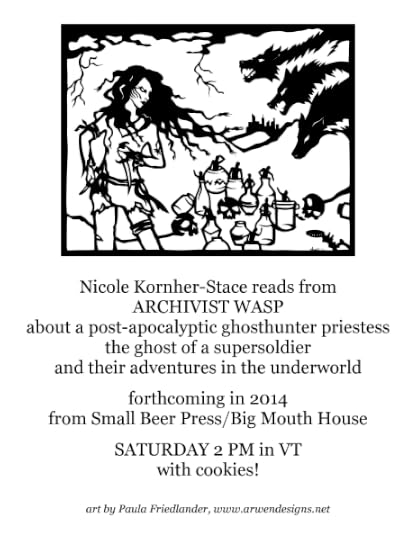
I'm currently reading Archivist Wasp by the way. I'm enjoying it a lot! Yes, it is bleak, but I don't find it depressing, because I don't find Wasp herself depressing. I like how she learns about herself and her world through her journey with the ghost. I had a few small annoyances: her not wanting to let her ankle be set, for instance. That sounded rather stupid to me. I see that her ankle being injured had a purpose later on, but I feel having it set wouldn't have changed that. The ghost baiting her a few times didn't sit well with me either, but at least she called him out on that. Other than that she is tough, driven, and persistent. I like that her rebellion shows through in kindness and I like how she insists on being heard and how she starts trusting her instincts more when she gets to the ghost world. The combination of ghosts and technology I find to be very original. I've never come across anything like it.
I agree with you that this is not YA. I don't know how the classification works, but I find it too easy to call something YA just because of the age of the protagonist. Wasp may be young, but she doesn't feel young to me, and I don't think this would particularly appeal to young adults. Of course it will appeal to some, but then again, some young adults will simply be interested in books for adults.
I wish I had kept track of what I read when I was young, then I would have had some notion of what I read at that age... I can remember David Eddings (that's YA I think), but also C.J. Cherryh, which is not.
Have a nice holiday, it sounds like great fun! 100 locks in 7 days does sound like a bit much, but I'm sure you'll get used to it!
Edit: hey, did you see this image? It's on GR, on the page of Nicole Kornher-Stace. I like it very much, I think it goes with the story very well.
177pwaites
175> I really loved Archivist Wasp. There's something so beautiful about how Wasp regains her humanity over the course of the story. Her character type - isolated, bitter warrior - is one that I've seen before, but this book really made me feel how tired she was. Other YA books (if this even is YA) don't convey the same sense of emotion.
When it comes to the question of if Archivist Wasp is YA or not, I'll accept it as such even if it doesn't feel YA to me. Maybe I've just read so much of the same sort of YA dystopian story (usually romance subplot heavy) that when I read something more original like Archivist Wasp, I don't feel like it's even the same genre. Then again, why not expand the boundaries of the YA genre?
When it comes to the question of if Archivist Wasp is YA or not, I'll accept it as such even if it doesn't feel YA to me. Maybe I've just read so much of the same sort of YA dystopian story (usually romance subplot heavy) that when I read something more original like Archivist Wasp, I don't feel like it's even the same genre. Then again, why not expand the boundaries of the YA genre?
178Jim53
>168 Sakerfalcon: think I took a bullet on The Hours before Dawn. Hope your canal-boat trip has been great!
179Sakerfalcon
>173 SylviaC: Thank you! We had a great time, with almost perfect weather, some great pubs, good company and beautiful countryside.
>174 LibraryPerilous: Thanks! Yes, the Huff series promises to be a good one if the first book is anything to go by.
>175 zjakkelien: Huff seems to have written a lot over the years, but only now is it being published in the UK. I'm not sure how easy her books will have been to find in the Netherlands, and whether you get the US or UK editions.
You make some great points about Archivist Wasp - that although it is set in a very bleak world the book itself is not depressing. Wasp is a really interesting character, suitably complex and with believable character growth. I like how she manages to break the cycle of violence imposed upon the girls by the priesthood ; that is very satisfying. That is a great image and really captures Wasp's scrappiness and determination. Thanks for sharing!
I was a bit older than YA when I read David Eddings (back then they were marketed as adult books) and gave up halfway through book 4 of the first series. I did later read the related stand-alones about Belgarion and Polgara and enjoyed those, but haven't read any more of his books. Anne McCaffery's Pern books were probably the first adult fantasy that I read, although I had always enjoyed children's books in the genre.
We ended up "only" doing about 70 locks in the end, as we had to change our route slightly. We still had to do a flight of 21 locks (on the one rainy day!) but got through it in exactly 2 hours which is amazingly good progress.
>176 AHS-Wolfy: If you like Mil SF written by someone who knows about the military and has a good sense of humour then you will almost certainly like the series!
>177 pwaites: I agree that recently in particular the term YA brings to mind a specific type of book, which Archivist Wasp is not. I really think it transcends an age-related classification - I don't feel that the age of the reader will determine whether someone is more or less likely to enjoy the book.
>178 Jim53: Hope you enjoy it! Lots of people in the Virago group have since read the book and found it as gripping as I did.
I didn't get much reading done while on holiday as I expected. We all took turns at the helm, opening and closing the locks and doing chores, but even when not busy it was quite absorbing just being on the boat and watching the world passing by. I did manage to read Maiden's trip though - I was determined to finish this memoir of life on the Grand Union Canal during WWII while I was actually on a narrowboat! The author describes the book as part fiction and part autobiography. It is based on the 2 years she spent working for the GUC Carrying Co. when women were hired to replace men transporting cargo from London to Birmingham. Smith condensed many incidents and characters from the 2 years into one journey for the book, which makes it a very eventful read. This was a really hard life, and it's not surprising that in the end very few women stuck it out. Emma and her companions were given charge of a pair of 72-ft long boats, one with a motor which was attached to the other which carried more cargo. Taken from sheltered middle class homes, the girls faced a steep learning curve but their pluck and determination saw them pass every test - sometimes through competence, more often by luck, stubbornness or assistance from the close-knit community of boaters. This is very well worth reading as a piece of social history and an entertaining yarn.
I started reading Apex on my kindle on the train home, and was soon drawn back into the future world which began in Nexus and continued in Crux. Like the previous books, it is an international SF thriller with technology, politics and human nature clashing to cause world-changing events. While the mind-linking tech seems far-fetched, the author provides an afterword that tells of the real-life advances which could one day lead to the scenario he imagines. While there are plenty of thrills and exciting action scenes on the surface, the characters are complex and engaging, and the theme of the good and evil of technology is nicely nuanced. The characters have to weigh the balance of the potential risks and benefits of Nexus, and the plot hinges on which side they choose. Everyone, powerful or ordinary, has to take a side and their decision can have an impact on the outcome. I really enjoyed this trilogy, though it is a bit more of an action thriller than I would usually read.
Since coming home I've read Sorcerer to the crown, which I enjoyed despite a few reservations. Zacharias, Prunella, Mak Genggang and the rest of the cast are lively and pleasing to read about, and the plot kept me wanting to keep picking up the book. However, while I can't put my finger on why, the Regency-style prose didn't quite feel fluent to me - I couldn't find anything obviously wrong with it, but it just didn't feel quite as "right" as, say, Georgette Heyer's writing. I couldn't really figure out the rules of magic use - Prunella seems to be able to do whatever she needs without having been taught even before she gains her three familiars . And the ending was rather frenetic, with plot points coming out of nowhere in a very confusing manner. However, I liked Cho's treatment of class, race and gender, which managed never to be preachy or to dominate the narrative despite being prominent throughout. I don't think this is nearly as strong a work as Cho's short stories, and it is perhaps unfortunate that it follows a recent trend for alternate-Regency fantasies (Shades of milk and honey, Sorcery and Cecilia, The magicians and Mrs Quent, and many more that are escaping me at present). Overall it was a good read, but not exceptional.
My Virago reading has rather fallen behind, but I've started A fine of two hundred francs, which contains 4 or 5 novellas written and published secretly during WWII, about French Resistance activity.
At home I've started The city, not long after, as it's been mentioned on the PA thread after I put it there, and The fifth season, which seems to be another PA book although I'm not yet sure if it is set on our world or another planet.
>174 LibraryPerilous: Thanks! Yes, the Huff series promises to be a good one if the first book is anything to go by.
>175 zjakkelien: Huff seems to have written a lot over the years, but only now is it being published in the UK. I'm not sure how easy her books will have been to find in the Netherlands, and whether you get the US or UK editions.
You make some great points about Archivist Wasp - that although it is set in a very bleak world the book itself is not depressing. Wasp is a really interesting character, suitably complex and with believable character growth. I like how she manages to
I was a bit older than YA when I read David Eddings (back then they were marketed as adult books) and gave up halfway through book 4 of the first series. I did later read the related stand-alones about Belgarion and Polgara and enjoyed those, but haven't read any more of his books. Anne McCaffery's Pern books were probably the first adult fantasy that I read, although I had always enjoyed children's books in the genre.
We ended up "only" doing about 70 locks in the end, as we had to change our route slightly. We still had to do a flight of 21 locks (on the one rainy day!) but got through it in exactly 2 hours which is amazingly good progress.
>176 AHS-Wolfy: If you like Mil SF written by someone who knows about the military and has a good sense of humour then you will almost certainly like the series!
>177 pwaites: I agree that recently in particular the term YA brings to mind a specific type of book, which Archivist Wasp is not. I really think it transcends an age-related classification - I don't feel that the age of the reader will determine whether someone is more or less likely to enjoy the book.
>178 Jim53: Hope you enjoy it! Lots of people in the Virago group have since read the book and found it as gripping as I did.
I didn't get much reading done while on holiday as I expected. We all took turns at the helm, opening and closing the locks and doing chores, but even when not busy it was quite absorbing just being on the boat and watching the world passing by. I did manage to read Maiden's trip though - I was determined to finish this memoir of life on the Grand Union Canal during WWII while I was actually on a narrowboat! The author describes the book as part fiction and part autobiography. It is based on the 2 years she spent working for the GUC Carrying Co. when women were hired to replace men transporting cargo from London to Birmingham. Smith condensed many incidents and characters from the 2 years into one journey for the book, which makes it a very eventful read. This was a really hard life, and it's not surprising that in the end very few women stuck it out. Emma and her companions were given charge of a pair of 72-ft long boats, one with a motor which was attached to the other which carried more cargo. Taken from sheltered middle class homes, the girls faced a steep learning curve but their pluck and determination saw them pass every test - sometimes through competence, more often by luck, stubbornness or assistance from the close-knit community of boaters. This is very well worth reading as a piece of social history and an entertaining yarn.
I started reading Apex on my kindle on the train home, and was soon drawn back into the future world which began in Nexus and continued in Crux. Like the previous books, it is an international SF thriller with technology, politics and human nature clashing to cause world-changing events. While the mind-linking tech seems far-fetched, the author provides an afterword that tells of the real-life advances which could one day lead to the scenario he imagines. While there are plenty of thrills and exciting action scenes on the surface, the characters are complex and engaging, and the theme of the good and evil of technology is nicely nuanced. The characters have to weigh the balance of the potential risks and benefits of Nexus, and the plot hinges on which side they choose. Everyone, powerful or ordinary, has to take a side and their decision can have an impact on the outcome. I really enjoyed this trilogy, though it is a bit more of an action thriller than I would usually read.
Since coming home I've read Sorcerer to the crown, which I enjoyed despite a few reservations. Zacharias, Prunella, Mak Genggang and the rest of the cast are lively and pleasing to read about, and the plot kept me wanting to keep picking up the book. However, while I can't put my finger on why, the Regency-style prose didn't quite feel fluent to me - I couldn't find anything obviously wrong with it, but it just didn't feel quite as "right" as, say, Georgette Heyer's writing. I couldn't really figure out the rules of magic use - Prunella seems to be able to do whatever she needs without having been taught
My Virago reading has rather fallen behind, but I've started A fine of two hundred francs, which contains 4 or 5 novellas written and published secretly during WWII, about French Resistance activity.
At home I've started The city, not long after, as it's been mentioned on the PA thread after I put it there, and The fifth season, which seems to be another PA book although I'm not yet sure if it is set on our world or another planet.
180LibraryPerilous
>179 Sakerfalcon: Glad you had a nice trip. It sounds like a very rewarding experience.
I'll be interested in your thoughts on The City, Not Long After, a book that fell flat for me.
I really need to read the Glamourist books. They sound like so much fun.
I'll be interested in your thoughts on The City, Not Long After, a book that fell flat for me.
I really need to read the Glamourist books. They sound like so much fun.
181Sakerfalcon
>180 LibraryPerilous: I've only read Shades of milk and honey but I really liked it. I think the rest of the series should be very interesting as the marriage plot is resolved at the end of the first book leading me to wonder what comes next.
I finished The city, not long after at the weekend and very much enjoyed it. It is a Post-Apocalyptic fantasy rather than science, but I liked it a lot. There really are very few people left in the former USA - the final confrontation mentions 150 against 50 in San Francisco and the Bay Area. It imagines that everyone left in San Francisco was an artist of some kind, and when they are threatened by a former army general and his men who want to claim the city and rebuild the USA, they take a very artistic approach to guerrilla warfare which confuses the soldiers. The city itself seems to play a part in defending itself with various almost magical occurrences. My main quibble is that the action seems to take place only about 15-20 years after the Plague hits, but the young people don't know what America was - surely some of the older people might have passed this knowledge down? I also didn't like the relationship between Danny Boy and Jax, although it became more palatable towards the end of the book. Still, I enjoyed the read and would recommend it if you want a more gentle, non-realistic but thoughtful PA book. It reads like a book-length fable.
I'm about 3/4 of the way through The fifth season and am absolutely gripped by it. There are some horrific scenes and it is a very dark world, which would prevent me recommending this to everyone, but I wouldn't class it as grimdark. The book takes place in the Stillness, an ironic name for a world which is constantly geologically unstable, prone to earthquakes and volcanic eruptions on a large scale that periodically send society back to the stone age. Some people are born with the ability to cause or influence these events - they are known as Orogenes and are hated and feared. We follow three plot lines - that of Essun, a middle aged woman whose husband has killed their son, because he thinks the boy is an Orogene, and kidnapped their daughter; Damaya whose parents have sold her to the Guardians who will take her away and train her to use her Orogeny to serve the continent; and that of Syenite, a young woman who has been trained at the school to which Damaya will go, and is being sent on a mission with a much more powerful partner. I guessed how two of the plotlines converge and am waiting to see how the third one joins up. This is a world where almost everyone is a person of colour and there are plenty of strong women, though really survival is of such importance that the only real prejudice is against Orogenes. I'm very much looking forward to finding out what happens next and have the sequel already lined up.
I'm also enjoying A fine of two thousand francs, having read 2 of the four novellas about life in occupied France during WWII. The first focuses on Juliette who works for the Resistance, and the second is about Alexis, a painter of Jewish descent who has had to leave Paris and live from hand to mouth with his lover in Lyons. He comes across as petulant and spoiled but I get the impression that his inertia is a symptom of depression rather than just laziness. I do think Henriette is too good for him though! The everyday details of life are beautifully conveyed in both stories and I'm looking forward to the remaining two vignettes.
On Saturday I managed to acquire one of the remaining books in the Fairacre series that are missing from my collection - Summer at Fairacre. I devoured this as soon as I got it home, happy to be back in the village world of Miss Read the schoolteacher, her cantankerous cleaning lady Mrs Pringle, her matchmaking friend Amy, the unfortunate urchin Joseph Coggs and other favourite characters. This was a perfect read for a hot sunny afternoon.
I finished The city, not long after at the weekend and very much enjoyed it. It is a Post-Apocalyptic fantasy rather than science, but I liked it a lot. There really are very few people left in the former USA - the final confrontation mentions 150 against 50 in San Francisco and the Bay Area. It imagines that everyone left in San Francisco was an artist of some kind, and when they are threatened by a former army general and his men who want to claim the city and rebuild the USA, they take a very artistic approach to guerrilla warfare which confuses the soldiers. The city itself seems to play a part in defending itself with various almost magical occurrences. My main quibble is that the action seems to take place only about 15-20 years after the Plague hits, but the young people don't know what America was - surely some of the older people might have passed this knowledge down? I also didn't like the relationship between Danny Boy and Jax, although it became more palatable towards the end of the book. Still, I enjoyed the read and would recommend it if you want a more gentle, non-realistic but thoughtful PA book. It reads like a book-length fable.
I'm about 3/4 of the way through The fifth season and am absolutely gripped by it. There are some horrific scenes and it is a very dark world, which would prevent me recommending this to everyone, but I wouldn't class it as grimdark. The book takes place in the Stillness, an ironic name for a world which is constantly geologically unstable, prone to earthquakes and volcanic eruptions on a large scale that periodically send society back to the stone age. Some people are born with the ability to cause or influence these events - they are known as Orogenes and are hated and feared. We follow three plot lines - that of Essun, a middle aged woman whose husband has killed their son, because he thinks the boy is an Orogene, and kidnapped their daughter; Damaya whose parents have sold her to the Guardians who will take her away and train her to use her Orogeny to serve the continent; and that of Syenite, a young woman who has been trained at the school to which Damaya will go, and is being sent on a mission with a much more powerful partner. I guessed how two of the plotlines converge and am waiting to see how the third one joins up. This is a world where almost everyone is a person of colour and there are plenty of strong women, though really survival is of such importance that the only real prejudice is against Orogenes. I'm very much looking forward to finding out what happens next and have the sequel already lined up.
I'm also enjoying A fine of two thousand francs, having read 2 of the four novellas about life in occupied France during WWII. The first focuses on Juliette who works for the Resistance, and the second is about Alexis, a painter of Jewish descent who has had to leave Paris and live from hand to mouth with his lover in Lyons. He comes across as petulant and spoiled but I get the impression that his inertia is a symptom of depression rather than just laziness. I do think Henriette is too good for him though! The everyday details of life are beautifully conveyed in both stories and I'm looking forward to the remaining two vignettes.
On Saturday I managed to acquire one of the remaining books in the Fairacre series that are missing from my collection - Summer at Fairacre. I devoured this as soon as I got it home, happy to be back in the village world of Miss Read the schoolteacher, her cantankerous cleaning lady Mrs Pringle, her matchmaking friend Amy, the unfortunate urchin Joseph Coggs and other favourite characters. This was a perfect read for a hot sunny afternoon.
183tardis
>181 Sakerfalcon: My mother is a big Miss Read fan. I went to considerable trouble a few years ago to help her complete her collection. I haven't read them myself, yet.
184SylviaC
I started The City, Not Long After last year, but had to stop for some reason that had nothing to do with the story. I should get back to it sometime.
I've never been able to get into Miss Read. I don't know why, because they are just the kind of books that I should like, but I'm always left feeling unsatisfied.
I've never been able to get into Miss Read. I don't know why, because they are just the kind of books that I should like, but I'm always left feeling unsatisfied.
185Sakerfalcon
>182 LibraryPerilous:, >183 tardis:, >184 SylviaC: I started reading Miss Read when I had depression a few years ago. They were just what I needed - gently humorous but affectionate books without trauma or strong emotional drama. I have only read her Fairacre series, most of which are narrated by the slightly acerbic schoolteacher, who is very content with her life but who frequently finds herself the victim of would-be matchmakers. The village life is lovely, but not without the problems of the modern world - broken families, loss of work, uncertainty - but these themes never dominate the books, they just prevent them from becoming too nostalgic and saccharine. Sylvia, sometimes an author's work has that effect on me too - I think it has all the criteria that I love, yet I just can't get on with it. Very strange!
I finished The fifth season and thought it was excellent, well deserving of the Hugo award. It remains a very dark book right to the end, but it is fascinating and extremely well constructed. I have the sequel lined up to read very soon.
I also finished A fine of two hundred francs (thanks to delayed trains), which was a very good read. The narrator of the third piece appeared in the second and it was good to learn more of her story. The last piece told of the vicious reprisal by the German forces against a village suspected of Resistance activity. The previous pieces had focused more on everyday life in occupied France, so this epilogue came as quite a contrast. This is an excellent and important book, and I feel it should be better known.
I've just started reading Oberland, the next volume of Dorothy Richardson's Pilgrimage. Miriam is setting out on a journey, but because (unlike her) I couldn't get a seat on my train this morning I haven't managed to read very far yet.
At home I've started the second book in my Tanya Huff omnibus, A confederation of valor. This sees Staff Sergeant Torin Kerr separated from her unit (punishment for pissing off the General at the end of the previous book) and sent on a secret mission to protect the team investigating an abandoned alien ship. Needless to say, all is not going smoothly.
I finished The fifth season and thought it was excellent, well deserving of the Hugo award. It remains a very dark book right to the end, but it is fascinating and extremely well constructed. I have the sequel lined up to read very soon.
I also finished A fine of two hundred francs (thanks to delayed trains), which was a very good read. The narrator of the third piece appeared in the second and it was good to learn more of her story. The last piece told of the vicious reprisal by the German forces against a village suspected of Resistance activity. The previous pieces had focused more on everyday life in occupied France, so this epilogue came as quite a contrast. This is an excellent and important book, and I feel it should be better known.
I've just started reading Oberland, the next volume of Dorothy Richardson's Pilgrimage. Miriam is setting out on a journey, but because (unlike her) I couldn't get a seat on my train this morning I haven't managed to read very far yet.
At home I've started the second book in my Tanya Huff omnibus, A confederation of valor. This sees Staff Sergeant Torin Kerr separated from her unit (punishment for pissing off the General at the end of the previous book) and sent on a secret mission to protect the team investigating an abandoned alien ship. Needless to say, all is not going smoothly.
186tardis
>185 Sakerfalcon: Love Torin Kerr & co. Actually Huff is one of my favourite authors. I've enjoyed all her books. Nice person, too. I met her at a con a few years ago.
187pgmcc
>186 tardis: I met her at WorldCon in Glasgow in 2005. I agree, a lovely person.
188jillmwo
I'm intrigued by A Fine of 200 Francs, but have to ask if it's in any way traumatic to read?
189pwaites
185> I loved The Fifth Season as well and thought it very deserving of an award. I didn't enjoy the sequel quite as much, but I think it's because I already knew what to expect.
190Sakerfalcon
>186 tardis:, >187 pgmcc: It's always good to hear that an author whose work you love turns out to be a nice person too. I have several more of her books lined up to read, having enjoyed everything I've tried so far.
>188 jillmwo: Only the last section is traumatic; the first three parts (which comprise the majority of the book) are not (IMO).
>189 pwaites: I imagine it will be hard for Jemisin to match the narrative reveal from book 1. But that last sentence of The Fifth Season has me intrigued ...
Last night I finished The better part of valor which met my high expectations. Torin finds herself part of a new team, who are perhaps less memorable than her platoon from the first book, but who still provide great banter and some moving moments. We are introduced to a couple more of the Elder species who make up the Confederation, and their quirks prove both entertaining and irritating (intentionally). I didn't like Ryder at all to start with, but Huff skillfully managed to develop his character to the point where I wasn't too unhappy with the way the book ended. The plot reads like one of those escape games - Torin, her Marines and a group of civilians find themselves trapped in a seemingly abandoned alien ship whose layout keeps changing and which has the ability to handicap them by affecting communication and weapons. Torin must get her group through the ever-mutating ship to a safe exit where they can be picked up by shuttle - but the surprises just keep coming. This was an exciting read and a good follow-up to the first novel.
I haven't mentioned A turn of light lately; I am still reading it but because it's a huge trade paperback I don't pick it up so often as I do smaller books. This is probably also a comment on the lack of engagement I feel with the story. I am determined to finish though ... only another 300 pages to go.
>188 jillmwo: Only the last section is traumatic; the first three parts (which comprise the majority of the book) are not (IMO).
>189 pwaites: I imagine it will be hard for Jemisin to match the narrative reveal from book 1. But that last sentence of The Fifth Season has me intrigued ...
Last night I finished The better part of valor which met my high expectations. Torin finds herself part of a new team, who are perhaps less memorable than her platoon from the first book, but who still provide great banter and some moving moments. We are introduced to a couple more of the Elder species who make up the Confederation, and their quirks prove both entertaining and irritating (intentionally). I didn't like Ryder at all to start with, but Huff skillfully managed to develop his character to the point where I wasn't too unhappy with the way the book ended. The plot reads like one of those escape games - Torin, her Marines and a group of civilians find themselves trapped in a seemingly abandoned alien ship whose layout keeps changing and which has the ability to handicap them by affecting communication and weapons. Torin must get her group through the ever-mutating ship to a safe exit where they can be picked up by shuttle - but the surprises just keep coming. This was an exciting read and a good follow-up to the first novel.
I haven't mentioned A turn of light lately; I am still reading it but because it's a huge trade paperback I don't pick it up so often as I do smaller books. This is probably also a comment on the lack of engagement I feel with the story. I am determined to finish though ... only another 300 pages to go.
191zjakkelien
The city, not long after sounds good. I might have to go and find that one...
192souloftherose
Hi Claire. A long overdue catch up on your thread but you hit me with book bullets for Masks and Shadows, Between Two Thorns, Fire Logic, Confederation of Valor. You would have hit me with a book bullet for The Fifth Season but I already have it out on loan from the library.
Also Heat Lightning and Fidelity from your AVAA reading and Maiden's Trip from your holiday reading. Please stop reading so many good books.
And I agree with all the positive comments about Archivist Wasp up thread - that was a very different, but very enjoyable read.
Also Heat Lightning and Fidelity from your AVAA reading and Maiden's Trip from your holiday reading. Please stop reading so many good books.
And I agree with all the positive comments about Archivist Wasp up thread - that was a very different, but very enjoyable read.
193Sakerfalcon
>191 zjakkelien: I really liked it; hope you will too! It's definitely a different take on the apocalypse.
>192 souloftherose: Hope you enjoy all the book bullet titles as much as I did. I picked the wrong time to read Between two thorns though, as the series seems to be transitioning to a new publisher with higher prices. I'll look out for your comments on The fifth season.
I've finally finished A turn of light! The very last scene in the book was wonderful. But I'm afraid that overall the book was rather a slog for me. I do like slow-paced, subtle fantasy - such as C.J. Cherryh's Fortress series - but this one just didn't do it for me. The main stumbling block was my dislike of the heroine, Jenn Nalynn (she is referred to by her full name throughout the narrative), who came over as a slightly dim, petulant teenager who has been petted all her life and is prone to making terrible decisions that affect others more than herself. Another problem was that a love triangle dominated the story. @Diana.n, your spoiler was interesting because I really did not want her to end up with Wyll/Wisp. Their engagement felt wrong to me in every way, not least because Jenn publically forced it upon him without him having a say! I wasn't convinced by Bannan's all-consuming love for her, but of the two he was preferable to me. The plot became more interesting towards the end of the book, but the climactic quest/trial was anticlimactic. I liked the village setting with "ordinary" characters, but felt we really only spent time with Jenn, her sister, her aunt and her suitors - others were frequently mentioned but we don't get to know them. I feel bad about rating the book so low, when it was clearly a labour of love, but it just didn't hit the spot for me. I'm now rereading A thousand words for stranger to remind myself of how much I like Czerneda's SF.
Oberland was one of the better episodes in the Pilgrimage sequence, with Miriam going on a winter holiday to Switzerland and being less self-conscious than she is at home.
I'm now reading Careless people, non-fiction about The great Gatsby, Scott and Zelda, and the times in which they lived. The author is trying to make a connection between the plot and a notorious murder case which happened around the time that Fitzgerald conceived the novel; the link is rather tenuous, but it makes for a good read. Gatsby is one of those books that I get more out of every time I read it, and this book is fascinating and compelling.
>192 souloftherose: Hope you enjoy all the book bullet titles as much as I did. I picked the wrong time to read Between two thorns though, as the series seems to be transitioning to a new publisher with higher prices. I'll look out for your comments on The fifth season.
I've finally finished A turn of light! The very last scene in the book was wonderful. But I'm afraid that overall the book was rather a slog for me. I do like slow-paced, subtle fantasy - such as C.J. Cherryh's Fortress series - but this one just didn't do it for me. The main stumbling block was my dislike of the heroine, Jenn Nalynn (she is referred to by her full name throughout the narrative), who came over as a slightly dim, petulant teenager who has been petted all her life and is prone to making terrible decisions that affect others more than herself. Another problem was that a love triangle dominated the story. @Diana.n, your spoiler was interesting because
Oberland was one of the better episodes in the Pilgrimage sequence, with Miriam going on a winter holiday to Switzerland and being less self-conscious than she is at home.
I'm now reading Careless people, non-fiction about The great Gatsby, Scott and Zelda, and the times in which they lived. The author is trying to make a connection between the plot and a notorious murder case which happened around the time that Fitzgerald conceived the novel; the link is rather tenuous, but it makes for a good read. Gatsby is one of those books that I get more out of every time I read it, and this book is fascinating and compelling.
194LibraryPerilous
>193 Sakerfalcon: I think I didn't like Bannan because he felt pretty one-note: "I'm so in love with her!" I felt there was some othering of Wisp? (But I skimmed most of the book.)
Oberland sounds very interesting.
Speaking of Fitzgerald, a new collection of his stories is slated for spring 2017: http://time.com/4481991/f-scott-fitzgerald-stories-new-book/
Oberland sounds very interesting.
Speaking of Fitzgerald, a new collection of his stories is slated for spring 2017: http://time.com/4481991/f-scott-fitzgerald-stories-new-book/
195Morphidae
All caught up with your thread and have added a book bullet, The Waterborne Blade, to Mount TBR!
196Sakerfalcon
>194 LibraryPerilous: I agree about the unconvincing nature of Bannan's love - it felt like something the author wanted, not something that sprang from his character.
Oberland was good, but probably doesn't make much sense apart from the rest of the 13-book Pilgrimage sequence of which it is part.
I will have to look out for the Fitzgerald stories - mind you, I have plenty of his already-published work to catch up on!
>195 Morphidae: Marissa hit me with The waterborne blade so I think she should share responsibility for your wound!
Oberland was good, but probably doesn't make much sense apart from the rest of the 13-book Pilgrimage sequence of which it is part.
I will have to look out for the Fitzgerald stories - mind you, I have plenty of his already-published work to catch up on!
>195 Morphidae: Marissa hit me with The waterborne blade so I think she should share responsibility for your wound!
197Sakerfalcon
I've finally found a moment to post a reading update.
Careless people remained a good and interesting read right the way through. I think it's best recommended to people who enjoy Fitzgerald's work and are interested in the times in which he lived. As a portrait of 1920s USA it is very good but if you haven't read Gatsby, or can't stand it, you will find the many references to it confusing or annoying. For me it was excellent though.
I also read Ashes of honor, as I slowly work my way through the Toby Daye books. This was another strong instalment, with Toby thrown into another difficult situation and forced to rely on her friends for help. We also see trouble in the Kingdom of Cats, and seeing how these two plots entwine makes for a gripping read. This series just keeps getting better with each book.
I've been away at a conference in Scotland and the travelling gave me plenty of time to read. I took with me Memory of water, Uprooted and The obelisk gate, but managed to acquire the first two volumes of scripts from Welcome to Night Vale at Waterstones in Glasgow, so those distracted me a bit.
Memory of water was a literary PA/dystopian novel by a Finnish author. It imagines life in a world that has been devastated by climate change, with low-lying areas submerged, water scarce due to pollution and a dependence on solar power, with the accompanying loss of most of our technology. The political landscape has changed too, with China seeming to be the dominant power. The book follows the story of Noria, whose family are the guardians of a dangerous secret - a spring of pure water in a land where water has to be strictly rationed and there are severe penalties for hoarding or overuse. After her mother leaves and her father dies, the secret is revealed and Noria is in great danger. This is a slow-paced, subtle novel with great attention to the details of the natural world and to the rituals of life. Noria's close, complex friendship with another girl and her family takes centre stage but forces her into some deep dilemmas. This is not an action packed book, but I did find it compelling and the prose was lovely.
I also finished Uprooted which I loved. I do like fairy tale retellings done well and, while I don't think this is based on a specific tale, it certainly falls into that category. The heroine is plain and clumsy which had me rolling my eyes every time she snags and tears her dress - but there is a reason behind this which made it acceptable. Agnieszka's friendship with Kasia was an unexpected treat, as I had expected the book to focus on her prickly relationship with the magician whose servant she expects to be. I can see why people have had issues with the latter, but for me it just about fell on the right side of the line. At least it isn't insta-love. The larger plot is exciting and rich with detail, and has a thought-provoking moral dimension to it.
I didn't get to The obelisk gate, but will be starting it soon.
In the meantime I'm reading A study in ashes, which completes the steampunk trilogy about Evelina Cooper and her friends, and rereading The dispossessed.
Careless people remained a good and interesting read right the way through. I think it's best recommended to people who enjoy Fitzgerald's work and are interested in the times in which he lived. As a portrait of 1920s USA it is very good but if you haven't read Gatsby, or can't stand it, you will find the many references to it confusing or annoying. For me it was excellent though.
I also read Ashes of honor, as I slowly work my way through the Toby Daye books. This was another strong instalment, with Toby thrown into another difficult situation and forced to rely on her friends for help. We also see trouble in the Kingdom of Cats, and seeing how these two plots entwine makes for a gripping read. This series just keeps getting better with each book.
I've been away at a conference in Scotland and the travelling gave me plenty of time to read. I took with me Memory of water, Uprooted and The obelisk gate, but managed to acquire the first two volumes of scripts from Welcome to Night Vale at Waterstones in Glasgow, so those distracted me a bit.
Memory of water was a literary PA/dystopian novel by a Finnish author. It imagines life in a world that has been devastated by climate change, with low-lying areas submerged, water scarce due to pollution and a dependence on solar power, with the accompanying loss of most of our technology. The political landscape has changed too, with China seeming to be the dominant power. The book follows the story of Noria, whose family are the guardians of a dangerous secret - a spring of pure water in a land where water has to be strictly rationed and there are severe penalties for hoarding or overuse. After her mother leaves and her father dies, the secret is revealed and Noria is in great danger. This is a slow-paced, subtle novel with great attention to the details of the natural world and to the rituals of life. Noria's close, complex friendship with another girl and her family takes centre stage but forces her into some deep dilemmas. This is not an action packed book, but I did find it compelling and the prose was lovely.
I also finished Uprooted which I loved. I do like fairy tale retellings done well and, while I don't think this is based on a specific tale, it certainly falls into that category. The heroine is plain and clumsy which had me rolling my eyes every time she snags and tears her dress - but there is a reason behind this which made it acceptable. Agnieszka's friendship with Kasia was an unexpected treat, as I had expected the book to focus on her prickly relationship with the magician whose servant she expects to be. I can see why people have had issues with the latter, but for me it just about fell on the right side of the line.
I didn't get to The obelisk gate, but will be starting it soon.
In the meantime I'm reading A study in ashes, which completes the steampunk trilogy about Evelina Cooper and her friends, and rereading The dispossessed.
198Marissa_Doyle
I loved Uprooted as well. I was a little uncertain going in as I was *not* a fan of the Temeraire books (well, perhaps I should say that the first one underwhelmed me and I didn't bother with the rest of the series), but I enjoyed it a great deal.
199dovelynnwriter
Oh, yay! I'm glad to hear you enjoyed Memory of Water. I loved the attention to detail too and I felt the way it handled the description of current everyday items really well done. ^_^
200Sakerfalcon
>198 Marissa_Doyle: The Temeraire books have never interested me, so this was my first experience of Novik's writing. I had read some negative responses to the relationship between Agnieska and the Dragon which put me off Uprooted for a long time, but I couldn't resist the paperback version when I saw it. I'm very glad I gave it a try.
>199 dovelynnwriter: It really was a beautiful book, although heartbreaking in places, and I'm really glad I read it. I have the author's second book, City of woven streets on my tbr pile and I'm looking forward to reading it soon.
I finished my reread of The dispossessed and really enjoyed it. This was probably the first non-Earthsea book by Le Guin that I read, and I certainly got more from it this time around. I thought she managed to balance the plot and character growth with the exploration of political philosophies very well and enjoyed the contrast between the societies of Annares and Urras. Neither place was perfect; both had strengths and weaknesses as well as similarities to our own world.
I've almost finished A study in ashes which is a good conclusion to the trilogy. The same good and bad points apply in this book as in the earlier ones - lots of interesting characters, especially women, great worldbuilding and a compelling plot, but annoying romance and lots of slips from her supposedly British prose - I'm noticing more errors in this book than in the last 2 so maybe she had a different editor this time. There are so many plot lines going on that a couple have been neglected for long periods of time which is a shame, but overall this is a very exciting and enjoyable book.
I forgot to mention that I read The Whicharts upon my return from Scotland. This was inspired by having watched a DVD of the (fairly) recent BBC adaptation of Ballet Shoes, starring Emma Watson as Pauline. I loved it, and it made me pick up my copy of The Whicharts, Streatfeild's first book that she later used as the basis for Ballet Shoes. It is definitely for adult readers, as the three girls are not nearly so sheltered from the world and its temptations as are their later incarnations. The stage school is a far tougher and less nurturing environment, and the girls have to work a lot harder for smaller rewards. The characters themselves are more morally grey and, as a result, less likeable but more interesting. The prose is a lot rougher than in Streatfeild's later works, and for most of the book it felt as though we were observing the characters from a distance, rather than being emotionally involved in their adventures. Still, this was a fascinating and worthwhile read, one which is probably a more realistic depiction of life in theatres in inter-war London.
I've just started reading The obelisk gate, which has hooked me immediately. We start out by seeing events from the point of view of Essun's missing daughter Nassun, who was being sought by her mother in the previous book. It's good to see her become a character and not just a plot device. I'm really looking forward to having more time to spend with this book.
>199 dovelynnwriter: It really was a beautiful book, although heartbreaking in places, and I'm really glad I read it. I have the author's second book, City of woven streets on my tbr pile and I'm looking forward to reading it soon.
I finished my reread of The dispossessed and really enjoyed it. This was probably the first non-Earthsea book by Le Guin that I read, and I certainly got more from it this time around. I thought she managed to balance the plot and character growth with the exploration of political philosophies very well and enjoyed the contrast between the societies of Annares and Urras. Neither place was perfect; both had strengths and weaknesses as well as similarities to our own world.
I've almost finished A study in ashes which is a good conclusion to the trilogy. The same good and bad points apply in this book as in the earlier ones - lots of interesting characters, especially women, great worldbuilding and a compelling plot, but annoying romance and lots of slips from her supposedly British prose - I'm noticing more errors in this book than in the last 2 so maybe she had a different editor this time. There are so many plot lines going on that a couple have been neglected for long periods of time which is a shame, but overall this is a very exciting and enjoyable book.
I forgot to mention that I read The Whicharts upon my return from Scotland. This was inspired by having watched a DVD of the (fairly) recent BBC adaptation of Ballet Shoes, starring Emma Watson as Pauline. I loved it, and it made me pick up my copy of The Whicharts, Streatfeild's first book that she later used as the basis for Ballet Shoes. It is definitely for adult readers, as the three girls are not nearly so sheltered from the world and its temptations as are their later incarnations. The stage school is a far tougher and less nurturing environment, and the girls have to work a lot harder for smaller rewards. The characters themselves are more morally grey and, as a result, less likeable but more interesting. The prose is a lot rougher than in Streatfeild's later works, and for most of the book it felt as though we were observing the characters from a distance, rather than being emotionally involved in their adventures. Still, this was a fascinating and worthwhile read, one which is probably a more realistic depiction of life in theatres in inter-war London.
I've just started reading The obelisk gate, which has hooked me immediately. We start out by seeing events from the point of view of Essun's missing daughter Nassun, who was being sought by her mother in the previous book. It's good to see her become a character and not just a plot device. I'm really looking forward to having more time to spend with this book.
201pgmcc
>200 Sakerfalcon:
I read The Dispossessed a long time ago. My first introduction to Le Guin's work was The Left Hand of Darkness which I loved. Subsequently I read The Earthsea Trilogy, as it was at the time, and may have read one or two other books by her before reading "The Dispossessed". I was disappointed in the novel and feel I may have to give it a reread as so many people have praised it. Perhaps in the intervening decades, I mean years, I have matured somewhat and will get more from the novel.
I read The Dispossessed a long time ago. My first introduction to Le Guin's work was The Left Hand of Darkness which I loved. Subsequently I read The Earthsea Trilogy, as it was at the time, and may have read one or two other books by her before reading "The Dispossessed". I was disappointed in the novel and feel I may have to give it a reread as so many people have praised it. Perhaps in the intervening decades, I mean years, I have matured somewhat and will get more from the novel.
202clamairy
>200 Sakerfalcon: Uh oh. I think I just took a bullet for the Le Guin.
Keep forgetting to tell you how happy I am that you're reading and enjoying books from that PA thread, including several that are on my wishlist.
Keep forgetting to tell you how happy I am that you're reading and enjoying books from that PA thread, including several that are on my wishlist.
204Bookmarque
The Post Apocalyptic thread - http://www.librarything.com/topic/224476
205catzteach
I have Uprooted on my TBR pile. I bought it dip urging the summer when I stopped into a bookstore to kill time before an appointment. I'm glad people are liking it!
206SylviaC
I haven't read any of Noel Streatfeild's adult books, partly because they are hard to find, but largely because I have the impression that they are all pretty dismal. Have you read many of them?
207jnwelch
Hi, Claire!
It was great to see you in London. That was a wonderful get-together in Golders Green.
Your early reaction to The Obelisk Gate is encouraging. As I mentioned, I liked The Fifth Season very much, and I've been wondering about the second one.
It was great to see you in London. That was a wonderful get-together in Golders Green.
Your early reaction to The Obelisk Gate is encouraging. As I mentioned, I liked The Fifth Season very much, and I've been wondering about the second one.
208Sakerfalcon
>201 pgmcc:, >202 clamairy: The dispossessed is certainly not as engaging as The left hand of darkness, with that amazing journey through the cold, but I got a lot more out of it on this my second reading than I did the first.
>202 clamairy:, >203 Morphidae:, >204 Bookmarque: I'm very glad that the PA thread exists and has given me a reason to take some of those books of my Tbr pile and read them! It's also good to have found some titles which are not gloomy and violent.
>205 catzteach: I'll look forward to seeing what you think of it.
>206 SylviaC: Only this one and Saplings. I wouldn't say they are exactly dismal, just more realistic about the hardships of life without financial security. Saplings was apparently one of the first books to look at the psychological impact of war upon children, and is fascinating for that (although one's child's trauma seems too easily cured). I do have some of the books that she published as Susan Scarlett, which are being reprinted by Greyladies but I haven't read them yet.
>207 jnwelch: It was great to see you and Debbi again, and to meet so many other LTers. I'm sorry I only got to meet up with you the once, but will look forward to your visit next year.
I finished The obelisk gate, which was a strong follow-up to The fifth season. It did move a little slowly in a few places, mostly when one character was holding back information from another (very frustrating), so I don't rate it quite so highly, but overall it builds satisfyingly on its predecessor. I really appreciated getting Nassun's viewpoint and seeing how she wrestles with her resentment towards her mother, even as she acknowledges her debt to her. The third viewpoint is that of Schaffa, Syen's erstwhile Guardian, and such is Jemisin's skill that I'm still not sure whether he's a force for good or evil. Probably both; all of Jemisin's characters are morally grey, and forced into situations where they must make difficult choices. I'm very much looking forward to the resolution to the trilogy now.
I've also read and finished the space opera Behind the throne which was a book bullet from @tottman. This follows the story of Hailimi, a princess who ran away from life at court to live life as a gunrunner but who is forced to return when she becomes the heir to the throne. She had good reasons for leaving court originally; it wasn't just dereliction of duty as her mother the Empress and the media presumed. Now she has to get back up to speed on Empire politics and court etiquette, try to prevent a war, and find out who killed her sisters and whether her mother's mental decline is due to something more sinister than dementia. Hail is a tough, scrappy heroine - the blurb compares her to Han Solo and it's not inappropriate - with a strong sense of justice that commits her to a future that is far from the one she desired. Her society is a matriarchy, so we see lots of strong competent women (as well as nasty incompetent ones), but there is constructive debate over whether power based on gender is ever the best way to govern. Her mostly male bodyguards (sorry, BodyGuards - that really annoyed me!) are engaging characters, but this is Hail's story and the focus really doesn't leave her. I was glad that there was no romance in the book. There were a few peculiarities in the writing which were possibly due to typos or bad editing, but overall it was well-written and very gripping. I'm now eagerly awaiting the second book.
I'm now reading Possession, the 8th book of the Greywalker series. I really enjoy this Seattle based urban fantasy series, with its competent heroine and low-key romance. The plots tend to be based on Seattle history or urban legend and the books have a very strong sense of place as a result. This one is set around Pike Place Market, which seems to have had quite an unsavoury past in its previous incarnations.
I've just started one of Louise Penny's Three Pines mysteries - The brutal telling. I like this series a lot; the seemingly cosy village is the setting for some very uncosy goings-on.
I've also started a Tattered But Still Lovely book - Lucy Carmichael by Margaret Kennedy. The titular character is about to marry the man of her dreams when things suddenly go wrong and she is forced to make a very difference life for herself. The review of this here on LT caught my attention and so when I happened upon a copy of the book in a charity shop I made sure to grab it.
>202 clamairy:, >203 Morphidae:, >204 Bookmarque: I'm very glad that the PA thread exists and has given me a reason to take some of those books of my Tbr pile and read them! It's also good to have found some titles which are not gloomy and violent.
>205 catzteach: I'll look forward to seeing what you think of it.
>206 SylviaC: Only this one and Saplings. I wouldn't say they are exactly dismal, just more realistic about the hardships of life without financial security. Saplings was apparently one of the first books to look at the psychological impact of war upon children, and is fascinating for that (although one's child's trauma seems too easily cured). I do have some of the books that she published as Susan Scarlett, which are being reprinted by Greyladies but I haven't read them yet.
>207 jnwelch: It was great to see you and Debbi again, and to meet so many other LTers. I'm sorry I only got to meet up with you the once, but will look forward to your visit next year.
I finished The obelisk gate, which was a strong follow-up to The fifth season. It did move a little slowly in a few places, mostly when one character was holding back information from another (very frustrating), so I don't rate it quite so highly, but overall it builds satisfyingly on its predecessor. I really appreciated getting Nassun's viewpoint and seeing how she wrestles with her resentment towards her mother, even as she acknowledges her debt to her. The third viewpoint is that of Schaffa, Syen's erstwhile Guardian, and such is Jemisin's skill that I'm still not sure whether he's a force for good or evil. Probably both; all of Jemisin's characters are morally grey, and forced into situations where they must make difficult choices. I'm very much looking forward to the resolution to the trilogy now.
I've also read and finished the space opera Behind the throne which was a book bullet from @tottman. This follows the story of Hailimi, a princess who ran away from life at court to live life as a gunrunner but who is forced to return when she becomes the heir to the throne. She had good reasons for leaving court originally; it wasn't just dereliction of duty as her mother the Empress and the media presumed. Now she has to get back up to speed on Empire politics and court etiquette, try to prevent a war, and find out who killed her sisters and whether her mother's mental decline is due to something more sinister than dementia. Hail is a tough, scrappy heroine - the blurb compares her to Han Solo and it's not inappropriate - with a strong sense of justice that commits her to a future that is far from the one she desired. Her society is a matriarchy, so we see lots of strong competent women (as well as nasty incompetent ones), but there is constructive debate over whether power based on gender is ever the best way to govern. Her mostly male bodyguards (sorry, BodyGuards - that really annoyed me!) are engaging characters, but this is Hail's story and the focus really doesn't leave her.
I'm now reading Possession, the 8th book of the Greywalker series. I really enjoy this Seattle based urban fantasy series, with its competent heroine and low-key romance. The plots tend to be based on Seattle history or urban legend and the books have a very strong sense of place as a result. This one is set around Pike Place Market, which seems to have had quite an unsavoury past in its previous incarnations.
I've just started one of Louise Penny's Three Pines mysteries - The brutal telling. I like this series a lot; the seemingly cosy village is the setting for some very uncosy goings-on.
I've also started a Tattered But Still Lovely book - Lucy Carmichael by Margaret Kennedy. The titular character is about to marry the man of her dreams when things suddenly go wrong and she is forced to make a very difference life for herself. The review of this here on LT caught my attention and so when I happened upon a copy of the book in a charity shop I made sure to grab it.
209pwaites
208> I think I just got hit with a book bullet by Behind the Throne.
210jillmwo
>209 pwaites: Yeah, I think she got me, too!
211reading_fox
And another for BtT, that does sound fun!
LeGuin - I have very varied experiences with her Hainish cycle SF books. I really didn't get on with Dispossessed or the later Left Hand of Darkness (probably my least favourite ever LeGuin), but very much enjoyed the earlier trilogy. Big fan of her very different Earthsea works as well.
LeGuin - I have very varied experiences with her Hainish cycle SF books. I really didn't get on with Dispossessed or the later Left Hand of Darkness (probably my least favourite ever LeGuin), but very much enjoyed the earlier trilogy. Big fan of her very different Earthsea works as well.
212Jim53
I, on the other hand, consider LHoD and The Dispossessed to be UKL's most significant works, although I'm also very fond of The Other Wind, the last Earthsea book. I haven't read all her recent stuff though.
IMHO the Penny series starts getting a lot better in A Trick of the Light. While the earlier ones have their appeal, all the ones since then are really top-notch.
IMHO the Penny series starts getting a lot better in A Trick of the Light. While the earlier ones have their appeal, all the ones since then are really top-notch.
213tottman
>208 Sakerfalcon: Glad you enjoyed Behind the Throne. The sequel, After the Crown is coming out soon.
Sounds like this one is book shotgun pellets instead of bullets. Seems to be hitting a whole crowd:)
Sounds like this one is book shotgun pellets instead of bullets. Seems to be hitting a whole crowd:)
214dovelynnwriter
Ooooooh. Behind the Throne sounds like a lot of fun! *adds to wishlist*
215Morphidae
Ugh, FINE. *also falls to the book bullet*
It seems that Behind the Throne is quite popular. I'm 6th in line at the library.
It seems that Behind the Throne is quite popular. I'm 6th in line at the library.
216catzteach
>208 Sakerfalcon: I have read the first Greywalker and would like to read more. Thanks for the reminder that they are out there!
217Sakerfalcon
>209 pwaites:, >210 jillmwo:, >211 reading_fox:, >214 dovelynnwriter:, >215 Morphidae: I hope you all enjoy Behind the throne as much as @tottman and I did. Hail is a great character and watching her take charge and root out the corruption that has taken hold of her society is very satisfying.
>213 tottman: I'm really looking forward to the sequel. Book 1 doesn't exactly end on a cliffhanger but you definitely want to know what happens next.
>211 reading_fox:, >212 Jim53: It's interesting that we can hold such different opinions of the same books. I guess that The dispossessed and Left hand of darkness are books where the plot and characters are used to serve the ideas whereas in Earthsea, although there is an obvious philosophical underlay to the stories the plot and characters are foremost. I haven't read the early Hainish books but they are on my Tbr pile. I have to say that I thought the political aspects of LHoD were far stronger and more interesting than its treatment of gender, for which it is best known, but which felt dated to me and not as revolutionary as it could have been - probably because I read it so long after Le Guin wrote it and had read other books that explored gender more effectively.
>212 Jim53: A trick of the light was actually the first in the series that I read, and it was superb. I've since gone back and started at the beginning but I think if Still life had been my first then I wouldn't have been so keen to carry on with the series. I do find that Penny puts a few too many twists and false trails in the mysteries which makes them feel artificially constructed to me, but I love the overarching plots and character growth that link the books.
>216 catzteach: Greywalker is another series where each book is better than the one before it. I like Harper as a character and enjoy seeing how she slowly comes to terms with her ability to work in the Grey. The Seattle setting is always good too.
I finished The brutal telling which was another good entry in the Three Pines series. As well as the main mystery, which was intriguing but ultimate a bit implausible to me, I really enjoy exploring the lives of the residents of Three Pines and of Gamache and his team. What I like in each book is how the mystery investigation changes and complicates the relationships between the characters, even those who are not suspects. Clara and Peter are especially well done. This is a series that I'm looking forward to continuing.
Possession was another satisfying read in the Greywalker series. Harper has to uncover the reason for the strange behaviour of some patients in a vegetative state and prevent a tragedy, but her life is complicated by the machinations of her boyfriend's father, an unpleasant and unscrupulous man who is conducting some very nasty experiments for the government. While the main plot is closed at the end of the book, the mystery about Quinton's father is left to continue and provides a hook to continue to the next book. As it's already on my tbr pile, the only question is how long do I wait to pick it up!
I've nearly finished Lucy Carmichael which is a lovely book of its time. It's set in post-war England and much of the story is set in an institute for the arts which was set up by a local philanthropist to bring the arts to the masses. He died before his vision could be achieved, leaving his aristocratic widow to carry on his work. Unfortunately she doesn't have quite the same ability for either organization or for getting on with people and despite her best efforts, the institute has become a closed-up little world that the local people want nothing to do with. Our heroine Lucy enters this world when she takes a job in the drama school and through her we see the problems and great potential of the institute. For a while it seems as though she will be able to make a difference ... but the weight of tradition is great and possibly immovable. Lucy is an interesting heroine; her youthful sparkle has been dimmed by the crisis with which the book opens and although she can't really put her heart into things she is still determined to do a good job and to stand up for what she believes is right. Her friend Melissa, whom we see at intervals, provides an interesting contrast and another view of life a woman's life at that time.
I've just started reading Ties of power, the sequel to A thousand words for stranger. If the earlier book implied that the Clan, Sira's people, are manipulative and corrupt, this book confirms it very quickly. Their appalling actions separate Sira and Jason, sending them on separate quests among alien people and worlds. Czerneda is excellent at writing both human and alien characters and I'm looking forward to seeing where she takes them.
I'm about to start The haunted hotel to join pgmcc and friends in their group read. I've always enjoyed Collins' novels and this one is new to me so how could I resist?
>213 tottman: I'm really looking forward to the sequel. Book 1 doesn't exactly end on a cliffhanger but you definitely want to know what happens next.
>211 reading_fox:, >212 Jim53: It's interesting that we can hold such different opinions of the same books. I guess that The dispossessed and Left hand of darkness are books where the plot and characters are used to serve the ideas whereas in Earthsea, although there is an obvious philosophical underlay to the stories the plot and characters are foremost. I haven't read the early Hainish books but they are on my Tbr pile. I have to say that I thought the political aspects of LHoD were far stronger and more interesting than its treatment of gender, for which it is best known, but which felt dated to me and not as revolutionary as it could have been - probably because I read it so long after Le Guin wrote it and had read other books that explored gender more effectively.
>212 Jim53: A trick of the light was actually the first in the series that I read, and it was superb. I've since gone back and started at the beginning but I think if Still life had been my first then I wouldn't have been so keen to carry on with the series. I do find that Penny puts a few too many twists and false trails in the mysteries which makes them feel artificially constructed to me, but I love the overarching plots and character growth that link the books.
>216 catzteach: Greywalker is another series where each book is better than the one before it. I like Harper as a character and enjoy seeing how she slowly comes to terms with her ability to work in the Grey. The Seattle setting is always good too.
I finished The brutal telling which was another good entry in the Three Pines series. As well as the main mystery, which was intriguing but ultimate a bit implausible to me, I really enjoy exploring the lives of the residents of Three Pines and of Gamache and his team. What I like in each book is how the mystery investigation changes and complicates the relationships between the characters, even those who are not suspects. Clara and Peter are especially well done. This is a series that I'm looking forward to continuing.
Possession was another satisfying read in the Greywalker series. Harper has to uncover the reason for the strange behaviour of some patients in a vegetative state and prevent a tragedy, but her life is complicated by the machinations of her boyfriend's father, an unpleasant and unscrupulous man who is conducting some very nasty experiments for the government. While the main plot is closed at the end of the book, the mystery about Quinton's father is left to continue and provides a hook to continue to the next book. As it's already on my tbr pile, the only question is how long do I wait to pick it up!
I've nearly finished Lucy Carmichael which is a lovely book of its time. It's set in post-war England and much of the story is set in an institute for the arts which was set up by a local philanthropist to bring the arts to the masses. He died before his vision could be achieved, leaving his aristocratic widow to carry on his work. Unfortunately she doesn't have quite the same ability for either organization or for getting on with people and despite her best efforts, the institute has become a closed-up little world that the local people want nothing to do with. Our heroine Lucy enters this world when she takes a job in the drama school and through her we see the problems and great potential of the institute. For a while it seems as though she will be able to make a difference ... but the weight of tradition is great and possibly immovable. Lucy is an interesting heroine; her youthful sparkle has been dimmed by the crisis with which the book opens and although she can't really put her heart into things she is still determined to do a good job and to stand up for what she believes is right. Her friend Melissa, whom we see at intervals, provides an interesting contrast and another view of life a woman's life at that time.
I've just started reading Ties of power, the sequel to A thousand words for stranger. If the earlier book implied that the Clan, Sira's people, are manipulative and corrupt, this book confirms it very quickly. Their appalling actions separate Sira and Jason, sending them on separate quests among alien people and worlds. Czerneda is excellent at writing both human and alien characters and I'm looking forward to seeing where she takes them.
I'm about to start The haunted hotel to join pgmcc and friends in their group read. I've always enjoyed Collins' novels and this one is new to me so how could I resist?
218pgmcc
>217 Sakerfalcon: I have to say that I thought the political aspects of LHoD were far stronger and more interesting than its treatment of gender,
Like yourself my primary thoughts of The Left Hand of Darkness relate to the politics although the gender treatment was one of the elements I was very much aware of when I read it. I read it in the early 1970s shortly after it won the Hugo. I loved the book.
I was left a bit non-plussed by The Dispossessed but I may give it another try some time in the future. I may also win the Lottery some time in the future.
Like yourself my primary thoughts of The Left Hand of Darkness relate to the politics although the gender treatment was one of the elements I was very much aware of when I read it. I read it in the early 1970s shortly after it won the Hugo. I loved the book.
I was left a bit non-plussed by The Dispossessed but I may give it another try some time in the future. I may also win the Lottery some time in the future.
219Sakerfalcon
>218 pgmcc: Yes, sometimes life is too short to reread books that didn't impress the first time around. Of course, if you win the lottery you will have much more time to read.
I really should post more often so I don't need to catch up with so many books at once. *sigh* I've finished several since I last posted.
The haunted hotel was a fun read but a bit of a disappointment for me after having read some of Collins' other novels. It is certainly not on the same level as The woman in white, No name or Armadale. I found the fatalistic nature of the story and its central character, the Countess, to be so improbable that I couldn't suspend my disbelief. There were some intriguing mysteries, and I appreciated that Collins left us unsure of many of these at the end, but I felt that using the narrative device of having us read the "play" which the countess wrote in order that we receive her unreliable account of events was quite a dull way of conveying the information. I did appreciate the comments of @pgmcc, @jillmwo and @MrsLee, who all seem to have enjoyed the book more than I did and made many insightful observations on it. If I ever reread this it will be due to them.
I also finished Ties of power which was a very satisfying and exciting follow-up to A thousand words for stranger. Without spoiling that book, I will just say that this one explores more deeply the nature of Sira and her race, the Clan, and the seeming evolutionary dead-end they have got themselves into. Czerneda also introduces a wonderful alien race, the Drapsk, who manage to be exasperating and adorable all at once. I don't know why her books have never been more easily available in the UK as they are excellent and original, well written with characters about whom you want to know more. I have the third volume on mount Tbr and will get to it fairly soon.
After the Collins, my next book I read while commuting was The peach keeper by Sarah Addison Allen. I do like her books; they are perfect comfort reads that are light as souffles. Set in a small Southern US community with a touch of magic in the air, the story follows two women as they try to discover what they really want from their lives. Romance plays a big part, but equally as important is female friendship. There is also some interesting social commentary here; the fictional town was once the centre of a thriving lumber industry, but when the surrounding area became a national park its economy crashed and the community had to reinvent itself. I am a huge believer in creating more national parks, but this was a very interesting look at the impact of doing that. (The book isn't critical of either national parks or industry but it did make me think about the conflict.) This was a lovely book which would most appeal to those who want some feel-good whimsy in their reading life.
I found a copy of The buried giant at the library, which I had been wanting to read, and that was my next commuting book. This is the story of Beatrice and Axl, an elderly couple who live in a village in Iron Age Britain, a place where ogres and dragons still roam and King Arthur's knights still ride the land. Beatrice and Axl set out on a journey to the village where their son lives; they can't remember exactly why he went away or quite where he lives but that doesn't stop them. In fact, everyone seems to be cursed with the inability to remember even the quite recent past. This gives the first part of the book a rather dreamlike feel, as we travel with the couple through this harsh landscape. Along the way they encounter some strange characters and creatures, and start to suspect that there is a reason for the collective amnesia. I liked the book best when it stuck to Beatrice and Axl's story; later on Ishiguro introduces a couple of other viewpoints which I liked less and wasn't so interested in. It allowed him to flesh out the events of the story, but I preferred the narrower focus. On the whole the book was beautifully written and vividly conveyed the landscapes through which the characters travel, and the ending was effectively poignant. I'm glad to have read this, but also glad I borrowed it.
I've also indulged in some Girlsown books - The honour of the house on kindle and Judith teaches in print. The former is a school story which follows the "new girl wants to improve the feeble house to which she has been assigned" but departs from the formula in that, while she is the catalyst for change, success comes through the actions of other girls. There is one of those hugely improbably coincidences that occur in this sort of book but apart from that it was a very pleasing story. Judith teaches is a "career novel' written for girls in the 1950s which follows the first year in the professional life of a young teacher. Judith is a very likeable and relatable character and she is nicely contrasted with her two equally sympathetic friends. It was nice to read a school story from the point of view of a teacher, and I can imagine it inspiring girls to enter the profession.
I'm currently reading Parable of the talents which is scarily prophetic (a presidential candidate who promises to "Make America great again, the privatization of space exploration). The USA in the 2030s sees the economy, society and the environment as having broken down, leaving people to fend for themselves in a violent world. Lauren Olamina has founded a community based on her self-created religion, Earthseed, which is centred around the tenet that "God is change. Change is God". But the changing political landscape will threaten to wipe out this fragile oasis of calm. So far this is a very powerful and frightening book and my appreciation of Butler's talent increases with every page.
I also want to make a start of The way of kings, which has been sitting on Mount Tbr for far too long. I have a big hardback edition which is why it's taking a while to rise to the top, but I think it's about there.
I'm also dipping into the scripts for Welcome to Night Vale, in Mostly void, partially stars. Because I've listened to the podcast I can imagine them read in Cecil's perfect voice, which adds to the enjoyment. Night Vale is just the kind of quirky, creepy small American town that I like.
I really should post more often so I don't need to catch up with so many books at once. *sigh* I've finished several since I last posted.
The haunted hotel was a fun read but a bit of a disappointment for me after having read some of Collins' other novels. It is certainly not on the same level as The woman in white, No name or Armadale. I found the fatalistic nature of the story and its central character, the Countess, to be so improbable that I couldn't suspend my disbelief. There were some intriguing mysteries, and I appreciated that Collins left us unsure of many of these at the end, but I felt that using the narrative device
I also finished Ties of power which was a very satisfying and exciting follow-up to A thousand words for stranger. Without spoiling that book, I will just say that this one explores more deeply the nature of Sira and her race, the Clan, and the seeming evolutionary dead-end they have got themselves into. Czerneda also introduces a wonderful alien race, the Drapsk, who manage to be exasperating and adorable all at once. I don't know why her books have never been more easily available in the UK as they are excellent and original, well written with characters about whom you want to know more. I have the third volume on mount Tbr and will get to it fairly soon.
After the Collins, my next book I read while commuting was The peach keeper by Sarah Addison Allen. I do like her books; they are perfect comfort reads that are light as souffles. Set in a small Southern US community with a touch of magic in the air, the story follows two women as they try to discover what they really want from their lives. Romance plays a big part, but equally as important is female friendship. There is also some interesting social commentary here; the fictional town was once the centre of a thriving lumber industry, but when the surrounding area became a national park its economy crashed and the community had to reinvent itself. I am a huge believer in creating more national parks, but this was a very interesting look at the impact of doing that. (The book isn't critical of either national parks or industry but it did make me think about the conflict.) This was a lovely book which would most appeal to those who want some feel-good whimsy in their reading life.
I found a copy of The buried giant at the library, which I had been wanting to read, and that was my next commuting book. This is the story of Beatrice and Axl, an elderly couple who live in a village in Iron Age Britain, a place where ogres and dragons still roam and King Arthur's knights still ride the land. Beatrice and Axl set out on a journey to the village where their son lives; they can't remember exactly why he went away or quite where he lives but that doesn't stop them. In fact, everyone seems to be cursed with the inability to remember even the quite recent past. This gives the first part of the book a rather dreamlike feel, as we travel with the couple through this harsh landscape. Along the way they encounter some strange characters and creatures, and start to suspect that there is a reason for the collective amnesia. I liked the book best when it stuck to Beatrice and Axl's story; later on Ishiguro introduces a couple of other viewpoints which I liked less and wasn't so interested in. It allowed him to flesh out the events of the story, but I preferred the narrower focus. On the whole the book was beautifully written and vividly conveyed the landscapes through which the characters travel, and the ending was effectively poignant. I'm glad to have read this, but also glad I borrowed it.
I've also indulged in some Girlsown books - The honour of the house on kindle and Judith teaches in print. The former is a school story which follows the "new girl wants to improve the feeble house to which she has been assigned" but departs from the formula in that, while she is the catalyst for change, success comes through the actions of other girls. There is one of those hugely improbably coincidences that occur in this sort of book but apart from that it was a very pleasing story. Judith teaches is a "career novel' written for girls in the 1950s which follows the first year in the professional life of a young teacher. Judith is a very likeable and relatable character and she is nicely contrasted with her two equally sympathetic friends. It was nice to read a school story from the point of view of a teacher, and I can imagine it inspiring girls to enter the profession.
I'm currently reading Parable of the talents which is scarily prophetic (a presidential candidate who promises to "Make America great again, the privatization of space exploration). The USA in the 2030s sees the economy, society and the environment as having broken down, leaving people to fend for themselves in a violent world. Lauren Olamina has founded a community based on her self-created religion, Earthseed, which is centred around the tenet that "God is change. Change is God". But the changing political landscape will threaten to wipe out this fragile oasis of calm. So far this is a very powerful and frightening book and my appreciation of Butler's talent increases with every page.
I also want to make a start of The way of kings, which has been sitting on Mount Tbr for far too long. I have a big hardback edition which is why it's taking a while to rise to the top, but I think it's about there.
I'm also dipping into the scripts for Welcome to Night Vale, in Mostly void, partially stars. Because I've listened to the podcast I can imagine them read in Cecil's perfect voice, which adds to the enjoyment. Night Vale is just the kind of quirky, creepy small American town that I like.
220SylviaC
When I first read The Peach Keeper, I thought it was okay, but I wasn't excited. Since then, I keep finding myself going back to it. It's the one I've reread most, next to The Sugar Queen, which is my favourite.
221catzteach
I put The Peach Keeper on my library shelf. I'm getting quite a big TBR on that shelf. :)
222jnwelch
I'm a big Sarah Addison Allen fan, too. She had some serious health issues (breast cancer), and had to stop writing for a while, but as far as I know she has been cancer-free for a while now.
223SylviaC
>222 jnwelch: Yes, she has been, but according to her Facebook page, she has been helping to care for her mother who has some serious health issues.
224Morphidae
Of Allen's books, I've read Garden Spells, my favorite with 9/10 stars; The Sugar Queen 8/10, The Girl Who Chased the Moon 7/10; First Frost 7/10. Looks like I'll have to pick up The Peach Keeper next!
225LibraryPerilous
I really must bump The Buried Giant up my TBR list.
226zjakkelien
Hi Sakerfalcon, I'm reading Planetfall at the moment. I came to LT to figure out who managed to hit me with that book bullet, and I think it must have been you.
So far I am enjoying it, I like how the narrative opens up more and more of the backstory so that you can figure out what's going on. I also like the way the colony lives, how they print what they need and recycle what they don't. The thing that worries me is that this might be one of those books that does the Annihilation thing, where there are all kinds of intriguing details about how the world works, but at the end, the resolution never becomes clear. (I'll admit I only read 1.5 books of that series. I liked the first one well enough, but the second one was dragging, and when I went online, I found thatat the end of the series, it was still not really clear what it was all about , so I stopped. Made me feel cheated. ) If I understand your comments in >126 Sakerfalcon:, that is not the case here, so that makes me happy!
Aside from knowing what happened 20 years ago and whyMack shot Suh , I also want to know about the weird plant and about God's city. I am worried that part will be left open, and in that case, I would definitely feel cheated. Quite frankly, that kind of story feels like a cop out to me. Like the author didn't put in the effort to resolve the story, and then just leaves it open. I only have another 100 pages to go, and at the moment I have no idea how everything can be tied together in that small number of pages. But who knows...
So far I am enjoying it, I like how the narrative opens up more and more of the backstory so that you can figure out what's going on. I also like the way the colony lives, how they print what they need and recycle what they don't. The thing that worries me is that this might be one of those books that does the Annihilation thing, where there are all kinds of intriguing details about how the world works, but at the end, the resolution never becomes clear. (I'll admit I only read 1.5 books of that series. I liked the first one well enough, but the second one was dragging, and when I went online, I found that
Aside from knowing what happened 20 years ago and why
227Sakerfalcon
It's good to see so much love for Sarah Addison Allen. Her books are real comfort reads where the characters feel like people you could be friends with. I need to get hold of first frost.
>225 LibraryPerilous: I'll be interested to see what you think of The buried giant when you get around to reading it. The only other book by Ishiguro I've read is Never let me go but most of his books seem to be very different from each other.
>226 zjakkelien: You may be disappointed with the end of Planetfall, although it worked for me. It becomes clear that it is Ren's story, not that of the whole colony, that is most important, and they diverge so that you don't find out all the answers to what is happening with the rest of the settlers. But compared to the Southern Reach trilogy more is tied up by the end.
I finished Parable of the talents and found it a very disturbing but compelling read. Butler's vision of a future USA under a right wing extreme government is violent and horrific and our heroine is not spared from the worst of the excesses. Olamina's story is told mostly in entries from her diary, but they are linked by narrative from her daughter, who grew up not knowing her mother. I wasn't sure if we were supposed to sympathise with the daughter's bitterness towards Olamina, but I wasn't able to. This is an important but harrowing read, not least because of the many parallels between Butler's future and our own present.
I've also read Astra, a dys/ecotopian novel set after our world has been transformed by climate change. The story takes place in a community where everyone lives in harmony with the Earth, not killing any other life forms (even insects) and respecting others regardless of their gender, skin colour or sexual orientation. But this Eden can only survive by keeping out the bands of violent destructive raiders that roam outside Is-Land. At the age of 7 all children are to be given an injection that will prepare them physically and mentally to defend their home. Our heroine, Astra, has a mother who thinks this is a bad idea and who finds a way to deceive the community into thinking Astra has had the shot. The good points of this book were the treatment of environmentalism, the dynamics of the community, where children learn from their elders rather than teens taking charge and way that technology was able to be incorporated into this low impact lifestyle. On the negative side, there were some plot holes and incidents that should have been made more of by the characters but which were let go in order to recur when the plot demanded it. But my main dislike was Astra herself. She was a brat when we met her at 7 years old, impetuous and careless when we saw her again at 12, and still immature and spoiled at 17. Her life and that of her mother depends upon her acting as though she has had the shot, but she seems to make no effort to moderate her behaviour or keep her temper when required. She was selfish and nasty when adults tried to make her do things she didn't want and acts superior to everyone. I wonder if she will be any more bearable in he sequel, in which she finds herself in a very different position and with many of her illusions stripped away. I'm not sure I care enough to find out though.
Now I'm reading An Australian girl which is the coming of age of a young woman in 19th century South Australia. I've also started The creative fire in which revolution seems to be brewing on a generation ship.
>225 LibraryPerilous: I'll be interested to see what you think of The buried giant when you get around to reading it. The only other book by Ishiguro I've read is Never let me go but most of his books seem to be very different from each other.
>226 zjakkelien: You may be disappointed with the end of Planetfall, although it worked for me.
I finished Parable of the talents and found it a very disturbing but compelling read. Butler's vision of a future USA under a right wing extreme government is violent and horrific and our heroine is not spared from the worst of the excesses. Olamina's story is told mostly in entries from her diary, but they are linked by narrative from her daughter, who grew up not knowing her mother. I wasn't sure if we were supposed to sympathise with the daughter's bitterness towards Olamina, but I wasn't able to. This is an important but harrowing read, not least because of the many parallels between Butler's future and our own present.
I've also read Astra, a dys/ecotopian novel set after our world has been transformed by climate change. The story takes place in a community where everyone lives in harmony with the Earth, not killing any other life forms (even insects) and respecting others regardless of their gender, skin colour or sexual orientation. But this Eden can only survive by keeping out the bands of violent destructive raiders that roam outside Is-Land. At the age of 7 all children are to be given an injection that will prepare them physically and mentally to defend their home. Our heroine, Astra, has a mother who thinks this is a bad idea and who finds a way to deceive the community into thinking Astra has had the shot. The good points of this book were the treatment of environmentalism, the dynamics of the community, where children learn from their elders rather than teens taking charge and way that technology was able to be incorporated into this low impact lifestyle. On the negative side, there were some plot holes and incidents that should have been made more of by the characters but which were let go in order to recur when the plot demanded it. But my main dislike was Astra herself. She was a brat when we met her at 7 years old, impetuous and careless when we saw her again at 12, and still immature and spoiled at 17. Her life and that of her mother depends upon her acting as though she has had the shot, but she seems to make no effort to moderate her behaviour or keep her temper when required. She was selfish and nasty when adults tried to make her do things she didn't want and acts superior to everyone. I wonder if she will be any more bearable in he sequel, in which she finds herself in a very different position and with many of her illusions stripped away. I'm not sure I care enough to find out though.
Now I'm reading An Australian girl which is the coming of age of a young woman in 19th century South Australia. I've also started The creative fire in which revolution seems to be brewing on a generation ship.
228zjakkelien
>227 Sakerfalcon: The reaction you describe to Parable of the talents is one I have with most of Butler's books. They are very compelling, but also uncomfortable. I think they are very good, and the only reason I haven't read all her books yet is because I am keeping them in reserve. It's almost a given that they are good and that I will like them, so I am keeping them for when I am in need of something good...
Thanks for the warning on Planetfall. I haven't read your spoiler yet, but I will probably finish the book today, so then I will have a look.
Thanks for the warning on Planetfall. I haven't read your spoiler yet, but I will probably finish the book today, so then I will have a look.
229dovelynnwriter
>227 Sakerfalcon:, >228 zjakkelien: I've had the same reaction to Butler's stories too. I haven't read many of them yet, I don't think, but they've consistently been incredibly compelling and deeply uncomfortable reads. (I found Wild Seed so uncomfortable for personal reasons that I couldn't finish it, though. T_T)
230zjakkelien
I just finished Planetfall. And like you, the end works for me. I just feel it is a bit disjointed. It comes rather sudden, the whole book being about other things. Not everything is clear, but at least there are answers to my questions. I find it interesting that one of the people in the first group tells Suh that he doesn't think it is right to cheat, and apparently he was right and it didn't work that way. Apparently Suh was partially prepped by the weird plant, but not enough to be able to survive in that last room without going through the whole city without covers.
I think the whole Sung Soo business was quite sad. I understand the bitterness of their situation, but they destroy the whole colony for the deeds of one man and the silence of one woman.
I think the whole Sung Soo business was quite sad. I understand the bitterness of their situation, but they destroy the whole colony for the deeds of one man and the silence of one woman.
231Morphidae
>227 Sakerfalcon: My favorite Ishiguro's are Never Let Me Go and The Remains of the Day. I didn't care that much for The Buried Giant or An Artist of the Floating World.
232pgmcc
>231 Morphidae: Oh dear! I just took delivery of The Buried Giant today. :-(
On the bright side, my expectations are now very low so I might read it and think it is the best book ever written. :-)
On the bright side, my expectations are now very low so I might read it and think it is the best book ever written. :-)
233Morphidae
>232 pgmcc: Many people liked The Buried Giant, so take my opinion with a grain of salt.
234kidzdoc
Nice review of The Buried Giant, Claire. I hesitated on buying it, and I think I'll hold off reading it for now.
235Sakerfalcon
>228 zjakkelien:, >230 zjakkelien: I'm glad you ended up enjoying Planetfall. I've just bought the sort-of sequel, After Atlas, so am looking forward to reading that.
>229 dovelynnwriter: Butler seems to look into the human psyche at its darkest and finds some very unpleasant things there, but in the books I've read so far she focuses on goodness and hope as the ways to a solution.
>231 Morphidae: Good to know! I definitely liked the first 100 pages or so of The buried giant the best; if it had continued in that mood I'd have liked it better overall.
>232 pgmcc: I look forward to seeing what you think of The buried giant.
>234 kidzdoc: Thanks! Good plan to hold off, given the size of your TBR pile!
It's been a while since I've posted, apparently, so here's what I've been reading.
I finished An Australian girl which was a very interesting look at life in colonial Australia, when individuals and the country were seeking to find an identity. The Girl of the title, Stella, is young, intelligent and beautiful and so of course must marry. She has been persistently courted since childhood by Ted, who is besotted with her but doesn't share her intellectual curiosity and focuses purely on physical pleasure. Some time before the book opens, Stella had, in a moment of weakness, accepted Ted's proposal of marriage, but broke it off again just hours later. Believing herself incapable of falling in love (and not much minding) she meets an Englishman who is her match in intelligence and taste. Love ensues, but all does not run smoothly in this unusual book. There were a few too many purple descriptions of the landscape (think of L.M. Montgomery at her most rapturous) which slowed down the plot, but overall this was a good and thought-provoking read. Stella is a well-rounded and sympathetic protagonist and the other female characters represent a broad spectrum of women and their choices. The ending prevents the book from being a formulaic romance and leaves Stella in an unusual position, but perhaps more free to do the things she cares about.
I also finished The Creative Fire which, while not marketed as such, is really YA SF. Our heroine, Ruby, is 16 and reaching the end of her schooling, after which she will take up a lowly career providing maintenance for the aging generation ship on which she lives. The injustice she sees around her inspires her to protest, through her songwriting and singing voice. The social stratification which is so common in YA dystopian books is explained fairly convincingly here (everyone started out equal but after some quashed rebellions order was imposed) and we see good and bad people from each class. Ruby is not much of an action girl (the book's cover notwithstanding) and mainly serves as a figurehead and rallying point for the rebellion rather than leading the action. I found her quite a frustrating character at times, but probably not too unrealistic for a teenager. I didn't think I was enjoying the book much, until I realised I kept thinking about it when not reading, and that made me pick up the sequel which I will try and read soon.
I've just reread The alloy of law and am proceeding to Shadows of self which so far is a very satisfying follow up. Marasi is coming into her own, and Wax and Wayne continue to delight. I do hope we get to see more of Steris, who could provide a nice contrast to Marasi, but she hasn't had much to do yet. Still, it's early days.
I'm going on holiday to Scotland for a week starting tomorrow, so have the difficult task of choosing which books to bring with me. I shall report when I've decided.
>229 dovelynnwriter: Butler seems to look into the human psyche at its darkest and finds some very unpleasant things there, but in the books I've read so far she focuses on goodness and hope as the ways to a solution.
>231 Morphidae: Good to know! I definitely liked the first 100 pages or so of The buried giant the best; if it had continued in that mood I'd have liked it better overall.
>232 pgmcc: I look forward to seeing what you think of The buried giant.
>234 kidzdoc: Thanks! Good plan to hold off, given the size of your TBR pile!
It's been a while since I've posted, apparently, so here's what I've been reading.
I finished An Australian girl which was a very interesting look at life in colonial Australia, when individuals and the country were seeking to find an identity. The Girl of the title, Stella, is young, intelligent and beautiful and so of course must marry. She has been persistently courted since childhood by Ted, who is besotted with her but doesn't share her intellectual curiosity and focuses purely on physical pleasure. Some time before the book opens, Stella had, in a moment of weakness, accepted Ted's proposal of marriage, but broke it off again just hours later. Believing herself incapable of falling in love (and not much minding) she meets an Englishman who is her match in intelligence and taste. Love ensues, but all does not run smoothly in this unusual book. There were a few too many purple descriptions of the landscape (think of L.M. Montgomery at her most rapturous) which slowed down the plot, but overall this was a good and thought-provoking read. Stella is a well-rounded and sympathetic protagonist and the other female characters represent a broad spectrum of women and their choices. The ending prevents the book from being a formulaic romance and leaves Stella in an unusual position, but perhaps more free to do the things she cares about.
I also finished The Creative Fire which, while not marketed as such, is really YA SF. Our heroine, Ruby, is 16 and reaching the end of her schooling, after which she will take up a lowly career providing maintenance for the aging generation ship on which she lives. The injustice she sees around her inspires her to protest, through her songwriting and singing voice. The social stratification which is so common in YA dystopian books is explained fairly convincingly here (everyone started out equal but after some quashed rebellions order was imposed) and we see good and bad people from each class. Ruby is not much of an action girl (the book's cover notwithstanding) and mainly serves as a figurehead and rallying point for the rebellion rather than leading the action. I found her quite a frustrating character at times, but probably not too unrealistic for a teenager. I didn't think I was enjoying the book much, until I realised I kept thinking about it when not reading, and that made me pick up the sequel which I will try and read soon.
I've just reread The alloy of law and am proceeding to Shadows of self which so far is a very satisfying follow up. Marasi is coming into her own, and Wax and Wayne continue to delight. I do hope we get to see more of Steris, who could provide a nice contrast to Marasi, but she hasn't had much to do yet. Still, it's early days.
I'm going on holiday to Scotland for a week starting tomorrow, so have the difficult task of choosing which books to bring with me. I shall report when I've decided.
236Sakerfalcon
Oh I forgot to report that I've also just read Clear horizon, the next novel in Dorothy Richardson's Pilgrimage sequence. This was quite challenging, as we get very little context to tell us where Miriam is and what she is doing, but it is still a wonderful immersion into early C20th century London as seen by a young woman earning her living and discovering who she is.
237Morphidae
I have certain opinions about Shadows of Self so will be interested in what you think about it.
239Sakerfalcon
>237 Morphidae: That sounds ominous!
>238 SylviaC: Thank you!
So I will be bringing Shadows of self with me and also Tower of thorns and Our lady of the ice. I also have my kindle, of course, should none of those appeal.
>238 SylviaC: Thank you!
So I will be bringing Shadows of self with me and also Tower of thorns and Our lady of the ice. I also have my kindle, of course, should none of those appeal.
240LibraryPerilous
Have a nice time!
241Sakerfalcon
>240 LibraryPerilous: Thank you!
Well, I've been back from my holiday for a week and this is the first time I've had to catch up on LT. My friends and I enjoyed a week of walking in the Scottish Highlands, enjoying the beautiful landscape, good weather and lots of tasty food. I don't think we walked enough to make up for the food, but never mind.
I finished Shadows of self and enjoyed it, although I think a lot of references were made to characters and concepts from the original Mistborn trilogy, which I didn't read. The treatment of religion was less subtle than usual from Sanderson and I hope he doesn't start trying to draw parallels with our world and its beliefs. But the characters were delightful as usual, especially Wayne and Marasi, and I enjoyed the introduction of MeLaan. The book definitely ends leaving you waiting for the next book, but I know my library has it so it's just a question of how soon I can get down there.
I also read Tower of thorns, which was just as gorgeous as Dreamer's pool. Blackthorn and Grim have a lovely caring, mutually supportive relationship and I love seeing how they work together. This story sees enemies try to divide them, and there were scenes that I found hugely frustrating whereBlackthorn is planning to leave Grim and seek revenge following a truly terrible plan. She is an intelligent woman so have her desert her good sense and go along with this was really annoying. There were some reasons why she would do so, but it did feel a bit like something the author wanted against what fit with the character she'd established We learn more about Grim's past, and his story arc in this book is heartbreaking and yet hopeful. As usual, the writing was lovely and the settings beautifully detailed without slowing the story. I love this series and am eagerly looking forward to the next instalment.
On kindle I read Ken Liu's short story collection The paper menagerie, which was excellent. Many of the stories referenced Chinese history and culture and featured diverse characters. They ranged from SF with aliens to magical realism, to commentary on the burden of history. Some are tragic and hard-hitting, others beautiful and strange, and all things in between. While I have no desire to read his novel based on the extract provided, I will certainly look out for more of Liu's short work.
I've also read Our lady of the ice a noir/SF novel set in a domed city on Antarctica. This was a gripping and thrilling read, with a fascinating setting and flawed characters. Three of the four viewpoint characters are female and must work together to survive despite having very real reasons to doubt each other's agendas and motives. There are a few times where two of them are annoyingly clingy about men, but when they need to stand up and be strong they come through. The infrastructure of the domed city is failing, and we feel at all times the pressing danger of the extreme dark and cold that is kept at bay by a fragile barrier. Politics, social issues and the nature of humanity are at the core of the novel, and the exploration of these themes is intrinsically woven into the story. This wasn't a perfect book by any means, but it was original and exciting.
I'm now reading Silver on the road, a fantasy Western by Laura Anne Gilman which is very good so far. And I've also started The silent history, which was a book bullet from Sylvia with a little help from Meredy. I'm enjoying it so far - I like "oral history" style narratives - so thank you!
I realised that I totally forgot to mention a couple of books that I read last month, before my vacation. Dark matter was a ghost story set in the 1930s that follows a scientific expedition to Spitzbergen to look at the weather, wildlife and glaciers during the dark months of winter. For various reasons the original team of 5 men is whittled down until Jack, the narrator, is left alone. The study site has a dark past, and things start to get very spooky. This is an effective psychological thriller that leaves it up to you whether there were in fact any supernatural goings-on.
The other book I read was All she was worth, a Japanese detective novel that digs deep into the dark side of the consumer credit industry and its impact on individuals. I really enjoyed this, despite sometimes finding it hard to keep track of the various businesses and apartments visited during the investigation, and appreciated that the novel didn't get too dark or violent.
Well, I've been back from my holiday for a week and this is the first time I've had to catch up on LT. My friends and I enjoyed a week of walking in the Scottish Highlands, enjoying the beautiful landscape, good weather and lots of tasty food. I don't think we walked enough to make up for the food, but never mind.
I finished Shadows of self and enjoyed it, although I think a lot of references were made to characters and concepts from the original Mistborn trilogy, which I didn't read. The treatment of religion was less subtle than usual from Sanderson and I hope he doesn't start trying to draw parallels with our world and its beliefs. But the characters were delightful as usual, especially Wayne and Marasi, and I enjoyed the introduction of MeLaan. The book definitely ends leaving you waiting for the next book, but I know my library has it so it's just a question of how soon I can get down there.
I also read Tower of thorns, which was just as gorgeous as Dreamer's pool. Blackthorn and Grim have a lovely caring, mutually supportive relationship and I love seeing how they work together. This story sees enemies try to divide them, and there were scenes that I found hugely frustrating where
On kindle I read Ken Liu's short story collection The paper menagerie, which was excellent. Many of the stories referenced Chinese history and culture and featured diverse characters. They ranged from SF with aliens to magical realism, to commentary on the burden of history. Some are tragic and hard-hitting, others beautiful and strange, and all things in between. While I have no desire to read his novel based on the extract provided, I will certainly look out for more of Liu's short work.
I've also read Our lady of the ice a noir/SF novel set in a domed city on Antarctica. This was a gripping and thrilling read, with a fascinating setting and flawed characters. Three of the four viewpoint characters are female and must work together to survive despite having very real reasons to doubt each other's agendas and motives. There are a few times where two of them are annoyingly clingy about men, but when they need to stand up and be strong they come through. The infrastructure of the domed city is failing, and we feel at all times the pressing danger of the extreme dark and cold that is kept at bay by a fragile barrier. Politics, social issues and the nature of humanity are at the core of the novel, and the exploration of these themes is intrinsically woven into the story. This wasn't a perfect book by any means, but it was original and exciting.
I'm now reading Silver on the road, a fantasy Western by Laura Anne Gilman which is very good so far. And I've also started The silent history, which was a book bullet from Sylvia with a little help from Meredy. I'm enjoying it so far - I like "oral history" style narratives - so thank you!
I realised that I totally forgot to mention a couple of books that I read last month, before my vacation. Dark matter was a ghost story set in the 1930s that follows a scientific expedition to Spitzbergen to look at the weather, wildlife and glaciers during the dark months of winter. For various reasons the original team of 5 men is whittled down until Jack, the narrator, is left alone. The study site has a dark past, and things start to get very spooky. This is an effective psychological thriller that leaves it up to you whether there were in fact any supernatural goings-on.
The other book I read was All she was worth, a Japanese detective novel that digs deep into the dark side of the consumer credit industry and its impact on individuals. I really enjoyed this, despite sometimes finding it hard to keep track of the various businesses and apartments visited during the investigation, and appreciated that the novel didn't get too dark or violent.
242Marissa_Doyle
Silver on the Road was pretty darn good. The next book in the series is out in January, I believe.
243pwaites
241> I think you've hit me with a book bullet with Our Lady of the Ice!
244zjakkelien
Looking forward to Tower of thorns!
246LibraryPerilous
Your holiday sounds fabulous!
My aunt really enjoyed Our Lady of the Ice.
Dark Matter sounds intriguing.
My aunt really enjoyed Our Lady of the Ice.
Dark Matter sounds intriguing.
247dovelynnwriter
>241 Sakerfalcon: Ooooh Our Lady of the Ice sounds fantastic! I'm glad to hear you've enjoyed your holiday!
248kidzdoc
I'm glad to hear that you spent a lovely week in the Scottish Highlands, Claire. Did you take photos?
249jillmwo
Seriously intrigued by Our Lady of the Ice. Filing away for future reference!
250pgmcc
>241 Sakerfalcon: I'm glad you had a good time in the highlands. Whereabouts were you this time? Photos?
251imyril
>241 Sakerfalcon: I've just recently come back from ten days in the Highlands - it's so beautiful at this time of year. I hope the weather was kind to you; we got very lucky, and only had rain on days we were driving anyway.
252AHS-Wolfy
>241 Sakerfalcon: Our Lady of the Ice grabs me as well. Science fiction mixed with hard-boiled noir sounds right up my street.
253reading_fox
And another.
254clamairy
>227 Sakerfalcon: (And a bunch of other posts) Yes, it's almost as if Octavia Butler was somewhat prescient.
255catzteach
>241 Sakerfalcon: Dark Matter sounds good! I'm putting it on my list.
256Sakerfalcon
>242 Marissa_Doyle: I'm really enjoying it. It builds slowly but surely until I have problems putting it down to go to sleep! I will definitely want the next book.
>243 pwaites:, >247 dovelynnwriter:, >249 jillmwo:, >252 AHS-Wolfy:, >253 reading_fox: I will look forward to seeing what you all think of Our lady of the ice when/if you pick it up. I thought the setting was excellent, and all the various issues tied into the plot really well. I will look out for future books by this author, although I don't really fancy her earlier novel, The mad scientist's daughter.
>244 zjakkelien: It is wonderful, just as good as the first book. Blackthorn and Grim are such great characters.
>245 SylviaC:, >248 kidzdoc:, >250 pgmcc:, >251 imyril: It was a good holiday and the weather was fair. There was a lot of snow on the hills when we arrived, but it was melting by the end of the week. We were staying at my friend's dad's cottage in Newtonmore, which is about 15 miles south of Aviemore and 50 south of Inverness, in the Spey valley. I did take photos and will post some here when my computer co-operates. At the moment it is refusing to let me import them from the camera as I don't have enough disk space.
>246 LibraryPerilous: I'm glad your aunt also enjoyed Our Lady of the Ice. I haven't seen a lot of attention being paid to the book. >255 catzteach: Dark matter was very atmospheric, a good book to read on long winter nights. I did think that the tension slackened a bit when the narrative moved away from diary form, but it had to do that really in order for events to be recounted more immediately.
>254 clamairy: Scarily so, yes. Have you seen that picture of a bookstore's chalkboard that reads "Our post apocalyptic books are now shelved in the Current Events section"?
I'm really enjoying Silver on the road. Isobel and her mentor set out on horseback across the Territory (roughly equal to the area of the Louisiana Purchase) so that Izzy can learn what will be expected of her as the Devil's Left Hand. But they are gradually made aware of a great menace that threatens the land. This alternative Western feels very rooted in American history but with a strong supernatural element to add to the hardships of life on the prairies. The book builds the tension slowly but effectively and it is good to watch Izzy figure out what her role might be in events.
I've just finished The silent history which was a good read. The format of short narratives from different voices is one I find hard to resist, even though in this case many of the characters were not very likeable. The book covers a period of about 30 years, from the first babies to be born silent, to them coming of age and becoming parents themselves. The "silent" themselves do not speak; instead we hear from those who encounter them - parents, teachers, politicians, doctors, New Age types and others. It's a long book, but moves fast due to the changing viewpoints. I'm very glad that Meredy commented on this on SylviaC's thread, as I had overlooked her original review.
I've just started reading a library book, Bury your dead, which is the 6th Inspector Gamache novel. This one seems to be set away from Three Pines, in Quebec City. I'm looking forward to catching up with the life of Gamache and other regular characters.
I'm also reading Wild strawberries, a light, amusing comedy by Angela Thirkell. It is a little dated in using some now-offensive language, but otherwise is a good escape from the weighty issues of real life.
I have several books lined up to read soon, some the result of my library visit and others from Forbidden Planet. These include Bands of mourning, Six Four, Saga volumes 5 and 6 and A closed and common orbit. Unfortunately most of the novels are hardbacks so I won't be able to read them on my way to work. But I will get to them soon.
I wish all USAnian Dragoneers a very Happy Thanksgiving and hope that whatever you are doing you have a good day.
>243 pwaites:, >247 dovelynnwriter:, >249 jillmwo:, >252 AHS-Wolfy:, >253 reading_fox: I will look forward to seeing what you all think of Our lady of the ice when/if you pick it up. I thought the setting was excellent, and all the various issues tied into the plot really well. I will look out for future books by this author, although I don't really fancy her earlier novel, The mad scientist's daughter.
>244 zjakkelien: It is wonderful, just as good as the first book. Blackthorn and Grim are such great characters.
>245 SylviaC:, >248 kidzdoc:, >250 pgmcc:, >251 imyril: It was a good holiday and the weather was fair. There was a lot of snow on the hills when we arrived, but it was melting by the end of the week. We were staying at my friend's dad's cottage in Newtonmore, which is about 15 miles south of Aviemore and 50 south of Inverness, in the Spey valley. I did take photos and will post some here when my computer co-operates. At the moment it is refusing to let me import them from the camera as I don't have enough disk space.
>246 LibraryPerilous: I'm glad your aunt also enjoyed Our Lady of the Ice. I haven't seen a lot of attention being paid to the book. >255 catzteach: Dark matter was very atmospheric, a good book to read on long winter nights. I did think that the tension slackened a bit when the narrative moved away from diary form, but it had to do that really in order for events to be recounted more immediately.
>254 clamairy: Scarily so, yes. Have you seen that picture of a bookstore's chalkboard that reads "Our post apocalyptic books are now shelved in the Current Events section"?
I'm really enjoying Silver on the road. Isobel and her mentor set out on horseback across the Territory (roughly equal to the area of the Louisiana Purchase) so that Izzy can learn what will be expected of her as the Devil's Left Hand. But they are gradually made aware of a great menace that threatens the land. This alternative Western feels very rooted in American history but with a strong supernatural element to add to the hardships of life on the prairies. The book builds the tension slowly but effectively and it is good to watch Izzy figure out what her role might be in events.
I've just finished The silent history which was a good read. The format of short narratives from different voices is one I find hard to resist, even though in this case many of the characters were not very likeable. The book covers a period of about 30 years, from the first babies to be born silent, to them coming of age and becoming parents themselves. The "silent" themselves do not speak; instead we hear from those who encounter them - parents, teachers, politicians, doctors, New Age types and others. It's a long book, but moves fast due to the changing viewpoints. I'm very glad that Meredy commented on this on SylviaC's thread, as I had overlooked her original review.
I've just started reading a library book, Bury your dead, which is the 6th Inspector Gamache novel. This one seems to be set away from Three Pines, in Quebec City. I'm looking forward to catching up with the life of Gamache and other regular characters.
I'm also reading Wild strawberries, a light, amusing comedy by Angela Thirkell. It is a little dated in using some now-offensive language, but otherwise is a good escape from the weighty issues of real life.
I have several books lined up to read soon, some the result of my library visit and others from Forbidden Planet. These include Bands of mourning, Six Four, Saga volumes 5 and 6 and A closed and common orbit. Unfortunately most of the novels are hardbacks so I won't be able to read them on my way to work. But I will get to them soon.
I wish all USAnian Dragoneers a very Happy Thanksgiving and hope that whatever you are doing you have a good day.
257Jim53
The Miyabe looks very interesting. Have you read any of her others? My library has several of hers but not All She Was Worth.
258Sakerfalcon
>257 Jim53: I own a couple of her fantasy novels, The book of heroes and Ico: Castle in the mist but haven't seen any of her other crime novels in translation. I would definitely read more of them if I found some.
This weekend I was able to finish Bury your dead which was excellent. The book follows three mysteries - the murder of a historian in Quebec City, which Gamache starts to investigate, the reexamination of the case from the previous book in the series by Inspector Beauvoir and flashbacks to a traumatic raid in which several Surete officers were killed. The three strands are all compelling and unravel at the same pace. As usual, the sense of place is vivid; although we see very little of Three Pines in this book, wintry Quebec City is brought to life with the same care. This book also gives an insight into the social and political tensions of Quebec between Anglos and Francophones, a theme which hasn't been dealt with yet in the series, and into the history of Quebec. I love this series because there is so much more than just a mystery to each book. In fact, often the mysteries are my least favourite aspect because Penny tends to put in just a twist or two too many for me. But the characters and settings are fantastic and I will be keeping on reading for sure.
I've just started reading Let me tell you as my next commuting book, a collection of obscure stories and prose by Shirley Jackson. I've been so excited to see all her work coming back into print in the UK and was pleased to add this volume to my collection.
This weekend I was able to finish Bury your dead which was excellent. The book follows three mysteries - the murder of a historian in Quebec City, which Gamache starts to investigate, the reexamination of the case from the previous book in the series by Inspector Beauvoir and flashbacks to a traumatic raid in which several Surete officers were killed. The three strands are all compelling and unravel at the same pace. As usual, the sense of place is vivid; although we see very little of Three Pines in this book, wintry Quebec City is brought to life with the same care. This book also gives an insight into the social and political tensions of Quebec between Anglos and Francophones, a theme which hasn't been dealt with yet in the series, and into the history of Quebec. I love this series because there is so much more than just a mystery to each book. In fact, often the mysteries are my least favourite aspect because Penny tends to put in just a twist or two too many for me. But the characters and settings are fantastic and I will be keeping on reading for sure.
I've just started reading Let me tell you as my next commuting book, a collection of obscure stories and prose by Shirley Jackson. I've been so excited to see all her work coming back into print in the UK and was pleased to add this volume to my collection.
260SylviaC
>258 Sakerfalcon: How does Ico work as a book? I have the game, and enjoy playing it, but as most of it consists of figuring out how to get from one room to the next without letting the characters get separated, I wonder how it would translate to novelization.
261Sakerfalcon
>259 Jim53: Hmm, I can see why, with the speculation about Champlain. That thread taught me a lot I didn't know about the history of Quebec.
>260 SylviaC: I haven't read it yet, but I will move it up the Tbr pile so I can let you know!
>260 SylviaC: I haven't read it yet, but I will move it up the Tbr pile so I can let you know!
262lohengrin
>260 SylviaC:: I love the book version of ICO, but from Miyabe's own words in the preface:
"The book you hold in your hands is a novelization of the story found in the Playstation 2 game ICO. Sort of. [...] They gave me free reign [sic] with the story and the world found in the game so that I might find my own path through the tale"
So very much not a strict step-by-step version of the game itself. Which makes it work better as a novel, but introduces definite differences from the game story.
"The book you hold in your hands is a novelization of the story found in the Playstation 2 game ICO. Sort of. [...] They gave me free reign [sic] with the story and the world found in the game so that I might find my own path through the tale"
So very much not a strict step-by-step version of the game itself. Which makes it work better as a novel, but introduces definite differences from the game story.
263SylviaC
>262 lohengrin: Thanks! Is there much dialogue in the book? The game is very quiet.
264lohengrin
>263 SylviaC:: It's funny, I remember it feeling like a very quiet book, but flipping through it I do see that while there are sections with little or no dialogue, there are also sections with more normal amounts of dialogue. Huh.
265hfglen
>264 lohengrin: So was the dialogue conducted in whispers?
266Sakerfalcon
>262 lohengrin:, >263 SylviaC:, >265 hfglen: Well, you inspired me to put down the Shirley Jackson collection and take Ico with me on my long train journey this week. It was a good read. Parts 2 and 4, which are Ico and Yorda in the castle, feel most indebted to the video game as they do largely consist of Ico moving around trying to find the places, people and things that he needs. But he's gathering information that fleshes out the story along the way so, although I did find these sections less engaging, they didn't become dull. Parts one and three give backstory to the characters and the world and because they contain a larger cast of characters they are faster moving and more colourful. Yorda's story takes us back into the world of the past and shows us how the tradition of the Sacrifices came to be and why the castle is empty and falling to ruin. It all comes together for a satisfying climax. I thought the writing/translation was very good; I've tried reading some other Japanese YA in translation and have had to stop because the prose was so clunky (Twelve kingdoms, I'm thinking of you) but this read very well. I would be interested in @SylviaC's thoughts should she choose to read this.
I finished Wild strawberries which was an amusing light read, full of characters both endearing and exasperating. The romance is predictable and unrealistic but very sweet nonetheless. Apart from a couple of dreadful instances of characters being obliviously racist this was a nice read. I have a few more of the Barsetshire series on mount Tbr and I will save them for when I need something soufflé-ish.
I put down the Shirley Jackson because I felt that reading so many pieces one after the other lessens their impact, and I wanted to reflect on them a bit. So this morning I started reading a short novel on kindle, Of sorrow and such by Angela Slatter. It is a beautiful little fantasy though with dark undertones, and I can hardly wait to get back to it.
I will be starting The bands of mourning very soon and am really looking forward to it.
I finished Wild strawberries which was an amusing light read, full of characters both endearing and exasperating. The romance is predictable and unrealistic but very sweet nonetheless. Apart from a couple of dreadful instances of characters being obliviously racist this was a nice read. I have a few more of the Barsetshire series on mount Tbr and I will save them for when I need something soufflé-ish.
I put down the Shirley Jackson because I felt that reading so many pieces one after the other lessens their impact, and I wanted to reflect on them a bit. So this morning I started reading a short novel on kindle, Of sorrow and such by Angela Slatter. It is a beautiful little fantasy though with dark undertones, and I can hardly wait to get back to it.
I will be starting The bands of mourning very soon and am really looking forward to it.
267clamairy
>256 Sakerfalcon: I have seen it! In fact I was trying to find it to post in the PA thread, but then I forgot all about it.
268SylviaC
I'll have to look into availability for ICO. It would be interesting to see how she fleshed out the game.
269Sakerfalcon
>267 clamairy: Truth is certainly stranger than fiction at the moment!
>268 SylviaC: When I was reading the book on the train the guy sitting opposite saw the book and asked about it because he'd played the game!
Of sorrow and such was a beautiful read, despite containing some horrible characters. It reminded me very much of some of Patricia McKillip's work, though the prose is less ornate. Our heroine is a middle aged healer with magical abilities which would see her burned as a witch if they were revealed. She provides a safe house for women with similar skills who travel through. One night a woman from her village needs help - but this draws her and other women into danger. This novella explores issues of women and power and the fear of women with power but the story and characters are engaging and keep this from becoming polemical. I desperately want to read more by the author, Angela Slatter, as this was so good.
The above was a tor.com novella; upon completing it I read another, very different one - The dream-quest of Vellitt Boe by Kij Johnson. This was super - the story of a female professor who goes in search of an errant student whose disappearance could result in the closure of the only women's college in this world. The world in question is based on those created by H.P. Lovecraft, and Vellitt goes on a long journey through fantastic other lands and into a very strange alternate universe ... Johnson wanted to use Lovecraft's imaginative creations but to counter his racism and lack of women, which she does so very successfully. Again, the issues never get in the way of a good story and this was another excellent read.
I've finished The bands of mourning which was a very good addition to the series by Brandon Sanderson. I actually liked this better than the previous one, because there was less rumination on religious topics and Harmony was only referred to, not actually present. The plot takes Wax, Wayne, Marasi, Steris and MeLaan out of Elendel to the city of New Seran where they become caught up in politics and plotting. I liked Wayne less than I have previously, because his behaviour is becoming more obnoxious than eccentric and, frankly, he's a jerk at times. But when needed, he rises to the occasion and saves the day. My favourite aspect of this book was the role that Steris plays, and the way her relationship with Wax develops. I always have a soft spot for women who know they're not action girls but use their own talents as best they can to be useful. Steris certainly succeeds in being awesome in her own unique way. I'm now impatient for the last book in this subseries.
I've read some more of the Shirley Jackson collection, some very good stories and interesting pieces about writing. I'm trying not to burn straight through it though.
My last commuting book was Ceremony by Leslie Marmon Silko, which I read because I've been thinking about Native Americans recently what with them being in the news. This was a harsh yet beautiful read about a WWII vet who returns to the reservation with PTSD. He is unable to find help in the alcohol and violence that his friends turn to, and instead seeks answers from the old rituals that his late beloved uncle held to. There is a strong thread of the injustices suffered by the Native peoples running through the book, but ultimately it's not out to lay blame but to seek healing. Sections of the book are poetry telling some of the old legends, and the story is told with flashbacks to the past and scenes from the present as well as episodes that might be dreams. It's a challenging read but thought provoking and very worthwhile. I'm glad to have read it and can see myself rereading in the future.
I've also been doing some light reading, in Sword of ice and other collections of short stories from Mercedes Lackey's Valdemar. I'm not keen on Lackey's own prose, but she has created a world in which there is plenty of room for others to explore, mostly with good results.
Another fun read was All change, a family and pony story by Josephine Pullein-Thompson. I wasn't familiar with this title of hers until I found it in a charity shop last weekend, but it is a huge amount of fun. The Conrad family live on a farm that is tied to the estate of the local landowner, for whom their father works as land agent. When the estate is sold, the family and the new owner butt heads and they fear they will have to leave their home. The five children have many adventures including a bull running amok, a fire in the hay ricks, rescuing cows stranded by flooding, and secretly keeping a cow and an extra pony secret from the adults (fortunately parental supervision was not what it is nowadays). The family are all likeable and the children feel realistic for their ages and the period. I really enjoyed this book and would recommend it to anyone who likes family stories with horse riding.
My current reads are Six four, a Japanese police procedural novel and The cranes dance, a novel about two sisters who are ballet dancers. The Japanese novel started a bit slowly with loads of characters named in a very short space of time, and lots of internal politics between departments, but it has drawn me in and now I'm interested. It is not so much investigating the original crime as discovering errors and cover-ups that took place and the impact their revelation is having on the present day. The ballet book is good so far.
>268 SylviaC: When I was reading the book on the train the guy sitting opposite saw the book and asked about it because he'd played the game!
Of sorrow and such was a beautiful read, despite containing some horrible characters. It reminded me very much of some of Patricia McKillip's work, though the prose is less ornate. Our heroine is a middle aged healer with magical abilities which would see her burned as a witch if they were revealed. She provides a safe house for women with similar skills who travel through. One night a woman from her village needs help - but this draws her and other women into danger. This novella explores issues of women and power and the fear of women with power but the story and characters are engaging and keep this from becoming polemical. I desperately want to read more by the author, Angela Slatter, as this was so good.
The above was a tor.com novella; upon completing it I read another, very different one - The dream-quest of Vellitt Boe by Kij Johnson. This was super - the story of a female professor who goes in search of an errant student whose disappearance could result in the closure of the only women's college in this world. The world in question is based on those created by H.P. Lovecraft, and Vellitt goes on a long journey through fantastic other lands and into a very strange alternate universe ... Johnson wanted to use Lovecraft's imaginative creations but to counter his racism and lack of women, which she does so very successfully. Again, the issues never get in the way of a good story and this was another excellent read.
I've finished The bands of mourning which was a very good addition to the series by Brandon Sanderson. I actually liked this better than the previous one, because there was less rumination on religious topics and Harmony was only referred to, not actually present. The plot takes Wax, Wayne, Marasi, Steris and MeLaan out of Elendel to the city of New Seran where they become caught up in politics and plotting. I liked Wayne less than I have previously, because his behaviour is becoming more obnoxious than eccentric and, frankly, he's a jerk at times. But when needed, he rises to the occasion and saves the day. My favourite aspect of this book was the role that Steris plays, and the way her relationship with Wax develops. I always have a soft spot for women who know they're not action girls but use their own talents as best they can to be useful. Steris certainly succeeds in being awesome in her own unique way. I'm now impatient for the last book in this subseries.
I've read some more of the Shirley Jackson collection, some very good stories and interesting pieces about writing. I'm trying not to burn straight through it though.
My last commuting book was Ceremony by Leslie Marmon Silko, which I read because I've been thinking about Native Americans recently what with them being in the news. This was a harsh yet beautiful read about a WWII vet who returns to the reservation with PTSD. He is unable to find help in the alcohol and violence that his friends turn to, and instead seeks answers from the old rituals that his late beloved uncle held to. There is a strong thread of the injustices suffered by the Native peoples running through the book, but ultimately it's not out to lay blame but to seek healing. Sections of the book are poetry telling some of the old legends, and the story is told with flashbacks to the past and scenes from the present as well as episodes that might be dreams. It's a challenging read but thought provoking and very worthwhile. I'm glad to have read it and can see myself rereading in the future.
I've also been doing some light reading, in Sword of ice and other collections of short stories from Mercedes Lackey's Valdemar. I'm not keen on Lackey's own prose, but she has created a world in which there is plenty of room for others to explore, mostly with good results.
Another fun read was All change, a family and pony story by Josephine Pullein-Thompson. I wasn't familiar with this title of hers until I found it in a charity shop last weekend, but it is a huge amount of fun. The Conrad family live on a farm that is tied to the estate of the local landowner, for whom their father works as land agent. When the estate is sold, the family and the new owner butt heads and they fear they will have to leave their home. The five children have many adventures including a bull running amok, a fire in the hay ricks, rescuing cows stranded by flooding, and secretly keeping a cow and an extra pony secret from the adults (fortunately parental supervision was not what it is nowadays). The family are all likeable and the children feel realistic for their ages and the period. I really enjoyed this book and would recommend it to anyone who likes family stories with horse riding.
My current reads are Six four, a Japanese police procedural novel and The cranes dance, a novel about two sisters who are ballet dancers. The Japanese novel started a bit slowly with loads of characters named in a very short space of time, and lots of internal politics between departments, but it has drawn me in and now I'm interested. It is not so much investigating the original crime as discovering errors and cover-ups that took place and the impact their revelation is having on the present day. The ballet book is good so far.
270Marissa_Doyle
Got me right between the eyes with The Dream-Quest of Vellitt Boe...
271pwaites
269> I really loved The Dream-Quest of Vellitt Boe, and I've been meaning to get a hold of Of Sorrow and Such.
I think my favorite thing about The Bands of Mourning is how much we see of Steris. She's really grown on me.
I think my favorite thing about The Bands of Mourning is how much we see of Steris. She's really grown on me.
272SylviaC
>269 Sakerfalcon: Another Ico player! It's fun when a stranger comments on a book you're reading.
273Sakerfalcon
>270 Marissa_Doyle:, >271 pwaites: @pwaites, your review was one that encouraged me to read Vellitt Boe.
Yes, Steris really is awesome, not least because I can identify with her awkwardness and her sense that everyone is bored by her.
>272 SylviaC: It rarely happens to me, maybe because British commuters are famously reserved, so it took me by surprise. Fortunately I was able to give a reasonably coherent answer!
I forgot to mention another book that I recently read, Summerlong by Peter Beagle. I was sure that I saw it mentioned on another GDer's thread, but couldn't find any mention of it using the LT search function. My memory does strange things. It's the story of a couple, Abe and Joanne and Joanne's daughter Lily, whose lives are shaken up when a compelling stranger comes into their midst. Lioness is a waitress at a local diner who needs a place to stay, and Abe finds himself offering her his garage - something that is totally out of character for him. Joanne and Lily also open up to her in ways they wouldn't with other people. As an unseasonably fine spring turns into a glorious summer, it becomes clear that Lioness is perhaps not quite human ... For me the strengths of this book were its evocation of the Puget Sound in the changing seasons, and the characters, even those who only appear in a few scenes. Lioness's presence causes people to act in ways that will transform and perhaps destroy their comfortably lives - but might also set them free. Those familiar with myth and legend will be able to guess Lioness's origins but it doesn't spoil the story if you figure it out before the reveal. I'm not quite sure why I didn't love this book, but I certainly liked it a good deal.
Yes, Steris really is awesome, not least because I can identify with her awkwardness and her sense that everyone is bored by her.
>272 SylviaC: It rarely happens to me, maybe because British commuters are famously reserved, so it took me by surprise. Fortunately I was able to give a reasonably coherent answer!
I forgot to mention another book that I recently read, Summerlong by Peter Beagle. I was sure that I saw it mentioned on another GDer's thread, but couldn't find any mention of it using the LT search function. My memory does strange things. It's the story of a couple, Abe and Joanne and Joanne's daughter Lily, whose lives are shaken up when a compelling stranger comes into their midst. Lioness is a waitress at a local diner who needs a place to stay, and Abe finds himself offering her his garage - something that is totally out of character for him. Joanne and Lily also open up to her in ways they wouldn't with other people. As an unseasonably fine spring turns into a glorious summer, it becomes clear that Lioness is perhaps not quite human ... For me the strengths of this book were its evocation of the Puget Sound in the changing seasons, and the characters, even those who only appear in a few scenes. Lioness's presence causes people to act in ways that will transform and perhaps destroy their comfortably lives - but might also set them free. Those familiar with myth and legend will be able to guess Lioness's origins but it doesn't spoil the story if you figure it out before the reveal. I'm not quite sure why I didn't love this book, but I certainly liked it a good deal.
274dovelynnwriter
I really need to give Summerlong a try. From what I've heard (and know of my reactions to Beagle's non-Last Unicorn works), I probably won't love it either, but it does sound like something I'd enjoy. ^_^ I'm glad to hear that you enjoyed it too!
275Sakerfalcon
>274 dovelynnwriter: Shockingly, I've never read The last unicorn. I loved Tamsin though - it's one of the best female first person narratives written by a man that I've ever read.
276pwaites
273> I'm so glad to hear that my review led to you finding a story you enjoyed!
I really love The Last Unicorn (and would highly recommend it), but none of Peter S. Beagle's other works that I've read have struck the same chord. Maybe I should try Tamsin.
I really love The Last Unicorn (and would highly recommend it), but none of Peter S. Beagle's other works that I've read have struck the same chord. Maybe I should try Tamsin.
277jnwelch
>273 Sakerfalcon:, >274 dovelynnwriter:, >275 Sakerfalcon:, >276 pwaites: Beagle has a new one coming out in February that is a "charming, lyrical tale of unicorns and love on a poor little hillside farm in the toe of boot-shaped Italy" (Publishers Weekly). It's called In Calabria.
I still haven't read The Last Unicorn. I need to fix that.
I still haven't read The Last Unicorn. I need to fix that.
278dovelynnwriter
>275 Sakerfalcon:, >276 pwaites: I too would really recommend The Last Unicorn. It's easily one of my favourite books of all time. And I liked Tamsin a lot as well, so I recommend that one too. ^_^ It's quite different from TLU, really, but it's a lot of fun all the same.
>277 jnwelch: I'm actually really excited to see Beagle write more about unicorns! Though I suspect In Calabria will have more in common with his other works, like Summerlong than TLU, so I'm also curious to see how he handles that. ^_^
>277 jnwelch: I'm actually really excited to see Beagle write more about unicorns! Though I suspect In Calabria will have more in common with his other works, like Summerlong than TLU, so I'm also curious to see how he handles that. ^_^
279pwaites
277> I read In Calabria. It was no where near as good as The Last Unicorn. It is probably more in line with his most recent books, but I haven't read enough of those to really compare it.
280Sakerfalcon
>276 pwaites:, >277 jnwelch:, >278 dovelynnwriter:, 279 I really should read The last unicorn but it's surprisingly difficult to find in the UK. Even second hand copies are scarce and quite expensive. I see it's available for kindle but priced at a bit more than I would usually pay for a book. It seems to be crying out for reissue, perhaps as a fantasy masterwork but maybe there are copyright issues.
I have finally finished Six four. My first thought upon finishing was "I am SO glad I got this from the library and didn't buy it". It's rare that I say this about a book, but it was just too long and slow and detailed. Perhaps the cover and marketing are partly responsible, for making it appear that the primary focus would be on the 14 year-old kidnap and murder case, rather than on the present-day politicking between admin and investigation branches and media-police relations. The cold case is in the background, and our protagonist does investigate some of the discrepancies which have been uncovered, but the bulk of the book is different factions of police and media trying to gain the upper hand over each other. The case is solved by the end, but in a way that didn't feel at all realistic to me. One thing that was quite well-done was the way the book showed how difficult it is to be a woman in the Japanese police force, although this is a minor thread. The only character we really get to know is Mikami and, to a lesser extent, his wife, out of a cast of about a hundred. That's another issue - just too many names being thrown around by the author, far too many to keep track of. If you are interested in how the Japanese police force works, and in their relations with the media then this is the book for you. It wasn't the one for me though.
I've also finished The cranes dance which I am happy to report was a much better read. In fact I could hardly put it down. I love reading about ballet, whether the fairytale-like Drina or Sadlers Wells series of my childhood or more realistic novels for adults such as this one. The author is herself an ex-dancer and all the details of everyday life in a ballet company ring true. Kate and her slightly younger sister Gwen are members of a prestigious NYC ballet company. Kate is a soloist but Gwen is already a principal dancer, being exceptionally brilliant for her age. However, with this brilliance comes mental fragility, and through flashbacks we see her deterioration and Kate's attempts to manage it while respecting Gwen's wish for privacy. In the book's present, Kate is alone in NY, having been driven to call her parents and ask them to take Gwen home after a particularly bad incident. Kate must now deal with the guilt she feels as she admits that her action may not have been entirely without self-interest. I really liked Kate as a character; she has a sense of humour and a basic practicality that gives her strength to meet the demands of her life. At the same time, she feels that people depend upon her to stay strong and that she can't let herself lean on others. We can see how this frustrates her friends when she won't let them in, telling them "It's fine". This really was a good book, well-written, with great characters and relationships, and fascinating details of life in ballet.
Last week I managed to acquire the sequel to Behind the throne, After the crown, and I flew through it this weekend. The stakes are even higher in this book than the previous one, as Hail faces betrayal both domestic and from foreign forces. She still relies heavily on Emmory and Zin, but as her tentatively established networks are shattered it becomes necessary for her to look for additional allies both new and from her old life. I like that Hail, while undoubtedly gifted at strategy and in physical combat, isn't so powerful that you never feel she's at risk. Her crazy plans really are crazy, and if they come off it is due to quick thinking from both Hail and her allies. She knows that she needs to be part of a strong team, and does what she needs to keep them loyal to her and to protect them. I am really enjoying this series and will be ready to read the next book whenever it is available.
I'm currently rereading A trick of the light as I've reached that point in the Inspector Gamache series. This was the first of Penny's books that I read, and it will be interesting to reread now that I know more of the history of Three Pines and its residents.
At home I'm reading Sarah Monette's short story collection Somewhere beneath these waves. I've read a couple of them before in anthologies, but most are new to me. As expected, her prose is gorgeous and the worlds she creates are vivid.
I have finally finished Six four. My first thought upon finishing was "I am SO glad I got this from the library and didn't buy it". It's rare that I say this about a book, but it was just too long and slow and detailed. Perhaps the cover and marketing are partly responsible, for making it appear that the primary focus would be on the 14 year-old kidnap and murder case, rather than on the present-day politicking between admin and investigation branches and media-police relations. The cold case is in the background, and our protagonist does investigate some of the discrepancies which have been uncovered, but the bulk of the book is different factions of police and media trying to gain the upper hand over each other. The case is solved by the end, but in a way that didn't feel at all realistic to me. One thing that was quite well-done was the way the book showed how difficult it is to be a woman in the Japanese police force, although this is a minor thread. The only character we really get to know is Mikami and, to a lesser extent, his wife, out of a cast of about a hundred. That's another issue - just too many names being thrown around by the author, far too many to keep track of. If you are interested in how the Japanese police force works, and in their relations with the media then this is the book for you. It wasn't the one for me though.
I've also finished The cranes dance which I am happy to report was a much better read. In fact I could hardly put it down. I love reading about ballet, whether the fairytale-like Drina or Sadlers Wells series of my childhood or more realistic novels for adults such as this one. The author is herself an ex-dancer and all the details of everyday life in a ballet company ring true. Kate and her slightly younger sister Gwen are members of a prestigious NYC ballet company. Kate is a soloist but Gwen is already a principal dancer, being exceptionally brilliant for her age. However, with this brilliance comes mental fragility, and through flashbacks we see her deterioration and Kate's attempts to manage it while respecting Gwen's wish for privacy. In the book's present, Kate is alone in NY, having been driven to call her parents and ask them to take Gwen home after a particularly bad incident. Kate must now deal with the guilt she feels as she admits that her action may not have been entirely without self-interest. I really liked Kate as a character; she has a sense of humour and a basic practicality that gives her strength to meet the demands of her life. At the same time, she feels that people depend upon her to stay strong and that she can't let herself lean on others. We can see how this frustrates her friends when she won't let them in, telling them "It's fine". This really was a good book, well-written, with great characters and relationships, and fascinating details of life in ballet.
Last week I managed to acquire the sequel to Behind the throne, After the crown, and I flew through it this weekend. The stakes are even higher in this book than the previous one, as Hail faces betrayal both domestic and from foreign forces. She still relies heavily on Emmory and Zin, but as her tentatively established networks are shattered it becomes necessary for her to look for additional allies both new and from her old life. I like that Hail, while undoubtedly gifted at strategy and in physical combat, isn't so powerful that you never feel she's at risk. Her crazy plans really are crazy, and if they come off it is due to quick thinking from both Hail and her allies. She knows that she needs to be part of a strong team, and does what she needs to keep them loyal to her and to protect them. I am really enjoying this series and will be ready to read the next book whenever it is available.
I'm currently rereading A trick of the light as I've reached that point in the Inspector Gamache series. This was the first of Penny's books that I read, and it will be interesting to reread now that I know more of the history of Three Pines and its residents.
At home I'm reading Sarah Monette's short story collection Somewhere beneath these waves. I've read a couple of them before in anthologies, but most are new to me. As expected, her prose is gorgeous and the worlds she creates are vivid.
281kceccato
280: Must have some After the Crown Spoilers! Are Willimet, Kisah, and Iza still around? Does Stasia show signs of brain activity? Does Alba get any more to do? Does Tefiz show up again? Do we get any NEW female characters who are cool?
282dovelynnwriter
>280 Sakerfalcon: I wouldn't be surprised if there are issues with getting it reissued, given the relationship between Beagle and Cochran. I really hope it can get reissued, though. It's such a shame to think of the book as going out of print forever/indefinitely. :(
283Sakerfalcon
284reading_fox
I found The Last Unicorn in a Humblebundle - it was probably why I bough the bundle - but wasn't that impressed, the sequel two hearts although only a short story and 35 years late, is much better.
285YouKneeK
>284 reading_fox: I had a similar reaction, both to The Last Unicorn and to Two Hearts. I read both for the first time in 2015.
In case anybody wants to read it, it’s available for free on the author’s web site: http://www.peterbeagle.com/works/shorts/two_hearts.htm
Edited to clarify that the above link is for the short story sequel, Two Hearts.
In case anybody wants to read it, it’s available for free on the author’s web site: http://www.peterbeagle.com/works/shorts/two_hearts.htm
Edited to clarify that the above link is for the short story sequel, Two Hearts.
286dovelynnwriter
>285 YouKneeK: To add more to that: You can probably read Two Hearts without having read TLU and follow along just fine. You won't know some of the secondary characters as well as someone who's read TLU, true, but you should be able to enjoy it as a stand-alone piece perfectly well. ^_^
287Sakerfalcon
>284 reading_fox:, >285 YouKneeK:, >286 dovelynnwriter: I'll give Two hearts a read when I get a moment. Thanks for the link, @YouKneeK. I do hope to find a copy of The last unicorn some day.
I finished A trick of the light which was just as satisfying second time around, and better for having read the previous books. I'm looking forward to reading the next one, The beautiful mystery, soon.
I also finished the Sarah Monette collection, most of which was very good. The title story, Somewhere beneath those waves, is a satisfying selkie story which examines issues of women's identity and agency without beating you over the head. Monette's prose is beautiful and she is capable of conjuring up alluring landscapes with her words. Other highlights for me were Draco campestris, set in a strange museum of artifacts from parallel universes; A light in Troy, set after the events of The iliad; Amante doree, set in an alternative historical New Orleans; Katabasis: Seraphic trains, which was my favourite, a modern-day Orpheus tale; The seance at Chisholm End, which is a slice of Victoriana; The world without sleep, which is a creative take on vampires and fallen angels; and the two stories about a pair of investigators for a paranormal government agency. Some of the short pieces, which I'd call prose poems, left me feeling like I was missing something, but the quality of the longer stories was very high, and I will definitely be returning to this collection.
I've just read An accident of stars, for which I had very high expectations. For the most part, they were met and in some ways, exceeded. This is a woman-centred fantasy, yet I don't think it would deter male readers; the characters do what they have to do and the fact that many of them are women isn't a big deal. The story centres around Saffron, an Australian teen who finds herself in a fantasy land after recklessly following a stranger through a portal. But this is no benign, charming world, but a politically and socially complex place on the brink of conflict. Saffron suffers real culture shock and PTSD, as well as taking physical harm during the course of events. But while things do get dark, this isn't a brutal grimdark fantasy. While flawed, we have real heroes who are seeking to do good with the minimum of violence, especially to innocents. One of the villains is a bit one-dimensional, but that is partly because we don't see much of him, but rely on hearsay to tell us how bad he is. I loved seeing how the relationships between the characters evolved over the story, and how they had to trust one another - or not - in order to achieve their goals. I was knocked for six at the end of the book by an event which I really didn't see coming and which gave a real emotional punch. Perhaps the book is a bit slow moving at times, and there are some really long info-dumps where people explain things to Saffron, but these are small flaws in a very strong book. I do have to note, sadly, that my edition is very badly edited and confusingly typeset - it can be hard to tell who is speaking because line breaks are quite random and the change of speaker isn't always indicated by a new line. There are also a number of typos where I had to guess what was actually intended - "swallowing's" (sic) I think should have been "shallowings", for example (although "shallows" would have been best). This carelessness has done the author a disservice, I feel. Still, if you want an exciting, original portal fantasy with lots of strong women characters I recommend this.
I've already "read" one of my Christmas books, Bookshop cats of New York, which will delight all cat lovers. I can tell that when I next go to New York I will want to visit some of the establishments featured and to meet their feline rulers.
Next up is The little Paris bookshop, a gift from a friend, which I've seen mixed reviews for. So far it feels like a French take on Sarah Addison Allen's books - where the everyday is permeated with a little magic and people are haunted by echoes of the past. I'm also eager to start reading The invention of Angela Carter, a new biography of one of my favourite writers.
I finished A trick of the light which was just as satisfying second time around, and better for having read the previous books. I'm looking forward to reading the next one, The beautiful mystery, soon.
I also finished the Sarah Monette collection, most of which was very good. The title story, Somewhere beneath those waves, is a satisfying selkie story which examines issues of women's identity and agency without beating you over the head. Monette's prose is beautiful and she is capable of conjuring up alluring landscapes with her words. Other highlights for me were Draco campestris, set in a strange museum of artifacts from parallel universes; A light in Troy, set after the events of The iliad; Amante doree, set in an alternative historical New Orleans; Katabasis: Seraphic trains, which was my favourite, a modern-day Orpheus tale; The seance at Chisholm End, which is a slice of Victoriana; The world without sleep, which is a creative take on vampires and fallen angels; and the two stories about a pair of investigators for a paranormal government agency. Some of the short pieces, which I'd call prose poems, left me feeling like I was missing something, but the quality of the longer stories was very high, and I will definitely be returning to this collection.
I've just read An accident of stars, for which I had very high expectations. For the most part, they were met and in some ways, exceeded. This is a woman-centred fantasy, yet I don't think it would deter male readers; the characters do what they have to do and the fact that many of them are women isn't a big deal. The story centres around Saffron, an Australian teen who finds herself in a fantasy land after recklessly following a stranger through a portal. But this is no benign, charming world, but a politically and socially complex place on the brink of conflict. Saffron suffers real culture shock and PTSD, as well as taking physical harm during the course of events. But while things do get dark, this isn't a brutal grimdark fantasy. While flawed, we have real heroes who are seeking to do good with the minimum of violence, especially to innocents. One of the villains is a bit one-dimensional, but that is partly because we don't see much of him, but rely on hearsay to tell us how bad he is. I loved seeing how the relationships between the characters evolved over the story, and how they had to trust one another - or not - in order to achieve their goals. I was knocked for six at the end of the book by an event which I really didn't see coming and which gave a real emotional punch. Perhaps the book is a bit slow moving at times, and there are some really long info-dumps where people explain things to Saffron, but these are small flaws in a very strong book. I do have to note, sadly, that my edition is very badly edited and confusingly typeset - it can be hard to tell who is speaking because line breaks are quite random and the change of speaker isn't always indicated by a new line. There are also a number of typos where I had to guess what was actually intended - "swallowing's" (sic) I think should have been "shallowings", for example (although "shallows" would have been best). This carelessness has done the author a disservice, I feel. Still, if you want an exciting, original portal fantasy with lots of strong women characters I recommend this.
I've already "read" one of my Christmas books, Bookshop cats of New York, which will delight all cat lovers. I can tell that when I next go to New York I will want to visit some of the establishments featured and to meet their feline rulers.
Next up is The little Paris bookshop, a gift from a friend, which I've seen mixed reviews for. So far it feels like a French take on Sarah Addison Allen's books - where the everyday is permeated with a little magic and people are haunted by echoes of the past. I'm also eager to start reading The invention of Angela Carter, a new biography of one of my favourite writers.
288stellarexplorer
Just read through this whole thread. You've reminded me that I have to pick up and read some things I already own - The Last Unicorn, the Octavia Butler, e.g. Accident of Stars and Planetfall sound up my alley too. Thanks for all the ideas!
289Sakerfalcon
>288 stellarexplorer: You're welcome! I wish you happy reading in 2017!
290FAMeulstee
Hi Claire, it was so nice to meet you in 2016, happy readings in 2017!
291Sakerfalcon
>290 FAMeulstee: And to you, Anita! Thank you, Frank and Ari for showing us around Rotterdam. It was one of the best days of our visit to the Netherlands!
292pgmcc
>287 Sakerfalcon: I have The Little Paris Bookshop in my tbr pile. The title enthralled me.
This topic was continued by Sakerfalcon is still trying to reduce Mount Tbr in 2017.

