
lyzard's list: Provided with books for the 2019 journey - Part 4
This is a continuation of the topic lyzard's list: Provided with books for the 2019 journey - Part 3.
This topic was continued by lyzard's list: Provided with books for the 2019 journey - Part 5.
Talk 75 Books Challenge for 2019
Join LibraryThing to post.
This topic is currently marked as "dormant"—the last message is more than 90 days old. You can revive it by posting a reply.
1lyzard
I presume no-one's surprised to see a lizard here?? :D
We're in India for the second thread-topper in a row: this amazing shot of a fan-throated lizard was among the 'People's Choice' finalists for 2015 (I'm a little ticked-off it lost to a cutesy shot of some monkeys):

We're in India for the second thread-topper in a row: this amazing shot of a fan-throated lizard was among the 'People's Choice' finalists for 2015 (I'm a little ticked-off it lost to a cutesy shot of some monkeys):

2lyzard
If you have a book with you on a journey it is very possible that you may not look at it;---but how terrible a thing it is to come on a journey unprovided with any book!
---Anthony Trollope, The Duke's Children: The First Complete Edition (1880)
**********************************************************

**********************************************************
Currently reading:
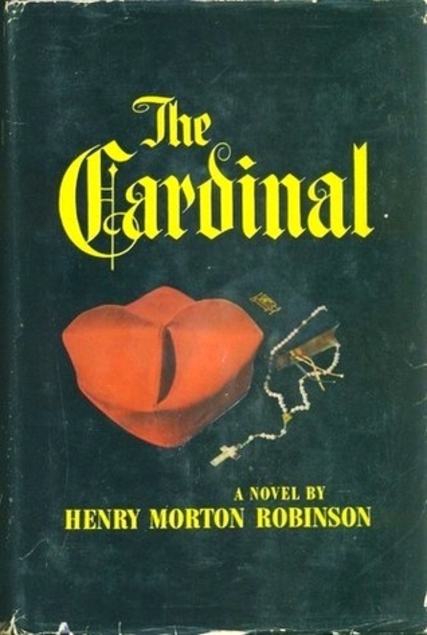
The Cardinal by Henry Morton Robinson (1950)

The American Caravan: A Yearbook Of American Literature by Van Wyck Brooks, Alfred Kreymborg, Lewis Mumford and Paul Rosenfeld (eds.) (1927)
---Anthony Trollope, The Duke's Children: The First Complete Edition (1880)
**********************************************************

**********************************************************
Currently reading:
The Cardinal by Henry Morton Robinson (1950)

The American Caravan: A Yearbook Of American Literature by Van Wyck Brooks, Alfred Kreymborg, Lewis Mumford and Paul Rosenfeld (eds.) (1927)
3lyzard
2019 reading:
January:
1. The Road Back by Erich Maria Remarque (1931)
2. Shadows On The Rock by Willa Cather (1931)
3. Family Trouble by William McFee (1949)
4. Patty's Motor Car by Carolyn Wells (1911)
5. Dr Nikola's Experiment by Guy Newell Boothby (1899)
6. Tragedy At The Unicorn by John Rhode (1928)
7. Juliania; or, The Affectionate Sisters by Elizabeth Sandham (1800)
8. The Crime At The Noah's Ark by Molly Thynne (1931)
9. The Mother-In-Law; or, The Isle Of Rays by E.D.E.N. Southworth (1851)
10. The Monster Of Grammont by George Goodchild (1927)
11. The Robe by Lloyd C. Douglas (1942)
12. The Stoneware Monkey by R. Austin Freeman (1938)
13. Cat Among The Pigeons by Agatha Christie (1959)
14. The Captain Of The Vulture by Mary Elizabeth Braddon (1862)
15. The Mystery Of The Peacock's Eye by Brian Flynn (1928)
February:
16. Belinda by Maria Edgeworth (1801)
17. Tragedy On The Line by John Rhode (1931)
18. The Island Of Dr Moreau by H. G. Wells (1896)
19. Strange Fruit by Lillian Smith (1944)
20. Circus Parade by Jim Tully (1927)
21. The Crouching Beast by Valentine Williams (1928)
22. Eternity Ring by Patricia Wentworth (1948)
23. Charlie Chan Carries On by Earl Derr Biggers (1930)
24. The Adventure Of The Christmas Pudding by Agatha Christie (1960)
25. Broadway Melody Of 1999 by Robert Steiner (1993)
26. The Fallen Angel: Chastity, Class And Women's Reading, 1835-1880 by Sally Mitchell (1981)
27. Farewell, Nikola by Guy Newell Boothby (1901)
March:
28. The Kellys And The O'Kellys; or, Landlords And Tenants by Anthony Trollope (1848)
29. Kenilworth by Walter Scott (1821)
30. The Two Elsies by Martha Finley (1885)
31. Forever Amber by Kathleen Winsor (1944)
32. Number Seventeen by Louis Tracy (1915)
33. The Slip-Carriage Mystery by Lynn Brock (1928)
34. The Hardway Diamonds Mystery by Miles Burton (1930)
35. The Supernatural by Douglas Hill and Pat Williams (1965)
36. The Great God Pan by Arthur Machen (1894)
37. The Pale Horse by Agatha Christie (1961)
38. Rich In Love by Josephine Humphreys (1987)
January:
1. The Road Back by Erich Maria Remarque (1931)
2. Shadows On The Rock by Willa Cather (1931)
3. Family Trouble by William McFee (1949)
4. Patty's Motor Car by Carolyn Wells (1911)
5. Dr Nikola's Experiment by Guy Newell Boothby (1899)
6. Tragedy At The Unicorn by John Rhode (1928)
7. Juliania; or, The Affectionate Sisters by Elizabeth Sandham (1800)
8. The Crime At The Noah's Ark by Molly Thynne (1931)
9. The Mother-In-Law; or, The Isle Of Rays by E.D.E.N. Southworth (1851)
10. The Monster Of Grammont by George Goodchild (1927)
11. The Robe by Lloyd C. Douglas (1942)
12. The Stoneware Monkey by R. Austin Freeman (1938)
13. Cat Among The Pigeons by Agatha Christie (1959)
14. The Captain Of The Vulture by Mary Elizabeth Braddon (1862)
15. The Mystery Of The Peacock's Eye by Brian Flynn (1928)
February:
16. Belinda by Maria Edgeworth (1801)
17. Tragedy On The Line by John Rhode (1931)
18. The Island Of Dr Moreau by H. G. Wells (1896)
19. Strange Fruit by Lillian Smith (1944)
20. Circus Parade by Jim Tully (1927)
21. The Crouching Beast by Valentine Williams (1928)
22. Eternity Ring by Patricia Wentworth (1948)
23. Charlie Chan Carries On by Earl Derr Biggers (1930)
24. The Adventure Of The Christmas Pudding by Agatha Christie (1960)
25. Broadway Melody Of 1999 by Robert Steiner (1993)
26. The Fallen Angel: Chastity, Class And Women's Reading, 1835-1880 by Sally Mitchell (1981)
27. Farewell, Nikola by Guy Newell Boothby (1901)
March:
28. The Kellys And The O'Kellys; or, Landlords And Tenants by Anthony Trollope (1848)
29. Kenilworth by Walter Scott (1821)
30. The Two Elsies by Martha Finley (1885)
31. Forever Amber by Kathleen Winsor (1944)
32. Number Seventeen by Louis Tracy (1915)
33. The Slip-Carriage Mystery by Lynn Brock (1928)
34. The Hardway Diamonds Mystery by Miles Burton (1930)
35. The Supernatural by Douglas Hill and Pat Williams (1965)
36. The Great God Pan by Arthur Machen (1894)
37. The Pale Horse by Agatha Christie (1961)
38. Rich In Love by Josephine Humphreys (1987)
4lyzard
2019 reading:
April:
39. Cone Of Silence by David Beaty (1959)
40. Orca by Arthur Herzog (1977)
41. Hands Unseen by Herman Landon (1924)
42. The Amazing Mr Bunn by Bertram Atkey (1911)
43. Miss Silver Comes To Stay by Patricia Wentworth (1948)
44. The Mirror Crack'd From Side To Side by Agatha Christie (1962)
45. Peril! by Sydney Horler (1930)
46. Mr Polton Explains by R. Austin Freeman (1940)
47. Murder By An Aristocrat by Mignon Eberhart (1932)
48. The King's General by Daphne du Maurier (1946)
49. Miss Parritt Disappears by Valentine Williams (1931)
50. Bread And Vinegar by H. A. Manhood (1931)
51. The Fox Prowls by Valentine Williams (1939)
52. The House Opposite by Elizabeth Kent (1902)
53. Murder In Amityville by Hans Holzer (1979)
54. Anna The Adventuress by E. Phillips Oppenheim (1904)
55. The House Opposite by J. Jefferson Farjeon (1931)
56. Who? by Elizabeth Kent (1912)
May:
57. Wilhelm Meister's Apprenticeship by Johann Wolfgang von Goethe (1796)
58. Home Port by Olive Higgins Prouty (1947)
59. The Clocks by Agatha Christie (1963)
60. The Complete Guide To Mysterious Beings by John A. Keel (1994)
61. The Miracle Of The Bells by Russell Janney (1946)
62. This'll Kill Ya: And Other Dangerous Stories by Harry Wilson (1991)
63. The Jacob Street Mystery by R. Austin Freeman (1942)
64. The Sicilian by "Gabrielli" (Elizabeth Meeke) (1798)
June:
65. Emmeline, The Orphan Of The Castle by Charlotte Smith (1788)
66. The Big Fisherman by Lloyd C. Douglas (1948)
67. The Catherine-Wheel by Patricia Wentworth (1949)
68. A Caribbean Mystery by Agatha Christie (1964)
69. The Adopted by William McFee (1952)
70. Women, Letters, And The Novel by Ruth Perry (1980)
71. Why: The Serial Killer In America by Margaret Cheney (1992)
72. Serial Slaughter: What's Behind America's Murder Epidemic? by Michael Newton (1992)
73. Bracebridge Hall; or, The Humorists by Washington Irving (1822)
74. Patty's Butterfly Days by Carolyn Wells (1912)
July:
75. The Handsome Young Men by Hulbert Footner (1926)
76. The Infidel Father by Jane West (1802)
77. The Three Clerks by Anthony Trollope (1857)
78. Sinuhe The Egyptian by Mika Waltari (1945 / 1949)
79. The Epicurean by Thomas Moore (1827)
80. The Go-Getter: A Story That Tells You How To Be One by Peter B. Kyne (1921)
81. Murdered But Not Dead by Anne Austin (1939)
82. The Maestro Murders by Frances Shelley Wees (1931)
83. Blind Corner by Dornford Yates (1927)
84. At Bertram's Hotel by Agatha Christie (1965)
85. The Sketch Book Of Geoffrey Crayon, Gent. by Washington Irving (1820)
86. Keeper Of The Keys by Earl Derr Biggers (1932)
August:
87. The Sands Of Windee by Arthur Upfield (1931)
88. The Brading Collection by Patricia Wentworth (1950)
89. The Clock Strikes by Leslie Ford (1935)
90. Third Girl by Agatha Christie (1966)
91. Gray Magic by Herman Landon (1925)
92. Many Ways by Margaret Pedler (1931)
April:
39. Cone Of Silence by David Beaty (1959)
40. Orca by Arthur Herzog (1977)
41. Hands Unseen by Herman Landon (1924)
42. The Amazing Mr Bunn by Bertram Atkey (1911)
43. Miss Silver Comes To Stay by Patricia Wentworth (1948)
44. The Mirror Crack'd From Side To Side by Agatha Christie (1962)
45. Peril! by Sydney Horler (1930)
46. Mr Polton Explains by R. Austin Freeman (1940)
47. Murder By An Aristocrat by Mignon Eberhart (1932)
48. The King's General by Daphne du Maurier (1946)
49. Miss Parritt Disappears by Valentine Williams (1931)
50. Bread And Vinegar by H. A. Manhood (1931)
51. The Fox Prowls by Valentine Williams (1939)
52. The House Opposite by Elizabeth Kent (1902)
53. Murder In Amityville by Hans Holzer (1979)
54. Anna The Adventuress by E. Phillips Oppenheim (1904)
55. The House Opposite by J. Jefferson Farjeon (1931)
56. Who? by Elizabeth Kent (1912)
May:
57. Wilhelm Meister's Apprenticeship by Johann Wolfgang von Goethe (1796)
58. Home Port by Olive Higgins Prouty (1947)
59. The Clocks by Agatha Christie (1963)
60. The Complete Guide To Mysterious Beings by John A. Keel (1994)
61. The Miracle Of The Bells by Russell Janney (1946)
62. This'll Kill Ya: And Other Dangerous Stories by Harry Wilson (1991)
63. The Jacob Street Mystery by R. Austin Freeman (1942)
64. The Sicilian by "Gabrielli" (Elizabeth Meeke) (1798)
June:
65. Emmeline, The Orphan Of The Castle by Charlotte Smith (1788)
66. The Big Fisherman by Lloyd C. Douglas (1948)
67. The Catherine-Wheel by Patricia Wentworth (1949)
68. A Caribbean Mystery by Agatha Christie (1964)
69. The Adopted by William McFee (1952)
70. Women, Letters, And The Novel by Ruth Perry (1980)
71. Why: The Serial Killer In America by Margaret Cheney (1992)
72. Serial Slaughter: What's Behind America's Murder Epidemic? by Michael Newton (1992)
73. Bracebridge Hall; or, The Humorists by Washington Irving (1822)
74. Patty's Butterfly Days by Carolyn Wells (1912)
July:
75. The Handsome Young Men by Hulbert Footner (1926)
76. The Infidel Father by Jane West (1802)
77. The Three Clerks by Anthony Trollope (1857)
78. Sinuhe The Egyptian by Mika Waltari (1945 / 1949)
79. The Epicurean by Thomas Moore (1827)
80. The Go-Getter: A Story That Tells You How To Be One by Peter B. Kyne (1921)
81. Murdered But Not Dead by Anne Austin (1939)
82. The Maestro Murders by Frances Shelley Wees (1931)
83. Blind Corner by Dornford Yates (1927)
84. At Bertram's Hotel by Agatha Christie (1965)
85. The Sketch Book Of Geoffrey Crayon, Gent. by Washington Irving (1820)
86. Keeper Of The Keys by Earl Derr Biggers (1932)
August:
87. The Sands Of Windee by Arthur Upfield (1931)
88. The Brading Collection by Patricia Wentworth (1950)
89. The Clock Strikes by Leslie Ford (1935)
90. Third Girl by Agatha Christie (1966)
91. Gray Magic by Herman Landon (1925)
92. Many Ways by Margaret Pedler (1931)
5lyzard
Books in transit:
Library books to collect:
On interlibrary loan / branch transfer / storage / Rare Book request:
The American Caravan by Van Wyck Brooks (ed.) {State Library NSW}
Upcoming requests:
The Spectacles Of Mr Cagliostro (aka The Blue Spectacles) by Harry Stephen Keeler {CARM}
The Creaking Tree Mystery by L. A. Knight {JFR}
Purchased and shipped:
On loan:
Fabia by Olive Higgins Prouty (09/09/2019)
*Many Ways by Margaret Pedler (18/09/2019)
Sex, Politics And Society: The Regulation Of Sexuality Since 1800 by Jeffrey Weeks (20/09/2019)
Wilhelm Meister's Journeyman Years by Johann Goethe (20/09/2019)
The Cardinal by Henry Morton Robinson (04/11/2019)
Thaddeus Of Warsaw by Jane Porter (04/11/2019)
The Adventures Of Hajji Baba Of Ispahan by James Justinian Morier (04/11/2019)
The Social Life Of Fluids: Blood, Milk, And Water In The Victorian Novel by Jules Law (04/11/2019)
Library books to collect:
On interlibrary loan / branch transfer / storage / Rare Book request:
The American Caravan by Van Wyck Brooks (ed.) {State Library NSW}
Upcoming requests:
The Spectacles Of Mr Cagliostro (aka The Blue Spectacles) by Harry Stephen Keeler {CARM}
The Creaking Tree Mystery by L. A. Knight {JFR}
Purchased and shipped:
On loan:
Fabia by Olive Higgins Prouty (09/09/2019)
*Many Ways by Margaret Pedler (18/09/2019)
Sex, Politics And Society: The Regulation Of Sexuality Since 1800 by Jeffrey Weeks (20/09/2019)
Wilhelm Meister's Journeyman Years by Johann Goethe (20/09/2019)
The Cardinal by Henry Morton Robinson (04/11/2019)
Thaddeus Of Warsaw by Jane Porter (04/11/2019)
The Adventures Of Hajji Baba Of Ispahan by James Justinian Morier (04/11/2019)
The Social Life Of Fluids: Blood, Milk, And Water In The Victorian Novel by Jules Law (04/11/2019)
6lyzard
Reading projects 2019:
Blog reads:
Chronobibliography: Leandro; or, The Lucky Rescue by James Smythies
Authors In Depth:
- Forest Of Montalbano by Catherine Cuthbertson
- Shannondale (aka "The Three Beauties; or, Shannondale: A Novel") by E.D.E.N. Southworth
- The Captain Of The Vulture by Mary Elizabeth Braddon / Lady Audley's Secret by Mary Elizabeth Braddon
- Ellesmere by Mrs Meeke
- The Cottage by Margaret Minifie
- The Old Engagement by Julia Day
- The Refugee In America by Frances Trollope
Reading Roulette: Pique by Sarah Stickney Ellis
Australian fiction: Louisa Egerton by Mary Leman Grimstone
Gothic novel timeline: Reginald Du Bray by 'A Late Nobleman'
Early crime fiction: The Mysteries Of London by G. W. M. Reynolds
Silver-fork novels: Sayings And Doings; or, Sketches From Life (First Series) by Theodore Hook
Related reading: Gains And Losses by Robert Lee Wollf / The Man Of Feeling by Henry Mackenzie / Le Loup Blanc by Paul Féval / Theresa Marchmont; or, The Maid Of Honour by Catherine Gore
Group / tutored reads:
NOW: The Three Clerks by Anthony Trollope (thread here)
Completed: Belinda by Maria Edgeworth (thread here)
Completed: The Kellys And The O'Kellys by Anthony Trollope (thread here)
Completed: Emmeline, The Orphan Of The Castle by Charlotte Smith (thread here)
General reading challenges:
America's best-selling novels (1895 - ????):
Next up: The Cardinal by Henry Morton Robinson
Virago chronological reading project:
Next up: The Semi-Attached Couple; and The Semi-Detached House by Emily Eden
Agatha Christie mysteries in chronological order:
Next up: Endless Night
The C.K. Shorter List of Best 100 Novels:
Next up: Wilhelm Meister by Johann Wolfgang von Goethe / The Adventures Of Hajji Baba Of Ispahan by James Morier
Mystery League publications:
Next up: Turmoil At Brede by Seldon Truss
Banned In Boston!:
Next up: American Caravan by Van Wyck Brooks, Alfred Kreymborg, Lewis Mumford and Paul Rosenfeld (eds.)
The evolution of detective fiction:
Next up: The Mysteries Of London (Volume III) by G. W. M. Reynolds
Random reading 1940 - 1969:
Next up: Brideshead Revisited by Evelyn Waugh / B.F.'s Daughter by John P. Marquand
Potential decommission:
Next up: They Who Do Not Grieve by Sia Figiel
Potential decommission (non-fiction):
Next up: Faces In The Smoke by Douchan Gersi
Completed challenges:
Georgette Heyer historical romances in chronological order
Possible future reading projects:
- Georgette Heyer's historical fiction
- Nobel Prize winners who won for fiction
- Daily Telegraph's 100 Best Novels, 1899
- James Tait Black Memorial Prize
- Berkeley "Books Of The Century"
- Collins White Circle Crime Club / Green Penguins
- Dell paperbacks
- "El Mundo" 100 best novels of the twentieth century
- 100 Best Books by American Women During the Past 100 Years, 1833-1933
- 50 Classics of Crime Fiction 1900–1950 (Jacques Barzun and Wendell Hertig Taylor)
- The Guardian's 100 Best Novels
- Life Magazine "The 100 Outstanding Books of 1924 - 1944" (Henry Seidel Canby)
- "40 Trashy Novels You Must Read Before You Die" (Flavorwire)
- best-novel lists in Wikipedia article on The Grapes Of Wrath
- Pandora 'Mothers Of The Novel'
Blog reads:
Chronobibliography: Leandro; or, The Lucky Rescue by James Smythies
Authors In Depth:
- Forest Of Montalbano by Catherine Cuthbertson
- Shannondale (aka "The Three Beauties; or, Shannondale: A Novel") by E.D.E.N. Southworth
- The Captain Of The Vulture by Mary Elizabeth Braddon / Lady Audley's Secret by Mary Elizabeth Braddon
- Ellesmere by Mrs Meeke
- The Cottage by Margaret Minifie
- The Old Engagement by Julia Day
- The Refugee In America by Frances Trollope
Reading Roulette: Pique by Sarah Stickney Ellis
Australian fiction: Louisa Egerton by Mary Leman Grimstone
Gothic novel timeline: Reginald Du Bray by 'A Late Nobleman'
Early crime fiction: The Mysteries Of London by G. W. M. Reynolds
Silver-fork novels: Sayings And Doings; or, Sketches From Life (First Series) by Theodore Hook
Related reading: Gains And Losses by Robert Lee Wollf / The Man Of Feeling by Henry Mackenzie / Le Loup Blanc by Paul Féval / Theresa Marchmont; or, The Maid Of Honour by Catherine Gore
Group / tutored reads:
NOW: The Three Clerks by Anthony Trollope (thread here)
Completed: Belinda by Maria Edgeworth (thread here)
Completed: The Kellys And The O'Kellys by Anthony Trollope (thread here)
Completed: Emmeline, The Orphan Of The Castle by Charlotte Smith (thread here)
General reading challenges:
America's best-selling novels (1895 - ????):
Next up: The Cardinal by Henry Morton Robinson
Virago chronological reading project:
Next up: The Semi-Attached Couple; and The Semi-Detached House by Emily Eden
Agatha Christie mysteries in chronological order:
Next up: Endless Night
The C.K. Shorter List of Best 100 Novels:
Next up: Wilhelm Meister by Johann Wolfgang von Goethe / The Adventures Of Hajji Baba Of Ispahan by James Morier
Mystery League publications:
Next up: Turmoil At Brede by Seldon Truss
Banned In Boston!:
Next up: American Caravan by Van Wyck Brooks, Alfred Kreymborg, Lewis Mumford and Paul Rosenfeld (eds.)
The evolution of detective fiction:
Next up: The Mysteries Of London (Volume III) by G. W. M. Reynolds
Random reading 1940 - 1969:
Next up: Brideshead Revisited by Evelyn Waugh / B.F.'s Daughter by John P. Marquand
Potential decommission:
Next up: They Who Do Not Grieve by Sia Figiel
Potential decommission (non-fiction):
Next up: Faces In The Smoke by Douchan Gersi
Completed challenges:
Georgette Heyer historical romances in chronological order
Possible future reading projects:
- Georgette Heyer's historical fiction
- Nobel Prize winners who won for fiction
- Daily Telegraph's 100 Best Novels, 1899
- James Tait Black Memorial Prize
- Berkeley "Books Of The Century"
- Collins White Circle Crime Club / Green Penguins
- Dell paperbacks
- "El Mundo" 100 best novels of the twentieth century
- 100 Best Books by American Women During the Past 100 Years, 1833-1933
- 50 Classics of Crime Fiction 1900–1950 (Jacques Barzun and Wendell Hertig Taylor)
- The Guardian's 100 Best Novels
- Life Magazine "The 100 Outstanding Books of 1924 - 1944" (Henry Seidel Canby)
- "40 Trashy Novels You Must Read Before You Die" (Flavorwire)
- best-novel lists in Wikipedia article on The Grapes Of Wrath
- Pandora 'Mothers Of The Novel'
7lyzard
TBR notes:
Currently 'missing' series works:
Mystery At Greycombe Farm by John Rhode (Dr Priestley #12) {Rare Books}
Dead Men At The Folly by John Rhode (Dr Priestley #13) {Rare Books}
The Robthorne Mystery by John Rhode (Dr Priestley #17) {Rare Books / State Library NSW, held}
Poison For One by John Rhode (Dr Priestley #18) {Rare Books / State Library NSW, held}
Shot At Dawn by John Rhode (Dr Priestley #19) {Rare Books}
The Corpse In The Car by John Rhode (Dr Priestley #20) {CARM}
Hendon's First Case by John Rhode (Dr Priestley #21) {Rare Books}
Mystery At Olympia (aka "Murder At The Motor Show") (Dr Priestley #22) {Kindle / State Library NSW, held}
In Face Of The Verdict by John Rhode (Dr Priestley #24) {Rare Books / State Library NSW, held}
Six Minutes Past Twelve by Gavin Holt (Luther Bastion #1) {State Library NSW, held}
The White-Faced Man by Gavin Holt (Luther Bastion #2) {State Library NSW, held}
Secret Judges by Francis D. Grierson (Sims and Wells #2) {Rare Books}
The Platinum Cat by Miles Burton (Desmond Merrion #17 / Inspector Arnold #18) {Rare Books}
The Double-Thirteen Mystery by Anthony Wynne (Dr Eustace Hailey #2) {Rare Books}
The Black Death by Moray Dalton {CARM}
1931:
My Desert Friend And Other Stories by Robert Hichens {Ill / JFR}
The Creaking Tree Mystery by L. A. Knight {ILL / JFR}
The Murderer Invisible by Philip Wylie {Rare Books}
The Back-Seat Murder by Herman Landon {Rare Books}
One-Man Girl by Maisie Greig {Mitchell Library}
Cameos by Octavus Roy Cohen {State Library NSW}
The Matilda Hunter Murder by Harry Stephen Keeler {Kindle}
Death By Appointment by "Francis Bonnamy" (Audrey Walz) (Peter Utley Shane #1) {Rare Books}
The Bell Street Murders by Sydney Fowler (S. Fowler Wright) (Inspector Cambridge and Mr Jellipot #1) {Rare Books}
The Murderer Returns by Edwin Dial Torgerson (Pierre Montigny #1) {Rare Books}
NB: Rest of 1931 listed on the Wiki
Completist reading:
The Spectacles Of Mr Cagliostro (aka The Blue Spectacles) by Harry Stephen Keeler (#3) {CARM}
The Bertrams by Anthony Trollope (#7) {owned}
XYZ by Anna Katharine Green {Project Gutenberg}
The Circular Staircase by Mary Roberts Rinehart {Project Gutenberg}
The White Cockatoo by Mignon Eberhart
Shopping list:
Expensive:
The Amber Junk (aka The Riddle Of The Amber Ship) by Hazel Phillips Hanshew (Cleek #9)
The Hawkmoor Mystery by W. H. Lane Crauford
Dead Man's Hat by Hulbert Footner
October House by Kay Cleaver Strahan (Lynn MacDonald #4)
The Double Thumb by Francis Grierson (Sims and Wells #3)
The Mystery Of The Open Window by Anthony Gilbert (Scott Egerton #4)
The Mystery Of The Creeping Man by Frances Shelley Wees (Michael Forrester #2)
The Shadow Of Evil by Charles J. Dutton (Harley Manners #2)
The Seventh Passenger by Alice MacGowan and Perry Newberry (Jerry Boyne #4)
The Daughter Of The House by Carolyn Wells (Fleming Stone #19)
The Pelham Murder Case by Monte Barrett (Peter Cardigan #1)
Prove It, Mr Tolefree (aka "The Tolliver Case") by R. A. J. Walling (Philip Tolefree #3)
The Hanging Woman by John Rhode (Dr Priestley #11)
Currently 'missing' series works:
Mystery At Greycombe Farm by John Rhode (Dr Priestley #12) {Rare Books}
Dead Men At The Folly by John Rhode (Dr Priestley #13) {Rare Books}
The Robthorne Mystery by John Rhode (Dr Priestley #17) {Rare Books / State Library NSW, held}
Poison For One by John Rhode (Dr Priestley #18) {Rare Books / State Library NSW, held}
Shot At Dawn by John Rhode (Dr Priestley #19) {Rare Books}
The Corpse In The Car by John Rhode (Dr Priestley #20) {CARM}
Hendon's First Case by John Rhode (Dr Priestley #21) {Rare Books}
Mystery At Olympia (aka "Murder At The Motor Show") (Dr Priestley #22) {Kindle / State Library NSW, held}
In Face Of The Verdict by John Rhode (Dr Priestley #24) {Rare Books / State Library NSW, held}
Six Minutes Past Twelve by Gavin Holt (Luther Bastion #1) {State Library NSW, held}
The White-Faced Man by Gavin Holt (Luther Bastion #2) {State Library NSW, held}
Secret Judges by Francis D. Grierson (Sims and Wells #2) {Rare Books}
The Platinum Cat by Miles Burton (Desmond Merrion #17 / Inspector Arnold #18) {Rare Books}
The Double-Thirteen Mystery by Anthony Wynne (Dr Eustace Hailey #2) {Rare Books}
The Black Death by Moray Dalton {CARM}
1931:
My Desert Friend And Other Stories by Robert Hichens {Ill / JFR}
The Creaking Tree Mystery by L. A. Knight {ILL / JFR}
The Murderer Invisible by Philip Wylie {Rare Books}
The Back-Seat Murder by Herman Landon {Rare Books}
One-Man Girl by Maisie Greig {Mitchell Library}
Cameos by Octavus Roy Cohen {State Library NSW}
The Matilda Hunter Murder by Harry Stephen Keeler {Kindle}
Death By Appointment by "Francis Bonnamy" (Audrey Walz) (Peter Utley Shane #1) {Rare Books}
The Bell Street Murders by Sydney Fowler (S. Fowler Wright) (Inspector Cambridge and Mr Jellipot #1) {Rare Books}
The Murderer Returns by Edwin Dial Torgerson (Pierre Montigny #1) {Rare Books}
NB: Rest of 1931 listed on the Wiki
Completist reading:
The Spectacles Of Mr Cagliostro (aka The Blue Spectacles) by Harry Stephen Keeler (#3) {CARM}
The Bertrams by Anthony Trollope (#7) {owned}
XYZ by Anna Katharine Green {Project Gutenberg}
The Circular Staircase by Mary Roberts Rinehart {Project Gutenberg}
The White Cockatoo by Mignon Eberhart
Shopping list:
Expensive:
The Amber Junk (aka The Riddle Of The Amber Ship) by Hazel Phillips Hanshew (Cleek #9)
The Hawkmoor Mystery by W. H. Lane Crauford
Dead Man's Hat by Hulbert Footner
October House by Kay Cleaver Strahan (Lynn MacDonald #4)
The Double Thumb by Francis Grierson (Sims and Wells #3)
The Mystery Of The Open Window by Anthony Gilbert (Scott Egerton #4)
The Mystery Of The Creeping Man by Frances Shelley Wees (Michael Forrester #2)
The Shadow Of Evil by Charles J. Dutton (Harley Manners #2)
The Seventh Passenger by Alice MacGowan and Perry Newberry (Jerry Boyne #4)
The Daughter Of The House by Carolyn Wells (Fleming Stone #19)
The Pelham Murder Case by Monte Barrett (Peter Cardigan #1)
Prove It, Mr Tolefree (aka "The Tolliver Case") by R. A. J. Walling (Philip Tolefree #3)
The Hanging Woman by John Rhode (Dr Priestley #11)
8lyzard
A Century (And A Bit) Of Reading:
A book a year from 1800 - 1900!
1800: Juliania; or, The Affectionate Sisters by Elizabeth Sandham
1801: Belinda by Maria Edgeworth
1802: The Infidel Father by Jane West
1807: Corinne; ou, l'Italie by Madame de Staël
1809: The Scottish Chiefs by Jane Porter
1812: The Absentee by Maria Edgeworth
1814: The Wanderer; or, Female Difficulties by Frances Burney
1815: Headlong Hall by Thomas Love Peacock
1820: The Sketch Book Of Geoffrey Crayon, Gent. by Washington Irving
1821: The Ayrshire Legatees; or, The Pringle Family by John Galt / Valerius: A Roman Story by J. G. Lockhart / Kenilworth by Walter Scott
1822: Bracebridge Hall; or, The Humorists by Washington Irving
1827: The Epicurean by Thomas Moore
1836: The Tree And Its Fruits; or, Narratives From Real Life by Phoebe Hinsdale Brown
1845: Zoe: The History Of Two Lives by Geraldine Jewsbury / The Mysteries Of London (Volume I) by G. W. M. Reynolds
1846: The Mysteries Of London (Volume II) by G. W. M. Reynolds
1847: Agnes Grey by Anne Brontë / The Macdermots Of Ballycloran by Anthony Trollope
1848: The Kellys And The O'Kellys by Anthony Trollope
1851: The Mother-In-Law; or, The Isle Of Rays by E.D.E.N. Southworth
1857: The Three Clerks by Anthony Trollope
1859: The Semi-Detached House by Emily Eden
1860: The Semi-Attached Couple by Emily Eden
1869: He Knew He Was Right by Anthony Trollope
1873: Had You Been In His Place by Lizzie Bates
1877: Elsie's Children by Martha Finley
1880: The Duke's Children: First Complete Edition by Anthony Trollope / Elsie's Widowhood by Martha Finley
1881: Ghosts by Henrik Ibsen / The Beautiful Wretch by William Black
1882: Grandmother Elsie by Martha Finley
1883: Elsie's New Relations by Martha Finley
1884: Elsie At Nantucket by Martha Finley
1885: The Two Elsies by Martha Finley
1894: Martin Hewitt, Investigator by Arthur Morrison / The Great God Pan by Arthur Machen
1896: The Island Of Dr Moreau by H. G. Wells
1897: Penelope's Progress by Kate Douglas Wiggin
1898: A Man From The North by Arnold Bennett / The Lust Of Hate by Guy Newell Boothby
1899: Agatha Webb by Anna Katharine Green / Dr Nikola's Experiment by Guy Newell Boothby
1900: The Circular Study by Anna Katharine Green
A book a year from 1800 - 1900!
1800: Juliania; or, The Affectionate Sisters by Elizabeth Sandham
1801: Belinda by Maria Edgeworth
1802: The Infidel Father by Jane West
1807: Corinne; ou, l'Italie by Madame de Staël
1809: The Scottish Chiefs by Jane Porter
1812: The Absentee by Maria Edgeworth
1814: The Wanderer; or, Female Difficulties by Frances Burney
1815: Headlong Hall by Thomas Love Peacock
1820: The Sketch Book Of Geoffrey Crayon, Gent. by Washington Irving
1821: The Ayrshire Legatees; or, The Pringle Family by John Galt / Valerius: A Roman Story by J. G. Lockhart / Kenilworth by Walter Scott
1822: Bracebridge Hall; or, The Humorists by Washington Irving
1827: The Epicurean by Thomas Moore
1836: The Tree And Its Fruits; or, Narratives From Real Life by Phoebe Hinsdale Brown
1845: Zoe: The History Of Two Lives by Geraldine Jewsbury / The Mysteries Of London (Volume I) by G. W. M. Reynolds
1846: The Mysteries Of London (Volume II) by G. W. M. Reynolds
1847: Agnes Grey by Anne Brontë / The Macdermots Of Ballycloran by Anthony Trollope
1848: The Kellys And The O'Kellys by Anthony Trollope
1851: The Mother-In-Law; or, The Isle Of Rays by E.D.E.N. Southworth
1857: The Three Clerks by Anthony Trollope
1859: The Semi-Detached House by Emily Eden
1860: The Semi-Attached Couple by Emily Eden
1869: He Knew He Was Right by Anthony Trollope
1873: Had You Been In His Place by Lizzie Bates
1877: Elsie's Children by Martha Finley
1880: The Duke's Children: First Complete Edition by Anthony Trollope / Elsie's Widowhood by Martha Finley
1881: Ghosts by Henrik Ibsen / The Beautiful Wretch by William Black
1882: Grandmother Elsie by Martha Finley
1883: Elsie's New Relations by Martha Finley
1884: Elsie At Nantucket by Martha Finley
1885: The Two Elsies by Martha Finley
1894: Martin Hewitt, Investigator by Arthur Morrison / The Great God Pan by Arthur Machen
1896: The Island Of Dr Moreau by H. G. Wells
1897: Penelope's Progress by Kate Douglas Wiggin
1898: A Man From The North by Arnold Bennett / The Lust Of Hate by Guy Newell Boothby
1899: Agatha Webb by Anna Katharine Green / Dr Nikola's Experiment by Guy Newell Boothby
1900: The Circular Study by Anna Katharine Green
9lyzard
Timeline of detective fiction:
Pre-history:
Things As They Are; or, The Adventures Of Caleb Williams by William Godwin (1794)
Mademoiselle de Scudéri by E. T. A. Hoffmann (1819); Tales Of Hoffmann (1982)
Richmond: Scenes In The Life Of A Bow Street Officer by Anonymous (1827)
Memoirs Of Vidocq by Eugene Francois Vidocq (1828)
Le Pere Goriot by Honore de Balzac (1835)
Passages In The Secret History Of An Irish Countess by J. Sheridan Le Fanu (1838); The Purcell Papers (1880)
The Murders In The Rue Morgue: The Dupin Tales by Edgar Allan Poe (1841, 1842, 1845)
Serials:
The Mysteries Of Paris by Eugene Sue (1842 - 1843)
The Mysteries Of London - Paul Feval (1844)
The Mysteries Of London - George Reynolds (1844 - 1848)
The Mysteries Of The Court Of London - George Reynolds (1848 - 1856)
John Devil by Paul Feval (1861)
Early detective novels:
Recollections Of A Detective Police-Officer by "Waters" (William Russell) (1856)
The Widow Lerouge by Emile Gaboriau (1866)
Under Lock And Key by T. W. Speight (1869)
Checkmate by J. Sheridan LeFanu (1871)
Is He The Man? by William Clark Russell (1876)
Devlin The Barber by B. J. Farjeon (1888)
Mr Meeson's Will by H. Rider Haggard (1888)
The Mystery Of A Hansom Cab by Fergus Hume (1889)
The Queen Anne's Gate Mystery by Richard Arkwright (1889)
The Ivory Queen by Norman Hurst (1889) (Check Julius H. Hurst 1899)
The Big Bow Mystery by Israel Zangwill (1892)
Female detectives:
The Diary Of Anne Rodway by Wilkie Collins (1856)
Ruth The Betrayer; or, The Female Spy by Edward Ellis (!862-1863)
The Female Detective by Andrew Forrester (1864)
Revelations Of A Lady Detective by William Stephens Hayward (1864)
The Law And The Lady by Wilkie Collins (1875)
Madeline Payne; or, The Detective's Daughter by Lawrence L. Lynch (Emma Murdoch Van Deventer) (1884)
Mr Bazalgette's Agent by Leonard Merrick (1888)
Moina; or, Against The Mighty by Lawrence L. Lynch (Emma Murdoch Van Deventer) (sequel to Madeline Payne?) (1891)
The Experiences Of Loveday Brooke, Lady Detective by Catherine Louisa Pirkis (1893)
When The Sea Gives Up Its Dead by Elizaberth Burgoyne Corbett (Mrs George Corbett)
Dorcas Dene, Detective by George Sims (1897)
- Amelia Butterworth series by Anna Katharine Grant (1897 - 1900)
Hagar Of The Pawn-Shop by Fergus Hume (1898)
The Adventures Of A Lady Pearl-Broker by Beatrice Heron-Maxwell (1899)
Miss Cayley's Adventures by Grant Allan (1899)
Hilda Wade by Grant Allan (1900)
Dora Myrl, The Lady Detective by M. McDonnel Bodkin (1900)
The Investigators by J. S. Fletcher (1902)
Lady Molly Of Scotland Yard by Baroness Orczy (1910)
Constance Dunlap, Woman Detective by Arthur B. Reeve (1913)
Related mainstream works:
Adventures Of Susan Hopley by Catherine Crowe (1841)
Men And Women; or, Manorial Rights by Catherine Crowe (1843)
Hargrave by Frances Trollope (1843)
Clement Lorimer by Angus Reach (1849)
True crime:
Clues: or, Leaves from a Chief Constable's Note Book by Sir William Henderson (1889)
Dreadful Deeds And Awful Murders by Joan Lock
Pre-history:
Serials:
The Mysteries Of London - George Reynolds (1844 - 1848)
The Mysteries Of The Court Of London - George Reynolds (1848 - 1856)
John Devil by Paul Feval (1861)
Early detective novels:
Recollections Of A Detective Police-Officer by "Waters" (William Russell) (1856)
The Widow Lerouge by Emile Gaboriau (1866)
Under Lock And Key by T. W. Speight (1869)
Checkmate by J. Sheridan LeFanu (1871)
Is He The Man? by William Clark Russell (1876)
Devlin The Barber by B. J. Farjeon (1888)
Mr Meeson's Will by H. Rider Haggard (1888)
The Mystery Of A Hansom Cab by Fergus Hume (1889)
The Queen Anne's Gate Mystery by Richard Arkwright (1889)
The Ivory Queen by Norman Hurst (1889) (Check Julius H. Hurst 1899)
The Big Bow Mystery by Israel Zangwill (1892)
Female detectives:
The Diary Of Anne Rodway by Wilkie Collins (1856)
Ruth The Betrayer; or, The Female Spy by Edward Ellis (!862-1863)
The Female Detective by Andrew Forrester (1864)
Revelations Of A Lady Detective by William Stephens Hayward (1864)
Madeline Payne; or, The Detective's Daughter by Lawrence L. Lynch (Emma Murdoch Van Deventer) (1884)
Mr Bazalgette's Agent by Leonard Merrick (1888)
Moina; or, Against The Mighty by Lawrence L. Lynch (Emma Murdoch Van Deventer) (sequel to Madeline Payne?) (1891)
The Experiences Of Loveday Brooke, Lady Detective by Catherine Louisa Pirkis (1893)
When The Sea Gives Up Its Dead by Elizaberth Burgoyne Corbett (Mrs George Corbett)
Dorcas Dene, Detective by George Sims (1897)
Hagar Of The Pawn-Shop by Fergus Hume (1898)
The Adventures Of A Lady Pearl-Broker by Beatrice Heron-Maxwell (1899)
Miss Cayley's Adventures by Grant Allan (1899)
Hilda Wade by Grant Allan (1900)
Dora Myrl, The Lady Detective by M. McDonnel Bodkin (1900)
The Investigators by J. S. Fletcher (1902)
Lady Molly Of Scotland Yard by Baroness Orczy (1910)
Constance Dunlap, Woman Detective by Arthur B. Reeve (1913)
Related mainstream works:
Clement Lorimer by Angus Reach (1849)
True crime:
Clues: or, Leaves from a Chief Constable's Note Book by Sir William Henderson (1889)
10lyzard
Series and sequels, 1866 - 1919:
(1866 - 1876) **Emile Gaboriau - Monsieur Lecoq - The Widow Lerouge (1/6) {ManyBooks}
(1867 - 1905) **Martha Finley - Elsie Dinsmore - Elsie's Kith And Kin (12/28) {Project Gutenberg}
(1867 - 1872) **George MacDonald - The Seaboard Parish - Annals Of A Quiet Neighbourhood (1/3) {ManyBooks}
(1878 - 1917) **Anna Katharine Green - Ebenezer Gryce - The Mystery Of The Hasty Arrow (13/13) {Project Gutenberg}
(1896 - 1909) **Melville Davisson Post - Randolph Mason - The Corrector Of Destinies (3/3) {Internet Archive}
(1893 - 1915) **Kate Douglas Wiggins - Penelope - Penelope's Postscripts (4/4) {Project Gutenberg}
(1894 - 1898) **Anthony Hope - Ruritania - Rupert Of Hentzau (3/3) {Project Gutenberg}
(1894 - 1903) **Arthur Morrison - Martin Hewitt - Chronicles Of Martin Hewitt (2/4) {Roy Glashan's Library}
(1895 - 1901) **Guy Newell Boothby - Dr Nikola - Farewell, Nikola (5/5) {Roy Glashan's Library}
(1897 - 1900) **Anna Katharine Green - Amelia Butterworth - The Circular Study (3/3) {Project Gutenberg}
(1898 - 1918) **Arnold Bennett - Five Towns - Anna Of The Five Towns (2/11) {Sutherland Library}
(1899 - 1917) **Anna Katharine Green - Caleb Sweetwater - The Mystery Of The Hasty Arrow (7/7) {Project Gutenberg}
(1899 - 1909) **E. W. Hornung - Raffles - Mr Justice Raffles (4/4) {Project Gutenberg}
(1900 - 1974) Ernest Bramah - Kai Lung - Kai Lung: Six / Kai Lung Raises His Voice (7/7) {Kindle}
(1901 - 1919) **Carolyn Wells - Patty Fairfield - Patty's Social Season (11/17) {Project Gutenberg}
(1901 - 1927) **George Barr McCutcheon - Graustark - Beverly Of Graustark (2/6) {Project Gutenberg}
(1903 - 1904) **Louis Tracy - Reginald Brett - The Albert Gate Mystery (2/2) {ManyBooks}
(1905 - 1925) **Baroness Orczy - The Old Man In The Corner - Unravelled Knots (3/3) {Project Gutenberg Australia}}
(1905 - 1928) **Edgar Wallace - The Just Men - Again The Three Just Men (6/6) {Roy Glashan's Library}
(1906 - 1930) **John Galsworthy - The Forsyte Saga - To Let (5/11) {Project Gutenberg}
(1907 - 1912) **Carolyn Wells - Marjorie - Marjorie's Vacation (1/6) {ManyBooks}
(1907 - 1942) R. Austin Freeman - Dr John Thorndyke - The Jacob Street Mystery (26/26) {Roy Glashan's Library}
(1907 - 1941) *Maurice Leblanc - Arsene Lupin - The Hollow Needle (3/21) {ManyBooks}
(1908 - 1924) **Margaret Penrose - Dorothy Dale - Dorothy Dale: A Girl Of Today (1/13) {ManyBooks}
(1909 - 1942) *Carolyn Wells - Fleming Stone - The Daughter Of The House (19/49) {expensive}
(1909 - 1929) *J. S. Fletcher - Inspector Skarratt - Marchester Royal (1/3) {Kindle}
(1909 - 1912) **Emerson Hough - Western Trilogy - 54-40 Or Fight (1/3) {Project Gutenberg}
(1910 - 1936) *Arthur B. Reeve - Craig Kennedy - The Adventuress (10/24) {ILL}
(1910 - 1946) A. E. W. Mason - Inspector Hanaud - The House In Lordship Lane (7/7) {Roy Glashan's Library}
(1910 - 1917) ***Edgar Wallace - Inspector Smith - Kate Plus Ten (3/3) {Project Gutenberg Australia}
(1910 - 1930) **Edgar Wallace - Inspector Elk - The Joker (3/6?) {ManyBooks}
(1910 - 1932) *Thomas, Mary and Hazel Hanshew - Cleek - The Amber Junk (9/12) {AbeBooks}
(1910 - 1918) **John McIntyre - Ashton-Kirk - Ashton-Kirk: Criminologist (4/4) {Project Gutenberg}
(1910 - 1931) Grace S. Richmond - Red Pepper Burns - Red Pepper Returns (6/6) {Internet Archive}
(1910 - 1933) Jeffery Farnol - The Vibarts - The Way Beyond (3/3) {Fisher Library storage / fadedpage.com}
(1910 - 1928) **Louis Tracy - Winter and Furneaux - The de Bercy Affair (1/9) / The Postmaster's Daughter (5/9) {Project Gutenberg}
(1911 - 1935) G. K. Chesterton - Father Brown - The Scandal Of Father Brown (5/5) {branch transfer}
(1911 - 1937) Mary Roberts Rinehart - Letitia Carberry - Tish Marches On (5/5) {Kindle}
(1911 - 1919) **Alfred Bishop Mason - Tom Strong - Tom Strong, Lincoln's Scout (5/5) {Project Gutenberg}
(1911 - 1940) *Bertram Atkey - Smiler Bunn - The Smiler Bunn Brigade (2/10) {rare, expensive}
(1912 - 1919) **Gordon Holmes (Louis Tracy) - Steingall and Clancy - The Bartlett Mystery (3/3) {ManyBooks}
(1913 - 1934) *Alice B. Emerson - Ruth Fielding - Ruth Fielding In The Far North (20/30) {expensive}
(1913 - 1973) Sax Rohmer - Fu-Manchu - The Bride Of Fu-Manchu (6/14) {interlibrary loan / Kindle}
(1913 - 1952) *Jeffery Farnol - Jasper Shrig - The High Adventure (4/9) {State Library NSW, JFR / Rare Books}
(1914 - 1950) Mary Roberts Rinehart - Hilda Adams - Episode Of The Wandering Knife (5/5) Better World Books}
(1914 - 1934) Ernest Bramah - Max Carrados - The Bravo Of London (5/5) {Roy Glashan's Library}
(1916 - 1941) John Buchan - Edward Leithen - Sick Heart River (5/5) {Fisher Library}
(1915 - 1936) *John Buchan - Richard Hannay - The Thirty-Nine Steps (1/5) {Fisher Library / Project Gutenberg / branch transfer / Kindle}
(1915 - 1923) **Booth Tarkington - Growth - The Magnificent Ambersons (2/3) {Project Gutenberg / Fisher Library / Kindle}
(1916 - 1917) **Carolyn Wells - Alan Ford - Faulkner's Folly (2/2) {owned}
(1916 - 1927) **Natalie Sumner Lincoln - Inspector Mitchell - The Nameless Man (2/10) {AbeBooks}
(1916 - 1917) **Nevil Monroe Hopkins - Mason Brant - The Strange Cases Of Mason Brant (1/2) {Coachwhip Books}
(1917 - 1929) **Henry Handel Richardson - Dr Richard Mahony - Australia Felix (1/3) {Fisher Library / Kindle}
(1918 - 1923) **Carolyn Wells - Pennington Wise - The Come Back (4/8) {Project Gutenberg}
(1918 - 1939) Valentine Williams - The Okewood Brothers - The Gold Comfit Box (6/?) {Roy Glashan's Library}
(1918 - 1944) Valentine Williams - Clubfoot - The Gold Comfit Box (6/8) {Roy Glashan's Library}
(1918 - 1950) *Wyndham Martyn - Anthony Trent - The Mysterious Mr Garland (3/26) {CARM}
(1919 - 1966) *Lee Thayer - Peter Clancy - The Key (6/60) {expensive / Rare Books}
(1919 - 1921) **Octavus Roy Cohen - David Carroll - The Crimson Alibi (1/3) {Rare Books / HathiTrust}
*** Incompletely available series
** Series complete pre-1931
* Present status pre-1931
(1866 - 1876) **Emile Gaboriau - Monsieur Lecoq - The Widow Lerouge (1/6) {ManyBooks}
(1867 - 1905) **Martha Finley - Elsie Dinsmore - Elsie's Kith And Kin (12/28) {Project Gutenberg}
(1867 - 1872) **George MacDonald - The Seaboard Parish - Annals Of A Quiet Neighbourhood (1/3) {ManyBooks}
(1894 - 1903) **Arthur Morrison - Martin Hewitt - Chronicles Of Martin Hewitt (2/4) {Roy Glashan's Library}
(1898 - 1918) **Arnold Bennett - Five Towns - Anna Of The Five Towns (2/11) {Sutherland Library}
(1901 - 1919) **Carolyn Wells - Patty Fairfield - Patty's Social Season (11/17) {Project Gutenberg}
(1901 - 1927) **George Barr McCutcheon - Graustark - Beverly Of Graustark (2/6) {Project Gutenberg}
(1906 - 1930) **John Galsworthy - The Forsyte Saga - To Let (5/11) {Project Gutenberg}
(1907 - 1912) **Carolyn Wells - Marjorie - Marjorie's Vacation (1/6) {ManyBooks}
(1907 - 1941) *Maurice Leblanc - Arsene Lupin - The Hollow Needle (3/21) {ManyBooks}
(1908 - 1924) **Margaret Penrose - Dorothy Dale - Dorothy Dale: A Girl Of Today (1/13) {ManyBooks}
(1909 - 1942) *Carolyn Wells - Fleming Stone - The Daughter Of The House (19/49) {expensive}
(1909 - 1929) *J. S. Fletcher - Inspector Skarratt - Marchester Royal (1/3) {Kindle}
(1909 - 1912) **Emerson Hough - Western Trilogy - 54-40 Or Fight (1/3) {Project Gutenberg}
(1910 - 1936) *Arthur B. Reeve - Craig Kennedy - The Adventuress (10/24) {ILL}
(1910 - 1930) **Edgar Wallace - Inspector Elk - The Joker (3/6?) {ManyBooks}
(1910 - 1932) *Thomas, Mary and Hazel Hanshew - Cleek - The Amber Junk (9/12) {AbeBooks}
(1910 - 1933) Jeffery Farnol - The Vibarts - The Way Beyond (3/3) {Fisher Library storage / fadedpage.com}
(1910 - 1928) **Louis Tracy - Winter and Furneaux - The de Bercy Affair (1/9) / The Postmaster's Daughter (5/9) {Project Gutenberg}
(1911 - 1940) *Bertram Atkey - Smiler Bunn - The Smiler Bunn Brigade (2/10) {rare, expensive}
(1913 - 1934) *Alice B. Emerson - Ruth Fielding - Ruth Fielding In The Far North (20/30) {expensive}
(1913 - 1973) Sax Rohmer - Fu-Manchu - The Bride Of Fu-Manchu (6/14) {interlibrary loan / Kindle}
(1913 - 1952) *Jeffery Farnol - Jasper Shrig - The High Adventure (4/9) {State Library NSW, JFR / Rare Books}
(1915 - 1936) *John Buchan - Richard Hannay - The Thirty-Nine Steps (1/5) {Fisher Library / Project Gutenberg / branch transfer / Kindle}
(1915 - 1923) **Booth Tarkington - Growth - The Magnificent Ambersons (2/3) {Project Gutenberg / Fisher Library / Kindle}
(1916 - 1927) **Natalie Sumner Lincoln - Inspector Mitchell - The Nameless Man (2/10) {AbeBooks}
(1916 - 1917) **Nevil Monroe Hopkins - Mason Brant - The Strange Cases Of Mason Brant (1/2) {Coachwhip Books}
(1917 - 1929) **Henry Handel Richardson - Dr Richard Mahony - Australia Felix (1/3) {Fisher Library / Kindle}
(1918 - 1923) **Carolyn Wells - Pennington Wise - The Come Back (4/8) {Project Gutenberg}
(1918 - 1939) Valentine Williams - The Okewood Brothers - The Gold Comfit Box (6/?) {Roy Glashan's Library}
(1918 - 1944) Valentine Williams - Clubfoot - The Gold Comfit Box (6/8) {Roy Glashan's Library}
(1918 - 1950) *Wyndham Martyn - Anthony Trent - The Mysterious Mr Garland (3/26) {CARM}
(1919 - 1966) *Lee Thayer - Peter Clancy - The Key (6/60) {expensive / Rare Books}
(1919 - 1921) **Octavus Roy Cohen - David Carroll - The Crimson Alibi (1/3) {Rare Books / HathiTrust}
*** Incompletely available series
** Series complete pre-1931
* Present status pre-1931
11lyzard
Series and sequels, 1920 - 1927:
(1920 - 1939)E. F. Benson - Mapp And Lucia - Trouble For Lucia (6/6) {interlibrary loan}
(1920 - 1948) *H. C. Bailey - Reggie Fortune - Case For Mr Fortune (7/23) {State Library NSW, JFR}
(1920 - 1952) William McFee - Spenlove - The Adopted - (7/7) {academic loan}
(1920 - 1932) *Alice B. Emerson - Betty Gordon - Betty Gordon At Bramble Farm (1/15) {ManyBooks}
(1920 - 1975) Agatha Christie - Hercule Poirot - Third Girl (34/39) {owned}
(1920 - 1921) **Natalie Sumner Lincoln - Ferguson - The Unseen Ear (2/2) {HathiTrust}
(1920 - 1937) *H. C. McNeile - Bulldog Drummond - Bull-Dog Drummond (1/10 - series continued) {Project Gutenberg / Fisher storage}
(1921 - 1929) **Charles J. Dutton - John Bartley - Streaked With Crimson (9/9) {owned}
(1921 - 1925) **Herman Landon - The Gray Phantom - Gray Magic (5/5) {owned}
(1922 - 1973) Agatha Christie - Tommy and Tuppence - By The Pricking Of My Thumbs (4/5) {owned}
(1922 - 1927) *Alice MacGowan and Perry Newberry - Jerry Boyne - The Seventh Passenger (4/5) {Amazon}
(1922 - 1931) *Valentine Williams - Inspector Manderton - The Eye In Attendance (3/4) {AbeBooks}
(1922 - 1961) Mark Cross ("Valentine", aka Archibald Thomas Pechey) - Daphne Wrayne and her Four Adjusters - The Adjusters (1/53) {rare, expensive}
(1923 - 1937) Dorothy L. Sayers - Lord Peter Wimsey - In The Teeth Of The Evidence (14/14) {interlibrary loan}
(1923 - 1924) **Carolyn Wells - Lorimer Lane - The Fourteenth Key (2/2) {eBay}
(1923 - 1931) *Agnes Miller - The Linger-Nots - The Linger-Nots And The Secret Maze (5/5) {unavailable}
(1923 - 1927) **Annie Haynes - Inspector Furnival - The Crow's Inn Tragedy (3/3) {Kindle, owned}
(1924 - 1959) Philip MacDonald - Colonel Anthony Gethryn - Persons Unknown (aka "The Maze") (5/24) {State Library NSW, JFR / Kindle / interlibrary loan}
(1924 - 1957) *Freeman Wills Crofts - Inspector French - The Sea Mystery (4/30) {Rare Books / State Library NSW, JFR / ILL / Kindle}
(1924 - 1935) * / ***Francis D. Grierson - Inspector Sims and Professor Wells - The Smiling Death (6/13) {AbeBooks, expensive}
(1924 - 1940) *Lynn Brock - Colonel Gore - The Dagwort Coombe Murder (5/12) {Kindle}
(1924 - 1933) *Herbert Adams - Jimmie Haswell - The Crooked Lip (2/9) {Rare Books}
(1924 - 1944) *A. Fielding - Inspector Pointer - The Charteris Mystery (2/23) {AbeBooks / Rare Books / Kindle, Resurrected Press}
(1924 - 1928) **Ford Madox Ford - Parade's End - No More Parades (2/4) {ebook}
(1924 - 1936) *Hulbert Footner - Madame Storey - Easy To Kill (7/14) {Roy Glashan's Library}
(1925 - 1961) ***John Rhode - Dr Priestley - Death In The Hopfields (25/72) {HathiTrust / State Library NSW, held}
(1925 - 1953) *G. D. H. Cole / M. Cole - Superintendent Wilson - Poison In A Garden Suburb (6/?) {State Library NSW, JFR}
(1925 - 1932) *Earl Derr Biggers - Charlie Chan - Keeper Of The Keys (6/6) {Roy Glashan's Library}
(1925 - 1944) *Agatha Christie - Superintendent Battle - Towards Zero (5/5) {owned}
(1925 - 1934) *Anthony Berkeley - Roger Sheringham - The Second Shot (6/10) {academic loan / Rare Books}
(1925 - 1950) *Anthony Wynne (Robert McNair Wilson) - Dr Eustace Hailey - The Double-Thirteen Mystery (2/27) (aka "The Double Thirteen") {AbeBooks / Rare Books}
(1925 - 1939) *Charles Barry (Charles Bryson) - Inspector Lawrence Gilmartin - The Smaller Penny (1/15) {AbeBooks / Amazon}
(1925 - 1929) **Will Scott - Will Disher - Disher--Detective (aka "The Black Stamp") (1/3) {AbeBooks, expensive}
(1925 - 1927) **Francis Beeding - Professor Kreutzemark - The Seven Sleepers (1/2) {Roy Glashan's Library / State Library NSW, interlibrary loan}
(1926 - 1968) * / ***Christopher Bush - Ludovic Travers - Murder At Fenwold (3/63) {Rare Books}
(1926 - 1939) *S. S. Van Dine - Philo Vance - The Kennel Murder Case (6/12) {fadedpage.com}
(1926 - 1952) *J. Jefferson Farjeon - Ben the Tramp - Murderer's Trail (3/8) {interlibrary loan / Kindle}
(1926 - ????) *G. D. H. Cole / M. Cole - Everard Blatchington - Burglars In Bucks (aka "The Berkshire Mystery") (2/6) {Fisher Library}
(1926 - 1936) *Margery Lawrence - The Round Table - Nights Of The Round Table (1/2) {Kindle}
(1926 - ????) *Arthur Gask - Gilbert Larose - The Dark Highway (2/27) {University of Adelaide / Project Gutenberg Australia}
(1926 - 1931) *Aidan de Brune - Dr Night - Dr Night (1/3) {Roy Glashan's Library}
(1927 - 1933) *Herman Landon - The Picaroon - The Picaroon Does Justice (2/7) {Book Searchers / CARM}
(1927 - 1932) *Anthony Armstrong - Jimmie Rezaire - The Trail Of The Lotto (3/5) {AbeBooks}
(1927 - 1937) *Ronald Knox - Miles Bredon - The Body In The Silo (3/5) {Kindle / Rare Books}
(1927 - 1958) *Brian Flynn - Anthony Bathurst - The Five Red Fingers (5/54) {expensive}}
(1927 - 1947) *J. J. Connington - Sir Clinton Driffield - Tragedy At Ravensthorpe (2/17) {Murder Room ebook / Kindle}
(1927 - 1935) *Anthony Gilbert (Lucy Malleson) - Scott Egerton - Mystery Of The Open Window (4/10) {expensive}
(1927 - 1932) *William Morton (aka William Blair Morton Ferguson) - Daniel "Biff" Corrigan - Masquerade (1/4) {expensive}
(1927 - 1929) **George Dilnot - Inspector Strickland - The Crooks' Game (1/2) {AbeBooks / Amazon}
(1927 - 1960) **Mazo de la Roche - Jalna - Jalna (1/16) {State Library NSW, JFR / fadedpage.com}
(1927 - 1949) **Dornford Yates - Richard Chandos - Perishable Goods (2/8) {State Library, JFR / Kindle}
*** Incompletely available series
** Series complete pre-1931
* Present status pre-1931
(1920 - 1939)
(1920 - 1948) *H. C. Bailey - Reggie Fortune - Case For Mr Fortune (7/23) {State Library NSW, JFR}
(1920 - 1932) *Alice B. Emerson - Betty Gordon - Betty Gordon At Bramble Farm (1/15) {ManyBooks}
(1920 - 1975) Agatha Christie - Hercule Poirot - Third Girl (34/39) {owned}
(1920 - 1937) *H. C. McNeile - Bulldog Drummond - Bull-Dog Drummond (1/10 - series continued) {Project Gutenberg / Fisher storage}
(1922 - 1973) Agatha Christie - Tommy and Tuppence - By The Pricking Of My Thumbs (4/5) {owned}
(1922 - 1927) *Alice MacGowan and Perry Newberry - Jerry Boyne - The Seventh Passenger (4/5) {Amazon}
(1922 - 1931) *Valentine Williams - Inspector Manderton - The Eye In Attendance (3/4) {AbeBooks}
(1922 - 1961) Mark Cross ("Valentine", aka Archibald Thomas Pechey) - Daphne Wrayne and her Four Adjusters - The Adjusters (1/53) {rare, expensive}
(1924 - 1959) Philip MacDonald - Colonel Anthony Gethryn - Persons Unknown (aka "The Maze") (5/24) {State Library NSW, JFR / Kindle / interlibrary loan}
(1924 - 1957) *Freeman Wills Crofts - Inspector French - The Sea Mystery (4/30) {Rare Books / State Library NSW, JFR / ILL / Kindle}
(1924 - 1935) * / ***Francis D. Grierson - Inspector Sims and Professor Wells - The Smiling Death (6/13) {AbeBooks, expensive}
(1924 - 1940) *Lynn Brock - Colonel Gore - The Dagwort Coombe Murder (5/12) {Kindle}
(1924 - 1933) *Herbert Adams - Jimmie Haswell - The Crooked Lip (2/9) {Rare Books}
(1924 - 1944) *A. Fielding - Inspector Pointer - The Charteris Mystery (2/23) {AbeBooks / Rare Books / Kindle, Resurrected Press}
(1924 - 1928) **Ford Madox Ford - Parade's End - No More Parades (2/4) {ebook}
(1924 - 1936) *Hulbert Footner - Madame Storey - Easy To Kill (7/14) {Roy Glashan's Library}
(1925 - 1961) ***John Rhode - Dr Priestley - Death In The Hopfields (25/72) {HathiTrust / State Library NSW, held}
(1925 - 1953) *G. D. H. Cole / M. Cole - Superintendent Wilson - Poison In A Garden Suburb (6/?) {State Library NSW, JFR}
(1925 - 1934) *Anthony Berkeley - Roger Sheringham - The Second Shot (6/10) {academic loan / Rare Books}
(1925 - 1950) *Anthony Wynne (Robert McNair Wilson) - Dr Eustace Hailey - The Double-Thirteen Mystery (2/27) (aka "The Double Thirteen") {AbeBooks / Rare Books}
(1925 - 1939) *Charles Barry (Charles Bryson) - Inspector Lawrence Gilmartin - The Smaller Penny (1/15) {AbeBooks / Amazon}
(1925 - 1929) **Will Scott - Will Disher - Disher--Detective (aka "The Black Stamp") (1/3) {AbeBooks, expensive}
(1925 - 1927) **Francis Beeding - Professor Kreutzemark - The Seven Sleepers (1/2) {Roy Glashan's Library / State Library NSW, interlibrary loan}
(1926 - 1968) * / ***Christopher Bush - Ludovic Travers - Murder At Fenwold (3/63) {Rare Books}
(1926 - 1939) *S. S. Van Dine - Philo Vance - The Kennel Murder Case (6/12) {fadedpage.com}
(1926 - 1952) *J. Jefferson Farjeon - Ben the Tramp - Murderer's Trail (3/8) {interlibrary loan / Kindle}
(1926 - ????) *G. D. H. Cole / M. Cole - Everard Blatchington - Burglars In Bucks (aka "The Berkshire Mystery") (2/6) {Fisher Library}
(1926 - 1936) *Margery Lawrence - The Round Table - Nights Of The Round Table (1/2) {Kindle}
(1926 - ????) *Arthur Gask - Gilbert Larose - The Dark Highway (2/27) {University of Adelaide / Project Gutenberg Australia}
(1926 - 1931) *Aidan de Brune - Dr Night - Dr Night (1/3) {Roy Glashan's Library}
(1927 - 1933) *Herman Landon - The Picaroon - The Picaroon Does Justice (2/7) {Book Searchers / CARM}
(1927 - 1932) *Anthony Armstrong - Jimmie Rezaire - The Trail Of The Lotto (3/5) {AbeBooks}
(1927 - 1937) *Ronald Knox - Miles Bredon - The Body In The Silo (3/5) {Kindle / Rare Books}
(1927 - 1958) *Brian Flynn - Anthony Bathurst - The Five Red Fingers (5/54) {expensive}}
(1927 - 1947) *J. J. Connington - Sir Clinton Driffield - Tragedy At Ravensthorpe (2/17) {Murder Room ebook / Kindle}
(1927 - 1935) *Anthony Gilbert (Lucy Malleson) - Scott Egerton - Mystery Of The Open Window (4/10) {expensive}
(1927 - 1932) *William Morton (aka William Blair Morton Ferguson) - Daniel "Biff" Corrigan - Masquerade (1/4) {expensive}
(1927 - 1929) **George Dilnot - Inspector Strickland - The Crooks' Game (1/2) {AbeBooks / Amazon}
(1927 - 1960) **Mazo de la Roche - Jalna - Jalna (1/16) {State Library NSW, JFR / fadedpage.com}
(1927 - 1949) **Dornford Yates - Richard Chandos - Perishable Goods (2/8) {State Library, JFR / Kindle}
*** Incompletely available series
** Series complete pre-1931
* Present status pre-1931
12lyzard
Series and sequels, 1928 - 1930:
(1928 - 1961) Patricia Wentworth - Miss Silver - Through The Wall (18/33) {fadedpage.com}
(1928 - 1936) *Gavin Holt - Luther Bastion - The Garden Of Silent Beasts (5/17) {academic loan / State Library NSW, held}
(1928 - ????) Trygve Lund - Weston of the Royal North-West Mounted Police - The Vanished Prospector (6/9) {AbeBooks}
(1928 - 1936) *Kay Cleaver Strahan - Lynn MacDonald - October House (4/7) {AbeBooks}
(1928 - 1937) *John Alexander Ferguson - Francis McNab - Murder On The Marsh (2/5) {Internet Archive / Rare Books / State Library NSW, held}
(1928 - 1960) *Cecil Freeman Gregg - Inspector Higgins - The Murdered Manservant (aka "The Body In The Safe") (1/35) {rare, expensive}
(1928 - 1959) *John Gordon Brandon - Inspector Patrick Aloysius McCarthy - The Black Joss (2/53) {State Library NSW, held}
(1928 - 1935) *Roland Daniel - Wu Fang / Inspector Saville - Wu Fang (2/6) {expensive}
(1928 - 1946) *Francis Beeding - Alistair Granby - Pretty Sinister (2/18) {academic loan}
(1928 - 1930) **Annie Haynes - Inspector Stoddart - The Crime At Tattenham Corner (2/4) {Project Gutenberg Australia / Kindle / mobilereads}
(1928 - 1930) **Elsa Barker - Dexter Drake and Paul Howard - The Cobra Candlestick (aka "The Cobra Shaped Candlestick") (1/3) {AbeBooks / Rare Books}
(1928 - ????) Adam Broome - Denzil Grigson - Crowner's Quest (2/?) {AbeBooks / eBay}
(1929 - 1947) Margery Allingham - Albert Campion - The Case Of The Late Pig (8/35) {interlibrary loan / Kindle / fadedpage.com}
(1929 - 1984) Gladys Mitchell - Mrs Bradley - The Devil At Saxon Wall (6/67) {interlibrary loan / Kindle}
(1929 - 1937) Patricia Wentworth - Benbow Smith - Down Under (4/4) {Kindle}
(1929 - ????) Mignon Eberhart - Nurse Sarah Keate - Dead Yesterday And Other Stories (6/8) (NB: multiple Eberhart characters) {expensive / limited edition} / Wolf In Man's Clothing (7/8) {Rare Books / Kindle}
(1929 - ????) ***Moray Dalton - Inspector Collier - ???? (3/?) - Death In The Cup {unavailable}, The Wife Of Baal {unavailable}
(1929 - ????) * / ***Charles Reed Jones - Leighton Swift - The King Murder (1/?) {AbeBooks}
(1929 - 1931) Carolyn Wells - Kenneth Carlisle - The Skeleton At The Feast (3/3) {Kindle}
(1929 - 1967) *George Goodchild - Inspector McLean - McLean Of Scotland Yard (1/65) {State Library NSW, held}
(1929 - 1979) *Leonard Gribble - Anthony Slade - The Case Of The Marsden Rubies (1/33) {AbeBooks / Rare Books / re-check Kindle}
(1929 - 1932) *E. R. Punshon - Carter and Bell - The Unexpected Legacy (1/5) {expensive, omnibus / Rare Books}
(1929 - 1971) *Ellery Queen - Ellery Queen - The Roman Hat Mystery (1/40) {interlibrary loan}
(1929 - 1966) *Arthur Upfield - Bony - Wings Above The Diamantina (3/29) {Fisher Library}
(1929 - 1931) *Ernest Raymond - Once In England - A Family That Was (1/3) {State Library NSW, interlibrary loan}
(1929 - 1937) *Anthony Berkeley - Ambrose Chitterwick - The Piccadilly Murder (2/3) {interlibrary loan}
(1929 - 1940) *Jean Lilly - DA Bruce Perkins - The Seven Sisters (1/3) {AbeBooks / expensive shipping}
(1929 - 1935) *N. A. Temple-Ellis (Nevile Holdaway) - Montrose Arbuthnot - The Inconsistent Villains (1/4) {AbeBooks / expensive shipping}
(1929 - 1943) *Gret Lane - Kate Clare Marsh and Inspector Barrin - The Cancelled Score Mystery (1/9) {Kindle}
(1929 - 1961) *Henry Holt - Inspector Silver - The Mayfair Mystery (aka "The Mayfair Murder") (1/16) {AbeBooks}
(1929 - 1930) *J. J. Connington - Superintendent Ross - The Eye In The Museum (1/2) {Kindle}
(1929 - 1941) *H. Maynard Smith - Inspector Frost - Inspector Frost's Jigsaw (1/7) {AbeBooks, omnibus}
(1929 - ????) *Armstrong Livingston - Jimmy Traynor - The Doublecross (1/?) {AbeBooks}
(1929 - 1932) Clemence Dane and Helen Simpson - Sir John Saumarez - Re-Enter Sir John (3/3) {Fisher Library storage}
(1929 - 1940) *Rufus King - Lieutenant Valcour - Murder By The Clock (1/11) {AbeBooks, omnibus / Kindle}
(1929 - 1933) *Will Levinrew (Will Levine) - Professor Brierly - For Sale - Murder (4/5) {AbeBooks}
(1929 - 1932) *Nancy Barr Mavity - Peter Piper - The Body On The Floor (1/5) {AbeBooks / Rare Books / State Library NSW, held}
(1929 - 1934) *Charles J. Dutton - Professor Harley Manners - The Shadow Of Evil (2/6) {expensive}
(1929 - 1932) *Thomas Cobb - Inspector Bedison - Inspector Bedison And The Sunderland Case (2/4) {unavailable?}
(1930 - ????) ***Moray Dalton - Hermann Glide - ???? (3/?) {see above}
(1930 - 1932) Hugh Walpole - The Herries Chronicles - Vanessa (4/4) {Fisher Library storage}
(1930 - 1932) Faith Baldwin - The Girls Of Divine Corners - Myra: A Story Of Divine Corners (4/4) {owned}
(1930 - 1960) ***Miles Burton - Desmond Merrion - The Platinum Cat (17/57) {Rare Books}
(1930 - 1960) ***Miles Burton - Inspector Henry Arnold - The Platinum Cat (18/57) {Rare Books}
(1930 - 1933) ***Roger Scarlett - Inspector Kane - In The First Degree (5/5) {unavailable}
(1930 - 1941) *Harriette Ashbrook - Philip "Spike" Tracy - The Murder Of Sigurd Sharon (3/7) {Rare Books}
(1930 - 1943) Anthony Abbot - Thatcher Colt - About The Murder Of The Night Club Lady (3/8) {AbeBooks / serialised}
(1930 - ????) ***David Sharp - Professor Fielding - I, The Criminal (4/?) {unavailable?}
(1930 - 1950) *H. C. Bailey - Josiah Clunk - Garstons (aka The Garston Murder Case) (1/11) {HathiTrust}
(1930 - 1968) *Francis Van Wyck Mason - Hugh North - The Vesper Service Murders (2/41) {Kindle}
(1930 - 1976) *Agatha Christie - Miss Jane Marple - Nemesis (13/13) {owned}
(1930 - ????) Anne Austin - James "Bonnie" Dundee - Murdered But Not Dead (5/5) {Kindle}
(1930 - 1950) *Leslie Ford (as David Frome) - Mr Pinkerton and Inspector Bull - The Hammersmith Murders (1/11) {AbeBooks / Rare Books}
(1930 - 1935) *"Diplomat" (John Franklin Carter) - Dennis Tyler - Murder In The State Department (1/7) {Amazon / Abebooks}
(1930 - 1962) *Helen Reilly - Inspector Christopher McKee - The Diamond Feather (1/31) {Rare Books}
(1930 - 1933) *Mary Plum - John Smith - The Killing Of Judge MacFarlane (1/4) {AbeBooks / Rare Books}
(1930 - 1945) *Hulbert Footner - Amos Lee Mappin - The Mystery Of The Folded Paper (aka The Folded Paper Mystery (1/10) {mobilereads / omnibus}
(1930 - 1940) *E. M. Delafield - The Provincial Lady - The Provincial Lady In Wartime (4/4) {Fisher Library}
(1930 - 1933) *Monte Barrett - Peter Cardigan - The Pelham Murder Case (1/3) {Amazon}
(1930 - 1931) Vernon Loder - Inspector Brews - Death Of An Editor (2/2) {Kindle}
(1930 - 1931) *Roland Daniel - John Hopkins - The Rosario Murder Case (1/2) {unavailable?}
*** Incompletely available series
** Series complete pre-1931
* Present status pre-1931
(1928 - 1961) Patricia Wentworth - Miss Silver - Through The Wall (18/33) {fadedpage.com}
(1928 - 1936) *Gavin Holt - Luther Bastion - The Garden Of Silent Beasts (5/17) {academic loan / State Library NSW, held}
(1928 - ????) Trygve Lund - Weston of the Royal North-West Mounted Police - The Vanished Prospector (6/9) {AbeBooks}
(1928 - 1936) *Kay Cleaver Strahan - Lynn MacDonald - October House (4/7) {AbeBooks}
(1928 - 1937) *John Alexander Ferguson - Francis McNab - Murder On The Marsh (2/5) {Internet Archive / Rare Books / State Library NSW, held}
(1928 - 1960) *Cecil Freeman Gregg - Inspector Higgins - The Murdered Manservant (aka "The Body In The Safe") (1/35) {rare, expensive}
(1928 - 1959) *John Gordon Brandon - Inspector Patrick Aloysius McCarthy - The Black Joss (2/53) {State Library NSW, held}
(1928 - 1935) *Roland Daniel - Wu Fang / Inspector Saville - Wu Fang (2/6) {expensive}
(1928 - 1946) *Francis Beeding - Alistair Granby - Pretty Sinister (2/18) {academic loan}
(1928 - 1930) **Annie Haynes - Inspector Stoddart - The Crime At Tattenham Corner (2/4) {Project Gutenberg Australia / Kindle / mobilereads}
(1928 - 1930) **Elsa Barker - Dexter Drake and Paul Howard - The Cobra Candlestick (aka "The Cobra Shaped Candlestick") (1/3) {AbeBooks / Rare Books}
(1928 - ????) Adam Broome - Denzil Grigson - Crowner's Quest (2/?) {AbeBooks / eBay}
(1929 - 1947) Margery Allingham - Albert Campion - The Case Of The Late Pig (8/35) {interlibrary loan / Kindle / fadedpage.com}
(1929 - 1984) Gladys Mitchell - Mrs Bradley - The Devil At Saxon Wall (6/67) {interlibrary loan / Kindle}
(1929 - ????) Mignon Eberhart - Nurse Sarah Keate - Dead Yesterday And Other Stories (6/8) (NB: multiple Eberhart characters) {expensive / limited edition} / Wolf In Man's Clothing (7/8) {Rare Books / Kindle}
(1929 - ????) * / ***Charles Reed Jones - Leighton Swift - The King Murder (1/?) {AbeBooks}
(1929 - 1967) *George Goodchild - Inspector McLean - McLean Of Scotland Yard (1/65) {State Library NSW, held}
(1929 - 1979) *Leonard Gribble - Anthony Slade - The Case Of The Marsden Rubies (1/33) {AbeBooks / Rare Books / re-check Kindle}
(1929 - 1932) *E. R. Punshon - Carter and Bell - The Unexpected Legacy (1/5) {expensive, omnibus / Rare Books}
(1929 - 1971) *Ellery Queen - Ellery Queen - The Roman Hat Mystery (1/40) {interlibrary loan}
(1929 - 1966) *Arthur Upfield - Bony - Wings Above The Diamantina (3/29) {Fisher Library}
(1929 - 1931) *Ernest Raymond - Once In England - A Family That Was (1/3) {State Library NSW, interlibrary loan}
(1929 - 1937) *Anthony Berkeley - Ambrose Chitterwick - The Piccadilly Murder (2/3) {interlibrary loan}
(1929 - 1940) *Jean Lilly - DA Bruce Perkins - The Seven Sisters (1/3) {AbeBooks / expensive shipping}
(1929 - 1935) *N. A. Temple-Ellis (Nevile Holdaway) - Montrose Arbuthnot - The Inconsistent Villains (1/4) {AbeBooks / expensive shipping}
(1929 - 1943) *Gret Lane - Kate Clare Marsh and Inspector Barrin - The Cancelled Score Mystery (1/9) {Kindle}
(1929 - 1961) *Henry Holt - Inspector Silver - The Mayfair Mystery (aka "The Mayfair Murder") (1/16) {AbeBooks}
(1929 - 1930) *J. J. Connington - Superintendent Ross - The Eye In The Museum (1/2) {Kindle}
(1929 - 1941) *H. Maynard Smith - Inspector Frost - Inspector Frost's Jigsaw (1/7) {AbeBooks, omnibus}
(1929 - ????) *Armstrong Livingston - Jimmy Traynor - The Doublecross (1/?) {AbeBooks}
(1929 - 1940) *Rufus King - Lieutenant Valcour - Murder By The Clock (1/11) {AbeBooks, omnibus / Kindle}
(1929 - 1933) *Will Levinrew (Will Levine) - Professor Brierly - For Sale - Murder (4/5) {AbeBooks}
(1929 - 1932) *Nancy Barr Mavity - Peter Piper - The Body On The Floor (1/5) {AbeBooks / Rare Books / State Library NSW, held}
(1929 - 1934) *Charles J. Dutton - Professor Harley Manners - The Shadow Of Evil (2/6) {expensive}
(1929 - 1932) *Thomas Cobb - Inspector Bedison - Inspector Bedison And The Sunderland Case (2/4) {unavailable?}
(1930 - 1960) ***Miles Burton - Desmond Merrion - The Platinum Cat (17/57) {Rare Books}
(1930 - 1960) ***Miles Burton - Inspector Henry Arnold - The Platinum Cat (18/57) {Rare Books}
(1930 - 1941) *Harriette Ashbrook - Philip "Spike" Tracy - The Murder Of Sigurd Sharon (3/7) {Rare Books}
(1930 - 1943) Anthony Abbot - Thatcher Colt - About The Murder Of The Night Club Lady (3/8) {AbeBooks / serialised}
(1930 - ????) ***David Sharp - Professor Fielding - I, The Criminal (4/?) {unavailable?}
(1930 - 1950) *H. C. Bailey - Josiah Clunk - Garstons (aka The Garston Murder Case) (1/11) {HathiTrust}
(1930 - 1968) *Francis Van Wyck Mason - Hugh North - The Vesper Service Murders (2/41) {Kindle}
(1930 - 1976) *Agatha Christie - Miss Jane Marple - Nemesis (13/13) {owned}
(1930 - 1950) *Leslie Ford (as David Frome) - Mr Pinkerton and Inspector Bull - The Hammersmith Murders (1/11) {AbeBooks / Rare Books}
(1930 - 1935) *"Diplomat" (John Franklin Carter) - Dennis Tyler - Murder In The State Department (1/7) {Amazon / Abebooks}
(1930 - 1962) *Helen Reilly - Inspector Christopher McKee - The Diamond Feather (1/31) {Rare Books}
(1930 - 1933) *Mary Plum - John Smith - The Killing Of Judge MacFarlane (1/4) {AbeBooks / Rare Books}
(1930 - 1945) *Hulbert Footner - Amos Lee Mappin - The Mystery Of The Folded Paper (aka The Folded Paper Mystery (1/10) {mobilereads / omnibus}
(1930 - 1933) *Monte Barrett - Peter Cardigan - The Pelham Murder Case (1/3) {Amazon}
(1930 - 1931) *Roland Daniel - John Hopkins - The Rosario Murder Case (1/2) {unavailable?}
*** Incompletely available series
** Series complete pre-1931
* Present status pre-1931
13lyzard
Series and sequels, 1931 - 1955:
(1931 - 1940) Bruce Graeme - Superintendent Stevens and Pierre Allain - Satan's Mistress (4/8) {expensive}
(1931 - 1951) Phoebe Atwood Taylor - Asey Mayo - Sandbar Sinister (5/24) {AbeBooks, expensive}
(1931 - 1955) Stuart Palmer - Hildegarde Withers - Murder On The Blackboard (3/18) {Kindle}
(1931 - 1951) Olive Higgins Prouty - The Vale Novels - Fabia (5/5) {State Library NSW, JFR}
(1931 - 1933) Sydney Fowler - Inspector Cleveland - Arresting Delia (4/4) {Book Depository / Rare Books / online}
(1931 - 1934) J. H. Wallis - Inspector Wilton Jacks - The Capital City Mystery (2/6) {Rare Books}
(1931 - ????) Paul McGuire - Inspector Cummings - Daylight Murder (aka "Murder At High Noon") (3/5) {academic loan / State Library NSW, held}
(1931 - 1937) Carlton Dawe - Leathermouth - The Sign Of The Glove (2/13) {academic loan / State Library NSW, held}
(1931 - 1947) R. L. Goldman - Asaph Clume and Rufus Reed - Murder Without Motive (2/6) {Wildside Press}
(1931 - 1959) E. C. R. Lorac (Edith Caroline Rivett) - Inspector Robert Macdonald - The Murder On The Burrows (1/46) {rare, expensive}
(1931 - 1935) Clifton Robbins - Clay Harrison - Methylated Murder (5/5) {Kindle}
(1931 - 1972) Georges Simenon - Inspector Maigret - La Guinguette à Deux Sous (11/75) {ILL}
(1931 - 1934) T. S. Stribling - The Vaiden Trilogy - The Store (2/3) {Internet Archive / academic loan / State Library, held}
(1931 - 1935) Pearl S. Buck - The House Of Earth - A House Divided (3/3) {Fisher Library storage}
(1931 - 1942) R. A. J. Walling - Garstang - The Stroke Of One (1/3) {Amazon}
(1931 - ????) Francis Bonnamy (Audrey Boyers Walz) - Peter Utley Shane - Death By Appointment (1/8) {AbeBooks / Rare Books}
(1931 - 1937) J. S. Fletcher - Ronald Camberwell - Murder In The Squire's Pew (3/11) {Kindle / State Library NSW, held}
(1931 - 1933) Edwin Dial Torgerson - Sergeant Pierre Montigny - The Murderer Returns (1/2) {Rare Books)
(1931 - 1933) Molly Thynne - Dr Constantine and Inspector Arkwright - Death In The Dentist's Chair (2/3) {Kindle}
(1931 - 1935) Valentine Williams - Sergeant Trevor Dene - Death Answers The Bell (1/4) {Kindle}
(1931 - 1942) Patricia Wentworth - Frank Garrett - Pursuit Of A Parcel (5/5) {Kindle}
(1932 - 1954) Sydney Fowler - Inspector Cambridge and Mr Jellipot - The Bell Street Murders (1/11) {AbeBooks / Rare Books}
(1932 - 1935) Murray Thomas - Inspector Wilkins - Buzzards Pick The Bones (1/3) {AbeBooks, expensive}
(1932 - ????) R. A. J. Walling - Philip Tolefree - Prove It, Mr Tolefree (aka The Tolliver Case) (3/22) {AbeBooks}
(1932 - 1962) T. Arthur Plummer - Detective-Inspector Andrew Frampton - Shadowed By The C. I. D. (1/50) {unavailable?}
(1932 - 1936) John Victor Turner - Amos Petrie - Death Must Have Laughed (1/7) {Rare Books}
(1932 - 1944) Nicholas Brady (John Victor Turner) - Ebenezer Buckle - The House Of Strange Guests (1/4) {Kindle}
(1932 - 1932) Lizette M. Edholm - The Merriweather Girls - The Merriweather Girls At Good Old Rockhill (4/4) {HathiTrust}
(1932 - 1933) Barnaby Ross (aka Ellery Queen) - Drury Lane - Drury Lane's Last Case (4/4) {AbeBooks}
(1932 - 1952) D. E. Stevenson - Mrs Tim - Mrs Tim Flies Home (5/5) {interlibrary loan}
(1932 - ????) Richard Essex (Richard Harry Starr) - Jack Slade - Slade Of The Yard (1/?) {AbeBooks}
(1932 - 1933) Gerard Fairlie - Mr Malcolm - Shot In The Dark (1/3) (State Library NSW, held}
(1932 - 1934) Paul McGuire - Inspector Fillinger - The Tower Mystery (aka Death Tolls The Bell) (1/5) {Rare Books / State Library, held}
(1932 - 1946) Roland Daniel - Inspector Pearson - The Crackswoman (1/6) {unavailable?}
(1932 - 1951) Sydney Horler - Tiger Standish - Tiger Standish (1/11) {Rare Books}
(1933 - 1959) John Gordon Brandon - Arthur Stukeley Pennington - West End! (1/?) {AbeBooks / State Library, held}
(1933 - 1940) Lilian Garis - Carol Duncan - The Ghost Of Melody Lane (1/9) {AbeBooks}
(1933 - 1934) Peter Hunt (George Worthing Yates and Charles Hunt Marshall) - Allan Miller - Murders At Scandal House (1/3) {AbeBooks / Amazon}
(1933 - 1968) John Dickson Carr - Gideon Fell - Hag's Nook (1/23) {Better World Books / State Library NSW, interlibrary loan}
(1933 - 1939) Gregory Dean - Deputy Commissioner Benjamin Simon - The Case Of Marie Corwin (1/3) {AbeBooks / Amazon}
(1933 - 1956) E. R. Punshon - Detective-Sergeant Bobby Owen - Information Received (1/35) {academic loan / State Library NSW, held / Rare Books}
(1933 - 1970) Dennis Wheatley - Duke de Richlieu - The Forbidden Territory (1/11) {Fisher Library}
(1933 - 1934) Jackson Gregory - Paul Savoy - A Case For Mr Paul Savoy (1/3) {AbeBooks / Rare Books}
(1933 - 1957) John Creasey - Department Z - The Death Miser (1/28) {State Library NSW, held}
(1933 - 1940) Bruce Graeme - Superintendent Stevens - Body Unknown (2/2) {expensive}
(1933 - 1952) Wyndham Martyn - Christopher Bond - Christopher Bond, Adventurer (1/8) {rare}
(1934 - 1936) Storm Jameson - The Mirror In Darkness - Company Parade (1/3) {Fisher Library}
(1934 - 1949) Richard Goyne - Paul Templeton - Strange Motives (1/13) {unavailable?}
(1934 - 1941) N. A. Temple-Ellis (Nevile Holdaway) - Inspector Wren - Three Went In (1/3) {unavailable?}
(1934 - 1953) Carter Dickson (John Dickson Carr) - Sir Henry Merivale - The Plague Court Murders (1/22) {Fisher Library}
(1934 - 1968) Dennis Wheatley - Gregory Sallust - Black August (1/11) {interlibrary loan / omnibus}
(1934 - 1953) Leslie Ford (Zenith Jones Brown) - Colonel Primrose - The Strangled Witness (1/17) {Rare Books}
(1935 - 1939) Francis Beeding - Inspector George Martin - The Norwich Victims (1/3) {AbeBooks / Book Depository / State Library NSW, held}
(1935 - 1976) Nigel Morland - Palmyra Pym - The Moon Murders (1/28) {State Library NSW, held}
(1935 - 1941) Clyde Clason - Professor Theocritus Lucius Westborough - The Fifth Tumbler (1/10) {unavailable?}
(1935 - ????) G. D. H. Cole / M. Cole - Dr Tancred - Dr Tancred Begins (1/?) (AbeBooks, expensive / State Library NSW, held / Rare Books}
(1935 - ????) George Harmon Coxe - Kent Murdock - Murder With Pictures (1/22) {AbeBooks}
(1935 - 1959) Kathleen Moore Knight - Elisha Macomber - Death Blew Out The Match (1/16) {AbeBooks / Amazon}
(1936 - 1974) Anthony Gilbert (Lucy Malleson) - Arthur Crook - Murder By Experts (1/51) {interlibrary loan}
(1936 - 1952) Helen Dore Boylston - Sue Barton - Sue Barton, Student Nurse (1/7) {interlibrary loan}
(1936 - 1940) George Bell Dyer - The Catalyst Club - The Catalyst Club (1/3) {AbeBooks}
(1936 - 1956) Theodora Du Bois - Anne and Jeffrey McNeil - Armed With A New Terror (1/19) {unavailable?}
(1937 - 1953) Leslie Ford (Zenith Jones Brown) - Grace Latham - Ill Met By Moonlight (1/16){Kindle}
(1938 - 1944) Zelda Popkin - Mary Carner - Death Wears A White Gardenia (1/6) {Kindle}
(1939 - 1942) Patricia Wentworth - Inspector Lamb - The Catherine-Wheel (10/?) {fadedpage.com}
(1939 - 1940) Clifton Robbins - George Staveley - Six Sign-Post Murder (1/2) {Biblio / rare}
(1940 - 1943) Bruce Graeme - Pierre Allain - The Corporal Died In Bed (1/3) {unavailable?}
(1941 - 1951) Bruce Graeme - Theodore I. Terhune - Seven Clues In Search Of A Crime (1/7) {unavailable?}
(1947 - 1974) Dennis Wheatley - Roger Brook - The Launching Of Roger Brook (1/12) {Fisher Library storage}
(1948 - 1971) E. V. Timms - The Gubbys - Forever To Remain (1/12) {Fisher Library / interlibrary loan}
(1953 - 1960) Dennis Wheatley - Molly Fountain and Colonel Verney - To The Devil A Daughter (1/2) {Fisher Library storage}
(1955 - 1956) D. E. Stevenson - The Ayrton Family - Summerhills (2/2) {interlibrary loan}
(1955 - 1991) Patricia Highsmith - Tom Ripley - Ripley Under Ground (2/5) {interlibrary loan / Kindle}
(1957 - 1993) Chester B. Himes - The Harlem Cycle - For Love Of Imabelle (aka "A Rage In Harlem") (1/9) {interlibrary loan / Kindle}
*** Incompletely available series
(1931 - 1940) Bruce Graeme - Superintendent Stevens and Pierre Allain - Satan's Mistress (4/8) {expensive}
(1931 - 1951) Phoebe Atwood Taylor - Asey Mayo - Sandbar Sinister (5/24) {AbeBooks, expensive}
(1931 - 1955) Stuart Palmer - Hildegarde Withers - Murder On The Blackboard (3/18) {Kindle}
(1931 - 1951) Olive Higgins Prouty - The Vale Novels - Fabia (5/5) {State Library NSW, JFR}
(1931 - 1934) J. H. Wallis - Inspector Wilton Jacks - The Capital City Mystery (2/6) {Rare Books}
(1931 - ????) Paul McGuire - Inspector Cummings - Daylight Murder (aka "Murder At High Noon") (3/5) {academic loan / State Library NSW, held}
(1931 - 1937) Carlton Dawe - Leathermouth - The Sign Of The Glove (2/13) {academic loan / State Library NSW, held}
(1931 - 1947) R. L. Goldman - Asaph Clume and Rufus Reed - Murder Without Motive (2/6) {Wildside Press}
(1931 - 1959) E. C. R. Lorac (Edith Caroline Rivett) - Inspector Robert Macdonald - The Murder On The Burrows (1/46) {rare, expensive}
(1931 - 1972) Georges Simenon - Inspector Maigret - La Guinguette à Deux Sous (11/75) {ILL}
(1931 - 1934) T. S. Stribling - The Vaiden Trilogy - The Store (2/3) {Internet Archive / academic loan / State Library, held}
(1931 - 1942) R. A. J. Walling - Garstang - The Stroke Of One (1/3) {Amazon}
(1931 - ????) Francis Bonnamy (Audrey Boyers Walz) - Peter Utley Shane - Death By Appointment (1/8) {AbeBooks / Rare Books}
(1931 - 1937) J. S. Fletcher - Ronald Camberwell - Murder In The Squire's Pew (3/11) {Kindle / State Library NSW, held}
(1931 - 1933) Edwin Dial Torgerson - Sergeant Pierre Montigny - The Murderer Returns (1/2) {Rare Books)
(1931 - 1933) Molly Thynne - Dr Constantine and Inspector Arkwright - Death In The Dentist's Chair (2/3) {Kindle}
(1931 - 1935) Valentine Williams - Sergeant Trevor Dene - Death Answers The Bell (1/4) {Kindle}
(1932 - 1954) Sydney Fowler - Inspector Cambridge and Mr Jellipot - The Bell Street Murders (1/11) {AbeBooks / Rare Books}
(1932 - 1935) Murray Thomas - Inspector Wilkins - Buzzards Pick The Bones (1/3) {AbeBooks, expensive}
(1932 - ????) R. A. J. Walling - Philip Tolefree - Prove It, Mr Tolefree (aka The Tolliver Case) (3/22) {AbeBooks}
(1932 - 1962) T. Arthur Plummer - Detective-Inspector Andrew Frampton - Shadowed By The C. I. D. (1/50) {unavailable?}
(1932 - 1936) John Victor Turner - Amos Petrie - Death Must Have Laughed (1/7) {Rare Books}
(1932 - 1944) Nicholas Brady (John Victor Turner) - Ebenezer Buckle - The House Of Strange Guests (1/4) {Kindle}
(1932 - ????) Richard Essex (Richard Harry Starr) - Jack Slade - Slade Of The Yard (1/?) {AbeBooks}
(1932 - 1933) Gerard Fairlie - Mr Malcolm - Shot In The Dark (1/3) (State Library NSW, held}
(1932 - 1934) Paul McGuire - Inspector Fillinger - The Tower Mystery (aka Death Tolls The Bell) (1/5) {Rare Books / State Library, held}
(1932 - 1946) Roland Daniel - Inspector Pearson - The Crackswoman (1/6) {unavailable?}
(1932 - 1951) Sydney Horler - Tiger Standish - Tiger Standish (1/11) {Rare Books}
(1933 - 1959) John Gordon Brandon - Arthur Stukeley Pennington - West End! (1/?) {AbeBooks / State Library, held}
(1933 - 1940) Lilian Garis - Carol Duncan - The Ghost Of Melody Lane (1/9) {AbeBooks}
(1933 - 1934) Peter Hunt (George Worthing Yates and Charles Hunt Marshall) - Allan Miller - Murders At Scandal House (1/3) {AbeBooks / Amazon}
(1933 - 1968) John Dickson Carr - Gideon Fell - Hag's Nook (1/23) {Better World Books / State Library NSW, interlibrary loan}
(1933 - 1939) Gregory Dean - Deputy Commissioner Benjamin Simon - The Case Of Marie Corwin (1/3) {AbeBooks / Amazon}
(1933 - 1956) E. R. Punshon - Detective-Sergeant Bobby Owen - Information Received (1/35) {academic loan / State Library NSW, held / Rare Books}
(1933 - 1970) Dennis Wheatley - Duke de Richlieu - The Forbidden Territory (1/11) {Fisher Library}
(1933 - 1934) Jackson Gregory - Paul Savoy - A Case For Mr Paul Savoy (1/3) {AbeBooks / Rare Books}
(1933 - 1957) John Creasey - Department Z - The Death Miser (1/28) {State Library NSW, held}
(1933 - 1940) Bruce Graeme - Superintendent Stevens - Body Unknown (2/2) {expensive}
(1933 - 1952) Wyndham Martyn - Christopher Bond - Christopher Bond, Adventurer (1/8) {rare}
(1934 - 1936) Storm Jameson - The Mirror In Darkness - Company Parade (1/3) {Fisher Library}
(1934 - 1949) Richard Goyne - Paul Templeton - Strange Motives (1/13) {unavailable?}
(1934 - 1941) N. A. Temple-Ellis (Nevile Holdaway) - Inspector Wren - Three Went In (1/3) {unavailable?}
(1934 - 1953) Carter Dickson (John Dickson Carr) - Sir Henry Merivale - The Plague Court Murders (1/22) {Fisher Library}
(1934 - 1968) Dennis Wheatley - Gregory Sallust - Black August (1/11) {interlibrary loan / omnibus}
(1934 - 1953) Leslie Ford (Zenith Jones Brown) - Colonel Primrose - The Strangled Witness (1/17) {Rare Books}
(1935 - 1939) Francis Beeding - Inspector George Martin - The Norwich Victims (1/3) {AbeBooks / Book Depository / State Library NSW, held}
(1935 - 1976) Nigel Morland - Palmyra Pym - The Moon Murders (1/28) {State Library NSW, held}
(1935 - 1941) Clyde Clason - Professor Theocritus Lucius Westborough - The Fifth Tumbler (1/10) {unavailable?}
(1935 - ????) G. D. H. Cole / M. Cole - Dr Tancred - Dr Tancred Begins (1/?) (AbeBooks, expensive / State Library NSW, held / Rare Books}
(1935 - ????) George Harmon Coxe - Kent Murdock - Murder With Pictures (1/22) {AbeBooks}
(1935 - 1959) Kathleen Moore Knight - Elisha Macomber - Death Blew Out The Match (1/16) {AbeBooks / Amazon}
(1936 - 1974) Anthony Gilbert (Lucy Malleson) - Arthur Crook - Murder By Experts (1/51) {interlibrary loan}
(1936 - 1952) Helen Dore Boylston - Sue Barton - Sue Barton, Student Nurse (1/7) {interlibrary loan}
(1936 - 1940) George Bell Dyer - The Catalyst Club - The Catalyst Club (1/3) {AbeBooks}
(1936 - 1956) Theodora Du Bois - Anne and Jeffrey McNeil - Armed With A New Terror (1/19) {unavailable?}
(1937 - 1953) Leslie Ford (Zenith Jones Brown) - Grace Latham - Ill Met By Moonlight (1/16){Kindle}
(1938 - 1944) Zelda Popkin - Mary Carner - Death Wears A White Gardenia (1/6) {Kindle}
(1939 - 1942) Patricia Wentworth - Inspector Lamb - The Catherine-Wheel (10/?) {fadedpage.com}
(1939 - 1940) Clifton Robbins - George Staveley - Six Sign-Post Murder (1/2) {Biblio / rare}
(1940 - 1943) Bruce Graeme - Pierre Allain - The Corporal Died In Bed (1/3) {unavailable?}
(1941 - 1951) Bruce Graeme - Theodore I. Terhune - Seven Clues In Search Of A Crime (1/7) {unavailable?}
(1947 - 1974) Dennis Wheatley - Roger Brook - The Launching Of Roger Brook (1/12) {Fisher Library storage}
(1948 - 1971) E. V. Timms - The Gubbys - Forever To Remain (1/12) {Fisher Library / interlibrary loan}
(1953 - 1960) Dennis Wheatley - Molly Fountain and Colonel Verney - To The Devil A Daughter (1/2) {Fisher Library storage}
(1955 - 1991) Patricia Highsmith - Tom Ripley - Ripley Under Ground (2/5) {interlibrary loan / Kindle}
(1957 - 1993) Chester B. Himes - The Harlem Cycle - For Love Of Imabelle (aka "A Rage In Harlem") (1/9) {interlibrary loan / Kindle}
*** Incompletely available series
14lyzard
Unavailable series works:
John Rhode - Dr Priestley
The Hanging Woman (#11)
Moray Dalton - Inspector Collier {NB: some now available in Kindle}
>#3 onwards (to end of series)
Moray Dalton - Hermann Glide
>#3 onwards (to end of series)
Miles Burton - Desmond Merrion / Inspector Arnold
>everything from #2 - #11 inclusive
David Sharp - Professor Fielding
When No Man Pursueth (#1)
Francis D. Grierson - Inspector Sims and Professor Wells
The Double Thumb (#3) {expensive}
Roger Scarlett - Inspector Kane {NB: Now available in paperback, but expensive}
>#4 onwards (to end of series)
Tom Strong - Alfred Bishop Mason
Tom Strong, Boy-Captain (#2)
Tom Strong, Junior (#3)
Tom Strong, Third (#4)
Wu Fang - Roland Daniel
The Society Of The Spiders (#1)
The Linger-Nots - Agnes Miller
The Linger-Nots And The Secret Maze (#5)
Inspector Bedison - Thomas Cobb
Inspector Bedison And The Sunderland Case (#2)
Inspector Bedison Risks It (#3)
Who Closed The Casement? (#4)
John Rhode - Dr Priestley
The Hanging Woman (#11)
Moray Dalton - Inspector Collier {NB: some now available in Kindle}
>#3 onwards (to end of series)
Moray Dalton - Hermann Glide
>#3 onwards (to end of series)
Miles Burton - Desmond Merrion / Inspector Arnold
>everything from #2 - #11 inclusive
David Sharp - Professor Fielding
When No Man Pursueth (#1)
Francis D. Grierson - Inspector Sims and Professor Wells
The Double Thumb (#3) {expensive}
Roger Scarlett - Inspector Kane {NB: Now available in paperback, but expensive}
>#4 onwards (to end of series)
Tom Strong - Alfred Bishop Mason
Tom Strong, Boy-Captain (#2)
Tom Strong, Junior (#3)
Tom Strong, Third (#4)
Wu Fang - Roland Daniel
The Society Of The Spiders (#1)
The Linger-Nots - Agnes Miller
The Linger-Nots And The Secret Maze (#5)
Inspector Bedison - Thomas Cobb
Inspector Bedison And The Sunderland Case (#2)
Inspector Bedison Risks It (#3)
Who Closed The Casement? (#4)


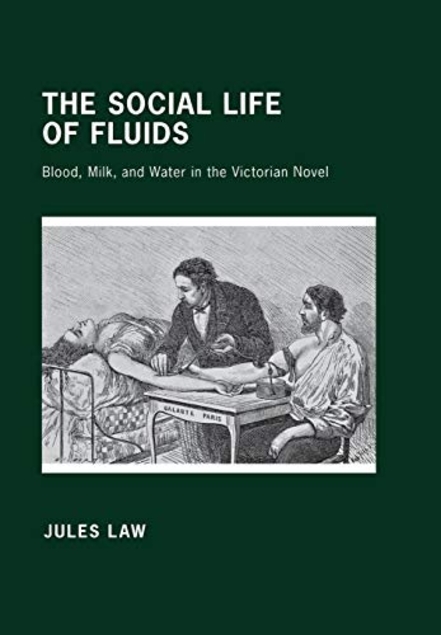


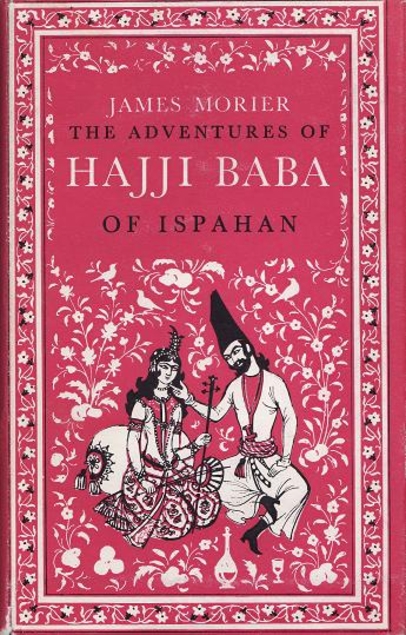


17lyzard
Group read news:
I will be setting up the thread for this month's group read of Charlotte Smith's Emmeline, The Orphan Of The Castle over the weekend.
Meanwhile, next month there will be a group read of Anthony Trollope's sixth novel, The Three Clerks.
All welcome!
I will be setting up the thread for this month's group read of Charlotte Smith's Emmeline, The Orphan Of The Castle over the weekend.
Meanwhile, next month there will be a group read of Anthony Trollope's sixth novel, The Three Clerks.
All welcome!
18lyzard
Ruminations:
May did not (to put it mildly) work out as planned: I got distracted from my book-blogging onto various film-related projects instead.
It was also a restricted reading month, with three long and/or difficult books added to those side-projects.
I'm feeling a bit torn at the moment: one more significant film-project is likely to get in the way of my reading again; however, I have made at least a start on my book-blogging, and the next group read will be starting too; in addition to various other reading commitments. I need to find a way of juggling these projects so as not to end up paralysed between them.
At the moment my definite reading commitments for June are as follows:
Emmeline, The Orphan Of The Castle by Charlotte Smith {group read}
The Big Fisherman by Lloyd C. Douglas {best-seller challenge}
A Caribbean Mystery by Agatha Christie {chronological challenge}
The Catherine Wheel by Patricia Wentworth {shared read}
Emmeline and The Big Fisherman are both chunksters and likely to occupy a fair percentage of my reading time, so trying to commit beyond this would be silly. However, I would very much like to finish off The American Caravan for the Banned In Boston challenge this month, although that is a matter of finding chunks of time to make a trip into the city worthwhile.
I have also had Washington Irving's Bracebridge Hall (for the C. K. Shorter challenge) sitting around untouched for a couple of months now; and I am expecting an interlibrary loan of William McFee's The Adopted, which would allow me to wrap up a series...but both of those represent hopes rather than expectations.
If I can polish off the top four and get both some film- and book-blogging done, I'll be satisfied.
May did not (to put it mildly) work out as planned: I got distracted from my book-blogging onto various film-related projects instead.
It was also a restricted reading month, with three long and/or difficult books added to those side-projects.
I'm feeling a bit torn at the moment: one more significant film-project is likely to get in the way of my reading again; however, I have made at least a start on my book-blogging, and the next group read will be starting too; in addition to various other reading commitments. I need to find a way of juggling these projects so as not to end up paralysed between them.
At the moment my definite reading commitments for June are as follows:
Emmeline, The Orphan Of The Castle by Charlotte Smith {group read}
The Big Fisherman by Lloyd C. Douglas {best-seller challenge}
A Caribbean Mystery by Agatha Christie {chronological challenge}
The Catherine Wheel by Patricia Wentworth {shared read}
Emmeline and The Big Fisherman are both chunksters and likely to occupy a fair percentage of my reading time, so trying to commit beyond this would be silly. However, I would very much like to finish off The American Caravan for the Banned In Boston challenge this month, although that is a matter of finding chunks of time to make a trip into the city worthwhile.
I have also had Washington Irving's Bracebridge Hall (for the C. K. Shorter challenge) sitting around untouched for a couple of months now; and I am expecting an interlibrary loan of William McFee's The Adopted, which would allow me to wrap up a series...but both of those represent hopes rather than expectations.
If I can polish off the top four and get both some film- and book-blogging done, I'll be satisfied.
20ronincats
Looks like you are almost ready--at least you are further along than when I was here 50 minutes ago. Happy New Thread, Liz! And that is a GORGEOUS lizard!
21lyzard
>20 ronincats:
Hi, Roni - thank you! Yeah, the touchstones have not exactly been lightning fast this morning, but we're under control at last.
I'm glad you like my lizard; we have to fight that pro-mammal prejudice! :D
Hi, Roni - thank you! Yeah, the touchstones have not exactly been lightning fast this morning, but we're under control at last.
I'm glad you like my lizard; we have to fight that pro-mammal prejudice! :D
22lyzard
"We have Emmeline! Repeat, we have Emmeline!"

Alas, we also have this.
I'll never complain about Forever Amber again!*

(*Okay, that's a lie...)

Alas, we also have this.
I'll never complain about Forever Amber again!*

(*Okay, that's a lie...)
23lyzard
So, yes: finished The Sicilian for TIOLI #5, which was a line under my truncated May.
Now reading Emmeline, The Orphan Of The Castle by Charlotte Smith.
Now reading Emmeline, The Orphan Of The Castle by Charlotte Smith.
24rosalita
That lizard is a very handsome fella!
Is this our month for the next Miss Silver? I didn't see it in your list up in >16 lyzard:.
Is this our month for the next Miss Silver? I didn't see it in your list up in >16 lyzard:.
25lyzard
>24 rosalita:
Agreed!
It is; and I'm mortified to realise you're just not reading my blather (i.e. >18 lyzard:) with sufficient attention to detail! :D
There's no reason you should remember it, but when we finished Eternity Ring I was complaining I couldn't find a first edition cover for The Catherine Wheel, and ended up using the French cover (in >16 lyzard:) because I hated all the others. I'll have to do a bit more chasing this month.
Agreed!
It is; and I'm mortified to realise you're just not reading my blather (i.e. >18 lyzard:) with sufficient attention to detail! :D
There's no reason you should remember it, but when we finished Eternity Ring I was complaining I couldn't find a first edition cover for The Catherine Wheel, and ended up using the French cover (in >16 lyzard:) because I hated all the others. I'll have to do a bit more chasing this month.
26figsfromthistle
Happy new thread
Love the topper :)
Love the topper :)
29rosalita
>25 lyzard: Doggone it! I did read that post, but my eye skipped right off Wentworth. Mea culpa, mea culpa, mea maxima culpa!
30FAMeulstee
Wow, Liz, that is a stunning lyzard at the top!
Sadly I see no shared reading possibilities for June...
Sadly I see no shared reading possibilities for June...
31lyzard
>28 drneutron:
Thanks, Jim!
>29 rosalita:
Truthfully I nearly did forget. The last two months have been weird and distracting, so that Eternity Ring feels like...well, an eternity ago!
>30 FAMeulstee:
Another pro-lizard vote!? - thanks, Anita!
I still think this month's share was amazing, so we won't fret too much this time. :)
Thanks, Jim!
>29 rosalita:
Truthfully I nearly did forget. The last two months have been weird and distracting, so that Eternity Ring feels like...well, an eternity ago!
>30 FAMeulstee:
Another pro-lizard vote!? - thanks, Anita!
I still think this month's share was amazing, so we won't fret too much this time. :)
32rosalita
Well, to be fair Eternity Ring really was an eternity ago. Our last read was Miss Silver Comes to Stay. :-D
34lyzard
The thread is up for the group read of Charlotte Smith's Emmeline, The Orphan Of The Castle:
Here
It is being conducted through the Virago group, but everyone's welcome!
Here
It is being conducted through the Virago group, but everyone's welcome!
39casvelyn
So today in Indianapolis, it's "things that make me think of Liz" day. :) First this ran on my state library's blog: https://blog.library.in.gov/historical-childrens-books-elsie-dinsmore/. I guess I'm okay with sharing a home state with Martha Finley...
And then I learned that this lovely gentleman and four of his friends recently arrived at our zoo. His name is Quinto and he's 15 years old:

And then I learned that this lovely gentleman and four of his friends recently arrived at our zoo. His name is Quinto and he's 15 years old:

40lyzard
>38 PaulCranswick:
Thanks, Paul!
Well, I came out of the blocks very fast this year, so my recent distractions haven't been too damaging: I'm expecting to hit 75 by the end of this month, which puts me on track for my 150 target. :)
>39 casvelyn:
And I guess I'm okay with you thinking of me when you see Elsie Dinsmore...maybe!?
But as for Quinto---that's brilliant, thank you so much!
Thanks, Paul!
Well, I came out of the blocks very fast this year, so my recent distractions haven't been too damaging: I'm expecting to hit 75 by the end of this month, which puts me on track for my 150 target. :)
>39 casvelyn:
And I guess I'm okay with you thinking of me when you see Elsie Dinsmore...maybe!?
But as for Quinto---that's brilliant, thank you so much!
41lyzard
Finished Emmeline, The Orphan Of The Castle for TIOLI #9.
Now reading The Big Fisherman by Lloyd C. Douglas.
Now reading The Big Fisherman by Lloyd C. Douglas.
42rosalita
>39 casvelyn: Oh my goodness, Quinto is such a cutie pie!
43lyzard
Phew!
I have actually finished blogging something: Wilhelm Meister's Apprenticeship by Johann Goethe.
And yes, it's run to three posts, but c'mon! - it's a 500 page-long book of German philosophy: I think I've done pretty well to pare it down! :D
Part 1
Part 2
Part 3
(Anita, if you're there, I'd be interested to get a reaction from you? I hope you don't think I've completely missed the point!)
I have actually finished blogging something: Wilhelm Meister's Apprenticeship by Johann Goethe.
And yes, it's run to three posts, but c'mon! - it's a 500 page-long book of German philosophy: I think I've done pretty well to pare it down! :D
Part 1
Part 2
Part 3
(Anita, if you're there, I'd be interested to get a reaction from you? I hope you don't think I've completely missed the point!)
44lyzard
...meanwhile, my feelings at actually getting through this are such, they can only be expressed via an astonished lemur!---


45Helenliz
>44 lyzard: he is very surprised, I prescribe a cup of tea.
47rosalita
>44 lyzard: That is the exact expression I have on my face whenever our president* opens his mouth.
48FAMeulstee
>43 lyzard: Yes, I am here, reading your 3 part review right now.
Overall I think you have a good eye for the intention and meaning of the book. For the most part I took the same from it. Although I would not be able to write it down like you did!
Reading the quotes was sometimes a bit puzzling, as I read it in Dutch translation. The German original will probably be somewhere in between what you have read and what I have read.
To me it occurred that The Count, The Baron and The Prince might have some satirical meaning, as the book was written before the unification of Germany, and at that time Germany was ruled by numurous Counts, Princes etc.
I am less familiar to English classics, so some of your references are above my head.
I have an other connection to the Moravian Brotherhood (I know them as Hernhutters), Von Zinzendorf came in 1736 to The Nederlands and found a place for them in Zeist. I lived near Zeist for 8 years, and the 3 years I spend in highschool in Zeist, my daily route to school went along the Hernhutter buildings there.
Overall I think you have a good eye for the intention and meaning of the book. For the most part I took the same from it. Although I would not be able to write it down like you did!
Reading the quotes was sometimes a bit puzzling, as I read it in Dutch translation. The German original will probably be somewhere in between what you have read and what I have read.
To me it occurred that The Count, The Baron and The Prince might have some satirical meaning, as the book was written before the unification of Germany, and at that time Germany was ruled by numurous Counts, Princes etc.
I am less familiar to English classics, so some of your references are above my head.
I have an other connection to the Moravian Brotherhood (I know them as Hernhutters), Von Zinzendorf came in 1736 to The Nederlands and found a place for them in Zeist. I lived near Zeist for 8 years, and the 3 years I spend in highschool in Zeist, my daily route to school went along the Hernhutter buildings there.
49lyzard
Oh, thank you for doing that, Anita, I appreciate it!
Translations are always tricky. In this case the text felt...I'm not sure what word to use...muffled? As if I wasn't really getting at the essence of Goethe's meaning. (Though of course I might have been!) I was sorry not to have access to the Blackall translation as it seems to be generally considered the best of the English-language versions.
And yes, I was always aware that there were things I was missing because I didn't have enough historical context to get the point: the prevalence of nobles of various ranks and various countries / provinces as you say, but particularly the Moravians.
How interesting that you have a personal connection! - I didn't know about that aspect of Van Zinzendorf's activities.
Anyway---thank you so much for joining me on this one, I hope you found it a worthwhile read. For me I think it's one of those books that are really difficult at the time, but you're glad afterwards to have had the experience. :)
Translations are always tricky. In this case the text felt...I'm not sure what word to use...muffled? As if I wasn't really getting at the essence of Goethe's meaning. (Though of course I might have been!) I was sorry not to have access to the Blackall translation as it seems to be generally considered the best of the English-language versions.
And yes, I was always aware that there were things I was missing because I didn't have enough historical context to get the point: the prevalence of nobles of various ranks and various countries / provinces as you say, but particularly the Moravians.
How interesting that you have a personal connection! - I didn't know about that aspect of Van Zinzendorf's activities.
Anyway---thank you so much for joining me on this one, I hope you found it a worthwhile read. For me I think it's one of those books that are really difficult at the time, but you're glad afterwards to have had the experience. :)
50FAMeulstee
I found it a worthwile read, and was happy I could join you. Sadly I didn't review it at all, as life had other plans. I might correct that later. I had to look up what "muffled" means, I think that is partly part of the original writing. As is was rewritten later in life, there are some incoherent parts.
Translations are more a part of our culture, Dutch is such a small language, we need translated books. Subsequently we have many good translators.
For now I am more drawn to read Goethe's Faust (waiting at the shelves) or The Sorrows of Young Werther (from the library) than the following Wilhelm Meister book.
Translations are more a part of our culture, Dutch is such a small language, we need translated books. Subsequently we have many good translators.
For now I am more drawn to read Goethe's Faust (waiting at the shelves) or The Sorrows of Young Werther (from the library) than the following Wilhelm Meister book.
51lyzard
A good translation is so important; it can be frustrating when you feel you're not getting to the heart of a book.
I haven't read Faust; The Sorrows Of Young Werther is a much easier read than Wilhelm Meister's Apprenticeship (although quite melodramatic). I don't blame you at all for opting out of the sequel, though I probably will get around to Wilhelm Meister's Travels at some point.
I haven't read Faust; The Sorrows Of Young Werther is a much easier read than Wilhelm Meister's Apprenticeship (although quite melodramatic). I don't blame you at all for opting out of the sequel, though I probably will get around to Wilhelm Meister's Travels at some point.
52lyzard
I have just wasted a deee-lightful hour sipping coffee and browsing the updated listings for the University of Illinois' amazing "19th Century Novel" collection at the Internet Archive: I could easily slip down that rabbit hole and never come back...
In more practical terms I'm thinking of using it to boost my 19th century-focused "Century Of Reading" self-challenge, which is languishing a bit as I get diverted onto other projects.
As I said on an earlier thread, while I started out just listing anything I read for that challenge, I feel that I ought to trying for more serious reading: investigating the more significant works for a particular year, and selecting those works that are both important and as-yet unread.
However, the reality is that there are several phases of 19th century literature where there simply are no novels of real note for a particular year. My immediate 'gap year' for this challenge, 1802, seems to be one of these.
My conscience is telling me I should probably choose Jane West's The Infidel Father: West is certainly the most important English novelist on the year's provisional list, however her books are extremely "improving"...and therefore not much fun...
There are also several novelists on the list I'm already examining for my blog (Mary Meeke, Elizabeth Gunning, Francis Lathom), and whose works I know I'll get to anyway...eventually.
Of the rest, I am currently pondering:
- Theodosius de Zulvin, The Monk Of Madrid by George Moore
- The Baron's Daughter by Isabella Kelly
- Warkfield Castle by Jane Harvey
- Celina; or, The Widowed Bride by Sarah Ann Hook
- The White Knight; or, The Monastery Of Morne by Theodore Melville
- Home by Margaret Cullen
- The Accusing Spirit by Mary Pilkington
ETA: ...although it may be none of these, as I have just become aware of Mary Pilkington's Marvellous Adventures; or, The Vicissitudes Of A Cat. (If only someone could assure me it has a happy ending!)
In more practical terms I'm thinking of using it to boost my 19th century-focused "Century Of Reading" self-challenge, which is languishing a bit as I get diverted onto other projects.
As I said on an earlier thread, while I started out just listing anything I read for that challenge, I feel that I ought to trying for more serious reading: investigating the more significant works for a particular year, and selecting those works that are both important and as-yet unread.
However, the reality is that there are several phases of 19th century literature where there simply are no novels of real note for a particular year. My immediate 'gap year' for this challenge, 1802, seems to be one of these.
My conscience is telling me I should probably choose Jane West's The Infidel Father: West is certainly the most important English novelist on the year's provisional list, however her books are extremely "improving"...and therefore not much fun...
There are also several novelists on the list I'm already examining for my blog (Mary Meeke, Elizabeth Gunning, Francis Lathom), and whose works I know I'll get to anyway...eventually.
Of the rest, I am currently pondering:
- Theodosius de Zulvin, The Monk Of Madrid by George Moore
- The Baron's Daughter by Isabella Kelly
- Warkfield Castle by Jane Harvey
- Celina; or, The Widowed Bride by Sarah Ann Hook
- The White Knight; or, The Monastery Of Morne by Theodore Melville
- Home by Margaret Cullen
- The Accusing Spirit by Mary Pilkington
ETA: ...although it may be none of these, as I have just become aware of Mary Pilkington's Marvellous Adventures; or, The Vicissitudes Of A Cat. (If only someone could assure me it has a happy ending!)
53japaul22
>52 lyzard: I went to University of Illinois for my undergraduate degree. I am very fond of that school and campus! I had never looked at their Internet Archive before - thanks for bringing it to my attention.
54lyzard
Hi, Jennifer! Apparently I am also very fond of the U. of I., I just didn't know it before! :D
I think there have been a number of specific collections uploaded to the IA recently; there also seem to be more and better ways of accessing a particular collection and searching within it.
It is relatively easy to access online copies of novels up to the 19th century but previously that was the cutoff: this collection is a wonderful addition!
I think there have been a number of specific collections uploaded to the IA recently; there also seem to be more and better ways of accessing a particular collection and searching within it.
It is relatively easy to access online copies of novels up to the 19th century but previously that was the cutoff: this collection is a wonderful addition!
55lyzard
Finished The Big Fisherman for TIOLI #1.

Now reading The Catherine-Wheel by Patricia Wentworth.
(...for which I cannot find a first-edition cover image, and really dislike the rest...grr!)

Now reading The Catherine-Wheel by Patricia Wentworth.
(...for which I cannot find a first-edition cover image, and really dislike the rest...grr!)
59lyzard
Finished The Adopted, hopefully for TIOLI #6...and therefore have also FINISHED A SERIES!!
Now reading Women, Letters, And The Novel by Ruth Perry.
Now reading Women, Letters, And The Novel by Ruth Perry.
60lyzard
To celebrate my completion of a series, here is a black-tufted marmoset!
(...not looking very happy about it; perhaps he thinks it shouldn't have taken me seven years to get through a seven-book series...)

(...not looking very happy about it; perhaps he thinks it shouldn't have taken me seven years to get through a seven-book series...)

61rosalita
>60 lyzard: Judgy black-tufted marmosets are the worst!
Whereas I am simply happy for you being able to cross another series off the (endless) list.
Am I favorably comparing myself to a picture of an animal? Yes, yes I am. I take my ego boosts wherever I can get them. :-)
Whereas I am simply happy for you being able to cross another series off the (endless) list.
Am I favorably comparing myself to a picture of an animal? Yes, yes I am. I take my ego boosts wherever I can get them. :-)
63lyzard
Finished Women, Letters, And The Novel for TIOLI #8; also managed to add The Adopted to TIOLI #6.
Now reading Why: The Serial Killer In America by Margaret Cheney.
Now reading Why: The Serial Killer In America by Margaret Cheney.
65souloftherose
>52 lyzard: From the title alone I would vote for Marvellous adventures; or, The vicissitudes of a cat...
>60 lyzard: Hooray!
>60 lyzard: Hooray!
67lyzard
Finished Why: The Serial Killer In America for TIOLI #10.
Now reading Serial Slaughter: What's Behind America's Murder Epidemic? by Michael Newton.
(I'm in a mood, can you tell?)
Now reading Serial Slaughter: What's Behind America's Murder Epidemic? by Michael Newton.
(I'm in a mood, can you tell?)
68rosalita
>67 lyzard: Yikes! You need to read another Miss Silver adventure, stat!
69lyzard
:D
More accurately it's about working through a pile of old non-fiction to see what might be decommissioned. This is stuff from a phase in the early nineties.
More accurately it's about working through a pile of old non-fiction to see what might be decommissioned. This is stuff from a phase in the early nineties.
70lyzard
...must have been quite a phase: I am somewhat dismayed to discover, while poking through the piles, that I have at least four more books on serial killers still to work through.
Think I'll give it a break for a bit, as far as my non-fiction / potential decommission reading goes: not so much because of the subject matter, but because both of the two I just read were rather poorly written. (Hurried cash-in publications, I would judge.)
Anyhoo---
Finished Serial Slaughter: What's Behind America's Murder Epidemic? for TIOLI #10.
Now reading - to go from one extreme to the other - Bracebridge Hall by Washington Irving.
Think I'll give it a break for a bit, as far as my non-fiction / potential decommission reading goes: not so much because of the subject matter, but because both of the two I just read were rather poorly written. (Hurried cash-in publications, I would judge.)
Anyhoo---
Finished Serial Slaughter: What's Behind America's Murder Epidemic? for TIOLI #10.
Now reading - to go from one extreme to the other - Bracebridge Hall by Washington Irving.
71rosalita
Are these books that were published in the US? I'm not recognizing any of the titles/authors, but my serial killer phase was pretty much over by the '90s.
ETA: Just to be clear, I mean my reading about serial killers phase. I was not myself an active participant.
ETA: Just to be clear, I mean my reading about serial killers phase. I was not myself an active participant.
72lyzard
THE TRUTH SLIPS OUT!!!!!!! :D
For me it was mostly about the scientific side of things, at the time when DNA technology and forensic investigation were just getting a proper foothold.
Some of the material seems a bit quaint now. :)
Yes, though both from smaller presses; the first is a hasty updating of a book first published in the mid-70s (then it was just about Ed Kemper, the update tries to make it more general), the second feels like a series of separate articles pasted together (and is quite repetitive as a consequence).
I do have a couple of the "standard texts" around, I think, i.e. stuff by John Douglas and Robert Ressler.
For me it was mostly about the scientific side of things, at the time when DNA technology and forensic investigation were just getting a proper foothold.
Some of the material seems a bit quaint now. :)
Yes, though both from smaller presses; the first is a hasty updating of a book first published in the mid-70s (then it was just about Ed Kemper, the update tries to make it more general), the second feels like a series of separate articles pasted together (and is quite repetitive as a consequence).
I do have a couple of the "standard texts" around, I think, i.e. stuff by John Douglas and Robert Ressler.
74lyzard
>73 Helenliz:
But we've come a long way since! Now we specialise in brutal murders being solved by sweet little old ladies. :D
But we've come a long way since! Now we specialise in brutal murders being solved by sweet little old ladies. :D
75lyzard
Best-selling books in America for 1947:
1. The Miracle of the Bells by Russell Janney
2. The Moneyman by Thomas B. Costain
3. Gentleman's Agreement by Laura Z. Hobson
4. Lydia Bailey by Kenneth Roberts
5. The Vixens by Frank Yerby
6. The Wayward Bus by John Steinbeck
7. House Divided by Ben Ames Williams
8. Kingsblood Royal by Sinclair Lewis
9. East Side, West Side by Marcia Davenport
10. Prince of Foxes by Samuel Shellabarger
American reading in 1947 was dominated by historical fiction, supported by (for the most part) fairly scathing portraits of contemporary society.
In the former category we find Samuel Shellabarger's Prince of Foxes, about the Borgias and their attempted unification of Italy; Thomas B. Costain's The Moneyman, also set in the 15th century, is about financial and other machinations at the court of Charles VII; Kenneth Roberts' Lydia Bailey is set predominantly in 19th century Haiti; Frank Yerby's The Vixens is a sequel to his 1946 best-seller, The Foxes Of Harrow, set in post-Civil War Louisiana; while Ben Ames Williams' House Divided is the inevitable actual Civil War novel, about the members of a slave-owning Virginia family who discover to their horror that they are closely related to Abraham Lincoln.
House Divided makes a curiously apt companion for Sinclair Lewis' Kingsblood Royal, which is about a returned WWII serviceman set the task of tracking his family's "aristocratic" forebears by his snobbish father, only to discover a black ancestor on his mother's side. Completing this triumvirate of sorts is Laura Z. Hobson's Gentleman's Agreement, her then-shocking expose of prejudice amongst "nice" Americans and possibly the "journalistic impersonation" ur-novel, with its writer-protagonist posing as Jewish.
John Steinbeck's The Wayward Bus finds a disparate (and mostly unpleasant) group of characters stranded together in an isolated corner of California when their bus breaks down; while Marcia Davenport's East Side, West Side is a psychological dissection of a failing high-society marriage, dealing frankly with adultery and across-the-class-lines relationships.
However, the year's best-seller, though contemporary in setting, is light-years away in tone and intent from its companion works: Russell Janney's The Miracle of the Bells.
1. The Miracle of the Bells by Russell Janney
2. The Moneyman by Thomas B. Costain
3. Gentleman's Agreement by Laura Z. Hobson
4. Lydia Bailey by Kenneth Roberts
5. The Vixens by Frank Yerby
6. The Wayward Bus by John Steinbeck
7. House Divided by Ben Ames Williams
8. Kingsblood Royal by Sinclair Lewis
9. East Side, West Side by Marcia Davenport
10. Prince of Foxes by Samuel Shellabarger
American reading in 1947 was dominated by historical fiction, supported by (for the most part) fairly scathing portraits of contemporary society.
In the former category we find Samuel Shellabarger's Prince of Foxes, about the Borgias and their attempted unification of Italy; Thomas B. Costain's The Moneyman, also set in the 15th century, is about financial and other machinations at the court of Charles VII; Kenneth Roberts' Lydia Bailey is set predominantly in 19th century Haiti; Frank Yerby's The Vixens is a sequel to his 1946 best-seller, The Foxes Of Harrow, set in post-Civil War Louisiana; while Ben Ames Williams' House Divided is the inevitable actual Civil War novel, about the members of a slave-owning Virginia family who discover to their horror that they are closely related to Abraham Lincoln.
House Divided makes a curiously apt companion for Sinclair Lewis' Kingsblood Royal, which is about a returned WWII serviceman set the task of tracking his family's "aristocratic" forebears by his snobbish father, only to discover a black ancestor on his mother's side. Completing this triumvirate of sorts is Laura Z. Hobson's Gentleman's Agreement, her then-shocking expose of prejudice amongst "nice" Americans and possibly the "journalistic impersonation" ur-novel, with its writer-protagonist posing as Jewish.
John Steinbeck's The Wayward Bus finds a disparate (and mostly unpleasant) group of characters stranded together in an isolated corner of California when their bus breaks down; while Marcia Davenport's East Side, West Side is a psychological dissection of a failing high-society marriage, dealing frankly with adultery and across-the-class-lines relationships.
However, the year's best-seller, though contemporary in setting, is light-years away in tone and intent from its companion works: Russell Janney's The Miracle of the Bells.
76lyzard

That we have a somewhat unlikely best-selling author here is underscored by the fact that I had to swipe an author picture from the back cover of an online first edition.
Russell Janney had two other careers before he became an author. Born in Ohio in 1906, he attended Yale where he got his professional start producing plays for his fraternity. Subsequently he had a lengthy career as a theatrical producer, perhaps best known for the operetta, The Vagabond King---which he co-wrote. He also wrote lyrics for various stage revues.
Janney was also a long-term press agent for many theatrical stars, writing promotional material for magazines and newspapers.
In between all this, he did publish some short stories; but he was sixty-one years old before writing his first novel, The Miracle Of The Bells. Published in 1946, it became the following year's #1 best-seller.
Janney subsequently published two more novels, So Long As Love Remembers in 1953 and (fittingly) Curtain Call in 1957, but neither came anywhere near duplicating the success of the first (even though most contemporary critics considered them superior works).
77lyzard

The Miracle Of The Bells - Out-of-work press agent, Bill Dunnigan, keeps a grim promise by escorting the body of young actress, Olga Treskovna, back to her home of Coaltown, Pennsylvania, for burial. His first exposure to the grim little town, and in particular to the crass and clutching undertaker / saloon owner, Orloff, infuriates Bill and confirms all his worst prejudices; but a subsequent meeting with the humble and devout young Father Paul of the Church of St. Michael the Archangel changes his mind about many things. Bill brings himself to tell the whole of Olga's story: her escape from Coaltown after the death of her often-drunken father; her long struggle to establish herself as an actress or singer; the extraordinary chance that catapulted her to the lead in a major Hollywood production; her collapse and death at the end of production, from lung damage carried from her childhood; and that he, Bill, never got the chance to tell her that he loved her... As Bill sets about his task of carrying out Olga's last wishes with respect to her funeral, he carries within him the intolerable knowledge that, in spite of its star's brilliant performance, producer Marcus Harris is planning on shelving Olga's only film. All of a sudden, however, Bill's press-agent instincts kick in, as he sees a way both to honour Olga and to ensure the release of her film---and unexpectedly finds himself becoming "press agent" also for Father Paul, the young priest's patron, St. Michael, and ultimately the entire town, when his efforts to promote Olga bring about an apparent miracle... Russell Janney's The Miracle Of The Bells is the kind of book where an individual reader's reaction will almost certainly be dictated by what the reader themselves brings to it...which is a sideways admission that I found it weird and often rather uncomfortable. As a religious novel, it has its virtues: though set largely amongst the Catholics, it's not a Catholic story per se, but rather one about faith; likewise, it is less about conversion than the suggestion that "faith" is something carried inside everyone, which simply needs to be awakened. In this, it evinces a welcome openness to other denominations, and even to none at all---with perhaps its most admirable touch (given the novel's publication date) its generous attitude towards a significant supporting character who happens to be Jewish. The novel also ponders the nature of faith, and of miracles; finding the latter less in rare, startling events than in everyday decency: Bill Dunnigan spends the book scattering miracles without even realising it. But despite these promising touches, ultimately The Miracle Of The Bells fails to reconcile its disparate elements and shifting tones---offering up Bill Dunnigan's press-agent shenanigans, which are presented humorously but intended to be taken seriously in their effects, at least, as a bridge between an extended satire of Hollywood and its workings on one hand, and on the other a depiction of the up-swelling and spreading of faith through Coaltown and beyond that is sincere to the point of naivety. These elements collide most dubiously with respect to Olga herself, who is presented as a virtual Christ-figure: she even "rises" after to death and appears to her "disciples", with cynical, two-fisted Dunnigan becoming, in effect, her "Peter". Some of this might have worked, or worked better, with a lighter touch, but The Miracle Of The Bells is not merely overlong, it finally writes its subject matter into the ground---spelling things out in unnecessary detail, pursuing each tiny subplot to the bitter end, killing potential humour with repetition, and finally turning what might have been an interesting rumination upon faith into a wearying endurance test.
Bill Dunnigan reached for a cigar. In so doing he realised the incongruity of his situation. Here he was, a man of no religious knowledge or belief, trying to expound faith to a man of God! But his inner convictions about what had happened were very clear, were very real...
"I am what is known as a theatrical press agent," he said to the priest. "I am myself that man I told you I knew. I had no religion. I have none yet, I suppose. I came here with a simple purpose, to bury my friend as she wished. I confess that purpose changed when I stood with you in your cemetery and heard your Angelus; when I started these funeral bells with the idea of attracting attention to a motion picture this girl had just finished making.
"But even then, Father, it wasn't entirely a selfish idea. Yes, I did want back a job I'd lost. I did want to put over, as we say, my big stunt. But at the same time I wanted to do something for this girl; to make her great work, which was going to die with her, live. And I had met you, Father, and knew you, and wanted honestly to do something for you and for your church and your Saint Michael...
"Well, we rang the bells. The crowds came. The reporters came and the newspapers fell for it. I stopped worrying about that motion picture. I began to worry about your church. What could I do for it? You were worrying also. Would the success of your Masses last? Now we've been given a break I could never have imagined in my wildest press-agent dreams! Would we have gotten that break if my motives were entirely selfish and bad? This 'miracle'---and who knows but that it is a miracle---will flash across the continent!...
"Think, Father. The other churches have mine shafts beneath them. Did their statues ever turn? Your church has been over mine shafts for years. Did its statues turn before? Don't destroy what can hurt no one---what can only bring new hope to a world that needs a lot of it!"
78swynn
I'm averting my eyes from The Miracle of the Bells but mentioning that I'm only two books behind, since I did finish Forever Amber.
Review coming sometime soon. Spoiler: it's long. (The book, not the review.)
Review coming sometime soon. Spoiler: it's long. (The book, not the review.)
79lyzard
>78 swynn:
You might want to avert your eyes for other reasons...
Well done on Amber! I'm actually a bit worried that you have finished it, though, because you're not going to like the next couple. In fact I worry sometimes that I'm going to lose you from this challenge---even after you were so brave through the 'romantic melodrama' phase! :D
You might want to avert your eyes for other reasons...
Well done on Amber! I'm actually a bit worried that you have finished it, though, because you're not going to like the next couple. In fact I worry sometimes that I'm going to lose you from this challenge---even after you were so brave through the 'romantic melodrama' phase! :D
81lyzard
>80 swynn:
No, no, no, no!
I was forgetting The King's General: it's 1947 and 1948 I'm concerned about; they make a pretty savage one-two punch...
No, no, no, no!
I was forgetting The King's General: it's 1947 and 1948 I'm concerned about; they make a pretty savage one-two punch...
82swynn
Well crap-- that means I've fallen three books behind. On the other hand, I'm happy to hear the Du Maurier isn't something to dread.
83lyzard
>82 swynn:
I'm still managing to plug away at one a month, but don't you worry about it too much. I think at this point, if you get them read at all, that's achievement enough. :D
You're fine with the du Maurier, though being accurate historical fiction it's rather grim.
I'm still managing to plug away at one a month, but don't you worry about it too much. I think at this point, if you get them read at all, that's achievement enough. :D
You're fine with the du Maurier, though being accurate historical fiction it's rather grim.
85lyzard
Completing Bracebridge Hall means that I do not have a single unread library book in my house---gasp!!
(Guess what I'll be doing for the next couple of days...?)
Bracebridge Hall was read for my 'C. K. Shorter challenge', which as some of you may recall I got stuck on due to Shorter's inclusion on his 'Best 100 Novels' list of a book he called Wilhelm Meister.
This was Thomas Carlyle's translation of Johann Goethe's 1796 novel, Wilhelm Meister's Apprenticeship and the first edition of its 1821 sequel, Wilhelm Meister's Years Of Travel.
Because of its influence upon that now-obscure branch of English fiction known as "the silver-fork novel", I also wanted to tackle Wilhelm Meister at my blog. I have now reviewed a different translation of Wilhelm Meister's Apprenticeship; and after pondering whether it was really necessary for me to also take on its sequel (yeah, like my OCD was going to let me just skip it!), I will be picking up Wilhelm Meister's Years Of Travel from my academic library on Friday.
Meanwhile, I am also able to progress with the Shorter challenge:
#31: The Epicurean by Thomas Moore (1827)

This has the rare and peculiar distinction of being a book about which I know nothing! - although I do know a bit about the Greek "Epicurean" sect, which this apparently deals with. A quick check would suggest that this is another of the "pagan converts to Christianity" novels that were so rampantly popular at the time. (It thus joins #27 on the list, J. G. Lockhart's Valerius: A Roman Story, which is the subgenre's ur-novel.)
(Guess what I'll be doing for the next couple of days...?)
Bracebridge Hall was read for my 'C. K. Shorter challenge', which as some of you may recall I got stuck on due to Shorter's inclusion on his 'Best 100 Novels' list of a book he called Wilhelm Meister.
This was Thomas Carlyle's translation of Johann Goethe's 1796 novel, Wilhelm Meister's Apprenticeship and the first edition of its 1821 sequel, Wilhelm Meister's Years Of Travel.
Because of its influence upon that now-obscure branch of English fiction known as "the silver-fork novel", I also wanted to tackle Wilhelm Meister at my blog. I have now reviewed a different translation of Wilhelm Meister's Apprenticeship; and after pondering whether it was really necessary for me to also take on its sequel (yeah, like my OCD was going to let me just skip it!), I will be picking up Wilhelm Meister's Years Of Travel from my academic library on Friday.
Meanwhile, I am also able to progress with the Shorter challenge:
#31: The Epicurean by Thomas Moore (1827)

This has the rare and peculiar distinction of being a book about which I know nothing! - although I do know a bit about the Greek "Epicurean" sect, which this apparently deals with. A quick check would suggest that this is another of the "pagan converts to Christianity" novels that were so rampantly popular at the time. (It thus joins #27 on the list, J. G. Lockhart's Valerius: A Roman Story, which is the subgenre's ur-novel.)
86lyzard
Group read news:
There is a group read of Anthony Trollope's The Three Clerks scheduled for next month.
However, since the group read of Emmeline, The Orphan Of The Castle is running a bit late due to some unavoidably erratic participation, my thought was to push the start of The Three Clerks by a week.
Having checked with some of the potential joiners, this would apparently suit the majority better than an immediate start, therefore I will be setting up the thread on the weekend of the 6th - 7th July.
And as always---all welcome! :)
There is a group read of Anthony Trollope's The Three Clerks scheduled for next month.
However, since the group read of Emmeline, The Orphan Of The Castle is running a bit late due to some unavoidably erratic participation, my thought was to push the start of The Three Clerks by a week.
Having checked with some of the potential joiners, this would apparently suit the majority better than an immediate start, therefore I will be setting up the thread on the weekend of the 6th - 7th July.
And as always---all welcome! :)
87lyzard

The Clocks - Rosemary Webb, a stenographer, arrives at the home of Miss Millicent Pebmarsh, a blind former teacher who now works with disabled children. Instructed to enter Miss Pebmarsh's house if she is there first, Rosemary does so---and finds herself in a room with a dead man, and surrounded by half-a-dozen clocks all stopped at the same time... Colin Lamb is passing Miss Pebmarsh's house when an hysterical Rosemary comes flying into the street. Having confirmed her story, he calls the police, bringing to the scene a friend of his, Inspector Hardcastle. Miss Pebmarsh tells Hardcastle that, as far as she can judge, she does not know the dead man; and astonishes him by her further assertions that she did not hire a stenographer at all, let alone request Rosemary specifically, as the girl claims, and has no idea how the clocks came to be in the room... Colin, who is actually a government agent, reveals to Hardcastle that he was on the scene in the first place in the hope of tying up loose ends in a case of espionage, and now must determine whether the murder is related to his own investigation, or a strange coincidence. As the joint investigation proceeds, the case only becomes more confusing---until Colin is moved to carry it to his old friend, Hercule Poirot... Published in 1963, The Clocks is a hybrid novel, the first of Agatha Christie's books in which the changing world of the Cold War makes itself felt, built around Colin's efforts to find the brains behind an organisation that is obtaining and passing on classified information; his discoveries along the way involve a defector to the Soviet Union and the dissemination of pro-Communist material; and there is an overt reference to "the Bomb". This espionage plot becomes interwoven with Hardcastle's investigation of the murder, and the overriding question of whether the unidentified man's death is related to the political conspiracy, or whether it is, so to speak, just an "ordinary" murder. (In fact I always find The Clocks very re-readable on this level, because it's almost impossible to keep the twin plots straight in your memory.) The novel's third thread, much lighter in tone, involves Hercule Poirot himself---who is something of a supporting character in this one; or perhaps, more correctly, a consulting detective. Bored and lonely, Poirot has been boning up on his crime fiction; and Christie has considerable fun with his reading list, having him offer up opinions on authors and their detectives, both real and fictional. He is, however, more than happy to put his reading aside when Colin brings to him the details of his investigation: an investigation which has taken on a very personal dimension, in that Colin is falling for Rosemary, who is Inspector Hardcastle's prime suspect... For a variety of reasons, then, Colin returns to the town of Crowdean, and to the strangely constructed Wilbraham Crescent, the scene of the murder, which separates its two sides and has its properties placed back-to-back. This means that the entire street, and in particular the occupants of each property which abuts Miss Pebmarsh's house, must be thoroughly investigated, since the police have been able to determine that the murder occurred elsewhere, and that the body was transported to Miss Pebmarsh's house---apparently without anyone seeing anything...
I described to him in detail the events that had taken place at 19, Wilbraham Crescent. Hercule Poirot leant back in his chair. He closed his eyes and gently tapped with a forefinger the arm of his chair while he listened to my recital...
"Well, I said impatiently, after waiting a few moments more. "What have you got to say?"
"But what do you want me to say?"
"I want you to give me the solution. I've always understood from you that it was perfectly possible to lie back in one's chair, just think about it all, and come up with the answer. That is was quite unnecessary to go and question people and run about looking for clues... Well, I'm calling your bluff," I said. "I've given you the facts, and now I want the answer."
"Just like that, hein? But then there is a lot more to be known, mon ami. We are only at the beginning of the facts. Is that not so?"
"I still want you to come up with something."
"I see." He reflected a moment. "One thing is certain," he pronounced. "It must be a very simple crime."
"Simple?" I demanded in some astonishment.
"Naturally."
"Why must it be simple?"
"Because it appears so complex..."
88lyzard
Twin mysteries aside, The Clocks functions on an entirely different level of entertainment: Christie has stuffed this one chock-full of both meta- and in-jokes.
Poirot's reading list is a delight. He has (like, ahem, someone else I could name) gone right back to the roots of the detective genre: specifically cited are Arthur Conan Doyle and Sherlock Holmes - a mention of Dr Watson sets Poirot mourning for the absent Arthur Hastings - Anna Katharine Green's The Leavenworth Case, Maurice Leblanc's The Adventures Of Arsene Lupin, and Gaston Leroux's The Mystery Of The Yellow Room.
(There's a nice referential touch in there: it was Green's Miss Amelia Butterworth who inspired the creation of Miss Jane Marple.)
Then Poirot moves on to fictional authors: in Britain, Cyril Quain, master of the alibi (an expy for Freeman Wills Crofts); thriller writer, Garry Gregson (John Creasey), and of course Ariadne Oliver...though in her case they must be all re-reads for Poirot!
With respect to American authors, Agatha's intentions aren't so clear---that is, to me at my present stage of reading, obviously she had specific writers in mind here too: Poirot dismisses the hard-boiled school, "violence for violence's sake", but praises Florence Elk, "order and method, colourful happenings, wit..." and Louisa O'Malley, "fine scholarly writing...those exclusive apartments and soulful snobberies, and underneath, deep unexpected seams of crime..."
This joke extends into the narrative: Miss Martindale, head of the agency for which Rosemary Webb works, was once secretary to Garry Gregson, and set up her own business on a legacy in his will (she also inherited his manuscripts).
However, the sweetest joke of all in The Clocks involves Colin himself. It becomes clear that "Lamb" is not really his surname, but that he uses it in his career so as not to leech off the professional fame and success of his father.
It is never revealed in-text just who his father is...but anyone who has read Agatha diligently to this point shouldn't have any trouble figuring it out...
Poirot's reading list is a delight. He has (like, ahem, someone else I could name) gone right back to the roots of the detective genre: specifically cited are Arthur Conan Doyle and Sherlock Holmes - a mention of Dr Watson sets Poirot mourning for the absent Arthur Hastings - Anna Katharine Green's The Leavenworth Case, Maurice Leblanc's The Adventures Of Arsene Lupin, and Gaston Leroux's The Mystery Of The Yellow Room.
(There's a nice referential touch in there: it was Green's Miss Amelia Butterworth who inspired the creation of Miss Jane Marple.)
Then Poirot moves on to fictional authors: in Britain, Cyril Quain, master of the alibi (an expy for Freeman Wills Crofts); thriller writer, Garry Gregson (John Creasey), and of course Ariadne Oliver...though in her case they must be all re-reads for Poirot!
With respect to American authors, Agatha's intentions aren't so clear---that is, to me at my present stage of reading, obviously she had specific writers in mind here too: Poirot dismisses the hard-boiled school, "violence for violence's sake", but praises Florence Elk, "order and method, colourful happenings, wit..." and Louisa O'Malley, "fine scholarly writing...those exclusive apartments and soulful snobberies, and underneath, deep unexpected seams of crime..."
This joke extends into the narrative: Miss Martindale, head of the agency for which Rosemary Webb works, was once secretary to Garry Gregson, and set up her own business on a legacy in his will (she also inherited his manuscripts).
However, the sweetest joke of all in The Clocks involves Colin himself. It becomes clear that "Lamb" is not really his surname, but that he uses it in his career so as not to leech off the professional fame and success of his father.
It is never revealed in-text just who his father is...but anyone who has read Agatha diligently to this point shouldn't have any trouble figuring it out...
89lyzard
Most of the covers for The Clocks are pretty obvious; I like this - Norwegian? - one best:

However---I was amused to note that one publisher couldn't resist that old standby: the threatened redhead!---


However---I was amused to note that one publisher couldn't resist that old standby: the threatened redhead!---

90lyzard
Finished Patty's Butterfly Days for TIOLI #3.
Meanwhile---my conscience has gotten the better of me; and instead of any of the fun-looking books from 1802 (including, alas, Marvellous Adventures; or, The Vicissitudes Of A Cat), I am reading the seriously intended (i.e. grindingly didactic, I suspect) The Infidel Father by Jane West.
(Of which, Volumes II and III are downloadable through GoogleBooks, but not Volume I; WHYYYY????)
Meanwhile---my conscience has gotten the better of me; and instead of any of the fun-looking books from 1802 (including, alas, Marvellous Adventures; or, The Vicissitudes Of A Cat), I am reading the seriously intended (i.e. grindingly didactic, I suspect) The Infidel Father by Jane West.
(Of which, Volumes II and III are downloadable through GoogleBooks, but not Volume I; WHYYYY????)
91lyzard
Oh boy.
From the preface:
The rage for novels does not decrease; and, though I by no means think them the best vehicle for "the words of sound doctrine;" yet, while the enemies of our church and state continue to pour their poison into unwary ears through this channel, it behoves the friends of our establishments to convey an antidote by the same course; especially as those who are most likely to be infected by false principles, will not search for a refutation of them in profound and scientific compositions.
The particular design of the present work is, to shew the superiority which religious principle possesses, when compared with a sense of honour, moral fitness, or a love of general applause. The story is confessedly subordinate to the aim...
From the preface:
The rage for novels does not decrease; and, though I by no means think them the best vehicle for "the words of sound doctrine;" yet, while the enemies of our church and state continue to pour their poison into unwary ears through this channel, it behoves the friends of our establishments to convey an antidote by the same course; especially as those who are most likely to be infected by false principles, will not search for a refutation of them in profound and scientific compositions.
The particular design of the present work is, to shew the superiority which religious principle possesses, when compared with a sense of honour, moral fitness, or a love of general applause. The story is confessedly subordinate to the aim...
92Helenliz
>91 lyzard: Good luck, that does not sound like a book intended to be an enjoyable read!
93lyzard
It gets better! :D
The episodical characters have a use besides relieving the sombrous hue of the principal personages. I wish they may be considered an overcharged picture of the vanity, extravagance, and self-importance, that have for some years infected the middle classes of society, threatening destruction to the sound sense, decent propriety, and manly virtues of the most important portion of the community...
The episodical characters have a use besides relieving the sombrous hue of the principal personages. I wish they may be considered an overcharged picture of the vanity, extravagance, and self-importance, that have for some years infected the middle classes of society, threatening destruction to the sound sense, decent propriety, and manly virtues of the most important portion of the community...
94rosalita
Isn't it striking how little faith Very Serious People have in the ability of anyone other than themselves to not be easily swayed into bad behavior? In 1802 it was novels; later it was radio, then movies, then television, then the internet. For as long as the world has been traveling to hell in a handbasket you'd think we'd be there by now!
Actually, reviewing events of the last couple of years, maybe we are. :-0
Actually, reviewing events of the last couple of years, maybe we are. :-0
96lyzard
>94 rosalita:
My favourite aspect of censorship: *I* am strong-minded enough to watch / read this and not be corrupted, but *you* would naturally be damaged by it!
It's important, though, to note the prevailing opinion of Very Serious People towards novels, which is something I try to convey during the group reads because it helps to place a book in its social context.
(And comic books; don't forget comic books!)
We're having a conservative backlash at the moment which, I'm sorry, is just bigotry in the guise of religion. :(
>95 Matke:
Oh, it's worse than preachy once you get into it: it's trying to be ironic, and it's just SO heavy-handed and ponderous, ugh!
The only upside is that like a lot of novels at this time, it has large font and wide margins, and isn't actually as long as it looks. (Just as well: three volumes, a total of about 900 pages!)
My favourite aspect of censorship: *I* am strong-minded enough to watch / read this and not be corrupted, but *you* would naturally be damaged by it!
It's important, though, to note the prevailing opinion of Very Serious People towards novels, which is something I try to convey during the group reads because it helps to place a book in its social context.
(And comic books; don't forget comic books!)
We're having a conservative backlash at the moment which, I'm sorry, is just bigotry in the guise of religion. :(
>95 Matke:
Oh, it's worse than preachy once you get into it: it's trying to be ironic, and it's just SO heavy-handed and ponderous, ugh!
The only upside is that like a lot of novels at this time, it has large font and wide margins, and isn't actually as long as it looks. (Just as well: three volumes, a total of about 900 pages!)
97rosalita
>96 lyzard: I did forget comic books! Bad Julia. And "bigotry in the guise of religion" seems to be all that's on offer from certain corners of the political spectrum these days, in too many countries. :-(
99lyzard
It was a rather silly day today...
I - eventually - made it to my academic library (public transport glitch), to swap one pile of library books for another pile of library books (see below). I had some problems tracking down everything I wanted, not least because, for some unknown and unguessable reason, they have removed the catalogue computers from the higher levels of the library---meaning that today involved going up to Level 7 to look for a book, returning to Level 3 to recheck the catalogue, going back to Level 7 to find the book, and then returning to Level 3 to check it out.
Apparently someone thought this arrangement was a good idea.
On top of that, our higher level libraries have all adopted a new cataloguing system that personally I find very annoying, tending to find either too many listings or none, and invariably requiring extra levels of searching before you can be sure that an item is held or not.
(Example: I thought I had located a copy of The Sketch Book Of Geoffrey Crayon by Washington Irving, but when I got to the shelf it turned out to be Irving's Mahomet And His Successors {!!}.)
I also - as it turned out - didn't did deeply enough into the listing for Johann Goethe's Wilhelm Meister's Journeyman Years, and therefore did not know a priori that someone else had, out of the three volumes, borrowed just Volume I...
WHYYY???
(...and to make things even more annoying, Volume I was due back today, but had not been returned to the shelf...)
Anyhoo---I eventually came away with:
The Three Clerks by Anthony Trollope {group read}
Sinuhe The Egyptian by Mika Walteri {best-seller challenge}
Sex, Politics And Society: The Regulation Of Sexuality Since 1800 by Jeffrey Weeks {non-fiction reading}
The Sketch Book Of Geoffrey Crayon by Washington Irving {on the third catalogue search attempt}
...and...
Volumes II and III of Wilhelm Meister's Journeyman Years by Johann Goethe {mostly out of spite}.
I then wove an erratic path from the academic library to the State Library (public transport glitch + significant wrong turn), for another whack at The American Caravan, my ongoing 'Banned in Boston' book, which is presenting a couple of significant challenges.
One of them is that it is on offsite storage request, and therefore to keep it in the library I have to do frequent, short-term renewals. The last was on Wednesday...which I forgot...although I did jerk awake in the middle of the night, remembering that I had forgotten...and when I snuck online before library opening time yesterday, it did accept my renewal...
...or I thought it did: when I got to the hold shelves at the library, The American Caravan was nowhere to be seen...
Fortunately, however, it eventually turned out to be "out the back somewhere", although it took two librarians about 15 minutes to figure that out.
BUT---I eventually managed to ettle into one of the library's little reading cubicles, and work my way through another 100 pages of it; though that still leaves me only halfway through it.
So I guess overall it was a positive day.
Still ticked about Volume I, tho'...
I - eventually - made it to my academic library (public transport glitch), to swap one pile of library books for another pile of library books (see below). I had some problems tracking down everything I wanted, not least because, for some unknown and unguessable reason, they have removed the catalogue computers from the higher levels of the library---meaning that today involved going up to Level 7 to look for a book, returning to Level 3 to recheck the catalogue, going back to Level 7 to find the book, and then returning to Level 3 to check it out.
Apparently someone thought this arrangement was a good idea.
On top of that, our higher level libraries have all adopted a new cataloguing system that personally I find very annoying, tending to find either too many listings or none, and invariably requiring extra levels of searching before you can be sure that an item is held or not.
(Example: I thought I had located a copy of The Sketch Book Of Geoffrey Crayon by Washington Irving, but when I got to the shelf it turned out to be Irving's Mahomet And His Successors {!!}.)
I also - as it turned out - didn't did deeply enough into the listing for Johann Goethe's Wilhelm Meister's Journeyman Years, and therefore did not know a priori that someone else had, out of the three volumes, borrowed just Volume I...
WHYYY???
(...and to make things even more annoying, Volume I was due back today, but had not been returned to the shelf...)
Anyhoo---I eventually came away with:
The Three Clerks by Anthony Trollope {group read}
Sinuhe The Egyptian by Mika Walteri {best-seller challenge}
Sex, Politics And Society: The Regulation Of Sexuality Since 1800 by Jeffrey Weeks {non-fiction reading}
The Sketch Book Of Geoffrey Crayon by Washington Irving {on the third catalogue search attempt}
...and...
Volumes II and III of Wilhelm Meister's Journeyman Years by Johann Goethe {mostly out of spite}.
I then wove an erratic path from the academic library to the State Library (public transport glitch + significant wrong turn), for another whack at The American Caravan, my ongoing 'Banned in Boston' book, which is presenting a couple of significant challenges.
One of them is that it is on offsite storage request, and therefore to keep it in the library I have to do frequent, short-term renewals. The last was on Wednesday...which I forgot...although I did jerk awake in the middle of the night, remembering that I had forgotten...and when I snuck online before library opening time yesterday, it did accept my renewal...
...or I thought it did: when I got to the hold shelves at the library, The American Caravan was nowhere to be seen...
Fortunately, however, it eventually turned out to be "out the back somewhere", although it took two librarians about 15 minutes to figure that out.
BUT---I eventually managed to ettle into one of the library's little reading cubicles, and work my way through another 100 pages of it; though that still leaves me only halfway through it.
So I guess overall it was a positive day.
Still ticked about Volume I, tho'...
100lyzard
Anyhoo: The American Caravan---
Little Towns by Frances Fletcher: a short poem about memory.
Landscape With Figures by Raymond Holden: a lengthy poem about the dissolution of a country marriage.
The Centaur Plays Croquet by Lyle Saxon: a bizarre short story about a woman in Louisiana who discovers and becomes involved with a centaur (called Horace). {Banned in Boston? - paganism, intimations of bestiality, general disrespect of religion}
End Of Travel by Mark van Doran: a poem about a shrinking world.
Fragment Of A Biography by Archibald MacLeish: an obscure poem about (I think) isolation and suffering.
Bravo by George O'Neil: a short story about a crumbling marriage, told from the perspective of the couple's young son. {Banned in Boston? - adultery, insanity, violence}
Twelve Poems by David O'Neil: short, wryly humorous poems, a number with a Chinese theme.
The Letter And The Janitor's Boy by Manuel Komroff: a short story about the tragic consequences of the non-delivery of a letter.
(pg 419 / 833)
Little Towns by Frances Fletcher: a short poem about memory.
Landscape With Figures by Raymond Holden: a lengthy poem about the dissolution of a country marriage.
The Centaur Plays Croquet by Lyle Saxon: a bizarre short story about a woman in Louisiana who discovers and becomes involved with a centaur (called Horace). {Banned in Boston? - paganism, intimations of bestiality, general disrespect of religion}
End Of Travel by Mark van Doran: a poem about a shrinking world.
Fragment Of A Biography by Archibald MacLeish: an obscure poem about (I think) isolation and suffering.
Bravo by George O'Neil: a short story about a crumbling marriage, told from the perspective of the couple's young son. {Banned in Boston? - adultery, insanity, violence}
Twelve Poems by David O'Neil: short, wryly humorous poems, a number with a Chinese theme.
The Letter And The Janitor's Boy by Manuel Komroff: a short story about the tragic consequences of the non-delivery of a letter.
(pg 419 / 833)
101Matke
The American Caravan sounds like just the thing for some off-beat reading. Perfect little palate cleansers.
102lyzard
>101 Matke:
Hi, Gail! It would be if I could browse it at home, but having to travel and read it in blocks is making it a bit of a challenge, to say the least. :)
Hi, Gail! It would be if I could browse it at home, but having to travel and read it in blocks is making it a bit of a challenge, to say the least. :)
103lyzard
I have a problem.
(Yes, yes: I know you all know that, you smarty-pants-es!)
This month's best-seller book is Sinuhe The Egyptian (aka "The Egyptian") by Mika Waltari. It was first published in Finnish in 1945 and became a huge success all over the world - the first Finnish novel to do so - after being translated into a wide range of different languages.
Therein lies my problem.
As far as I can tell, there has never been an unabridged English-language version of this novel...which is setting off all kinds of klaxtons and other warning flares in my head.
In fact, there has never been a direct Finnish-to-English translation of this novel at all. In 1949, Naomi Walford translated the Swedish version into English. That edition was already cut; and when Walford translated it, she cut it even more. And as late as 2002 (as far as I can tell, the most recent re-release), the Walford version of the text was still being used.
Now---of course the reality is, if there is no other version, then that's the only version I can read. But my poor neurotic brain is fighting that pragmatic conclusion all the way.
(Yes, yes: I know you all know that, you smarty-pants-es!)
This month's best-seller book is Sinuhe The Egyptian (aka "The Egyptian") by Mika Waltari. It was first published in Finnish in 1945 and became a huge success all over the world - the first Finnish novel to do so - after being translated into a wide range of different languages.
Therein lies my problem.
As far as I can tell, there has never been an unabridged English-language version of this novel...which is setting off all kinds of klaxtons and other warning flares in my head.
In fact, there has never been a direct Finnish-to-English translation of this novel at all. In 1949, Naomi Walford translated the Swedish version into English. That edition was already cut; and when Walford translated it, she cut it even more. And as late as 2002 (as far as I can tell, the most recent re-release), the Walford version of the text was still being used.
Now---of course the reality is, if there is no other version, then that's the only version I can read. But my poor neurotic brain is fighting that pragmatic conclusion all the way.
104rosalita
>103 lyzard: How good are you at learning a new language, Liz? Surely you could pick up enough Finnish to be going on with in a flash, no?
;)
;)
106lyzard
Hmm. Well.
I'm obviously not going to finish The Infidel Father by the end of June - it's not exactly the kind of book you dash through because you're enjoying it so much - which has got me thinking about my July reading.
At the moment my definites are:
The Three Clerks by Anthony Trollope: group read
Sinuhe The Egyptian by Mika Waltari: best-seller challenge...abridged or not...
At Bertram's Hotel by Agatha Christie: chronological challenge
The Infidel Father by Jane West: 'A Century Of Reading' challenge
Also in contention:
The Epicurean by Thomas Moore: 'C. K. Shorter' challenge
The Maestro Murders by Frances Shelley Wees: 'Mystery League' challenge...I have a copy of this somewhere, if I only I could find it...!
The American Caravan by various: 'Banned in Boston' challenge...I would love to finally finish this but with 400 pages still to go, that realistically means four city trips / in-library reading sessions, so maybe not...
Meanwhile, hopefully TIOLI can help me with all or some of:
Fabia by Olive Higgins Prouty: ILL / last in a series
The Eye In Attendance by Valentine Williams: last in a series
Gray Magic by Herman Landon: last in a series
Keeper Of The Keys by Earl Derr Biggers: last in a series
Murdered But Not Dead by Anne Austin: last in a series
The Handsome Young Men by Hulbert Footner: a gap in a series
I'm obviously not going to finish The Infidel Father by the end of June - it's not exactly the kind of book you dash through because you're enjoying it so much - which has got me thinking about my July reading.
At the moment my definites are:
The Three Clerks by Anthony Trollope: group read
Sinuhe The Egyptian by Mika Waltari: best-seller challenge...abridged or not...
At Bertram's Hotel by Agatha Christie: chronological challenge
The Infidel Father by Jane West: 'A Century Of Reading' challenge
Also in contention:
The Epicurean by Thomas Moore: 'C. K. Shorter' challenge
The Maestro Murders by Frances Shelley Wees: 'Mystery League' challenge...I have a copy of this somewhere, if I only I could find it...!
The American Caravan by various: 'Banned in Boston' challenge...I would love to finally finish this but with 400 pages still to go, that realistically means four city trips / in-library reading sessions, so maybe not...
Meanwhile, hopefully TIOLI can help me with all or some of:
Fabia by Olive Higgins Prouty: ILL / last in a series
The Eye In Attendance by Valentine Williams: last in a series
Gray Magic by Herman Landon: last in a series
Keeper Of The Keys by Earl Derr Biggers: last in a series
Murdered But Not Dead by Anne Austin: last in a series
The Handsome Young Men by Hulbert Footner: a gap in a series
107lyzard

The Complete Guide To Mysterious Beings - Compiled by John A. Keel, this publication is - predominantly - an overview of "sightings": of UFOs, of hominids, of monsters both aquatic and land-based, real - or "real" - and supernatural. On that level, the sheer amount of material presented is impressive and tends to give the reader pause. However, the way in which Keel presents that material is both childish and tiresome. His authorial tone is facetious, which he doesn't seem to realise undermines his arguments, and he spends much of the book sneering and jeering at scientists in their "ivory towers", with their stubborn insistence upon "evidence": this, from a man whose own explanation for why there is no evidence in spite of all these reported sightings is that the beings and entities in question are capable of slipping back and forth between this world and some other dimension. The only thing sillier is that, in any instance when there has actually been a proper scientific study of anything that falls within his purview, Keel waves it in our faces as support for his arguments! The Complete Guide To Mysterious Beings is actually a revised and updated version of a work from 1970, Strange Creatures From Time And Space, and this is the other issue with it: the revision is only a token gesture, with the vast majority of the material dating from prior to the first edition's publication date---giving the impression that "sightings" stopped abruptly in the 1970s, and that scientific research and methodology stopped then too. There's some fun to be had with this book, as well as a few creepy moments, but there are also much better publications on the subject.
The gorilla was considered a mere myth for many years, as was the okapi, a crazy combination of horse and zebra which was first captured in Africa in the early 1900s. A ferocious giant lizard, the Komodo dragon, remained folklore until the 1930s, when an American expedition visited Indonesia and brought one back alive.
A world that can produce vampire bats, flying snakes, and nine-foot scorpions might well be able to serve as the nesting place for fifteen-foot-tall apes and giant birds. The Abominable Snowman is no more impossible than a fifteen-foot-tall penguin and, believe it or not, there is some evidence that such a breed of penguin exists. There is also considerable evidence, which we will review later on, that ten-foot-tall giant men once roamed this little mudball of ours.
The Type B scientists sit in their campus ivory towers and scoff while men like Dr Ditmars poke arpund inhospitable jungles and caves reeking with bat guano. In any given year the back pages of your own local newspaper carries dozens of stories of small "human interest" items about new sightings of sea serpents, ABSMS, and the funny folk who ride around in flying saucers. Are all these stories journalistic put-ons?
108lyzard

This'll Kill Ya: And Other Dangerous Stories - This slender, specialty press publication from 1991 collects four short satirical / anarchic stories by the New Mexico-based author, Harry Willson. The title story is the best, managing the difficult task of being simultaneously erudite, witty and crude: the tale of a book so dangerous, reading it can actually kill you; its victims being the members of a local censorship committee, who keel over one by one... Acts Of God takes as its starting point the 1980 eruption of Mt St. Helen's, building to a tale of global disaster and human stupidity. Soliloquy With Five Interruptions is an amusing reworking of the story of Methuselah, whose attempt to celebrate his birthday - goodness knows which birthday - is interrupted by heavy rain and reports of some nutjob called Noah... Sabotage is the shortest and most serious of the stories, asking, in effect, whether societies get the terrorists they deserve.
Keith sat again and reached for the book. "You're not afraid of the danger?" he asked Tracey.
"What danger?"
"Chief thinks this stuff is dangerous," Keith reminded her. "And something DID kill Titus."
"Well, it wasn't sex," Tracey said flatly. "Find 'em."
"O.K.," said Keith, paging through the book. "VIOLENCE PAGES. FINDING OUT PAGES. GUILT PAGES. SEX PAGES. Here we are."
He turned pages back one at a time. "Let's get to the beginning of this batch. Here we are."
He read: "THE SEX PAGES. Fine print. CAUTION! IF YOU BELIEVE THAT FINDING OUT ABOUT AND THINKING ABOUT SEX AND SEXUALITY ARE INJURIOUS, READING THESE PAGES MAY BE HAZARDOUS TO YOUR HEALTH."
"Well, I don't," asserted Tracey proudly. "So read on."
"But I do," interposed Mrs Boyer. "So maybe you better not."
Keith looked directly into Mrs Boyer's face. "I'm gonna read 'em. You wanta go outside?"
Mrs Boyer stared at Keith briefly. Then she said, "No. I'll stay. But it's awful."
109lyzard
Well.
If you're reading something online, the sad fact is you can't also read it in the bath...
Consequently---finished The Handsome Young Men by Hulbert Footner, a novella in his series featuring Madame Rosika Storey, for TIOLI #3...
...which also happens to be #75 for the year!
Still reading The Infidel Father by Jane West, and The American Caravan by various.
If you're reading something online, the sad fact is you can't also read it in the bath...
Consequently---finished The Handsome Young Men by Hulbert Footner, a novella in his series featuring Madame Rosika Storey, for TIOLI #3...
...which also happens to be #75 for the year!
Still reading The Infidel Father by Jane West, and The American Caravan by various.
110Helenliz
>109 lyzard: That is very true. I'm not sure any electronic device and the bath works terribly well.
Hurrah on 75!
Hurrah on 75!
111rosalita
>108 lyzard: That sounds bizarre but interesting!
>109 lyzard: >110 Helenliz: Well, my Kobo Forma is touted to be waterproof and perfect for the beach and bath, though I've not put it to the test!
>109 lyzard: >110 Helenliz: Well, my Kobo Forma is touted to be waterproof and perfect for the beach and bath, though I've not put it to the test!
112Matke
Congratulations on #75! You read some large, unwieldy (in every possible sense), difficult books, so it’s doubly impressive that you hit 75 at the half-way mark of the year.
114lyzard
>110 Helenliz:
I do use my eReader in the bath but definitely *not* my laptop! :D
Thanks, Julia! :)
>111 rosalita:
Yes, a bit out of my usual orbit but very interesting.
My old Sony is definitely not up for that sort of challenge!
>112 Matke:
Hi, Gail - thank you! Yes, my reading has been erratic over the past few months so I'm kind of surprised I got there; pleased, though. :)
>113 swynn:
Thanks, Steve!
I do use my eReader in the bath but definitely *not* my laptop! :D
Thanks, Julia! :)
>111 rosalita:
Yes, a bit out of my usual orbit but very interesting.
My old Sony is definitely not up for that sort of challenge!
>112 Matke:
Hi, Gail - thank you! Yes, my reading has been erratic over the past few months so I'm kind of surprised I got there; pleased, though. :)
>113 swynn:
Thanks, Steve!
115lyzard

The Jacob Street Mystery (US title: The Unconscious Witness) - The artist Tom Pedley is working on a landscape on the edge of the Epping Forest when he is witness to an odd scene: two men walk along a winding path near to where he is working, followed at some distance by a woman who clearly does not wish to be seen; a short time later, the woman reappears, slipping off the path and hiding in a state of some alarm; then only one of the men walks by... Packing up for the day, Tom is sufficiently curious to follow the path himself, and finds himself in an area where old farm buildings are being converted into a housing development. He sees nothing that could have attracted the three people; but nor can he see where the second man could have gone. The incident remains so vividly in Tom's mind, he is moved to turn it into a sketch: the two men in the distance, the following, eavesdropping woman... Tom is a private person, and one who pays little heed to the newspapers. Consequently he remains unaware that he is being sought by the police as a witness to a murder---possibly even as a suspect---and that his sketch represents an eyewitness account of the events leading up to the crime... The final book in R. Auston Freeman's long-running series featuring medical detective and barrister, Dr John Thorndyke, is unfortunately not one of his stronger works. The Jacob Street Mystery offers too blatant an example of a trick that Freeman was fond of, that is, two seemingly unconnected crimes that turn out to be intertwined. In this case, that a solitary individual like Tom Pedley could have first been a witness in one half of the case, and then an involuntary participant in the other half, stretches credibility just a little too far. Furthermore (as with the preceding series entry, The Stoneware Monkey), the fact that Tom is an artist allows Freeman to once again voice his dislike of "modern art", and at unnecessary length. However, the novel is stronger in its medical and legal aspects. There is a gruesome scene involving the discovery of a second body some three weeks after a murder was committed; and Thorndyke's case turns on a genetic anomaly called pili annulati ("ringed hair", in which hair has alternating light and dark bands). There is also an amusing courtroom set-piece, with Thorndyke hijacking the proceedings of the Probate Court in a 'presumption of death' case in order to establish, legally, the real identity of one of the murder victims. Ultimately, however, perhaps the most unusual thing about The Jacob Street Mystery is that it involves a potential romance between a white woman and a black man; and although it does not lead to anything in the long run, this subplot is treated in a matter-of-fact manner startling both for its time, and in a series not always free of expressions of prejudice against "foreigners".
"Ah," said the judge, "39 Jacob Street. Then the Epping Forest tragedy, if there ever was one, is irrelevant to the case of this poor woman?"
"Quite irrelevant, my Lord," Miller agreed.
The judge reflected for a few moments; then, addressing the court, that is to say the counsel and solicitors, he said:
"You have heard this officer's remarkable announcement. Obviously this new information involves at least the suspension of these proceedings. If there is evidence that Lotta Schiller was murdered, there must be evidence that she is dead; and if her death can be proved, that proof excludes the idea of presuming it. The hearing will therefore be adjourned sine die."
On this, we all rose. The witnesses---there were no spectators---faded out of the court, and we were preparing to depart also. But the judge made no sign of retiring. Instead, he craned out of his seat towards Thorndyke, and, in a low voice, suggested his desire for a little further enlightenment. Accordingly Thorndyke stepped over to the bench, and Lorimer and I had no false delicacy about following him.
"Well, Doctor," said the judge, "as you seem to have been making use of the Probate Court for your own purposes, I think that the least you can do is to satisfy our legitimate curiosity. Now, what I want to know is, what has happened to the woman who personated Lotta Schiller at 39 Jacob Street, and what part did she take in the crime?"
116lyzard
I still need to write up a blog-post about The Sicilian by "Gabrielli" (Elizabeth Meeke) - I have started, but it's a dull book to write about - but otherwise I am caught up to the end of May.
This is, I think, the *only* time my mystery / thriller reading has not outweighed everything else!
May stats:
Works read: 8
TIOLI: 8, in 8 different challenges, and 1 shared read
Contemporary drama: 2
Mystery / thriller: 2
Classic: 2
Short stories: 1
Non-fiction: 1
Re-reads: 3
Series works: 3
Blog reads: 2
1932: 0
1931: 0
Virago / Persephone: 0
Potential decommission: 1
Owned: 3
Library: 3
Ebooks: 2
Male authors : female authors : 5 : 3
Oldest work: Wilhelm Meister's Apprenticeship by Johann Wolfgang von Goethe (1796)
Newest work: The Complete Guide To Mysterious Beings by John A. Keel (1994)
******
YTD stats:
Works read: 64
TIOLI: 64, in 55 different challenges, with 7 shared reads
Mystery / thriller: 31
Contemporary drama: 10
Classics: 9
Historical drama: 4
Non-fiction: 4
Young adult: 2
Short stories: 2
Humour: 1
Horror: 1
Re-reads: 7
Series works: 27
Blog reads: 4
1932: 1
1931: 7
Virago / Persephone: 2
Potential decommission: 1
Owned: 14
Library: 24
Ebooks: 26
Male authors : female authors : 39 : 26
Oldest work: Wilhelm Meister's Apprenticeship by Johann Wolfgang von Goethe (1796)
Newest work: The Complete Guide To Mysterious Beings by John A. Keel (1994)
This is, I think, the *only* time my mystery / thriller reading has not outweighed everything else!
May stats:
Works read: 8
TIOLI: 8, in 8 different challenges, and 1 shared read
Contemporary drama: 2
Mystery / thriller: 2
Classic: 2
Short stories: 1
Non-fiction: 1
Re-reads: 3
Series works: 3
Blog reads: 2
1932: 0
1931: 0
Virago / Persephone: 0
Potential decommission: 1
Owned: 3
Library: 3
Ebooks: 2
Male authors : female authors : 5 : 3
Oldest work: Wilhelm Meister's Apprenticeship by Johann Wolfgang von Goethe (1796)
Newest work: The Complete Guide To Mysterious Beings by John A. Keel (1994)
******
YTD stats:
Works read: 64
TIOLI: 64, in 55 different challenges, with 7 shared reads
Mystery / thriller: 31
Contemporary drama: 10
Classics: 9
Historical drama: 4
Non-fiction: 4
Young adult: 2
Short stories: 2
Humour: 1
Horror: 1
Re-reads: 7
Series works: 27
Blog reads: 4
1932: 1
1931: 7
Virago / Persephone: 2
Potential decommission: 1
Owned: 14
Library: 24
Ebooks: 26
Male authors : female authors : 39 : 26
Oldest work: Wilhelm Meister's Apprenticeship by Johann Wolfgang von Goethe (1796)
Newest work: The Complete Guide To Mysterious Beings by John A. Keel (1994)

120lyzard
Finished The Infidel Father for TIOLI #2.
Now reading The Three Clerks by Anthony Trollope.
Mmm...Trollope...
Now reading The Three Clerks by Anthony Trollope.
Mmm...Trollope...
121rosalita
Trollope! Now I'm reminded that I got stalled in the Barsetshire Chronicles after Dr. Thorne. Must find that book again ...
126Helenliz
>120 lyzard: not started my copy yet, it may be the book that kills my sweeplette...
127FAMeulstee
Congratulations on reaching 75 76, Liz!
129rosalita
Hey there, Miss Lizzie, do you remember which year was the tutored thread for Framley Parsonage? I started reading it today and am already finding myself in need of your crackerjack interpretive skills.
ETA: Never mind, I found it all by my lonesome! I just wasn't paging far enough back in my starred threads ...
ETA: Never mind, I found it all by my lonesome! I just wasn't paging far enough back in my starred threads ...
130lyzard
It's a bit scary to see how long we've been doing this! - but it's great that people are still finding the threads useful. :)
131kac522
>129 rosalita: FYI--an easy way to find topics/lists in which a book has been mentioned, is to go to the book's Main Page, and scroll down to "Conversations" (which is just above the Member Reviews).
132lyzard
>131 kac522:
That's true, though it does work better for more obscure books: I couldn't tell you how many conversations I've accessed that are just my own threads! :D
That's true, though it does work better for more obscure books: I couldn't tell you how many conversations I've accessed that are just my own threads! :D
133lyzard
Finished The Three Clerks for TIOLI #10.
Just noting again: I will be setting up the thread for the group read of The Three Clerks over this coming weekend.
Now reading Sinuhe The Egyptian by Mika Waltari.
(Abridged version!! shrieks my poor bewildered obsessive brain.)
Just noting again: I will be setting up the thread for the group read of The Three Clerks over this coming weekend.
Now reading Sinuhe The Egyptian by Mika Waltari.
(Abridged version!! shrieks my poor bewildered obsessive brain.)
134lyzard

Emmeline, The Orphan Of The Castle - In 1787, after twenty-two years of marriage, Charlotte Smith packed up her nine surviving children and left her dissolute, debt-ridden husband. Smith was already a published poet of some acclaim, but poetry didn't pay the bills; and consequently, as did so many women at the time, she turned to writing novels to support herself and her family. The first of her ten works of fiction, Emmeline, The Orphan Of The Castle, was published in 1788, and uses the melodramatic conventions of the time as a smokescreen for a fairly angry critique of society's treatment of women. Emmeline Mowbray, the illegitimate niece of Lord Montreville, is raised in isolation at the family's property in the Welsh countryside. Her solitude is broken into when her uncle, on whom she is dependent, and his only son arrive at Mowbray Castle, which they intend to put under renovation. Frederic Delamere is immediately struck with the beauty of this unacknowledged cousin; and though at first he intends only flirtation, the more Lord Montreville interferes between himself and Emmeline, the more serious Delamere becomes in his pursuit of her. Unable to convince the furious Lord Montreville that she has not encouraged Delamere's advances and in fact does not want them, Emmeline is forced to leave her refuge and go out into the world at large... In its broad outlines, Emmeline, The Orphan Of The Castle is very much a Cinderella-story, with its despised and neglected heroine working her way up the ladder of society by virtue of her beauty and impeachable morality, and finally achieving safe harbour. However, behind this familiar facade is a far more unconventional narrative that not only deals forthrightly with such subjects as adultery and illegitimacy, but does so in a daringly unconventional manner. Smith is also highly critical of irresponsible parenting, and of the way that marriages were made---particularly the era's tendency to force very young women into marriage, often with disastrous consequences (something Smith herself experienced). Much of the novel, indeed, is focused upon Emmeline's own attempt to avoid such a marriage---which everyone assumes she must want in spite of her protests and denials. Spoiled and wilful, and entirely unused to any sort of restraint, once Delamere makes up his mind to marry Emmeline he pursues his goal with a reckless disregard of both his parents' wishes and Emmeline's reputation. Moving from place to place to avoid him, Emmeline is fortunate in securing the friendship and protection of the respectable Mrs Stafford, but also finds herself involved in the desperate plight of the Lady Adelina Trelawny who, after being married at fifteen to a man she did not love, has been drawn into an adulterous affair that has left her alone and pregnant. Emmeline finally allows herself to be pressured into a conditional engagement to Delamere, the marriage to take place after a twelve-month separation if Delamere still wishes it. However, the separation has just begun when Emmeline is introduced to William Godolphin, the brother of Lady Adelina, whose generosity and self-control make him a striking contrast to the passionate and selfish Delamere... A first novel, Emmeline, The Orphan Of The Castle has a number of the expected faults. In particular, Smith struggles with the need to fill four volumes, such that the fourth finds her somewhat guilty of spinning her narrative wheels. In this respect, the characters' failure to communicate frankly and their resulting misunderstandings do become frustrating; although this reflects the social realities of the time. Ultimately, however, Smith's iconoclastic handling of her more daring material, her criticisms of the legal and social position of women, and her thoughtful consideration of what makes a good marriage - and the contrary - elevate this novel in spite of its flaws.
Emmeline, thus separated from every body she loved, pursued her journey melancholy and repining. The first hour, she wept bitterly, and accused her destiny of caprice and cruelty. But tho' to the unfortunate passion of Delamere she owed all the inconvenience she had lately experienced, she could not resolve to hate him; but found a degree of pity and regard perpetually mingled itself with his idea in her heart. Yet she was not in love; and had rather the friendship of a sister for him than any wish to be his wife.
Had there been no impediments to their union, she would have married him, rather to make him happy than because she thought it would make herself so; but she would have seen him married to another, and have rejoiced at it, if he had found felicity...
She reflected on her present situation, compared to what it would have been had she been prevailed upon to become the wife of Delamere against the consent of his family.
Splendid as his fortune was, and high as his rank would raise her above her present lot of life, she thought that neither would reconcile her to the painful circumstance of carrying uneasiness and contention into his family; of being thrown from them with contempt, as the disgrace of their rank and the ruin of their hopes; and of living in perpetual apprehension lest the subsiding fondness of her husband should render her the object of his repentance and regret.
The regard she was sensible of for Delamere did not make her blind to his faults; and she saw, with pain, that the ungovernable violence of his temper frequently obscured all his good qualities, and gave his character an appearance of ferocity, which offered no very flattering prospect to whosoever should be his wife...
135lyzard

Women, Letters, And The Novel - This 1980 study by Ruth Perry is something of a mixed bag, more interesting - and, I think, more accurate - with respect to its social and historical material than its literary analysis. The stringest part of the book is that in which Perry traces the social change that occurred in England from the late 17th century and through the 18th, with increasing urbanisation and drastic changes to how business and manufacturing were conducted: an upheaval which (among other things) saw women progressively stripped of their individual legal protections and denied most ways of supporting themselves. The end-point was the creation of a "middle class" in which women had literally nothing to do but acquire a few specious accomplishments and finally be sold off in marriage by their menfolk. In parallel with this, Perry offers a brief study of the how the English novel evolved over the same period of time, from the popularity of "external" works such as travel narratives and rogue's biographies of the Restoration, to a more "internal" form of of writing which ultimately gave rise to what was considered a peculiarly feminine form of fiction, the epistolary novel. So far, Women, Letters, And The Novel is a useful and interesting work. However, I disagree with most of the conclusions that Perry draws over the final section of her study---in particular her argument that in exchange for everything that had been taken from them, socially and legally, middle-class women were not only offered an unrealistic view of romantic love and marriage, but that novels were used deliberately to convey to them the idea of such "compensation". This argument overlooks both the prevailing social disapproval of novels for young women - precisely because they did, or could, put "unrealistic" expectations into their heads - and the fact that not only did many 18th century novels dealing with passionate love have an unhappy ending, but that for every one depicting romantic love, there was at least one arguing for "esteem" rather than passion as the basis for a sound marriage. It seems likely that either Perry did not do sufficient reading as the basis for this study, or that she chose to cherry-pick the novels she did read. Either way, her analysis of the 18th century novel, in particular the epistolary novel, though interesting as an overview of individual works, is less valuable than the social and legal history surrounding that analysis.
Letters, by virtue of their place in culture, their literary effects, and their implicit fiction of a single, personal voice, had been an important link in the process which evolved the modern novel,,, This new kind of literature encouraged readers to dream themselves into the lives they found in books, lives of characters for whom reading and writing were their most significant acts.
The epistolary mode also made plausible a new kind of heroine---literary, isolated, unhappy---who symbolised in a purer form the dilemmas of the current culture than the heroes of earlier romances and epics. Such heroines, who poured out their hearts on paper, valued their individual happiness above social approval and assumed that this happiness was to be found not in work or religion but in a perfect sexual union whose institutional form was marriage. These were assumptions which, however widely adopted by middle-class English society, belonged particularly to the women of that class, for the economic and social reorganisation which took place in England in the course of the seventeenth century had abridged many of their functions. Novels not only filled the leisure of those without serious work but provided romantic fantasies to give meaning to their lives...
136lyzard
Ohhhhhhhhhhhh, DAGNABBIT!!!!
It is now evident that there are variant editions of Anthony Trollope's The Three Clerks out there, and that in fact most of them may be cut.
If you are thinking of participating in the group read, please check in at the thread (here) for more information.
It is now evident that there are variant editions of Anthony Trollope's The Three Clerks out there, and that in fact most of them may be cut.
If you are thinking of participating in the group read, please check in at the thread (here) for more information.
137lyzard
Best-selling books in the United States for 1948:
1. The Big Fisherman by Lloyd C. Douglas
2. The Naked and the Dead by Norman Mailer
3. Dinner at Antoine's by Frances Parkinson Keyes
4. The Bishop's Mantle by Agnes Sligh Turnbull
5. Tomorrow Will Be Better by Betty Smith
6. The Golden Hawk by Frank Yerby
7. Raintree County by Ross Lockridge, Jr.
8. Shannon's Way by A. J. Cronin
9. Pilgrim's Inn by Elizabeth Goudge
10. The Young Lions by Irwin Shaw
American reading in 1948 went from one extreme to the other.
The contemporary passion for historical fiction remains in full force. Frank Yerby's The Golden Hawk is set in the West Ibdies in the 1600s, a tale of piracy and gold influenced (to say the least) by the novels of Rafael Sabatini; while Ross Lockridge Jr's Raintree County is set in late 19th century Indiana, the story of one man's failure to achieve anticipated greatness. (The novel, which in real-time terms unfolds over the course a single day, is over 1000 pages long!)
A. J. Cronin's Shannon's Way is a sequel to his 1944 best-seller, The Green Years, and finds its protagonist failing in his career as a medical researcher due to his inability to compromise. Betty Smith's Tomorrow Will Be Better is also a bitter work, about a young couple unable to escape their life of poverty despite hard work and devotion.
Frances Parkinson Keyes' Dinner at Antoine's is something of an outlier, a New Orleans-set mystery about murder amongst the wealthy and powerful following a dinner at the titular restaurant (a local landmark).
Both Norman Mailer's The Naked and the Dead and Irwin Shaw's The Young Lions are war novels, the latter about three very different soldiers (one German, two American) destined to come together on D-Day; the former, based on Mailer's own experiences during the Philippines Campaign, is a story of brutality and dehumanisation which became a succès de scandale partly due to its explicit yet compromised language---with Mailer famously using the minced oath "fug" in order to get published at all.
At the other end of the spectrum are three religiously-themed novels. Elizabeth Goudge's Pilgrim's Inn (original title: The Herb Of Grace), the second in her 'Eliots of Damerosehay' trilogy, is about the healing of a broken English family post-WWII. Agnes Sligh Turnbull's The Bishop's Mantle is about a young minister struggling both to live up to the principles of his late grandfather, a much-loved bishop, and to save his unlikely marriage to a socialite.
The year's #1 best-seller was Lloyd C. Douglas' The Big Fisherman, the story of Simon-called-Peter and his follow-up to The Robe, #1 in 1943 and #2 during both 1944 and 1945.
1. The Big Fisherman by Lloyd C. Douglas
2. The Naked and the Dead by Norman Mailer
3. Dinner at Antoine's by Frances Parkinson Keyes
4. The Bishop's Mantle by Agnes Sligh Turnbull
5. Tomorrow Will Be Better by Betty Smith
6. The Golden Hawk by Frank Yerby
7. Raintree County by Ross Lockridge, Jr.
8. Shannon's Way by A. J. Cronin
9. Pilgrim's Inn by Elizabeth Goudge
10. The Young Lions by Irwin Shaw
American reading in 1948 went from one extreme to the other.
The contemporary passion for historical fiction remains in full force. Frank Yerby's The Golden Hawk is set in the West Ibdies in the 1600s, a tale of piracy and gold influenced (to say the least) by the novels of Rafael Sabatini; while Ross Lockridge Jr's Raintree County is set in late 19th century Indiana, the story of one man's failure to achieve anticipated greatness. (The novel, which in real-time terms unfolds over the course a single day, is over 1000 pages long!)
A. J. Cronin's Shannon's Way is a sequel to his 1944 best-seller, The Green Years, and finds its protagonist failing in his career as a medical researcher due to his inability to compromise. Betty Smith's Tomorrow Will Be Better is also a bitter work, about a young couple unable to escape their life of poverty despite hard work and devotion.
Frances Parkinson Keyes' Dinner at Antoine's is something of an outlier, a New Orleans-set mystery about murder amongst the wealthy and powerful following a dinner at the titular restaurant (a local landmark).
Both Norman Mailer's The Naked and the Dead and Irwin Shaw's The Young Lions are war novels, the latter about three very different soldiers (one German, two American) destined to come together on D-Day; the former, based on Mailer's own experiences during the Philippines Campaign, is a story of brutality and dehumanisation which became a succès de scandale partly due to its explicit yet compromised language---with Mailer famously using the minced oath "fug" in order to get published at all.
At the other end of the spectrum are three religiously-themed novels. Elizabeth Goudge's Pilgrim's Inn (original title: The Herb Of Grace), the second in her 'Eliots of Damerosehay' trilogy, is about the healing of a broken English family post-WWII. Agnes Sligh Turnbull's The Bishop's Mantle is about a young minister struggling both to live up to the principles of his late grandfather, a much-loved bishop, and to save his unlikely marriage to a socialite.
The year's #1 best-seller was Lloyd C. Douglas' The Big Fisherman, the story of Simon-called-Peter and his follow-up to The Robe, #1 in 1943 and #2 during both 1944 and 1945.
138lyzard

This was Lloyd C. Douglas's third time at the top of the US best-seller lists, after Green Light in 1935 (review here) and The Robe in 1943 (review here).
For a brief overview of Douglas' life and career, see here.
139lyzard

The Big Fisherman - Lloyd C. Douglas's 1948 best-seller is another of his biblical / historical works and one for which we need a new descriptor: it is neither a sequel nor a prequel to The Robe, but tells much the same story from a different perspective. In fairness to Douglas, it must be stressed that his novels were published, and intended to be read, five years apart---not five months apart, as I did. Consequently, the reuse of material and story details would have been far less obvious to the novel's original readers. Be that as it may, the fact remains that for long stretches of The Big Fisherman Douglas seems to be struggling for something new to say, not least because he never dares attempt to put Jesus' thoughts and feelings on paper, but again tells his story from the point of view of an onlooker and reluctant convert: in this case, the brash, hot-tempered, sceptical Simon, who becomes the first of Jesus' disciples. Simon is the most successful fisherman in Capernaum, a village on the shore of the Sea of Galilee, went he becomes aware of the local growing interest in a new prophet called Jesus. Simon is an unbeliever, who has rejected the teachings of his meek but sanctimonious father; and he follows the growing crowds who listen to Jesus as much with a desire to expose him as a fraud as out of interest in anything he has to say. But both the man himself and his apparent miracles stagger Simon, who finds his entire way of life and of thinking turned upside-down. When Jesus calls for him, Simon finds that he has no choice but to answer. Under his newly granted name, Peter - Petros, the Rock - becomes the most prominent of Jesus' followers; but he will have to struggle against both the growing dangers of this association and his own pride and weakness of character, before he can fulfill his destiny... Though it has its points of interest in terms of its depiction of the various clashing cultures and beliefs of the time, and a few memorable touches in passing (Jesus' fellow-Nazarenes don't think much of him as a prophet, but they all concede he's an excellent carpenter), The Big Fisherman is ultimately something of a struggle. There is too much repetition in the telling of Douglas's story---repetition both within this novel, and with respect to its connection with The Robe (various aspects of which are deliberately recapitulated here, and its characters referenced). Furthermore, despite its title it does not truly become the story of Simon-called-Peter until after the crucifixion, which occurs relatively late in the narrative. The novel's overriding flaw, however, is its entirely unnecessary length, largely resulting from what may have been an attempt to disguise its basic sameness to The Robe. Douglas works into his narrative the history of Herod Antipas, the Tetrach of Galilee and Perea---although not from his point of view. In his youth - before, that is, becoming husband to Herodias and step-father to Salome - Herod Antipas contracted a political marriage to the daughter of the King of Nabatea, which failed and ended in divorce. Here, Douglas takes that fact and turns it into a major subplot, with the daughter of the failed marriage plotting to avenge her mother by murdering her father. However, not only is most of this extraneous to the main plot, but here Douglas rewrites history to suit himself, a curious choice in a novel whose main purpose is to present the life of Jesus as historical fact.
The dawn was coming now, coming fast, leaping over the mountains, pouring down upon the sea. Leaning far across the rail, Simon peered hard into the dissolving mist that enveloped the shore. He made out a dim figure standing on the beach, close to the water's edge.
The stranger waved his upraised arm, and Simon---after a moment of indecision---put up his hand and waved it. The fog was lifting. Again the stranger waved his hand, and called: "Simon!"
There was no mistaking that voice! For there was no other voice like it in the world---or ever had been!
"Coming!" shouted Simon, hoarse with excitement. His throat was dry and his big hands trembled as he vaulted over the rail and dropped into a rocking dory. He was an experienced oarsman, but no one observing would have thought so from the awkwardness of his nervous flailings and splashings. It seemed a long voyage, but eventually he arrived, very much out of breath, and dragged the dory up on the sand.
Limp with emotion, his face twitching, he found himself staring mystifiedly into the calm, friendly eyes of Jesus. He dropped to his knees. He felt the wonder-working hands on his bent shoulders and experienced the same sensation that had thrilled him when their bare arms had touched---at Hammath.
Now Jesus was speaking, quietly but insistently. "Simon, son of Jonas, I have need of you."
"But I am a very sinful man, Master," confessed Simon thickly.
"I have come to save sinners, my son," said Jesus.
"How can I help you, Master? I am only a fisherman." Simon's voice was barely audible now, for his pent-up emotion was choking him.
"You are to remain a fisherman always, Simon," said Jesus. "But---from this day forward you will fish for men!"
140lyzard

The Adopted - In the middle of the night, a young merchant seaman called William Caxton "Bud" Younger turns up on the doorstep of Fred Spenlove's home in the English countryside. Bud explains, however, that he hasn't come to stay: he is on his way to introduce himself to his only blood relative, a sister of whose existence he has only just learned. As very small children in New York, the two of them were given up by their parents and later adopted out separately. Bud was raised in difficult and narrow circumstances by a pair of disgruntled English expatriates, and as a form of rebellion grew up more American than the Americans; while his sister was taken in by German emigrants and, as Margaret Herbacher, given a loving and generous upbringing that included a college education. When he meets her, Bud realises that Maggie is everything he wishes he could be; in fact, the woman of his dreams... The Adopted is the final entry in William McFee's semi-autobiographical series featuring the now-retired Chief Engineer Fred Spenlove and, as usual in this series, although Spenlove is the pivot, the story is actually about someone else. Bud Younger was a neighbour of Spenlove's during his time living in Connecticut. Loathing his life and hating his parents, Bud ran away to sea, and later found himself working for a time on the same ship as Spenlove. The narrative of The Adopted divides itself between Spenlove's account of Bud, with Bud's own building of a relationship with the sister he didn't know he had---the latter taking a worrying turn when these unknowing siblings find themselves attracted to one another. The awkwardness of this situation is added to that with which Maggie is already struggling: she is employed by and living with the English author, Anastasia Tattersall, who despite her long marriage has lesbian tendencies, and a history of making things difficult for her secretaries... Its focus upon what was, at the time (the novel, though published in 1952, is set in 1938, and includes some interesting and ominous foreshadowings of war), considered "aberrant" sexuality makes The Adopted an unusual and occasionally uncomfortable read; though that said, the novel is far more critical of Anastasia Tattersall's abuse of her position of power than it is of the involuntary attraction between Bud and Maggie. Indeed, the latter it treated sympathetically, to the extent of a tacit agreement among the other characters that if the two young people chose to pursue their relationship, there would be no particular harm in it. While this subplot is working itself out, the rest of the narrative - via, as usual, a lengthy tale told by Fred Spenlove - is tracing the history of Bud's adoptive parents and the boy's consequent upbringing, which has left him with a chip on his shoulder and a deep prejudice against everything and everyone not American. And, in the end, the aspect of The Adopted that may cause the most difficulty for the modern reader is not the novel's incestuous and homosexual overtones, but Bud's endless array of prejudices and the language in which he expresses them---such that the real point of contention here is not the potential relationship between the siblings, but rather the mystery of what a nice girl like Maggie sees in the thoroughly unpleasant Bud.
"Listen, there's something else, something you don't know about. I have my problems..."
Bud looked at her sharply. Something in her tone alarmed him. "How come?"
Maggie told him it wasn't always easy "working for a woman". She said there were sometimes "occupational hazards". He stared at her, twirling her glass, his hard, bright, blue eyes fixed on her face. He sat straight and rigid, waiting for more information.
"Yep," he said, as she continued. Presently she added:
"She's going to Paris and wants me to go with her."
"Secretary?"
She made no answer. She saw the waiter coming.
"Would you come to Paris with me?" he inquired.
"I'd rather go home," she said. "I don't want to lose my bearings, Bud."
He had time to say, before the waiter came within range, "Yeah, it's a problem, all right. You and me, we got our problems, eh, Margaret?"
141lyzard

Why: The Serial Killer In America - This 1992 release by Margaret Cheney is in fact an updating of an earlier work, The Co-ed Killer, which was originally published in 1976. At that time it was purely an account of the heinous crimes and subsequent legal handling of the serial killer, Ed Kemper; while for the 1992 edition, the text has been given a rather hasty and less than comprehensive makeover, presumably to fit it for the explosion of publications on serial killers and related subjects (such as criminal profiling and forensic science) that occurred at that time. Nevertheless, this book makes no attempt to address the sweeping question asked in its title; though in other ways it is not without value. It traces in gruesome Kemper's career as the unsuspected killer and mutilator of six young women over an eleven-month period during 1972 - 1973. However, as so often in these cases, the real object of Kemper's hatred was his mother; and at length he slaughtered her and a friend of hers, before going on the run and eventually turning himself in to police in Colorado. His subsequent confession, and the related investigation, progressively revealed Kemper as a necrophile and a cannibal as well as a killer; but it revealed even more about the American legal system... Though the crimes described in this book are horrifying enough, equally so is the parallel story told - and told quite well - by Margaret Cheney. Her main area of interest is insanity under the law, and she devotes considerable effort to dissecting out the legal paradox involved in the need for defendants, no matter how "insane" the crimes of which they stand accused, to be judged legally sane in order to ensure their ongoing incarceration. Her description of the legal manoeuvring that is often involved is thought-provoking. She describes, too, with respect to Kemper and others like him, the progressive closing of Californian mental care facilities in the late sixties and early seventies, forced by savage budget cuts under Ronald Reagan as Governor and Richard Nixon as President, which saw potentially violent offenders released into "community care" when they had anywhere to go at all. She also highlights the other institutional failures that paved the way for what turned out to be Ed Kemper's second set of killings: as a fifteen-year-old he shot dead both his grandparents---yet later was not only released from care, but returned home to his mother against his doctors' explicit warnings. By that time Kemper had learned to manipulate the system so as to be declared "no threat" during his subsequent psychiatric evaluations, which in turn allowed him to get his juvenile record sealed and left him free to buy guns... But for all these failures, Cheney is fair to the health professionals involved, showing the impossibility of the job they were asked to do in terms of both caseload and a lack of options. At the same time, this is one of the areas where the book is insufficiently updated: it continues to express beliefs long since discredited (the dismissive attitude of quoted psychiatrists to schizophrenia is particularly disturbing). But the shortcomings of the health system were not the only ones to impact this case: Cheney highlights, too, the difficulties experienced by the families of the victims in getting the police to take the girls' disappearances seriously; in some cases even refusing to accept a missing persons report and stubbornly insisting that the girl would surely "turn up". But as it happened, what began to turn up were body parts...
Everything went against the defense---primarily the defendant. Not only had Kemper handed the case to the DA on a platter but Jackson was unable to persuade a single psychiatrist to take the stand in the defendant's behalf.
Pleas were entered of Not Guilty and Not Guilty by Reason of Insanity.
It did not matter that Kemper had been found insane after killing his grandparents; society would have to find him sane after he had killed eight more times. For only by finding him sane could be be put out of circulation for keeps, punished in a prison rather than treated in a hospital.
Jackson found one psychiatrist who would have testified in Kemper's behalf under the "product" rule (Is this crime the product of a diseased mind?)---but in California only the M'Naghten Rule is admissible (Did you dig what you did?). And Kemper had left little doubt that he dug.
Harold Cartwright, a young private investigator for the public defender's office and a former policeman---he is now studying law---asked one psychiatrist, who refused to testify that Kemper was legally insane, to answer off-the-record, "Where would you rate him on a scale of one to one hundred---if one hundred was crazy?"
And the psychiatrist said candidly, "Oh, around 275."
142lyzard

Serial Slaughter: What's Behind America's Murder Epidemic? - I criticised Margaret Cheney's Why: The Serial Killer In America as a "hasty" addition to the early nineties serial killer cottage industry, but this 1992 publication by Michael Newton is even more so. Rather than an organic work, Serial Slaughter feels like a set of essays or articles that have been bundled together without editing, meaning that it is guilty of numerous repetitions across its length. But this is only one of its flaws. Though overtly it addresses the upsurge in serial murder committed in America during the 1980s, Serial Slaughter throws together with little explanation accounts of killings and killers from different countries and different times, under the apparent assumption that the reader will be familiar with cases referenced. It also makes no distinction between cases of multiple murder for profit and the psychologically motivated murders more usually understood as "serial killing", nor separates out the sexually motivated killers from the so-called "Angels of Death", who operate from a completely different (if equally aberrant) place. The result is a failed work both in terms of the book's declared purpose, and in respect of the way the information is presented, a veritable deluge of jumbled names, dates, places, motives and methods. Moreover, when Serial Slaughter does finally return to its point, it loses any pretence of detachment, adopting an angry, hectoring tone as it denounces both the society that produced these killers, and the way in which that society handles them, and sneering at "self-styled experts", when the author disagrees with their conclusions...yet what is Michael Newton himself if not a self-styled expert? My suspicion is that, sadly, Newton had himself been touched by this form of murder, and while this does not of course invalidate his study, it does mean that the work lacks a desirable objectivity. The questions raised by Serial Slaughter are entirely valid, but the answers given suggest the tunnel-vision of a very personal agenda.
Having recognised the problem, pressing questions still remain. Who are the murderers among us, and where do they come from? Why does the United States, with barely six percent of the world's population, produce more than three-fourths of all known serial killers? Why has the number of recreational slayers increased nearly tenfold since the mid-1960s? How can authorities best run these monsters to earth, once they begin to kill? And, most important, how can we reverse the deadly trend?
This volume does not presume to offer the last word on serial murder, much less an ultimate solution to the modern "homicide epidemic." Nonetheless, by studying the most complete and comprehensive roster of serial killers to date, we may be able to detect some patterns...and, perhaps, arrive at some prescriptions for the future.
It is not too late.
The lives we save may be our own.
143lyzard

The Catherine-Wheel - The wealthy and eccentric Jacob Taverner arranges for his solicitor to contact the members of his scattered family, most of whom do not know each other and who, due to separations, financial failures and the nature of their parents' marriages, represent a diverse range of occupations and social standings. Finally, eight of them are invited to a reunion of sorts at the 'Catherine-Wheel', an old family hostelry on the coast. Those who accept soon realise that Jacob has more on his mind than family unity: in particular, he presses each of his relatives for anything they might know about the history of the Catherine-Wheel... Miss Maud Silver is summoned to Scotland Yard by Inspector Lamb, who asks her to act as an unofficial agent of the police in a case of suspected smuggling---of drugs in the first place, but also perhaps of the jewels stolen in a series of recent robberies, which are being ferried to Europe from an unknown English base. The Catherine-Wheel has long had a dubious reputation, and surveillance has recogised unusual activity on the scene, including the proposed family gathering. To Lamb the timing seems suspicious; he asks Miss Silver to visit the inn - which still operates as a hotel - purely as a guest, and to see what she can see. Miss Silver takes on the task, and finds herself confronted by a strangely hostile management, some very uncomfortable guests---and ultimately, murder... The Catherine-Wheel is in a number of ways an unusual entry in Patricia Wentworth's Miss Silver series, and not always a successful one: Wentworth struggles here with the balance of her elements, giving too much weight her various "smokescreens" and not enough to the actual central mystery. In particular, Jacob Taverner's manoeuvrings seem under-motivated; what appears to be a major revelation about the origins of one of the characters is then just dropped and ignored; and (of most grievance to me) the apparent promise of gruesome evidence of ancient crimes amounts to nothing. This is also a very character-dense work, though as it turns out only a portion of the material which the reader is required to absorb and keep straight has much impact upon the main plot, or plots. On the other hand, the Taverner family gathering offers evidence of a changing post-war world, bringing together people who, in spite of their common descent, span the social spectrum from the aristocracy to a local railway porter; and by no means is vice or virtue distributed in accordance with social standing. (I was, in this respect, particularly struck by the sympathetic portrait of the rather blowsy Florence Duke.) Similarly, though there is - inevitably - a romantic pairing amongst her higher-class characters, the narrative is far more interested in the relationship between Eily Fogarty, a servant at the Catherine-Wheel, and John Higgins, a carpenter. Of course, this focus is partly because, after Eily becomes the object of the unwanted and rather violent attentions of Luke White, the inn's waiter, White is found sprawled at the foot of the main staircase with a fatal stab-wound in his back... The other most important difference about The Catherine-Wheel is that it finds Miss Silver acting as an official agent of the police, as opposed to her usual, more adversarial position (which is to say, she has a habit of proving Inspector Lamb wrong); and though an adversarial relationship does develop, it is rather between the local police, in the form of Inspector Crisp, and the representatives of Scotland Yard---who of course include Maudie herself. Crisp resents the intrusion of London into what he views as a local case, and even more so the resistance of those intruders to his own view of Luke White's murder as a crime of passion. Most of all, however, Crisp is aggrieved by the role played in these events by Miss Silver---who holds hard to her theory that the murder is connected with the suspected smuggling which brought them all to the Catherine-Wheel in the first place...
Miss Silver coughed. "I was wondering why Mr Jacob Taverner should have asked all these people for the weekend."
Lamb sat back easily. "Well, you know, there mightn’t be anything in it at all. He’s a rich man, and he hasn’t anyone to leave his money to. So far as the police are concerned, he’s got a clean sheet. I don’t suppose he’s sailed any nearer the wind than a lot of other people who have got away with it and made their pile. He may be wanting nothing more than to have a look at his relations and make up his mind which of them he’ll put into his will. That’s one possibility. There are others, of course. Maybe he’s got a finger in the smuggling pie. Maybe he thinks a family party wouldn’t be a bad cover-up for anything that might be going to happen down that way. Maybe he’s just got interested in the family history. I don’t know, but I’d like to. I want these people sized up, and when it comes to that kind of job---well, we all know you’re a wonder at it."
Miss Silver smiled graciously, but with restraint. A truly excellent man, the Chief Inspector, but sometimes just a little inclined to be patronising. At such moments she was apt to, as it were, recede and become the governess again. Lamb may or may not have felt a slight touch of frost upon the air.
Miss Silver coughed, glanced at the paper in her hand, and addressed him. "Is Miss Jane Heron young?"
He nodded. "Yes, bit of a girl---mannequin. Not the sort of job I’d like one of my girls to take on, but there’s nothing against her. She and Captain Taverner are said to be sweet-hearting."
"I believe that I have met her. Some months ago at a friend’s house. An attractive girl, and quite young." She spoke in a meditative tone.
Frank Abbott allowed himself to smile. "There!" he said. "What more do you need? We can’t offer you a murder, but a love affair with a nice girl in an invidious position should really do almost as well."
144lyzard
Perhaps the off-kilter nature of The Catherine-Wheel accounts for what we might infer was its relative contemporary unpopularity...which I admit I am inferring from the fact that I have been unable to find an image of the first edition cover.
{*sniff*}
In fact I don't much like any of the available covers for this novel, most of which are uninspired / uninspiring, or irrelevant to the plot; including (of course) the one from the reissue series that collectively I like to call 'People looking vaguely worried':

Although I do find this pair of ramped-up romancey / Gothicky ones amusing:


In the end, though, only this French cover seems to have gotten into the proper spirit of the thing:

{*sniff*}
In fact I don't much like any of the available covers for this novel, most of which are uninspired / uninspiring, or irrelevant to the plot; including (of course) the one from the reissue series that collectively I like to call 'People looking vaguely worried':

Although I do find this pair of ramped-up romancey / Gothicky ones amusing:


In the end, though, only this French cover seems to have gotten into the proper spirit of the thing:

145rosalita
This is the first outing by our Maudie in a while that I haven't really liked. I agree with everything you said. Too many characters, too convoluted a plot with seeming clues turning out to be irrelevant, and the old man at the heart of it was just creepy to me for reasons I can't quite define. I did like the way Wentworth portrayed Florence Duke, and the belowstairs romance was a nice touch. Although lordy, having to spend the rest of my life with a saint like John Higgins might lead me to frame myself for murder!
Ah well. There's always another Miss Silver waiting in the wings!
Ah well. There's always another Miss Silver waiting in the wings!
146rosalita
Oh, and forgot to mention — I can't see any of the covers in >144 lyzard:. :(
147lyzard
>145 rosalita:
There are some really interesting aspects to it but ultimately it's hard to see the forest for the trees.
I guess if you'd been brought up by the Castells, John Higgins would seem like a refreshing change. :)
>146 rosalita:
Ugh! - they're all Amazon covers, another hint of the book's standing.
I've tinkered, can you see them now? If not I'll re-save and re-post.
There are some really interesting aspects to it but ultimately it's hard to see the forest for the trees.
I guess if you'd been brought up by the Castells, John Higgins would seem like a refreshing change. :)
>146 rosalita:
Ugh! - they're all Amazon covers, another hint of the book's standing.
I've tinkered, can you see them now? If not I'll re-save and re-post.
148rosalita
You're not wrong about the Castells vs Higgins, but still. Loosen up, mate!
Still blank boxes instead of pictures, dagnabit. There's some sort of thing where LT is not allowing links from non-secure (https) sites; I wonder if that's causing it? Or who knows, really.
Still blank boxes instead of pictures, dagnabit. There's some sort of thing where LT is not allowing links from non-secure (https) sites; I wonder if that's causing it? Or who knows, really.
149lyzard
>148 rosalita:
Yeah, that's what I tried tinkering with. Gimme a couple of minutes...
ETA: That better?
Yeah, that's what I tried tinkering with. Gimme a couple of minutes...
ETA: That better?
150rosalita
Success! And those are very ... not great. Where are the redheads?!
The French one is the best, really. Very atmospheric without being comically over-the-top gothic like the two middle ones. "Love brought her to the eerie old inn. Terror made her stay." Ummm...
The French one is the best, really. Very atmospheric without being comically over-the-top gothic like the two middle ones. "Love brought her to the eerie old inn. Terror made her stay." Ummm...
151lyzard

A Caribbean Mystery - Courtesy of her nephew, the writer Raymond West, Miss Jane Marple finds herself enjoying a holiday in the West Indies, at a resort run by a newly married English couple, Tim and Molly Kendall. Though the weather is extremely kind to her arthritis, Miss Marple finds the sameness of her days a little dull; also, her politeness makes her the victim of the group bore, Major Palgrave, who likes to tell long - and possibly apocryphal - stories of his adventurous life. The Major does wander into Miss Marple's area of experience when he tells a curious story of a man apparently afflicted by suicidal wives; he even offers to show her "a photograph of a murderer"; only to abruptly change the subject, leaving Miss Marple to ponder which of the approaching guests made him change his mind... The matter takes on a new urgency when Major Palgrave is found dead, though seemingly of natural causes: suddenly everyone is talking of his high blood pressure. However, when one of the resort's employees, Victoria Johnson, reports that the medication found in the Major's room after his death was not there previously, Miss Marple suddenly finds herself on a "busman's holiday"... Those critics who like to hold the Miss Marple mysteries up as an example of the "country village cliche" apparently overlook - or ignore - A Caribbean Mystery, which finds Jane both far out of her comfort-zone and bereft of her usual resources and helpers when murder happens practically on her doorstep...or at least a few cabins downs. She is not the woman to let that stop her, however; and in addition to finding a way (not altogether ethical) of recruiting the local doctor to her cause, she forms...certainly not a friendship, but a mutually respectful working-partnership with the very bad-tempered, very rude but also very wealthy Mr Rafiel, who has the ability to get things done, however reluctant people may be to pay attention to a slightly dithery old lady... (That Agatha realised she'd hit gold with this unlikely pairing is evident in a later novel.) But however certain Miss Marple may be, both that Major Palgrave was murdered, and that the motive was their interrupted conversation about someone who, in the past, had gotten away with murder, proving it is another matter. This scenario is further complicated when, pursuing her usual tactic of constant conversation, Miss Marple learns that the tale told her was not the only murder story in the Major's repertoire---meaning that the original implication of a male murderer is not necessarily the case... Indeed, murder seems in the air in this beautiful and seemingly peaceful corner of the world: to the two known cases are added some deadly secrets in the background of some of the guests; while it is impossible for the people at the resort not to notice Tim Kendall's worry over the increasingly erratic behaviour of his young wife, Molly, who has been suffering nightmares and begins to experience blackouts. From one of these she emerges literally with blood on her hands, having - she says - stumbled over the dead body of Victoria Johnson...
"Eh---what---what the devil's this?"
"It's me," said Miss Marple, for once ungrammatical, "though I should put it a little more strongly than that. The Greeks, I believe, had a word for it. Nemesis, if I am not wrong."
Mr Rafiel raised himself on his pillows as far as he could. He stared at her. Miss Marple, standing there in the moonlight, her head encased in a fluffy scarf of pale pink wool, looked as unlike a figure of Nemesis as it was possible to imagine...
"I think we have have to act quickly. Very quickly. I have been foolish. Extremely foolish. I ought to have known from the very beginning what all this was about. It was so simple..."
Miss Marple drew a deep breath. "Mr Rafiel, will you trust me? We have got to stop a murder being committed."
"I thought you said it had been committed."
"That murder was committed in error. Another murder may be committed any moment now. There's no time to lose. We must prevent it happening. We must go at once."
"It's all very well to talk like that," said Mr Rafiel. "We, you say? What do you think I can do about it? I can't even walk without help. How can you and I set about preventing a murder? You're about a hundred and I'm a broken up old crock..."
152lyzard
>150 rosalita:
Most of them are just dull. :(
"Love brought her to the eerie old inn. Terror made her stay."
I wonder who that's meant to be referring to? Isn't the only person brought to the inn "by love" John Higgins?? :D
Most of them are just dull. :(
"Love brought her to the eerie old inn. Terror made her stay."
I wonder who that's meant to be referring to? Isn't the only person brought to the inn "by love" John Higgins?? :D
153rosalita
>151 lyzard: This has always been one of my favorite Miss Marple tales. It's such an outlier in terms of setting that it makes me wonder if Christie was responding to criticism that Miss Marple's cases were a bit too much the same? Do you know?
>152 lyzard: Well, exactly. The only thing that brought anyone to the eerie old inn was greed or curiosity. Even the main love interest ended up there against the wishes of her fellow, not because she was trying to snare him. It's just a dumb tagline.
>152 lyzard: Well, exactly. The only thing that brought anyone to the eerie old inn was greed or curiosity. Even the main love interest ended up there against the wishes of her fellow, not because she was trying to snare him. It's just a dumb tagline.
154lyzard
>153 rosalita:
As I understand it, it was the result of Agatha having a nice holiday in the West Indies herself. :D
I'm not aware of any such criticism at the time. What we get now, though, is a misinformed view that "all" British Golden Age mysteries are either set in a quaint little village or deal with murder at a country house party; just as "all" British Golden Age mysteries feature an amateur detective and never the police.
The Miss Marple novels tend to get held up as "proof" of this when in fact only The Murder At The Vicarage really fits the paradigm (it probably created the paradigm!): it's the only pre-WWII Miss Marple novel, and the only one that is set entirely in St Mary Mead. For most of the others she's away from home a greater or lesser distance. The later books also deal significantly with how the world was changing post-war, and the end of village life (by the time of The Mirror Crack'd From Side To Side, we have a housing estate outside St Mary Mead where there used to be farmland).
It's just a dumb tagline.
It's an entirely typical tagline from the bizarre publishing phase in the 1960s that saw earlier mysteries and thrillers being re-released in the guise of the domestic-Gothic: everything was made to look like it was about about a young woman being persecuted at an isolated country house.
It must have been an interesting reading experience for those given to judging books by their covers. :D
As I understand it, it was the result of Agatha having a nice holiday in the West Indies herself. :D
I'm not aware of any such criticism at the time. What we get now, though, is a misinformed view that "all" British Golden Age mysteries are either set in a quaint little village or deal with murder at a country house party; just as "all" British Golden Age mysteries feature an amateur detective and never the police.
The Miss Marple novels tend to get held up as "proof" of this when in fact only The Murder At The Vicarage really fits the paradigm (it probably created the paradigm!): it's the only pre-WWII Miss Marple novel, and the only one that is set entirely in St Mary Mead. For most of the others she's away from home a greater or lesser distance. The later books also deal significantly with how the world was changing post-war, and the end of village life (by the time of The Mirror Crack'd From Side To Side, we have a housing estate outside St Mary Mead where there used to be farmland).
It's just a dumb tagline.
It's an entirely typical tagline from the bizarre publishing phase in the 1960s that saw earlier mysteries and thrillers being re-released in the guise of the domestic-Gothic: everything was made to look like it was about about a young woman being persecuted at an isolated country house.
It must have been an interesting reading experience for those given to judging books by their covers. :D
155lyzard
Finished Sinuhe The Egyptian for TIOLI #9.
And because I am a sucker for punishment, now reading The Epicurean by Thomas Moore.
And because I am a sucker for punishment, now reading The Epicurean by Thomas Moore.
156rosalita
>154 lyzard: Well, the book made me want to book a holiday to West Indies, so I'd say it worked! That's such a good point about how it was only after Miss Marple that the stereotype for that sort of mystery got formed. I felt somewhat the same way when I finally read Sherlock Holmes for the first time as an adult: At first I was disappointed, but then I realized that all the stuff he did that seemed so run-of-the-mill to me was essentially invented by Conan Doyle (or at least I think so? Please correct me if I'm wrong about that impression).
Speaking for myself, I often felt cheated as a youngster to sneak-read an old book whose cover description seemed to promise naughty bits galore, only to realize that it was really quite dull compared to what contemporary writers were able to get away with. :)
Speaking for myself, I often felt cheated as a youngster to sneak-read an old book whose cover description seemed to promise naughty bits galore, only to realize that it was really quite dull compared to what contemporary writers were able to get away with. :)
157lyzard
>155 lyzard:
No, you're right about Sherlock Holmes, he was the prototype. Importantly, too, Doyle created him within a climate of widespread dissatisfaction with the police and the legal service: the public seized on the comforting fantasy of the brilliant amateur who could act as a buffer between police incompetence and the falsely accused; although with subsequent reforms that also became (like the "village mystery") more a stereotype than a reality. (If you really want incompetent police in your mysteries, you need to go to America!)
Yes, it's very important to keep in mind where the cliches came from!
only to realize that it was really quite dull
:D
Yes, I can't imagine they did those older works any real favours, repackaging them that way: the suckers wouldn't enjoy them, and their proper audience would have been put off.
No, you're right about Sherlock Holmes, he was the prototype. Importantly, too, Doyle created him within a climate of widespread dissatisfaction with the police and the legal service: the public seized on the comforting fantasy of the brilliant amateur who could act as a buffer between police incompetence and the falsely accused; although with subsequent reforms that also became (like the "village mystery") more a stereotype than a reality. (If you really want incompetent police in your mysteries, you need to go to America!)
Yes, it's very important to keep in mind where the cliches came from!
only to realize that it was really quite dull
:D
Yes, I can't imagine they did those older works any real favours, repackaging them that way: the suckers wouldn't enjoy them, and their proper audience would have been put off.
158lyzard
Another massively overlong religious novel!?
Oh, best-seller challenge, how you spoil me!
:(
Oh, best-seller challenge, how you spoil me!
:(
159rosalita
One thing I've also noticed and of course seen in the books you review: The relationship between American amateur detectives and the police is much more adversarial, with the police threatening the detective for interference and not wanting to accept help. Whereas Miss Marple and Poirot (and of course Miss Silver) are on fairly good terms with the police, who are happy to take whatever help they can get to solve the crime.
It's like the American authors felt they had to make the police stupid and jealous in order to justify the amateur stepping in to save the day, while the British authors saw it as more of a team effort. Probably says something about the respective collective psyches of the two countries (in which my side does not come out looking particularly good). :)
It's like the American authors felt they had to make the police stupid and jealous in order to justify the amateur stepping in to save the day, while the British authors saw it as more of a team effort. Probably says something about the respective collective psyches of the two countries (in which my side does not come out looking particularly good). :)
160rosalita
>158 lyzard: Oh dear. Is this another besides the sequel to The Robe?!
161lyzard
>159 rosalita:
The contempt for the law generally and the police in particular in the American mysteries of the 20s and 30s is astonishing---or maybe not astonishing so much as a bit frightening. Rampart political corruption is taken for granted, and the police are viewed as an arm of that, rather than anything to do with the enforcement of the law. The best you can hope for in an American mystery is a well-meaning failure; most fictional police officers are aggressively stupid and violent.
Whereas in the vast majority of British mysteries, in spite of the assertion that they're all about brilliant amateurs and stupid police, the police in fact are treated with respect, most of the portraits are positive, and there are numerous series with a police-hero. I haven't yet found an American series where the latter is really true; even when it's supposed to be true the detective carries on as an individual and is often at loggerheads with his colleagues. (Such a detective is more likely to be a "special investigator" attached to the DA's office or some such, rather than an actual policeman.)
The contempt for the law generally and the police in particular in the American mysteries of the 20s and 30s is astonishing---or maybe not astonishing so much as a bit frightening. Rampart political corruption is taken for granted, and the police are viewed as an arm of that, rather than anything to do with the enforcement of the law. The best you can hope for in an American mystery is a well-meaning failure; most fictional police officers are aggressively stupid and violent.
Whereas in the vast majority of British mysteries, in spite of the assertion that they're all about brilliant amateurs and stupid police, the police in fact are treated with respect, most of the portraits are positive, and there are numerous series with a police-hero. I haven't yet found an American series where the latter is really true; even when it's supposed to be true the detective carries on as an individual and is often at loggerheads with his colleagues. (Such a detective is more likely to be a "special investigator" attached to the DA's office or some such, rather than an actual policeman.)
162lyzard
>160 rosalita:
Yup. :(
I don't know what the mid-20th century American obsession with Catholicism was, but here we go again...
Yup. :(
I don't know what the mid-20th century American obsession with Catholicism was, but here we go again...
163lyzard

Bracebridge Hall; or, The Humorists - Washington Irving's literary career began with a series of short stories and essays that were published across 1819 - 1820, before being collected into volume form in 1821 as The Sketch Book Of Geoffrey Crayon, Gent.. This became one of the first American works to receive significant attention and critical praise in England---possibly because in spite of its background, Irving wrote much of it while living in Britain, and many of its stories deal with British themes: in particular, a collection of five linked short stories about a traditional Christmas at an English country house. In 1827, Irving followed up his first publication with Bracebridge Hall; or, The Humorists, which functioned as a sequel of sorts specifically to his "Christmas cycle", as those stories were known, and reintroduced some of the same characters. Still writing in the persona of "Geoffrey Crayon", the narrator recounts his return to Bracebridge Hall, this time during spring and summer, as a guest at the wedding of the second son of the house, Captain Guy Bracebridge, to his father's ward, Julia Templeton. For a variety of reasons, the wedding is several times postponed, so that the narrator's visit is extended well beyond his initial expectation; and he turns this delay to good account by jotting down his observations regarding the behaviours and habits of the entire household, and the old-fashioned way of life that persists in this quiet corner of the English countryside... In his approach to this collection of character sketches, Washington Irving may have been influenced by the writings of Thomas Love Peacock, whose Headlong Hall and Nightmare Abbey had found great favour a few years earlier. Bracebridge Hall, however, though it follows Peacock's episodic style, is (despite its subtitle) far less overtly humorous. Though it does indeed record the individual quirks (or "humors") of the Bracebridge menage, from the squire himself down to his retainers and a number of the residents of the nearby village, Bracebridge Hall is much gentler in its satire than are the works of the irascible Peacock, and occasionally lapses into sentimentality. Indeed, the narrator's view of a way of life which is not merely "old-fashioned" but frankly feudal borders on the romanticised. Still, first published in a rapidly changing world where the call for significant reform was gaining momentum, we can understand why this appeal to the past was so popular with a certain class of readers. But while the modern reader may take a slightly more jaundiced view overall, the individual characterisations in Bracebridge Hall are often sharp and amusing, and the volume as a whole does offer a vivid portrait of a world that no longer exists.
While sojourning in this strong-hold of old fashions, it is my intention to make occasional sketches of the scenes and characters before me. I would have it understood, however, that I am not writing a novel, and have nothing of intricate plot, or marvellous adventure, to promise the reader. The Hall of which I treat, has, for aught I know, neither trap-door, nor sliding-panel, nor donjon-keep; and indeed appears to have no mystery about it. The family is a worthy, well-meaning family, that, in all probability, will eat and drink, and go to bed, and get up regularly, from one end of my work to the other; and the Squire is so kind-hearted an old gentleman, that I see no likelihood of his throwing any kind of distress in the way of the approaching nuptials. In a word, I cannot foresee a single extraordinary event that is likely to occur in the whole term of my sojourn at the Hall.
I tell this honestly to the reader, lest, when he finds me dallying along, through every-day English scenes, he may hurry ahead, in hopes of meeting with some marvellous adventure further on. I invite him, on the contrary, to ramble gently on with me, as he would saunter out into the fields, stopping occasionally to gather a flower, or listen to a bird, or admire a prospect, without any anxiety to arrive at the end of his career. Should I, however, in the course of my loiterings about this old mansion, see or hear anything curious, that might serve to vary the monotony of this every-day life, I shall not fail to report it for the reader’s entertainment...
164lyzard

Patty's Butterfly Days - Preparing to cut short her holiday at the seaside, Patty Fairfield receives an invitation to stay on as the house-guest of near neighbour, Mona Galbraith. Though Mr Fairfield is reluctant to leave Patty behind while he takes her step-mother into the mountains for her health, he is persuaded when Mona explains that she and Patty will be under the chaperonage of Mona's aunt. Patty's visit becomes a series of comical mishaps, however, the first being the non-arrival of Aunt Adelaide, forcing Patty to "invent" a stand-in chaperone so that Mona's house-party can go ahead. The situation also has its significant side, when Patty finds herself the object of romantic interest more serious than she is prepared to deal with... Published in 1912, Patty's Butterfly Days is well-named: this entry in the young-adult series by Carolyn Wells continues to spin its wheels, as indeed it has done since Patty left school; and while much the appeal of these stories at the time was undoubtedly its glimpse of "life in the leisured class", the sense of entitlement displayed by its young characters becomes rather exasperating. So, for that matter, is Patty's own patronising attitude towards the nouveau riche Mona---for which Mona is slavishly grateful, rather than offended. As usual by this point in the story, the narrative consists chiefly of descriptions of social gatherings of more or less success, and of the various manifestations of Patty's supreme popularity (yawn). Things do take a more serious turn, however, when Patty finds herself being courted in all earnestness by Bill Farnsworth, a visitor from the West, and is forced to deal with her first proposal of marriage: something which requires her to stop and take stock of her situation, and hopefully marks a turning-point in this increasingly pointless series.
"Patty---Pat-ty! Bill! Where ARE you both?"
Mona's voice rose high as she called, and it was joined by others calling the same two names.
"They're calling, we must go!" exclaimed Patty.
"Go! Nothing!" cried Big Bill, savagely. He glanced round,---he saw the dumb-waiter, built large and roomy in accordance with all the plans of 'Red Chimneys'.
In about three seconds he had picked Patty up, and before she knew it, she found herself sitting on the top shelf of that big dumb-waiter, and, moreover, she found herself being lowered, at first slowly, and then rapidly.
She was about to scream when she heard Big Bill whisper softly, but commandingly, "Not a word! Not a sound! I'll pull you up in a few minutes."
She heard the doors above her close. She was in total darkness. She now had no desire to scream, but she was consumed with laughter.
Farnsworth had hidden her! Hidden her from Mona and the others, in the dumb-waiter! What a man he was! She had no idea what he intended to do next, but she was not afraid. It was an escapade, and of all things Patty loved an escapade!
165lyzard
Still struggling with my blog-post of The Sicilian, but otherwise---
June stats:
Works read: 10
TIOLI: 10, in 9 different challenges, and 1 shared read
Non-fiction: 3
Mystery / thriller: 2
Classic: 2
Contemporary drama: 1
Historical drama: 1
Young adult: 1
Re-reads: 4
Series works: 4
Blog reads: 0
1932: 0
1931: 0
Virago / Persephone: 0
Potential decommission: 2
Owned: 3
Library: 4
Ebooks: 3
Male authors : female authors : 4 : 6
Oldest work: Emmeline, The Orphan Of The Castle by Charlotte Smith (1788)
Newest work: Why: The Serial Killer In America by Margaret Cheney (1992) / Serial Slaughter: What's Behind America's Murder Epidemic? by Michael Newton (1992)
******
YTD stats:
Works read: 74
TIOLI: 74, in 64 different challenges, with 8 shared reads
Mystery / thriller: 33
Contemporary drama: 11
Classics: 11
Historical drama: 5
Non-fiction: 7
Young adult: 3
Short stories: 2
Humour: 1
Horror: 1
Re-reads: 11
Series works: 31
Blog reads: 4
1932: 1
1931: 7
Virago / Persephone: 2
Potential decommission: 3
Owned: 17
Library: 28
Ebooks: 29
Male authors : female authors : 43 : 32
Oldest work: Emmeline, The Orphan Of The Castle by Charlotte Smith (1788)
Newest work: The Complete Guide To Mysterious Beings by John A. Keel (1994)
June stats:
Works read: 10
TIOLI: 10, in 9 different challenges, and 1 shared read
Non-fiction: 3
Mystery / thriller: 2
Classic: 2
Contemporary drama: 1
Historical drama: 1
Young adult: 1
Re-reads: 4
Series works: 4
Blog reads: 0
1932: 0
1931: 0
Virago / Persephone: 0
Potential decommission: 2
Owned: 3
Library: 4
Ebooks: 3
Male authors : female authors : 4 : 6
Oldest work: Emmeline, The Orphan Of The Castle by Charlotte Smith (1788)
Newest work: Why: The Serial Killer In America by Margaret Cheney (1992) / Serial Slaughter: What's Behind America's Murder Epidemic? by Michael Newton (1992)
******
YTD stats:
Works read: 74
TIOLI: 74, in 64 different challenges, with 8 shared reads
Mystery / thriller: 33
Contemporary drama: 11
Classics: 11
Historical drama: 5
Non-fiction: 7
Young adult: 3
Short stories: 2
Humour: 1
Horror: 1
Re-reads: 11
Series works: 31
Blog reads: 4
1932: 1
1931: 7
Virago / Persephone: 2
Potential decommission: 3
Owned: 17
Library: 28
Ebooks: 29
Male authors : female authors : 43 : 32
Oldest work: Emmeline, The Orphan Of The Castle by Charlotte Smith (1788)
Newest work: The Complete Guide To Mysterious Beings by John A. Keel (1994)

169rosalita
Well, you'd have to post a pic of yourself sticking out your tongue before we can truly compare. :p
171Helenliz
Sloth!!
My goodness, you are caught up, that's finished June and it's not yet the middle of July!
My goodness, you are caught up, that's finished June and it's not yet the middle of July!
172lyzard
>171 Helenliz:
I know! I'm a bit freaked out too. :D
May and June were both lesser reader months than usual, which accounts for it. Now if only I could get that blog-post wrapped up...
I know! I'm a bit freaked out too. :D
May and June were both lesser reader months than usual, which accounts for it. Now if only I could get that blog-post wrapped up...
173lyzard
Finished The Epicurean, hopefully for TIOLI #8; possibly for TIOLI #5. #8 it is!
Now reading The Go-Getter by Peter B. Kyne.
Now reading The Go-Getter by Peter B. Kyne.
174lyzard
The Epicurean was read for my 'C. K. Shorter Best 100 Novels' challenge, which has caused me a certain amount of angst, inasmuch as that list incorrectly lists the original publication date of Thomas Moore's first novel as 1822, and that consequently this stretch of Shorter's supposedly chronological list is out of order.
Sigh.
Be that as it may, next up in the Shorter challenge is---
#32: The Adventures Of Hajji Baba Of Ispahan by James Morier (1824)

Another book about which I know very little, other than it was (obviously) part of the British "Orientalism" phase, tales of greater or lesser accuracy about the Middle East and Asia, and which often incorporated fantastic adventures and/or the outright supernatural.
James Justinian Morier was born in Smyrna and, after being educated in England, returned to work in his father's merchant business until 1806, when he entered the diplomatic service. His background fitted him for several assignments in the Middle East, and he spent some years living and working in Iran. He began his writing career with non-fiction accounts of his travel experiences, but found his greatest success with his trilogy of novels about the Persian adventurer, Hajji Baba.
Sigh.
Be that as it may, next up in the Shorter challenge is---
#32: The Adventures Of Hajji Baba Of Ispahan by James Morier (1824)

Another book about which I know very little, other than it was (obviously) part of the British "Orientalism" phase, tales of greater or lesser accuracy about the Middle East and Asia, and which often incorporated fantastic adventures and/or the outright supernatural.
James Justinian Morier was born in Smyrna and, after being educated in England, returned to work in his father's merchant business until 1806, when he entered the diplomatic service. His background fitted him for several assignments in the Middle East, and he spent some years living and working in Iran. He began his writing career with non-fiction accounts of his travel experiences, but found his greatest success with his trilogy of novels about the Persian adventurer, Hajji Baba.
176PaulCranswick
Trust that you had a wonderful weekend, Liz.
178lyzard
Finished Murdered But Not Dead for TIOLI #14...and have also FINISHED A SERIES!!
To mark the occasion, here is a Wied's marmoset...looking a little dismayed that I took four years over a five-book series:

To mark the occasion, here is a Wied's marmoset...looking a little dismayed that I took four years over a five-book series:

179lyzard
Next up---
This is a re-post, but for good reason: though I knew I had a copy of The Maestro Murders somewhere, it wasn't in any of the more likely places; and after looking for it, on and off, since April, I finally unearthed it last weekend.
Having done so, I can at last move forward with The Mystery League Inc. Challenge.
#13: The Maestro Murders by Frances Shelley Wees (published in the US in 1931, no UK edition; cover art by Arthur Hawkins Jr).

This is a re-post, but for good reason: though I knew I had a copy of The Maestro Murders somewhere, it wasn't in any of the more likely places; and after looking for it, on and off, since April, I finally unearthed it last weekend.
Having done so, I can at last move forward with The Mystery League Inc. Challenge.
#13: The Maestro Murders by Frances Shelley Wees (published in the US in 1931, no UK edition; cover art by Arthur Hawkins Jr).

180lyzard
Though I couldn't stay as long as I would have liked, as I had another stop to make, I did manage a session at the State Library yesterday, and knocked off another 53 pages of The American Caravan:
Impressions by Carl Rakosi: a short poem about a brief encounter in the park.
Autobiography by John Gould Fletcher: a longer, more impressionist poem about war and self-doubt and things passing away,
The Soul Of Man Under Bolshevism by Avrahm Yarmolinsky: subtitled Being an un-platonic dialogue whereof the persons are drawn from life, a satirical dialogue-play involving a conversation amongst an unlikely gathering of detainees in post-revolutionary Moscow. {Banned in Boston? - disrespectful attitude to American as well as Russian institutions}
T. S. Eliot And His Impersonal Theory Of Art by Francis Fergusson: a critical essay examining Eliot as an artistic theorist.
Meadow Turf by Janet Lewis: a short, naturist poem.
Lines To A Lady by John Dos Passos: a poem about the transience of life, love and passion. {Banned in Boston? - sexual references including to an interracial relationship and venereal disease}
A Pittsburgher En Route by Haniel Long: a series of brief observational / travelogue sketches, made as the author travels by train through New Mexico and Mexico and by boat to Havana.
(pg 472/833)
Impressions by Carl Rakosi: a short poem about a brief encounter in the park.
Autobiography by John Gould Fletcher: a longer, more impressionist poem about war and self-doubt and things passing away,
The Soul Of Man Under Bolshevism by Avrahm Yarmolinsky: subtitled Being an un-platonic dialogue whereof the persons are drawn from life, a satirical dialogue-play involving a conversation amongst an unlikely gathering of detainees in post-revolutionary Moscow. {Banned in Boston? - disrespectful attitude to American as well as Russian institutions}
T. S. Eliot And His Impersonal Theory Of Art by Francis Fergusson: a critical essay examining Eliot as an artistic theorist.
Meadow Turf by Janet Lewis: a short, naturist poem.
Lines To A Lady by John Dos Passos: a poem about the transience of life, love and passion. {Banned in Boston? - sexual references including to an interracial relationship and venereal disease}
A Pittsburgher En Route by Haniel Long: a series of brief observational / travelogue sketches, made as the author travels by train through New Mexico and Mexico and by boat to Havana.
(pg 472/833)
181rosalita
>178 lyzard: He looks confused in addition to dismayed, which leads me to believe that he is not reacting to your finishing a series (huzzah!) but is possibly watching the evening news report. :-0
183Helenliz
>178 lyzard: we'll take a series finish if it produces another strange looking animal. I did read it as being Wierd's Marmoset at first, which struck me as odd but not entirely inappropriate. It's early and I've not put my glasses on yet.
184lyzard
>183 Helenliz:
:D
The glasses go on immediately but sometimes a lack of coffee can have deleterious consequences.
:D
The glasses go on immediately but sometimes a lack of coffee can have deleterious consequences.
185lyzard
Finished The Maestro Murders for TIOLI #4.
Now reading Blind Corner by Dornford Yates.
Hmm...
Shouldn't that be "Plunges you headlong into adventure"?...although I guess that wouldn't fit so neatly across the cover...
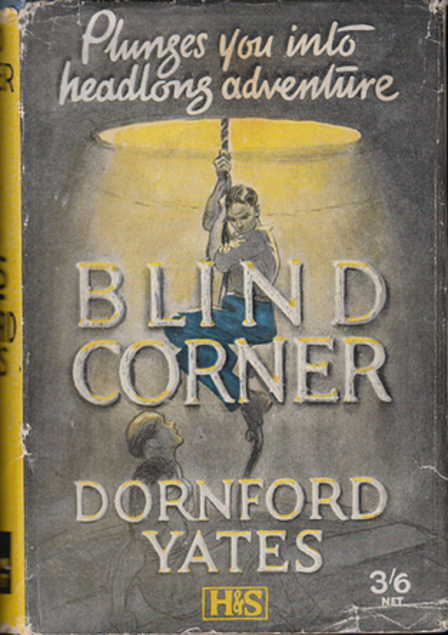
Now reading Blind Corner by Dornford Yates.
Hmm...
Shouldn't that be "Plunges you headlong into adventure"?...although I guess that wouldn't fit so neatly across the cover...
186lyzard
Aw, crap.
In fact, crap AND crap.
I was so excited about getting the 'Mystery League' challenge moving again...and now I've hit a wall at pace.
The next book up is Turmoil At Brede by Seldon Truss, which turns out (i) not to be available in this country or online, and (ii) in any event, the second book of a trio featuring Inspector Shane of Scotland Yard.
There are copies of Turmoil At Brede for...not an exorbitant price, though a bit more than I really want to pay; but the first book in the series, Gallows Bait, aka "The Living Alibi", is rare and expensive.
NOW what do I do? :(
ETA: A little more research reveals that Truss is one of those authors whose books are more readily available in non-English-language editions, French and Spanish and particularly German. And while there are no English-language copies of his books for sale here, we do have a handful of German-language ebooks available for purchase---WHHHHYYYYYYYY????
In fact, crap AND crap.
I was so excited about getting the 'Mystery League' challenge moving again...and now I've hit a wall at pace.
The next book up is Turmoil At Brede by Seldon Truss, which turns out (i) not to be available in this country or online, and (ii) in any event, the second book of a trio featuring Inspector Shane of Scotland Yard.
There are copies of Turmoil At Brede for...not an exorbitant price, though a bit more than I really want to pay; but the first book in the series, Gallows Bait, aka "The Living Alibi", is rare and expensive.
NOW what do I do? :(
ETA: A little more research reveals that Truss is one of those authors whose books are more readily available in non-English-language editions, French and Spanish and particularly German. And while there are no English-language copies of his books for sale here, we do have a handful of German-language ebooks available for purchase---WHHHHYYYYYYYY????
187lyzard
Finished Blind Corner for TIOLI #15.
Now reading The Sketch Book Of Geoffrey Crayon, Gent. by Washington Irving.
Now reading The Sketch Book Of Geoffrey Crayon, Gent. by Washington Irving.
188rosalita
>186 lyzard: The torture the book gods put you through, Liz! It just doesn't seem fair.
189lyzard
>188 rosalita:
I suppose I ask for it. :)
This one hurts because nearly all of Truss's other books are available here, one way or another; there's just this gap where it does the most damage.
I suppose I ask for it. :)
This one hurts because nearly all of Truss's other books are available here, one way or another; there's just this gap where it does the most damage.
190lyzard
I'm tempted to trot out my crushed-by-a-book image again (except that I have a better image to offer you):
I have finally seen the last of The Sicilian by "Gabrielli" (Elizabeth Meeke), which I feel like I've been wrestling with forever---responding to this painfully overlong and terribly dull domestic novel from 1798 with an equally overlong but hopefully not quite so dull blog-post:
The Sicilian
I have finally seen the last of The Sicilian by "Gabrielli" (Elizabeth Meeke), which I feel like I've been wrestling with forever---responding to this painfully overlong and terribly dull domestic novel from 1798 with an equally overlong but hopefully not quite so dull blog-post:
The Sicilian

192rosalita
>191 lyzard: You might think Mr. (Ms.?) Lemur is surprised that you published your blog post on The Sicilian at last. I think La Lemur is shocked that you actually persevered to the end of a "painfully overlong and terribly dull domestic novel". That sort of stick-to-itiveness is why we love you!
194lyzard
And, oh yeah, that whole computer-in-the-bath thing:
Also now reading At Bertram's Hotel by Agatha Christie.
Also now reading At Bertram's Hotel by Agatha Christie.
195swynn
>190 lyzard: Ugh, that sounds worse than Anthony Adverse -- a work much better enjoyed through the Liz filter. Thanks for taking that hit!
196rosalita
>194 lyzard: Ooh, ooh — At Bertram's Hotel was one of the first Christies I ever read, when I was just a tyke, and I have very fond memories of it. I'm sure I had never stayed in a proper hotel at that stage of my young life, and I was enthralled at the very idea.
I've spent many nights in hotel since, but I was pleased that it held up on a re-read a couple of years ago.
I've spent many nights in hotel since, but I was pleased that it held up on a re-read a couple of years ago.
197lyzard
>195 swynn:
Heh! - no, not that bad; though her ability to fill out four volumes without saying anything is...well, we'll leave it at remarkable.
My academic consolation here is proving the the real academics wrong with respect to this writer and her namesake; although whether that inner glow of nerdy self-satisfaction really compensates for having to read the books is debatable.
>196 rosalita:
I've always had a soft spot for it too. I think it's because (rather like The Clocks) it's hard to keep the plot, or plots, straight, and so it holds up to re-reading.
And, mark you! - once again we find Jane away from home. :)
Heh! - no, not that bad; though her ability to fill out four volumes without saying anything is...well, we'll leave it at remarkable.
My academic consolation here is proving the the real academics wrong with respect to this writer and her namesake; although whether that inner glow of nerdy self-satisfaction really compensates for having to read the books is debatable.
>196 rosalita:
I've always had a soft spot for it too. I think it's because (rather like The Clocks) it's hard to keep the plot, or plots, straight, and so it holds up to re-reading.
And, mark you! - once again we find Jane away from home. :)
198lyzard
Finished At Bertram's Hotel for TIOLI #13.
Still reading The Sketch Book Of Geoffrey Crayon by Washington Irving (and of course The American Caravan); whether I require another bathtub-book remains to be seen...
Still reading The Sketch Book Of Geoffrey Crayon by Washington Irving (and of course The American Caravan); whether I require another bathtub-book remains to be seen...
199Helenliz
I learnt the word doppleganger from At Bertram's Hotel I have a soft spot for that kind of thing.
200lyzard
>199 Helenliz:
Oh, nice!
I noticed a couple of things during this re-read that really show that times were changing...
Oh, nice!
I noticed a couple of things during this re-read that really show that times were changing...
201lyzard
Finished The Sketch Book Of Geoffrey Crayon, Gent. for TIOLI #5 (and the 'Century Of Reading' challenge)...
...and I'm not quite sure what I'm going to read next. I have two potential TIOLI works on hand, but I can't get the slot for either of them; and my brain being what it is, it's going round and round on that point like a mouse in an exercise wheel rather than putting it aside and picking something else.
I do have a third pick, but it's slightly cheaty...or perhaps more correctly, of the letter rather than the spirit...but oh well:
Now reading Keeper Of The Keys by Earl Derr Biggers.
...and I'm not quite sure what I'm going to read next. I have two potential TIOLI works on hand, but I can't get the slot for either of them; and my brain being what it is, it's going round and round on that point like a mouse in an exercise wheel rather than putting it aside and picking something else.
I do have a third pick, but it's slightly cheaty...or perhaps more correctly, of the letter rather than the spirit...but oh well:
Now reading Keeper Of The Keys by Earl Derr Biggers.
202lyzard
I'm already thinking about next month's reading - eep! - but mostly because I have to get some library requests organised:
My locked-in books for next month are:
The Cardinal by Henry Morton Robinson {best-seller challenge / library}
Third Girl by Agatha Christie {chronological challenge}
The Brading Collection by Patricia Wentworth {shared read}
Other possibilities:
The Adventures Of Hajji Baba Of Ispahan by James Morier {Shorter challenge / library storage request}
Thaddeus Of Warsaw by Jane Porter {Century Of Reading challenge / library storage request}
Fabia by Olive Higgins Prouty {ILL / end of a series / this month if I can get a TIOLI slot}
Gray Magic by Herman Landon {end of a series / this month if I can get a TIOLI slot}
Many Ways by Margaret Pedler {ILL / 1931}
The Eye In Attendance by Valentine Williams {series work}
B.F.'s Daughter by John P. Marquand {random reading}
They Who Do Not Grieve by Sia Figiel {potential decommission / fiction}
Faces In The Smoke by Douchan Gersi {potential decommission / non-fiction}
Meanwhile, I'm still trying to find a way forward with the Mystery League challenge {as moaned about in >186 lyzard:}, but I suspect I'll end up biting two bullets and just buying a copy of Turmoil At Brede, sigh...
My locked-in books for next month are:
The Cardinal by Henry Morton Robinson {best-seller challenge / library}
Third Girl by Agatha Christie {chronological challenge}
The Brading Collection by Patricia Wentworth {shared read}
Other possibilities:
The Adventures Of Hajji Baba Of Ispahan by James Morier {Shorter challenge / library storage request}
Thaddeus Of Warsaw by Jane Porter {Century Of Reading challenge / library storage request}
Fabia by Olive Higgins Prouty {ILL / end of a series / this month if I can get a TIOLI slot}
Gray Magic by Herman Landon {end of a series / this month if I can get a TIOLI slot}
Many Ways by Margaret Pedler {ILL / 1931}
The Eye In Attendance by Valentine Williams {series work}
B.F.'s Daughter by John P. Marquand {random reading}
They Who Do Not Grieve by Sia Figiel {potential decommission / fiction}
Faces In The Smoke by Douchan Gersi {potential decommission / non-fiction}
Meanwhile, I'm still trying to find a way forward with the Mystery League challenge {as moaned about in >186 lyzard:}, but I suspect I'll end up biting two bullets and just buying a copy of Turmoil At Brede, sigh...
203lyzard

The Handsome Young Men - This entry in Hubert Footner's series featuring Madame Rosika Storey first appeared in Argosy, as did most of its shorter fellows. Unlike the rest, however, it was only collected and reissued subsequently in the UK, in a volume titled The Viper, which also contained the title story and The Steerers; while these two were also reissued in the US as part of a different collection, The Velvet Hand. (Confused? You should be!) It seems likely that The Handsome Young Men was banished from American shores due to its generally unflattering portrait of the higher levels of US society, where (the sophisticated and brilliant Madame Story herself excepted, of course) everyone is depicted as being as dumb as a bag of hammers, and in the case of the young women---shall we say, "romantically overeager"? A public feud between Van Sicklen Harker and his heiress daughter, Cornelia - known as the "billion dollar baby" - over her determination to marry a professional dancer, a Hungarian called Arpad Rody, ends in a runaway marriage---and murder. The day after the wedding, Rody is found shot dead in the palatial hotel suite occupied by himself and his bride, after he has a violent confrontation with his father-in-law. Cornelia suddenly confesses to the crime, only for Van Sicklen Harker to do likewise. With the evidence inconclusive, it is for Madame Storey to discover the truth---which involves a dangerous syndicate of handsome young men imported from Europe and trained in the social arts that will appeal to wealthy but naive young American women, all with the aim of money through marriage or blackmail...
We had no difficulty in identifying our men. They were sent out every afternoon for an aimless walk. These were the neophytes; they were still shabbily dressed. Apparently there was no love lost between them, for they always separated on the doorstep. The French boy would turn aside and remain staring at the river through the bars of the railing until the Italian had walked off out of sight. This French lad was as pretty as a girl. He was evidently of the Northern provinces, with tight blonde curls all over his head, and big blue eyes which were at once saddened, and secretly terrified. What had those eyes beheld, I wondered. As soon as she saw him, Mme. Storey said:
"They slipped up when they picked him. He's already cracking under the strain."
The Italian on the other hand was a big, stalwart fellow, black as the Knave of Spades. He was undeniably good-looking; but with the good looks of a brigand. His full, red lips were curved in a perpetual sneer. He looked at women through his lowered sooty eyelashes with an expression of insolent triumph.
"Good Heavens!" said I, "surely no gently brought-up girl would ever fall for him!"
"On the contrary," said Mme. Storey, "if they can give him a slight veneer of good manners, that sort of man is irresistible to inexperienced girls..."
204lyzard
Finished Keeper Of The Keys for TIOLI #7...and FINISHED A SERIES!!
To mark the occasion, here is a white-headed marmoset (also known as Geoffroy's marmoset), who seems less judgy than his immediate predecessors, but still a bit sad it took me six years to get through a six-book series:

To mark the occasion, here is a white-headed marmoset (also known as Geoffroy's marmoset), who seems less judgy than his immediate predecessors, but still a bit sad it took me six years to get through a six-book series:

205lyzard
I'm having trouble settling on my next read, chiefly because I don't have most of my challenge reads to hand (library ahoy!).
But in any event, that will be a line under July, where after a brief flourish my unwritten reviews got the better of me again, sigh.
ETA: When in doubt, turn to TIOLI; when in more doubt, do TIOLI in order! :D
Now reading The Sands Of Windee by Arthur Upfield.
But in any event, that will be a line under July, where after a brief flourish my unwritten reviews got the better of me again, sigh.
ETA: When in doubt, turn to TIOLI; when in more doubt, do TIOLI in order! :D
Now reading The Sands Of Windee by Arthur Upfield.
206rosalita
Well done finishing another series, Liz! I am going to come back and look at Geoffrey's marmoset whenever I need a giggle, because he is adorably goofy looking. There's something about those ears ... they almost look tied on like a wig! So cute.
207Helenliz
Oh well done! A series finish is, after all, a series finish.
>206 rosalita: I'm with you, a lot of Liz's animals do look a bit like they've beeen made up with the bots someone had lying around in the workshop! Those ear tufts look too big for his head, to me. Maybe he'll grow into them!
>206 rosalita: I'm with you, a lot of Liz's animals do look a bit like they've beeen made up with the bots someone had lying around in the workshop! Those ear tufts look too big for his head, to me. Maybe he'll grow into them!
208Matke
Your thread is always so interesting, Liz. And the animals I The last few posts have been particularly adorable. That last marmoset...
I’ll skip all my trite comments on your reading exploits, except for:
Congratulations on finishing several series! That must give you a thrill of satisfaction deep in your soul.
And thank you as always for shouldering the burden of reading stultifyingly boring books. You save all of us from a lot to f slogging.
And my goodness! The Cardinal! You’ve given me an excuse to pull my copy off the shelf next month. Haven’t read that one in more years than I can count.
I’ll skip all my trite comments on your reading exploits, except for:
Congratulations on finishing several series! That must give you a thrill of satisfaction deep in your soul.
And thank you as always for shouldering the burden of reading stultifyingly boring books. You save all of us from a lot to f slogging.
And my goodness! The Cardinal! You’ve given me an excuse to pull my copy off the shelf next month. Haven’t read that one in more years than I can count.
209rosalita
>207 Helenliz: Good call on the idea that Mr. Marmoset might grow into his ear tufts. The more I look at him, the more I think the bemused expression on his face is not in reaction to how long it took Liz to finish this latest series, and more that he has the same reaction I do when someone turns the camera on me. "Oh dear, must we?"
210lyzard
>206 rosalita:
Thank you, Julia! I wonder if they had to struggle not to be silly while naming marmoset species??
>207 Helenliz:
Thanks, Helen. Oh, yes---but I always wince when I access the first book in a finished series to check!
Um, I think he's already done as much growing into them as he's going to do! I wonder if I can find a pic of a baby one...?
>208 Matke:
Hi, Gail! Glad you're enjoying my extra little visitors.
Please don't skip the trite comments, my thread needs all the posts it can get!
Yes, my completism takes great joy in actually wrapping something up (and doesn't get to experience it all that often!).
thank you as always for shouldering the burden of reading stultifyingly boring books
Okay...I guess I'll take that as praise for my courage and generosity, rather than a comprehensive take-down of my reading. :D
Oh, please do join me for The Cardinal if you can! - Steve is supposed to be joining me, but he's bogged down in 1946 at the moment, so I've had to battle on alone with the best-sellers. That's one of the books I have to take a trip in to the library to collect, though, so I'm not sure when I'll be starting.
>209 rosalita:
You mean you do sit still for it? Wimp!
NOT a fan of the 'photograph everything' phenomenon...
Thank you, Julia! I wonder if they had to struggle not to be silly while naming marmoset species??
>207 Helenliz:
Thanks, Helen. Oh, yes---but I always wince when I access the first book in a finished series to check!
Um, I think he's already done as much growing into them as he's going to do! I wonder if I can find a pic of a baby one...?
>208 Matke:
Hi, Gail! Glad you're enjoying my extra little visitors.
Please don't skip the trite comments, my thread needs all the posts it can get!
Yes, my completism takes great joy in actually wrapping something up (and doesn't get to experience it all that often!).
thank you as always for shouldering the burden of reading stultifyingly boring books
Okay...I guess I'll take that as praise for my courage and generosity, rather than a comprehensive take-down of my reading. :D
Oh, please do join me for The Cardinal if you can! - Steve is supposed to be joining me, but he's bogged down in 1946 at the moment, so I've had to battle on alone with the best-sellers. That's one of the books I have to take a trip in to the library to collect, though, so I'm not sure when I'll be starting.
>209 rosalita:
You mean you do sit still for it? Wimp!
NOT a fan of the 'photograph everything' phenomenon...
211Matke
>210 lyzard: Oh my! No, of course I refer to your courage, tenacity, and kindness to us when I mentioned some of the, er, slightly less interesting books your manage to get through.
I’m committed to The Cardinal next month. It will be fun to exchange thoughts. I was brought up RC and in Massachusetts, so it resonated the first time around. We’ll see how much I’ve changed.
I’m committed to The Cardinal next month. It will be fun to exchange thoughts. I was brought up RC and in Massachusetts, so it resonated the first time around. We’ll see how much I’ve changed.
212lyzard
>211 Matke:
Okay then. :D
Oh, that's interesting! I haven't read it before, though I did see the film many years ago.
Okay then. :D
Oh, that's interesting! I haven't read it before, though I did see the film many years ago.
213rosalita
>210 lyzard: I was much better at evasive maneuvers when I was more physically mobile. Too often now I'm reduced to "grimace and bear it." As long as I fend off the "kind" offers to give me a copy I can usually pretend it never happened.
Having said that, I am slightly dreading the photo Steve is going to post of our meetup last Saturday. Hopefully his thread will quickly add enough posts for it to scroll off screen. :-)
Having said that, I am slightly dreading the photo Steve is going to post of our meetup last Saturday. Hopefully his thread will quickly add enough posts for it to scroll off screen. :-)
214lyzard
>213 rosalita:
I am mostly still able to dodge, and do! Full sympathies over the unavoidable consequences of a meet-up...
I am mostly still able to dodge, and do! Full sympathies over the unavoidable consequences of a meet-up...
216lyzard

The Infidel Father - Jane West was an important literary figure at the turn of the 19th century, helping to bring "respectability" both to the novel in general and to the position of female authors; while her 1796 novel, A Gossip's Story, is believed to have been an important influence upon Jane Austen and her move from her comic juvenilia to her serious adult novels. However, West's 1802 novel, The Infidel Father, brings together all of the elements in her work that make her a struggle for the modern reader. Writing as her literary alter-ego, "Prudentia Homespun", West offers a painfully didactic story that blends smug conservatism with an equally smug air of condescension---all of it delivered with a sort of ponderous irony that becomes increasingly teeth-clenching. The "infidel father" of the title is Lord Glanville who, in his youth, contracts a secret - and false - marriage to Sophia Aubrey, a beautiful, yet humble and virtuous, seamstress---repudiating her and their young son when he inherits his father's title. Repairing his fortune by marrying an heiress, Lord Glanville is early widowed, leaving him to raise his daughter, Lady Caroline, in his own cynical tenets. Many years later, however, the lives of the two are turned upside-down when evidence emerges that the Earl's marriage to Sophia Aubrey was legal. Lord Glanville's heir is therefore his granddaughter, Sophia Herbert, who has been raised by her maternal grandfather, Mr Brudenell, a minister... This outline, I imagine, makes it obvious enough how The Infidel Father plays out: Lord Glanville and Lady Caroline go down to destruction upon the rocks of their unbelief and consequent bad behaviour, while the devout Sophia triumphs across the board, achieving a title, a fortune, and a properly pious brand of happiness. The overriding problem with this novel, however, is not its predictability, but what I'm tempted to call its dishonesty. There is - though I doubt that West actually realised it - a disconnect here between cause and effect that undermines the entire narrative. Most obviously, Lord Glanville does not do what he does to Sophia Aubrey because he lacks religious principle; rather, he chooses to become "an infidel" afterwards, because it's more comfortable that way. Likewise, Lady Caroline is led astray not by her lack of religion, but her vanity and wilfulness. Surrounding these points, too, is the always-exasperating suggestion that people without "religion" - by which, I should stress, West means her own narrow brand of Anglicanism - must likewise be without any morality or sense of right and wrong. I was also (perhaps unreasonably) annoyed by West's constant use of the term "deism" to mean "atheism": deism is more correctly the worship of God without an intervening church; and while I don't doubt the conservative West found this personally offensive, it's hardly the same thing as atheism. The only saving grace of The Infidel Father is that it does manage some sympathy for the unfortunate Lady Caroline, who faces the twin revelations of her illegitimacy and disinheritance with courage and generosity, and who is almost redeemed by her association with Mr Brudenell, but ultimately finds her prevailing faults too strong for her. However, this hardly compensates for the fact that, with all these plot machinations, Jane West was hard pressed to fill her obligatory three volumes---and so padded out her story via the introduction of a nouveau riche family, via which she could, in a series of lengthy scenes that contribute little to the main narrative, criticise numerous other aspects of society...although her lecturing here is less tiresome than the fact that these supporting characters are supposed to be funny. I hope Mrs West will forgive me if I am moved to exclaim: "Heaven help us!"
Lady Caroline wished to condemn Mr Brudenell for unseasonable prosing; but, turning her eyes upon his countenance, she beheld it irradiated by an expression which was the reverse of dullness and melancholy. A serene smile, a placid brow, lips that seemed to utter some pious ejaculation, and eyes uplifted towards the religion of eternal peace, bespoke a mind able to meditate upon eternity, not only without terror, but with sublime joy.
Is there a more enviable being in this world, than a man who can thus anticipate the next? What true dignity and real greatness of character are acquired by frequently reflecting on the audit at which we must one day deliver in our tale of intrusted talents! Sustained by the holy confidence which a well-spent life inspires, Mr Brudenell calmly advanced to meet the mean, debased, yet proud Earl of Glanville; who, poor amid the hoards of superfluous wealth, timid while possessing plenitude of power, and wretched while surrounded by every earthly good, now saw the veil torn away by which he had concealed the soul deformity of his cancerous guilt from the world, his idolised reputation blasted, and himself obliged to confess, not only with his tongue, but by his actions, the littleness of craft and the imprudence of dissimulation...
217Helenliz
>216 lyzard: Yikes!
You're a better woman than I, for wading through that.
You're a better woman than I, for wading through that.
220rosalita
>219 lyzard: Oh! Are we reading that this month? I keep losing track. :-)
221lyzard
So do I, but that's because I get confused between reading the books and writing my reviews. I don't know what your problem is. :D
The Catherine-Wheel was June, so that would be a yes.
The Catherine-Wheel was June, so that would be a yes.
222rosalita
I think my problem is that I always jump on it and read Miss Silver really early in the two-month window, and then I forget exactly when I read it. I'll have to try to remember that once I see your review I know it's almost time to start the next one :-p
224lyzard

The Three Clerks - Published in 1857, Anthony Trollope's sixth novel is a semi-autobiographical work that follows the fortunes of three young men beginning their careers in London. Harry Norman and Alaric Tudor are fortunate enough to secure clerkships within the prestigious Department of Weights and Measures, but Alaric's young cousin, Charley Tudor, ends up at the poorly run Department of Internal Navigation where poor example and his own weaknesses lead him down a bad path. All three young men are glad to escape London on the weekends to the country cottage of Mrs Woodward, Harry's widowed cousin, and to spend time with her daughters, Gertrude, Linda and Katie. Though at the outset colleagues and roommates, Harry and Alaric find their friendship crumbling as they become both professional and romantic rivals. As Alaric climbs the ladder of promotion with the Civil Service, he also succeeds in winning the affections of Gertrude Woodward, with whom Harry is in love. Alaric's run of success is ultimately threatened, however, when he falls into the clutches of Undecimus Scott, the son of an impecunious peer, who makes a dangerous living by stock manipulation---and by luring others into his dubious financial transactions... The Three Clerks is, overall, a relatively minor work in the Trollope canon, and a curious work in some respects---not least because Trollope uses it to push back against a government investigation into the workings of the Civil Service and the men employed within it, the conclusions of which he felt were inaccurate and unjust. (The non-fiction chapter which Trollope devotes to a straight attack upon this report was later deleted from the novel and is rarely included today; although the Trollope Society edition goes back to the original text.) At the same time, The Three Clerks does offer some fascinating early glimpses of matters which were to occupy Trollope for much of his writing career. These include, inevitably, politics; but also - in a manner which links this early work to later, more celebrated novels such as The Way We Live Now - Trollope's personal dismay over what he perceived to be the increasing dishonesty of society in general, particularly in financial matters, something he illustrates via the rise and fall of Alaric Tudor. With only his earnings to rely upon, Alaric is drawn by Undy Scott into a confusing and dangerous game of stock-trading and financial manipulation, on the specious but alluring grounds that "everyone's doing it". But Alaric is only a novice at the game that Undy plays professionally, and soon finds himself hopelessly entangled and compromised... The temptations of rapid professional and financial success that Alaric is unable to withstand were only some of the dangers and difficulties faced by young men at the outset of their careers, and Trollope considers some of the others via Harry Norman and Charley Tudor. The thin-skinned Harry, unable to recover from his twin failures, finds himself unfit to compete in the dog-eat-dog professional world; while the weak young Charley falls into bad company and, inevitably, debt---which finally lands him in prison... The most interesting aspect of The Three Clerks is Trollope's astonishingly unvarnished portrait of himself as a weak young man in Charley Tudor: most of Charley's embarrassments and misadventures were taken directly from Trollope's own miserable experiences as a young clerk in London. Trollope himself finally escaped rather than recovered; he is kinder to his alter-ego, who is finally able to throw off his bad habits and find some necessary strength of character when the people he loves are beset by crisis. Meanwhile, though much of The Three Clerks is deals with serious matters, Trollope lets himself go in his subplot dealing with Charley's first attempts as a professional writer, which are deliciously funny both in themselves and as a satirical attack upon the contemporary state of publishing.
"But, Alaric," said Norman, going on rather with the thread of his own thoughts, than answering or intending to answer what the other said, "in following up your high ambition---and I know you have a high ambition---do not allow yourself to believe that the end justifies the means, because you see that men around you act as though they believed so."
"Do I do so---do I seem to do so?" said Alaric, turning sharply round.
"Don't be angry with me, Alaric; don't think that I want to preach; but sometimes I fancy, not that you do so, but that your mind is turning that way; that in your eager desire for honourable success you won't scrutinise the steps you will have to take."
"That I would get to the top of the hill, in short, even though the hillside be miry. Well, I own I wish to get to the top of the hill."
"But not to defile yourself in doing so."
"When a man comes home from a successful chase, with his bag well stuffed with game, the women do not quarrel with him because there is mud on his gaiters."
"Alaric, that which is evil is evil. Lies are evil---"
"And am I a liar?"
"Heaven forbid that I should say so: heaven forbid that I should have to think so! but it is by such doctrines as that that men become liars."
"What! by having muddy gaiters?"
"By disregarding the means in looking to the end."
225lyzard
Best-selling books in the United States for 1949:
1. The Egyptian by Mika Waltari
2. The Big Fisherman by Lloyd C. Douglas
3. Mary by Sholem Asch
4. A Rage to Live by John O'Hara
5. Point of No Return by John P. Marquand
6. Dinner at Antoine's by Frances Parkinson Keyes
7. High Towers by Thomas B. Costain
8. Cutlass Empire by Van Wyck Mason
9. Pride's Castle by Frank Yerby
10. Father of the Bride by Edward Streeter
History and religion continued to dominate American reading during 1949.
In fact three books, including the year's best-seller and its #2, which topped the list in 1948, fall into both categories. The third is Sholem Asch's Mary, his biography of the mother of Jesus (which unlike any of Lloyd Douglas's biblical novels, dares to get inside the heads of his characters).
Meanwhile, Thomas Costain's High Towers is about the settling of New Orleans in the early 18th century; Van Wyck Mason's Cutlass Empire is set in the Caribbean during the 17th century, and based loosely on the life of pirate-turned governor, Sir Henry Morgan; while Frank Yerby's Pride's Castle is about a poor man's rise to wealth and prominence in post-Civil War New York. John O'Hara's A Rage to Live deals with a prominent Pennsylvania family and the scandalous woman at its centre, and is set predominantly during the first two decades of the 20th century.
The remaining three books on the list deal with contemporary American society, including Frances Keyes' Dinner at Antoine's, a holdover from 1948. John P. Marquand's Point of No Return is about a conservative investment banker tempted for the first time into risk-taking; while Edward Streeter's Father of the Bride is about a family thrown into chaos by the impending wedding of the daughter.
The best-selling book of 1949, however, was the English-language translation of Finnish author Mika Waltari's 1945 historical novel, Sinuhe The Egyptian (aka "The Egyptian").
1. The Egyptian by Mika Waltari
2. The Big Fisherman by Lloyd C. Douglas
3. Mary by Sholem Asch
4. A Rage to Live by John O'Hara
5. Point of No Return by John P. Marquand
6. Dinner at Antoine's by Frances Parkinson Keyes
7. High Towers by Thomas B. Costain
8. Cutlass Empire by Van Wyck Mason
9. Pride's Castle by Frank Yerby
10. Father of the Bride by Edward Streeter
History and religion continued to dominate American reading during 1949.
In fact three books, including the year's best-seller and its #2, which topped the list in 1948, fall into both categories. The third is Sholem Asch's Mary, his biography of the mother of Jesus (which unlike any of Lloyd Douglas's biblical novels, dares to get inside the heads of his characters).
Meanwhile, Thomas Costain's High Towers is about the settling of New Orleans in the early 18th century; Van Wyck Mason's Cutlass Empire is set in the Caribbean during the 17th century, and based loosely on the life of pirate-turned governor, Sir Henry Morgan; while Frank Yerby's Pride's Castle is about a poor man's rise to wealth and prominence in post-Civil War New York. John O'Hara's A Rage to Live deals with a prominent Pennsylvania family and the scandalous woman at its centre, and is set predominantly during the first two decades of the 20th century.
The remaining three books on the list deal with contemporary American society, including Frances Keyes' Dinner at Antoine's, a holdover from 1948. John P. Marquand's Point of No Return is about a conservative investment banker tempted for the first time into risk-taking; while Edward Streeter's Father of the Bride is about a family thrown into chaos by the impending wedding of the daughter.
The best-selling book of 1949, however, was the English-language translation of Finnish author Mika Waltari's 1945 historical novel, Sinuhe The Egyptian (aka "The Egyptian").
226lyzard

Mika Waltari was born in Helsinki in 1908, and experienced the Finnish Civil War as a small child. As a young man he began to study theology, like his minister-father, but soon transferred his interest to philosophy and literature. Contrary to common belief, he never formally studied history.
Waltari began to contribute short stories and poetry to the magazines while still at university. In 1927, after graduating, he relocated to Paris and wrote his first novel, Suuri Illusioni ("The Grand Illusion"), a 'Lost Generation' story. A prolific writer and hard worker, Waltari continued to publish novels within a variety of genres, while working as a journalist and critic and finally magazine editor. Among his works were three mysteries featuring a Helsinki police detective, which may represent the beginnings of "Scandi-crime".
During WWII, Waltari worked in the government information centre, an experience which taught him painful lessons about the manipulation of public "knowledge" and the rewriting of history: these experiences later informed his work as he turned increasingly to the writing of historical fiction, which often dealt with the enormous gap between individual, first-hand experience and the historical record.
In 1945, Waltari published his most successful book, Sinuhe The Egyptian, a sprawling historical novel set during the 18th Dynasty of Egypt, around 1300 BC. This story of inter-nation warfare and the failure of humanist values was widely read as an allegory of WWII, and became an enormous best-seller, first across Europe and then all around the world.
Though he never again reached the same professional heights, Waltari continued to publish historical novels that were successful and celebrated for their attention to detail and accuracy. He became a member of the Finnish Academy of Science and Letters, mentoring young writers, and received the State Literature Award five times.
227lyzard

Sinuhe Egyptiläinen (translation title: Sinuhe The Egyptian, reissue title: The Egyptian) - Published in 1945, Mika Waltari's work of historical fiction eventually became an international best-seller---in spite of the need to overcome some rare language barriers. A rolling wave of translations from the original Finnish saw the novel find success across Europe over the following few years, but the book was not reissued in English until 1949---and then, not via a direct translation, but as a translation of a Swedish translation. Moreover, Waltari's extremely lengthy novel was cut while being rendered into Swedish, and then cut again while being turned into English---and this remains the only English-language version, re-released as recently as 2002. But while this abridgement is to be deplored, given the novel's translation history, its content and the characters' way of speaking, by which Waltari conveys much of the Egyptian culture, this version by Naomi Walford is a remarkably smooth read. And just as well too, because despite the double-cutting of the book (undertaken, I gather, to shorten the protagonist's philosophical musings), Sinuhe The Egyptian still runs to a good 450 pages of largely dialogue-free text. The novel is retrospective, comprising the life-history of Sinuhe, former royal physician, who in his youth acquired the prophetic nickname, "He Who Is Alone"; his story is told from his exile on the shores of the Red Sea. As a baby, Sinuhe is rescued from the Nile by a couple who raise him as their own, not telling him of his background until he reaches adolescence. Sinuhe grows up in a poor section of Thebes, and follows his adopted father by becoming a physician. Under the aegis of his father's friend, Ptahor, Sinuhe is trained in the rare medical skill of skull-opening, and in this capacity carried to the royal court, where he assists in an operation upon the Pharaoh. He also meets the two people who, with their radically opposed philosophies, will shape the course of his life: the ambitious warrior, Horemheb, who will rise to command of the Egyptian army---and beyond; and the royal prince who, as Pharaoh Akhnaton, will attempt to impose upon Egypt the god, Aton, and his religion of brotherhood and equality---and in so doing, unleash civil war and bloodshed, and almost bring about the downfall of Egypt... How much enjoyment, if 'enjoyment' is the right word, the reader gathers from Sinuhe The Egyptian may depend upon the level upon which he or she takes it. Much of it is fascinating, in particular Sinuhe's extended journey through the various territories abutting the Nile and the Red Sea, as Sinuhe seeks to expand his medical knowledge (and spies for Horemheb): a journey in which the different cultures and ways of life are rendered with (we gather) great historical accuracy. Indeed, since its first appearance Sinuhe The Egyptian has been praised as a piece of near-perfect historical writing, with only a few points within this long work becoming the basis for dispute, and a few (admitted) meldings of characters for dramatic purposes. Those with an interest in this period of history and its varying cultures are likely to find this novel richly rewarding. However, Sinuhe himself is a problematic protagonist, as he lives up - or down - to his nickname, and proves inadequate in one human relationship after another. In addition, this is necessarily a story of conflict and suffering, and of selfishness and cruelty, and the struggle for power. Above all, however, it is a rather cynical account of the living hell that may be created through good intentions. Behind Sinuhe's account of his own enforced wanderings is the story of Akhnaton (Pharaoh Amenhotep IV, who changed his name to Akhenaten), sometimes considered history's first monotheist, who attempts to force his own one god upon polytheist Egypt, and likewise the concepts of equality and peace upon a culture that maintains its position through slavery, occupation and enforced tributes. Sinuhe, strongly attracted to the creed of Aton, finds himself caught between the isolated, stubborn, afflicted Akhnaton, and the ruthless, cunning Horemheb, who must hold Egypt together through internecine warfare even as her Pharaoh is tearing her apart with his creed of the brotherhood of men. Much of the larger part of the novel is devoted to the wars which Horemheb conducts in the teeth of his Pharaoh, brutal inter-nation conflicts which at the time of the first publication of Sinuhe The Egyptian led to the novel being widely interpreted as an allegory of WWII: a reading which Mika Waltari later admitted had some validity. This relentless clashing of nations and philosophies forms the backdrop to Sinuhe's own (albeit largely doomed) attempt to navigate his way to a compromise between extremes wherein individuality and choice may function. It is the last and greatest of the novel's many cynical touches that this journey of knowledge, and self-knowledge, leads Sinuhe only to exile and despair, even as Egypt settles back contentedly into an unthinking cycle of warfare, oppression and slavery...
At the sight of Horemheb his eyes cleared, and he was beautiful in his radiant wonder. "Is it you whom Aton, the one god, has sent?"
"The falcon flew before me, and I followed; that is why I am here. I know no more than that."
The prince looked with a frown at the other's weapon. "You carry a spear," he said in rebuke.
Horemheb held it forth. "The shaft is of choice wood," he said. "Its copper head longs to drink the blood of Pharaoh's enemies. My spear is thirsty, and its name is Throat Slitter."
"Not blood!" cried the prince. "Blood is an abomination to Aton. There is nothing more terrible than flowing blood."
"Blood purifies the people and makes them strong; it makes the gods fat and contented. As long as there is war, so long must blood flow."
"There will never be war again," declared the heir to the throne.
Horemheb laughed. "The lad's daft! War there has always been and always will be, for the nations must test each other's worth if they are to survive."
"All peoples are his children---all languages---all complexions---the black land and the red." The prince was gazing straight into the sun. "I shall raise temples to him in every land, and to the princes of those lands I shall send the symbol of life---for I have seen him! Of him I was born and to him I shall return."
"He is mad," said Horemheb to me. "I can see he needs a doctor..."
228PaulCranswick
>227 lyzard: Fascinating review Liz, especially the bits about the abridgement of translations upon translations.
229lyzard
Thanks, Paul! Yes, that had me tearing my hair out in the first instance, and it still seems crazy that no-one has gone back and translated the original text over all these years. Took me a while to accept that this version is IT. :)
230lyzard
Oh...fudge.
In this month's TIOLI "mystery mystery" challenge I drew 'a book either shorter than 200 pages or longer than 500 pages', which I thought would be a good opportunity to read something I've had sitting around for far too long. Years ago I picked up a copy of Ellery Queen's Mystery Anthology: 30th Anniversary because (among other things*) it contains a reprint of Leslie Ford's The Clock Strikes Twelve (aka "The Supreme Court Murder"), a 1935 novella which introduces Ford's long-running series character, Grace Latham...and which I thought also introduced Grace's co-detective, Colonel Primrose.
But though the two of them would appear together regularly over the next twenty years, it turns out that while this novella does mark Grace's first appearance, Colonel Primrose was introduced as a standalone character the previous year, in a novel called The Strangled Witness.
The good news is that there is a copy of The Strangled Witness available here in Rare Books; though of course that means finding the time to read it.
So the question now is whether I can "let myself" read The Clock Strikes Twelve, knowing that it is only The First In A Series for one of its characters; or whether I will feel obliged to access and read The Strangled Witness first...
...although that isn't really what made me say "fudge": I just realised that since I am the only reader of this series to hold a copy of The Clock Strikes Twelve, which is therefore currently omitted from both series lists---I'm also going to have to be the one to edit both those lists to include it...
ETA: Gah! - a little more research discovers that there is disagreement over whether Ford's novella was originally titled "The Clock Strikes Twelve" or just "The Clock Strikes"; down the rabbit-hole I go...
(*Among the other authors to feature in this anthology are Rex Stout, Ross Macdonald, P. D. James and Georges Simenon; impressive!)
In this month's TIOLI "mystery mystery" challenge I drew 'a book either shorter than 200 pages or longer than 500 pages', which I thought would be a good opportunity to read something I've had sitting around for far too long. Years ago I picked up a copy of Ellery Queen's Mystery Anthology: 30th Anniversary because (among other things*) it contains a reprint of Leslie Ford's The Clock Strikes Twelve (aka "The Supreme Court Murder"), a 1935 novella which introduces Ford's long-running series character, Grace Latham...and which I thought also introduced Grace's co-detective, Colonel Primrose.
But though the two of them would appear together regularly over the next twenty years, it turns out that while this novella does mark Grace's first appearance, Colonel Primrose was introduced as a standalone character the previous year, in a novel called The Strangled Witness.
The good news is that there is a copy of The Strangled Witness available here in Rare Books; though of course that means finding the time to read it.
So the question now is whether I can "let myself" read The Clock Strikes Twelve, knowing that it is only The First In A Series for one of its characters; or whether I will feel obliged to access and read The Strangled Witness first...
...although that isn't really what made me say "fudge": I just realised that since I am the only reader of this series to hold a copy of The Clock Strikes Twelve, which is therefore currently omitted from both series lists---I'm also going to have to be the one to edit both those lists to include it...
ETA: Gah! - a little more research discovers that there is disagreement over whether Ford's novella was originally titled "The Clock Strikes Twelve" or just "The Clock Strikes"; down the rabbit-hole I go...
(*Among the other authors to feature in this anthology are Rex Stout, Ross Macdonald, P. D. James and Georges Simenon; impressive!)
231lyzard
Oh, what the hell; let's live dangerously!
Finished The Brading Collection for TIOLI #2.
Now reading The Clock Strikes Twelve by Leslie Ford. (Um, maybe: see above)
Finished The Brading Collection for TIOLI #2.
Now reading The Clock Strikes Twelve by Leslie Ford. (Um, maybe: see above)
232lyzard
Okay: the listings are split about 50:50 but various magazine databases and indexes go with "The Clock Strikes" so I will too.
Either way, the novella was first published on The American Magazine of May 1935: check out the full contents!---


Either way, the novella was first published on The American Magazine of May 1935: check out the full contents!---


233lyzard
...it's just occurred to me that it will probably take me less time to read this novella than it did to do all that...
:D
:D
234Matke
Powder Puff Champs intrigues...champs at what? Did they have races involving makeup application? Perhaps talcum powder dust offs?
The mind reels...
The mind reels...
235lyzard
>234 Matke:
It's probably something far less interesting, like an "underdogs triumph" story. I like your suggestions much better! :D
It's probably something far less interesting, like an "underdogs triumph" story. I like your suggestions much better! :D
236rosalita
>234 Matke: >235 lyzard: When I was a mere lass back in the 1970s, an annual event at high school Homecoming celebrations was a "powder puff" (American) football game, in which the cheerleaders became the football players, and the football players became the cheerleaders, complete with "hilarious" cross-dressing with boys shoving volleyballs under their cheerleading sweaters. See also: https://en.m.wikipedia.org/wiki/Powderpuff_sports
237lyzard
>236 rosalita:
{*really wanting an 'eyes-wide-open' emoji*}
Well, this is 1935 so hopefully the latter part of that suggestion is wrong; but maybe you're onto something with the first part?
{*really wanting an 'eyes-wide-open' emoji*}
Well, this is 1935 so hopefully the latter part of that suggestion is wrong; but maybe you're onto something with the first part?
238lyzard
Oh....FUDGE.
I did indeed finish The Clock Strikes quite quickly, and it turns out that Grace Latham isn't in it at all, only Colonel Primrose.
I guess the up-side of that is I only have to edit one series list, but I'm definitely not comfortable reading a standalone work out of order.
My goodness, there is a lot of misinformation out there!
Speaking of which, it is 12:45pm when the eponymous clock strikes, so that settles that about the correct title.
Anyhoo---
Finished The Clock Strikes for TIOLI #4.
Now reading Third Girl by Agatha Christie.
I did indeed finish The Clock Strikes quite quickly, and it turns out that Grace Latham isn't in it at all, only Colonel Primrose.
I guess the up-side of that is I only have to edit one series list, but I'm definitely not comfortable reading a standalone work out of order.
My goodness, there is a lot of misinformation out there!
Speaking of which, it is 12:45pm when the eponymous clock strikes, so that settles that about the correct title.
Anyhoo---
Finished The Clock Strikes for TIOLI #4.
Now reading Third Girl by Agatha Christie.
239rosalita
>237 lyzard: It's certainly possible! The Wikipedia article says the earliest photographic evidence of a powder puff football game is 1931, so ...
Now that the idea of girls playing actual sports is not an object of ridicule, I hope the popularity of such things has waned, although apparently it was still around as recently as 2016, so ... sigh.
Now that the idea of girls playing actual sports is not an object of ridicule, I hope the popularity of such things has waned, although apparently it was still around as recently as 2016, so ... sigh.
240lyzard
>239 rosalita:
Good grief, and good grief! - the latter accompanied by {*angry face*}...
Not an object of ridicule, no, but still an object of misogynistic ranting and entitled whinging about male sportspeople having "their" funding taken away. We've reached the point where this attitude is a minority one and not stopping anyone, but it is persistent and very ugly.
Good grief, and good grief! - the latter accompanied by {*angry face*}...
Not an object of ridicule, no, but still an object of misogynistic ranting and entitled whinging about male sportspeople having "their" funding taken away. We've reached the point where this attitude is a minority one and not stopping anyone, but it is persistent and very ugly.
241rosalita
>240 lyzard: Amen, sister!
242lyzard
The Epicurean - In 1827, the Irish poet, Thomas Moore, experimented for the first time with writing fiction---partly because he was struggling to complete a lengthy verse-narrative in the format in which he had first conceived it, and partly because of his acceptance that while poetry wasn't going to pay his bills any more, a novel might. The incomplete poem, Alciphron, is now almost always appended to its prose-twin, which Moore published under the title, The Epicurean. In this guise it forms one of a curiously popular branch of 19th century historical fiction---curiously, because most of these novels are built around an almost identical plot, in which a pagan falls in love with a beautiful woman, and then discovers her to be a secret Christian; either tragedy or triumph may ensue (though more commonly the former). Such narratives also tend to place real historical figures in fictional settings and here, the pagan in question is Alciphron, a 4th century Greek teacher and epistolographer celebrated for the beauty of his writing. Moore, however, makes him a member of the Epicurean sect, which we learn has degenerated from the time of its its founding by the philosopher Epicurius, who believed that pleasure might best be found in being good, to an excuse to find pleasure by indulging all the vices. When the narrative opens, Alciphron has just been elected leader of the sect---whose tenets he has just begun to question. Though Epicureanism is by definition a materialistic philosophy that believes in no life but this, Alciphron is unable to accept this---chiefly out of an inability to believe that he, personally, will one day cease to exist. One night, Alciphron experiences a vivid dream, in which he is promised that he will find the secret of eternal life on the banks of the Nile. He follows his vision to Egypt, seeking out the priests of Memphis and becoming involved with the Sect of Isis. While watching one sacred ceremony, Alciphron becomes obsessed with one beautiful young participant---and in pursuing her, he discovers the great secret... In converting his unfinished poem to prose, Thomas Moore did little to disguise its origins: The Epicurean is rich with descriptive passages, and gives more weight to Alciphron's immediate sensory experiences than to his eventual embrace of the new religion, to which he is led by the purity (and physical beauty) of the mysterious Alethe. Perhaps this reflects the fact that it was his story's climax that he never succeeded in rendering in verse, or perhaps Alciphron's conversion was less "real" to Moore than his strange experiences beneath the Pyramids of Memphis, which comprise both startling visions and dangerous obstacles which he must surmount---purportedly to fit him to join the Sect of Isis, but which ultimately lead him down a very different path. The irony here is that, even as he draws an overt contrast between the---not just fake but overtly faked miracles of Isis and the real miracles of Christianity, Moore makes the former far more vividly real to the reader than the latter. Alciphron is eventually led out of the literal and figurative darkness by Alethe, who he discovers was secretly raised in the Christian religion by her mother. Theora was one of the scribes of Origen of Alexandria, assisting him in his religious commentaries and so coming to the new faith. Alciphron allows Alethe to carry him into a rocky enclave overlooking the Nile, where a small band of Christians have found a refuge under the guidance of a venerable hermit. Scheming to possess Alethe, Alciphron pretends to convert to her faith---only for his experiences to end in true conversion, just as the Emperor Valerian begins a new wave of persecutions of the Christians...
Suddenly, along the edges of the mighty Veils, I perceived a thin rim of light, as if from some brilliant object under them;---like that border which encircles a cloud at sunset, when the radiance, from behind, is escaping at its edges.
This indication of concealed glories grew every instant more strong; till, at last, vividly marked as it was upon the darkness, the narrow fringe of lustre almost pained the eye, giving promise of a splendour too bright to be endured. My expectations were now wound to the highest pitch, and all the scepticism, into which I had been cooling down my mind, was forgotten. The wonders that had been presented to me since my descent from earth---that glimpse into Elysium on the first night of my coming---those visitants from the Land of Spirits in the mysterious valley,---all led me to expect, in this last and brightest revelation, such visions of glory and knowledge as might transcend even fancy itself, nor leave a doubt that they belonged less to earth than heaven.
While, with an imagination thus excited, I stood waiting the result, an increased gush of light still more awakened my attention; and I saw, with an intenseness of interest, which made my heart beat aloud, one of the corners of the mighty Veil slowly raised up. I now felt that the Great Secret---whatever it might be---was at hand. A vague hope even crossed my mind---so wholly had imagination resumed her empire---that the splendid promise of my dream was on the point of being realised!
With surprise, however, and---for a moment---with disappointment, I perceived, that the massy corner of the Veil was but raised sufficiently to allow a female figure to emerge from under it,---and then fell again, over its mystic splendours, as dark as before. By the strong light, too, that issued when the drapery was lifted, and illuminated the profile of the emerging figure, I either saw, or fancied that I saw, the same bright features, that had already mocked me so often with their momentary charm, and seemed destined to haunt my heart as unavailingly as the fond, vain dream of Immortality itself...
244lyzard
Finished Gray Magic for TIOLI #9...and also FINISHED A SERIES!!!!
This buffy-headed marmoset looks like he can't quite believe I bothered getting all the way through this really very silly five-book series...let alone taking six years to do it (which is one year longer than Herman Landon took to write it!):

This buffy-headed marmoset looks like he can't quite believe I bothered getting all the way through this really very silly five-book series...let alone taking six years to do it (which is one year longer than Herman Landon took to write it!):

246rosalita
>244 lyzard: If the series is really very silly, I'd say five books over six years is just about the right pace! And congratulations for crossing the finish line.
Also, "buffy-headed marmoset?" He doesn't look like a vampire slayer ...
Also, "buffy-headed marmoset?" He doesn't look like a vampire slayer ...
247Matke
>244 lyzard: Oh dear. I’m perishing from cuteness overload...
248lyzard
>246 rosalita:
Oh, it's silly, all right; though the pace was more about its (deserved) obscurity and the related need to hunt the books down.
Thank you!
Maybe not, but I think they got the hair right...
>247 Matke:
:D
Stick around, I'm hoping for yet more cuteness this month (if I can fit it into TIOLI...)
Oh, it's silly, all right; though the pace was more about its (deserved) obscurity and the related need to hunt the books down.
Thank you!
Maybe not, but I think they got the hair right...
>247 Matke:
:D
Stick around, I'm hoping for yet more cuteness this month (if I can fit it into TIOLI...)
251rosalita
You may not be the best person to answer this, since you are an Aussie not a Brit, but in the latest Miss Silver there is a reference made to a character pronounce Don Quixote "in the British fashion." Which made me wonder, how do the British pronounce it? Do they not say Key-HO-tay the way Americans do? And how do you pronounce it, as long as we're asking?
252Helenliz
>251 rosalita: well I wouldn't say it that way, but that makes no assessment of me being right. Stress the first sylable, not the second; no h on the o in the middle; short final syllable. KEY-o-tey
253rosalita
>252 Helenliz: Thanks, Helen! That seems like a reasonable pronunciation. I was imagining all sorts of weirdness like kwik-SOTTY or something like that for it to be worth remarking on.
254lyzard
>251 rosalita:, >252 Helenliz:, >253 rosalita:
I believe the "British pronunciation" (whether or not British people did or do use it) is the more phonetic 'quick-sote', giving rise to the term, 'quixotic', pronounced 'quick-sot-ic'.
The way it is phrased in the novel, Wentworth suggests that Maudie knows the "correct" pronunciation but assumes Mrs Constantine won't and therefore uses the "British pronunciation".
Most people use one or other of your suggestions (I tend to agree with Helen), but there is a counter-suggestion of something like 'key-shot'...which has given rise to "Donkey-shot" as a guide to the entire name.
Not that these arguments are new: Cervantes choosing to spell his character's name with an 'x' instead of a 'j' means that they've been raging since about 1604. :D
I believe the "British pronunciation" (whether or not British people did or do use it) is the more phonetic 'quick-sote', giving rise to the term, 'quixotic', pronounced 'quick-sot-ic'.
The way it is phrased in the novel, Wentworth suggests that Maudie knows the "correct" pronunciation but assumes Mrs Constantine won't and therefore uses the "British pronunciation".
Most people use one or other of your suggestions (I tend to agree with Helen), but there is a counter-suggestion of something like 'key-shot'...which has given rise to "Donkey-shot" as a guide to the entire name.
Not that these arguments are new: Cervantes choosing to spell his character's name with an 'x' instead of a 'j' means that they've been raging since about 1604. :D
255FAMeulstee
>254 lyzard: Interesting... the idea of arguments going on since 1604 :-)
BTW I loved the book.
BTW I loved the book.
256rosalita
>254 lyzard: Thanks, Liz! What you wrote about that particular passage in the Miss Silver book was exactly the way I took it, even though I wasn't sure of the exact pronunciation, so Wentworth made her point regardless.
257lyzard
>255 FAMeulstee:
It's true! - even apart from the 'x' there has been pronunciation drift in Spanish as in most languages, so no-one knows for sure.
Yes, me too. :)
>256 rosalita:
I think Maudie was assuming that, like most of us, Mrs Constantine might have seen the word written but not heard it spoken. It's interesting to think about that subset of words, where the pronunciation you have in your head is not necessarily the correct one. I try to make a point now of accessing one of those online audio-dictionaries when I hit something I'm not sure about---there have been some funny gaps between the two!
It's true! - even apart from the 'x' there has been pronunciation drift in Spanish as in most languages, so no-one knows for sure.
Yes, me too. :)
>256 rosalita:
I think Maudie was assuming that, like most of us, Mrs Constantine might have seen the word written but not heard it spoken. It's interesting to think about that subset of words, where the pronunciation you have in your head is not necessarily the correct one. I try to make a point now of accessing one of those online audio-dictionaries when I hit something I'm not sure about---there have been some funny gaps between the two!
258lyzard
Yesterday was a 'running around to libraries' day, which included - finally - another reading session with The American Caravan.
I still have a fair chunk of it to go, but at least at this point I can feel that I'm well past the halfway mark:
Fire Sequence by Yvor Winters: a series of short poems set amongst immigrants and the poor (and poor immigrants) in a mining community. {Banned in Boston? - some sexual imagery and other explicit language}
City Love by Eric Walrond: a short story, written in dialect, about an unmarried black couple - that is to say, not married to each other - trying to find somewhere to have sex. {Banned in Boston? - everything about it!}
Idle Noon by Louis Grudin: a short poem about a street cat.
Five Poems by Stanley Burnshaw: as stated, a series of poems, rather contradictory in tone, sympathising with the struggles of the poor but critical of man's destruction of his environment through manufacturing and mining.
Adventure by Gertrude Diamant: a disturbing short story about an extreme introvert and his difficult relationships with people and the world.
Mad Proposal by Louis Untermeyer: a short poem about a poor couple throwing off convention.
Toil by Wilfrid Bendall: a longer poem that envisages work, "toil", as a living and destructive entity.
The Country by Nathan Asch: a strange and rather brilliant short story about a completely citified couple spending an afternoon in what is to them an alien environment, the country.
Three Poems by William Saphier: short poems about struggling workers.
Amuck In The Bush by Morley Callaghan: an unnerving short story about a man, fired from his job, who attempts an ugly revenge. {Banned in Boston? - planned kidnapping, description of an assault}
Directions For A Rendezvous On A Summer Night by Loius Kronenberger: a short poem with disturbing undertones, about a possible assignation.
Holiday by Clarkson Crane: a short story about a man suffering a complete breakdown, told from the inside.
Begun but not completed: Hoboken Blues; or, The Black Rip van Winkle by Michael Gold.
(pg 572 / 833)
I still have a fair chunk of it to go, but at least at this point I can feel that I'm well past the halfway mark:
Fire Sequence by Yvor Winters: a series of short poems set amongst immigrants and the poor (and poor immigrants) in a mining community. {Banned in Boston? - some sexual imagery and other explicit language}
City Love by Eric Walrond: a short story, written in dialect, about an unmarried black couple - that is to say, not married to each other - trying to find somewhere to have sex. {Banned in Boston? - everything about it!}
Idle Noon by Louis Grudin: a short poem about a street cat.
Five Poems by Stanley Burnshaw: as stated, a series of poems, rather contradictory in tone, sympathising with the struggles of the poor but critical of man's destruction of his environment through manufacturing and mining.
Adventure by Gertrude Diamant: a disturbing short story about an extreme introvert and his difficult relationships with people and the world.
Mad Proposal by Louis Untermeyer: a short poem about a poor couple throwing off convention.
Toil by Wilfrid Bendall: a longer poem that envisages work, "toil", as a living and destructive entity.
The Country by Nathan Asch: a strange and rather brilliant short story about a completely citified couple spending an afternoon in what is to them an alien environment, the country.
Three Poems by William Saphier: short poems about struggling workers.
Amuck In The Bush by Morley Callaghan: an unnerving short story about a man, fired from his job, who attempts an ugly revenge. {Banned in Boston? - planned kidnapping, description of an assault}
Directions For A Rendezvous On A Summer Night by Loius Kronenberger: a short poem with disturbing undertones, about a possible assignation.
Holiday by Clarkson Crane: a short story about a man suffering a complete breakdown, told from the inside.
Begun but not completed: Hoboken Blues; or, The Black Rip van Winkle by Michael Gold.
(pg 572 / 833)
261rosalita
>261 rosalita: Well, this guy, for one.
Catholicism is still the most populous religious denomination in the US other than lumping all the Protestants together in one group. In the 20th century, as many as a quarter of Americans were Catholic.
And they didn't only run churches — they were the primary source for private (i.e. not government-financed) schools, hospitals, orphanages, and lots of other social-welfare organizations. That gave them a pretty big toehold in civic life even beyond their own parishioners.
My favorite books about 20th century Catholicism, which are quite a bit more lively than the tomes you've been reading, are by John R. Powers: Do Black Patent Leather Shoes Really Reflect Up?, The Unoriginal Sinner and the Ice Cream God, and The Last Catholic in America. I was maybe 10 years younger than the era they depict, but I ate them up with a spoon. I'm pretty sure Bishop Sheen would not have approved. :)
Catholicism is still the most populous religious denomination in the US other than lumping all the Protestants together in one group. In the 20th century, as many as a quarter of Americans were Catholic.
And they didn't only run churches — they were the primary source for private (i.e. not government-financed) schools, hospitals, orphanages, and lots of other social-welfare organizations. That gave them a pretty big toehold in civic life even beyond their own parishioners.
My favorite books about 20th century Catholicism, which are quite a bit more lively than the tomes you've been reading, are by John R. Powers: Do Black Patent Leather Shoes Really Reflect Up?, The Unoriginal Sinner and the Ice Cream God, and The Last Catholic in America. I was maybe 10 years younger than the era they depict, but I ate them up with a spoon. I'm pretty sure Bishop Sheen would not have approved. :)
262lyzard
That's an interesting answer, thank you! - but in a way it confuses the issue more. It's not just that there was this upsurge in Catholic-themed novels, it's that they nearly all have this sense of "explaining" something mysterious and unknown to a naive audience; whereas you're suggesting that Catholicism at the time was pretty mainstream and even "in your face". It seems a contradiction.
But whatever the reason, a heck of a lot of them made it onto the best-seller lists! :D
But whatever the reason, a heck of a lot of them made it onto the best-seller lists! :D
263kac522
>262 lyzard: I think most big US cities had large Catholic populations (New York, Chicago, etc.), but Catholics were still not completely accepted in small towns and rural areas. As families started moving out of the inner cities and into suburban areas after the war, I can see how there was a need to explain Catholicism, as new churches and parochial schools were being built in formerly all-Protestant areas.
It certainly was still a big deal when Kennedy ran for President in 1960. He might never have won if it hadn't been for Chicago's (Irish Catholic) Mayor Richard Daley and his political machine.
It certainly was still a big deal when Kennedy ran for President in 1960. He might never have won if it hadn't been for Chicago's (Irish Catholic) Mayor Richard Daley and his political machine.
264rosalita
>263 kac522: Yes, well put.
265kac522
>261 rosalita: And I also read those Powers' books; like you I was about 10 years behind his Catholic experience. He taught at the university where I went to school and later worked, and my husband took several of Powers' classes.
266kac522
>260 lyzard: I think my first grade readers (probably printed circa 1950) in Catholic grammar school sort of says it all.
We didn't have Dick and Jane in their suburban house. Our readers had David and Ann and Baby Mary. They lived in a city, in an apartment building. Father went to work in a blue worker's jumpsuit, and carried a metal lunch pail--no suit & tie in this working class family. I don't remember much about Mother, but I remember crucifixes in the background of the illustrations.
We didn't have Dick and Jane in their suburban house. Our readers had David and Ann and Baby Mary. They lived in a city, in an apartment building. Father went to work in a blue worker's jumpsuit, and carried a metal lunch pail--no suit & tie in this working class family. I don't remember much about Mother, but I remember crucifixes in the background of the illustrations.
267lyzard
>263 kac522:
That makes sense of what I was struggling with, thank you!
Yes, I always vaguely aware that the fact that Kennedy was Catholic was somehow a big deal; I can see now how that fits into the same paradigm.
Still and all...I don't think they had to write quite so many long novels about it... :)
>266 kac522:
Oh, that's fascinating!
That makes sense of what I was struggling with, thank you!
Yes, I always vaguely aware that the fact that Kennedy was Catholic was somehow a big deal; I can see now how that fits into the same paradigm.
Still and all...I don't think they had to write quite so many long novels about it... :)
>266 kac522:
Oh, that's fascinating!
268rosalita
>265 kac522: Interesting connection to Powers. I have always thought of the books as being somewhat subversive, so I was amused to see when I looked them up here on LT that they have been re-published by Loyola Classics. I'm sure the priest at my childhood church would not be amused, though my memory is of affectionately satirical humor rather than anger.
269japaul22
>263 kac522: wasn't the antii-Catholic sentiment also because many Catholics were poor Irish immigrants? Until those immigrants became people like the wealthy Kennedys (which probably did happen around the 1950s - a couple generations after the big wave of Irish immigration), Catholics were still poor "others". And now a large percentage of Catholics in America are Hispanic and so face many of the same prejudices.
270swynn
>262 lyzard: I barely know anything about it, which seems a perfect status for chiming in! But I don't think there is necessarily a contradiction between a religion being mainstream and, on the other hand, simplistic introductory texts defending it being very popular. In the religious tradition I was raised in, the books that enjoy sudden popularity are frequently the most redundant. It is my impression that readers find the repetition of elementary doctrine comforting, especially when framed as a Great Mystery. (For clarity: I mean this as observation, not as criticism. And I think this is worth mentioning because I have been critical elsewhere, and probably will be again.)
271kac522
>269 japaul22: Yes, Irish Catholics were probably the largest in this category, but there were a fair number of Catholic Polish and Italian immigrants, too, at this time, all moving out from dense inner-city neighborhoods, where Hispanics and migrating African-Americans were moving in.
272lyzard
>268 rosalita:, >269 japaul22:, >270 swynn:, >271 kac522:
Thank you all for adding your comments.
I find myself trying to put together a lot of random details from different threads of reading. For instance, historically I am well-versed in English anti-Catholicism, and I know that there was a particularly virulent strain of it in America during the 19th century---presumably sparked by the first waves of Irish immigration post-potato famine.
However, I suppose I have always thought of the attitude towards the Irish as anti-immigrant, rather than anti-Catholic, though of course in this instance the two would go hand-in-hand---probably because in literary terms this is usually expressed via racist rather than religious invective.
Kathy's point in >271 kac522: is taken up in the early chapters of The Cardinal, which are set in Boston amongst third-generation Irish-American Catholics, and have a priest fuming because his established parishioners are being "forced out" by the "dagos" and "wops". The title character makes himself useful here because, being Rome-trained, he "knows how to deal with the Eyetalians".
In terms of the American post-war novel of Catholicism, it makes most sense to me not just as "explaining the mystery", but as a novel about the working-classes, something which on the whole was not popular in pre-WWII writing. Whether set in the country (like The Miracle Of The Bells) or in the city (like the opening of The Cardinal), there is a lot of detail about the day-to-day lives and struggles of the working poor which previously had been confined to the works of a mere handful of writers like Steinbeck.
At the same time there's a distinct sense in these books of "look what we have that you don't" that seems aimed at middle-class Protestant readers. Catholicism is not just being presented for informational purposes (so to speak) but with a mixture of smugness and self-consolation: Catholics presenting themselves as favoured by God.
Of course---it occurs to me now as I bemoan the plethora of Catholic best-sellers that I am already thoroughly familiar with the English religious novel of the 19th century, via which Protestant factionalism was thrashed out (and anti-Catholicism expressed!). I suppose the difference is that most of those novels were more like tracts in disguise, and wouldn't have made it anywhere near the best-seller lists had any such existed.
Also, those novels were very much about preaching to the converted, literally, rather than any (ahem) good faith attempt to make a particular belief set explicable to outsiders; about explaining why "we" are right and "they" are wrong.
I'm not yet familiar with the English Catholic novel of the same time---whether it was of the same ilk or a genuine attempt to make an alien position understandable.
Likewise I haven't yet hit any of the clutch of rapidly anti-Catholic novels of the time---although that said, I've encountered no shortage of "wicked Jesuits", a stock character in the Gothic novel of an earlier generation.
To go back to the original point---against all that background I suppose the post-WWII American Catholic novel does make a certain sense---but I'm still struggling to grasp how and why it became a popular phenomenon with, presumably, a predominantly Protestant, predominantly middle-class and up, reading audience. There's still something counterintuitive in that.
Thank you all for adding your comments.
I find myself trying to put together a lot of random details from different threads of reading. For instance, historically I am well-versed in English anti-Catholicism, and I know that there was a particularly virulent strain of it in America during the 19th century---presumably sparked by the first waves of Irish immigration post-potato famine.
However, I suppose I have always thought of the attitude towards the Irish as anti-immigrant, rather than anti-Catholic, though of course in this instance the two would go hand-in-hand---probably because in literary terms this is usually expressed via racist rather than religious invective.
Kathy's point in >271 kac522: is taken up in the early chapters of The Cardinal, which are set in Boston amongst third-generation Irish-American Catholics, and have a priest fuming because his established parishioners are being "forced out" by the "dagos" and "wops". The title character makes himself useful here because, being Rome-trained, he "knows how to deal with the Eyetalians".
In terms of the American post-war novel of Catholicism, it makes most sense to me not just as "explaining the mystery", but as a novel about the working-classes, something which on the whole was not popular in pre-WWII writing. Whether set in the country (like The Miracle Of The Bells) or in the city (like the opening of The Cardinal), there is a lot of detail about the day-to-day lives and struggles of the working poor which previously had been confined to the works of a mere handful of writers like Steinbeck.
At the same time there's a distinct sense in these books of "look what we have that you don't" that seems aimed at middle-class Protestant readers. Catholicism is not just being presented for informational purposes (so to speak) but with a mixture of smugness and self-consolation: Catholics presenting themselves as favoured by God.
Of course---it occurs to me now as I bemoan the plethora of Catholic best-sellers that I am already thoroughly familiar with the English religious novel of the 19th century, via which Protestant factionalism was thrashed out (and anti-Catholicism expressed!). I suppose the difference is that most of those novels were more like tracts in disguise, and wouldn't have made it anywhere near the best-seller lists had any such existed.
Also, those novels were very much about preaching to the converted, literally, rather than any (ahem) good faith attempt to make a particular belief set explicable to outsiders; about explaining why "we" are right and "they" are wrong.
I'm not yet familiar with the English Catholic novel of the same time---whether it was of the same ilk or a genuine attempt to make an alien position understandable.
Likewise I haven't yet hit any of the clutch of rapidly anti-Catholic novels of the time---although that said, I've encountered no shortage of "wicked Jesuits", a stock character in the Gothic novel of an earlier generation.
To go back to the original point---against all that background I suppose the post-WWII American Catholic novel does make a certain sense---but I'm still struggling to grasp how and why it became a popular phenomenon with, presumably, a predominantly Protestant, predominantly middle-class and up, reading audience. There's still something counterintuitive in that.
274lyzard
>261 rosalita:
And, oh yeah, missy:
which are quite a bit more lively than the tomes you've been reading
You don't say?? :D
And, oh yeah, missy:
which are quite a bit more lively than the tomes you've been reading
You don't say?? :D
276lyzard
>275 rosalita:
I can't actually call these books "stultifyingly boring", but definitely they are too much...even if you do think it's of a good thing...
I can't actually call these books "stultifyingly boring", but definitely they are too much...even if you do think it's of a good thing...
This topic was continued by lyzard's list: Provided with books for the 2019 journey - Part 5.

