MissWatson consults the oracles, part three
This is a continuation of the topic MissWatson consults the oracles, part two.
Talk 2025 Category Challenge
Join LibraryThing to post.
1MissWatson
Hello, I am Birgit and I live on the coast of the Baltic Sea.
2025 is my second year of retirement. I am happy that I now have so much more time for reading, but the basic problem remains: what shall I read next? This year, I have decided on a mix of expert advice and chance to help me make up my mind. The experts are critics, reviewers and compilers of lists, the random element is provided by time and the luck of the draw.
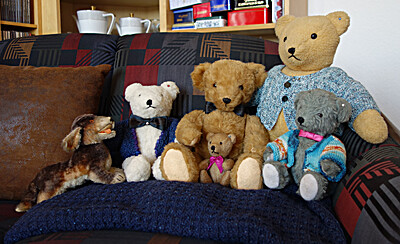
Meet my cheerleading team: dachshund Strolch, Valerius Maximus, Austin Reed, Arzhel, Richard Sean and Corrado.
All images are my own, except for The VIB list.
2MissWatson
I am not setting numerical goals for my categories, but I like to keep track of how many pages I read, aiming for 3,500 per month.

January: 4,150 pages
February: 4,286 pages
March: 4,590 pages
April: 3,167 pages
May: 4,348 pages
June: 2,999 pages
July: 4,096 pages
August: 3,998 pages
September: 3,748 pages
October: 3,319 pages
November: 4,086 pages
December: 3,228 pages

January: 4,150 pages
February: 4,286 pages
March: 4,590 pages
April: 3,167 pages
May: 4,348 pages
June: 2,999 pages
July: 4,096 pages
August: 3,998 pages
September: 3,748 pages
October: 3,319 pages
November: 4,086 pages
December: 3,228 pages
3MissWatson
The Big Box
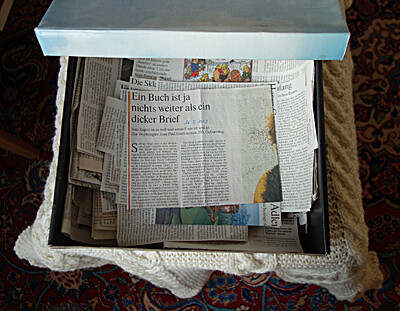
I’m sorting (slowly) through the nooks and crannies of my apartment, and one of the things I ran across was a big shoe box filled with newspaper clippings, all of them reviews for books which I thought interesting. Most are non-fiction books, I think. Once every month I intend to put my hand into this box (with my eyes closed) and either read the book or dismiss the review.
January: Stoner by John Williams. Review "Er war kein Kämpfer, aber ein Sieger", FAZ of 31 October 2013
February: Der Schatz by Eduard Mörike. Review "Unsere Romanhelden – Franz Arbogast", FAZ 11 May 2013
February: Wellen by Eduard von Keyserling. Review "Glanz und Verzweiflung", FAZ 8 November 1988
March: Armut, Reichtum, Schuld und Buße der Gräfin Dolores by Achim von Arnim. Review "Unsere Romanhelden – Gräfin Dolores", FAZ 15 February 2014
April: Der amerikanische Traum by Ernst Augustin, Review "Hawk Steen", FAZ 4 April 2014
May: The natural way of things by Charlotte Wood, Review "The way of the world", Economist 23 July 2016
June: Weil der Mensch erbärmlich ist by Jeroen Olyslaegers, Review "Aus Scherz wird Ernst", FAZ 6 February 2019
July: Blood Song by Anthony Ryan, Review "Die dunkle Blüte", Süddeutsche 23 October 2014
August: Une vie by Guy de Maupassant, Review "Diese Welle im Strom des Bewusstseins", FAZ 23 May 2018
September: The silence of the girls by Pat Barker, Review "Achilles and the heels", Economist 15 September 2018
October: Das Gemeindekind by Marie von Ebner-Eschenbach, Review "Pavel Holub", FAZ 10 October 2014
November: Dr. Katzenbergers Badereise by Jean Paul, Review "Dr. Katzenberger", FAZ 24 November 2012
December: The longest afternoon by Brendan Simms, Review "Und Germania schrie "Viktoria"!", FAZ 28 November 2014
I’m sorting (slowly) through the nooks and crannies of my apartment, and one of the things I ran across was a big shoe box filled with newspaper clippings, all of them reviews for books which I thought interesting. Most are non-fiction books, I think. Once every month I intend to put my hand into this box (with my eyes closed) and either read the book or dismiss the review.
January: Stoner by John Williams. Review "Er war kein Kämpfer, aber ein Sieger", FAZ of 31 October 2013
February: Der Schatz by Eduard Mörike. Review "Unsere Romanhelden – Franz Arbogast", FAZ 11 May 2013
February: Wellen by Eduard von Keyserling. Review "Glanz und Verzweiflung", FAZ 8 November 1988
March: Armut, Reichtum, Schuld und Buße der Gräfin Dolores by Achim von Arnim. Review "Unsere Romanhelden – Gräfin Dolores", FAZ 15 February 2014
April: Der amerikanische Traum by Ernst Augustin, Review "Hawk Steen", FAZ 4 April 2014
May: The natural way of things by Charlotte Wood, Review "The way of the world", Economist 23 July 2016
June: Weil der Mensch erbärmlich ist by Jeroen Olyslaegers, Review "Aus Scherz wird Ernst", FAZ 6 February 2019
July: Blood Song by Anthony Ryan, Review "Die dunkle Blüte", Süddeutsche 23 October 2014
August: Une vie by Guy de Maupassant, Review "Diese Welle im Strom des Bewusstseins", FAZ 23 May 2018
September: The silence of the girls by Pat Barker, Review "Achilles and the heels", Economist 15 September 2018
October: Das Gemeindekind by Marie von Ebner-Eschenbach, Review "Pavel Holub", FAZ 10 October 2014
November: Dr. Katzenbergers Badereise by Jean Paul, Review "Dr. Katzenberger", FAZ 24 November 2012
December: The longest afternoon by Brendan Simms, Review "Und Germania schrie "Viktoria"!", FAZ 28 November 2014
4MissWatson
Author of the Day
One of my daily habits is to check the list of authors who were born or died on that day. The plan is to choose a book by one of these authors if they’re on my shelf and I am looking for a new book to start on this day.
Armance by Stendhal, who was born on 23 January 1783
Die Fieberkurve by Friedrich Glauser, born on 4 February 1896
Montezuma’s Revenge by Harry Harrison, born on 12 March 1925
Flashman and the Dragon by George MacDonald Fraser, born on 2 April 1925
Vor dem Spiegel by Wenjamin Kawerin, born on 6 April 1902 (Julian calendar)
Gerächt / Der Weg zum Friedhof by Thomas Mann, born on 6 June 1875
Ein Glück by Thomas Mann, died on 12 August 1955
Les vacances du petit Nicolas by René Goscinny, born on 14 August 1926
Arc de Triomphe by Erich Maria Remarque, died on 25 September 1970
Calypso by Ed McBain, born on 15 October 1926
Irving’s Delight by Art Buchwald, born 20 October 1925
The Blue Castle by L. M. Montgomery, born 30 November 1874
Die Aufzeichnungen des Malte Laurids Brigge by Rainer Maria Rilke, born 4 December 1875
One of my daily habits is to check the list of authors who were born or died on that day. The plan is to choose a book by one of these authors if they’re on my shelf and I am looking for a new book to start on this day.
Armance by Stendhal, who was born on 23 January 1783
Die Fieberkurve by Friedrich Glauser, born on 4 February 1896
Montezuma’s Revenge by Harry Harrison, born on 12 March 1925
Flashman and the Dragon by George MacDonald Fraser, born on 2 April 1925
Vor dem Spiegel by Wenjamin Kawerin, born on 6 April 1902 (Julian calendar)
Gerächt / Der Weg zum Friedhof by Thomas Mann, born on 6 June 1875
Ein Glück by Thomas Mann, died on 12 August 1955
Les vacances du petit Nicolas by René Goscinny, born on 14 August 1926
Arc de Triomphe by Erich Maria Remarque, died on 25 September 1970
Calypso by Ed McBain, born on 15 October 1926
Irving’s Delight by Art Buchwald, born 20 October 1925
The Blue Castle by L. M. Montgomery, born 30 November 1874
Die Aufzeichnungen des Malte Laurids Brigge by Rainer Maria Rilke, born 4 December 1875
5MissWatson
The VIB list(s)

Like many other readers, I keep an eye on several “You must have read this!” lists. But when the time comes, the Very Important Book has to make way for something more alluring. The plan is to actually read one book per month from my various lists. At least one.
The list pictured here was compiled by Deutsche Welle for a campaign back in 2018.
January
The Quiet American by Graham Greene (1001 BYMRBYD)
Burmese Days by George Orwell (1001 BYMRBYD, Guardian 1000)
Transit by Anna Seghers (1001 BYMRBYD)
Tinker, Tailor, Soldier, Spy by John Le Carré (1001 BYMRBYD, Guardian 1000)
February
Strangers on a train by Patricia Highsmith (Guardian 1000)
The War of the Worlds by H. G. Wells (1001 BYMRBYD, Guardian 1000)
March
Ungeduld des Herzens by Stefan Zweig (Deutsche Welle 100)
Smiley’s People by John le Carré (1001 BYMRBYD)
Die Reise nach Petuschki by Wenedikt Jerofejew (1001 BYMRBYD)
Cause for Alarm by Eric Ambler (1001 BYMRBYD)
April
What Maisie Knew by Henry James (1001 BYMRBYD)
May
The Prime of Miss Jean Brodie by Muriel Spark (1001 BYMRBYD, Guardian 1000)
Der Kummer von Belgien by Hugo Claus (1001 BYMRBYD)
June
David Copperfield by Charles Dickens (1001 BYMRBYD)
Das Muschelessen by Birgit Vanderbeke (Deutsche Welle 100)
July
Der abenteuerliche Simplizissimus by Grimmelshausen
August
Tschick by Wolfgang Herrndorf (Deutsche Welle 100)
October
Tintenherz by Cornelia Funke (Deutsche Welle 100)
Nightmare Abbey by Thomas L. Peacock (Guardian 1000)
November
The Woodlanders by Thomas Hardy (1001 BYMRBYD), Guardian 1000)
Überfluss by Martin Andersen Nexö (Rowohlt Jahrhundert)
December
Der Russe ist einer, der Birken liebt by Olga Grjasnowa (Deutsche Welle 100)

Like many other readers, I keep an eye on several “You must have read this!” lists. But when the time comes, the Very Important Book has to make way for something more alluring. The plan is to actually read one book per month from my various lists. At least one.
The list pictured here was compiled by Deutsche Welle for a campaign back in 2018.
January
The Quiet American by Graham Greene (1001 BYMRBYD)
Burmese Days by George Orwell (1001 BYMRBYD, Guardian 1000)
Transit by Anna Seghers (1001 BYMRBYD)
Tinker, Tailor, Soldier, Spy by John Le Carré (1001 BYMRBYD, Guardian 1000)
February
Strangers on a train by Patricia Highsmith (Guardian 1000)
The War of the Worlds by H. G. Wells (1001 BYMRBYD, Guardian 1000)
March
Ungeduld des Herzens by Stefan Zweig (Deutsche Welle 100)
Smiley’s People by John le Carré (1001 BYMRBYD)
Die Reise nach Petuschki by Wenedikt Jerofejew (1001 BYMRBYD)
Cause for Alarm by Eric Ambler (1001 BYMRBYD)
April
What Maisie Knew by Henry James (1001 BYMRBYD)
May
The Prime of Miss Jean Brodie by Muriel Spark (1001 BYMRBYD, Guardian 1000)
Der Kummer von Belgien by Hugo Claus (1001 BYMRBYD)
June
David Copperfield by Charles Dickens (1001 BYMRBYD)
Das Muschelessen by Birgit Vanderbeke (Deutsche Welle 100)
July
Der abenteuerliche Simplizissimus by Grimmelshausen
August
Tschick by Wolfgang Herrndorf (Deutsche Welle 100)
October
Tintenherz by Cornelia Funke (Deutsche Welle 100)
Nightmare Abbey by Thomas L. Peacock (Guardian 1000)
November
The Woodlanders by Thomas Hardy (1001 BYMRBYD), Guardian 1000)
Überfluss by Martin Andersen Nexö (Rowohlt Jahrhundert)
December
Der Russe ist einer, der Birken liebt by Olga Grjasnowa (Deutsche Welle 100)
6MissWatson
Siren Song
This is the category for books that beckon from my shelves, on other people’s threads, or in bookshops. In short, everything that detracts me from my own categories.
1. Notre-Dame – Geschichte einer Kathedrale by Thomas W. Gaethgens
2. Gefallen by Thomas Mann (No 1 in a collection of his stories)
3. Der Wille zum Glück by Thomas Mann (No 2)
4. Le Petit Nicolas – La Bande Dessinée Originale by Sempé/Goscinny
5. Der Tod by Thomas Mann (No 3)
6. Deacon King Kong by James McBride
7. Der kleine Herr Friedemann by Thomas Mann (No 4)
8. Schlick by Kester Schlenz and Jan Jepsen
9. Frankie by Jochen Gutsch and Maxim Leo
10. Peony by Pearl S. Buck
11. Enttäuschung and Bajazzo by Thomas Mann (No 5+6)
12. Der Schachautomat by Robert Löhr
13. Tobias Mindernickel by Thomas Mann (No 7)
14. Cinq-Mars by Alfred de Vigny
15. Die Schatten von La Rochelle by Tanja Kinkel
16. Der Kleiderschrank by Thomas Mann (No 8)
17. At Mrs Lippincote’s by Elizabeth Taylor
18. A wreath of roses by Elizabeth Taylor
19. The Life of a Stupid Man by Ryūnosuke Akutagawa
20. Detstvo sorok devjat' by Ljudmila Ulickaja
21. Maurice by E. M. Forster
22. Gladius Dei by Thomas Mann (No 11)
23. Tristan by Thomas Mann (No 12)
24. A Man and his Cat 1 by Umi Sakurai
25. The Crown Agent by Stephen O’Rourke
26. Die Hungernden by Thomas Mann (No 13)
27. Tonio Kröger by Thomas Mann (No 14)
28. A Man and his Cat 8 by Umi Sakurai
29. Das schwebende Schachbrett by Louis Couperus
30. Der Schatz des Preußenkönigs by Christoph Öhm
31. The buried giant by Kazuo Ishiguro
32. Der Flakon by Hans Pleschinski
33. Die Ottonen by Helmut Beumann
34. König Artus by Heinz Ohff
35. Heligoland by Jan Rüger
36 .Da muss man durch by Hans Rath
37. Dumala by Eduard von Keyserling
38. Das Wunderkind by Thomas Mann
39. Asterix in Lusitanien by Fabcaro and Didier Conrad
40. The narrative of Arthur Gordon Pym of Nantucket by Edgar Allan Poe
41. Beim Propheten by Thomas Mann
42. Aufwachen, es ist Weihnachten! by Stephanie Polák
43. Der Tag, an dem Max dreimal ins Auto gekotzt hat by Marc-Uwe Kling
44. Der Tag, an dem der Opa den Wasserkocher auf den Herd gestellt hat by Marc-Uwe Kling
45. Der Tag, an dem Papa ein heikles Gespräch führen wollte by Marc-Uwe Kling
46. Das Klugscheisserchen by Marc-Uwe Kling
47. Die Katze die zur Weihnacht kam by Cleveland Amory
This is the category for books that beckon from my shelves, on other people’s threads, or in bookshops. In short, everything that detracts me from my own categories.
1. Notre-Dame – Geschichte einer Kathedrale by Thomas W. Gaethgens
2. Gefallen by Thomas Mann (No 1 in a collection of his stories)
3. Der Wille zum Glück by Thomas Mann (No 2)
4. Le Petit Nicolas – La Bande Dessinée Originale by Sempé/Goscinny
5. Der Tod by Thomas Mann (No 3)
6. Deacon King Kong by James McBride
7. Der kleine Herr Friedemann by Thomas Mann (No 4)
8. Schlick by Kester Schlenz and Jan Jepsen
9. Frankie by Jochen Gutsch and Maxim Leo
10. Peony by Pearl S. Buck
11. Enttäuschung and Bajazzo by Thomas Mann (No 5+6)
12. Der Schachautomat by Robert Löhr
13. Tobias Mindernickel by Thomas Mann (No 7)
14. Cinq-Mars by Alfred de Vigny
15. Die Schatten von La Rochelle by Tanja Kinkel
16. Der Kleiderschrank by Thomas Mann (No 8)
17. At Mrs Lippincote’s by Elizabeth Taylor
18. A wreath of roses by Elizabeth Taylor
19. The Life of a Stupid Man by Ryūnosuke Akutagawa
20. Detstvo sorok devjat' by Ljudmila Ulickaja
21. Maurice by E. M. Forster
22. Gladius Dei by Thomas Mann (No 11)
23. Tristan by Thomas Mann (No 12)
24. A Man and his Cat 1 by Umi Sakurai
25. The Crown Agent by Stephen O’Rourke
26. Die Hungernden by Thomas Mann (No 13)
27. Tonio Kröger by Thomas Mann (No 14)
28. A Man and his Cat 8 by Umi Sakurai
29. Das schwebende Schachbrett by Louis Couperus
30. Der Schatz des Preußenkönigs by Christoph Öhm
31. The buried giant by Kazuo Ishiguro
32. Der Flakon by Hans Pleschinski
33. Die Ottonen by Helmut Beumann
34. König Artus by Heinz Ohff
35. Heligoland by Jan Rüger
36 .Da muss man durch by Hans Rath
37. Dumala by Eduard von Keyserling
38. Das Wunderkind by Thomas Mann
39. Asterix in Lusitanien by Fabcaro and Didier Conrad
40. The narrative of Arthur Gordon Pym of Nantucket by Edgar Allan Poe
41. Beim Propheten by Thomas Mann
42. Aufwachen, es ist Weihnachten! by Stephanie Polák
43. Der Tag, an dem Max dreimal ins Auto gekotzt hat by Marc-Uwe Kling
44. Der Tag, an dem der Opa den Wasserkocher auf den Herd gestellt hat by Marc-Uwe Kling
45. Der Tag, an dem Papa ein heikles Gespräch führen wollte by Marc-Uwe Kling
46. Das Klugscheisserchen by Marc-Uwe Kling
47. Die Katze die zur Weihnacht kam by Cleveland Amory
7MissWatson
CATs and KITs

Sir Puss has agreed to preside over the various CATs and KITs. I am just going to keep track of my participation by month. I probably won’t manage to cover them all, but we can have our ambitions. Double-counting is allowed here, but not for my own categories.
January
1. Brunos Weihnachten by Ben Becker ColourCAT: green
2. Der Schattenmann by Kester Schlenz and Jan Jepsen AlphaKIT: S
3. Stoner by John Williams AlphaKIT: S
4. The Quiet American by Graham Greene ColourCAT
5. The Looking Glass War by John Le Carré MysteryKIT
6. Burmese Days by George Orwell ColourCAT, AlphaKIT
7. Der Gin des Lebens by Carsten Sebastian Henn RandomKIT, AlphaKIT
8. Transit by Anna Seghers CultureCAT, AlphaKIT
9. Tinker, Tailor, Soldier, Spy by John Le Carré MysteryKIT, AlphaKIT
10. Armance by Stendhal AlphaKIT
11. The Honourable Schoolboy by John le Carré ColourCAT, AlphaKIT
February
1. Mord im Filmstudio by Beate Maly ColourCAT
2. Die Toten vom Lärchensee by Joe Fischler AlphaKIT
3. Die Fieberkurve by Friedrich Glauser AlphaKIT, MysteryKIT
4. Der Wald by Hansjörg Küster CoverCat, NatureKIT
5. The Secret Chapter by Genevieve Cogman AlphaKIT, RandomKIT
6. Le Petit Nicolas – La Bande Dessinée Originale by Sempé/Goscinny AlphaKIT
7. Arsène Lupin, gentleman-cambrioleur by Maurice Leblanc AlphaKIT, MysteryKIT
8. Die goldene Stadt by Sabrina Janesch ColourCAT, AlphaKIT, Bingo
9. Auf der Suche nach dem Goldenen Mann by Victor Von Hagen ColourCAT, AlphaKIT
10. Schlumpf Erwin Mord by Friedrich Glauser AlphaKIT, MysteryKIT
11. Der wunderbare Massenselbstmord by Aarto Paasilinna CultureCAT, RandomKIT
12. Les confidences d’Arsène Lupin by Maurice Leblanc MysteryKIT, AlphaKIT
March
1. Nordlicht – Die Tote am Strand by Anette Hinrichs AlphaKIT
2. Die Stimme der Violine by Andrea Camilleri AlphaKIT
3. L’homme au ventre de plomb by Jean-François Parot AlphaKIT
4. Montezuma’s Revenge by Harry Harrison MysteryKIT
5. Armut, Reichtum, Schuld und Buße der Gräfin Dolores by Achim von Arnim AlphaKIT
6. The Mountain in the Sea by Ray Nayler ColourCAT, RandomKIT
7. Ungeduld des Herzens by Stefan Zweig ColourCAT, AlphaKIT
8. Smiley’s People by Johne le Carré MysteryKIT
9. The Light of Day by Eric Ambler MysteryKIT, AlphaKIT
10. Cause for Alarm by Eric Ambler MysteryKIT, AlphaKIT
April
1. Vor dem Spiegel by Wenjamin Kawerin AlphaKIT
2. Der amerikanische Traum by Ernst Augustin AlphaKIT
3. What Maisie Knew by Henry James AlphaKIT
4. Venedig sehen und stehlen by Krischan Koch AlphaKIT
5. The wisdom of Father Brown by G.K. Chesterton ColourCAT
6. Der Spurenfinder by Marc-Uwe Kling AlphaKIT
7. The School at the Chalet by Elinor M. Brent-Dyer AlphaKIT, RandomKIT
May
1. A view of the harbour by Elizabeth Taylor CoverCAT
2. Bretonisches Leuchten by Jean-Luc Bannalec MysteryKIT
3. Mord auf der Insel Gokumon by Seishi Yokomizo ColourCAT, AlphaKIT, MysteryKIT
4. Slow Horses by Mick Herron MysteryKIT
5. Dead Lions by Mick Herron AlphaKIT, MysteryKIT
6. At Mrs Lippincote’s by Elizabeth Taylor RandomKIT
7. The Prime of Miss Jean Brodie by Muriel Spark April RandomKIT
8. Parle-leur de batailles, de rois et d’éléphants CoverCAt, RandomKIT
9. Die rote Wand by David Pfeifer ColourCAT, AlphaKIT
10. Das Mädchen, mit dem die Kinder nicht verkehren durften by Irmgard Keun AlphaKIT, RandomKIT
June
1. Claudine à l’école by Willy et Colette AlphaKIT
2. Die Reliquie by José Maria Eça de Queiroz AlphaKIT
3. Die Gelbe Straße by Veza Canetti ColourCAT, AlphaKIT
4. Wilde Reise durch die Nacht by Walter Moers ColourCAT
5. David Copperfield by Charles Dickens AlphaKIT
6. The Machine Stops by E.M. Forster SFF KIT
7. Weil der Mensch erbärmlich ist by Jeroen Olyslaegers RandomKIT
8. Le chat qui parlait malgré lui by Claude Roy AlphaKIT
July
1. Frau Helbing und der tote Fagottist by Eberhard Michaely AlphaKIT, MysteryKIT
2. Die Könige von Köln by Tilman Röhrig ColourCAT, AlphaKIT
3. Frau Helbing und die Schwarze Witwe by Eberhard Michaely MysteryKIT
4. Die allerletzte Kaiserin by Irene Diwiak RandomKIT
5. Der Sonnenfürst by Tilman Röhrig AlphaKIT
6. All Systems Red by Martha Wells AlphaKIT
7. The trail of the serpent by Mary Elizabeth Braddon AlphaKIT
8. Das Mozart-Mysterium by Christoph Öhm
9. Real Tigers by Mick Herron AlphaKIT, MysteryKIT
10. Spook Street by Mick Herron MysteryKIT
11. London Rules by Mick Herron MysteryKIT
12. La Tapisserie de Bayeux by François Neveux AlphaKIT
13. 1066 : Englands Eroberung durch die Normannen by Dominik Waßenhoven AlphaKIT
August
1. Das Judaskreuz by William Boehart AlphaKIT, RandomKIT
2. Les vacances du petit Nicolas by René Goscinny AlphaKIT
3. Töchter by Lucy Fricke RandomKIT
4. Selbs Justiz by Bernhard Schlink and Walter Popp AlphaKIT
5. Das verbotene Notizbuch by Alba De Céspedes ColourCAT, CoverCAT, AlphaKIT, RandomKIT
September
1. Boom Boom Babuschka by Moritz Matthies AlphaKIT
2. Mord im Böhmischen Prater by Beate Maly AlphaKIT
3. Pot-Bouille by Émile Zola AlphaKIT
4. Modesty Blaise : The Black Pearl by Peter O’Donnell AlphaKIT, MysteryKIT
5. Die Akte Marx by Stephan Brakensiek AlphaKIT
6. Mord im Nord-Ostsee-Express by Krischan Koch CoverCAT, AlphaKIT, RandomKIT
7. The silence of the girls by Pat Barker AlphaKIT
8. Frau Helbing und der Casanova aus Winterhude by Eberhard Michaely AlphaKIT
9. Waxwork by Peter Lovesey MysteryKIT
10. Arc de Triomphe by Erich Maria Remarque AlphaKIT
11. The Silver Mistress by Peter O’Donnell ColourCAT, MysteryKIT
October
1. Tintenherz by Cornelia Funke AlphaKIT
2. L’homme de Londres by Georges Simenon ColourCAT
3. Calypso by Ed McBain ColourCAT, CoverCAT, MysteryKIT
4. Irving’s Delight by Art Buchwald ColourCAT
5. Just So Stories by Rudyard Kipling ColourCAT
6. L’île de feu by Alexandre Dumas ColourCAT
7. Nightmare Abbey by Thomas L. Peacock AlphaKIT, ScaredyKIT
8. La femme au collier de velours by Alexandre Dumas AlphaKIT, ScaredyKIT
9. The thousand autumns of Jacob de Zoet by David Mitchell AlphaKIT
November
1. Harry Potter and the Philosopher’s Stone by JK Rowling AlphaKIT, RandomKIT
2. Tödliche Oliven by Tom Hillenbrand AlphaKIT
3. The Woodlanders by Thomas Hardy AlphaKIT
4. The Mystery of the Blue Train by Agatha Christie ColourCAT
5. Mon ami Maigret by Georges Simenon MysteryKIT
6. Au Bonheur des Dames by Émile Zola AlphaKIT, RandomKIT
7. Das Dorf der acht Gräber by Seishi Yokomizo AlphaKIT
8. Murder in the snow by Gladys Mitchell ColourCAT, MysteryKIT
9. L’Affaire Saint-Fiacre by Georges Simenon MysteryKIT
10. The Blue Castle by L. M. Montgomery ColourCAT
December
1. Mord im Planetarium by Beate Maly ColourCAT, MysteryKIT
2. Sunset by Klaus Modick RandomKIT
3. Under a calculating star by John Morressy SFF KIT
4. Die Aufzeichnungen des Malte Laurids Brigge by Rainer Maria Rilke AlphaKIT
5. The Rose and the Ring by William Makepeace Thackeray AlphaKIT
6. Empress Dowager Cixi by Jung Chang RandomKIT
7. Die Verschwörung der Krähen by Markus Gasser AlphaKIT
8. Der Russe ist einer, der Birken liebt by Olga Grjasnowa AlphaKIT
9. Küstenstrich by Benjamin Cors CoverCAT

Sir Puss has agreed to preside over the various CATs and KITs. I am just going to keep track of my participation by month. I probably won’t manage to cover them all, but we can have our ambitions. Double-counting is allowed here, but not for my own categories.
January
1. Brunos Weihnachten by Ben Becker ColourCAT: green
2. Der Schattenmann by Kester Schlenz and Jan Jepsen AlphaKIT: S
3. Stoner by John Williams AlphaKIT: S
4. The Quiet American by Graham Greene ColourCAT
5. The Looking Glass War by John Le Carré MysteryKIT
6. Burmese Days by George Orwell ColourCAT, AlphaKIT
7. Der Gin des Lebens by Carsten Sebastian Henn RandomKIT, AlphaKIT
8. Transit by Anna Seghers CultureCAT, AlphaKIT
9. Tinker, Tailor, Soldier, Spy by John Le Carré MysteryKIT, AlphaKIT
10. Armance by Stendhal AlphaKIT
11. The Honourable Schoolboy by John le Carré ColourCAT, AlphaKIT
February
1. Mord im Filmstudio by Beate Maly ColourCAT
2. Die Toten vom Lärchensee by Joe Fischler AlphaKIT
3. Die Fieberkurve by Friedrich Glauser AlphaKIT, MysteryKIT
4. Der Wald by Hansjörg Küster CoverCat, NatureKIT
5. The Secret Chapter by Genevieve Cogman AlphaKIT, RandomKIT
6. Le Petit Nicolas – La Bande Dessinée Originale by Sempé/Goscinny AlphaKIT
7. Arsène Lupin, gentleman-cambrioleur by Maurice Leblanc AlphaKIT, MysteryKIT
8. Die goldene Stadt by Sabrina Janesch ColourCAT, AlphaKIT, Bingo
9. Auf der Suche nach dem Goldenen Mann by Victor Von Hagen ColourCAT, AlphaKIT
10. Schlumpf Erwin Mord by Friedrich Glauser AlphaKIT, MysteryKIT
11. Der wunderbare Massenselbstmord by Aarto Paasilinna CultureCAT, RandomKIT
12. Les confidences d’Arsène Lupin by Maurice Leblanc MysteryKIT, AlphaKIT
March
1. Nordlicht – Die Tote am Strand by Anette Hinrichs AlphaKIT
2. Die Stimme der Violine by Andrea Camilleri AlphaKIT
3. L’homme au ventre de plomb by Jean-François Parot AlphaKIT
4. Montezuma’s Revenge by Harry Harrison MysteryKIT
5. Armut, Reichtum, Schuld und Buße der Gräfin Dolores by Achim von Arnim AlphaKIT
6. The Mountain in the Sea by Ray Nayler ColourCAT, RandomKIT
7. Ungeduld des Herzens by Stefan Zweig ColourCAT, AlphaKIT
8. Smiley’s People by Johne le Carré MysteryKIT
9. The Light of Day by Eric Ambler MysteryKIT, AlphaKIT
10. Cause for Alarm by Eric Ambler MysteryKIT, AlphaKIT
April
1. Vor dem Spiegel by Wenjamin Kawerin AlphaKIT
2. Der amerikanische Traum by Ernst Augustin AlphaKIT
3. What Maisie Knew by Henry James AlphaKIT
4. Venedig sehen und stehlen by Krischan Koch AlphaKIT
5. The wisdom of Father Brown by G.K. Chesterton ColourCAT
6. Der Spurenfinder by Marc-Uwe Kling AlphaKIT
7. The School at the Chalet by Elinor M. Brent-Dyer AlphaKIT, RandomKIT
May
1. A view of the harbour by Elizabeth Taylor CoverCAT
2. Bretonisches Leuchten by Jean-Luc Bannalec MysteryKIT
3. Mord auf der Insel Gokumon by Seishi Yokomizo ColourCAT, AlphaKIT, MysteryKIT
4. Slow Horses by Mick Herron MysteryKIT
5. Dead Lions by Mick Herron AlphaKIT, MysteryKIT
6. At Mrs Lippincote’s by Elizabeth Taylor RandomKIT
7. The Prime of Miss Jean Brodie by Muriel Spark April RandomKIT
8. Parle-leur de batailles, de rois et d’éléphants CoverCAt, RandomKIT
9. Die rote Wand by David Pfeifer ColourCAT, AlphaKIT
10. Das Mädchen, mit dem die Kinder nicht verkehren durften by Irmgard Keun AlphaKIT, RandomKIT
June
1. Claudine à l’école by Willy et Colette AlphaKIT
2. Die Reliquie by José Maria Eça de Queiroz AlphaKIT
3. Die Gelbe Straße by Veza Canetti ColourCAT, AlphaKIT
4. Wilde Reise durch die Nacht by Walter Moers ColourCAT
5. David Copperfield by Charles Dickens AlphaKIT
6. The Machine Stops by E.M. Forster SFF KIT
7. Weil der Mensch erbärmlich ist by Jeroen Olyslaegers RandomKIT
8. Le chat qui parlait malgré lui by Claude Roy AlphaKIT
July
1. Frau Helbing und der tote Fagottist by Eberhard Michaely AlphaKIT, MysteryKIT
2. Die Könige von Köln by Tilman Röhrig ColourCAT, AlphaKIT
3. Frau Helbing und die Schwarze Witwe by Eberhard Michaely MysteryKIT
4. Die allerletzte Kaiserin by Irene Diwiak RandomKIT
5. Der Sonnenfürst by Tilman Röhrig AlphaKIT
6. All Systems Red by Martha Wells AlphaKIT
7. The trail of the serpent by Mary Elizabeth Braddon AlphaKIT
8. Das Mozart-Mysterium by Christoph Öhm
9. Real Tigers by Mick Herron AlphaKIT, MysteryKIT
10. Spook Street by Mick Herron MysteryKIT
11. London Rules by Mick Herron MysteryKIT
12. La Tapisserie de Bayeux by François Neveux AlphaKIT
13. 1066 : Englands Eroberung durch die Normannen by Dominik Waßenhoven AlphaKIT
August
1. Das Judaskreuz by William Boehart AlphaKIT, RandomKIT
2. Les vacances du petit Nicolas by René Goscinny AlphaKIT
3. Töchter by Lucy Fricke RandomKIT
4. Selbs Justiz by Bernhard Schlink and Walter Popp AlphaKIT
5. Das verbotene Notizbuch by Alba De Céspedes ColourCAT, CoverCAT, AlphaKIT, RandomKIT
September
1. Boom Boom Babuschka by Moritz Matthies AlphaKIT
2. Mord im Böhmischen Prater by Beate Maly AlphaKIT
3. Pot-Bouille by Émile Zola AlphaKIT
4. Modesty Blaise : The Black Pearl by Peter O’Donnell AlphaKIT, MysteryKIT
5. Die Akte Marx by Stephan Brakensiek AlphaKIT
6. Mord im Nord-Ostsee-Express by Krischan Koch CoverCAT, AlphaKIT, RandomKIT
7. The silence of the girls by Pat Barker AlphaKIT
8. Frau Helbing und der Casanova aus Winterhude by Eberhard Michaely AlphaKIT
9. Waxwork by Peter Lovesey MysteryKIT
10. Arc de Triomphe by Erich Maria Remarque AlphaKIT
11. The Silver Mistress by Peter O’Donnell ColourCAT, MysteryKIT
October
1. Tintenherz by Cornelia Funke AlphaKIT
2. L’homme de Londres by Georges Simenon ColourCAT
3. Calypso by Ed McBain ColourCAT, CoverCAT, MysteryKIT
4. Irving’s Delight by Art Buchwald ColourCAT
5. Just So Stories by Rudyard Kipling ColourCAT
6. L’île de feu by Alexandre Dumas ColourCAT
7. Nightmare Abbey by Thomas L. Peacock AlphaKIT, ScaredyKIT
8. La femme au collier de velours by Alexandre Dumas AlphaKIT, ScaredyKIT
9. The thousand autumns of Jacob de Zoet by David Mitchell AlphaKIT
November
1. Harry Potter and the Philosopher’s Stone by JK Rowling AlphaKIT, RandomKIT
2. Tödliche Oliven by Tom Hillenbrand AlphaKIT
3. The Woodlanders by Thomas Hardy AlphaKIT
4. The Mystery of the Blue Train by Agatha Christie ColourCAT
5. Mon ami Maigret by Georges Simenon MysteryKIT
6. Au Bonheur des Dames by Émile Zola AlphaKIT, RandomKIT
7. Das Dorf der acht Gräber by Seishi Yokomizo AlphaKIT
8. Murder in the snow by Gladys Mitchell ColourCAT, MysteryKIT
9. L’Affaire Saint-Fiacre by Georges Simenon MysteryKIT
10. The Blue Castle by L. M. Montgomery ColourCAT
December
1. Mord im Planetarium by Beate Maly ColourCAT, MysteryKIT
2. Sunset by Klaus Modick RandomKIT
3. Under a calculating star by John Morressy SFF KIT
4. Die Aufzeichnungen des Malte Laurids Brigge by Rainer Maria Rilke AlphaKIT
5. The Rose and the Ring by William Makepeace Thackeray AlphaKIT
6. Empress Dowager Cixi by Jung Chang RandomKIT
7. Die Verschwörung der Krähen by Markus Gasser AlphaKIT
8. Der Russe ist einer, der Birken liebt by Olga Grjasnowa AlphaKIT
9. Küstenstrich by Benjamin Cors CoverCAT
8MissWatson
Bingo DOG
My favourite challenge! As always, many thanks to LShelby and Christina for the lovely card. I am trying to fill a second card this year.
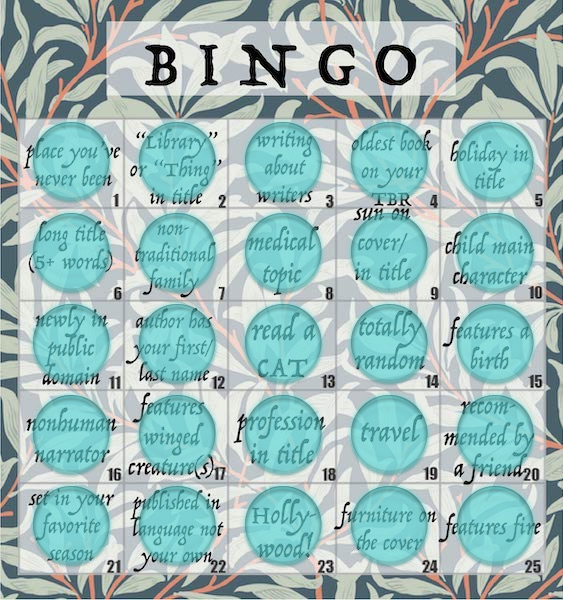
1: Die Akte Marx by Stephan Brakensiek
2: Small things like these by Claire Keegan
3: Das Judaskreuz by William Boehart
4: Under a calculating star by John Morressy
5: Murder in the Snow : A Cotswold Christmas Mystery by Gladys Mitchell
6: Frau Helbing und der Casanova aus Winterhude by Eberhard Michaely
7: Mord im Planetarium by Beate Maly
8: The thousand autumns of Jacob de Zoet by David Mitchell
9: Sunset by Klaus Modick
10: Les vacances du petit Nicolas by René Goscinny
11: Überfluss by Martin Andersen Nexö
12: Mord im Böhmischen Prater by Beate Maly
13: Mord im Nord-Ostsee-Express by Krischan Koch
14: Harry Potter and the Philosopher’s Stone by JK Rowling
15: Une vie by Guy de Maupassant
16: Boom Boom Babuschka by Moritz Matthies
17: The narrative of Arthur Gordon Pym by EA Poe
18: Dr. Katzenbergers Badereise by Jean Paul
19: The buried giant by Kazuo Ishiguro
21: Mon ami Maigret by Georges Simenon
22: Töchter by Lucy Fricke
22: Das schwebende Schachbrett by Louis Couperus
23: The last Tycoon by F. Scott Fitzgerald
24: Tödliche Oliven by Tom Hillenbrand
25: The silence of the girls by Pat Barker
My favourite challenge! As always, many thanks to LShelby and Christina for the lovely card. I am trying to fill a second card this year.
1: Die Akte Marx by Stephan Brakensiek
2: Small things like these by Claire Keegan
3: Das Judaskreuz by William Boehart
4: Under a calculating star by John Morressy
5: Murder in the Snow : A Cotswold Christmas Mystery by Gladys Mitchell
6: Frau Helbing und der Casanova aus Winterhude by Eberhard Michaely
7: Mord im Planetarium by Beate Maly
8: The thousand autumns of Jacob de Zoet by David Mitchell
9: Sunset by Klaus Modick
10: Les vacances du petit Nicolas by René Goscinny
11: Überfluss by Martin Andersen Nexö
12: Mord im Böhmischen Prater by Beate Maly
13: Mord im Nord-Ostsee-Express by Krischan Koch
14: Harry Potter and the Philosopher’s Stone by JK Rowling
15: Une vie by Guy de Maupassant
16: Boom Boom Babuschka by Moritz Matthies
17: The narrative of Arthur Gordon Pym by EA Poe
18: Dr. Katzenbergers Badereise by Jean Paul
19: The buried giant by Kazuo Ishiguro
21: Mon ami Maigret by Georges Simenon
22: Töchter by Lucy Fricke
22: Das schwebende Schachbrett by Louis Couperus
23: The last Tycoon by F. Scott Fitzgerald
24: Tödliche Oliven by Tom Hillenbrand
25: The silence of the girls by Pat Barker
9MissWatson
Welcome!
I still need to fix the touchstones, but now I am more or less set up for the last quarter. I didn’t manage to fill all challenges in September, but I’m not really bothered about that. The VIB lists are proving elusive, because I do not really like to read according to a plan, so I haven’t made any for October. I’m travelling light tomorrow and will have a look at my sister’s bookshelves. If I have time to read in the next few days...
See you all next week!
I still need to fix the touchstones, but now I am more or less set up for the last quarter. I didn’t manage to fill all challenges in September, but I’m not really bothered about that. The VIB lists are proving elusive, because I do not really like to read according to a plan, so I haven’t made any for October. I’m travelling light tomorrow and will have a look at my sister’s bookshelves. If I have time to read in the next few days...
See you all next week!
10lowelibrary
Happy New Thread and happier vacation.
12RidgewayGirl
Happy New Thread!
14LadyoftheLodge
Hi there, happy new thread!
15MissWatson
>10 lowelibrary: >11 VivienneR: >12 RidgewayGirl: >13 Jackie_K: >14 LadyoftheLodge: Thank you all, ladies! I was away for longer than expected, because I spontaneously visited my best friend, too, and we had a lovely time. Not much reading, though...
16MissWatson
Siren Song
I borrowed Heligoland from our newly remodelled State Library, and it was an amazingly quick read for an academic book. It describes Anglo-German relations and rivalries in the North Sea over the last 200 years as manifested on the island of Heligoland. Lots of surprising stuff, and he cites frequently from primary documents on both sides, but the islanders’ voices remain frustratingly elusive.
I borrowed Heligoland from our newly remodelled State Library, and it was an amazingly quick read for an academic book. It describes Anglo-German relations and rivalries in the North Sea over the last 200 years as manifested on the island of Heligoland. Lots of surprising stuff, and he cites frequently from primary documents on both sides, but the islanders’ voices remain frustratingly elusive.
17MissWatson
Siren Song
Da muss man durch is an audiobook we listened to while I stayed with my friend. It was a loan from my sister, and although abridged, it was still a hoot. Paul Schubert is to be the new chairman of a publishing house and flies to Mallorca to meet the owner family. Much chaos ensues, his friends arrive on the island, too, and everyone has to solve some problem. Fluff, but enjoyable fluff.
Da muss man durch is an audiobook we listened to while I stayed with my friend. It was a loan from my sister, and although abridged, it was still a hoot. Paul Schubert is to be the new chairman of a publishing house and flies to Mallorca to meet the owner family. Much chaos ensues, his friends arrive on the island, too, and everyone has to solve some problem. Fluff, but enjoyable fluff.
18MissWatson
The VIB list / AlphaKIT: F
I packed Tintenherz for the train ride south and I was very pleasantly surprised. I had missed the hype when it first came out, and I am glad I found this now. There is such passion for books and reading here, and I enjoyed the reading list at the end. Most of the books she cites from I have read, but there are still some left, and I am strongly tempted to pick them up right away. What more can you want from an author?
I packed Tintenherz for the train ride south and I was very pleasantly surprised. I had missed the hype when it first came out, and I am glad I found this now. There is such passion for books and reading here, and I enjoyed the reading list at the end. Most of the books she cites from I have read, but there are still some left, and I am strongly tempted to pick them up right away. What more can you want from an author?
19MissWatson
Siren Song
I opened a Dumas novel on my e-reader, but the file was so heavily corrupted that I couldn’t read it. So I chose Dumala instead, a novella by a Baltic-German author who is unfashionable today. Which is a pity, his psychological portraits are remarkable. Here we meet a clergyman who has fallen violently in love with the wife of a local aristocrat. She doesn’t return his affection and runs off with a womaniser instead. When she returns for her husband’s funeral, the clergyman finds that his passion has died.
I opened a Dumas novel on my e-reader, but the file was so heavily corrupted that I couldn’t read it. So I chose Dumala instead, a novella by a Baltic-German author who is unfashionable today. Which is a pity, his psychological portraits are remarkable. Here we meet a clergyman who has fallen violently in love with the wife of a local aristocrat. She doesn’t return his affection and runs off with a womaniser instead. When she returns for her husband’s funeral, the clergyman finds that his passion has died.
20threadnsong
Happy new thread, and happy visits and travels and catching up with your best friend! And how wonderful that you enjoyed an audiobook while you were there.
21MissWatson
>20 threadnsong: Thanks for dropping in! We have learned that we can play MP3 files on laptops, which opens a whole new range of possibilities ...
22MissWatson
I am now caught up with all the threads and can concentrate on reading books. Just started L’homme de Londres and it’s riveting.
23MissWatson
ColourCAT: Black
L’homme de Londres has a very atmospheric black-and-white photograph on the cover which I think shows the glass cabin of the pointsman (switchman? I am not really familiar with railway technical personnel) who works in Dieppe harbour. He has the night shift and one night he witnesses a murder and the loss of a small briefcase in the harbour. He dives after it and finds a lot of money in pound notes...
This is brilliant, I think. The crime is mostly told from the perspective of the eyewitness and shows his reaction to the act and the ensuing investigations, but also his own attitude as he fails to deliver the money to the police or to give evidence. Simenon really knows how to tell a story.
L’homme de Londres has a very atmospheric black-and-white photograph on the cover which I think shows the glass cabin of the pointsman (switchman? I am not really familiar with railway technical personnel) who works in Dieppe harbour. He has the night shift and one night he witnesses a murder and the loss of a small briefcase in the harbour. He dives after it and finds a lot of money in pound notes...
This is brilliant, I think. The crime is mostly told from the perspective of the eyewitness and shows his reaction to the act and the ensuing investigations, but also his own attitude as he fails to deliver the money to the police or to give evidence. Simenon really knows how to tell a story.
25MissWatson
ColourCAT: black / CoverCAT: fits into your pocket / MysteryKIT: police procedural / Author of the Day
Calypso is an 87th Precinct novel which shows red knidney beans and pistol shells on a black background. I am somewhat embarrassed to find I read this eleven years ago and retained nothing of the plot. The gruesome killing at the end should have stayed in the memory, at least. But revisiting the cops in the big bad city is always good.
Calypso is an 87th Precinct novel which shows red knidney beans and pistol shells on a black background. I am somewhat embarrassed to find I read this eleven years ago and retained nothing of the plot. The gruesome killing at the end should have stayed in the memory, at least. But revisiting the cops in the big bad city is always good.
26MissWatson
I’ve picked up a cold somewhere and it’s messing with my head, so I am putting aside the Dumas for the moment and console myself with a re-read of Irving’s Delight in honour of Art Buchwald’s 100th birthday today.
27MissWatson
ColourCAT: Black
The cover of Irving’s Delight shows a black and white cat, just as the book say. It was a joy to re-visit and just what I needed when my brain was turning to wet cotton wool. I spent much time in bed, but feel a lot better now. It’s a weird kind of cold, but luckily I was able to read.
The cover of Irving’s Delight shows a black and white cat, just as the book say. It was a joy to re-visit and just what I needed when my brain was turning to wet cotton wool. I spent much time in bed, but feel a lot better now. It’s a weird kind of cold, but luckily I was able to read.
28MissWatson
ColourCAT: Black
More light reading in the form of Just So Stories which I picked up because Cornelia Funke cites quite often from it in Tintenherz. Of course she lists the German translation in her book, and I didn’t identify it immediately. The cover of my edition shows Kipling’s drawing of the Cat who walked by himself, in black.
More light reading in the form of Just So Stories which I picked up because Cornelia Funke cites quite often from it in Tintenherz. Of course she lists the German translation in her book, and I didn’t identify it immediately. The cover of my edition shows Kipling’s drawing of the Cat who walked by himself, in black.
29MissWatson
ColourCAT: Black / AlphaKIT: F
And once my head was clear again, I settled down to L’île de feu again. The editor in his preface calls it Dumas’ foray into the genre of noir fantastique, which is something like Gothic, but to be honest, I don’t find it quite convincing. It may have been his intention, but the execution is strangely disappointing.
We are on the island of Java in 1847, then a Dutch colony, and a terrible storm is raging when a young man knocks on the door of Doctor Basilius to ask for help for his dying wife. There is a lot of mystifying conversation about love, life and death, and then we suddenly find that the doctor is the wife’s uncle, he offers to return her to life if young Eusèbe will agree to a deal proving that his love for her is constant: every time he tells another woman that he loves her he must return a part of the fortune his wife is going to inherit from him. And from there we go to snake charmers and Javanese princes plotting insurgency.
It’s a strange mix of melodrama and exotic adventure. He spends far too much time describing the landscape and flora and fauna whenever his characters travel, the dialogue is mostly over the top and reminded me of cheap and bad melodrama, and it suffers from excessive wordiness. This one is only for Dumas completists, I’m afraid.
ETA: The book also contains two short stories which are most likely inspired by ETA Hoffmann: Le Bal Masqué and Invraisemblable. Both are much more convincing in their subject matter and handling.
And once my head was clear again, I settled down to L’île de feu again. The editor in his preface calls it Dumas’ foray into the genre of noir fantastique, which is something like Gothic, but to be honest, I don’t find it quite convincing. It may have been his intention, but the execution is strangely disappointing.
We are on the island of Java in 1847, then a Dutch colony, and a terrible storm is raging when a young man knocks on the door of Doctor Basilius to ask for help for his dying wife. There is a lot of mystifying conversation about love, life and death, and then we suddenly find that the doctor is the wife’s uncle, he offers to return her to life if young Eusèbe will agree to a deal proving that his love for her is constant: every time he tells another woman that he loves her he must return a part of the fortune his wife is going to inherit from him. And from there we go to snake charmers and Javanese princes plotting insurgency.
It’s a strange mix of melodrama and exotic adventure. He spends far too much time describing the landscape and flora and fauna whenever his characters travel, the dialogue is mostly over the top and reminded me of cheap and bad melodrama, and it suffers from excessive wordiness. This one is only for Dumas completists, I’m afraid.
ETA: The book also contains two short stories which are most likely inspired by ETA Hoffmann: Le Bal Masqué and Invraisemblable. Both are much more convincing in their subject matter and handling.
30MissWatson
The VIB lists / AlphaKIT: P / ScaredyKIT: Gothic
The skies are dark, it’s raining buckets, a storm is building, just the perfect weather for reading something Gothic. Which is why I picked Nightmare Abbey. I was much surprised to find it is not quite that, rather a satire of the literary fashions of the time of writing (1818), which of course included Gothic, so it has elements of this. But it is largely based on Shelley and his circle, written by a close friend, and not very harsh, so he didn’t object. Someone more familiar with the poets and writers of the time will probably get more enjoyment out of it, but even though I have never read Coleridge’s or Keats’s poems, I found this very entertaining. Especially Peacock’s own notes.
Reading the introduction in my Penguin edition (afterwards) helped a lot with undderstanding the book, and I actually look forward to reading Crotchet Castle, which is also contained in my edition.
The skies are dark, it’s raining buckets, a storm is building, just the perfect weather for reading something Gothic. Which is why I picked Nightmare Abbey. I was much surprised to find it is not quite that, rather a satire of the literary fashions of the time of writing (1818), which of course included Gothic, so it has elements of this. But it is largely based on Shelley and his circle, written by a close friend, and not very harsh, so he didn’t object. Someone more familiar with the poets and writers of the time will probably get more enjoyment out of it, but even though I have never read Coleridge’s or Keats’s poems, I found this very entertaining. Especially Peacock’s own notes.
Reading the introduction in my Penguin edition (afterwards) helped a lot with undderstanding the book, and I actually look forward to reading Crotchet Castle, which is also contained in my edition.
31MissWatson
But first, more Gothic and Dumas. I have started La femme au collier de velours, which features ETA Hoffmann who is one of the founding fathers of the genre in Germany. It was mentioned in the preface to L’île de feu and is a much better reading experience!
I am still not decided on what to read for the RandomKIT, and The Big Box is proving elusive. My first draw was for Une vie, this time the book and not the film as in August. And then came Das Gemeindekind which I don’t have on my shelves. The library doesn’t have it, and it’s not the first time they have failed me when it comes to German-language classics. The charity shop didn’t have it, either, and I have been thinking about a trip to Hamburg, for fun and to browse the used-book shops, but with the present weather train services are sure to run into problems. But, there’s light at the end of the tunnel: it has just turned up on a bookmooching site. Now the mail service has to deliver it in time, which is another gamble these days.
I am still not decided on what to read for the RandomKIT, and The Big Box is proving elusive. My first draw was for Une vie, this time the book and not the film as in August. And then came Das Gemeindekind which I don’t have on my shelves. The library doesn’t have it, and it’s not the first time they have failed me when it comes to German-language classics. The charity shop didn’t have it, either, and I have been thinking about a trip to Hamburg, for fun and to browse the used-book shops, but with the present weather train services are sure to run into problems. But, there’s light at the end of the tunnel: it has just turned up on a bookmooching site. Now the mail service has to deliver it in time, which is another gamble these days.
32MissWatson
AlphaKIT: F / ScaredyKIT: Gothic
La femme au collier de velours was a nice, short and delightful read, and has everything I like about Dumas. The year is 1793, and young ETA Hoffmann (still called Ernst Theodor Wilhelm at seventeen) finds himself in Mannheim with a friend, officially at university. They want to go to Paris, but lack the money. Just when Hoffmann wins a sufficient sum at gambling, he falls in love with a young girl, so his friend goes alone and he stays behind to court her. But he gets restless and she gives him leave to follow his friend if he swears to be always true to her and never to gamble again...and that promise will be his downfall.
Of course I hared off immediately to find out if Hoffmann ever spent time in Mannheim or went to Paris (no to both), but it doesn’t really matter. Dumas’ description of Hoffmann’s adventures in Paris is funny and scary in turns, and he is rather acid-tongued about the revolutionaries. This reconciled me entirely with the less stellar book I read previously.
La femme au collier de velours was a nice, short and delightful read, and has everything I like about Dumas. The year is 1793, and young ETA Hoffmann (still called Ernst Theodor Wilhelm at seventeen) finds himself in Mannheim with a friend, officially at university. They want to go to Paris, but lack the money. Just when Hoffmann wins a sufficient sum at gambling, he falls in love with a young girl, so his friend goes alone and he stays behind to court her. But he gets restless and she gives him leave to follow his friend if he swears to be always true to her and never to gamble again...and that promise will be his downfall.
Of course I hared off immediately to find out if Hoffmann ever spent time in Mannheim or went to Paris (no to both), but it doesn’t really matter. Dumas’ description of Hoffmann’s adventures in Paris is funny and scary in turns, and he is rather acid-tongued about the revolutionaries. This reconciled me entirely with the less stellar book I read previously.
33MissWatson
AlphaKIT: Z / Bingo: medical topic
The thousand autumns of Jacob de Zoet is a marvellous read, and it is funny that it should feature the Dutch East India Company, after just having finished a book set in the Dutch colony of Java. There the similarities end.
Mitchell’s book is full of fascinating facts and very real characters about whose lives we truly care. I wasn’t quite sure where he was going with his demoniac abbot and his occult shrine, but he leaves things much to the imagination, and the solution was breathtaking (for me, at least). In the opening chapter we have a birth scene just as excruciatingly realistic as the one in Pot-Bouille, picture included, and there is much medical stuff going on, as Dr Marinus teaches some Japanese medicine as practised in Europe. Not to mention that the heroine, Orito, is a midwife. It is not a comfortable read in many places, as Mitchell reproduces the racist attitudes of the Europeans without sugarcoating.
The thousand autumns of Jacob de Zoet is a marvellous read, and it is funny that it should feature the Dutch East India Company, after just having finished a book set in the Dutch colony of Java. There the similarities end.
Mitchell’s book is full of fascinating facts and very real characters about whose lives we truly care. I wasn’t quite sure where he was going with his demoniac abbot and his occult shrine, but he leaves things much to the imagination, and the solution was breathtaking (for me, at least). In the opening chapter we have a birth scene just as excruciatingly realistic as the one in Pot-Bouille, picture included, and there is much medical stuff going on, as Dr Marinus teaches some Japanese medicine as practised in Europe. Not to mention that the heroine, Orito, is a midwife. It is not a comfortable read in many places, as Mitchell reproduces the racist attitudes of the Europeans without sugarcoating.
34MissWatson
Siren Song
"Das Wunderkind" is an extremely short story by Thomas Mann, sketching a concert by a seven-year-old pianist. Enjoyable in its mocking tone, but also rather forgettable, I am afraid. I seem to have got the numbering of the stories in the collection wrong at some point, so won’t bother with it any more.
I am still waiting for my copy of Das Gemeindekind to arrive before I leave for an extended weekend. The mail service has become so unreliable, which is a scandal, given all those price hikes in the last years. It looks like my reading for October is more or less done. Planning for November will start next week.
"Das Wunderkind" is an extremely short story by Thomas Mann, sketching a concert by a seven-year-old pianist. Enjoyable in its mocking tone, but also rather forgettable, I am afraid. I seem to have got the numbering of the stories in the collection wrong at some point, so won’t bother with it any more.
I am still waiting for my copy of Das Gemeindekind to arrive before I leave for an extended weekend. The mail service has become so unreliable, which is a scandal, given all those price hikes in the last years. It looks like my reading for October is more or less done. Planning for November will start next week.
35Tess_W
You've read some really great ones since the last time I checked in! I think I will give Simenon another chance with a non-Maigret based on your review.
36MissWatson
>35 Tess_W: Thanks, Tess, I really enjoyed most of these books. Simenon is very laconic, especially in the early years, which I quite like.
37MissWatson
The Big Box
Das Gemeindekind did arrive in time so I could read it on the train. It’s a classic in Germany, though no longer much read in schools, I think. The rural life described here is far away from modern kids’ lives, although the social isolation arising from slander and wilful misrepresentation still exist, in other form. This was a bit depressing, to be honest, because people still act so cruelly towards children.
Das Gemeindekind did arrive in time so I could read it on the train. It’s a classic in Germany, though no longer much read in schools, I think. The rural life described here is far away from modern kids’ lives, although the social isolation arising from slander and wilful misrepresentation still exist, in other form. This was a bit depressing, to be honest, because people still act so cruelly towards children.
38MissWatson
And here we are in November. It has been a fun weekend, I acquired far too many books, and yesterday we went to a yarn factory in Hamburg which had an end-of-season sale. I am now equipped for winter evenings spent at home!
39MissWatson
Siren Song
My first read in November was Asterix in Lusitanien. My friend had bought it fresh off the press, and we had many LOL moments with it. Sadly, nobody stocks the French original, I would very much like to compare. Ah well, next year we plan to go to Normandy, it can wait that long.
I have got some books lined up for the November cats but got sidetracked already by a chance encounter in a stationery shop on Monday: fountainpen maker Lamy has a special Harry Potter edition and none of us could identify the animal on the Hufflepuff pen. So I looked it up in the first HP novel and couldn’t put it aside...
My first read in November was Asterix in Lusitanien. My friend had bought it fresh off the press, and we had many LOL moments with it. Sadly, nobody stocks the French original, I would very much like to compare. Ah well, next year we plan to go to Normandy, it can wait that long.
I have got some books lined up for the November cats but got sidetracked already by a chance encounter in a stationery shop on Monday: fountainpen maker Lamy has a special Harry Potter edition and none of us could identify the animal on the Hufflepuff pen. So I looked it up in the first HP novel and couldn’t put it aside...
40MissWatson
RandomKIT: When I was a child / AlphaKIT: H / Bingo: totally random
As a child, I loved books set in English boarding schools, so when I spontaneously picked up Harry Potter and the Philosopher’s Stone I finally had a book for this KIT. A little late, but who cares.
ETA: I just realised that it also fits for this month’s AlphaKIT. And because it was a totally unplanned read, I am using it for the Bingo, too.
As a child, I loved books set in English boarding schools, so when I spontaneously picked up Harry Potter and the Philosopher’s Stone I finally had a book for this KIT. A little late, but who cares.
ETA: I just realised that it also fits for this month’s AlphaKIT. And because it was a totally unplanned read, I am using it for the Bingo, too.
41MissWatson
AlphaKIT: H / Bingo: furniture on the cover
Tödliche Oliven is the fourth mystery in a series featuring Xavier Kieffer who owns a restaurant in Luxembourg and gets involved in severe cases of food adulteration. This time we learn about olive oil and the criminal minds earning money from selling us the cheap stuff while labelling it as premium. The cover shows a table and two chairs in a bistro.
Tödliche Oliven is the fourth mystery in a series featuring Xavier Kieffer who owns a restaurant in Luxembourg and gets involved in severe cases of food adulteration. This time we learn about olive oil and the criminal minds earning money from selling us the cheap stuff while labelling it as premium. The cover shows a table and two chairs in a bistro.
42MissWatson
VIB lists / AlphaKIT: H
The woodlanders has 380 pages, and sometimes it felt twice as long. There’s little action here, people are talking slowly and carefully, and there is a lot of nature description here. I think that’s the lasting impression I’ll take away from the book: how closely Hardy must have observed the world around him. It has a certain archaeological value too; the crafts that these people work in must have been dying out even at the time of writing.
The woodlanders has 380 pages, and sometimes it felt twice as long. There’s little action here, people are talking slowly and carefully, and there is a lot of nature description here. I think that’s the lasting impression I’ll take away from the book: how closely Hardy must have observed the world around him. It has a certain archaeological value too; the crafts that these people work in must have been dying out even at the time of writing.
43MissWatson
ColourCAT: Blue
I wanted something short and fluffy after the previous plodding tome and The Mystery of the Blue Train fit the bill perfectly. It is an early Poirot, and it feels as if she hadn’t tired of him yet. I was surprised at any rate to find him charming, and often twinkling his eyes at the young ladies. There was also much room for the romance and the high society life lived on the Riviera, and it reminded me often of the Arsène Lupin world. Some deplorable racist stereotypes apart, this was very enjoyable. Most interesting was the mention of St. Mary Mead without Miss Marple, who seems to have made her debut in a short story in the year before this novel was published.
I looked up the train on Wikipedia and it tells me Simenon also has a book involving this train: Mon ami Maigret. Which I just happened to buy, so I am reading that first before tackling another heavy tome...
I wanted something short and fluffy after the previous plodding tome and The Mystery of the Blue Train fit the bill perfectly. It is an early Poirot, and it feels as if she hadn’t tired of him yet. I was surprised at any rate to find him charming, and often twinkling his eyes at the young ladies. There was also much room for the romance and the high society life lived on the Riviera, and it reminded me often of the Arsène Lupin world. Some deplorable racist stereotypes apart, this was very enjoyable. Most interesting was the mention of St. Mary Mead without Miss Marple, who seems to have made her debut in a short story in the year before this novel was published.
I looked up the train on Wikipedia and it tells me Simenon also has a book involving this train: Mon ami Maigret. Which I just happened to buy, so I am reading that first before tackling another heavy tome...
44MissWatson
MysteryKIT: psychological mystery / Bingo: favourite season
And I have finished Mon ami Maigret. The Blue Train appears only briefly, alas. It is May, springtime, and it is raining buckets in Paris. So Maigret is quite willing to go to the Riviera to look into the death of a smalltime crook who has been murdered after boasting that he "is a friend of Maigret". The local police think that someone is out for the famous commissaire himself.
Psychology always plays an important part in Maigret’s sleuthing, and here doubly so, because he has been teamed with an inspector from Scotland Yard, as a kind of work exchange, and now he constantly asks himself if and how this affects his way of doing things. How does he compare to the sleek, educated, suave man from London? He buys tickets for a sleeping compartment on the Blue Train to Nice, where he would have contented himself with a couchette, had he been on his own, then feels embarrassed about sharing a bathrooom. And so it goes on through most of the investigation.
Reading this immediately after Christie’s Blue Train mystery I had a distinct feeling that Simenon is deliberately playing with stereotypes and fashions in detective stories. It added lots of fun to the story. And reading about the sunny Riviera was a bonus in rainy November.
ETC
And I have finished Mon ami Maigret. The Blue Train appears only briefly, alas. It is May, springtime, and it is raining buckets in Paris. So Maigret is quite willing to go to the Riviera to look into the death of a smalltime crook who has been murdered after boasting that he "is a friend of Maigret". The local police think that someone is out for the famous commissaire himself.
Psychology always plays an important part in Maigret’s sleuthing, and here doubly so, because he has been teamed with an inspector from Scotland Yard, as a kind of work exchange, and now he constantly asks himself if and how this affects his way of doing things. How does he compare to the sleek, educated, suave man from London? He buys tickets for a sleeping compartment on the Blue Train to Nice, where he would have contented himself with a couchette, had he been on his own, then feels embarrassed about sharing a bathrooom. And so it goes on through most of the investigation.
Reading this immediately after Christie’s Blue Train mystery I had a distinct feeling that Simenon is deliberately playing with stereotypes and fashions in detective stories. It added lots of fun to the story. And reading about the sunny Riviera was a bonus in rainy November.
ETC
45kac522
>43 MissWatson:, >44 MissWatson: I love it when one book leads to another...fun choices for blue!
46MissWatson
>45 kac522: I should make room for that kind of reading more often!
47charl08
I read A Telegram from Le Touquet on the train in France, and felt quite smug at the symmetry. The Maigret you mention would have been even better though!
48MissWatson
>47 charl08: Oh, that sounds perfect!
49MissWatson
RandomKIT: Villains / AlphaKIT: Z
It has taken me a few days, but I have finished Au Bonheur des Dames at last. We meet Octave Mouret from Pot-Bouille again, as the ambitious director of a Parisian department store, rising from humble beginnings as a draper’s store. To the small shopkeepers of the neighbourhood he is a villain as their business is slowly and irretrievably taken away by his "pile ’em high and sell ’em cheap" methods.
As a history about the economics of a department store, this was fascinating, and there is much in here that resonates with modern consumerism. His descriptions of the crushes on sales days reminded me of the days when there were "end of season" sales in Germany where people would queue for hours before the stores opened. The psychology of Mouret’s marketing still works today. The romantic side of the book was less satisfactory, sometimes Zola seems to be carried away and completely forgets that he wants to tell Denise’s story.
ETC
It has taken me a few days, but I have finished Au Bonheur des Dames at last. We meet Octave Mouret from Pot-Bouille again, as the ambitious director of a Parisian department store, rising from humble beginnings as a draper’s store. To the small shopkeepers of the neighbourhood he is a villain as their business is slowly and irretrievably taken away by his "pile ’em high and sell ’em cheap" methods.
As a history about the economics of a department store, this was fascinating, and there is much in here that resonates with modern consumerism. His descriptions of the crushes on sales days reminded me of the days when there were "end of season" sales in Germany where people would queue for hours before the stores opened. The psychology of Mouret’s marketing still works today. The romantic side of the book was less satisfactory, sometimes Zola seems to be carried away and completely forgets that he wants to tell Denise’s story.
ETC
50MissWatson
Time to look at the end of the month, reading-wise. I am currently embarked on The narrative of Arthur Gordon Pym for the RTT challenge of the month, which is agreeably short (and entertaining). I drew a review for Der Nachsommer from the Big Box, but this is an 800page brick that I’m not up to right now. So I am going with Dr. Katzenbergers Badereise, recommended by a recent article in the FAZ on the occasion of Jean Paul’s death 200 years ago. There are more articles about him in the Big Box, and I think I’ll take them all out.
51kac522
>49 MissWatson: I enjoyed that one, too. I read it after watching the BBC series "The Paradise", which is based on the book, but set in England. I thought the series was well done; I think it ran for 2 seasons.
I have tried reading other books by Zola, but I seem to give up half-way.
I have tried reading other books by Zola, but I seem to give up half-way.
52MissWatson
>51 kac522: He can be brutal and unforgiving in his descriptions, and his characters are mostly on the unsympathetic side. But I like to learn about the subjects he tackles and which do not feature often in other books of the time.
53kac522
>52 MissWatson: Yes, I think it's the brutality and lack of sympathy that makes me close his books. Our real world seems so full of it now, it's hard for me to take in fiction.
54MissWatson
>53 kac522: I completely agree. I have genres I avoid, too, like Scandinavian crime which is far too close to real life.
55MissWatson
Siren Song / Bingo: winged creatures
I chose The narrative of Arthur Gordon Pym of Nantucket for the RTT challenge without knowing exactly what I was letting myself in for. Young Arthur wants to go to sea, and his friend helps him stow away on his father’s whaling ship. We then get a full banquet of mutiny, shipwreck and cannibalism before Arthur and one seaman are rescued by an English ship headed for Antarctica, officially to hunt seals, inofficially the captain wants to find the South Pole. Another loss of ship, another crew killed, and finally Arthur finds the Pole. Or not? This is where things got more than mystical.
As for the winged creatures: Arthur und Dirk Peters spend some time on Desolation Island and there is constant mention of the seabirds found in the Southern Oceans. (Note to self: re-read the Jack Aubrey book set on Desolation Island...)
My Penguin edition has an introduction, appendix, notes, and even excerpts from the story that Jules Verne wrote to explain the abrupt and open ending, but none of them really helped me coming to grips with this baffling tale. They pointed out the parallels with Melville’s Moby Dick, and they are quite informative about explorations in the South Pole, but when it comes to analysing Poe’s intentions they descend into the sort of intellectual guessing games that I find boring and ultimately futile.
So, gone there, read that, move on.
One nugget of information I hope to keep is that a Russian expedition headed by Fabian von Bellingshausen was the first to sight the Antarctic continent in 1821. I keep running into Russian scientific expeditions of the nineteenth century in the oddest places. Could be a project for next year...
I chose The narrative of Arthur Gordon Pym of Nantucket for the RTT challenge without knowing exactly what I was letting myself in for. Young Arthur wants to go to sea, and his friend helps him stow away on his father’s whaling ship. We then get a full banquet of mutiny, shipwreck and cannibalism before Arthur and one seaman are rescued by an English ship headed for Antarctica, officially to hunt seals, inofficially the captain wants to find the South Pole. Another loss of ship, another crew killed, and finally Arthur finds the Pole. Or not? This is where things got more than mystical.
As for the winged creatures: Arthur und Dirk Peters spend some time on Desolation Island and there is constant mention of the seabirds found in the Southern Oceans. (Note to self: re-read the Jack Aubrey book set on Desolation Island...)
My Penguin edition has an introduction, appendix, notes, and even excerpts from the story that Jules Verne wrote to explain the abrupt and open ending, but none of them really helped me coming to grips with this baffling tale. They pointed out the parallels with Melville’s Moby Dick, and they are quite informative about explorations in the South Pole, but when it comes to analysing Poe’s intentions they descend into the sort of intellectual guessing games that I find boring and ultimately futile.
So, gone there, read that, move on.
One nugget of information I hope to keep is that a Russian expedition headed by Fabian von Bellingshausen was the first to sight the Antarctic continent in 1821. I keep running into Russian scientific expeditions of the nineteenth century in the oddest places. Could be a project for next year...
56charl08
>55 MissWatson: I've never heard of this one, and your description makes me think I probably won't pick it up. It sounds like a complex read, to say the least!
57MissWatson
>56 charl08: It is told from Arthur’s POV, and he spends far too much time talking about himself.
58MissWatson
Big Box / Bingo: profession in title
In an article marking the 200th anniversary of Jean Paul’s death, the author recommends Dr. Katzenbergers Badereise as the work that may be most accessible to modern readers. If that is true, I hate to think what the others may be like. This was a challenging read, mostly because German has changed a lot since this was first published (in 1809), and because Jean Paul is extremely fond of wordplay and digressions. I imagine his mind as bubbling with ideas as he writes, thinking of this and that, making allusions, poking fun, addressing his readers. He was obviously a voracious reader and interested in everything under the sun.
Here he sends of a doctor of medicine to a Spa, because the learned gentleman is an avid participant in the intellectual debates of his time (as taking place in journals) and has an axe to grind with one of his critics who lives in that Spa. His daughter comes along because she hopes to meet a popular author of plays there. Nothing much really happens, people have odd conversations, and it is quite entertaining, but I was glad to have the endnotes, because most of the names being dropped were unknown to me. I am glad to have read this, but I need something plain and simple now.
In an article marking the 200th anniversary of Jean Paul’s death, the author recommends Dr. Katzenbergers Badereise as the work that may be most accessible to modern readers. If that is true, I hate to think what the others may be like. This was a challenging read, mostly because German has changed a lot since this was first published (in 1809), and because Jean Paul is extremely fond of wordplay and digressions. I imagine his mind as bubbling with ideas as he writes, thinking of this and that, making allusions, poking fun, addressing his readers. He was obviously a voracious reader and interested in everything under the sun.
Here he sends of a doctor of medicine to a Spa, because the learned gentleman is an avid participant in the intellectual debates of his time (as taking place in journals) and has an axe to grind with one of his critics who lives in that Spa. His daughter comes along because she hopes to meet a popular author of plays there. Nothing much really happens, people have odd conversations, and it is quite entertaining, but I was glad to have the endnotes, because most of the names being dropped were unknown to me. I am glad to have read this, but I need something plain and simple now.
59MissWatson
AlphaKIT: Y
Das Dorf der acht Gräber by Seishi Yokomizo is the third book featuring Detective Kosuke Kindaichi. Again, we are in a remote village, a few years after the end of the Second World War. The head of the local important family has run amok twenty-six years ago, and the villagers are still scarred by the experience. So when the murderer’s illegitimate son appears in the village, to be adopted and continue the family name, he falls instantly under suspicion when murders start happening again.
The story is told entirely from the young man’s viewpoint, and the detective Kindaichi appears on the sidelines only, which makes for an interesting change of perspective. But it is also a weakness, as Tatsuya doesn’t have much agency in this. He, like many others in the story, are apt to panic and shock, and not much proper sleuthing is going on. We also do not meet many individuals of the villagers, they remain an anonymous mass, which may excuse Tatsuya’s terror, but it is unsatisfactory for the reader.
I also got the impression that the translator was in a rush to finish this, there are way too many typos and missing commas. Not my favourite in the series, but I am looking forward to the next one, if only for the (to me) unusual setting.
Das Dorf der acht Gräber by Seishi Yokomizo is the third book featuring Detective Kosuke Kindaichi. Again, we are in a remote village, a few years after the end of the Second World War. The head of the local important family has run amok twenty-six years ago, and the villagers are still scarred by the experience. So when the murderer’s illegitimate son appears in the village, to be adopted and continue the family name, he falls instantly under suspicion when murders start happening again.
The story is told entirely from the young man’s viewpoint, and the detective Kindaichi appears on the sidelines only, which makes for an interesting change of perspective. But it is also a weakness, as Tatsuya doesn’t have much agency in this. He, like many others in the story, are apt to panic and shock, and not much proper sleuthing is going on. We also do not meet many individuals of the villagers, they remain an anonymous mass, which may excuse Tatsuya’s terror, but it is unsatisfactory for the reader.
I also got the impression that the translator was in a rush to finish this, there are way too many typos and missing commas. Not my favourite in the series, but I am looking forward to the next one, if only for the (to me) unusual setting.
60MissWatson
Siren Song
From Japan I went back to Munich and read the next in my collection of Thomas Mann’s short stories: Beim Propheten. It is a mere nine pages long and gives us a dozen people who meet in a garret to listen to a reading from the writings of a strange philosopher? intellectual? madman? The point of it being, probably, to give a glimpse of the backwaters of literary and intellectual life in a big city.
From Japan I went back to Munich and read the next in my collection of Thomas Mann’s short stories: Beim Propheten. It is a mere nine pages long and gives us a dozen people who meet in a garret to listen to a reading from the writings of a strange philosopher? intellectual? madman? The point of it being, probably, to give a glimpse of the backwaters of literary and intellectual life in a big city.
61MissWatson
The VIB lists / Bingo: newly in the public domain
Martin Andersen Nexö died in 1954, which put his works into the public domain in Germany this year. I had found a near-pristine copy of Überfluss at the charity shop, from publisher Rowohlt’s "Jahrhundert" edition, and thought now would be a good time to read it. Although I expected some Scandinavian misery and realism, it wasn’t as dreary and depressing as Halldor Laxness’s introduction led me to expect. We meet a young man who is sickly, weak and unhappy in his family and retires to a small country town with the intention to die there. He, and the readers, meets some of the town’s inhabitants, he takes lodgings with an unmarried mother and has a romantic episode with her daughter, and makes an unlikely friend in his total opposite, a strong young man bursting with life. At the end, things have gone very differently...
There is an enormous amount of drinking going on in these pages, and the evils associated with it are frequently mentioned. The main character is not entirely sympathetic, and we are left to wonder what he will make of this life. It is an odd story, in many ways, but enjoyable. I think I should also like reading his best-known book, Pelle the Conqueror, now.
As an interesting aside, the author was Danish but spent his last years in the GDR. In 1954, many firms who were still named after their original owners werde ordered to change them and use those of socialist heroes instead. The long-established printers of Haag Drugulin in Dresden chose Martin Andersen Nexö as their new name. I have seen this very often in books printed in the GDR and always wondered. Now I know.
Martin Andersen Nexö died in 1954, which put his works into the public domain in Germany this year. I had found a near-pristine copy of Überfluss at the charity shop, from publisher Rowohlt’s "Jahrhundert" edition, and thought now would be a good time to read it. Although I expected some Scandinavian misery and realism, it wasn’t as dreary and depressing as Halldor Laxness’s introduction led me to expect. We meet a young man who is sickly, weak and unhappy in his family and retires to a small country town with the intention to die there. He, and the readers, meets some of the town’s inhabitants, he takes lodgings with an unmarried mother and has a romantic episode with her daughter, and makes an unlikely friend in his total opposite, a strong young man bursting with life. At the end, things have gone very differently...
There is an enormous amount of drinking going on in these pages, and the evils associated with it are frequently mentioned. The main character is not entirely sympathetic, and we are left to wonder what he will make of this life. It is an odd story, in many ways, but enjoyable. I think I should also like reading his best-known book, Pelle the Conqueror, now.
As an interesting aside, the author was Danish but spent his last years in the GDR. In 1954, many firms who were still named after their original owners werde ordered to change them and use those of socialist heroes instead. The long-established printers of Haag Drugulin in Dresden chose Martin Andersen Nexö as their new name. I have seen this very often in books printed in the GDR and always wondered. Now I know.
62MissWatson
ColourCAT: blue / Mystery: psychological / Bingo: holiday in title
Murder in the snow : A Cotswold Christmas mystery is the full title of the re-published mystery featuring psychiatrist Mrs Adela Bradley, which is why I am counting it for the Bingo square. The story starts at Christmas, but the second body is found days later when the snow melts, and it takes several months until it is finally solved.
There are many things here which I didn’t like: Mrs Bradley has an unfortunate habit of making cryptic comments in her conversation which are not fully explained to the reader; many of the clues are given in hindsight when we jump ahead in time in the narration and then learn things from another incomplete conversation; characters drift in and out of the narrative as time lengthens. I also wondered how Mrs Bradley could leave her clinic in London for weeks on end, and how she affords such an affluent lifestyle in the postwar years when there are still ration books. And those upperclass attitudes...this time around I found them off-putting.
Murder in the snow : A Cotswold Christmas mystery is the full title of the re-published mystery featuring psychiatrist Mrs Adela Bradley, which is why I am counting it for the Bingo square. The story starts at Christmas, but the second body is found days later when the snow melts, and it takes several months until it is finally solved.
There are many things here which I didn’t like: Mrs Bradley has an unfortunate habit of making cryptic comments in her conversation which are not fully explained to the reader; many of the clues are given in hindsight when we jump ahead in time in the narration and then learn things from another incomplete conversation; characters drift in and out of the narrative as time lengthens. I also wondered how Mrs Bradley could leave her clinic in London for weeks on end, and how she affords such an affluent lifestyle in the postwar years when there are still ration books. And those upperclass attitudes...this time around I found them off-putting.
63MissWatson
MysteryKIT: psychological
A couple of weeks ago, I watched the movie version of L’Affaire Saint-Fiacre starring Jean Gabin and I was a little disturbed to find that I remembered nothing about the plot. So I pulled the book off the shelf and re-read this. The movie differs indeed from the novel, where we never meet the dead countess at all. And Maigret has little to do with the final unmasking of the culprit, it is the young count himself who gathers the suspects and two witnesses for a final discussion.
It’s an early novel, published in 1932, and it is quite unusual as there is no legal action. officially, the countess dies of a heart failure, and the count must find his own means of punishment. Maigret is more of an observer here, and frequently distracted by memories of his childhood and youth spent in the village.
A couple of weeks ago, I watched the movie version of L’Affaire Saint-Fiacre starring Jean Gabin and I was a little disturbed to find that I remembered nothing about the plot. So I pulled the book off the shelf and re-read this. The movie differs indeed from the novel, where we never meet the dead countess at all. And Maigret has little to do with the final unmasking of the culprit, it is the young count himself who gathers the suspects and two witnesses for a final discussion.
It’s an early novel, published in 1932, and it is quite unusual as there is no legal action. officially, the countess dies of a heart failure, and the count must find his own means of punishment. Maigret is more of an observer here, and frequently distracted by memories of his childhood and youth spent in the village.
64MissWatson
Bingo: Hollywood!
A few squares are left on my second card, and I am thinking on making a last-month push to fill it. To this purpose I finally read The Last Tycoon which has been on my shelves for more than forty years (it could have qualified for that square, too). I didn’t know that he never finished it, so it’s hard to know what if would have been like. It was interesting, at any rate, to read about the film industry in the thirties, and he drops a lot of names. Ultimately, it remains a torso.
Today is the birthday of L. M. Montgomery, so I am going to read The Blue Castle next, for my Author of the Day category. I don’t think I can finish this today, I stayed up rather too late last night to watch a documentary about the band Steppenwolf. I had no idea two of the members were born in Germany!
A few squares are left on my second card, and I am thinking on making a last-month push to fill it. To this purpose I finally read The Last Tycoon which has been on my shelves for more than forty years (it could have qualified for that square, too). I didn’t know that he never finished it, so it’s hard to know what if would have been like. It was interesting, at any rate, to read about the film industry in the thirties, and he drops a lot of names. Ultimately, it remains a torso.
Today is the birthday of L. M. Montgomery, so I am going to read The Blue Castle next, for my Author of the Day category. I don’t think I can finish this today, I stayed up rather too late last night to watch a documentary about the band Steppenwolf. I had no idea two of the members were born in Germany!
65kac522
>64 MissWatson: I didn't realize it was L. M. Montgomery's birthday--I just started Anne's House of Dreams last night, so very appropriate! Thanks!
66DeltaQueen50
Good luck with filling tht 2n Bingo card, Brigit!
67MissWatson
>65 kac522: It’s one of my habits on LT, I check the "on this day" column regularly.
>66 DeltaQueen50: Thank you Judy, I have some books in mind that should fit well for the last squares.
>66 DeltaQueen50: Thank you Judy, I have some books in mind that should fit well for the last squares.
68MissWatson
ColourCAT: Blue / Author of the Day: L. M. Montgomery
I found The Blue Castle a few weeks ago at TK Maxx, where they offload surplus printings from some rather obscure publishers, mostly books now in the public domain. I had had no idea that the author also wrote books for grown-ups, so I fell to temptation.
And a truly lovely book it is! It is a romance, so the plot was fairly predictable. It is the "how" it is written that is so utterly charming. Those first chapters describing Valancy’s miserable life as an unloved and unrespected daughter must speak to so many young girls (and women!), even today, and many probably recognise themselves. I loved the way her dream princes changed appearance as she grew older, I remember something like that from my own childhood. And I cheered her all the way when she suddenly refuses to take it any more.
I also very much enjoyed the section where the description of nature takes pride of place, that magical year of living in the forest. It made me want to pack a suitcase and travel to Canada.
I found The Blue Castle a few weeks ago at TK Maxx, where they offload surplus printings from some rather obscure publishers, mostly books now in the public domain. I had had no idea that the author also wrote books for grown-ups, so I fell to temptation.
And a truly lovely book it is! It is a romance, so the plot was fairly predictable. It is the "how" it is written that is so utterly charming. Those first chapters describing Valancy’s miserable life as an unloved and unrespected daughter must speak to so many young girls (and women!), even today, and many probably recognise themselves. I loved the way her dream princes changed appearance as she grew older, I remember something like that from my own childhood. And I cheered her all the way when she suddenly refuses to take it any more.
I also very much enjoyed the section where the description of nature takes pride of place, that magical year of living in the forest. It made me want to pack a suitcase and travel to Canada.
69MissWatson
November round-up
It has been another good reading month. Not enough time for all the CATs and KITs, as usual, and I am surprised that the Cover Challenge is so elusive. But it doesn’t really bother me. I am very pleased to have reached my main goals of the year as regards 100 books from my own shelves (over in the ROOT challenge) and the number of pages read. I haven’t made much inroad into the Big Box, probably because most of those reviews are for fat books or non-fiction books. I haven’t made up my mind yet whether to simply put it into the paper bin...
What I really want to do in the next weeks is to fill in the last four squares on the Bingo card. But first comes Mord im Planetarium for the ColourCAT and MysteryKIT, because it will be a quick read and I can pass on the book successfully to someone else on my bookmooching site.
It has been another good reading month. Not enough time for all the CATs and KITs, as usual, and I am surprised that the Cover Challenge is so elusive. But it doesn’t really bother me. I am very pleased to have reached my main goals of the year as regards 100 books from my own shelves (over in the ROOT challenge) and the number of pages read. I haven’t made much inroad into the Big Box, probably because most of those reviews are for fat books or non-fiction books. I haven’t made up my mind yet whether to simply put it into the paper bin...
What I really want to do in the next weeks is to fill in the last four squares on the Bingo card. But first comes Mord im Planetarium for the ColourCAT and MysteryKIT, because it will be a quick read and I can pass on the book successfully to someone else on my bookmooching site.
70Tess_W
>65 kac522:
>64 MissWatson:
My sister and I are going on cruise this summer and we will be stopping on Prince Edward Island. We plan to go to the house that inspired the Green Gables books. We will probably also look up her home in Ontario.
>64 MissWatson:
My sister and I are going on cruise this summer and we will be stopping on Prince Edward Island. We plan to go to the house that inspired the Green Gables books. We will probably also look up her home in Ontario.
71kac522
>70 Tess_W: Sounds lovely!
72MissWatson
>70 Tess_W: >71 kac522: Lovely indeed!
73MissWatson
ColourCAT: purple / MysteryKIT: cozy / Bingo: non-traditional family
Mord im Planetarium is the latest instalment in the series featuring retired teacher Ernestine Kirsch and her hapless partner Anton Böck. This time she has snatched up tickets for a private performance of the newly installed planetarium and drags the family along. The family paying for the event turn out to be at each other’s throats and it ends with a death.
I am finding the non-traditional family a bit hard to fill, so unless something else crops up I am using this. As a teacher in Habsburg Austria, Ernestine was not allowed to marry, and her partner’s family is her substitute. There is a daughter widowed in WWI, with a daughter of her own, and she has married a police detective (usually assigned to the cases Ernestine puts her nose in) and there’s a baby son now, so we have half-siblings.
These books are quick reads, and for an avid reader of mysteries it is pretty clear early on where the case is headed. But I do like the local colour and the serious efforts the author puts into her research.
Mord im Planetarium is the latest instalment in the series featuring retired teacher Ernestine Kirsch and her hapless partner Anton Böck. This time she has snatched up tickets for a private performance of the newly installed planetarium and drags the family along. The family paying for the event turn out to be at each other’s throats and it ends with a death.
I am finding the non-traditional family a bit hard to fill, so unless something else crops up I am using this. As a teacher in Habsburg Austria, Ernestine was not allowed to marry, and her partner’s family is her substitute. There is a daughter widowed in WWI, with a daughter of her own, and she has married a police detective (usually assigned to the cases Ernestine puts her nose in) and there’s a baby son now, so we have half-siblings.
These books are quick reads, and for an avid reader of mysteries it is pretty clear early on where the case is headed. But I do like the local colour and the serious efforts the author puts into her research.
74christina_reads
Congratulations on your progress with this year's challenges, and I'm glad you loved The Blue Castle!
75LadyoftheLodge
>70 Tess_W: We visited the Green Gables house and museum on PEI. I hope you will enjoy the visit!
76MissWatson
>74 christina_reads: Thank you! It is wonderful to be taken completely by surprise by a lovely book.
77MissWatson
Bingo: "Thing" in the title
Small things like these turned out be another stellar read. It did everything I expected from it. Just precious.
Small things like these turned out be another stellar read. It did everything I expected from it. Just precious.
78MissWatson
Two more squares to go, and I am currently reading Sunset, which takes care of one. The oldest on the TBR is a bit of a conundrum, as I didn’t really keep track of acquisition dates before I joined LT. Maybe just one I have been dragging along with me since my uni days...
It has been another very long night because I binge-watched a fresh batch of archaeology documentaries. I really disapprove of the deplorable modern habit of TV stations to show series in immediate succession, but to do this with non-fiction is even worse. There were some amazing finds here, and I had never even heard about the medieval mine they found in Saxony. Taking a note for this for next year’s challenge...
It has been another very long night because I binge-watched a fresh batch of archaeology documentaries. I really disapprove of the deplorable modern habit of TV stations to show series in immediate succession, but to do this with non-fiction is even worse. There were some amazing finds here, and I had never even heard about the medieval mine they found in Saxony. Taking a note for this for next year’s challenge...
79kac522
>77 MissWatson: Small Things Like These has become an annual December read for me, along with A Christmas Carol.
>78 MissWatson: Yes, I also have on my TBR about 50 books from pre-LT days that I have no idea when or where they came from. Plus, after 45 years of marriage, there are a few of them I can't remember if they were originally mine or my husband's!
>78 MissWatson: Yes, I also have on my TBR about 50 books from pre-LT days that I have no idea when or where they came from. Plus, after 45 years of marriage, there are a few of them I can't remember if they were originally mine or my husband's!
80MissWatson
>79 kac522: That is a nice tradition. Or maybe a ritual? I don’t do it every year, but I read the Dickens quite often during advent.
81MissWatson
RandomKIT: endings / Bingo: sun in title
Sunset was another very interesting read. We’re in Pacific Palisades, the year is 1956, and Lion Feuchtwanger receives a telegram, telling him that Bert Brecht has died and inviting him to the memorial service organised by the GDR in Berlin. He starts reminiscing about their friendship and reflecting on his own work.
It’s a short book, and there’s a lot in it about the German refugees from Nazi Germany who washed up in Hollywood. Most of them, who didn’t find real work or never felt at home, have returned to Europe by now. Feuchtwanger is very successful and stayed, but he is still waiting to be given US citizenship – McCarthy and his minions are at large.
What disturbed me most about this is the patience of the wives of these writers, and what they had to put up with. Brecht comes across as a real swine, and you have to wonder at Helene Weigl who managed to build him up into a monument.
Sunset was another very interesting read. We’re in Pacific Palisades, the year is 1956, and Lion Feuchtwanger receives a telegram, telling him that Bert Brecht has died and inviting him to the memorial service organised by the GDR in Berlin. He starts reminiscing about their friendship and reflecting on his own work.
It’s a short book, and there’s a lot in it about the German refugees from Nazi Germany who washed up in Hollywood. Most of them, who didn’t find real work or never felt at home, have returned to Europe by now. Feuchtwanger is very successful and stayed, but he is still waiting to be given US citizenship – McCarthy and his minions are at large.
What disturbed me most about this is the patience of the wives of these writers, and what they had to put up with. Brecht comes across as a real swine, and you have to wonder at Helene Weigl who managed to build him up into a monument.
82MissWatson
SFF KIT: what makes you happy / Bingo: oldest book in you TBR
In the end, I picked Under a calculating star for this last square, because it’s very short. It’s also highly entertaining, which I didn’t expect. Four loosely connected episodes lead from a treasure hunt to a revolution, liberated slaves travel to a new planet, and an adventurer fails at winning a queen. I can’t help thinking that today’s authors would write this a four-volume series of at least 400 pages each.
There were a few hours left in the day after finishing it, and because it was RM Rilke’s 150th birthday, I decided to give Die Aufzeichnungen des Malte Laurids Brigge a second chance. The first time I gave up halfway because I was bored out of my skull. We’ll see how it goes this time.
In the end, I picked Under a calculating star for this last square, because it’s very short. It’s also highly entertaining, which I didn’t expect. Four loosely connected episodes lead from a treasure hunt to a revolution, liberated slaves travel to a new planet, and an adventurer fails at winning a queen. I can’t help thinking that today’s authors would write this a four-volume series of at least 400 pages each.
There were a few hours left in the day after finishing it, and because it was RM Rilke’s 150th birthday, I decided to give Die Aufzeichnungen des Malte Laurids Brigge a second chance. The first time I gave up halfway because I was bored out of my skull. We’ll see how it goes this time.
83MissWatson
Author of the Day: RM Rilke / AlphaKIT: R
Well, I have finished that book by Rainer Maria Rilke, sort of. The morbidity at the beginning was a good match for a grey winter day. But I admit freely that I skimmed the last few pages, because it was going completely over my head. Unless you are an expert in French medieval history and poetry (as in troubadours), none of it will make sense. The language ranges from refined to eclectic to self-invented, and we spend the entire time inside Brigge’s head, which is a very disturbing place to be. Definitely not my kind of book.
What I took away from the afterword is that Niels Lyhne was an important book for Rilke, and that Scandinavian literature in general dominated the literary scene at the end of the 19th, beginning of the 20th century.
Well, I have finished that book by Rainer Maria Rilke, sort of. The morbidity at the beginning was a good match for a grey winter day. But I admit freely that I skimmed the last few pages, because it was going completely over my head. Unless you are an expert in French medieval history and poetry (as in troubadours), none of it will make sense. The language ranges from refined to eclectic to self-invented, and we spend the entire time inside Brigge’s head, which is a very disturbing place to be. Definitely not my kind of book.
What I took away from the afterword is that Niels Lyhne was an important book for Rilke, and that Scandinavian literature in general dominated the literary scene at the end of the 19th, beginning of the 20th century.
84threadnsong
Catching up with your thread and loving all of your book choices. I read Zola in college; I've had L'Assomoir on my shelves since then. I remember Nana pretty well, and I was struck by each chapter separately narrated by the two main characters, until finally their stories intertwine.
>69 MissWatson: Ooooh, I hope you still keep your Big Box of Reviews! Those words meant something to you at the time, and I have enjoyed reading about what interested you enough to keep a review of it.
>81 MissWatson: I've often wondered about Bert Brecht. My sole knowledge of him has been "Threepenny Opera" which I saw in the theater. There always seemed something, I dunno, empty? about him.
>69 MissWatson: Ooooh, I hope you still keep your Big Box of Reviews! Those words meant something to you at the time, and I have enjoyed reading about what interested you enough to keep a review of it.
>81 MissWatson: I've often wondered about Bert Brecht. My sole knowledge of him has been "Threepenny Opera" which I saw in the theater. There always seemed something, I dunno, empty? about him.
85MissWatson
>84 threadnsong: Oh, thanks for dropping in! So far, I have liked most of the Zolas I’ve read, and Nana looks like a good one, too.
Re-reading the reviews has been quite instructive, especially when compared to my own experience of the book.
We had to read Brecht in school, which is always a good way to put people off a writer. To me, he was too much of a ranter, cramming his worldview down your throat instead of making you think for yourself.
Re-reading the reviews has been quite instructive, especially when compared to my own experience of the book.
We had to read Brecht in school, which is always a good way to put people off a writer. To me, he was too much of a ranter, cramming his worldview down your throat instead of making you think for yourself.
86MissWatson
AlphaKIT: R
I wanted something completely different after that difficult Rilke book, so I picked up the recently acquired The Ring and the Rose. Alas, this was not quite successful, either. I am not sure exactly what Thackeray was writing here: a pantomime for children or a satire for grownups? Neither works, in my opinion, and it wasn’t helped by some odd spellings. Repeatedly I had the impression that text was missing. Off it goes.
I wanted something completely different after that difficult Rilke book, so I picked up the recently acquired The Ring and the Rose. Alas, this was not quite successful, either. I am not sure exactly what Thackeray was writing here: a pantomime for children or a satire for grownups? Neither works, in my opinion, and it wasn’t helped by some odd spellings. Repeatedly I had the impression that text was missing. Off it goes.
87MissWatson
I have taken the plunge and set up my 2026 thread. If you are curious, you are welcome to drop in: https://www.librarything.com/topic/375953#
I find myself getting impatient for the new challenges and have to tell myself firmly to finish what I started this year.
I find myself getting impatient for the new challenges and have to tell myself firmly to finish what I started this year.
88MissWatson
RandomKIT: Endings and Beginnings
Empress Dowager Cixi by Jang Chung turns pretty much all received notions about the notorious empress of China on their heads and gives her the credit due to her. A most remarkable woman, and a very readable book, too.
I am off to a lightning visit to my sister; there’s an aprtment for rent that she thought might suit me, so I am off to view it. How exciting.
Empress Dowager Cixi by Jang Chung turns pretty much all received notions about the notorious empress of China on their heads and gives her the credit due to her. A most remarkable woman, and a very readable book, too.
I am off to a lightning visit to my sister; there’s an aprtment for rent that she thought might suit me, so I am off to view it. How exciting.
89Jackie_K
Oh my, keeping everything crossed for this apartment!
I love Jung Chang's writing, everything I've read by her has been excellent.
I love Jung Chang's writing, everything I've read by her has been excellent.
90Tess_W
>77 MissWatson: Had this on my shelf for sometime. Thanks for the reminder to read it!
91MissWatson
>89 Jackie_K: Thanks for the support, Jackie. It came close, but no cigar. It was quite big, not very old, and very reasonably priced. But: the kitchen was tiny, and would have driven me insane within a few months. Plus, I wasn’t keen on mowing the lawn...I have never had a garden, and I have no inclination to start pottering about now.
>90 Tess_W: It is short, and quite lovely to read at this season.
>90 Tess_W: It is short, and quite lovely to read at this season.
92MissWatson
Siren Song
The trains were on time, more or less, and I arrived early, so I lingered at my sister’s library until closing time and read a few children’s books.
Aufwachen, es ist Weihnachten! A lovely picture book about a squirrel who has never attended a Christmas party because he sleeps in winter. But this time he invites his friends, gets an alarm clock, and rises to the occasion. Gorgeous pictures!
Der Tag, an dem Max dreimal ins Auto gekotzt hat Marc-Uwe Kling is a prolific writer for children and adults, and this is one is the latest instalment in a series about a family with three children who are quite widely spaced in terms of years: Luisa is 17, Max 14 and Tiffany (from whose POV the books are written and whose contemporaries are the intended readership) is 7. This time they have to take a car trip to a family event, and brother Max is suffering from his first hangover...
Der Tag, an dem der Opa den Wasserkocher auf den Herd gestellt hat More misadventures when grandad puts the electric kettle on the stove andit melts...
Der Tag, an dem Papa ein heikles Gespräch führen wollte Luisa wants to spend a weekend alone with her boyfriend, and her parents need to talk about you know what...
Das Klugscheisserchen I am not sure if "smartass" or "smart alec" are perfect translations for the German "Klugscheißer": a person who knows everything better than you and never misses an opportunity to tell you so? Here it’s the children and the parents who correct every mistake in grammar, spelling or common knowledge and find that there is a small troll living in the new house who does the same.
The nice thing about Kling’s books is that his characters are believable and imperfect, the house is untidy, and the situations taken from real life. And he gets the language right without dumbing down for younger children. Great fun!
The trains were on time, more or less, and I arrived early, so I lingered at my sister’s library until closing time and read a few children’s books.
Aufwachen, es ist Weihnachten! A lovely picture book about a squirrel who has never attended a Christmas party because he sleeps in winter. But this time he invites his friends, gets an alarm clock, and rises to the occasion. Gorgeous pictures!
Der Tag, an dem Max dreimal ins Auto gekotzt hat Marc-Uwe Kling is a prolific writer for children and adults, and this is one is the latest instalment in a series about a family with three children who are quite widely spaced in terms of years: Luisa is 17, Max 14 and Tiffany (from whose POV the books are written and whose contemporaries are the intended readership) is 7. This time they have to take a car trip to a family event, and brother Max is suffering from his first hangover...
Der Tag, an dem der Opa den Wasserkocher auf den Herd gestellt hat More misadventures when grandad puts the electric kettle on the stove andit melts...
Der Tag, an dem Papa ein heikles Gespräch führen wollte Luisa wants to spend a weekend alone with her boyfriend, and her parents need to talk about you know what...
Das Klugscheisserchen I am not sure if "smartass" or "smart alec" are perfect translations for the German "Klugscheißer": a person who knows everything better than you and never misses an opportunity to tell you so? Here it’s the children and the parents who correct every mistake in grammar, spelling or common knowledge and find that there is a small troll living in the new house who does the same.
The nice thing about Kling’s books is that his characters are believable and imperfect, the house is untidy, and the situations taken from real life. And he gets the language right without dumbing down for younger children. Great fun!
93MissWatson
Siren Song
A more serious book was Die Katze die zur Weihnacht kam which I read after viewing the apartment on Saturday. I picked it up for the beautiful illustrations, but I think I would have preferred to read it in English. The translation felt a little stilted.
As for the apartment, it was quite nice except for the tiny kitchen. It made me feel cramped already when it was completely empty, and I couldn’t imagine it filled with cabinets and appliances. And I wasn’t keen on mowing the lawn...that’s one of the drawbacks of living in a small town, you are supposed to do quite a lot for yourself. Since I am looking for a place where I can stay into my eighties without such obligations, it didn’t really suit. Better luck next time.
ETC
A more serious book was Die Katze die zur Weihnacht kam which I read after viewing the apartment on Saturday. I picked it up for the beautiful illustrations, but I think I would have preferred to read it in English. The translation felt a little stilted.
As for the apartment, it was quite nice except for the tiny kitchen. It made me feel cramped already when it was completely empty, and I couldn’t imagine it filled with cabinets and appliances. And I wasn’t keen on mowing the lawn...that’s one of the drawbacks of living in a small town, you are supposed to do quite a lot for yourself. Since I am looking for a place where I can stay into my eighties without such obligations, it didn’t really suit. Better luck next time.
ETC
94MissWatson
AlphaKIT: V
And the train ride home yesterday went without a hitch, which is quite a miracle. My book was Die Verschwörung der Krähen, a novel about the life and times of Daniel De Foe. If only half of the things related here are true, his life must have been even more eventful than his books, which is saying a lot. I hope I remember them until I get a chance to find out more from a non-fiction book...
What I couldn’t quite figure out is where the title – Conspiracy of Crows – comes from. Crows are frequently mentioned, and some people compared to them, but the author doesn’t spell it out.
And the train ride home yesterday went without a hitch, which is quite a miracle. My book was Die Verschwörung der Krähen, a novel about the life and times of Daniel De Foe. If only half of the things related here are true, his life must have been even more eventful than his books, which is saying a lot. I hope I remember them until I get a chance to find out more from a non-fiction book...
What I couldn’t quite figure out is where the title – Conspiracy of Crows – comes from. Crows are frequently mentioned, and some people compared to them, but the author doesn’t spell it out.
95christina_reads
Sorry the apartment wasn't suitable for you -- hope you find a better option soon!
96MissWatson
>95 christina_reads: Thanks, Christina. I’m going to put more effort into my search after the holidays.
97MissWatson
The VIB lists / AlphaKIT: R
The holidays are approaching fast and I am on the lookout for short books to finish my last categories. The first of these is Der Russe ist einer, der Birken liebt which features on the reading list of Deutsche Welle.
This is the debut novel of Olga Grjasnowa. Her narrator was born in Baku, like the author, and when the USSR fell apart and war broke out between Azerbaijan and Armenia, her parents emigrated to Germany, as Russian Jews they could do so more easily than others. But like many of their countrymen they never fully arrived, and Mascha finds herself between cultures. She is also traumatised by things she witnessed as a child, and when her (German) boyfriend dies after a botched operation she gradually spirals down. She decides to go to Israel, where some of her family live, but it offers no solution, things are even more complicated and violent, and her mental state deteriorates further.
This was a difficult read, because Mascha is such a damaged soul, and yet as a reader I felt unable to fully warm to her. Sometimes it felt as if she lived in a different country, and that is quite unsettling. It left me feeling very uncomfortable.
The holidays are approaching fast and I am on the lookout for short books to finish my last categories. The first of these is Der Russe ist einer, der Birken liebt which features on the reading list of Deutsche Welle.
This is the debut novel of Olga Grjasnowa. Her narrator was born in Baku, like the author, and when the USSR fell apart and war broke out between Azerbaijan and Armenia, her parents emigrated to Germany, as Russian Jews they could do so more easily than others. But like many of their countrymen they never fully arrived, and Mascha finds herself between cultures. She is also traumatised by things she witnessed as a child, and when her (German) boyfriend dies after a botched operation she gradually spirals down. She decides to go to Israel, where some of her family live, but it offers no solution, things are even more complicated and violent, and her mental state deteriorates further.
This was a difficult read, because Mascha is such a damaged soul, and yet as a reader I felt unable to fully warm to her. Sometimes it felt as if she lived in a different country, and that is quite unsettling. It left me feeling very uncomfortable.
98charl08
>96 MissWatson: Good luck with your search: hopefully knowing what you don't want is helpful in narrowing things down.
99MissWatson
>98 charl08: That’s one of the advantages of the internet: there are photos of the apartments and you can dismiss some of them right then and there.
100MissWatson
The Big Box
I have been going through my Big Box, sorting the articles into "on my shelves", "easy to get hold of" and "hard to find". Among the first, I ran into a review of Brendan Simms’ The longest afternoon. I bought this for the bicentenary of the battle of Waterloo, and read it back then, but because I didn’t remember much about it, I decided on a re-read. Again, the minute details of the action around La Haye Sainte won’t stay in my memory, but I liked the refresher.
And for now, I am keeping the box. I’ve put the "on my shelves" pile on top and plan to work my way through them. Slowly.
I have been going through my Big Box, sorting the articles into "on my shelves", "easy to get hold of" and "hard to find". Among the first, I ran into a review of Brendan Simms’ The longest afternoon. I bought this for the bicentenary of the battle of Waterloo, and read it back then, but because I didn’t remember much about it, I decided on a re-read. Again, the minute details of the action around La Haye Sainte won’t stay in my memory, but I liked the refresher.
And for now, I am keeping the box. I’ve put the "on my shelves" pile on top and plan to work my way through them. Slowly.
101MissWatson
CoverCAT: something you’d like to receive as a gift
Küstenstrich is a mystery set in Normandy, and the cover shows the beach at Etretat and one of the iconic cliffs, the one with the chapel of Notre Dame de la Garde on top. We stayed at a lovely hotel there, an old, half-timbered building, and I would gladly accept an invitation to return there.
The mystery is the second in a series about a bodyguard who is suspended from duty for psychological problems. He is assigned semi-officially to a very rich nobleman who is receiving death threats and has called in favours from the minister who is technically our hero’s top boss. So Nicolas Guerlain returns to his native Deauville, and he runs into the same police officers as last time. Neither side is happy to find that they are working on the same case again. This time it’s refugees and girls who are snatched and forced into prostitution.
The action jumps between the present and the destruction of a big refugee camp near Calais two years before, and in between we also get flashbacks to Guerlain’s past and his relationship with his girlfriend who has vanished without a trace. It feels cinematic, sometimes, with these very short scenes, but also disorienting. And then it becomes obvious that the author has planned a story arc covering several books, there is a big revelation at the end. Which means I should read the next book pretty soon, so as not to forget important details.
Küstenstrich is a mystery set in Normandy, and the cover shows the beach at Etretat and one of the iconic cliffs, the one with the chapel of Notre Dame de la Garde on top. We stayed at a lovely hotel there, an old, half-timbered building, and I would gladly accept an invitation to return there.
The mystery is the second in a series about a bodyguard who is suspended from duty for psychological problems. He is assigned semi-officially to a very rich nobleman who is receiving death threats and has called in favours from the minister who is technically our hero’s top boss. So Nicolas Guerlain returns to his native Deauville, and he runs into the same police officers as last time. Neither side is happy to find that they are working on the same case again. This time it’s refugees and girls who are snatched and forced into prostitution.
The action jumps between the present and the destruction of a big refugee camp near Calais two years before, and in between we also get flashbacks to Guerlain’s past and his relationship with his girlfriend who has vanished without a trace. It feels cinematic, sometimes, with these very short scenes, but also disorienting. And then it becomes obvious that the author has planned a story arc covering several books, there is a big revelation at the end. Which means I should read the next book pretty soon, so as not to forget important details.
102MissWatson
And I think that’s my last challenge book for this year. Tomorrow I’m going to my sister’s for the holidays and I will be offline for some time. Any reading done from now on will work towards the 2026 challenge.
Merry Christmas and a Happy New Year to all my fellow LTers!
Merry Christmas and a Happy New Year to all my fellow LTers!
103Tess_W
>102 MissWatson: May your holidays be blessed!
104MissWatson
>103 Tess_W: Thank you, Tess, and the same to you and your family!
105threadnsong
Winding down is a great way to end this year and start the new one! I fully support you in deciding not to go with a kitchen that is too small. It's hard enough to find space for all of one's pots and pans, but then to add the various bowls and Cuisinart and space on the counter for a big set of knives? No, it would not be worth it.
>92 MissWatson: for "Klugscheißer" the translation would be whether one is in polite company or one wants to bring down the know-it-all to a lower level. "Smart alec" would be what one says to or about one's colleague; "smart ass" would be what one says to a friend or acquaintance. Or what one says about a colleague at the office Christmas party after a few glasses of mulled wine.
Look forward to sharing your reading adventures in 2026!
>92 MissWatson: for "Klugscheißer" the translation would be whether one is in polite company or one wants to bring down the know-it-all to a lower level. "Smart alec" would be what one says to or about one's colleague; "smart ass" would be what one says to a friend or acquaintance. Or what one says about a colleague at the office Christmas party after a few glasses of mulled wine.
Look forward to sharing your reading adventures in 2026!
106MissBrangwen
Hi Birgit, I'm finally catching up with your thread!
>19 MissWatson: Taking a BB for Dumala, I hadn't heard of it before.
>39 MissWatson: My husband received Asterix in Lusitanien for Christmas from his parents, so I am glad to read that you liked it.
>43 MissWatson: >44 MissWatson: I read The Mystery of the Blue Train last year and really enjoyed it, too. How interesting that there is a Maigret novel involving that train as well, even if it plays only a small part.
>50 MissWatson: I have Der Nachsommer on my shelf, but I don't know if I'll ever get to it, it's so daunting!
>81 MissWatson: Taking a BB for Sunset as well. I agree about the assessment of Brecht!
>88 MissWatson: How interesting! I am currently reading The Gift of Rain by Tan Twan Eng and the Empress Dowager Cixi plays a rather sinister role. I'm taking note of this book to get a better picture at a later point.
>97 MissWatson: Der Russe ist einer, der Birken liebt has been on my shelf for quite some time. Some years ago it was one of four possible books for one topic of the Bremer Abitur. We had to choose two, and I chose two different ones, but I used an excerpt for a mock exam without ever reading the whole thing. I still mean to do so, though.
I hope you had a good time and a lovely Christmas with your sister, and good luck with the search for an apartment in the new year!
>19 MissWatson: Taking a BB for Dumala, I hadn't heard of it before.
>39 MissWatson: My husband received Asterix in Lusitanien for Christmas from his parents, so I am glad to read that you liked it.
>43 MissWatson: >44 MissWatson: I read The Mystery of the Blue Train last year and really enjoyed it, too. How interesting that there is a Maigret novel involving that train as well, even if it plays only a small part.
>50 MissWatson: I have Der Nachsommer on my shelf, but I don't know if I'll ever get to it, it's so daunting!
>81 MissWatson: Taking a BB for Sunset as well. I agree about the assessment of Brecht!
>88 MissWatson: How interesting! I am currently reading The Gift of Rain by Tan Twan Eng and the Empress Dowager Cixi plays a rather sinister role. I'm taking note of this book to get a better picture at a later point.
>97 MissWatson: Der Russe ist einer, der Birken liebt has been on my shelf for quite some time. Some years ago it was one of four possible books for one topic of the Bremer Abitur. We had to choose two, and I chose two different ones, but I used an excerpt for a mock exam without ever reading the whole thing. I still mean to do so, though.
I hope you had a good time and a lovely Christmas with your sister, and good luck with the search for an apartment in the new year!
107MissWatson
>105 threadnsong: Thanks for the explanation, I’ll keep that in mind!
>106 MissBrangwen: Thanks, Mirjam. I think your husband will immensely enjoy the new Asterix, it’s quite clever and topical. Lovely holidays to you!
>106 MissBrangwen: Thanks, Mirjam. I think your husband will immensely enjoy the new Asterix, it’s quite clever and topical. Lovely holidays to you!

