This topic is currently marked as "dormant"—the last message is more than 90 days old. You can revive it by posting a reply.
1kidzdoc
It's time for a new thread.
Books Read in 2009:
January:
2666 by Roberto Bolaño (Chile)
The Illusion of Return by Samir El-Youssef (Palestine)
A Grain of Wheat by Ngũgĩ wa Thiongʾo (Kenya)
Mishima's Sword by Christopher Ross (UK)
Patriotism by Yukio Mishima (Japan)
Does Your House Have Lions? by Sonia Sanchez (US)
Mi Revalueshanary Fren by Linton Kwesi Johnson (UK)
The Obscene Bird of Night by José Donoso Yáñez (Chile)
Hear the Wind Sing by Haruki Murakami (Japan)
Pinball, 1973 by Haruki Murakami
Bonsai by Alejandro Zambra (Chile)
Nazi Literature in the Americas by Roberto Bolaño
February:
The Housekeeper and the Professor by Yoko Ogawa (Japan)
Poor Folk by Fyodor Dostoevsky (Russia)
The Interrogation by Jean-Marie Gustave Le Clézio (France)
Admiring Silence by Abdulrazak Gurnah (Zanzibar)
Novel 11, Book 18 by Dag Solstad (Norway)
A Better Angel: Stories by Chris Adrian (US)
The Cobra's Heart by Ryszard Kapuściński (Poland/Africa)
Diary of a Wimpy Kid: The Last Straw by Jeff Kinney (US)
The Arrival by Shaun Tan (Australia)
Travelling with Djinns by Jamal Mahjoub (UK/Sudan)
The Conjure Woman by Charles W. Chesnutt (US)
Metropole by Ferenc Karinthy (Hungary)
A Journey Round My Skull by Frigyes Karinthy (Hungary)
Ül: Four Mapuche Poets (Chile)
The Lemoine Affair by Marcel Proust (France)
March:
Cutting for Stone by Abraham Verghese (Ethiopia/US)
My Floating Mother, City by Kazuko Shiraishi (Japan)
The Oldest Orphan by Tierno Monénembo (Guinea)
Outcasts United: A Refugee Team, an American Town by Warren St. John (US)
Resistance: The Human Struggle Against Infection by Norbert Gualde, MD (France)
The United States of Africa by Abdourahman A. Waberi (Djibouti)
The Winners by Julio Cortázar (Argentina)
Wise Blood by Flannery O'Connor (US)
Notes of a Native Son by James Baldwin (US)
Broken Glass by Alain Mabanckou (Congo)
The Tango Singer by Tomás Eloy Martinez (Argentina)
Autonauts of the Cosmoroute by Julio Cortázar & Carol Dunlop (France)
Golpes Bajos/Low Blows: Instantáneas/Snapshots by Alicia Borinsky (Argentina)
UFO in Her Eyes by Xiaolu Guo (China)
Shyness & Dignity by Dag Solstad (Denmark)
A Strange and Sublime Address by Amit Chaudhuri (India)
April:
Brain Surgeon by Keith Black, MD (US)
The Twin by Gerbrand Bakker (The Netherlands)
Cambridge by Caryl Phillips (UK/Caribbean)
Afternoon Raag by Amit Chaudhuri (India/UK)
A Concise Chinese-English Dictionary for Lovers by Xiaolu Guo (China/UK)
Breath by Tim Winton (Australia)
Books v. Cigarettes by George Orwell(UK)
Rhyming Life & Death by Amos Oz (Israel)
Burnt Shadows by Kamila Shamsie (Pakistan)
World Ball Notebook by Sesshu Foster (US)
The Invention of Everything Else by Samantha Hunt (US)
Unlucky Lucky Days by Daniel Grandbois (US)
May:
Five Spice Street by Can Xue (China)
The Mighty Angel by Jerzy Pilch (Poland)
The Fat Man and Infinity by António Lobo Antunes (Portugal)
Brooklyn by Colm Tóibín (Ireland)
Gimpel the Fool: And Other Stories by Isaac Bashevis Singer (Poland)
Flowers of a Moment by Ko Un (Korea)
W, or The Memory of Childhood by Georges Perec (France)
Voice Over by Céline Curiol (France)
C.L.R. James: Cricket's Philosopher King by Dave Renton (Trinidad/UK)
The King's Rifle by Biyi Bandele (Nigeria/UK)
Six Characters in Search of an Author by Luigi Pirandello (Italy)
Plants Don't Drink Coffee by Unai Elorriaga (Basque/Spain)
Nocturnes by Kazuo Ishiguro (UK)
The Thief and the Dogs by Naguib Mahfouz (Egypt)
The Armies by Evelio Rosero (Colombia)
The Bathroom by Jean-Philippe Toussaint (France)
Currently reading:
Rose by Li-Young Lee (Indonesia)
In the Falling Snow by Caryl Phillips (St. Kitts/UK)
Digging: The Afro-American Soul of American Classical Music by Amiri Baraka (US)
Books I plan to read next month:
Notes From Underground by Fyodor Dostoevsky (Russia)
The Double by Fyodor Dostoevsky
The Gambler by Fyodor Dostoevsky
Frida's Bed by Slavenka Drakulic (Croatia)
The Void by Georges Perec (France)
Desert by Jean-Marie Gustave Le Clézio (France)
The Prospector by Jean-Marie Gustave Le Clézio
Mourior by Breyten Breytenbach (South Africa)
I won't repeat my goals, which can be found on my initial thread:
http://www.librarything.com/topic/55087
Books Read in 2009:
January:
2666 by Roberto Bolaño (Chile)
The Illusion of Return by Samir El-Youssef (Palestine)
A Grain of Wheat by Ngũgĩ wa Thiongʾo (Kenya)
Mishima's Sword by Christopher Ross (UK)
Patriotism by Yukio Mishima (Japan)
Does Your House Have Lions? by Sonia Sanchez (US)
Mi Revalueshanary Fren by Linton Kwesi Johnson (UK)
The Obscene Bird of Night by José Donoso Yáñez (Chile)
Hear the Wind Sing by Haruki Murakami (Japan)
Pinball, 1973 by Haruki Murakami
Bonsai by Alejandro Zambra (Chile)
Nazi Literature in the Americas by Roberto Bolaño
February:
The Housekeeper and the Professor by Yoko Ogawa (Japan)
Poor Folk by Fyodor Dostoevsky (Russia)
The Interrogation by Jean-Marie Gustave Le Clézio (France)
Admiring Silence by Abdulrazak Gurnah (Zanzibar)
Novel 11, Book 18 by Dag Solstad (Norway)
A Better Angel: Stories by Chris Adrian (US)
The Cobra's Heart by Ryszard Kapuściński (Poland/Africa)
Diary of a Wimpy Kid: The Last Straw by Jeff Kinney (US)
The Arrival by Shaun Tan (Australia)
Travelling with Djinns by Jamal Mahjoub (UK/Sudan)
The Conjure Woman by Charles W. Chesnutt (US)
Metropole by Ferenc Karinthy (Hungary)
A Journey Round My Skull by Frigyes Karinthy (Hungary)
Ül: Four Mapuche Poets (Chile)
The Lemoine Affair by Marcel Proust (France)
March:
Cutting for Stone by Abraham Verghese (Ethiopia/US)
My Floating Mother, City by Kazuko Shiraishi (Japan)
The Oldest Orphan by Tierno Monénembo (Guinea)
Outcasts United: A Refugee Team, an American Town by Warren St. John (US)
Resistance: The Human Struggle Against Infection by Norbert Gualde, MD (France)
The United States of Africa by Abdourahman A. Waberi (Djibouti)
The Winners by Julio Cortázar (Argentina)
Wise Blood by Flannery O'Connor (US)
Notes of a Native Son by James Baldwin (US)
Broken Glass by Alain Mabanckou (Congo)
The Tango Singer by Tomás Eloy Martinez (Argentina)
Autonauts of the Cosmoroute by Julio Cortázar & Carol Dunlop (France)
Golpes Bajos/Low Blows: Instantáneas/Snapshots by Alicia Borinsky (Argentina)
UFO in Her Eyes by Xiaolu Guo (China)
Shyness & Dignity by Dag Solstad (Denmark)
A Strange and Sublime Address by Amit Chaudhuri (India)
April:
Brain Surgeon by Keith Black, MD (US)
The Twin by Gerbrand Bakker (The Netherlands)
Cambridge by Caryl Phillips (UK/Caribbean)
Afternoon Raag by Amit Chaudhuri (India/UK)
A Concise Chinese-English Dictionary for Lovers by Xiaolu Guo (China/UK)
Breath by Tim Winton (Australia)
Books v. Cigarettes by George Orwell(UK)
Rhyming Life & Death by Amos Oz (Israel)
Burnt Shadows by Kamila Shamsie (Pakistan)
World Ball Notebook by Sesshu Foster (US)
The Invention of Everything Else by Samantha Hunt (US)
Unlucky Lucky Days by Daniel Grandbois (US)
May:
Five Spice Street by Can Xue (China)
The Mighty Angel by Jerzy Pilch (Poland)
The Fat Man and Infinity by António Lobo Antunes (Portugal)
Brooklyn by Colm Tóibín (Ireland)
Gimpel the Fool: And Other Stories by Isaac Bashevis Singer (Poland)
Flowers of a Moment by Ko Un (Korea)
W, or The Memory of Childhood by Georges Perec (France)
Voice Over by Céline Curiol (France)
C.L.R. James: Cricket's Philosopher King by Dave Renton (Trinidad/UK)
The King's Rifle by Biyi Bandele (Nigeria/UK)
Six Characters in Search of an Author by Luigi Pirandello (Italy)
Plants Don't Drink Coffee by Unai Elorriaga (Basque/Spain)
Nocturnes by Kazuo Ishiguro (UK)
The Thief and the Dogs by Naguib Mahfouz (Egypt)
The Armies by Evelio Rosero (Colombia)
The Bathroom by Jean-Philippe Toussaint (France)
Currently reading:
Rose by Li-Young Lee (Indonesia)
In the Falling Snow by Caryl Phillips (St. Kitts/UK)
Digging: The Afro-American Soul of American Classical Music by Amiri Baraka (US)
Books I plan to read next month:
Notes From Underground by Fyodor Dostoevsky (Russia)
The Double by Fyodor Dostoevsky
The Gambler by Fyodor Dostoevsky
Frida's Bed by Slavenka Drakulic (Croatia)
The Void by Georges Perec (France)
Desert by Jean-Marie Gustave Le Clézio (France)
The Prospector by Jean-Marie Gustave Le Clézio
Mourior by Breyten Breytenbach (South Africa)
I won't repeat my goals, which can be found on my initial thread:
http://www.librarything.com/topic/55087
2avaland
I loved your quote of one of your father's favorite sayings! (from the end of the old thread) So true. Life is too short.
3bonniebooks
Re: Resistance, Kidzdoc, sometimes you just know too much about a subject. I often feel that way about topics related to my work. LOVE the cover though; I'd buy it for that reason alone! ;-) I'm curious now, what did you think about Tracy Kidder's book, Mountains Beyond Mountains?
4kidzdoc
You're right, bonnie. The first half of the book was a waste of time, as I knew about most of the historical and current infectious diseases already (I majored in Microbiology as an undergrad). I didn't know about the surge in drug-resistant leprosy, though. The second part was also a waste of time, as it wasn't what I was looking for, and I definitely wasn't interested in a poorly written -- or poorly translated -- discussion of immunology or Gaia & chaos theory. It wasn't an absolutely horrible book, as the last book I read was, but I was expecting a lot from it, and the author did not meet his own goals, IMO.
I have had Mountains Beyond Mountains on my bookshelf for several years, but haven't picked it up yet. I have read two of Paul Farmer's books, though, Pathologies of Power: Health, Human Rights, and the New War on the Poor and Infections and Inequalities: The Modern Plagues, which were both excellent.
I have had Mountains Beyond Mountains on my bookshelf for several years, but haven't picked it up yet. I have read two of Paul Farmer's books, though, Pathologies of Power: Health, Human Rights, and the New War on the Poor and Infections and Inequalities: The Modern Plagues, which were both excellent.
5bobmcconnaughey
I thought mountains beyond mountains is really the only book I've read that's a fair comparison to My own country. The difference (besides that of place) being that one is biography and the other autobiography. It does justice to Paul Farmer's life - so far; and is very well written.
btw, if anyone is interested, i have a scanned pdf copy of Verghese's original article in the Jnl of Infectious Diseases. I shouldn't post it, but will happily email it as an attachment. Though the new guidelines in re publication of research conducted w/ NIH-govt monies/support (Verghese was w/ the VA) seem to imply that the free use of any published research based on govt funding is retroactive.
btw, if anyone is interested, i have a scanned pdf copy of Verghese's original article in the Jnl of Infectious Diseases. I shouldn't post it, but will happily email it as an attachment. Though the new guidelines in re publication of research conducted w/ NIH-govt monies/support (Verghese was w/ the VA) seem to imply that the free use of any published research based on govt funding is retroactive.
6kidzdoc
The Winners by Julio Cortázar

My rating: 1/2
1/2
Julio Cortázar was one of the most influential and widely praised of the postmodern Argentinian writers. He was born in Brussels in 1914 but spent most of his formative years in Buenos Aires, after his parents divorced. He taught in secondary schools after college, where his career as a writer began. He emigrated to France in 1951, due to his opposition to the Perón government, and he remained an exile in Paris until his death in 1984.
Cortázar wrote several novels, plays, and collections of short stories and poems. His first novel, The Winners (Los premios), was published in Spanish in 1960, but it wasn't translated into English until 1965. He is best known for his stream of consciousness novel Hopscotch (Rayuela), published in 1963 in Spanish and in English in 1966, and his short story collections Blow-Up and Other Stories, All Fires the Fire, We Love Glenda So Much, and A Certain Lucas. His last book was Autonauts of the Cosmoroute, a humorous travelogue about an automobile trip between Paris and Marseilles that was co-authored by his companion and wife Carol Dunlop. It was re-translated and published in English by Archipelago Books in 2007.
I have to include this hilarious quote by Pablo Neruda about Cortázar from the back of my copy of Autonauts of the Cosmoroute: "Anyone who doesn't read Cortázar is doomed. Not to read him is a serious invisible disease, which in time can have terrible consequences. Something similar to a man who has never tasted peaches. He would quietly become sadder...and, probably, little by little, he would lose his hair."
Here (finally!) is my review of The Winners:
Two dozen citizens of Buenos Aires, representing all facets of Argentinian society, are declared the winners of a state lottery. Their prize is a luxury oceanic cruise...but to where? And for how long? They are told to meet at a café on the day of departure, where they will be given more details about the voyage. A bureaucrat comes to the cafe, demands that everyone not going on the trip must leave immediately, and orders a policeman to lower the iron shutters of the café. Despite these mysterious precautions, the bureaucrat is unable or unwilling to tell them where they will be going, what ports they will visit, or even the name of the ship they will be traveling on. They are taken on a bus at night to the dimly lit ship, and told to board quickly and quietly.
The secrecy continues once the passengers board the vessel, as they are told that they cannot venture past the small section of the ship to which they are confined. Multiple disparate explanations are given for their sequestration and the delay in going out to sea. Some of the passengers accept these excuses without question, but several others are deeply troubled by the stories they are being told by the staff, who relay second-hand information from the captain. They decide to conduct their own investigation, but are unable to learn any more information or meet the captain. The tension builds between the passengers, which leads to an unexpected and unbelievable set of actions and conclusion to the story.
This is a captivating story of human nature, and how the actions and opinions of others can influence our own decisions and actions. All of the characters are unremarkable citizens prior to the journey, but several take extraordinary positions and actions, which in retrospect are unnecessary and absurd. I highly recommend this book!

My rating:
 1/2
1/2Julio Cortázar was one of the most influential and widely praised of the postmodern Argentinian writers. He was born in Brussels in 1914 but spent most of his formative years in Buenos Aires, after his parents divorced. He taught in secondary schools after college, where his career as a writer began. He emigrated to France in 1951, due to his opposition to the Perón government, and he remained an exile in Paris until his death in 1984.
Cortázar wrote several novels, plays, and collections of short stories and poems. His first novel, The Winners (Los premios), was published in Spanish in 1960, but it wasn't translated into English until 1965. He is best known for his stream of consciousness novel Hopscotch (Rayuela), published in 1963 in Spanish and in English in 1966, and his short story collections Blow-Up and Other Stories, All Fires the Fire, We Love Glenda So Much, and A Certain Lucas. His last book was Autonauts of the Cosmoroute, a humorous travelogue about an automobile trip between Paris and Marseilles that was co-authored by his companion and wife Carol Dunlop. It was re-translated and published in English by Archipelago Books in 2007.
I have to include this hilarious quote by Pablo Neruda about Cortázar from the back of my copy of Autonauts of the Cosmoroute: "Anyone who doesn't read Cortázar is doomed. Not to read him is a serious invisible disease, which in time can have terrible consequences. Something similar to a man who has never tasted peaches. He would quietly become sadder...and, probably, little by little, he would lose his hair."
Here (finally!) is my review of The Winners:
Two dozen citizens of Buenos Aires, representing all facets of Argentinian society, are declared the winners of a state lottery. Their prize is a luxury oceanic cruise...but to where? And for how long? They are told to meet at a café on the day of departure, where they will be given more details about the voyage. A bureaucrat comes to the cafe, demands that everyone not going on the trip must leave immediately, and orders a policeman to lower the iron shutters of the café. Despite these mysterious precautions, the bureaucrat is unable or unwilling to tell them where they will be going, what ports they will visit, or even the name of the ship they will be traveling on. They are taken on a bus at night to the dimly lit ship, and told to board quickly and quietly.
The secrecy continues once the passengers board the vessel, as they are told that they cannot venture past the small section of the ship to which they are confined. Multiple disparate explanations are given for their sequestration and the delay in going out to sea. Some of the passengers accept these excuses without question, but several others are deeply troubled by the stories they are being told by the staff, who relay second-hand information from the captain. They decide to conduct their own investigation, but are unable to learn any more information or meet the captain. The tension builds between the passengers, which leads to an unexpected and unbelievable set of actions and conclusion to the story.
This is a captivating story of human nature, and how the actions and opinions of others can influence our own decisions and actions. All of the characters are unremarkable citizens prior to the journey, but several take extraordinary positions and actions, which in retrospect are unnecessary and absurd. I highly recommend this book!
7rachbxl
I'm glad you liked The Winners - it was one of my favourite books of last year. There's something intrinsically interesting to me in the idea of taking a group of more or less unrelated individuals, putting them in extreme circumstances in isolation, and watching their reactions (put like that it sounds just like Big Brother, which wasn't quite what I meant!) I first encountered it in The Plague by Camus, which I read when I was at school, and most recently in Saramago's Blindness - all three are among my favourite books of all time, I think. I have Hopscotch lined up and will jump in as soon as the mood takes me.
8kidzdoc
rachbxl, I agree with you completely; The Plague and Blindness are two of my favorite novels. I have Hopscotch, but I'm tempted to read Autonauts of the Cosmoroute first, but after I finish The Tango Singer and Ficciones.
I can't comment on Big Brother, having never seen the show. I know it is shown in the UK, due to the Jade Goody controversy, and I have no idea if it is shown in the US or not. I can only watch reality TV for about two minutes without screaming.
I can't comment on Big Brother, having never seen the show. I know it is shown in the UK, due to the Jade Goody controversy, and I have no idea if it is shown in the US or not. I can only watch reality TV for about two minutes without screaming.
9rachbxl
kidzoc, you haven't missed much! I've no idea if Big Brother is shown here in Belgium or not - one of the advantages to being an expat, I find, is that you can very easily avoid popular culture when it suits. My British colleagues and I are currently struggling to explain "the Jade Goody controversy" to our non-Brit colleagues - they're confused to put the British news on and have this story keep coming up, so they want to know what's going on and expect us to know, only I'm not sure we have any more idea than they do. It makes Britain feel like a very foreign country to me.
10kidzdoc
Wise Blood by Flannery O'Connor (232 pp)

My rating:1/2
O'Connor's first novel was published in 1952, and is a classic Southern Gothic novel, filled with grotesque and disturbing characters. It is a darkly comic satire of Southern small town life and religion, although these themes are not limited to the South or the United States.
Hazel Motes is a young man who has been discharged from active military duty, and he is traveling by train to a small town in Tennessee. He is taciturn with an underlying mean streak, someone you would never turn your back on or trust with your least valued possession. As he mentions to a fellow passenger, "{I} Don't know nobody there, but I'm going to do some things."
Motes buys a used "rat-colored car", and becomes a street preacher for his new church, The Church Without Christ, proselytizing while standing on the hood of his car: "I believe in a new kind of jesus...one that can't waste his blood redeeming people with it, because he's all man and ain't got any God in him. My church is the Church Without Christ!"
He meets Enoch Emery, an unstable teenager abandoned by his father, who is unduly influenced by Motes, a miniaturized mummy in a museum, and a gorilla that is a movie star. Other key characters are Asa Hawks, a blind evangenical preacher who is neither blind nor a man of God; his illegitimate 15 year old daughter Sabbath, who is just as immoral as her father; and Hoover Shoats, a huckster masquerading as an evangelical preacher who tries to form an alliance with Motes, and when he is rebuffed, forms a rival "church", The Holy Church of Christ Without Christ, going so far as to hire a "twin" that looks and dresses exactly like Motes.
The novel is bizarre at the beginning, and only becomes more so as the plots develop. Heroes? There are none, nor any victims. Moral to the story? You won't find it here (at least I didn't). Who is the "new jesus", Motes or Enoch...or nobody?
It is a testament to O'Connor's skill as a writer that these thoroughly dislikable characters and this unlikely plot combine to form a fantastic novel, which I couldn't put down.

My rating:
1/2O'Connor's first novel was published in 1952, and is a classic Southern Gothic novel, filled with grotesque and disturbing characters. It is a darkly comic satire of Southern small town life and religion, although these themes are not limited to the South or the United States.
Hazel Motes is a young man who has been discharged from active military duty, and he is traveling by train to a small town in Tennessee. He is taciturn with an underlying mean streak, someone you would never turn your back on or trust with your least valued possession. As he mentions to a fellow passenger, "{I} Don't know nobody there, but I'm going to do some things."
Motes buys a used "rat-colored car", and becomes a street preacher for his new church, The Church Without Christ, proselytizing while standing on the hood of his car: "I believe in a new kind of jesus...one that can't waste his blood redeeming people with it, because he's all man and ain't got any God in him. My church is the Church Without Christ!"
He meets Enoch Emery, an unstable teenager abandoned by his father, who is unduly influenced by Motes, a miniaturized mummy in a museum, and a gorilla that is a movie star. Other key characters are Asa Hawks, a blind evangenical preacher who is neither blind nor a man of God; his illegitimate 15 year old daughter Sabbath, who is just as immoral as her father; and Hoover Shoats, a huckster masquerading as an evangelical preacher who tries to form an alliance with Motes, and when he is rebuffed, forms a rival "church", The Holy Church of Christ Without Christ, going so far as to hire a "twin" that looks and dresses exactly like Motes.
The novel is bizarre at the beginning, and only becomes more so as the plots develop. Heroes? There are none, nor any victims. Moral to the story? You won't find it here (at least I didn't). Who is the "new jesus", Motes or Enoch...or nobody?
It is a testament to O'Connor's skill as a writer that these thoroughly dislikable characters and this unlikely plot combine to form a fantastic novel, which I couldn't put down.
11QuentinTom
#6 & 7
I really recommend Hopscotch. It has a most unusual and creative structure, beautiful prose, and one of the funniest episodes I have ever read in my life. I won't say more in case of spoilers.
I'm going to put THe Winners on my fantasy TBR list. Thanks for the review, doc.
I really recommend Hopscotch. It has a most unusual and creative structure, beautiful prose, and one of the funniest episodes I have ever read in my life. I won't say more in case of spoilers.
I'm going to put THe Winners on my fantasy TBR list. Thanks for the review, doc.
12kidzdoc
Notes of a Native Son by James Baldwin (176 pp)

My rating:
Notes of a Native Son (1955) was Baldwin's first book of nonfiction, and consists of 10 previously published essays preceded by a brief autobiography. These essays appeared in Partisan Review, Commentary and Harper's Magazine. Several of the early essays are a bit stiff and stilted, not unexpected for a young writer. However, you also feel as if he is trying to walk a fine line, being a black writer writing for a predominantly white audience, one who is financially struggling and is dependent on these articles to eke out a meager living. It is in the later essays that the passion and wit of the Baldwin we know and love comes out.
The brightest jewel of this collection is "Notes of a Native Son", which is set in 1943, the year that his stepfather died. He vividly describes the racially charged climate, when black soldiers were brutally mistreated and the daily racial strife led to riots in several US cities; his experiences working at a munitions factory in New Jersey and a explosion of anger toward a waitress who refused to serve him at a restaurant, which nearly led to his death at the hands of a white mob; his diificult and complicated relationship with his father, who died just before Baldwin 19th birthday; and a Harlem riot that occurs just after his father's funeral, triggered by a confrontation between a white city policeman and a black soldier on leave.
Baldwin makes a powerful statement of the complexity of black and white relations, and each group's hatred toward the other:
"One is always in the position of having to decide between amputation and gangrene. Amputation is swift but time may prove that amputation was not necessary--or one may delay the amputation too long. Gangrene is slow, but it is impossible to be sure that one is reading one's symptoms right. The idea of going through life as a cripple is more than one can bear, and equally unbearable is the risk of swelling up slowly, in agony, with poison. And the trouble, finally, is that the risks are real even if the choices do not exist."
Baldwin's father was a preacher, but he was not very good, due to his bitterness and inability to connect with others. Baldwin was a successful child preacher, which won the admiration and love of his father. However, once Baldwin decided that he wanted to abandon the pulpit and dedicate his life to writing, he incurred the wrath of his father, and they rarely spoke after that.
Baldwin writes about a visit he took with his mother and aunt to visit his father at a hospital on Long Island, the last time he would see him alive:
"It was on the 28th of July...that I visited my father for the first time during his illness and for the last time in his life. The moment I saw him I knew why I had put off this visit so long. I had told my mother that I did not want to see him because I hated him. But this was not true. It was only that I had hated him and I wanted to hold on to this hatred. I did not want to look on him as a ruin: it was not a ruin I had hated. I imagine that one of the reasons people cling to their hates so stubbornly is because they sense, once hate is gone, that they will be forced to deal with pain."
The last part of the book concerns his life as an expatriate living in Europe after World War II. "Encounter on the Seine" describes the experiences of American blacks living in Paris, particularly the awkward interactions with white Americans, Parisians, and Africans. In "Equal in Paris" he is imprisoned in a Parisian jail for eight days for a crime that he did not commit. In the last essay, "Stranger in the Village", he is invited to spend time at the home of a friend in a small Swiss village whose residents have never seen a black man.
I did not enjoy this book as well as The Fire Next Time and The Evidence of Things Not Seen, two of his other nonfiction books. However, the title essay is searing and brilliant, and the book overall is a worthwhile read to learn about the black experience in America and Europe in the mid-20th century.

My rating:
Notes of a Native Son (1955) was Baldwin's first book of nonfiction, and consists of 10 previously published essays preceded by a brief autobiography. These essays appeared in Partisan Review, Commentary and Harper's Magazine. Several of the early essays are a bit stiff and stilted, not unexpected for a young writer. However, you also feel as if he is trying to walk a fine line, being a black writer writing for a predominantly white audience, one who is financially struggling and is dependent on these articles to eke out a meager living. It is in the later essays that the passion and wit of the Baldwin we know and love comes out.
The brightest jewel of this collection is "Notes of a Native Son", which is set in 1943, the year that his stepfather died. He vividly describes the racially charged climate, when black soldiers were brutally mistreated and the daily racial strife led to riots in several US cities; his experiences working at a munitions factory in New Jersey and a explosion of anger toward a waitress who refused to serve him at a restaurant, which nearly led to his death at the hands of a white mob; his diificult and complicated relationship with his father, who died just before Baldwin 19th birthday; and a Harlem riot that occurs just after his father's funeral, triggered by a confrontation between a white city policeman and a black soldier on leave.
Baldwin makes a powerful statement of the complexity of black and white relations, and each group's hatred toward the other:
"One is always in the position of having to decide between amputation and gangrene. Amputation is swift but time may prove that amputation was not necessary--or one may delay the amputation too long. Gangrene is slow, but it is impossible to be sure that one is reading one's symptoms right. The idea of going through life as a cripple is more than one can bear, and equally unbearable is the risk of swelling up slowly, in agony, with poison. And the trouble, finally, is that the risks are real even if the choices do not exist."
Baldwin's father was a preacher, but he was not very good, due to his bitterness and inability to connect with others. Baldwin was a successful child preacher, which won the admiration and love of his father. However, once Baldwin decided that he wanted to abandon the pulpit and dedicate his life to writing, he incurred the wrath of his father, and they rarely spoke after that.
Baldwin writes about a visit he took with his mother and aunt to visit his father at a hospital on Long Island, the last time he would see him alive:
"It was on the 28th of July...that I visited my father for the first time during his illness and for the last time in his life. The moment I saw him I knew why I had put off this visit so long. I had told my mother that I did not want to see him because I hated him. But this was not true. It was only that I had hated him and I wanted to hold on to this hatred. I did not want to look on him as a ruin: it was not a ruin I had hated. I imagine that one of the reasons people cling to their hates so stubbornly is because they sense, once hate is gone, that they will be forced to deal with pain."
The last part of the book concerns his life as an expatriate living in Europe after World War II. "Encounter on the Seine" describes the experiences of American blacks living in Paris, particularly the awkward interactions with white Americans, Parisians, and Africans. In "Equal in Paris" he is imprisoned in a Parisian jail for eight days for a crime that he did not commit. In the last essay, "Stranger in the Village", he is invited to spend time at the home of a friend in a small Swiss village whose residents have never seen a black man.
I did not enjoy this book as well as The Fire Next Time and The Evidence of Things Not Seen, two of his other nonfiction books. However, the title essay is searing and brilliant, and the book overall is a worthwhile read to learn about the black experience in America and Europe in the mid-20th century.
13charbutton
I've just read Go Tell it on the Mountain by Baldwin for book club. Have you read it? Although fiction, I think it's semi-autobiographical with a son's difficult relationship with his preacher father. General consensus was that it was very difficult for us to understand the religious aspects of the book, particularly the episodes when two of the characters went through religious transformations and found God. Our Church of England background's just wouldn't let us believe in the all the wailing and writhing!
Your comment about him writing for a predominantly white audience is interesting. Go Tell It has been criticised by other Black writers for portraying stereotypes of Black people. We had a good discussion about whether he was telling it like 1930s Harlem was or whether he was playing to a white audience. I'm not sure we came to a definitive conclusion though. I'd like to read more from Baldwin to consider this further.
Your comment about him writing for a predominantly white audience is interesting. Go Tell It has been criticised by other Black writers for portraying stereotypes of Black people. We had a good discussion about whether he was telling it like 1930s Harlem was or whether he was playing to a white audience. I'm not sure we came to a definitive conclusion though. I'd like to read more from Baldwin to consider this further.
14kidzdoc
Hi charbutton, I read Go Tell It on the Mountain about 10 years ago, and don't remember it that well. I looked at an online summary of the book to refresh my memory, but it didn't help that much! I am African-American and went to church regularly as a child, so I can comment about the black church (although I won't claim to be an expert!).
Like most elements of black life, there is a wide spectrum of activity in black (and white, for that matter) church services in the US. The Lutheran church I went to as a young child was very traditional, as the congregation consisted predominantly of 1st and 2nd generation German immigrants and African-Americans in a large northern city.
After my family moved to Pennsylvania we attended an A.M.E. (African Methodist Episcopalian) church, that was founded by free blacks who were not allowed to participate in Methodist services. The congregation was almost 100% black, consisting primarily of descendants of escaped slaves that fled from the South along the Underground Railroad in the late 1700s to mid 1800s. The community was very proper and traditional, and the church is nearly 200 years old. As a result, the services were still quite traditional, very similar in structure to services in the town's largely white United Methodist Church, except that many of the hymns in the A.M.E. church were written by slaves and freed blacks. Some of the A.M.E. services were more lively than those of the church I attended, but they were still relatively traditional.
Some fundamental/evangelical religions, especially in the South and in smaller towns, follow a less traditional structure and are based more on singing, audience participation, including singing and dancing, and fiery sermons. Some of these churches believe in the "laying of hands", where a preacher can remove sin and cure affliction by placing his or her hands on the believer. I know much less about these religions, as I only attended services in these churches very rarely, and did not enjoy the histrionics when I did go. If I remember correctly, the church that Baldwin describes falls under this category.
I'd need to re-read the book, or read more about the reaction to the book, to accurately comment about the criticisms of the book by some in the black community. When I read the book I did not feel that he was writing for a white audience, as he was when he wrote the essays contained in Notes of a Native Son, or that the story was inauthentic. The criticisms may be similar to those that have been expressed for years by some in the black community, namely that whites should not be exposed to "our dirty laundry", i.e. elements of black life that are unsavory or controversial. At that time (early 1950s, before the dawn of the civil rights movement), many blacks were eager to portray themselves as equally sophisticated and cultured as whites, in order to feel better about themselves, and in the hope that whites would notice this and allow them to fully participate in American culture (equal work, pay, access to quality education, etc.). So, anything that portrayed blacks in an unfavorable light, particularly those things that would be viewed (or read) by the white community, would have met with harsh criticism, particularly by middle and upper class blacks.
Baldwin is my favorite African-American writer. Two of his other books I count amongst my favorites are Giovanni's Room and Another Country, which should be readily available in London.
Like most elements of black life, there is a wide spectrum of activity in black (and white, for that matter) church services in the US. The Lutheran church I went to as a young child was very traditional, as the congregation consisted predominantly of 1st and 2nd generation German immigrants and African-Americans in a large northern city.
After my family moved to Pennsylvania we attended an A.M.E. (African Methodist Episcopalian) church, that was founded by free blacks who were not allowed to participate in Methodist services. The congregation was almost 100% black, consisting primarily of descendants of escaped slaves that fled from the South along the Underground Railroad in the late 1700s to mid 1800s. The community was very proper and traditional, and the church is nearly 200 years old. As a result, the services were still quite traditional, very similar in structure to services in the town's largely white United Methodist Church, except that many of the hymns in the A.M.E. church were written by slaves and freed blacks. Some of the A.M.E. services were more lively than those of the church I attended, but they were still relatively traditional.
Some fundamental/evangelical religions, especially in the South and in smaller towns, follow a less traditional structure and are based more on singing, audience participation, including singing and dancing, and fiery sermons. Some of these churches believe in the "laying of hands", where a preacher can remove sin and cure affliction by placing his or her hands on the believer. I know much less about these religions, as I only attended services in these churches very rarely, and did not enjoy the histrionics when I did go. If I remember correctly, the church that Baldwin describes falls under this category.
I'd need to re-read the book, or read more about the reaction to the book, to accurately comment about the criticisms of the book by some in the black community. When I read the book I did not feel that he was writing for a white audience, as he was when he wrote the essays contained in Notes of a Native Son, or that the story was inauthentic. The criticisms may be similar to those that have been expressed for years by some in the black community, namely that whites should not be exposed to "our dirty laundry", i.e. elements of black life that are unsavory or controversial. At that time (early 1950s, before the dawn of the civil rights movement), many blacks were eager to portray themselves as equally sophisticated and cultured as whites, in order to feel better about themselves, and in the hope that whites would notice this and allow them to fully participate in American culture (equal work, pay, access to quality education, etc.). So, anything that portrayed blacks in an unfavorable light, particularly those things that would be viewed (or read) by the white community, would have met with harsh criticism, particularly by middle and upper class blacks.
Baldwin is my favorite African-American writer. Two of his other books I count amongst my favorites are Giovanni's Room and Another Country, which should be readily available in London.
15charbutton
Thanks for your views. I guess any kind of culture emerging from oppression/suppression has to have a lot of debate about how to present it self to others. As you say, there are huge tensions between portraying black people in as positive light as possible so that whites deem them 'worthy' of recognition and equality, and the need to explain life as people actually lived it. I think I'll dig out my Langston Hughes poetry for a different view as he was one of the people who criticised Baldwin. Any other suggestions for reading on this subject?
16kidzdoc
For more on Baldwin, there are two recent biographies, Talking at the Gates by James Campbell and Baldwin's Harlem by Herb Boyd, which was published last year. I think I have the first book, but I haven't read it yet, and I plan to get the second one.
One of my favorite recent biographies is Ralph Ellison: A Biography by Arnold Rampersad, which doesn't have that much information about Baldwin, but does provide insight and information about the experience of another famous AfrAm writer.
One of my favorite recent biographies is Ralph Ellison: A Biography by Arnold Rampersad, which doesn't have that much information about Baldwin, but does provide insight and information about the experience of another famous AfrAm writer.
17QuentinTom
really interesting discussion doc, and great review of Baldwin's essays. I have read most of his novels, but his essays have passed me by. I must remedy that.
I saw a production years ago in London of his play Amen Corner, which describes his relationship with his father pretty much as you have above. The production included lots of preaching, lots of singing, it was like being in one of the church services you describe. Fantastic play, fantastic production.
Giovanni's Room, is one of my all time favourite books. Baldwin was a very brave man and writer. One of the things not mentioned in the discussion above is Baldwin's homosexuality. This placed him at a double distance of prejudice: from the whites because he was black, and from the blacks coz he was gay. He was a pariah for just about everyone in the US, which explains his sojourn in Paris, where attitudes towards colour and sexuality were more open. And he wrote about this with such humanity, openness and courage. He was a trailblazer in more ways than one.
I saw a production years ago in London of his play Amen Corner, which describes his relationship with his father pretty much as you have above. The production included lots of preaching, lots of singing, it was like being in one of the church services you describe. Fantastic play, fantastic production.
Giovanni's Room, is one of my all time favourite books. Baldwin was a very brave man and writer. One of the things not mentioned in the discussion above is Baldwin's homosexuality. This placed him at a double distance of prejudice: from the whites because he was black, and from the blacks coz he was gay. He was a pariah for just about everyone in the US, which explains his sojourn in Paris, where attitudes towards colour and sexuality were more open. And he wrote about this with such humanity, openness and courage. He was a trailblazer in more ways than one.
18QuentinTom
Langston Hughes was also another gay black writer, btw.
19tiffin
kidz, have you read this article by Zadie Smith? Your mention of inauthentic vs. authentic voice reminded me of it:
http://www.nybooks.com/articles/22334
http://www.nybooks.com/articles/22334
20kidzdoc
Broken Glass by Alain Mabanckou

My rating:
Alain Mabanckou (1966-) is a Francophone Congolese author who was educated in Brazzaville and Paris, moved to the US to teach at the University of Michigan in 2002, and currently is a professor in the Department of French and Francophone studies at UCLA. He has written six volumes of poetry and six novels; to date only African Psycho and Broken Glass have been translated into English. He has won several literary prizes, including the Prix Renaudot in 2006 for Memoires de porc-épic (Memoirs of a Porcupine) and the Grand prix littéraire d'Afrique noire for his first novel Bleu-Blanc-Rouge (Blue-White-Red). Last month Broken Glass received the French-Israeli Literary Prize at the Jerusalem International Book Fair.
Broken Glass is the nickname of an elderly regular at the 'Credit Gone West', a dive in a seedy Congolese town. He spends his days getting drunk on palm wine and eating bicycle chicken, after his drinking habits cause him to lose his teaching position, his wife of many years, and ultimately his home. The owner of the bar, the Stubborn Snail, recognizes his love of literature and gives him a notebook to record the history of the bar and its customers. The regulars eagerly tell Broken Glass of their conquests and downfalls, and he records them in narrative form. Broken Glass is an unreliable narrator, and the men embellish their stories for posterity, each claiming that his story is the most tragic and vital.
The characters are colorful but vulgar and pathetic, but Broken Glass tells their stories with great humor and wit, with numerous references to literature and popular culture. He also includes his own story, including his plan to reunite with his late mother.
This was a most enjoyable read, and I'll be looking forward to the release of his other books in English. BTW, this novel is not yet available in the US; I ordered it from the Book Depository last month after reading a review of it in The Guardian.
My rating:
Alain Mabanckou (1966-) is a Francophone Congolese author who was educated in Brazzaville and Paris, moved to the US to teach at the University of Michigan in 2002, and currently is a professor in the Department of French and Francophone studies at UCLA. He has written six volumes of poetry and six novels; to date only African Psycho and Broken Glass have been translated into English. He has won several literary prizes, including the Prix Renaudot in 2006 for Memoires de porc-épic (Memoirs of a Porcupine) and the Grand prix littéraire d'Afrique noire for his first novel Bleu-Blanc-Rouge (Blue-White-Red). Last month Broken Glass received the French-Israeli Literary Prize at the Jerusalem International Book Fair.
Broken Glass is the nickname of an elderly regular at the 'Credit Gone West', a dive in a seedy Congolese town. He spends his days getting drunk on palm wine and eating bicycle chicken, after his drinking habits cause him to lose his teaching position, his wife of many years, and ultimately his home. The owner of the bar, the Stubborn Snail, recognizes his love of literature and gives him a notebook to record the history of the bar and its customers. The regulars eagerly tell Broken Glass of their conquests and downfalls, and he records them in narrative form. Broken Glass is an unreliable narrator, and the men embellish their stories for posterity, each claiming that his story is the most tragic and vital.
The characters are colorful but vulgar and pathetic, but Broken Glass tells their stories with great humor and wit, with numerous references to literature and popular culture. He also includes his own story, including his plan to reunite with his late mother.
This was a most enjoyable read, and I'll be looking forward to the release of his other books in English. BTW, this novel is not yet available in the US; I ordered it from the Book Depository last month after reading a review of it in The Guardian.
21kidzdoc
#17: Murr, you are exactly right about Giovanni's Room. It was, IMO, one of the most courageous novels ever written in the US. The AfrAm community continues to be relatively intolerant of homosexuality, but the current situation must pale in comparison to 1956, when this novel came out. It is my favorite Baldwin novel, and definitely in my top 25 list.
I haven't seen The Amen Corner, but I'll be on the lookout for it, either here in Atlanta, or during one of my frequent trips to Philadelphia, NYC or San Francisco.
I don't know if this is available to you (in Taiwan, right?), but The Library of America's James Baldwin: Collected Essays has most of his nonfictional writings in a single volume.
#19: tiffin, thanks for the reminder about the Zadie Smith article. I subscribe to The New York Review of Books, and I have that edition here somewhere...
I haven't seen The Amen Corner, but I'll be on the lookout for it, either here in Atlanta, or during one of my frequent trips to Philadelphia, NYC or San Francisco.
I don't know if this is available to you (in Taiwan, right?), but The Library of America's James Baldwin: Collected Essays has most of his nonfictional writings in a single volume.
#19: tiffin, thanks for the reminder about the Zadie Smith article. I subscribe to The New York Review of Books, and I have that edition here somewhere...
22QuentinTom
oh what a super link, thanks!
23kidzdoc
I'm moving our food discussion from the old thread to the new one.
kidzdoc: Key lime pie is the best dessert ever created...with the possible exception of bread pudding, New Orleans style. Now I'm hungry...
bobmcconnaughey: bread pudding, banana pudding, blueberry crumb cake, home made fruitcake w/ a dark cake batter and drenched in bourbon and left to age for at least 2 months - we have 1 left from the set Patty makes after Thanksgiving, and i'm a sucker for good fruit and pecan pies. Don't get Key Lime pie often any more because Patty has a v. serious egg allergy - on our first date we split a single slice of cheesecake (problematic because of the variation in # of eggs and time in oven - baking long enough denatures the protein)..but this one obviously had "active egg cultures" and i took patty to student health where they shot her up w/ epinephrine and she felt - GOOD for the rest of the evening, although her soft featured face swelled up something awful. The poor on call doc had his work cut out; the other girl in that Fri night clearly had appendicitis. Probably need a dessert threat, er thread.
tomcatMurr: oh would you two cut it out already! I'm getting fat just reading this!
Murr: Hmph. I think you're getting fat because of all the vodka and caviar --and eel-- that you're consuming on your thread!
Bob: I'm adding Linzer tarts to the best dessert list. There was a German bakery in my home town (Jersey City, NJ) run by Mrs. Schultz, a first generation immigrant that attended the Lutheran church I went to as a child. Her tarts were better than the ones at the bakery downtown, as they had an additional ingredient: love, and lots of it.
Oh yeah, hot Krispy Kreme doughnuts (the original glazed ones) are hard to beat, too. Don't even bother buying them in your local supermarket. Charbutton, I was amazed to see KK stores in Waterloo Station and on Oxford Street when I visited London two years ago, but I didn't try them there. Do any of the stores in London sell them hot?
kidzdoc: Key lime pie is the best dessert ever created...with the possible exception of bread pudding, New Orleans style. Now I'm hungry...
bobmcconnaughey: bread pudding, banana pudding, blueberry crumb cake, home made fruitcake w/ a dark cake batter and drenched in bourbon and left to age for at least 2 months - we have 1 left from the set Patty makes after Thanksgiving, and i'm a sucker for good fruit and pecan pies. Don't get Key Lime pie often any more because Patty has a v. serious egg allergy - on our first date we split a single slice of cheesecake (problematic because of the variation in # of eggs and time in oven - baking long enough denatures the protein)..but this one obviously had "active egg cultures" and i took patty to student health where they shot her up w/ epinephrine and she felt - GOOD for the rest of the evening, although her soft featured face swelled up something awful. The poor on call doc had his work cut out; the other girl in that Fri night clearly had appendicitis. Probably need a dessert threat, er thread.
tomcatMurr: oh would you two cut it out already! I'm getting fat just reading this!
Murr: Hmph. I think you're getting fat because of all the vodka and caviar --and eel-- that you're consuming on your thread!
Bob: I'm adding Linzer tarts to the best dessert list. There was a German bakery in my home town (Jersey City, NJ) run by Mrs. Schultz, a first generation immigrant that attended the Lutheran church I went to as a child. Her tarts were better than the ones at the bakery downtown, as they had an additional ingredient: love, and lots of it.
Oh yeah, hot Krispy Kreme doughnuts (the original glazed ones) are hard to beat, too. Don't even bother buying them in your local supermarket. Charbutton, I was amazed to see KK stores in Waterloo Station and on Oxford Street when I visited London two years ago, but I didn't try them there. Do any of the stores in London sell them hot?
24kidzdoc
The Tango Singer by Tomás Eloy Martínez
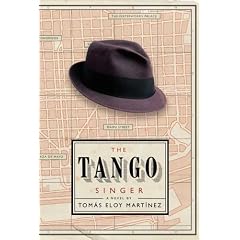
My rating:
Tomás Eloy Martínez (1934-) was a journalist and film critic in Buenos Aires and Paris for many years before moving to Venezuela in 1975, to escape the political strife occurring in Argentina. He moved to the US in 1983, where he initially taught at the U. of Maryland. Since 1995 he has been the director of the Latin American Studies program at Rutgers. He has written several novels and nonfictional works, most notably The Perón Novel, Santa Evita and Flight of the Queen.
The Tango Singer is Martinez's latest novel, which I read for the Reading Globally theme read on Argentina. The narrator, Bruno Cadogan, is a graduate student in literature at NYU, who travels to Buenos Aires in order to complete his Ph.D. dissertation on Borges' essays on the origin of the tango. He soon learns about Julio Martel, a mysterious tango singer who is considered to be even better than Carlos Gardel, the greatest of all tango singers.
Cadogan sets off on a search for Martel throughout the city, which he describes as as a labyrinth. His paths are frequently blocked by demonstrators and crowds watching spontaneous tango performances, and the "street names change from one week to tne next", which causes even long time residents of the city to become lost outside of their own neighborhoods.
Eventually he meets and befriends Martel, but in doing so he discovers the dark side of Argentinian history, and achieves a greater understanding of Borges and his story "The Aleph", which describes a point in space that contains all other points.
Although it was a well written novel, I didn't enjoy it as much as I thought I would. The frequent references to streets, neighborhoods and sections of Buenos Aires and a lack of knowledge of Argentinian history made this a tedious read for me. I've heard good things about his other novels, and I'm willing to give them a try. I think that anyone with better knowledge about Argentina would enjoy this book far more than I did.
My rating:

Tomás Eloy Martínez (1934-) was a journalist and film critic in Buenos Aires and Paris for many years before moving to Venezuela in 1975, to escape the political strife occurring in Argentina. He moved to the US in 1983, where he initially taught at the U. of Maryland. Since 1995 he has been the director of the Latin American Studies program at Rutgers. He has written several novels and nonfictional works, most notably The Perón Novel, Santa Evita and Flight of the Queen.
The Tango Singer is Martinez's latest novel, which I read for the Reading Globally theme read on Argentina. The narrator, Bruno Cadogan, is a graduate student in literature at NYU, who travels to Buenos Aires in order to complete his Ph.D. dissertation on Borges' essays on the origin of the tango. He soon learns about Julio Martel, a mysterious tango singer who is considered to be even better than Carlos Gardel, the greatest of all tango singers.
Cadogan sets off on a search for Martel throughout the city, which he describes as as a labyrinth. His paths are frequently blocked by demonstrators and crowds watching spontaneous tango performances, and the "street names change from one week to tne next", which causes even long time residents of the city to become lost outside of their own neighborhoods.
Eventually he meets and befriends Martel, but in doing so he discovers the dark side of Argentinian history, and achieves a greater understanding of Borges and his story "The Aleph", which describes a point in space that contains all other points.
Although it was a well written novel, I didn't enjoy it as much as I thought I would. The frequent references to streets, neighborhoods and sections of Buenos Aires and a lack of knowledge of Argentinian history made this a tedious read for me. I've heard good things about his other novels, and I'm willing to give them a try. I think that anyone with better knowledge about Argentina would enjoy this book far more than I did.
25QuentinTom
*throwing my hands up* Doc, I can't keep up with you. Are you employing a sweatshop of kids to read these books for you?
That sounds like an amazing read. I love tango.
That sounds like an amazing read. I love tango.
26kidzdoc
I can't use kids; the AAP (American Academy of Pediatrics) would take away my fellowship! However, Nietzsche's typing chimps were laid off recently, so I hired them to read and write my reviews.
Actually I've been off from work since the Sunday before last, and I set a goal to read a book a day for those 14 days. So far so good: nine books in nine days.
I'm currently reading Autonauts of the Cosmoroute by Julio Cortázar and his wife Carol Dunlop, which I should finish by tomorrow. It's hilarious!
Actually I've been off from work since the Sunday before last, and I set a goal to read a book a day for those 14 days. So far so good: nine books in nine days.
I'm currently reading Autonauts of the Cosmoroute by Julio Cortázar and his wife Carol Dunlop, which I should finish by tomorrow. It's hilarious!
27SqueakyChu
I have to admit that I, too, am utterly amazed by the number of books for which you've posted reviews. And they *all* look so good!
By the way, a few days ago after I finished Outcasts United, I gave my ARC of that book to a neighbor of mine from Atlanta because he already knew of the team of the Fugees. He says he hates to read, but I told him he'd enjoy the book! I hope he decides to go ahead and read it.
By the way, a few days ago after I finished Outcasts United, I gave my ARC of that book to a neighbor of mine from Atlanta because he already knew of the team of the Fugees. He says he hates to read, but I told him he'd enjoy the book! I hope he decides to go ahead and read it.
28chrine
Hola kidzdoc
The husband thinks he will be liking the CD! It usually takes him a couple of listens to decide on a CD. He's one of those people. lol Thanks for the recommendation. I'll be back with a post once he has something definite to say about it.
The husband thinks he will be liking the CD! It usually takes him a couple of listens to decide on a CD. He's one of those people. lol Thanks for the recommendation. I'll be back with a post once he has something definite to say about it.
29kidzdoc
The main reason for this book reading frenzy (other than the obvious fact that I love to read) is that I wanted to make a dent in the number of unread books that are accumulating like Tribbles. I'm still buying far more books than I can hope to read, and I have hundreds of books I want to read but haven't been able to get to yet, which is a little bit frustrating.
Having said that, I ordered six books from Amazon earlier in the week, received three others by mail on Tuesday, and two or three more should come today!
Oh oh, the 2009 Orange Prize longlist of 20 books was announced today. I only have one of the books, The Lost Dog by Michelle de Kretser, and the recently released Burnt Shadows by Kamila Shamsie should be coming from The Book Depository any day now. Must resist...
SqueakyChu, I hope your friend enjoys Outcasts United as much as we did. I think it will sell likehotcakes Varsity hot dogs here in Atlanta.
¡Hola chrine! I'm glad to hear that your husband likes the CD so far (it was Straight Ahead by Abbey Lincoln, right?). I'm like him, I have to listen to an album or song at least two or three times before I can render an opinion. I'll be awaiting his comments.
Yesterday I downloaded an album after I heard about it on NPR (National Public Radio), "One Ounce of Truth: The Nikki Giovanni Songs" by Capathia Jenkins & Louis Rosen. Jenkins is an actress that has appeared on several Broadway and off-Broadway productions, and Rosen is a songwriter who put several of Nikki Giovanni's poems to music. I like it so far, but I need another listen or two before I can recommend it. I'll post a review of it in the next couple of days.
Having said that, I ordered six books from Amazon earlier in the week, received three others by mail on Tuesday, and two or three more should come today!
Oh oh, the 2009 Orange Prize longlist of 20 books was announced today. I only have one of the books, The Lost Dog by Michelle de Kretser, and the recently released Burnt Shadows by Kamila Shamsie should be coming from The Book Depository any day now. Must resist...
SqueakyChu, I hope your friend enjoys Outcasts United as much as we did. I think it will sell like
¡Hola chrine! I'm glad to hear that your husband likes the CD so far (it was Straight Ahead by Abbey Lincoln, right?). I'm like him, I have to listen to an album or song at least two or three times before I can render an opinion. I'll be awaiting his comments.
Yesterday I downloaded an album after I heard about it on NPR (National Public Radio), "One Ounce of Truth: The Nikki Giovanni Songs" by Capathia Jenkins & Louis Rosen. Jenkins is an actress that has appeared on several Broadway and off-Broadway productions, and Rosen is a songwriter who put several of Nikki Giovanni's poems to music. I like it so far, but I need another listen or two before I can recommend it. I'll post a review of it in the next couple of days.
30dukedom_enough
kidzdoc@29,
The recording of the Giovanni poems reminded me that I once heard a piece from a recording of Ishmael Reed works set to music. I searched and, what do you know, it's just about to be rereleased. See also here.
The song I heard was based on "The Wardrobe Master of Paradise," and quite good if my now 20 year old memory is right.
The recording of the Giovanni poems reminded me that I once heard a piece from a recording of Ishmael Reed works set to music. I searched and, what do you know, it's just about to be rereleased. See also here.
The song I heard was based on "The Wardrobe Master of Paradise," and quite good if my now 20 year old memory is right.
32Fullmoonblue
Re 10 -- "It is a testament to O'Connor's skill as a writer that these thoroughly dislikable characters and this unlikely plot combine to form a fantastic novel..."
Good review of Wise Blood, and I'm completely with you on that last line. Nicely put.
Good review of Wise Blood, and I'm completely with you on that last line. Nicely put.
33kidzdoc
Autonauts of the Cosmoroute by Julio Cortázar and Carol Dunlop

My rating:1/2
In the spring of 1982, the Argentinian author Julio Cortázar and his wife Carol Dunlop decide to drive from Paris to Marseille, a 790 km (450 mi) trip, and to write about the trip. This seems simple (and boring) enough, right? However, the master humorist and surrealist and his wife decide to turn this trip into a scientific expedition and exploration of all of the rest stops along the route. They plan to visit two rest stops per day, and there are 70 stops along the way.
After consulting travel diaries by Captain Cook and Marco Polo, and ensuring that they have sufficent supplies to prevent scurvy, Cortázar ('El Lobo') and Dunlop ('La Osita', or 'Little Bear') embark on their epic journey, led by their faithful Volkswagen beetle van 'Fafner' ('the dragon').
The 33 day trip is filled with bizarre and hilarious episodes, including a near-fatal encounter with a swarm of carnivorous ants, confrontations with suspicious gendarmes and highway workers, and the constant threats of large trucks and sports cars traveling at impossible speeds. The voyagers also discover a site where witches were tortured and executed, which other travelers naïvely mistake for a children's playground.
In the latter part of the journey, the entries become more introspective and philosophical, and are infused with the love that El Lobo and La Ostia share for each other. A joyful sadness also permeates the last pages, as deceased friends are mourned and loved, and the end of the journey is celebrated with wine and tears.
This travelogue/flight of ideals/love story is unlike anything I've ever read, and, although it drags in a couple of spots, preventing me from giving a five star rating, is highly recommended.

My rating:
1/2In the spring of 1982, the Argentinian author Julio Cortázar and his wife Carol Dunlop decide to drive from Paris to Marseille, a 790 km (450 mi) trip, and to write about the trip. This seems simple (and boring) enough, right? However, the master humorist and surrealist and his wife decide to turn this trip into a scientific expedition and exploration of all of the rest stops along the route. They plan to visit two rest stops per day, and there are 70 stops along the way.
After consulting travel diaries by Captain Cook and Marco Polo, and ensuring that they have sufficent supplies to prevent scurvy, Cortázar ('El Lobo') and Dunlop ('La Osita', or 'Little Bear') embark on their epic journey, led by their faithful Volkswagen beetle van 'Fafner' ('the dragon').
The 33 day trip is filled with bizarre and hilarious episodes, including a near-fatal encounter with a swarm of carnivorous ants, confrontations with suspicious gendarmes and highway workers, and the constant threats of large trucks and sports cars traveling at impossible speeds. The voyagers also discover a site where witches were tortured and executed, which other travelers naïvely mistake for a children's playground.
In the latter part of the journey, the entries become more introspective and philosophical, and are infused with the love that El Lobo and La Ostia share for each other. A joyful sadness also permeates the last pages, as deceased friends are mourned and loved, and the end of the journey is celebrated with wine and tears.
This travelogue/flight of ideals/love story is unlike anything I've ever read, and, although it drags in a couple of spots, preventing me from giving a five star rating, is highly recommended.
34avaland
Me thinks we will need to elevate you to Book God or something. So many interesting reads here. . .
35SqueakyChu
-->
I'd like to nominate kidzdoc to stock my local library's shelves! (JK, as I really love my local library, but I also love kd's taste in books). :)
I'd like to nominate kidzdoc to stock my local library's shelves! (JK, as I really love my local library, but I also love kd's taste in books). :)
36rebeccanyc
I think kidzdoc is stocking MY shelves!
37kidzdoc
Aww...thanks for the kind comments! I'll only agree to be a Book God if the three of you (and a few others) become Book Goddesses.
I finished today's book earlier than usual today. Big props to a fellow Pitt alum!
Golpes Bajos / Low Blows: Instantaneas / Snapshots by Alicia Borinsky
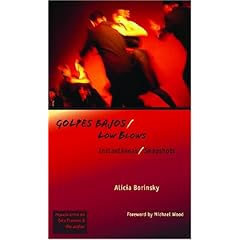
My rating:1/2
I obtained most of this information from Ms. Borinsky's bio on the web site of the Department of Romance Studies at Boston University:
Golpes Bajos/Low Blows: Instantáneas/Snapshots is a collection of stories about Buenos Aires, which are brief scenes of the lives of people and stories told about others. The stories are presented in both Spanish and English, and Ms Borinsky tells us that the English versions are not literal translations, they are similar creations that maintain the flavor and spirit of the original Spanish vignettes. The people portrayed in the stories are reflective of the diversity of the city's inhabitants, with generous portions of lovers' tales, and sections of stories about orphans and prophets.
I've included two of the snapshots that I especially enjoyed, though there were at least a dozen others that I liked as much:
I loved these brief glimpses into life, and the mind of Borinsky. Although this was a quick read, there is much to savor here, and I'm sure I'll revisit it often.
I finished today's book earlier than usual today. Big props to a fellow Pitt alum!
Golpes Bajos / Low Blows: Instantaneas / Snapshots by Alicia Borinsky
My rating:
1/2I obtained most of this information from Ms. Borinsky's bio on the web site of the Department of Romance Studies at Boston University:
Alicia Borinsky is a literary scholar, fiction writer, and poet and has published in Spanish and English in the United States, Latin America, and Europe. Her publications include Mean Woman (1993); La Pareja Desmontable (1994); Madres Aquiladas (1997); and Cine Continuado (1997). She teaches modern and contemporary Latin American literature in the Department of Romance Studies at Boston Univesity, and directs the Writing in the Americas Program.
She was born in Buenos Aires, received her MA and PhD from the University of Pittsburgh, and has held visiting professorships at Harvard University and Washington University in St. Louis. She won the Metcalf Award for Excellence in Teaching (1985), the Latino Literature Prize for Fiction (1996) and the John Simon Guggenheim Fellowship (2002).
Her book Golpes Bajos/Low Blows: Instantáneas/Snapshots was published by the University of Wisconsin Press in 2007.
Golpes Bajos/Low Blows: Instantáneas/Snapshots is a collection of stories about Buenos Aires, which are brief scenes of the lives of people and stories told about others. The stories are presented in both Spanish and English, and Ms Borinsky tells us that the English versions are not literal translations, they are similar creations that maintain the flavor and spirit of the original Spanish vignettes. The people portrayed in the stories are reflective of the diversity of the city's inhabitants, with generous portions of lovers' tales, and sections of stories about orphans and prophets.
I've included two of the snapshots that I especially enjoyed, though there were at least a dozen others that I liked as much:
haven't i seen that face before?
what really gets me is when he walks behind me so close he
could step on my heels I tell you my mouth goes dry just thinking
about it as always he is about to walk past me without as
much as a glance. He walks by, stares across the street as though I
wasn't there what does he care about our midday escapades
the splendid nights carelessly abandoned beds our hushed
conversations in the train station, the same one he is going to
now I am sure he is heading home although we didn't even
go through half the excellent bottles of wine I got for us at a
discount. I can't stand it when I catch a glimpse of his mis-
matched socks and above all the way in which he hurries so
close indifferent and arrogant without knowing that soon
she will open up the envelope and breathless, shocked, will confront
him with the photograph, an address, a key, our scandal.
For the Country
Once there was a country with so many doctors that the military
junta that had generously taken over the responsibilities of govern-
ment organized a civil war so the doctors would have plenty of work
but they forgot that the earlier lack of cases had turned them into a
bunch of lazy bums with no interest beyond getting cushy jobs and
taking illegal payoffs from chemical and pharmaceutical companies.
When the number of neglected dead and wounded became a scan-
dal the entire country demanded that all the doctors be killed. Still
five years after the dramatic executions, we keep celebrating our
great national reconciliation with embraces and festivals.
I loved these brief glimpses into life, and the mind of Borinsky. Although this was a quick read, there is much to savor here, and I'm sure I'll revisit it often.
38avaland
>37 kidzdoc: This sounds intriguing, may have to look into it - but after my project is done (hopefully, in the next 2 weeks or so).
39kidzdoc
I wasn't sure what to expect from this book, as the reviews on the web weren't that helpful. I received it from Amazon yesterday, started leafing through it, and began reading it straight away.
I'm planning to read Children of the New World by Assia Djebar this weekend. I enjoyed lriley's review of Fantasia as well; he is definitely a Book God.
Good luck on your project!
I'm planning to read Children of the New World by Assia Djebar this weekend. I enjoyed lriley's review of Fantasia as well; he is definitely a Book God.
Good luck on your project!
40kiwidoc
Kidzdoc - your reading pace is phenomenal. Are you managing to going to work, too??? (Jealousy creeping in!)
Great line-up of books - severely testing my willpower as they all lie just a click away in cyberspace. I have also sourced some from my library, but my eyes are bigger than my brain.
Thanks for posting the Orange List - I have found it quite helpful in the past for good reads, although last year there were quite a few that disappointed (cannot remember their names so not a particularly helpful comment).
Great line-up of books - severely testing my willpower as they all lie just a click away in cyberspace. I have also sourced some from my library, but my eyes are bigger than my brain.
Thanks for posting the Orange List - I have found it quite helpful in the past for good reads, although last year there were quite a few that disappointed (cannot remember their names so not a particularly helpful comment).
41kidzdoc
Hi kiwidoc! No, I have been off from work since the Sunday before last (11 days and counting), and don't go back to work until this coming Monday. There is no way that I could have read 11 books in 11 days while working! During weeks that I work my usual goal is two books per week, or one book (or less) if I'm working the weekend. When I'm off I tend to read shorter books, and longer ones when I'm working (that doesn't make much sense, I know). So, my reading will slow down dramatically starting Monday, and stay that way for the next 3-4 weeks.
I'm basically tripping over piles of books that I've accumulated over the past couple of years. I wouldn't be surprised if I purchased ~250 books/yr in that time, and I'm actually buying more than that this year. This week I've already received 10 books, and I may get another one or two by the weekend, absolutely ridiculous! I have so many books that I eagerly want to read, but the new books get in the way. I really need to come up with a plan to limit my book buying! (Having said that, let's see if I can get to Sunday without going to Borders or ordering anything online; I wouldn't bet more than a nickel on that happening!)
Did I post the Orange longlist? I thought citizenkelly did...oh, maybe I posted it to Club Read; she was the first one to post it, to the Prizes group. So many awards and longlists have come out in the past week or so that I think I'm experiencing award fatigue...
I'm basically tripping over piles of books that I've accumulated over the past couple of years. I wouldn't be surprised if I purchased ~250 books/yr in that time, and I'm actually buying more than that this year. This week I've already received 10 books, and I may get another one or two by the weekend, absolutely ridiculous! I have so many books that I eagerly want to read, but the new books get in the way. I really need to come up with a plan to limit my book buying! (Having said that, let's see if I can get to Sunday without going to Borders or ordering anything online; I wouldn't bet more than a nickel on that happening!)
Did I post the Orange longlist? I thought citizenkelly did...oh, maybe I posted it to Club Read; she was the first one to post it, to the Prizes group. So many awards and longlists have come out in the past week or so that I think I'm experiencing award fatigue...
42kidzdoc
UFO in Her Eyes by Xiaolu Guo
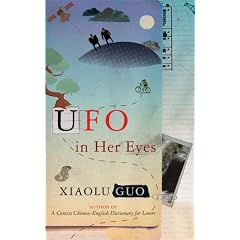
My rating:
Xiaolu Guo is an award-winning filmmaker and an acclaimed novelist. She was born in a fishing village in China in 1973, graduated from the Beijing Film Academy, and emigrated to London in 2002 to further her career. She has written several novels in Chinese; her first novel published in English, A Concise Chinese-English Dictionary for Lovers, was shortlisted for the Orange Prize for Fiction in 2007. Other notable novels by Guo include 20 Fragments of a Ravenous Youth and Village of Stone, which was as shortlisted for the Independent Foreign Fiction Prize and nominated for the International IMPAC Dublin Literary Award in 2005. Her first feature film, How is Your Fish Today?, was featured at the Sundance Film Festival in 2007
Her latest novel, UFO in Her Eyes, which was published in the UK last month, is set in a rural village in China in 2012. Local and regional intelligence agents conduct an investigation there after an illiterate peasant, Kwok Yun, sees a UFO in a rice field. At the same time Yun also discovers and treats a wounded foreigner, an American who is bitten by a snake while hiking through Hunan Province.
Several months later the American donates $2000 to the village as a token of gratitude for Yun's actions. The chief of the village, Chang Lee, is inspired by this gift, and, after the town is awarded a 2 million yuan grant by the province, embarks on a plan to modernize the village.
The villagers, mostly illiterate peasants and elderly people, are initially supportive of the plan, as they wish to become wealthy like the entrepreneurs in Shenzen and Shanghai. However, as their livelihoods and properties are disrupted by the chief's increasingly more ambitious plans, they become resistant and rebellious.
This is a very nice satire about life in rural China, and the effects of modernization and Western influence on the country. The writing is a bit sparse, as the novel (which will be made into a movie) consists of reports by intelligence agents and provincial officials, with minimal dialogue or insight into the characters. However, it was definitely an enjoyable read.
My rating:
Xiaolu Guo is an award-winning filmmaker and an acclaimed novelist. She was born in a fishing village in China in 1973, graduated from the Beijing Film Academy, and emigrated to London in 2002 to further her career. She has written several novels in Chinese; her first novel published in English, A Concise Chinese-English Dictionary for Lovers, was shortlisted for the Orange Prize for Fiction in 2007. Other notable novels by Guo include 20 Fragments of a Ravenous Youth and Village of Stone, which was as shortlisted for the Independent Foreign Fiction Prize and nominated for the International IMPAC Dublin Literary Award in 2005. Her first feature film, How is Your Fish Today?, was featured at the Sundance Film Festival in 2007
Her latest novel, UFO in Her Eyes, which was published in the UK last month, is set in a rural village in China in 2012. Local and regional intelligence agents conduct an investigation there after an illiterate peasant, Kwok Yun, sees a UFO in a rice field. At the same time Yun also discovers and treats a wounded foreigner, an American who is bitten by a snake while hiking through Hunan Province.
Several months later the American donates $2000 to the village as a token of gratitude for Yun's actions. The chief of the village, Chang Lee, is inspired by this gift, and, after the town is awarded a 2 million yuan grant by the province, embarks on a plan to modernize the village.
The villagers, mostly illiterate peasants and elderly people, are initially supportive of the plan, as they wish to become wealthy like the entrepreneurs in Shenzen and Shanghai. However, as their livelihoods and properties are disrupted by the chief's increasingly more ambitious plans, they become resistant and rebellious.
This is a very nice satire about life in rural China, and the effects of modernization and Western influence on the country. The writing is a bit sparse, as the novel (which will be made into a movie) consists of reports by intelligence agents and provincial officials, with minimal dialogue or insight into the characters. However, it was definitely an enjoyable read.
43polutropos
OK, Darryl,
I am spending time with the Greeks, specifically Mary Renault's Theseus, and therefore this talk of you becoming Book God seems very a propos to me. You have already selected your goddesses, (hmm, three of them, is there a fellow named Paris anywhere around to judge a contest?), can I be a faithful retainer, or messenger, who gets to read all YOUR books, too?
With my current work load and Real Life, even though I am sure I have a thousand unread books sitting around here in various piles, sometimes long forgotten, and of course I keep buying more, especially on your recommendation, (Blinding Absence of Light was your recommendation, wasn't it, that just arrived), I am lucky if I finish a book a week. A book a day, he said, green with envy, how I wish!
I am spending time with the Greeks, specifically Mary Renault's Theseus, and therefore this talk of you becoming Book God seems very a propos to me. You have already selected your goddesses, (hmm, three of them, is there a fellow named Paris anywhere around to judge a contest?), can I be a faithful retainer, or messenger, who gets to read all YOUR books, too?
With my current work load and Real Life, even though I am sure I have a thousand unread books sitting around here in various piles, sometimes long forgotten, and of course I keep buying more, especially on your recommendation, (Blinding Absence of Light was your recommendation, wasn't it, that just arrived), I am lucky if I finish a book a week. A book a day, he said, green with envy, how I wish!
44kidzdoc
I'm also feeling a bit Grecian, polutropos, as my Achilles tendonitis has flared up this week.
You & Murr are definitely Book Gods, and urania is certainly a Goddess! Club Read and the 75ers have plenty of members that qualify, too.
I probably should have included Murr earlier, to avoid his vengeful claws...
I did read This Blinding Absence of Light a couple of years ago, but I don't think I was the one who recommended it. I think that one of the Book Goddesses (avaland or rebeccanyc) did.
My reading slowed down the past four days, as March Madness (AKA the NCAA men's and women's Division 1 college basketball tournaments in the US) is underway. The three teams from my two Division 1 alma maters (Pitt men & women, Rutgers women) all won their games this weekend.
I go back to work tomorrow, after being off for two weeks, so I'll be back to the usual 1-3 books/week pace for the next few weeks. I hope to finish Children of the New World by Assia Djebar and Burnt Shadows by Kamila Shamsie.
I just finished Shyness and Dignity by Dag Solstad, which was very good (4 stars). I'll submit a review later this week; I need to think about it a little more, and it's getting late.
You & Murr are definitely Book Gods, and urania is certainly a Goddess! Club Read and the 75ers have plenty of members that qualify, too.
I probably should have included Murr earlier, to avoid his vengeful claws...
I did read This Blinding Absence of Light a couple of years ago, but I don't think I was the one who recommended it. I think that one of the Book Goddesses (avaland or rebeccanyc) did.
My reading slowed down the past four days, as March Madness (AKA the NCAA men's and women's Division 1 college basketball tournaments in the US) is underway. The three teams from my two Division 1 alma maters (Pitt men & women, Rutgers women) all won their games this weekend.
I go back to work tomorrow, after being off for two weeks, so I'll be back to the usual 1-3 books/week pace for the next few weeks. I hope to finish Children of the New World by Assia Djebar and Burnt Shadows by Kamila Shamsie.
I just finished Shyness and Dignity by Dag Solstad, which was very good (4 stars). I'll submit a review later this week; I need to think about it a little more, and it's getting late.
45avaland
>44 kidzdoc: I don't think I was the one who recommended This Blinding Absence of Light, although I would certainly do so (I read it the year it won the Impac Dublin). Someone in this group read it recently though because I remember commenting.
I'll look forward to your comments on the Djebar, kidzdoc. It's amazing to think she was just 26 when she wrote it. lriley just read her Fantasia and did a nice review on it.
I'll look forward to your comments on the Djebar, kidzdoc. It's amazing to think she was just 26 when she wrote it. lriley just read her Fantasia and did a nice review on it.
46arubabookwoman
I think both you, avaland, and polutropos commented on my thread last month when I recommended This Blinding Absence of Light. I have since purchased two other of Jelloun's books I hope to get to in the next few months.

48kidzdoc
Hi mckait! I've been almost invisible on LT since Monday, as I worked all week. I was the teaching attending this week, rounding with medical students and residents in the hospital, which made my days longer than usual (although I enjoy the teaching role).
I was also slowed by moderate pain in my right Achilles tendon and pitting edema in my ankle, and I couldn't walk very well. I was on crutches for a couple of days, but soon gave up on them. I saw an orthopaedic surgeon yesterday, and X-rays of my foot & ankle showed that I have calcific tendinitis of the Achilles tendon, probably due to a partial tear of the tendon. Fortunately it should resolve, albeit slowly, with rest, NSAIDs, physical therapy, and time.
I have to prepare for two talks the week after next, which I'll be working on the next two weekends. I'll also be working all of next week. So, I may not be on LT very much for the next couple of weeks. Hopefully I can get at least a couple of books read in that time.
I'm a bit sick to my stomach at the moment, as Pitt just lost to Villanova 78-76 on a last second shot by the 'Cats. So, no Final Four for the Panthers this year. :-( Pitt still had a great season, finishing 31-5.
I guess I'd better get back to reading journal articles...
I was also slowed by moderate pain in my right Achilles tendon and pitting edema in my ankle, and I couldn't walk very well. I was on crutches for a couple of days, but soon gave up on them. I saw an orthopaedic surgeon yesterday, and X-rays of my foot & ankle showed that I have calcific tendinitis of the Achilles tendon, probably due to a partial tear of the tendon. Fortunately it should resolve, albeit slowly, with rest, NSAIDs, physical therapy, and time.
I have to prepare for two talks the week after next, which I'll be working on the next two weekends. I'll also be working all of next week. So, I may not be on LT very much for the next couple of weeks. Hopefully I can get at least a couple of books read in that time.
I'm a bit sick to my stomach at the moment, as Pitt just lost to Villanova 78-76 on a last second shot by the 'Cats. So, no Final Four for the Panthers this year. :-( Pitt still had a great season, finishing 31-5.
I guess I'd better get back to reading journal articles...
49QuentinTom
Hey doc,
I hope your Achilles heels most quickly. Take it easy there.
I hope your Achilles heels most quickly. Take it easy there.
51mckait
ouch! that does sound painful. I hope you are all healed up soon.
Wonder why Photobucket spilled out my gif? must research.
It does sound as if you are pretty busy.. fingers crossed for some reading time for you. I am looking forward to our spring break which is coming up soon.
I have been busy myself with spring cleaning sorts of things.. you know how it is.. old patterns are hard to break :)
Take care docdear.. and I will keep watching for your next extraordinary read!
Wonder why Photobucket spilled out my gif? must research.
It does sound as if you are pretty busy.. fingers crossed for some reading time for you. I am looking forward to our spring break which is coming up soon.
I have been busy myself with spring cleaning sorts of things.. you know how it is.. old patterns are hard to break :)
Take care docdear.. and I will keep watching for your next extraordinary read!
52kiwidoc
Hi Doc - take care re. work. I just emerged from that black hole of work last week!!
Sorry to hear about your Achilles. I had a 30 year old step out of his car yesterday and completely snap his Achilles. No trauma at all.
Hope you heal fast!!!
Sorry to hear about your Achilles. I had a 30 year old step out of his car yesterday and completely snap his Achilles. No trauma at all.
Hope you heal fast!!!
53kidzdoc
Thanks mckait & kiwidoc. I hope that this will be much improved by the end of next month, so that I can go to San Francisco.
I think I originally injured my Achilles in December, when I twisted my foot while walking down a flight of stairs. Later that day my Achilles was throbbing, and I had similar pain to what I had last week, which lasted about a week. I had some very mild flareups up until about two weeks ago, when it began again, and progressively worsened. I guess that I partially tore the ligament in December, and it took time for the calcium to build within it. The lateral X-ray showed a bright lucency in the tendon exactly where the pain is the worst.
I have stayed inside since Friday night, and I think I'll stay in again today (mckait, I hope that Pittsburgh doesn't get as much rain as we had in Atlanta yesterday!). My ankle is swollen and throbbing now, just with minimal ambulation inside; I just put on my ACE wrap and I'll take a dose of naproxen now. I still don't quite understand why I'm having so much pitting edema, though.
My sympathy to your patient with the Achilles rupture, kiwidoc. That must have been a lot more painful than what I've experienced!
I think I originally injured my Achilles in December, when I twisted my foot while walking down a flight of stairs. Later that day my Achilles was throbbing, and I had similar pain to what I had last week, which lasted about a week. I had some very mild flareups up until about two weeks ago, when it began again, and progressively worsened. I guess that I partially tore the ligament in December, and it took time for the calcium to build within it. The lateral X-ray showed a bright lucency in the tendon exactly where the pain is the worst.
I have stayed inside since Friday night, and I think I'll stay in again today (mckait, I hope that Pittsburgh doesn't get as much rain as we had in Atlanta yesterday!). My ankle is swollen and throbbing now, just with minimal ambulation inside; I just put on my ACE wrap and I'll take a dose of naproxen now. I still don't quite understand why I'm having so much pitting edema, though.
My sympathy to your patient with the Achilles rupture, kiwidoc. That must have been a lot more painful than what I've experienced!
54avaland
>53 kidzdoc: keep that foot up, Darryl! Hope it starts to feel better.
55arubabookwoman
Not medical advice--just a mom's advice--stay off your feet as much as you can (probably pretty hard to do if you're at the hospital). Hope the Achilles heals as soon as possible.
56mckait
ahem
Whisper explained it to me. Can I blame it on... say, some post-menopausal
brain cell something???

Whisper explained it to me. Can I blame it on... say, some post-menopausal
brain cell something???

57kidzdoc
I finished A Strange and Sublime Address, Amit Chaudhuri's first novel yesterday, which was pretty good. I'll post a review of it, and Shyness and Dignity by Dag Solstad, this weekend.
58urania1
mckait,
PhotoBucket has been deleting some of my pictures as well. I think they're having a visual cleansing revival right now. My pictures were all copies of art (not by me but by the greats) containing nudity. I read through PhotoBucket's rule list. Nudity, even on private sites, is not allowed. The CEO probably went to one of those 19th-century convent schools where the pupils had to bathe with their clothes on lest they get "ideas." About what, I sure I don't know ;-)
PhotoBucket has been deleting some of my pictures as well. I think they're having a visual cleansing revival right now. My pictures were all copies of art (not by me but by the greats) containing nudity. I read through PhotoBucket's rule list. Nudity, even on private sites, is not allowed. The CEO probably went to one of those 19th-century convent schools where the pupils had to bathe with their clothes on lest they get "ideas." About what, I sure I don't know ;-)
59avaland
Wow, I actually had trouble finding your thread! (and I can't believe I'm caught up on it!) Looking forward to hearing about your latest reading.
60kidzdoc
Hi avaland, I have been extra busy at work lately (including today, when I admitted 9 kids to the hospital, saw a half dozen other complicated inpatients, attended two meetings, and gave a 45 minute lecture to the pediatric residents on nephrolithiasis (kidney stones) in children that I worked on all weekend; I probably won't leave work until 9 pm or later). I think I've only read one book in the past two weeks, but I hope to get at least 1-2 books in by the weekend. After next week I'll be off for (I think) 2-1/2 weeks, and hopefully I'll resume my frenetic book reading then.
Congratulations on finishing(?) your research!
Congratulations on finishing(?) your research!
61avaland
Thanks, and don't feel you have to squeeze time in to report to us; it's not like there aren't other threads to read;-) I have begun my African reading jag, btw, but will alternate with other books.
64kiwidoc
That would be really cool, kidzdoc. Thanks.
I went to a great conference on the weekend - the best talk was from an ER doc who talked about "Five things that can walk into your office and must not miss" - eg aortic dissection, sepsis, etc. Full of pearls! The best kind of talk.
I went to a great conference on the weekend - the best talk was from an ER doc who talked about "Five things that can walk into your office and must not miss" - eg aortic dissection, sepsis, etc. Full of pearls! The best kind of talk.
65kidzdoc
Okay, I've just sent them to you by e-mail.
Those conferences are the best kind. Unfortunately, as we tell the medical students (and, to a lesser degree, the residents, who should know better), "kids don't always read the books", and we have to keep an open mind about them (not that I need to tell you this, either!). I've seen lots of kids with pneumonia who presented with abdominal pain and vomiting with little or no cough or DIB, and a number of infants with UTIs who came in with tachypnea and fever.
Those conferences are the best kind. Unfortunately, as we tell the medical students (and, to a lesser degree, the residents, who should know better), "kids don't always read the books", and we have to keep an open mind about them (not that I need to tell you this, either!). I've seen lots of kids with pneumonia who presented with abdominal pain and vomiting with little or no cough or DIB, and a number of infants with UTIs who came in with tachypnea and fever.
66mckait
But you persist until you find the problem, and don't just send them home with "he'll be fine, its nothing" bless you doc dear.
67kidzdoc
That is true, kath. There are times, though, where we don't have an answer on discharge, as there are pending lab tests that take a week or two to come back. But I try to do everything possible in the hospital before discharging them.
68mckait
But you look.. The horror stories I have heard about kids being "blown off" and ending up back in hospital again, and sometimes again..
With our kids, doc... there are certain things that we can predict will be done. Surgeries for kids with CP that have never ever made any difference. They do it over and over. If we ever saw the promised results.......but we don't .
Of course you know the parental horror stories better than I do.
With our kids, doc... there are certain things that we can predict will be done. Surgeries for kids with CP that have never ever made any difference. They do it over and over. If we ever saw the promised results.......but we don't .
Of course you know the parental horror stories better than I do.
69kidzdoc
Brain Surgeon: A Doctor's Inspiring Encounters with Mortality and Miracles by Keith Black, MD

My rating: 3-1/2 stars
I received this book through the LibraryThing Early Reviewer program earlier this month.
Dr. Keith Black is the chairman of Neurosurgery at Cedars-Sinai Medical Center in Los Angeles, who specializes in the surgical and medical treatment of brain tumors. He has gained widespread recognition for his clinical skill in treating brain cancers, and has been featured in Time Magazine, CBS News and PBS' The History Makers.
Brain Surgeon is an enjoyable and inspiring story about his career, obstacles he overcame along the way, battles and controversies he has encountered in providing the best care for his patients, and the advances of clinical brain tumor research that are allowing patients to live longer and, in some cases, making disease remission possible.
Although the story centers on Dr. Black's impressive accomplishments, equal billing is given to several patients, who he claims are the true heroes of this book. They are fully engaged in the treatment plan, and the trust and faith that they have in Dr. Black is matched by his respect and desire to help them as best he can.
The book is written for a lay audience, and would be appropriate for high school and college students interested in medicine and neurosurgery, or anyone else interested in stories of faith and inspiration.

My rating: 3-1/2 stars
I received this book through the LibraryThing Early Reviewer program earlier this month.
Dr. Keith Black is the chairman of Neurosurgery at Cedars-Sinai Medical Center in Los Angeles, who specializes in the surgical and medical treatment of brain tumors. He has gained widespread recognition for his clinical skill in treating brain cancers, and has been featured in Time Magazine, CBS News and PBS' The History Makers.
Brain Surgeon is an enjoyable and inspiring story about his career, obstacles he overcame along the way, battles and controversies he has encountered in providing the best care for his patients, and the advances of clinical brain tumor research that are allowing patients to live longer and, in some cases, making disease remission possible.
Although the story centers on Dr. Black's impressive accomplishments, equal billing is given to several patients, who he claims are the true heroes of this book. They are fully engaged in the treatment plan, and the trust and faith that they have in Dr. Black is matched by his respect and desire to help them as best he can.
The book is written for a lay audience, and would be appropriate for high school and college students interested in medicine and neurosurgery, or anyone else interested in stories of faith and inspiration.
70bonniebooks
I always like reading books like this. While working as a medical assistant, I came to see patients as frequently fitting into one of two categories. Either they wanted lots of information and wanted to be very involved in making decisions in terms of their care. Or they relied on their faith and trust in their doctor and too much information made them uncomfortable.
I know that people are never that black/white, and my experiences may be shaded by the fact that this was over 35 years ago (!) and a lot of the patients were older and more people back then fit into the latter category, while I am definitely in the former. I want as much information and control as I can get. I remember when I had to have surgery 23 years ago, I even got recommendations for anesthesiologists and went in ahead of time to interview the one I chose. At the hospital, I also shooed away "attendings" or residents who wanted to practice their examining and history-taking skills on me, so that I could listen to my carefully selected music which I brought into the operating room with me.
Nowadays, we patients have so much more access to information which can present its own problems, but that's another story. :-) Your comments are still leaving me unclear. Do you mean faith and inspiration as in faith in God? Or faith in the expertise and experience of a doctor? I think both are helpful/soothing to patients depending on their beliefs. As an atheist, though, I depend on the latter.
Edit. to fix redundancies in sentences. Why do those only pop out after I've posted?!
I know that people are never that black/white, and my experiences may be shaded by the fact that this was over 35 years ago (!) and a lot of the patients were older and more people back then fit into the latter category, while I am definitely in the former. I want as much information and control as I can get. I remember when I had to have surgery 23 years ago, I even got recommendations for anesthesiologists and went in ahead of time to interview the one I chose. At the hospital, I also shooed away "attendings" or residents who wanted to practice their examining and history-taking skills on me, so that I could listen to my carefully selected music which I brought into the operating room with me.
Nowadays, we patients have so much more access to information which can present its own problems, but that's another story. :-) Your comments are still leaving me unclear. Do you mean faith and inspiration as in faith in God? Or faith in the expertise and experience of a doctor? I think both are helpful/soothing to patients depending on their beliefs. As an atheist, though, I depend on the latter.
Edit. to fix redundancies in sentences. Why do those only pop out after I've posted?!
71kidzdoc
Your comments are still leaving me unclear. Do you mean faith and inspiration as in faith in God? Or faith in the expertise and experience of a doctor?
Yes, and yes! Faith in God, some other higher power, or in their ability to recuperate from this illness; and faith in Dr. Black and the medical team.
Yes, and yes! Faith in God, some other higher power, or in their ability to recuperate from this illness; and faith in Dr. Black and the medical team.
72TadAD
>70 bonniebooks:: "...I came to see patients as frequently fitting into one of two categories. Either they wanted lots of information and wanted to be very involved in making decisions in terms of their care."
I find that interesting. I think of myself as "I want a lot of information and then let the doctor make the decisions" and just assumed most people were the same way. I like to know exactly what is wrong, what is going on, how the treatment will fix it, etc...but I find myself saying, "Why did he/she go to four years of med school plus all the follow-on work if I'm just going to second-guess him/her?"
I find that interesting. I think of myself as "I want a lot of information and then let the doctor make the decisions" and just assumed most people were the same way. I like to know exactly what is wrong, what is going on, how the treatment will fix it, etc...but I find myself saying, "Why did he/she go to four years of med school plus all the follow-on work if I'm just going to second-guess him/her?"
73bonniebooks
Well, as I said, it probably isn't black or white. I'm at one extreme (I do have faith and trust in the doctors I choose, but I need a lot more information and explanation than most people to get there and believe that I get better care for doing that) and there are plenty of people I've met who were at the other end, but maybe the majority of people are on the continuum such as you. I just saw that it was important to respect where patients were on that continuum. Oftentimes family members and/or friends could get upset with each other just for this reason alone.
75avaland
Darrell, I will be interested to hear what you have to say about Something Torn and New, as I have it in the pile. The collection of essays on African fiction I picked up is a bit of a disappointment. The academic rhetoric is so thick that I get little enjoyment out of it. Still, I will persevere with the essays on authors I have read.
76kidzdoc
Thanks for the reminder, Lois! I should get to it soon, as I'll be off from work for the next three weeks. Sorry to hear that the essay collection is overly academic; I won't plan to pick it up unless I hear otherwise from you (or rebeccanyc, if she decides to read it).
77rebeccanyc
I think I'm about to start Something Torn and New myself; I don't have the essay collection Lois is talking about -- you are talking about something different, right? I did see a new collection of fiction and essays in the bookstore today, entitled Gods and Soldiers: The Penguin Anthology of Current African Writing, but it seemed to include a lot of excerpts from novels, which didn't appeal to me. But I may get back to it.
78kidzdoc
Boven is het stil (The Twin) by Gerbrand Bakker

My rating:1/2
I received this book as part of my 2009 subscription to Archipelago Books, which entitles me to receive all 10 of the books the company will publish this year.
The Twin, the first adult novel by Bakker, was originally published in The Netherlands in 2006, and was awarded the Golden Dog-Ear, a prize for the best-selling literary debut in the Netherlands. It will also be made into a film.
Helmer von Wonderen, the narrator of this novel, has worked on his family's farm outside of Amsterdam since his twin, Herk, died suddenly at age 19. Helmer is now 55, and is also responsible for the care of his elderly father, who always viewed him as inferior to Herk and made him give up his university studies when Herk died. Helmer has never married or dated in that time, and truly leads a life of quiet desperation.
Helmer receives a letter from his brother's former fiancee Riet, the first contact they have had since his brother's tragic death. She is recently widowed, and asks if her wayward teenage son can work with him on the farm. As he has done his entire life, Helmer reluctantly agrees to take on the boy, but wonders if Riet has a plan for him, as well.
The book primarily revolves around the three male characters Helmer, his father and Herk, and is filled with deep but subtle resentment, loneliness, loss and mourning. It is a simply but beautifully told story, as evidenced by the opening paragraph:
"I've put father upstairs. I had to park him on a chair first to take the bed apart. He sat there like a calf that's just a couple of minutes old, before it's been licked clean: with a directionless, wobbly head and eyes that drift over things."
Highly recommended.

My rating:
1/2I received this book as part of my 2009 subscription to Archipelago Books, which entitles me to receive all 10 of the books the company will publish this year.
The Twin, the first adult novel by Bakker, was originally published in The Netherlands in 2006, and was awarded the Golden Dog-Ear, a prize for the best-selling literary debut in the Netherlands. It will also be made into a film.
Helmer von Wonderen, the narrator of this novel, has worked on his family's farm outside of Amsterdam since his twin, Herk, died suddenly at age 19. Helmer is now 55, and is also responsible for the care of his elderly father, who always viewed him as inferior to Herk and made him give up his university studies when Herk died. Helmer has never married or dated in that time, and truly leads a life of quiet desperation.
Helmer receives a letter from his brother's former fiancee Riet, the first contact they have had since his brother's tragic death. She is recently widowed, and asks if her wayward teenage son can work with him on the farm. As he has done his entire life, Helmer reluctantly agrees to take on the boy, but wonders if Riet has a plan for him, as well.
The book primarily revolves around the three male characters Helmer, his father and Herk, and is filled with deep but subtle resentment, loneliness, loss and mourning. It is a simply but beautifully told story, as evidenced by the opening paragraph:
"I've put father upstairs. I had to park him on a chair first to take the bed apart. He sat there like a calf that's just a couple of minutes old, before it's been licked clean: with a directionless, wobbly head and eyes that drift over things."
Highly recommended.
79bonniebooks
OMG! That is such a great sentence, it makes me want to read the whole book!
80avaland
>77 rebeccanyc: yes, sorry if that was not clear. It's Essays in African Writing, II edited by Abdulrazak Gurnah. The editor, of course, attracted my attention. I have not read his essay in the collection yet, but each essay is on a specific book or author's work, and I am not sure of what I will gain by reading such essays on work or author who I may not have read (I also noticed by way of touchstone that Ngugi has another older group of essays called Homecoming: Essays on African and Caribbean Literature, Culture and Politics.)
>76 kidzdoc: Well, if you will be off work, I had best clear my schedule as it will take extra time to keep up with your off-duty reading:-)
>76 kidzdoc: Well, if you will be off work, I had best clear my schedule as it will take extra time to keep up with your off-duty reading:-)
81rebeccanyc
As soon as I get on the subway (which will be as soon as I tear myself away from LT), I'm starting Something Torn and New.
82kidzdoc
Elizabeth Strout's Olive Kitteridge was announced as this year's winner of the Pulitzer Prize for Fiction. Has anyone read this? If so, I'd like to know your thoughts about it.
83dchaikin
#48 - I don't know if it helps your pain any, but I thought that Pitt-Nova game was the best of the tournament. Both teams were phenomenal. I was impartial, just looking for a good game. What made the game especially memorable for me was that my 4-yr-old daughter snuck out of bed and sat on my lap for the last 10 minutes of game time...she actually watched, and paid attention, even asking questions. Afterward I told her that was about the best college basketball has to offer. It's the only game she's ever watched for more than about 10 seconds, of any sport.
The Twin sounds really nice, I might have to add that one to the list.
The Twin sounds really nice, I might have to add that one to the list.
84kidzdoc
Dan, I agree with you that the Pitt-Villanova game was the best one of the tournament. I honestly expected that Pitt would lose that game, but I thought that the 'Cats would demolish Pitt in the same way that they disposed of UCLA and Duke. It would have been great for Pitt to have made it to the Final Four, but the Panthers would have lost to UNC, anyway. So, in the end, it really didn't matter, as the best team won.
It will be awhile before Pitt reaches such lofty heights, as four of their starters, and all three of their star players, are graduating or leaving school early for the NBA draft.
I've been pleased with the books I've purchased from Archipelago Books. I haven't yet read A Mind at Peace by Ahmet Hamdi Tanpinar, the first of the 2009 Archipelago Books, which is set in Istanbul between WWI and WWII, and two other books should be coming shortly, Mouroir and Voice Over: A Nomadic Conversation with Mahmoud Darwish, both by Breyten Breytenbach.
It will be awhile before Pitt reaches such lofty heights, as four of their starters, and all three of their star players, are graduating or leaving school early for the NBA draft.
I've been pleased with the books I've purchased from Archipelago Books. I haven't yet read A Mind at Peace by Ahmet Hamdi Tanpinar, the first of the 2009 Archipelago Books, which is set in Istanbul between WWI and WWII, and two other books should be coming shortly, Mouroir and Voice Over: A Nomadic Conversation with Mahmoud Darwish, both by Breyten Breytenbach.
85kidzdoc
Cambridge by Caryl Phillips

My rating: 4 stars
Emily Cartwright is a 30 year old unmarried early 19th century Englishwoman whose father sends her to an unnamed Caribbean island to check on the state of his sugar plantation. She and her maidservant board a vessel that is ill-prepared for the women, and her aide does not survive the journey. She is a modern and refined woman, mildly opposed to slavery but quite naive about the benefits it provides to her and other wealthy Englanders. She keeps a journal of her voyage and stay at the plantation, in order to educate other Englishwomen about the immorality of plantation society.
When she arrives at the plantation, the manager she is expecting to meet has been replaced by a boorish and brutal overseer, Arnold Brown. He is especially harsh toward Cambridge, a well educated and devoutly Christian slave who refuses to subjugate to Brown's physical and psychological mistreatments. The conflict between the men progressively escalates until it reaches its tragic conclusion.
The first 2/3 of the book consists of Emily's journal. Most of the remainder of the book is Cambridge's account of his own life and his conflict with Brown, which seems to be hastily written in his final days. The juxtaposition between the characters' views of these events is striking, and the reader is not completely sure which account, if either, is accurate. The final pages include the Court's accounts of these events, which differ from Emily's or Cambridge's narrative, and ends with a final and most unexpected twist.
The two narratives are believable and captivating. Although he probably intended it this way, Cambridge's account is somewhat rushed and harried, and the ending is a bit too abrupt. However, this was a very enjoyable novel by a gifted storyteller.

My rating: 4 stars
Emily Cartwright is a 30 year old unmarried early 19th century Englishwoman whose father sends her to an unnamed Caribbean island to check on the state of his sugar plantation. She and her maidservant board a vessel that is ill-prepared for the women, and her aide does not survive the journey. She is a modern and refined woman, mildly opposed to slavery but quite naive about the benefits it provides to her and other wealthy Englanders. She keeps a journal of her voyage and stay at the plantation, in order to educate other Englishwomen about the immorality of plantation society.
When she arrives at the plantation, the manager she is expecting to meet has been replaced by a boorish and brutal overseer, Arnold Brown. He is especially harsh toward Cambridge, a well educated and devoutly Christian slave who refuses to subjugate to Brown's physical and psychological mistreatments. The conflict between the men progressively escalates until it reaches its tragic conclusion.
The first 2/3 of the book consists of Emily's journal. Most of the remainder of the book is Cambridge's account of his own life and his conflict with Brown, which seems to be hastily written in his final days. The juxtaposition between the characters' views of these events is striking, and the reader is not completely sure which account, if either, is accurate. The final pages include the Court's accounts of these events, which differ from Emily's or Cambridge's narrative, and ends with a final and most unexpected twist.
The two narratives are believable and captivating. Although he probably intended it this way, Cambridge's account is somewhat rushed and harried, and the ending is a bit too abrupt. However, this was a very enjoyable novel by a gifted storyteller.
86avaland
>have read Olive Kitteridge and liked it very much. The stories are loosely connected around Olive, often viewing her from other character's viewpoints (her husband, a former student..etc), but not always. It's really an interesting collection.
I did express some disappointment in it to some LT friends, but it was a personal thing - the book is set in Maine, in my home state and not all that far from where I grew up (actually, it's the area where my mother and my brother's family live), so I think I expected to 'recognize' people, but Strout was clearly not writing a regional story, if you know what I mean. Of course, I am pleased that not only did a woman-authored book win, but that the book is also about a woman (a rare win, indeed).
I did express some disappointment in it to some LT friends, but it was a personal thing - the book is set in Maine, in my home state and not all that far from where I grew up (actually, it's the area where my mother and my brother's family live), so I think I expected to 'recognize' people, but Strout was clearly not writing a regional story, if you know what I mean. Of course, I am pleased that not only did a woman-authored book win, but that the book is also about a woman (a rare win, indeed).
87kidzdoc
Thanks, Lois. I may pick this book up, after all...
I'm very excited about the books on the Orange Prize shortlist, and my newest goal will be to read as many of them as possible by June 3rd, when the winner will be announced. I have Burnt Shadows, which will be released in the US on April 28th, and will buy at least three or four of the others later this week. The Wilderness and The Invention of Everything Else sound particularly enticing, as does Scottsboro. The only book I'm hesitant about reading is Home. Has anyone read this? To fully enjoy it, would it be preferable to read Gilead first?
I'm very excited about the books on the Orange Prize shortlist, and my newest goal will be to read as many of them as possible by June 3rd, when the winner will be announced. I have Burnt Shadows, which will be released in the US on April 28th, and will buy at least three or four of the others later this week. The Wilderness and The Invention of Everything Else sound particularly enticing, as does Scottsboro. The only book I'm hesitant about reading is Home. Has anyone read this? To fully enjoy it, would it be preferable to read Gilead first?
88polutropos
#87
Darryl,
I suspect I will have many missiles thrown at me, but thinking it sounded excellent, I picked up Gilead when it first came out and read about a third before dropping it. Undeterred, I picked up Home recently. The same result. Many readers whose opinion I value swear by her. I am NOT looking for a plot-driven book but the thin plot and slow pace and ruminative style left me yawning and unengaged.
Darryl,
I suspect I will have many missiles thrown at me, but thinking it sounded excellent, I picked up Gilead when it first came out and read about a third before dropping it. Undeterred, I picked up Home recently. The same result. Many readers whose opinion I value swear by her. I am NOT looking for a plot-driven book but the thin plot and slow pace and ruminative style left me yawning and unengaged.
89LisaCurcio
>85 kidzdoc:: kidzdoc, the idea of an early 19th century father sending his daughter and a maidservant to check on his plantation sounds (to me) so odd, that I am wondering how this is explained. When I first started reading your review, I expected to hear that the story was based upon an improbable premise.
Although I mostly lurk, I have added many of your recommended books to my TBR. This one sounds really interesting, too, but I am wondering about the above. Thanks!
Although I mostly lurk, I have added many of your recommended books to my TBR. This one sounds really interesting, too, but I am wondering about the above. Thanks!
90kidzdoc
Good question, LisaCurcio. Unfortunately, Phillips doesn't give us much of an answer. The two page Prologue tells us that Emily's mother died when she was four, and there is no mention of any male siblings. Her father is insistent that she makes this trip, without explicitly saying why no one else can do do so, and later in the book she makes an oblique reference that seems to indicate that her father would not have survived a journey to this plantation. I should have included this as another critique of the book, as I kept wondering why she had to be the one to make this perilous journey.
92bonniebooks
Aaaaw! I loved Gilead, but I know that it was more relevant for me because one of my sisters had just died and I was thinking a lot about life and relationships.
93kidzdoc
#88: Andrew, I appreciate your comments. I know that Gilead and Home are popularly loved books, and I'm sure that there are dozens of serious readers on LT who would praise both books. But, I wanted to get the opinions of readers whose tastes were more similar to mine.
The topic of these books doesn't interest me, especially in comparison to the description of The Invention of Everything Else in The New Yorker or Maya Jaggi's review of Burnt Shadows in The Guardian last month.
Books in certain settings, especially small town or (groan) suburban America, are of little interest to me. That's not to say, though, that I wouldn't give certain books a try, if they came highly recommended by people whose opinions I value.
The topic of these books doesn't interest me, especially in comparison to the description of The Invention of Everything Else in The New Yorker or Maya Jaggi's review of Burnt Shadows in The Guardian last month.
Books in certain settings, especially small town or (groan) suburban America, are of little interest to me. That's not to say, though, that I wouldn't give certain books a try, if they came highly recommended by people whose opinions I value.
95dchaikin
I'll comment on Gilead, which I enjoyed. For a book that took some 18 years to write, it didn't come across as all that complex to me, which either means I missed the important subtleties (normal for me) or that it would make a curious study on writer's block. It's a pretty straight forward, but interesting account of a minister's look back on life and his much more religiously passionate father and civil-war era grandfather. There is a strong sense of history and the interconnectedness (and complexities) of generations in the book, and for this I think it's worth reading. There is also a sympathetic look at religion, something that can make me uncomfortable, but which here I found palatable.
As a side note, there is a piece in Gilead where minister remembers watching a baseball game as a young boy with his father. He was bored, nothing happened, not a single hit, and yet the fans were intently glued to the game. I'm prone to ridiculous extrapolations, but this makes we wonder whether this is comment on her book. Did M. Robinson expect us to see a bland book, did she think she was pitching a no-hitter and we wouldn't get it? Just a thought.
Having said all that, I'm not itching to read 'Home'.
As a side note, there is a piece in Gilead where minister remembers watching a baseball game as a young boy with his father. He was bored, nothing happened, not a single hit, and yet the fans were intently glued to the game. I'm prone to ridiculous extrapolations, but this makes we wonder whether this is comment on her book. Did M. Robinson expect us to see a bland book, did she think she was pitching a no-hitter and we wouldn't get it? Just a thought.
Having said all that, I'm not itching to read 'Home'.
96LisaCurcio
>90 kidzdoc:: Well, despite the lack of explanation, I have added it to my list. I also looked up the author, who seems to be quite prolific. Many of his books and his account of his travels in Europe sound interesting. Have you read any of them?
97kidzdoc
Oh yes, Lisa! He is one of my favorite writers, and I think I have read more of his books than any other author whose books I own. He has published 12 books (not counting his upcoming book In the Falling Snow, which will be published in the UK in May); I have 10 of them, and have finished eight. From his Wikipedia page:
Novels
* The Final Passage (1985): don't own it
* A State of Independence (1986): read it
* Higher Ground (1989): don't own it
* Cambridge (1991): read it
* Crossing the River (1993): read it
* The Nature of Blood (1997): own it, haven't read it yet
* A Distant Shore (2003): read it
* Dancing in the Dark (2005): read it
* Foreigners (2007): read it
* In the Falling Snow (2009): pre-ordered from The Book Depository, as it won't be published in the US until September
Essay collections
* The European Tribe (1987): read it
* The Atlantic Sound (2001): own it, will probably read it next week
* A New World Order (2002): read it
I like his later books better, and his last three novels were especially good. Crossing the River and A Distant Shore were longlisted for the Booker Prize. I saw him speak at Foyles in London in 2007 just after Foreigners was published. He was interviewed by the dub poet Linton Kwesi Johnson, and it remains the most enjoyable author reading I've ever attended. He currently resides in NYC, and teaches at Yale. He has an excellent web site with more information about his books and articles.
Novels
* The Final Passage (1985): don't own it
* A State of Independence (1986): read it
* Higher Ground (1989): don't own it
* Cambridge (1991): read it
* Crossing the River (1993): read it
* The Nature of Blood (1997): own it, haven't read it yet
* A Distant Shore (2003): read it
* Dancing in the Dark (2005): read it
* Foreigners (2007): read it
* In the Falling Snow (2009): pre-ordered from The Book Depository, as it won't be published in the US until September
Essay collections
* The European Tribe (1987): read it
* The Atlantic Sound (2001): own it, will probably read it next week
* A New World Order (2002): read it
I like his later books better, and his last three novels were especially good. Crossing the River and A Distant Shore were longlisted for the Booker Prize. I saw him speak at Foyles in London in 2007 just after Foreigners was published. He was interviewed by the dub poet Linton Kwesi Johnson, and it remains the most enjoyable author reading I've ever attended. He currently resides in NYC, and teaches at Yale. He has an excellent web site with more information about his books and articles.
98avaland
Add me to the menagerie of readers who didn't warm up to Gilead. Reading it on the heels of Banville's The Sea and Brooks's March may not have been a good thing though. I've picked up Robinson's Housekeeping recently and may have a go at that sometime in the future.
99bobmcconnaughey
#84 i've been having a hard time finishing Banville's books - i'm really not sure why as they are certainly well written.
But...as nervous as the Tar Heels inevitably make me feel - it was obvious they were a lot more confident than I !! The first half of the final game was about the best I can remember seeing them play in...what 1976 till now? Always get that Arizona final game deja vu syndrome.
And as a literary aside - just finished a very good historical novel set in Malaya before and during WWII, the gift of rain that seems like something you'd enjoy. It seems like every novel in the old empire is being nominated for the Man Booker...and so was this. Great detail in the interaction of characters from the polyglot of cultures that lived in Penang. But the interaction all comes via the characters - English, Chinese, Malay, Japanese, landowners, Triads, who all live via the memory of the protagonist. Philip Hutton is hybrid; the son of a wealthy English trading companies pater familias whose second wife was island Chinese aristocracy, and, doesn't feel completely at ease in any culture, though he enters into many. Philip is taken under the wing of a Japanese sensei, who (as the dust jacket mentions, and it's not a spoiler) turns out to be a Japanese spy. But nothing is simple; cross loyalties to family, place, friends, teacher all turn out to be more complex than Philip could have imagined. And in the end, far more moving than I had imagined.
But...as nervous as the Tar Heels inevitably make me feel - it was obvious they were a lot more confident than I !! The first half of the final game was about the best I can remember seeing them play in...what 1976 till now? Always get that Arizona final game deja vu syndrome.
And as a literary aside - just finished a very good historical novel set in Malaya before and during WWII, the gift of rain that seems like something you'd enjoy. It seems like every novel in the old empire is being nominated for the Man Booker...and so was this. Great detail in the interaction of characters from the polyglot of cultures that lived in Penang. But the interaction all comes via the characters - English, Chinese, Malay, Japanese, landowners, Triads, who all live via the memory of the protagonist. Philip Hutton is hybrid; the son of a wealthy English trading companies pater familias whose second wife was island Chinese aristocracy, and, doesn't feel completely at ease in any culture, though he enters into many. Philip is taken under the wing of a Japanese sensei, who (as the dust jacket mentions, and it's not a spoiler) turns out to be a Japanese spy. But nothing is simple; cross loyalties to family, place, friends, teacher all turn out to be more complex than Philip could have imagined. And in the end, far more moving than I had imagined.
100kidzdoc
I bought The Sea last summer; one of these days I'll get to it...
I picked up The Gift of Rain when I visited London two years ago; Foyles had all of the books longlisted for the 2007 Booker Prize on one table. It was very good, it reminded me somewhat of Ishiguro's When We Were Orphans.
I miss London...I hope to get back there later this year.
I picked up The Gift of Rain when I visited London two years ago; Foyles had all of the books longlisted for the 2007 Booker Prize on one table. It was very good, it reminded me somewhat of Ishiguro's When We Were Orphans.
I miss London...I hope to get back there later this year.
101kidzdoc
Afternoon Raag by Amit Chaudhuri
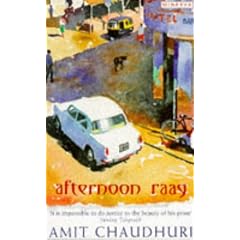
My rating: 3 stars
This second novel by Chaudhuri consists of short vignettes about the narrator's life as a university student at Oxford, intertwined with ones about his middle class family in Bombay and Calcutta. The descriptions of his friends and two girlfriends in Oxford and street life in Bombay are entertaining, but became a bit tiresome in the second half of the book, as I wanted to learn more about these characters and the narrator. This was a quick and mildly enjoyable read, but not a memorable one.
My rating: 3 stars
This second novel by Chaudhuri consists of short vignettes about the narrator's life as a university student at Oxford, intertwined with ones about his middle class family in Bombay and Calcutta. The descriptions of his friends and two girlfriends in Oxford and street life in Bombay are entertaining, but became a bit tiresome in the second half of the book, as I wanted to learn more about these characters and the narrator. This was a quick and mildly enjoyable read, but not a memorable one.
102LisaCurcio
>97 kidzdoc:: Ah, the blessing and the curse of LT. Thanks for the intro to this author. I never would have heard of him had you not posted about Cambridge. I think I will like his works, and I am going to see what I can get at the library when I go on Thursday. Now what am I going to push out of the way?
103QuentinTom
#99 Bob and Doc, have you read Banville's The Untouchable? That is really spectacularly good. Banville writes exquisite prose.
Gift of rain looks excellent. Have you read Timothy Mo? Another excellent Asian/English writer who has somewhat dropped out of the picture, regrettably.
Gift of rain looks excellent. Have you read Timothy Mo? Another excellent Asian/English writer who has somewhat dropped out of the picture, regrettably.
104kidzdoc
Murr, I haven't read anything by John Banville yet. I have his Booker winner The Sea, but I haven't touched it yet. Have you read it? If so, how does it compare to The Untouchable? I have read elsewhere that some think that The Sea is not as good as his other books that were listed for the prize, namely The Book of Evidence and Shroud.
I haven't heard of Timothy Mo! I'm a bit surprised because I see that three of his books, Sour Sweet, An Insular Possession and The Redundancy of Courage have been listed for the Booker Prize in years past, and I am fond of Asian writing (Ishiguro, Ha Jin, Maxine Hong Kingston, Oe, Murakami, & Kobo Abe are amongst my favorite writers). Apparently he hasn't written any novels since 2000, which may explain why I haven't heard about him (2000 was the year that I started reading in earnest). I'll look for these books at City Lights this weekend. Thanks Murr!
I haven't heard of Timothy Mo! I'm a bit surprised because I see that three of his books, Sour Sweet, An Insular Possession and The Redundancy of Courage have been listed for the Booker Prize in years past, and I am fond of Asian writing (Ishiguro, Ha Jin, Maxine Hong Kingston, Oe, Murakami, & Kobo Abe are amongst my favorite writers). Apparently he hasn't written any novels since 2000, which may explain why I haven't heard about him (2000 was the year that I started reading in earnest). I'll look for these books at City Lights this weekend. Thanks Murr!
105QuentinTom
I'm sure you'll find them. They are readily available in most stores I have been in. He publishes them himself now, as he wasn't happy with the whole books industry. He set up his own bijoux publishing house and self publishes. I think he is based in Singapore now, but I might be wrong about that.
His book An Insular Possession is the best book you are likely to read about the founding of Hong Kong. The Redundancy of Courage is a thinly fictionalised account of the people power uprising in the Philippines in the mid 1980s. Sweet and Sour is about the immigrant Cantonese community in London. All excellent reads. I hope you enjoy them as much as I did.
The only Banville I have read is The Untouchable, so I can't comment on his other books except to say the subject of The Sea doesn't appeal to me, which is why I've stayed away from it. I'm more interested in his scientific/historical trilogy: Kepler/Newton/Coppernicus.
When/If I get out of my Russian exile, I am interested in exploring his work further.
His book An Insular Possession is the best book you are likely to read about the founding of Hong Kong. The Redundancy of Courage is a thinly fictionalised account of the people power uprising in the Philippines in the mid 1980s. Sweet and Sour is about the immigrant Cantonese community in London. All excellent reads. I hope you enjoy them as much as I did.
The only Banville I have read is The Untouchable, so I can't comment on his other books except to say the subject of The Sea doesn't appeal to me, which is why I've stayed away from it. I'm more interested in his scientific/historical trilogy: Kepler/Newton/Coppernicus.
When/If I get out of my Russian exile, I am interested in exploring his work further.
107QuentinTom
Dunno, good question. I will investigate this and get back to you.
108kidzdoc
A Concise Chinese—English Dictionary for Lovers by Xiaolu Guo


My rating: 4 stars
This novel was shortlisted for the 2007 Orange Prize for Fiction. Zhuang Xiao Qiao is a 23 year old woman from a small Chinese village, who is ordered by her hardworking parents to study English for a year in London, so that she can use these skills to further the family's business. She is completely on her own, and has to negotiate the bustling city using her concise Chinese-English dictionary, as she does not speak Mandarin fluently. Her narrative is in her broken English, and is both humorous and painful:
I worry I getting lost and nobody in China can find me anymore. How I finding important places including Buckingham Palace, or Big Stupid Clock? I looking everywhere but not seeing big posters of David Beckham, Spicy Girls or President Margaret Thatcher. In China we hanging them everywhere. English person not respect their heroes or what?
She finds a cheap flat in north London, and attends an English language school. The writing in her narrative progressively improves as she becomes more fluent in English. However, she continues to be lonely, as she cannot even communicate with the Cantonese family that lives in her building.
She meets an Englishman who sits next to her at a movie theater, and within a week she moves in with him. He is older, and quite different from her, yet she discovers herself through her love of him and her exposure to Western culture mainly by him.
The author deftly uses Zhuang's words to express her conflicted feelings about the freedoms she experiences in London, with its associated loneliness, in contrast to the sense of family and community but associated lack of freedom and individuality in her Chinese village:
But in the evening, you cook a fish for me. Not cod, not seabass, not any typical English fish. It is
a silver carp. It is like my hometown's fish. It smells of the river nearby our house. I remember I
studied a word before, and I remember how to pronounce this word. No-stal-gia. Eating carp causes my nostalgia.
The wording of the last sentence made me think of "nausea" in addition to "nostalgia", and I had a sense of her psychological nausea, as the relationship begins to fray.
At the end of the year, she is faced with a dilemma: should she stay in London with this man who loves her but cannot guarantee that he will be there for her in the future, or should she return to the mundane security of her home village?
I thought that I would enjoy this novel, but I liked it even more than I had expected. Through Zhuang's narrative we are provided with a somewhat skewed view of her lover's thoughts and desires, which makes it somewhat difficult to sympathize with him. However, this is a minor criticism, and I definitely recommend this novel.


My rating: 4 stars
This novel was shortlisted for the 2007 Orange Prize for Fiction. Zhuang Xiao Qiao is a 23 year old woman from a small Chinese village, who is ordered by her hardworking parents to study English for a year in London, so that she can use these skills to further the family's business. She is completely on her own, and has to negotiate the bustling city using her concise Chinese-English dictionary, as she does not speak Mandarin fluently. Her narrative is in her broken English, and is both humorous and painful:
I worry I getting lost and nobody in China can find me anymore. How I finding important places including Buckingham Palace, or Big Stupid Clock? I looking everywhere but not seeing big posters of David Beckham, Spicy Girls or President Margaret Thatcher. In China we hanging them everywhere. English person not respect their heroes or what?
She finds a cheap flat in north London, and attends an English language school. The writing in her narrative progressively improves as she becomes more fluent in English. However, she continues to be lonely, as she cannot even communicate with the Cantonese family that lives in her building.
She meets an Englishman who sits next to her at a movie theater, and within a week she moves in with him. He is older, and quite different from her, yet she discovers herself through her love of him and her exposure to Western culture mainly by him.
The author deftly uses Zhuang's words to express her conflicted feelings about the freedoms she experiences in London, with its associated loneliness, in contrast to the sense of family and community but associated lack of freedom and individuality in her Chinese village:
But in the evening, you cook a fish for me. Not cod, not seabass, not any typical English fish. It is
a silver carp. It is like my hometown's fish. It smells of the river nearby our house. I remember I
studied a word before, and I remember how to pronounce this word. No-stal-gia. Eating carp causes my nostalgia.
The wording of the last sentence made me think of "nausea" in addition to "nostalgia", and I had a sense of her psychological nausea, as the relationship begins to fray.
At the end of the year, she is faced with a dilemma: should she stay in London with this man who loves her but cannot guarantee that he will be there for her in the future, or should she return to the mundane security of her home village?
I thought that I would enjoy this novel, but I liked it even more than I had expected. Through Zhuang's narrative we are provided with a somewhat skewed view of her lover's thoughts and desires, which makes it somewhat difficult to sympathize with him. However, this is a minor criticism, and I definitely recommend this novel.
109bonniebooks
Your quotes have totally convinced me that I would really enjoy this book. Thanks! Love the Orange Prize logo too. BTW, is there any place on LT where I can learn how to add book cover pictures?
110kidzdoc
Yes, TadAD has a nice set of instructions in message 1 on his Basic HTML topic in the 75ers group. I use Google Images (http://images.google.com) to search for the book cover or image that I want, right click on it in Firefox, select "Copy Image Location", and paste it between the quotation marks in the command (the way that TadAD uses it to create the two stars in message 1 of Basic HTML). If this isn't clear, TadAD or polutropos may be able to help, too.
111QuentinTom
#106 Marsha,
I have done a bit of poking around. It appears Mo does not publish in electronic format. But I did find out that he is now based in Hong Kong, not Singapore.
I have done a bit of poking around. It appears Mo does not publish in electronic format. But I did find out that he is now based in Hong Kong, not Singapore.
112kidzdoc
Breath by Tim Winton

My rating: 3-1/2 stars
Breath, the latest novel by the acclaimed Australian writer, is on the shortlist for this year's Miles Franklin Award, is a coming of age story narrated by a teenaged boy in a small town near the Australian coast, who befriends another boy his age in the town, who shares his love for swimming, and ultimately surfboarding. The two fall under the tutelage of a thirtysomething surfing legend, who lives in a beach house with his attractive but prickly American wife. The first 2/3 of the novel was moderately entertaining and very well-written; however, the last 1/3 degenerated into an unexpected, disturbing and tangential (but still captivating) wreck.
This is a beautifully written book, but one that I cannot wholeheartedly recommend.

My rating: 3-1/2 stars
Breath, the latest novel by the acclaimed Australian writer, is on the shortlist for this year's Miles Franklin Award, is a coming of age story narrated by a teenaged boy in a small town near the Australian coast, who befriends another boy his age in the town, who shares his love for swimming, and ultimately surfboarding. The two fall under the tutelage of a thirtysomething surfing legend, who lives in a beach house with his attractive but prickly American wife. The first 2/3 of the novel was moderately entertaining and very well-written; however, the last 1/3 degenerated into an unexpected, disturbing and tangential (but still captivating) wreck.
This is a beautifully written book, but one that I cannot wholeheartedly recommend.
113Jargoneer
I can second tomcat's recommendation of Timothy Mo. In the late 1980s he was seen as a new major English writer - alongside McEwan, Barnes, Rushdie, Amis, et al. The move to self-publishing, allied to long gaps between novels (5 years is normal, though it has been 9 years since the last one), effectively have seen him disappear from critical consciousness. Sour Sweet is a nice introduction but the really impressive ones come later - An Insular Possession and The Redundancy of Courage, for example.
Despite owning a few later Banville novels I have only read the earlier ones based on the scientists - I enjoyed them, thought they were closer to European novels of ideas than the traditional English/Irish novel.
Despite owning a few later Banville novels I have only read the earlier ones based on the scientists - I enjoyed them, thought they were closer to European novels of ideas than the traditional English/Irish novel.
114kidzdoc
Books v. Cigarettes by George Orwell

My rating: 3-1/2 stars
This collection of essays was published by Penguin UK last year as part of its Great Ideas series. It consists of two long and five short and humorous essays, including the title essay. In "Books v. Cigarettes" he determines that his yearly cost of buying books is less than the amount he spends on cigarettes and alcohol, and argues against those who claimed that the cost of reading was prohibitively expensive for the average working man. Other short essays include a hilarious look at the life of a book reviewer, and his barbaric treatment in a Paris hospital.
The two longer essays make up the majority of the book. "The Prevention of Literature" is a critique of left-wing postwar orthodoxy, which at that time strongly favored Soviet communism and limited intellectual freedom. "Such, Such Were the Joys", which chronicles his experiences in a boarding school in late childhood, comprises over half of the book. His middle class parents are unable to pay full tuition, and he is allowed to attend the school at reduced fees, due to his academic promise and the expectation that he will gain a scholarship to a prestigious private school—or so he claims. He and the other lower tier boys are constantly tortured and belittled by the headmaster, his wife, and the older boys in the school. He has nothing good to say about anyone there, and you can't help but think that it couldn't possibly have been that bad. His experiences at St. Cyprian's appear to be the genesis for his interest in social justice and anti-totalitarianism, as he expounds upon the lessons he learned during that time at the end of the essay.
This would a worthwhile read for anyone interested in Orwell, but it is nowhere near as good as Down and Out in Paris and London.

My rating: 3-1/2 stars
This collection of essays was published by Penguin UK last year as part of its Great Ideas series. It consists of two long and five short and humorous essays, including the title essay. In "Books v. Cigarettes" he determines that his yearly cost of buying books is less than the amount he spends on cigarettes and alcohol, and argues against those who claimed that the cost of reading was prohibitively expensive for the average working man. Other short essays include a hilarious look at the life of a book reviewer, and his barbaric treatment in a Paris hospital.
The two longer essays make up the majority of the book. "The Prevention of Literature" is a critique of left-wing postwar orthodoxy, which at that time strongly favored Soviet communism and limited intellectual freedom. "Such, Such Were the Joys", which chronicles his experiences in a boarding school in late childhood, comprises over half of the book. His middle class parents are unable to pay full tuition, and he is allowed to attend the school at reduced fees, due to his academic promise and the expectation that he will gain a scholarship to a prestigious private school—or so he claims. He and the other lower tier boys are constantly tortured and belittled by the headmaster, his wife, and the older boys in the school. He has nothing good to say about anyone there, and you can't help but think that it couldn't possibly have been that bad. His experiences at St. Cyprian's appear to be the genesis for his interest in social justice and anti-totalitarianism, as he expounds upon the lessons he learned during that time at the end of the essay.
This would a worthwhile read for anyone interested in Orwell, but it is nowhere near as good as Down and Out in Paris and London.
115QuentinTom
WH Auden said that the main reason for his opposition to fascism was that he had experienced it as a child in an English boarding school. Seems like Orwell would have agreed with him.
116SqueakyChu
I should *never* read your book reviews, kidzdoc. After reading them, I *always* want to get those books.
I just love your eclectic collection of books!
*runs off to her wishlist*
I just love your eclectic collection of books!
*runs off to her wishlist*
117RidgewayGirl
While Down and Out in Paris and London is fantastic, it cannot compare with my favorite novel, Keep the Apidistra Flying.
118polutropos
Darryl:
I am just so excited I had to tell you immediately. I just finished watching a TV show (I don't watch TV) on a photographer named Ted Grant and some of his books I think you'd love. Doctors' Work: The Legacy of Sir William Osler is the first, Women in Medicine: A Celebration of Their Work the next. I absolutely loved him and he celebrates doctors, a most worthwhile endeavor.
I am just so excited I had to tell you immediately. I just finished watching a TV show (I don't watch TV) on a photographer named Ted Grant and some of his books I think you'd love. Doctors' Work: The Legacy of Sir William Osler is the first, Women in Medicine: A Celebration of Their Work the next. I absolutely loved him and he celebrates doctors, a most worthwhile endeavor.
119kidzdoc
#117: I hadn't heard of Keep the Apidistra Flying before, but it's on my wish list now. Thanks!
#118: Hi Andrew, thanks for the info about Grant. I'll be on the lookout for these books. Women in Medicine: A Celebration of Their Work will also go on my gift list, to give to my female physician friends.
#118: Hi Andrew, thanks for the info about Grant. I'll be on the lookout for these books. Women in Medicine: A Celebration of Their Work will also go on my gift list, to give to my female physician friends.
120kidzdoc
Rhyming Life and Death by Amos Oz
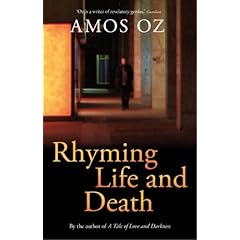
My rating: 4 stars
Rhyming Life and Death is the latest novel by the acclaimed Israeli novelist, public intellectual and peace activist Amos Oz. This was a short novel, and I thought it would be a good introduction to Oz's work.
The events take place on one evening, in which the Author attends a public reading of his latest book. While a literary critic discusses his work and a woman reads from his book, he gazes out onto the audience, and creates stories about several people he see, along with a waitress at a cafe, that appear throughout the book. He also appears to have a relationship with the reader of his book, but there are several distinct episodes, and one is never sure where reality ends and fantasy/fiction begins. It was a moderately interesting and amusing exercise, but it wasn't exactly what I was looking for or expecting.
My rating: 4 stars
Rhyming Life and Death is the latest novel by the acclaimed Israeli novelist, public intellectual and peace activist Amos Oz. This was a short novel, and I thought it would be a good introduction to Oz's work.
The events take place on one evening, in which the Author attends a public reading of his latest book. While a literary critic discusses his work and a woman reads from his book, he gazes out onto the audience, and creates stories about several people he see, along with a waitress at a cafe, that appear throughout the book. He also appears to have a relationship with the reader of his book, but there are several distinct episodes, and one is never sure where reality ends and fantasy/fiction begins. It was a moderately interesting and amusing exercise, but it wasn't exactly what I was looking for or expecting.
121SqueakyChu
Now you've gone and picked a book by one of my favorite authors...so this book has to go onto my wishlist as well... *sigh*
*runs off to add it*
My favorite of Amos Oz's books, and you'd probably really like it as well, is his autobiography, A Tale of Love and Darkness. He grew up in Jerusalem in (pre-Israel) Palestine. In this book, you'll see how his liberal political stance developed through the years of his growing up. One of the things I've always liked about Oz's fiction, and I've read his books over many years, is that his books have always been about more universal topics back in the days when most Israelis were writing about either the Holocaust or the young state of Israel.
*runs off to add it*
My favorite of Amos Oz's books, and you'd probably really like it as well, is his autobiography, A Tale of Love and Darkness. He grew up in Jerusalem in (pre-Israel) Palestine. In this book, you'll see how his liberal political stance developed through the years of his growing up. One of the things I've always liked about Oz's fiction, and I've read his books over many years, is that his books have always been about more universal topics back in the days when most Israelis were writing about either the Holocaust or the young state of Israel.
122kidzdoc
I have A Tale of Love and Darkness, the only other book I have by him, but haven't read it yet; I'll probably read it this summer. I first heard about him when this book came out. Which of his fictional works would you recommend most?
123SqueakyChu
I read them so long ago that I've forgotten the details of most. The novel I did like the best, though, I remember being Black Box because it was a story told through letters (Ha! That was back before email....). I had not read a book before with that type of literary device, and I remember thinking that it was an unusual way to present a story.
124kidzdoc
Murr, I bought The Untouchable at City Lights Bookstore, it looks good. Surprisingly, the store had no books by Timothy Mo (or Amos Oz, SqueakyChu). I'll look for their books at Black Oak Books in Berkeley later this week.
125kidzdoc
I had a request to list the books I bought at City Lights yesterday:
The Posthuman Dada Guide: Tzara and Lenin Play Chess by Andrei Codrescu
The Political Worlds of Slavery and Freedom by Steven Hahn
The Untouchable by John Banville
The King's Rifle by Biyi Bandele
Five Spice Street by Can Xue
Blonde Roots by Bernadine Evaristo
World Ball Notebook by Sesshu Foster
Asian Americans in the Twenty-First Century: Oral Histories of First to Fourth Generation Americans from China, Japan, India, Korea, the Phillipines, Vietnam and Laos by Joann Faung Jean Lee
Voice Over by Céline Curiol
More Than Just Race: Being Black and Poor in the Inner City by William Julius Wilson
City Kid: A Writer's Memoir of Ghetto Life and Post-Soul Success by Nelson George
Flowers of a Moment by Ko Un
The Posthuman Dada Guide: Tzara and Lenin Play Chess by Andrei Codrescu
The Political Worlds of Slavery and Freedom by Steven Hahn
The Untouchable by John Banville
The King's Rifle by Biyi Bandele
Five Spice Street by Can Xue
Blonde Roots by Bernadine Evaristo
World Ball Notebook by Sesshu Foster
Asian Americans in the Twenty-First Century: Oral Histories of First to Fourth Generation Americans from China, Japan, India, Korea, the Phillipines, Vietnam and Laos by Joann Faung Jean Lee
Voice Over by Céline Curiol
More Than Just Race: Being Black and Poor in the Inner City by William Julius Wilson
City Kid: A Writer's Memoir of Ghetto Life and Post-Soul Success by Nelson George
Flowers of a Moment by Ko Un
126QuentinTom
I hope you enjoy the Untouchable! Looking forward to hearing your thoughts on it.
127cwc790411
Wow, a lot of good stuff going on in this thread!
Perhaps a nice complement to A Tale of Love and Darkness would be Once Upon a Country: A Palestinian Life by Sari Nusseibeh. I quite like autobiographies and I took them both out of the library when the latter came out in 2007, but unfortunately only had time for Oz's book, which I quite enjoyed. I've in fact never read his fiction, but would like to. Perhaps the only Israeli novel I've read is A.B. Yehoshua's A Woman in Jerusalem which I thought was great. Anybody want to recommend other novels by Yehoshua or other Israeli novelists?
Also, Kidzdoc please let us know how the book on Asian-Americans turns out. I'm interested in that one. Is it an oral history/Studs Terkel style affair? Speaking of Studs Terkel and immigration, I highly recommend his American Dreams Lost and Found, a powerful work I need to revisit in the future.
I am eager to try reading Banville as I've never had the pleasure. In addition to having The Sea on my bookshelf, I also have a copy of Birchwood which I came across somewhere. Has anybody read it?
I have neither read Keep the Apidistra Flying or Down and Out in Paris and London, but I have always meant too. Perhaps an Orwell theme read is on the horizon. And all of those intriguing essays he wrote as well.
Perhaps a nice complement to A Tale of Love and Darkness would be Once Upon a Country: A Palestinian Life by Sari Nusseibeh. I quite like autobiographies and I took them both out of the library when the latter came out in 2007, but unfortunately only had time for Oz's book, which I quite enjoyed. I've in fact never read his fiction, but would like to. Perhaps the only Israeli novel I've read is A.B. Yehoshua's A Woman in Jerusalem which I thought was great. Anybody want to recommend other novels by Yehoshua or other Israeli novelists?
Also, Kidzdoc please let us know how the book on Asian-Americans turns out. I'm interested in that one. Is it an oral history/Studs Terkel style affair? Speaking of Studs Terkel and immigration, I highly recommend his American Dreams Lost and Found, a powerful work I need to revisit in the future.
I am eager to try reading Banville as I've never had the pleasure. In addition to having The Sea on my bookshelf, I also have a copy of Birchwood which I came across somewhere. Has anybody read it?
I have neither read Keep the Apidistra Flying or Down and Out in Paris and London, but I have always meant too. Perhaps an Orwell theme read is on the horizon. And all of those intriguing essays he wrote as well.
128SqueakyChu
Anybody want to recommend other novels by Yehoshua or other Israeli novelists?
A Late Divorce by A.B. Yehoshua - learning about the parties involved in a man's divorce
Some other books by Israeli novelists I've enjoyed were:
1. Beaufort by Ron Leshem - about a platoon of Israeli soldiers ationed in Lebanon
2. Adjusting Sights by Haim Sabato - story of a man in a tanker division during teh Yom Kippur war
3. The Nimrod Flipout by Etgar Keret - a sampling of some off-the-wall very short stories by the Israeli humorist
4. The Zig Zag Kid by David Grossman - a boy is taken on a bizarre train ride for his bar mitzvah
5. The Blue Mountain by Meir Shalev - a group of Ukrainian immigrants start a kibbutz in Palestine
6. Four Mothers by Shifra Horn - a curse on four generations of women in a family living in Jerusalem
How's that for starters, cwc790411?
A Late Divorce by A.B. Yehoshua - learning about the parties involved in a man's divorce
Some other books by Israeli novelists I've enjoyed were:
1. Beaufort by Ron Leshem - about a platoon of Israeli soldiers ationed in Lebanon
2. Adjusting Sights by Haim Sabato - story of a man in a tanker division during teh Yom Kippur war
3. The Nimrod Flipout by Etgar Keret - a sampling of some off-the-wall very short stories by the Israeli humorist
4. The Zig Zag Kid by David Grossman - a boy is taken on a bizarre train ride for his bar mitzvah
5. The Blue Mountain by Meir Shalev - a group of Ukrainian immigrants start a kibbutz in Palestine
6. Four Mothers by Shifra Horn - a curse on four generations of women in a family living in Jerusalem
How's that for starters, cwc790411?
130kidzdoc
#123: SqueakyChu, I was amazed to learn that City Lights has no books by Oz! I did go to Black Oak Books in Berkeley yesterday, and bought a copy of The Same Sea, which looks interesting. Have you read it?
Other books I bought yesterday:
The Catcher in the Rye: the Author Theme Reads group will be reading Salinger from May to August
Obabakoak by Atxaga: recommended by chrisharpe in the Iberoamerican Prizes thread
The Flying Troutmans by Miriam Toews: longlisted for this year's Orange Prize
The Innocent by Ian McEwan
#127: I read Once Upon a Country: A Palestinian Life a couple of years ago, and thoroughly enjoyed it.
#128: Yehoshua's latest book, Friendly Fire, is on the shortlist for this year's Independent Foreign Fiction Prize; I may pick it up later this week. On deebee's recommendation, I bought Yellow Wind by David Grossman earlier this year; have you read it?
I'm almost finished with Burnt Shadows, which is so far one of the best books I've read this year. It should be available in the US starting today.
Other books I bought yesterday:
The Catcher in the Rye: the Author Theme Reads group will be reading Salinger from May to August
Obabakoak by Atxaga: recommended by chrisharpe in the Iberoamerican Prizes thread
The Flying Troutmans by Miriam Toews: longlisted for this year's Orange Prize
The Innocent by Ian McEwan
#127: I read Once Upon a Country: A Palestinian Life a couple of years ago, and thoroughly enjoyed it.
#128: Yehoshua's latest book, Friendly Fire, is on the shortlist for this year's Independent Foreign Fiction Prize; I may pick it up later this week. On deebee's recommendation, I bought Yellow Wind by David Grossman earlier this year; have you read it?
I'm almost finished with Burnt Shadows, which is so far one of the best books I've read this year. It should be available in the US starting today.
131Fullmoonblue
Kidzdoc, thank you (albeit belatedly) for posting that review of Cambridge! I hadn't heard of it but will definitely watch for a copy now. I've read Phillips' The European Tribe and The Nature of Blood and will be interested in your reaction to the latter if you post about it here. :)
132kidzdoc
Burnt Shadows by Kamila Shamsie

My rating: 5 stars
This epic novel chronicles the lives of four families, starting in Nagasaki in 1945 of the day the second atomic bomb was launched, and ending in post-9/11 North America.
The book's one paragraph prologue actually takes place in a US prison cell in 2002, as an unidentified man is stripped of his clothing, and ordered to put on an orange jumpsuit, in preparation of his transfer to Guantánamo Bay.
Hiroko Tanaka is a young, modern Japanese teacher who is fluent in multiple languages, who lives with her disgraced father in 1945 Nagasaki. She plans to marry Konrad Weiss, a German who has lived there before the start of World War II. In an instant, the world goes white, and her life is irrevocably changed.
She travels to Delhi two years later, to meet Konrad's half-sister Elizabeth and her British husband James Burton. During her stay there, she meets Sajjad Ashraf, a local Muslim who is employed by Burton and who intends to become a lawyer like Burton. He teaches her the Urdu language, and the two become close, despite their different levels of status. Hiroko and Elizabeth become as close as sisters, and as the Burtons make plans to leave India, they assume that Hiroko will travel with them back to London. However, she and Sajjad have different plans.
The families' relationships continue to intersect and intermingle for the remainder of the century, in Pakistan, Afghanistan, and the United States, and tragic events in these two Middle Eastern countries before 9/11 and in the US and Canada afterward both enrich and strain the families' relationships within and toward each other. The ending is stunning, yet almost inevitable in retrospect.
This story has unforgettable characters, and the historical events portrayed in the story are both enlightening and complex, with no simple answers or explanations. Highly recommended!

My rating: 5 stars
This epic novel chronicles the lives of four families, starting in Nagasaki in 1945 of the day the second atomic bomb was launched, and ending in post-9/11 North America.
The book's one paragraph prologue actually takes place in a US prison cell in 2002, as an unidentified man is stripped of his clothing, and ordered to put on an orange jumpsuit, in preparation of his transfer to Guantánamo Bay.
Hiroko Tanaka is a young, modern Japanese teacher who is fluent in multiple languages, who lives with her disgraced father in 1945 Nagasaki. She plans to marry Konrad Weiss, a German who has lived there before the start of World War II. In an instant, the world goes white, and her life is irrevocably changed.
She travels to Delhi two years later, to meet Konrad's half-sister Elizabeth and her British husband James Burton. During her stay there, she meets Sajjad Ashraf, a local Muslim who is employed by Burton and who intends to become a lawyer like Burton. He teaches her the Urdu language, and the two become close, despite their different levels of status. Hiroko and Elizabeth become as close as sisters, and as the Burtons make plans to leave India, they assume that Hiroko will travel with them back to London. However, she and Sajjad have different plans.
The families' relationships continue to intersect and intermingle for the remainder of the century, in Pakistan, Afghanistan, and the United States, and tragic events in these two Middle Eastern countries before 9/11 and in the US and Canada afterward both enrich and strain the families' relationships within and toward each other. The ending is stunning, yet almost inevitable in retrospect.
This story has unforgettable characters, and the historical events portrayed in the story are both enlightening and complex, with no simple answers or explanations. Highly recommended!
133SqueakyChu
It's hard to get a wide variety of Israeli novels in the United States. Only the most popular Israeli authors are usually stocked in either large chains or Jewish book stores (or at Jewish book fairs). It seems to me that Europe has a much larger selection of Israeli novels than can be found in the United States.
I have a great local library that lets me put the newest Israeli novels on order. I recently read Friendly Fire: A Duet by A.B. Yehoshua as soon as it was released - thanks to my library. My review is here.
I have not yet read David Grossman's The Yellow Wind. David Grossman is one of Israel's most popular contemporary authors. Some of his work is too "over my head" (for example, See: Under Love), but others are wonderful to read. David Grossman is known as being a very liberal peacenik. He sadly lost one of his two sons, (Yonatan, at the age of 20) during the 2006 Israel-Lebanon conflict. If you read his books, it would be worthwhile also reading about the author. Come to think of it, it's always interesting to read about the authors of any book we read!!
Indeed I have read The Same Sea and posted a review of it here on LT back in 2007!! I think you'll like it. It's written in a different style than your usual run-of-the-mill novel. I'd love for *everyone* to read at least a few novels by Israeli authors.
I have a great local library that lets me put the newest Israeli novels on order. I recently read Friendly Fire: A Duet by A.B. Yehoshua as soon as it was released - thanks to my library. My review is here.
I have not yet read David Grossman's The Yellow Wind. David Grossman is one of Israel's most popular contemporary authors. Some of his work is too "over my head" (for example, See: Under Love), but others are wonderful to read. David Grossman is known as being a very liberal peacenik. He sadly lost one of his two sons, (Yonatan, at the age of 20) during the 2006 Israel-Lebanon conflict. If you read his books, it would be worthwhile also reading about the author. Come to think of it, it's always interesting to read about the authors of any book we read!!
Indeed I have read The Same Sea and posted a review of it here on LT back in 2007!! I think you'll like it. It's written in a different style than your usual run-of-the-mill novel. I'd love for *everyone* to read at least a few novels by Israeli authors.
134cwc790411
Ugh, I wrote a response and lost it to a "LibraryThing down" message last night.
#128 & #133 SqueakyChu thanks for your recommendations about Israeli novels - I am definitely intrigued and would love to read more. Funny you mention them being difficult to get in the U.S. - I'm in Japan, where from my vantage point, the U.S. is a paradise of books in English, particularly in translation. (I find that while I can indeed get books in English here, but those in translation are far less common for whatever reason.) So I might not be able to enjoy those books in the immediate future, but I have indeed noted them. Thanks!
#128 & #133 SqueakyChu thanks for your recommendations about Israeli novels - I am definitely intrigued and would love to read more. Funny you mention them being difficult to get in the U.S. - I'm in Japan, where from my vantage point, the U.S. is a paradise of books in English, particularly in translation. (I find that while I can indeed get books in English here, but those in translation are far less common for whatever reason.) So I might not be able to enjoy those books in the immediate future, but I have indeed noted them. Thanks!
135kidzdoc
World Ball Notebook by Sesshu Foster

My rating: 4-1/2 stars
Sesshu Foster is a Chicano poet, novelist and teacher from East L.A., who has also taught at UC Santa Cruz and the University of Iowa. World Ball Notebook is an eclectic collection of prose and more traditional poems, brief essays, and even shopping and check lists, describing real and imagined lives in and around L.A., Central America and the Midwest. The entries are divided into soccer games, starting with a tribute to his daughter's soccer coach. Although most of the other entries are not about soccer, one gets the feel of a soccer match, with long runs punctuated by crisp passes and brief, intense, and sometimes violent bursts of action.
"Game 14" describes a girls' soccer game:
The forwards pass off to each other and take shots on goal, but there's only one of them getting through–no recoveries and no goals. A couple shots go wide, a couple hit the bars and bounce off. You watch the keeper trot after the ball out of bounds, thinking, "That's probably the game, right there." That bounce. Both teams are tiring, the faces of girls flushed and drawn in the lights. The night is cool but not cold enough to see anyone's breath. Beyond the ragged eucalyptus trees the mountains a ragged silhouette against the deep blue of nightfall. The other team sinks a penalty shot, and afterwards most of the play happens on the wrong end of the field. Our girl played midfield hard the whole game, defense. She doesn't like to lose, this girl, but you figure she'll be okay with it. This team has lost more than they're likely to win.
"Game 67" describes an interaction between an adult and a troubled Vietnamese teenager:
"Don't ever do anything like that again," I said. I noted the cast on one foot, otherwise not a single visible scar; she smiled pretty as ever, the girl who'd thrown herself drunk off the overpass onto the 605 freeway, Vietnamita with black hair she tucked behind her ear with a nervous chuckle. ("My father didn't want me to have a boyfriend." "How are you getting along with your father now?" "Better.") ("That girl's getting a reputation," somebody a lot like her would later say.)
The author will be giving a reading at City Lights Books tomorrow, which I plan to attend.

My rating: 4-1/2 stars
Sesshu Foster is a Chicano poet, novelist and teacher from East L.A., who has also taught at UC Santa Cruz and the University of Iowa. World Ball Notebook is an eclectic collection of prose and more traditional poems, brief essays, and even shopping and check lists, describing real and imagined lives in and around L.A., Central America and the Midwest. The entries are divided into soccer games, starting with a tribute to his daughter's soccer coach. Although most of the other entries are not about soccer, one gets the feel of a soccer match, with long runs punctuated by crisp passes and brief, intense, and sometimes violent bursts of action.
"Game 14" describes a girls' soccer game:
The forwards pass off to each other and take shots on goal, but there's only one of them getting through–no recoveries and no goals. A couple shots go wide, a couple hit the bars and bounce off. You watch the keeper trot after the ball out of bounds, thinking, "That's probably the game, right there." That bounce. Both teams are tiring, the faces of girls flushed and drawn in the lights. The night is cool but not cold enough to see anyone's breath. Beyond the ragged eucalyptus trees the mountains a ragged silhouette against the deep blue of nightfall. The other team sinks a penalty shot, and afterwards most of the play happens on the wrong end of the field. Our girl played midfield hard the whole game, defense. She doesn't like to lose, this girl, but you figure she'll be okay with it. This team has lost more than they're likely to win.
"Game 67" describes an interaction between an adult and a troubled Vietnamese teenager:
"Don't ever do anything like that again," I said. I noted the cast on one foot, otherwise not a single visible scar; she smiled pretty as ever, the girl who'd thrown herself drunk off the overpass onto the 605 freeway, Vietnamita with black hair she tucked behind her ear with a nervous chuckle. ("My father didn't want me to have a boyfriend." "How are you getting along with your father now?" "Better.") ("That girl's getting a reputation," somebody a lot like her would later say.)
The author will be giving a reading at City Lights Books tomorrow, which I plan to attend.
136Jargoneer
>135 kidzdoc: - coming from the UK where football is the major sport I can honestly say that the quote from Game 14 is hilarious - what is he talking about? If you going to write about football you should at least learn the correct language.
137avaland
Always interesting to hear about what you are reading, Darryl. And it sounds like you are enjoying your stay in San Francisco.
138avatiakh
Hi Darryl - I'm jumping over from the 75 book challenge to post here -
Regarding Israeli novels I think squeakyChu has covered the field pretty well. I've just finished Amos Oz's Black Box tonight and found it to be a beautifully descriptive novel reflecting on lost love but also a political statement. The book is set in the 1970s.
For a more immediate and contemporary novel I strongly recommend Beaufort by Ron Leshem which I've also just read - this covers the final year of the Israeli occupation of Lebanon and follows the experiences of a squad of IDF soldiers.
Shifra Horn is also a favourite writer of mine, Ode to Joy was her last book.
I'll be reading the Oxford Book of Hebrew Short Stories later this year to find out who else I should be reading.
Regarding Israeli novels I think squeakyChu has covered the field pretty well. I've just finished Amos Oz's Black Box tonight and found it to be a beautifully descriptive novel reflecting on lost love but also a political statement. The book is set in the 1970s.
For a more immediate and contemporary novel I strongly recommend Beaufort by Ron Leshem which I've also just read - this covers the final year of the Israeli occupation of Lebanon and follows the experiences of a squad of IDF soldiers.
Shifra Horn is also a favourite writer of mine, Ode to Joy was her last book.
I'll be reading the Oxford Book of Hebrew Short Stories later this year to find out who else I should be reading.
139LisaCurcio
>132 kidzdoc:, re: Burnt ShadowsYour review of this book is affecting--it is going to the top of my wishlist!
140kidzdoc
#139: Thanks, Lisa. However, my review is intentionally a bit vague, as I didn't want to give away too much information about the book.
141SqueakyChu
I know why you couldn't find Amos Oz in City Lights. Oz is a very popular mainstream author, and City Lights probably only goes for the "cutting edge" of literature.
You'll like this. In honor of your trip to City Lights, I've decided to read a book by Charles Bukowski. My first! You can't imagine how hard it is to find his books second hand. No one wants to part with them. The book I've started tonight is Post Office.
Have you read any of Bukowski's novels or poetry?
You'll like this. In honor of your trip to City Lights, I've decided to read a book by Charles Bukowski. My first! You can't imagine how hard it is to find his books second hand. No one wants to part with them. The book I've started tonight is Post Office.
Have you read any of Bukowski's novels or poetry?
142kidzdoc
#141: Hmm...I definitely agree that City Lights shies away from mainstream or popular US authors, for the most part, and you certainly won't find anything by conservative or right-wing authors there. It does, of course, have comprehensive selections of Beat poetry & literature, a good selection of local authors, and extensive sections of European literature, poetry (to which the entire upstairs section is dedicated), and world literature (which comprises almost all of one section). American literature is relatively underrepresented, except for local authors. However, I'm not sure that I would categorize Oz as being a popular mainstream author, especially in comparison to Ishiguro, Murakami, Bolaño, Gabriel García Márquez or McEwan. So, I remain surprised that at least a couple of his books weren't available. It could be that I wasn't looking in the proper section, but I would have thought that Rhyming Life and Death would have been displayed with the new works of fiction, as Friendly Fire by Yehoshua was. (Hmm...touchstones must be sleeping.)
I have Run With the Hunted: A Charles Bukowski Reader, but I haven't read it (or anything else by him) yet. I'm curious to know what you—and anyone else—think of his writing.
I'm halfway through The Invention of Everything Else by Samantha Hunt, which is very good so far. I hope to finish it tomorrow.
The San Francisco International Film Festival is underway, and I have a ticket for the new Ferlinghetti documentary, which premiered yesterday.
#138: Thanks, avatiakh; I'll be on the lookout for the books you suggested.
#137: I could go on and on for hours about how much I love SF, it's such a unique place. For example, yesterday afternoon, while riding the light rail (MUNI Metro), I sat near a dozen or more Chinese or Korean kindergartners, who spontaneously started singing nursery rhymes in Mandarin or Korean. They were too cute for words! Where else in the US would you see that?
I have Run With the Hunted: A Charles Bukowski Reader, but I haven't read it (or anything else by him) yet. I'm curious to know what you—and anyone else—think of his writing.
I'm halfway through The Invention of Everything Else by Samantha Hunt, which is very good so far. I hope to finish it tomorrow.
The San Francisco International Film Festival is underway, and I have a ticket for the new Ferlinghetti documentary, which premiered yesterday.
#138: Thanks, avatiakh; I'll be on the lookout for the books you suggested.
#137: I could go on and on for hours about how much I love SF, it's such a unique place. For example, yesterday afternoon, while riding the light rail (MUNI Metro), I sat near a dozen or more Chinese or Korean kindergartners, who spontaneously started singing nursery rhymes in Mandarin or Korean. They were too cute for words! Where else in the US would you see that?
143LisaCurcio
>140 kidzdoc:. I suppose it was vague as to plot details, but it was quite well written to make one want to read the book. If the book gives the same "feeling" as your review, it must be quite good.
144kidzdoc
#143: Great. Thanks for your comment, Lisa. That's what I was hoping to accomplish by my review, provide enough information to make the book seem interesting, without giving away the surprises in the story.
145polutropos
Darryl,
you have so many fans it is almost pointless to compliment you :-) but once again I must say your thread is always a highlight of the LT experience.
#130 Miriam Toews. Her A Complicated Kindness is one of my favourite books of the last five years and I have given it to many friends. I was going to see her at a reading in ten days, and then it turns out that I have to help my daughter move that day (Real Life rearing its ugly head again) and I will miss the Troutmans reading.
#141 Bukowski. I picked up some time ago a CD of Bukowski doing readings of his poetry, drunk in a pub somewhere. Hilarious, illuminating, thrilling because of the immediacy. A real experience. If anyone is interested, once I get home I can have a look at the CD and post the exact particulars.
you have so many fans it is almost pointless to compliment you :-) but once again I must say your thread is always a highlight of the LT experience.
#130 Miriam Toews. Her A Complicated Kindness is one of my favourite books of the last five years and I have given it to many friends. I was going to see her at a reading in ten days, and then it turns out that I have to help my daughter move that day (Real Life rearing its ugly head again) and I will miss the Troutmans reading.
#141 Bukowski. I picked up some time ago a CD of Bukowski doing readings of his poetry, drunk in a pub somewhere. Hilarious, illuminating, thrilling because of the immediacy. A real experience. If anyone is interested, once I get home I can have a look at the CD and post the exact particulars.
146SqueakyChu
--> 142
However, I'm not sure that I would categorize Oz as being a popular mainstream author
Amos Oz is not mainstream among Americans who do not read Israeli authors. He certainly is mainstream among Israelis or Jews. More people have heard of him than have heard of A.B. Yehoshua, for example. Oz is well enough known that he has been considered in recent years as a candidate to receive the Nobel Prize in Literature.
It's a good thing I'm not in City Lights. The online catalog of their books is so tantalizing, and the last thing I need is more books!
I just started reading Bukowski's Post Office last night and love it. I'm a big fan of most of Richard Brautigan's writing (although I recently tried to read Trout Fishing in America and gave up half way through), and find Bukowski's writing a bit similar to Brautigan. The book I'm reading is ribald and funny. I'll be finished it in no time and will definitely look for more of Bukowski's books. Some excerpts of his poetry I've read elsewhere really appeal to me as well.
However, I'm not sure that I would categorize Oz as being a popular mainstream author
Amos Oz is not mainstream among Americans who do not read Israeli authors. He certainly is mainstream among Israelis or Jews. More people have heard of him than have heard of A.B. Yehoshua, for example. Oz is well enough known that he has been considered in recent years as a candidate to receive the Nobel Prize in Literature.
It's a good thing I'm not in City Lights. The online catalog of their books is so tantalizing, and the last thing I need is more books!
I just started reading Bukowski's Post Office last night and love it. I'm a big fan of most of Richard Brautigan's writing (although I recently tried to read Trout Fishing in America and gave up half way through), and find Bukowski's writing a bit similar to Brautigan. The book I'm reading is ribald and funny. I'll be finished it in no time and will definitely look for more of Bukowski's books. Some excerpts of his poetry I've read elsewhere really appeal to me as well.
147bobmcconnaughey
late as per usual, but just wanted to recommend the liberated bride, a relatively recent novel of Yehoshua's which was engrossing on multiple levels. Seemingly simple stories of love and disenchantment in Israeli academia send shoots throughout Israeli and Palestinian society/culture.
An elderly "Orientalist" specializing in old Arabic poetry becomes entangled in the love and learning lives of students. I said recent - but not recent enough in some sense. Written before the most recent scourge of Israeli/Palestinian conflicts, one of the most poignant subplots, which has Prof. Rivlin traveling to Ramallah for the wedding party of one of his grad students, would likely be unlikely in today's middle east (though please correct me if my ad hoc impression is wrong). A gentle and profound book. I wish i had the copy from our town library, so i could include a snippet or two of the (multi) translated poetry from the middle ages of the Caliphate. The novel was written in Hebrew and I read the English translation (which has had its critics).
An elderly "Orientalist" specializing in old Arabic poetry becomes entangled in the love and learning lives of students. I said recent - but not recent enough in some sense. Written before the most recent scourge of Israeli/Palestinian conflicts, one of the most poignant subplots, which has Prof. Rivlin traveling to Ramallah for the wedding party of one of his grad students, would likely be unlikely in today's middle east (though please correct me if my ad hoc impression is wrong). A gentle and profound book. I wish i had the copy from our town library, so i could include a snippet or two of the (multi) translated poetry from the middle ages of the Caliphate. The novel was written in Hebrew and I read the English translation (which has had its critics).
148kidzdoc
#147: Thanks for the recommendation, Bob; I've added this one to my wish list.
#146: SqueakyChu, that makes sense, that Oz is not well known among Americans who do not read Israeli authors; I plan to remove myself from that category in the very near future!
I stand corrected, as there were at least four novels by Oz, along with The Amos Oz Reader, on display at City Lights; however, the novels were displayed in the European Literature section, and I was looking for his works in the World Literature section. Black Box was not on the shelf, and since I already bought The Same Sea earlier this week—and since my arms were already loaded down with the 11 books (and copy of Granta 104) that I bought, I didn't buy any of them. As usual, most of the books I bought were new to me, but sounded very interesting (this never happens at any other book store I go to).
City Lights' online catalog is good, but it does not accurately reflect what it is in the store. For example, yesterday I searched for any of Oz's books, but none were listed.
You've convinced me to give Bukowski a try; I'll start with the book I already have.
#145: Andrew, your daughter should be grateful beyond words for the incredible sacrifice that you're making for her! I'd love to hear about the Bukowski CD; actually, I'll look for it on iTunes now.
Today's "only in San Francisco" moment: as I was exiting the Civic Center MUNI station, I and the other passengers were serenaded by a tall, beautiful young Japanese woman with long flowing hair, playing Elvis Presley's "Love Me Tender" on a harp, while singing the lyrics in Japanese.
#146: SqueakyChu, that makes sense, that Oz is not well known among Americans who do not read Israeli authors; I plan to remove myself from that category in the very near future!
I stand corrected, as there were at least four novels by Oz, along with The Amos Oz Reader, on display at City Lights; however, the novels were displayed in the European Literature section, and I was looking for his works in the World Literature section. Black Box was not on the shelf, and since I already bought The Same Sea earlier this week—and since my arms were already loaded down with the 11 books (and copy of Granta 104) that I bought, I didn't buy any of them. As usual, most of the books I bought were new to me, but sounded very interesting (this never happens at any other book store I go to).
City Lights' online catalog is good, but it does not accurately reflect what it is in the store. For example, yesterday I searched for any of Oz's books, but none were listed.
You've convinced me to give Bukowski a try; I'll start with the book I already have.
#145: Andrew, your daughter should be grateful beyond words for the incredible sacrifice that you're making for her! I'd love to hear about the Bukowski CD; actually, I'll look for it on iTunes now.
Today's "only in San Francisco" moment: as I was exiting the Civic Center MUNI station, I and the other passengers were serenaded by a tall, beautiful young Japanese woman with long flowing hair, playing Elvis Presley's "Love Me Tender" on a harp, while singing the lyrics in Japanese.
149kidzdoc
iTunes has three spoken word CDs by Bukowski: 70 Minutes in Hell from 1969 (sober), Solid Citizen (Live in Hamburg 1978) (sober-->drunk) and King of Poets from 1970 in New Orleans, which features a doctored image of the Budweiser beer label on the cover (drunk-->beyond drunk). Are any of these the one that you have, Andrew?
150polutropos
The one I have, Darryl, is Solid Citizen.
Highly entertaining.
Highly entertaining.
152SqueakyChu
--> 142
I have Run With the Hunted: A Charles Bukowski Reader, but I haven't read it (or anything else by him) yet. I'm curious to know what you—and anyone else—
think of his writing.
I'm about half way through Bukowski's Post Office now. It' funny, but not overwhelmingly so. I think the fun of reading this book is because of Bukowski's name over a long period of time as a beat writer. He was born in 1920, started writing at age 24, and died in 1994. The contents of this book seem kind of dated, although certainly not the feelings about what it might be like to work in the post office if one is averse to standard work norms (which I always have been!). Post Office was published in 1971. What might have been a tad offensive then is standard reading material now. I think this book is fun to read, though. I'm enjoying it because it's a chance to read a beat author I missed back in the 60's and 70's, so I'm happy. :)
I have Run With the Hunted: A Charles Bukowski Reader, but I haven't read it (or anything else by him) yet. I'm curious to know what you—and anyone else—
think of his writing.
I'm about half way through Bukowski's Post Office now. It' funny, but not overwhelmingly so. I think the fun of reading this book is because of Bukowski's name over a long period of time as a beat writer. He was born in 1920, started writing at age 24, and died in 1994. The contents of this book seem kind of dated, although certainly not the feelings about what it might be like to work in the post office if one is averse to standard work norms (which I always have been!). Post Office was published in 1971. What might have been a tad offensive then is standard reading material now. I think this book is fun to read, though. I'm enjoying it because it's a chance to read a beat author I missed back in the 60's and 70's, so I'm happy. :)
153urania1
>106 urania1: Rover,
My name is not Marsha. How could you!
kizdoc, I don't share your enthusiasm for Burnt Shadows. It struck me as one of those "predictable" "sweeping epics," over which critics swoon, but strike me as much ado about nothing. I purchased it at my local purveyor of books on their strong recommendation. While I love them dearly, they still have not figured out my taste in books. I started and finished Burnt Shadows yesterday because I was stuck in town with nothing much to do. The book bored me so badly, I eventually had to purchase ice cream to get me through to the end. So many calories, so much time wasted. I am glad you enjoyed the book. If anyone wants my copy, let me know.
My name is not Marsha. How could you!
kizdoc, I don't share your enthusiasm for Burnt Shadows. It struck me as one of those "predictable" "sweeping epics," over which critics swoon, but strike me as much ado about nothing. I purchased it at my local purveyor of books on their strong recommendation. While I love them dearly, they still have not figured out my taste in books. I started and finished Burnt Shadows yesterday because I was stuck in town with nothing much to do. The book bored me so badly, I eventually had to purchase ice cream to get me through to the end. So many calories, so much time wasted. I am glad you enjoyed the book. If anyone wants my copy, let me know.
154QuentinTom
Marsha is a Russian diminutive of Mary, Marenka.
If anyone calls me Rover, I shall bark.
If anyone calls me Rover, I shall bark.
155kidzdoc
#153: Urania, sorry to hear that you didn't like it. I guess I'm one of those that likes epic stories that are (IMO) told well (e.g., A House for Mr. Biswas, Midnight's Children, A Sea of Poppies).
156kidzdoc
The Invention of Everything Else by Samantha Hunt


My rating: 4 stars
Louisa is a dreamy young woman who works as a chambermaid at The Hotel New Yorker during World War II. She frequently goes through her guests' personal belongings, to learn more about them and to create fantasies of their lives for her own entertainment. One day one of her colleagues calls out sick, and she is reassigned to the 33rd and 34th floors of the hotel. She soon discovers that the occupant of Room 3327 is the famous but aged inventor Nicola Tesla, who has lived in the hotel for years despite being destitute and in arrears on his rent for several months. While cleaning his room the next day, she is caught by him as she is reading a manuscript of his life. The two strike up a friendship, due to their shared love of pigeons and to Louisa's interest in his life and his inventions.
She has a chance encounter on the subway with a high school classmate, and their mutual love of homing pigeons and science fantasy lead to a love affair. Her father, whose wife died many years in the past, re-encounters his best friend, who invites him to a radio science program where he will discuss his new invention, which will change all of their lives. At the same time, Louisa learns that Tesla is also working on a grand project, which he hopes will win him the acclaim that he did not receive in the past.
Many of the events in this extensively researched and well told novel are based on real details of Tesla's life. It is also on the shortlist for the 2009 Orange Prize for Fiction. It was a very enjoyable and worthwhile read overall, although I found it to be overly detailed in some sections.


My rating: 4 stars
Louisa is a dreamy young woman who works as a chambermaid at The Hotel New Yorker during World War II. She frequently goes through her guests' personal belongings, to learn more about them and to create fantasies of their lives for her own entertainment. One day one of her colleagues calls out sick, and she is reassigned to the 33rd and 34th floors of the hotel. She soon discovers that the occupant of Room 3327 is the famous but aged inventor Nicola Tesla, who has lived in the hotel for years despite being destitute and in arrears on his rent for several months. While cleaning his room the next day, she is caught by him as she is reading a manuscript of his life. The two strike up a friendship, due to their shared love of pigeons and to Louisa's interest in his life and his inventions.
She has a chance encounter on the subway with a high school classmate, and their mutual love of homing pigeons and science fantasy lead to a love affair. Her father, whose wife died many years in the past, re-encounters his best friend, who invites him to a radio science program where he will discuss his new invention, which will change all of their lives. At the same time, Louisa learns that Tesla is also working on a grand project, which he hopes will win him the acclaim that he did not receive in the past.
Many of the events in this extensively researched and well told novel are based on real details of Tesla's life. It is also on the shortlist for the 2009 Orange Prize for Fiction. It was a very enjoyable and worthwhile read overall, although I found it to be overly detailed in some sections.
157kidzdoc
Unlucky Lucky Days by Daniel Grandbois
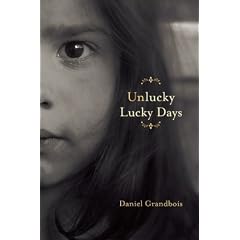
My rating: 2 stars
Unlucky Lucky Days is a collection of very short stories, described on the cover as "Dr. Seuss for adults". The 73 stories range in length from a paragraph to two pages long, and are in the fantastic or surrealistic realm. However, they are nowhere near as enjoyable as those written by Italo Calvino or Julio Cortázar.
One of the better stories is "Counter-Puncher":
He was a natural counter-puncher, so it was a shame nobody would attack. Tired of waiting, his fists turned on him. He countered with his feet, but his eyes were with his hands. They helped his hands find his face and land with precision. That is, until the blows swelled them shut. After that, his hands moved in the same darkness as his feet and every other part of him.
But soon he saw that he could feel what he could no longer see. He felt his fists, measuring them out. He felt the presence of others, including his dead mother and the cat in her lap. He felt the slipping of his once tight grip. Then, he felt a blow he could never have seen coming and saw pinholes of light, as if through a mask.
Some of the stories were mildly interesting, but most were just weird and abstruse to me.
My rating: 2 stars
Unlucky Lucky Days is a collection of very short stories, described on the cover as "Dr. Seuss for adults". The 73 stories range in length from a paragraph to two pages long, and are in the fantastic or surrealistic realm. However, they are nowhere near as enjoyable as those written by Italo Calvino or Julio Cortázar.
One of the better stories is "Counter-Puncher":
He was a natural counter-puncher, so it was a shame nobody would attack. Tired of waiting, his fists turned on him. He countered with his feet, but his eyes were with his hands. They helped his hands find his face and land with precision. That is, until the blows swelled them shut. After that, his hands moved in the same darkness as his feet and every other part of him.
But soon he saw that he could feel what he could no longer see. He felt his fists, measuring them out. He felt the presence of others, including his dead mother and the cat in her lap. He felt the slipping of his once tight grip. Then, he felt a blow he could never have seen coming and saw pinholes of light, as if through a mask.
Some of the stories were mildly interesting, but most were just weird and abstruse to me.
158kidzdoc
Five Spice Street by Can Xue

My rating: 1-1/2 stars
Five Spice Street is the first full-length novel translated into English by the acclaimed Chinese author Can Xue, who is described as "the only woman associated with the male-dominated avant-garde school that emerged in China around 1985 and includes such authors as Mo Yan, Yu Hua, and Su Tong."
Madame X is a mysterious woman on Five Spice Street, who appears to have supernatural powers, and is the object of desire of every man on the street. Some say she is 22 years old, but her best friend, a widow who others compare to her, claims that she is 50. Madame X has an affair with a Mr. Q, who is mysterious in his own right and both loved and reviled by the women on the street.
I stopped reading this after 75 pages. In the first 10-15 pages, various people in the village speculate on Madame X's true age, which became tiresome, and the next 50-60 pages describe Madame X's and the widow's sexual appeal to men, which was repetitive and painful. I did manage to suppress the urge to throw the book out of the streetcar window this afternoon, but only because it was raining and I didn't want to open the window.

My rating: 1-1/2 stars
Five Spice Street is the first full-length novel translated into English by the acclaimed Chinese author Can Xue, who is described as "the only woman associated with the male-dominated avant-garde school that emerged in China around 1985 and includes such authors as Mo Yan, Yu Hua, and Su Tong."
Madame X is a mysterious woman on Five Spice Street, who appears to have supernatural powers, and is the object of desire of every man on the street. Some say she is 22 years old, but her best friend, a widow who others compare to her, claims that she is 50. Madame X has an affair with a Mr. Q, who is mysterious in his own right and both loved and reviled by the women on the street.
I stopped reading this after 75 pages. In the first 10-15 pages, various people in the village speculate on Madame X's true age, which became tiresome, and the next 50-60 pages describe Madame X's and the widow's sexual appeal to men, which was repetitive and painful. I did manage to suppress the urge to throw the book out of the streetcar window this afternoon, but only because it was raining and I didn't want to open the window.
159QuentinTom
lol
160avaland
>142 kidzdoc: City Lights sounds like a divine bookstore.
161kidzdoc
The Mighty Angel by Jerzy Pilch

My rating:
Jerzy Pilch is one of the most important contemporary Polish authors and journalists. The Mighty Angel was published in 2000, and won the NIKE Literary Award the following year. It was translated into English and published by Open Letter Books last month.
Jerzy was a moderately successful writer, until his life became consumed by alcoholism. He has been admitted to the alco ward of his local hospital 18 times. There he is detoxified and pumped full of vitamins and nutrients, under the care of the unstable Dr. Granada, and is given harsh therapy by Moses Alias I Alcohol ("if you do not quiet yourselves, I, alcohol, will destroy you"). However, each time he is released, he immediately goes to his favorite bar, The Mighty Angel, to see who is still there and what has happened since his internment, and he resumes his habit.
Jerzy writes about several characters who are also "frequent fliers" in the alco ward, which becomes their preferred residence. They give each other hilarious nicknames, such as The Most Wanted Terrorist in the World, the Hero of Socialist Labor, and Don Juan the Rib. Their stories are both funny and tragic, with hilarious experiences and lost love. However, their individual spirit and love of life, along with the group's support, allow each of them to go on.
This novel was very good, but I didn't enjoy it as much as I expected to, ergo the mediocre rating.

My rating:

Jerzy Pilch is one of the most important contemporary Polish authors and journalists. The Mighty Angel was published in 2000, and won the NIKE Literary Award the following year. It was translated into English and published by Open Letter Books last month.
Jerzy was a moderately successful writer, until his life became consumed by alcoholism. He has been admitted to the alco ward of his local hospital 18 times. There he is detoxified and pumped full of vitamins and nutrients, under the care of the unstable Dr. Granada, and is given harsh therapy by Moses Alias I Alcohol ("if you do not quiet yourselves, I, alcohol, will destroy you"). However, each time he is released, he immediately goes to his favorite bar, The Mighty Angel, to see who is still there and what has happened since his internment, and he resumes his habit.
Jerzy writes about several characters who are also "frequent fliers" in the alco ward, which becomes their preferred residence. They give each other hilarious nicknames, such as The Most Wanted Terrorist in the World, the Hero of Socialist Labor, and Don Juan the Rib. Their stories are both funny and tragic, with hilarious experiences and lost love. However, their individual spirit and love of life, along with the group's support, allow each of them to go on.
This novel was very good, but I didn't enjoy it as much as I expected to, ergo the mediocre rating.
162kidzdoc
#160: City Lights is divine. Whenever I go, I bring a list of books I'm looking for, but invariably I start picking up books that look interesting, and then stop when my arms are full (about a dozen books), which doesn't take very long. One of the booksellers that works there during the day has come to know me pretty well, as we will briefly chat about books, jazz and the arts whenever I visit. Every so often, he will recommend a book that he's read or one that has just come in that he thinks I'll find interesting, and this time was no exception. It is also a local landmark, as the bookstore was the first business to be designated as a historic landmark by the city of SF, and bus tours frequenly point out the bookstore, and the Vesuvio Cafe, a famous beatnik hangout which is right next door.
163urania1
I loved The Invention of Everything Else. Tesla is one of those fascinating and mysterious people about whom all sorts of conspiracy theories and tales of time travel revolve. I just downloaded a free mobi text from Feedbooks.com (a wonderful site for Kindle owners and others), written by George Sylvester Viereck - a friend of Tesla's in the 1920's. Tesla believed Viereck was "the greatest contemporary American poet." Not having read any of Viereck's poetry, indeed not having heard of Viereck until recently, I cannot say if Tesla's praise had any substance. Viereck, himself, was a pretty shady character. A Nazi sympathizer imprisoned from 1942-47 for writing Nazi propaganda, Viereck wrote Men into Beasts about his prison experiences. The book was scandalous for the time as it dealt with "situational homosexuality" and male rape in the prisons. I downloaded Viereck's The House of the Vampire described as "one of the first known gay vampire novels." And I see I have wandered waaay off topic.
P.S. I don't dislike sweeping epics. However, I usually refuse to buy a book if the phrase "sweeping epic" or "epic grandeur" appears on the cover.
P.S. I don't dislike sweeping epics. However, I usually refuse to buy a book if the phrase "sweeping epic" or "epic grandeur" appears on the cover.
164kidzdoc
#163: Rats! I was hoping you'd find a way to link gay vampires back to Tesla, or Samantha Hunt.
Hmm...yeah, normally I would avoid books that display those phrases, too, or New York Times or USA Today bestsellers.
Most Sundays I look at the NYT fiction and nonfiction bestseller lists in the Sunday Book Review, to see how many books I have, and how many I plan to buy. It's becoming more and more unlikely that there will be more than one or two books on either list. Let's see about this week...0/16 for the fiction list, and 0/16 for the nonfiction list!
I made one last(?) trip to City Lights tonight, and bought a copy of Brooklyn by Colm Tóibín, two days before its scheduled release (yay!). I also bought Sag Harbor by Colson Whitehead, A Comrade Lost and Found by Jan Wong, which was favorably reviewed in The Guardian several weeks ago, and, to my great surprise and delight, the UK edition of C.L.R. James; Cricket's Philosopher King by Dave Renton, a book about the West Indian/British activist and intellectual that I had wanted but had completely forgotten about.
Hmm...yeah, normally I would avoid books that display those phrases, too, or New York Times or USA Today bestsellers.
Most Sundays I look at the NYT fiction and nonfiction bestseller lists in the Sunday Book Review, to see how many books I have, and how many I plan to buy. It's becoming more and more unlikely that there will be more than one or two books on either list. Let's see about this week...0/16 for the fiction list, and 0/16 for the nonfiction list!
I made one last(?) trip to City Lights tonight, and bought a copy of Brooklyn by Colm Tóibín, two days before its scheduled release (yay!). I also bought Sag Harbor by Colson Whitehead, A Comrade Lost and Found by Jan Wong, which was favorably reviewed in The Guardian several weeks ago, and, to my great surprise and delight, the UK edition of C.L.R. James; Cricket's Philosopher King by Dave Renton, a book about the West Indian/British activist and intellectual that I had wanted but had completely forgotten about.
165charbutton
Is City Lights related to the City Lights in LA? I and a couple of friends found the LA one on a trip there a couple of years ago and it is still one of our most favourite bookshops ever. When I fantasise about winning the lottery, I wish that I could go live in LA and go to City Lights every day. And eat sushi at the fab restaurant across the road. And go to the ice cream parlour nearby.
166kidzdoc
#165: I highly doubt it, charbutton. I'm 99.99% sure that City Lights SF has no branch stores, certainly none in the Bay Area. I don't know LA or SoCal very well, as I've only been to LA twice for interviews, and the last time I was there was in early '93. Anyone have any idea which bookstore this might be?
167charbutton
I'm an idiot, the LA one is Skylight Books!!
168kidzdoc
City Lights Books, Skylight Books, both in California...that's close enough in name, I wouldn't blame yourself.
169kidzdoc
The Fat Man and Infinity: And Other Writings by Antonio Lobo Antunes, translated by Margaret Jull Costa

My rating:
I enjoyed this book more than any other that I've read so far this year.
Antunes (1942-) is a highly regarded Portuguese writer born to an upper-middle class family, who decided at a young age that he wanted to be a writer. His father, who was a neurologist, insisted that he attend medical school, so as to avoid a certain life of poverty as a writer. He was trained as a psychiatrist, then worked at an Angolan military hospital during the Portuguese Colonial War. He returned to Portugal in 1973, and wrote his first novel, Memória de Elefante (Elephant's Memory), in 1979.
The Fat Man and Infinity is a collection of Antunes' crónicas, short weekly or biweekly columns that he wrote for Portuguese magazines or newspapers. The writing is absolutely glorious, and the stories in the first two parts, which describe his early childhood and life as a writer, are frequently hilarious or touching, or both. This is an excerpt from "Portrait of the Artist as a Young Man—I":
When, at around eight years old, I decided to devote myself to literature, I imagined that all writers without exception resembled, Sandokan, Tiger of Malaysia
(my hero then and now)
by which I mean incredibly handsome, dark-skinned, bearded, green-eyed and with a ruby fixed in the middle of his turban on his forehead. The fact that I was fair-haired, blue-eyed and rubyless worried me and I even considered rubbing shoe polish on my hair to make it darker: I experimented on one section of hair and resembled nothing so much as a dwarf chimney sweep, my family said
—Are you stupid or something?
and ordered me to wash my face and hands and come to the table and I spent the whole of supper with my nose in my soup hating my parents for not having made me mulatto. In my view I didn't really have the physique for drama, poetry, stories, and I prepared myself to change careers and to be either retired, a martyr or a hostage
(the three alternative careers I had chosen to follow as an adult if the arts failed me)
when, one providential Sunday, I saw in Benfica a plump gentleman, wearing glasses and a linen suit, standing outside Marijú's store window eating a strawberry ice cream.
The last part of the book consists of fictional snapshots of working-class people in and around Lisbon. Many of these stories are almost unbearably sad; behind the veneer of ordinary lives lie stories of quiet desperation. People fall into and out of love; a man who sees a beautiful woman every day on the bus is tortured by his stuttering problem, and cannot bear to have the love of his life laugh at him; a woman in a restaurant begs her husband to not die there, but at home or in a hospital as decent man would. These latter crónicas were so intense and affecting that I had to stop reading them on several occasions.
This is an astonishing collection of stories, which have been, as usual, beautifully translated by Margaret Jull Costa.

My rating:

I enjoyed this book more than any other that I've read so far this year.
Antunes (1942-) is a highly regarded Portuguese writer born to an upper-middle class family, who decided at a young age that he wanted to be a writer. His father, who was a neurologist, insisted that he attend medical school, so as to avoid a certain life of poverty as a writer. He was trained as a psychiatrist, then worked at an Angolan military hospital during the Portuguese Colonial War. He returned to Portugal in 1973, and wrote his first novel, Memória de Elefante (Elephant's Memory), in 1979.
The Fat Man and Infinity is a collection of Antunes' crónicas, short weekly or biweekly columns that he wrote for Portuguese magazines or newspapers. The writing is absolutely glorious, and the stories in the first two parts, which describe his early childhood and life as a writer, are frequently hilarious or touching, or both. This is an excerpt from "Portrait of the Artist as a Young Man—I":
When, at around eight years old, I decided to devote myself to literature, I imagined that all writers without exception resembled, Sandokan, Tiger of Malaysia
(my hero then and now)
by which I mean incredibly handsome, dark-skinned, bearded, green-eyed and with a ruby fixed in the middle of his turban on his forehead. The fact that I was fair-haired, blue-eyed and rubyless worried me and I even considered rubbing shoe polish on my hair to make it darker: I experimented on one section of hair and resembled nothing so much as a dwarf chimney sweep, my family said
—Are you stupid or something?
and ordered me to wash my face and hands and come to the table and I spent the whole of supper with my nose in my soup hating my parents for not having made me mulatto. In my view I didn't really have the physique for drama, poetry, stories, and I prepared myself to change careers and to be either retired, a martyr or a hostage
(the three alternative careers I had chosen to follow as an adult if the arts failed me)
when, one providential Sunday, I saw in Benfica a plump gentleman, wearing glasses and a linen suit, standing outside Marijú's store window eating a strawberry ice cream.
The last part of the book consists of fictional snapshots of working-class people in and around Lisbon. Many of these stories are almost unbearably sad; behind the veneer of ordinary lives lie stories of quiet desperation. People fall into and out of love; a man who sees a beautiful woman every day on the bus is tortured by his stuttering problem, and cannot bear to have the love of his life laugh at him; a woman in a restaurant begs her husband to not die there, but at home or in a hospital as decent man would. These latter crónicas were so intense and affecting that I had to stop reading them on several occasions.
This is an astonishing collection of stories, which have been, as usual, beautifully translated by Margaret Jull Costa.
170QuentinTom
Wow. Looks fantastic. Portugese writers are kind of an undiscovered country for me, but I believe they are very good. I have Pesoa on my tbr, and I am deeply ashamed that I have still not read any Saramago. Perhaps after my Russian exile, a spell in Lisbon might be in order.
I enjoyed that review very much. Now I am going out to have a ruby inserted into my turban.
I enjoyed that review very much. Now I am going out to have a ruby inserted into my turban.
171kidzdoc
I lack both a turban and a ruby. I am dark-skinned and goateed, though not bearded, and am neither particularly handsome nor green-eyed. So, no one will mistake me for the great Sandokan:
I'm too young to be retired. Being a hostage would not work for me, so I'll have to be a martyr, and sacrifice my medical career for the cause of literature. Now all I need to do is find a Ms. Sandokan, who will provide financial support for me to achieve this goal.
I'm too young to be retired. Being a hostage would not work for me, so I'll have to be a martyr, and sacrifice my medical career for the cause of literature. Now all I need to do is find a Ms. Sandokan, who will provide financial support for me to achieve this goal.
172bobmcconnaughey
add a guitar and you get Richard Thompson (on the cover of Pour Down Like Silver); actually RT doesn't have a guitar on the cover - but he does have the headdress and uber intense stare.
A close friend is upset that his niece is bagging med school to go off to Japan to translate 16th C poetry. I doubt that i can convince him that she'll be fine; and if she does go to med school later on, a more interesting MD.
A close friend is upset that his niece is bagging med school to go off to Japan to translate 16th C poetry. I doubt that i can convince him that she'll be fine; and if she does go to med school later on, a more interesting MD.
173kidzdoc
#172: Bob, she will very likely be a far more impressive and interesting candidate for med school with that background. Some schools prefer "fresh outs" or traditional students, those who have gone straight from high school to college and completed a bachelor's degree in one of the sciences. A lot of schools, though, including my alma mater (U. of Pittsburgh), seek a wide variety of students, including non-traditional students, i.e. those who are older, have worked in other careers, or majored in something other than the sciences. I think it made for a more interesting and diverse class, although I was one of the non-traditional students and my opinion is somewhat biased. And, there is a huge shortage of doctors in this country, and it is moderately likely that medical school and residency classes will be expanding in the next few years. Some schools, including Emory University, where I attended residency, have already increased their class size. Emory's pediatric residency program has expanded, too.
174bonniebooks
The best book you've read all year?! That alone was a selling point, given the high quality of the books you choose and then I read the excerpt and knew I would love it! Thanks!
175deebee1
Isn't Lobo Antunes just great? Happy to know that you enjoyed The Fat Man. I'm sure that your giving him 5 stars will go some way in introducing this lesser known (vis-à-vis Saramago) but equally brilliant Portuguese writer to other LT members.
176kidzdoc
I'm not sure what took me so long to read Antunes. I have one other of his books, The Inquisitors' Manual, which I enjoyed, but I don't have anything else by him. Which of his books do you prefer?
177lriley
I'm a huge fan of Lobo Antunes as well--by the way I just added The Fat man and Infinity yesterday. The Inquisitors manual is excellent. Other favorites An explanation of the birds, Fado Alexandrino and Act of the Damned. Fado is very long though. His first novel was South of Nowhere or Os cus de Judas and is a bit of a semi-autographical look at Portugal's Vietnam era colonial war in Angola. In some ways those debacles resemble each other.
Anyway just in passing Bukowski's Post Office is another favorite--and being an employee the work related events described are not really that much of a reach even some 40 some years later.
Anyway just in passing Bukowski's Post Office is another favorite--and being an employee the work related events described are not really that much of a reach even some 40 some years later.
178RimalPublications 
This message has been flagged by multiple users and is no longer displayed (show)
Rimal Publications, an independent publishing house, was established in Nicosia, Cyprus in 1993. We publish books (mostly in English) on travel, world history and politics, art and culture – related to the Middle East and the countries of the Eastern Mediterranean.
Please visit our website www.rimalbooks.com
Please visit our website www.rimalbooks.com
179deebee1
I've only read Fado Alexandrino, which blew me away (English translations of his books are very hard to come by in Portugal, and my Portuguese is way too basic for reading Lobo Antunes in the original). I agree with Iriley that the book is quite long and it's not quick reading either, but I think the length in addition to the seeming circularity of events brought home better the point of the isolation and senselessness the main characters continue to feel even years after their return from war.
It's funny to note that the English title of Os Cus de Judas is nowhere near the Portuguese title -- a faithful translation would be A-- of Judas. I wonder if the latter title might have been a better marketing strategy? :-)
It's funny to note that the English title of Os Cus de Judas is nowhere near the Portuguese title -- a faithful translation would be A-- of Judas. I wonder if the latter title might have been a better marketing strategy? :-)
180kidzdoc
#177, 179: Thanks! Fado Alexandrino will be on my list of summer readings.
181lriley
Lobo Antunes seems to have a real love-hate relationship when it comes to Portugal--almost like Celine with France or Bernhard with Austria. His work can be very satiric and often relies on the grotesque and a sense of exasperation for its comic element. I've read that he is a fan of Celine and Faulkner. There's often a kind of ever circling weaving pattern in his prose--which is evident in a lot of the very best (IMO) post modern writers--Claude Simon, Camilo Jose Cela--even Cormac McCarthy sometimes and Faulkner as well. This weaving gives weight and impact to the body of the work but it also can make it much more difficult for the reader to keep on top of it. In the case of Lobo the black humorous touches actually have a way of lightening the load and is an essential part of his work.
182kidzdoc
#181: Thanks for the insight into Antunes. The Reading Globally monthly theme for September is Portugal, so I'll make that my month to read some of his other books (but I'll plan to read Fado Alexandrino before then).
183kidzdoc
Brooklyn by Colm Tóibín

My rating: to
to
This is the first book I have read by Tóibín (whose name is pronounced CuLL-um toe-BEAN, according to the article about the author in this past Sunday's New York Times Magazine), and it certainly won't be the last.
I am still thinking about the book, in particular the last section of the book and how it relates to the main character's previous actions and decisions, before I give it a full review and rating. I will say that I was completely captivated by the book, and the writing is absolutely gorgeous.
Eilis Lacey is a young Irish woman who emigrates to Brooklyn in 1951, at the behest of her mother and older sister, due to the lack of job opportunities in post-war Ireland. She does not wish to go, but she does not protest their decision. A Irish priest serves as her protector, and arranges for her to live in the house of another Irish emigrant, work at a clothing store, and take bookkeeping classes at Brooklyn College. She falls in love with a young man she meets at a parish dance, and she slowly becomes more comfortable with her life in Brooklyn—until a sudden and unexpected event calls her back to her home town.
I'll post a more detailed review later this week.

My rating:
 to
to This is the first book I have read by Tóibín (whose name is pronounced CuLL-um toe-BEAN, according to the article about the author in this past Sunday's New York Times Magazine), and it certainly won't be the last.
I am still thinking about the book, in particular the last section of the book and how it relates to the main character's previous actions and decisions, before I give it a full review and rating. I will say that I was completely captivated by the book, and the writing is absolutely gorgeous.
Eilis Lacey is a young Irish woman who emigrates to Brooklyn in 1951, at the behest of her mother and older sister, due to the lack of job opportunities in post-war Ireland. She does not wish to go, but she does not protest their decision. A Irish priest serves as her protector, and arranges for her to live in the house of another Irish emigrant, work at a clothing store, and take bookkeeping classes at Brooklyn College. She falls in love with a young man she meets at a parish dance, and she slowly becomes more comfortable with her life in Brooklyn—until a sudden and unexpected event calls her back to her home town.
I'll post a more detailed review later this week.
184dchaikin
Your review of Toibin got my attention, I'm adding that to my list.
In another thread you mentioned you are reading Gimpel the Fool - I look forward to your comments on Singer. I took a nice writing class one summer a long time ago, and, upon the news of Singer's passing the instructor had us read his short story Gimpel the Fool. I've carried that story around in my head since then...maybe I should pick it up again.
In another thread you mentioned you are reading Gimpel the Fool - I look forward to your comments on Singer. I took a nice writing class one summer a long time ago, and, upon the news of Singer's passing the instructor had us read his short story Gimpel the Fool. I've carried that story around in my head since then...maybe I should pick it up again.
185kidzdoc
#184: Yes, I'm reading Singer for the Reading Globally monthly theme read, on Poland. I bought a copy of Collected Stories: Gimpel the Fool to The Letter Writer, which is the Library of America's collection of most of his short stories from four separate books. I'll finish Gimpel the Fool: And Other Stories later tonight or tomorrow, and read The Spinoza of Market Street next week.
186rebeccanyc
I read most of those Singer books a very long time ago in a college course on Yiddish literature in translation and haven't read any of them since. I also will be interested in your comments, and may even be inspired to reread Singer.
187kidzdoc
Gimpel the Fool: And Other Stories by Isaac Bashevis Singer


My rating:
Isaac Bashevis Singer was born to a Hasidic rabbi and his wife in a small village near Warsaw in 1904, and he lived in poverty for most of his childhood and young adult life. He studied the Talmud formally, read literature and philosophy in his spare time, and worked as a proofreader, reviewer and short story writer in the mid-1920s, aided by his older brother Israel Joshua Singer, who became a noted journalist and novelist. He emigrated to New York in 1935, following his brother who had emigrated there three years previously. He continued to write short stories and novels, always in Yiddish initially, which were later revised and translated into English. He was awarded the Nobel Prize for Literature in 1978.
Gimpel the Fool: And Other Stories (1953) was the first collection of Singer's short stories published in English in the United States. It is one of four books included in the Library of America's Collected Stories: Gimpel the Fool to The Letter Writer.
The stories are set in shtetls. small towns with large Jewish populations, in late 19th century Poland. They are told as folk tales involving villagers, mainly of whom are led to sin by a variety of devils and demons, who take advantage of the characters' weaknesses and greed to lead them astray. The first story, "Gimpel the Fool", is the best in this collection, involving a simple man who is repeatedly tricked and tortured by his fellow villagers and wife, but ultimately has the last word, as he retains his belief in the God and the capacity of goodness in man. Other stories are similarly themed, in that those who follow a path of truth and good will ultimately be rewarded, whereas those consumed by greed or desired will be easily tricked by demons, who assume a variety of disguises, and will meet fates worse than death.
The stories are quite rich, humorous and witty without being overly moralistic, and the book was a most enjoyable read.

My rating:

Isaac Bashevis Singer was born to a Hasidic rabbi and his wife in a small village near Warsaw in 1904, and he lived in poverty for most of his childhood and young adult life. He studied the Talmud formally, read literature and philosophy in his spare time, and worked as a proofreader, reviewer and short story writer in the mid-1920s, aided by his older brother Israel Joshua Singer, who became a noted journalist and novelist. He emigrated to New York in 1935, following his brother who had emigrated there three years previously. He continued to write short stories and novels, always in Yiddish initially, which were later revised and translated into English. He was awarded the Nobel Prize for Literature in 1978.
Gimpel the Fool: And Other Stories (1953) was the first collection of Singer's short stories published in English in the United States. It is one of four books included in the Library of America's Collected Stories: Gimpel the Fool to The Letter Writer.
The stories are set in shtetls. small towns with large Jewish populations, in late 19th century Poland. They are told as folk tales involving villagers, mainly of whom are led to sin by a variety of devils and demons, who take advantage of the characters' weaknesses and greed to lead them astray. The first story, "Gimpel the Fool", is the best in this collection, involving a simple man who is repeatedly tricked and tortured by his fellow villagers and wife, but ultimately has the last word, as he retains his belief in the God and the capacity of goodness in man. Other stories are similarly themed, in that those who follow a path of truth and good will ultimately be rewarded, whereas those consumed by greed or desired will be easily tricked by demons, who assume a variety of disguises, and will meet fates worse than death.
The stories are quite rich, humorous and witty without being overly moralistic, and the book was a most enjoyable read.
188kidzdoc
Flowers of a Moment by Ko Un

My rating:
A brief review, as it's getting late.
Ko Un (1933-) is an award winning Korean poet, who has been nominated for the Nobel Prize in literature on four occasions. Flowers of a Moment is a collection of 185 brief and delicate but powerful zen poems. Here are four poems from the book:
A photo studio's shop window
A woman who cannot bear children
gazes smilingly at a photo of a one-year-old child
Look, that dandelion drenched by a shower
is making the best of it, pursing its lips
Stand firm, little girl
At the foot of a hill where children are playing
a dainty stream babbles
It does not realize that very soon
it will be the sea
Go to Somalia
and look at your capitalism
look at your socialism
Look in the eyes of starving children
This is a beautifully written and translated collection; definitely recommended.

My rating:
A brief review, as it's getting late.
Ko Un (1933-) is an award winning Korean poet, who has been nominated for the Nobel Prize in literature on four occasions. Flowers of a Moment is a collection of 185 brief and delicate but powerful zen poems. Here are four poems from the book:
A photo studio's shop window
A woman who cannot bear children
gazes smilingly at a photo of a one-year-old child
Look, that dandelion drenched by a shower
is making the best of it, pursing its lips
Stand firm, little girl
At the foot of a hill where children are playing
a dainty stream babbles
It does not realize that very soon
it will be the sea
Go to Somalia
and look at your capitalism
look at your socialism
Look in the eyes of starving children
This is a beautifully written and translated collection; definitely recommended.
189polutropos
I just picked up a Ko Un book myself, Darryl, without knowing anything about him. It is a novel called Little Pilgrim which has on the back blurbs from Rober Hass, Gary Snyder and Allen Ginsberg, calling him a magnificent poet, a combination of Buddhist cognoscente, passionate libertarian and naturalist historian. It is a 380 page tale of a small boy's quest for enlightenment. After your recommendation, I think I will have to move it higher on my Mt. Everest TBR. If it jumps over a thousand books, it will make it to the top 500 :-).
190kidzdoc
Andrew, Flowers of a Moment was a typical City Lights purchase for me. I had never heard of this author, but this book was on a display table in the poetry section, and sounded interesting. I always discover a handful of new authors whenever I go there.
Let me know if you're able to get to Little Pilgrim in the next decade or so. ;-)
Let me know if you're able to get to Little Pilgrim in the next decade or so. ;-)
191dchaikin
kidzdoc - Singer also wrote a lot about Warsaw between the wars, including in his powerful autobiography Love and Exile, and in fiction such as the novel Sosha and the collection A Friend of Kafka And Other Stories. Some of this stuff is brilliant, well, at least IMHO. His non-fictional and fictional Warsaw are very consistent - the later highlighting aspects of the former.
192akeela
That's the second time in two days that I've heard about Ko Un! I just read an interview with award-winning South African poet, Gabeba Baderoon (incidentally now based in the US) in which she mentions that his poems sound like they're hundreds of years old, and interestingly (like you)she was touched by the gentleness and strength in his collection Beyond Self: 108 Korean Zen Poems by Ko Un. I'll be looking for his work! Thanks for your thoughts and for sharing the poems, Darryl.
193QuentinTom
I'm looking forward to reading your review of the Toibin. I read The Master last year and thought it was brilliant (mad Henry James nut here). I have not read anything else by Toibin.
I have only read The Magician of Lublin, by Singer, but that was so long ago, I have no memory of it.
I have only read The Magician of Lublin, by Singer, but that was so long ago, I have no memory of it.
194kidzdoc
Help! There is an excellent chance that I will be going back to London in the middle of the summer. Unlike last time, when I did not venture outside of the capital, I plan to spend at least a day or two in Paris. However, I don't speak any French, except for the words that all of us know (bonjour, merci, au revoir, etc.). Does anyone have any recommendations on books, CDs, or other media for someone to learn basic French? I have a small guide book, Conversational French in 7 Days, that I will start reading this week.
Thanks in advance.
Thanks in advance.
195RidgewayGirl
I recently took my aunt and uncle to Paris as they were nervous about not speaking the language and found that Paris has changed -- there is a lot of tolerance and kindness exhibited towards American tourists, and more English-speaking than I had ever experienced before. I even watched a French waiter swallow a sneer when my aunt ordered a diet coke with her morning croissant. And this was before our elections, so I think that even with only a few words of French and a good attitude you'll have a fantastic time.
Consider reading A Movable Feast in preparation.
Consider reading A Movable Feast in preparation.
196LisaCurcio
Try the Alliance Francaise:
http://www.afatl.com/
You probably won't have time to take any classes, but they might be able to point you in a direction that will be useful.
In Chicago they schedule some intensive classes that last only a week or two but meet every day. Those are good because you are somewhat immersed in the language. Also, my experience is that their teachers are usually native speakers, and they are good. The difficulty with books, of course, is that you do not hear the language to have a sense of how it should sound.
And do spend more than a day or two if you can.
If you are interested in the history of Paris, try Seven Ages of Paris by Alistair Horne. It is not a comprehensive French history, but Horne writes about seven periods in French history that he believes are important to the development of Paris. It is amazing to me how relatively recently the current layout was finished, and how the rulers over the ages managed to build it up and tear it down.
http://www.afatl.com/
You probably won't have time to take any classes, but they might be able to point you in a direction that will be useful.
In Chicago they schedule some intensive classes that last only a week or two but meet every day. Those are good because you are somewhat immersed in the language. Also, my experience is that their teachers are usually native speakers, and they are good. The difficulty with books, of course, is that you do not hear the language to have a sense of how it should sound.
And do spend more than a day or two if you can.
If you are interested in the history of Paris, try Seven Ages of Paris by Alistair Horne. It is not a comprehensive French history, but Horne writes about seven periods in French history that he believes are important to the development of Paris. It is amazing to me how relatively recently the current layout was finished, and how the rulers over the ages managed to build it up and tear it down.
197LisaCurcio
I was just looking at the web site and notice they have two "French for Travelers" workshops scheduled--one in May and one in June. There you go!
198avaland
>169 kidzdoc: Just catching up. The Atunes sounds great!
199kidzdoc
#196, 197: Fabulous! Thanks, Lisa! I will register for one of these workshops. The Alliance Française d'Atlanta is a short walk from my building, so that makes it doubly convenient. Hmm...I thought I had Seven Ages of Paris, but it isn't in my LT library. I'll be on the lookout for it, if I don't have it. I do have a few books about Paris and France, Why France?, France and the French: A Modern History, Metro Stop Paris, and A Movable Feast, at least.
200LisaCurcio
Another thing--do not go without a "Plan de Paris" with the street maps, subway maps with stops marked, bus maps, etc. It is indispensable. The one difficulty is that they are so detailed that, in order to be a manageable size, the print is usually very small. If you can read without glasses, no matter. As one with short arms, I found myself always looking for good light and stronger magnification.
The best thing about Seven Ages of Paris is the historical perspective that I don't think many books have, but those others will certainly give you a grounding.
Nice that you switched to your French keyboard, by the way.
The best thing about Seven Ages of Paris is the historical perspective that I don't think many books have, but those others will certainly give you a grounding.
Nice that you switched to your French keyboard, by the way.
201rebeccanyc
Yes, I second Plan de Paris, and I concur that the French are much more willing to speak English than they used to. Contrary to many people's impressions, I have always found the French and even the Parisians friendly to tourists. (I speak French but not nearly as well as I did when I was in high school -- lack of practice.)
Just being able to say "Parlez-vous anglais?" in a pleasant tone and normal speaking level is fine. It's the Americans who speak very loudly in English, assuming that if they just speak louder, the French will understand, who cause the problems. Years ago I was in the shop in the Louvre and a very rude American man was talking to a saleswoman at high volume in English; she pretended not to understand. I say "pretended" because I am quite sure that one of the prerequisites for being a saleswoman in the shop at the Louvre is being able to speak English.
Just being able to say "Parlez-vous anglais?" in a pleasant tone and normal speaking level is fine. It's the Americans who speak very loudly in English, assuming that if they just speak louder, the French will understand, who cause the problems. Years ago I was in the shop in the Louvre and a very rude American man was talking to a saleswoman at high volume in English; she pretended not to understand. I say "pretended" because I am quite sure that one of the prerequisites for being a saleswoman in the shop at the Louvre is being able to speak English.
202polutropos
Darryl,
I spent a month in France last summer. My French is close to fluent but my wife does not have any. We found the French on the whole quite receptive to tourists and non-French speakers, with the exception of one "waiter from hell" who decided to take out all of his life's misery on us. But in retrospect he was so over-the-top ludicrous that it can be seen as humorous. As long as your attitude is positive, you will be fine. I wish I were going again :-)
I spent a month in France last summer. My French is close to fluent but my wife does not have any. We found the French on the whole quite receptive to tourists and non-French speakers, with the exception of one "waiter from hell" who decided to take out all of his life's misery on us. But in retrospect he was so over-the-top ludicrous that it can be seen as humorous. As long as your attitude is positive, you will be fine. I wish I were going again :-)
203polutropos
A wonderful book to give you the flavour of France is Piano Shop on the Left Bank. Highly recommended.
204kidzdoc
#200: I do have a book by Alistair Horne about France, as I thought, La Belle France. Have you read this, Lisa? Since I have it, I'll plan to read it first, and then read Seven Ages of Paris.
I will definitely get Plan de Paris, and I have a copy of Access Paris that I bought two years ago. I love the Access Guides, which are available for most major cities (London, SF, NYC, Boston, Philadelphia, Chicago, etc.), as they are based on neighborhoods, with detailed maps and transit guides.
Depending on how much time I will have off, I may spend several days in Paris, or I might take one or more day trips using Eurostar; the trip from St. Pancras to Gare du Nord only takes 2 hr 15 min.
#201: I will bring my "gentle pediatrician" voice with me, and leave my "rude American" voice at home. ;-)
#203: I'll borrow Piano Shop on the Left Bank from my office mate; he raved about this book a couple of years ago. Thanks!
I will definitely get Plan de Paris, and I have a copy of Access Paris that I bought two years ago. I love the Access Guides, which are available for most major cities (London, SF, NYC, Boston, Philadelphia, Chicago, etc.), as they are based on neighborhoods, with detailed maps and transit guides.
Depending on how much time I will have off, I may spend several days in Paris, or I might take one or more day trips using Eurostar; the trip from St. Pancras to Gare du Nord only takes 2 hr 15 min.
#201: I will bring my "gentle pediatrician" voice with me, and leave my "rude American" voice at home. ;-)
#203: I'll borrow Piano Shop on the Left Bank from my office mate; he raved about this book a couple of years ago. Thanks!
205SqueakyChu
I second polutropos's recommendation of The Piano Shop on the Left Bank by Thaddeus Carhart.
206cwc790411
I know you're a fan of Haruki Murakami, so I thought you'd like to know, if you didn't already, that his new novel is being published in Japan at the end of the month. It's called '1Q84'. In Japanese, 'kyu' means '9', so there is some connection with '1984', interestingly enough. You can get a glimpse of it at the publisher's web site: http://www.shinchosha.co.jp/murakami/
207kidzdoc
Thanks, Christopher! I hadn't heard about this. I couldn't find anything in English on the publisher's web site, but I did find this from The Complete Review:
Murakami's 1Q84
Not much information yet about Murakami Haruki's forthcoming (in Japanese) novel, 1Q84, but bits and pieces are coming out.
It is already listed -- sort of -- at Amazon.jp (with two reader-reviews, which, however, provide no actual information about the book itself). How to Japanese had some interesting Predictions for 1Q84, and now Murakami has said a bit more about it while in Barcelona. Clarin, for example, reports on Lo nuevo de Murakami, vinculado a Orwell -- and the most useful titbit is his explanation that:
Orwell escribió 1984 mirando al futuro y yo, con mi novela, quiero hacer lo contrario, mirar al pasado, pero sin dejar de ver el futuro.
He also says it's his most ambitious and voluminous work -- so we probably shouldn't expect it in English translation anytime soon.
My best translation of his quote: "Orwell wrote 1984 looking to the future and I, with my novel, want to do the opposite, to look to the past, but without stopping the view of the future." Hmm...anyone else have a better translation?
Murakami's 1Q84
Not much information yet about Murakami Haruki's forthcoming (in Japanese) novel, 1Q84, but bits and pieces are coming out.
It is already listed -- sort of -- at Amazon.jp (with two reader-reviews, which, however, provide no actual information about the book itself). How to Japanese had some interesting Predictions for 1Q84, and now Murakami has said a bit more about it while in Barcelona. Clarin, for example, reports on Lo nuevo de Murakami, vinculado a Orwell -- and the most useful titbit is his explanation that:
Orwell escribió 1984 mirando al futuro y yo, con mi novela, quiero hacer lo contrario, mirar al pasado, pero sin dejar de ver el futuro.
He also says it's his most ambitious and voluminous work -- so we probably shouldn't expect it in English translation anytime soon.
My best translation of his quote: "Orwell wrote 1984 looking to the future and I, with my novel, want to do the opposite, to look to the past, but without stopping the view of the future." Hmm...anyone else have a better translation?
208kidzdoc
I found the link to the aforementioned Predictions for 1Q84.
209LisaCurcio
>204 kidzdoc:: Darryl, I have not read La Belle France, although it is on my list. Horne is an author I tripped over this year while looking at something else (I bet that never happens to anyone else). He seems to be well respected for his histories involving France. I also have A Savage War of Peace: Algeria 1954-1962 on my list.
Another one I have read this year is Paris to the Moon by Adam Gopnik, but it was just okay. I have heard good things about Piano Shop on the Left Bank, but have not gotten to it yet.
Another one I have read this year is Paris to the Moon by Adam Gopnik, but it was just okay. I have heard good things about Piano Shop on the Left Bank, but have not gotten to it yet.
210kidzdoc
W, or The Memory of Childhood by Georges Perec

My rating:
Georges Perec (1936-1982) was born in Paris to Jewish parents who both emigrated from Poland in the 1920s. His father, an infantryman in the French Army, died in battle in 1940, and his mother died a few years later, after she was sent to Auschwitz. Before then, he was sent to live with relatives in southeastern France, who ultimately adopted him.
For most of his life he wrote part-time, publishing reviews, essays, crossword puzzles, radio plays, and eventually several novels. He is best known for his novel Life: A User's Manual, which was published in 1978 and won the Prix Médicis that year.
Perec died in 1982 at the age of 45, after he was diagnosed with lung cancer the previous year.
W, or The Memory of Childhood is a short but powerful and disturbing novel which consists of alternating chapters in two parts. In the first part, the autobiographical chapters describe his first few years of life. However, he cannot remember much of his childhood, and we are given fragments that are amended and corrected, based on what he is told by the aunt and uncle who adopted him and other relatives. His parents are almost ghostlike figures in this narrative, and the reader wonders if they truly did exist. The fictional chapters are the account of a French soldier who deserts his post and lives in a small German town after receiving a new name and identity by conscientious objectors. He receives a mysterious letter one day, and the man who sends him the letter provides him with information about his namesake, a boy who is missing after a boating accident near Tierra del Fuego. The mysterious man encourages him to conduct a search for his namesake.
In the second part of the book, the autobiographical chapters consist of Perec's life with his aunt and uncle in southeastern France during the war. Once again, the narrator's memory is hazy, but his recall of events sharpens as the years progress. The fictional chapters consist of a story of what first appears to be an Olympic utopia on the island of W, located in Tierra del Fuego, an archipelago near the tip of South America. The setting seems to be idyllic initially, with friendly competition between the athletes of the four towns on the island. However, with each subsequent chapter another layer is peeled away to reveal a more sinister society, as losing athletes are starved, tortured and even killed, and fertile women are chased by the athletes and allowed to be raped by the winners. The officials overseeing the games encourage the increasingly violent and lawless behavior, and the villagers passively and unquestioningly accept what their lives have become.
The reader eventually realizes what the island is meant to portray, and the interrelationship between the alternating autobiographical and fictional chapters becomes apparent. I highly recommend this novel, but it is not one to be read at bedtime!

My rating:
Georges Perec (1936-1982) was born in Paris to Jewish parents who both emigrated from Poland in the 1920s. His father, an infantryman in the French Army, died in battle in 1940, and his mother died a few years later, after she was sent to Auschwitz. Before then, he was sent to live with relatives in southeastern France, who ultimately adopted him.
For most of his life he wrote part-time, publishing reviews, essays, crossword puzzles, radio plays, and eventually several novels. He is best known for his novel Life: A User's Manual, which was published in 1978 and won the Prix Médicis that year.
Perec died in 1982 at the age of 45, after he was diagnosed with lung cancer the previous year.
W, or The Memory of Childhood is a short but powerful and disturbing novel which consists of alternating chapters in two parts. In the first part, the autobiographical chapters describe his first few years of life. However, he cannot remember much of his childhood, and we are given fragments that are amended and corrected, based on what he is told by the aunt and uncle who adopted him and other relatives. His parents are almost ghostlike figures in this narrative, and the reader wonders if they truly did exist. The fictional chapters are the account of a French soldier who deserts his post and lives in a small German town after receiving a new name and identity by conscientious objectors. He receives a mysterious letter one day, and the man who sends him the letter provides him with information about his namesake, a boy who is missing after a boating accident near Tierra del Fuego. The mysterious man encourages him to conduct a search for his namesake.
In the second part of the book, the autobiographical chapters consist of Perec's life with his aunt and uncle in southeastern France during the war. Once again, the narrator's memory is hazy, but his recall of events sharpens as the years progress. The fictional chapters consist of a story of what first appears to be an Olympic utopia on the island of W, located in Tierra del Fuego, an archipelago near the tip of South America. The setting seems to be idyllic initially, with friendly competition between the athletes of the four towns on the island. However, with each subsequent chapter another layer is peeled away to reveal a more sinister society, as losing athletes are starved, tortured and even killed, and fertile women are chased by the athletes and allowed to be raped by the winners. The officials overseeing the games encourage the increasingly violent and lawless behavior, and the villagers passively and unquestioningly accept what their lives have become.
The reader eventually realizes what the island is meant to portray, and the interrelationship between the alternating autobiographical and fictional chapters becomes apparent. I highly recommend this novel, but it is not one to be read at bedtime!
211lriley
Perec was a great writer and a member of Raymond Queneau's literary club Oulipo--which also includes Italo Calvino, Harry Mathews and Jacques Roubaud. Even the dead are still considered members. His Life: A user's manual is IMO a masterpiece and is coming out in a new and corrected edition in the next couple months. He also wrote A void a kind of Edgar Allan Poe-ish mystery novel and in which the vowel E plays a part through it's complete absence. In fact there is not one single e throughout the entire text (about 250 pages) either in French or in the english translation. The man faced with solving the puzzle by the way is one Anton Vowl.
212kidzdoc
#211: Thanks for letting me know about the upcoming edition of Life: A User's Manual. According to the publisher's web page, it will be released this fall. I bought A Void along with W, or The Memory of Childhood, so I'll get to it soon.
Hmm...seeing your post and looking at the Godine web site reminds me that I have at least eight(!) of Le Clézio's books that I haven't read yet, and I've pre-ordered Désert, which Godine will publish next month. I'll try to read one or two of his books each month, starting in June. I didn't enjoy The Interrogation all that much, which may be why I haven't started any of his other books yet.
#209: Lisa, after flipping through La Belle France I think I will pick up Seven Ages of Paris this weekend, and read it first, as it looks like a much better book. Thanks again for the recommendation. I also have A Savage War of Peace, but haven't gotten to it yet.
Hmm...seeing your post and looking at the Godine web site reminds me that I have at least eight(!) of Le Clézio's books that I haven't read yet, and I've pre-ordered Désert, which Godine will publish next month. I'll try to read one or two of his books each month, starting in June. I didn't enjoy The Interrogation all that much, which may be why I haven't started any of his other books yet.
#209: Lisa, after flipping through La Belle France I think I will pick up Seven Ages of Paris this weekend, and read it first, as it looks like a much better book. Thanks again for the recommendation. I also have A Savage War of Peace, but haven't gotten to it yet.
213SqueakyChu
Have you ever heard of Barrington, Georgia? Is it a real place near Atlanta? What is it like?
I'm reading a book called What the Deaf-Mute Heard by G.D. Gearino and am liking it a lot. I'm curious to know about Barrington, though.
I'd never heard of the author before, but I felt a need to buy a book from an indie used book store I passed in Alexandria, Virginia, and the title of this book intrigued me. I think I picked a winner. The writing is kind of "gritty South". You know, like Pete Dexter, Greg Iles, or Steve Yarbough.
I'm reading a book called What the Deaf-Mute Heard by G.D. Gearino and am liking it a lot. I'm curious to know about Barrington, though.
I'd never heard of the author before, but I felt a need to buy a book from an indie used book store I passed in Alexandria, Virginia, and the title of this book intrigued me. I think I picked a winner. The writing is kind of "gritty South". You know, like Pete Dexter, Greg Iles, or Steve Yarbough.
214kidzdoc
#213: According to Google Maps, Barrington is about 30-40 miles southeast of Atlanta, between McDonough and Covington. I guess you could place it in the Atlanta metropolitan area, but I have never heard of it, and never been there, or anywhere nearby. I am an ITPer, Atlanta lingo for a person that lives Inside the Perimeter (ITP), the highway (I-285) that rings the city; consequently I almost never go OTP, or Outside the Perimeter, where Barrington is located. The hospital I work at sees patients from all over the metropolitan Atlanta area, ITP and OTP, and I have a passing familiarity with most cities in north Georgia, but I've never heard of Barrington.
215SqueakyChu
At first, I wondered if it was a fictitious name. I see it now on Google maps. It seems so tiny!! I wonder if there's really a bus station there? :)
216kidzdoc
Hmm...I doubt that a town that small would have a true bus station, either in 1966 or now.
217kidzdoc
#138: Sorry avatiakh, I somehow missed your post and recommendations until now. Beaufort sounds like an interesting book, and my local Borders has it in stock, so I'll probably buy it tomorrow. Thanks!
218arubabookwoman
Life A User's Manual is one of my favorite books. What kinds of changes are they making to it?
219kidzdoc
#218: I could only find this information from the publisher's web site (David R. Godine):
Over twenty years ago, Godine published the first English translation of Georges Perec's masterpiece, Life A User's Manual, hailed by the Times Literary Supplement, Boston Globe, and others as "one of the great novels of the century." We are now proud to announce a newly revised twentieth anniversary edition of Life. Carefully prepared, with many corrections, this edition of Life A User's Manual will be the preferred reference edition for the future.
It will be published on September 1.
Over twenty years ago, Godine published the first English translation of Georges Perec's masterpiece, Life A User's Manual, hailed by the Times Literary Supplement, Boston Globe, and others as "one of the great novels of the century." We are now proud to announce a newly revised twentieth anniversary edition of Life. Carefully prepared, with many corrections, this edition of Life A User's Manual will be the preferred reference edition for the future.
It will be published on September 1.
220kidzdoc
Voice Over by Céline Curiol

My rating:
This debut novel by Curiol, a French journalist, was shortlisted for two awards this year, the Independent Foreign Fiction Prize and the Best Translated Book Award. The main character is a woman in her late twenties who works as an announcer at Paris' Gare du Nord train station. She is an attractive but average woman in her mind, and her coworkers characterize her as cold, withdrawn and strange. She develops an attraction to a man who she has known for a long time, but he is living with another woman, Ange, in what appears to be a happy and stable relationship. One night at a dinner party he kisses her, and she soon is obsessed with him. She continues to see him—and Ange—at social gatherings, and she alleviates her growing despair and longing in alcohol and in meaningless encounters with strange men, including a female impersonator, an unemployed North African immigrant and a controlling psychiatric intern.
The man eventually realizes that she is madly in love with him. Her desire for him increases as they become closer, but her obsession also grows, and her grasp of reality begins to slip.
Reading this taut and captivating novel reminded me of the 1970s movie "Looking for Mr. Goodbar", and of The Guess Who song "Undun", as I wondered what she was going to do next.

My rating:
This debut novel by Curiol, a French journalist, was shortlisted for two awards this year, the Independent Foreign Fiction Prize and the Best Translated Book Award. The main character is a woman in her late twenties who works as an announcer at Paris' Gare du Nord train station. She is an attractive but average woman in her mind, and her coworkers characterize her as cold, withdrawn and strange. She develops an attraction to a man who she has known for a long time, but he is living with another woman, Ange, in what appears to be a happy and stable relationship. One night at a dinner party he kisses her, and she soon is obsessed with him. She continues to see him—and Ange—at social gatherings, and she alleviates her growing despair and longing in alcohol and in meaningless encounters with strange men, including a female impersonator, an unemployed North African immigrant and a controlling psychiatric intern.
The man eventually realizes that she is madly in love with him. Her desire for him increases as they become closer, but her obsession also grows, and her grasp of reality begins to slip.
Reading this taut and captivating novel reminded me of the 1970s movie "Looking for Mr. Goodbar", and of The Guess Who song "Undun", as I wondered what she was going to do next.
221bobmcconnaughey
#216 - bus stations vs bus stops. Esp. in the south, where Greyhound and Trailways were THE way for poor folk to get from place to place, Darryl's right - there WOULD have been a bus stop - maybe covered - but probably not a bus station (unless it was a small college town). The ride from Alexandria, Va to Williamsburg took ~ 5+ hrs if i ended up on the local circa 1968. And it seemed MUCH longer. And woe betide you if you had a ride that required changing buses in the dread Richmond terminal!~
I was totally shocked when i took a bus from Williamsburg to Providence ~ 1970 and the Providence bus station was quite lovely, clean, "modern" looking. Our local Durham station (well, the old one, recently replaced) has been discovered to be the source of a new STD variant!~ Go NC.
I was totally shocked when i took a bus from Williamsburg to Providence ~ 1970 and the Providence bus station was quite lovely, clean, "modern" looking. Our local Durham station (well, the old one, recently replaced) has been discovered to be the source of a new STD variant!~ Go NC.
222SqueakyChu
--> 221
Thanks for your interesting comments, Bob. Since the date at the beginning of What the Deaf-Mute Heard was 1968, the bus "station" I was seeking would not have, in fact, existed. In the course of the story, the narrator takes up residence in one room of that bus station. However, looking at the Google map to which Darryl pointed, those few streets seem hardly worthy of a bus stop!
I find it intriguing to try to figure out what part of fiction is fact. The opposite (of nonfiction) is also true! :)
I finished my book last night and thought it was definitely a worthwhile read.
Thanks for your interesting comments, Bob. Since the date at the beginning of What the Deaf-Mute Heard was 1968, the bus "station" I was seeking would not have, in fact, existed. In the course of the story, the narrator takes up residence in one room of that bus station. However, looking at the Google map to which Darryl pointed, those few streets seem hardly worthy of a bus stop!
I find it intriguing to try to figure out what part of fiction is fact. The opposite (of nonfiction) is also true! :)
I finished my book last night and thought it was definitely a worthwhile read.
223SqueakyChu
--> 220
Voice Over sounds very interesting. Onto the wishlist it goes!
Other books I've read about obsessivestalking attraction that I thought were particularly fascinating were Enduring Love by (the now well-known English author) Ian McEwan and Certifiably Insane by Arthur W. Bahr. I'd never heard of McEwan when I first read Enduring Love. Certifiably Insane was written by a forensic psychologist who died of a heart attack at age 47, and it was his wife who finished writing her husband's book.
Voice Over sounds very interesting. Onto the wishlist it goes!
Other books I've read about obsessive
224kidzdoc
SqueakyChu, I'll be awaiting your review of What the Deaf-Mute Heard. I had planned to look for it at the Midtown Borders this afternoon, but we're currently having T-storms, which seems as though they'll last off and mainly on all day today.
BTW, the main character in Voice Over is obsessed about him, but does not stalk him. She sees him on a semi-regular basis only because he and Ange call her to invite her to social events. She is passive and fearful of rejection, and is afraid to call him or go to his house or work place to look for him (Curiol doesn't tell us either of their names).
Thanks for the info about Enduring Love, one of only a few of his books that I don't have yet.
BTW, the main character in Voice Over is obsessed about him, but does not stalk him. She sees him on a semi-regular basis only because he and Ange call her to invite her to social events. She is passive and fearful of rejection, and is afraid to call him or go to his house or work place to look for him (Curiol doesn't tell us either of their names).
Thanks for the info about Enduring Love, one of only a few of his books that I don't have yet.
225RidgewayGirl
And Ingrid Noll, the German Author, has an excellent book along the same theme called Hell Hath No Fury. I can't comment on the translation since I read it (slowly) in German as Der Hahn ist tot. The woman and narrator, like in Voice Over was an introverted loner, but in this case she took charge of her destiny.
226kidzdoc
C.L.R. James: Cricket's Philosopher King by Dave Renton

My rating:
C.L.R. James (1901-89) was one of the leading black intellectuals of the 20th century, and was influential in the Pan African and US civil rights movements, independence for his home country of Trinidad, and the socialist and Trotskyite movements. He was born in Trinidad and lived for many years in the UK and the US, and was closely linked to Leon Trotsky, Kwame Nkrumah (the first president of Ghana), Richard Wright, V.S. Naipaul (his fellow countryman, who eventually turned against him), Dr. Eric Williams (the first prime minister of Trinidad and Tobago), and the American Marxist Max Shachtman. He was an ardent critic of Stalin, who he felt betrayed the Russian Revolution and did not support the independence movements in Africa, Asia and the Caribbean. However, his first love was cricket, and he turned to the life of a writer and intellectual only after he proved to be nothing more than a competent player of the sport. Cricket would always be important to him, as his book Beyond a Boundary is widely considered to be the best book ever written about the sport, and he was a regular cricket reporter for The Manchester Guardian throughout much of his adult life.
Renton's short but accessible and interesting biography demonstrates how the rules and play of cricket influenced James' development as a socialist and intellectual. As a young man in Trinidad and his early years in the UK he loved the attire, proper rules and moral code of the sport, especially in comparison to the raucous and wanton behavior of his people, and he viewed the British culture as inherently superior. Later on, however, he learned more about the pastoral and egilatarian aspects of cricket, particularly as it was played in the countries of the British Empire and in working class Britain, and this coincided with his changing political views.
This book is an excellent introduction to James, socialism, and the Pan African movement, in addition to cricket, and is highly recommended as a starting point for further study in these areas.

My rating:
C.L.R. James (1901-89) was one of the leading black intellectuals of the 20th century, and was influential in the Pan African and US civil rights movements, independence for his home country of Trinidad, and the socialist and Trotskyite movements. He was born in Trinidad and lived for many years in the UK and the US, and was closely linked to Leon Trotsky, Kwame Nkrumah (the first president of Ghana), Richard Wright, V.S. Naipaul (his fellow countryman, who eventually turned against him), Dr. Eric Williams (the first prime minister of Trinidad and Tobago), and the American Marxist Max Shachtman. He was an ardent critic of Stalin, who he felt betrayed the Russian Revolution and did not support the independence movements in Africa, Asia and the Caribbean. However, his first love was cricket, and he turned to the life of a writer and intellectual only after he proved to be nothing more than a competent player of the sport. Cricket would always be important to him, as his book Beyond a Boundary is widely considered to be the best book ever written about the sport, and he was a regular cricket reporter for The Manchester Guardian throughout much of his adult life.
Renton's short but accessible and interesting biography demonstrates how the rules and play of cricket influenced James' development as a socialist and intellectual. As a young man in Trinidad and his early years in the UK he loved the attire, proper rules and moral code of the sport, especially in comparison to the raucous and wanton behavior of his people, and he viewed the British culture as inherently superior. Later on, however, he learned more about the pastoral and egilatarian aspects of cricket, particularly as it was played in the countries of the British Empire and in working class Britain, and this coincided with his changing political views.
This book is an excellent introduction to James, socialism, and the Pan African movement, in addition to cricket, and is highly recommended as a starting point for further study in these areas.
227alcottacre
#226: Looks very good and I will definitely be looking for a copy. Thanks for the recommendation, Darryl!
228SqueakyChu
--> 224
My review of What the Deaf-Mute Heard has been posted. I'll keep an eye out for any other "Georgia" novels in which you may be interested. If you do read this book, I'd love to hear your thoughts about it.
--> 226
C.L.R. James: Cricket's Philosopher King looks like a fascinating read. Your review brings to mind a time when a friend of mine tried to explain the rules of cricket to me. That was as bad for me as someone trying to explain American football to a non-American. Ha!
Hmmm? American football as a prototype for a political stance? Now *that's* an interesting thought! (Push anything that gets in your way. If your opponent moves first, call a penalty. If moving forward doesn't work, move laterally. Okay, I'm getting carried away...) :D
My review of What the Deaf-Mute Heard has been posted. I'll keep an eye out for any other "Georgia" novels in which you may be interested. If you do read this book, I'd love to hear your thoughts about it.
--> 226
C.L.R. James: Cricket's Philosopher King looks like a fascinating read. Your review brings to mind a time when a friend of mine tried to explain the rules of cricket to me. That was as bad for me as someone trying to explain American football to a non-American. Ha!
Hmmm? American football as a prototype for a political stance? Now *that's* an interesting thought! (Push anything that gets in your way. If your opponent moves first, call a penalty. If moving forward doesn't work, move laterally. Okay, I'm getting carried away...) :D
229kidzdoc
The King's Rifle by Biyi Bandele
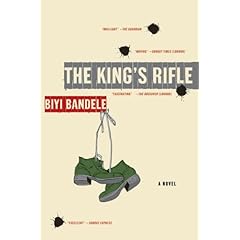
My rating:
Biyi Bandele (1967-) is an award-winning playwright who was born in Nigeria and currently lives in London. He has also written four novels, including The King's Rifle, which was originally published as Burma Boy in 2007 in the UK.
The King's Rifle is a historical novel about black African soldiers who served in World War II in the Burma Campaign against the Japanese. The characters are based on actual participants in the war, based on Bandele's research and on the stories told by his father, who served in the Burma Campaign.
The main character is a 13 year old Nigerian boy, Ali Banana, who lies about his age and manages to get enlisted for battle with his older friends. He contracts chicken pox, and instead of going off with his friends, he is sent to fight with the Chindits, a legendary British Special Forces unit founded by General Charles Wingate, who makes a striking appearance early in the book. His unit, made up of Nigerians commanded by Sergeant Damisa, a father like figure to his young charges, is sent to Burma to fight alongside British Army and British Indian Army forces. The units meet at White City, a stronghold that the Japanese attempt to reacquire. The young men must grow up quickly, as their training has been meager and they don't receive much support or respect from their British and Indian colleagues. The fortress is relentlessly attacked by swarms of Japanese forces, and the Chindits are provided with very little outside support, which begins to take its toll on them.
This is an enjoyable story of an unfamiliar piece of military history, with engaging characters and rapid fire action.
My rating:
Biyi Bandele (1967-) is an award-winning playwright who was born in Nigeria and currently lives in London. He has also written four novels, including The King's Rifle, which was originally published as Burma Boy in 2007 in the UK.
The King's Rifle is a historical novel about black African soldiers who served in World War II in the Burma Campaign against the Japanese. The characters are based on actual participants in the war, based on Bandele's research and on the stories told by his father, who served in the Burma Campaign.
The main character is a 13 year old Nigerian boy, Ali Banana, who lies about his age and manages to get enlisted for battle with his older friends. He contracts chicken pox, and instead of going off with his friends, he is sent to fight with the Chindits, a legendary British Special Forces unit founded by General Charles Wingate, who makes a striking appearance early in the book. His unit, made up of Nigerians commanded by Sergeant Damisa, a father like figure to his young charges, is sent to Burma to fight alongside British Army and British Indian Army forces. The units meet at White City, a stronghold that the Japanese attempt to reacquire. The young men must grow up quickly, as their training has been meager and they don't receive much support or respect from their British and Indian colleagues. The fortress is relentlessly attacked by swarms of Japanese forces, and the Chindits are provided with very little outside support, which begins to take its toll on them.
This is an enjoyable story of an unfamiliar piece of military history, with engaging characters and rapid fire action.
230kidzdoc
#228: LOL! Actually, there is at least one recent example of American football influencing a person's political stance. Jack Kemp, the former professional football quarterback, Congressman, and Republican vice-Presidential candidate who died a couple of weeks ago, was an ardent civil rights supporter throughout his career, which he attributed to playing on integrated pro football teams. This is from his Wikipedia page:
He also brought from his football career a belief in racial equality, which came from playing football with black teammates. Kemp said, "I wasn't there with Rosa Parks or Dr. King or John Lewis. But I am here now, and I am going to yell from the rooftops about what we need to do." Kemp's football colleagues confirmed this influence. John Mackey explained that "The huddle is colorblind."
He also brought from his football career a belief in racial equality, which came from playing football with black teammates. Kemp said, "I wasn't there with Rosa Parks or Dr. King or John Lewis. But I am here now, and I am going to yell from the rooftops about what we need to do." Kemp's football colleagues confirmed this influence. John Mackey explained that "The huddle is colorblind."
231SqueakyChu
--> 230
Thanks for sharing the information about Jack Kemp. I was talking about that issue tonight with a friend. If one works closely with someone of a different race, religion, etc., those differences start to fall away as we learn more and more about how much we have in common. Sadly, some people do not have the chance (or take the chance) to do this.
The reason that issue came up at all was that I was reading an Oprah magazine article about an organization in Jerusalem for weight loss for women. I think it was called A Simple Peace. When the Palestinian and Israeli woman came together to figure out how to deal with the problem of being overweight, they realized they had much more in common than they were different. All felt they were gaining much from their shared problem-solving, while all despaired of the difficult political situation surrounding them.
Thanks for sharing the information about Jack Kemp. I was talking about that issue tonight with a friend. If one works closely with someone of a different race, religion, etc., those differences start to fall away as we learn more and more about how much we have in common. Sadly, some people do not have the chance (or take the chance) to do this.
The reason that issue came up at all was that I was reading an Oprah magazine article about an organization in Jerusalem for weight loss for women. I think it was called A Simple Peace. When the Palestinian and Israeli woman came together to figure out how to deal with the problem of being overweight, they realized they had much more in common than they were different. All felt they were gaining much from their shared problem-solving, while all despaired of the difficult political situation surrounding them.
232LisaCurcio
>229 kidzdoc:: Darryl, having recently finished The Glass Palace by Amitav Ghosh, much of which is set in Burma and in which the issues of the British Indian Army play a part, I have had to add The King's Rifle to my wishlist. Thanks, I think.
233lriley
Working on The fat man and infinity right now kidzdoc---just started the last section. It is excellent.
234kidzdoc
#233: I'm glad you're enjoying it, and I'll definitely look forward to your comments about it.
235polutropos
Darryl:
I was in Canada's largest book warehouse today, spending someone else's money and having a great time. I had in my hands a book called Better: A Surgeon's Notes on Performance, thinking of you, and almost picked it up since it looked good, but then I thought maybe you either have it, or know of it already.
I was in Canada's largest book warehouse today, spending someone else's money and having a great time. I had in my hands a book called Better: A Surgeon's Notes on Performance, thinking of you, and almost picked it up since it looked good, but then I thought maybe you either have it, or know of it already.
236kidzdoc
Andrew,
Thanks for thinking of me; however, you guessed right. I do have it, and I had my copy signed by Dr. Gawande two years ago when he spoke at The Commonwealth Club in San Francisco. He is a very impressive speaker, writer, and physician role model, and I would highly recommend both of his books; his first book is Complications: A Surgeon's Notes on an Imperfect Science.
Thanks for thinking of me; however, you guessed right. I do have it, and I had my copy signed by Dr. Gawande two years ago when he spoke at The Commonwealth Club in San Francisco. He is a very impressive speaker, writer, and physician role model, and I would highly recommend both of his books; his first book is Complications: A Surgeon's Notes on an Imperfect Science.
237urania1
Darryl,
I absent myself from LT for a mere three weeks and find 70 unread posts on your thread alone. Stop it! Furthermore, stop it again! Every time I read your thread I get severe book envy. Right now, book envy is bad as I am on a book diet. The only new books I will be reading are free classics from PG et al and whatever ARCs I cadge from my local bookseller . . . and all the unread books on Mt. TBR. Poor, poor pitiful me. Woe is I.
I absent myself from LT for a mere three weeks and find 70 unread posts on your thread alone. Stop it! Furthermore, stop it again! Every time I read your thread I get severe book envy. Right now, book envy is bad as I am on a book diet. The only new books I will be reading are free classics from PG et al and whatever ARCs I cadge from my local bookseller . . . and all the unread books on Mt. TBR. Poor, poor pitiful me. Woe is I.
238kidzdoc
Welcome back, urania! In honor of your return and request, I promise to post no book reviews today.
I really need to be on a book diet, too.
I really need to be on a book diet, too.
239bobmcconnaughey
#237
Poor, poor pitiful me
Poor, poor pitiful me
These young boys won't let me be
Lord have mercy on me
Woe is me
Well, I met a boy at the Rainbow gym
he asked me if I'd beat him
he took me back to the Hyatt House
I don't want to talk about it.
apologies all round to Urania and Warren Zevon
Poor, poor pitiful me
Poor, poor pitiful me
These young boys won't let me be
Lord have mercy on me
Woe is me
Well, I met a boy at the Rainbow gym
he asked me if I'd beat him
he took me back to the Hyatt House
I don't want to talk about it.
apologies all round to Urania and Warren Zevon
240polutropos
Thanks, Bob, for providing a much needed laugh.
I must go in search of Warren. I have always loved Werewolves of London, but this one I don't remember.
I must go in search of Warren. I have always loved Werewolves of London, but this one I don't remember.
241kidzdoc
Plants Don't Drink Coffee by Unai Elorriaga

My rating:
Unai Elorriaga (1973-) was born in the Basque region of Spain, and has worked as a translator, critic, and writer. He is currently a professor at the Instituto Labairu in Bilbao, and has published three novels, including SPrako Tranbia (A Tram in SP), which won the 2002 Premio Nacional de Narrativa, one of the most prestigious literary awards in Spain.
Plants Don't Drink Coffee was originally published as Vredaman in 2005. It was translated into English last year, and published by Archipelago Books earlier this month.
The narrator, Tomas, is a young boy who is living with his Aunt Martina while his father recuperates from illness. He adores his older cousin Iñes, who is studying entomology at university, and he desires to catch the rare and elusive blue dragonfly, as the person who catches it will be "the most intelligent person in the world".
Tomas observes his slightly off center relatives that live in Aunt Martina's home. His uncle Simon is obsessed with rugby, and engages in a plot with his friend Gur to create a rugby pitch on a private golf course. Mateo, Tomas' cousin and a skillful pilferer of library books, learns about his grandfather Julian, who competed to be the best carpenter in Europe, but no one will tell him if Julian won the event. And Piedad, an elderly friend of Aunt Martina, tells endless stories about her old lover Samuel Mud, a famed architect, whom she never marries due to a family secret.
This is a lighthearted and beautiful story of seemingly ordinary people who engage in mildly odd and surreal quests, and is definitely recommended.

My rating:
Unai Elorriaga (1973-) was born in the Basque region of Spain, and has worked as a translator, critic, and writer. He is currently a professor at the Instituto Labairu in Bilbao, and has published three novels, including SPrako Tranbia (A Tram in SP), which won the 2002 Premio Nacional de Narrativa, one of the most prestigious literary awards in Spain.
Plants Don't Drink Coffee was originally published as Vredaman in 2005. It was translated into English last year, and published by Archipelago Books earlier this month.
The narrator, Tomas, is a young boy who is living with his Aunt Martina while his father recuperates from illness. He adores his older cousin Iñes, who is studying entomology at university, and he desires to catch the rare and elusive blue dragonfly, as the person who catches it will be "the most intelligent person in the world".
Tomas observes his slightly off center relatives that live in Aunt Martina's home. His uncle Simon is obsessed with rugby, and engages in a plot with his friend Gur to create a rugby pitch on a private golf course. Mateo, Tomas' cousin and a skillful pilferer of library books, learns about his grandfather Julian, who competed to be the best carpenter in Europe, but no one will tell him if Julian won the event. And Piedad, an elderly friend of Aunt Martina, tells endless stories about her old lover Samuel Mud, a famed architect, whom she never marries due to a family secret.
This is a lighthearted and beautiful story of seemingly ordinary people who engage in mildly odd and surreal quests, and is definitely recommended.
242kidzdoc
Nocturnes: Five Stories of Music and Nightfall by Kazuo Ishiguro
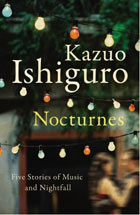
My rating:
A nocturne, according to Wikipedia, can be defined as a musical composition that evokes the night. However, "{n}octurnes are generally thought of as being tranquil, often expressive and lyrical, and sometimes rather gloomy, but in practice pieces with the name nocturne have conveyed a variety of moods." And so it is with this collection of interlinked short stories, all with a connection to music, quiet yet evocative, melancholy for the most part with interspersed brief touches of pathos, humor and searing anger and bitterness.
Although music does appear in each story, the major theme of these stories is the relationship between two people, and how the pursuit of one's career and passions, the expectations we have for those we love, and how we view ourselves in relation to the loved one can often undermine and even destroy the relationship.
In all of the stories there is an outsider who views and comments dispassionately on a troubled relationship. The stories are separate, yet closely connected. One character from the first story, "Crooner", will reappear later in "Cellists", and the location of the first and last stories are identical. The moods differ within and between stories, but Ishiguro's unique ability to gently convey a story is always present.
Like a well written piece of music, I believe that the reader of these stories will gain greater appreciation of the characters and what Ishiguro is trying to tell us with repeated "listening". This is a beautiful collection, and is very highly recommended.
My rating:
A nocturne, according to Wikipedia, can be defined as a musical composition that evokes the night. However, "{n}octurnes are generally thought of as being tranquil, often expressive and lyrical, and sometimes rather gloomy, but in practice pieces with the name nocturne have conveyed a variety of moods." And so it is with this collection of interlinked short stories, all with a connection to music, quiet yet evocative, melancholy for the most part with interspersed brief touches of pathos, humor and searing anger and bitterness.
Although music does appear in each story, the major theme of these stories is the relationship between two people, and how the pursuit of one's career and passions, the expectations we have for those we love, and how we view ourselves in relation to the loved one can often undermine and even destroy the relationship.
In all of the stories there is an outsider who views and comments dispassionately on a troubled relationship. The stories are separate, yet closely connected. One character from the first story, "Crooner", will reappear later in "Cellists", and the location of the first and last stories are identical. The moods differ within and between stories, but Ishiguro's unique ability to gently convey a story is always present.
Like a well written piece of music, I believe that the reader of these stories will gain greater appreciation of the characters and what Ishiguro is trying to tell us with repeated "listening". This is a beautiful collection, and is very highly recommended.
243kidzdoc
The Thief and the Dogs by Naguib Mahfouz

My rating:
This novella by the Nobel Prize winning author is set in Egypt after the 1952 Revolution, and describes the events following the release of a young man who is released from a Cairo prison after serving a four year sentence for grand theft. He was betrayed by two former colleagues, who both have become wealthy from their gains, which began in a noble quest to steal from wealthy residents of the city in support of the Revolution. Upon his release he visits the first traitor, who has married his wife and taken in his young daughter, who screams in horror and refuses to greet him when he sees her. He is consumed with anger, and with the help of former companions, he plans his revenge on the two men and his ex-wife. He is unsuccessful in his attempts, and he becomes more desperate, as the city and state police slowly descend upon him.
This was a good read, in the existential style of Camus' The Stranger.

My rating:
This novella by the Nobel Prize winning author is set in Egypt after the 1952 Revolution, and describes the events following the release of a young man who is released from a Cairo prison after serving a four year sentence for grand theft. He was betrayed by two former colleagues, who both have become wealthy from their gains, which began in a noble quest to steal from wealthy residents of the city in support of the Revolution. Upon his release he visits the first traitor, who has married his wife and taken in his young daughter, who screams in horror and refuses to greet him when he sees her. He is consumed with anger, and with the help of former companions, he plans his revenge on the two men and his ex-wife. He is unsuccessful in his attempts, and he becomes more desperate, as the city and state police slowly descend upon him.
This was a good read, in the existential style of Camus' The Stranger.
244kidzdoc
The Armies by Evelio Rosero

My rating:
Evelio Rosero (1958-) is an award winning author and journalist who was born in Bogotá, Colombia, where he currently resides. The Armies (Los ejércitos), his first novel to be translated into English, won the Tusquets International Novel Prize in 2006 and the Independent Foreign Fiction Prize in 2009.
Ismael is a 70 year old retired school teacher, who lives peacefully with his wife Otilia in a Colombian village. His days are spent picking oranges from the trees in his garden, while longingly admiring his neighbor as she sunbathes in the nude. Surrounding this peaceful village, however, are guerrillas who grow coca in the nearby hills, who occasionally threaten and kidnap individuals but do not have much of an impact on the town as a whole. Unfortunately for the villagers, the army decides to use the village as a front in the war against the guerrillas, and slowly but steadily the villagers are caught in the middle of these warring factions.
Ismael decides to take an early morning walk, and is detained by government soldiers. Otilia goes to look for him later that day, and Ismael goes to look for her after his release. However, there is fierce fighting on that day, and he cannot find her by day's end. His neighbor's husband and son are kidnapped, and a number of villagers are killed or injured. Over the next days, as the fighting intensifies and the villagers find themselves increasingly trapped, Ismael continues his search for Otilia, vowing to remain there until she returns to him.
No one in The Armies is entirely innocent or guilty: the captain of the army randomly shoots several civilians, accusing them of being guerrillas; the mayor and the local police abandon the villagers with little warning; journalists drop in for photo ops but are detached and uninterested in the villagers' plight; and the country's president denies the existence of the war, and claims that the deaths reported by the media were due to old age.
This was a beautifully written novel which captures the horrors of the Colombian civil war on its people, without resorting to gruesome and repetitive depictions of violence, and is highly recommended.

My rating:
Evelio Rosero (1958-) is an award winning author and journalist who was born in Bogotá, Colombia, where he currently resides. The Armies (Los ejércitos), his first novel to be translated into English, won the Tusquets International Novel Prize in 2006 and the Independent Foreign Fiction Prize in 2009.
Ismael is a 70 year old retired school teacher, who lives peacefully with his wife Otilia in a Colombian village. His days are spent picking oranges from the trees in his garden, while longingly admiring his neighbor as she sunbathes in the nude. Surrounding this peaceful village, however, are guerrillas who grow coca in the nearby hills, who occasionally threaten and kidnap individuals but do not have much of an impact on the town as a whole. Unfortunately for the villagers, the army decides to use the village as a front in the war against the guerrillas, and slowly but steadily the villagers are caught in the middle of these warring factions.
Ismael decides to take an early morning walk, and is detained by government soldiers. Otilia goes to look for him later that day, and Ismael goes to look for her after his release. However, there is fierce fighting on that day, and he cannot find her by day's end. His neighbor's husband and son are kidnapped, and a number of villagers are killed or injured. Over the next days, as the fighting intensifies and the villagers find themselves increasingly trapped, Ismael continues his search for Otilia, vowing to remain there until she returns to him.
No one in The Armies is entirely innocent or guilty: the captain of the army randomly shoots several civilians, accusing them of being guerrillas; the mayor and the local police abandon the villagers with little warning; journalists drop in for photo ops but are detached and uninterested in the villagers' plight; and the country's president denies the existence of the war, and claims that the deaths reported by the media were due to old age.
This was a beautifully written novel which captures the horrors of the Colombian civil war on its people, without resorting to gruesome and repetitive depictions of violence, and is highly recommended.
245kidzdoc
The Bathroom by Jean-Philippe Toussaint

My rating: (3 yawns)
I first learned about this French writer after I purchased his latest book, Camera, at City Lights Books last year, which I enjoyed. This is his first novel, published in 1985, and I picked it up at my local Borders (in Atlanta) while browsing the fiction shelves this past week. I decided to read it on this morning's flight from Atlanta to Philadelphia (I'm visiting my parents this week), as it is only 102 pages long. Well, I couldn't even make it to 50 pages!
The narrator is a researcher who decides that he will live in his bathroom in a Parisian flat. He moves everything (clothes, books, etc.) there, and sits in his tub all day, contemplating his toenails. His girlfriend and his mother visit him and are amazingly tolerant of his foibles. The book consists of short, self-absorbed entries, such as this one:
9. The bathroom walls were light green, the paint blistered in spots. After turning the key in the door I took off my underpants and hung them on the doorknob. I took a shower in the tub, dried myself, and went back to my room shivering, towel around my shoulders. The new underwear was on the table. Using my teeth, I separated the socks, which were tied together with a thread. The wool was soft, smelled good. I put on clean socks, new underpants. I was feeling good. In that state, I hung around the room for a while, pulling on the elasstic of my underpants, reading the notices thumbtacked to the door: safety instructions, prices of rooms, breakfast. Turning back to the table, I pulled on my trousers and put on my dirty shirt, which stank under the armpits.
I'm amazed that I made it through almost 50 pages without screaming at the captain, being forcibly removed from the plane after an emergency landing in Charlotte, or using every barf bag on the plane. Thankfully there was a very cute baby two seats ahead of me, whose coos and laughs allowed me to keep my sanity. This is recommended only if you want a reason to visit a psychotherapist.

My rating:
 (3 yawns)
I first learned about this French writer after I purchased his latest book, Camera, at City Lights Books last year, which I enjoyed. This is his first novel, published in 1985, and I picked it up at my local Borders (in Atlanta) while browsing the fiction shelves this past week. I decided to read it on this morning's flight from Atlanta to Philadelphia (I'm visiting my parents this week), as it is only 102 pages long. Well, I couldn't even make it to 50 pages!
The narrator is a researcher who decides that he will live in his bathroom in a Parisian flat. He moves everything (clothes, books, etc.) there, and sits in his tub all day, contemplating his toenails. His girlfriend and his mother visit him and are amazingly tolerant of his foibles. The book consists of short, self-absorbed entries, such as this one:
9. The bathroom walls were light green, the paint blistered in spots. After turning the key in the door I took off my underpants and hung them on the doorknob. I took a shower in the tub, dried myself, and went back to my room shivering, towel around my shoulders. The new underwear was on the table. Using my teeth, I separated the socks, which were tied together with a thread. The wool was soft, smelled good. I put on clean socks, new underpants. I was feeling good. In that state, I hung around the room for a while, pulling on the elasstic of my underpants, reading the notices thumbtacked to the door: safety instructions, prices of rooms, breakfast. Turning back to the table, I pulled on my trousers and put on my dirty shirt, which stank under the armpits.
I'm amazed that I made it through almost 50 pages without screaming at the captain, being forcibly removed from the plane after an emergency landing in Charlotte, or using every barf bag on the plane. Thankfully there was a very cute baby two seats ahead of me, whose coos and laughs allowed me to keep my sanity. This is recommended only if you want a reason to visit a psychotherapist.
246SqueakyChu
The book sounds horrible, but your review is hilarious!
247urania1
>245 kidzdoc: Kizdoc,
I started the book but put it aside for reasons I don't remember. However, I remember laughing at a number of passages. I haven't read Camera.
urania
P. S. So you had to make an emergency landing in Charlotte, home of my misspent youth. My sympathies. If me sainted Pa didn't live there, I would never return. It is one of the more soulless cities in the south.
I started the book but put it aside for reasons I don't remember. However, I remember laughing at a number of passages. I haven't read Camera.
urania
P. S. So you had to make an emergency landing in Charlotte, home of my misspent youth. My sympathies. If me sainted Pa didn't live there, I would never return. It is one of the more soulless cities in the south.
248kidzdoc
#247: Urania, There were a couple of mildly humorous parts in the first few pages, particularly the one where the girlfriend is undressing to have sex with the guy (yes, in the bathroom), while trying to get rid of the flat's painter, and the one where his mother talks to him in the bathroom while they are eating pastries. Most of it, though, was much more similar to the passage I quoted above.
I've only been through Charlotte (Amtrak, car), and had no desire to visit before your comment. Now I'll almost certainly never go there!
I've only been through Charlotte (Amtrak, car), and had no desire to visit before your comment. Now I'll almost certainly never go there!
249bonniebooks
Aaack! I felt like screaming after only one paragraph! But then it was so ridiculous, it made me laugh too, so thanks!
250nancyewhite
As a mom, it is very nice to hear a good story about a baby on a plane . I hope you had a backup book!
251kidzdoc
I always have a backup book, or two or 12.
Since is it 1 June and this thread has 250+ posts, I'll create a new thread, which can be found here:
http://www.librarything.com/topic/65896
Since is it 1 June and this thread has 250+ posts, I'll create a new thread, which can be found here:
http://www.librarything.com/topic/65896
