
Democracy in America
by Alexis de Tocqueville
On This Page
Description
Alexis de Tocqueville's Democracy in America (De la démocratie en Amérique) is a classic text detailing the United States of the 1830s, showing a primarily favorable view by Tocqueville as he compares it to his native France. Considered to be an important account of the U.S. democratic system, it has become a classic work in the fields of political science and history. It quickly became popular in both the United States and Europe. Democracy in America was first published as two volumes, show more one in 1835 and the other in 1840; both are included in this edition.. show less
Tags
Recommendations









































Member Recommendations

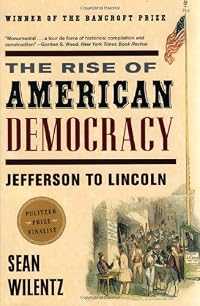
wildbill This volume of the Oxford History of the United States is an excellent history of the period of de Tocqueville's visit to America.
20




Member Reviews
Although I highly recommend this book, you should investigate different translations before diving into reading a 900+ page opus. This edition was translated by Henry Reeve, a contemporary and an Englishman. That, unfortunately made some of the sentences extremely awkward. I swear I read a few sentences with triple negatives. Also, although updated with an occasional footnote about subsequent events that proved de Tocqueville either prescient or wrong, it still lacks the perspective from our modern era. Many sentences presume a contemporary understanding of terms that no longer are used or have changed meanings since 1840.
Still de Tocqueville's insights are not to be missed, especially chapter XVIII of Book 1, The present and future show more condition of the three races which inhabit the territory of the United States. His insights about the contemporary and likely future conditions of the American Indians and Blacks in the U.S. are astonishingly prescient. show less
Still de Tocqueville's insights are not to be missed, especially chapter XVIII of Book 1, The present and future show more condition of the three races which inhabit the territory of the United States. His insights about the contemporary and likely future conditions of the American Indians and Blacks in the U.S. are astonishingly prescient. show less
Democracy in America by Alexis de Tocqueville translated by Mansfield & Winthrop) I started this book sometime ago as part of my "US Famous Historical Documents/Books" read. This book seemed overwhelming; I'm not sure of de Tocqueville's thesis, so it was a bit difficult to figure out where he was going; and that is important to me when I read a non-fiction or historical document. My favorite parts were his observations on politicians, specifically Daniel Boone and Andrew Jackson, both of whom he found illiterate and unfit for office. de Tocqueville was also astounded at the "equality" he found in America. Everybody shaking hands, sitting in church together, and walking down the same street. Although in America in 1837 slaves, Native show more Americans, and women certainly were not equal, de Tocqueville certainly found it much different that the stratified classes of France. He also studied the US Constitution and warned against the tyranny of the majority. I think de Tocqueville got that wrong, in the US we have the tyranny of the minority. Although there was much repetition, I found this to be a thought provoking reading. 722 show less
Genius. Sheer genius. It seems like any book about American politics or history that I've read has at least one quote from this book, so I finally figured I should read it. Man, is this ever great. It's fascinating on so many levels. As history, it's primary source observations of a Frenchman who studied the United States in the 1830's. As a book on politics, it describes our government in depth, giving not just the facts of how it operates but also the rationale and history behind it. As a sociological tome, it mirrors the attitudes and behavior of the American people as well as contrasting those to the English and French. As a booster seat, it's nice and thick. It took me weeks to read (over a number of meals), and every day or so I show more found some tidbit to make me stop and think about the people around me--neighbors, co-workers, fellow church members. It's not a simple read, since Tocqueville, like other 19th century writers, is very lengthy and doesn't limit himself to one field of study. But it is definitely worth making an effort to read. Why I wasn't given this to read in high school, I don't know. Well, it's twenty years late, but I'm gonna put a copy on my shelf.
--J. show less
--J. show less
I bought this book in the aftermath of the 2016 election seeking to understand America. It's surprising how well parts of the book holds up as an analysis. The comparative approach - contrasting 19th century USA vs France - is a welcome, different way to analyze the subject. The "part 1" chapters are the strongest with significant evidence sourced. The later chapters leap into the realm of political theory and abstractions (e.g. how "equality" as a principle explains everything in society.... yet inequality of the sexes and the races only warrants passing mentions). For a book that is nearly two hundred years old, I found it a helpful text to understand America further.
Excellent first-hand analysis of the early decades of the USA, and its imperfect attempts to create a genuinely 'democratic' state, from an intellectual who had also witnessed the near-parallel development of the French state from the revolution to the dictatorship of Napoleon and beyond.
Alexis de Tocqueville compares with disinterested honesty 19th century Democracy, especially American democracy, with the European aristocracies that preceded it. In this two-volume work, he outlines both the benefits and dangers of both social orders. With the certain knowledge that the age of the aristocracy is passed, de Tocqueville writes with the ultimate hope that his book will serve as a warning to citizens under democratic rule, that they will not succumb to the apathy that is their greatest enemy, which would allow the government to pursue its natural tendency to metastasize into the private realm of citizen, governing an ever greater number of minutiae in the personal lives of its subjects, and annulling the freedom that was show more originally sought in creating a democracy show less
Definitely a very interesting book. The author provides some interesting insights into the political life and culture of America of the time. While some things are specific to the time period, such as some of the finer points of political culture, some of the broader strokes still seem pertinent today. Additionally, being French, de Tocqueville was able to provide an outsiders perspective on many details of the U.S. Overall, definitely worth reading.
Members
- Recently Added By
Lists

2024-2025 Ezra Klein Guest Recommendations
213 works; 6 members

Books Cited in Digging Up the Dead by Michael Kammen
183 works; 1 member

Works Cited in The Life and Death of Democracy by John Keane
278 works; 1 member

.
396 works; 1 member

Books in the Bibliography of Freethinkers by Susan Jacoby
155 works; 1 member

In Our Time books
4,934 works; 2 members

Books Cited in Blueprint by Nicholas Christakis
261 works; 1 member
Author Information

209+ Works 15,713 Members
French writer and politician Alexis de Tocqueville was born in Verneuil to an aristocratic Norman family. He entered the bar in 1825 and became an assistant magistrate at Versailles. In 1831, he was sent to the United States to report on the prison system. This journey produced a book called On the Penitentiary System in the United States (1833), show more as well as a much more significant work called Democracy in America (1835--40), a treatise on American society and its political system. Active in French politics, Tocqueville also wrote Old Regime and the Revolution (1856), in which he argued that the Revolution of 1848 did not constitute a break with the past but merely accelerated a trend toward greater centralization of government. Tocqueville was an observant Catholic, and this has been cited as a reason why many of his insights, rather than being confined to a particular time and place, reach beyond to see a universality in all people everywhere. (Bowker Author Biography) show less
Some Editions
Awards and Honors
Notable Lists
Series
Belongs to Publisher Series
Ad fontes (Kalligram) (2009)
Union générale d'éditions, 10/18 (111, 112)
Westvaco American Classics (1999)
Library of America (147)
The World's Classics (496)
Work Relationships
Is contained in
Contains
Is abridged in
Democracy in America: Abridged with an Introduction by Michael Kammen (The Bedford Series in History and Culture) by Alexis de Tocqueville
Has as a study
Has as a commentary on the text
Common Knowledge
- Canonical title
- Democracy in America
- Original title
- De la démocratie en Amérique; Democracy in America (Mansfield/Winthrop) (Mansfield/Winthrop)
- Original publication date
- 1835 (volume 1) (volume 1); 1840 (volume 2) (volume 2)
- First words
- Among the new things that attracted my attention during my stay in the United States, none struck me more forcefully than the equality of conditions.
- Quotations
- The human mind invents things more easily than words; that is why many improper terms and inadequate expressions gain currency.
The Constitution of the United States is like one of those beautiful creations of human diligence which give their inventors glory and riches but remains sterile in other hands.
How wonderful is the position of the New World, where man has as yet no enemies but himself.
[The oppression] would be akin to parental authority if only it had the same goal of preparing children for adulthood; but instead its sole objective is to consign them to everlasting kindergarten; it wants the populace to en... (show all)joy themselves, as long as they never have any dreams beyond their own entertainment.
Having seized each individual in turn in its firm grip and molded him into its pattern, the regime extends its embrace to encompass the entire society, blanketing its surface with an intricate web of trivial regulations, comp... (show all)rehensive and regimented, from which the most creative minds and resolute souls cannot manage to extricate themselves away from the collective; rather than breaking the willpower, it softens, bends, and channels it; instead of compelling action, it endlessly restricts it; instead of destroying, it impedes formation; instead of tyrannizing, it prods, manipulates, conditions, discourages, restrains, and brainwashes the whole nation into nothing more than a herd of tractable, hard-working livestock of which the regime is the herdsman. - Last words
- (Click to show. Warning: May contain spoilers.)It is beyond the ability of nations today to prevent conditions within them from becoming equal, but it is within their power to decide whether equality will lead them into servitude or liberty, enlightenment or barbarism, prosperity or misery.
- Canonical DDC/MDS
- 320.973; 320.473
- Canonical LCC
- JK216
- Disambiguation notice
- The ISBN 0679728252 is used in LT's records both for the complete version of de Tocqueville's work and for the first volume of it.
Do not combine with any abridged ... (show all)edtion.
Classifications
- Genres
- Politics and Government, History, Nonfiction, Philosophy, Sociology, General Nonfiction
- DDC/MDS
- 320.973 — Society, government, & culture Political science Types of Government Political situation and conditions North America United States
- LCC
- JK216 — Political Science Political institutions and public administration (United States) Political institutions and public administration United States
- BISAC
Statistics
- Members
- 5,324
- Popularity
- 2,537
- Reviews
- 28
- Rating
- (4.23)
- Languages
- 16 — Chinese, Czech, Dutch, English, Finnish, French, German, Greek, Hungarian, Italian, Lithuanian, Norwegian (Bokmål), Russian, Spanish, Turkish, Portuguese (Portugal)
- Media
- Paper, Audiobook, Ebook
- ISBNs
- 219
- UPCs
- 5
- ASINs
- 133