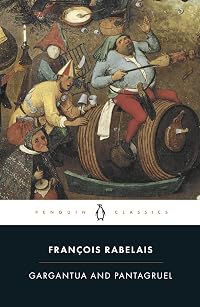
Gargantua and Pantagruel
by François Rabelais
Gargantua and Pantagruel (Collections and Selections — complete 1-5)
On This Page
Description
"First published in four volumes between 1532 and 1552, Rabelais' comic masterpiece chronicles the adventures of a giant, Gargantua, and his son, Pantagruel. More than four centuries later, the terms "gargantuan" and "Rabelaisian" are synonymous with earthy humor, a surfeit of good food and drink, and pleasures of the flesh. This series of exaggerated fables was condemned upon its initial publication by the censors of the College de la Sorbonne. But beneath their bawdy, often scatological show more wit, the tales bear a deeper significance as the author's defense of daring and groundbreaking ideas. Using his ribald humor, Rabelais addresses timeless issues of education, politics, and philosophy. His parodies of classic authors as well as his own contemporaries offer a hilarious expose of human folly and an enduring satire of history, literature, religion, and culture. This edition features the classic translation by Sir Thomas Urquhart and Pierre le Motteux"-- show lessTags
Recommendations


















Member Recommendations

Member Reviews
This collection of books began with the highest of the high, then proceeded immediately to tank miserably until it reached the lowest of the low. I read the version translated by Samuel Putnam, and in his hands, the word "lively" in the title was very well suited. The first book of Gargantua was a revelation, rich with linguistic acrobatics, profound in silliness, and filled to hilarity with hyperbole. I enjoyed every moment.
Then Pantagruel was born, and I wished he never was. I prefer the father, and the apple fell far from the tree. The first book on his life contained nothing I can remember. The second book contained hundreds of pages of a meandering conversation about whether or not his friend should marry. The third book had 20 or show more so pages on a missing hatchet? What a waste of my time. show less
Then Pantagruel was born, and I wished he never was. I prefer the father, and the apple fell far from the tree. The first book on his life contained nothing I can remember. The second book contained hundreds of pages of a meandering conversation about whether or not his friend should marry. The third book had 20 or show more so pages on a missing hatchet? What a waste of my time. show less
This whole series is stuffed with references to ancient greece, ancient rome, references to the bible, medieval history and philosophy, and i mean caked with so many classical references while being so verbosely fancy and grotesque at the same time, that if you'd get rid of them you could probably read these five books all in one sitting. Critics love to take a dump on Ready Player One for namedropping 80s and 90s pop culture brands and references, but still consider Pantagruel a literary masterpiece because it was written by a white man some five centuries ago, whatever floats their boat, but I'll never get their point.
And yes, I am well-versed in classical culture and history, but still found Pantagruel an insufferably tedious read. show more My favorite scenes and the only ones that I deem as worth remembering were Panurge's sign debate and some passages in Gargantua, but that's all there's to it, these works are extremely outdated and unsuitable for a modern audience, also the repetitive poop and pee and ass jokes weren't funny, at all. show less
And yes, I am well-versed in classical culture and history, but still found Pantagruel an insufferably tedious read. show more My favorite scenes and the only ones that I deem as worth remembering were Panurge's sign debate and some passages in Gargantua, but that's all there's to it, these works are extremely outdated and unsuitable for a modern audience, also the repetitive poop and pee and ass jokes weren't funny, at all. show less
Well, it's done: I got through Rabelais. I plowed this 16th century classic of arse-wind symphonies, infarctious bum-hole fruppery, codpiece flip-flappery, and vertiginous piles of latinate verbiage, much of which only a scholar from the Beansquiddle School of Counterposed Argumentation and Juxtiperous Scholary Assidification would understand, or profit therefrom. . .
And for all that, it was fun. Yes, the complaint that I formed early on was that the writing was overwhelmingly verbose. Despite the outlandishly bawdy humor, it took forever to get through what I took for pointless descriptions, words piled up in a groaning sideboard of verbiage, chapters with no apparent aim toward what I supposed should be the meat of the enterprise: show more advancing the plot. But that complaint, I finally realized, was really my 20th-century American upbringing speaking: my get-out-of-my-way-I'm-in-a-hurry, time-is-money, let's-be-serious-I-don't-have-time-for this, nose-to-the-grindstone, and put-it-in-a-sound-byte upbringing.
By comparison, today's novels are written almost in short hand where an economy of words wins. Blogs must be digestible in two minutes or less. We can quit any newspaper article after only three sentences and come away with its essential point. We've basically re-written Descartes to: I stress, therefore I exist. . .
On the other hand, with 'Gargantua and Pantagruel' you have sat down with someone from the 16th-century and you must not be interested in getting anywhere in a hurry. You must be prepared to sacrifice the entire afternoon to careless, rambling conversation where the person repeats himself, gets sidetracked in colorful but pointless tangents, tells lewd jokes, flirts with passersby, pauses frequently to order more beer, farts at will, and has a love for rattling off endless lists: of popular games, of foods appearing at a banquet, of ways to run someone through with a weapon, or the best materials to use in an outhouse.
The characters Gargantua and Pantagruel are of a race of giants, and in a satire the figure of a giant is often a device for showing human traits writ large. It occurs to me that Rabelais' use of this literary device may be seen as a kind of rejoinder to Plato's 'Republic'. In 'The Republic,' man was writ large in the form of an ideal city to explore the question: how should a man live? Then, in 'Gargantua and Pantagruel,' perhaps the corollary occurs: the city or society is writ large in the form of a giant man to explore the question: what is the end of life?
And if this be the case, then Rabelais tell us, in effect, to chill! There you go! There's your modern urge to reduce everything to one formulaic pithy equation: just chill. Rabelais seems to be saying: what's the use in being so pretentious and tight-assed? Humanity is funny, flawed, tragic, comic, both beautiful and ugly - and driven by passion and appetite more so than its rationality. Relax, understand this, and stop pushing. If you don't mind bawdy jokes, gutter humor, satire, and enough crude body functions to start a riot in a whorehouse, this will be a delightful, if somewhat long read. Let it have its effect on you. On other hand, “If you say to me, master, it would seem that you were not very wise in writing to us these flimflam stories, and pleasant fooleries...” as Rabelais writes, near the end of Book II, “I answer you that you are not much wiser to spend your time reading them." Tis a sentiment truer than meets the eye, because to respond out of impatience to this book is to have missed much of the point. show less
And for all that, it was fun. Yes, the complaint that I formed early on was that the writing was overwhelmingly verbose. Despite the outlandishly bawdy humor, it took forever to get through what I took for pointless descriptions, words piled up in a groaning sideboard of verbiage, chapters with no apparent aim toward what I supposed should be the meat of the enterprise: show more advancing the plot. But that complaint, I finally realized, was really my 20th-century American upbringing speaking: my get-out-of-my-way-I'm-in-a-hurry, time-is-money, let's-be-serious-I-don't-have-time-for this, nose-to-the-grindstone, and put-it-in-a-sound-byte upbringing.
By comparison, today's novels are written almost in short hand where an economy of words wins. Blogs must be digestible in two minutes or less. We can quit any newspaper article after only three sentences and come away with its essential point. We've basically re-written Descartes to: I stress, therefore I exist. . .
On the other hand, with 'Gargantua and Pantagruel' you have sat down with someone from the 16th-century and you must not be interested in getting anywhere in a hurry. You must be prepared to sacrifice the entire afternoon to careless, rambling conversation where the person repeats himself, gets sidetracked in colorful but pointless tangents, tells lewd jokes, flirts with passersby, pauses frequently to order more beer, farts at will, and has a love for rattling off endless lists: of popular games, of foods appearing at a banquet, of ways to run someone through with a weapon, or the best materials to use in an outhouse.
The characters Gargantua and Pantagruel are of a race of giants, and in a satire the figure of a giant is often a device for showing human traits writ large. It occurs to me that Rabelais' use of this literary device may be seen as a kind of rejoinder to Plato's 'Republic'. In 'The Republic,' man was writ large in the form of an ideal city to explore the question: how should a man live? Then, in 'Gargantua and Pantagruel,' perhaps the corollary occurs: the city or society is writ large in the form of a giant man to explore the question: what is the end of life?
And if this be the case, then Rabelais tell us, in effect, to chill! There you go! There's your modern urge to reduce everything to one formulaic pithy equation: just chill. Rabelais seems to be saying: what's the use in being so pretentious and tight-assed? Humanity is funny, flawed, tragic, comic, both beautiful and ugly - and driven by passion and appetite more so than its rationality. Relax, understand this, and stop pushing. If you don't mind bawdy jokes, gutter humor, satire, and enough crude body functions to start a riot in a whorehouse, this will be a delightful, if somewhat long read. Let it have its effect on you. On other hand, “If you say to me, master, it would seem that you were not very wise in writing to us these flimflam stories, and pleasant fooleries...” as Rabelais writes, near the end of Book II, “I answer you that you are not much wiser to spend your time reading them." Tis a sentiment truer than meets the eye, because to respond out of impatience to this book is to have missed much of the point. show less
Once upon a time, I was reading books on a list of "100 Significant Books" in Good Reading to make sure my mind didn't turn to mush. I was surprised to find I honestly adored just about everything on the list--until I came to number 25, Rabelais' Gargantua and Pantagruel. Reader, I hated it.
Its author is one of those names that's become a word in itself, such as Machiavellian, Shakespearian, Darwinian, Freudian... This is how "Rabelaisian" is defined, quite accurately, on Merriam-Webster.com:
1 : of, relating to, or characteristic of Rabelais or his works
2 : marked by gross robust humor, extravagance of caricature, or bold naturalism.
Gross is right, with a side of crude, and as for the "bold naturalism"--just know that means nature as in show more bodily effluvia, not the beauty of the wild. There's perhaps nothing more tedious than reading through a longwinded book that's supposed to be uproariously funny and wise but only bores you silly, when you're not going ewwww--and I have been known to laugh at bawdy Shakespeare jokes. This book is pedantic, rambling, misogynistic, and Rabelais was way too overfond of lists. Very, very long lists.
I do get its importance. Sorta. I can certainly see the line connecting Gargantua and Pantagruel to Swift's Gulliver's Travels, Joyce's Ulysses, even Gregory Maguire's Wicked. Have I mentioned how much I hate Wicked? I do. (Not a fan of Ulysses either.) I also get how subversive and irreverent it was when published. Nevertheless, as one reviewer put it, there's only so much codpiece jokes one can take. (Never mind poop and fart jokes.) show less
Its author is one of those names that's become a word in itself, such as Machiavellian, Shakespearian, Darwinian, Freudian... This is how "Rabelaisian" is defined, quite accurately, on Merriam-Webster.com:
1 : of, relating to, or characteristic of Rabelais or his works
2 : marked by gross robust humor, extravagance of caricature, or bold naturalism.
Gross is right, with a side of crude, and as for the "bold naturalism"--just know that means nature as in show more bodily effluvia, not the beauty of the wild. There's perhaps nothing more tedious than reading through a longwinded book that's supposed to be uproariously funny and wise but only bores you silly, when you're not going ewwww--and I have been known to laugh at bawdy Shakespeare jokes. This book is pedantic, rambling, misogynistic, and Rabelais was way too overfond of lists. Very, very long lists.
I do get its importance. Sorta. I can certainly see the line connecting Gargantua and Pantagruel to Swift's Gulliver's Travels, Joyce's Ulysses, even Gregory Maguire's Wicked. Have I mentioned how much I hate Wicked? I do. (Not a fan of Ulysses either.) I also get how subversive and irreverent it was when published. Nevertheless, as one reviewer put it, there's only so much codpiece jokes one can take. (Never mind poop and fart jokes.) show less
I think anyone who loved Tristram Shandy will at least like this book, which comes from a similar place of joy and chaos and learned ... well, *stuff.*
If you *hate* books like Tristram Shandy, well, you probably won't like this. And I probably won't like you. :^) Oh well.
The translation and notes by the improbably-named Screech are very, very good. Top class.
If you *hate* books like Tristram Shandy, well, you probably won't like this. And I probably won't like you. :^) Oh well.
The translation and notes by the improbably-named Screech are very, very good. Top class.
Imagine that the world insisted that Dante's Comedy, the Vita Nuova, the writings on Monarchy, his book about using Italian instead of Latin, and some random thing written by someone claiming to be Dante were all one book, and insisted on printing them together in one 2000 page behemoth. That is what happens here. 'Gargantua' and 'Pantagruel' are rollicking. The third book no doubt repays close study by people really into the Renaissance and who get off on making fun of the Papacy. The fourth book is somewhere in between. The fifth book, according to this translator and editor, isn't by Rabelais at all. Now, these are four utterly different books. I recommend the first two to everyone who appreciates a good dick joke. If you're really, show more really, really keen on puns, know latin, greek and hebrew, and are deeply, deeply invested in whether it's better to be a Lutheran or a Papist, you'll probably get a lot from the third and fourth. But even if that's the case, I'd go with the first two books here and Erasmus' 'Praise of Folly,' which is funnier, more comprehensible, and much, much shorter.
So, if you're in college and someone offers a course on Rabelais, you should definitely take it. If you're in the soi disant real world, maybe go with the name-calling and farting of 'Gargantua' and 'Pantagruel' instead. show less
So, if you're in college and someone offers a course on Rabelais, you should definitely take it. If you're in the soi disant real world, maybe go with the name-calling and farting of 'Gargantua' and 'Pantagruel' instead. show less
I read this years ago in the Everyman's Library edition, which reprints an old translation by Sir Thomas Urquhart. Urquhart has been criticized for taking liberties with his translation--i.e., not translating the text "accurately." To that I say: so what! I'm never going to read this book in French. And Urquhart was himself a brilliant writer, and his translation is a marvel. So over-the-top funny and strange, such verbose genuis, I had a hard time putting it down.
Members
- Recently Added By
Lists

1001 Books You Must Read Before You Die
1,448 works; 1,134 members

The Guardian's 1000 Novels Everyone Must Read
1,005 works; 550 members

Best of French Literature
138 works; 27 members

100 Books to Read in a Lifetime (That Are Older Than 200 Years)
415 works; 175 members

Favorite Long Books
330 works; 42 members

The 100 Best Books of All Time by Norwegian Book Club (World Library)
104 works; 23 members

Philip Ward's Lifetime Reading Plan
592 works; 22 members
The Top Ten: Writers Pick Their Favorite Books
240 works; 31 members

Books with "Living Chess"
17 works; 12 members

Western World's Greatest Books - Project Gutenberg
295 works; 15 members
Blue Pyramid 1,276 Best Books of All Time
1,248 works; 32 members

Unread books
1,063 works; 87 members

Harold Bloom - The Western Canon: B. The Aristocratic Age
231 works; 13 members

LibraryThingers' 1001 Books You Must Read Before You Die
442 works; 30 members

The Greatest Books
99 works; 5 members

1,001 BYMRBYD Concensus
723 works; 27 members
How to Read a Book's Recommended Reading List
309 works; 10 members

The Road to Freedom (Will Durant's 100 Best Books for an Education)
100 works; 8 members

Books Read in 2017
4,249 works; 130 members

All Things France
100 works; 8 members

CCE 1000 Good Books List
1,033 works; 12 members

Europe
205 works; 6 members

Tall tales
25 works; 1 member

A Reading List
100 works; 3 members

Greatest Books, allegedly
484 works; 9 members

Recommended Literary Books
111 works; 1 member

Mustich's 1000 Books to Read Before You Die: A Life Changing List
1,001 works; 19 members
New Lifetime Reading Plan by Fadiman and Major
225 works; 5 members
My List
302 works; 1 member

DigitalDreamDoor top 300
300 works; 4 members

.
396 works; 1 member
Author Information

400+ Works 8,679 Members
One of the leading humanist writers of the French Renaissance, Rabelais was at first a Franciscan and then a Benedictine monk, a celebrated physician and professor of anatomy, and later cure of Meudon. The works of Rabelais are filled with life to the overflowing, hence the term "Rabelaisian." His principal protagonists, Gargantua and his son, show more Pantagruel, are appropriately giants, not only in size, but also in spirit and action. The five books of their adventures are separate works, containing, in different measure, adventures, discussions, farcical scenes, jokes, games, satires, philosophical commentaries, and anything else that a worldly, learned man of genius such as Rabelais could pour into his work. His style is innovative and idiosyncratic, marked by humorous neologisms made up from the learned languages, Greek and Latin, side by side with the most earthy, humble, and rough words of the street and barnyard. His Gargantua, published in 1534, satirizes the traditional education of Parisian theologians and, in the Abbe de Theleme episode, recommends a free, hedonistic society of handsome young men and women in contrast to the restrictive life of monasticism. The gigantic scope of Rabelais's work also reflects the Renaissance thirst for encyclopedic knowledge. (Bowker Author Biography) show less
Some Editions
Awards and Honors
Awards
Notable Lists
Series

Belongs to Publisher Series
Génie de la France Hilsum (oeuvres de François Rabelais, I,II,III,IV)
ET Tascabili [Einaudi] (139)
Corticelli [Mursia] (46)
Modern Library Giant (G65)
La nostra biblioteca Edipem (80-81)
insel taschenbuch (0077)
Modern Library (4.2)
Everyman's Library (826-827)
Penguin Classics (L047)
Work Relationships
Contains
Has the adaptation
Is abridged in
Inspired
Has as a reference guide/companion
Common Knowledge
- Canonical title
- Gargantua and Pantagruel
- Original title
- Les horribles et épouvantables faits et prouesses du très renommé Pantagruel Roi des Dipsodes; La vie de Gargantua et de Pantagruel; La vie très horrifique du grand Gargantua; Tiers livre des faits et dits Héroïques du noble Pantagruel; Le Quart Livre; Le Cinquième Livre
- Original publication date
- 1532
- People/Characters
- Gargantua; Pantagruel
- Important places
- Abbey of Thélème; Aragon, Spain
- Important events
- 16th century
- Dedication*
- AUX LECTEURS
Amis lecteurs, qui ce livre lisez,
Despouilez-vous de toute affection,
Et, le lisant, ne vous scandalisez :
il ne contient mal ni infection.
Vray est qu... (show all)'icy peu de perfection
Vous apprendrez, sinon en cas de rire ;
Aultre argument ne peut mon coeur elire,
Voyant le dueil qui vous mine et consomme :
Mieux est de ris que de larmes escripre,
Pour ce que rire est le propre de l'homme. - First words
- Most noble and illustrious drinkers, and you thrice precious pockified blades (for to you, and none else do I dedicate my writings), Alcibiades, in that dialogue of Plato's which is entitled The Banquet, whilst he was ... (show all)setting forth the praises of his schoolmaster Socrates (without all question the prince of philosophers), amongst other discourses to that purpose said that he resembled the Sileni.
- Quotations
- So far as I am concerned, I would have every man put aside his proper business, take no care for his trade, and forget his own affairs, in order to devote himself entirely to this book. I would have him allow no distraction o... (show all)r hindrance from elsewhere to trouble his mind, until he knows it by heart; so that if the art of printing happened to die out, or all books should come to perish, everyone should be able, in time to come, to teach it thoroughly to his children, and to transmit it to his successors and survivors, as if from hand to hand, like some religious Cabala.
If you say to me: 'It does not seem very wise of you to have written down all this gay and empty balderdash for us,' I would reply that you do not show yourself much wiser by taking pleasure in the reading of it.
If you want to be good Pantagruelists, moreover - that is to say, to live in peace, joy, and health, always making good cheer - never trust in men who peer from under a cowl.
Friar John: "By my thirst, dear friend, when the snows are on the mountains - the head and chin, I mean - there's no great heat in the valleys of the cod-piece." Panurge: "By the blisters on your heels, you don'... (show all)t understand plain logic. When the snow's on the mountains there is thunder, lightning, whirlwinds, avalanches, tempests and all the devils in the valleys...You mock me for my greying hair, but you don't consider that my nature is like the leeks, which we find white on top when its tail's green, straight, and vigorous." - Original language
- French
- Disambiguation notice
- This work does indeed contain all five of the books of Gargantua and Pantagruel (i.e. Gargantua, Pantagruel, The Third Book, The Fourth Book, The Fifth Book), even though in some cases (e.g. the Penguin Classics edition), onl... (show all)y ‘Gargantua’ and ‘Pantagruel’ are mentioned on the front cover.
Any editions consisting of only ‘Gargantua’ and ‘Pantagruel’ (check the table of contents) should be separated from this work.
This work consists of the five books of Gargantua and Pantagruel, i.e.:
- Gargantua
- Pantagruel
- The Third Book (Le tiers livre)
- The Fourth Book (Le quart livre)
- The Fifth Book (Le cinquième livre)
Sh... (show all)ould not be combined with editions that contain only the first two books.
*Some information comes from Common Knowledge in other languages. Click "Edit" for more information.
Classifications
Statistics
- Members
- 5,351
- Popularity
- 2,532
- Reviews
- 52
- Rating
- (3.76)
- Languages
- 25 — Catalan, Chinese, Czech, Danish, Dutch, English, Estonian, French, French (Middle), German, Galician, Greek, Hebrew, Hungarian, Italian, Lithuanian, Norwegian (Bokmål), Polish, Portuguese, Romanian, Russian, Serbian, Spanish, Turkish, Ukrainian
- Media
- Paper, Audiobook, Ebook
- ISBNs
- 186
- UPCs
- 1
- ASINs
- 186