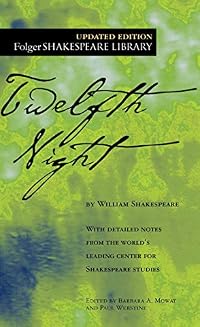
Twelfth Night
by William Shakespeare
On This Page
Description
Another case of mistaken identity from the king of the plot twist, Twelfth Night tells the tale of the beautiful young Viola who is separated from her twin brother, Sebastian, when their ship is lost at sea. Believing Sebastian to be dead Viol poses as a man and enters service with the Duke Orisino. When Olivia, the woman that Orisino loves, falls for his messenger "boy" Viola and she in turn falls for the Duke the stage is set for a classic Shakespearean love triangle..
Tags
Recommendations



Member Reviews
"This fellow is wise enough to play the fool… This is a practice As full of labour as a wise man's art…" (pg. 64)
Shakespeare's comedies always seem to enjoy a more ambiguous reputation than his tragedies. Whereas, once the peculiarities of language are overcome, dramatic schemes and actions like those in Macbeth, Hamlet and King Lear can be readily identified and appreciated by modern audiences, it is often much harder to parse the worth of one of the Bard's comedies. That they do have worth – The Merchant of Venice and The Taming of the Shrew are ingenious satires, and A Midsummer Night's Dream is metaphysical drunkenness – is why so many readers and lovers of the theatre make the effort to meet them halfway, or sometimes more show more than halfway.
This is why I happily dismissed my doubts about Twelfth Night and why, even though this play doesn't have the deeper worth of those other Shakespeare comedies I mentioned above, I cannot fault it. The clue to Twelfth Night's essence is in its title, which has no bearing on the content of the play: 'Twelfth Night' is a day of festivities, a date in early January to mark the end of the Christmas period. To this end, Shakespeare's light romp of mistaken identities, bawdy language and plenty of sing-song, was meant as just a piece of fluff for Queen Elizabeth's court. The equivalent of one of our Boxing Day TV repeats as we pig out on Quality Street.
Despite this light remit, Shakespeare can't help but be erudite, dexterous and interesting. For all its mistaken identities and merry pranking, it is one of the easiest Shakespearean comedies to follow. It's tidy and it's never dull and it's one of Shakespeare's more quotable plays. Its success in doing all this well means this piece of fluff has survived, through the skill of its author, for much longer than would otherwise be expected. After all, while some, like Hamlet and Macbeth, are born great, and others like The Merchant of Venice and King Lear achieve greatness, some, by virtue of sharing such company, have greatness thrust upon them. Twelfth Night is one of the latter. show less
Shakespeare's comedies always seem to enjoy a more ambiguous reputation than his tragedies. Whereas, once the peculiarities of language are overcome, dramatic schemes and actions like those in Macbeth, Hamlet and King Lear can be readily identified and appreciated by modern audiences, it is often much harder to parse the worth of one of the Bard's comedies. That they do have worth – The Merchant of Venice and The Taming of the Shrew are ingenious satires, and A Midsummer Night's Dream is metaphysical drunkenness – is why so many readers and lovers of the theatre make the effort to meet them halfway, or sometimes more show more than halfway.
This is why I happily dismissed my doubts about Twelfth Night and why, even though this play doesn't have the deeper worth of those other Shakespeare comedies I mentioned above, I cannot fault it. The clue to Twelfth Night's essence is in its title, which has no bearing on the content of the play: 'Twelfth Night' is a day of festivities, a date in early January to mark the end of the Christmas period. To this end, Shakespeare's light romp of mistaken identities, bawdy language and plenty of sing-song, was meant as just a piece of fluff for Queen Elizabeth's court. The equivalent of one of our Boxing Day TV repeats as we pig out on Quality Street.
Despite this light remit, Shakespeare can't help but be erudite, dexterous and interesting. For all its mistaken identities and merry pranking, it is one of the easiest Shakespearean comedies to follow. It's tidy and it's never dull and it's one of Shakespeare's more quotable plays. Its success in doing all this well means this piece of fluff has survived, through the skill of its author, for much longer than would otherwise be expected. After all, while some, like Hamlet and Macbeth, are born great, and others like The Merchant of Venice and King Lear achieve greatness, some, by virtue of sharing such company, have greatness thrust upon them. Twelfth Night is one of the latter. show less
One of Shakespeare's better comedies, it's a definite favorite of mine to both read and watch either on stage or on television (think Felicity Kendal as Viola and Trevor Peacock as the fool, Feste). There's a bit of mean-spirited humor, but the part the Clown plays within the confines of the play is both endearing, funny, and tinged with sadness. What starts with a ship wreck turns into a case of mistaken identities, a woman playing a man, wayward letters, drunks, and a lot of singing. It may lack the depth (and good advice) of "Hamlet," but "Twelfth Night" shouldn't be pooh-pooh'd as merely light-hearted fun. If you look into it hard enough, you can find the sadder aspects of life and the roles we play to different individuals.
The best of the bard's comedies with a wealth of character relevation, and lovely passages of poetry. The plot is simple: a shipwrecked slip of a girl, with no great career prospects, manages to do a successful male impersonation, and gain a comfortable marriage. Hi-jinks ensue, written by an author who did not like puritans. I seem to have read it nine times, and seen a performance.
Shakespeare's last great romantic comedy combines the wit of the other great comedies with some rather mean-spirited slapstick more reminiscent of his very first comedies. The first is provided largely by the male-impersonating heroine who finds herself, as an intermediary between lovers, becoming the true object of affection from both lovers. The slapstick is provided by Sir Toby Belch, a small-scale Falstaff, and his idiot friends, who make life miserable for a major domo whose Puritanism does not protect him from vanity and desire. I loved it, despite the bullying.
If music be the food of love, play on;
Give me excess of it, that, surfeiting,
The appetite may sicken, and so die.
That strain again! it had a dying fall:
O, it came o'er my ear like the sweet sound,
That breathes upon a bank of violets,
Stealing and giving odour! Enough; no more:
'Tis not so sweet now as it was before.
O spirit of love! how quick and fresh art thou,
That, notwithstanding thy capacity
Receiveth as the sea, nought enters there,
Of what validity and pitch soe'er,
But falls into abatement and low price,
Even in a minute: so full of shapes is fancy
That it alone is high fantastical.
Act 1, 1.1-15
Every major character in Twelfth Night experiences some form of desire or love. Duke Orsino is in love with Olivia. Viola falls in love with show more Orsino, while disguised as his pageboy, Cesario. Olivia falls in love with Cesario. This love triangle is only resolved when Olivia falls in love with Viola's twin brother, Sebastian, and, at the last minute, Orsino decides that he actually loves Viola. Twelfth Night derives much of its comic force by satirizing these lovers. In the lines that open the play (above), Shakespeare pokes fun at Orsino's flowery love poetry, making it clear that Orsino is more in love with being in love than with his supposed beloveds. At the same time, by showing the details of the intricate rules that govern how nobles engage in courtship, Shakespeare examines how characters play the "game" of love. Viola (as Cesario) has the following lines in Act 1, scene 5:
Make me a willow cabin at your gate
And call upon my soul within the house;
Write loyal cantons of contemned love
And sing them loud even in the dead of night;
Halloo your name to the reverberate hills
And make the babbling gossip of the air
Cry out 'Olivia!' O, You should not rest
Between the elements of air and earth
But you should pity me. (251-259)
Twelfth Night further mocks the main characters' romantic ideas about love through the escapades of the servants. Malvolio's idiotic behavior, which he believes will win Olivia's heart, serves to underline Orsino's own only-slightly-less silly romantic ideas. Meanwhile, Sir Andrew Aguecheek, Sir Toby Belch, and Maria, are always cracking crass double entendres that make it clear that while the nobles may spout flowery poetry about romantic love, that love is at least partly motivated by desire and sex. Shakespeare further makes fun of romantic love by showing how the devotion that connects siblings (Viola and Sebastian) and servants to masters (Antonio to Sebastian and Maria to Olivia) actually prove more constant than any of the romantic bonds in the play.
But there is more than love and desire in this amazing comedy. At the opening when Viola is shipwrecked in Illyria she bemoans that she cannot join her lost twin brother Sebastian in Elysium. Illyria is not Elysium however it reminds those familiar with As You Like It of the Arcadian forest of Arden. In both plays the setting is otherworldly--a place apart from the rest of civilization.
There is also melancholy, for several characters in Twelfth Night suffer from some version of love-melancholy. Orsino exhibits many symptoms of the disease (including lethargy, inactivity, and interest in music and poetry). Dressed up as Cesario, Viola describes herself as dying of melancholy, because she is unable to act on her love for Orsino. Olivia also describes Malvolio as melancholy and blames it on his narcissism. It is this melancholy that represents the painful side of love.
Perhaps more central to this play in particular are the themes of deception, disguise, and performance. With these themes Twelfth Night raises questions about the nature of gender and sexual identity. That Viola has disguised herself as a man, and that her disguise fools Olivia into falling in love with her, is genuinely funny. On a more serious note, however, Viola's transformation into Cesario, and Olivia's impossible love for him/her, also imply that, maybe, distinctions between male/female and heterosexual/homosexual are not as absolutely firm as you might think. When you recall that the players in Shakespeare's Globe were all men and boys these issues become both more humorous and serious at the same time. You may get a more vivid idea of this theme by viewing clips of the recent all-male production of Twelfth Night starring Mark Rylance.*
This play rivals As You Like It for the title of the best of Shakespeare's comedies. While I prefer the former, there are complexities of love and desire mixed with questions of sexual identity that make this comedy a fine way to experience and enjoy Shakespeare. show less
Give me excess of it, that, surfeiting,
The appetite may sicken, and so die.
That strain again! it had a dying fall:
O, it came o'er my ear like the sweet sound,
That breathes upon a bank of violets,
Stealing and giving odour! Enough; no more:
'Tis not so sweet now as it was before.
O spirit of love! how quick and fresh art thou,
That, notwithstanding thy capacity
Receiveth as the sea, nought enters there,
Of what validity and pitch soe'er,
But falls into abatement and low price,
Even in a minute: so full of shapes is fancy
That it alone is high fantastical.
Act 1, 1.1-15
Every major character in Twelfth Night experiences some form of desire or love. Duke Orsino is in love with Olivia. Viola falls in love with show more Orsino, while disguised as his pageboy, Cesario. Olivia falls in love with Cesario. This love triangle is only resolved when Olivia falls in love with Viola's twin brother, Sebastian, and, at the last minute, Orsino decides that he actually loves Viola. Twelfth Night derives much of its comic force by satirizing these lovers. In the lines that open the play (above), Shakespeare pokes fun at Orsino's flowery love poetry, making it clear that Orsino is more in love with being in love than with his supposed beloveds. At the same time, by showing the details of the intricate rules that govern how nobles engage in courtship, Shakespeare examines how characters play the "game" of love. Viola (as Cesario) has the following lines in Act 1, scene 5:
Make me a willow cabin at your gate
And call upon my soul within the house;
Write loyal cantons of contemned love
And sing them loud even in the dead of night;
Halloo your name to the reverberate hills
And make the babbling gossip of the air
Cry out 'Olivia!' O, You should not rest
Between the elements of air and earth
But you should pity me. (251-259)
Twelfth Night further mocks the main characters' romantic ideas about love through the escapades of the servants. Malvolio's idiotic behavior, which he believes will win Olivia's heart, serves to underline Orsino's own only-slightly-less silly romantic ideas. Meanwhile, Sir Andrew Aguecheek, Sir Toby Belch, and Maria, are always cracking crass double entendres that make it clear that while the nobles may spout flowery poetry about romantic love, that love is at least partly motivated by desire and sex. Shakespeare further makes fun of romantic love by showing how the devotion that connects siblings (Viola and Sebastian) and servants to masters (Antonio to Sebastian and Maria to Olivia) actually prove more constant than any of the romantic bonds in the play.
But there is more than love and desire in this amazing comedy. At the opening when Viola is shipwrecked in Illyria she bemoans that she cannot join her lost twin brother Sebastian in Elysium. Illyria is not Elysium however it reminds those familiar with As You Like It of the Arcadian forest of Arden. In both plays the setting is otherworldly--a place apart from the rest of civilization.
There is also melancholy, for several characters in Twelfth Night suffer from some version of love-melancholy. Orsino exhibits many symptoms of the disease (including lethargy, inactivity, and interest in music and poetry). Dressed up as Cesario, Viola describes herself as dying of melancholy, because she is unable to act on her love for Orsino. Olivia also describes Malvolio as melancholy and blames it on his narcissism. It is this melancholy that represents the painful side of love.
Perhaps more central to this play in particular are the themes of deception, disguise, and performance. With these themes Twelfth Night raises questions about the nature of gender and sexual identity. That Viola has disguised herself as a man, and that her disguise fools Olivia into falling in love with her, is genuinely funny. On a more serious note, however, Viola's transformation into Cesario, and Olivia's impossible love for him/her, also imply that, maybe, distinctions between male/female and heterosexual/homosexual are not as absolutely firm as you might think. When you recall that the players in Shakespeare's Globe were all men and boys these issues become both more humorous and serious at the same time. You may get a more vivid idea of this theme by viewing clips of the recent all-male production of Twelfth Night starring Mark Rylance.*
This play rivals As You Like It for the title of the best of Shakespeare's comedies. While I prefer the former, there are complexities of love and desire mixed with questions of sexual identity that make this comedy a fine way to experience and enjoy Shakespeare. show less
One of Shakespeare’s plays turns out to be surprisingly (at least to me) sexually fluid. I like the complexity of the pretending game going on, even if it gets rather confusing sometimes.
A case of mistaken identity is always a good time. I'm embarking on the Shakespeare 2020 challenge, and starting off with a comedy is always a great idea, in my book.
This year, I'll be looking for spaces to integrate queer, womanist identities, and the characters of Antonio, Malvolio, Clown, and Maria provide plenty of fodder for consideration.
Questions I have: is Maria a villain or an opportunistic agent? And is this bad?
Is Malvolio a bad guy or misunderstood?
Are the Duke (and possibly Viola) queer?
This year, I'll be looking for spaces to integrate queer, womanist identities, and the characters of Antonio, Malvolio, Clown, and Maria provide plenty of fodder for consideration.
Questions I have: is Maria a villain or an opportunistic agent? And is this bad?
Is Malvolio a bad guy or misunderstood?
Are the Duke (and possibly Viola) queer?
Members
- Recently Added By
Lists

Favorite Shakespeare plays?
37 works; 44 members

Greatest Books, allegedly
484 works; 9 members

Folio Society
831 works; 53 members

Five star books
1,755 works; 108 members

Books mentioned in Fire and Hemlock by Diana Wynne Jones
33 works; 1 member

Stage Plays/Screenplays/Dialogues/Anything Dialogue-Storytelling Related
81 works; 2 members
Books Mentioned in The Wedding Planner's Daughter series
107 works; 2 members
1:28 p.m.'s 350 Stage Plays Challenge
94 works; 3 members

AP Lit
363 works; 6 members

Authors from England
147 works; 4 members
Essential/Recognized Stage Plays
115 works; 4 members

Book Titles Mentioned In Newberry Medal And Honor Books
884 works; 3 members
'Books You Can't Live Without: The Top 100', The Guardian, 2007
156 works; 7 members

Recommended Reading : 600 Classics Reviewed, Editors of Salem Press, 2015
634 works; 6 members
My Play Collection
769 works; 3 members
School Made Us Read It
380 works; 196 members

Read the book and saw the movie
1,170 works; 195 members

Books With Numbers in the Title
308 works; 13 members

Unread books
1,063 works; 84 members

Great Books Favorites
71 works; 6 members
Plays I Like
230 works; 31 members

Bibliography for Among Others
159 works; 15 members

Best of British Literature
226 works; 41 members

Books You Read During High School (For School)
301 works; 53 members
One Book, Many Authors
441 works; 40 members

Merrill's English Texts
59 works; 3 members

Ambleside Books
459 works; 18 members

Western World's Greatest Books - Project Gutenberg
295 works; 15 members

100 Books to Read in a Lifetime (That Are Older Than 200 Years)
415 works; 175 members
Literature About Women and Girls
391 works; 39 members

Literary Works Read in College
316 works; 15 members

100 World Classics
99 works; 15 members
Favourite Books
1,817 works; 308 members

Books with Twins
175 works; 12 members
Early Modern (Shakesperean)
64 works; 2 members

In Our Time books
4,934 works; 2 members
Talk Discussions
Past Discussions
some words about the Comic Character Malvolio in Twelfth Night in Book talk (June 2011)
Author Information

5,934+ Works 439,893 Members
William Shakespeare, 1564 - 1616 Although there are many myths and mysteries surrounding William Shakespeare, a great deal is actually known about his life. He was born in Stratford-Upon-Avon, son of John Shakespeare, a prosperous merchant and local politician and Mary Arden, who had the wealth to send their oldest son to Stratford Grammar School. show more At 18, Shakespeare married Anne Hathaway, the 27-year-old daughter of a local farmer, and they had their first daughter six months later. He probably developed an interest in theatre by watching plays performed by traveling players in Stratford while still in his youth. Some time before 1592, he left his family to take up residence in London, where he began acting and writing plays and poetry. By 1594 Shakespeare had become a member and part owner of an acting company called The Lord Chamberlain's Men, where he soon became the company's principal playwright. His plays enjoyed great popularity and high critical acclaim in the newly built Globe Theatre. It was through his popularity that the troupe gained the attention of the new king, James I, who appointed them the King's Players in 1603. Before retiring to Stratford in 1613, after the Globe burned down, he wrote more than three dozen plays (that we are sure of) and more than 150 sonnets. He was celebrated by Ben Jonson, one of the leading playwrights of the day, as a writer who would be "not for an age, but for all time," a prediction that has proved to be true. Today, Shakespeare towers over all other English writers and has few rivals in any language. His genius and creativity continue to astound scholars, and his plays continue to delight audiences. Many have served as the basis for operas, ballets, musical compositions, and films. While Jonson and other writers labored over their plays, Shakespeare seems to have had the ability to turn out work of exceptionally high caliber at an amazing speed. At the height of his career, he wrote an average of two plays a year as well as dozens of poems, songs, and possibly even verses for tombstones and heraldic shields, all while he continued to act in the plays performed by the Lord Chamberlain's Men. This staggering output is even more impressive when one considers its variety. Except for the English history plays, he never wrote the same kind of play twice. He seems to have had a good deal of fun in trying his hand at every kind of play. Shakespeare wrote 154 sonnets, all published on 1609, most of which were dedicated to his patron Henry Wriothsley, The Earl of Southhampton. He also wrote 13 comedies, 13 histories, 6 tragedies, and 4 tragecomedies. He died at Stratford-upon-Avon April 23, 1616, and was buried two days later on the grounds of Holy Trinity Church in Stratford. His cause of death was unknown, but it is surmised that he knew he was dying. (Bowker Author Biography) show less
Some Editions
Awards and Honors
Series
Belongs to Publisher Series
Work Relationships
Is contained in
4 Plays: As You Like It; A Midsummer Night's Dream; The Tempest; Twelfth Night by William Shakespeare
4 Plays: The Merchant of Venice; A Midsummer Night's Dream; The Taming of the Shrew; Twelfth Night by William Shakespeare
5 Plays: As You Like It; The Merry Wives of Windsor; A Midsummer Night's Dream; Much Ado About Nothing; Twelfth Night by William Shakespeare
The complete works of William Shakespeare : reprinted from the First Folio (volume 5 of 13) by William Shakespeare
4 Plays: A Midsummer Night's Dream; The Taming of the Shrew; The Tempest; Twelfth Night by William Shakespeare
4 Plays: As You Like It; Love's Labour's Lost; The Merchant of Venice; Twelfth Night by William Shakespeare
The Annotated Shakespeare: The Comedies, Histories, Sonnets and Other Poems, Tragedies and Romances Complete by William Shakespeare (indirect)
Is retold in
Has the (non-series) sequel
Has the adaptation
Is abridged in
Inspired
Has as a study
Has as a supplement
Has as a commentary on the text
Has as a student's study guide
Has as a teacher's guide
Common Knowledge
- Canonical title
- Twelfth Night
- Original title
- Twelfth Night, or What You Will
- Alternate titles
- What You Will; A New Variorum Edition of Shakespeare: Twelfth Night or, what you will
- Original publication date
- 1601; 1623 (Folio) (Folio)
- People/Characters
- Viola; Sebastian; Antonio; Orsino; Valentine; Curio (show all 14); Sir Toby Belch; Sir Andrew Aguecheek; Malvolio; Fabian; Feste; Olivia; Maria; Sea Captain
- Important places
- Illyria
- Important events
- Christmas
- Related movies
- Hallmark Hall of Fame: Twelfth Night (1957 | IMDb); Twelfth Night (1969 | IMDb); Twelfth Night, or What You Will (1988 | IMDb); Twelfth Night (1996 | IMDb); Twelfth Night, or What You Will (2003 | IMDb); She's the Man (2006 | IMDb)
- First words
- If music be the food of love, play on,
Give me excess of it; that, surfeiting,
The appetite may sicken, and so die.
Feste the Clown: Come away, come away, death,
And in sad cypress let me be laid;
Fly away, fl y away, breath;
I am slain by a fair cruel maid.
My shroud of white, stuck all with yew,
O, prepare it!
My part o... (show all)f death, no one so true
Did share it. - Quotations
- If music be the food of love, play on;
Give me excess of it, that, surfeiting,
The appetite may sicken, and so die.
That strain again! it had a dying fall:
O, it came o'er my ear like the sweet sound
T... (show all)hat breathes upon a bank of violets,
Stealing and giving odour!
what says Quinapalus?
“Better a witty fool, than a foolish wit.”
If this were played upon a stage now, I could condemn it as an improbable fiction.
Be not afraid of greatness: some men are born great, some achieve greatness and some have greatness thrust upon them. - Last words
- (Click to show. Warning: May contain spoilers.)A great while ago the world begun,
With hey, ho, the wind and the rain,
But that's all one, our play is done,
And we'll strive to please you every day.
(Click to show. Warning: May contain spoilers.)When that I was and a little tiny boy,
With hey, ho, the wind and the rain,
A foolish thing was but a toy,
For the rain it raineth every day.
But when I came to man’s estate,
With hey, ho, the wind and the rain,
Against knaves and thieves men shut their gate,
For the rain it raineth every day.
But when I came, alas! to wive,
With hey, ho, the wind and the rain,
By swaggering could I never thrive,
For the rain it raineth every day.
But when I came unto my beds,
With hey, ho, the wind and the rain,
With toss-pots still had drunken heads,
For the rain it raineth every day.
A great while ago the world begun,
With hey, ho, the wind and the rain,
But that’s all one, our play is done,
And we’ll strive to please you every day. - Publisher's editor
- Applebaum, Stanley; Ward, Candace; Harrison, G. B. (Penguin Popular Classics); Mahood, M. M. (New Penguin Shakespeare)
- Original language*
- Englisch
- Disambiguation notice
- This work is for the complete Twelfth Night only. Do not combine this work with abridgements, adaptations or "simplifications" (such as "Shakespeare Made Easy"), Cliffs Notes or similar study guides, or anything else t... (show all)hat does not contain the full text. Do not include any video recordings. Additionally, do not combine this with other plays.
*Some information comes from Common Knowledge in other languages. Click "Edit" for more information.
Classifications
Statistics
- Members
- 12,488
- Popularity
- 664
- Reviews
- 131
- Rating
- (3.98)
- Languages
- 27 — Afrikaans, Arabic, Catalan, Chinese, Czech, Dutch, English, English (Middle), Esperanto, Finnish, French, German, Galician, Greek, Swiss German, Hungarian, Italian, Japanese, Multiple languages, Norwegian (Bokmål), Polish, Russian, Croatian, Spanish, Swedish, Turkish, Portuguese (Portugal)
- Media
- Paper, Audiobook, Ebook
- ISBNs
- 557
- UPCs
- 12
- ASINs
- 241