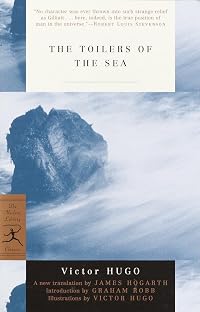
The Toilers of the Sea
by Victor Hugo
On This Page
Description
"No character was ever thrown into such strange relief as Gilliatt... here, indeed, the true position of man in the universe." --Robert Louis Stevenson The Toilers of the Sea tells the fairytale-esque story of Gilliatt, an outcast fisherman who must rescue an engine from a wrecked steamship. If successful, he will win the hand of the shipowner's beautiful daughter, Déruchette. He will brave the harsh rocks, the freezing waves, and even the grasp of a sea monster to prove his worth. A show more richly detailed study of early nineteenth-century Guernsey, The Toilers of the Sea is the oft-forgotten novel that completes a trilogy with Hugo's famed The Hunchback of Notre Dame and Les Misérables. It is a tribute to the drama of nature and the insignificance of man against it, to solitude in exile, and the light we choose to carry in the darkness. show lessTags
Recommendations


























Member Recommendations

Member Reviews
Eco szerint az olvasónak nem kell mindent tudnia a regény univerzumáról, mert egy regény narratívája szükségszerűen csak kisvilágokban működik*. Hugo viszont tojik Eco-ra, és könyve elejére odabiggyeszt egy könnyed ötven oldalas kultúr-, gazdaság- és etnotörténeti tanulmányt a normann szigetvilágról – nesze neked, Nyájas Olvasó, ezt mind biflázd be, mielőtt egyáltalán beengedlek a történetembe. Úgyhogy fel lehet venni a túrabakacsokat, meg a vízhatlan tengerészkabátot, és veselkedjünk neki. A vicc az, hogy amilyen nagy író Hugo, még ezt is megteheti, mert a szárazanyagot is olyan elemi lelkesedéssel tálalja, hogy az ember nem is bánja, amikor az idegeire megy, mi több, még hálás is show more érte. Érthető amúgy az efféle nyitány, mert ennek a könyvnek a főszereplője bizony maga Guernesey szigete úgy mindenestül**, no és persze a szörnyű, a félelmetes, a csodálatos óceán. Mellette eltörpülnek az emberek, még a regény talán legfőszereplőbb (humán) szereplője, Gilliatt is legfeljebb a mellékszereplő kategóriában nevezhet az Oscar-ra.
A helyszín nem csak a szereplőkre, de a sztorira is árnyékot vet: talán ez a legharmatosabb cselekményű Hugo-történet a nagyregények közül. Tulajdonképpen annyi az egész (eltekintve a marginális, bár fineszesen megszerkesztett kacskaringóktól), hogy Gilliatt, az „ördöngős” egy pokoli szikladarabon, a tenger kellős közepén egymagában nekiáll végrehajtani a lehetetlen küldetést. Egyfajta újraértelmezett Robinson Crusoe ő: az emberfeletti ember, aki saját eszére és erejére hagyatkozva küzd meg az elemekkel. Azért az író egy pluszt is bevisz ebbe a szálba, mégpedig egy rettentő polipot! Egy rohadt nagy, ocsmány polipot!!! Mi ez, ha nem cool? És ez a polip nem ám valami Attenborough-természetfilmből szökött át, hanem egyenesen az ’50-es évek amerikai szörnymozijaiból! Szóval nagyszerű mese ez, ha valaki szereti a francia romantikusok áradó nyelvezetét, akik képesek egy parasztház tetőszerkezetéről is másfél-két oldalas, harsány színekkel megföstött gyorselemzést illeszteni a regénytestbe. És persze ha valakit nem zavar, ha egy író galádul bánik a szereplőivel***.
(Megjegyzés: és ha valakinek nem tűnt volna fel a Nyomorultak-ból – Victor Hugonak nagyon jó humora van!)
* "A mintaolvasónak nem kell ismernie az összes említett helyet és individuumot a regényben. Elegendő, ha úgy tesz, mintha hinné, hogy ismeri őket. Nem csupán hatalmas méretű rugalmasság és felületesség kéretik a mintaolvasótól, hanem a jó szándék folyamatos gyakorlása is.
Ha a mintaolvasó így viselkedik, élvezni fogja a történetet. Máskülönben örökké tartó enciklopédikus kutatásra ítéltetik. Akadhatnak olvasók, akik azt kérdezik, hány lakosa lehet Saint-Quen-les-Toits-nak, vagy hogy hívják Charles Bovary nagyapját. De az ilyen akadékoskodók nem mintaolvasók. Maximális világokat keresnek, míg a narratíva csak kis világokkal maradhat életben." (Eco: Az értelmezés határai)
** Ahol amúgy Hugo száműzetésének éveit töltötte. Ilyen értelemben elmondhatjuk, hogy igazi íróként kipréselte a rosszból a jót, és a lehető legtöbbet profitált a kényszerű ottlétből – és nem mellesleg Guernesey sem járt rosszul, mert ilyen szép himnuszt aligha írtak hozzá még egyet.
*** Ebben a műben Hugo még azt a disznóságot is elköveti, hogy csinál (SPOILER!!!) egy protohepiendet, amikor Gilliatt sikerrel véghezviszi a véghezvihetetlent. De amint nyugodtan hátradőlünk, mert minden rendben levőnek látszik, akkor az író sanda vigyorral ajkán visszakézből lekever neki egyet. show less
A helyszín nem csak a szereplőkre, de a sztorira is árnyékot vet: talán ez a legharmatosabb cselekményű Hugo-történet a nagyregények közül. Tulajdonképpen annyi az egész (eltekintve a marginális, bár fineszesen megszerkesztett kacskaringóktól), hogy Gilliatt, az „ördöngős” egy pokoli szikladarabon, a tenger kellős közepén egymagában nekiáll végrehajtani a lehetetlen küldetést. Egyfajta újraértelmezett Robinson Crusoe ő: az emberfeletti ember, aki saját eszére és erejére hagyatkozva küzd meg az elemekkel. Azért az író egy pluszt is bevisz ebbe a szálba, mégpedig egy rettentő polipot! Egy rohadt nagy, ocsmány polipot!!! Mi ez, ha nem cool? És ez a polip nem ám valami Attenborough-természetfilmből szökött át, hanem egyenesen az ’50-es évek amerikai szörnymozijaiból! Szóval nagyszerű mese ez, ha valaki szereti a francia romantikusok áradó nyelvezetét, akik képesek egy parasztház tetőszerkezetéről is másfél-két oldalas, harsány színekkel megföstött gyorselemzést illeszteni a regénytestbe. És persze ha valakit nem zavar, ha egy író galádul bánik a szereplőivel***.
(Megjegyzés: és ha valakinek nem tűnt volna fel a Nyomorultak-ból – Victor Hugonak nagyon jó humora van!)
* "A mintaolvasónak nem kell ismernie az összes említett helyet és individuumot a regényben. Elegendő, ha úgy tesz, mintha hinné, hogy ismeri őket. Nem csupán hatalmas méretű rugalmasság és felületesség kéretik a mintaolvasótól, hanem a jó szándék folyamatos gyakorlása is.
Ha a mintaolvasó így viselkedik, élvezni fogja a történetet. Máskülönben örökké tartó enciklopédikus kutatásra ítéltetik. Akadhatnak olvasók, akik azt kérdezik, hány lakosa lehet Saint-Quen-les-Toits-nak, vagy hogy hívják Charles Bovary nagyapját. De az ilyen akadékoskodók nem mintaolvasók. Maximális világokat keresnek, míg a narratíva csak kis világokkal maradhat életben." (Eco: Az értelmezés határai)
** Ahol amúgy Hugo száműzetésének éveit töltötte. Ilyen értelemben elmondhatjuk, hogy igazi íróként kipréselte a rosszból a jót, és a lehető legtöbbet profitált a kényszerű ottlétből – és nem mellesleg Guernesey sem járt rosszul, mert ilyen szép himnuszt aligha írtak hozzá még egyet.
*** Ebben a műben Hugo még azt a disznóságot is elköveti, hogy csinál (SPOILER!!!) egy protohepiendet, amikor Gilliatt sikerrel véghezviszi a véghezvihetetlent. De amint nyugodtan hátradőlünk, mert minden rendben levőnek látszik, akkor az író sanda vigyorral ajkán visszakézből lekever neki egyet. show less
The Toilers of the Sea is a bittersweet story, and while not in quite the vein of Hunchback and Les Mis it is still completely Victor Hugo. Gilliatt, the protagonist of this novel, undergoes what I can only compare to the mythical trials of Odysseus. In order to receive what he wants most, he must undertake the impossible. But, in the end, though he conquered wind and sea, battled monsters and his own failings, he forgot to anticipate the working of another human heart. His ending is both heartfelt and heartbreaking. Simply a lovely novel. While filled with typical Hugo over indulgence in descriptions, the final narrative is definitely worth the read.
Hugo wrote this book as a sort of nod to the isle of Guernsey for hosting him while he was in political disfavor in France. It is a love story to that island. I think at a younger age, I might have enjoyed it more, but I became impatient with it after trying to make progress for over a month.
Finally, I took the bull by the horns and decided to skim read; when I read the last few chapters, I was very glad I hadn't put any more time into it. Imagine Charles Dickens at his most maudlin. Was Victor Hugo paid by the word? You cannot imagine how many words he used to tell a very small thing. I will admit that he uses words charmingly, even cleverly, but so many! It's like trying to eat a huge dense fruitcake. Glad that's over.
Finally, I took the bull by the horns and decided to skim read; when I read the last few chapters, I was very glad I hadn't put any more time into it. Imagine Charles Dickens at his most maudlin. Was Victor Hugo paid by the word? You cannot imagine how many words he used to tell a very small thing. I will admit that he uses words charmingly, even cleverly, but so many! It's like trying to eat a huge dense fruitcake. Glad that's over.
A great book and well written. It's a wonderful story of a moral hero that accomplishes the impossible against all odds, for what turn out to be selfless reasons. It's got a good smattering of Robinson Crusoe ingenuity and survival as well, along with some love, intrigue, villainy, deception, and adventure.
My only complaint is that I had read nearly 150 pages before the story started. The author did plenty of digressing in his other novels I've read, but this one seemed over-the-top, but at least it was mostly front-loaded and if you can push through it you're good to go. I'd recommend this book, but skip the first 30% or so - you will miss nothing by doing this.
My only complaint is that I had read nearly 150 pages before the story started. The author did plenty of digressing in his other novels I've read, but this one seemed over-the-top, but at least it was mostly front-loaded and if you can push through it you're good to go. I'd recommend this book, but skip the first 30% or so - you will miss nothing by doing this.
How would you feel if someone you respect were to show you that one of your friends, whom you've liked and trusted for many years, is in fact a coward, hypocrite, backstabber, rapist and murderer? Troubled? Offended? Confused? Shocked? Sad? That's about how I felt when I was reading this book.
That someone is Victor Hugo, and that friend of mine is the Ocean.
Introduction
Growing up on the coast, the ocean has been my friend since childhood. I have fond memories of countless hours spent on the beach, swimming, playing with sand castles, collecting shellfish and starfish, or watching the sunset over the distant horizon.
This book by Hugo, Part III of a trilogy which also includes his two best-known works, Notre-Dame de Paris and Les show more Misérables, changed my perception to some extent of the ocean, man and the universe.
One of the main reasons why Hugo was and is so popular is that there are so many layers and nuances of his views that people from different walks of life find themselves represented and vindicated by him, and all can enjoy his books on different levels. This book is a prime example.
The Disney Story
The story may be summarized in one sentence printed on the back cover of the book. It "tells of the reclusive Guernsey fisherman Gilliatt, who salvages the engine of a wrecked ship by performing great feats of engineering, matching wits with sea and storm, and doing battle with a great sea monster - all to win the hand of a shipowner's daughter." It would make a great sea adventure movie with a music soundtrack (e.g., Beethoven's Pastoral Symphony), sound and visual effects and spectacular cinematography.
The One Man Iliad
The epic battle between Gilliatt and the Ocean is portrayed in Homeric style. The Ocean seems to bear a grudge against Gilliatt and fights against him with fury, which reminds one of the battle between Odysseus and the sea god Poseidon in Odyssey, Achilles and the river god Scamander in Iliad.
Hugo endows the Ocean with many human characteristics: how like a hypocrite she hides her secrets in caverns in which dwell man-eating monsters; how she overpowers her victims with bombardments of the waves and the wind like a coward; and if power fails, how she sneaks in on man through leaks, cracks and rusts like a backstabber.
The struggle between Gilliatt and the Ocean is painted as a violent rape. The rapist is the Ocean. In the end, Gilliatt was completely naked and in submission. Many natural phenomena are depicted as either a slaughter or a coitus, even the close encounter between Gilliatt and the man-eating octopus, "You both become one".
The Sufferer
The battle between Gilliatt and the Ocean is an allegory of man's battle with Fate, the Unknown, in general, and Hugo's own life in particular. At the time of writing the novel, Hugo was in political exile on the Guernsey island, his ideal of social progress having suffered a shipwreck. He was alone and forlorn, so downcast that he deemed the island his tomb. Fate was the backstabbing hypocrite, and he was the victim. Nevertheless, he devoted himself to the battle of the pen, naked like Gilliatt.
The Embracer
By assigning human attributes to nature, in a sense, Hugo promoted an amoral worldview, where "Evil is an erasure on the page of creation". "There are embraces and antagonisms, the magnificent flow and ebb of a universal antithesis."
Or, as it is written in the Ecclesiastes:
There is a time for everything,
and a season for every activity under heaven:
a time to be born and a time to die,
a time to kill and a time to heal,
a time to weep and a time to laugh,
a time to love and a time to hate,
a time for war and a time for peace.
The Ideal Man is one who embraces everything. "We feel the unknown that is within us fraternizing mysteriously with an unknown that is outside of us. ... to look at the stars and say, I'm a soul like you! to look at the darkness and say, I'm an abyss like you!"
The ideal man conquers all with his will and intelligence. "Faith is only a secondary power; the will is the first. The mountains,which faith is proverbially said to move, are nothing beside that which the will can accomplish." This quote reminded me of Nietzsche's conception of Übermensch.
Epilogue
I went to see my friend the Ocean again. There was a strong wind, and few people were left on the beach that had been crowded with sunbathers only a day before. In the beautiful sunset, the Ocean danced before us. show less
That someone is Victor Hugo, and that friend of mine is the Ocean.
Introduction
Growing up on the coast, the ocean has been my friend since childhood. I have fond memories of countless hours spent on the beach, swimming, playing with sand castles, collecting shellfish and starfish, or watching the sunset over the distant horizon.
This book by Hugo, Part III of a trilogy which also includes his two best-known works, Notre-Dame de Paris and Les show more Misérables, changed my perception to some extent of the ocean, man and the universe.
One of the main reasons why Hugo was and is so popular is that there are so many layers and nuances of his views that people from different walks of life find themselves represented and vindicated by him, and all can enjoy his books on different levels. This book is a prime example.
The Disney Story
The story may be summarized in one sentence printed on the back cover of the book. It "tells of the reclusive Guernsey fisherman Gilliatt, who salvages the engine of a wrecked ship by performing great feats of engineering, matching wits with sea and storm, and doing battle with a great sea monster - all to win the hand of a shipowner's daughter." It would make a great sea adventure movie with a music soundtrack (e.g., Beethoven's Pastoral Symphony), sound and visual effects and spectacular cinematography.
The One Man Iliad
The epic battle between Gilliatt and the Ocean is portrayed in Homeric style. The Ocean seems to bear a grudge against Gilliatt and fights against him with fury, which reminds one of the battle between Odysseus and the sea god Poseidon in Odyssey, Achilles and the river god Scamander in Iliad.
Hugo endows the Ocean with many human characteristics: how like a hypocrite she hides her secrets in caverns in which dwell man-eating monsters; how she overpowers her victims with bombardments of the waves and the wind like a coward; and if power fails, how she sneaks in on man through leaks, cracks and rusts like a backstabber.
The struggle between Gilliatt and the Ocean is painted as a violent rape. The rapist is the Ocean. In the end, Gilliatt was completely naked and in submission. Many natural phenomena are depicted as either a slaughter or a coitus, even the close encounter between Gilliatt and the man-eating octopus, "You both become one".
The Sufferer
The battle between Gilliatt and the Ocean is an allegory of man's battle with Fate, the Unknown, in general, and Hugo's own life in particular. At the time of writing the novel, Hugo was in political exile on the Guernsey island, his ideal of social progress having suffered a shipwreck. He was alone and forlorn, so downcast that he deemed the island his tomb. Fate was the backstabbing hypocrite, and he was the victim. Nevertheless, he devoted himself to the battle of the pen, naked like Gilliatt.
The Embracer
By assigning human attributes to nature, in a sense, Hugo promoted an amoral worldview, where "Evil is an erasure on the page of creation". "There are embraces and antagonisms, the magnificent flow and ebb of a universal antithesis."
Or, as it is written in the Ecclesiastes:
There is a time for everything,
and a season for every activity under heaven:
a time to be born and a time to die,
a time to kill and a time to heal,
a time to weep and a time to laugh,
a time to love and a time to hate,
a time for war and a time for peace.
The Ideal Man is one who embraces everything. "We feel the unknown that is within us fraternizing mysteriously with an unknown that is outside of us. ... to look at the stars and say, I'm a soul like you! to look at the darkness and say, I'm an abyss like you!"
The ideal man conquers all with his will and intelligence. "Faith is only a secondary power; the will is the first. The mountains,which faith is proverbially said to move, are nothing beside that which the will can accomplish." This quote reminded me of Nietzsche's conception of Übermensch.
Epilogue
I went to see my friend the Ocean again. There was a strong wind, and few people were left on the beach that had been crowded with sunbathers only a day before. In the beautiful sunset, the Ocean danced before us. show less
Imagine the perfect recipe, the perfect blend of elements. In many respects "The Toilers of the Sea" is that perfect blend. One part epic drama, one part satiric wit, one part ethnographic study of Guernsey Island in the mid 1800s, one part battle between man and nature, one part spiritual allegory, and the topping is two parts elegant prose. Yes, yes, it is a lot to take on, but Victor Hugo did it oh so well. How many authors can make long drawn out descriptive passages gripping?
Hugo's prose is marvelous and his insight into human nature seems the result of astute, keen observation. This book, written during his exile on Guernsey Island, represents a veritable compendium of observation. His writing makes me want to hop a flight to show more Guernsey yesterday! I have witnessed storms such as Hugo describes and it sent shivers up my spine as he recaptured the sense of foreboding in the air just before a massive storm breaks!
Drawbacks, unfortunately, they exist. Dialogue? Relationship between individuals? I get the sense that Hugo was aching with solitude and projected that into this novel. Character development is done really well, except that the characters rarely interact until the very end of the tale, and then quite superficially. If, as existentialists say, we are ultimately alone and judged by our actions, then this allegory is perfection itself!
I loved it...... show less
Hugo's prose is marvelous and his insight into human nature seems the result of astute, keen observation. This book, written during his exile on Guernsey Island, represents a veritable compendium of observation. His writing makes me want to hop a flight to show more Guernsey yesterday! I have witnessed storms such as Hugo describes and it sent shivers up my spine as he recaptured the sense of foreboding in the air just before a massive storm breaks!
Drawbacks, unfortunately, they exist. Dialogue? Relationship between individuals? I get the sense that Hugo was aching with solitude and projected that into this novel. Character development is done really well, except that the characters rarely interact until the very end of the tale, and then quite superficially. If, as existentialists say, we are ultimately alone and judged by our actions, then this allegory is perfection itself!
I loved it...... show less
Hugo was a mystic, a visionary, a seer; he was one of the last of the Romantics as realism was coming into vogue; he was as Flaubert put it, “a pantheist with the sap of trees in his veins”. “The Toilers of the Sea” (1866) is the story of a lonely man’s battle with the ocean, and it feels Homeric in form. Hugo wrote the book while he was living in the British-ruled Channel Islands while in exile from France, and the book is clearly inspired by the seascape, lore, and people of Guernsey, who he dedicated the book to. One has to suspend disbelief while reading Hugo, for example, during the fight with the octopus, which we know today to be gentle and very shy creatures. If you can do that, and if you like his other more popular show more works, you should enjoy this book.
Quotes:
On charm:
“There are on earth few more important functions than this: to be charming. The forest would be in despair without the humming-bird. To scatter joy, to beam with happiness, to possess amid somber things an exhalation of light, to be the gilding of destiny, to be harmony, to be grace, to be prettiness, is to render a service. “
On the cosmos:
“Night is the peculiar and normal state of the special creation of which we form a part. Daylight, brief in duration as in space, is but the proximity of a star.”
On destiny:
“Man participates in this movement of translation, and the amount of oscillation which he undergoes he calls destiny. Where does destiny begin? Where does nature end? What difference is there between an event and a season, between a grief and a shower, between a virtue and a star? Is not an hour a wave? The wheel-work continues, without replying to man, its impassive revolutions. The starry heaven is a vision of wheels, balances, and counterpoises.”
“Life is a perpetual succession! We undergo it. We never know from what quarter fate’s abrupt descent will be made. Catastrophes and happiness enter, then depart, like unexpected personages. They have their law, their orbit, their gravitation, outside of man. Virtue does not bring happiness, crime does not bring unhappiness; conscience has one logic, fate has another; no coincidence. Nothing can be foreseen. We live pell-mell, and in confusion. Conscience is a straight line, life is a whirlwind. This whirlwind unexpectedly casts black chaos and blue skies upon the head of man.”
On eating animals:
“All beings enter into each other. To decay is to nourish…Man, a carnivorous animal, is also one who buries. Our life is made up of death. Such is the appalling law. We are sepulchres.”
On God, and religion:
“Chance having led him to hear a sermon on hell by the Reverend Jacquemin Herode, a magnificent sermon filled from one end to the other with sacred texts proving eternal pains, punishments, torments, damnations, inexorable chastisements, endless burnings, inextinguishable curses, the wrath of the Omnipotent, celestial furies, divine vengeances, incontestable facts, he was heard to say gently, as he was coming out with one of the faithful: ‘You see, I have such a queer idea, I imagine that God is good.’”
On the human spirit:
“Man, this short-lived being, this creature always surrounded by death, undertakes the infinite.”
On the moment of truth:
“One often encounters in deeds of devotions or duty, interrogation points which seem placed there by death. ‘Wilt thou do this?’ says the shadow.”
On obstinacy:
“The obstinate are the sublime. He who is merely brave acts from impulse…the man obstinate in the true sense has greatness. Nearly the whole secret of great hearts lies in this word, perseverando…Whatever the goal may be, in earth or heaven, the whole secret lies in proceeding to that goal…”
On oneness:
“There is a work of the whole composed of all the works of isolation being swept along towards a common goal, without even the workers’ knowledge, by the one great central soul.” show less
Quotes:
On charm:
“There are on earth few more important functions than this: to be charming. The forest would be in despair without the humming-bird. To scatter joy, to beam with happiness, to possess amid somber things an exhalation of light, to be the gilding of destiny, to be harmony, to be grace, to be prettiness, is to render a service. “
On the cosmos:
“Night is the peculiar and normal state of the special creation of which we form a part. Daylight, brief in duration as in space, is but the proximity of a star.”
On destiny:
“Man participates in this movement of translation, and the amount of oscillation which he undergoes he calls destiny. Where does destiny begin? Where does nature end? What difference is there between an event and a season, between a grief and a shower, between a virtue and a star? Is not an hour a wave? The wheel-work continues, without replying to man, its impassive revolutions. The starry heaven is a vision of wheels, balances, and counterpoises.”
“Life is a perpetual succession! We undergo it. We never know from what quarter fate’s abrupt descent will be made. Catastrophes and happiness enter, then depart, like unexpected personages. They have their law, their orbit, their gravitation, outside of man. Virtue does not bring happiness, crime does not bring unhappiness; conscience has one logic, fate has another; no coincidence. Nothing can be foreseen. We live pell-mell, and in confusion. Conscience is a straight line, life is a whirlwind. This whirlwind unexpectedly casts black chaos and blue skies upon the head of man.”
On eating animals:
“All beings enter into each other. To decay is to nourish…Man, a carnivorous animal, is also one who buries. Our life is made up of death. Such is the appalling law. We are sepulchres.”
On God, and religion:
“Chance having led him to hear a sermon on hell by the Reverend Jacquemin Herode, a magnificent sermon filled from one end to the other with sacred texts proving eternal pains, punishments, torments, damnations, inexorable chastisements, endless burnings, inextinguishable curses, the wrath of the Omnipotent, celestial furies, divine vengeances, incontestable facts, he was heard to say gently, as he was coming out with one of the faithful: ‘You see, I have such a queer idea, I imagine that God is good.’”
On the human spirit:
“Man, this short-lived being, this creature always surrounded by death, undertakes the infinite.”
On the moment of truth:
“One often encounters in deeds of devotions or duty, interrogation points which seem placed there by death. ‘Wilt thou do this?’ says the shadow.”
On obstinacy:
“The obstinate are the sublime. He who is merely brave acts from impulse…the man obstinate in the true sense has greatness. Nearly the whole secret of great hearts lies in this word, perseverando…Whatever the goal may be, in earth or heaven, the whole secret lies in proceeding to that goal…”
On oneness:
“There is a work of the whole composed of all the works of isolation being swept along towards a common goal, without even the workers’ knowledge, by the one great central soul.” show less
Members
- Recently Added By
Lists

water on the brain: maritime fiction
74 works; 18 members

Best of French Literature
138 works; 27 members

Harold Bloom - The Western Canon: C. The Democratic Age
336 works; 15 members

Literary Works Read in College
316 works; 15 members

French Fiction of the 18th and 19th Centuries in English Translation
169 works; 3 members

Books and authors mentioned by Le Clézio in his Nobel Prize speech
87 works; 3 members

Literature in Translation
113 works; 5 members

1860s
25 works; 4 members

Out of Copyright
244 works; 14 members

Favourite Books
1,817 works; 308 members

Favorite Long Books
330 works; 41 members
Talk Discussions
Past Discussions
Toilers of the Sea Group Read in Author Theme Reads (February 2013)
Author Information

2,153+ Works 68,173 Members
Victor Hugo was born in Besançon, France on February 26, 1802. Although he originally studied law, Hugo dreamed of writing. In 1819, he founded the journal Conservateur Litteraire as an outlet for his dream and soon produced volumes of poetry, plays, and novels. His novels included The Hunchback of Notre Dame and Les Miserables. Both of these show more works have been adapted for the stage and screen many times. These adaptations include the Walt Disney version of The Hunchback of Notre Dame, and the award-winning musical sensation Les Miserables. In addition to his literary career, Hugo also held political office. In 1841, he was elected to the Academie Francaise. After political upheaval in 1851, he was exiled and remained so until 1870. He returned to Paris in 1871 and was elected to the National Assembly, though he soon resigned. He died on May 22, 1885. (Bowker Author Biography) show less
Some Editions
Awards and Honors
Series
Belongs to Publisher Series
Work Relationships
Is contained in
4 Vintage Hardcover Books by Victor Hugo: Hunchback of Notre Dame, The Laughing Man, Toilers of the Sea, Ninety-Three by Victor Hugo
Has the adaptation
Common Knowledge
- Canonical title
- The Toilers of the Sea
- Original title
- Les Travailleurs de la mer
- Original publication date
- 1866
- People/Characters
- Gilliatt; Deruchette; M. Lethierry
- Important places
- Guernsey, Channel Islands; Channel Islands
- Related movies*
- Toilers of the Sea (1936 | IMDb); Les travailleurs de la mer (1918 | IMDb); Toilers of the Sea (1923 | IMDb); The Toilers (1919 | IMDb); Sea Devils (1953 | IMDb)
- Dedication
- Je dédie ce livre au rocher d'hospitalité et de liberté, à ce coin de vieille terre normande où vit le noble petit peuple de la mer, à l'île de Guernesey, sévère et douce, mon asile actuel, mon tombeau probable.
<... (show all)br>(I dedicate this book to the rock of hospitality and freedom, in the corner of the ancient Norman lands where the noble little people of the sea live, to the island of Guernsey, harsh and sweet, my current refuge, my likely resting place.) - First words
- The Christmas of 182– was a memorable day in Guernsey.
- Last words
- (Click to show. Warning: May contain spoilers.)Nothing was visible now but the sea.
- Original language*
- Français
*Some information comes from Common Knowledge in other languages. Click "Edit" for more information.
Classifications
- Genres
- Fiction and Literature, General Fiction, Romance
- DDC/MDS
- 843.7 — Literature & rhetoric French Literature French fiction Constitutional monarchy 1815–48
- LCC
- PQ2289 .T7 .E55 — Language and Literature French, Italian, Spanish and Portuguese literatures French literature Modern literature 19th century
- BISAC
Statistics
- Members
- 1,471
- Popularity
- 15,817
- Reviews
- 29
- Rating
- (3.86)
- Languages
- 18 — Czech, Danish, Dutch, English, Finnish, French, German, Greek, Hungarian, Italian, Norwegian (Bokmål), Polish, Russian, Spanish, Swedish, Turkish, Portuguese (Portugal), Portuguese (Brazil)
- Media
- Paper, Audiobook, Ebook
- ISBNs
- 120
- ASINs
- 78