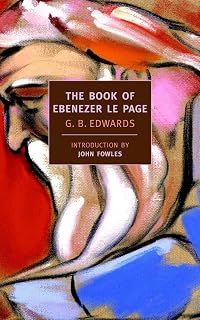
The Book of Ebenezer Le Page
by G. B. Edwards
On This Page
Description
Ebenezer Le Page, cantankerous, opinionated, and charming, is one of the most compelling literary creations of the late twentieth century. Eighty years old, Ebenezer has lived his whole life on the Channel Island of Guernsey, a stony speck of a place caught between the coasts of England and France yet a world apart from either. Ebenezer himself is fiercely independent, but as he reaches the end of his life he is determined to tell his own story and the stories of those he has known. He show more writes of family secrets and feuds, unforgettable friendships and friendships betrayed, love glimpsed and lost. The Book of Ebenezer Le Page is a beautifully detailed chronicle of a life, but it is equally an oblique reckoning with the traumas of the twentieth century, as Ebenezer recalls both the men lost to the Great War and the German Occupation of Guernsey during World War II, and looks with despair at the encroachments of commerce and tourism on his beloved island. G.B. Edwards labored in obscurity all his life and completed The Book of Ebenezer Le Page shortly before his death. Published posthumously, the book is a triumph of the storyteller's art that conjures up the extraordinary voice of a living man. show lessTags
Recommendations
























Member Recommendations
Widsith Two sprawling tales of Guernsey life, one from the great French Romantic master and one from a neo-Romantic native Guernseyman.
Member Reviews
One has to be in the right frame of mind for this book. The first time I picked it up, decades ago, I couldn’t get into it at first; then I adored it. Having just read it again, there were times when I thought it too slow, but upon finishing it I did truly feel as if the characters were flesh and blood. It is sentimental and provincial (not a criticism, a style description): best to read it when there is time and one is in a reflective mood. It is in a similar vein to books from the Blasket Islands; the ending has a Wuthering Heights vibe.
Through the narrator Ebenezer Le Page, an intimate portrait of life on Guernsey, both changing and unchanging, is revealed in the decades between the end of the 19th century and the mid-20th show more century. There are two important style choices made by the author that make this book stand out. While world events such as WWI, WWII and the German occupation of Guernsey are of course featured, they are incorporated only as to how they affect the narrator: there is no heavy-handed drama, at times they seem merely a blip on the radar, there is no sense of a ‘before and after’ and there are no dispatches from the world outside of the island. Rather than reflect mere insularity, this choice makes for a deep realism; the human experience of living day to day where any signposts or breaks in time periods are of our own design. We are in Ebenezer’s mind only and view the world through his singular lens.
The author does not care if we like or dislike any character, there are no extended “this is why they are the way they are” explanations. Just as in real life, we never fully know why people are the way they are. We are allowed to make our own guesses or to take each islander’s life choices at face value.
There is a bewildered sadness but also a defiant happiness captured in moments. In different ways for the main characters, it is a story of choosing individual freedom, of resisting the expectations of others, and choosing what price to pay for that freedom. show less
Through the narrator Ebenezer Le Page, an intimate portrait of life on Guernsey, both changing and unchanging, is revealed in the decades between the end of the 19th century and the mid-20th show more century. There are two important style choices made by the author that make this book stand out. While world events such as WWI, WWII and the German occupation of Guernsey are of course featured, they are incorporated only as to how they affect the narrator: there is no heavy-handed drama, at times they seem merely a blip on the radar, there is no sense of a ‘before and after’ and there are no dispatches from the world outside of the island. Rather than reflect mere insularity, this choice makes for a deep realism; the human experience of living day to day where any signposts or breaks in time periods are of our own design. We are in Ebenezer’s mind only and view the world through his singular lens.
The author does not care if we like or dislike any character, there are no extended “this is why they are the way they are” explanations. Just as in real life, we never fully know why people are the way they are. We are allowed to make our own guesses or to take each islander’s life choices at face value.
There is a bewildered sadness but also a defiant happiness captured in moments. In different ways for the main characters, it is a story of choosing individual freedom, of resisting the expectations of others, and choosing what price to pay for that freedom. show less
This book was a surprise. It sounds a little boring - an elderly man telling about his life on the island of Guernsey. But the time period, which spans early 1900s through the 1960s, and the unique setting of Guernsey, which changes from an isolated and unique island to a tourist destination that begins to lose its identity is fascinating.
Ebenezer Le Page describes his deep friendships beautifully and thoroughly, without being sappy or sentimental. He describes the beauty and uniqueness of the island itself without using travel guide language or much landscape description - instead describing how the locals interact with the terrain. He reacts to two world wars without creating a war novel, but by absorbing the deaths and German show more occupation into the story of Guernsey instead.
It's truly brilliant. The emotions underneath a matter of fact telling run deep. It's both a simple and complex narrative. I really loved it. show less
Ebenezer Le Page describes his deep friendships beautifully and thoroughly, without being sappy or sentimental. He describes the beauty and uniqueness of the island itself without using travel guide language or much landscape description - instead describing how the locals interact with the terrain. He reacts to two world wars without creating a war novel, but by absorbing the deaths and German show more occupation into the story of Guernsey instead.
It's truly brilliant. The emotions underneath a matter of fact telling run deep. It's both a simple and complex narrative. I really loved it. show less
This is like nothing else I've ever read. The solitary, curmudgeonly old Ebenezer le Page looks back on his life in Guernsey...World War I; the halcyon years before tourism; the German occupation- slave labor and starvation...and then the modern world. Edwards writes in colloquial language- Le Page is just an agricultural worke- yet the characters are so BRILLIANTLY described, that the reader feels he largely "gets" them....even the intensely complex Raymond, who struggles with religion, love and his sexuality...
There are some pretty horrendous marriages; there is pure platonic friendship of the highest order....it's long, it meanders, but you can't put it down.
How could it end? I wondered. There didnt seem any possible kind of show more resolution. The end is the best bit....
Utterly superb. show less
There are some pretty horrendous marriages; there is pure platonic friendship of the highest order....it's long, it meanders, but you can't put it down.
How could it end? I wondered. There didnt seem any possible kind of show more resolution. The end is the best bit....
Utterly superb. show less
It doesn't happen very often, but every now and again you come across writing that is so unexpectedly honest, true and life affirming that it feels like it leaves a permanent stamp on your soul.
Written as a three-part fictional (or was it???) memoir, The Book of Ebenezer Le Page is like nothing I've read before. Written in the timbre of the anglicised Guernsey patois, this is a novel of enormous heart which leaves the reader with a firm reminder of the extraordinary specialness of an ordinary life.
The first line of the blurb on the jacket calls our narrator Ebenezer 'cantankerous', which had been putting me off picking it up for a long while. I expected a book with a spiky, unlikeable narrator who would spew endless vitriol and show more complaints. Instead, however, I found him to be a wonderfully forthright but steadfast character, quietly capable of immense depths of love and compassion.
This is not a book with shouty plot moments clambering for attention, but rather it sews together the tapestry of memories and relationships and people that make up the story of a long life and ultimately shape the person whose life it is.
At times in the first half of the book I got muddled on the characters and I found it needed my close attention to keep up with it. I also wasn't mad about this NYRB edition, which was printed with narrow line spacing in a small font which seemed to slow my reading speed per page right down. Despite that, it would be criminal of me to give this novel anything less than 5 stars.
G.B. Edwards' writing was nothing short of genius, and it's desperately sad that this was the only book he left us with. But then again, perhaps it's just perfect that this hugely reclusive and private man should, like the wonderful Ebenezer, leave us with this glorious swan song to enjoy once he was long gone.
5 stars - a very, very special novel. show less
Written as a three-part fictional (or was it???) memoir, The Book of Ebenezer Le Page is like nothing I've read before. Written in the timbre of the anglicised Guernsey patois, this is a novel of enormous heart which leaves the reader with a firm reminder of the extraordinary specialness of an ordinary life.
The first line of the blurb on the jacket calls our narrator Ebenezer 'cantankerous', which had been putting me off picking it up for a long while. I expected a book with a spiky, unlikeable narrator who would spew endless vitriol and show more complaints. Instead, however, I found him to be a wonderfully forthright but steadfast character, quietly capable of immense depths of love and compassion.
This is not a book with shouty plot moments clambering for attention, but rather it sews together the tapestry of memories and relationships and people that make up the story of a long life and ultimately shape the person whose life it is.
At times in the first half of the book I got muddled on the characters and I found it needed my close attention to keep up with it. I also wasn't mad about this NYRB edition, which was printed with narrow line spacing in a small font which seemed to slow my reading speed per page right down. Despite that, it would be criminal of me to give this novel anything less than 5 stars.
G.B. Edwards' writing was nothing short of genius, and it's desperately sad that this was the only book he left us with. But then again, perhaps it's just perfect that this hugely reclusive and private man should, like the wonderful Ebenezer, leave us with this glorious swan song to enjoy once he was long gone.
5 stars - a very, very special novel. show less
For the past few weeks I have been spending my evenings with old Ebenezer at his kitchen table, listening to him reminiscing about the Guernsey of his childhood, about his friends and family, the people he liked and those he didn't, the changes wrought by World War I and then the German Occupation of the island, and the more recent invasion of tourists, modern housing, roads, cars and the dreaded T.V. Ebenezer contented himself without any of these mod cons. I travelled with him on foot or by island bus to visit vague relatives, in an attempt to find someone to inherit his house, greenhouses, land, the money stashed away under a board in the grandfather clock and the gold sovereigns buried in a tin beneath the apple tree. I cried with show more him, sometimes not at the things he said, but what he didn't say. And he made me laugh, for instance when he decided it was time for bed but hoped he wouldn't wake up in the morning and find himself dead.
Of course I didn't really listen to him; I was reading the three books he wrote when he found himself alone after his sister Tabitha died. But it felt as if I could hear his voice, with his quaint turns of speech,his humbleness and his determined attitude.
And then, what is remarkable, is realising that it is not Ebenezer writing at all, but the mysterious G.B. Edwards who has slid under the skin of this venerable and only slightly curmudgeonly Guernseyman.
This publication, by Extraordinary Editions, is very beautiful, with careful typesetting, an insightful introduction, a glossary of terms, and perfect illustrations by Charlie Buchanan. I thought at first that Tabitha looked too young, then turned the page to see that Ebenezer described her face as that of a young girl. I did notice a few minor flaws: uncomfortable word splits such as an-yone and re-ally, a font size mistake in the cascading first lines of one of the early chapters, and though Ebenezer says quite clearly that he wrote THE PROPERTY OF NEVILLE FALLA in capital letters, the dedication page has it hand-written in cursive. Well, there has to be an imperfection through which our soul can escape and fly to heaven. I'd like to meet Ebenezer up there. show less
Of course I didn't really listen to him; I was reading the three books he wrote when he found himself alone after his sister Tabitha died. But it felt as if I could hear his voice, with his quaint turns of speech,his humbleness and his determined attitude.
And then, what is remarkable, is realising that it is not Ebenezer writing at all, but the mysterious G.B. Edwards who has slid under the skin of this venerable and only slightly curmudgeonly Guernseyman.
This publication, by Extraordinary Editions, is very beautiful, with careful typesetting, an insightful introduction, a glossary of terms, and perfect illustrations by Charlie Buchanan. I thought at first that Tabitha looked too young, then turned the page to see that Ebenezer described her face as that of a young girl. I did notice a few minor flaws: uncomfortable word splits such as an-yone and re-ally, a font size mistake in the cascading first lines of one of the early chapters, and though Ebenezer says quite clearly that he wrote THE PROPERTY OF NEVILLE FALLA in capital letters, the dedication page has it hand-written in cursive. Well, there has to be an imperfection through which our soul can escape and fly to heaven. I'd like to meet Ebenezer up there. show less
This splendid novel was published in 1981, several years after its author's death. It is the only book he wrote, and an unusually vivid portrait of an island and its people.
G. B. Edwards describes life on Guernsey as seen in retrospect by Ebenezer Le Page. He gives Ebenezer a wonderfully resonant voice. Although others might view things differently, Eb is a determined man, writing secretly in notebooks his account of events (and his firm opinions). He has on a mantelpiece two china dogs (Family Keepsakes). "When I write down anything wicked, one of them looks very serious; but the other one, he wink."
He says he has "lived too long," but this longevity enables him to review and assess complicated relationships. There have been many show more during his lifetime.
The years 1890-1970 saw great changes all over the world. Two major wars, the transition from horse to motor, the acceleration of communication: these impacted people everywhere. The island of Guernsey was drastically impacted. Ebenezer does not think all changes are progress. He especially resents Guernsey's loss of isolation when it becomes a tourist haven.
G. B. Edwards writes: "The Book of Ebenezer Le Page ends sometime in the mid 1960s. . . He is stingy with dates." To his author, and to his readers, Ebenezer is real. He lives even now in the pages of his book. show less
G. B. Edwards describes life on Guernsey as seen in retrospect by Ebenezer Le Page. He gives Ebenezer a wonderfully resonant voice. Although others might view things differently, Eb is a determined man, writing secretly in notebooks his account of events (and his firm opinions). He has on a mantelpiece two china dogs (Family Keepsakes). "When I write down anything wicked, one of them looks very serious; but the other one, he wink."
He says he has "lived too long," but this longevity enables him to review and assess complicated relationships. There have been many show more during his lifetime.
The years 1890-1970 saw great changes all over the world. Two major wars, the transition from horse to motor, the acceleration of communication: these impacted people everywhere. The island of Guernsey was drastically impacted. Ebenezer does not think all changes are progress. He especially resents Guernsey's loss of isolation when it becomes a tourist haven.
G. B. Edwards writes: "The Book of Ebenezer Le Page ends sometime in the mid 1960s. . . He is stingy with dates." To his author, and to his readers, Ebenezer is real. He lives even now in the pages of his book. show less
No man is an island entire of itself; every man is a piece of the continent, a part of the main; if a clod be washed away by the sea, Europe is the less, as well as if a promontory were, as well as any manner of thy friends or of thine own were; any man's death diminishes me, because I am involved in mankind. And therefore never send to know for whom the bell tolls; it tolls for thee.
Meditation XVII, Devotions upon Emergent Occasions, by John Donne
Ebenezer is not just an islander; he is an island - wilfully so. And yet he is also, quietly, kindly, involved in mankind, despite cultivating the demeanour of a curmudgeonly loner. That is the essence of his book: his rambling reminiscences of a long life and the myriad islanders he has show more known, liked, loved, and feuded with.
The island is Guernsey, only about 17km (10 miles) from one corner to the other, much nearer France than England, and occupied by the Nazis for four years. Ebenezer lives his entire life there, leaving it just once, in his youth, to visit the neighbouring island of Jersey for an inter-island football competition.
Photos: Pleinmont Observation Tower amid bluebells 29 April 2017, Castle Cornet 30 April 2017, Jerbourg 29 April 2017
Ebenezer is a delight. Like his island, he is a web of contradictions (see notes below for examples). His disarming honesty about his own faults make his cantankerousness all the more charming, and his meandering memoirs, sprinkled with hints of what's to come (“Who would ever have thought Liza Queripel would end up the way she have, when she could have married a lord?”), captivate and reel the reader in, like a fish in a net.
Sex Isn’t the Answer
“I wasn’t hot for her, as I can be for a girl; but when I blow hot, I blow cold pretty soon. I wanted her; but not under the hedge.”
All the happiest, most trusting, and enduring relationships here are the non-sexual ones. Those include friendships between men and women (Ebenezer andLiza Queripel ), as well as those where marriage wouldn’t have been an option: siblings (Ebenezer and Tabitha), cousins (Horace and Raymond), men (Ebenezer and Jim), and parental concern for youngsters who are not one’s children (Neville Falla especially ). The funniest is between competitive and sometimes feuding sisters (his aunts Hetty and Prissy).
Even though his parents were not especially unhappy Ebenezer says “Marriage is a terrible thing” and can think of only two women who loved their husbands (his sister Tabitha and cousin Mary Ann).
Money Isn’t the Answer
“Lay not up treasure for yourselves upon earth where moth and rust doth corrupt, and thieves break through and steal; but lay up for yourselves treasure in heaven.”
Ebenezer’s religious mother reminds him of this more than once. He pays no heed. Nor to the Parable of the Talents, or the Biblical significance of an apple tree. He has faith that "gold is gold". Making money is easy, he says (spending it, not so much).
But that leads to a dilemma in old age: what to do with his money? The quest for a worthy heir brings hope, excitement, and mischief to his finals days. People don’t know the reason for Ebenezer’s unexpected visits, let alone why they are rejected: too fond of cars or TV, inappropriately dressed, a supporter of tourism, having a job he disapproves of, excessive drinking, or just being mercenary.
Forgiveness and Blessings Are the Answer
“Is all one generation can do to set the stage for the comic, sad story of the next?”
Sometimes the most powerful voices are those who don’t realise they have something to preach. Such is Ebenezer. His message seeps out, inadvertently, between the pages, and it’s only towards the end, the end I didn’t want to get to, that I realised what it was.
In the final chapters, there is a risk of sentimentality, exacerbated by a rather neat twist. The fact it’s uncharacteristic, coupled with the fact it doesn’t go too far, adds to the book’s charm and strength.
Ebenezer dies alive, more alive than he’s been for years. He has regrets. He has not lived a blameless life, but nor has he set himself up as an example. (For a more fantastical take on the living not being fully alive, see Neil Gaiman’s American Gods, which I reviewed here.)
“That’s what I am. A Guernsey donkey. Sometimes I stick my heels in and sometimes I kick out and sometimes I lift my head to heaven and bray.”
But his closing thoughts are to write down all the good things, never to judge anyone again, and to wish blessings for all. The world needs more Ebenezers, kicking and braying and all.
Photo: Petit Bot, 29 April 2017
Notes: covering Ebenezer, Guernsey, Language, the Author, and Other Ebenezers in Literature
No plot spoilers, but more detail than you probably want unless you have a book report to write or want to jog your memory about some detail.
Ebenezer, Man of Contradictions
“I don’t think I have changed much; but I think everybody else have.”
Ebenezer could be mistaken for a simple man. He had some education, and held a clerical job for a few years, but most of his life he is a fisher and grower. He lives in a modest house without electricity, has no expensive tastes, and is fiercely independent, even towards the end of his life. But he’s a web of contradictions.
• An honest scribe who respects privacy enough not to write everything he knows, and who is not averse to telling tall tales to tourists, and letting a budding archaeologist be happy in an untruth.
• A non-religious man who respects the beliefs of others and enjoys pondering religion.
• A fisherman who can’t swim.
• A man who doesn’t read much, but treasures Robinson Crusoe, albeit in part as a lesson in the dangers of travel!
• A loner who sacrifices time, effort, and money, “always trying to arrange happy lives for other people”, overlooking his own needs, even though he knows that “perhaps I put things wrong when I tried to put things right.”
• A moral man who commits minor fraud for many years.
• A man who doesn’t like the idea of homosexuality, but is accepting of and sympathetic to gay men he encounters.
• A man who reckons people think him happy-go-lucky (I’m not so sure), but for much of his life feels quite the reverse (when Liza rejects him, he writes “since that night I have lived without hope” - until he finds a quest to give him a stake in the future ).
• A man who’s not at all bookish - but writes a book. And why? “I got to say what I think to somebody”, but no one wants to listen to old men when they have TV. He also writes “for company”. He has no expectation of anyone reading it, but adds that “you got to read between the lines”.
His many faults and contradictions make him relatable and endearing. I was reminded of Stoner (see my review HERE), though it’s hard to pinpoint specific similarities, other than them both tending to the solitary.
Guernsey, Island of Contradictions
“Guernsey is a factory for the manufacture of tourists now.”
“Any place which sells its soul to Tourism is a whore of a place.”
I confess to being a tourist. I started reading this as I waited to board the plane to Guernsey, and read its account of Liberation Day (9 May) just a couple of days after the anniversary. Out of respect to Ebenezer, the pictures I’ve included here show no tourists.
Guernsey is the second largest of the Channel Islands, with hybrid French and English names, words, and culture. It sits ~65km (40 miles) from France but ~160km (100 miles) to England. The island is only 65 km2 (25 sq miles) and 17km (10 miles) from SW to NE corner, and it currently has just over 60,000 inhabitants in two small towns and several villages. Fishing has always been important. In the 1950s-1980s, tomatoes and flowers were major industries, more recently replaced by tourism and financial services.
Ebenezer doesn’t like talking about the Occupation: four years of Nazi rule. Many left just before the Germans arrived (including my father-in-law, as a small boy). Those who remained lived under tight restrictions, and in the final year, Germans and Guernseymen alike nearly starved for lack of supplies. Although Ebenezer mentions some horrors, he does so with a lighter touch than the museums on the island, and intersperses happier anecdotes.
Photo: Official Poster in the Occupation Museum
But the Occupation, just within living memory, is unmissable. It’s part of what makes Guernsey a place of strange contrasts: holidays and financial services on a rural island - but with visible reminders of the horrors of the Occupation at every turn - not just museums, but concrete lookout towers, fortifications, and gunnery placements. And their brutalism is challenged in some cases by being surrounded by fields (yes, fields) of bluebells and other colourful flowers. Even the museums have a strange disconnect: portraits of Hitler, Nazi propaganda, memorabilia, and notices of executions, but the labels are written by hand or ancient typewriter, giving an incongruous homely feel. The concrete bunkers the Germans added to Castle Cornet each have a woman's name carved above the entrance, in a very Nazi script. Again, a strange disconnect between gentle domesticity and the evils of war. And facing that castle, there are now some excellent restaurants and cocktail bars.
Yet even though the island is so small, and Ebenezer is some sort of cousin of most of his fellow islanders, it was possible for someone to move to another parish and start afresh, “where he wasn’t known”, and Ebenezer sometimes went several years without talking to or visiting people he knew and cared about.
Liberation Day “Our happiness that day was for the moment only; and make-believe.”
Language
Ebenezer writes in “the English”, with a dash of Guernsey. There is a glossary of French patois at the back, though I didn’t need it. Other features are verbs not agreeing (“they was” instead of “they were”), double negatives (“didn’t say nothing”), referring to women with La (La Cecily), and appending a comma and extra pronoun to sentences (“I want to dance, me”). Most place names, and many surnames are French.
How much of Ebenezer is GB Edwards?
Whereas Ebenezer wanted to write about his life, Edwards went to great lengths to destroy as much as possible about himself. The bare facts that are known (and covered in the introduction) suggest little overlap. He left the island as a young man, and was far more educated and cosmopolitan - he was even commissioned to write a biography of DH Lawrence. However, like Ebenezer, Edwards wanted to tell a story in his own way, on his own terms, and his repeated rejection of editorial input suggests he didn’t really care what anyone else thought.
Other Ebenezers in Literature?
Four solitary, but not lonely men, who live long lives, seemingly without many major incidents. See my reviews of Stoner, HERE, Leo Gursky in The History of Love, HERE, and of Jayber Crow HERE. Of particular note is that Ebenezer, Leo, and Jayber stay loyal to a woman they love, year after year, forsaking all others, without their love being fully aware of their devotion or sacrifice .
Quotes
• “My mother didn’t dance, but tried to look as if she didn’t think it was sinful.”
• “My mother’s lot… didn’t go round trying to convert everybody. They knew they was right and it was other people’s own lookout if they wasn’t.”
• “I would rather be a black man than a Jerseyman.” And “I didn’t like the French… I thought they was dirty.” A man of his times.
• “She gave him everything he wanted, or that she thought he wanted, or ought to want… Yet, if she had only known it, she kept him in a cage.”
• Nowadays, there is too much “improvement for the worse”.
• “The trouble with marrying a girl is you marry all the scandal in the family for three or four generations, half of it not true.”
• To a modern artist, “I’m glad you got the first prize… but I wish I knew why.” Another says he “paints in patois”.
• “It takes two to make a picture: the chap who paints it and the chap who looks at it.”
• “She would have looked all right in a circus, but I wouldn’t have liked to have her around me when I was eating.” A young woman wearing skin-tight black and white herring-bone trousers and sweater.
• “The answer for me is not in the religion they teach you from the books; but it was in the very stones of the church I was standing in.”
• “Land is worshipped first and money next and the Lord last, if at all.” Raymond, of Guernsey.
• “When you got nobody to love and nothing to live for, you can always make money.”
• “Patriotism… is too much! It is enough for us to love and hate our neighbours as ourselves.” show less
Meditation XVII, Devotions upon Emergent Occasions, by John Donne
Ebenezer is not just an islander; he is an island - wilfully so. And yet he is also, quietly, kindly, involved in mankind, despite cultivating the demeanour of a curmudgeonly loner. That is the essence of his book: his rambling reminiscences of a long life and the myriad islanders he has show more known, liked, loved, and feuded with.
The island is Guernsey, only about 17km (10 miles) from one corner to the other, much nearer France than England, and occupied by the Nazis for four years. Ebenezer lives his entire life there, leaving it just once, in his youth, to visit the neighbouring island of Jersey for an inter-island football competition.
Photos: Pleinmont Observation Tower amid bluebells 29 April 2017, Castle Cornet 30 April 2017, Jerbourg 29 April 2017
Ebenezer is a delight. Like his island, he is a web of contradictions (see notes below for examples). His disarming honesty about his own faults make his cantankerousness all the more charming, and his meandering memoirs, sprinkled with hints of what's to come (“Who would ever have thought Liza Queripel would end up the way she have, when she could have married a lord?”), captivate and reel the reader in, like a fish in a net.
Sex Isn’t the Answer
“I wasn’t hot for her, as I can be for a girl; but when I blow hot, I blow cold pretty soon. I wanted her; but not under the hedge.”
All the happiest, most trusting, and enduring relationships here are the non-sexual ones. Those include friendships between men and women (Ebenezer and
Even though his parents were not especially unhappy Ebenezer says “Marriage is a terrible thing” and can think of only two women who loved their husbands (his sister Tabitha and cousin Mary Ann).
Money Isn’t the Answer
“Lay not up treasure for yourselves upon earth where moth and rust doth corrupt, and thieves break through and steal; but lay up for yourselves treasure in heaven.”
Ebenezer’s religious mother reminds him of this more than once. He pays no heed. Nor to the Parable of the Talents, or the Biblical significance of an apple tree. He has faith that "gold is gold". Making money is easy, he says (spending it, not so much).
But that leads to a dilemma in old age:
Forgiveness and Blessings Are the Answer
“Is all one generation can do to set the stage for the comic, sad story of the next?”
Sometimes the most powerful voices are those who don’t realise they have something to preach. Such is Ebenezer. His message seeps out, inadvertently, between the pages, and it’s only towards the end, the end I didn’t want to get to, that I realised what it was.
In the final chapters, there is a risk of sentimentality, exacerbated by a rather neat twist. The fact it’s uncharacteristic, coupled with the fact it doesn’t go too far, adds to the book’s charm and strength.
Ebenezer dies alive, more alive than he’s been for years. He has regrets. He has not lived a blameless life, but nor has he set himself up as an example. (For a more fantastical take on the living not being fully alive, see Neil Gaiman’s American Gods, which I reviewed here.)
“That’s what I am. A Guernsey donkey. Sometimes I stick my heels in and sometimes I kick out and sometimes I lift my head to heaven and bray.”
But his closing thoughts are to write down all the good things, never to judge anyone again, and to wish blessings for all. The world needs more Ebenezers, kicking and braying and all.
Photo: Petit Bot, 29 April 2017
Notes: covering Ebenezer, Guernsey, Language, the Author, and Other Ebenezers in Literature
No plot spoilers, but more detail than you probably want unless you have a book report to write or want to jog your memory about some detail.
Ebenezer, Man of Contradictions
“I don’t think I have changed much; but I think everybody else have.”
Ebenezer could be mistaken for a simple man. He had some education, and held a clerical job for a few years, but most of his life he is a fisher and grower. He lives in a modest house without electricity, has no expensive tastes, and is fiercely independent, even towards the end of his life. But he’s a web of contradictions.
• An honest scribe who respects privacy enough not to write everything he knows, and who is not averse to telling tall tales to tourists, and letting a budding archaeologist be happy in an untruth.
• A non-religious man who respects the beliefs of others and enjoys pondering religion.
• A fisherman who can’t swim.
• A man who doesn’t read much, but treasures Robinson Crusoe, albeit in part as a lesson in the dangers of travel!
• A loner who sacrifices time, effort, and money, “always trying to arrange happy lives for other people”, overlooking his own needs, even though he knows that “perhaps I put things wrong when I tried to put things right.”
• A moral man who commits minor fraud for many years.
• A man who doesn’t like the idea of homosexuality, but is accepting of and sympathetic to gay men he encounters.
• A man who reckons people think him happy-go-lucky (I’m not so sure), but for much of his life feels quite the reverse (
• A man who’s not at all bookish - but writes a book. And why? “I got to say what I think to somebody”, but no one wants to listen to old men when they have TV. He also writes “for company”. He has no expectation of anyone reading it, but adds that “you got to read between the lines”.
His many faults and contradictions make him relatable and endearing. I was reminded of Stoner (see my review HERE), though it’s hard to pinpoint specific similarities, other than them both tending to the solitary.
Guernsey, Island of Contradictions
“Guernsey is a factory for the manufacture of tourists now.”
“Any place which sells its soul to Tourism is a whore of a place.”
I confess to being a tourist. I started reading this as I waited to board the plane to Guernsey, and read its account of Liberation Day (9 May) just a couple of days after the anniversary. Out of respect to Ebenezer, the pictures I’ve included here show no tourists.
Guernsey is the second largest of the Channel Islands, with hybrid French and English names, words, and culture. It sits ~65km (40 miles) from France but ~160km (100 miles) to England. The island is only 65 km2 (25 sq miles) and 17km (10 miles) from SW to NE corner, and it currently has just over 60,000 inhabitants in two small towns and several villages. Fishing has always been important. In the 1950s-1980s, tomatoes and flowers were major industries, more recently replaced by tourism and financial services.
Ebenezer doesn’t like talking about the Occupation: four years of Nazi rule. Many left just before the Germans arrived (including my father-in-law, as a small boy). Those who remained lived under tight restrictions, and in the final year, Germans and Guernseymen alike nearly starved for lack of supplies. Although Ebenezer mentions some horrors, he does so with a lighter touch than the museums on the island, and intersperses happier anecdotes.
Photo: Official Poster in the Occupation Museum
But the Occupation, just within living memory, is unmissable. It’s part of what makes Guernsey a place of strange contrasts: holidays and financial services on a rural island - but with visible reminders of the horrors of the Occupation at every turn - not just museums, but concrete lookout towers, fortifications, and gunnery placements. And their brutalism is challenged in some cases by being surrounded by fields (yes, fields) of bluebells and other colourful flowers. Even the museums have a strange disconnect: portraits of Hitler, Nazi propaganda, memorabilia, and notices of executions, but the labels are written by hand or ancient typewriter, giving an incongruous homely feel. The concrete bunkers the Germans added to Castle Cornet each have a woman's name carved above the entrance, in a very Nazi script. Again, a strange disconnect between gentle domesticity and the evils of war. And facing that castle, there are now some excellent restaurants and cocktail bars.
Yet even though the island is so small, and Ebenezer is some sort of cousin of most of his fellow islanders, it was possible for someone to move to another parish and start afresh, “where he wasn’t known”, and Ebenezer sometimes went several years without talking to or visiting people he knew and cared about.
Liberation Day “Our happiness that day was for the moment only; and make-believe.”
Language
Ebenezer writes in “the English”, with a dash of Guernsey. There is a glossary of French patois at the back, though I didn’t need it. Other features are verbs not agreeing (“they was” instead of “they were”), double negatives (“didn’t say nothing”), referring to women with La (La Cecily), and appending a comma and extra pronoun to sentences (“I want to dance, me”). Most place names, and many surnames are French.
How much of Ebenezer is GB Edwards?
Whereas Ebenezer wanted to write about his life, Edwards went to great lengths to destroy as much as possible about himself. The bare facts that are known (and covered in the introduction) suggest little overlap. He left the island as a young man, and was far more educated and cosmopolitan - he was even commissioned to write a biography of DH Lawrence. However, like Ebenezer, Edwards wanted to tell a story in his own way, on his own terms, and his repeated rejection of editorial input suggests he didn’t really care what anyone else thought.
Other Ebenezers in Literature?
Four solitary, but not lonely men, who live long lives, seemingly without many major incidents. See my reviews of Stoner, HERE, Leo Gursky in The History of Love, HERE, and of Jayber Crow HERE. Of particular note is that Ebenezer, Leo, and Jayber stay loyal to
Quotes
• “My mother didn’t dance, but tried to look as if she didn’t think it was sinful.”
• “My mother’s lot… didn’t go round trying to convert everybody. They knew they was right and it was other people’s own lookout if they wasn’t.”
• “I would rather be a black man than a Jerseyman.” And “I didn’t like the French… I thought they was dirty.” A man of his times.
• “She gave him everything he wanted, or that she thought he wanted, or ought to want… Yet, if she had only known it, she kept him in a cage.”
• Nowadays, there is too much “improvement for the worse”.
• “The trouble with marrying a girl is you marry all the scandal in the family for three or four generations, half of it not true.”
• To a modern artist, “I’m glad you got the first prize… but I wish I knew why.” Another says he “paints in patois”.
• “It takes two to make a picture: the chap who paints it and the chap who looks at it.”
• “She would have looked all right in a circus, but I wouldn’t have liked to have her around me when I was eating.” A young woman wearing skin-tight black and white herring-bone trousers and sweater.
• “The answer for me is not in the religion they teach you from the books; but it was in the very stones of the church I was standing in.”
• “Land is worshipped first and money next and the Lord last, if at all.” Raymond, of Guernsey.
• “When you got nobody to love and nothing to live for, you can always make money.”
• “Patriotism… is too much! It is enough for us to love and hate our neighbours as ourselves.” show less
Members
- Recently Added By
Published Reviews
ThingScore 100
IN his introduction to this posthumous novel by a writer hitherto unknown, John Fowles says, ''There may have been stranger recent literary events than the book you are about to read, but I rather doubt it.'' Gerald Basil Edwards (1899-1976) finished this book in 1974, only to have it turned down - incredibly -by publisher after publisher. Yet ''The Book of Ebenezer Le Page'' is one of the show more best novels of our time. show less
added by SimoneA
Lists

Top Five Books of 2013
1,562 works; 721 members

Favourite Books
1,820 works; 311 members

Hidden Classics
73 works; 15 members

Backlisted
109 works; 9 members

Top Five Books of 2020
982 works; 350 members

Books Read in 2020
4,379 works; 123 members

Books About Older People
50 works; 11 members

Undiscovered Classics to Read
70 works; 15 members

Harold Bloom - The Western Canon: D. The Chaotic Age
833 works; 24 members

Mustich's 1000 Books to Read Before You Die: A Life Changing List
1,001 works; 20 members
Talk Discussions
Past Discussions
OT: Ebenezer Le Page in Folio Society Devotees (March 2025)
The Book of Ebeneezer le Page by Gerald Basil Edwards – EXTRAORDINARY EDITIONS 2022 in Fine Press Forum (July 2023)
OT – Extraordinary Editions - The Book of Ebenezer Le Page in Folio Society Devotees (December 2022)
Author Information

1 Work 1,053 Members
All Editions
Some Editions
Awards and Honors
Series
Belongs to Publisher Series
Common Knowledge
- Canonical title
- The Book of Ebenezer Le Page
- Original title
- The Book of Ebenezer Le Page
- Alternate titles*
- Le Livre d'Ebenezer Le Page
- Original publication date
- 1981
- People/Characters
- Ebenezer Le Page
- Important places
- Guernsey, Channel Islands; Channel Islands
- Dedication
- For
Edward and Lisa Chaney - First words
- Guernsey, Guernesey, Garnsai, Sarnia: so they say.
- Blurbers
- Golding, William
*Some information comes from Common Knowledge in other languages. Click "Edit" for more information.
Classifications
Statistics
- Members
- 1,070
- Popularity
- 24,097
- Reviews
- 37
- Rating
- (4.32)
- Languages
- English, French, Italian
- Media
- Paper, Audiobook, Ebook
- ISBNs
- 19
- ASINs
- 10