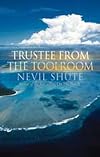
Trustee from the Toolroom
by Nevil Shute
On This Page
Description
Keith Stewart, a retiring and ingenious engineer, could not have been happier in his little house in the shabby London suburb of Ealing. There he invented the mini-motor, the six-volt generator, and the tiny Congreve clock. Then a chain of events sweeps him into deep waters and leads him to his happiest discovery yet.Tags
Recommendations
























Member Recommendations


Member Reviews
Keith Stewart is a content man, having created a niche with his miniature machines. He and his wife, unable to bear children, have settled into a modest and happy existence. After helping his brother-in-law and sister secret a stash of diamonds in a yacht, he becomes he only person who knows about his nieces inheritance when the couple dies in a sailing accident on a remote tropical island. As the guardian for his niece, he realizes that he doesn’t have the resources to provide for her and sets out on a journey to recover the diamonds. Without much money, he must rely on his wit and peculiar talents to make his way by rail and plane and ship. The motley bunch of people who help him along the way are eccentric, each more colorful than show more the last.
Shute’s book is a rare look at a contented and modest hero – sweet in disposition and noble in mind. His journey isn’t the typical arc for a hero as we often think of them, but it’s comforting to watch the character’s creativity and self-reliance. Keith’s choices, and what motivates them, are instructive in our time when most people are obsessed with popularity and self-promotion. To share the story of a man who wants nothing more than to provide for those he loves and maintain his contented life is a pleasant surprise.
Bottom Line: Contentment and nobility embodied in the everyday man.
4 bones!!!!! show less
Shute’s book is a rare look at a contented and modest hero – sweet in disposition and noble in mind. His journey isn’t the typical arc for a hero as we often think of them, but it’s comforting to watch the character’s creativity and self-reliance. Keith’s choices, and what motivates them, are instructive in our time when most people are obsessed with popularity and self-promotion. To share the story of a man who wants nothing more than to provide for those he loves and maintain his contented life is a pleasant surprise.
Bottom Line: Contentment and nobility embodied in the everyday man.
4 bones!!!!! show less
An introverted basement hobbyist becomes responsible for his niece's inheritance. The only problem is that it's located aboard a shipwreck on the other side of the world, and he's rarely ventured more than a hundred miles from home.
Nevil Shute seems to have been well known in the UK and Australia, but I think he never got as much footing here in Canada. I only learned about him through LibraryThing. The opening chapters don't impress much with their prose, but something else begins to emerge. Shute is not content with telling you that his characters sailed a boat, flew a plane, crafted something in the workshop, etc. He's going to explain each of these things in great detail, as though he were preparing you to do each of them yourself show more (or allowing you to judge his characters' actions, if you already know a thing or two). On the one hand this is a huge obstacle to moving the plot forward. On the other, it's an unusual degree of realism that serves to put you in the moment, battling the elements or technological know-how to get each job done. There's a deep appreciation here for what it takes, and for proving each task possible through ingenuity and learning. If that's your element, this is the book for you.
There are frequent reminders of the novel's 1960 pedigree, especially with regards to women. Even supposing the niece gets her inheritance and graduates from Oxford, Keith's greatest ambition for her future is to become his secretary so she can cook his food and help with his correspondence - that says it all. Many in my father's generation will still find this to be a nice comfort read, caught up by the engineering and navigational details and the playful-if-unlikely romance. For me it's only the South Pacific setting that made it sing, along with the nobility of Keith's purpose. Might be one of the worst novel titles ever chosen, but it has a cute ending. show less
Nevil Shute seems to have been well known in the UK and Australia, but I think he never got as much footing here in Canada. I only learned about him through LibraryThing. The opening chapters don't impress much with their prose, but something else begins to emerge. Shute is not content with telling you that his characters sailed a boat, flew a plane, crafted something in the workshop, etc. He's going to explain each of these things in great detail, as though he were preparing you to do each of them yourself show more (or allowing you to judge his characters' actions, if you already know a thing or two). On the one hand this is a huge obstacle to moving the plot forward. On the other, it's an unusual degree of realism that serves to put you in the moment, battling the elements or technological know-how to get each job done. There's a deep appreciation here for what it takes, and for proving each task possible through ingenuity and learning. If that's your element, this is the book for you.
There are frequent reminders of the novel's 1960 pedigree, especially with regards to women. Even supposing the niece gets her inheritance and graduates from Oxford, Keith's greatest ambition for her future is to become his secretary so she can cook his food and help with his correspondence - that says it all. Many in my father's generation will still find this to be a nice comfort read, caught up by the engineering and navigational details and the playful-if-unlikely romance. For me it's only the South Pacific setting that made it sing, along with the nobility of Keith's purpose. Might be one of the worst novel titles ever chosen, but it has a cute ending. show less
Six-word review: Mild-mannered homebody braves challenging journey.
Extended review:
Keith Stewart is a prosaic Frodo Baggins pulled out of his quiet everyday world to undertake a classic hero's journey, as Joseph Campbell defines it: he answers the call, he survives the ordeals, he returns with the elixir.
Keith is a plain, ordinary, home-loving man with no ego to speak of, content with a fixed, simple life, who suddenly finds himself charged with a duty that requires extraordinary measures. A man of meager means, he must find a way to travel from his home in England to a remote, uninhabited island in the South Pacific in order to carry out the daunting task entrusted to him by his sister.
Not so ordinary after all, though, our Keith: show more within the very small sphere of miniature-machine hobbyists, he is a world-renowned expert, engineer of designs for tiny working machines and author of articles about them in a weekly specialty magazine. Subscribers around the globe know and admire his work, and many have benefited from his generous-spirited correspondence. As he travels he is amazed to be greeted as a celebrity because of his stature within the engineering world. Although he is much too modest to realize it, he has earned gratitude from his readers because of his selfless courtesy and assistance to others over the years as they have sought his help through exchanges of letters. Now several of those are in a position to treat him handsomely and offer him significant aid in completing his mission.
But it is his own courage and endurance that see him through: those and his goodness of heart and simple honesty, which win him friends who can help him--just as in the old folktales where a humble hero befriends creatures he meets on his road to adventure, only to find in his own time of need that they possess special powers and are able to confer magical favors to repay his kindness.
There's no magic here, of course, other than the magic of invention and resourcefulness. Shute describes in loving detail the complex apparatus and processes involved in sailing, metal machining, and lumber milling. There's not enough pretext in either character or plot for all the technical particulars he supplies, which seems to be there for their own sake, much like ornamentation in a fabulously excessively detailed pen-and-ink drawing that you simply can't look at without awe. Somehow, though, all that obsessively intricate detail succeeds in showing a bigger picture, one in which skill is respected, expertise is valued, and dedication is rewarded. I'd guess that a story like this probably couldn't be published today; I can easily imagine a book editor insisting that all the technicality be drastically reduced in favor of more interpersonal drama.
Not that drama is lacking. A storm at sea is as chilling as any I've ever met in print, including in a Thor Heyerdahl voyage. There are touching moments as well, especially between Keith and his young niece. And there is nicely restrained humor. The centerpiece of the book is the leg of the journey taken with a modern-day Neanderthal named Jack Conelly, proprietor of a minimalist vessel that appears to be Keith's only hope for reaching Tahiti from Honolulu. Jack is a great secondary character--a natural man, somewhat appalling, but good-hearted, with the rugged, odoriferous charm of a bear in his den. Being trapped on a small boat with him on a 2700-mile journey, with no engine, no navigational devices, no radio, and no inhabited land in between, sounds more than a little intimidating; but practical-minded Keith considers his options and then takes the likeliest path to his goal, yielding no more to doubt once he's made his decision.
Written in 1960, the book reflects some attitudes that are long out of date, and in general those don't bother me. I'm not even too miffed that Shute's Americans all sound like uneducated bumpkins not long out of the boonies. But I did find myself cringing at the fact that they can scarcely speak a sentence that doesn't begin with "Say." Most of us don't talk like that and never did.
That's a small point, however. I enjoyed this book, and I especially liked the epilogue, which gives us a quick-take life trajectory for each of the principal characters. I wish more novels would provide such a satisfactory answer to the question "And then what?" show less
Extended review:
Keith Stewart is a prosaic Frodo Baggins pulled out of his quiet everyday world to undertake a classic hero's journey, as Joseph Campbell defines it: he answers the call, he survives the ordeals, he returns with the elixir.
Keith is a plain, ordinary, home-loving man with no ego to speak of, content with a fixed, simple life, who suddenly finds himself charged with a duty that requires extraordinary measures. A man of meager means, he must find a way to travel from his home in England to a remote, uninhabited island in the South Pacific in order to carry out the daunting task entrusted to him by his sister.
Not so ordinary after all, though, our Keith: show more within the very small sphere of miniature-machine hobbyists, he is a world-renowned expert, engineer of designs for tiny working machines and author of articles about them in a weekly specialty magazine. Subscribers around the globe know and admire his work, and many have benefited from his generous-spirited correspondence. As he travels he is amazed to be greeted as a celebrity because of his stature within the engineering world. Although he is much too modest to realize it, he has earned gratitude from his readers because of his selfless courtesy and assistance to others over the years as they have sought his help through exchanges of letters. Now several of those are in a position to treat him handsomely and offer him significant aid in completing his mission.
But it is his own courage and endurance that see him through: those and his goodness of heart and simple honesty, which win him friends who can help him--just as in the old folktales where a humble hero befriends creatures he meets on his road to adventure, only to find in his own time of need that they possess special powers and are able to confer magical favors to repay his kindness.
There's no magic here, of course, other than the magic of invention and resourcefulness. Shute describes in loving detail the complex apparatus and processes involved in sailing, metal machining, and lumber milling. There's not enough pretext in either character or plot for all the technical particulars he supplies, which seems to be there for their own sake, much like ornamentation in a fabulously excessively detailed pen-and-ink drawing that you simply can't look at without awe. Somehow, though, all that obsessively intricate detail succeeds in showing a bigger picture, one in which skill is respected, expertise is valued, and dedication is rewarded. I'd guess that a story like this probably couldn't be published today; I can easily imagine a book editor insisting that all the technicality be drastically reduced in favor of more interpersonal drama.
Not that drama is lacking. A storm at sea is as chilling as any I've ever met in print, including in a Thor Heyerdahl voyage. There are touching moments as well, especially between Keith and his young niece. And there is nicely restrained humor. The centerpiece of the book is the leg of the journey taken with a modern-day Neanderthal named Jack Conelly, proprietor of a minimalist vessel that appears to be Keith's only hope for reaching Tahiti from Honolulu. Jack is a great secondary character--a natural man, somewhat appalling, but good-hearted, with the rugged, odoriferous charm of a bear in his den. Being trapped on a small boat with him on a 2700-mile journey, with no engine, no navigational devices, no radio, and no inhabited land in between, sounds more than a little intimidating; but practical-minded Keith considers his options and then takes the likeliest path to his goal, yielding no more to doubt once he's made his decision.
Written in 1960, the book reflects some attitudes that are long out of date, and in general those don't bother me. I'm not even too miffed that Shute's Americans all sound like uneducated bumpkins not long out of the boonies. But I did find myself cringing at the fact that they can scarcely speak a sentence that doesn't begin with "Say." Most of us don't talk like that and never did.
That's a small point, however. I enjoyed this book, and I especially liked the epilogue, which gives us a quick-take life trajectory for each of the principal characters. I wish more novels would provide such a satisfactory answer to the question "And then what?" show less
This is one of Shute's last novels, published in 1960. Whilst it's much more positive in tone than some of the others from the fifties, it still includes a few digs at his bête noire, the post-war British government. You don't have to be a born-again libertarian to enjoy it, though: it's primarily a celebration of craftsmanship as a unifying force that breaks through social and geographical barriers.
The central character, Keith Stewart, is a model engineer living a quiet life on the western fringes of London (where Shute grew up himself), who, without much money, has to make an epic journey to a remote Pacific island to retrieve his young niece's inheritance. En route, he receives assistance from fans of his articles in Miniature show more Mechanic magazine. He's a modest, middle-aged hero in the great tradition of Bailie Nicol Jarvie and Dickson McCunn.
Being an engineer himself, Shute obviously enjoys the excuse this book gives him to indulge in the language of precision mechanics, but he doesn't go overboard. A technical reader probably wouldn't find much to quibble at, but I don't think someone without a mechanics background would be baffled for long, either. Where the book is less convincing is in the final section, where the main characters are American industrial tycoons. Here you do get the impression that Shute doesn't quite know how such people speak and act (they talk like Americans in British novels), and is using the technology of long-distance phone calls, tape recorders and helicopters to distract from this.
The ending is a bit fairy-godmotherish, but that is entirely fitting for this sort of story, so there's no reason to complain about this: we need a bit of escapism in a feel-good adventure story. show less
The central character, Keith Stewart, is a model engineer living a quiet life on the western fringes of London (where Shute grew up himself), who, without much money, has to make an epic journey to a remote Pacific island to retrieve his young niece's inheritance. En route, he receives assistance from fans of his articles in Miniature show more Mechanic magazine. He's a modest, middle-aged hero in the great tradition of Bailie Nicol Jarvie and Dickson McCunn.
Being an engineer himself, Shute obviously enjoys the excuse this book gives him to indulge in the language of precision mechanics, but he doesn't go overboard. A technical reader probably wouldn't find much to quibble at, but I don't think someone without a mechanics background would be baffled for long, either. Where the book is less convincing is in the final section, where the main characters are American industrial tycoons. Here you do get the impression that Shute doesn't quite know how such people speak and act (they talk like Americans in British novels), and is using the technology of long-distance phone calls, tape recorders and helicopters to distract from this.
The ending is a bit fairy-godmotherish, but that is entirely fitting for this sort of story, so there's no reason to complain about this: we need a bit of escapism in a feel-good adventure story. show less
Trustee from the Tool Room - Nevil Shute *****
This is Nevil Shute’s final novel first published in 1960 it details the adventures of Keith Stewart, a brilliant but unassuming engineer. Keith is someone that is more than content with his life, despite never really having risen to his full potential. He is a writer for a magazine called ‘The Miniature Mechanic’ a job to which he devotes his entire life despite the less than glamorous wages. His sister is married to a naval officer who has recently retired, and decided to emigrate for a different way of life in British Columbia, but decide to travel there alone on their small yacht. Before setting off they ask Keith to do two things, firstly help them hide their diamonds in the ships show more ballast (all of their wealth was converted to diamonds for the trip) and to mind their ten year old daughter whilst they make the journey. Things however do not go to plan and Keith soon finds himself as the girl’s trustee and legal guardian. The family solicitor informs him that there are no funds left in the bank and therefore the child’s inheritance has been lost. The usually unadventurous Keith must decide on what course of action to undertake, and we soon see him travelling across the world on a limited budget, relying on the kindness of strangers and goodwill of the readers of his magazine. As much a book of morality, honesty and strength as it is of adventure.
What did I like?
What isn’t there to like? Shute is an author that I have discovered only relatively recently yet I feel as if I have known all my life. Yes, at times the books seem dated, but that is part of their beauty. He transports the reader to a time that probably never really existed, and yet we all wish we lived in. He doesn’t need to rely on violence or sex to sell you a story and ‘Trustee’ is no exception to this rule. The characters are warm, everyday people that find themselves thrown into extraordinary circumstances, although not so extraordinary that we couldn’t imagine them happening to ourselves. I don’t know what it is that draws me back to a Shute book, but he has the ability to drag me into the storyline and get lost there.
What didn’t I like?
Nevil Shute was an engineer by trade, and at times I sometimes felt a little bogged down by some of the technical descriptions, but to be honest they rarely detracted away from the main body of the story, and I probably picked up some free knowledge without even realising it.
Would I recommend?
If I had to recommend a Shute novel as in introduction to the author it would either be this or ‘On the Beach’. Whatever you normally enjoy reading I am sure you will find something here that will get you hooked. It is a real shame that his books aren’t seen more often. show less
This is Nevil Shute’s final novel first published in 1960 it details the adventures of Keith Stewart, a brilliant but unassuming engineer. Keith is someone that is more than content with his life, despite never really having risen to his full potential. He is a writer for a magazine called ‘The Miniature Mechanic’ a job to which he devotes his entire life despite the less than glamorous wages. His sister is married to a naval officer who has recently retired, and decided to emigrate for a different way of life in British Columbia, but decide to travel there alone on their small yacht. Before setting off they ask Keith to do two things, firstly help them hide their diamonds in the ships show more ballast (all of their wealth was converted to diamonds for the trip) and to mind their ten year old daughter whilst they make the journey. Things however do not go to plan and Keith soon finds himself as the girl’s trustee and legal guardian. The family solicitor informs him that there are no funds left in the bank and therefore the child’s inheritance has been lost. The usually unadventurous Keith must decide on what course of action to undertake, and we soon see him travelling across the world on a limited budget, relying on the kindness of strangers and goodwill of the readers of his magazine. As much a book of morality, honesty and strength as it is of adventure.
What did I like?
What isn’t there to like? Shute is an author that I have discovered only relatively recently yet I feel as if I have known all my life. Yes, at times the books seem dated, but that is part of their beauty. He transports the reader to a time that probably never really existed, and yet we all wish we lived in. He doesn’t need to rely on violence or sex to sell you a story and ‘Trustee’ is no exception to this rule. The characters are warm, everyday people that find themselves thrown into extraordinary circumstances, although not so extraordinary that we couldn’t imagine them happening to ourselves. I don’t know what it is that draws me back to a Shute book, but he has the ability to drag me into the storyline and get lost there.
What didn’t I like?
Nevil Shute was an engineer by trade, and at times I sometimes felt a little bogged down by some of the technical descriptions, but to be honest they rarely detracted away from the main body of the story, and I probably picked up some free knowledge without even realising it.
Would I recommend?
If I had to recommend a Shute novel as in introduction to the author it would either be this or ‘On the Beach’. Whatever you normally enjoy reading I am sure you will find something here that will get you hooked. It is a real shame that his books aren’t seen more often. show less
Keith Stewart is an unassuming engineer living in England with his wife. His hobby is model making, and he writes about it for a magazine. His life is rather uneventful until a tragedy strikes. The tragedy leads him to undertake a long journey. Along the way, he receives help from people who have enjoyed his magazine articles. It was published in 1960 and reflects the technologies of the time period. Nevil Shute is skilled at portraying “regular people” with positive character traits. Keith Stewart is one such individual. He is a man of integrity doing the best he can with few resources for a good cause. It is easy to root for him to succeed. This is a feel-good story, and a nice break between heavier reads. It contains many details show more about sailing and engineering. These topics add texture to the story without overwhelming it. It reads almost like a fairy tale or a myth featuring a regular guy rather than a “hero.” There are a few elements that seem rather far-fetched, but it is engaging and entertaining. show less
In a way, this is sort of a fairy tale placed in a realistic setting. Keith Stewart, an "insignificant" little engineer who writes for a magazine devoted to model makers, sets out against almost impossible odds to rescue his niece's inheritance which was lost at sea. Along the way, many of those who loved his articles and willingness to help the inexperienced—from simple engineers on cargo ships to captains of industry—lend a hand to make his quest a success. The story works in Shute's hands because of his talent for giving us quiet, lovable characters that engage us. It's a nice story in the best sense of the word.
Members
- Recently Added By
Published Reviews
ThingScore 75
Mr. Shute told his yarn straight, without frills and without subtlety either. But these days there is so much fake "literature" published that your judges have no hesitation in recommending a book that is certainly not destined for the ages but is equally sure to afford a couple of evenings of delightful entertainment.
added by muumi
Lists

Fiction Featuring Cranky, Eccentric Old Folks
80 works; 35 members

Recommend the 20 best books you've read in the last five years
2,168 works; 607 members

Best Sea Stories
33 works; 5 members

Publisher's Weekly Bestsellers - Part II - 1940 - 1979
355 works; 6 members

Favorite Childhood Books
1,651 works; 519 members

Our Favorite Comfort Reads
334 works; 200 members
Author Information

56+ Works 20,331 Members
Nevil Shute Norway was born in Ealing, London, England, on January, 17 1899. At the age of 11, Norway played truant from his first preparatory school in Hammersmith. After he was discovered, he was sent to the Dragon School, Oxford, and from there to Shrewsbury. He was on holiday in Dublin at the time of the Easter rising of 1916 and acted as an show more ambulance driver, winning a commendation for gallant conduct. He then entered the Royal Military Academy, intending to be commissioned into the Royal Flying Corps, but a bad stammer led to his being failed at his final medical examination and returned to civil life. The last few months of the war were spent on home service as a private in the Suffolk Regiment. In 1919, Norway went to Balliol College, Oxford, where he took a third class honors course in engineering science in 1922. During the vacations he worked, unpaid, as an aeronautical engineer, for the Aircraft Manufacturing Company at Hendon, and then for Geoffrey de Havilland's own firm, which he joined as an employee upon finishing at Oxford. He learned to fly and gained experience as a test observer. During the evenings he diligently wrote novels and short stories unperturbed by rejection slips from publishers. In 1924 Norway took the post of Chief Calculator to the Airship Guarantee Company, to work on the construction of the R100. In 1929 he became Deputy Chief Engineer under Barnes Wallis, and in the following year he flew to and from Canada in the R100. After the end of the airship project, jobs were hard to come by due to the depression so Shute started an aircraft manufacturing company, Airspeed Limited. This company was ultimately successful and built a large number of aircraft during the war. Shute remained joint managing director until 1938. When the business became too routine, he decided to get out of the rut and live by writing. The de Havillands, the first aviation job Shute had ever had, wound up buying Airspeed Ltd. He had by then enjoyed some success as a novelist and had sold the film rights of Lonely Road and Ruined City. At the outbreak of war in 1939, Norway joined the Royal Naval Volunteer Reserve as a Sub-Lieutenant in the Miscellaneous Weapons Department. Rising to Lieutenant Commander, he found experimenting with secret weapons a job after his own heart. But he found that his growing celebrity as a writer caused him to be in the Normandy landings on 6th June 1944, for the Ministry of Information, and to be sent to Burma as a correspondent in 1945. He entered Rangoon with the 15th Corps from Arakan. Soon after demobilisation in 1945 he emigrated to Australia and made his home in Langwarrin, Victoria. His output of novels, which began with Marazan (1926) continued to the end. Shute was one of the leading aeronautical engineers in Britain during the 30's and a fellow of the Royal Aeronautical Society. When he began writing in the 20's, he feared that a reputation as a writer of fiction might harm his engineering career. For this reason he published under his two Christian names, Nevil Shute and engineered under his "real" name, Nevil S. Norway. Nevil Shute Norway died in Melbourne on January, 12 1960. (Bowker Author Biography) show less
Some Editions
Awards and Honors
Distinctions
Notable Lists
Series
Belongs to Publisher Series
Work Relationships
Is contained in
Is abridged in
Kirjavaliot - Mengelen pojat (The boys from Brazil) / Luottamustehtävä (Trustee from the toolroom) / Suden sukua (The north runner) / Nuorallatanssi (The tightrope walker) by Reader's Digest
Reader's Digest Condensed Books 1960 v03: The Lovely Ambition / Trustee from the Toolroom / The Leopard / Village of Stars / To Kill a Mockingbird by Mary Ellen Chase
Common Knowledge
- Canonical title*
- Förmyndaren
- Original title
- Trustee from the Toolroom
- Original publication date
- 1960
- People/Characters
- Keith Stewart; Jack Connelly
- Important places
- Ealing, London, England, UK; Honolulu, O'ahu, Hawai'i, USA; Tahiti; Tacoma, Washington, USA
- Epigraph
- An engineer is a man who can make something for five bob that any bloody fool can make for a quid. Definition: origin unknown
- First words
- West Ealing is a suburb to the west of London, and Keith Stewart lives there in the lower part of No. 56 Somerset Road.
- Last words
- (Click to show. Warning: May contain spoilers.)He is perfectly, supremely happy.
- Original language
- English
*Some information comes from Common Knowledge in other languages. Click "Edit" for more information.
Classifications
Statistics
- Members
- 981
- Popularity
- 26,948
- Reviews
- 37
- Rating
- (4.16)
- Languages
- 7 — Danish, Dutch, English, Finnish, German, Norwegian (Bokmål), Swedish
- Media
- Paper, Audiobook, Ebook
- ISBNs
- 36
- ASINs
- 30