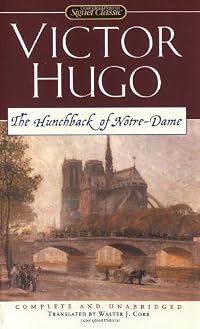
The Hunchback of Notre Dame
by Victor Hugo
On This Page
Description
Immerse yourself in one of the classic masterpieces of Western literature. Victor Hugo's sweeping epic The Hunchback of Notre Dame is a timeless tale of unrequited love that also touches on themes of jealousy, passion, purity, social justice, and moral goodness..
Tags
Recommendations







Member Recommendations


Gail.C.Bull The English translation is called The Only Son by Stephane Audeguy
Member Reviews
While reading, I was considering the merits of abridged versions of classical works, but at the end - FUCK.
My only experience with this tale was Disney - I knew their version was rot-your-teeth, sugar coated but duuuuuuude.
SPOILER ALERT:
In the late 1400s, a priest is infatuated with a gypsy girl who is in love with a soldier who is a P.O.S. (except when compared with the priest then he comes out favorably). The soldier is about to get lucky with the gypsy girl when the priest intervenes and stabs him. The gypsy girl is arrested and sentenced to hang as a witch. The hunchback (saved and raised by the priest) is also infatuated with the gypsy girl - he at least respects her bubble and moreso seems to recognize her as a human being - and show more thus rescues her from the scaffold temporarily protecting her with the sanctuary of Notre Dame ('cept that's the priest's crib!). The gypsy ends up "escaping" the church to find her long-lost mother grieving in a self-inflicted, weather-exposed dungeon (prayer cell). The guard catches up with her - her mother's skull is bashed in while the gypsy hangs. The hunchback pushes the priest off the ramparts of Notre Dame then finds and cuddles up with the corpse of the gypsy, rotting together. The soldier survived and marries (fate worse than death for him).
I wish I could call this a caricature, but that would imply that it's exaggerated - this is the depth of absurdity that society had reached and the descent continues.
But apparently it's really about the importance of preserving architecture from earlier ages. Aye, aye Hugo. show less
My only experience with this tale was Disney - I knew their version was rot-your-teeth, sugar coated but duuuuuuude.
SPOILER ALERT:
In the late 1400s, a priest is infatuated with a gypsy girl who is in love with a soldier who is a P.O.S. (except when compared with the priest then he comes out favorably). The soldier is about to get lucky with the gypsy girl when the priest intervenes and stabs him. The gypsy girl is arrested and sentenced to hang as a witch. The hunchback (saved and raised by the priest) is also infatuated with the gypsy girl - he at least respects her bubble and moreso seems to recognize her as a human being - and show more thus rescues her from the scaffold temporarily protecting her with the sanctuary of Notre Dame ('cept that's the priest's crib!). The gypsy ends up "escaping" the church to find her long-lost mother grieving in a self-inflicted, weather-exposed dungeon (prayer cell). The guard catches up with her - her mother's skull is bashed in while the gypsy hangs. The hunchback pushes the priest off the ramparts of Notre Dame then finds and cuddles up with the corpse of the gypsy, rotting together. The soldier survived and marries (fate worse than death for him).
I wish I could call this a caricature, but that would imply that it's exaggerated - this is the depth of absurdity that society had reached and the descent continues.
But apparently it's really about the importance of preserving architecture from earlier ages. Aye, aye Hugo. show less
On my themed reading list, The Hunchback of Notre Dame should have been in another category (e.g. A Book More Than One Hundred Years Old) because this is not A Classic Romance. At some point in a romance both parties in said romance have to love each other. Not only is this requirement never fulfilled, it was destined to fail due to the limitations of the novel's protagonists.
The four main characters of The Hunchback of Notre Dame are each flawed - either naive about love (Esmeralda), incapable of being loved (Quasimodo), incapable of love (Phoebus) or forbidden to love (Frollo). Each person in this quadrangle loves someone else within it who does not return their love. Three will pay the ultimate price for their attachment (four if you show more agree with Hugo's humorous view of Phoebus's fate). Although their destinies are evident at the outset of each romance, what makes the novel worth reading is the accumulated tragedy that results from Hugo's interweaving of each character's individual tale.
Like Les Miserables, The Hunchback of Notre Dame suffers from Hugo's verbosity, which is particularly noticeable at climactic moments. At these times a character hesitates to act or launches into an extended (and unrealistically lengthy) dialogue. Hugo might have thought this generated suspense; for me, it had the opposite effect. The novel is also a good candidate for abridgement. There are several chapters, such as both chapters of Book III and the additions to the 8th edition, that are bereft of plot and can be skipped without any impairment in understanding or enjoyment of the novel. The introduction to my edition discusses Hugo's efforts to control the profits from his novel, and these chapters are evidence that the narrative suffered for his efforts.
Despite these complaints, I enjoyed the novel - it just needs to be read with an understanding that it was written in a time when it didn't have to compete with myriad entertainment alternatives and an acceptance of the deleterious effects of that environment. show less
The four main characters of The Hunchback of Notre Dame are each flawed - either naive about love (Esmeralda), incapable of being loved (Quasimodo), incapable of love (Phoebus) or forbidden to love (Frollo). Each person in this quadrangle loves someone else within it who does not return their love. Three will pay the ultimate price for their attachment (four if you show more agree with Hugo's humorous view of Phoebus's fate). Although their destinies are evident at the outset of each romance, what makes the novel worth reading is the accumulated tragedy that results from Hugo's interweaving of each character's individual tale.
Like Les Miserables, The Hunchback of Notre Dame suffers from Hugo's verbosity, which is particularly noticeable at climactic moments. At these times a character hesitates to act or launches into an extended (and unrealistically lengthy) dialogue. Hugo might have thought this generated suspense; for me, it had the opposite effect. The novel is also a good candidate for abridgement. There are several chapters, such as both chapters of Book III and the additions to the 8th edition, that are bereft of plot and can be skipped without any impairment in understanding or enjoyment of the novel. The introduction to my edition discusses Hugo's efforts to control the profits from his novel, and these chapters are evidence that the narrative suffered for his efforts.
Despite these complaints, I enjoyed the novel - it just needs to be read with an understanding that it was written in a time when it didn't have to compete with myriad entertainment alternatives and an acceptance of the deleterious effects of that environment. show less
Una maledizione e una benedizione.
La maledizione è per chi sceglie i brani da inserire nelle antologie scolastiche, scelte così insipide, noiose, inutili, che hanno tenuto una lettrice incallita come me lontana dal Hugo per tutti questi anni.
La benedizione invece è per lui, il grande Victor, per la sua scrittura meravigliosa, piena di humour persino nei punti più grevi e didascalici del racconto, per la sua penetrazione psicologica dei personaggi, per la sua abilità pittorica e architettonica nel descriverli.
Perché la Esmeralda, la piccola zingara, è descritta in modo pittorico, è un quadro pieno di luce e di colori, mentre Quasimodo è pura architettura, nelle sue membra deformi.
Da leggere, e inserire nelle riletture periodiche show more di cui non si può fare a meno per non perdere il senso della propria lettura. show less
La maledizione è per chi sceglie i brani da inserire nelle antologie scolastiche, scelte così insipide, noiose, inutili, che hanno tenuto una lettrice incallita come me lontana dal Hugo per tutti questi anni.
La benedizione invece è per lui, il grande Victor, per la sua scrittura meravigliosa, piena di humour persino nei punti più grevi e didascalici del racconto, per la sua penetrazione psicologica dei personaggi, per la sua abilità pittorica e architettonica nel descriverli.
Perché la Esmeralda, la piccola zingara, è descritta in modo pittorico, è un quadro pieno di luce e di colori, mentre Quasimodo è pura architettura, nelle sue membra deformi.
Da leggere, e inserire nelle riletture periodiche show more di cui non si può fare a meno per non perdere il senso della propria lettura. show less
While this was all too frequently a tedious read, I am, on the whole, very glad I stuck with this novel. Hugo's witty humor and overall tone made even the most superfluous scenes moderately enjoyable, and the plot, once firmly established, proved to be rather gripping. The strongest aspects of this book, however, were the characters. Hugo's characters showcase the wide capacity for contradiction within human nature by being alternatively commendable and ignoble, pitiable and disdainful. Even when they have the best intentions, they are immensely and authentically flawed, making them exceptionally intriguing and occasionally loveable.
I was prepared for the novel to be vastly different from the Disney film, more serious and 'grown-up'. In the end the distance was probably less than I was expecting. Although naturally more complex, the novel is comic and carnivalesque in a way that feels somewhat Disney. All the characters are somewhat comically grotesque, and few of their actions feel truly human.
I suppose the difference is in the absence of 'good' and 'bad' characters. Esmerelda and Phoebus are as comic and irrationally-driven as everyone else, and Frollo is more screw-eyed than he is evil. The hunchback himself is no protagonist, and to my mind no more interesting than other fringe characters like Clopin, Pierre and the mad mother in the cell.
I suppose the difference is in the absence of 'good' and 'bad' characters. Esmerelda and Phoebus are as comic and irrationally-driven as everyone else, and Frollo is more screw-eyed than he is evil. The hunchback himself is no protagonist, and to my mind no more interesting than other fringe characters like Clopin, Pierre and the mad mother in the cell.
Gosto de tudo em Victor Hugo, a escrita descritiva em excesso, o fatalismo do romantismo, a crítica ao patriarcado, e, acima de tudo, ele saber o quanto o leitor se preocuparia com a Djali. Rá!
Sério, O Corcunda de Notre-Dame é impecável tanto como entretenimento quanto obra de arte.
Sério, O Corcunda de Notre-Dame é impecável tanto como entretenimento quanto obra de arte.
This book is an epic, and yet surprisingly quick read. I won’t try to compare it to the one adaptation I’ve seen of the hunchback story (that being the disney animated version) as it has been more than a decade since I’ve seen it and the two don’t seem compatible or even really comparable. The characters all seem, and this is despite the many fantastical elements hinted at, very real. Claude Frollo is deeply flawed and at the same time incredibly bright, a slave to his lust for Esmeralda and the inescapable rational truth that he will be crushed by his obsession. Esmeralda herself is an interesting creation, exotic beauty on the outside, ignorant but well meaning child in her actions. But for me, the story rests on two sets of show more shoulders. One being Quasimodo, the only really ‘pure’ character in the book scarred by his own birth and the ignorance of his age. And two, Hugo’s own narrative voice that creates a Paris so vividly described and realistically inhabited that the events described, as incredibly horrific or at times magnificent, seem plausible, or even real. show less
Members
- Recently Added By
Published Reviews
ThingScore 100
Au point de sembler plus vraie que la vraie. Bref, un roman-cathédrale.
added by Ariane65
In Notre-Dame de Paris Hugo’s dreams are magnified in outline, microscopic in detail. They are true but are made magical by the enlargement of pictorial close-up, not by grandiloquent fading. Compare the treatment of the theme of the love that survives death in this book, with the not dissimilar theme in Wuthering Heights. Catherine and Heathcliff are eternal as the wretched wind that whines show more at the northern casement. They are impalpable and bound in their eternal pursuit. A more terrible and more precise fate is given by Hugo to Quasimodo after death. The hunchback’s skeleton is found clasping the skeleton of the gypsy girl in the charnel house. We see it with our eyes. And his skeleton falls into dust when it is touched, in that marvellous last line of the novel. Where love is lost, it is lost even beyond the grave...
The black and white view is relieved by the courage of the priest’s feckless brother and the scepticism of Gringoire, the whole is made workable by poetic and pictorial instinct. It has often been pointed out that Hugo had the eye that sees for itself. Where Balzac described things out of descriptive gluttony, so that parts of his novels are an undiscriminating buyer’s catalogue; where Scott describes out of antiquarian zeal, Hugo brings things to life by implicating them with persons in the action in rapid ‘takes’. In this sense, Notre-Dame de Paris was the perfect film script. Every stone plays its part. show less
The black and white view is relieved by the courage of the priest’s feckless brother and the scepticism of Gringoire, the whole is made workable by poetic and pictorial instinct. It has often been pointed out that Hugo had the eye that sees for itself. Where Balzac described things out of descriptive gluttony, so that parts of his novels are an undiscriminating buyer’s catalogue; where Scott describes out of antiquarian zeal, Hugo brings things to life by implicating them with persons in the action in rapid ‘takes’. In this sense, Notre-Dame de Paris was the perfect film script. Every stone plays its part. show less
added by SnootyBaronet
Lists

1001 Books You Must Read Before You Die
1,448 works; 1,132 members

Classics you know you should have read but probably haven't
421 works; 406 members

Best Historical Fiction
620 works; 261 members

Read the book and saw the movie
1,170 works; 195 members

Best of French Literature
138 works; 26 members

Favorite Long Books
330 works; 42 members

Best Gothic Fiction
110 works; 31 members

Philip Ward's Lifetime Reading Plan
592 works; 22 members

Favourite 19th century fiction
257 works; 60 members

French Books
102 works; 15 members

Recommend the 20 best books you've read in the last five years
2,168 works; 606 members
501 Must-Read Books
508 works; 72 members

19th Century
190 works; 16 members

Favourite Books
1,817 works; 316 members

Books That Made Me Cry
199 works; 105 members
Love and Marriage
93 works; 10 members
Historical Fiction
889 works; 89 members
Books Featured on Gilmore Girls
307 works; 21 members
Harold Bloom - The Western Canon: C. The Democratic Age
336 works; 15 members
150 Best Novels Selected by Brander Matthews (1883)
150 works; 7 members

Western World's Greatest Books - Project Gutenberg
295 works; 15 members

Fictional Characters With Disabilities
43 works; 9 members

Best Love Stories
107 works; 14 members

Top Five Books of 2014
1,064 works; 397 members

Troublesome bodies
110 works; 7 members

1,001 BYMRBYD Concensus
723 works; 27 members

Houses and Buildings as Characters in Fiction
182 works; 28 members

A High School Trip to France
57 works; 5 members
Folio Society
831 works; 48 members

Best Antiheroes and Antiheroines
119 works; 7 members

A Novel Cure
742 works; 23 members
Newark Public Library's 1904 List of a Thousand of the Best Novels
95 works; 5 members
Out of Copyright
244 works; 14 members
LibraryThingers' 1001 Books You Must Read Before You Die
442 works; 30 members

Fake Top 100 Fiction
81 works; 4 members
Ten Books That Have Stayed With Me
160 works; 29 members

Books You Read During High School (For School)
301 works; 52 members
The College Board: 101 Great Books Recommended for College-Bound Readers
111 works; 7 members

Mothers and Daughters
114 works; 11 members
Paris, City of Lights
103 works; 17 members

Rory Gilmore Book Club
193 works; 5 members

Works That Inspired Disney Movies
119 works; 13 members

Fifty Representative Historical Novels
50 works; 2 members

Books Read in 2023
5,547 works; 145 members

All Things France
100 works; 8 members
99 Bücher, die man gelesen haben muss
37 works; 1 member
Overdue Podcast
803 works; 9 members

CCE 1000 Good Books List
1,033 works; 12 members

Europe
205 works; 6 members
My 100 Favorite Books of All Time
57 works; 2 members
F. B. Perkins' List of 100 Best Fiction
100 works; 5 members

1830s
3 works; 1 member

Books Read in 2004
200 works; 7 members

Set in the Middle Ages
42 works; 9 members

Favorite Books in Translation
320 works; 133 members

Movies/Shows
617 works; 7 members
Books That Made Us Cry
278 works; 145 members

My wishlist
85 works; 1 member

Recommended Reading : 600 Classics Reviewed, Editors of Salem Press, 2015
634 works; 6 members
Books in The Club Dumas
72 works; 1 member

Books Read in 2019
4,052 works; 110 members

Allie's List of Books I Want To Read
93 works; 1 member
Antiheroes
17 works; 3 members

DigitalDreamDoor top 300
300 works; 4 members
The Complete Rory Gilmore Reading List
506 works; 5 members

el
1,139 works; 1 member

Books Read in 2026
1,768 works; 62 members

Books I Own But Haven't Read
144 works; 2 members

Greatest Books, allegedly
484 works; 9 members

Books Referenced by Izetbegovic's Islam Between East and West
233 works; 2 members

Mensa for Kids Excellence in Reading Award Program (Grades 7-8)
62 works; 1 member

Set in the 15th and 16th Centuries
28 works; 4 members

Global Reads: Books Set in Western Europe
186 works; 10 members

Books Bought & Received as Gifts in 2014
81 works; 1 member

Trinity College Booklist (1951): Class Nine, Foreign Literatures
161 works; 3 members

Jones & Newman: Best Horror Books Further Recommended Reading
577 works; 4 members

Novels/Poems/Short Stories/Anything Storytelling Related
112 works; 2 members
A Reading List
100 works; 3 members
Books Mentioned in The Wedding Planner's Daughter series
107 works; 2 members

Books Read in 2021
5,361 works; 113 members
French Fiction of the 18th and 19th Centuries in English Translation
169 works; 3 members
Mensa for Kids Excellence in Reading Award Program (Grades 7-8)
62 works; 3 members
Books available on Open Library
171 works; 4 members

Französische Romantik
16 works; 1 member

Unread books
1,063 works; 87 members
Talk Discussions
Past Discussions
Easton Press Item 2782 Victor Hugo's THE HUNCHBACK OF NOTRE DAME 2 volume DLE in Easton Press Collectors (September 2023)
Pictures of Hunchback of Notre Dame DLE in Easton Press Collectors (July 2020)
Newly discovered Hunchback of Notre Dame DLEs in Easton Press Collectors (July 2020)
Group Read, March 2014: The Hunchback of Notre-Dame in 1001 Books to read before you die (April 2014)
Author Information

2,147+ Works 67,991 Members
Victor Hugo was born in Besançon, France on February 26, 1802. Although he originally studied law, Hugo dreamed of writing. In 1819, he founded the journal Conservateur Litteraire as an outlet for his dream and soon produced volumes of poetry, plays, and novels. His novels included The Hunchback of Notre Dame and Les Miserables. Both of these show more works have been adapted for the stage and screen many times. These adaptations include the Walt Disney version of The Hunchback of Notre Dame, and the award-winning musical sensation Les Miserables. In addition to his literary career, Hugo also held political office. In 1841, he was elected to the Academie Francaise. After political upheaval in 1851, he was exiled and remained so until 1870. He returned to Paris in 1871 and was elected to the National Assembly, though he soon resigned. He died on May 22, 1885. (Bowker Author Biography) show less
Some Editions
Awards and Honors
Series
Belongs to Publisher Series
Kramers pocket-reeks (26)
Bantam Pathfinder Edition (HP36)
Limited Editions Club (S:2.01)
La clàssica (19)
GF Flammarion (441)
Os Grandes Romances Históricos (35,36)
Pocket Books (31-32)
Collins Classics (128)
Perpetua reeks (47)
Modern Library (35)
Airmont Classics (162)
insel taschenbuch (0298)
Everyman's Library (422)
A tot vent (705)
Gallimard, Folio (549)
Work Relationships
Is contained in
Die schönsten Bücher für junge Leser: Ein Baum wächst in Brooklyn, Taifun, Der Glöckner von Notre Dame, Lausbubengeschichten by Stuttgart
International Collector's Library Classics 19 volumes: Crime & Punishment; Twenty Thousand Leagues Under the Sea; Mysterious Island; Magic Mountain; Around the World in 80 Days; Count of Monte Cristo; Camille; Quo Vadis; Hunchback of Notre Dame; Nana; Scaramouche; Pinocchio; Fernande; War and Peace; The Egyptian; From the Earth to the Moon; Candide; Treasure of Sierra Madre; Siddhartha/Steppenwolf by Jules Verne
Contains
Has the adaptation
Is abridged in
Is parodied in
Inspired
Has as a student's study guide
Has as a teacher's guide
Common Knowledge
- Canonical title
- The Hunchback of Notre-Dame; The Hunchback of Notre Dame
- Original title
- Notre-Dame de Paris
- Alternate titles
- Notre-Dame de Paris (Our Lady of Paris) (Our Lady of Paris)
- Original publication date
- 1831
- People/Characters
- Quasimodo; Esmeralda; Claude Frollo; Pierre Gringore; Phoebus de Châteaupers; Djali (a goat) (show all 13); Louis XI, King of France; Jacques Charmolue; Pierrat Torterue; Jehan Frollo; Fleur-de-Lys de Gondelaurier; Sister Gudule (Paquette la Chantefleurie); Clopin Trouillefou
- Important places
- Paris, Île-de-France, France; Arras, Pas-de-Calais, Hauts-de-France, France; Notre-Dame Cathedral, Paris, France; France
- Important events
- Middle Ages; Festival of Fools; 15th century; 1480s; 1482
- Related movies
- The Hunchback of Notre Dame (1923/I | IMDb); Notre-Dame de Paris (1911 | IMDb); The Darling of Paris (1917 | IMDb); Esmeralda (1922 | IMDb); The Hunchback of Notre Dame (1939 | IMDb); Notre Dame de Paris (1956 | IMDb) (show all 16); O Corcunda de Notre Dame (1957 | IMDb); The Hunchback of Notre Dame (1976 | IMDb); Buenas noches, señor monstruo (1982 | IMDb); Notre-Dame de Paris (1996 | IMDb); The Hunchback of Notre Dame (1996 | IMDb); The Hunchback (1997 | IMDb); Notre-Dame de Paris (1999 | IMDb); Quasimodo d'El Paris (1999 | IMDb); Notre Dame de Paris - Live Arena di Verona (2002 | IMDb); "Wishbone" The Hunchdog of Notre Dame (1995 | IMDb)
- First words
- Exactly three hundred and forty-eight years, six months and nineteen days have passed away since the Parisians were awakened by the noise of all the bells within the triple walls of the city, the university, and the town, rin... (show all)ging a full peal.
- Quotations
- Endlich neigte sich der geschworene Buchhändler der Universität, Meister Andry Musnier, zum Ohre des Kürschners der Kleider des Königs mit den Worten:
"Ich sage euch, Herr, das Ende der Welt ist nahe. Man sah nie s... (show all)olche Ausgelassenheit der Studenten. Die verfluchten Erfindungen des Jahrhunderts richten alles zugrunde, die Kanonen, Serpentinen, Bombarden und vor allem die Buchdruckerkunst, diese andere Pest aus Deutschland. Keine Manuskripte! Keine Bücher! Der Druck tötet den Buchhandel! Das Ende der Welt ist nah."
Stets dachte ich, werde es von mir abhängen, den Prozeß zu verfolgen oder fallen zu lassen. Doch jeder böse Gedanke ist unerbittlich und bestrebt, zur Tatsache zu werden; und da, wo ich mich allmächtig glaube, ist das Ver... (show all)hängnis mächtiger als ich. Ach, ach, das Verhängnis ergriff dich, überlieferte dich den furchtbaren Rädern der Maschine, die ich im Dunkel baute. Jetzt bin ich dem Ende nahe. (Claude Frollo)
Die Liebe gleicht einem Baum; sie sproßt von selbst hervor, treibt tiefe Wurzeln in unser Sein und grünt oft noch auf einem gebrochenen Herzen.
Dom Claude begann aufs neue: "Ihr seid also glücklich?" - Gringoire erwiderte mit Feuer: "Auf Ehre, ja! Zuerst liebte ich Frauen, dann Tiere; jetzt liebe ich Steine. Sie sind ebenso unterhaltend wie Tiere und Frauen, aber ni... (show all)cht so treulos."
Der Priester legte die Hand auf die Stirn. Es war seine gewöhnliche Bewegung; dann sprach er: "Wahrhaftig, Ihr habt recht!"
Peter Gringoire war so glücklich, die Ziege zu retten, und erlangte auch einigen Beifall im Tragödien-Dichten. Nachdem er, wie es scheint, alle Torheiten gekostet hatte, die Astrologie, Alchimie, Philosophie und Architektur... (show all), kehrte er zur albernsten Torheit, der Tragödie zurück; das nannte er: Ein tragisches Ende nehmen.
Auch Phoebus von Chateaupers nahm ein tragisches Ende: Er verheiratete sich.
If he had all Peru in his pocket, he would certainly have given it to the dancer, but Gringoire had not Peru, and, moreover, America had not yet been discovered.
…precisely at the spot where the wife of the present janitor of the towers has made for herself a garden which is to the hanging gardens of Babylon what a lettuce is to a palm tree…
"Findet ihr nicht", antwortete der Archidiakonus, der in tiefes Nachdenken versunken schien, "dass die Tracht der Reiter, die wir soeben gesehen haben, schöner ist als die Eurige und die meinige?"
Gringoire schüttel... (show all)te den Kopf. "Meiner Treu'! Mir gefällt meine gelbe und rote Jacke besser als diese eisernen und stählernen Schuppen. Ein schönes Vergnügen, beim Gehen denselben Lärm zu verursachen wie ein eisernes Geländer bei einem Erdbeben!"
A one-eyed man is much more incomplete than a blind man, for he knows what it is that's lacking. - Last words
- (Click to show. Warning: May contain spoilers.)When they strove to detach this skeleton from the one it was embracing, it fell into dust.
- Original language
- French
- Disambiguation notice
- This is the major work for The Hunchback of Notre Dame by Victor Hugo. Please do not combine with abridgements, adaptations, etc.
Classifications
- Genres
- Fiction and Literature, General Fiction, Historical Fiction
- DDC/MDS
- 843.7 — Literature & rhetoric French Literature French fiction Constitutional monarchy 1815–48
- LCC
- PQ2288 .A33 — Language and Literature French, Italian, Spanish and Portuguese literatures French literature Modern literature 19th century
- BISAC
Statistics
- Members
- 16,423
- Popularity
- 410
- Reviews
- 206
- Rating
- (3.92)
- Languages
- 30 — Arabic, Bosnian, Catalan, Chinese, Czech, Danish, Dutch, English, Estonian, Finnish, French, German, Scottish Gaelic, Greek, Hebrew, Hungarian, Italian, Lithuanian, Norwegian (Bokmål), Norwegian, Polish, Romanian, Russian, Croatian, Slovak, Spanish, Swedish, Turkish, Welsh, Portuguese (Portugal)
- Media
- Paper, Audiobook, Ebook
- ISBNs
- 854
- UPCs
- 8
- ASINs
- 429