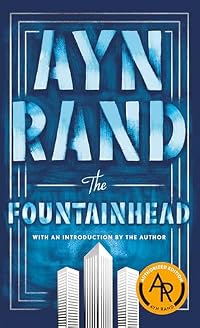
The Fountainhead
by Ayn Rand 
On This Page
Description
Here is the story of an intransigent young architect, Howard Roark, of his violent battle against a mindless status quo, and of his explosive love affair with a beautiful woman who worships him yet struggles to defeat him. In order to build his kind of buildings according to his own standards, Roark must fight against every variant of human corruption.Tags
Recommendations























Member Recommendations
bigtent21 "Atlas Shrugged" and "The Fountainhead" are becoming more relevant as we head into 2009. Large Government Buyouts and Regulation are the scourge of Atlas Shrugged and the outright sponsoring of mediocrity predominates The Fountainhead. Rand can be long-winded, but these two books are must reads regardless of your own personal beliefs.
Also recommended by thebookpile
103
mcaution Gain a deeper understanding and appreciation on the classic novel from this collection of scholarly criticism.
41



anonymous user The real world results of libertarianism.
35



Member Reviews
Ayn Rand would’ve hated social media. To her, it would’ve been just another way for the mediocre and incompetent to celebrate the loss of their humanity in a churn of upcycled memes endlessly reflecting a shared sterility where our souls should be.
She died in 1982, so mercifully didn’t have to reckon with the digital apotheosis of everything she despised. As “The Fountainhead” hammers home in waves of unrelenting bleakness, Rand understood the great enemy of mankind to be the idea of mankind. The delusion that we exist as an equalitarian mass knit together by shared virtues of selflessness and altruism is the refuge of cowards and the lever of tyrants.
This is illustrated most starkly in the buildup to the trial of her ideal show more great man Howard Roark, the architect who will not bend to the collective will of the people even as it constricts its strangulating grip ever tighter. Rand offers a shortlist of other men martyred by society: “Socrates, Galileo, Pasteur, the thinkers, the scientists.” Noticeably absent is the name of Jesus, and there’s a good reason.
The fountainhead of Rand’s thought is the notion that objectively, rationally, actually, the only true morality is that of the individual who produces and creates in total integrity with himself. The immoral are the “second-handers” like Peter Keating, leeching off the productive genius of others, smothering their guilt in facile notions of the brotherhood of man and love for others, who never have an original thought and immolate their souls on the altar of popular demand. The truly virtuous man would never sacrifice himself for the unworthy, and anyone who would do so — even and especially Jesus and his followers — is both immoral and a fool, or worse.
In America, Rand enjoys popularity on the political and cultural right because of her devotion to capitalism. For this reason, it’s helpful to recognize why she defended capitalism: because unfettered and unregulated it allows the divinity of superior men to soar unrestrained by their parasitic inferiors. Any hint of social responsibility to the widows, the orphans, the poor, or the downtrodden is irrational to Rand; a great man pursues his own inner light and lets others sink or swim on their own.
A pure Randian would thus never wish to control others or be controlled by them, and would oppose socialist democracy, socialism, communism, fascism, and religion with equal fervor. But it’s not hard to see that a less-pure Randian who yearns for the triumph of the superior human will, but who hasn’t rid himself of the natural human craving to organize and be organized, is a pretty short step away from abandoning democracy in favor of autocracy or fascism. Those drawn toward Rand because of her defense of capitalism should recognize this and handle her ideas with due care. show less
She died in 1982, so mercifully didn’t have to reckon with the digital apotheosis of everything she despised. As “The Fountainhead” hammers home in waves of unrelenting bleakness, Rand understood the great enemy of mankind to be the idea of mankind. The delusion that we exist as an equalitarian mass knit together by shared virtues of selflessness and altruism is the refuge of cowards and the lever of tyrants.
This is illustrated most starkly in the buildup to the trial of her ideal show more great man Howard Roark, the architect who will not bend to the collective will of the people even as it constricts its strangulating grip ever tighter. Rand offers a shortlist of other men martyred by society: “Socrates, Galileo, Pasteur, the thinkers, the scientists.” Noticeably absent is the name of Jesus, and there’s a good reason.
The fountainhead of Rand’s thought is the notion that objectively, rationally, actually, the only true morality is that of the individual who produces and creates in total integrity with himself. The immoral are the “second-handers” like Peter Keating, leeching off the productive genius of others, smothering their guilt in facile notions of the brotherhood of man and love for others, who never have an original thought and immolate their souls on the altar of popular demand. The truly virtuous man would never sacrifice himself for the unworthy, and anyone who would do so — even and especially Jesus and his followers — is both immoral and a fool, or worse.
In America, Rand enjoys popularity on the political and cultural right because of her devotion to capitalism. For this reason, it’s helpful to recognize why she defended capitalism: because unfettered and unregulated it allows the divinity of superior men to soar unrestrained by their parasitic inferiors. Any hint of social responsibility to the widows, the orphans, the poor, or the downtrodden is irrational to Rand; a great man pursues his own inner light and lets others sink or swim on their own.
A pure Randian would thus never wish to control others or be controlled by them, and would oppose socialist democracy, socialism, communism, fascism, and religion with equal fervor. But it’s not hard to see that a less-pure Randian who yearns for the triumph of the superior human will, but who hasn’t rid himself of the natural human craving to organize and be organized, is a pretty short step away from abandoning democracy in favor of autocracy or fascism. Those drawn toward Rand because of her defense of capitalism should recognize this and handle her ideas with due care. show less
this is the first time i've read this (and i think it's my 5th reading) that i didn't find it almost perfect. it seemed to me, this time, that there were a lot more "mistakes" made in her writing. things that seem small, like using the word regretfully when probably roark would never feel that way or she has him or dominique or gail answer a question that they would never answer, but it moves the scene forward to do it. but if you believe what she tells you about man's purpose and man's perfection, then these aren't small things at all. it's also the first time i've read this that i haven't felt like she was telling me that i am peter keating. (and not because of what happens with lucius heyer; i've always felt that even that could be show more anyone, could be me. and not because of the attempt at redemption, which i tend to forget, but which makes him such a great character, perfectly written.) i think it was because the book as a whole just resonated with me less this time around. it's the first time i've read this that her reprehensible ideas bothered me and got in the way of the story and the characters. i've always disagreed with most of what she says and thinks and stands for - really with everything except being true to yourself - but have always loved this book anyway, for all the other things that it has in it and that it gives. it was harder for me this time.
i still very much enjoyed it. i still think this is very very well written, but not as close to perfect as i once did. (and not in the way i usually mean when i say well written; it's precise and studied, not lyrical and beautiful.) i think the rape is a bigger problem than i ever did before; not just that it happened but how it's discussed when it is (there are just a couple of mentions) and how dominique feels about it. it's so weird because it's so obviously a rape but also exactly what she wanted, and so then not a rape. it's problematic on a number of levels and it takes something away from the rest of the book every time i read it.
the speech roark makes about taxes and the relative value of men is pretty awful and somehow never bothered me before. toohey actually makes a similar point about valuing men, and they couldn't be more opposite (and he couldn't be more evil a character). i had a harder time ignoring this kind of political talk this time around, and it got in the way of my being able to see the characters the way she wanted the reader to see them. while i was far more annoyed by her pro-capitalism speech and the anti-helping people and no tax view she takes, i am still impressed that i can disagree so vehemently with her philosophy and her view of life, and still like this book as much as i do, but i certainly liked it less this time than the other times i've read it.
and i can't believe that the opening paragraph that i've read upwards of 10 times can be read as being all about sex and i'd never noticed that before.
also. so she has this anti-socialist rant - really, it's her main point throughout - about how people aren't of equal value but only worth what they contribute (this ties into her issue with taxes) in a capitalistic way, but she completely assumes that everyone has the same starting position to be able to contribute what they want or can. she fled communism in the ussr but clearly internalized part of that system, as she's basing her idea of capitalism on a communist foundation that just doesn't work. it entirely ignores the reality of privilege, which, once you acknowledge, makes everything she says an impossibility. also she's only talking to white men, and anyone else isn't even considered.
but. i do take something valuable from her talk about selfishness and selflessness. the argument that doing something you believe in and care about or just want to do shouldn't be done because it's selfish is taken to an extreme in this book, but it's a point well made and one worth listening to, i think. almost everything ayn rand stands for is the opposite of what i believe in, but there are still things to take from this book, and lots to make you think. i can't hold it in quite as high esteem as i have in the past, but i still think it's quite something, and i am already interested in seeing if i'll like it even less next time, or if it'll be back as a favorite and that this reading was the anomaly.
"Peter Keating had never felt the need to formulate abstract conditions. But he had a working substitute. 'A thing is not high if one can reach it; it is not great if one can reason about it; it is not deep if one can see its bottom' - this had always been his credo, unstated and unquestioned. This spared him any attempt to reach, reason or see; and it cast a nice reflection of scorn on those who made the attempt."
4 stars
from oct 2009:
is there anything better than coming back to one of your favorite books and finding it as glorious as you remember?
i try to read often and a lot and i've never come across a book i love better. (although there is a book i love equally.)
what strikes me every time i read this book is how much i don't agree with her actual point (or some of them) but how much i can still take away. also, how derisive she is toward me, and how i love to take it from her.
some people say that this is a book to be read when you're young (late teens/early twenties) when you can truly embrace it, and that returning to it (or reading it later in the first place) you will see your folly. i think i first read this book when i was 21, and i loved it. this is my 4th read of the book and now that i'm 32, i still love it. i speculate that the reason that most young people love this book at first, and then find it horrifying, is as follows:
rand claims through howard roark, the book's hero, that the only way to live is by being true to yourself. through the book she shows how difficult it is to do that in this world. (but she is clear that there is no excuse in not living for yourself and yourself only.) not succumbing to other's opinions, views, critiques, etc, and doing what you need to do to live the way you believe in, creating that which you want to, in the way that you want to. it's a struggle, and you're always fighting the other people, most beautifully shown in the character of peter keating, who i have always thought is probably the best written character in literature. throughout the book she gives the reader tastes of her philosophy, which is pretty objectionable in practice, but i don't think this is the problem people have with it. i think that people read this book and love it because they think that they are noble, like howard roark. they're young and they believe that they will never compromise their selves and they love the heroism in themselves that rand says they thereby have. but then they reread this book 10 years later and realize that they aren't howard roark in the end. they've compromised, they care about other people's opinions, views, esteem. in order to continue to feel good about themselves, they have to believe that howard roark is no hero after all, and then what's the point of this book anyway, and they think that it's not nearly as good as it was at that first read. and maybe by devaluing this character and this book, they can re-value themselves.
i've known from the beginning that i was no howard roark. i recognized that the vast majority of readers of this novel, including me, are peter keating. while that's completely contemptible, it's realistic. i can only hope that i never reach the depths that keating does, but i also know that i will never be roark. reading as a story, the characters toohey and wynand may seem like hyperboles of a character (but we know that roark and dominique are never that) but peter keating never could feel that way. he is so purely written. he is everyone. i read this for the first time, and every time since, knowing that peter keating is simply awful, and that i am peter keating. and that if ayn rand had the capacity to think about anyone other than those that were worth thinking about (her roark and her dominique), that she would revile me for it, but that because i'm peter keating, she'd never give me any thought at all.
that said, there is a lot about roark that i'm perfectly satisfied not being. (a rapist is one of those things. i've never been able to wrap my head around that part of this book, although i came closest during this reading. i'm still disappointed and wish she wrote that differently.)
one thing i will always take away from this book (and that blew my mind when i first read it) was the power of the media. i always find myself thinking about ellsworth toohey and the power the people in the media have to shape public opinion and direct where money is syphoned in our society.
i obviously don't agree with her opinions of social work (and let's be honest, capitalism or socialism) and people who do help others. (although i absolutely agree that there's no such thing as altruism.) i've never been totally satisfied with the ending of this book (maybe the last 4 or so out of the 700 pages) and the way she wraps thing up. my point is that you don't have to agree with ayn rand's philosophy or every dramatic point to appreciate this book. i'm stunned that english is not her first language, because this book is written with such precision. and barring any feeling about the statements that she makes, this is a compelling story with characters that completely suck you in. (i mean come on, how is this not an amazing beginning: "Howard Roark laughed. [P] He stood naked at the edge of a cliff. The lake lay far below him. A frozen explosion of granite burst in flight to the sky over motionless water. The water seemed immovable, the stone -- flowing." i typed that and am compelled to start the book over again, to just keep reading. i love the way she starts this book.)
and it's worth saying that although one of her points is how lacking self we all are, another of her points is also how much she esteems the human being and how great she knows we can be.
i have so much to say about this book and much of it is disjointed....i guess i'll let her say the rest:
in her introduction:
"It is not in the nature of man - nor of any living entity - to start out by giving up, by spitting in one's own face and damning existence; that requires a process of corruption whose rapidity differs from man to man. Some give it up at the first touch of pressure; some sell out; some run down by imperceptible degrees and lose their fire, never knowing when or how they lost it. Then all of these vanish in the vast swamp of their elders who tell them persistently that maturity consists of abandoning one's mind; security, of abandoning one's values; practicality, of losing self-esteem. Yet a few hold on and move on, knowing that that fire is not to be betrayed, learning how to give it shape, purpose and reality. But whatever their future, at the dawn of their lives, men seek a noble vision of man's nature and of life's potential....It does not matter that only a few in each generation will grasp and achieve the full reality of man's proper stature--and that the rest will betray it. It is those few that move the world and give life it's meaning--and it is those few that I have always sought to address. The rest are of no concern of mine; it is not me or The Fountainhead that they will betray: it is their own souls."
and in the book:
"They stood silently before each other for a moment, and she thought that the most beautiful words were those which were not needed."
"'It's said that the worst thing one can do to a man is to kill his self-respect. But that's not true. Self-respect is something that can't be killed. The worst thing is to kill a man's pretense at it.'"
"'...a quest for self-respect is proof of its lack.'"
"'What you feel in the presence of a thing you admire is just one word - 'Yes.' The affirmation, the acceptance, the sign of admittance. And that 'Yes' is more than an answer to one thing, it's a kind of 'Amen' to life, to the earth that holds this thing, to the thought that created it, to yourself for being able to see it.'"
5 stars show less
i still very much enjoyed it. i still think this is very very well written, but not as close to perfect as i once did. (and not in the way i usually mean when i say well written; it's precise and studied, not lyrical and beautiful.) i think the rape is a bigger problem than i ever did before; not just that it happened but how it's discussed when it is (there are just a couple of mentions) and how dominique feels about it. it's so weird because it's so obviously a rape but also exactly what she wanted, and so then not a rape. it's problematic on a number of levels and it takes something away from the rest of the book every time i read it.
the speech roark makes about taxes and the relative value of men is pretty awful and somehow never bothered me before. toohey actually makes a similar point about valuing men, and they couldn't be more opposite (and he couldn't be more evil a character). i had a harder time ignoring this kind of political talk this time around, and it got in the way of my being able to see the characters the way she wanted the reader to see them. while i was far more annoyed by her pro-capitalism speech and the anti-helping people and no tax view she takes, i am still impressed that i can disagree so vehemently with her philosophy and her view of life, and still like this book as much as i do, but i certainly liked it less this time than the other times i've read it.
and i can't believe that the opening paragraph that i've read upwards of 10 times can be read as being all about sex and i'd never noticed that before.
also. so she has this anti-socialist rant - really, it's her main point throughout - about how people aren't of equal value but only worth what they contribute (this ties into her issue with taxes) in a capitalistic way, but she completely assumes that everyone has the same starting position to be able to contribute what they want or can. she fled communism in the ussr but clearly internalized part of that system, as she's basing her idea of capitalism on a communist foundation that just doesn't work. it entirely ignores the reality of privilege, which, once you acknowledge, makes everything she says an impossibility. also she's only talking to white men, and anyone else isn't even considered.
but. i do take something valuable from her talk about selfishness and selflessness. the argument that doing something you believe in and care about or just want to do shouldn't be done because it's selfish is taken to an extreme in this book, but it's a point well made and one worth listening to, i think. almost everything ayn rand stands for is the opposite of what i believe in, but there are still things to take from this book, and lots to make you think. i can't hold it in quite as high esteem as i have in the past, but i still think it's quite something, and i am already interested in seeing if i'll like it even less next time, or if it'll be back as a favorite and that this reading was the anomaly.
"Peter Keating had never felt the need to formulate abstract conditions. But he had a working substitute. 'A thing is not high if one can reach it; it is not great if one can reason about it; it is not deep if one can see its bottom' - this had always been his credo, unstated and unquestioned. This spared him any attempt to reach, reason or see; and it cast a nice reflection of scorn on those who made the attempt."
4 stars
from oct 2009:
is there anything better than coming back to one of your favorite books and finding it as glorious as you remember?
i try to read often and a lot and i've never come across a book i love better. (although there is a book i love equally.)
what strikes me every time i read this book is how much i don't agree with her actual point (or some of them) but how much i can still take away. also, how derisive she is toward me, and how i love to take it from her.
some people say that this is a book to be read when you're young (late teens/early twenties) when you can truly embrace it, and that returning to it (or reading it later in the first place) you will see your folly. i think i first read this book when i was 21, and i loved it. this is my 4th read of the book and now that i'm 32, i still love it. i speculate that the reason that most young people love this book at first, and then find it horrifying, is as follows:
rand claims through howard roark, the book's hero, that the only way to live is by being true to yourself. through the book she shows how difficult it is to do that in this world. (but she is clear that there is no excuse in not living for yourself and yourself only.) not succumbing to other's opinions, views, critiques, etc, and doing what you need to do to live the way you believe in, creating that which you want to, in the way that you want to. it's a struggle, and you're always fighting the other people, most beautifully shown in the character of peter keating, who i have always thought is probably the best written character in literature. throughout the book she gives the reader tastes of her philosophy, which is pretty objectionable in practice, but i don't think this is the problem people have with it. i think that people read this book and love it because they think that they are noble, like howard roark. they're young and they believe that they will never compromise their selves and they love the heroism in themselves that rand says they thereby have. but then they reread this book 10 years later and realize that they aren't howard roark in the end. they've compromised, they care about other people's opinions, views, esteem. in order to continue to feel good about themselves, they have to believe that howard roark is no hero after all, and then what's the point of this book anyway, and they think that it's not nearly as good as it was at that first read. and maybe by devaluing this character and this book, they can re-value themselves.
i've known from the beginning that i was no howard roark. i recognized that the vast majority of readers of this novel, including me, are peter keating. while that's completely contemptible, it's realistic. i can only hope that i never reach the depths that keating does, but i also know that i will never be roark. reading as a story, the characters toohey and wynand may seem like hyperboles of a character (but we know that roark and dominique are never that) but peter keating never could feel that way. he is so purely written. he is everyone. i read this for the first time, and every time since, knowing that peter keating is simply awful, and that i am peter keating. and that if ayn rand had the capacity to think about anyone other than those that were worth thinking about (her roark and her dominique), that she would revile me for it, but that because i'm peter keating, she'd never give me any thought at all.
that said, there is a lot about roark that i'm perfectly satisfied not being. (a rapist is one of those things. i've never been able to wrap my head around that part of this book, although i came closest during this reading. i'm still disappointed and wish she wrote that differently.)
one thing i will always take away from this book (and that blew my mind when i first read it) was the power of the media. i always find myself thinking about ellsworth toohey and the power the people in the media have to shape public opinion and direct where money is syphoned in our society.
i obviously don't agree with her opinions of social work (and let's be honest, capitalism or socialism) and people who do help others. (although i absolutely agree that there's no such thing as altruism.) i've never been totally satisfied with the ending of this book (maybe the last 4 or so out of the 700 pages) and the way she wraps thing up. my point is that you don't have to agree with ayn rand's philosophy or every dramatic point to appreciate this book. i'm stunned that english is not her first language, because this book is written with such precision. and barring any feeling about the statements that she makes, this is a compelling story with characters that completely suck you in. (i mean come on, how is this not an amazing beginning: "Howard Roark laughed. [P] He stood naked at the edge of a cliff. The lake lay far below him. A frozen explosion of granite burst in flight to the sky over motionless water. The water seemed immovable, the stone -- flowing." i typed that and am compelled to start the book over again, to just keep reading. i love the way she starts this book.)
and it's worth saying that although one of her points is how lacking self we all are, another of her points is also how much she esteems the human being and how great she knows we can be.
i have so much to say about this book and much of it is disjointed....i guess i'll let her say the rest:
in her introduction:
"It is not in the nature of man - nor of any living entity - to start out by giving up, by spitting in one's own face and damning existence; that requires a process of corruption whose rapidity differs from man to man. Some give it up at the first touch of pressure; some sell out; some run down by imperceptible degrees and lose their fire, never knowing when or how they lost it. Then all of these vanish in the vast swamp of their elders who tell them persistently that maturity consists of abandoning one's mind; security, of abandoning one's values; practicality, of losing self-esteem. Yet a few hold on and move on, knowing that that fire is not to be betrayed, learning how to give it shape, purpose and reality. But whatever their future, at the dawn of their lives, men seek a noble vision of man's nature and of life's potential....It does not matter that only a few in each generation will grasp and achieve the full reality of man's proper stature--and that the rest will betray it. It is those few that move the world and give life it's meaning--and it is those few that I have always sought to address. The rest are of no concern of mine; it is not me or The Fountainhead that they will betray: it is their own souls."
and in the book:
"They stood silently before each other for a moment, and she thought that the most beautiful words were those which were not needed."
"'It's said that the worst thing one can do to a man is to kill his self-respect. But that's not true. Self-respect is something that can't be killed. The worst thing is to kill a man's pretense at it.'"
"'...a quest for self-respect is proof of its lack.'"
"'What you feel in the presence of a thing you admire is just one word - 'Yes.' The affirmation, the acceptance, the sign of admittance. And that 'Yes' is more than an answer to one thing, it's a kind of 'Amen' to life, to the earth that holds this thing, to the thought that created it, to yourself for being able to see it.'"
5 stars show less
When I was a student at The British Council I was shagging left and right. I met a very cute Swedish girl learning both English and Portuguese (I was attending the English classes) who was truly counter cultural in that amongst a sea of left wing/liberal ideas; she was a lone right wing voice (what we know may call a “free spirit”). In my defense, she had the most pert arse you could imagine but hey, nobody said I wasn't superficial. Especially at 22! So our relationship stumbled on for a bit and as part of getting to know each other, she gave me as a gift “The Fountainhead” and “Atlas Shrugged” with the suggestion (or perhaps with hindsight warning!) that if I really wanted to know what she was about, her Goddess that she show more worshipped aka Ayn Rand would tell me all. Suffice to say, I managed with great effort and irritation to get through one of the books, started on the first chapter of the second and realised that actually it really wasn't working. Both the book and the relationship. And with that I bid farewell to Ayn,...and the butt :)
The moral of the tale - apart from looks aren't everything kids! - came many, many years later when I bumped into said Swede on a train platform somewhere in London of all places. Apparently, her politics had remained as hardened as ever while also managing to now live in a beautiful housing association flat. How fitting I thought that just like her "goddess" with her social security benefits, she had not allowed a minor thing like an accusation of hypocrisy to get in the way of grabbing what she could. Oh and fear not dear reader, no old neo-liberal flames were rekindled that day! The cute girl had turned into a very much old prune. Which I guess is a moral in itself...
Coming back to Ayn Rand; she mentioned disabled people in “The Fountainhead”, when one of the protagonist's brilliant buildings, designed as a temple, is instead handed over to a school for disabled and "special needs" kids, as they'd be known now. So, the innovative architecture goes for nothing as money and resources are poured into these kids who can barely communicate, while kids from the nearby slums, with their "intelligent eyes" are shooed away. It's only a brief mention, but there are some chilling implications, there. Hey, but what do I know? Having read and re-read the book over the last twenty five years, apparently I'm shallow for having more than just a neocon conspiracy theory to froth at the mouth over. I had a suspicion Rand's utopia might involve a lot of "undesirables" dying off, or being helped to die off. The trouble with utopias, is so many people so plainly aren't the ideals that a utopia would be filled with. So what happens to them? The answer always seems to involve a great many corpses.
Still, we have objectivists in lots of the reviews on GR. Tell me then, what happens in an objectivist state to the physically handicapped, the mentally handicapped, orphans without living relatives, those who contract serious illnesses beyond the ability of their income to pay for treatment for (and bear in mind, if you fall ill at 22, the odds on your having earned through brilliance enough to pay for much treatment ain't great)? In a state in which no man should be asked to care for another, what exactly do we do with all those who for whatever reason cannot care for themselves?
Is there an answer to that, or just the comforting fantasy of some stateless utopia in which people whose lives are not I suspect presently as successful as they would like them to be suddenly find their hidden talents recognised and rewarded?
NB: This review will probably be deleted sooner or later. Read while you can if you feel so inclined…or don't. I don't care. As soon as the minders delete it I'll upload it again. But I'll always have the memories of the Swedish girl... show less
The moral of the tale - apart from looks aren't everything kids! - came many, many years later when I bumped into said Swede on a train platform somewhere in London of all places. Apparently, her politics had remained as hardened as ever while also managing to now live in a beautiful housing association flat. How fitting I thought that just like her "goddess" with her social security benefits, she had not allowed a minor thing like an accusation of hypocrisy to get in the way of grabbing what she could. Oh and fear not dear reader, no old neo-liberal flames were rekindled that day! The cute girl had turned into a very much old prune. Which I guess is a moral in itself...
Coming back to Ayn Rand; she mentioned disabled people in “The Fountainhead”, when one of the protagonist's brilliant buildings, designed as a temple, is instead handed over to a school for disabled and "special needs" kids, as they'd be known now. So, the innovative architecture goes for nothing as money and resources are poured into these kids who can barely communicate, while kids from the nearby slums, with their "intelligent eyes" are shooed away. It's only a brief mention, but there are some chilling implications, there. Hey, but what do I know? Having read and re-read the book over the last twenty five years, apparently I'm shallow for having more than just a neocon conspiracy theory to froth at the mouth over. I had a suspicion Rand's utopia might involve a lot of "undesirables" dying off, or being helped to die off. The trouble with utopias, is so many people so plainly aren't the ideals that a utopia would be filled with. So what happens to them? The answer always seems to involve a great many corpses.
Still, we have objectivists in lots of the reviews on GR. Tell me then, what happens in an objectivist state to the physically handicapped, the mentally handicapped, orphans without living relatives, those who contract serious illnesses beyond the ability of their income to pay for treatment for (and bear in mind, if you fall ill at 22, the odds on your having earned through brilliance enough to pay for much treatment ain't great)? In a state in which no man should be asked to care for another, what exactly do we do with all those who for whatever reason cannot care for themselves?
Is there an answer to that, or just the comforting fantasy of some stateless utopia in which people whose lives are not I suspect presently as successful as they would like them to be suddenly find their hidden talents recognised and rewarded?
NB: This review will probably be deleted sooner or later. Read while you can if you feel so inclined…or don't. I don't care. As soon as the minders delete it I'll upload it again. But I'll always have the memories of the Swedish girl... show less
I can't say enough how much I disliked this book. It's so bad I felt physically ill after finishing it (and yes I did choose to finish it anyway, because how else could I form a comprehensive opinion, especially if I don't at least give it the chance to redeem itself?)
Having never heard of Ayn Rand, or read anything by her or about her, my AP English teacher suggested reading one of her novels for a short essay competition being hosted by the Ayn Rand society. I read "The Fountainhead" with no predispositions other than the vague awareness that it was probably famous since the author had her own society, and that presumably the book was food for thought since it was sponsoring an essay competition.
Where to start? The plot is pathetic show more and uninteresting; the characters are a paradoxical combination of everything unappealing about humanity while still managing to lack any semblance of humanity or depth; the romance is embarrassing; the writing in terrible, and comes across as smugly self-satisfied; and on a personal level I also found the philosophies it advocates as offensive, though I guess you could argue that's more a reaction to Ayn Rand herself than to her book.
In fairness, though, it's difficult to separate the two. She puts a lot of herself into her novel. Without the author's overwhelming presence, I'm not sure it would be much of a novel though.
But really, my biggest complaint about TF is that it doesn't achieve what it sets out to do. (The HON phrase "tryhard" comes to mind). I feel, mostly, that it's trying for greatness and not succeeding in any category. Ironically, this sets it apart from supposedly "trashy" books - think airpoint lounge shops - which don't try to be anything other than a timesink, and succeed admirably; the distinction does TF no favours. show less
Having never heard of Ayn Rand, or read anything by her or about her, my AP English teacher suggested reading one of her novels for a short essay competition being hosted by the Ayn Rand society. I read "The Fountainhead" with no predispositions other than the vague awareness that it was probably famous since the author had her own society, and that presumably the book was food for thought since it was sponsoring an essay competition.
Where to start? The plot is pathetic show more and uninteresting; the characters are a paradoxical combination of everything unappealing about humanity while still managing to lack any semblance of humanity or depth; the romance is embarrassing; the writing in terrible, and comes across as smugly self-satisfied; and on a personal level I also found the philosophies it advocates as offensive, though I guess you could argue that's more a reaction to Ayn Rand herself than to her book.
In fairness, though, it's difficult to separate the two. She puts a lot of herself into her novel. Without the author's overwhelming presence, I'm not sure it would be much of a novel though.
But really, my biggest complaint about TF is that it doesn't achieve what it sets out to do. (The HON phrase "tryhard" comes to mind). I feel, mostly, that it's trying for greatness and not succeeding in any category. Ironically, this sets it apart from supposedly "trashy" books - think airpoint lounge shops - which don't try to be anything other than a timesink, and succeed admirably; the distinction does TF no favours. show less
This is my favorite book I've read in a long time. I've always been a fan of Atlas Shrugged, but upon subsequent rereadings, I find myself bogged down by its length, pacing and atmosphere. The Fountainhead is a better book in every way, but is similar enough to Atlas Shrugged in order to communicate the same ideas.
The Fountainhead is an unconventional book, telling the story of four characters as they revolve around Howard Roark: the personification of incorrigible merit and confidence. Each character falls short of the ideal in a different way, and each suffers for it. This is not so much a book as a philosophical treatise told in literary form, but it's a healthy dose of inspiration for those of us who need its message. For those of show more us who need to know that excellence is life's greatest joy, that it's admirable to disagree with the majority, that there are higher ideals than charity, and that sympathy can be weaponized by the incompetent.
At its heart, The Fountainhead is an ode to human excellence, superiority, and accomplishment. Its message is distasteful in the contemporary political climate, and liking Rand can immediately get you branded as an enemy of the blue tribe. Many of these ideas are likely to be unpalatable to a modern audience, but I'd argue that's even more of a reason to read The Fountainhead.
Strongly recommended. show less
The Fountainhead is an unconventional book, telling the story of four characters as they revolve around Howard Roark: the personification of incorrigible merit and confidence. Each character falls short of the ideal in a different way, and each suffers for it. This is not so much a book as a philosophical treatise told in literary form, but it's a healthy dose of inspiration for those of us who need its message. For those of show more us who need to know that excellence is life's greatest joy, that it's admirable to disagree with the majority, that there are higher ideals than charity, and that sympathy can be weaponized by the incompetent.
At its heart, The Fountainhead is an ode to human excellence, superiority, and accomplishment. Its message is distasteful in the contemporary political climate, and liking Rand can immediately get you branded as an enemy of the blue tribe. Many of these ideas are likely to be unpalatable to a modern audience, but I'd argue that's even more of a reason to read The Fountainhead.
Strongly recommended. show less
I'm a fairly sensible reader, and appreciate allegory and even a little didacticism in fiction. But this novel bored me senseless. Rourk and Keating do not appeal to reader pathos--one character is ideal to the point of elitism and the other so generically corporate that the juxtaposition between the two is predictable and uninspiring--its hard to engage in a character conflict that does not spur imagination. At first, the novel appeared to be about an all-boys club and I was relieved when Dominique arrived, but alas even with the advent of this sulky proto-feminist 'independent' daughter of the big-wig corporate owner, the novel moved painfully slow. The characters' dialog is stilted, and while the omniscient narration is credible, it show more lacks the sophistication expected in a critically exalted work. As an aside, there is an irritating overuse of "and" throughout. Such small but awkward issues serve to illustrate that the ability to story-tell and the ability to write are distinctive skills; both ought to be present in a critically acclaimed novel. I don't believe Rand successfully demonstrates remarkable prowess with either skill here. show less
As a story, it's bland, very long, and way too light on the kinds of details and flourishes that leave an impression. Its protagonist faces no internal conflicts and needs no redemption arc because he begins, spends, and ends the novel as Ayn Rand's ideal man - "everything a man ought to be." (Fair warning - Rand's perfect man is both a rapist and a domestic terrorist.) As a philosophical doctrine, well, your mileage may vary, but it's still bland and still long and frankly a little nonsensical. Circular logic abounds - if the free market can ultimately factually determine what something is worth, why waste your time worrying about someone else's shitty architecture? If yours is truly superior, it will become regarded as such. Moreover, show more if every man ought to live for himself and himself alone, why's it wrong for less talented men to aim for success through flattery and compromise? The whole thing feels like a proto-"angry white man" diatribe. Authorial intent be damned, if Rand's politics and policies weren't abundantly clear, a reader could be forgiven for mistaking this cumbersome read for satire. Bad satire, but satire all the same. show less
Members
- Recently Added By
Published Reviews
ThingScore 100
[Miss Rand] has written a hymn in praise of the individual and has said things worth saying in these days. Whether her antithesis between altruism and selfishness is logically correct or not, she has written a powerful indictment.
added by Shortride
Lists

1001 Books You Must Read Before You Die
1,448 works; 1,132 members

Radcliffe's 100 Best Novel of the 20th Century
100 works; 32 members

You Couldn't Pay Me to Read That (Take 2)
203 works; 86 members

Books I've Read More Than Once
602 works; 49 members

Female Author
1,235 works; 66 members

Favorite Long Books
330 works; 42 members

Unread books
1,063 works; 82 members
The American Experience
173 works; 18 members

1940s
221 works; 25 members
Books read by Charlie in "The Perks of Being a Wallflower"
12 works; 2 members

Rory Gilmore Book Club
193 works; 5 members

Mensa for Kids Excellence in Reading Award Program (Grades 9-12)
116 works; 5 members
Mensa for Kids Excellence in Reading Award Program (Grades 9-12)
116 works; 3 members

Amanda's Guaranteed Books
110 works; 5 members

Books Featured on Gilmore Girls
307 works; 21 members

Maybe This Year? Books to Look Forward To
409 works; 9 members

Overdue Podcast
803 works; 9 members
American Lit for Eng 11 Research Project
368 works; 6 members
School Made Us Read It
380 works; 196 members

Bookshelf from Interstellar
62 works; 1 member
The Complete Rory Gilmore Reading List
506 works; 5 members

The Five Books That Represent Us
390 works; 147 members

Llibres que he llegit el 2025
81 works; 2 members

Libertarian Books
102 works; 19 members

Cult Classics
30 works; 1 member
Books We Love to Reread
688 works; 296 members

BitLife
212 works; 4 members

Books by Jewish Authors
68 works; 5 members

NPRs audience picks: 100 best beach reads
105 works; 12 members

Works with inappropriate subject headings on LibraryThing
35 works; 4 members

Faithful to Atheist: Books on your Journey
14 works; 5 members
Books We Resisted Reading
175 works; 106 members

Blue Pyramid 1,276 Best Books of All Time
1,248 works; 32 members
Author Information

179+ Works 76,376 Members
Ayn Rand, 1905 - 1982 Novelist and philosopher Ayn Rand was born Alice Rosenbaum on February 2, 1905 in St. Petersburg, Russia. She graduated with highest honors in history from the University of Petrograd in 1924, and she came to the United States in 1926 with dreams of becoming a screenwriter. In 1929, she married actor Charles "Frank" O'Connor. show more After arriving in Hollywood, Rand was spotted by Cecil B. DeMille standing at the gate of his studio and gave her a job as an extra in King of Kings. She also worked as a script reader and a wardrobe girl and, in 1932, she sold Red Pawn to Universal Studios. In the 1950's, she returned to New York City where she hosted a Saturday night group she called "the collective." It was also during this time that Rand received a fan letter from a young man, Nathaniel Branden. She was impressed with his letter, and she wrote him back. Her correspondence with him eventually led to an affair that lasted over a decade. He became her chief spokesperson and codified the principles of her novels into a strict philosophical system (objectivism) and founded an institute bearing his name. Their affair ended in 1968 when Branden got involved with another one of Rand's disciples. According to Rand, people are inherently selfish and act only out of personal interest making a selfish act, a rational one. It is from this belief that her characters play out their lives. Rand's first novel was "We the Living" (1936) and was followed by "Anthem" (1938), "The Fountainhead" (1943), and "Atlas Shrugged" (1957). All four of her novels made the top ten of the controversial list of the 100 Best Novels of the 20th Century. On March 6, 1982, Ayn Rand died in her New York City apartment. (Bowker Author Biography) show less
Ayn Rand has a Legacy Library. Legacy libraries are the personal libraries of famous readers, entered by LibraryThing members from the Legacy Libraries group.
Some Editions
Awards and Honors
Distinctions
Notable Lists
Greatest Books algorithm (275)
Series
Belongs to Publisher Series
Work Relationships
Is contained in
Contains
Has the adaptation
Is abridged in
Has as a reference guide/companion
Has as a study
Has as a supplement
Has as a commentary on the text
Has as a student's study guide
Has as a teacher's guide
Common Knowledge
- Canonical title*
- Der ewige Quell
- Original title
- The Fountainhead
- Alternate titles*
- Der Ursprung
- Original publication date
- 1943
- People/Characters
- Howard Roark; Ellsworth Toohey; Dominique Francon; Gail Wynand; Peter Keating; Henry Cameron (show all 18); Guy Francon; Lucius Heyer; Catherine 'Katie' Halsey; Roger Enright; Steve Mallory; Alvah Scarret; Austen Heller; Gordon L. Prescott; Gus Webb; Hopton Stoddard; Kent Lansing; Mike Donnigan
- Important places
- New York, New York, USA; Connecticut, USA
- Related movies
- The Fountainhead (1949 | IMDb)
- Epigraph
- "Whatever their future, at the dawn of their lives, men seek a noble vision of man's nature and of life's potential." _____Ayn Rand
- Dedication
- To Frank O'Connor
- First words
- Howard Roark laughed.
- Quotations
- To say "I love you" one must first be able to say the "I".
- Last words
- (Click to show. Warning: May contain spoilers.)Then there was only the ocean and the sky and the figure of Howard Roark.
- Publisher's editor
- Archibald Ogden
- Original language
- English
- Canonical DDC/MDS
- 813.52
- Canonical LCC
- PS3535.A547
*Some information comes from Common Knowledge in other languages. Click "Edit" for more information.
Classifications
Statistics
- Members
- 20,716
- Popularity
- 271
- Reviews
- 277
- Rating
- (3.83)
- Languages
- 26 — Chinese, Czech, Danish, Dutch, English, Estonian, French, German, Greek, Hebrew, Hungarian, Italian, Japanese, Marathi, Norwegian (Bokmål), Norwegian, Polish, Russian, Serbian, Croatian, Slovenian, Spanish, Swedish, Turkish, Ukrainian, Portuguese (Portugal)
- Media
- Paper, Audiobook, Ebook
- ISBNs
- 153
- UPCs
- 3
- ASINs
- 168