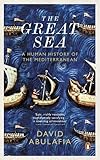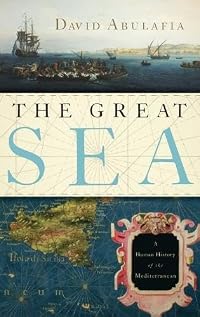
The Great Sea: A Human History of the Mediterranean
by David Abulafia
On This Page
Description
This text presents a complete history of the Mediterranean from the erection of the mysterious temples on Malta around 3500 BC to the recent reinvention of the Mediterranean's shores as a tourist destination.Tags
Recommendations




























Member Recommendations



Member Reviews
Covers a lot of ground temporally, tracing the development of human settlement, trade, culture and warfare around the Mediterranean Sea. End up weaving together a lot of stuff that seem to wandered in from other histories - the British Empire, the Russians, World Wars, not to mention technological developments in sea travel and swimwear. Very good, but there is a lot of it, and even then there's bits I'd liked the book to have dug in to a bit deeper. Barbary Corsairs, for example, being uniquely central to the Med could maybe have been explored in more detail? I dunno. Good stuff, though.
Tough read on a hyper-specific topic. I feel like books like these make sense only for expert historians who are already very familiar with the mise-en-scène and are looking to dig deeper on a specific area. For instance, the battles of Zama and Cannae merit literally one mention each because they are land battles while Lepanto gets a much more extensive treatment because it is a naval battle fought in the Mediterranean. If one doesn't already know a great deal about the Punic wars to begin with, there is no way to gain any larger historical perspective on what the book is discussing.
Still, this is not the book's fault. It set out to discuss a hyper-specific topic and it does so with great erudition and moves along at a reasonable show more pace. Just take heed of the author's unambiguous declaration in the preface - you are getting into a history of the Mediterranean as a sea and not as a region. show less
Still, this is not the book's fault. It set out to discuss a hyper-specific topic and it does so with great erudition and moves along at a reasonable show more pace. Just take heed of the author's unambiguous declaration in the preface - you are getting into a history of the Mediterranean as a sea and not as a region. show less
Oh, Braudel, Braudel! What trend you started. While a common "Club Med" lifestyle around the mare nostrum can be quite easily identified (and witnessed by any tourist), establishing a common history is a much more difficult task. Similar to Ravel's Boléro, the start in the eastern corner of the sea is deceptively easy (Abulafia in contrast to Norwich's attempt even excludes the non-sea orientied Egyptians), transfers to the Greeks to Carthage and culminates with Rome. Alas. then it breaks down - the different parts of the Mediterranean act quite independently and forces from beyond the sea interfere heavily (especially the vile French and Germans). Abulafia's book can be read as his view of a different Europe, a non-German Europe where show more also the French have limited influence. A Europe of merchant cities and trading houses. He somehow ignores that the wealth of Venice, Alexandria, Smyrna, Beirut etc. was based on exclusion and exploitation of the Hinterland. The predominance of these cities was swept away in violence and nationalism.
Abulafia divides his book into five periods. The second period (1000 BC to 600 AD) is the age of the Greeks and Romans, the third period (600 - 1350) sees the rise of Venice, the fourth (1350-1830) is the rise and fall of the Ottoman Empire. The fifth period (1830- ) sees the importance of the Mediterranean disappear - the Great Sea turning into a local backwater whose only value is its access to both the Atlantic and the Indian ocean. The book, thus, is nostalgic - and revisionist in neglecting the extremely powerful influence of the non-Mediterranean powers. From the Romans to the Ottomans to the Germans and Americans, it was the people of the land, not the sea that dominated Mediterranean history. Reading only Abulafia will not give you a full picture of this sea's history. His elitist diatribe against mass tourism at the end of the book is unnecessary, but it included a wonderful Freudian expression that illustrates his anti-German stance based on ignorance: "naturist resorts ...would appeal specially to the eager adherents of German and Scandinavian Frei-Korps-Kultur seeking an all-over tan." In German, the terminus is Frei-Körper-Kultur (enjoying one's naked body in mother nature). Freikorps exist too - these were the post WWI German right-wing militias, ancestor of the SA and SS. Mixing the two up requires both linguistic and cultural ignorance whose undertone detracts from an otherwise highly readable book. show less
Abulafia divides his book into five periods. The second period (1000 BC to 600 AD) is the age of the Greeks and Romans, the third period (600 - 1350) sees the rise of Venice, the fourth (1350-1830) is the rise and fall of the Ottoman Empire. The fifth period (1830- ) sees the importance of the Mediterranean disappear - the Great Sea turning into a local backwater whose only value is its access to both the Atlantic and the Indian ocean. The book, thus, is nostalgic - and revisionist in neglecting the extremely powerful influence of the non-Mediterranean powers. From the Romans to the Ottomans to the Germans and Americans, it was the people of the land, not the sea that dominated Mediterranean history. Reading only Abulafia will not give you a full picture of this sea's history. His elitist diatribe against mass tourism at the end of the book is unnecessary, but it included a wonderful Freudian expression that illustrates his anti-German stance based on ignorance: "naturist resorts ...would appeal specially to the eager adherents of German and Scandinavian Frei-Korps-Kultur seeking an all-over tan." In German, the terminus is Frei-Körper-Kultur (enjoying one's naked body in mother nature). Freikorps exist too - these were the post WWI German right-wing militias, ancestor of the SA and SS. Mixing the two up requires both linguistic and cultural ignorance whose undertone detracts from an otherwise highly readable book. show less
I read this book in advance of going on a Mediterranean cruise and it delivers. The author has a challenging assignment - covering thousands of years of history for a large region. That's a difficult task for any historian. The book is at its strongest in political history - the movements of kings, dukes, pirates, traders and more. The economic history - especially the trade in grain, wine, olive oil and more is strong.
I also liked that the book is liberally supported with maps in each chapter so the reader can easily visualize the different areas under discussion.
I also liked that the book is liberally supported with maps in each chapter so the reader can easily visualize the different areas under discussion.
Contains a wealth of information that I did not know. By using the Mediterranean as his focus, swaths of history that are normally in separate silos are brought together much more coherently - such as Western civilization, Near Eastern civilization, Islamic studies, Northern Africa, etc. This history provides a much better context for many actions, such as the expulsion of Jews and Muslims from Spain in the context of the Hapsburgs holding the line against Islam and the ongoing piracy that would draw the United States into one of its earliest military conflicts.
This reads like a textbook at times, but Abulafia livened things up at one point when he said "the incestuous mass-murderer Charlemagne." He did not refer to any other conqueror show more in such derogatory terms nor did he make many personal judgments against others, so I wonder what his beef against Charlemagne is. As a historian, making the incest claim stick against Charlemagne based on rumor and innuendo is questionable at best. show less
This reads like a textbook at times, but Abulafia livened things up at one point when he said "the incestuous mass-murderer Charlemagne." He did not refer to any other conqueror show more in such derogatory terms nor did he make many personal judgments against others, so I wonder what his beef against Charlemagne is. As a historian, making the incest claim stick against Charlemagne based on rumor and innuendo is questionable at best. show less
Superb, superb, superb. A keeper for the rest of my life, a book I will dip in and out of, I am certain, many many times (have now read cover-to-cover twice) before I lay aside. I am an Asia historian but one can not escape the importance of Mediterranean Europe upon Asian history and culture, hence the value of this work that systematically goes into each of the great ages of the Mediterranean, its peoples, its cultures, its wars, its injustices, its epidemics, its destinies.
This is not to say there are not issues: I was deeply unhappy with the maps. There were too few, with too few labels, and I had to have a historical atlas constantly at my side. In addition, the photographs in my edition were in black & white (the European edition show more apparently had colour photos so watch which edition you purchase). And the names and place names are so endless that although my Kindle-reading friends complained about certain aspects of the book on a Kindle, they said the links to the footnotes, etc. which were obviously electronic, were extremely helpful, which made me mad with jealousy as I juggled bookmarks on the map and footnote pages.
I can't conceive of writing a book of this magnitude and depth of knowledge. What a legacy Professor Abulafia has left the world. I stand in total awe. show less
This is not to say there are not issues: I was deeply unhappy with the maps. There were too few, with too few labels, and I had to have a historical atlas constantly at my side. In addition, the photographs in my edition were in black & white (the European edition show more apparently had colour photos so watch which edition you purchase). And the names and place names are so endless that although my Kindle-reading friends complained about certain aspects of the book on a Kindle, they said the links to the footnotes, etc. which were obviously electronic, were extremely helpful, which made me mad with jealousy as I juggled bookmarks on the map and footnote pages.
I can't conceive of writing a book of this magnitude and depth of knowledge. What a legacy Professor Abulafia has left the world. I stand in total awe. show less
Immense sweep of time and space which is impressive, but means major events like the Arab conquests or even the Roman Empire are treated almost as details.
Members
- Recently Added By
Published Reviews
ThingScore 75
The title of David Abulafia’s magisterial book comes, as he reminds us, from a Hebrew blessing, to be recited when setting eyes on the Mediterranean: ‘Blessed are you, Lord our God, king of the Universe, who made the Great Sea.’ His book is a two-fold history: first of the trade and the traders who discovered the sea, created its ports and never ceased thereafter to animate it in pursuit show more of commerce. (The ports could be said to be the principal players in this story.) Second, it is a history of religious and territorial struggles and subsequent accommodations. show less
added by John_Vaughan
The Great Sea, Professor David Abulafia's magnificent new history of the Mediterranean, celebrates sea-faring nationalities of bewildering mixed bloods and ethnicities. Arab, Greek, Etruscan, Roman, Hittite, Assyrian and Phoenician have all intertwined to form an indecipherable blend of peoples. How to write a history of this fabulous pasticcio? The Mediterranean itself – a "sea between the show more lands" – defies easy definition. Rather than write a history of empires and nation-states, Abulafia has chosen to concentrate on the peoples who crossed this great sea and lived along its shores. Accordingly, his emphasis is on networks of commerce, on merchants, on human migration and conquest. show less
added by simaqian
Author Information

23+ Works 2,165 Members
David Abulafia is Professor of Mediterranean History at Cambridge University and the author of The Mediterranean in History.
Awards and Honors
Distinctions
Common Knowledge
- Canonical title*
- 偉大的海:地中海世界人文史
- Original title
- The Great Sea: A Human History of the Mediterranean
- Original publication date
- 2011
- People/Characters
- Ferdinand de Lesseps
- Important places
- Mediterranean Sea; Mediterranean Region
- Dedication
- a la memoria de mis antecesores
- Blurbers
- Montefiore, Simon Sebag; Ruiz, Teofilo F.; Jordan, William; Freedman, Paul
*Some information comes from Common Knowledge in other languages. Click "Edit" for more information.
Classifications
- Genres
- History, Nonfiction, General Nonfiction, Religion & Spirituality
- DDC/MDS
- 909.09822 — History & geography History World history Other Geographic Classifications Other Classifications Ocean And Sea Basins Mediterranean
- LCC
- DE71 .A25 — History of Europe, Asia, Africa and Oceania Greco-Roman World History of the Greco-Roman world Antiquities. Civilization. Culture. Ethnography
- BISAC
Statistics
- Members
- 917
- Popularity
- 29,025
- Reviews
- 17
- Rating
- (4.06)
- Languages
- 9 — Chinese, traditional, Dutch, English, French, German, Italian, Portuguese, Romanian, Spanish
- Media
- Paper, Audiobook, Ebook
- ISBNs
- 31
- ASINs
- 13