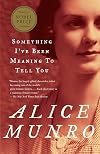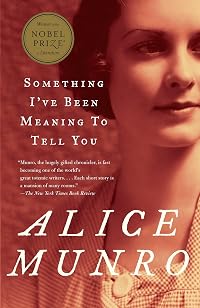
Something I've Been Meaning to Tell You
by Alice Munro
On This Page
Description
In the thirteen stories in her second collection, Alice Munro demonstrates the precise observation, straightforward prose style, and masterful technique that led no less a critic than John Updike to compare her to Chekhov. The sisters, mothers and daughters, aunts, grandmothers, and friends in these stories shimmer with hope and love, anger and reconciliation, as they contend with their histories and their present, and what they can see of the future. -- Book jacket.Tags
Recommendations












Member Recommendations
Member Reviews
In Something I’ve Been Meaning to Tell You, her masterful second collection of short fiction published in 1974 (Lives of Girls and Women is widely considered a novel), Alice Munro’s art takes a significant step forward. Though the subject matter remains much the same as in her first two books (stories of quotidian lives mainly told from female perspectives), in these stories she is extending her reach and experimenting with voice and form, light and dark. Many of the stories are built around memory and are often filled with expressions of disappointment, grief, regret, sometimes bewilderment, occasionally satisfaction with how things have turned out. In the breathtaking title story, Et is recalling her beautiful, impulsive, show more temperamental older sister Char. The sisters grow up, a tight-knit pair, in small-town Ontario, Char much more dramatic and worldly than her sister, and the more adventurous when it comes to love. Char’s early beau is Blaikie, whose family owns the local hotel and spends the off-season in California. When Blaikie marries someone else, Char takes poison. It’s Et who saves her. Later Char marries Arthur—a teacher, an unexceptional man—and lives an ordinary life. But the poison episode remains with Et, who one day makes a startling discovery in Char’s kitchen, which leaves her forever wondering what her sister might have been capable of. “How I Met My Husband” is narrated by Edie, who is recalling when she was fifteen and working as housekeeper for the Peebles, Dr. and Mrs., and their two small children. Though not farmers, the Peebles live in farming country, five miles outside of town. One day a small plane lands in the empty field across the road from the Peebles’ house. It turns out the pilot, Chris Watters, is touring his plane from town to town, and for a small fee will take people up to enjoy the view. By happenstance, Edie strikes up a casual friendship with Chris, which quickly becomes physical, and soon Edie’s head is filled with all kinds of romantic notions. When Chris moves on, leaving behind Edie’s broken heart and an empty promise to write to her, Edie’s life takes a turn she never saw coming. And “Executioners” is narrated by Helena, whose father is a drunk and whose inattentive mother nurses her grudges lovingly. Helena is tormented by her peers, ridiculed because of her odd clothing and her father’s dissipation. But Helena is a curious and generous child who, through an act of kindness, comes to the attention of Howard Troy, the shiftless son of the town bootlegger, Stump Troy. Howard starts bullying her, for no better reason than that “he may have seen the glimmer of a novel, interesting, surprising weakness.” The story turns on the family of Robina, Helena’s mother’s housekeeper, whose younger brothers are enemies of Stump Troy. In the story’s principal scene, Helena and Robina stand among the curious onlookers witnessing the fire that one night consumes the Troy family home. The event is tragic, but Helena views the spectacle coolly, reporting it in clinical terms, hinting but never overtly suggesting who might be responsible. Throughout, Munro’s prose is flawless: precise, understated, rarely drawing attention to itself, but shining nonetheless, evoking character and setting in painterly fashion: “Her tall flat body seemed to loosen, to swing like a door on its hinges, controlled, but dangerous if you got in the way.” In Something I’ve Been Meaning to Tell You people are often mysterious to each other (and sometimes to themselves), their actions troubling, their motives opaque. Munro’s narrators spend a good deal of time and mental effort wondering how and why they do the things they do. Munro seizes on this aspect of daily life and turns it into a major building block of her fiction. The result is a collection of poignant, thoughtful, loosely structured dramas that eloquently explore what it means to be human. Essential, vintage Alice Munro. show less
Wow! Now I know why Alice Munro won the Nobel Prize for Literature. She's been writing stories for more than sixty years, which is why I'm more than a little embarrassed to say that this book, SOMEHTING I'VE BEEN MEANING TO TELL YOU: THIRTEEN STORIES, is the first Munro book I've ever read. Originally published in 1974, these stories all still read like they could have been published last year - or even this year. Because Munro's stories simply tell us what it's like to be alive, are stories full of ah-ha moments, phrases that grab us with the chill - the thrill - of recognition. As in "The Spanish Lady" when her narrator, recently devastated by the discovery of an affair between her husband and best friend, thinks back on her marriage show more and all the years when her children were small and filled her life, and reflects, "and all that time of care and confusion that seemed as if it would never end seems as if it never was." And later, in the same story: "There are layers on layers in this marriage, mistakes in timing, wrongs on wrongs, nobody could get to the bottom of it."
In another story, "Winter Wind," a woman remembers when, as a teenager, she often spent time with her widowed grandmother and great aunt, and there was a photograph on their dining room wall -
"... of my grandmother and Aunt Madge, with their parents, and this sister who had died, and another sister who had married a Catholic, so that it seemed almost as bad as if she had died, though peace was made later on. I did not bother to look at this photograph, except in a passing way, but after my grandmother's death and Aunt Madge's removal to a nursing home (where she lives yet, lives on and on, unrecognizable, unrecognizing, completely divested of herself, dried up like a little monkey, past all memory, and maybe past bewilderment, free), I salvaged it, and have taken it with me wherever I go."
A freighted family history, whole lives, a woman coming of age in a single paragraph." Now that takes some doing. And in every one of these stories Munro does it again and again, creating a whole world populated with the most human and believable people you will ever meet, each time in only twenty pages or so.
Many of these stories move back and forth in time, often with a narrator looking back at a much earlier period in her life. The last story, "The Ottawa Valley," is a pitch perfect example of this kind of reflective storytelling, once again about family, about finally understanding complex relationships.
To paraphrase Andrew Marvel, had I "but world enough and time," I would read everything Alice Munro has written, because I loved these stories. I probably don't have that much time, but I'll work on it. She's that good. My highest recommendation.
- Tim Bazzett, author of the memoir, BOOKLOVER show less
In another story, "Winter Wind," a woman remembers when, as a teenager, she often spent time with her widowed grandmother and great aunt, and there was a photograph on their dining room wall -
"... of my grandmother and Aunt Madge, with their parents, and this sister who had died, and another sister who had married a Catholic, so that it seemed almost as bad as if she had died, though peace was made later on. I did not bother to look at this photograph, except in a passing way, but after my grandmother's death and Aunt Madge's removal to a nursing home (where she lives yet, lives on and on, unrecognizable, unrecognizing, completely divested of herself, dried up like a little monkey, past all memory, and maybe past bewilderment, free), I salvaged it, and have taken it with me wherever I go."
A freighted family history, whole lives, a woman coming of age in a single paragraph." Now that takes some doing. And in every one of these stories Munro does it again and again, creating a whole world populated with the most human and believable people you will ever meet, each time in only twenty pages or so.
Many of these stories move back and forth in time, often with a narrator looking back at a much earlier period in her life. The last story, "The Ottawa Valley," is a pitch perfect example of this kind of reflective storytelling, once again about family, about finally understanding complex relationships.
To paraphrase Andrew Marvel, had I "but world enough and time," I would read everything Alice Munro has written, because I loved these stories. I probably don't have that much time, but I'll work on it. She's that good. My highest recommendation.
- Tim Bazzett, author of the memoir, BOOKLOVER show less
It's odd reading fiction that's 50 years old: it's too young to be considered the classical past, but too old to be seen as truly modern and new. There's a strange quaintness to the stories which must have felt incisive and biting at the time. This does not take away from the sharp portraits that Munro makes of her heroines, some trapped in tradition, others launched in the newness of a changing world. There are descriptions of Canada that no longer exist but that echo in the memories of generations still alive.
Sometimes poignant, sometimes lively, these stories capture their time beautifully.
Sometimes poignant, sometimes lively, these stories capture their time beautifully.
If you've never read Alice Munro what are you waiting for? If you like your fiction with a narrative that goes back and forth in time, she does that. If you like your fiction with the travails that every family faces in one way of another, she does that. If you like fiction that dwells on the wonders of memory, she does that. If you like writing that just glides along and captures you with language and poetic phrases, well, she does that too.
"In the mirror over the dresserEileen could see her sister's face, the downward profile, which was waiting, perhaps embarrassed, now that this offering had been made. Also, her own face, surprising her with its wonderfully appropriate look of tactfulness and concern. She felt cold and tired, she show more wanted mostly to get away. It was an effort to put her hand out. Acts done without faith may restore faith. She believed, with whatever energy she could summon at the moment, she had to believe and hope that was true."
Like any collection, some stories are stronger than others and this is a very early publication, maybe one of her first (1974) but it is vintage Munro and has all the hallmarks that make her work so wonderful. show less
"In the mirror over the dresserEileen could see her sister's face, the downward profile, which was waiting, perhaps embarrassed, now that this offering had been made. Also, her own face, surprising her with its wonderfully appropriate look of tactfulness and concern. She felt cold and tired, she show more wanted mostly to get away. It was an effort to put her hand out. Acts done without faith may restore faith. She believed, with whatever energy she could summon at the moment, she had to believe and hope that was true."
Like any collection, some stories are stronger than others and this is a very early publication, maybe one of her first (1974) but it is vintage Munro and has all the hallmarks that make her work so wonderful. show less
I'm not a huge fan of realism as a genre, but Alice Munro is such a good writer that I always enjoy her work. She is outstanding at shaping her short stories in such a way that they proceed logically, yet not predictably, from introduction to conclusion. The only slight criticism I have is that the range of the stories in this book is small: they are about similar women in similar situations. One or two stories with different settings or protagonists would provide the mixture with a little more seasoning.
moody and moving
not my favourite alice munro. stories not meandering.
Members
- Recently Added By
Lists

Harold Bloom - The Western Canon: D. The Chaotic Age
833 works; 24 members

50 Books by Women Authors
50 works; 10 members

Books You Read For University
184 works; 3 members
Author Information

127+ Works 30,429 Members
Alice Munro was born Alice Laidlaw in Wingham, Ontario on July 10, 1931. She published her first story, The Dimensions of a Shadow, while a student at the University of Western Ontario in 1950. She left the university in 1951 to get married and start a family. In 1972 she became Writer in Residence at the University of Western Ontario. Her first show more collection, Dance of the Happy Shades, was published in 1968 and won the Governor General's Award, Canada's highest literary prize. Her other works include Lives of Girls and Women, The View from Castle Rock, Something I've Been Meaning to Tell You, Too Much Happiness, and Dear Life. She has received several awards including the Governor General's Award for fiction for Who Do You Think You Are? and The Progress of Love, the Giller Prize for Runaway in 2004, the Man Booker International Prize in 2009 for her lifetime body of work, and the 2013 Nobel Prize in Literature. Her stories have appeared in numerous publications including The New Yorker, The Paris Review, and The Atlantic Monthly. Also, in 2013, her title Dear Life: Stories made The New York Times Best Seller List. (Bowker Author Biography) show less
Work Relationships
Contains
Common Knowledge
- Canonical title
- Something I've Been Meaning to Tell You
- Original publication date
- 1974
- Quotations*
- Il problema, l'unico problema, resta mia madre.
Ed è ovviamente lei quella che cerco di afferrare; è per raggiungere lei che è stato intrapreso l'intero viaggio. A quale scopo? Per delimitarla, descriverla, illuminarla,... (show all) celebrarla, per liberarmene;
… quello che disapprovava nella generazione attuale, ammesso che questo fosse il punto, era che non si potesse fare niente senza esibizionismi. Perché si doveva sempre berciare su ogni cosa, si chiedeva. Non si era più ca... (show all)paci di piantare una carota senza congratularsi dell'impresa.
Ha smesso di mangiare carne, ovviamente, si nutre di cereali integrali e ortaggi in foglia. Una volta è entrato in cucina mentre tagliavo delle barbabietole – le barbabietole sono proibite, in quanto radici – e mi fa: «... (show all)Spero tu sappia che stai commettendo un omicidio». «Non lo sapevo, – gli ho risposto, – ma hai sessanta secondi di tempo per sparire se non vuoi che lo commetta sul serio».
Ogni giorno al ritorno dalle lezioni passo davanti alla cassetta della posta e a essere sincera provo una specie di piacere, un'assenza di aspettative. Per due anni quella scatola di latta è stata l'oggetto al centro della m... (show all)ia esistenza e adesso constatarne il ritorno alla neutralità, vederla promettere e negare cosette di poco conto, ecco, è come accorgersi che un dolore è finito.
"Ci siamo", pensò Dorothy; aveva scordato quanto fosse tetra la visione del mondo di Jeanette e come la irritasse, istigandola a prendere la difesa di cose che non conosceva per niente e che non riteneva affar suo difendere.
«Non dai l'impressione di pensare a cose belle, – le aveva ripetuto Viola a più riprese. – Pensare alle cose belle mantiene giovani». «Ah sì? – disse Dorothy. – Beh, io giovane lo sono già stata».
June disse che aveva elaborato quell'aspetto completamente. «Sono anni, ormai, durante la Gestalt. Sì, proprio in terapia. Ho rielaborato tutto e ho risolto». “Io non ho rielaborato un bel niente”, pensò Eileen. E anc... (show all)ora: “Non sono convinta che le cose succedano solo per essere rielaborate”. La gente muore. Si soffre, si muore. La loro madre era morta di una banale polmonite, dopo tutte quelle mattane. Malattie e incidenti. Erano cose da rispettare, più che da spiegare. Le parole dovrebbero vergognarsi. Dovrebbero sgretolarsi dalla vergogna.
*Some information comes from Common Knowledge in other languages. Click "Edit" for more information.
Classifications
Statistics
- Members
- 779
- Popularity
- 35,862
- Reviews
- 14
- Rating
- (4.25)
- Languages
- 5 — English, German, Italian, Polish, Spanish
- Media
- Paper, Audiobook, Ebook
- ISBNs
- 28
- ASINs
- 6