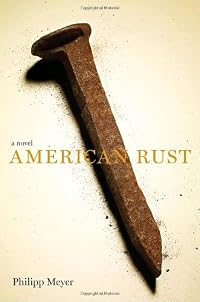
American Rust
by Philipp Meyer 
On This Page
Description
Author Philipp Meyer presents his dramatic debut novel, American Rust-a moving tale of friends in a fading Pennsylvania steel town and the murder that forces them to question their assumptions about each other and those around them. Unfolding at a relentless pace, Meyer's dark vision of an environment in flux is propelled by characters drawn with keen insight into human pathos. Before the last act is staged, loyalties will be tested as old paradigms shift and a new reality takes hold.Tags
Recommendations





Member Recommendations
Member Reviews
American Rust by Philipp Meyer is set in a small Pennsylvania steel town called Buell, where the steel mills have shut down and the jobs have disappeared. Foreclosures, minimum wage and drug use are the facts of life in this economical wasteland. This is a town where the older people feel trapped in their lives while the younger ones search for a way out.
Although his characters could be classified as “losers” Meyer writes about them with such straightforward clarity and unsentimental sympathy that the reader is soon caught up in their lives and hoping that they find an escape from this one-way downward spiral that they are on. The main characters are two young men who are very different from each other. Isaac is a brainy yet show more socially awkward kid while the other, Billy, is a former high school football hero with a hair trigger temper. The young men, now in their twenties, didn’t get away to university like everyone thought they would but Isaac now decides it’s time for him to leave. Billy accompanies him out of town, but unfortunately trouble finds them before they get very far. This trouble escalates to affect both young men and their families through a series of bad choices and bad timing.
This is a story that reached out and grabbed me. Told from multiple perspectives, the author creates a rich layered narrative that shows how circumstances, personalities and timing combined to bring on a tragedy. This compelling plot is set against a landscape of industrial decline, giving American Rust a distinctive and entirely believable atmosphere that made the story totally work for me. show less
Although his characters could be classified as “losers” Meyer writes about them with such straightforward clarity and unsentimental sympathy that the reader is soon caught up in their lives and hoping that they find an escape from this one-way downward spiral that they are on. The main characters are two young men who are very different from each other. Isaac is a brainy yet show more socially awkward kid while the other, Billy, is a former high school football hero with a hair trigger temper. The young men, now in their twenties, didn’t get away to university like everyone thought they would but Isaac now decides it’s time for him to leave. Billy accompanies him out of town, but unfortunately trouble finds them before they get very far. This trouble escalates to affect both young men and their families through a series of bad choices and bad timing.
This is a story that reached out and grabbed me. Told from multiple perspectives, the author creates a rich layered narrative that shows how circumstances, personalities and timing combined to bring on a tragedy. This compelling plot is set against a landscape of industrial decline, giving American Rust a distinctive and entirely believable atmosphere that made the story totally work for me. show less
Not unlike a Springsteen song, Philipp Meyer's story is a raw and unvarnished view of the decline of the Northeastern industrial belt and the sad lives of the people trapped there. Each new page finds someone looking out over what were once prosperous and vital communities, commenting on dilapidated buildings and boarded up businesses and the movement of everything back towards nature. Even the characters themselves reflect the decompensation and desperation of their surroundings, either in their physical or emotional make up. All of this, the characters and the communities, are described in simple, pared down prose. At times, Meyer's own writing seems to break down itself, as he resorts to short bursts of emotionally charged, pared show more down phrases. All in all, the novel is a battering and realistic story. Indeed, Meyer has written a novel in American Rust that could easily be included with some of America's greatest realist literature, right along with the works of Mark Twain or Jack London.
Yet, in the midst of this stripped bare and raw tale, Meyer sprinkles in small items of patent fantasy. Not the kind of fantasy that involves elves and magic, but unrealistic, romantic fantasy. For instance, the bad people in the story are completely bad, completely devoid of any redeeming qualities. In this case, most of the bad people are either homeless men or disaffected youth. But anytime one of the stories 'heroes' comes across one of these evil doers, there is purposeless violence. Another example can be found in the lives of the 'heroes' of the story. Certainly humans are all a bundle of contradiction and incongruity. But Meyer has penned a trailer bound woman who is caught up in a dead-end marriage with an alcoholic and is mother to an anger riddled and aimless son yet still capable of managing a gourmet meal in the broken down kitchen. Her son, who is incapable of controlling his temper or his urge towards violence, selflessly sacrifices himself in an act of honor that would be a stretch for the most romantic of characters. His best friend, a 100 pound weakling who has never been much of anything but a target of ridicule, possesses a genius IQ.
These elements of romantic fantasy laid over Meyer's dark realism mix to bring a point home; a point that didn't dawn on me until I recently heard Springsteen's "Reason to Believe" on the radio. Springsteen encapsulated what I found to be Meyer's central theme in the chorus of the tune, "Still at the end of every day, people find a reason to believe." The people populating Meyer's story seem to be capable of finding hope in themselves and in others which transcends the decay of their community and their own lives. Despite their social standing and deepest flaws, they are capable of acts of honor and faith much greater than themselves.
A good read, especially given that it represents a debut for this writer. The book grew on me and became more clear after I put it down. Based on Meyer's writing and life experience, detailed in the book's jacket materials, we should expect more from him.
Four bones!!!! show less
Yet, in the midst of this stripped bare and raw tale, Meyer sprinkles in small items of patent fantasy. Not the kind of fantasy that involves elves and magic, but unrealistic, romantic fantasy. For instance, the bad people in the story are completely bad, completely devoid of any redeeming qualities. In this case, most of the bad people are either homeless men or disaffected youth. But anytime one of the stories 'heroes' comes across one of these evil doers, there is purposeless violence. Another example can be found in the lives of the 'heroes' of the story. Certainly humans are all a bundle of contradiction and incongruity. But Meyer has penned a trailer bound woman who is caught up in a dead-end marriage with an alcoholic and is mother to an anger riddled and aimless son yet still capable of managing a gourmet meal in the broken down kitchen. Her son, who is incapable of controlling his temper or his urge towards violence, selflessly sacrifices himself in an act of honor that would be a stretch for the most romantic of characters. His best friend, a 100 pound weakling who has never been much of anything but a target of ridicule, possesses a genius IQ.
These elements of romantic fantasy laid over Meyer's dark realism mix to bring a point home; a point that didn't dawn on me until I recently heard Springsteen's "Reason to Believe" on the radio. Springsteen encapsulated what I found to be Meyer's central theme in the chorus of the tune, "Still at the end of every day, people find a reason to believe." The people populating Meyer's story seem to be capable of finding hope in themselves and in others which transcends the decay of their community and their own lives. Despite their social standing and deepest flaws, they are capable of acts of honor and faith much greater than themselves.
A good read, especially given that it represents a debut for this writer. The book grew on me and became more clear after I put it down. Based on Meyer's writing and life experience, detailed in the book's jacket materials, we should expect more from him.
Four bones!!!! show less
 This review was written for LibraryThing Early Reviewers.
A well-written debut novel that I enjoyed despite its stark sensibilities, American Rust has been reviewed often, as it was part of an Early Reviewer batch. Most people gave it something between three and four stars, but I think that it deserves at least four stars simply for Meyer’s stylish way of presenting a well-managed plot. I see that many people disliked the dreariness of the story, but I think that is mostly a case of not seeing the wood for the trees. The tale is, admittedly, a depressing one, with small town Pennsylvania serving as the backdrop to a story of accidental murder, and all the consequences that flow therefrom. It is a character-driven novel, however, and one never senses that the plot becomes too restrictive.
I show more liked the pace of the novel, which is abetted by the often stripped-down narration – many of the action and descriptive passages have a Hemingway-like minimalism to them, although the description is a bit more textured than Papa’s tends to be. The staccato sentences and mixture of first and third person narration can get a bit much, but it is mostly handled well. What I also liked was the way Meyer switches between the different characters, with each having a unique angle on the story, and a distinguishable voice. Not all of them are likeable, but they are all recognisable as individuals. I did like Isaac English, the young man who actually commits the murder, mostly because I could relate to his situation – no, not to murdering someone, even accidentally, but to being a young man of a peculiar stripe: at Isaac’s age, I also felt that I did not really fit into any particular society. I have mellowed out somewhat since then, but I can still connect to that feeling of alienation. But enough about me – Meyer obviously has a strong feeling for character idiosyncrasies, which he puts to good use in representing characters from different generations.
To give you an idea of Meyer’s style, here is Isaac on the murder and his friend, Billy Poe:
Only reason you and Poe are alive, that small choice. Your own body trying to keep you breathing - go in the other door. Hard-wiring. Old as gravity. Look what you did to the Swede: no premeditation, no knife, gun, or club. A found object. A natural part of you, the lower level. Built into every man woman child, you tell yourself you don’t need it but look around you. Your friend over the stranger. Yourself over the friend. Highest stakes and you are still here and the other guy is not.
Grim indeed. Isaac’s interior monologue is beautifully realised – he even has an alter ego he calls ‘the kid’, more worldly-wise than himself, whom he defers to when he lands in tough situations. Of course, it is only a coping mechanism that does not always work. But Isaac has a few amusing conversations with himself / the kid throughout the book, especially when he flees home on a quixotic quest to reach California.
American Rust is obviously informed by contemporary concerns about American exceptionalism. Not being American, I can only speculate as to how accurate description the book gives of present hopes and fears. Perhaps the characters in the book are a tad pessimistic, but their situation in a dying rustbelt town probably does not engender confidence in the nation or themselves. It did remind me of Steinbeck’s Grapes of Wrath, as mentioned on the back page, but only tangentially. This book is a more personal statement about relationships, be they between family, lovers, or friends. Yet it is also concerned with broader issues of decline and possible redemption. It does not shy away from showing the dark side of unbridled capitalism. Now, I am no socialist, but I do sometimes worry that, as Emerson wrote, ‘Things are in the saddle, / And ride mankind’. I remain an irreverent optimist, however, and hope that this is not quite the case. In any case, the ending of the book left me feeling somewhat ambivalent: it is hopeful to a degree, but one cannot help feeling that Meyer himself is anything but hopeful about America and the wider world.
Well, a good, worthwhile book. I look forward to Meyer’s sophomore effort. show less
I show more liked the pace of the novel, which is abetted by the often stripped-down narration – many of the action and descriptive passages have a Hemingway-like minimalism to them, although the description is a bit more textured than Papa’s tends to be. The staccato sentences and mixture of first and third person narration can get a bit much, but it is mostly handled well. What I also liked was the way Meyer switches between the different characters, with each having a unique angle on the story, and a distinguishable voice. Not all of them are likeable, but they are all recognisable as individuals. I did like Isaac English, the young man who actually commits the murder, mostly because I could relate to his situation – no, not to murdering someone, even accidentally, but to being a young man of a peculiar stripe: at Isaac’s age, I also felt that I did not really fit into any particular society. I have mellowed out somewhat since then, but I can still connect to that feeling of alienation. But enough about me – Meyer obviously has a strong feeling for character idiosyncrasies, which he puts to good use in representing characters from different generations.
To give you an idea of Meyer’s style, here is Isaac on the murder and his friend, Billy Poe:
Only reason you and Poe are alive, that small choice. Your own body trying to keep you breathing - go in the other door. Hard-wiring. Old as gravity. Look what you did to the Swede: no premeditation, no knife, gun, or club. A found object. A natural part of you, the lower level. Built into every man woman child, you tell yourself you don’t need it but look around you. Your friend over the stranger. Yourself over the friend. Highest stakes and you are still here and the other guy is not.
Grim indeed. Isaac’s interior monologue is beautifully realised – he even has an alter ego he calls ‘the kid’, more worldly-wise than himself, whom he defers to when he lands in tough situations. Of course, it is only a coping mechanism that does not always work. But Isaac has a few amusing conversations with himself / the kid throughout the book, especially when he flees home on a quixotic quest to reach California.
American Rust is obviously informed by contemporary concerns about American exceptionalism. Not being American, I can only speculate as to how accurate description the book gives of present hopes and fears. Perhaps the characters in the book are a tad pessimistic, but their situation in a dying rustbelt town probably does not engender confidence in the nation or themselves. It did remind me of Steinbeck’s Grapes of Wrath, as mentioned on the back page, but only tangentially. This book is a more personal statement about relationships, be they between family, lovers, or friends. Yet it is also concerned with broader issues of decline and possible redemption. It does not shy away from showing the dark side of unbridled capitalism. Now, I am no socialist, but I do sometimes worry that, as Emerson wrote, ‘Things are in the saddle, / And ride mankind’. I remain an irreverent optimist, however, and hope that this is not quite the case. In any case, the ending of the book left me feeling somewhat ambivalent: it is hopeful to a degree, but one cannot help feeling that Meyer himself is anything but hopeful about America and the wider world.
Well, a good, worthwhile book. I look forward to Meyer’s sophomore effort. show less
“You ought to be able to grow up in a place and not have to get the hell out of it when you turn eighteen.”
American Rust is set in a small Pennsylvania steel town named Buell, a place that had been a wealthy steel town but since the closure of the mills is a place where jobs are scarce and foreclosures are on the rise, where older residents feel trapped and younger ones are eager to take wing and flee. Buell is the underbelly of the 'American Dream'.
The book centres around two young men, Isaac English and Billy Poe, best friends since high school. Their friendship is an unlikely one, Isaac is diminutive, brainy and socially awkward, the kid who was top of his class and apparently destined for an Ivy League university and a stellar show more career; and Billy Poe, the brawny football jock with the volatile temper, who ignored had the opportunity to go away to college on an athletic scholarship but instead chose to stay in Buell.
Scarred by his mother's suicide, Issac spent years at home taking care of his invalid father instead of following his sister, Lee, to college, until one day he decides to chuck it all and head to California to begin a new life. When a chance encounter Isaac and Billy have with three homeless men unexpectedly turns ugly, the two former schoolmates find themselves caught in a dangerous spiral of violence, their dreams for the future crushed. Suddenly Isaac is on the run from the authorities whilst Billy is arrested for murder and sent away to prison, where his quick temper lands him in even more trouble.
In each chapter the narrative switches from one character’s point of view to another, mainly Isaac and Billy's but on occasion Lee, Grace (Billy's mother) and Harris (the town's chief of police) meaning that the author is able to create a richly layered narrative with multiple perspectives, thoughts and feelings.
In Isaac and Billy we have two alienated young men bound to one another by loyalty and a shared past but who also come to represent those youngsters who are ill-equipped for the demands of digital era.
Lee and Grace, are two women whose choices has sets their lives on very differing trajectories. Lee, also a brilliant student, got a scholarship to Yale where she married a wealthy classmate and is making plans to attend law school. She feels guilty about having left Isaac at home with their invalid father, and returns home to try and get her father proper nursing care thus allowing Isaac to go off to college. Grace, also once dreamed of going to college; of becoming a social worker, but marriage has kept her from leaving the area and now she fears that decision has not only crushed her dreams but Billy's as well.
In contrast Harris, the local police chief, is the moral centre of this novel. He is a kind, decent man, who whilst realizing that the town's halcyon days are behind them, "beings in time, moving towards............expiration", tries to slow the neighbourhoods slide into lawlessness by bringing a sense of compassion to his job, cutting people a break here and there, seeing the best in them rather than the worst, using common sense rather than dogma. Harris, who has been dating Grace on and off for years and now finds himself torn between his desire to help her and the likelihood that her son is guilty.
If I'm honest there were a few minor issues with the narrative, in particular on the occasions when Isaac started thinking about himself in the third person, but on the whole I felt that Meyer handled it remarkably well. He has created truly believable characters who took on real flesh-and-blood as the story progressed, meaning that I felt a real empathy for them. I grew up in Cornwall, a beautiful part of the country but also one with limited job opportunities, so on leaving school moved away to find employment, as did many of my contemporaries, so can certainly appreciate with the tough choices made here, by those who chose to leave and those who opted to remain. There are certainly elements of Salinger within this book but I also saw a touch of Moby Dick's Ishmail in Isaac, a young man struggling to cope in an alien environment.
It seems strange to be reading this whilst there is a Presidential election going on in America. As an outsider I struggled to see the attraction of Trump the first time around but having read this I feel that I have a little more insight into the hopelessness that many in the country's so called 'Rust Belt' must have felt and how how they feel discarded by conventional politicians. Here we get glimpses into some of the town's local politics and it isn't particularly pleasant reading.
Overall a very enjoyable read that deserves to be on the 1001 list. show less
American Rust is set in a small Pennsylvania steel town named Buell, a place that had been a wealthy steel town but since the closure of the mills is a place where jobs are scarce and foreclosures are on the rise, where older residents feel trapped and younger ones are eager to take wing and flee. Buell is the underbelly of the 'American Dream'.
The book centres around two young men, Isaac English and Billy Poe, best friends since high school. Their friendship is an unlikely one, Isaac is diminutive, brainy and socially awkward, the kid who was top of his class and apparently destined for an Ivy League university and a stellar show more career; and Billy Poe, the brawny football jock with the volatile temper, who ignored had the opportunity to go away to college on an athletic scholarship but instead chose to stay in Buell.
Scarred by his mother's suicide, Issac spent years at home taking care of his invalid father instead of following his sister, Lee, to college, until one day he decides to chuck it all and head to California to begin a new life. When a chance encounter Isaac and Billy have with three homeless men unexpectedly turns ugly, the two former schoolmates find themselves caught in a dangerous spiral of violence, their dreams for the future crushed. Suddenly Isaac is on the run from the authorities whilst Billy is arrested for murder and sent away to prison, where his quick temper lands him in even more trouble.
In each chapter the narrative switches from one character’s point of view to another, mainly Isaac and Billy's but on occasion Lee, Grace (Billy's mother) and Harris (the town's chief of police) meaning that the author is able to create a richly layered narrative with multiple perspectives, thoughts and feelings.
In Isaac and Billy we have two alienated young men bound to one another by loyalty and a shared past but who also come to represent those youngsters who are ill-equipped for the demands of digital era.
Lee and Grace, are two women whose choices has sets their lives on very differing trajectories. Lee, also a brilliant student, got a scholarship to Yale where she married a wealthy classmate and is making plans to attend law school. She feels guilty about having left Isaac at home with their invalid father, and returns home to try and get her father proper nursing care thus allowing Isaac to go off to college. Grace, also once dreamed of going to college; of becoming a social worker, but marriage has kept her from leaving the area and now she fears that decision has not only crushed her dreams but Billy's as well.
In contrast Harris, the local police chief, is the moral centre of this novel. He is a kind, decent man, who whilst realizing that the town's halcyon days are behind them, "beings in time, moving towards............expiration", tries to slow the neighbourhoods slide into lawlessness by bringing a sense of compassion to his job, cutting people a break here and there, seeing the best in them rather than the worst, using common sense rather than dogma. Harris, who has been dating Grace on and off for years and now finds himself torn between his desire to help her and the likelihood that her son is guilty.
If I'm honest there were a few minor issues with the narrative, in particular on the occasions when Isaac started thinking about himself in the third person, but on the whole I felt that Meyer handled it remarkably well. He has created truly believable characters who took on real flesh-and-blood as the story progressed, meaning that I felt a real empathy for them. I grew up in Cornwall, a beautiful part of the country but also one with limited job opportunities, so on leaving school moved away to find employment, as did many of my contemporaries, so can certainly appreciate with the tough choices made here, by those who chose to leave and those who opted to remain. There are certainly elements of Salinger within this book but I also saw a touch of Moby Dick's Ishmail in Isaac, a young man struggling to cope in an alien environment.
It seems strange to be reading this whilst there is a Presidential election going on in America. As an outsider I struggled to see the attraction of Trump the first time around but having read this I feel that I have a little more insight into the hopelessness that many in the country's so called 'Rust Belt' must have felt and how how they feel discarded by conventional politicians. Here we get glimpses into some of the town's local politics and it isn't particularly pleasant reading.
Overall a very enjoyable read that deserves to be on the 1001 list. show less
Steel plants have closed, and jobs lost in the Monongahela Valley, Pennsylvania, where this novel takes place. Poverty, violence, drugs, boredom, and desperation are prevalent. Former steel plant structures stand abandoned in the overgrowth. Two unlikely friends, Isaac (the smart but awkward kid) and Billy (the football jock) have stayed in their small town after graduation, missing their chance to go to college. Isaac has been taking care of his invalid father after his mother’s suicide. His sister has already escaped to college and marriage. He decides to leave and asks Billy to come with him. They approach an abandoned building, where a man will be killed, and their lives forever altered. It is a story of staying vs. leaving, fear show more vs. bravery, selfishness vs. altruism.
The writing style took me a bit of time to assimilate. It is quasi-stream-of-consciousness, as if the reader is in the head of six characters, thinking along with them, which proves to be a very effective method of characterization. Each character sees a portion of the greater story from a personal perspective, none having access to the entire picture. In addition to Isaac and Billy, the story is told from the perspectives of Grace (Billy’s mother), Henry (Isaac’s father), Lee (Isaac’s sister), and Harris (the chief of police of their town who has been involved with Grace). The novel is more character-driven than plot-driven, but there is a plot, and the tension is built through this limited perspective of each character, gradually revealing to the reader what has happened. I thought it was a brilliant way to tell this story.
These are flawed but decent people, often making poor decisions and facing the fallout. They are confronted with moral dilemmas and must choose their actions when the stakes are high. This book explores the questions of what lengths a person will go to protect a friend or loved one, and whether a person should save oneself or someone else at the risk of personal safety. It touches on questions of personal dignity, inner strength, and integrity. How much are an individual’s actions are driven by social, mental, or physical fear, and should they be? I questioned a couple of plot points, but in the end, I became so invested in these characters that it didn’t matter. The ending is not tidied up and is left for the reader to imagine but offers hope for the characters of the story and, more importantly, for humankind. This book is the author’s debut and I look forward to reading more of his work. Highly recommended. show less
The writing style took me a bit of time to assimilate. It is quasi-stream-of-consciousness, as if the reader is in the head of six characters, thinking along with them, which proves to be a very effective method of characterization. Each character sees a portion of the greater story from a personal perspective, none having access to the entire picture. In addition to Isaac and Billy, the story is told from the perspectives of Grace (Billy’s mother), Henry (Isaac’s father), Lee (Isaac’s sister), and Harris (the chief of police of their town who has been involved with Grace). The novel is more character-driven than plot-driven, but there is a plot, and the tension is built through this limited perspective of each character, gradually revealing to the reader what has happened. I thought it was a brilliant way to tell this story.
These are flawed but decent people, often making poor decisions and facing the fallout. They are confronted with moral dilemmas and must choose their actions when the stakes are high. This book explores the questions of what lengths a person will go to protect a friend or loved one, and whether a person should save oneself or someone else at the risk of personal safety. It touches on questions of personal dignity, inner strength, and integrity. How much are an individual’s actions are driven by social, mental, or physical fear, and should they be? I questioned a couple of plot points, but in the end, I became so invested in these characters that it didn’t matter. The ending is not tidied up and is left for the reader to imagine but offers hope for the characters of the story and, more importantly, for humankind. This book is the author’s debut and I look forward to reading more of his work. Highly recommended. show less
This was, quite simply, a damn good read. The pace was set right from the start, and had me turning the pages anxiously right until the last.
It's hard to say much about this book without spoiling the plot. With a backdrop of the antithesis of the American Dream, this novel has the pace of a thriller but the heart of something much deeper. An incredibly well developed cast of characters take their turn to narrate following a life-changing event that is pulling them all down but ultimately setting them all the ultimate test of love and loyalty.
This will be one of my favourites of the year.
4.5 stars - pure reading pleasure.
It's hard to say much about this book without spoiling the plot. With a backdrop of the antithesis of the American Dream, this novel has the pace of a thriller but the heart of something much deeper. An incredibly well developed cast of characters take their turn to narrate following a life-changing event that is pulling them all down but ultimately setting them all the ultimate test of love and loyalty.
This will be one of my favourites of the year.
4.5 stars - pure reading pleasure.
It astonishes me that American Rust is Philipp Meyer's first published novel. It's not so much that the story is gripping or that he's captured the atmosphere of a place; plenty of debut novels have done this, but that the pacing is perfectly timed, the characters fully realized and the book ends exactly where it should.
The story begins with Isaac English leaving his rural Pennsylvania home with the intention of riding the rails to California. He stops by to say good-bye to his best friend, Poe, a high school baseball star who never left and who lives in a trailer with his mother. They walk awhile together, and when they meet some other men when they take shelter in an abandoned building, violence ensues. American Rust deals with the show more aftermath of that crime and it's impact on the families involved. Mostly though, it's about a time and a place. Isaac and Poe live in a community that had made its living off of steel manufacturing, and with the mills closed, the towns in the county are sinking into poverty.
My father read American Rust, and said that it perfectly summed up the place he grew up. Given the amount of attention being paid to places like this one, this is as timely today as it was when it was written almost a decade ago. show less
The story begins with Isaac English leaving his rural Pennsylvania home with the intention of riding the rails to California. He stops by to say good-bye to his best friend, Poe, a high school baseball star who never left and who lives in a trailer with his mother. They walk awhile together, and when they meet some other men when they take shelter in an abandoned building, violence ensues. American Rust deals with the show more aftermath of that crime and it's impact on the families involved. Mostly though, it's about a time and a place. Isaac and Poe live in a community that had made its living off of steel manufacturing, and with the mills closed, the towns in the county are sinking into poverty.
My father read American Rust, and said that it perfectly summed up the place he grew up. Given the amount of attention being paid to places like this one, this is as timely today as it was when it was written almost a decade ago. show less
Members
- Recently Added By
Published Reviews
ThingScore 70
Do people still think in terms of the Great American Novel – a work of fiction that exactly captures the contemporary spirit of the union? If so, American Rust has GAN stamped all over it. In racing terms it’s by Of Mice and Men, out of Huckleberry Finn, ridden by Cormac McCarthy, and trained by Salinger and Kerouac.
added by Widsith
[T]he plot is captivating without ever straying into the realm of folksy page-turner. The political message may be obvious - "We're treading backwards as a nation, probably for the first time in history," Bud's boss tells him - but it's a compelling one none the less.
added by Widsith
There are awkward moments in this novel […] but these are fleeting lapses, steamrollered by Mr. Meyer’s instinctive storytelling powers and his ability to create characters who evolve from familiar types into flesh-and-blood human beings. “American Rust” announces the arrival of a gifted new writer — a writer who understands how place and personality and circumstance can converge to show more create the perfect storm of tragedy. show less
added by Widsith
Lists

1001 Books You Must Read Before You Die
1,448 works; 1,132 members

The American Experience
173 works; 18 members

Books Set in Small Towns and Villages
278 works; 16 members

Books Read in 2016
4,666 works; 197 members
First Novels
373 works; 16 members

Literary Pittsburgh
45 works; 1 member
Author Information

3+ Works 3,766 Members
Philipp Meyer is a LibraryThing Author, an author who lists their personal library on LibraryThing.
Some Editions
Awards and Honors
Awards
Distinctions
Series
Belongs to Publisher Series
Common Knowledge
- Canonical title
- American Rust
- Original title
- American Rust
- Original publication date
- 2009
- People/Characters
- Isaac English; Billy Poe; Grace Poe; Buddy Harris; Lee English; Virgil Poe (show all 7); Henry English
- Important places
- Buell, Pennsylvania, USA; Fayette County, Pennsylvania, USA; Pennsylvania, USA; Pittsburgh, Pennsylvania, USA
- Related movies
- American Rust (2021 | IMDb)
- Epigraph*
- Falls ein Mensch nicht im Besitz eines ewigen Bewußtseins wäre (…), falls sich unter allem eine bodenlose Leere, niemals gesättigt, verbärge, was wäre das Leben dann anders als Verzweiflung? (Søren Kierkegaard)
(…) was man in Plagen lernt, nämlich daß es an den Menschen mehr zu bewundern als zu verachten gibt. (Albert Camus) - Dedication*
- Für meine Familie
- First words
- Isaac's mother was dead five years but he hadn't stopped thinking about her.
- Quotations
- Isaac overheard his sister tell someone from college: half the people went on welfare and the other half went back to hunting and gathering.
Sarà sempre peggio, amico mio. Le buone azioni non restano impunite.
Odds of you existing — one in ten trillion, no smaller. One to Avogadro's number. 6.022 times 1023. Meanwhile people throw it away.
At seventeen, you’d pick a school based on the nice architecture, or that a professor had smiled at you, or that your best friend was going there—you made choices based on feelings, which were bound, especially at that ag... (show all)e, to be arbitrary and ill-formed and rooted mostly in insecurity - Last words
- (Click to show. Warning: May contain spoilers.)Poe stood looking for a long time and then he was walking back down the road, toward a new place. Making his way toward her.
- Blurbers
- Toibin, Colm
- Original language
- English
- Canonical DDC/MDS
- 813.6
- Canonical LCC
- PS3613.E976
*Some information comes from Common Knowledge in other languages. Click "Edit" for more information.
Classifications
Statistics
- Members
- 1,561
- Popularity
- 14,577
- Reviews
- 156
- Rating
- (3.67)
- Languages
- 10 — Danish, Dutch, English, French, German, Italian, Spanish, Swedish, Turkish, Portuguese (Portugal)
- Media
- Paper, Audiobook, Ebook
- ISBNs
- 40
- ASINs
- 11
